Month: September 2010

  • A Few Reading Strategies for the Science Fiction Novice

    Underlying many definitions of science fiction is the fact that reading science fiction requires some level of apprenticing and learning of the key concepts, tropes, and concepts that appear in much of the genre’s works. Damien Broderick formalized this in his book Reading by Starlight, in which he argues that there is a ‘science fiction megatext’ that authors borrow from and give to that science fiction readers learn over time. Thus, reading science fiction can be a daunting task for someone not yet accustomed to the genre and its many elements.

    However, this is true of any literature that you may read whether it be mainstream fiction from one particular historical period versus another, or another genre such as detective fiction or the western. Any reading requires a certain amount of heavy lifting on the part of the reader to engage the story and its characters. Perhaps with science fiction there is an additional attendant requirement to figure out the science, technology, and estranging qualities of the story, but the reader’s success at figuring these things out is part of the joy of any kind of revelation.

    Below, I have written out some strategies for reading science fiction that can equally apply to other literatures. If you have other suggestions, please leave them in the comments.

    • Read slowly and carefully. Reading is not a race to the finish. You may have to read something more than once to completely understand the story, and you may have to read it a further time in order to uncover any greater meanings lying beneath the surface.
    • Keep a notebook handy as you read. Jot down ideas with the page numbers that attend those ideas.
    • Diagram the characters and actions in a flow chart or story outline to better make sense of a complex narrative. Who are the characters? Where do characters go? Who do they encounter? What happens to them? What do they do?
    • Keep a web browser open with two tabs: one for your favorite search engine and the other for dictionary.oed.com. Search terms that you have not encountered before.
    • Be smart with your reading. If you don’t have the time to read and re-read something, you should search the Lexis Nexis database for reviews of the novel. Wikipedia also has a number of plot summaries. However, I cannot warn you enough that these serve as a guide or introduction only; you should read the work at hand in order to fully understand it and experience the novel itself through the act of reading.
    • Don’t always think literally, and vice versa. When you come across something like, “She turned on her right side,” it could have more than one interpretation. She could turn over onto the right side of her body, or it could mean that she powered up the right side of her body (cybernetic implants, computers, etc.).
    • Pause during your reading to imagine what it is you are reading. This can be hard work, but it does get easier as you encounter it more often.
    • You only build new and powerful connections in your brain through challenging and unique experiences. The readings in my classes are intended to be just that. If you don’t do the heavy lifting though, you won’t get any of the long term benefits of engaging and surmounting these challenges.
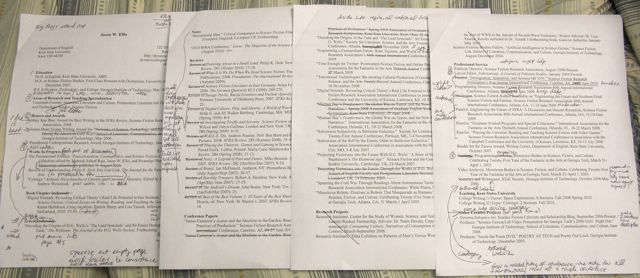
  • Path to Professionalization: Finding My Ratio of Publication to Service

    This past Friday, Tammy Clewell hosted the second Job Placement Workshop for this school year. The topic for the workshop was how to build a kick ass curriculum vitae.

    I have been working on my C.V. since I was an undergraduate at Georgia Tech and I began applying to graduate schools. Like the characters in The Guild, I thought of the C.V. as a record of my achievements and development as a professional scholar. I thought about what I needed to do to get the kind of research-1 position that I wanted after completing my PhD. I knew that I needed publications, which meant that I needed to do more reading, research, and writing. While at Liverpool, I began writing reviews for SFRA Review with this goal in mind. I considered reviewing a kind of intellectual exercise that would yield benefits in the more important refereed publications in journals and books. Also, reviewing would show search committees that I regularly kept up with the field by reading and seeing things that were on the cutting edge.

    I also knew that I needed to do some conferencing, so I did a lot of that. I have prepared papers and participated on roundtable discussions at SFRA, ICFA, SLSA, and others. Again, writing essays to present at conferences improves your argumentation and keeps you knee deep in research. These are good things, and I duly noted on my C.V.

    Since returning to academia in 2002, even before I had decided on my current career path, I began offering my labor and expertise in service positions. The most important of these landed on my C.V. in the proper place, but it was at the job placement workshop that I began to question how much time I had invested in service roles including those that didn’t make the C.V. cut.

    One of the recommendations that I received at the workshop had to do with organizing the service category of my C.V., and in particular, one of the commenters said that I had done a lot of service. Additionally, I was warned against presenting myself as the kind of person who does all of the grunt work. By moving things around, I believe that I can streamline my C.V. in this regard, but this comment made me pause to think about how much work I have done for others at the cost of working on things that I really need to focus on right now: publications and dissertation.

    What I come to realize is that there are some really important service things that I do want to pursue: namely, Vice President of the SFRA. I feel that I can do something good for the organization while also giving me the experience of helping run an international academic organization (so, please vote Ellis!).

    There are other things that are rewarding, but they take a lot of time away from the writing that I need to focus on as I finish my PhD. I will have to transition out of these commitments in the future, so that I can devote that time to getting another publication sent out and more pages of my dissertation completed.

    The lesson to take away from this is to remember to make a ratio of publications, conferencing, and service that fit your goals and personal development. It is okay to say ‘no’ if you don’t have the time to do something, but it is also okay to say ‘yes’ when you have the time to help. Service to others can be a rewarding, enjoyable, and challenging opportunity, but you have to make sure that you take care of yourself before committing to it.