Month: May 2010

  • Reading List for PhD Minor Exam on the Works of Philip K. Dick

    In June 2010, I will take my three PhD exams in the Kent State University English Literature PhD program.  For these exams, I convened a committee of trusted professors, each administering one exam. I choose to take my exams in these areas: 20th Century American Literature (administered by Kevin Floyd), Postmodern Theory (administered by Tammy Clewell), and the Philip K. Dick Canon (administered by Donald “Mack” Hassler). Below, I have included my Philip K. Dick reading list. Go here to read my Postmodern Theory exam list, and here to read my 20th Century American Literature exam list.

    PhD Minor Area Exam:  Philip K. Dick’s Fiction and Non-Fiction, and Critical Works

    Director:  Donald “Mack” Hassler

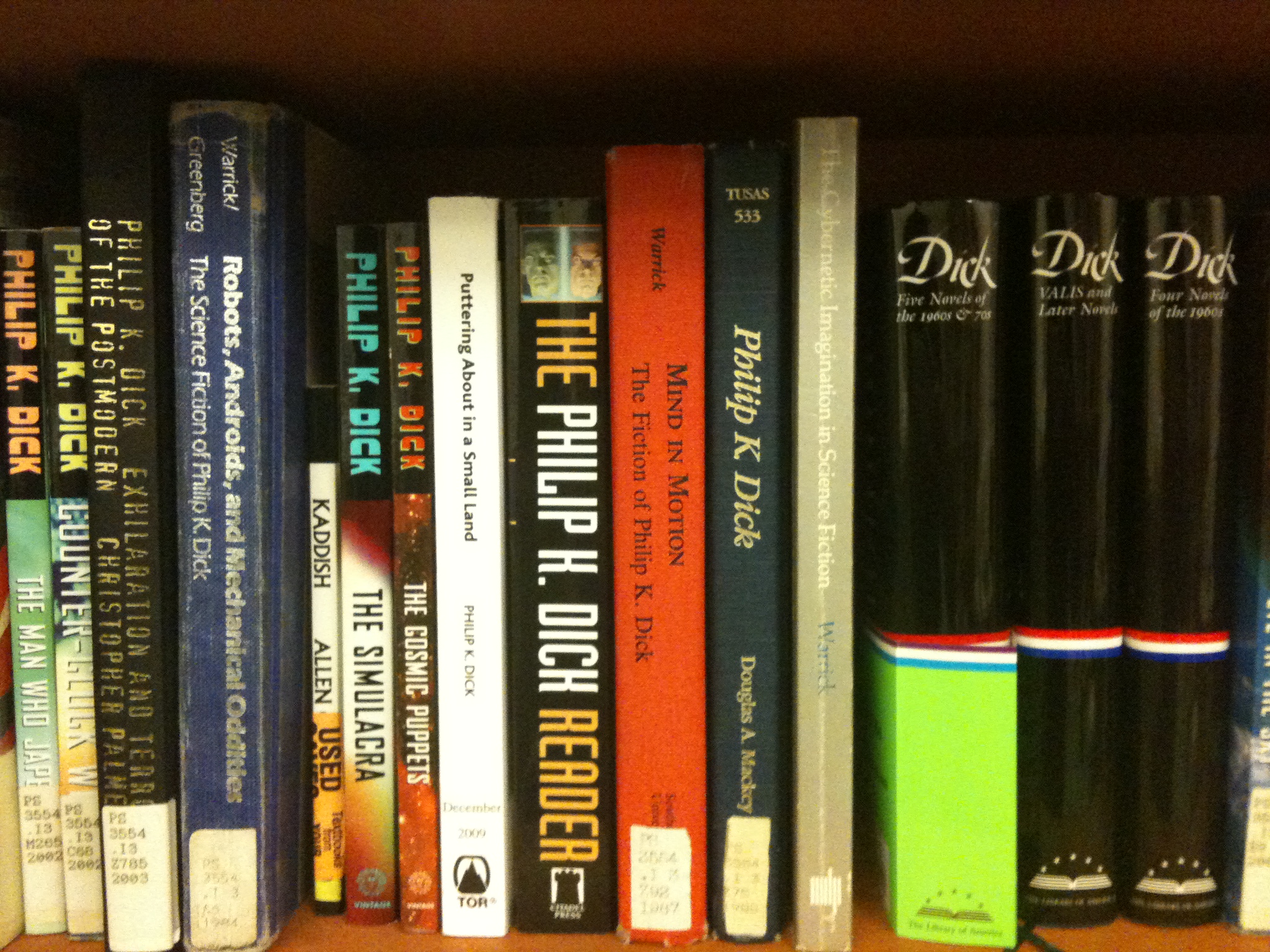
    Novels by Philip K. Dick, organized by date of composition.

    1. Dick, Philip K. Gather Yourselves Together.  1950.  1994.
    2. —. Voices from the Street.  1952.  2007.
    3. —. Vulcan’s Hammer .  1953.  1960.
    4. —. Dr. Futurity.  1953.  1960.
    5. —. The Cosmic Puppets.  1953.  1957.
    6. —. Solar Lottery.  1954.  1955.
    7. —. Mary and the Giant.  1954.  1987.
    8. —. The World Jones Made.  1954.  1956.
    9. —. Eye in the Sky.  1955.  1957.
    10. —. The Man Who Japed.  1955.  1956.
    11. —. The Broken Bubble.  1956.  1988.
    12. —. Puttering About in a Small Land.  1957.  1985.
    13. —. Time Out of Joint.  1958.  1959.
    14. —. In Milton Lumky Territory.  1958.  1985.
    15. —. Confessions of a Crap Artist.  1959.  1975.
    16. —. The Man Whose Teeth Were All Exactly Alike.  1960.  1982.
    17. —. Humpty Dumpty in Oakland.  1960.  1986.
    18. —. The Man in the High Castle.  1961.  1962.
      2009/12/2
    19. —. We Can Build You.  1962.  1972.
    20. —. Martian Time-Slip.  1962.  1964.
    21. —. Dr. Bloodmoney, or How We Got Along After the Bomb.  1963.  1965.
    22. —. The Game-Players of Titan.  1963.  1963.
    23. —. The Simulacra. 1963.  1964.
    24. —. The Crack in Space.  1963.  1966.
    25. —. Now Wait for Last Year.  1963.  1966.
    26. —. Clans of the Alphane Moon.  1964.  1964.
    27. —. The Three Stigmata of Palmer Eldritch.  1964.  1965.
    28. —. The Zap Gun.  1964.  1967.
    29. —. The Penultimate Truth.  1964.  1964.
    30. —. Deus Irae.  1964.  1976.  (Collaboration with Roger Zelazny).
    31. —. The Unteleported Man.  1964.  1966.  (Republished as Lies, Inc. in 1984).
    32. —. The Ganymede Takeover.  1965.  1967.  (Collaboration with Ray Nelson).
    33. —. Counter-Clock World.  1965.  1967.
    34. —. Do Androids Dream of Electric Sheep? 1966.  1968.
    35. —. Nick and the Glimmung.  1966.  1988.
    36. —. Ubik.  1966.  1969.
    37. —. Galactic Pot-Healer.  1968.  1969.
    38. —. A Maze of Death.  1968.  1970.
    39. —. Our Friends from Frolix 8.  1969.  1970.
    40. —. Flow My Tears, The Policeman Said.  1970.  1974.
    41. —. A Scanner Darkly.  1973.  1977.
    42. —. Radio Free Albemuth.  1976.  1985.
    43. —. VALIS. 1978.  1981.
    44. —. The Divine Invasion.  1980.  1981.
    45. —. The Transmigration of Timothy Archer.  1981.  1982.

    Short Fiction by Philip K. Dick, needs elaboration by individual stories.

    1. The Philip K. Dick Reader.  1997.
    2. Robots, Androids, and Mechanical Oddities:  The Science Fiction of Philip K. Dick.  Eds. Patricia S. Warrick and Martin H. Greenberg.  1984.

    Selected Stories of Philip K. Dick.  2002.

    Non-Fiction by Philip K. Dick

    1. Dick, Philip K.  “The Android and the Human.” Vector:  Journal of the British Science Fiction Association 64 (March/April 1973):  5-20.
    2. —. The Dark Haired Girl.  1988.

    Critical Works

    1. Fitting, Peter.  “Ubik:  The Deconstruction of Bourgeois SF.” Science Fiction Studies 2:1 (1975).  19 October 2007 <http://www.depauw.edu/sfs/backissues/5/fitting5art.htm&gt;.
    2. Haney, William S. II. Culture and Consciousness:  Literature Regained.  Lewisburg:  Bucknell University Press, 2002.
    3. Kucukalic, Lejla. Philip K. Dick:  Canonical Writer of the Digital Age.  New York:  Routledge, 2009.
    4. Mackey, Douglas A. Philip K. Dick.  Boston:  Twayne Publishers, 1988.
    5. Palmer, Christopher. Philip K. Dick:  Exhilaration and Terror of the Postmodern.  Liverpool:  Liverpool UP, 2003.
    6. On Philip K. Dick:  40 Articles from Science-Fiction Studies.  <more information>.
    7. Sutin, Lawrence. Divine Invasions: A Life of Philip K. Dick.  New York:  Carroll & Graf, 2005.
    8. Suvin, Darko.  “P.K. Dick’s Opus:  Artifice as Refuge and World View.” Science Fiction Studies 2:22 (1975).  19 October 2007 <http://www.depauw.edu/sfs/backissues/5/suvin5art.htm&gt;.
    9. Vest, Jason P. The Postmodern Humanism of Philip K. Dick.  Lanham, MD:  Scarecrow Press, 2009.
    10. Warrick, Patricia S. The Cybernetic Imagination in Science Fiction. Cambridge: MIT Press, 1980.
    11. —.Mind in Motion:  The Fiction of Philip K. Dick.  Carbondale and Edwardsville:  Southern Illinois UP, 1987.
  • Reading List for PhD Minor Exam in Postmodern Theory

    In June 2010, I will take my three PhD exams in the Kent State University English Literature PhD program.  For these exams, I convened a committee of trusted professors, each administering one exam. I choose to take my exams in these areas: 20th Century American Literature (administered by Kevin Floyd), Postmodern Theory (administered by Tammy Clewell), and the Philip K. Dick Canon (administered by Donald “Mack” Hassler). Below, I have included my Postmodern Theory reading list. Go here to read my 20th century American literature exam list, and here to read my Philip K. Dick exam list.

    PhD Minor Exam Area:  Postmodern Theory

    Director:  Tammy Clewell

    Texts:

    1. Baudrillard, Jean. Simulacra and Simulation.
    2. Berman, Marshall. All That Is Solid Melts Into Air.
    3. Bertens, Hans. The Idea of the Postmodern:  A History.
    4. Broderick, Damien. Reading by Starlight: Postmodern Science Fiction.
    5. Bukatman, Scott. Terminal Identity:  The Virtual Subject in Postmodern Science Fiction.
    6. Butler, Judith. Bodies That Matter.
    7. de Certeau, Michel. The Practice of Everyday Life.
    8. Deleuze, Gilles and Félix Guattari. A Thousand Plateaus:  Capitalism and Schizophrenia.
    9. Derrida, Jacques. Of Grammatology.
    10. Eagleton, Terry. The Illusions of Postmodernism.
    11. Foucault, Michel. The History of Sexuality Volume 1:  An Introduction.
    12. Habermas, Jürgen.  “Modernity: An Incomplete Project.”
    13. Haraway, Donna. Modest_Witness@Second_Millennium.FemaleMan©Meets_OncoMouse™: Feminism and Technoscience.
    14. —. Simians, Cyborgs and Women: The Reinvention of Nature.
    15. Harvey, David. The Condition of Postmodernity.
    16. Hassan, Ihab. The Postmodern Turn.
    17. Hayles, N. Katherine. How We Became Posthuman: Virtual Bodies in Cybernetics, Literature, and Informatics.
    18. Huyssen, Andreas. After the Great Divide.
    19. Hutcheon, Linda. A Poetics of Postmodernism: History, Theory, Fiction.
    20. Jameson, Fredric. Postmodernism:  Or, The Cultural Logic of Late Capitalism.
    21. —. Archaeologies of the Future: The Desire Called Utopia and Other Science Fictions.
    22. Latour, Bruno. We Have Never Been Modern.
    23. Lyotard, Jean-François. The Postmodern Condition:  A Report on Knowledge.
    24. McHale, Brian. Postmodernist Fiction.
    25. Norris, Christopher. What’s Wrong with Postmodernism?
    26. Perryman, Mark ed. Altered States: Postmodernism, Politics, Culture.
    27. Poster, Mark. The Information Subject.
    28. Vattimo, Gianni. The Transparent Society.
    29. Wilde, Alan. Horizons of Assent: Modernism, Postmodernism, and the Ironic Imagination
  • Reading List for PhD Major Exam on 20th Century American Literature

    In June 2010, I will take my three PhD exams in the Kent State University English Literature PhD program.  For these exams, I convened a committee of trusted professors, each administering one exam. I choose to take my exams in these areas: 20th Century American Literature (administered by Kevin Floyd), Postmodern Theory (administered by Tammy Clewell), and the Philip K. Dick Canon (administered by Donald “Mack” Hassler). Below, I have included my 20th Century American Literature reading list. Go here to read my Postmodern Theory exam list, and here to read my Philip K. Dick exam list.

    PhD Major Exam Area:  Twentieth-Century American Literature

    Director:  Kevin Floyd

    Texts:

    CANONICAL

    1. Chopin, Kate. The Awakening (1899).
    2. Cather, Willa. O Pioneers! (1913).
    3. Gilman, Charlotte Perkins. “The Yellow Wallpaper”
    4. TS Eliot: “The Waste Land,” “The Love Song of J Alfred Prufrock”
    5. Anderson, Sherwood. Winesburg, Ohio (1919).
    6. William, Carlos Williams. Spring and All (1923).
    7. Fitzgerald, F. Scott. The Great Gatsby (1925).
    8. Faulkner, William. The Sound and the Fury (1929).
    9. Faulkner, William. As I Lay Dying (1930).
    10. Langston Hughes: “The Negro Speaks of Rivers”; “Epilogue”; “Harlem”; “Same in Blues”; “Theme for English B”; “Mother to Son”; “Song for a Dark Girl.”
    11. Countee Cullen: “Yet Do I Marvel”; “Heritage”; “Incident.”
    12. Hemingway, Ernest. A Farewell to Arms (1929).
    13. Hurston, Zora Neale. Their Eyes Were Watching God (1937).
    14. Dos Passos, John. The Big Money (1936).
    15. Steinbeck, John. The Grapes of Wrath (1939).
    16. Hemingway, Ernest. For Whom the Bell Tolls (1940).
    17. Wright, Richard. Native Son (1940).
    18. Williams, Tennessee. A Streetcar Named Desire (1947).
    19. Miller, Arthur. Death of a Salesman (1949).
    20. Salinger, J.D. The Catcher in the Rye (1951).
    21. Ellison, Ralph. Invisible Man (1952).
    22. Baldwin, James. The Fire Next Time.
    23. Edward Albee, Who’s Afraid of Virginia Woolf
    24. Eugene O’Neill, Long Days Journey Into Night
    25. Vladimir Nabokov, Lolita
    26. Ginsberg, Allen. “Howl” and “Kaddish.”
    27. Kerouac, Jack. On the Road (1957)
    28. Burroughs, William S. Naked Lunch (1959).
    29. Hansberry, Lorraine. A Raisin in the Sun (1959).
    30. Kesey, Ken. One Flew Over the Cuckoo’s Nest (1962).
    31. Plath, Sylvia. Ariel.
    32. Pynchon, Thomas. V. (1963).
    33. Sam Shepard, True West
    34. LeRoi Jones, Dutchman (1964)
    35. O’Connor, Flannery. “A good man is hard to find”; “everything that rises must converge”; “revelation”; “good country people”
    36. Le Guin, Ursula K. The Left Hand of Darkness (1969).
    37. Reed, Ishmael. Mumbo Jumbo (1972).
    38. Delany, Samuel R. Dhalgren (1975).
    39. Silko, Leslie Marmon. Ceremony (1977).
    40. Gibson, William. Neuromancer (1984)
    41. DeLillo, Don. White Noise (1985).
    42. Morrison, Toni. Beloved (1987).
    43. Gloria Naylor, Linden Hills
    44. Roth, Philip. American Pastoral (1997).
    45. Updike, John.  Rabbit, Run
    46. Butler, Octavia. Kindred (1979).
    47. Eugenides, Jeffrey. Middlesex (2002).
    48. Vonnegut, Jr., Kurt. Slaughterhouse-Five (1969).

    NON-CANONICAL

    1. Asimov, Isaac. I, Robot (1950).
    2. Bradbury, Ray. The Martian Chronicles (1950).
    3. Kornbluth, Cyril M. and Fredrick Pohl. The Space Merchants (1953).
    4. Ellison, Harlan.  “I Have No Mouth, and I Must Scream” (1967).
    5. Tiptree, James Jr. (Alice B. Sheldon), “The Girl Who Was Plugged In” (1973).
    6. Delany, Samuel R. Tales of Nevèrÿon (1979)
    7. Sterling, Bruce ed. Mirrorshades:  The Cyberpunk Anthology (1986).
    8. Stephenson, Neal. Snow Crash (1992).
    9. Powers, Richard. Galatea 2.2 (1995).
    10. Di Filippo, Paul. Ribofunk (1996).
    11. Cunningham, Michael. Specimen Days (2005).
  • Stanislaw Lem’s “Philip K. Dick: A Visionary Among the Charlatans”

    In Science Fiction Studies #5 (1975), Stanislaw Lem wrote an article, translated from the Polish by Robert Abernathy, describing, analyzing, and challenging the work of Philip K. Dick (up to that point). Titled “Philip K. Dick: A Visionary Among the Charlatans,” it is a rich essay that has much to say about Dick’s work and the work of the critic.

    Lem says that Dick, like other science fiction authors, takes from the “warehouse which has long since become their common property,” or what Damien Broderick later theorized as the SF mega-text (57). One of the themes that Dick relies on is the catastrophe, but unlike most other science fiction authors, the catastrophes in Dick’s fiction occur for unascertainable reasons, i.e., the uncovered causes are deferred to the end. The common denominator in all of Dick’s fiction is a world beset by an unconstrained and monstrous entropy that devours matter and even time. Following his instincts, as Patricia Warrick would later say of Dick that he is understood intuitively, Lem says of Dick that he does not go in for rational explanations, but instead, confounds both the plot and the conventions of the science fiction genre itself. Of this, Lem demonstrates that genres have conventions, but those conventions were formed by previous breaking of convention to make the genre thus. Dick does this to science fiction, changing it to meet his own needs and creativity. Coupled with his genre breaking is the fact that Dick is a bricoleur, though this is not the word Lem uses, but it is very much what he is describing. Lem describes Dick’s work as something offered for sale at a “county fair,” having been made from a variety of concepts and ideas, but making the new creation solidly his own. Dick is not a futurologist, but rather representing the very idea of futureshock in his stories. Dick is not an extrapolator who changes one thing and leaves all the rest unscathed. He shows how civilization goes on, progress forward, but having been changed radically by the events presupposed in his stories. He acknowledges that history cannot be rewound. The fusion of the natural with the artificial, a point also raised by Warrick, Leo Marx, and Sharona Ben-Tov, means that there can be no more talk of a return to nature. In this, Dick does question progress, but not by chucking the concept. Instead, he complicates it, and again, confounds it. For Dick, our technological labyrinth prevents us from returning to nature–again, connections with Warrick, Marx, and Ben-Tov. Lem conjectures on this as something beyond the scope of Dick’s work, but nevertheless should be taken into account. He thinks about how the “irreversibility of history, leads Dick to the pessimistic conclusion that looking far into the future becomes such a fulfillment of dreams of power over matter as converts the ideal of progress into a monstrous caricature” (64). It is this carrying Dick’s ideas further in his criticism that Lem attempts to practice the very thing Dick practiced in his writing. And most importantly, in his short engagement of the novel Ubik, Lem, a good structuralist, avoids the author’s interpretation of the work, and instead considers how the thing ‘ubik’ and its combination of the old and philosophical with the modern and consumer culture resulted in such a powerful metaphor and not a futurological or technical artifact (66).

    Two other things that I would like to leave with you from this essay is Lem’s idea about the relationship of the critic to a work–as defender rather than prosecutor–a way that I have tried to work in my own scholarship and reviews: “I think, however, that the critic should not be the prosecutor of a book but its defender, though one not allowed to lie: he may only present the work in the most favorable light” (60).

    And I would like to quote at length, Lem’s concluding paragraph, in which he gives a honest, gracious, and thoughtful tribute to Dick’s writing. Lem says:

    The writings of Philip Dick have deserved a better fate than that to which they were destined by their birthplace. If they are neither of uniform quality nor fully realized, still it is only by brute force that they can be jammed into that pulp of materials, destitute of intellectual value and original structure, which makes up SF. Its fans are attracted by the worst in Dick–the typical dash of American SF, reaching to the stars, and the headlong pace of action moving from one surprise to the next–but they hold it against him that, instead of unraveling puzzles, he leaves the reader at the end on the battlefield, enveloped in the aura of a mystery as grotesque as it is strange. Yet his bizarre blendings of hallucinogenic and palingenetic techniques have not won him many admirers outside the ghetto walls, since there readers are repelled by the shoddiness of the props he has adopted from the inventory of SF. Indeed, these writings sometimes fumble their attempts; but I remain after all under their spell, as it often happens at the sight of a lone imagination’s efforts to cope with a shattering superabundance of opportunities–efforts in which even a partial defeat can resemble a victory (66-67).

    I am also under that spell and happily on the battlefield, a little the worse for wear, but with kit in hand. At least, I thought I was on a battlefield until I realized that I was sitting at a desk in front of a computer wildly typing away on this very blog. I suppose the battlefields, like ontologies, can change unexpectedly and for inexplicable reasons.

    Image of Lem at the top of the post is from the Wikimedia Commons, details here.

  • Mary Kay Bray’s Copy of Time Out of Joint

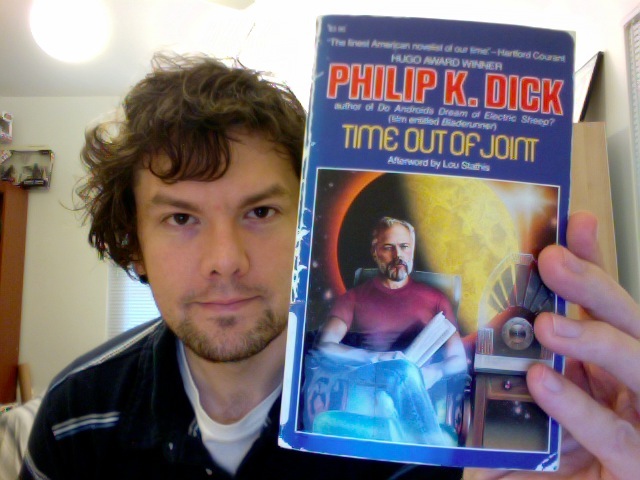
    I just cracked open the copy of Philip K. Dick’s Time Out of Joint that I requested via interlibrary loan for my PKD exam. I noticed that it arrived at the Kent State Library from the Watson Library at Wilmington College in Wilmington, OH, but I didn’t register where I had heard of Wilmington before. It has a colorful cover by Roy Colmer that portrays Phil Dick sitting with book in hand next to an old radio and eclipsing a distant planet in the background, but the real treasure was just inside the front cover:

    This copy of Time Out of Joint used to belong to Mary Kay Bray, the science fiction scholar who was active in the Science Fiction Research Association and whose name is honored with her memorializing SFRA award: the Mary Kay Bray Award for Best Feature, Essay, or Review in the SFRA Review. She taught at Wilmington College. After her death in 1999, her close friend Professor William L. Andrews of UNC, Chapel Hill funded this award in Bray’s name. I was honored with the 2007 award for two reviews I wrote: one on Heinlein’s Starship Troopers and one on Ian McDonald’s Brasyl. Since then, I have served on the awards committee two years. See the other award winners here.

    I was already looking forward to reading Time Out of Joint, but I am even more eager to do so now knowing that this particular copy of the novel belonged to a distinguished scholar and teacher with many friends in the SFRA. I only wish that I had had the chance to meet her in person. As it is, we are connected through time by science fiction.