Author: Jason W. Ellis

  • Gary Westfahl’s The Mechanics of Wonder

    I just finished reading Gary Westfahl’s The Mechanics of Wonder as part of the research on my dissertation’s important theoretical chapter.

    I wish that I had known about and read this book a long time ago. I have heard some of the things that he argues about Hugo Gernsback and John W. Campbell, Jr. in other places, but I see now that those other places likely based or were inspired by Westfahl’s book.

    Having read The Mechanics of Wonder, I am persuaded by Westfahl’s arguments that science fiction came to be what it was from the work of Gernsback and Campbell. Their delayed influence on the writing taking place in the genre appears to have had profound implications. For the most part, Westfahl’s rigorous approach to evidence and his claims based on that evidence are very well received.

    This is not to say that I am giving up my Aldiss or Suvin. I find their work equally stimulating even if their historical claims might not always be on target. I believe that we can find earlier examples of science fiction even if they are not part of the modern instantiation of the genre itself. Can we not say that a particular work is science fictional? Can we not go so far as to say that a given work is part of the science fiction genre, because it shares all of the characteristics of the work even if it was not yet part of the genre due to its chronological deficiencies?

    Likewise, I believe that structuralist approaches such as that undertaken by Suvin are useful for understanding the mechanics of the science fiction genre. In fact, Suvin provides an advantageous link between two different spheres of knowledge in my theory chapter. Westfahl’s careful reading does knock a few sizable holes in Metamorphoses of Science Fiction, but I will gladly salvage the concept of cognitive estrangement.

    The Mechanics of Wonder is a must-read for everyone studying science fiction. Westfahl not only presents compelling evidence, he also provides a demanding model for scholarly rigor and engagement of evidence.

  • 2011-2012 R. D. Mullen Fellowship Winners

    Last week, Rob Latham of the University of California, Riverside announced the winners of the 2011-2012 R. D. Mullen Fellowship winners. I am one among the three recipients! This fellowship will provide each of us with funding to travel to California during the next school year to conduct research in the Eaton Science Fiction Collection at Riverside. I am very honored to have been selected as one of this year’s winners, and I congratulate the other recipients, Alexander and Jennifer, listed below from the original release:

    I would like to announce the winners of the third annual R.D. Mullen Research Fellowship, which is funded by Science Fiction Studies in the name of our late founding editor to support archival research in the J. Lloyd Eaton Collection of Science Fiction, Fantasy, Horror, and Utopian Literature at UC-Riverside. The committee—chaired by me and consisting of Andrea Bell, Neil Easterbrook, Joan Gordon, and Brooks Landon—reviewed a number of excellent applications and settled on a slate of three winners for 2011-12:

    JASON ELLIS is a PhD student in the English Department at Kent State University. His dissertation studies what he calls “neuronarratives,” sf texts that deal with the cognitive implications of artificial intelligence and human-machine interfaces. He is the coeditor of The Postnational Fantasy:  Postcolonialism, Cosmopolitics, and Science Fiction (McFarland, 2011) and has published articles on H.G. Wells, on digital nomadism, and on World of Warcraft. He plans to visit UC-Riverside to do research towards the writing of a dissertation chapter on “the effects of brain trauma” in the work of Philip K. Dick.

    ALEXANDER ISER is a PhD student in the School of Culture and Communication at the University of Melbourne. His dissertation focuses on how time-travel narratives draw out the links “between apocalyptic crises and societal conceptions of time.” He will be spending several weeks at UC-Riverside examining the Eaton’s extensive fanzine collection for evidence of how readers interpreted major time-travel stories as allegories of cultural crisis.

    JENNIFER L. LIEBERMAN is a PhD student in the Department of English at the University of Illinois. Her dissertation, entitled Power Lines: Electric Networks and the American Literary Imagination, studies how “literature helped to shape American perceptions of electrical technologies between 1870 and 1952.” She has published essays on Mark Twain’s A Connecticut Yankee in King Arthur’s Court and on Gertrude Atherton’s Patience Sparhawk and Her Times. At the Eaton, she plans to explore dime novels, boys’ adventure stories, and other proto/early-sf materials in terms of their evocation of the engineer as “the new frontiersman of the twentieth century.”

    I am very grateful to my committee for their work in vetting the applications, and my congratulations to the three winners, whom I hope to see soon here at UCR.

  • I Have Been Chosen as a 2011-2012 David B. Smith Fellowship Recipient

    I learned last week by mail that I have been chosen as a 2011-2012 recipient of Kent State University’s David B. Smith Fellowship. According to the congratulatory letter from Dr. Mary Ann Stephens, Dean of Graduate Studies, the David B. Smith Fellowship is “an award given annually in honor of David B. Smith, a magna cum laude graduate of Kent State University, who passed away in 1982. This Fellowship is to recognize outstanding scholarship and research potential.”

    I am deeply honored to have been nominated for this award by Dr. Tammy Clewell, Coordinator of Graduate Studies, Department of English, and I express my sincere gratitude to the fellowship selection committee headed by Dr. Stephens. I would like to express my heartfelt gratefulness to Mr. and Mrs. Robert W. Smith for creating this fellowship in the memory of their son. I hope that my continuing work will reflect positively on this fellowship and what it represents.

    Dr. Donald “Mack” Hassler, my dissertation director, and I will attend the Doctoral Students’ Academic Commitment Ceremony in October 2011 where I will be presented with this award.

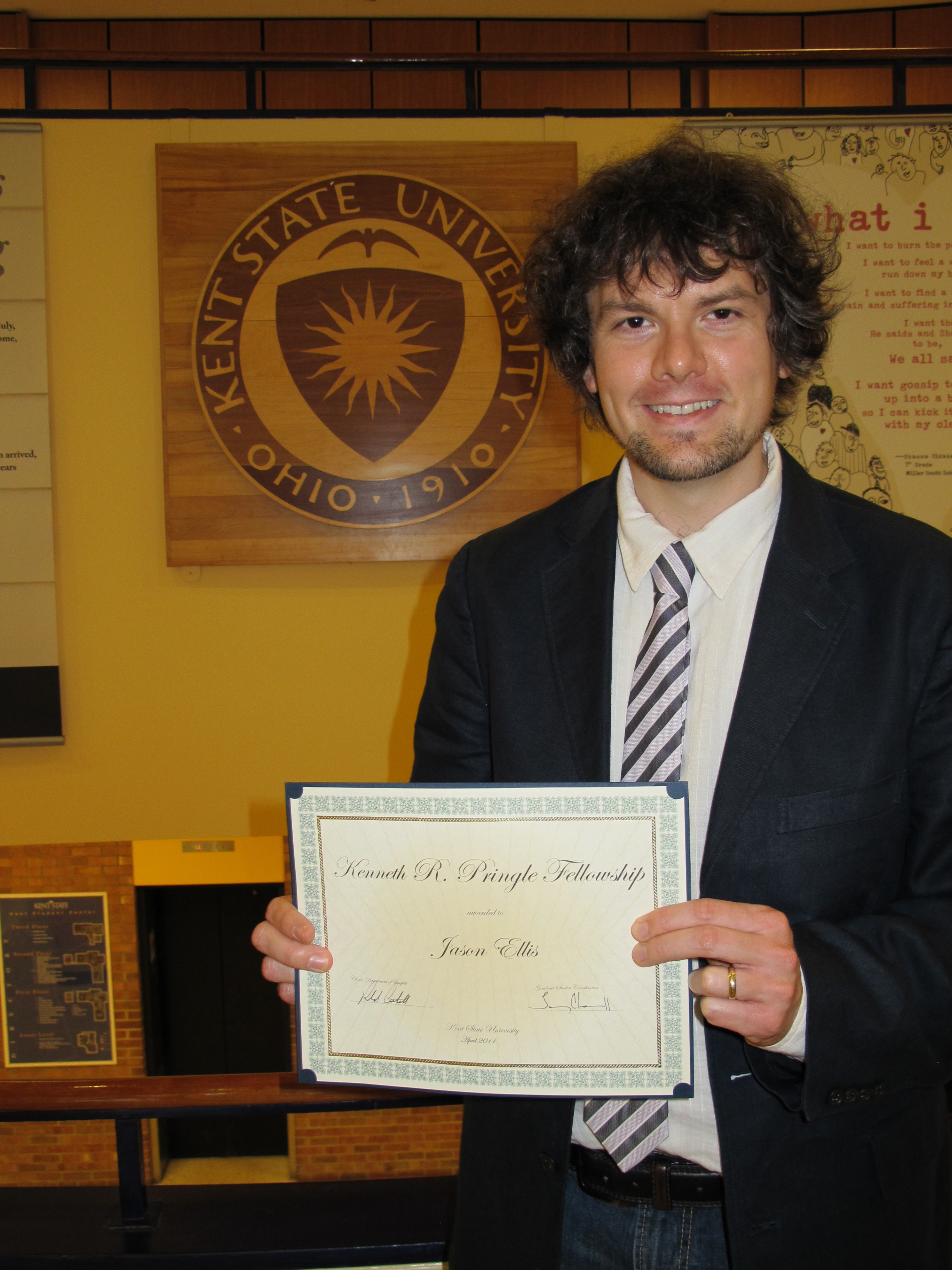
  • I Received a Kenneth R. Pringle Research Fellowship for 2011-2012

    At last night’s Kent State English Department Awards Ceremony, I received a Kenneth R. Pringle Research Fellowship for the 2011-2012 school year. This fellowship gives me a service free semester to focus on research and writing. I plan to use this time, in part, to travel to several special collections to perform research related to my dissertation and a few unpublished articles.

    The award ceremony was well attended by students and faculty in the English Department. Y and I represented the English Literature PhD students.

    It was the last ceremony presided over by current Chair Ron Corthell, who is leaving the department after 30 years of service. Professor Donald “Mack” Hassler presented Professor Corthell with an Old English decree (and some good-natured ribbing) for his service to the department. I can attest to the good work of Professor Corthell, because he helped me deal with attacks on my blog publishing as a graduate student (here and here) and with professional issues relating to students. I wish Professor Corthell the best in his future work.

  • Michio Kaku, Sci Fi Science: Physics of the Impossible, and My Early Readings in Physics

    Another good show on the Science Channel is Dr. Michio Kaku‘s Sci Fi Science: Physics of the Impossible. In each episode, Dr. Kaku investigates a single science fiction idea (e.g., the technological singularity, Transformers robotic beings, or building your own solar system) and speculates about how humanity could achieve those plans. In the episode that is on right now, about solar system construction, he does calculations to show that you cannot built a Dyson sphere, a superstructure that encapsulates a star to harness all of its energy, with only the materials found in our solar system. On the surface (a pun?), I had not considered this as a limitation to the construction of such a structure. However, he then considers the possibility of using graphene, an allotrope or special molecular bonding structure of carbon that has a super strong honeycomb structure. Additionally, graphene’s strength allows it to be very thin, thus requiring less material. Therefore, graphene could be used to construct a Dyson swarm or sphere given that the planets in a solar system are carbon rich.

    During the show, he interviews science fiction fans for ideas, and then, he works through these ideas with scientists at universitiesHis explanations are fascinating and insightful. I like the way that fans are engaged through brainstorming and opinions as Dr. Kaku arrives at his solution to the episode’s problem. This is one aspect of science fiction that goes beyond the stories themselves as prophetic visions. Fandom is the meta-level discourse that, in part, explores the what-if or is-this-possible aspects of science fiction. It is this meta-level discussion that Dr. Kaku’s show engages.

    I have long been a fan of Dr. Kaku. In my senior year of high school, after reading Albert Einstein’s Relativity: The Special and General Theories, Stephen Hawking’s A Brief History of Time, and Kip Thorne’s Black Holes and Time Warps: Einstein’s Outrageous Legacy among others, I read his book Hyperspace: A Scientific Odyssey Through Parallel Universes, Time Warps, and the 10th Dimension. This was when I was a physics-geek rather than a lit-geek. I had finished two interviews for MIT, and I had won my high school’s Physics prize in my Junior year. I was energized not only by the amazing science that Kaku described in his popularization, but I was also intrigued by his life leading up to becoming a theoretical physicist. While I was in my teens learning how to work on cars with my 1965 Ford Mustang and optimizing memory usage on my and my friend’s computers, Dr. Kaku in his teens had built his own particle accelerator in his family’s garage complete with electromagnetic confinement rings and vacuum pumps! I suppose the life of the scientist is almost as interesting to me as the science. Also, the writing was important for Kaku and other popularizers from Einstein to the present. I appreciated the way in which they and Kaku could present an engaging narrative that also told me about the advances taking place and the imaginative conjectures proposed in the physical sciences. Perhaps I should have recognized then that I might not have been pursuing the best career path when I tried out for the MIT and Georgia Tech physics programs.

    At least now, I feel more comfortable with what I am doing as a English literature PhD candidate. In the way that I approach literature, I look at the relationships between science, technology, and culture, because I believe that our exploration of and engineering of the world is absolutely necessary to our understanding of ourselves. Our science shapes our understanding of the world, and our technology shapes our engagement and mediation of the world. Even the most mundane narrative, past or present, is indelibly marked by the traces of our science and technology. It is exciting to approach the humanities in this broadly interdisciplinary approach, because it reveals more ways to read and understand humanity than a limited or narrowly defined humanities approach. However, I am not advocating the erasure of those approaches, but I am saying that interdisciplinary approaches energize and expand our comprehension and appreciation of humanity and our work.