My current access to Azeroth is kind of convoluted. It’s a little bit like an incantation or prayer that my Undead priest Mordvar might have to speak in order to heal a comrade or hurt a foe.
I’m running World of Warcraft 1.12 via Wine in the foreground window where you see Mordvar flying a Tawny Wind Rider on a flight path. In the background on the right, I have Windows 7 Professional 32-bit (a copy that I received for free from a Microsoft event in Ohio some years back) running in Oracle VirtualBox. And in Windows 7, I have an old copy of SingleCore Vanilla, a WoW server emulator that I connect to on my local machine.
This weird assemblage allows me to explore Azeroth for research using admin tools that are otherwise unavailable to normal WoW players.
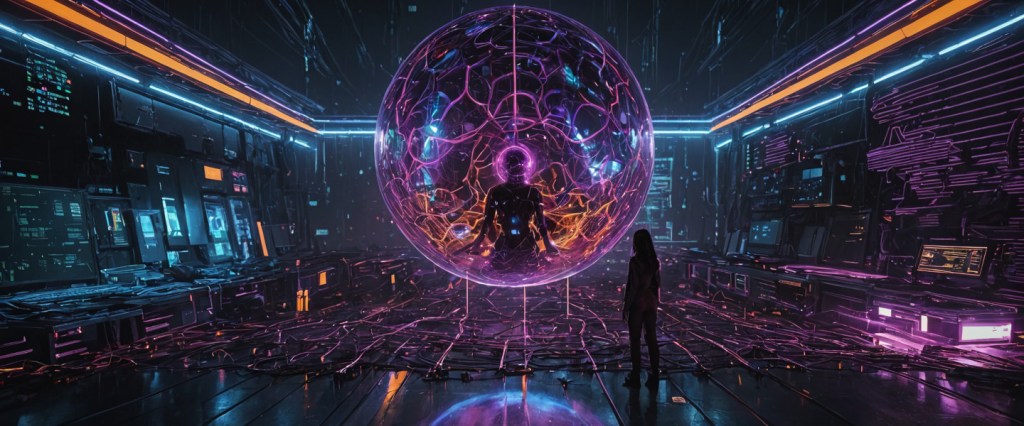
I’ve been working on the site’s header image using different Stable Diffusion SDXL models, which give it a higher fidelity without needing as much post-processing outpainting and inpainting as the current header needed, which was made with an SD 1.5 model.
The idea behind the header image is a cyberpunk scene within cyberspace. The scene takes place within a virtual room representing computers and terminals with an orb-like artificial intelligence in the center levitating above the floor. Within the orb, a shadowy figure can be seen. To the side of the AI is a woman standing before it and peering into the depths of its otherness.
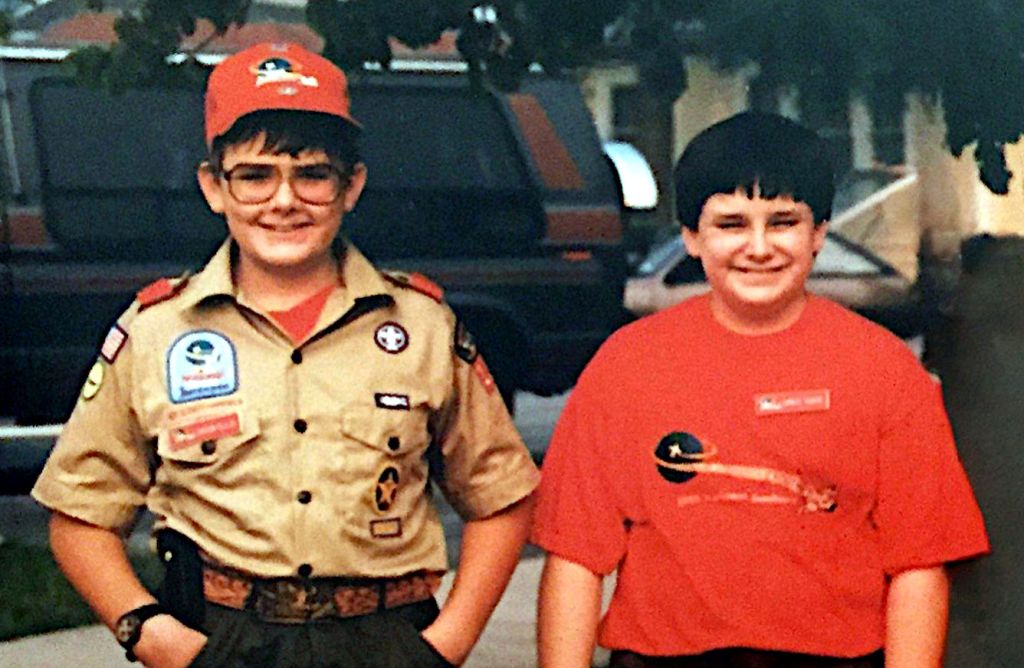
The photo above shows me (left) and Greg (right) as we’re about to leave for the 1989 National Scout Jamboree in Washington, DC. By that point, we had spent a lot of our early life together–same elementary school, Cub Scouts, Webelos, and then, Boy Scouts.
On the long bus ride to the Jamboree, he assembled a plastic model kit of the USS Enterprise USS-1701-D. Imagine his determination to build that model while the bus is bouncing around on the roadbed and young boys are shouting and carrying on around him. He laid out his sprues in the flimsy cardboard box–full color lid inverted to hold the plain cardboard bottom–and applied bits of modeling cement from a metal Testors tube to bind and hold the bits together. I thought that he was out of his mind to build that model on the trip, but he wasn’t out of his mind–he was focused. It meant something to him. It gave him an escape and outlet from everything else going on around him. It channeled his love of Star Trek: The Next Generation into something tangible and real–bringing the utopian world on the screen into a moment of his real lived experience.
Some years before that trip, I spent an afternoon with Greg at his house. We pulled out his older brother Jeff’s precious Star Wars toys–carefully preserved in their original boxes and meticulously stored in his bedroom closet–for otherworldly battles in outer space. We assembled the Kenner Death Star playset and strafed its villains with an X-Wing and the Millennium Falcon.
Greg was an aficionado of great toy lines based on children’s cartoons. He had an extensive collection of action figures from He-Man and the Masters of the Universe, and he proudly showed off the Miraj with a full compliment of heroes from Silverhawks. I can safely say that I’m as impressed now as I was then. And, I was awfully glad we got to play with them together.
Even earlier, I remember being sick in elementary school. I might have missed a week of school. When I returned to classes, I didn’t have a lot of get-up-and-go. Greg became my companion during PE–we would walk the track beside Glyndale Elementary School. While we walked, we talked about all sorts of things–things that I can’t recall but feel like something important, meaningful, revelatory.
An even earlier memory is of Greg, me, and a bunch of other boys pretending to be Transformers in the expansive field behind Glyndale. Sideswipe was my preferred character. Greg, however, took it to the next level as Megatron–nailing his character’s raspy electronic voice and striking an imposing silhouette with his arm canon raised.
The last time that I saw Greg was June 16, 2018. I had visited his parents Wayne and Faye–my Boy Scout Scoutmaster and Cub Scout Pack Leader respectively. Greg happened to be home, so I got to catch up with him some, too. Our lives had diverged in significant ways, but he was still the same determined and playful guy I had know in my youth. However, I also sensed there was a gap between who we were and who we had become that couldn’t be bridged in a brief visit.
Greg passed away last Monday on 1 Jul. 2024–about six weeks shy of his 47th birthday. Looking at his LinkedIn profile, it seems like he was still moving forward–starting his own company and getting certifications in cybersecurity, which makes the unexpected news that much harder to bear. Even when the bonds of friendship have frayed with time, we still can’t help wanting our old friends’ dreams come true and feeling heartbreak when they don’t.
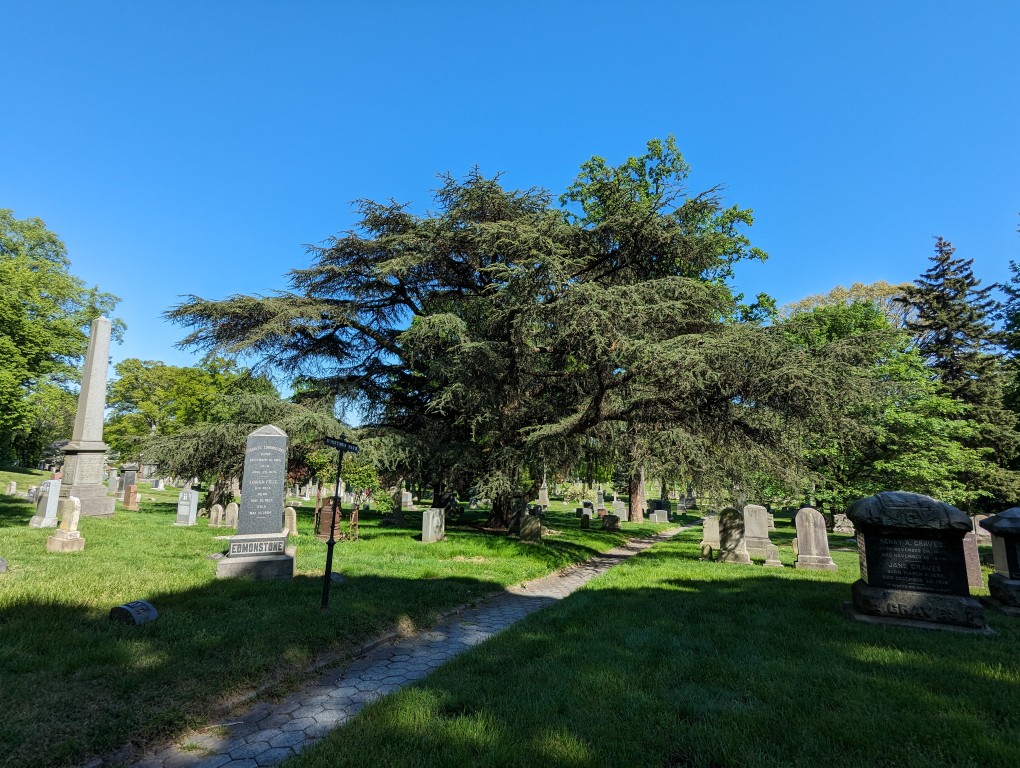
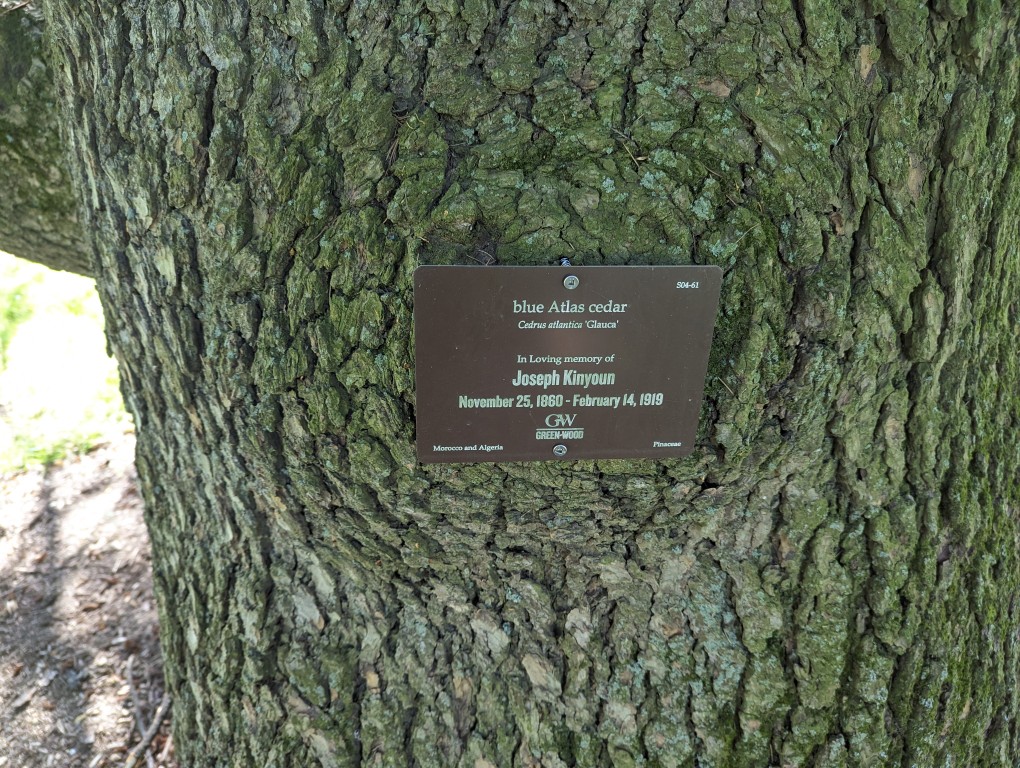
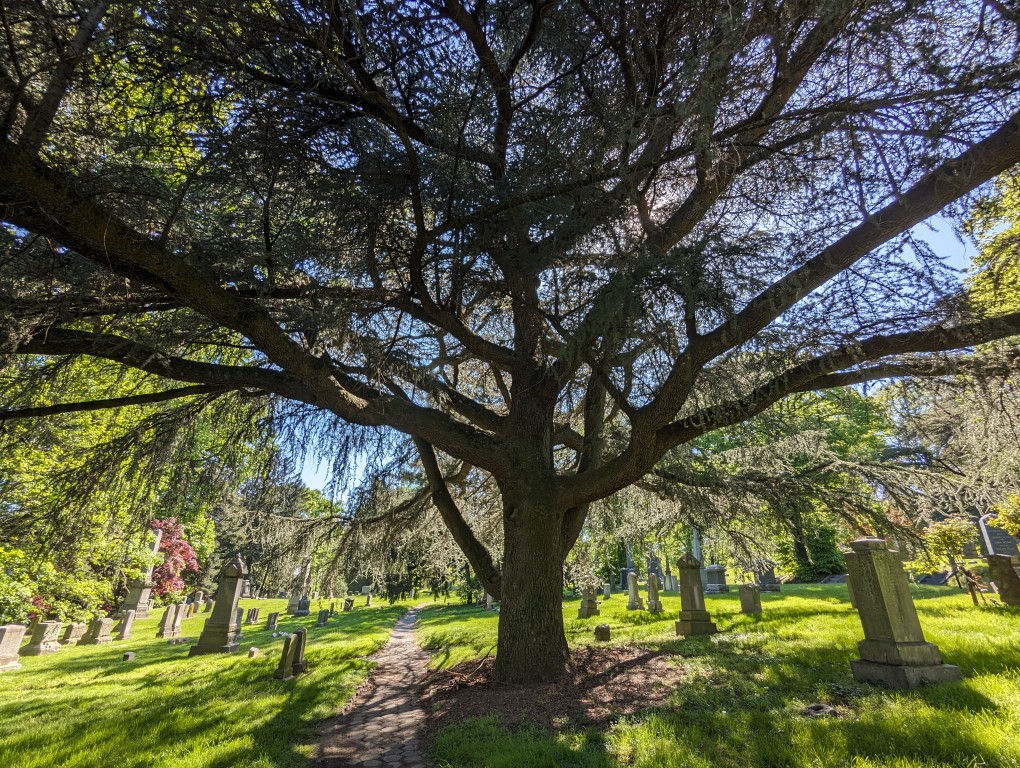
Y and I know this blue atlas cedar as “Big Tree Friend.” It grows somewhere in the middle of Green-Wood Cemetery. We walk around–turning here and there–until we eventually find it.
It has been growing in Green-Wood Cemetery for over 100 years–assuming it was planted soon after the death of the person it memorializes, Joseph Kinyoun (Nov. 25, 1860-Feb. 14, 1919). Its circumference is so large that I don’t think Y and I could join hands around it.
When you stand beneath it, it complete envelops you.
On a hot day, it’s a good friend to have shade you.