Author: Jason W. Ellis

  • Linkages in Making: Assembling a Bandai 1/144 Millennium Falcon Rise of Skywalker Model and Creating a Composite Image of the Falcon Among the Stars

    Introduction

    This week, I created the composite image above of the Millennium Falcon midflight among the stars. This most recent exercise in making was made possible by the Falcon model at the center of the composition that I assembled in June 2021 while healing from a broke toe.

    I like to think about how one project links to another, how one kind of making supports another kind of making. Making and culture go hand-in-hand. One new thing makes possible countless new things given tools, materials, and know-how.

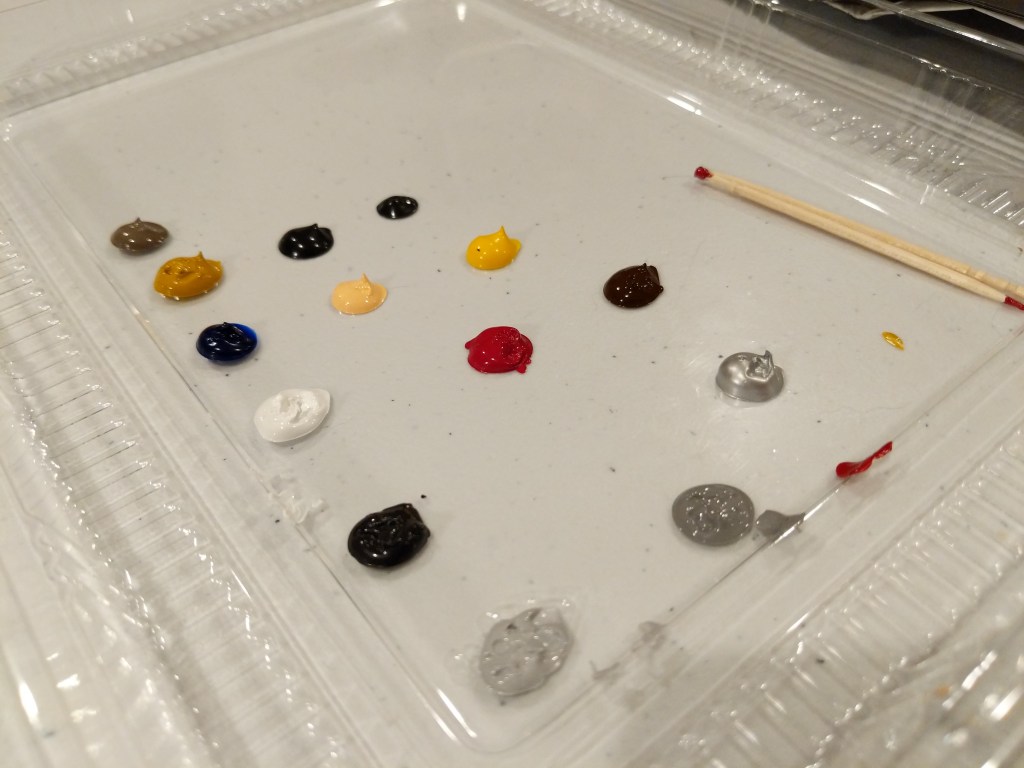
    In this case, I assembled and painted a Bandai 1/144-scale Millennium Falcon plastic model set from Star Wars: The Rise of Skywalker. Proper assembly, though by no means professional, required tools (e.g., sprue cutter, paint brushes, and toothpicks), materials (e.g., plastic model glue, acrylic paints, and tape), and know-how (e.g., cutting, filing, gluing, and mixing paints and washes).

    A year later, I created the science fictional composite image above. Its production required tools (e.g., Linux Mint-running desktop computer, GNU Image Manipulation Program, or aka GIMP, and the Internet), materials (e.g., the assembled model, a photo of the model in an orientation appropriate for the composite image, and a public domain photo of a star field), and know-how (e.g., an idea for what the finished product will look like, a workflow for using GIMP to achieve it, and an understanding of how to use GIMP’s affordances including layers, opacity, and filters for each stage of the workflow).

    Assembling the Model

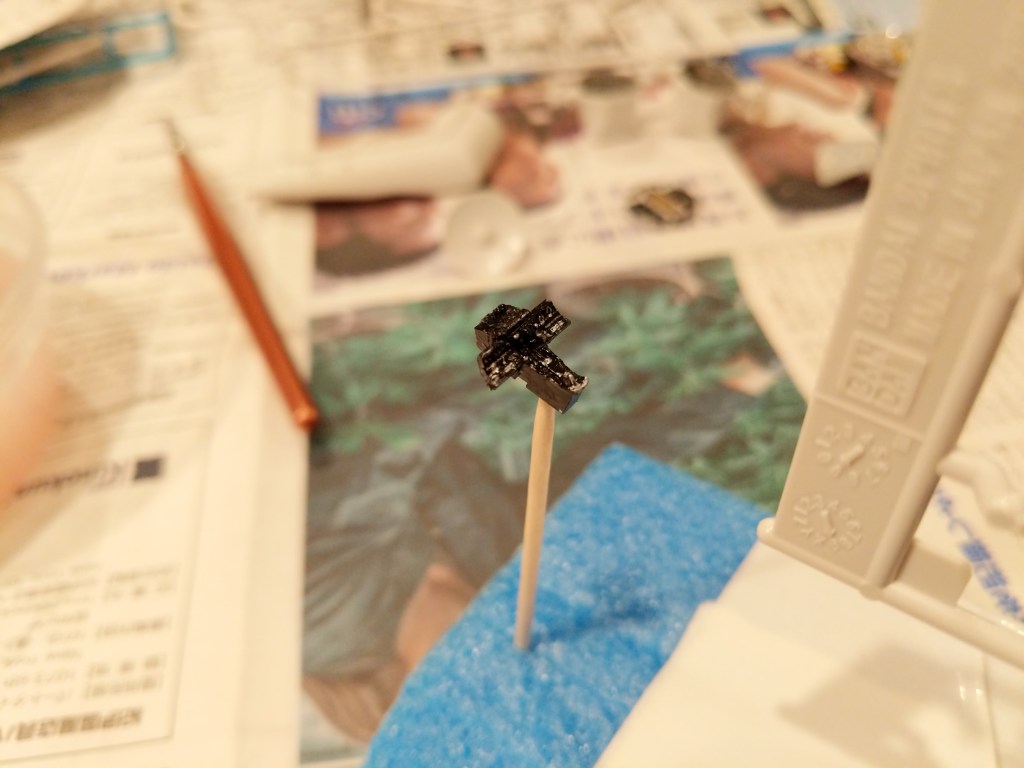
    The completed Bandai 1/144 Millennium Falcon model is only about 9 1/4″ long. Hence, it and its constituent parts are very tiny. I built and painted the model over the course of a week. Given more time and equipment, I would have liked to have done a more professional job with lots of masking and airbrushed paint. Given my limitations, I decided to have fun and use what I had at hand to assemble and paint the model.

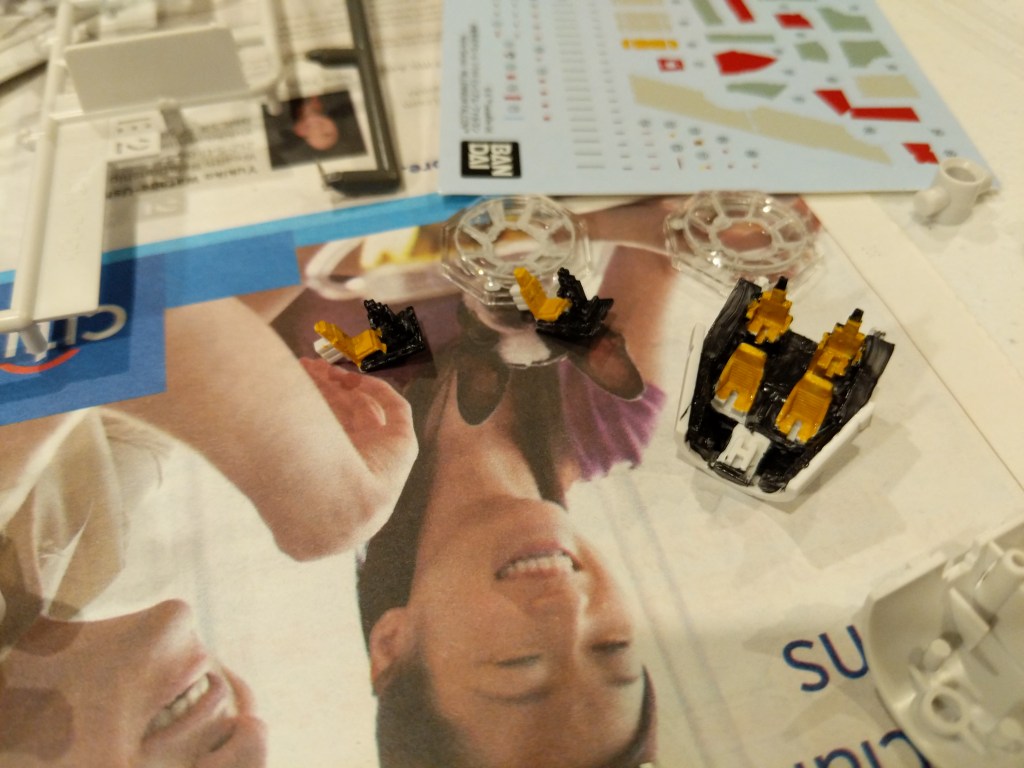
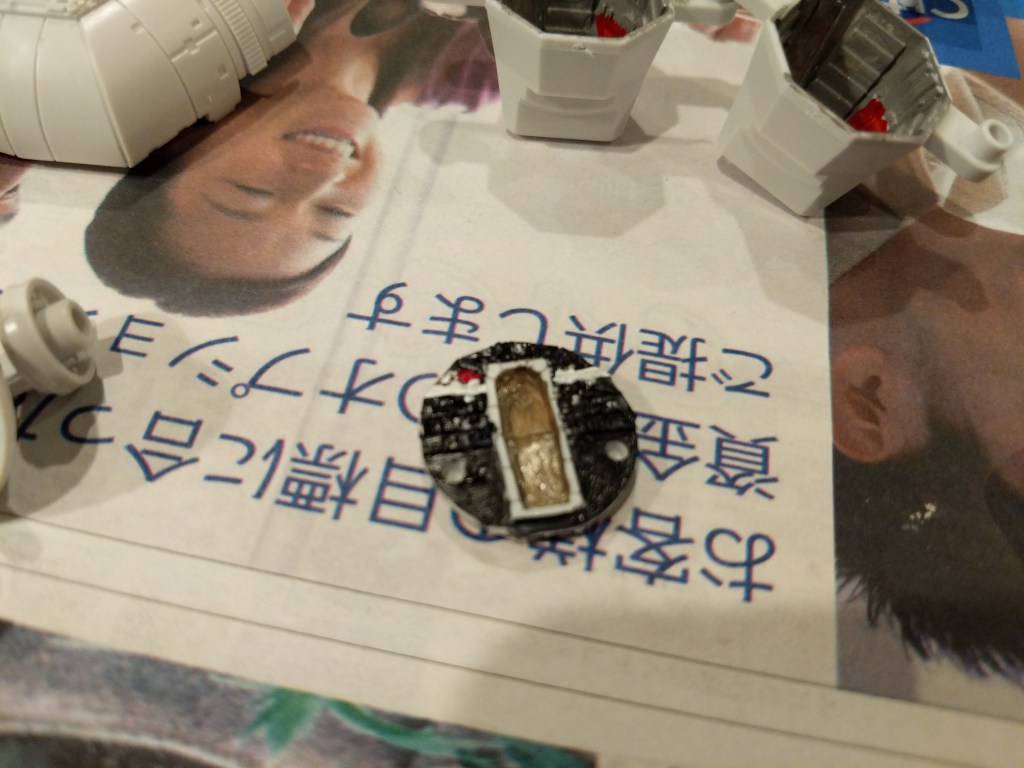
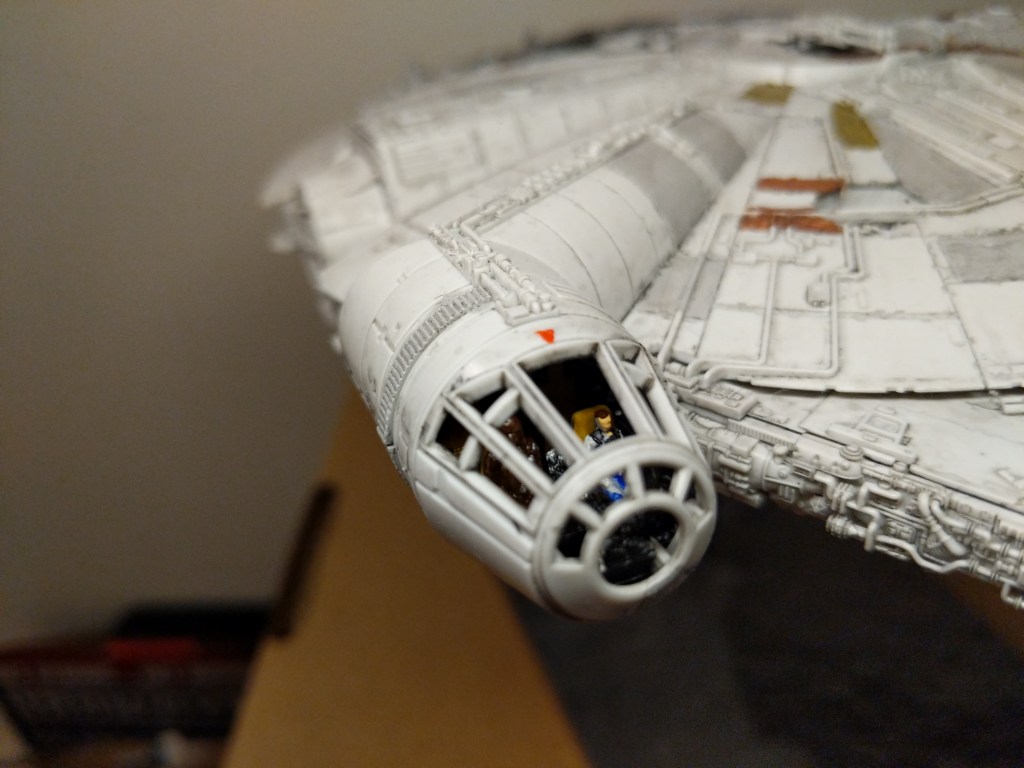
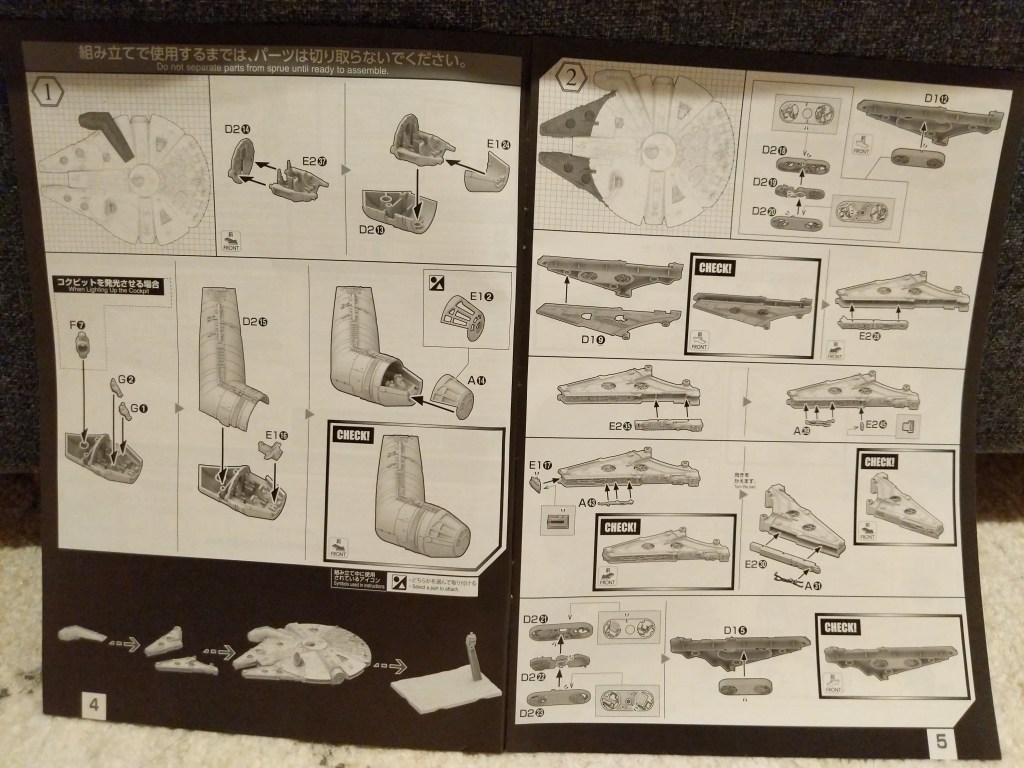
    One example of the assembly process is pictured below. It involves the cockpit. Even though the model is sold as the Falcon from The Rise of Skywalker, it included Han Solo and Chewbacca figures, which I decided to use instead of the other cast miniatures. For these detailed elements of the model, I used a combination of toothpicks, very fine brushes, and dabs of paint to achieve the intended effect.
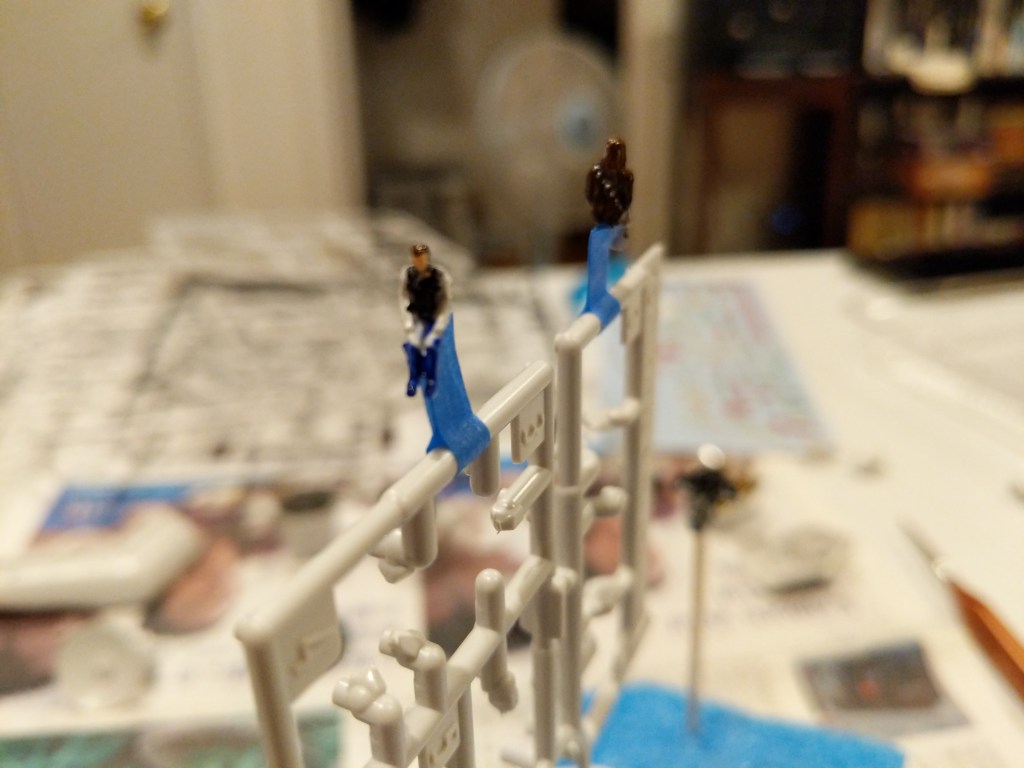
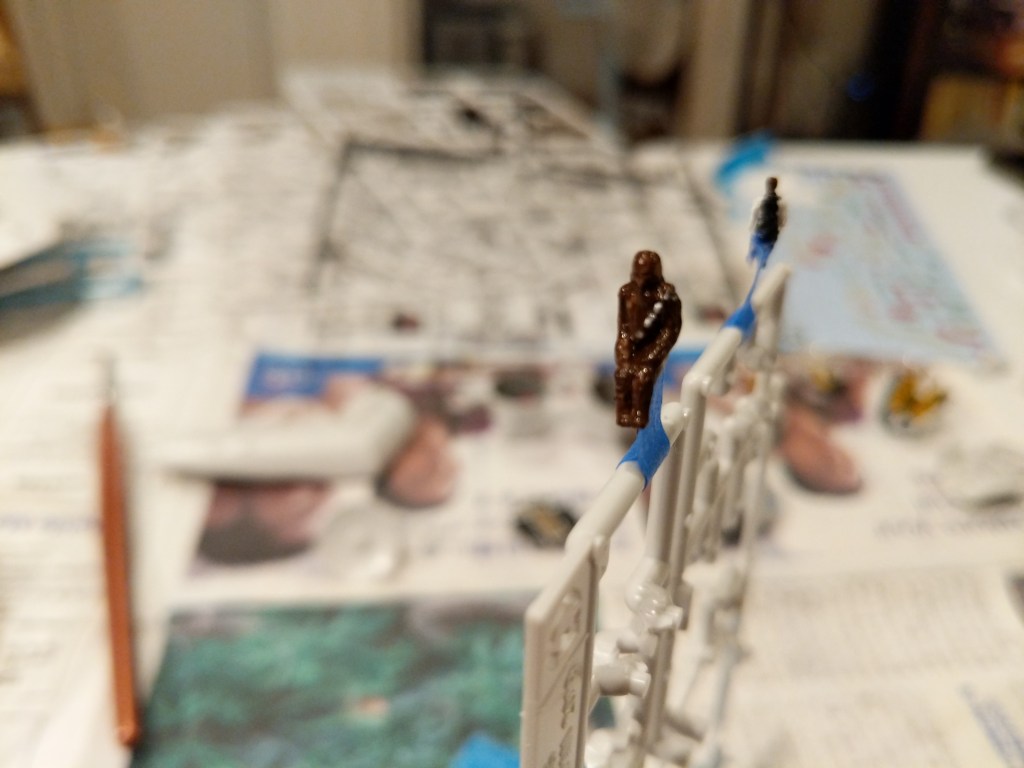
    The pictures below show the assembled cockpit with shaky, imperfect paint application on the left and remnants of the dark wash that I applied to age and highlight lines on the model’s surface on the right.
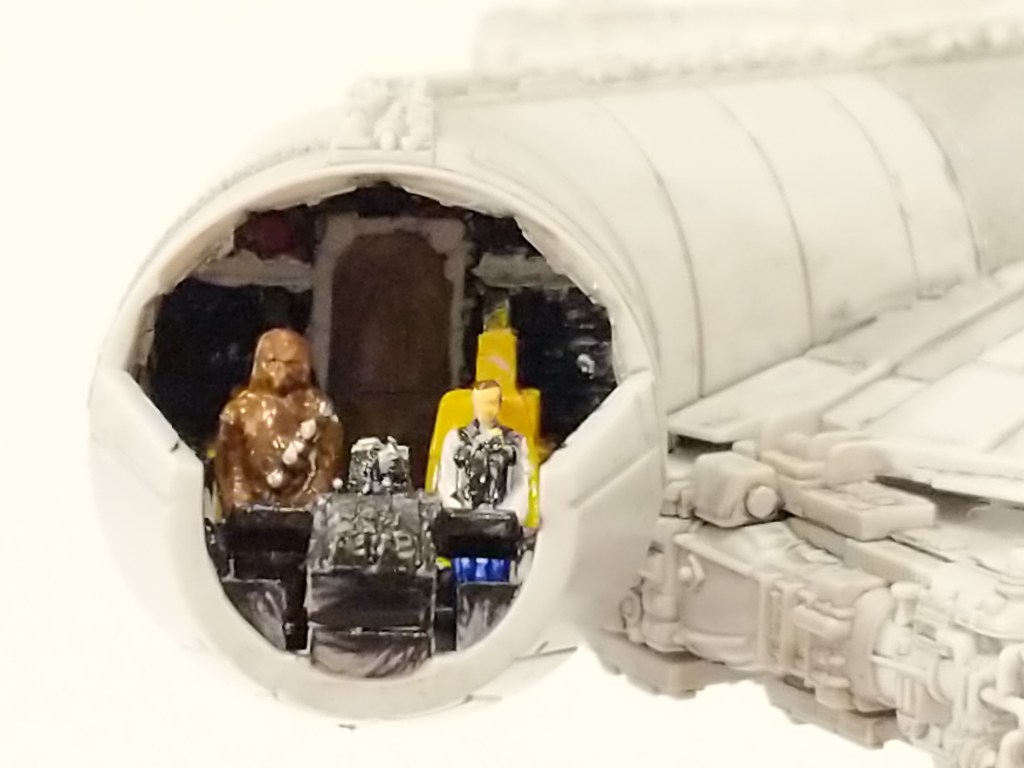
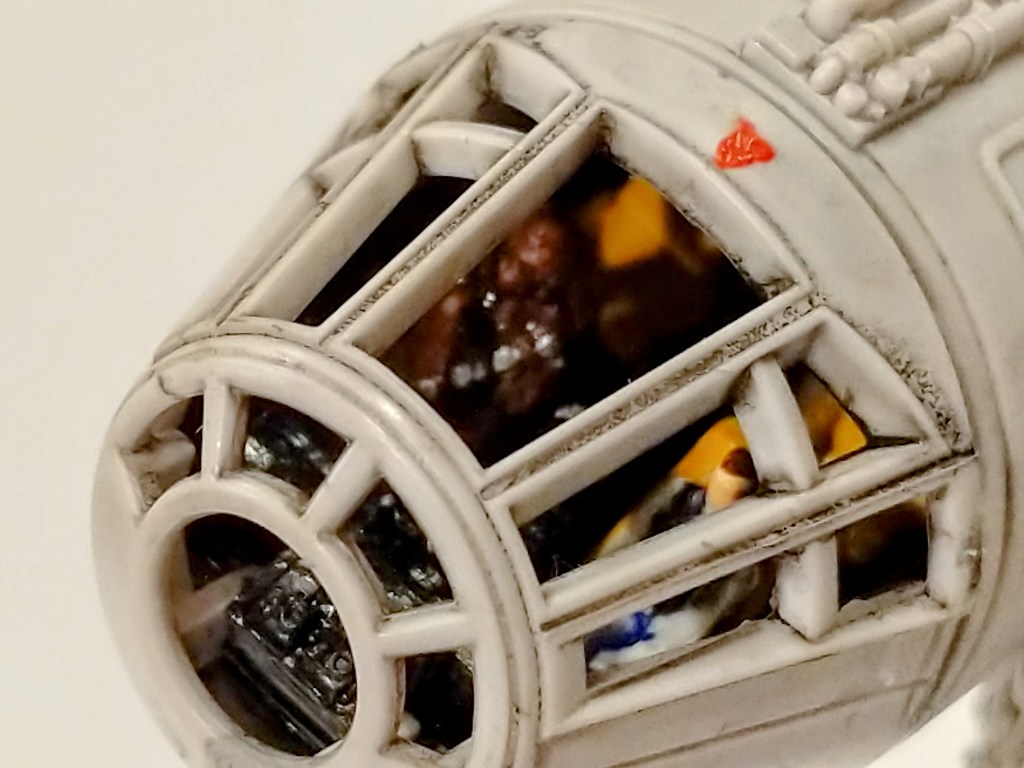
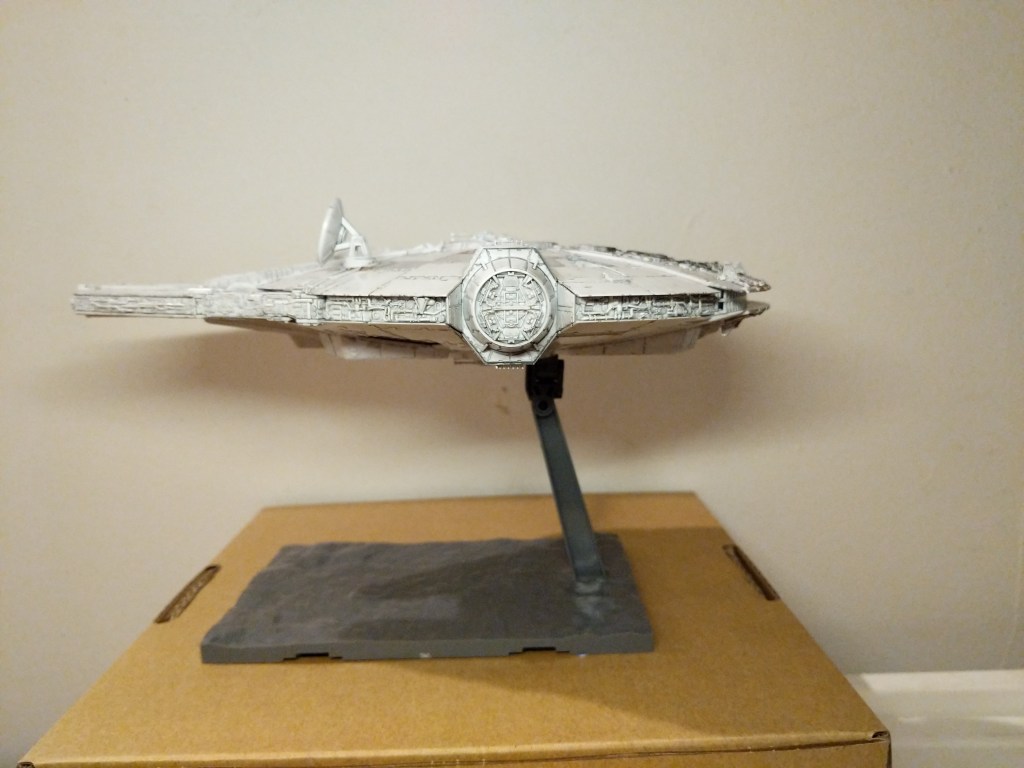
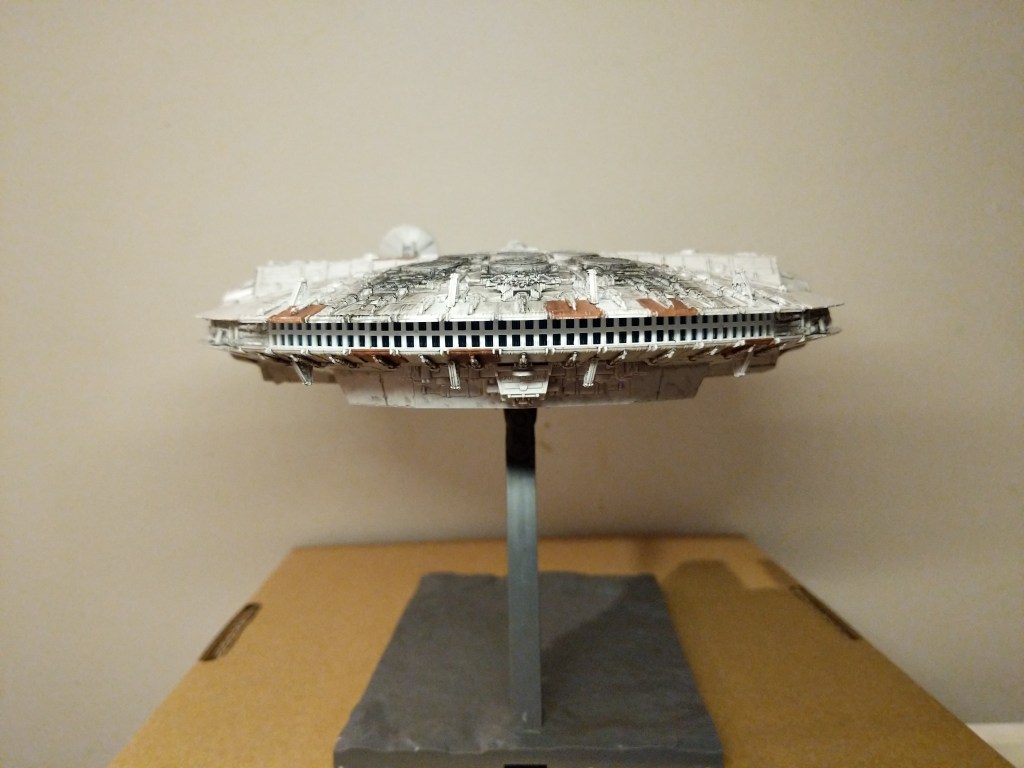
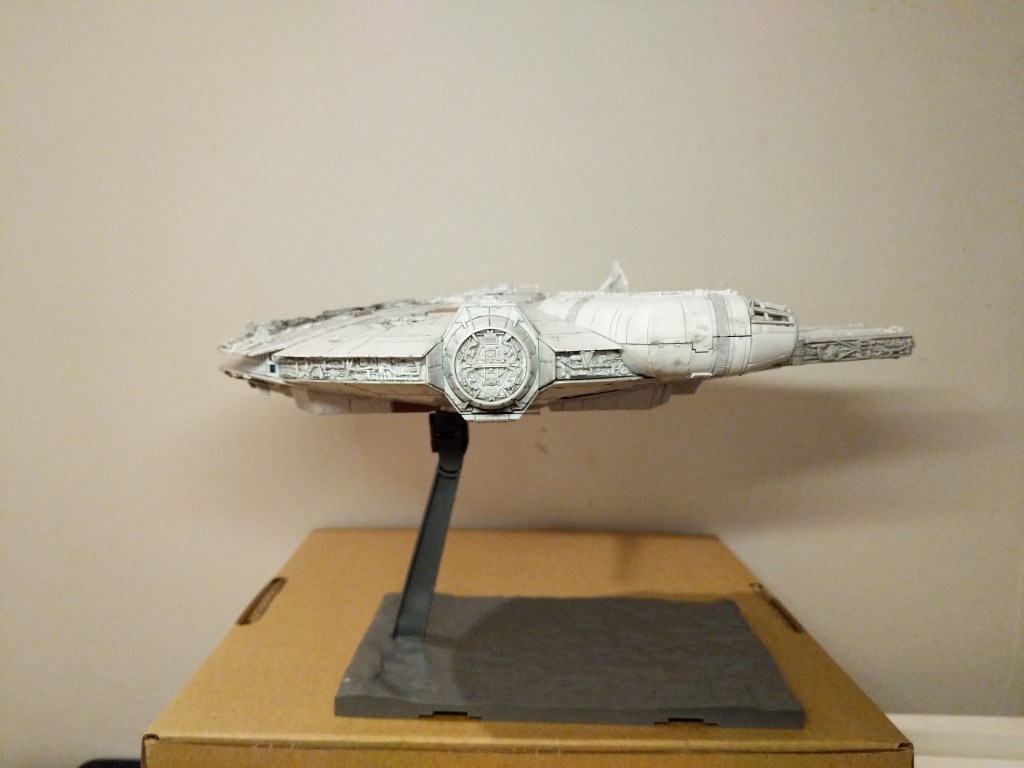
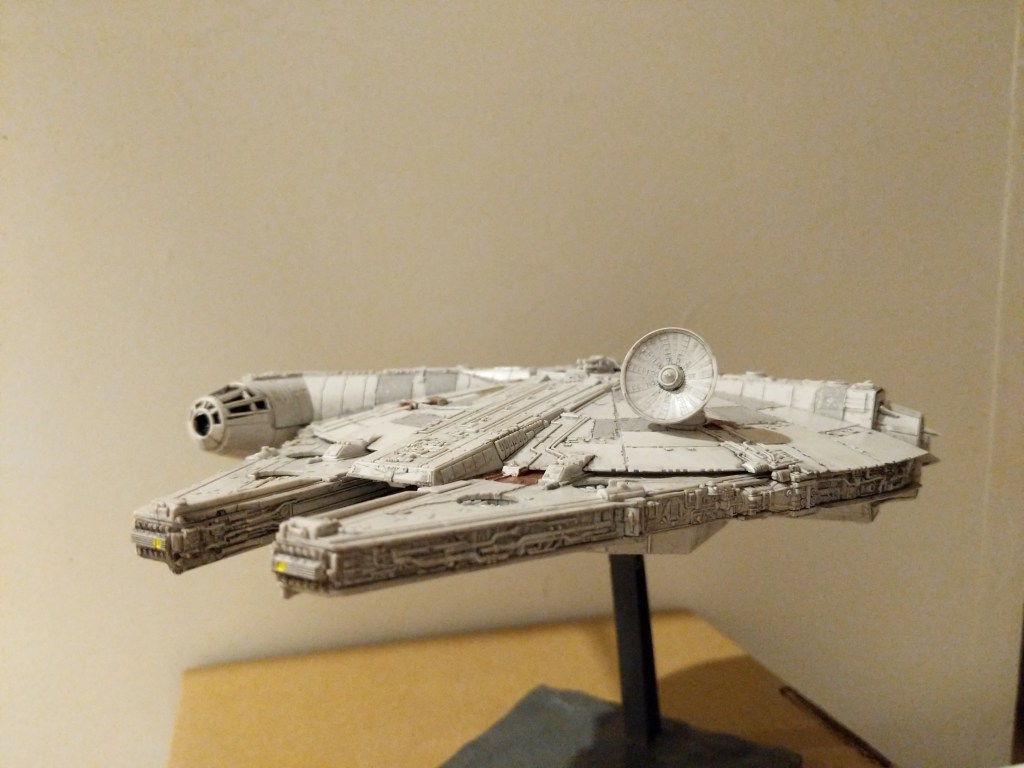
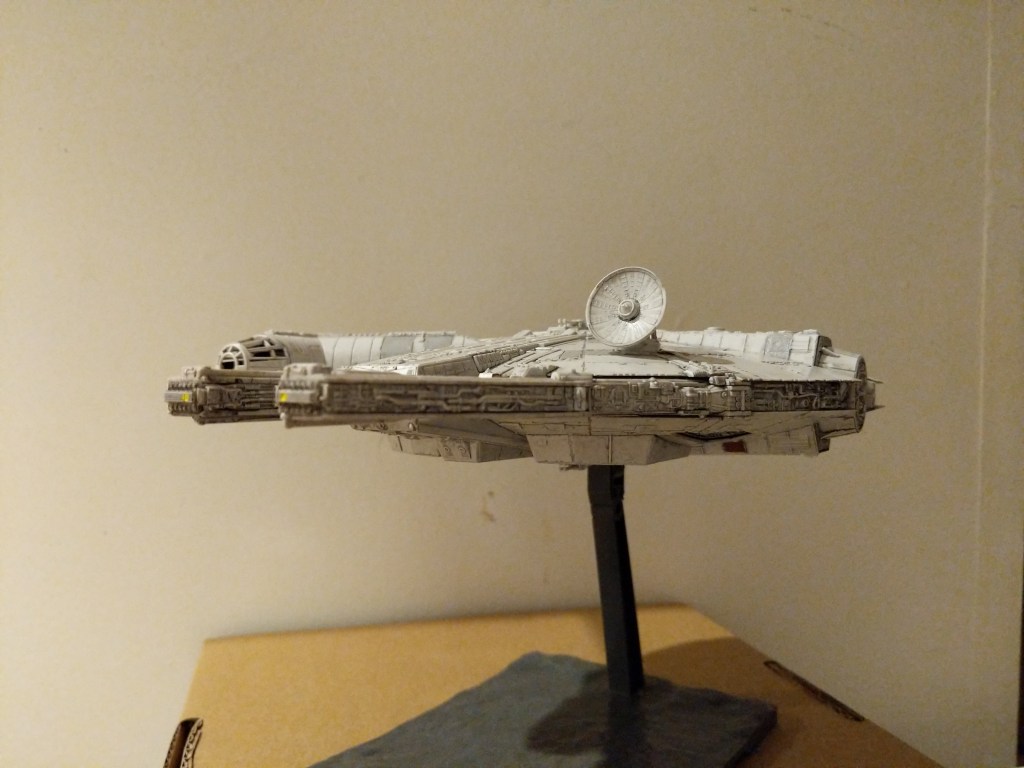
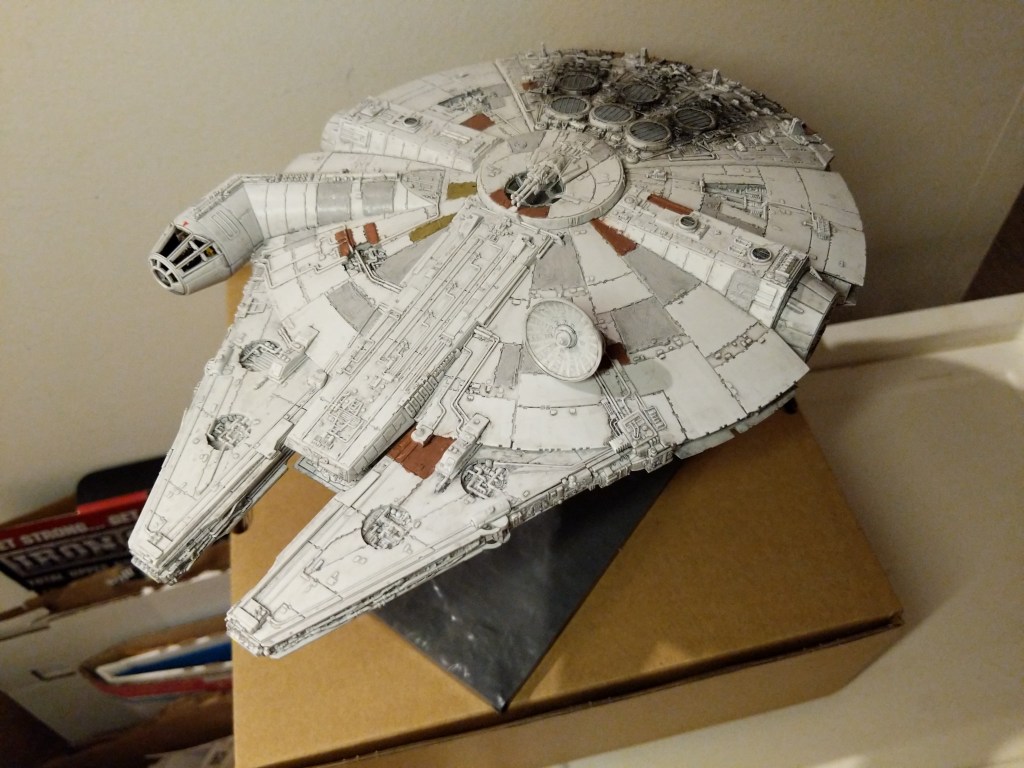
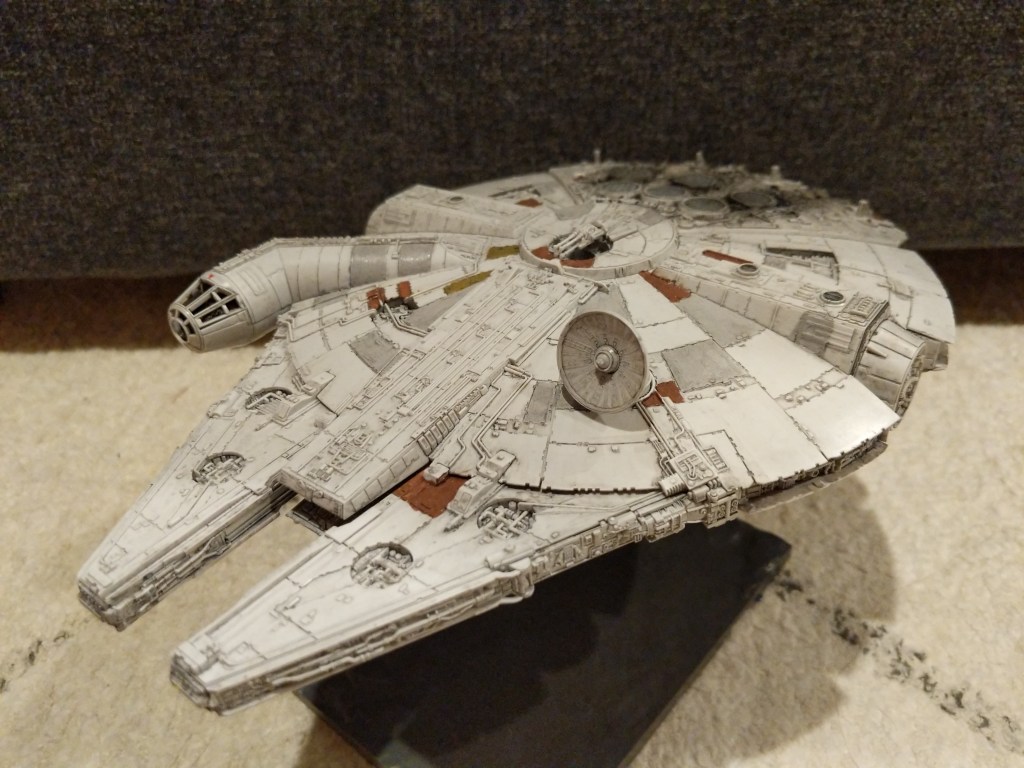
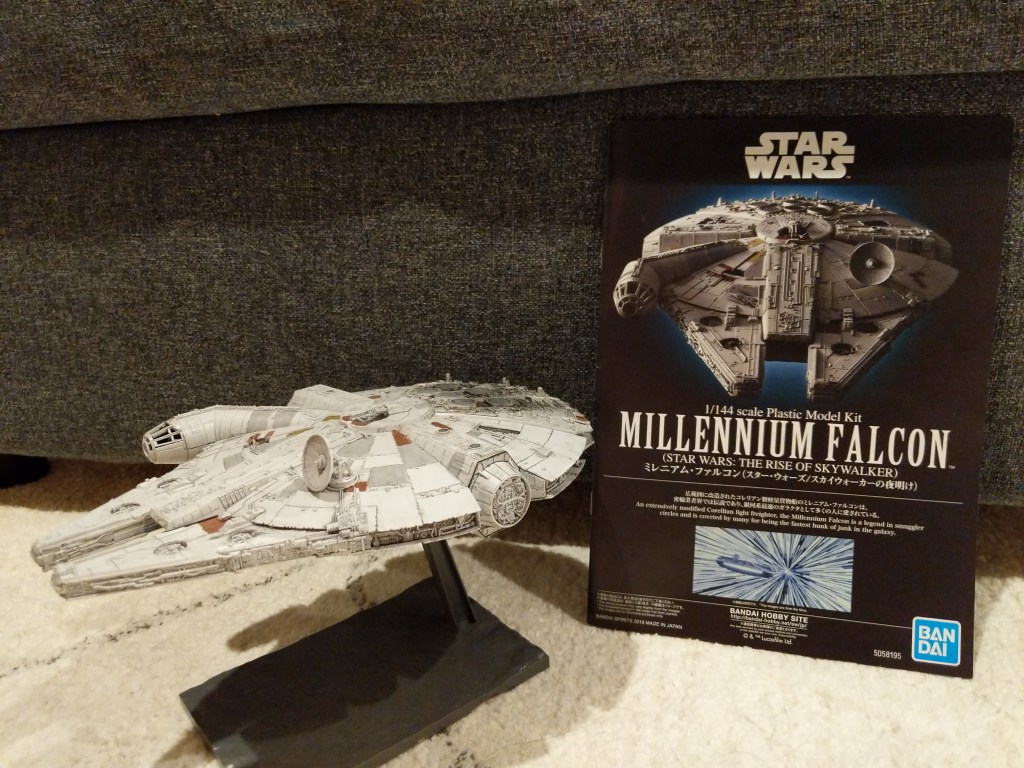
    The photos below show the completed model perched on its included, adjustable stand.
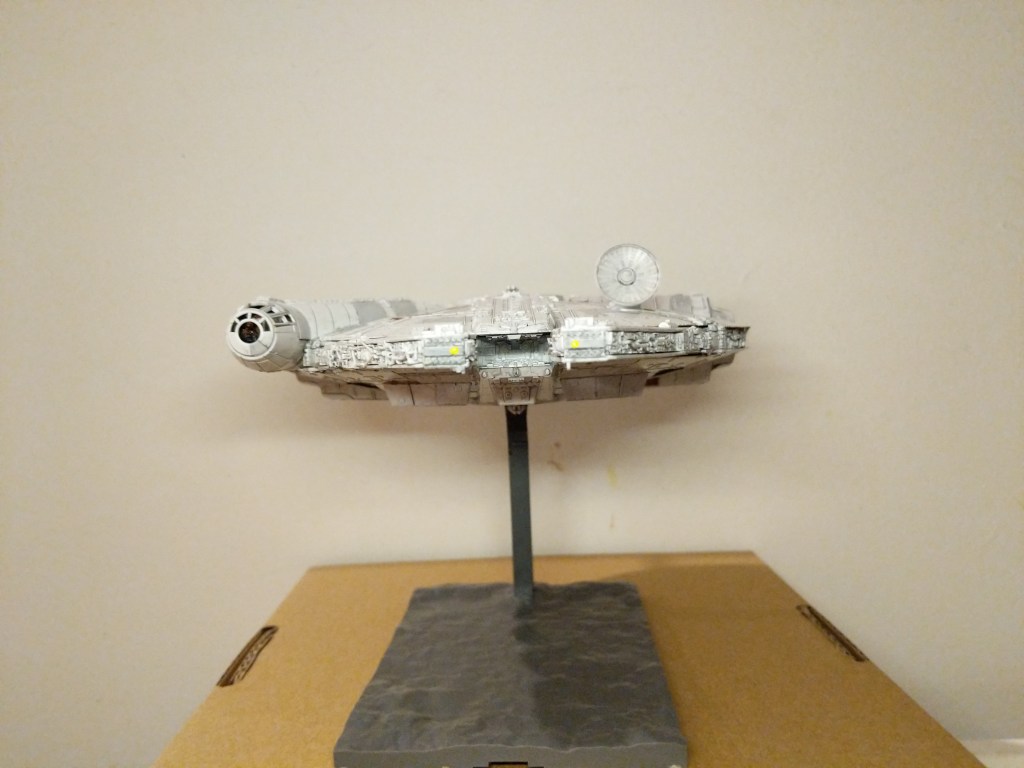
    Overall, Bandai’s model was expertly designed, easy to assemble, and highly respectful of its source material.
    Creating the Composite Image in GIMP

    The Bandai 1/144-scale Falcon sits on my desk to the left of my keyboard between LEGO models of The Mandalorian’s N-1 and the Millennium Falcon from The Force Awakens (It’s safe to say that I aspire to have as cluttered and interesting workspace as Ray Bradbury has in the opening to Ray Bradbury Theater shown here). So, I see it everyday.

    Recently, I was thinking wouldn’t it be fun to use it to create an in-flight image using the model. That stray thought picked up the thread from making the model and began creating a linkage to using the model to create something new–a fantastic image of the Falcon flying in outerspace.

    Looking through my photos, I selected the one below due to it’s orientation and composition within the photo’s rectangular frame.
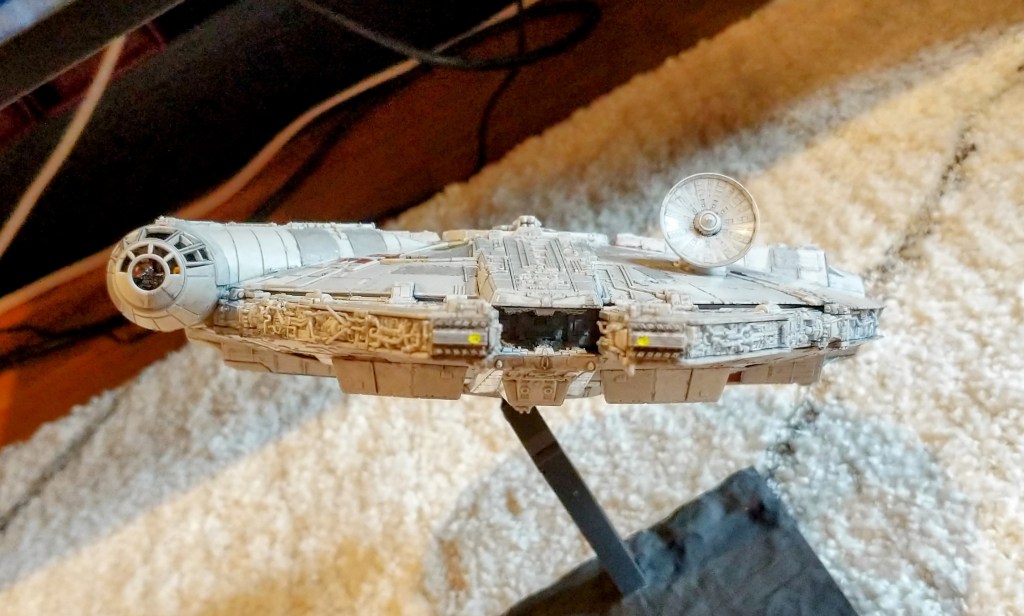
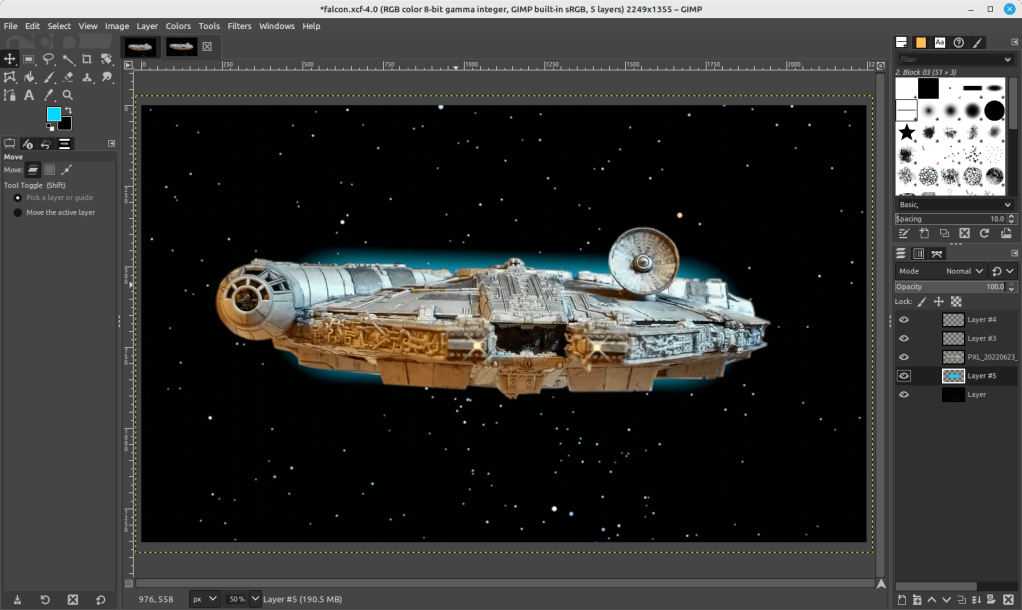
    I cut out the Falcon and added it to its own layer with a translucent background in GIMP. I selected all of the window areas in the cockpit and adjusted the brightness and contrast to make the interior a little more recognizable. Then, I adjusted the shadows and exposure to make the Falcon’s exterior “pop.” Next, I used the clone tool to copy matte colors to hide some of the shinier/mirrored spots (especially in the dish and in the panels directly beneath the dish). And, I used the clone and smudge tools to fill in a gap between top and bottom parts of the cockpit (the black line as seen above).
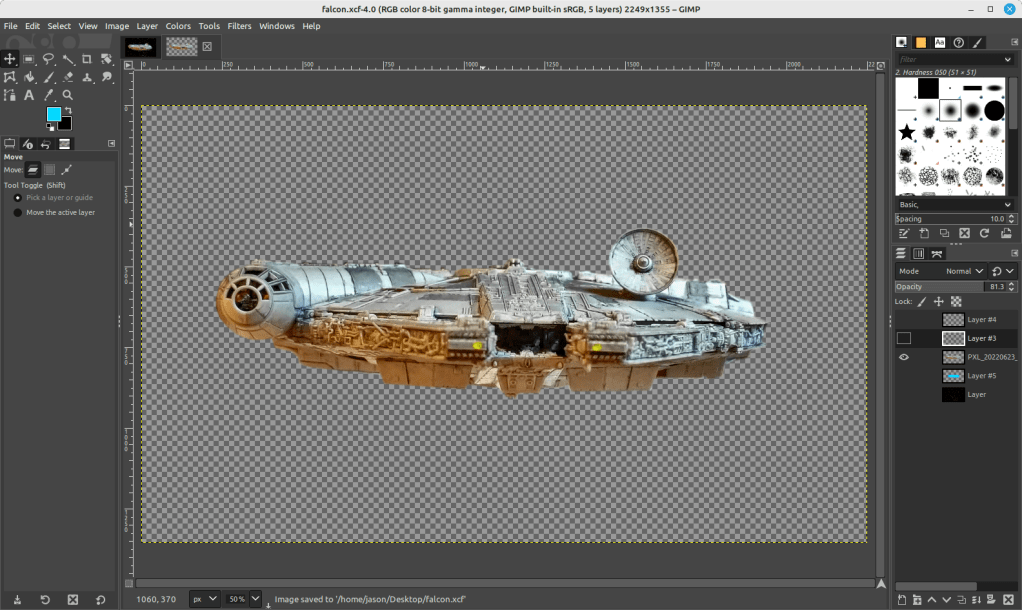
    To put the Falcon in outer space, I created a base layer and pasted a star field image from NASA (found here).
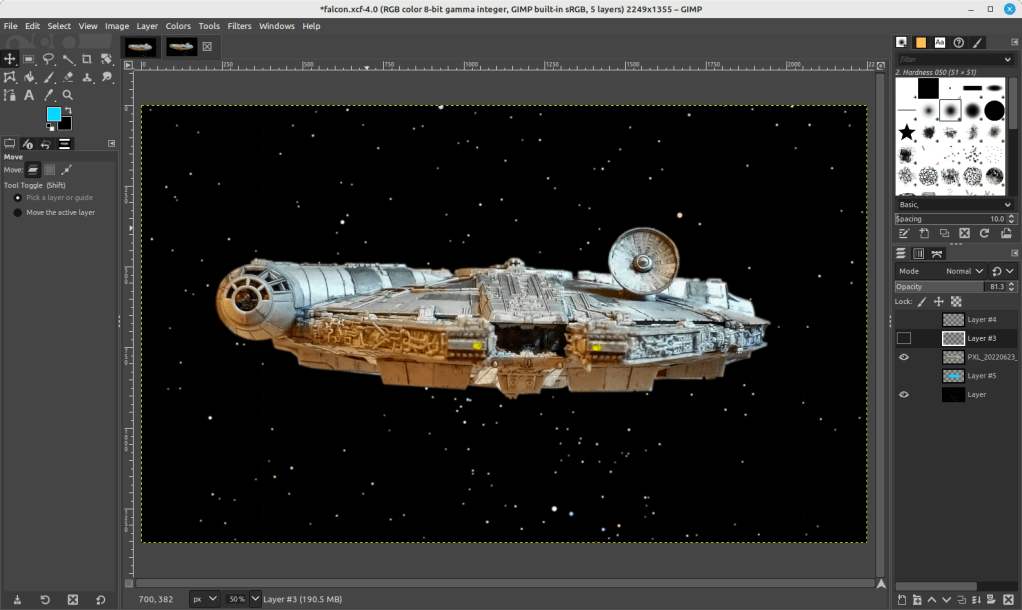
    On the ventral side of the Falcon, you can see that the sides of the lower mandible are catching light that throws off the image if we’re imagining one light source (e.g., a star–of course, there could be two stars, but most of the ventral side of the Falcon is in shadow, so I wanted to stick to that). So I selected those bright areas and then used the clone tool to copy that coloration from either side–the left side looks redder and the right side more neutral–onto its own layer. I set the clone tool to 50% opacity to control the shade as shown below.
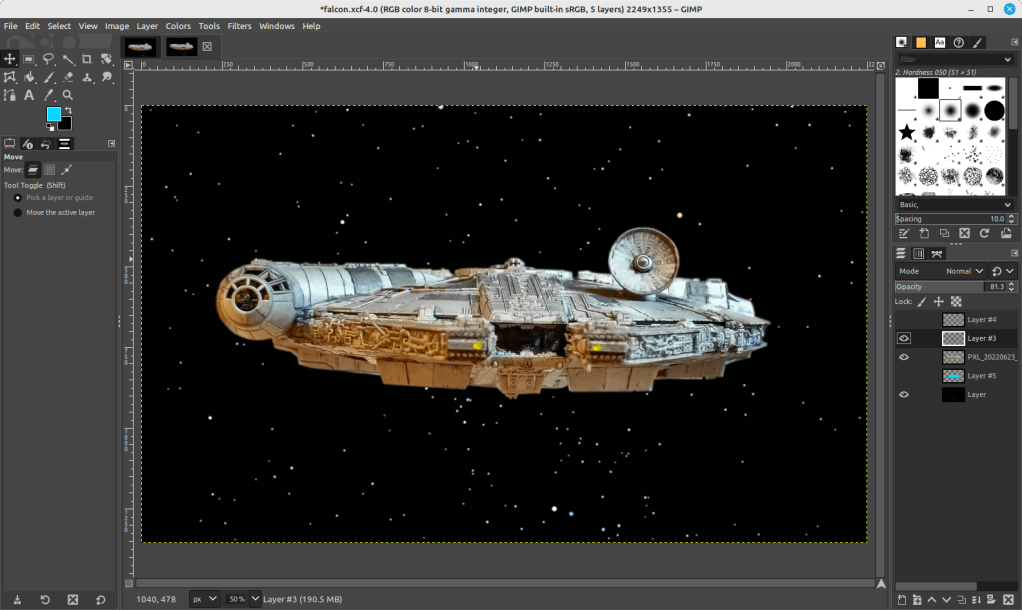
    To make the scene appear more alive, I added layers for the headlights (a center circle of very bright yellow with crossed Block 03 brushes at 45 and 135 degrees for the diffraction spikes with a smidge of Gaussian blur).
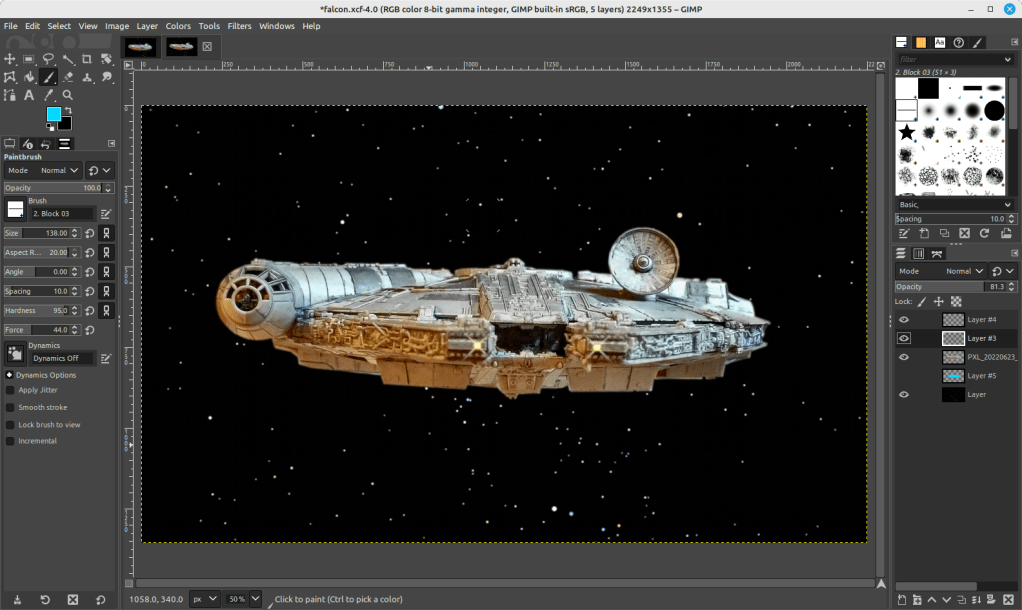
    And finally, the Falcon needs its engines, which I created with a large, single brush stroke with neon blue light (##04d9ff) with 95% hardness but only 44% force (not that kind!).
    Conclusion

    A plastic model building project from the past makes another project of science fictional image manipulation possible. Making in the present is linked to making in the past. This is the general work of culture–linkages up and down time, across geographies and nations, circuitous and not always obvious. This blog post is a microcosm of the macrocosmic work of inhabiting and building our culture. I suggest in closing that we should all reflect and chart these linkages. We might not be able to map them all, but those that we do, pays a debt of gratitude perhaps both ways–we in the present rely on that we are given from the past and the past lives on through the work that we do today.

    Download the full size composite Falcon image here.

  • Updates to the Neuroscience and Science Fiction Literature Chronological Bibliography

    Brain illuminated from within and transparent face. My brain MRI scan used with ControlNet. Image created by Stable Diffusion.

    Following my recent updates of the Generative AI and Pedagogy Bibliography and Skateboarding Studies Bibliography, I’m happy to announce that I’ve made significant changes and additions to the Neuroscience and Science Fiction Literature Chronological Bibliography that I created on 2 April 2015 but hadn’t updated since 2019.

    Overall, the page now has a table of contents that helps with understanding and navigating the page’s wealth of information. In the primary source list, I added headings and dividers for decades and years with the titles in each year being alphabetized by author’s last name. Also, the biggest improvement was reformatting each entry in the latest MLA style with information gleaned from my research and the Internet Speculative Fiction Database. Those stories and chapters that I did not have on hand are therefore listed without inclusive page numbers (I will add these as I source each item). In the secondary sources list, I reordered these alphabetically by author’s last name as these are a reference source and chronology isn’t as important as it is for the primary source list.

    The number of sources listed in the primary source list increased 61% from 103 to 166. Each includes parenthetical notes about the specific brain-related narrative elements. Many thanks to James Davis Nicoll and the commenters on his “Get Out of My Head: SFF Stories About Sharing Brain-Space With Someone Else” (Tor.com, 8 Nov. 2018) article for contributing some of the new titles to the primary source list.

    The number of second sources increased 141% from 17 to 41, which includes a French title that I can’t wait to get my hands on: Laurent Vercueil’s Neuro-Science-Fiction (Le Bélial, 2022).

    I’ll continue adding to this bibliography as well as the others that I maintain as a part of my research interests. If you have a useful source that I should add, please send it my way. Also, I’m open to collaboration, so let me know if you’re likewise inclined and would like to discuss a project!

  • Updates to the Skateboarding Studies Bibliography

    Illustration of skateboarders skating a halfpipe, surrounded by night sky. Created with Stable Diffusion.

    While working on the Generative AI and Pedagogy Bibliography the other day, I realized that I had neglected the Skateboarding Studies Bibliography for the past few years. To bring it up to speed, I updated it with some new rigorous books and articles along with some lighter, reference works for the would-be skateboarder (or researcher who needs the name and steps for a particular trick). The book section more than doubled in size to 33 sources, and the articles and book chapter section grew by a handful to number 87 now. Going forward, I plan to break the bibliography into focused sections as I did on the Generative AI and Pedagogy Bibliography. I’ll post an update when that gets done. In the meantime, I hope that you find something useful to read on the list!

  • Updates to the Generative AI and Pedagogy Bibliography

    A cute humanoid robot writing at a desk with bookshelf in background. Image created with Stable Diffusion.

    Over the weekend, I made some significant updates to the Generative AI and Pedagogy Bibliography and Resource List page, which includes background, debates, teaching approaches, applications, disciplinary research, and a list of online resources. I started it as a place to organize my own research while sharing it back out to others.

    It now features a table of contents at the top of the page under the introduction.

    I added about 50 articles and books to the bibliography, which now contains 232 sources.

    And, I added three links to the resource list at the bottom of the page which brings it to 42 links.

    I will periodically add more entries to the list as my own research progresses. But, it’s important to note that this bibliography isn’t meant to be exhaustive.

  • Tips for Improving Your Writing

    A Victorian cat writing a letter. Image created with Stable Diffusion.

    I often get asked by my Professional and Technical Writing (PTW) students at City Tech how they can improve their writing. As I tell them, there are no shortcuts. Improvement comes from work spread out over time. If you are willing to put in the work over time, you’ll begin to see results in the quality of your writing and the ease with which you write.

    Below are my tips for improving your writing with an emphasis on PTW, Technical Communication, and Professional Writing. They are: find an excuse to write; beg, borrow, and barter for feedback; read as if your life depended on it (because it does); layer your learning; check out Science Fiction; pick up a style guide; and finally, be patient.

    Find an Excuse to Write: Give yourself an excuse to do more writing. Research shows that doing more writing automatically improves your writing ability. You can write privately in a journal, but a public-facing blog gives you a record that you can incorporate into your job search materials and professional portfolio (two birds, one stone). Also, you can create YouTube videos that rely on an outline and script that you write as a part of the production process. Any writing–whether for a written deliverable or part of a multimodal composition process–contributes to developing your abilities. Giving yourself a reason to write will make you much more productive and you might even find enjoyment in the practice. For example, I started dynamicsubspace.net as a place to write about what I learned in graduate school and to give myself regular writing practice. I set goals for myself early on: write a post at least once a week, and later, when my writing had improved, write a post once a day. Pick your own goals for writing frequency, and pick your own writing development goals (are you wanting to learn more about a topic–write content about what you learn, are you wanting to develop a particular writing style–mimic the style of writing demonstrated in a source text–see below, or both).

    Beg, Borrow, and Barter for Feedback: Revising and editing your writing is not as simple as swapping adjectives or changing a few words. Real revision happens when you’re willing to rewrite whole swaths of your work; rethink the overall organization of a document, a paragraph, or a sentence; and begin again with just your idea in mind. Take professional literary writers for example: Many rewrite a single novel from scratch not just once but several times. Each iteration generates new ideas, creates better expression and imagery, and improves the overall narrative. It seems that if a novelist is willing to put in the work to rewrite a whole novel, then it is a small order for us to put in similar efforts of revision into those documents that matter the most to us (especially those documents that make their way into our professional portfolios!). Each of us can revise our own work by returning to it with a critical eye, but there’s a lot that we might miss in our own writing even with this approach. It’s best to ask your classmates, mentors, and family members to read your work and give you constructive critical feedback. What I mean by constructive critical feedback is not just an identification of issues with the writing but also ideas about how to improve it. Since you are asking for someone to give you their time and advice, it’s a good practice to offer something in return–for example, offer to give them feedback on their writing or sweeten the deal with a coffee or slice of pizza. It can be difficult to hear someone trash your writing, but always ask for advice about making it better with the understanding that their feedback is meant to help you improve as a writer. And the fact is that all of us–me included–can improve our writing skills. Improving as a writer is a lifelong task!

    Read As If Your Life Depended On It (Because It Does): Reading in general is good for exercising your mind, learning new things, and observing how others write. But, it is especially important for technical communicators and professional writers to read writing that is like the kinds of writing that they want to be doing. Furthermore, you need to reflect on not just what is written (content) but how it is written (style), and imitate the latter in your writing practice (above). While he’s primarily focused on literary writing, Ray Bradbury’s points about how to become an accomplished writer in his book Zen in the Art of Writing has many relevant points to make if instead of thinking about writing as only by literary artists but also by professionals who write for other purposes, such as providing the right information to the right audience at the right time. Other places to learn content and style in the specialization that you’ve selected in the major: books (can be technical or written for a lay audience), journals (peer-reviewed and research-based publications), trade publications (like magazines but focused on topics of interest to professionals in that field), and magazines (less technical than trade publications but with a similar focus).

    Layer Your Learning: It’s important for technical communicators and professional writers to learn how to use the tools of writing and multimodal composition inside-and-out. Pick a tool that you might not know well or at all, and learn how to do specific things with it. For example, watch tutorials on YouTube or LinkedIn Learning (free through the NYPL) about tracking changes in Microsoft Word. Practice what you’ve learned on some of your existing documents that you want to revise. Then, write a blog post with screenshots that summarize some of the techniques that you’ve learned. Meet up with some friends in the PTW Program to teach them what you have learned. Then, you and your friends can plan out and shoot your own YouTube video teaching others how to use the basics of Word’s Track Changes. So, what’s going on here? First, you gain theoretical knowledge about Word’s Track Changes. You gain practical skill or application of that knowledge by practicing those techniques on your own documents. You begin integrating what you’ve learned by writing a guide or instructional blog post. You fully integrate what you’ve learned by teaching it to others. Finally, you help your friends gain their own mastery over Track Changes by planning (script, storyboard) and shooting a YouTube video with the additional bonus of you taking leadership of a project that you can mention in your professional portfolio.

    Check Out Science Fiction: Many technical communicators and technical writers also enjoy reading Science Fiction (SF). SF is a literature that explores the effects of science and technology on human beings and society. It’s written for non-specialist audience, so the SF writer has to communicate technical topics in a way that a broad range of readers are able to understand those topics and how they relate to the story. Communicating complex topics to different audiences is key to the work that we do in PTW, so there are techniques and approaches that we can learn from SF if we pay attention to how those writers accomplish those tasks, reflect on how they do it, and practice what we observe in our own writing. There are many ways to experience SF literature: books (check out for free from the library or purchase a novel from a bookstore–2nd hand bookstores are a great resource for this!), magazines (look on the magazine racks at the big bookstores for Analog Science Fiction and Fact, Asimov’s Science Fiction Magazine, The Magazine of Fantasy and Science Fiction, Amazing Stories, and Clarkesworld), and online (strangehorizons.com, lightspeedmagazine.com, tor.com, and freesfonline.net).

    Pick Up a Style Guide: There are many professional style guides that provide rules about how to write in that field, cite sources, and format documents. You’ve probably heard about the style guides of the Modern Languages Association (MLA) or the American Psychological Association (APA). Each have their own rules that govern writing, formatting, and documenting. In the professional world, you can’t mix and match style guides. If you are writing for a publication that states you must use MLA style, then you have to follow MLA or you risk your article being rejected. Also, workplaces and some publications might have their own style guide–an internal document that borrows from other styles but with significant and important changes that you will have to apply to your writing. As you learn more about your specialization, you’ll identify what style guide or guides are the most used. Those are the ones that you want to learn as much about. Thinking about writing practice, you should apply those styles to your writing so that you memorize perhaps not everything about the style but enough of the most important aspects of it. In addition to style guides that you can buy from a bookstore or check out from the library, there are simplified online guides that can help you get started but be aware that these online guides likely don’t cover everything that is contained in the printed guide! A good starting point is the Purdue Online Writing Lab (Purdue OWL), expand the menu items on the left for Research and Citation (for style guides) and Subject-Specific Writing (for stylistic concerns in different fields).

    Be Patient. It takes time and effort before you begin to see results. What’s going on is that your brain is rewiring itself in response to your life and its experiences. If you choose to spend more time writing, reading, and learning, then your brain will develop to support those kinds of experiences (what you write is clearer and audience directed, it gets easier to write more than in the past, you have more things to write about from what you’ve learned, etc.). If you choose instead to spend more time playing World of Warcraft, then your brain will develop to support that experience instead (perhaps improving your memory of where to complete quests, how to maximize your armor, improve your team playing skills, etc.). One experience isn’t necessarily better than the other. It’s just that they are different choices and priorities. If you want to improve as a writer, then you should choose to do things, such as what I suggest above, that engage you as a writer, thinker, learner, and collaborator. Throughout this process of making choices to support your writing skill, you will need to be patient. While our brain is constantly changing in response to our experiences, it takes time for those experiences to solidify into memories and heuristics that support our writing activities. Improvement will happen–just keep at it over time.