Author: Jason W. Ellis

  • LEGO Skateboarding Vert Ramp and Street Skating MOC, and Exploring Connections Between Skateboarding and Making

    img_20190103_223812
    My Skateboarding Vert Ramp and Street Skating Model

    I began this new LEGO MOC (my own creation) project while reading Michael Brooke’s The Concrete Wave: The History of Skateboarding (1999) and after assembling my Mike McGill re-issued skateboard.

    Some ideas from skateboarding culture inspired this project. First, there’s the tension between Thrasher’s “Skate and Destroy” and Transworld Skateboarding’s “Skate and Create.” The former appearing in the December 1982 issue and the latter appearing in response in its first issue in May/June 1983. When I first skated, I didn’t know about this difference of ethos, but I can say that I was drawn to reading Transworld Skateboarding more so than ThrasherTransworld’s ethos of making something from the act of skateboarding fits well with my own attitude of doing good in the world through teaching and making (as opposed to wrapping the act of destruction into an aggressive skating attitude–understanding, of course, there is a certain amount of hyperbole in this motto and more back story worth investigating–see the interview by Adam Creagan with Craig Stecyk in Thrasher March 2010, pp. 80-81, and Konstatin Butz’s Grinding California, pp. 73).

    Second, many skaters talk about riding as an act of self-expression, creativity, and doing. While the act of skating is ephemeral, skaters build analogies between the sport and other creative endeavors such as writing, playing, painting, expression, and language. For example: Rodney Mullen writes, “[Skateboarding] has been the arena where I could stake my claim, the play where I would contribute my verse, and even the pen with which I write” (qtd. in Brookle 11).  Chris Long writes, “‘How glad I am that I skateboard’ . . . finding my own lines and creating my own ways of playing” (qtd. in Brooke 173). Darrel Delgado writes, “Skateboarding in a pool is like being a painter, and every new pool is a blank canvas and you are the artist. Every artist has a different approach and every pool is different, which keeps the intrigue alive. You can go wherever your mind and the transitions will let you go” (qtd. in Brooke 135). Mike Valleley writes about finding skateboarding, “I got an identity and something productive. It was creative, physical activity and I used my entire being to do it” (qtd. in Brooke 137). Tony Alva writes, “Just do something that’s in tune with an individual type of expression. I think that’s what’s so important about skateboarding” (qtd. in Brooke 175). Dave Hackett writes, “Pure and simple, [skateboarding is] a healthy, radical art form. . . . Skateboarding utilizes the every-expanding environment of steel, concrete, plaster, or wood as its canvas. . . . The skater becomes one with his board, while the board in turn translates the language of the terrain” (qtd. in Brooke 176). On these points, I think skateboarding and LEGO building overlap–in both cases, skateboarding and making, the fulfilling goal is creative and imaginative expression through a given medium–the former being the assemblage of body, skateboard, and terrain, and the latter being the assemblage of builder and brick.

    I wanted to combine different aspects of skateboarding into a single model. I grew up with street skating, because there weren’t any local skate parks (though, I have discovered in my research that there was a skate park in Brunswick in the late-1970s called Nova Skate Park–more on that in a future post). But, I always wanted to skate vert and pipes, so I thought about combining what I knew with what I wanted to learn.

    I got the idea for the ramp’s vert and transition design from LEGO 60200 Capital City set, which has one component that is a combined skateboard ramp/wall climb/basketball court. It uses dark grey inverted arches for the transition, which I agreed was the best choice of brick–albeit in tan color to emulate the color of wood–for the ramp that I had in mind.
    img_20190104_172507
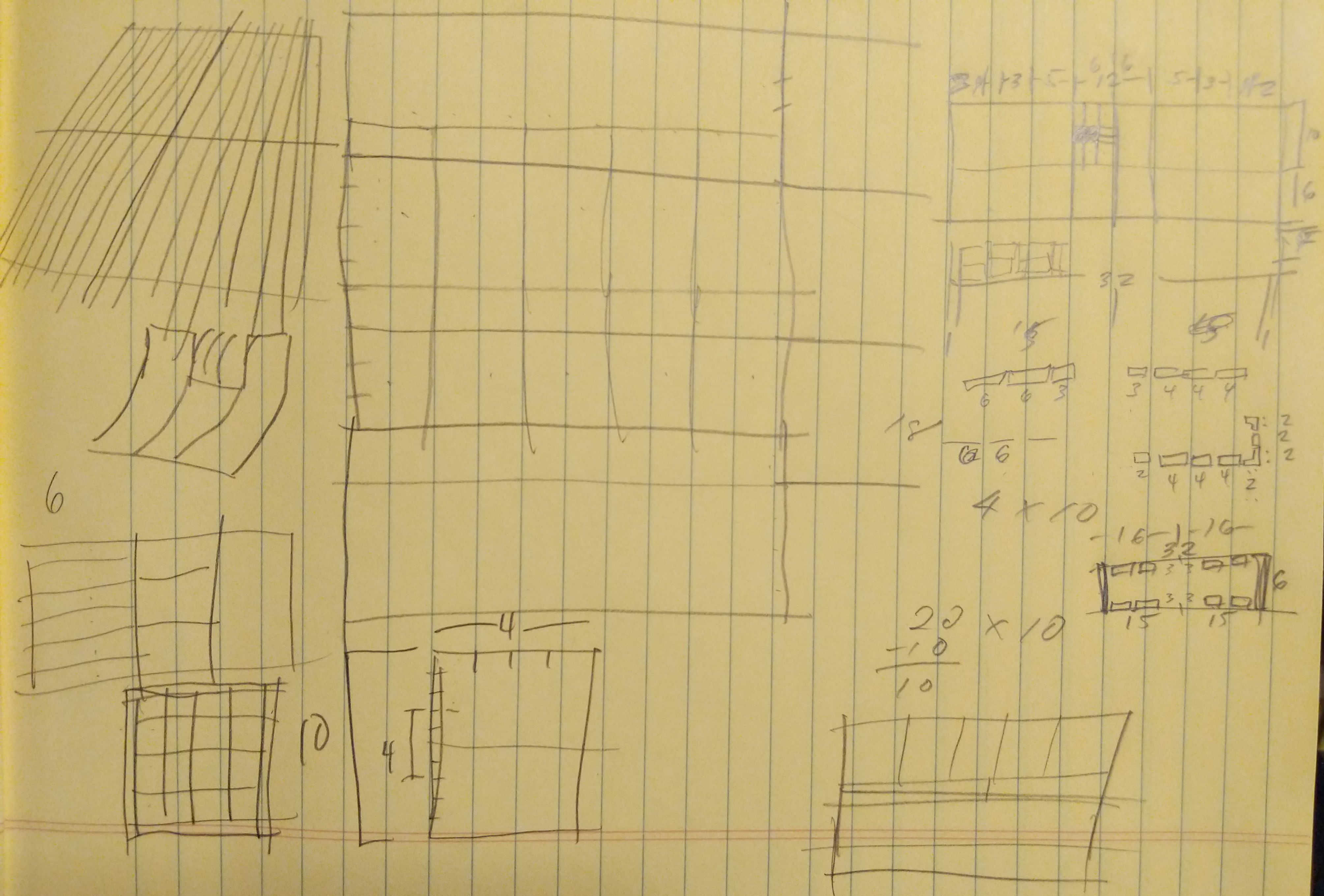
    Brainstorming and calculating dimensions in studs. 

    The next consideration was how large a model to make. I knew that I would have to purchase the inverted arch bricks for the ramp, so I looked for a seller with a good price and selection of elements that would help me realize the idea crystalizing in my mind. Alphabrix, a seller with great feedback had 20 tan, inverted arch bricks, which would let me build a 10-stud wide ramp. I figured that its length should be at least double its width, if not more. Ultimately, I settled on a 10-stud wide ramp with a 28 stud length including both tables. This allowed two studs on either side of the ramp for stairs if I went with an overall length of 32 studs for the model. Since I opted for a 32 stud length, I figured that a 16 stud width for the overall model would be enough to add a street skating scene in the model’s foreground.

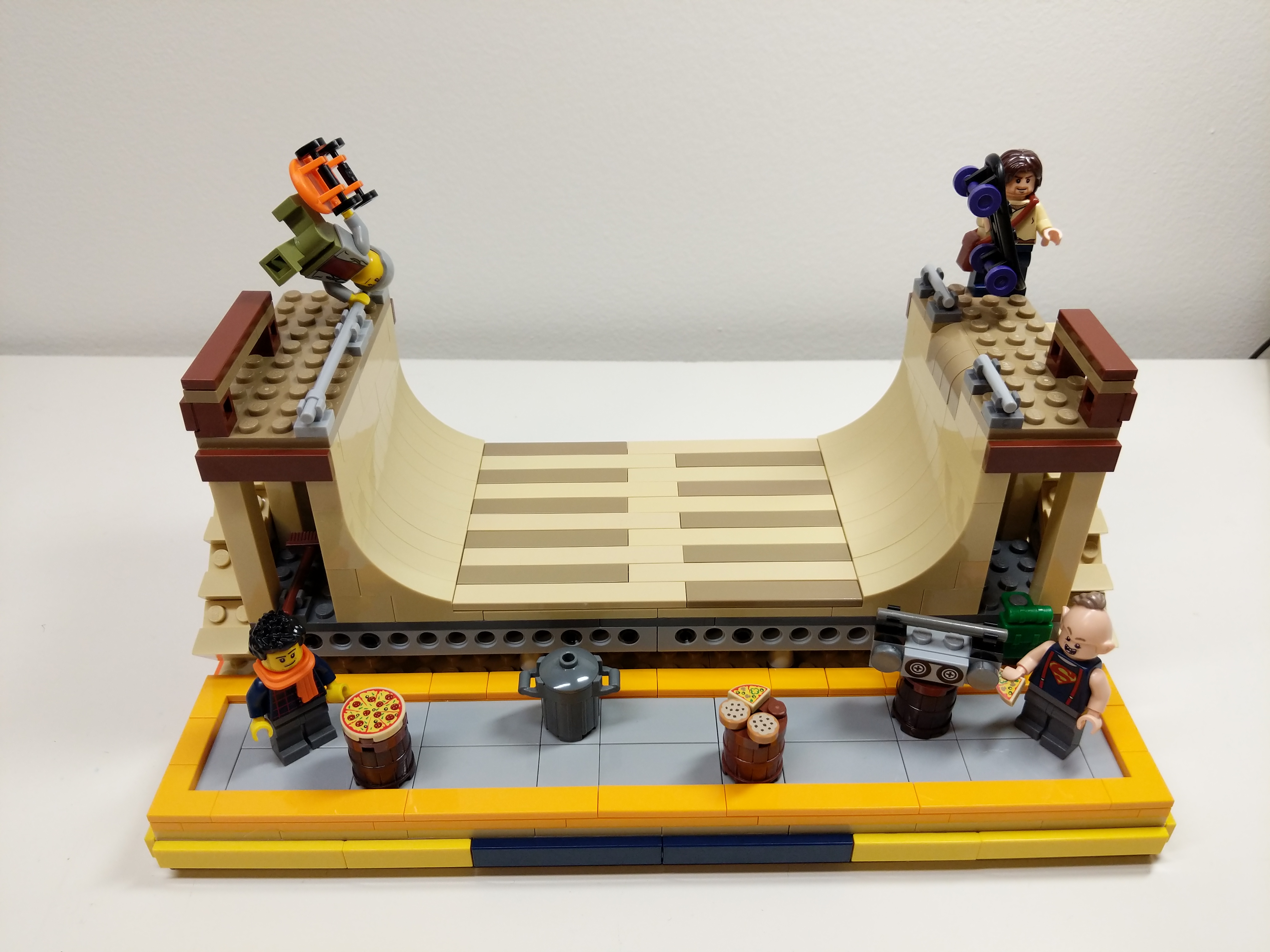
    After receiving the Bricklink parts and sorting out some necessary elements from my collection, I built the vert ramp first. Even though this would occupy the rear part of the model, it would dominate the model and be its focus. I wanted to get it right. I thought about how I would build a real one. I wanted a steel foundation that would be elevated off the ground. The ramp and tables would be made out of wood. As a new ramp, I wanted to give it a little bit of style with alternating color–light and dark tan tiles emulating different sheets of plywood. On the right side, I wanted a sloping launch that divided two drops on the front and back–this was a ramp design that I saw many years ago that gave the skaters a divided coping for new trick opportunities.

    With the vert ramp complete, I turned my attention to the base and its foregrounded street skating area comprising 6 studs by 32 studs. The bottom of the base are dark grey plates supporting a circumference of Technic bricks and filled in with 2 x 4 bricks. I covered the surface mostly with tan 4 x 6 plates. I built up a curb with 1 x 4 and 1 x 6 bright yellow plates covered with the same colored tiles. Within that area, I filled in with a single layer of light grey tiles–some with single studs and the rest without to allow placement of obstacles like barrels and trash cans, which can be skated around or ollied over. Finally, I put concrete cones down to support the ramp behind the street skate area.

    Finally, I combined the vert ramp with the base and its street skate area. I used yellow, dark blue, and orange tiles to skirt the Technic bricks around the base. The vert ramp’s coping permits posing of skaters doing hand plants. In the foreground, I added a stereo (probably playing an eclectic mix of They Might Be Giants, The Beastie Boys, and Technotronic) and snacks including pizza and cookies (shredding fuel).

    Usually, it takes me several days to weeks to complete a build like this, which I have chronicled on other blog posts. However, I built this model in a single evening. I think my mind had been working on the project while I waited for the needed bricks to arrive in the mail. Even though I wasn’t haptically manipulating the bricks in my hands, I was daydreaming and imagining how to put the model together at odd times between placing the brick order and receiving them in the mail.

    While imagining myself shredding on my completed LEGO skateboarding model and thinking about picking up my McGill deck to hit the streets with, I’m reminded of the Kevin J. Thatcher’s first editorial in the January 1981 issue of Thrasher: “The average individual was never properly exposed to the unlimited possibilities of a platform with four wheels under it–a simple basic mechanical device which serves as an energy-efficient mode of transportation, a basis for a valid sporting activity, and as a vehicle for aggressive expression. . . . Thrashing is finding something and taking it to the ultimate limit–not dwelling on it, but using it to the fullest and moving on. Skateboarding has not yet reached its maximum potential, and who can say what the limits are? To find out–Grab that board!” (6). Grab that board, grab that LEGO brick, grab that camera, grab whatever it is that you can express yourself with, because that is the thing with which you can leave your mark on the world.

    Works Cited

    Brooke, Michael. The Concrete Wave: The History of Skateboarding. Warrick Publishing, 1999.

    Butz, Konstatin. Grinding California: Culture and Corporeality in American Skate Punk. Transcript Verlag, 2012.

    Creagan, Adam. “Skate and Destroy: The Stecyk Scrawl Lives On.” Thrasher, March 2010, pp. 80-81.

    Lowboy. “Skate and Destroy, or Multiple Choices (Something to Offend Everyone).” Thrasher, December 1982, pp. 24-29.

    Thatcher, Kevin J. “Talking Ed.” Thrasher, January 1981, pp. 6.

    Tracker Peggy (Peggy Cozens). “Skate and Create.” Transworld Skateboarding, May/June 1983, pp. 13-15.

  • Miao Miao (2005-2018)

    IMG_5118
    Miao Miao taking a nap in 2012.

    Our little cat Miao Miao passed away on December 26, 2018 after a battle with cancer. She was 13 years and 8 months old. Y rescued Miao after her mother had abandoned her when she was only a few weeks old in 2005. She was sick and small, but Y nursed her back to health and adopted her as part of her family.  I came to know Miao beginning in 2008, after I met Y at Kent State. Soon, I became a part of the family, too. Miao was strong willed but also very loving. When we had guests over, she was an enthusiastic host. She brightened our days, which now seem diminished without her around. Even though Miao never really took to our younger cat Mose, we can tell that he grieves in his own way for her, too. She will be dearly missed.

  • Memories of Skateboarding and Nostalgic Assembly of a Re-Issued Mike McGill Powell-Peralta Skull & Snake Skateboard

    complete-mcgill-skateboard-top-and-bottom.jpg
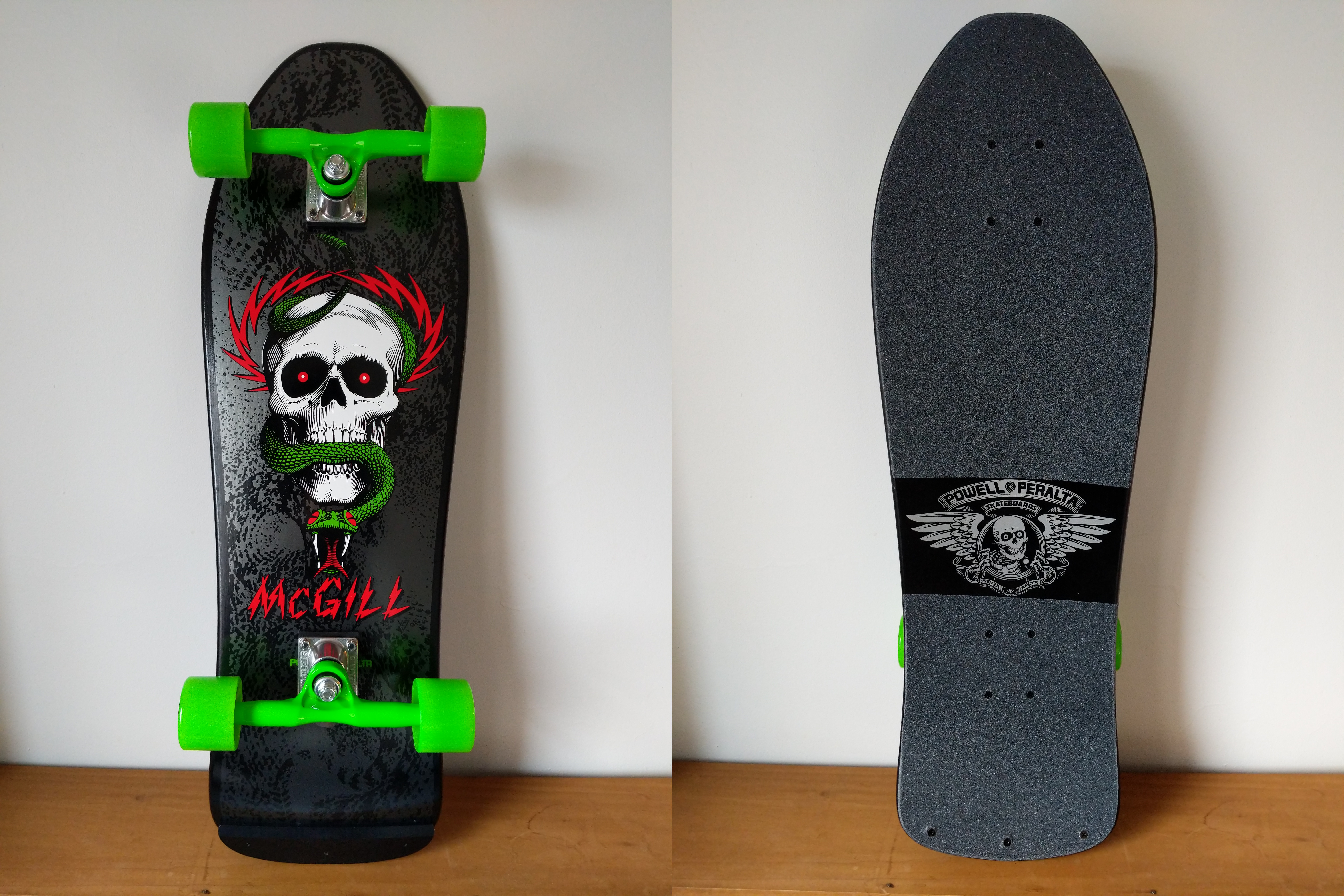
    My Mike McGill Pro Model “Skull and Snake” Re-Issue Series 5 by Powell-Peralta, Complete with Gullwing Pro III Trucks and Sector Nine Nineballs Wheels.

    This is a long read that combines autobiography, nostalgia, memory, and instructions. Visitors here might find it interesting and informative. My students might use it as a model for some of their own multimodal writing about memory, processes, instructions, and reflection.

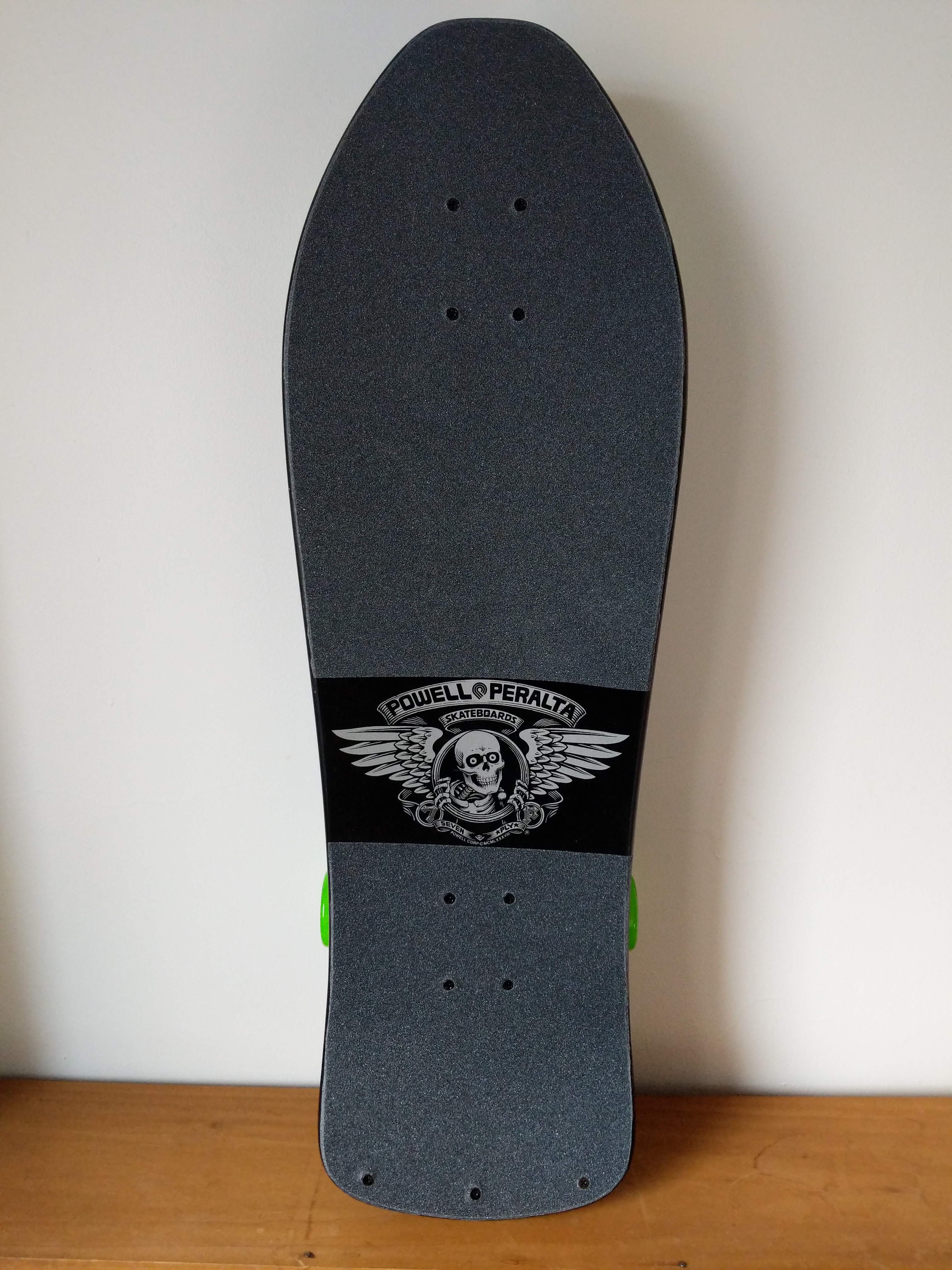
    While it has been over 25 years since I last rode a skateboard with my hometown friends, I recently felt drawn to the 7-ply deck once again and decided to assemble a board similar to my second skateboard–a 1990 Powell-Peralta Mike McGill pro board with VCJ’s Skull & Snake graphics, fish shape, nose and tail kicks, natural wood grain with Gullwing Pro III trucks (red), and Powell-Peralta Rat Bones wheels (neon green).

    Before I got my original McGill deck, I learned to skateboard on a Teenage Mutant Ninja Turtles complete skateboard that my grandparents–Wilma and Papa Gerald–bought for me from the Wal-Mart on Altama Avenue in Brunswick, Georgia (since replaced by a Supercenter about a mile away, and then the original site re-built as a Neighborhood Market a few years ago).

    With the TMNT skateboard, I learned how to balance, turn, and ride on my grandparent’s back car port. At first, I held on to a broom handle to steady myself until I felt confident enough to ride without this support. I don’t think I had a helmet, but I did have pads and wrist guards–the former store bought neon green plastic over black, and the latter used, red, gifted or traded for–I can’t remember.

    I rode and shared the TMNT skateboard with my friends who I paled around with when I stayed at my grandparents. However, I wanted to learn how to ollie and do tricks, but I found this to be next to impossible on the heavy, tank-like TMNT board. This is what began my search for a better board, relying heavily on the photo stories and advertising in magazines such as Transworld Skateboarding and Thrasher, and eventually led to me mail ordering the McGill deck and new hardware (was this a Christmas gift from my grandparents or my folks–again, my memory falters).

    With the new McGill, I continued skating through the beginning of high school, but I drifted away from the sport when I got more interested in books (physics first, science fiction second), computers (Amiga, IBM-compatible PCs, and eventually, Macintosh), and cars (my first being a 1965 Ford Mustang, but always having a soft spot for the small Toyota pickup trucks that I used to deliver auto parts from my family’s business).

    I don’t remember what became of my McGill. I suspect that I gave it to a friend before going to college where I really got into Rollerblading, but my memory fails completely on this point. I hope that I can remember what happened to my old McGill skateboard, not because I want it back, but instead simply to recall that moment in my life’s narrative. Related to this is the fact that I don’t seem to have any photos of me with my skateboard (though I do have a photo of me holding my Rat Bones wheels on Christmas Day). It’s an odd omission in the photographic record of my life of something I considered important to me at that early time in my life.

    hackers-the-plague-mcgill-skateboard.png
    In the film Hackers (1995), The Plague (Fisher Stevens) rides into the NOC on a McGill skateboard while Hal (Penn Jillette) studies the situation.

    My re-interest in skateboarding began when I was watching the film Hackers (1995) in HD. I don’t think it registered with me when I first saw it when it was originally released that the film’s villain, The Plague (Fisher Stevens), rides into his company’s NOC (network operations center) on a McGill skateboard (see above).

    Then, I caught up with my oldest best friend Bert over the phone. He lives in Seattle now, but back in the day, we used to skateboard in his neighborhood. Bert was a much better skater than me. Our conversation drifted back to skateboarding, including the time that he and I were stopped by a cop on our way back from a Hampton Inn construction site. The obese, good ol’ boy police officer asked us questions about what we had been doing and he stopped when he pointed his flashlight on our boards. Bert skated Vision, and I skated Powell-Peralta. The cop took a breath through his teeth and said, “now boys, I’ve done heard things about that POW-ell Per-AL-ta. They’s devil worshipers!” Bert and I smiled and nodded until he let us go on our way back to his house, but it’s a strange encounter that’s stuck with me.

    Our phone conversation encouraged me to begin searching the web for information about my old skateboard. This led me to the Bones Brigade video The Search for Animal Chin (1987), which I shared with Bert via text message. By this point, I was thinking and spending more free time learning more about skating history and its evolution after I had left the sport.

    While I was already burdened by a big research project on computers in science fiction from 1975-1995, which I’m continuing to work on, and the Third Annual City Tech Science Fiction Symposium, which I was organizing, I wanted to give myself something on the horizon to look forward to as a reward for this work. I decided to get the parts to build a new, complete skateboard similar to one that I had to before without breaking the bank, so I turned to eBay after striking out with the major skateboard online retailers and local shops, such as Uncle Funky’s Boards.

    mcgill-skateboard-top-and-bottom.jpg

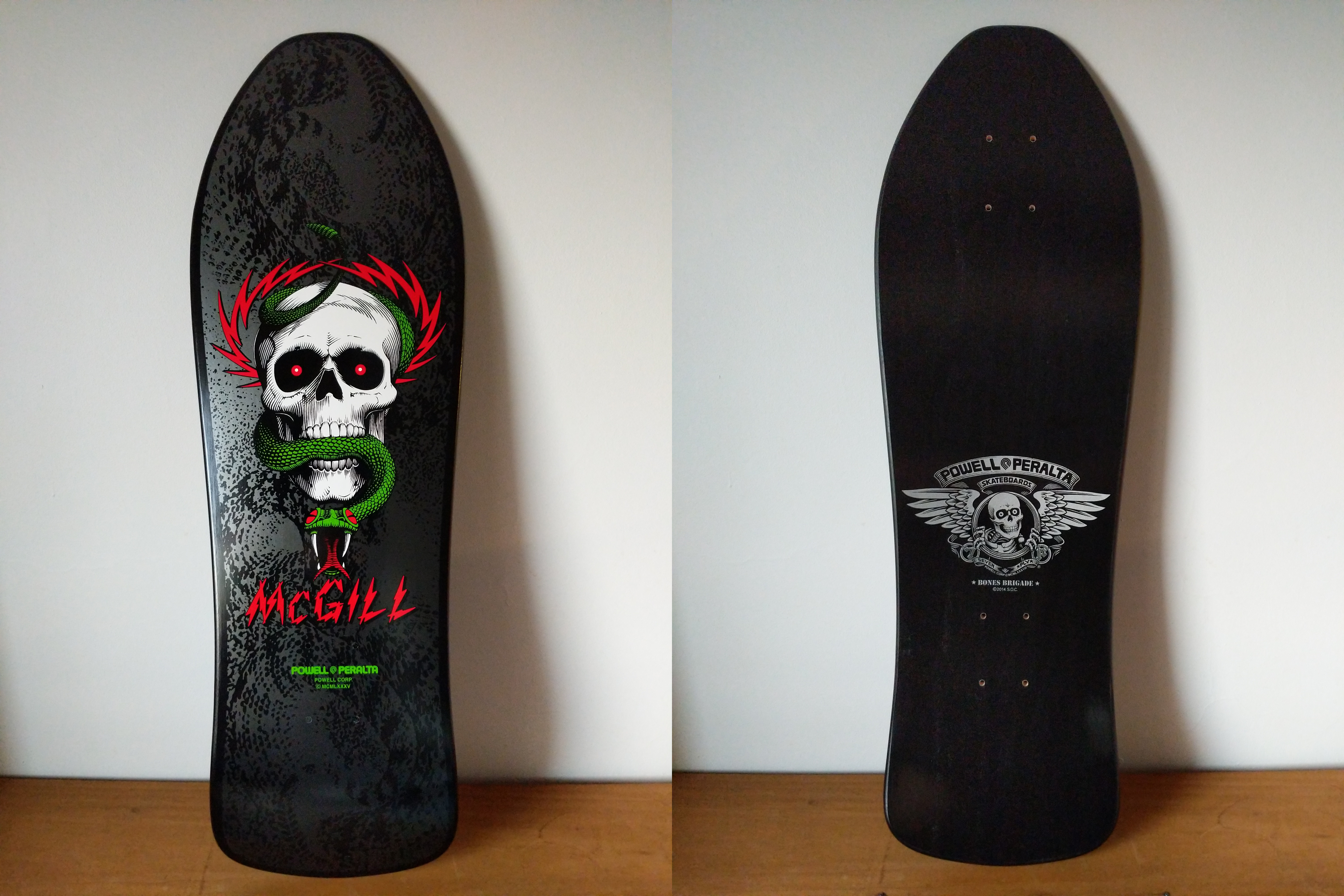
    While I couldn’t find my original McGill with a natural finish, I did find this brand new, black dipped, Series #5 re-issue on offer by a seller in Puerto Rico. We negotiated a best offer price, and I received it before anything else.

    IMG_20181208_154036.jpg

    I picked up a Gullwing Pro III trucks, wheels, bearings, risers, hardware combo from Raptorunner in Riverside, CA, and I ordered a Powell Peralta Tailbone and Jessup grip tape (and a helmet and pads) from TGM Skateboards in Mount Clemens, MI.

    IMG_20181208_154142.jpg

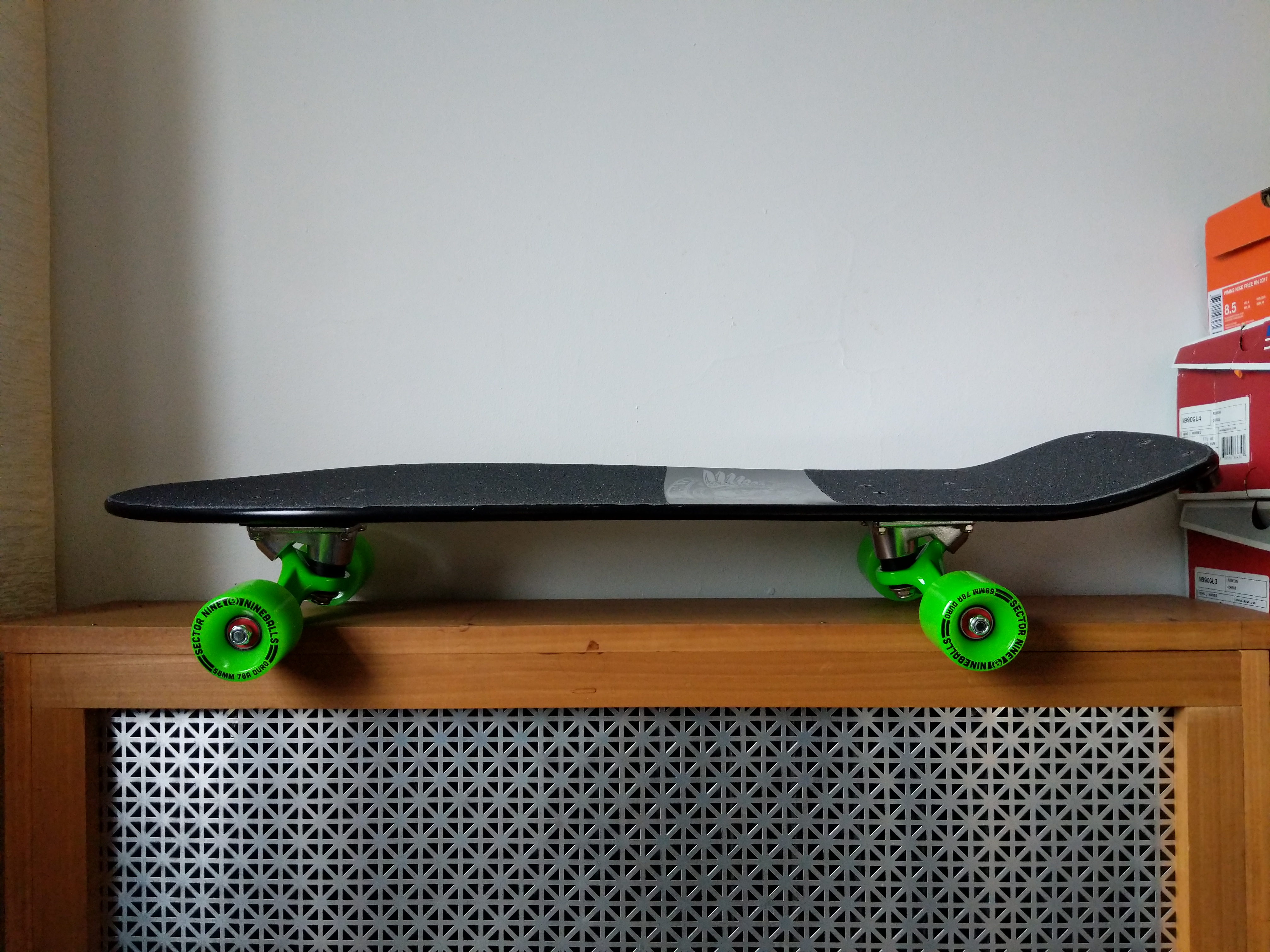
    My original Gullwing Pro III trucks were cherry red and stood out well against the natural grain of the board. I liked these new 9″, 155mm neon green ones, because they stand out against the black background on the new, black McGill deck. Also, my re-issued McGill deck uses the old truck bolt pattern, so I chose between these (note that the base plate has six bolt holes instead of four–to accommodate both old and new bolt patterns) and Independent Stage 11 169mm trucks. Ultimately, I opted for the Gullwings since I skated with them before.

    IMG_20181208_154216.jpg

    Raptorunner had several different truck, wheel, and hardware bundles. I chose this one, because it had these Sector Nine Nineballs wheels. They aren’t too big (I would have preferred 56mm) and they are real soft (78a), which will be good for the street crusing that I intend to use the skateboard for.

    IMG_20181208_155501.jpg

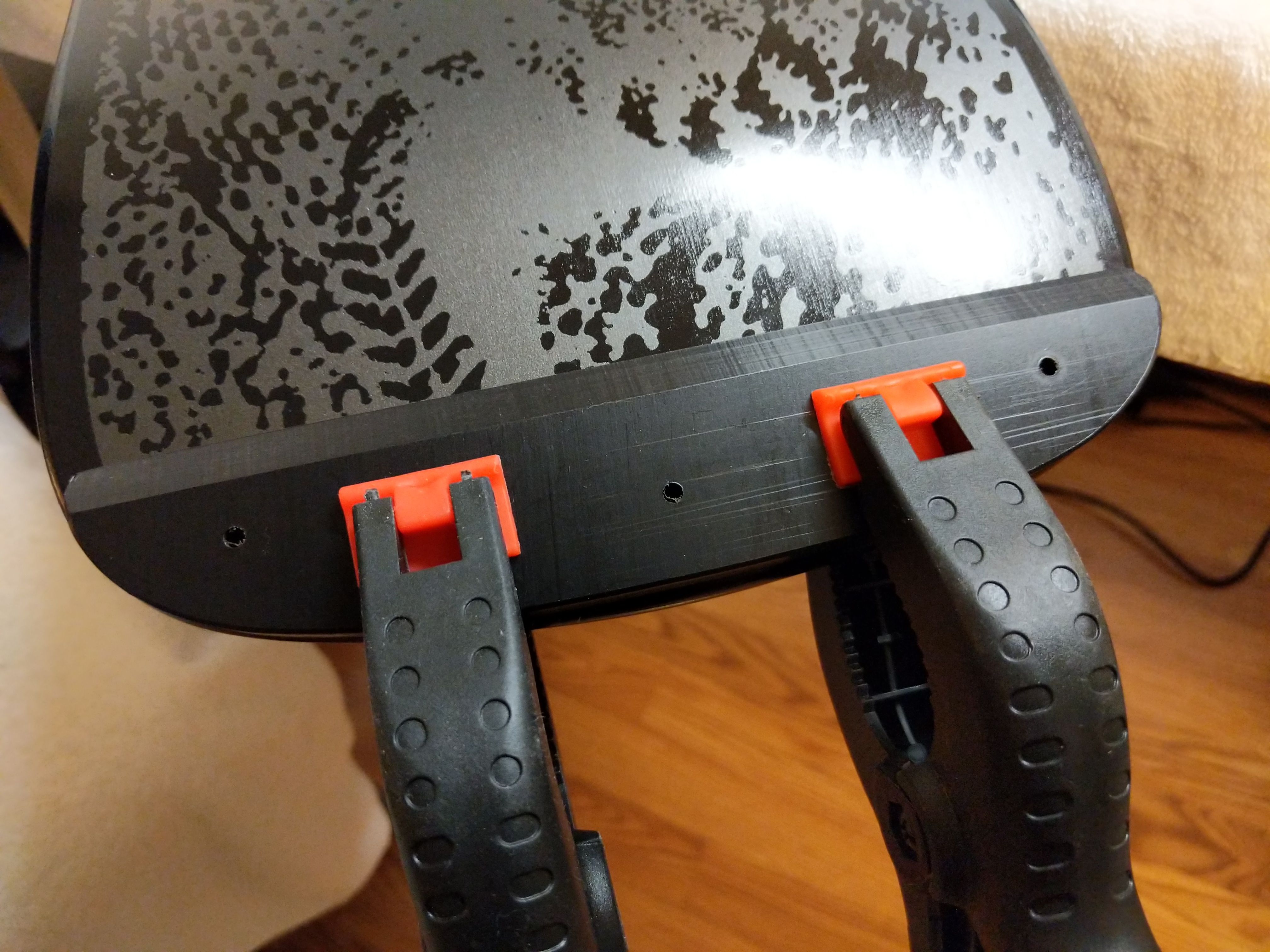
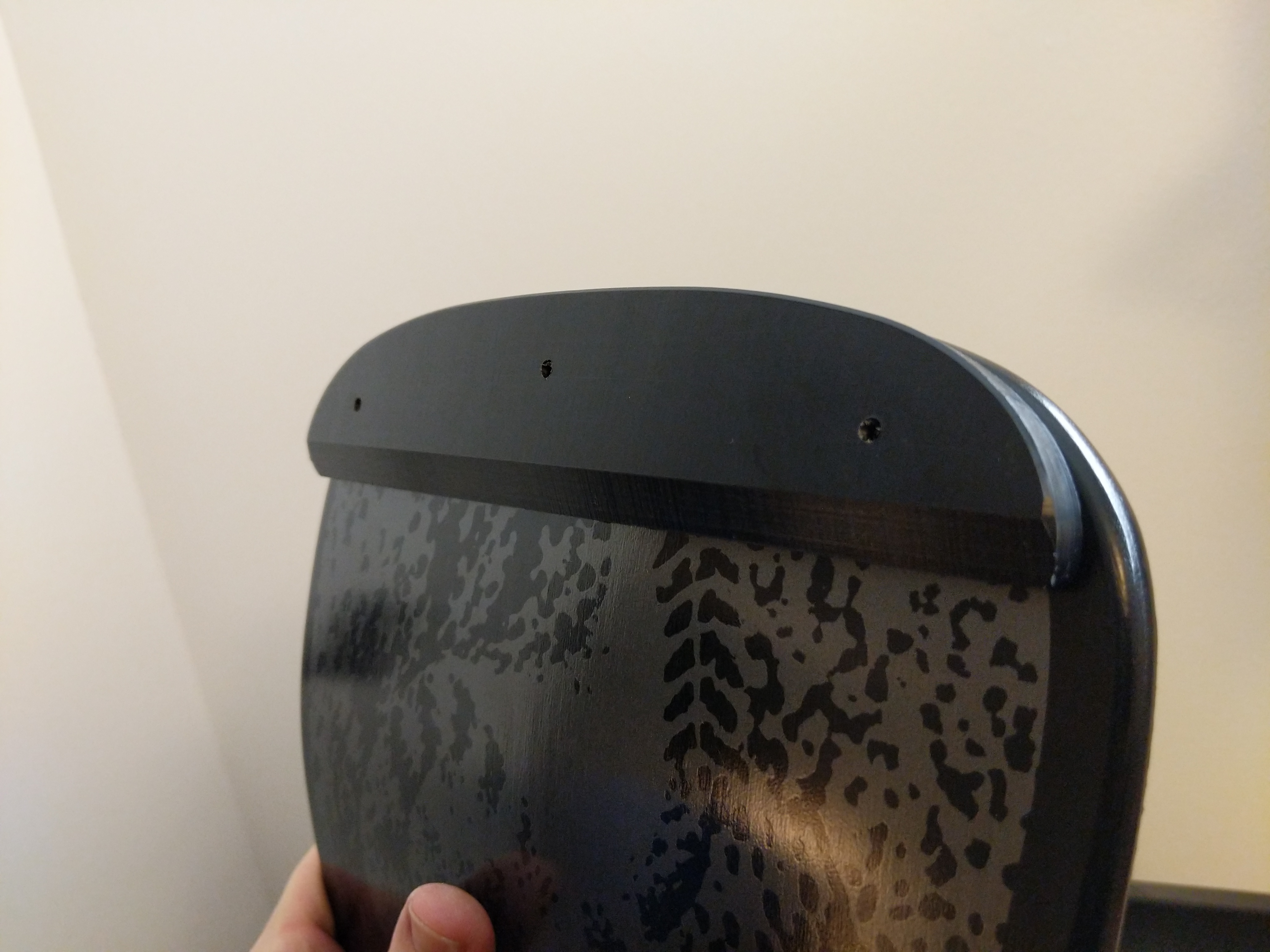
    To begin my skateboard’s assembly, I began with the Tailbone before applying the grip tape. I clamped the tail guard to the bottom of the deck’s tail and measured to ensure it was centered.

    IMG_20181208_160002.jpg

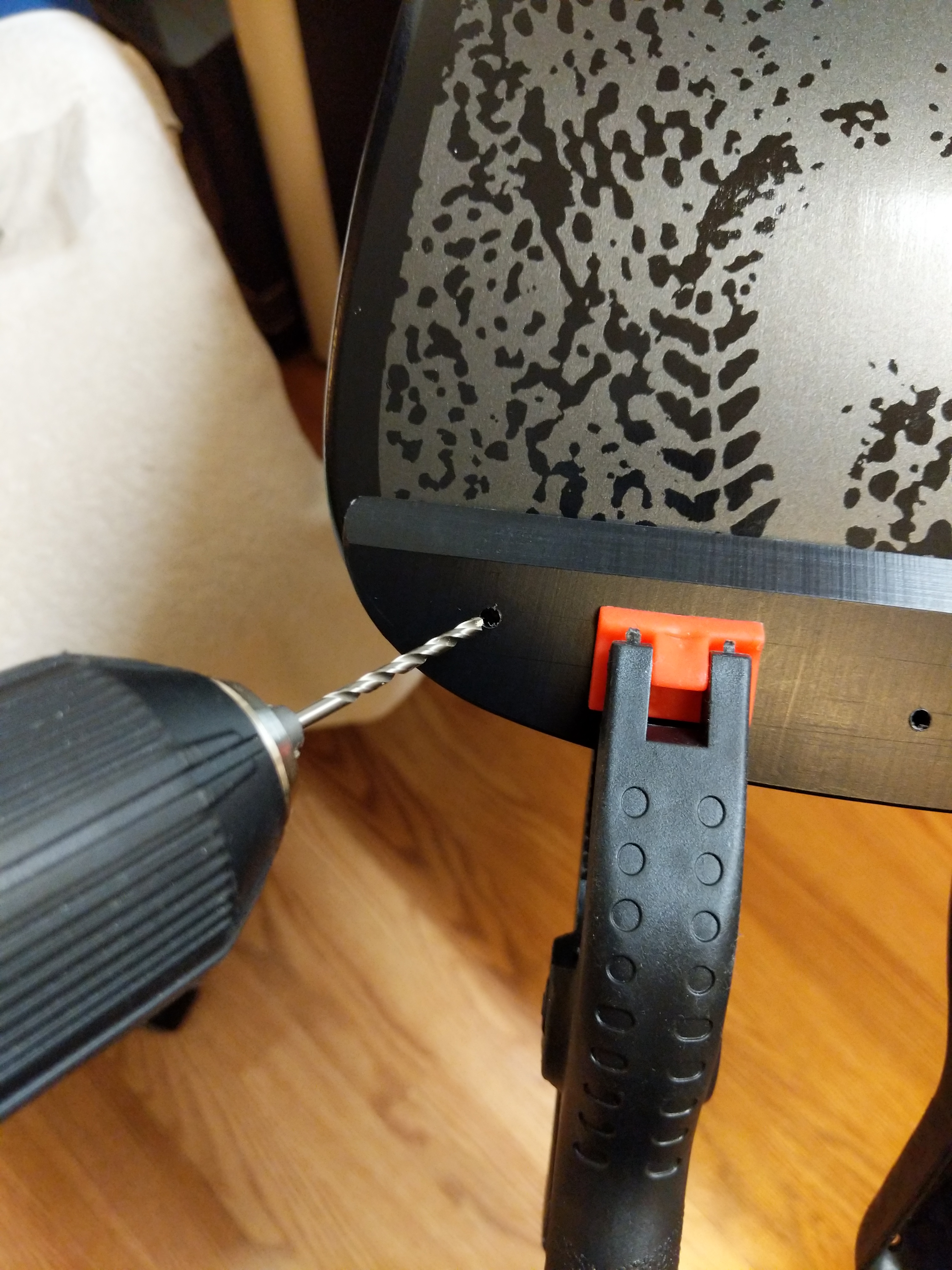
    Then, I used a small drill bit to lightly mark where I should drill the larger holes for the wood screws that will go through the top of the board into the Tailbone.

    IMG_20181208_160143.jpg

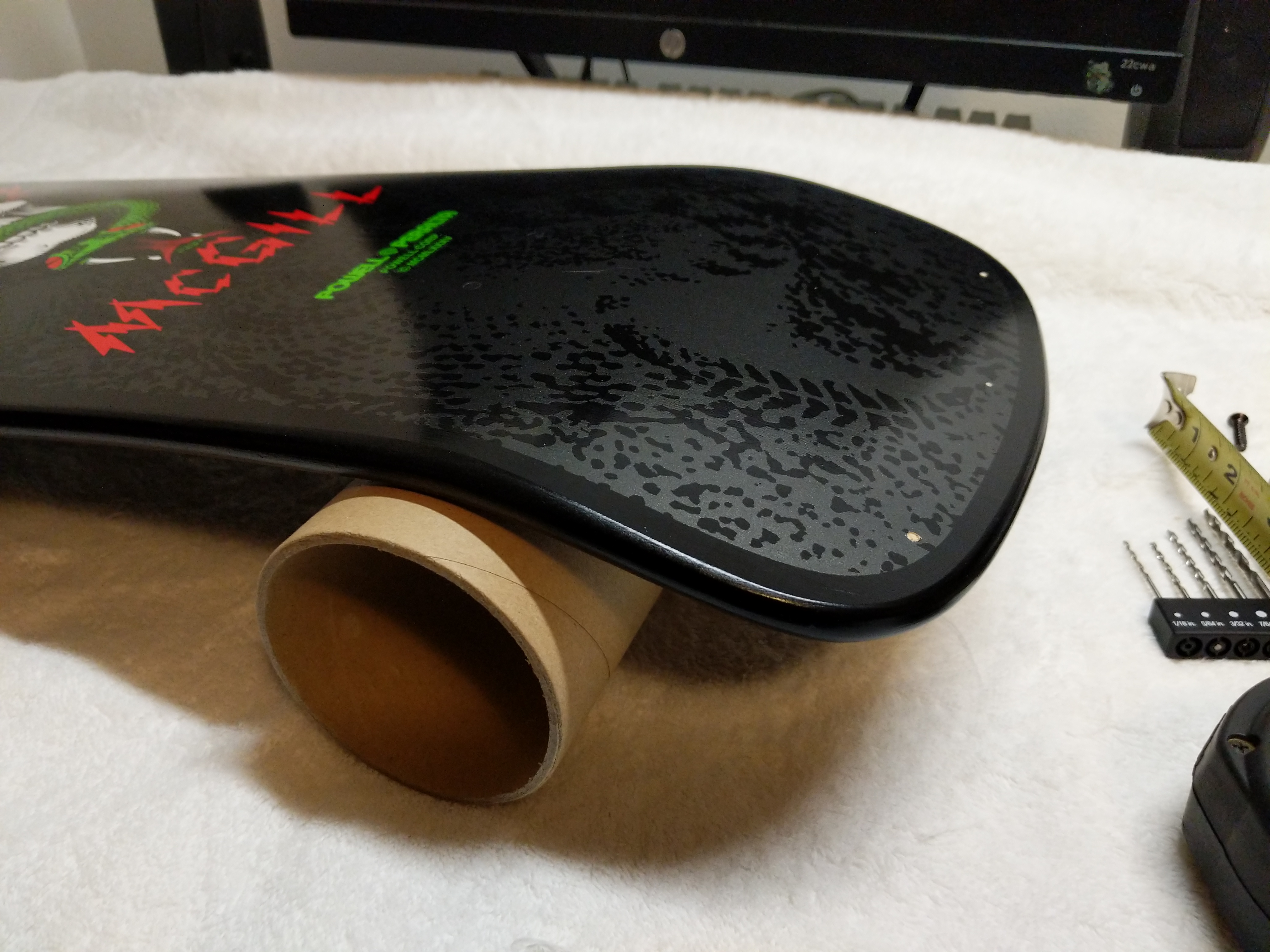
    I used the grip tape shipping tube to support the deck while I was drilling.

    IMG_20181208_160631.jpg

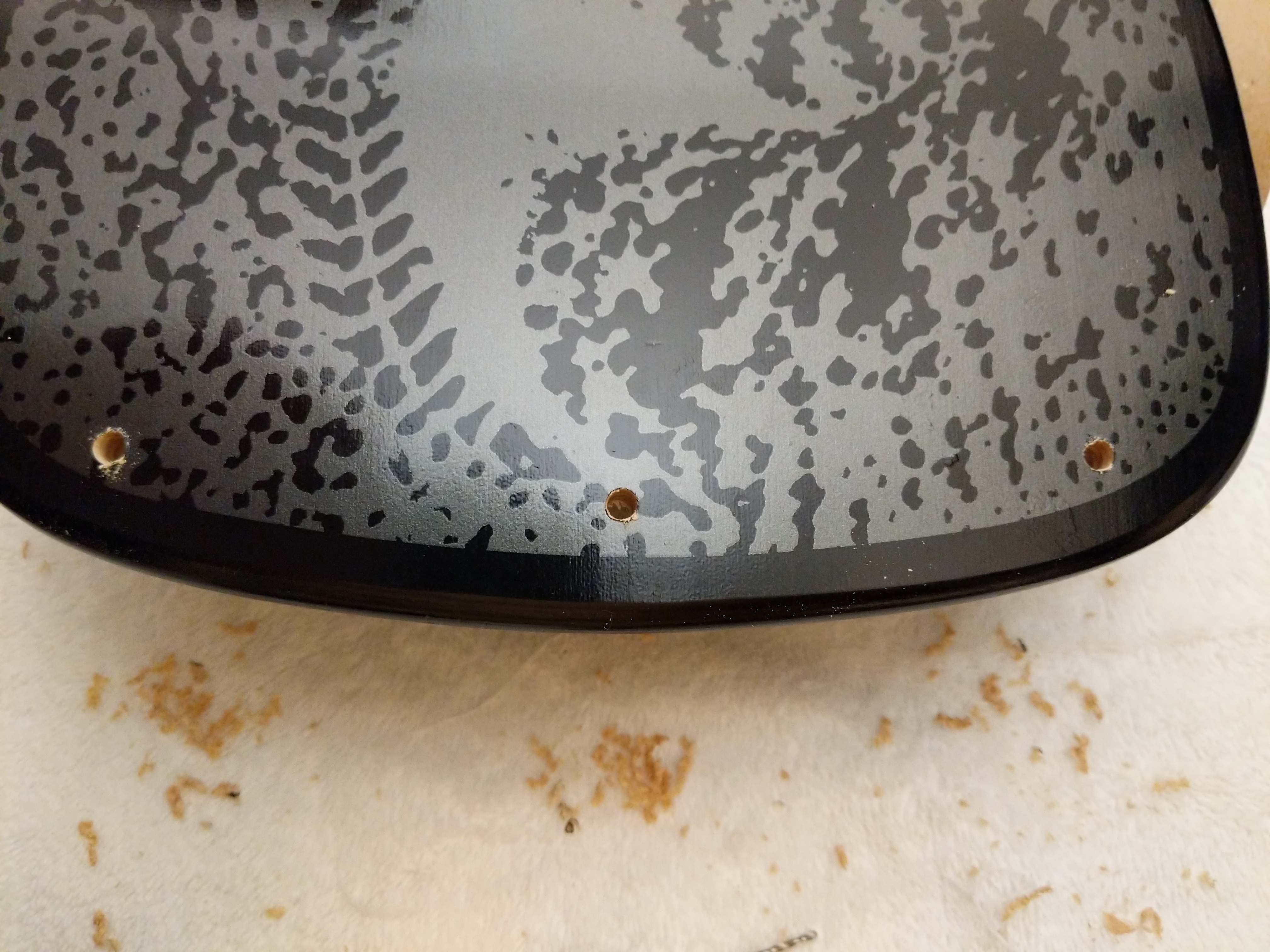
    Powell-Peralta’s instructions for the Tailbone call for a 7/32″ drill bit. Unfortunately, I didn’t have one in this size. I didn’t want to go with a larger hole (1/4″), so I tried the 3/16″ bit. Luckily, this was more than enough room for the wood screws to pass through the board without biting and then go into the Tailbone.

    IMG_20181208_160345.jpg

    Using my earlier marks, I drilled three holes through the deck’s tail. These will be used later for mounting the Tailbone.

    IMG_20181208_160857.jpg

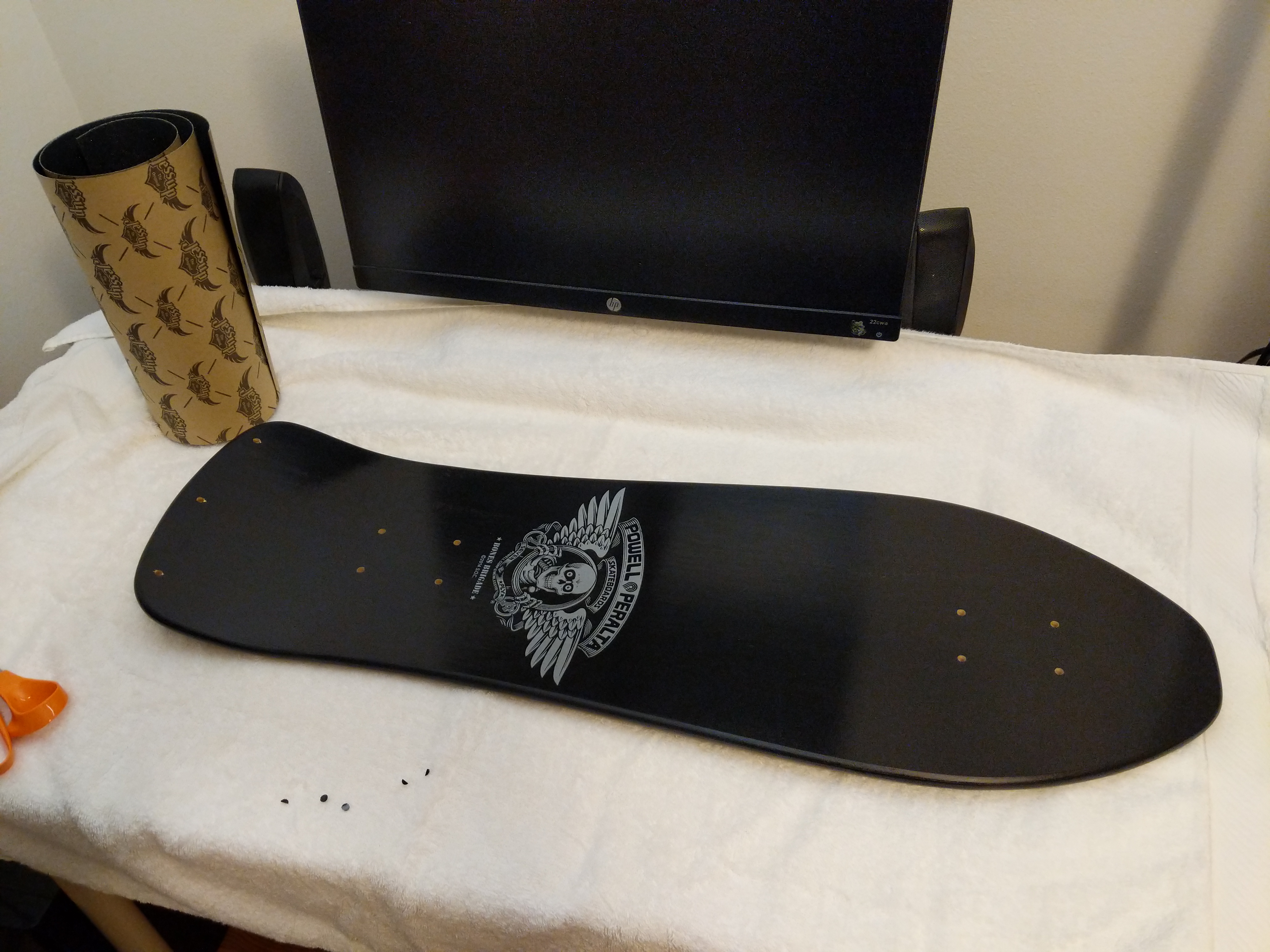
    Before mounting the Tailbone, I applied the Jessup grip tape. I bought 10″ wide grip tape, which is just barely wide enough to give some room for error with the front of the deck. If I had to do over again, I would have opted for the 11″ wide grip tape.

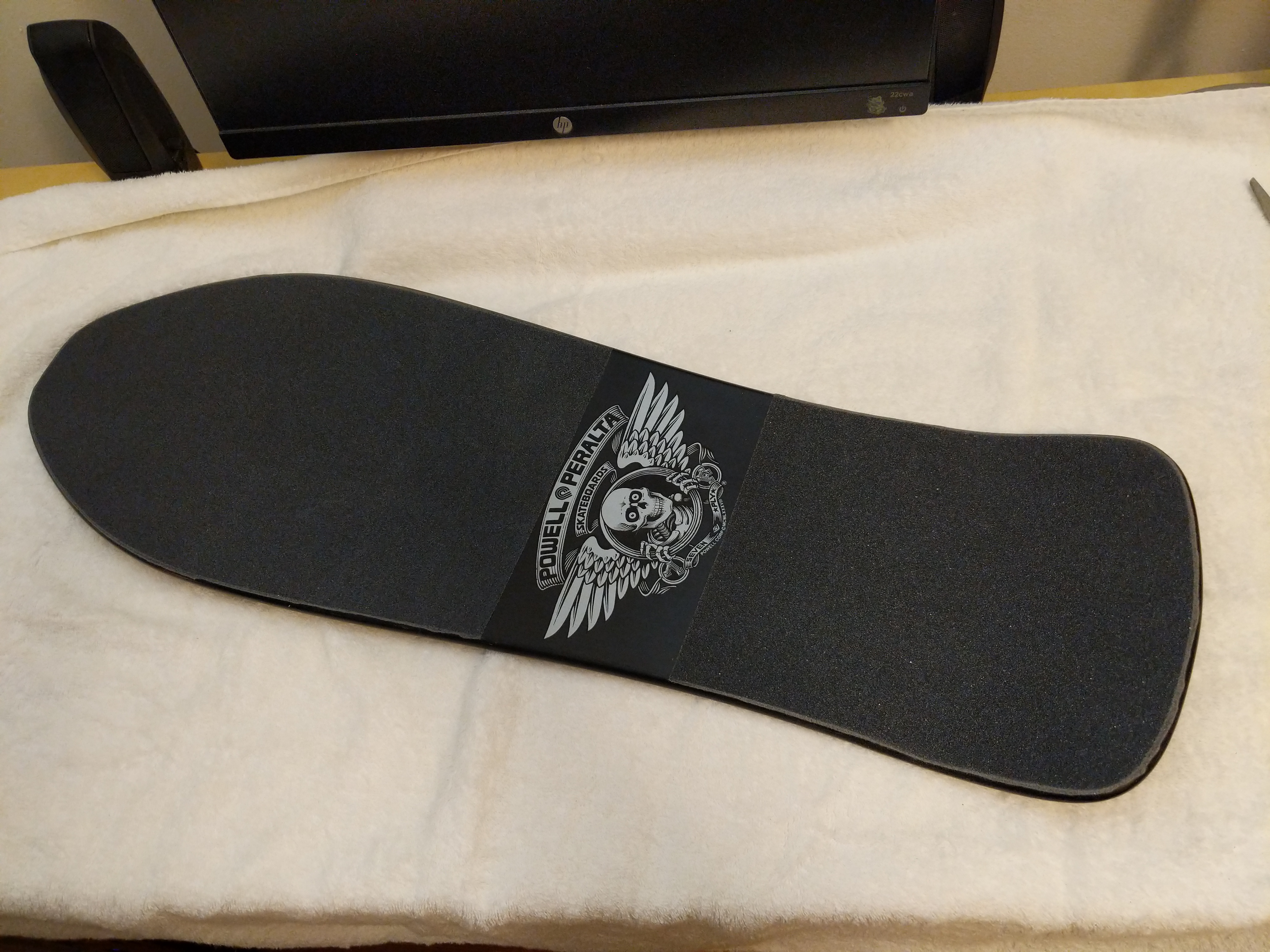
    I wanted the Bones Brigade logo to appear on the top of the deck, so I needed to apply two sections of grip tape–one above it towards the nose and one below it towards the tail. I measured these lengths twice and cut the length of grip tape into two sections allowing some room for error in terms of length. I used the pre-cut edges as the beginning of application above or below the Bones Brigade logo. I slowly lowered and pressed the grip tape to the deck so as to avoid any air bubbles under the tape.

    IMG_20181208_162618.jpg

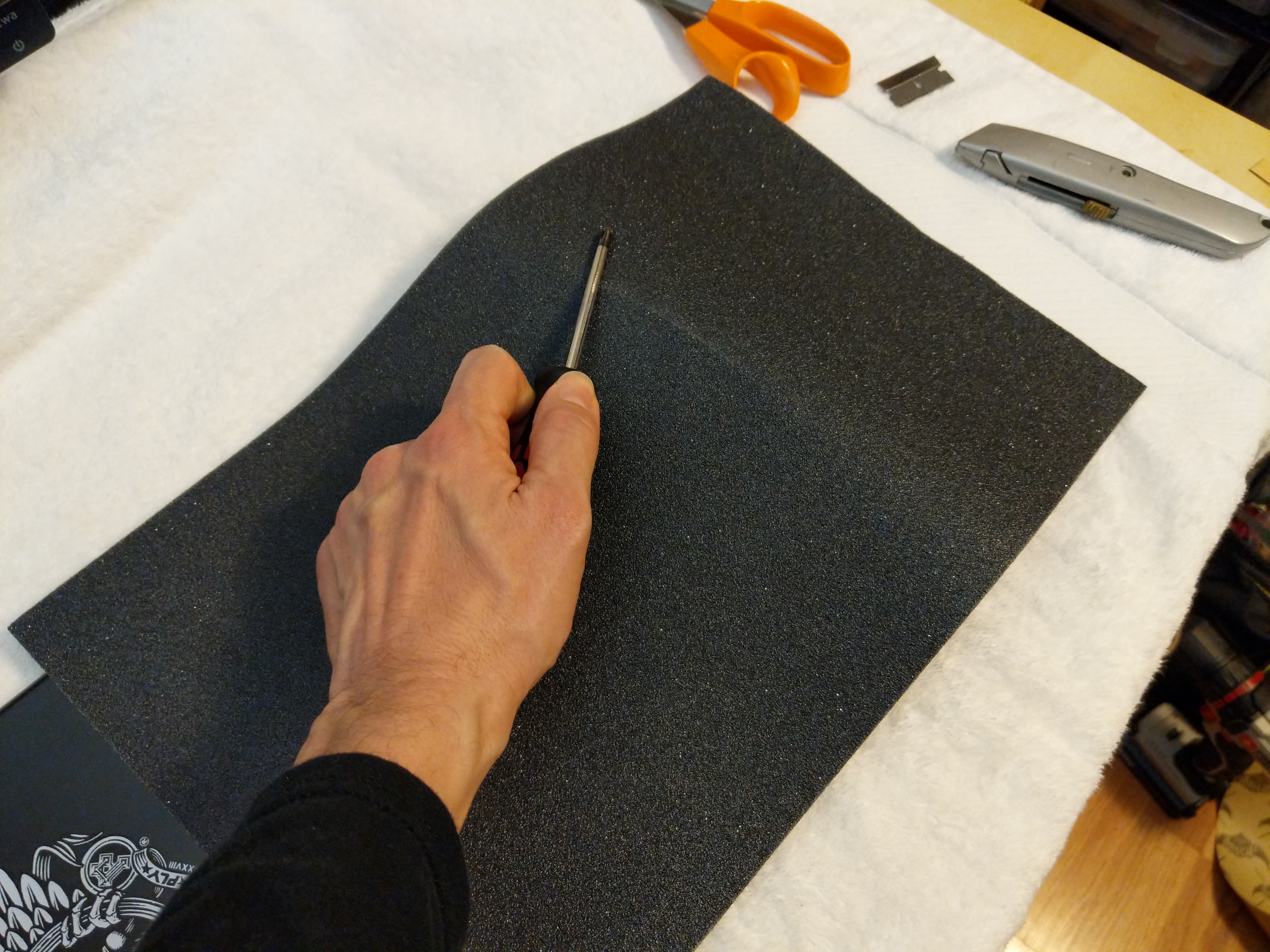
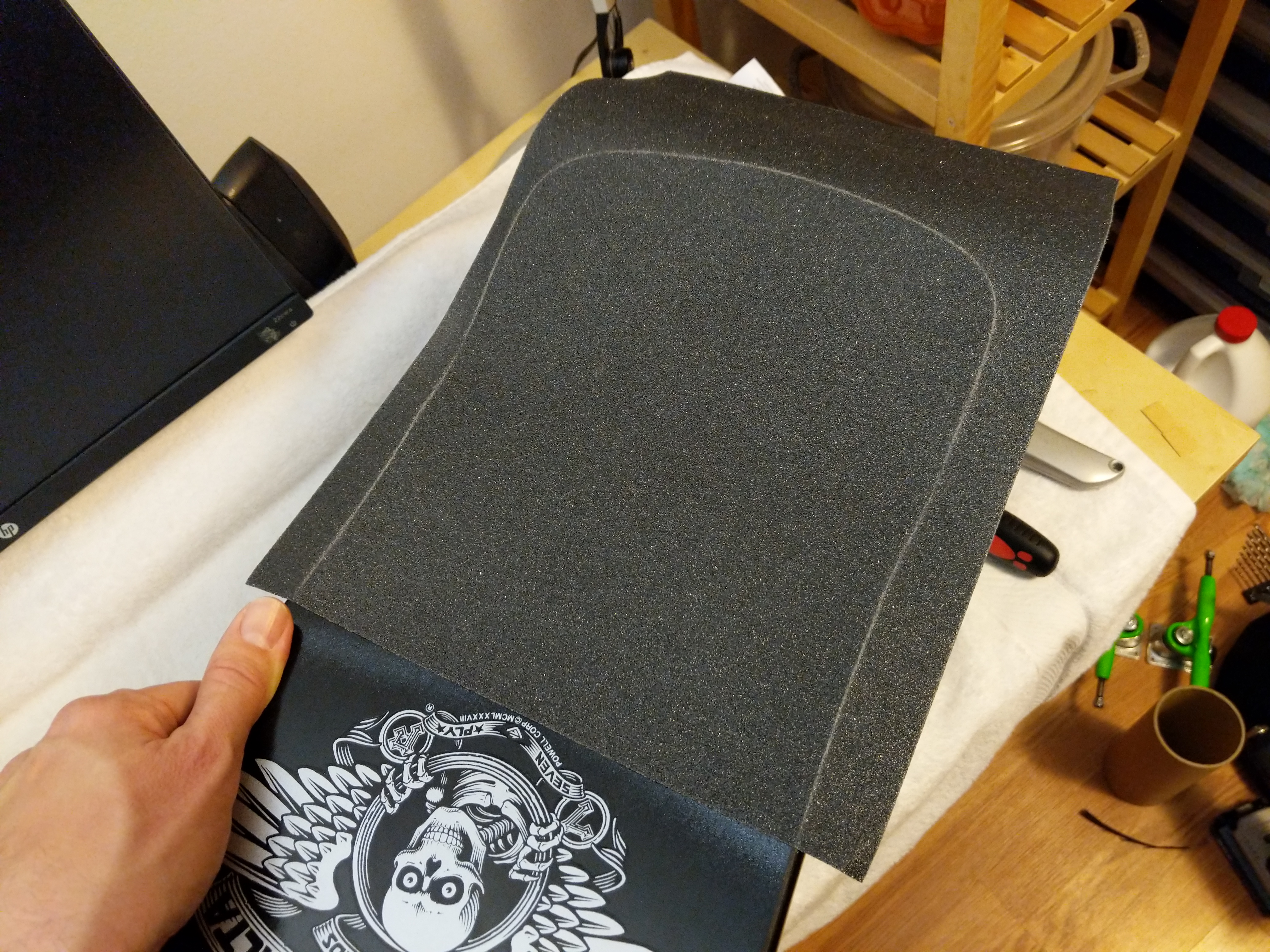
    With the tape applied, I used the barrel’s edge of a screw driver to draw a scoring line around the edge of the skateboard deck.

    IMG_20181208_162653.jpg

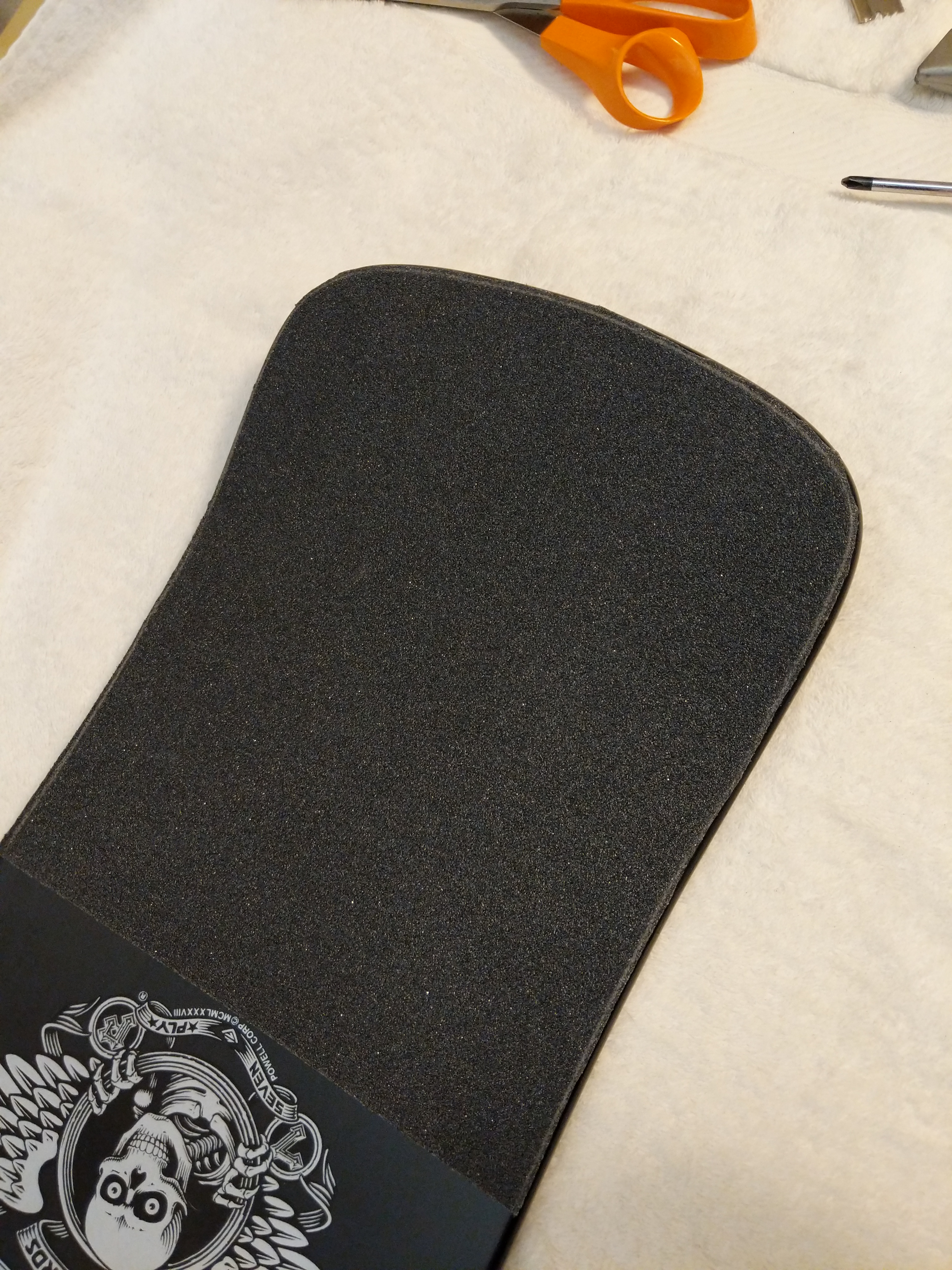
    Then, I used a razor blade held from underneath the board to follow the edge of the board and cut the excess grip tape off along the scoring line.

    IMG_20181208_162821.jpg

    Next, I pressed the grip tape down around the edges of the deck.

    IMG_20181208_162828.jpg

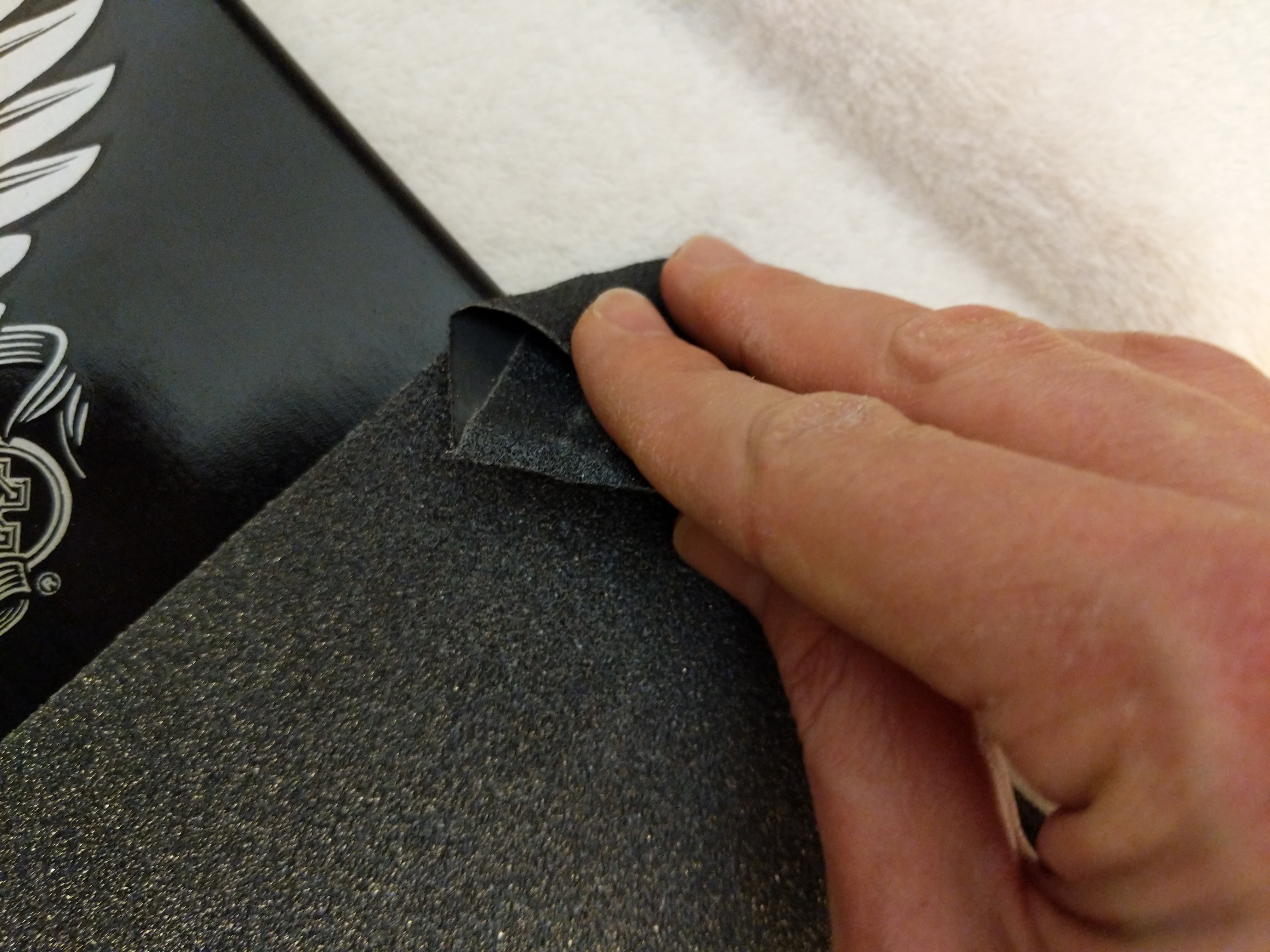
    I ran a rolled up piece of excess grip tape around the edge of the deck to give the grip tape a clean edge all away around.

    IMG_20181208_162906.jpg

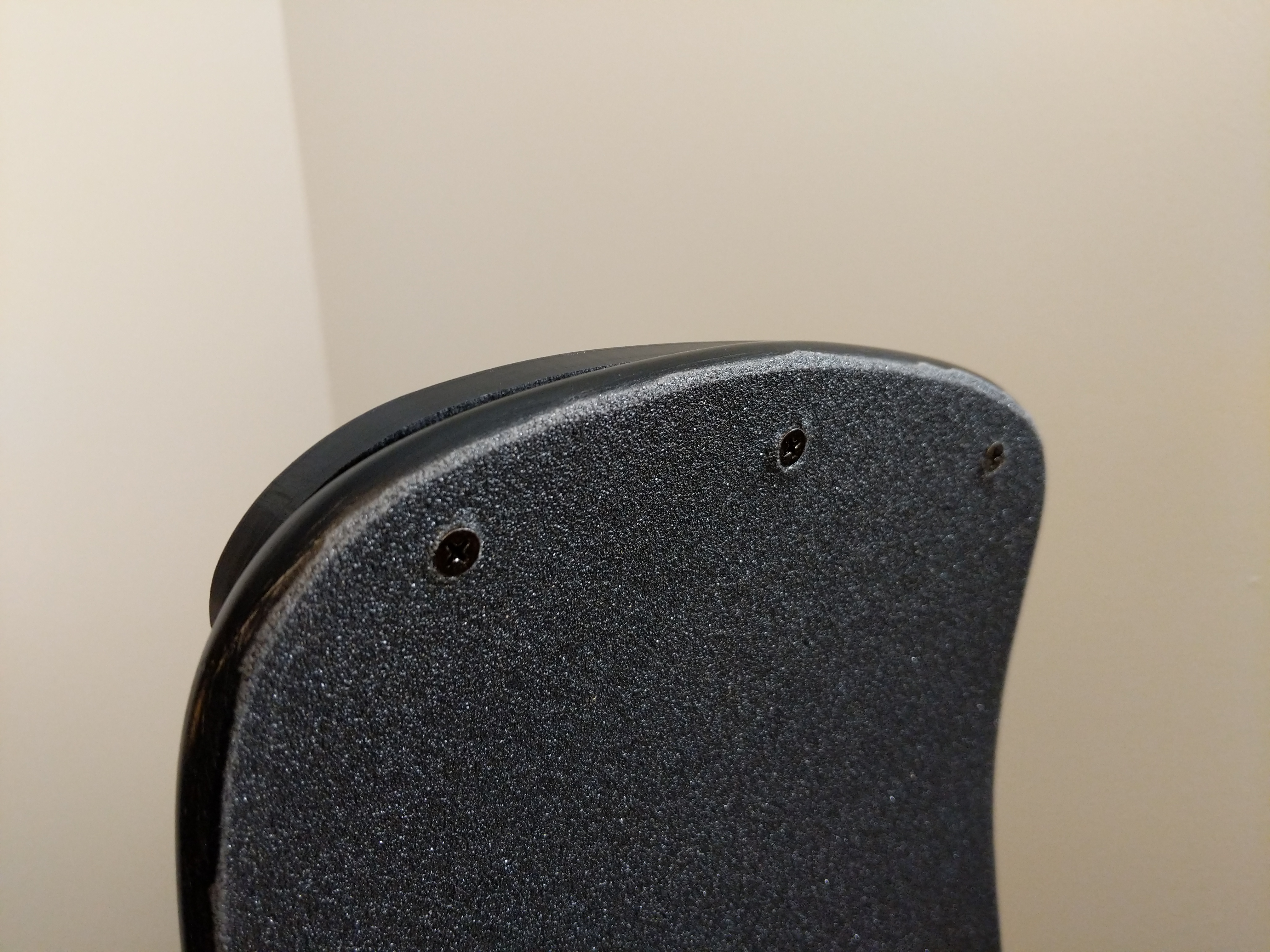
    With the grip tape applied, I used a screw driver to punch through all of the holes in the deck for the trucks and Tailbone.

    IMG_20181208_163309.jpg

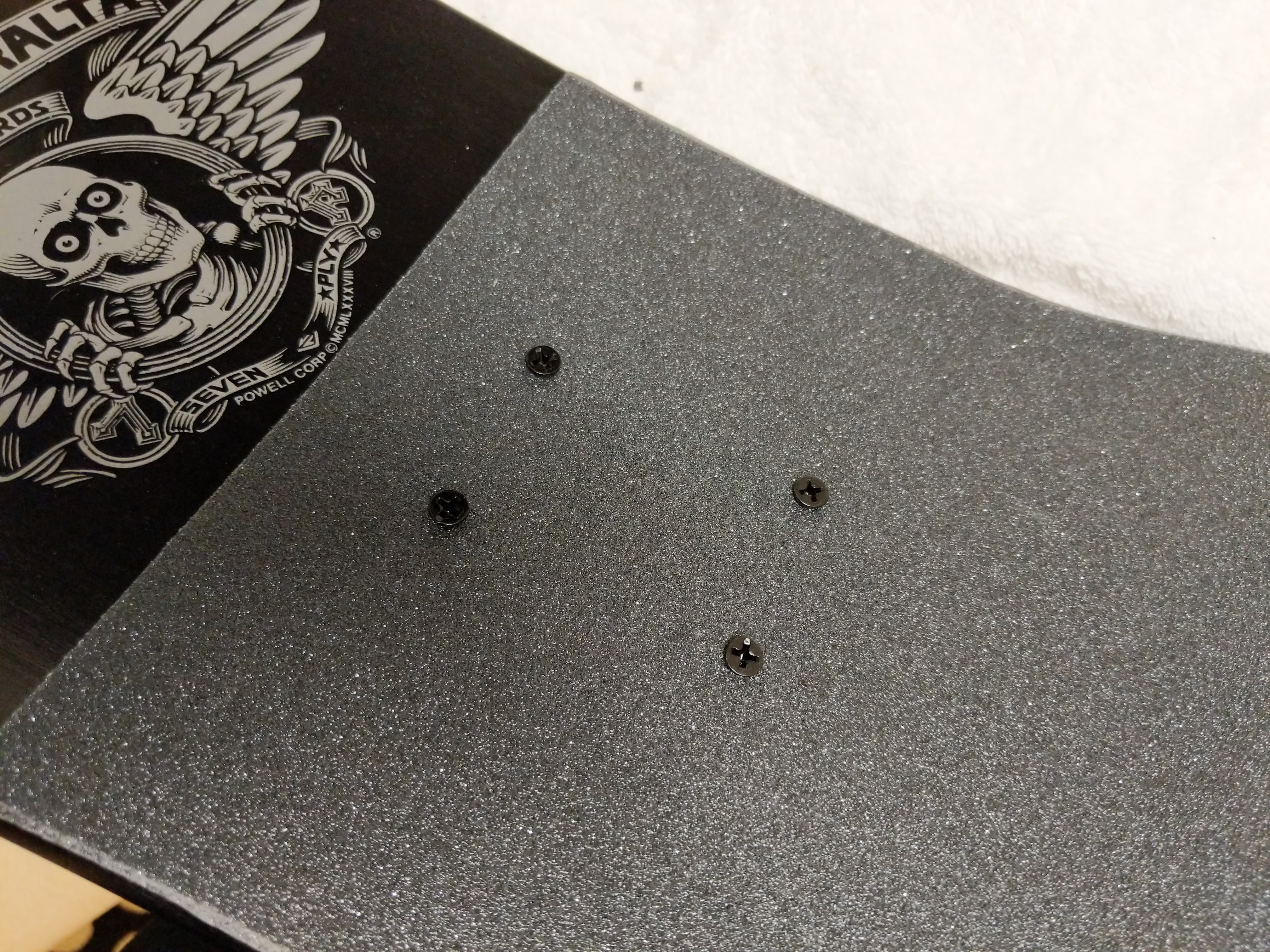
    Next, I installed the tailbone by pushing through wood screws and matching them to the holes in the Tailbone.

    IMG_20181208_163305.jpg

    While I had a cordless drill on-hand, I preferred to install these screws by hand. I was afraid of over torquing the screws and losing grip in the Tailbone’s plastic. Installing the screws by hand allows me to feel them dig into the plastic and maintain a secure hold on the Tailbone through the deck without stripping out plastic.

    IMG_20181208_163456.jpg

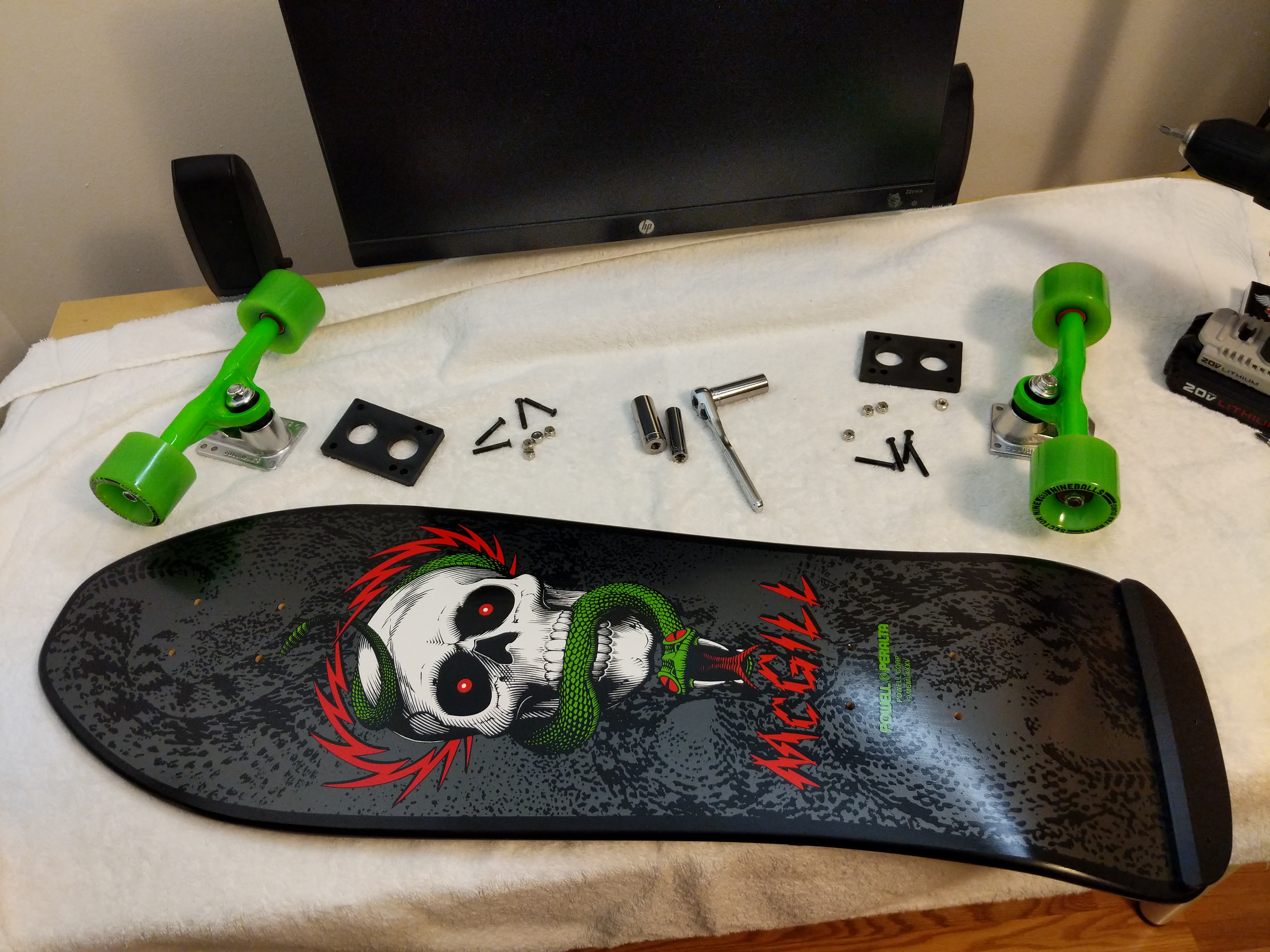
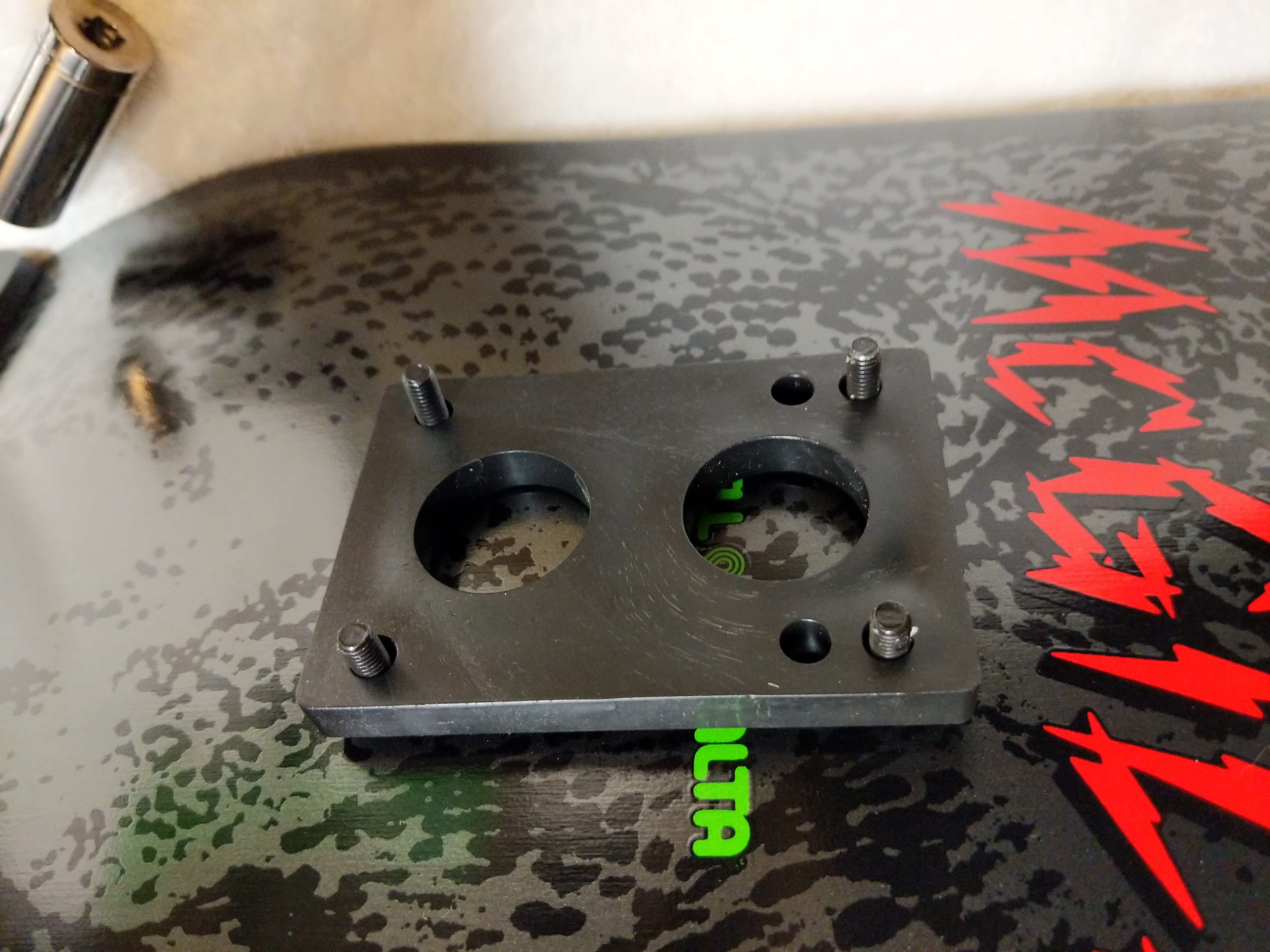
    The final stage of the assembly involves the trucks, wheels, bearings, and 1/4″ risers. I laid all of these parts out to make the assembly quicker. For some of the assembly, I used the cordless drill with a Philips head driver, and I had my 1/4″ drive tall sockets in 3/8″ (for the truck mounting bolts) and 1/2″ (for the truck’s axle bolts).

    IMG_20181208_163849.jpg

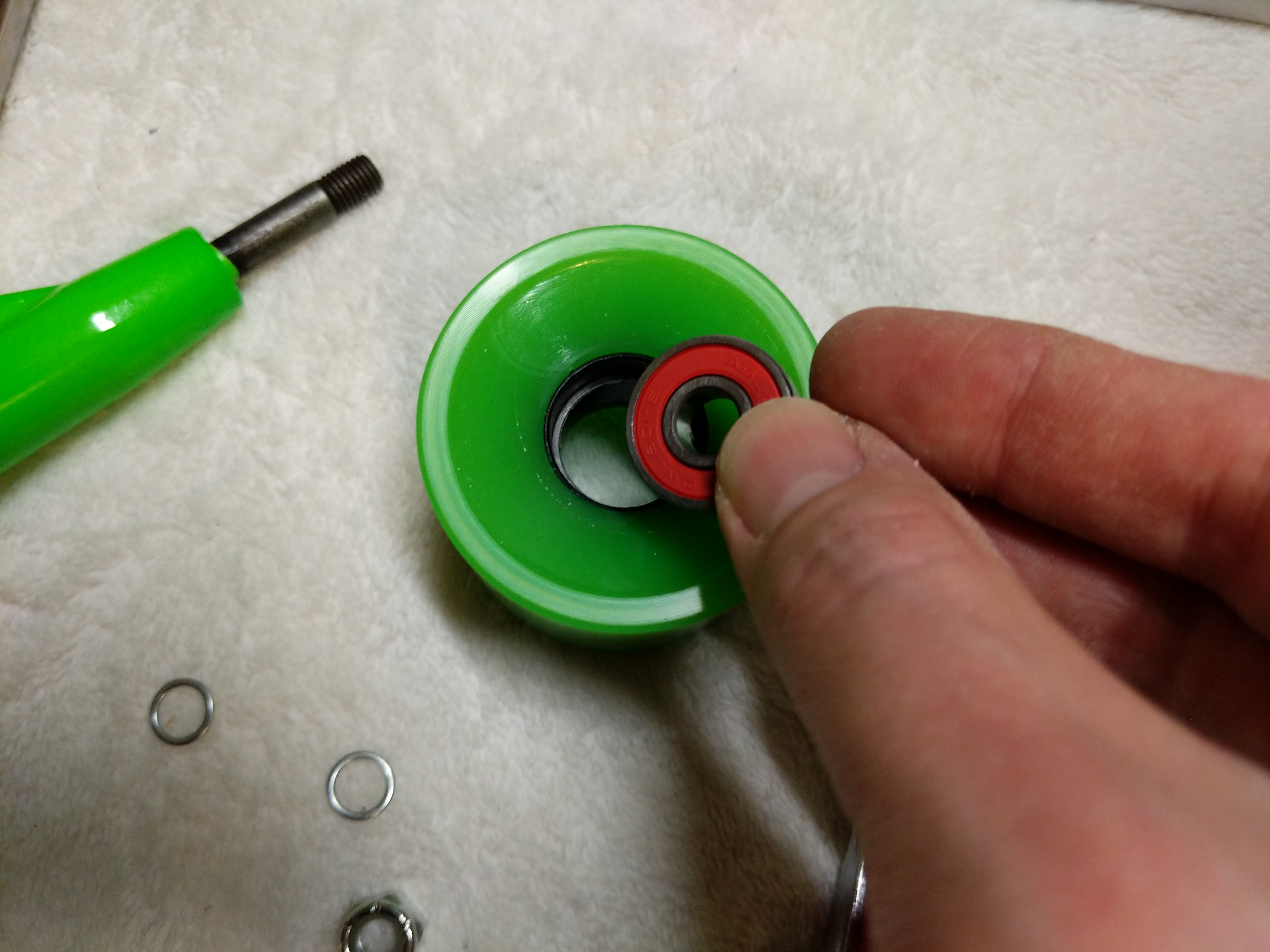
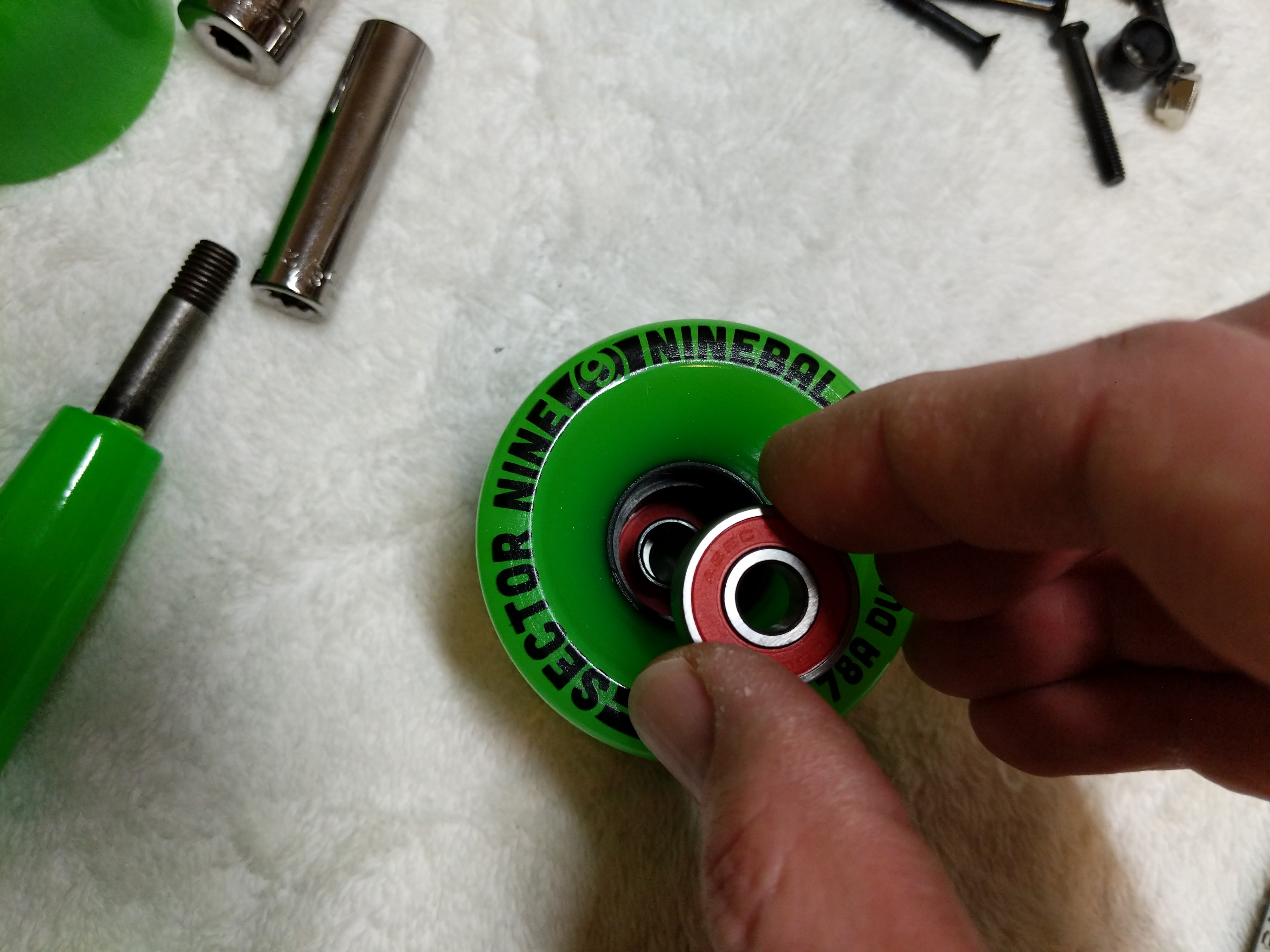
    The first task was to install bearings and spacers in each wheel. I placed an Owlsome Precision ABEC 7 bearing assembly into the back of a wheel.

    IMG_20181208_163904.jpg

    Then, I used one of the trucks to help me press the bearing completely into the wheel so that it is flush with the wheel.

    IMG_20181208_163930.jpg

    Turning the wheel over, I dropped a spacer on top of the inserted bearing.

    IMG_20181208_163942.jpg

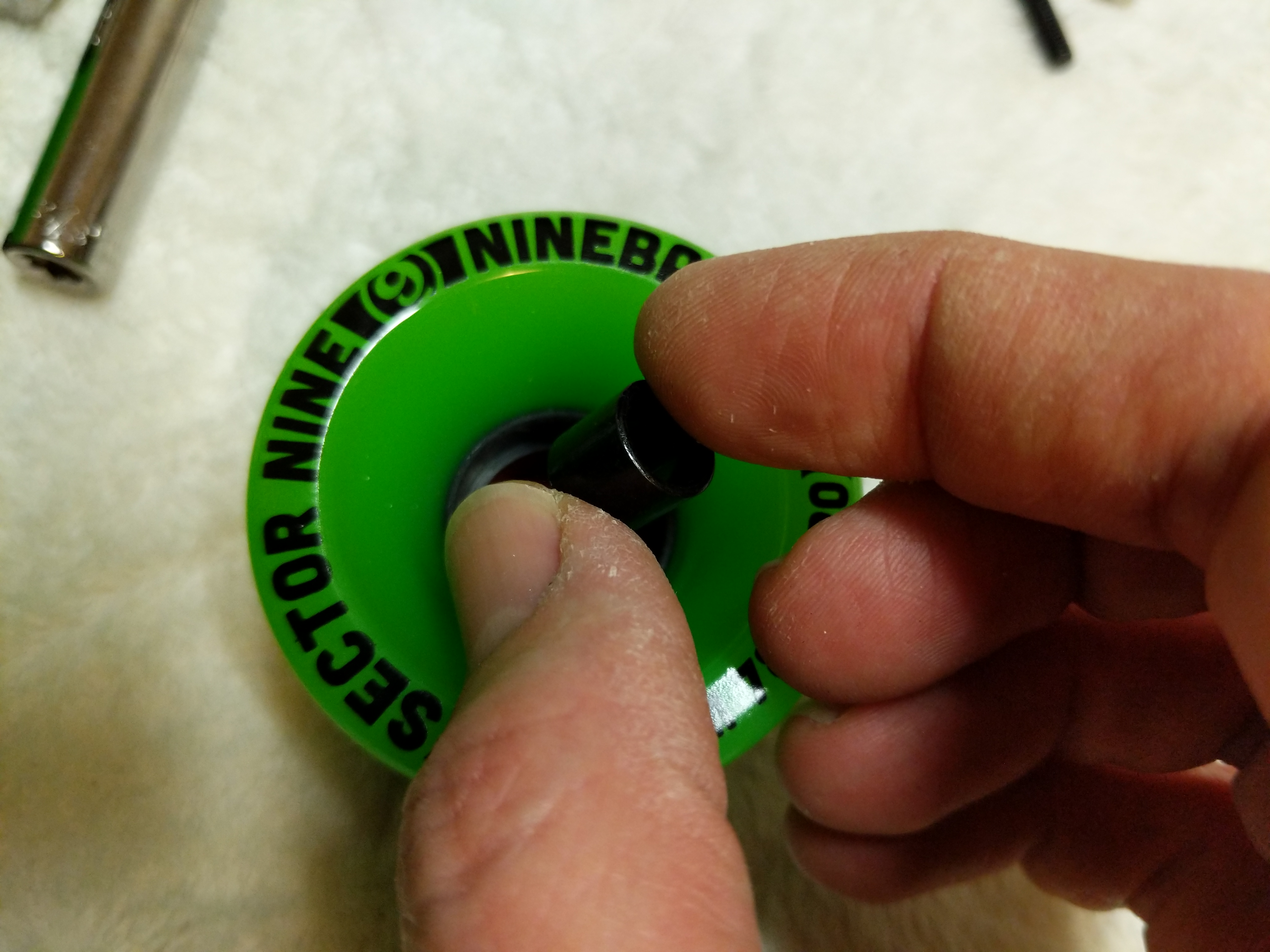
    Then, I placed another bearing into the front of the front of the wheel over the spacer, and again, used the trucks to help me press the bearing assembly completely into the wheel.

    IMG_20181208_163736.jpg

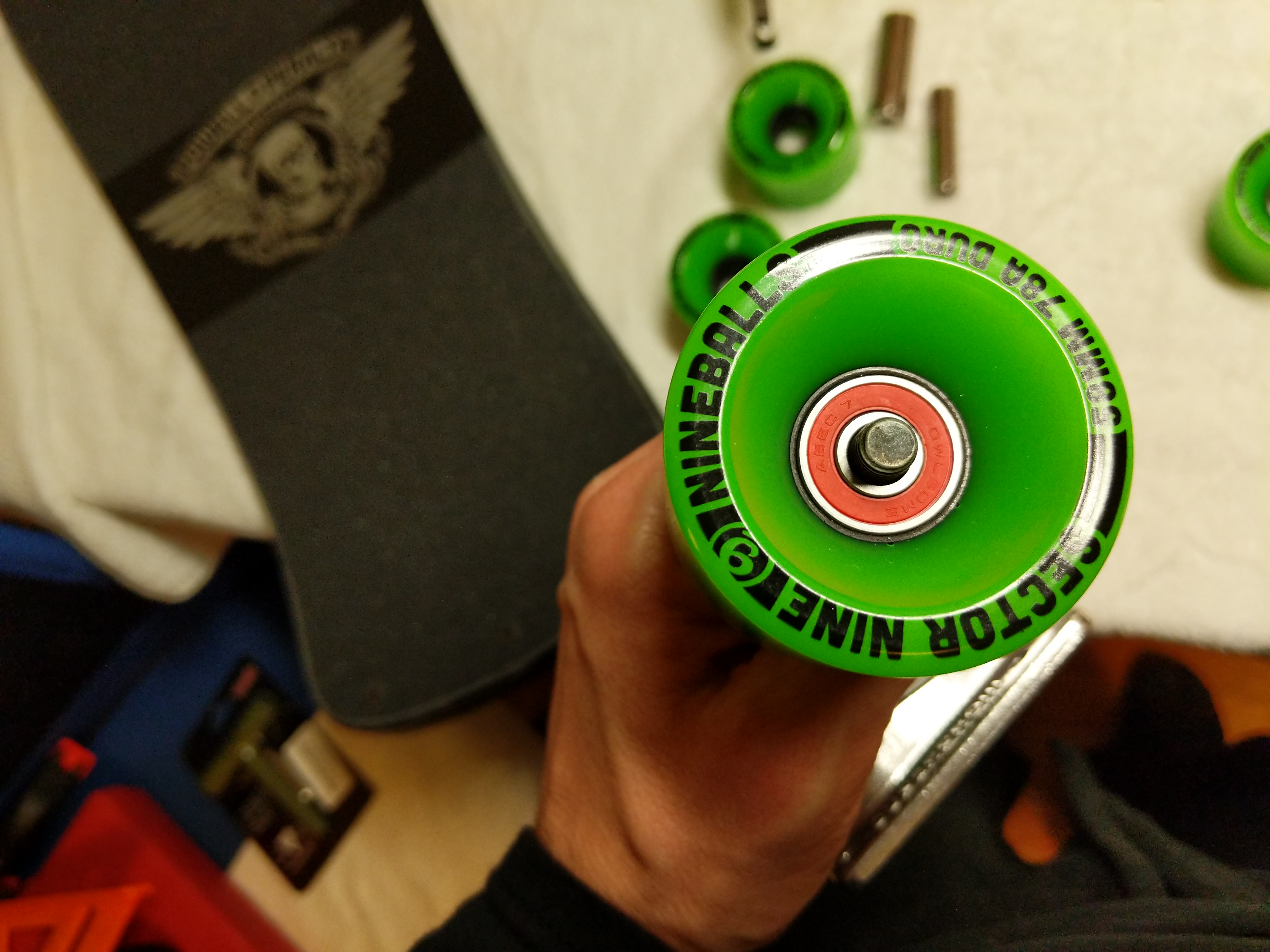
    Then, I pulled the wheel off, placed a washer on the axle, followed by the wheel with the front facing outward, another washer, and then the axle nut. I tightened the axle nut by hand with the 1/2″ socket. I left a very slight bit of play for the wheel on the axle.

    IMG_20181208_164820.jpg

    With all of the wheels assembled with bearings and spacers and these installed on the trucks, I was ready to complete assembly of the skateboard by mounting the risers and trucks to the skateboard deck.

    IMG_20181208_164921.jpg

    First, I pushed the 1 1/4″ truck mounting bolts through the skateboard deck.

    IMG_20181208_164940.jpg

    Then, I mounted the 1/4″ riser through the bolts on the underside of the skateboard deck.

    IMG_20181208_164957.jpg

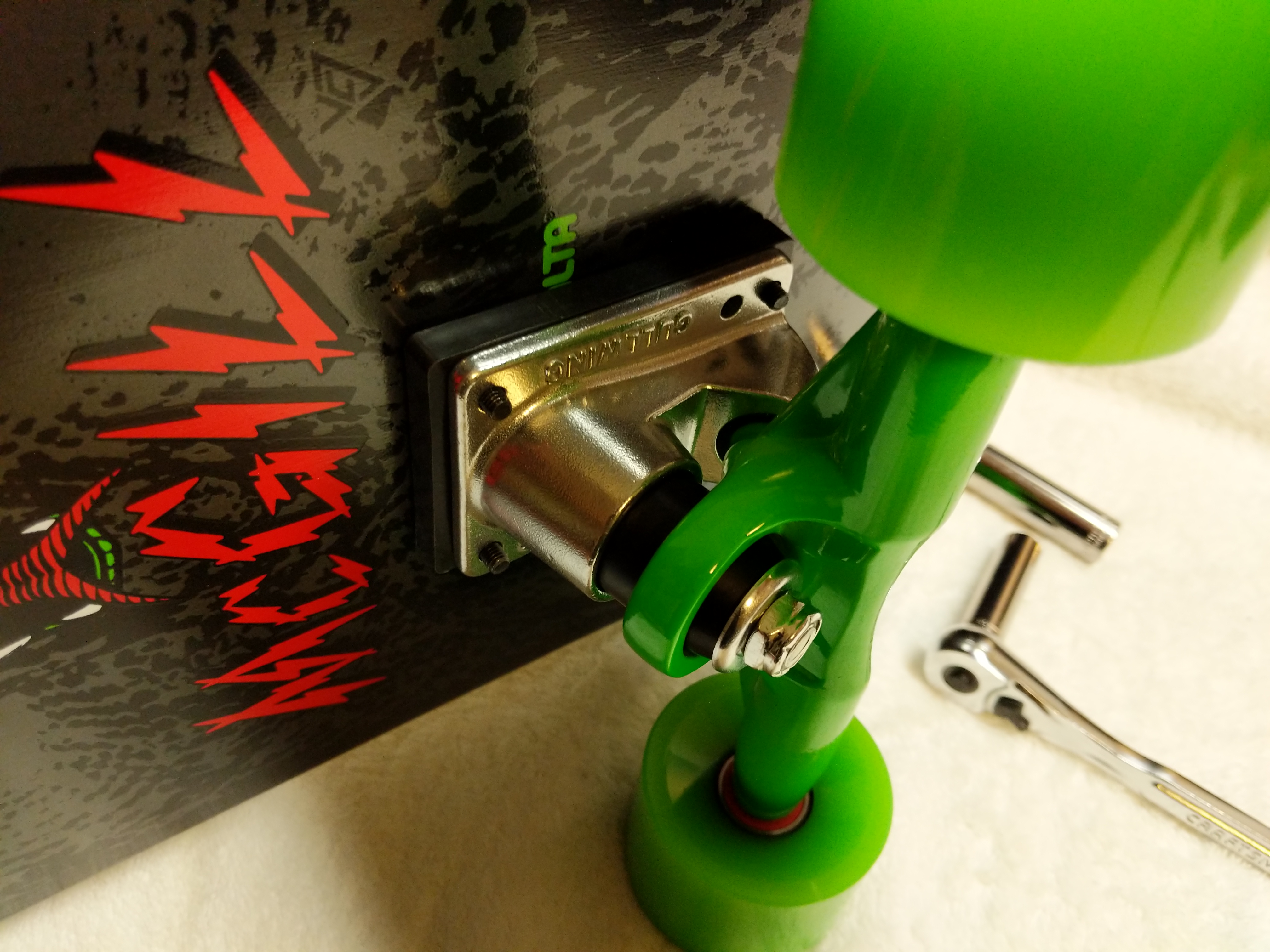
    Next, I turned the skateboard on its side and mounted the trucks.

    IMG_20181208_165031.jpg

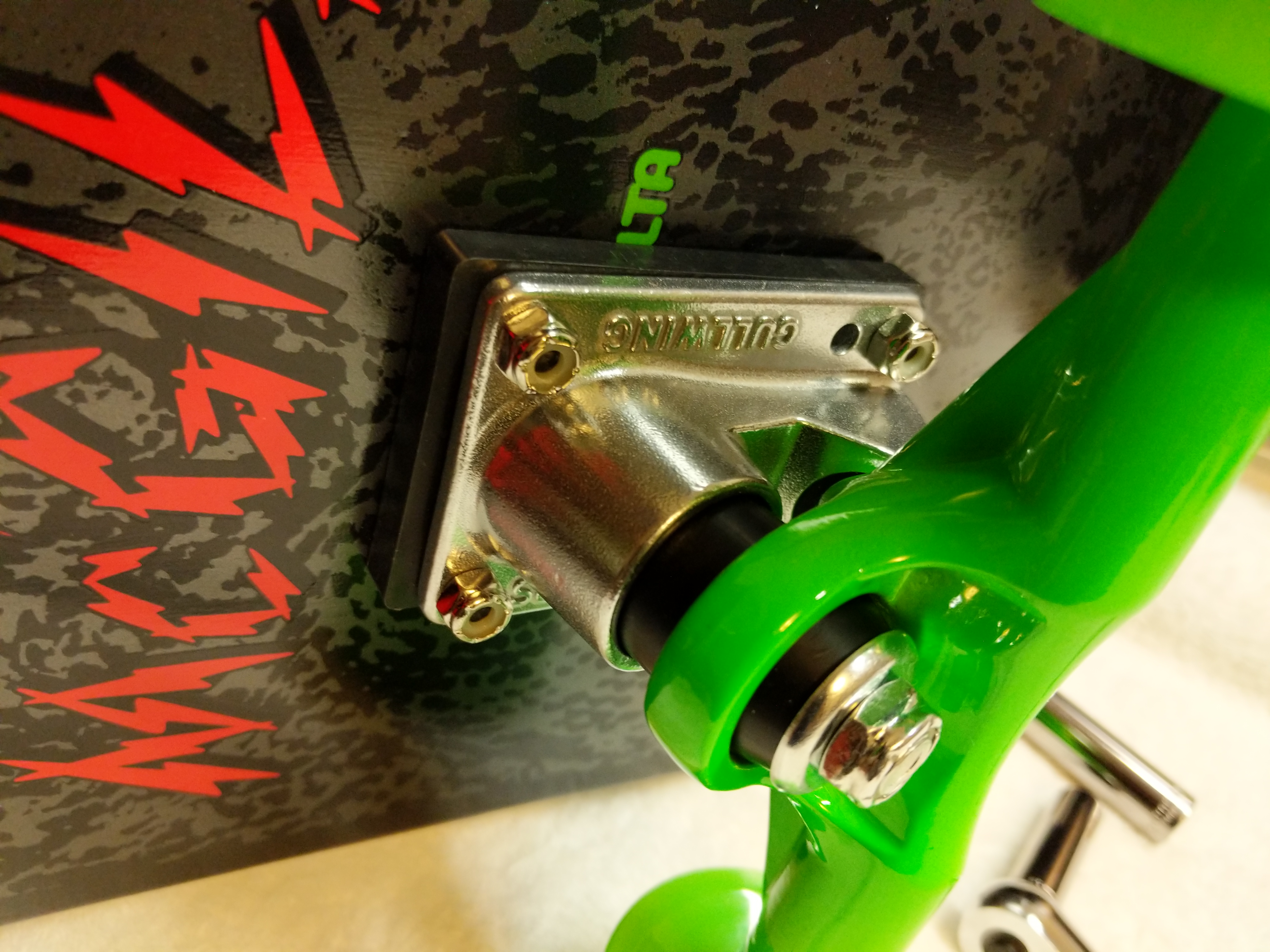
    I hand threaded the four hardware nuts on each mounting bolt for each truck.

    IMG_20181208_165218.jpg

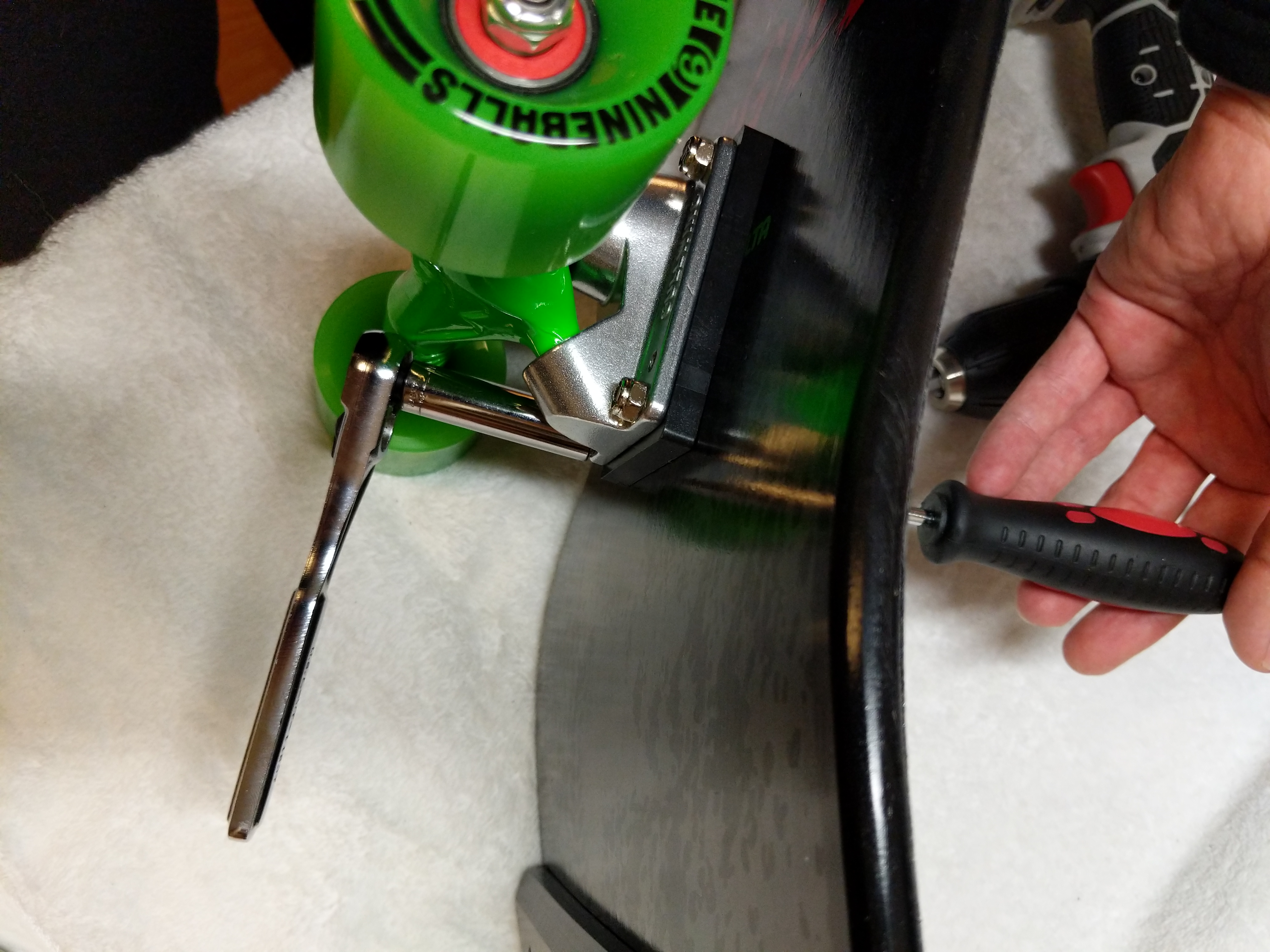
    After confirming each nut was threaded correctly, I used the cordless drill to snug each bolt down to the nut and then hand tightened each bolt in an X-pattern until I was confident in each truck’s mounting to the skateboard deck.

    IMG_20181209_135235.jpg

    With the trucks mounted, I have a complete skateboard ready to take out and hit the streets with. The soft, larger wheels should be great for riding in my neighborhood. However, I have been looking at Powell-Peralta’s G-Slides, which I might get later.

    IMG_20181209_135251.jpg

    I opted to cover the “Bones Brigade” name beneath the logo, because I wanted a little more grip on the tail section of the deck.

    IMG_20181209_135344.jpg

    My original McGill had a nose kick while this late-80s re-issue does not. Nevertheless, I think this will be a fun skateboard to ride. Y asked me to wait until she returned from her trip to see her parents before I rode it in case I hurt myself. She’s back, but the weather isn’t superb, so I might content myself with daydreaming about riding my new skateboard until we can take it out together.

    In all honesty, I have to remind myself that I can’t necessarily do the things I did when I was younger, or put another way, I can try to do the things that I used to do, but there will likely be more serious consequences. C’est la vie!

  • Presentation Videos from the Third Annual City Tech Science Fiction Symposium, Nov. 27, 2018


    IMG_20181127_161342

    The Third Annual City Tech Science Fiction Symposium was an amazing success! Here are videos from the symposium’s presentations and discussions from Nov. 27, 2018. Watch them all on YouTube via this playlist, or watch them as embedded videos below.


    9:00am-9:20am
    Continental Breakfast and Opening Remarks
    Location: Academic Complex A105
    Justin Vazquez-Poritz, Dean of the School of Arts and Sciences, New York City College of Technology
    Jason W. Ellis, New York City College of Technology


    9:20am-10:35am
    Session 1: Affect and Experimentation
    Location: Academic Complex A105
    Moderator: Jason W. Ellis
    Leigh Gold, “The Legacy of Frankenstein: Science, Mourning, and the Ethics of Experimentation”
    Lucas Kwong, “The Island Of Dr. Moreau, Fantastic Ambivalence, and the Victorian “Science Of Religion”
    Robert Lestón, “Between Intervals: A Soundscape for all Us Monsters”


    10:45am-12:00am
    Session 2: Identity and Genre
    Location: Academic Complex A105
    Moderator: Jill Belli
    Anastasia Klimchynskaya, “Frankenstein, Or, the Modern Fantastic: Rationalizing Wonder and the Birth of Science Fiction”
    Paul Levinson, “Golem, Frankenstein, and Westworld”
    Joy Sanchez-Taylor, “Genetic Engineering and non-Western Modernity in Paolo Bacigalupi’s The Windup Girl and Larissa Lai’s Salt Fish Girl”


    1:15pm-2:30pm
    Session 3: American Culture and Media
    Location: Academic Complex A105
    Moderator: A. Lavelle Porter
    Aaron Barlow, “‘Fraunkensteen’: What’s No Longer Scary Becomes Funny or, How American Popular Culture Appropriates Art and Expands the Commons”
    Marleen S. Barr, “Trumppunk Or Science Fiction Resists the Monster Inhabiting the White House”
    Sharon Packer, “Jessica Jones (Superhero), Women & Alcohol Use Disorders”


    2:40pm-3:40pm
    Student Round Table: “Shaping the Future: A Student Roundtable on Octavia Butler’s Parable of the Sower”
    Location: Academic Complex A105
    Moderator: A. Lavelle Porter
    Panelists: Zawad Ahmed
    Marvin Blain
    Kartikye Ghai
    Devinnesha Ryan


    4:00pm-4:50pm
    Frankenstein Panel: Mary Shelley’s Novel’s Influence on Scientists and Technologists
    Location: Academic Complex A105
    Moderator: Justin Vazquez-Poritz
    Panelists:
    Heidi Boisvert, Entertainment Technology Department
    Robert MacDougall, Social Sciences Department
    Ashwin Satyanarayana, Computer Systems Technology Department
    Jeremy Seto, Biological Sciences Department


    5:00pm-6:00pm
    Closing and Tour of the City Tech Science Fiction Collection
    Location: City Tech Library L543
    Remarks by Jason W. Ellis

  • Third Annual City Tech Science Fiction Symposium, Nov. 27: Program and Details

    SF-symposium-3-poster

    The Third Annual City Tech Symposium on Science Fiction


    200 Years of Interdisciplinarity Beginning with Mary Shelley’s Frankenstein


    Tuesday, Nov. 27, 2018, 9:00am-6:00pm


    New York City College of Technology, CUNY

    Academic Complex, Room A105

    285 Jay St., Brooklyn, NY 11201


    Organizing Committee: Jill Belli, Jason W. Ellis, Leigh Gold, Lucas Kwong, Robert Lestón, and A. Lavelle Porter


    Hosted by the School of Arts and Sciences.


    Event hashtag: #CityTechSF


    The kind of literature that came to be known as Science Fiction (SF) owes a tremendous debt to Mary Shelley’s Frankenstein, or The Modern Prometheus (1818). In addition to being an (if not the) inaugural work of SF, Mary Shelley builds her cautionary tale around interdisciplinary approaches to science, and she takes this innovation further by applying the humanities to question the nature of being in the world, the effects of science on society, and the ethical responsibilities of scientists. These are only some of Frankenstein’s groundbreaking insights, which as Brian Aldiss and David Wingrove observe in Trillion Year Spree (1986), “is marvellously good and inexhaustible in its interest” (20). The many dimensions of interdisciplinarity in Frankenstein and the SF that followed are the focus of the Third Annual City Tech Science Fiction Symposium.


    Schedule


    9:00am-9:20am

    Continental Breakfast and Opening Remarks

    Location: Academic Complex A105

    Justin Vazquez-Poritz, Dean of the School of Arts and Sciences, New York City College of Technology

    Jason W. Ellis, New York City College of Technology


    9:20am-10:35am       

    Session 1: Affect and Experimentation

    Location: Academic Complex A105

    Moderator: Jason W. Ellis

    Leigh Gold, “The Legacy of Frankenstein: Science, Mourning, and the Ethics of Experimentation”

    Lucas Kwong, “The Island Of Dr. Moreau, Fantastic Ambivalence, and the Victorian “Science Of Religion”

    Robert Lestón, “Between Intervals: A Soundscape for all Us Monsters”


    10:35am-10:45am     

    Break


    10:45am-12:00am     

    Session 2: Identity and Genre

    Location: Academic Complex A105

    Moderator: Jill Belli

    Anastasia Klimchynskaya, “Frankenstein, Or, the Modern Fantastic: Rationalizing Wonder and the Birth of Science Fiction”

    Paul Levinson, “Golem, Frankenstein, and Westworld”

    Joy Sanchez-Taylor, “Genetic Engineering and non-Western Modernity in Paolo Bacigalupi’s The Windup Girl and Larissa Lai’s Salt Fish Girl


    12:00am-1:15pm       

    Lunch


    1:15pm-2:30pm        

    Session 3: American Culture and Media

    Location: Academic Complex A105

    Moderator: A. Lavelle Porter

    Aaron Barlow, “‘Fraunkensteen’: What’s No Longer Scary Becomes Funny or, How American Popular Culture Appropriates Art and Expands the Commons”

    Marleen S. Barr, “Trumppunk Or Science Fiction Resists the Monster Inhabiting the White House”

    Sharon Packer, “Jessica Jones (Superhero), Women & Alcohol Use Disorders”


    2:30pm-2:40pm        

    Break


    2:40pm-3:40pm        

    Student Round Table: “Shaping the Future: A Student Roundtable on Octavia Butler’s Parable of the Sower

    Location: Academic Complex A105

    Moderator:      A. Lavelle Porter

    Panelists:         Zawad Ahmed

    Marvin Blain
    Kartikye Ghai

    Devinnesha Ryan


    3:40pm-3:50pm        

    Break


    4:00pm-4:50pm        

    Frankenstein Panel: Mary Shelley’s Novel’s Influence on Scientists and Technologists

    Location: Academic Complex A105

    Moderator:      Justin Vazquez-Poritz

    Panelists:         Jeremy Seto

    Robert MacDougall


    4:50pm-5:00pm        

    Break/Relocate to Library


    5:00pm-6:00pm        

    Closing and Tour of the City Tech Science Fiction Collection

    Location: City Tech Library L543

    Remarks by Jason W. Ellis


    Symposium Participants & Contributors


    Aaron Barlow teaches English at New York City College of Technology (CUNY).


    Marleen S. Barr is known for her pioneering work in feminist science fiction and teaches English at the City University of New York. She has won the Science Fiction Research Association Pilgrim Award for lifetime achievement in science fiction criticism. Barr is the author of Alien to Femininity: Speculative Fiction and Feminist Theory, Lost in Space: Probing Feminist Science Fiction and Beyond, Feminist Fabulation: Space/Postmodern Fiction, and Genre Fission: A New Discourse Practice for Cultural Studies. Barr has edited many anthologies and co-edited the science fiction issue of PMLA. She is the author of the novels Oy Pioneer! and Oy Feminist Planets: A Fake Memoir. Her latest publication is When Trump Changed, the first single authored short story collection about Trump.


    Jill Belli, Ph.D., is Associate Professor of English and Co-Director of the OpenLab, the college’s open-source digital platform for teaching, learning, and collaborating. Jill teaches and researches utopian studies and science fiction, and she serves on the Steering Committee and as the web developer for the Society for Utopian Studies. She is currently working on a book about happiness and well-being in education.


    Julie Bradford designed the symposium’s Frankenstein-themed poster. She is a BFA in Communication Design Management student at City Tech who has a strong background in illustration. When she is not distracted by cute and shiny things or busy drawing up comic adventures with her Pokemon Go buddies, she is focused on her schoolwork and catching up on her shows. While completing her BFA, she is working as a graphic design intern for City Tech’s Faculty Commons. Her online portfolio is available here: www.behance.net/
    juliebradf2a85.


    Jason W. Ellis is an Assistant Professor of English at the New York City College of Technology, CUNY. He holds a Ph.D. in English from Kent State University, M.A. in Science Fiction Studies from the University of Liverpool, and B.S. in Science, Technology, and Culture from Georgia Tech. Recently, he co-edited a special issue of New American Notes Online (NANO) on Star Wars: The Force Awakens.


    Leigh Dara Gold received her doctorate in German Literature in 2011 from New York University. She teaches Introduction to Poetry and English 1121 at New York City College of Technology, and Ancient Literature and Composition at Borough of Manhattan Community College. Her current research interests include science fiction’s role in the classroom, research on Ursula K. Le Guin, and connections between dance, literature, and philosophy.


    Anastasia Klimchynskaya is a doctoral candidate at the University of Pennsylvania. She is currently working on a dissertation on the emergence of science fiction in the 19th century, which she situates in the context of earlier genres as well as the period’s discourses around scientific and technological novelty.  Her other intellectual interests include the mechanisms through which science fiction becomes science fact, literature as political engagement, and the cultural history of AI. She is also on the organizing committee of the Philadelphia Science Fiction Conference (Philcon), and a peer reviewer for the Journal of Science Fiction. 


    Lucas Kwong is an assistant professor of English at New York City College of Technology, where he has recently served as the coordinator for the Literary Arts Festival Writing Competitions. His scholarship includes the article “Dracula’s Apologetics of Progress,” published in a 2016 issue of Victorian Literature and Culture, as well as a forthcoming article on H.P. Lovecraft’s “The Call of Cthulhu” for Journal of Narrative Theory. His current research project examines how late Victorian fantastic fiction reimagined the era’s fascination with religious difference. He also serves as the assistant editor for New American Notes Online (www.nanocrit.com) and City Tech Writer (openlab.citytech.cuny.edu/citytechwriter), a journal of student writing.


    Paul Levinson, PhD, is Professor of Communication & Media Studies at Fordham University in NYC. His science fiction novels include The Silk Code (winner of Locus Award for Best First Science Fiction Novel of 1999), Borrowed Tides (2001), The Consciousness Plague (2002), The Pixel Eye (2003), The Plot To Save Socrates (2006), Unburning Alexandria (2013), and Chronica (2014). His stories and novels have been nominated for Hugo, Nebula, Sturgeon, Edgar, Prometheus, and Audie Awards. His novelette “The Chronology Protection Case” was made into short movie, now on Amazon Prime. His nonfiction books, including The Soft Edge (1997), Digital McLuhan (1999), Realspace (2003), Cellphone (2004), New New Media (2009; 2nd edition, 2012), McLuhan in an Age of Social Media (2015), and Fake News in Real Context (2016), have been translated into twelve languages. He co-edited Touching the Face of the Cosmos: On the Intersection of Space Travel and Religion in 2016. He appears on CNN, MSNBC, Fox News, the Discovery Channel, National Geographic, the History Channel, NPR, and numerous TV and radio programs. His 1972 LP, Twice Upon a Rhyme, was re-issued in 2010. He was President of the Science Fiction and Fantasy Writers of America, 1998-2001. He reviews television in his InfiniteRegress.tv blog, and was listed in The Chronicle of Higher Education’s “Top 10 Academic Twitterers” in 2009.


    Robert MacDougall is an Assistant Professor in Philosophy at City Tech.


    Sharon Packer, MD is a physician and psychiatrist who is in private practice and is Assistant Clinical Professor at Icahn School of Medicine at Mt. Sinai. She is the author of several books that link science, psychiatry and the humanities, including Neuroscience in Science Fiction Film, Cinema’s Sinister Psychiatrists, Movies and the Modern Psyche, Superheroes & Superegos: the Minds behind the Masks; Dreams in Myth, Medicine & Movies. She edited two multi-volume books on Evil in American Popular Culture and Mental Illness in Popular Culture. She writes regular articles on “Why Psychiatrists are Physicians First” for Psychiatric Times.  


    A. Lavelle Porter is an Assistant Professor of English at New York City College of Technology. He holds a B.A. in history from Morehouse College and a Ph.D. in English from the CUNY Graduate Center. His writing has appeared in venues such as The GC Advocate, Callaloo, The New Inquiry, Poetry Foundation, and the African American Intellectual History Society. He is currently working on a book about representations of black higher education in popular culture.


    Joy Sanchez-Taylor is an Associate Professor of English at LaGuardia Community College whose research specialty is science fiction and fantasy literature by authors of color. She has published articles in Science Fiction Studies, Extrapolation and The Journal of the Fantastic in the Arts. Currently, she is working on a book project titled Diverse Futures: Science Fiction, Fantasy, and Writers of Color.


    Jeremy Seto is an Assistant Professor in Biological Sciences at City Tech.


    Justin Vazquez-Poritz is the Dean of the School of Arts and Sciences at City Tech.


    Special Thanks


    Complementary magazines donated by Analog Science Fiction and Fact. For more information about the magazine and subscriptions, visit http://www.analogsf.com.


    Complementary passes donated by The Morgan Library & Museum. Enjoy the exhibition It’s Alive! Frankenstein at 200 through January 27, 2019. For more information, visit www.themorgan.org.


    Invaluable support from Dean Justin Vazquez-Poritz and Office Assistant Iva Williams.


    Tremendous assistance from the Faculty Commons: Director Julia Jordan, Design Intern Julie Bradford, and the rest of the team.