Author: Jason W. Ellis

  • The Debut of the Apple Disk II, Ambiguous Terminology, and the Effects of Memory: Digging Deeper into an Anecdote from Kirschenbaum’s Mechanisms

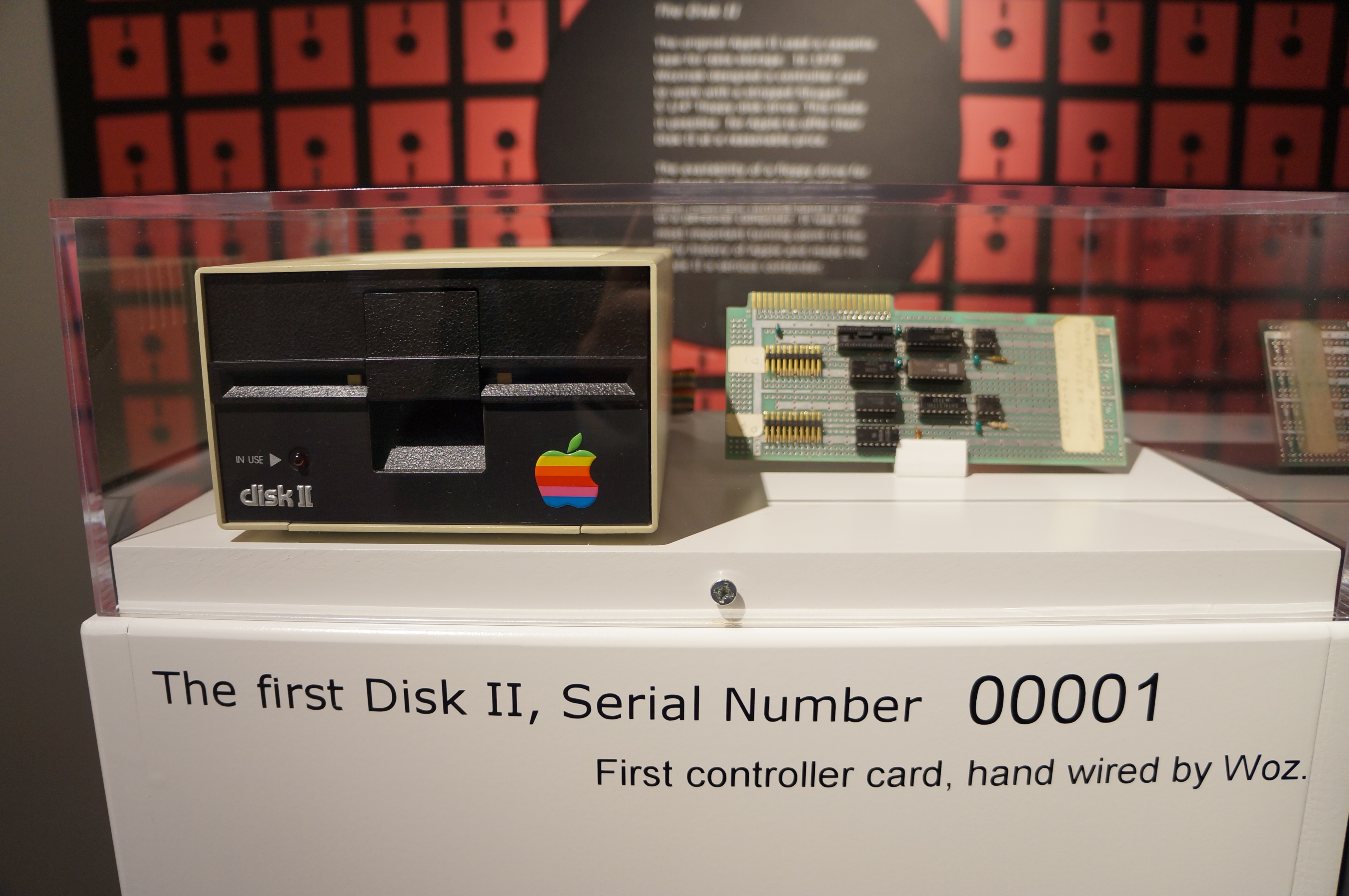
    The first Apple Disk II and controller card hand wired by Wozniak. Photo taken at the Apple Pop-Up Museum in Roswell, GA.
    The first Apple Disk II and controller card hand wired by Wozniak. Photo taken at the Apple Pop-Up Museum in Roswell, GA.

    Matthew Kirschenbaum constructs a compelling and interesting argument in his book Mechanisms: New Media and the Forensic Imagination (2008). He argues that while new media and computer software might seem ephemeral and intangible, it has in fact physicality, a many-layered history, and emerging archaeological protocols (developed by Kirschenbaum and many others).

    However, one section titled “Coda: CTRL-D, CTRL-Z” attracted my attention, because its use of the term “recover” in a story about the debut of the Apple Disk II seemed to imply computer disk data recovery instead of what historically happened, which was the manual rewriting of the software that had been accidentally overwritten during a botched disk copy operation.

    Kirschenbaum uses the story of Steve Wozniak and Randy Wigginton’s development of software to control the reading and writing of data to Apple’s Disk II, which was based on Shugart’s 5 1/4″ floppy disk drive, before its unveiling at the 1978 CES in Las Vegas to establish an analogy: “Nowadays we toggle the CTRL-D and CTRL-Z shortcuts, deleting content and undoing the act at a whim. Gone and then back again, the keyboard-chorded Fort and Da of contemporary knowledge work” (Kirschenbaum 69). The idea is that computer facilitate a kind of gone and back again play as described by Freud. Of course, the keyboard shortcuts that he refers to are not universal across platforms or software, but the concept is pervasive. Nevertheless, my focus is not on that concept per se but instead on the Apple Disk II debut anecdote, the terminology surrounding what actually happened, and how that relates to the kinds of work that we do in new media archaeology.

    After introducing the story of the Apple Disk II’s debut at CES, Kirschenbaum cites a passage from Steven Weyhrich’s Apple II History website:

    “When they got to Las Vegas they helped to set up the booth, and then returned to working on the disk drive. They stayed up all night, and by six in the morning they had a functioning demonstration disk. Randy suggested making a copy of the disk, so they would have a backup if something went wrong. They copied the disk, track by track. When they were done, they found that they had copied the blank disk on top of their working demo! By 7:30 am they had recovered the lost information and went on to display the new disk drive at the show.” (Weyhrich par. 13, qtd. in Kirschenbaum 69).

    First, it should be noted that Weyhrich uses the term “recovered” to describe the way that the “lost information” was brought back from the brink of the overwritten disk. Then, Kirschenbaum reads Weyhrich’s account above in the following way:

    “Thus the disk handling routines that took the nascent personal computer industry by storm were accidentally overwritten on the very morning of their public debut–but recovered and restored again almost as quickly by those who had intimate knowledge of the disk’s low-level formatting and geometry” (Kirschenbaum 69).

    Weyhrich uses the term “recovered” to refer to the software Wozniak and Wigginton had lost during the bad copy operation. Kirschenbaum borrows Weyhrich’s “recovered” and adds “restored” to describe the final state of the software on Wozniak and Wigginton’s floppy disks for use on the CES show floor. When I first read Kirschenbaum’s book, his reading seemed unncessarily ambiguous. On the one hand, Kirschenbaum does not directly say that the two Apple engineers used their knowledge of controlling the disk drive and reading low-level information on the floppy disks to “recover” the lost data–i.e., use the drive and disk technology to salvage, rescue, or retrieve what remains on the disk but otherwise might seem lost to someone with less advanced knowledge. On the other hand, Kirschenbaum’s reading of the incident–“recovered and restored again almost as quickly”–is implicitly aligned with his own project of the physicality of data stored on new media storage devices. One could mistakenly believe that Wozniak and Wigginton had restored the lost data from the overwritten floppy disk.

    Steven Wozniak writes about this episode in his autobiography, iWoz: Computer Geek to Cult Icon (2006). Before turning to Wozniak’s later recall of this event in 1978, I would like to look at the two sources that Weyhrich cites on the passage that Kirschenbaum cites in his argument.

    Weyhrich’s first of two footnotes on his passage points to page 168 of Gregg Williams and Rob Moore’s 1985 interview with Steve Wozniak titled, “The Apple Story, Part 2: More History And The Apple III” in the January 1985 issue of Byte magazine. In the interview, Wozniak tells them:

    “We worked all night the day before we had to show it [the disk drive] at CES. At about six in the morning it was ready to demonstrate. Randy thought we ought to back it up, so we copied the disk, track by track. When we were done, he looked down at them in his hands and said, “Oh, no! I wrote on the wrong one!” We managed to recover it and actually demonstrated it at CES” (Williams and Moore 168).

    In this primary source, we see Wozniak using  the term “recover” to indicate that they were able to get the demonstration operational in time for CES that day, but what form the “recovery” took place is not explained. Was it data recovery in the technical sense or data recovery in the hard work sense of re-writing the code?

    Weyrich’s second footnote on his passage points to Paul Freiberger and Michael Swaine’s “Fire In The Valley, Part Two (Book Excerpt)” in the January 1985 issue of A+ Magazine. While I have been unable to find a copy of this magazine, I did refer to the book that this excerpt was taken from: Freiberger and Swaine’s Fire in the Valley (1984). On page 286, they write in regard to Wozniak and Wigginton’s disk dilemma at CES:

    “Wigginton and Woz arrived in Las Vegas the evening before the event. They helped set up the booth that night and went back to work on the drive and the demo program. They planned to have it done when the show opened in the morning even if they had to go without sleep. Staying up all night is no novelty in Las Vegas, and that’s what they did, taking periodic breaks from programming to inspect the craps tables. Wigginton, 17, was elated when he won $35 at craps, but a little later back in the room, his spirits were dashed when he accidentally erased a disk they had been working on. Woz patiently helped him reconstruct all the information. They tried to take a nap at 7:30 that morning, but both were too keyed up” (Freiberger and Swaine 286).

    Unlike Wozniak’s “recover” in the Williams and Moore interview above, Freiberger and Swaine use the term “reconstruct” in their narrative about the pre-CES development of the Disk II demonstration software. Unlike the term recover, which means to regain what is lost, reconstruct means to build something again that has been destroyed. Freiberger and Swaine’s selection of this term seems more accurate when considering what Wozniak says about this episode in his autobiography:

    “We set up in our booth and worked until about 6 a.m., finally getting everything working. At that point I did one very smart thing. I was so tired and wanted some sleep but knew it was worth backing up our one good floppy disk, with all the right data. . . . But when I finished this backup, I looked at the two unlabeled floppy disks and got a sinking feeling that I’d followed a rote pattern but accidentally copied the bad floppy to the good one, erasing all the good data. A quick test determined that this is what happened. You do things like that when you are extremely tired. So my smart idea had led to a dumb and unfortunate result. . . . We went back to the Villa Roma motel and slept. At about 10 a.m. I woke up and got to work. I wanted to try to rebuild the whole thing. The code was all in my head, anyways. I managed to get the good program reestablished by noon and took it to our booth. There we attached the floppy and started showing it” (Wozniak and Smith 218-219).

    In this account, Wozniak says that he is responsible for overwriting the good disk with the bad (as opposed to what he said to Williams and Moore for the 1985 Byte magazine interview), but most important is the terms that he uses to describe how he made things right: “I wanted to try to rebuild the whole thing.” He “reestablished” the program by reentering “the code . . . in [his] head” into the computer that they had on-hand. Wozniak’s word choice and description makes it clearer than in his earlier interview that he had to remake the program from memory instead of attempting to “recover” it from the overwritten media itself. While, it might have been theoretically possible for someone as well versed in the mechanism that by that point he had had a significant hand in redesigning from the original Shugart drive mechanism and controller card and of course his development with Wigginton of the software that controlled the hardware to read and write floppy disks in the Apple Disk II system (computer-controller card-disk drive), Wozniak, who reports throughout his autobiography as an engineer who works things out in head meticulously before putting his designs into hardware or software, took the easiest path to the solution of this new media problem: write out the software again from memory.

    Memory, of course, is another tricky element of this story. It was my memory of Wozniak’s exploits that drew me to this passage in Kirschenbaum’s book. My memory of Kirschenbaum’s argument informed the way that I interpreted what I thought Kirschenbaum meant by using this episode as a way of making his Fort-Da computer analogy. Kirschenbaum’s memory of the episode as it had been interpreted secondhand in Weyhrich’s history of the Apple II informed how he applied it to his argument. Wozniak’s own memory is illustrated as pliable through the subtle differences in his story as evidenced in the 1985 Byte magazine interview and twenty-one years later in his 2006 autobiography.

    Ultimately, the episode as I read it in Kirschenbaum’s Mechanisms was caught in an ambiguous use of language. The use of certain terms to describe the work that we do in new media–in its development, implementation, or daily use–relies on the terminology that we use to describe the work that is done to others–lay audience or otherwise. Due to the kind of ambiguity illustrated here, we have to strive to select terms that accurately and explicitly describe what it is we are talking about. Of course, primary and secondary accounts contribute to the possibility of ambiguity, confusion, or inaccuracy. Sometimes, we have to dig more deeply through the layers of new media history to uncover the fact that illuminates the other layers or triangulate between differing accounts to establish a best educated guess about the topic at hand.

    Works Cited

    Freiberger, Paul and Michael Swaine. Fire in the Valley: The Making of the Personal Computer. 2nd ed. New York: McGraw-Hill, 1984. Print.

    Kirschenbaum, Matthew G. Mechanisms: New Media and the Forensic Imagination. Cambridge: MIT Press, 2008. Print.

    Weyhrich, Steven. “The Disk II.” Apple II History. Apple II History, n.d. Web. 13 Sept. 2015.

    Williams, Gregg, and Rob Moore. “The Apple Story, Part 2: More History And The Apple III”, Byte, Jan 1985: 167-180. Web. 13 Sept. 2015.

    Wozniak, Steve and Gina Smith. iWoz: Computer Geek to Cult Icon. New York: W. W. Norton & Co., 2006. Print.

  • Demos Chiang, Chiang Kai-shek’s Great Grandson, on the Cost of Social Media

    Demos Chiang, photo by Yi-Ping Wu. CC BY-ND 2.0.
    Demos Chiang, photo by Yi-Ping Wu. CC BY-ND 2.0.

    In a BuzzOrange.com interview with Demos Yu-bou Chiang (蔣友柏), who is Chiang Kai-shek’s great grandson and  founder of the Taiwan design firm DEM Inc. (橙果設計), the interviewer asks if he uses social media:

    Q:你有 Facebook 或 Line 等社交通訊軟件嗎?

    不開,很累,真的很累,而且 Facebook 商業行為太嚴重。我的手機是 4G 可以上網,但所有通訊軟件 、Line 都不使用,只用簡訊。我不喜歡人家可以免費找到我。

    Y’s translation into English:

    Q: Do you have Facebook or Line accounts, or any kind of social media apps?

    A: I don’t use it. It is too much work. Facebook has too much commercial activity. I have a 4G cellphone to get online, but I don’t use the communicating apps like Line except for text messaging. I don’t like it that people can find [or reach] me for free.

    There are three parts of Chiang’s response that I would like to discuss.

    First, he observes that social media takes “too much work.” This is one of the reasons why I deleted my Facebook account a few years ago. It seemed like I was putting in a lot of time and labor on the Facebook website and mobile app. On the one hand, I wanted to connect with others, create conversation, and share my goings-on while enjoying the goings-on of others. However, it increasingly seemed to me to take a considerable amount of effort to keep up with the information and conversations taking place there. Jennifer Pan goes into the issue of labor that sustains social media networks in her Jacobin article, “The Labor of Social Media.”

    Chiang laments that there is “too much commercial activity” on social media. This can be interpreted in different ways. On the one hand, there is a lot of advertising on social media, which is a kind of commercial activity. On the other hand, people use social media as a platform to publicize their work or seek support for their work on social media (another form of advertising). While social media opens new ways of supporting otherwise unfunded projects (such as with Patreon or Kickstarter), the number of such projects that one sees on a daily basis can be overwhelming and seemingly unsustainable.

    Another aspect of Chiang’s lament is the unseen commercial activity of tracking and personal information. Social media platforms make money in part through targeting advertising to its users by selling targeted and detailed access to its advertising partners. The more information that a social network can get about its users and the more meaningful that information can be made for the purposes of advertising mean that the social network can potentially make more money by selling a higher value to advertisers.

    Finally, the third issue that Chiang takes with social media is that he says, “people can find me for free.” This is important point that I hadn’t really considered when I left Facebook and other social media platforms a few years ago. For Chiang, he is a business person whose time is valuable. Even deflecting questions or offers takes away from his focus and time, which is time and focus he could apply to other endeavors. Social media at its core is about connecting people together. Social media makes it easier for one person to contact another person. Some networks, such as LinkedIn, place monetized barriers in the way of too easy contact, but others, such as Twitter, make contact for public accounts extremely easy. By not being on social media, Chiang places the ultimate old-school barrier to others bothering him, stealing his focus, or taking away his time. Making it so that others cannot simply find you “for free” protects your time and attention so that you can apply yourself to the work and living that matters the most to you.

    Chiang’s three points are useful for thinking about what the costs of social media are for you. It involves our labor, out information is bought and sold, and others want to monopolize our time. Consider these things when you sign-up or configure your social media accounts to protect yourself and maximize its value to yourself.

  • Living in the Present with Vintage Computers, and Reading the Past as a Netrunner: On Reading William Gibson’s All Tomorrow’s Parties

    Having just finished William Gibson’s All Tomorrow’s Parties (1999) and thus concluding his Bridge Trilogy, I cannot say with anything resembling certainty that I have read or not read these novels before. As I said when I began writing a few notes on my blog about Virtual Light and Idoru, I have a creepy feeling of having been in these novels before, of having read them sometime and some place. If I have encountered these novels directly before, the memory source for those encounters is locked away in some inaccessible part of my memory. Anyways, if I did read them before and there should be some memory, I am hopeful that it is still there and simply inaccessible to my mind’s eye in the present and not eradicated by some biological injury.

    Despite my memory’s misgivings and uncertainty, I can certainly say that I enjoyed this vision of the future/present/near past illustrated in the fast and sharp language Gibson lays down in these three novels. In All Tomorrow’s Parties, we experience Laney’s virtuosity as a netrunner who builds alliances/buys alliances that out maneuvers the 0.001%er Harwood. Laney’s ability as a psychopharmacologically enhanced cyborg who can see the flows of data, understands what we have all just recently learned about the power of metadata, and seizes the accreting eddies and currents of information, narrative, and inevitability leading to something bigger, powerful, and otherwise unseen–an undertow of history.

    Laney as netrunner seems an analog of what we have all become in one way or another. We manage our flows of information with RSS feed aggregators, news readers, the Facebook wall, the Twitter feed, the timeline, hashtags, tagging, Friend lists, Google+ Circles, subscriptions, etc. Before all of this, there was talk in the magazines about creating intelligent agents–small programs that would scour the Internet for the information and news that we would like to learn more about (perhaps through keywords and other coded instructions)–that helped manage what we read and saw while also managing our precious pre-broadband bandwidth.

    It is worth noting that in both cases, watching the firehose of feed data now or harvesting news bits with intelligent agents, all data written by someone for the info consumption of others is a practice of historic preservation, archivization, observing what has come before. Taken one step further, none of us experience the present due to our biological senses and cognition systems that delay our experiencing the world beyond ourselves. Thus, the netrunner (and ourselves as modern netizens) are a further step away–observer experiences, reports multimodally over the Internet, we experience the multimodal report. To go further on this point or digress on the transformation of these experiences by the media and modal channels involved would likely cover several volumes, so I will end the digression here.

    There are times when I feel like Laney must have felt in his dank cardboard hovel in the Japanese train station. Surrounded by his own filth and barely holding on to life with a ritual of cough syrup and sugars to keep his body barely operational but well enough that he could remain plugged into the data feed via his VR eye goggles. Trying to keep up what is going on in the world, going on with family and friends, going on professionally via the numerous and multiplying channels of social and broadcast media is daunting. It is a burden–a heavy one at that. Any attempt that I make at streamlining, modulating, organizing, and taming these never ceasing feeds of information makes me feel overwhelmed, lacking control, and otherwise wasted. My own compulsion to try to keep up, to interact, and to communicate in kind leaves me feeling dread over joy more often than not.

    At least in Laney’s case in All Tomorrow’s Parties, he is working toward a goal of swinging the nodal point away from Harwood and towards something different, perhaps altruistic and thus the many Rei Toei’s are born of nanotech assemblers in the many Lucky Dragon establishments.

    Another interesting image for me and my work as a researcher of our shared digital culture is the Bad Sector shop on the San Francisco side of the bridge. Chevette finds Tessa outside the Bad Sector shop working on her tiny video drone, God’s Little Toy (an increasingly ubiquitous and problematic technology today ranging from privacy violation to public safety in the air and on the ground). Later, Rydell goes to the Bad Sector to obtain two cables for Rei Toei’s holographic projector. Inside the Bad Sector shop, Gibson describes its Jurassic technologies–lingering on audio recording media going back to the beginning and vintage personal computers–particularly those encased in beige. Of course, the shop’s name refers to a bad sector on computer readable magnetic media–a physically unreadable or damaged location on the media platter–floppy or hard disk.

    For media archivists, the bad sector is like a burned or rotted page in an ancient manuscript. There is the possibility that the data might exist copied by the manipulations of digital technology far more quickly than that by a human scribe, but if no copy or backup exists, the bad sector–depending on the type of magnetic media, its data density, etc–could leave some information permanently inaccessible. Although, I can imagine a bad sector can, in some very particular circumstances, tell us things about how technology-as-culture was developed and continues to develop (the physicality of drive mechanisms, error correction algorithms, the application of scientific principles to avoid physical destruction of the drive media, the deformities or problems with a given writer’s computer setup, how that writer’s computer influenced the development of cultural works–lost drafts, overwritten work, etc.). So, the bad sector can be seen as a loss on the one hand and potentially a gain for understanding on the other.

    My office at City Tech (and the previous labs of vintage computer that I have built up, sold off, donated over the years beginning at my childhood home in Brunswick, GA, my flea market booth at Duke’s Y’all Come Flea Market in Darien, GA, my home in Norcross, GA, the Special Collections of Georgia Tech’s Library Archives, and now my college in Brooklyn, NY) is kind of like the Bad Sector on the bridge. It is cobbled together. It is incomplete. It is bricolage. It is pieced and held together with equal parts ingenuity and duct tape. Unlike the Bad Sector in All Tomorrow’s Parties, it is mine and not something bought and sold by off-bridge investors. Like the bridge in the novel, my vintage/retro computing lab is a community effort–I get and give, others get and give. I work on it and at it to remember where we have come from and to reflect on how our past innovations inform and continue to speak to our current digital culture. I want its archive to provide testimony about who we were and who we have become as human beings and thinking organisms. It is part of my research and pedagogy.

    William Gibson’s Bridge Trilogy (Virtual Light, Idoru, and All Tomorrow’s Parties) is an impressive vision. My deja vu or amnesia–depending on your point of view–about the novels might say more about how much like the present some themes and images in Gibson’s novels speak to the way things were and are in the real world.

  • What Do We Call Their Union: On Reading William Gibson’s Idoru

    Continuing with William Gibson’s Bridge Trilogy, I read Idoru (1996) this past Sunday.

    My sense of deja vu was as pronounced as when I read Virtual Light, but I still cannot bring myself to say with absolute certainty that I had read these books before. I tend to believe that my triangulation of these narratives from conference going and secondary literature reading have implanted the seeds of these novels in my memory–with roots long, but stem and leaves stunted–almost translucent.

    Idoru circles the entertainment-industrial complex’s creation of celebrity, fandom’s eclipsing of the actual cultural production of celebrity, personal metadata and its uses for surveillance and control, and another trajectory of emergent AI/personality construct–in this case the idoru, Rei Toei.

    Rei Toei is like a more advanced version of the vocaloid, Hatsune Miku. Her entrance into the real world might be more aligned today with 3D printing technologies and robotics like Danny Choo’s Smart Doll (though, I’m sure Mr. Choo would do equally interesting and exciting things if he got his hands on a packet of self-assembling nanomachines described in the novel). Or, in 2009, a Japanese man married Nene Anegasaki, a character from the Nintendo DS game Love Plus (Telegraph story, BoingBoing video). These bonds are so strong that in 2012, a Japanese groom and his bridge destroyed his Nintendo DS and Love Plus game cartridge, which held his saved game data with (again) Nene Anegasaki (Kotaku story, Twitter post).

    I recalled David Levy’s Love and Sex with Robots: The Evolution of Human-Robot Relationships (2008), which explores how humanity’s relationships with its technologies–especially those anthropomorphized or imbued with human qualities–has and continues to change over time.

    In regard to Rez’s desire to wed Rei Toei, on the one hand, the union is of celebrity–albeit two forms of it: a human male musician and an AI construct gendered female and given form holographically (machinery and bandwidth permitting). What should we call this sameness?

    On the other hand, it is a union of biological and technical, human and computer, human and technology, human and entertainment, human and the Other. What should we call this difference?

    However, the wedding of human-AI construct seems pedestrian, a reinscription of heteronormativity. It is a capitulation to heteronormative culture instead of an embrace of the newness, the otherness, the differentness brought about by human-technology co-evolution (thinking of Bruce Mazlish’s The Forth Discontinuity).

    Considering its heteronormative trajectory, what is Rez and Rei Toei’s marriage produce? Seems like there’s talk about some kind of becoming or emergence. This brings to mind arguments like Leo Bersani’s in “Is the Rectum a Grave?” or Christine Overall’s in Why Have Children? It should go without saying that a child need not be the result of a union/marriage/partnership, but if we follow the heteronormative logic of Rez and Rei Toei marriage, what might their desire be–merging, emergence, becoming, creating?

    Regardless, I welcome these new developments, their possibilities, and how we account for them with language. But, I hope that the new is unshackled from simply repeating what has come before.

  • Déjà vu or Reality: On Reading William Gibson’s Virtual Light

    Over the weekend, I began reading William Gibson’s “Bridge Trilogy” beginning with his novel, Virtual Light (1993).

    Reading the novel, I had a tremendous sense of déjà vu that was impossible to shake. I asked myself these questions in response to this strange feeling that persisted during the hours of reading and after:

    Have I read this before? This is entirely possible. I used to have copies of the Bridge Trilogy novels, but I sold them before moving to Liverpool for graduate school. As I look back on my blog–or am reminded of things I have wrote about on my blog when I occasionally receive and respond to a comment on something long forgotten–I have read a number of things that I cannot now recall in my memory.

    Have I read so much secondary literature about it that I feel as if I have read it? This is definitely a possibility, because I read through a lot of secondary literature on Gibson’s oeuvre as I was writing my dissertation and in preparing for my research trip to the University of California, Riverside Library in 2012. In academia, I have found myself circling works through the secondary literature. I learn bits and pieces through summary and arguments that I then piece together in my mind as a kind of jigsaw puzzle version of the work in question. You triangulate the narrative and characters from that data that you have. Of course, this is not the same as having read the real thing, but it is akin to how we know about some Greek dramas and ancient philosophies–the surviving references instead of the thing itself.

    Are there so many aspects of the present (or recent past) like those we encounter in Virtual Light that I feel as if the novel mirrors the present? Besides the image of the bridge and its bricolage/assemblage/community, Virtual Light has augmented reality, navigation systems, cracking car computer/communication system, SWATTING (of a kind), armed drones, an erased Middle Class, a San Francisco dependent upon the service industry, and a security-industrial complex. I recently read Bruce Sterling’s The Hacker Crackdown (1992), which seems to figure into the novel by anecdote and theme (differentiating hackers/merry pranksters from hackers/criminalization). The connection between the themes of his over two-decade old novel and the present is strong. Maybe it should be required reading for contemporary security analysts.

    So, have I read it before? I’m still not sure, but I’m left with a strange feeling about the novel and the present.