Author: Jason W. Ellis

  • Recovered Writing, PhD in English, Teaching College Writing, Assignment Design: Team-Based Competitive Blogging with Portfolio Integration, July 1, 2008

    This is the fifty-second post in a series that I call, “Recovered Writing.” I am going through my personal archive of undergraduate and graduate school writing, recovering those essays I consider interesting but that I am unlikely to revise for traditional publication, and posting those essays as-is on my blog in the hope of engaging others with these ideas that played a formative role in my development as a scholar and teacher. Because this and the other essays in the Recovered Writing series are posted as-is and edited only for web-readability, I hope that readers will accept them for what they are–undergraduate and graduate school essays conveying varying degrees of argumentation, rigor, idea development, and research. Furthermore, I dislike the idea of these essays languishing in a digital tomb, so I offer them here to excite your curiosity and encourage your conversation.

    Before I could accept my teaching fellowship at Kent State University, I needed to take the graduate seminar, “Teaching College English.” I was fortunate to have the opportunity to take this class from Professor Brian Huot. At the time, I thought my primary concern was putting together my first syllabus, but through the seminar, I learned the importance of meeting student needs, considering outcomes, meeting students on the page, helping students improve their command of rhetoric and multimodality with a portfolio, and considering student work holistically (something that I continue to do with the Georgia Tech WCP’s WOVEN modalities and programmatic rubric).

    In this first of four Recovered Writing posts from this seminar, I am sharing a project with support for portfolios. Since I wrote this project, technology and teaching have come a long way, but the ideas in this assignment can be repurposed in many different ways.

    Also, I enjoyed looking at the attached screenshots of WordPress circa 2008. I miss the earlier design for WordPress.

    Jason W. Ellis

    Professor Brian Huot

    Teaching College English

    1 July 2008

    Competitive Team Blogging with Portfolio Integration

    image002
    BoingBoing crew photo by Bart Nagel, http://boingboing.net/2006/07/30/astronauts-reveal-bo.html

    Introduction and Pedagogical Concerns

    The five, seemingly innocuous persons in the photograph on the title page are the eccentric collaborative technoculture team of the insanely popular BoingBoing.net blog–“A Directory of Wonderful Things.”[1] They are Mark Frauenfelder, David Pescovitz, John Battelle, Cory Doctorow, and Xeni Jardin. BoingBoing.net began as a ‘zine in the 1990s by Frauenfelder, and later oozed online and evolved into the A-list blog that it is today. Through its various mediums–print, website, and blog–it has been a collaborative effort encompassing the various talents of different persons with complementary skills, abilities, and loves. Additionally, the collaboration of the “Boingers” is not only very synthetic, but also technically required in order to generate the copious content posted to their blog every day. Without this on-going large textual corpus, the popularity and repeat viewership of BoingBoing.net would not have been possible or sustainable.

    I believe that BoingBoing’s collaborative blogging model has something to offer our students in an ever-increasingly technologically mediated world. Also, the writing aspect of blogging, which has been talked about in the literature by numerous persons, is a useful tool in the freshman composition and college writing classroom. Another important aspect of the blog is the archival aspect of blogging that lends itself as complementary to a portfolio centric writing classroom. However, team blogging necessitates some aspect to engender caring on the part of students in order to distinguish it as something more than merely writing online. This is achieved by forming groups to create a themed blog based on their major or interests, and requiring each team to report to the class as a whole on the “success” of the blog in terms of viewership and comments. This friendly competitive atmosphere will motivate students to work above-and-beyond in order to have better statistics than their rival groups. Therefore, team based blogging should be considered as another viable multimodal model for college writing courses, because it fulfills a number of important developmental tasks promoted by the Kent State Writing Program.

    Competitive team blogging with portfolio integration for the College Writing I classroom is a pedagogical tool aimed at achieving several important goals: providing students a space and theme they are interested in, increasing student investment in a work that they “own” outside the context of the classroom, and improving teacher response by emphasizing explanation over marginal remarks, and embracing multimodal compositional practices by shifting student portfolios from physical media to the Internet.

    The theory behind competitive team blogging is that students will care more about the creation, maintenance, and contribution to a collaborative work focused around something that interests them than artificial, individual assignments to be handed into the teacher. Their care for their blog and their writing posted to it will come with an audience larger than the class, department, and school. Reminding students of this broader audience, combined with their real-world data showing the origin of the viewers, should motivate them to work harder on this than assignments for a teacher-only audience.   Additionally, team blogs allow for all written work done by the student to be contained in an archive that’s always present, which encourages students to look back at past work, and more easily prepare revisions based on their own considerations and those provided by their team and the class as a whole.

    This document on the implementation of competitive team blogging with portfolio integration contains a step-by-step methodology, a worksheet of topics to cover regarding collaborative blogging, a student handout on blogging and team blogging, and illustrated instructions on creating a collaborative blog with WordPress.com.[2] Additionally, this teaching tool is intended as a guide for teachers, and is aimed at that audience. Each teacher who implements team blogging should tailor its employment to his or her class. Obviously, this pedagogical tool would be much more difficult for someone with a 4/4 teaching load as opposed to a 1/2 teaching load. However, I encourage alterations to this project that makes it practical and meaningful for you and your students.

    Methodology

    1. Introduce your students to your methodology and the reasons behind it. Be up-front and open with your students regarding competitive team blogging with portfolio integration. For example, tell them that they’ll be doing “team blogging” all semester, and maintain an emphasis on their contributions to their blogs throughout, and stand firm on the place of team blogging in the classroom. I don’t mean that you should not be a reflective practitioner, but the core idea of team blogging should be maintained and other alterations to lessons and assignments should be made if need be. Additionally, some students may or may not blog, and they may not be accustomed to extended teamwork. You’ll have to teach your students how to do these things, as well as teach them about other aspects of online content creation and commenting (these may be extended throughout the course).
    2. Gather student information. It’s expedient for the teacher undertaking the semester-length team blogging exercise to assign members to each of the groups. This is easily accomplished during the first week of class by requiring all students to email the teacher a numerated list of at least three interests or hobbies as well as their major. The teacher should tell the students the purpose of this exercise, and allow friends to request making their own team as long as they provide a convincing explanation for their team’s focus.
    3. Form teams. Following the gathering of student interests, form the class into four or five teams based on similar or complementary interests. Explain to the class that this will form the basis of their collaborative work over the course of the semester. Allow the students time to get to know one another, exchange contact information, and decide on the final theme and title for their team’s blog.
    4. Develop team roles. Have students review and write critiques or reports about popular collaborative blogging sites such as Gawker, Boing Boing, etc. before class. In class, open discussion about the purpose of blogs and the way in which collaborative blogs handle content creation from a number of authors. This means, guide them through understanding the roles of webmasters, editors, and content contributors. Finally, have the teams pick their first round of roles, which will alternate periodically throughout the semester in order to allow each member a chance to wear a different hat and experience different responsibilities.
    5. Create blogs. Devote a class in the computer classroom to guide the students through creating a collaborative blog with a free service such as wordpress.com (see Appendix 1 for instructions).
    6. Integrating blogs into the writing classroom. Non-graded individual assignments should be tailored as posts for the student’s team blog. If your class isn’t always in a computer classroom, require students to type up and post their handwritten class work before your next meeting.
    7. Building team competition. After four weeks of blogging, prepare your students for weekly group presentations. These presentations should be about five minutes in length for each team, so that no more than half a class is devoted to them. These presentations should include the following information: the editor’s choice of best post, the group’s choice of best post, site traffic numbers, and other interesting information such as incoming links and search terms visitors to their blog used to find their posts. Other ways of increasing competition is to offer prizes at the end of the semester for the best blog, and this can be decided by the teacher or by the class through the use of ranked voting (i.e., the class rates each team as either 1st, 2nd, 3rd, etc, and the team with the least amount of votes–meaning higher ranking–wins). Cheap prizes such as KSU keychains or t-shirts may be given to the winning team, or the teacher may solicit local businesses for donated giftcards.
    8. Team blog as portfolio. The fearless teacher combines portfolios with team blogs. This would entail having students post all of their assignments, including the required graded papers, to their team’s blog. The teacher may use the comments on those posts to leave feedback, encouragement, and critique on each student’s graded post. Additionally, students will have the opportunity to revise their papers in a new posting, which they must link back to their original post. At the end of the semester, each student must write a post that includes links to their last revisions, which in turn will link back to their earlier drafts. This nesting should facilitate easy evaluation of the portfolio assignments.
    9. Reflective Assignment. For your students’ reflective assignment, they should reflect on the blogging process as well as the writing process that you model for them throughout the semester. They will realize that they will have produced an extraordinary amount of material individually and even more so cooperatively through semester-long blogging, which will add to their developing sense as a writer.

    Topics of Discussion Regarding Collaborative Blogging

    • How is online content created? It isn’t “automagically” generated by machines. Real people, with real investments in what is being communicated, are behind the text that you read on your favorite blogs.
    • Online etiquette and protocol. Encourage openness and cooperation and warn against flaming. Even though our blog writing exists out in the Internet cloud, a human being created it, and we must respect the person behind that content. It’s okay to disagree and constructively argue with a writer about his or her content, but it’s not okay to attack the person behind the writing.
    • Team roles. Talk about the differences between the roles of editor and contributors. Encourage group cohesion and support. The editor’s role is not to discourage team members, but instead to encourage them. Additionally, all team members should comment on and provide support for the other members.
    • Intergroup roles. Members of each group should be required to comment on the postings of the other groups. These comments need not be about the content of the postings, but more importantly the ideas and argument communicated by the post’s writer to an online audience.
    • Citations and plagiarism. As in traditional writing, all works and sources should be cited in blog posts. WordPress has a quoting feature, and BoingBoing.net has a good model to follow regarding proper attribution.

    Handout for Students

    Team Blogging

    So, what’s blogging exactly?

    Blogging is the maintenance of an online journal, available for all to read, that reflects on your life or a particular subject. For example, I’m a blogger. I maintain a blog about Science Fiction at dynamicsubspace.net. Each day, I write something relating to SF, teaching, or my personal life. Another example is boingboing.net, which is billed as “A Directory of Wonderful Things.” It’s run by several bloggers who post about interesting, political, and fun things that they find on the Internet.

    You’re Blogging Now!

    Team blogging is the basis for the most popular blogs on the net. Boing Boing, Slashfilm, Gawker, Valleywag, Slashdot, and many others write enormous amounts of content for their readers, because the task of writing is distributed amongst a number of contributors and administered by an editor. Over the course of the semester, each of you will get to experience the different roles in team blogging by developing your own blog in groups. Your team blogs will have a theme or subject that all members will tailor their writing towards. Also, everyone will post their assignments on the team blogs for your peers and I to read and respond to. I want you to own these blogs, so make as much of them as you can for a particular audience with an interest in your theme. To make things more interesting, everyone will have a chance at the end of the semester to vote on the best blog, and that team will get a prize!

    I guarantee you that at the end of the semester you won’t believe how much you’ve each written, and how much you’ve progressed as writers. Furthermore, your blogs will explode with content that will interest many more people than students and myself.

    Creating a Collaborative Blog with WordPress.com

    1. Sign Up Now! Direct your web browser to wordpress.com and click on the large icon labeled, Sign Up Now!
      image003
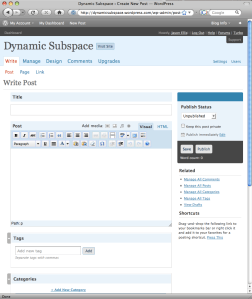
    1. Have one student create the blog’s administrator account using the Gimme a blog! option, and then have each team member go through the signup process with the Just a username, please option.image005
    2. Login to WordPress.com using the blog’s administrator account. The pages that follow are from my blog’s Dashboard—dynamicsubspace.net.image007
    3. Click on My Dashboard (upper left). This is the heart of the blog where all management takes place. Now, click on Users (right) to invite the individual team members to the blog.image009
    4. The Manage Users area allows for adding contributors to the blog. At the bottom of the page, have the teams invite each member by their registered email address. Add everyone as Editor so that they can serve that function when called on, as well as contribute to the blog.image011
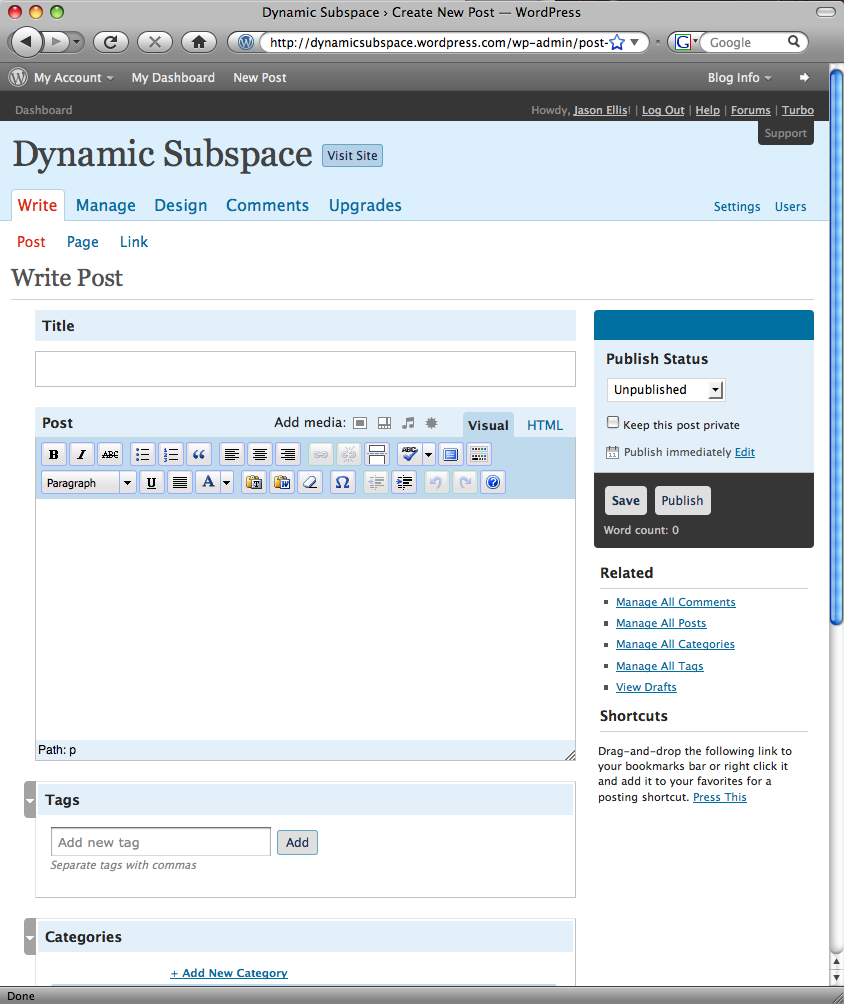
    5. Now that the housekeeping stuff has been taken care of, have the students log out of the administrator account, making sure to write down that information in a safe place, and log in with their own accounts. Once logged in, have them click on Write and begin exploring the text editing capabilities of WordPress.image013
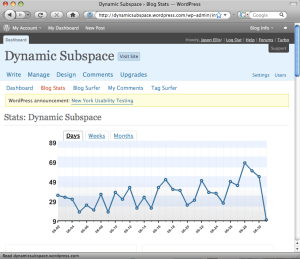
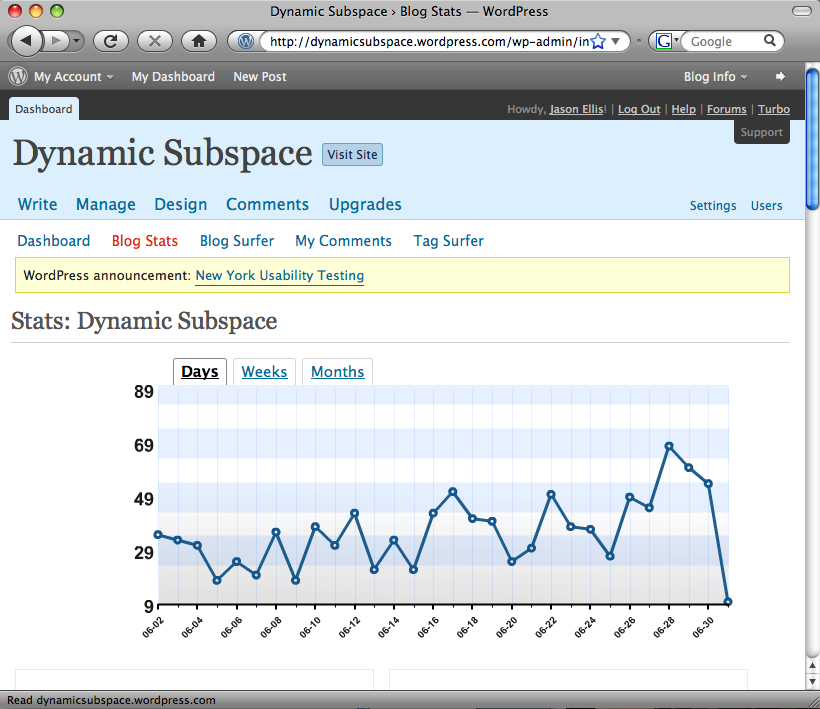
    6. The Blog Stats are essential for team reflection on the progress and audience of their blog. Returning to “My Dashboard” and clicking on Manage, and then Blog Stats yields a wealth of information about the blog’s readers. This information should be utilized in the weekly team update reports. The graphic below shows the number of visitors over time.image015
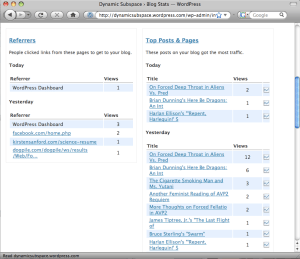
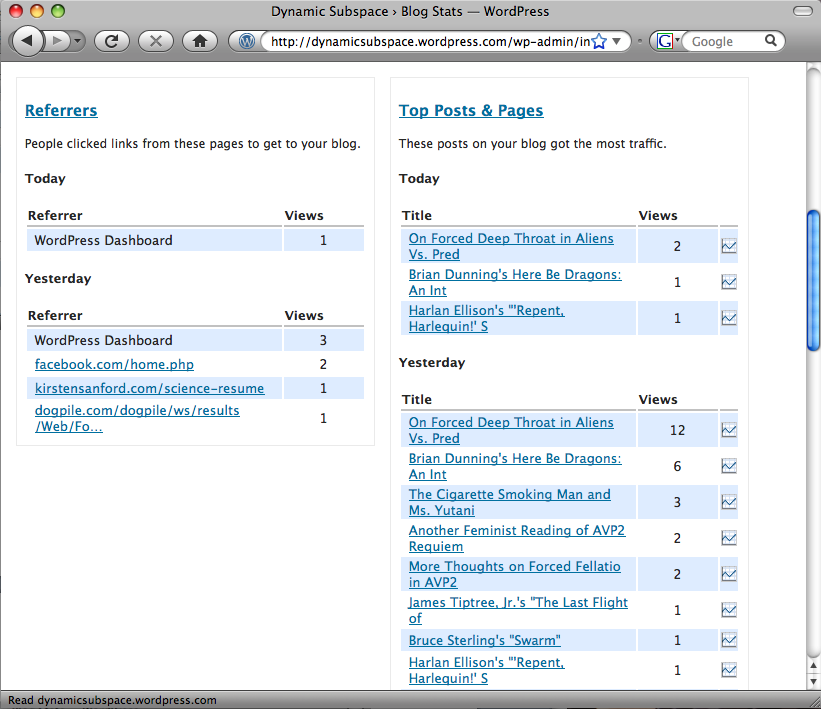
    7. Blog Stats continued. These stat boxes show referrers to the blog and the most visited posts on the blog.image017
    8. Blog Stats continued. These stat boxes show search engine terms that lead visitors to the team’s blog, and clicks made by readers from their blog to external sites.image021
    9. Blog Stats continued. At the bottom of the statistics page are raw numbers of views and posts, and incoming links to their blog from other websites and blogs.
    10. Design considerations and other explorations. Encourage your students to try out different themes (My Dashboard > Design > Themes) and other design considerations that reinforce their rhetorical choices.image023
    11. Have students reflect on their own work as well as the work of others in class and on the Internet at large. Who knows, maybe they’ll develop the next “Boing Boing” success level team blog!image025


  • Recovered Writing, PhD in English, Methods in the Study of Literature, Project 5/5, The Image of Women in Philip K. Dick’s Ubik Publishable Essay, December 10, 2008

    This is the fifty-first post in a series that I call, “Recovered Writing.” I am going through my personal archive of undergraduate and graduate school writing, recovering those essays I consider interesting but that I am unlikely to revise for traditional publication, and posting those essays as-is on my blog in the hope of engaging others with these ideas that played a formative role in my development as a scholar and teacher. Because this and the other essays in the Recovered Writing series are posted as-is and edited only for web-readability, I hope that readers will accept them for what they are–undergraduate and graduate school essays conveying varying degrees of argumentation, rigor, idea development, and research. Furthermore, I dislike the idea of these essays languishing in a digital tomb, so I offer them here to excite your curiosity and encourage your conversation.

    If I had to pick one seminar at Kent State University as being the most important to my shifting my thinking and rigor into running gear, it would have to be Professor Tammy Clewell’s Methods in the Study of Literature class. Methods is the introductory class that all PhD students have to take. Each year, a different faculty member teaches this class, and I am glad that the planets aligned for me to take this class from Professor Clewell. My joy for taking this class derives from Professor Clewell’s laser-beam accurate and calmly delivered criticisms. She expected rigor in our work, but she delivered her appraisals and commentary kindly. There was no malace in her demeanor—only the daily expectation of meticulousness, demonstration of preparedness, and application of theory. Her candor about higher education and the challenges of scholarship were eye-opening and appreciated. I was very happy to take another class from Professor Clewell the following year and even more so when she agreed to lead my postmodern theory exam and join my dissertation committee. For all of her efforts teaching, advising, and advocating, I am eternally grateful.

    This is the final Recovered Writing post from Professor Clewell’s Methods seminar. Each post is one project from the seminar. They should be considered parts of a semester-long process of entering professional discourse. These are attempts at learning, arguing, and improving. The culmination of this work is the fifth project/post in this subseries—a publishable-length essay, “The Image of Women in Philip K. Dick’s Ubik.”

    With additional feedback from Professor Clewell and seminar members, I continued my research and expanded my conference length paper into this publishable length essay included below. While all five parts should be seen together as a constellation of my progress in the class, this longer essay is the final deliverable of that very formative period in the Kent State PhD program. I shopped it around, but I decided instead to publish it as-is as a part of this seminar series of Recovered Writing on dynamicsubspace.net.

    Jason W. Ellis

    Professor Tammy Clewell

    Methods in the Study of Literature

    10 Dec. 2008

    The Image of Women in Philip K. Dick’s Ubik

    Ubik has generated a significant amount of discussion in the thirty-eight years following its initial publication in 1969. Much of this criticism avoids rigorous examination of gender roles in the text, particularly the roles of women. For example, Brian McHale includes the novel as an emblematic example of New Wave Science Fiction (SF) that represents, “SF and postmodernist mainstream fiction [becoming] one another’s contemporaries, aesthetically as well as chronologically, with each finally beginning to draw on the current phase of the other, rather than on some earlier and now dated phase” (228). Patricia Warrick most lucidly describes the postmodern aspects of Ubik in her textual and biographical analysis of the novel in which she says:

    The power of Ubik…lies in Dick’s perfect yoking of content and form. He is writing of entropy, of a time when things fall apart, when death begins to eat at social structures and at the individuals who live in society, and he uses a form that is itself decayed and nearly worn out. He writes of the struggle between order and entropy, and the form becomes the content. (146)

    Beneath the level of form creating content, most of the discussion involving the novel primarily involves economics and class structures. Darko Suvin argues for an elaborate structure to Dick’s writing periods by studying his, “use of characters as narrative foci and as indicators of upper and lower social classes or power statuses” (par. 2). Fredric Jameson continues the discussion on Ubik with a Marxist analysis, and he notes Dick’s postmodern dissolution of history when he writes, “Consider Dick’s capacity to render history. Consumer society, media society, “the society of the spectacle,” late capitalism–whatever one wants to call his moment–is striking in its loss of a sense of the historical past and of historical futures” (346). However, these analyses stop short of any sustained commentary and critique of gender in the text. Peter Fitting tacitly engages this when he writes, “Ubik is…a deconstruction of the metaphysical ideologies and the metaphysical formal implications of the classical bourgeois novel” (par. 14). His critique of the “metaphysical formal implications of the classical bourgeois novel” has to do with the nature of reality and linear time rather than other aspects of the bourgeois novel replicating and reinforcing accepted gender roles. Christopher Palmer talks about sex and sexuality, but only in terms of male sexual fulfillment. He connects sex to consumer advertising when he writes, “Joe Chip’s quest for sexual pleasure strikes us as grubby in the circumstances of Ubik, and anyway is continually frustrated…The implication seems to be that one can find Ubik–which is simultaneously a deity; the ultimate, shiny, and wonder-working, but insubstantial consumer product; and the promise evanescently behind every consumer product. But sexual satisfaction is not to be had” (57). My question then is for whom is that satisfaction intended? In this reading, the answer seems to be for men, which promotes patriarchic hegemony. Ubik becomes a story for and about men as well as men’s “needs.” Yes, there are women, but they are made subservient to the needs of men and the narrative progression centering on the favored narrators: Joe Chip, and his employer, Glen Runciter. Krista Kasdorf’s recent work brings us one step closer to investigating female subjectivity in Ubik through an analysis of thermodynamic entropy in Dick’s novel and Pamela Zoline’s 1967 feminist SF short story, “The Heat Death of the Universe.” Kasdorf, extending the metaphor of entropy to women, writes, “the young attractive women of Ubik can be combined into one type based on function instead of merely by physical description–they are the Maxwell’s demons of the text, and their usefulness is determined by their willingness to expend energy for men” (39). Despite the intriguing aspects of her argument about the function of women in Ubik, I disagree with her reductionist argument to combine the “young attractive women” into one type. Things are more complicated than that within the text. Instead, I argue that the individual representations of the women in Ubik serves as a more useful model to critique and understand gender roles within the novel and their replication and commentary on the real world–historically or in the here-and-now. Therefore, the question stands: How does Dick (re)present women in Ubik, and what does that representation mean?

    To answer this question, Joanna Russ’ significant Second Wave Feminist (2WF) essay from 1974, “The Image of Women in Science Fiction,” serves as an important starting point to engage Ubik and its representation of women. Her essay is published only five years after Ubik, and one year before her own groundbreaking New Wave SF work, The Female Man. In the essay, Russ argues that the majority of SF lacks an imaginative extrapolation of sex, gender, and sexuality. She summarizes her paper by writing:

                The title I chose for this essay was “The Image of Women in Science Fiction.” I hesitated between that and “Women in Science Fiction” but if I had chosen the latter, there would have been very little to say.

    There are plenty of images of women in science fiction.

    There are hardly any women. (Russ 57)

    For Russ, “images of women” lack, “speculation about the personality differences between men and women, about family structure, about sex, in short about gender roles” (54). Instead of imagining gender roles other than those rooted in the past or present, she finds that what’s often generated is, “the American middle class with a little window dressing” (54). However, there are some examples of extrapolation that require biological oddities or reengineering rather than a re-imagining of the interaction between men and women in a future space.

    For all the literary experimentation as well as critiques of capitalism and subjective experiential reality in Ubik, women are subjected and subordinated to male hegemony through the reinforcement of “images of women.” I don’t agree with the way the text reinforces these images, but it is essential to uncover and analyze these images as part of a feminist reading. This reading will determine whether these images of women are a reinforcement of male hegemony or a commentary on the feminist struggles during 2WF.

    There are several aspects of images of women in Ubik. First, all of the women, save one briefly in chapter five, are subordinated to narration and internal dialog of the favored male protagonists. Without a deeper, psychological voice, the women characters are flattened into images. They lack the depth of their male counterparts. Second, the women are immediately identified by physical appearance and sexual attributes, most notably through the characters Ella Runciter, Pat Conley, and Wendy Wright. And third, the women are literally miscounted in relation to male characters–more on this later.

    Ella Runciter, like the other female characters in Ubik, is constructed as a mere image, because she is presented and restrained by the sexualized descriptions of her body and sexual desirability. Her full name, revealed in the penultimate chapter, is Ella Hyde Runciter. She is framed as the perpetually twenty-year-old dead wife of Glen Runciter. Also, her first name, Ella, sounds like a child’s name, possibly derived from Stella, Isabella, or perhaps whimsically, Cinderella. Her maiden name, Hyde, brings up two questions: Is she hiding from the real world in half-life, or does male authority, signified by her husband, hide her away from the world through the masculinized half-life technology provided by the Beloved Brethren Moratorium?

    There are two “encounters” with Ella in Ubik, and each is loaded with physical images of the character, revealing her subjection to male hegemony. The first appearance of Ella takes place in chapter two, when Glen visits her at the half-life moratorium to speak with her on dire business matters. She is described as, “upright in her transparent casket, encased in an effluvium of icy mist…with her eyes shut, her hands lifted permanently toward her impassive face. It had been three years since he had seen Ella, and of course she had not changed. She never would, now, at least in the outward physical way” (Dick 11). Ella is described most effectively as Runciter’s “dead wife,” because she is encased in a casket, with her hands posed just-so in relation to her “impassive face.” The casket conceals her “pretty and light-skinned” body, and her closed eyelids cover her “bright and luminous blue” eyes (Dick 12). Additionally, her “impassive face” indicates that she lacks agency on the real world. Runciter chooses when to visit with Ella, without any apparent way for Ella to request or demand an audience with her husband who hasn’t visited her in three years. In terms of her appearance to someone inhabiting the real world, she cannot change “in the outward physical way,” further reinforcing her lack of dynamism, choice, and ultimately, future in the real.

    Ella, in the moratorium described above, and in the world of half-life, is a character constantly seen rather than seeing. Dick describes Ella very differently in the next-to-last chapter, when a dying and increasingly sexually frustrated Joe Chip, riding in a cab, spots Ella walking along the sidewalk. The narration illustrates her as a “girl” with a “slow, easy gait,” “window-shopping,” and she’s “a pretty girl, with gay blond pigtails, wearing an unbuttoned sweater over her blouse, a bright red skirt and high-heeled little shoes” (Dick 203). In two sentences she’s described as a “girl,” despite her twenty years, and her body is eroticized by the juxtaposition of “gay blond pigtails,” implying youth, and her adult attire modified by the words: unbuttoned, bright red, and little.

    Ella is made more of an objectified image when Chip learns her identity, and exclaims, “You’re the other one…Jory destroying us, you trying to help us. Behind you there’s no one, just as there’s no one behind Jory. I’ve reached the last entities involved” (Dick 206). Chip objectifies her doubly, first as a sexual object with “gay blond pigtails,” and now, as an “entity.” She responds to Chip by saying, “I don’t think of myself as an ‘entity’; I usually think of myself as Ella Runciter,” to which Joe adds, “but it’s true” (Dick 206). Granted, there is a sarcastic element to Ella’s response, but nevertheless, it’s interesting that she “usually [thinks] of [herself] as Ella Runciter,” than knowing and claiming herself as a female subject. Also, her agreeing with Chip, further implicates herself in her own objectification as an “entity” and not a human subject. Instead of a female subject, or a human being, she is reduced to existence as an “entity.” An entity usually refers to a thing, rather than a person. This is an objectified labeling by the favored male narrator enforcing the real world’s male hegemony on Ella within the psychological, dream-like world of half-life, which in a sense, is an even more despicable enterprise considering that her psyche is undermined in addition to her body.

    The final aspect of Ella’s creation as an “image” rather than a woman comes when she reveals her plan to Chip about his future in half-life. She tells him, “I have a very selfish, practical reason for assisting you, Mr. Chip; I want you to replace me. I want to have someone whom Glen can ask for advice and assistance, whom he can lean on” (Dick 206). This seemingly innocuous scheme reveals the facsimile nature of Ella’s existence. She pointedly tells Chip that she wants him to replace her. Granted, she’s nearing her point of departure from half-life into rebirth, but the straight-faced manner in which she delivers this plan indicates that her role as provider of Ubik and advice, as well as role as wife, is interchangeable. Her being an interchangeable image or part further serves to objectify her as merely a “cog in the male dominated machine.” Furthermore, no one is suggesting that Chip be swapped out for one of the female characters. Despite her youthful, sexualized entrance on the stage of half-life, her plan for replacement eliminates any other desires whether they are personal fulfillment, sexual, or otherwise. Therefore, she, by this admission of replacement, relinquishes any possibility of human subjectivity and she is laid bare as an “image of women in science fiction.”

    Considering Ella as an “image of women in science fiction,” is there the possibility of a redemptive reading of Ubik? Reading Ella as a cyborg as defined by Donna Haraway has the potential for interpreting her image in the novel. Haraway defines a cyborg as, “a cybernetic organism, a hybrid of machine and organism, a creature of social reality as well as a creature of fiction” (149). Ella is transformed through the technological mediation of her body on cold-pac life support, and the audial technology that facilitates the conversion of her thoughts into voice, and a live speaker’s voice into thought–what Runciter calls, “impediments to natural communication” (Dick 12). She is a “hybrid of machine and organism,” because her life and interaction with the real world is made possible and mediated by technology. Additionally, Ella is repeatedly referred to as a machine in need of “[cranking] up” and Runciter fears she’s “worn out” (Dick 7 and 12). Through her life encased in cold-pac, as her being seen as a body within a casket, she is termed more machine than human. The hybridization of half-life as being between life and death, mirrors Ella’s own hybridity of flesh and machine. Furthermore, Ella’s subjectivity as a cyborg is, in Haraway’s terms, “a matter of fiction and lived experience that changes what counts as women’s experience in the late twentieth century” (149). This reading of the image of women in Ubik reveals something about the acceptance and reinforcement of stereotyped gender roles in culture perpetuated by works of SF.

    In the preceding examples, Ella is represented as an image and not a realized subject with her own voice. Connected to her image is the sexual language surrounding her cyborg encapsulation in half-life. Haraway points out that, “far from signaling a walling off of people from other living beings, cyborgs signal disturbingly and pleasurably tight couplings” (152). Nothing could be further from the truth in Ubik. Half-lifers’ intermingle minds and experiences through a shared hallucinatory experience. Unfortunately, this facilitates what the moratorium owner describes as, others “may have gotten into her because of her weakened state. She’s accessible to almost anyone” (Dick 18). The phrases “gotten into her” and “she’s accessible to almost anyone” are sexually laden and imply rape, particularly considering the “getting into her” involved an adolescent boy. Therefore, Ella’s cyborg subjectivity is more of a disturbing bodily nightmare than a political space of “pleasurably tight couplings.”

    Another significant image of women in Ubik is the character Wendy Wright. Unlike Ella, Wendy is Runciter’s employee, which places her in a subordinated position in relation to the male corporate head. Additionally, she’s bound to the organization through her wages in order to exist in the future coin-operated world and “tyranny of the homeostatic machine” (Dick 81-82). As an employee, Wendy’s particular inertial ability isn’t described as it is with the majority of the other members of the team, which weakens her position as an active participant in the team’s mission to the moon. Also, her name is significant. Like Ella, Wendy is a childish name, derived from Gwendolyn and reportedly first used as a girl’s name in J. M. Barrie’s Peter Pan (1904). Her last name, Wright, is phonetically the same as “right.” This, along with Chip’s desire for Wendy might be what leads him later to say, “You know who I feel like talking to?…Wendy Wright. She’ll know what to do. I value her opinion. Why is that? I wonder. I barely know her” (Dick 90). However, Chip’s not knowing a woman very well is irrelevant to his male patriarchal objectification. She fits into a mold he created in his mind for the ideal woman, and within that role, she’s made to be the image that Chip wants.

    Wendy’s objectification by Chip is best illustrated in an important passage in chapter five. In addition, the passage frames Wendy as the token Marilyn Monroe actress/character/persona on Runciter’s team to the moon. The narration presents Wendy in the following way:

    As always, when the opportunity arose, Joe took a long, astute look at the girl whom, if he could have managed it, he would have had as his mistress, or, even better, his wife. It did not seem possible that Wendy Wright had been born out of blood and internal organs like other people. In proximity to her he felt himself to be a squat, oily, sweating, uneducated nurt whose stomach rattled and whose breath wheezed. Near her he became aware of the physical mechanisms which kept him alive; within him machinery, pipes and valves and gas-compressors and fan belts had to chug away at a losing task, a labor ultimately doomed. Seeing her face, he discovered that his own consisted of a garish mask; noticing her body made him feel like a low-class windup toy. All her colors possessed a subtle quality, indirectly lit. Her eyes, those green and tumbled stones, looked impassively at everything; he had never seen fear in them, or aversion, or contempt. What she saw she accepted. Generally she seemed calm. But more than that she struck him as being durable, untroubled and cool, not subject to wear, or to fatigue, or to physical illness and decline. Probably she was twenty-five or -six, but he could not imagine her looking younger, and certainly she would never look older. She had too much control over herself and outside reality for that. (Dick 58-59)

    In this passage, there is a confluence of order and entropy. Wendy represents order through eternal, idealized femininity. Juxtaposed with Wendy, Joe is made aware, through his desire for this woman he idealizes, that he has a mere mortal body with processes that “had to chug away at a losing task, a labor ultimately doomed.” Part of being a human subject is the fact that death is a part of life. For Joe, Wendy is removed from the reality of death, and therefore, is a mere image, like the nymph or fairy–removed from time, and from a subjective reality of agency. In this way, Wendy’s beauty, as seen through Chip’s gaze, puts her in a casket much like that of Ella Runciter. Ella’s half-life existence removes her from agency in the real world, much like Chip’s objectification of Wendy creates a statue-like immortality. In fact, Wendy is very much described the same way as Ella in that Wendy, “looked impassively at everything.” Chip doesn’t want to join with her in a union of equality, but rather, he saw her as a, “girl whom, if he could have managed it, he would have had as his mistress, or, even better, his wife.” Therefore, Wendy is boxed into an eternal ideal as if she were already encased in cold-pac like Ella Runciter. This aspect of the novel is particularly disturbing in that wives of the choosing of the male protagonists are framed through the glass window of cold-pac and half-life existence. They are refused subjectivity so that they may be acted on explicitly by males, supposedly active in the real world.

    Wendy’s image of immortality and unchanging womanhood in the early part of the novel contrasts heavily with her reaction to the explosion on the moon, and her ultimate dissolution as an image/character. During their anti-climatic escape from the moon base, Wendy asks Chip why Pat Conley didn’t use her time traveling ability to obviate the detonation. This interrogation on her part is the one act attributable to her person, but the only result is Pat laughing in her face. Wendy’s powers are negative and therefore, non-active on the world. She has to go to someone else, in this case, another woman, to act on the world. This reinforces Wendy’s powerlessness as a woman in the world of Ubik, and it questions Pat’s motivations and desires, which I will turn to later.

    Juxtaposed with Wendy’s image of woman as constructed by Chip is the bodily effects that transform her following the detonation on the moon. Wendy is the first of the team to vocalize the entropic changes taking place on their bodies, which contrasts with Chip’s belief that, “Probably she was twenty-five or -six, but he could not imagine her looking younger, and certainly she would never look older. She had too much control over herself and outside reality for that” (Dick 59). In the face of Chip’s fantasy, Wendy questions and reports, “Did it age us? I feel old. I am old; your package of cigarettes is old; we’re all old, as of today, because of what has happened. This was a day for us like no other” (Dick 75). The ever youthful image of Wendy is shattered by her realization that “I feel old. I am old.” However, Chip doesn’t respond to Wendy’s epiphany, which indicates that he’s unwilling to acknowledge that his position as part of privileged male patriarchy with its benefit of creating desired objects is challenged by a potential female subject.

    Wendy’s potential as a female subject is never realized within Ubik. Instead, her death reinforces her image-ness. In the morning after Al Hammond tells Chip that he’ll convince Wendy to sleep with him in his hotel room, Chip awakes to an empty room. Investigating after the moratorium’s owner arrives, they find something in the closet:

    On the floor of the closet a huddled heap, dehydrated, almost mummified, lay curled up. Decaying shreds of what seemingly had once been cloth covered most of it, as if it had, by degrees, over a long period of time, retracted into what remained of its garments. Bending, he turned it over. It weighed only a few pounds; at the push of his hand its limbs folded out into thin bony extensions that rustled like paper. Its hair seemed enormously long; wiry and tangled, the black cloud of hair obscured its face. he crouched, not moving, not wanted to see who it was. (Dick 99)

    Repeatedly, the body is referred to as “it.” Chip resists identifying the body, because that would connect the “huddled heap” with a flesh and blood person. Eventually, “he stared silently…at the shriveled, heat-darkened little face. And knew who this was. With difficulty he recognized her.

    Wendy Wright” (Dick 100). The “shriveled, heat-darkened little face” is the only identifying feature with which to connect this ashen body with the once entropy-evading ideal called Wendy Wright. In some ways, Chip accepts her death as the burning coal of his revenge on the entropic forces acting upon him and the others. Unfortunately, Chip’s attempts at indiscretion with prostitutes in Des Moines eradicates any possibility that he actually cared for Wendy. She’s made into another image of women that can be discarded and forgotten. Thus, Wendy is denied, like Ella, any possibility as a desiring subject by a favored male protagonist. Furthermore, she’s idealized as a desired object, and anything outside those boundaries, obviates her and another form of patriarchy, Jory, devours/burns her alive.

    Through Ella Runciter and Wendy Wright, women are constructed images rather than realized human subjects. Ella is encased in cyborg enhancing cold-pac, silent to the real world, and unable to act beyond the veil of glass covering her face. Wendy is a pin-up girl among Runciter’s team of inertials, lusted after by the male protagonist, and unable to live up to the ideal of her constructed image. A third, and much more problematic image in Ubik, is Pat Conley. Pat is a desired object, and not a desiring subject. However, she employs her desirability to manipulate the men that would otherwise control her. In this way, she does attain a certain subjectivity. Yet, whatever gains she makes as a sadistic manipulator of men, she looses in the end when she is devoured like the others by the half-life presence of the fifteen-year-old boy, Jory.

    Pat’s image is fashioned early in the novel when a psionic talent scout tells Joe Chip that she’s a “sweet number,” and after his first gaze on her, he thinks to himself, “My god…she’s beautiful” (Dick 21, 24). Then, the narrator describes Pat:

    She wore an ersatz canvas workshirt and jeans, heavy boots caked with what appeared to be authentic mud. Her tangle of shiny hair was tied back and knotted with a red bandanna. Her rolled-up sleeves showed tanned, competent arms. At her imitation leather belt she carried a knife, a field-telephone unit and an emergency pack of rations and water. On her bare, dark forearm he made out a tattoo. CAVEAT EMPTOR, it read. (Dick 24-25)

    First, it’s interesting that the adjective “ersatz” is employed in relation to Pat. Besides the obvious connection to her fake “canvas workshirt,” it doubly points to her body beneath the shirt. This, combined with her tattoo, “CAVEAT EMPTOR,” implies a warning regarding her being not genuine. Furthermore, her not being genuine suggests a copy or image like quality to her being. This combined with the men’s gaze generating a desired object results in Pat’s being initially constructed as an image of women.

    Relying on the previous passage, it’s intriguing that Pat’s image is described in masculine terms. First, her name is androgynous, and it’s only later that the reader sees Pat introduced as “Patricia,” and that’s in an alternative reality created by her in which she’s married to Joe Chip. As “Pat,” she is a masculinized image of women with work clothes, “hair…tied back and knotted with a red bandanna,” “rolled-up sleeves,” “tanned, competent arms,” and her having a tattoo. She evokes the image of Norman Rockwell’s painting, Rosie the Riveter, albeit without the halo. As an image of women, she’s set apart from the other, more feminine female characters in the text, which includes Ella and Wendy. She has a masculine physique and a laborer’s job as a maintenance person on the “subsurface vidphone lines in the Topeka Kibbutz,” where, “Only women can hold jobs involving manual labor” (Dick 25-26). In light of these revelations, she appears to be a female subject from a Jewish collective community that inverts predominant male patriarchal norms from the era of 2WF. Therefore, Pat appears to be a female subject that problematizes male/female roles and challenges male patriarchy.

    However, Pat’s challenge to male patriarchy doesn’t remove her status as desired object, because she is never revealed as a desiring subject. If she is shown to be desiring, it’s a desiring of emasculating males (e.g., assuming Chip’s debt, and making up new house rules while essentially performing a striptease in front of him), and taking a sadistic pleasure in observing men in pain (e.g., watching Chip ascend the stairs in Des Moines while entropic forces are breaking down his body and not making any attempt to help him) (Dick 32-34, 170-179). She makes Chip the object of her delight in regards to inflicting pain, or observing pain. For these examples, she inverts the desired object/desiring subject dynamic, albeit only temporarily. Her gains as a desiring subject (i.e., one who desires to invert male patriarchy) are quickly lost when she leaves Chip on the stairs. She’s eventually consumed by Jory, the fifteen-year-old boy who’s actually orchestrating the strange affairs in half-life that Chip and his team are experiencing. Jory tells Chip during their first showdown, “I ate her out in the hall by the elevator.” There’s the literal reading that Jory devoured Pat, but another reading is that he “ate her out” in the sexual sense of cunnilingus. On the one hand, this would imply a male giving a female oral sexual pleasure, but this is made gross and potentially painful considering Jory’s “Gray, shabby teeth,” “grubby tongue,” and “great shovel teeth” (Dick 196, 198). The twist for Pat is that she believes that it was her powers facilitating the entropic deaths of the others as well as the temporal reversion from 1992 to 1939. However, these actions took place on the will of the male boy, and his implied adolescent sexual subjugation of others via his devouring oral fixation. Jory represents a sort of mega-male patriarchy in that all half-lifers represent desired objects for him, the only desiring subject. His status as desiring subject pulls the rug out from beneath Pat’s subjectivity, because the impetus behind her desiring is removed as she herself is consumed by the entropic heat death experienced by the others.

    To conclude, it appears that images of women in Ubik just don’t count. This is alarmingly illustrated by a mathematical error in chapter four. It begins with Runciter gazing about his office, and thinking, “And so it went: five females and–he counted–five males. Someone was missing” (Dick 57). Prior to this, four female characters are named in the office: Edie Dorn, Tippy Jackson, Francesca Spanish, and Wendy Wright, as well six males. Also, he only pauses to count the men (albeit incorrectly). Following the passage above, the narration continues, “Ahead of Joe Chip the smoldering, brooding girl, Patricia Conley, entered. That made the eleventh; the group had all appeared” (Dick 57). Pat Conley increases the number of female inertials to five, whereas in the incorrect count, there should be six female inertials. Instead, there is an unacknowledged weighting of inertials towards men. This undocumented mistake or purposeful inclusion begs the question: Do women in Ubik really count? Ella Runciter’s loss of agency as a half-lifer would indicate no. Wendy Wright’s claim as the first of the team to die a lonely, accelerated entropic death further demonstrates this. And, Pat Conley’s false belief of destroying Runciter’s team with the use of her time traveling psionic power also implies the inability of women to act on the strange world of Ubik. Therefore, these images of women lack signification afforded to (male) human subjects caught in the subjective postmodern world Dick (re)creates in Ubik, and reinforces what Russ decried as the “cultural stereotype” of “masculinity equals power and femininity equals powerlessness” (55).

    A feminist reading of this text in regard to Russ’ concept of “images of women in Science Fiction” can be problematic. On the one hand, there’s the reading that this novel absolutely objectifies women and does so in particularly demeaning ways. Essentially, they are formulated as nothing more than parts in a male dominated machine, easy to replace, and ready to serve. However, my reading of the text holds that the images of women in Ubik are commentary on Dick’s historical present within New Wave SF and more importantly, 2WF. This is evidenced by his later work, particularly the fully realized female subject, Angel Archer, in his last novel, The Transmigration of Timothy Archer (1982). Ubik, and Dick’s other novels, are deserving of further attention regarding gender roles, and I believe that there is much more to say about the interrelationships of gender and capitalism that, unfortunately, I could not address in the scope of this paper.

    Works Cited

    Barrie, J.M. Peter Pan and Other Plays. Oxford: Oxford UP, 1999.

    Dick, Philip K. The Transmigration of Timothy Archer. New York: Simon & Schuster, 1982.

    —. Ubik. New York: Doubleday, 1969.

    Fitting, Peter. “Ubik: The Deconstruction of Bourgeois SF.” Science Fiction Studies 2:1 (1975). 19 October 2007 <http://www.depauw.edu/sfs/backissues/5/fitting5art.htm&gt;.

    Haraway, Donna. “A Cyborg Manifesto: Science, Technology, and Socialist-Feminism in the Late Twentieth Century.” Simians, Cyborgs, and Women: The Reinvention of Nature. New York: Routledge, 1991. 149-181.

    Jameson, Fredric. Archaeologies of the Future: The Desire Called Utopia and Other Science Fictions. New York: Verso, 2005.

    Kasdorf, Krista. “Ubiquitous Entropy and Heat Death in Philip K. Dick and Pamela Zoline.” Thesis. Florida Atlantic University, 2006. Proquest/UMI Microform 1435298.

    McHale, Brian. Constructing Postmodernism. New York: Routledge, 1992.

    Palmer, Christopher. Philip K. Dick: Exhilaration and Terror of the Postmodern. Liverpool: Liverpool UP, 2003.

    Rockwell, Norman. Rosie the Riveter. 1943. Private collection. 2 December 2007 <http://www.artchive.com/artchive/R/rockwell/rockwell_rosie.jpg.html&gt;.

    Russ, Joanna. “The Image of Women in Science Fiction.” Vertex 1.6 (Feb 1974): 53-57.

    —. The Female Man. New York: Bantam Book, 1975.

    Suvin, Darko. “P.K. Dick’s Opus: Artifice as Refuge and World View.” Science Fiction Studies 2:22 (1975). 19 October 2007 <http://www.depauw.edu/sfs/backissues/5/suvin5art.htm&gt;.

    Warrick, Patricia S. Mind in Motion: The Fiction of Philip K. Dick. Carbondale and Edwardsville: Southern Illinois UP, 1987.

  • Recovered Writing, PhD in English, Methods in the Study of Literature, Project 4/5, The Image of Women in Philip K. Dick’s Ubik Conference Paper, November 29, 2008

    This is the fiftieth post in a series that I call, “Recovered Writing.” I am going through my personal archive of undergraduate and graduate school writing, recovering those essays I consider interesting but that I am unlikely to revise for traditional publication, and posting those essays as-is on my blog in the hope of engaging others with these ideas that played a formative role in my development as a scholar and teacher. Because this and the other essays in the Recovered Writing series are posted as-is and edited only for web-readability, I hope that readers will accept them for what they are–undergraduate and graduate school essays conveying varying degrees of argumentation, rigor, idea development, and research. Furthermore, I dislike the idea of these essays languishing in a digital tomb, so I offer them here to excite your curiosity and encourage your conversation.

    If I had to pick one seminar at Kent State University as being the most important to my shifting my thinking and rigor into running gear, it would have to be Professor Tammy Clewell’s Methods in the Study of Literature class. Methods is the introductory class that all PhD students have to take. Each year, a different faculty member teaches this class, and I am glad that the planets aligned for me to take this class from Professor Clewell. My joy for taking this class derives from Professor Clewell’s laser-beam accurate and calmly delivered criticisms. She expected rigor in our work, but she delivered her appraisals and commentary kindly. There was no malace in her demeanor—only the daily expectation of meticulousness, demonstration of preparedness, and application of theory. Her candor about higher education and the challenges of scholarship were eye-opening and appreciated. I was very happy to take another class from Professor Clewell the following year and even more so when she agreed to lead my postmodern theory exam and join my dissertation committee. For all of her efforts teaching, advising, and advocating, I am eternally grateful.

    This is the fourth of five Recovered Writing posts from Professor Clewell’s Methods seminar. Each post is one project from the seminar. They should be considered parts of a semester-long process of entering professional discourse. These are attempts at learning, arguing, and improving. The culmination of this work is the fifth project/post in this subseries—a publishable-length essay, “The Image of Women in Philip K. Dick’s Ubik.”

    While my third project’s argument was a complete disaster, the feedback that I received on it enabled me to find a better approach supported by a stronger argument and more persuasive evidence in the fourth project. I went through three drafts before arriving at the conference-length paper included below.

    Jason W. Ellis

    Professor Tammy Clewell

    Methods in the Study of Literature

    29 Nov. 2008

    The Image of Women in Philip K. Dick’s Ubik

    Ubik has generated a significant amount of discussion in the thirty-eight years following its initial publication in 1969. Brian McHale includes the novel as an emblematic example of New Wave Science Fiction (SF) that represents, “SF and postmodernist mainstream fiction [becoming] one another’s contemporaries, aesthetically as well as chronologically, with each finally beginning to draw on the current phase of the other, rather than on some earlier and now dated phase” (228). Patricia Warrick most lucidly describes the postmodern aspects of Ubik in her textual and biographical analysis of the novel in which she says:

    The power of Ubik…lies in Dick’s perfect yoking of content and form. He is writing of entropy, of a time when things fall apart, when death begins to eat at social structures and at the individuals who live in society, and he uses a form that is itself decayed and nearly worn out. He writes of the struggle between order and entropy, and the form becomes the content. (146)

    Beneath the level of form creating content, most of the discussion involving the novel primarily involves economics and class structures. Darko Suvin argues for an elaborate structure to Dick’s writing periods by studying his, “use of characters as narrative foci and as indicators of upper and lower social classes or power statuses” (par. 2). Fredric Jameson continues the discussion on Ubik with a Marxist analysis, and he notes Dick’s postmodern dissolution of history when he writes, “Consider Dick’s capacity to render history. Consumer society, media society, “the society of the spectacle,” late capitalism–whatever one wants to call his moment–is striking in its loss of a sense of the historical past and of historical futures” (346). However, these analyses stop short of any sustained commentary and critique of gender in the text. Peter Fitting tacitly engages this when he writes, “Ubik is…a deconstruction of the metaphysical ideologies and the metaphysical formal implications of the classical bourgeois novel” (par. 14). His critique of the “metaphysical formal implications of the classical bourgeois novel” has to do with the nature of reality and linear time rather than other aspects of the bourgeois novel replicating and reinforcing accepted gender roles. Christopher Palmer talks about sex and sexuality, but only in terms of male sexual fulfillment. He connects sex to consumer advertising when he writes, “Joe Chip’s quest for sexual pleasure strikes us as grubby in the circumstances of Ubik, and anyway is continually frustrated…The implication seems to be that one can find Ubik–which is simultaneously a deity; the ultimate, shiny, and wonder-working, but insubstantial consumer product; and the promise evanescently behind every consumer product. But sexual satisfaction is not to be had” (57). My question then is for whom is that satisfaction intended? In this reading, the answer clearly is for men, thus promoting patriarchic hegemony. Ubik becomes a story for and about men as well as men’s “needs.” Yes, there are women, but they are made subservient to the needs of men and the narrative progression centering on the favored narrators: Joe Chip, and his employer, Glen Runciter. Krista Kasdorf’s recent work brings us one step closer to investigating female subjectivity in Ubik through an analysis of thermodynamic entropy in Dick’s novel and Pamela Zoline’s 1967 feminist SF short story, “The Heat Death of the Universe.” Kasdorf, extending the metaphor of entropy to women, writes, “the young attractive women of Ubik can be combined into one type based on function instead of merely by physical description–they are the Maxwell’s demons of the text, and their usefulness is determined by their willingness to expend energy for men” (39). Despite the intriguing aspects of her argument about the function of women in Ubik, I disagree with her reductionist argument to combine the “young attractive women” into one type. Instead, I argue that the individual representations of the women in Ubik serves as a more useful model to critique and understand gender roles within the novel and their replication and commentary on the real world–historically or in the here-and-now. Therefore, the question stands: How does Dick (re)present women in Ubik, and what does that representation mean?

    To answer this question, Joanna Russ’ significant Second Wave Feminist essay from 1974, “The Image of Women in Science Fiction,” serves as an important starting point to engage Ubik and its representation of women. Her essay is published only five years after Ubik, and one year before her own groundbreaking New Wave SF work, The Female Man. In the essay, Russ argues that the majority of SF lacks an imaginative extrapolation of sex, gender, and sexuality. She summarizes her paper by writing:

    The title I chose for this essay was “The Image of Women in Science Fiction.” I hesitated between that and “Women in Science Fiction” but if I had chosen the latter, there would have been very little to say.

    There are plenty of images of women in science fiction.

    There are hardly any women. (Russ 57)

    For Russ, “images of women” lack, “speculation about the personality differences between men and women, about family structure, about sex, in short about gender roles” (54). Instead of imagining gender roles other than those rooted in the past or present, she finds that what’s often generated is, “the American middle class with a little window dressing” (54). However, there are some examples of extrapolation that require biological oddities or reengineering rather than a re-imagining of the interaction between men and women in a future space.

    For all the literary experimentation as well as critiques of capitalism and subjective experiential reality in Ubik, women are subjected and subordinated to male hegemony through the reinforcement of “images of women.” First, all of the women, save one briefly in chapter five, are subordinated to narration and internal dialog of the favored male protagonists. Without a deeper, psychological voice, the women characters are flattened into images. They lack the depth of their male counterparts. Second, the women are immediately identified by physical appearance and sexual attributes, most notably through the character Ella Runciter. And third, the women are literally miscounted in relation to male characters–more on this later.

    Ella Runciter, like the other female characters in Ubik, is constructed as a mere image, because she is presented and restrained by the sexualized descriptions of her body and sexual desirability. Her full name, revealed in the penultimate chapter, is Ella Hyde Runciter. She is framed as the perpetually twenty-year-old dead wife of Glen Runciter. Also, her first name, Ella, sounds like a child’s name, possibly derived from Stella, Isabella, or perhaps whimsically, Cinderella. Her maiden name, Hyde, brings up two questions: Is she hiding from the real world in half-life, or does male authority, signified by her husband, hide her away from the world through the masculinized half-life technology provided by the Beloved Brethren Moratorium?

    There are two “encounters” with Ella in Ubik, and each is loaded with physical images of the character, revealing her subjection to male hegemony. The first appearance of Ella takes place in chapter two, when Glen visits her at the half-life moratorium to speak with her on dire business matters. She is described as, “upright in her transparent casket, encased in an effluvium of icy mist…with her eyes shut, her hands lifted permanently toward her impassive face. It had been three years since he had seen Ella, and of course she had not changed. She never would, now, at least in the outward physical way” (Dick 11). Ella is described most effectively as Runciter’s “dead wife,” because she is encased in a casket, with her hands posed just-so in relation to her “impassive face.” The casket conceals her “pretty and light-skinned” body, and her closed eyelids cover her “bright and luminous blue” eyes (Dick 12). Additionally, her “impassive face” indicates that she lacks agency on the real world. Runciter chooses when to visit with Ella, without any apparent way for Ella to request or demand an audience with her husband who hasn’t visited her in three years. In terms of her appearance to someone inhabiting the real world, she cannot change “in the outward physical way,” further reinforcing her lack of dynamism, choice, and ultimately, future in the real.

    Ella, in the moratorium described above, and in the world of half-life, is a character constantly seen rather than seeing. Dick describes Ella very differently in the next-to-last chapter, when a dying and increasingly sexually frustrated Joe Chip, riding in a cab, spots Ella walking along the sidewalk. The narration illustrates her as a “girl” with a “slow, easy gait,” “window-shopping,” and she’s “a pretty girl, with gay blond pigtails, wearing an unbuttoned sweater over her blouse, a bright red skirt and high-heeled little shoes” (Dick 203). In two sentences she’s described as a “girl,” despite her twenty years, and her body is eroticized by the juxtaposition of “gay blond pigtails,” implying youth, and her adult attire modified by the words: unbuttoned, bright red, and little.

    Ella is made more of an objectified image when Chip learns her identity, and exclaims, “You’re the other one…Jory destroying us, you trying to help us. Behind you there’s no one, just as there’s no one behind Jory. I’ve reached the last entities involved” (Dick 206). Chip objectifies her doubly, first as a sexual object with “gay blond pigtails,” and now, as an “entity.” She responds to Chip by saying, “I don’t think of myself as an ‘entity’; I usually think of myself as Ella Runciter,” to which Joe adds, “but it’s true” (Dick 206). Granted, there is a sarcastic element to Ella’s response, but nevertheless, it’s interesting that she “usually [thinks] of [herself] as Ella Runciter,” than absolutely declaring herself as a human subject identified as Ella Runciter. Also, her agreeing with Chip, further implicates herself in her own objectification as an “entity” and not a human subject. Instead of a female subject, or a human being, she is reduced to existence as an “entity.” An entity usually refers to a thing, rather than a person. This is an objectified labeling by the favored male narrator enforcing the real world’s male hegemony on Ella within the psychological, dream-like world of half-life, which in a sense, is an even more despicable enterprise considering that her psyche is undermined in addition to her body.

    The final aspect of Ella’s creation as an “image” rather than a woman comes when she reveals her plan to Chip about his future in half-life. She tells him, “I have a very selfish, practical reason for assisting you, Mr. Chip; I want you to replace me. I want to have someone whom Glen can ask for advice and assistance, whom he can lean on” (Dick 206). This seemingly innocuous scheme reveals the facsimile nature of Ella’s existence. She pointedly tells Chip that she wants him to replace her. Granted, she’s nearing her point of departure from half-life into rebirth, but the straight-faced manner in which she delivers this plan indicates that her role as provider of Ubik and advice, as well as role as wife, is interchangeable. Interchangeability implies commodification and objectification. Despite her youthful, sexualized entrance on the stage of half-life, her plan for replacement eliminates any other desires whether they are personal fulfillment, sexual, or otherwise. Therefore, she, by this admission of replacement, relinquishes any possibility of human subjectivity and she is laid bare as an “image of women in science fiction.”

    Considering Ella as an “image of women in science fiction,” is there the possibility of a redemptive reading of Ubik? Reading Ella as a cyborg as defined by Donna Haraway has the potential for interpreting her image in the novel. Haraway defines a cyborg as, “a cybernetic organism, a hybrid of machine and organism, a creature of social reality as well as a creature of fiction” (149). Ella is transformed through the technological mediation of her body on cold-pac life support, and the audial technology that facilitates the conversion of her thoughts into voice, and a live speaker’s voice into thought–what Runciter calls, “impediments to natural communication” (Dick 12). She is a “hybrid of machine and organism,” because her life and interaction with the real world is made possible and mediated by technology. Additionally, Ella is repeatedly referred to as a machine in need of “[cranking] up” and Runciter fears she’s “worn out” (Dick 7 and 12). Through her life encased in cold-pac, as her being seen as a body within a casket, she is termed more machine than human. The hybridization of half-life as being between life and death, mirrors Ella’s own hybridity of flesh and machine. Furthermore, Ella’s subjectivity as a cyborg is, in Haraway’s terms, “a matter of fiction and lived experience that changes what counts as women’s experience in the late twentieth century” (149). It should be noted that Haraway’s Third Wave Feminism affinity politics structured around the idea of the cyborg comes much later historically than the text to which I’m applying it. As such, my reading of the image of women in Ubik reveals something about the acceptance and reinforcement of stereotyped gender roles in culture perpetuated by works of SF.

    In the preceding examples, Ella is represented as an image and not a realized subject with her own voice. Connected to her image is the sexual language surrounding her cyborg encapsulation in half-life. Haraway points out that, “far from signaling a walling off of people from other living beings, cyborgs signal disturbingly and pleasurably tight couplings” (152). Nothing could be further from the truth in Ubik. Half-lifers’ intermingle minds and experiences through a shared hallucinatory experience. Unfortunately, this facilitates what the moratorium owner describes as, others “may have gotten into her because of her weakened state. She’s accessible to almost anyone” (Dick 18). The phrases “gotten into her” and “she’s accessible to almost anyone” are sexually laden and imply rape, particularly considering the “getting into her” involved an adolescent boy. Therefore, Ella’s cyborg subjectivity is more of a disturbing bodily nightmare than a political space of “pleasurably tight couplings.”

    To conclude, it appears that images of women in Ubik just don’t count. This is alarmingly illustrated by a mathematical error in chapter four. It begins with Runciter gazing about his office, and thinking, “And so it went: five females and–he counted–five males. Someone was missing” (Dick 57). Prior to this, four female characters are named in the office: Edie Dorn, Tippy Jackson, Francesca Spanish, and Wendy Wright, as well six males. Also, he only pauses to count the men (albeit incorrectly). Following the passage above, the narration continues, “Ahead of Joe Chip the smoldering, brooding girl, Patricia Conley, entered. That made the eleventh; the group had all appeared” (Dick 57). Pat Conley increases the number of female inertials to five, whereas in the incorrect count, there should be six female inertials. Instead, there is an unacknowledged weighting of inertials towards men. This undocumented mistake or purposeful inclusion begs the question: Do women in Ubik really count? Ella Runciter’s loss of agency as a half-lifer would indicate no. Wendy Wright’s claim as the first of the team to die a lonely, accelerated entropic death further demonstrates this. And, Pat Conley’s false belief of destroying Runciter’s team with the use of her time traveling psionic power also implies the inability of women to act on the strange world of Ubik. Therefore, these images of women lack signification afforded to (male) human subjects caught in the subjective postmodern world Dick (re)creates in Ubik, and reinforces what Russ decried as the “cultural stereotype” of “masculinity equals power and femininity equals powerlessness” (55).

    Works Cited

    Dick, Philip K. Ubik. New York: Doubleday, 1969.

    Fitting, Peter. “Ubik: The Deconstruction of Bourgeois SF.” Science Fiction Studies 2:1 (1975). 19 October 2007 <http://www.depauw.edu/sfs/backissues/5/fitting5art.htm&gt;.

    Haraway, Donna. “A Cyborg Manifesto: Science, Technology, and Socialist-Feminism in the Late Twentieth Century.” Simians, Cyborgs, and Women: The Reinvention of Nature. New York: Routledge, 1991. 149-181.

    Jameson, Fredric. Archaeologies of the Future: The Desire Called Utopia and Other Science Fictions. New York: Verso, 2005.

    Kasdorf, Krista. “Ubiquitous Entropy and Heat Death in Philip K. Dick and Pamela Zoline.” Thesis. Florida Atlantic University, 2006. Proquest/UMI Microform 1435298.

    McHale, Brian. Constructing Postmodernism. New York: Routledge, 1992.

    Palmer, Christopher. Philip K. Dick: Exhilaration and Terror of the Postmodern. Liverpool: Liverpool UP, 2003.

    Russ, Joanna. “The Image of Women in Science Fiction.” Vertex 1.6 (Feb 1974): 53-57.

    Suvin, Darko. “P.K. Dick’s Opus: Artifice as Refuge and World View.” Science Fiction Studies 2:22 (1975). 19 October 2007 <http://www.depauw.edu/sfs/backissues/5/suvin5art.htm&gt;.

    Warrick, Patricia S. Mind in Motion: The Fiction of Philip K. Dick. Carbondale and Edwardsville: Southern Illinois UP, 1987.

     

  • Recovered Writing, PhD in English, Methods in the Study of Literature, Project 3/5, New Wave Deconstruction in Philip K. Dick’s Ubik, November 8, 2008

    This is the forty-ninth post in a series that I call, “Recovered Writing.” I am going through my personal archive of undergraduate and graduate school writing, recovering those essays I consider interesting but that I am unlikely to revise for traditional publication, and posting those essays as-is on my blog in the hope of engaging others with these ideas that played a formative role in my development as a scholar and teacher. Because this and the other essays in the Recovered Writing series are posted as-is and edited only for web-readability, I hope that readers will accept them for what they are–undergraduate and graduate school essays conveying varying degrees of argumentation, rigor, idea development, and research. Furthermore, I dislike the idea of these essays languishing in a digital tomb, so I offer them here to excite your curiosity and encourage your conversation.

    If I had to pick one seminar at Kent State University as being the most important to my shifting my thinking and rigor into running gear, it would have to be Professor Tammy Clewell’s Methods in the Study of Literature class. Methods is the introductory class that all PhD students have to take. Each year, a different faculty member teaches this class, and I am glad that the planets aligned for me to take this class from Professor Clewell. My joy for taking this class derives from Professor Clewell’s laser-beam accurate and calmly delivered criticisms. She expected rigor in our work, but she delivered her appraisals and commentary kindly. There was no malace in her demeanor—only the daily expectation of meticulousness, demonstration of preparedness, and application of theory. Her candor about higher education and the challenges of scholarship were eye-opening and appreciated. I was very happy to take another class from Professor Clewell the following year and even more so when she agreed to lead my postmodern theory exam and join my dissertation committee. For all of her efforts teaching, advising, and advocating, I am eternally grateful.

    This is the third of five Recovered Writing posts from Professor Clewell’s Methods seminar. Each post is one project from the seminar. They should be considered parts of a semester-long process of entering professional discourse. These are attempts at learning, arguing, and improving. The culmination of this work is the fifth project/post in this subseries—a publishable-length essay, “The Image of Women in Philip K. Dick’s Ubik.”

    In this project, “Drafting a Relevant Argument,” we created the kernel of our argument for a conference paper (Project 4) and a longer publishable essay (Project 5). I had great ambition for this short paper, but I realized later—thanks to feedback from Professor Clewell and others in the seminar—that my approach to deconstruction was completely off base. This feedback was immensely useful to my thinking and reconceptualization of my argument in the projects 4 (conference paper) and 5 (publishable essay).

    Jason W. Ellis

    Professor Tammy Clewell

    Methods in the Study of Literature

    8 Nov. 2008

    New Wave Deconstruction in Philip K. Dick’s Ubik

    Philip K. Dick’s 1969 novel, Ubik, is the quintessential New Wave Science Fiction (SF) novel, because the author challenges accepted social frameworks, questions individualized versus universal experiences of the world, and draws on the soft sciences such as psychology and parapsychology. This work, originally written in 1966, was produced during a time of experimentation by a number of SF authors including J.G. Ballard, Harlan Ellison, and Ursula K. Le Guin. Douglas Mackey describes it as “a landmark in Dick’s development,” and, “not only is it generally considered to be one of his best novels, it marks the first distinct appearance of the transcendental element in his work” (92). The “transcendental element” is the substance of the title, Ubik. As its name suggests, Ubik is ubiquitous, and it signifies a great many things including, among others: soap, beer, coffee, and a transcendent god.

    The permutations of Ubik are initially eluded to as epigraphs to each chapter. These increasingly bizarre advertisements and warnings about the potential and danger of Ubik combine with the disjointedness of the narrative. The reader is unable to pin down a meaning for Ubik, in the same way that the narrative following the explosion on the moon that supposedly kills Runciter, but spares Joe Chip, lead technician, and ten anti-psi inertials (persons having the ability to nullify psionic abilities such as pre-cognition and mind reading). The counter-intuitive regression of time in the narrative, and the transformation of modern artifacts to their Platonic essences (e.g., coins transform from a present date to an earlier one, or a La Salle turns into an older Ford Model A) creates problems for character and reader alike. Darko Suvin claims in an early essay on the novel that, “there is a serious loss of narrative control in Ubik” (par. 23). I disagree with Suvin’s argument, because what he views as its “loss” is actually a positive gain. The SF author and critic, Stanislaw Lem, asserts that, “I think, however, that the critic should not be the prosecutor of a book but its defender, though one not allowed to lie: he may only present the work in the most favorable light” (par. 18). This paper’s “favorable light” begins with the work of Peter Fitting, who writes, “Ubik is not only a deconstruction of the metaphysical ideologies and the metaphysical formal implications of the classical bourgeois novel, but also of what (in Solaris) Lem has described as the anthropomorphic presuppositions of science and of SF” (par. 14). Fitting claims that Ubik deconstructs the bourgeois novel and its commonsense worldview by, “breaking through the psychological and perceptual confines imposed on us by capitalism” (par. 16). Dick breaks through by introducing both psychological as well as metaphysical conundrums into the text that challenge not only his character’s perception of reality, but also that of the reader. However, Fitting’s argument is based deconstruction as a metaphor analogous to the fragmentation in the narrative following the explosion on the moon.

    This paper goes farther than previous criticism in an exploration of its often cited non-meaning. In fact, Ubik’s meaning derives from its postmodern aspects including narrative fragmentation and deconstruction (in the Derridian sense) of commonly held beliefs. I argue that binary opposites and the deferment of meaning throughout the text generates what may be called a meditation on the nature of reality and the dissolution of objectivity.

    It’s necessary to briefly describe the story before continuing the analysis. The narrative develops following the afore mentioned sneak attack on the moon by a group of industrial espionage psis perpetrated on Runciter and his group of anti-psis. The inertials escape for Earth with Runciter in cold-pac, but Joe Chip, the favored narrator, soon notices that entropy threatens the survivors’ existences. Chip and the surviving inertials discuss various theories about what’s happening, but they never fully discover the reason or mechanism for the entropic regression taking place around them and to them in the form of an accelerated death. The strange things taking place to Chip and the others is explicitly described in the text, but the overall form of the narrative into episodes of failed discovery reveals a continual deferment of meaning and resolution. In fact, many of the long running debates over the novel concerns interpretations of what actually happens and what the ending, or more accurately non-ending, actually means.

    The meaning of Ubik first arrives in the ubiquity of binary opposites, which include life/death, order/entropy, heat/cold, and positive/negative. First, life and death are integral elements of the progression of the story. In the opening pages of the novel, Runciter responds to an imminent crisis by saying, “I’ll consult my dead wife” (Dick 4). He isn’t going to use a Ouiji board by candlelight. Instead, he flies to Herbert Schoenheit von Vogelsand’s Beloved Brethern Moratorium in Switzerland. Moratoriums are places where the dead still live with the help of cold-pac, or cryogenic storage in a state of half-life. Technology is utilized to keep the half-lifer from going over the brink of death, and facilitate two-way vocal communication between the half-lifer and the outside world. Life is clearly favored over death, and Dick employs half-life as a mediator between the two. In doing so, half-life breaks down the binary categories of life and death by providing a third alternative where there was none before.

    Parallel to the life/death binary is order/entropy. Life is aligned with order, and death is connected to entropy or disorder. Both in the universe and in Ubik, entropy is an encroaching threat. This begins on the moon following the explosion. On board their fleeing spaceship, Joe pulls out a cigarette from his pocket and finds it, “dry and stale, [it] broke apart as he tried to hold it between his fingers. Strange, he thought” (Dick 75). This manifestation of entropy has to do with the breakdown of organic matter. A further example of this is the foreshadowing of death on the same page when Wendy Wright tells Joe and Al Hammond, “I feel old. I am old; your package of cigarettes is old; we’re all old, as of today, because of what has happened. This was a day for us like no other” (Dick 75). In the following chapters, the progression of age is something affectively felt, and shown dramatically when individuals including Wendy succumb to entropy and wind up as, “a huddled heap, dehydrated, almost mummified” (Dick 99). After the loss of most of his compatriots, Joe Chip begins to feel the onslaught of entropy. In the regressed past of 1939, the narrator says of Chip, “He perceived himself in one mode only: that of an object subjected to the pressure of weight. One quality, one attribute. And one experience. Inertia” (Dick 173).   The inertial weight that Chip experiences is the rapid advance of age as part of the strange phenomena overtaking the survivors. Near death, Chip is saved by the once believed-to-be-dead Runciter armed with a spray can of Ubik. The cloud of Ubik restores Chip in body and mind, but it raises more questions for Chip and leads to him discounting earlier theories about what’s going on. Ultimately, Chip is told by Runciter that Chip and the others died on the moon, and that they are now in half-life. Runciter is alive in the outside world, and communicating with Chip. Therefore, the things that Chip sees are simulations of the mind within half-life, but they are not generated exclusively by him.

    There are other forces at work within half-life, and they are Jory, a teenager in half-life that feeds off the psyche of other half-lifers, and Ella Runciter, Runciter’s dead wife. Jory and his two other personalities, Matt and Bill, created the regressive world that Chip and the others find themselves in following the explosion. In many ways, this process of simulation and devouring is a game for Jory. Ella Hyde Runciter on the other hand is one of many other half-lifers who resist Jory’s voracious appetite, which resulted in the development of Ubik within the world of half-life. This aspect of the novel combined with the mysterious Ubik substance is where Dick introduces the “transcendent element.” It’s not necessary to muddle in the metaphysical aspects of reincarnation that Dick alludes to, but it’s poignant that there is another layering of binary opposites. Ella connects to order, and Jory represents entropy. She’s clearly positive for helping Chip, and she’s a “pretty girl, with gay, blond pigtails, wearing an unbuttoned sweater over her blouse, a bright red skirt and high-heeled little shoes” (203). Jory on the other hand is negative, selfish, and wicked. Also, he’s described as, “an adolescent boy, mawkishly slender, with irregular black-button eyes beneath tangled brows,” and having “shabby teeth,” and, “a grubby tongue” (Dick 195-196). Chip believes that after having met Ella and Jory that’s he pulled back the curtain of his half-life menagerie. He says, “You’re the other one…Jory destroying us, you trying to help us. Behind you there’s no one, just as there’s no one behind Jory. I’ve reached the last entities involved” (Dick 206). However, this isn’t the case, and the deconstruction is revealed. In the final chapter, Runciter tells Chip good-bye and walks away from Chip’s cold-pac casket. When he tries to tip the attendant, he discovers that his money has transformed into coins with Joe Chip’s face, just as Joe Chip’s money had Runciter’s face, and the last line of the novel is, “This was just the beginning” (Dick 216). The author’s deliberate problematization of narrative resolution complicates where the end actually lies. Clearly, Jory and Ella are not the final “entities involved,” and Dick gives the reader a clue with the final epigraph at the beginning of that chapter. He writes:

    I am Ubik. Before the universe was, I am. I made the suns. I made the worlds. I created the lives and the places they inhabit; I move them here, I put them there. They go as I say, they do as I tell them. I am the word and my name is never spoken, the which no one knows. I am called Ubik, but that is not my name. I am. I shall always be (Dick 215).

    Ubik is described as an all encompassing order. It is, as its name suggests, ubiquity–appearing in all places. Therefore, Ubik flattens the binary opposites of Ella-order and Jory-entropy, because each are a part of its greater whole.

    However, this cannot be full solution to the novel. Dick is playing with the nature of the mind and the ability of the mind to create reality. Also, the general consensus is that the actions taking place in the novel are taking place in half-life. They may involve different individuals as a sort of mass hallucination, or the events may be within the mind of one individual working out a rationalization for their existence following the explosion on the moon. In this light, the final epigraph is more telling about the nature of reality that Dick is questioning within the novel. Through imagination, we each have the ability to be god within our own mind. Jory creates a world for Chip and the Runciter inertials, but so can any one of them create a world and act on it through will alone. Dick even touches on this when Jory regresses Ubik to a pre-spray can state. Chip, “poured whatever energy he had left onto the container. It did not change” (Dick 209). Even though he could not directly transform the regressed container of Ubik to its modern form, his will ricocheted off in another direction bringing a television commercial spokeswoman from the future with a fresh can of Ubik. Thus, Chip acts on his environment, much as the god-like Ubik does in the last chapter’s epigraph.

    Dick draws on the binary opposites of life/death, order/entropy, and internal/external to create a meditation on the nature of reality. As Patricia Warrick has pointed out, Dick said in speeches and essays that, “the material for the novel came primarily from a series of dreams” (145). However, she goes on make a beautiful analysis of the novel that fits into the deconstructive overall whole of the novel. She writes:

    The power of Ubik…lies in Dick’s perfect yoking of content and form. He is writing of entropy, of a time when things fall apart, when death begins to eat at social structures and at the individuals who live in society, and he uses a form that is itself decayed and nearly worn out. He writes of the struggle between order and entropy, and the form becomes the content (146).

    This final aspect of the novel creates an additional layer connecting the binary opposites of order and entropy with form and content. Form is an ordering of the text, and the content has that form imposed on it. In this case, the content pushes back against the form. The content’s uncertainty manifests itself in the form. It’s a straight story in the sense that the book proceeds from one chapter to the next, each preceded by an epigraph, but within the form is the dual forces of time. Objective time going forward, and a subjective time enforcing regression to older essences opposing it.

    Ubik is a novel that challenges objective, privileged frameworks by revealing how subjective mind world building and interaction is an uncertain enterprise. The novel’s ending is ambiguous as well as amorphous, because the author leaves little clues as to its resolution. Meaning is deferred ad infinitum, because the thesis contained in Ubik promotes uncertainty as the fabric of reality due to the subjective nature of the mind. In fact, Warrick, who performs a biographical analysis of Ubik in relation to Dick’s life, claims Dick doesn’t know the answers to the many questions his text raises. However, she writes, “He can speculate, as he does in the novel, but here he refuses to provide an answer for anyone else. Each man must make the intuitive leap to his own answer” (Warrick 144). This is the general idea of the final chapter that the reader must engage the text on a level beyond content. It’s a philosophical puzzle, perhaps without a definitive answer, but one worthy of and even necessitating consideration. Ubik requires the reader to consider the implications of these puzzles, and to work them out in his or her own mind–the place of literal and imaginative world building.

    Works Cited

    Dick, Philip K. Ubik. New York: Doubleday, 1969.

    Fitting, Peter. “Ubik: The Deconstruction of Bourgeois SF.” Science Fiction Studies 2:1 (1975). 19 October 2007 <http://www.depauw.edu/sfs/backissues/5/fitting5art.htm&gt;.

    Lem, Stanislaw. “Philip K. Dick: A Visionary Among the Charlatans.” Science Fiction Studies 2:1 (1975). 19 October 2007 <http://www.depauw.edu/sfs/backissues/5/lem5art.htm&gt;.

    Mackey, Douglas A. Philip K. Dick. Boston: G.K. Hall & Co., 1988.

    Suvin, Darko. “P.K. Dick’s Opus: Artifice as Refuge and World View.” Science Fiction Studies 2:22 (1975). 19 October 2007 <http://www.depauw.edu/sfs/backissues/5/suvin5art.htm&gt;.

    Warrick, Patricia S. Mind in Motion: The Fiction of Philip K. Dick. Carbondale and Edwardsville: Southern Illinois UP, 1987.


  • Digital Archives and Vintage Computing @ Georgia Tech, Co-Presentation by Wendy Hagenmaier and Jason W. Ellis, VCF 2.0

    Screen Shot 2014-05-03 at 11.02.38 PMOn May 4, 2014 at 11AM, Wendy Hagenmaier and I will give a co-presentation on Digital Archives and Vintage Computing @ Georgia Tech at the Vintage Computing Festival 2.0 in Roswell, Georgia. This post includes a support video embedded below, a link to our PowerPoint presentation, and a transcript of our talk.

    During my part of the presentation, I will discuss this Google Glass captured demo of the Voyager Expanded Books series ebook of William Gibson’s Sprawl Trilogy on a Powerbook 145:

    We have provided a transcript of Jason’s part of the presentation below (and Wendy’s follows):

    Digital Archives and Vintage Computing at Georgia Tech

    Jason W. Ellis and Wendy Hagenmaier

    Jason:

    [OPENING SLIDE-COMPUTERS]

    Hello and welcome to our presentation on Digital Archives and Vintage Computing at Georgia Tech. I am Jason Ellis, a Marion L. Brittain Postdoctoral Fellow, and this is Wendy Hagenmaier, Digital Collections Archivist at the Georgia Tech Library.

    In the first part of our presentation on digital archives and vintage computing at Georgia Tech, I will describe how these fit into my research and teaching before suggesting how the library can fulfill those needs for the communities it serves. Wendy will conclude with a discussion of the trajectory of the Georgia Tech Library as a place of research, learning, and making beyond the traditional image of a library.


    [JASON W. ELLIS]

    My primary work at Tech is to teach first year composition, tech comm, and occasionally, science fiction.

    [HOW I CAME TO FOLD VINTAGE COMPUTING INTO MY WORK]

    While I have long considered myself a computer hobbyist and I was an IT professional before going back to school to finish my degrees, I have leveraged my interest in computer technology and the human brain to do innovative research on the interplay between the digital and the biological. This raises issues of accessing digital culture on older media and making meaning from these significant forms of culture. These things are important to my research, but I want to enrich my teaching and help my students develop their digital literacies, too.

    [AUTHOR’S AFTERWORD]

    What specifically led me down this path professionally was that I needed to find a citation for a text I found online. It was an intriguing article attributed to the cyberpunk SF writer William Gibson on a Russian website (cyberpunk.ru). In it, he talks about the ephermerality of technologies—a very interesting idea in light of the fact that he wrote his novel Neuromancer on a typewriter. The afterword seemed ephemeral, too, because I couldn’t find a trace of this afterword in any printed book. A friend of my tweeted Gibson (@GreatDismal) and gave me a lead on a floppy disk-based ebook by the Voyager Company. After a search in Worldcat, the massive library database, I found a copy at the Michigan State University Library: the pictured Voyager Expanded Book series floppy disk of Gibson’s Sprawl Trilogy (Neuromancer, Count Zero, and Mona Lisa Overdrive). Unfortunately, I had no way of reading it.

    [POWERBOOK 145]

    After calling around northeast Ohio area schools and libraries without any luck finding a Macintosh with a 3.5” floppy disk drive, I turned to eBay where I acquired this Powerbook 145 (one much like the first computer I carried to Georgia Tech as a freshman in 1995). While I could have purchased an external floppy disk drive that connects with USB to access the ebook software, I wanted to experience the ebook as it was meant to be.

    [VOYAGER EBOOK SOFTWARE]

    With my Powerbook 145 and the Voyager Expanded Books floppy disk, I copied the self expanding archive’s contents to the Powerbook’s 80 MB hard drive. I observed that the Voyager ebook software is Hypercard-based. While it is made for the Macintosh Portable, it works fine on the later model Powerbook 145.

    You can navigate the complete text of the novels and afterword with the trackball or arrow keys. While it has a global search box, you can also search by clicking on a word to see where else the word appears (much like Apple’s iBooks today). It supports annotations and bookmarking with virtual paperclips—an issue of remediation.

    [AUTHOR’S AFTERWORD IN VOYAGER EBOOK]

    This was the prize that I was looking for—the original author’s afterword available only in this ebook. In fact, Gibson did not even include it in his recent collection of nonfiction writing—Distrust That Particular Flavor. If you visit my blog at dynamicsubspace.net, you can watch an experimental video that I made with the Powerbook 145, Gibson’s ebook, an iPad Air, and my Google Glass.

    [LET ME DO THAT FOR YOU]

    Besides my research with and on vintage computing, I believe that these technologies should be an important part of teaching. Our students and young people need to have an idea about how the technology we enjoy today came to be the way that it is and to know that the past is full of ideas that might be repurposed, retried, or rediscovered as we continue developing ever new digital technologies.

    For example, when I was researching Philip K. Dick in the Eaton Science Fiction Collection at the University of California at Riverside—the largest SF collection in the US if not the world—I had to stop a young, special collections librarian-in-training from jamming a one-of-a-kind cassette tape interview into a VHS machine on the AV cart. I directed her attention to the record/cassette combo on the bottom rack and offered, let me show you how to do that. These issues of use, operation, and support are passed on through teaching and first-hand experience.

    [HOW I CONNECT RESEARCH AND TEACHING]

    In my research, I have built a personal “Retrocomputing Lab” of Macs and PCs that support my research in the development of reading on screens just prior to and after the widespread adoption of the Internet. You can learn more about these on dynamicsubspace.net.

    Most recently, I have embarked on a new way of sharing my research with others. In addition to writing essays for publication in journals and online, I am using Google Glass to record my experiences as a raw dataset that I can share on YouTube to support my scholarship and connect with others.

    In my teaching, I encourage my freshmen students to learn how our computing technologies in the past and present have an influence on our neurobiology—put another way how we create computers with our brains and how do computing technologies change the way that we think over time. In Tech Comm, I have students research problems on the Tech campus that can be fixed with a technical communication solution. In one case, students resurrected an online printing solution that had died before they were students. Finally, in Science Fiction, I invite students to read Gibson’s afterword on the Powerbook and play the DOS video game interpretation of Neuromancer on an IBM-compatible PC.

    [A VISION FOR THE FUTURE OF GEORGIA TECH]

    My suspicion is that the need for accessing older media, studying vintage computing hardware and software, and teaching others how to use and preserve these technologies is not limited to literary and cultural studies. Obviously, computing is an interdisciplinary endeavor— specifically, I am thinking what Steve Jobs said about Apple being at the intersection of technology and the liberal arts—I think that this is a long tradition in computing not confined to the fine work at Apple.

    I told Wendy, Sherri Brown, Alison Valk, and Elizabeth Rolando about my hopes for the Georgia Tech Library to serve as a synthesis of vintage computing research and teaching. The library’s archival mission can simultaneously maintain access to knowledge while preserving hardware and software as important artifacts of study. The library’s learning mission can support theoretical issues such as archival work and the history of science and technology alongside practical issues of training, using, and making. The library can do this through acquisition and on-going support, providing space for this kind of work, coordinating across institutions and the private sector, outreach, and more. Already, the Georgia Tech Library is a nexus of research and teaching that evolves to meet the research and learning needs of the communities that it serves. Wendy will tell us more about that in the next part of our presentation.

    We have provided a transcript of Wendy’s part of the presentation below:

    Hi everyone, I’m Wendy Hagenmaier, the Digital Collections Archivist at the Georgia Tech Library. I’m responsible for digital archives (similar to the work Al and Anne have discussed).


    Reimagining the Georgia Tech Library

    In light of Jason’s insights, I want to talk about some exciting changes happening at the Georgia Tech Library—changes we’ve been referring to as “reimagining the Library.” Though some of these changes are unique to Georgia Tech, many of them reflect how libraries everywhere are evolving to anticipate the needs of future library users, including people like Jason and all of you, the attendees here today.

    The GT Library is transforming into a technological research library for the 21st century, but its mission remains the same: to be a creative partner and essential force in the learning community and the Institute’s programs.

    At the GT Library lately, we’ve been asking ourselves: How can we support the research and teaching needs of faculty like Jason and inspire the scholarship of our broader community? And how can we invite the community to explore the past and design the future? As an archivist, I’m always interested in what the past can teach us about the future, so let’s take a quick look at the GT Library of long ago…

    The Georgia Tech Library of the Past

    Welcome to the Library of the 1960s.

    Like many research libraries of the era, the GT Library provided services to support traditional, print book and journal-based research. The emphasis was on creating the most massive collection of print material possible, to position the library as a secluded, exclusive repository of knowledge that could only be found within a print collection. Imagine the shushing librarian, no food, no drink, no talking.

    This worked well for a while, but radical changes in research and daily life on campus—mobile/ubiquitous/wearable technologies, Massive Open Online degrees, flipped classrooms, project based learning, digital repositories, university history now enacted on YouTube and Twitter—have made it essential that the Library undergo its own transformation. Print book checkouts are declining, but the number of visitors to the Library is exploding and users are accessing our e-resources over a million times a year. So here we are, at the Georgia Tech Library of the Present:

    The Georgia Tech Library of the Present

    In light of the cultural shifts I mentioned, the Library is presently planning its own shifts, both literally and metaphorically, on several fronts:

    Here’s the first literal shift: the GT Library and Emory Libraries are partnering to construct a large climate-controlled facility to house the majority of our collection. This means we’re moving perhaps as much as 90% of our print collection to Emory’s Briarcliff campus. Books will be delivered to users on demand, and traditional browsing of physical library stacks will have to be translated into the digital realm.

    Another shift: the Library is conducting user research with students and faculty, including focus groups, interviews, and surveys, to develop a shared vision for the Library’s future.

    The walls of our 1960s buildings are now covered with post-it notes from dozens of internal brainstorming sessions, where we’re defining and innovating future services.

    And another literal shift: we’re working with an architectural team to completely redesign the interiors of our buildings over the next five years.

    Through reimagined spaces and services, the Library is becoming an interdisciplinary platform for scholarship, an integrated network of human and technological resources, and a champion of innovation.

    The Georgia Tech Library of the Future

    My colleague Sherri Brown and I interviewed Jason a few months ago as part of the Library’s user research, and he brought up the idea that the GT community has unmet retrocomputing needs. Faculty members from all sides of campus are encountering the need to access information stored on outdated media and to teach their students about the history of technology.

    This academic interest in retrocomputing parallels the digital archaeology work being conducted in libraries and archives—everywhere from Emory’s Digital Archives to the New York Public Library. Archivists at these institutions are using old hardware and software to access and preserve content created with obsolete technologies (such as Salman Rushdie’s manuscripts saved on floppy disks). To date, however, all of the retrocomputing work in the library world has been conducted by library staff. These digital archaeology labs are not accessible to the libraries’ user communities.

    My colleagues Jason, Sherri, Alison Valk, Lizzy Rolando and I are trying to imagine how we might do something different at the GT Library: offer our technologically-savvy patrons a chance to use the retrocomputing equipment typically restricted to library staff.

    This might take the form of one or two retrocomputing consoles—or perhaps a larger lab—within the Library, which would be available to users who would be vetted by Library staff.

    The idea is to take the digital forensics and archaeology work occurring behind the scenes in archives, plus the rise of hacker and makerspaces in libraries, plus collaborations with campus and community partners (perhaps even you?)…to imagine creating a retrocomputing lab. This space would not only serve as a hands-on historical reference point; it could activate new ideas about future technology and preservation of tools and ideas.

    So how could we make this space happen, and how might we collaborate? Collectors, experts, and community organizations like the Atlanta Historical Computing Society could support an idea like this through:

    -equipment sourcing

    -IT support and expertise, knowledge of the history of computing

    -and mentorship

    In return, a project like this might someday offer collectors, experts, and community organizations:

    -a collaborative meeting and hacking space, for making connections with like-minded people and hacking the past, present and future

    -space dedicated to preservation (libraries specialize in preservation environments in a way that most individuals and community groups can’t)

    -as well as infrastructure, branding, and support for community organizations seeking institutional allies

    In many ways, the retrocomputing space we’re envisioning resembles the high tech computing lab of Georgia Tech’s past, which once seemed so futuristic and advanced, bringing us full circle, so that imagining the future of our Library becomes an act of reimagining our past.