Author: Jason W. Ellis

  • Recovered Writing, PhD in English, Queer Studies, Summary of Foucault, The History of Sexuality, Vol. 1, Parts 3 and 4, January 29, 2008

    This is the thirty-ninth post in a series that I call, “Recovered Writing.” I am going through my personal archive of undergraduate and graduate school writing, recovering those essays I consider interesting but that I am unlikely to revise for traditional publication, and posting those essays as-is on my blog in the hope of engaging others with these ideas that played a formative role in my development as a scholar and teacher. Because this and the other essays in the Recovered Writing series are posted as-is and edited only for web-readability, I hope that readers will accept them for what they are–undergraduate and graduate school essays conveying varying degrees of argumentation, rigor, idea development, and research. Furthermore, I dislike the idea of these essays languishing in a digital tomb, so I offer them here to excite your curiosity and encourage your conversation.

    This is the first of seven posts of material from Professor Kevin Floyd’s Queer Studies seminar at Kent State University. Most of these Recovered Writing posts are from summaries that we wrote during the semester on readings. Most of these were densely theoretical works, but we could not expend more than one page on these summaries–no more and no less–exactly one page. While these assignments were incredibly difficult, they were equally useful to get to the heart of an argument, study its supporting evidence, and identify its strengths and weaknesses. These summaries encouraged us to take a rigorous approach to understand arguments, express those arguments cogently, and adopt the jargon, terminology, and language utilized by the argument’s writer.

    Jason W. Ellis

    Professor Kevin Floyd

    Queer Studies

    29 January 2008

    Summary of Foucault, The History of Sexuality, Vol. 1, Parts 3 and 4

    Foucault argues in Part Three that Western civilization has developed a “scientia sexualis,” which has replaced “ars erotica” through a series of transpositions and developments. Part Four, arguably the most important section of the text, is Foucault’s theoretical framework describing the knowledge-power dynamic, which he describes both generally as well as applicably to sex and sexuality.

    In Part Three, Foucault traces the difference between ars erotica and scientia sexualis as the, “two great procedures for producing the truth of sex” (57). Ars erotica is experiential, sensual, and derived from pleasure. On the other hand, scientia sexualis arrives (originally) in Western civilization via the confession. Over time, the confession has shifted from a religious exercise in penance (sin and religion) to a method of obtaining data about our individuated sexual experiences (bodies and biological processes). In the modern usage of the confession, the confessional data is either given freely or through coercion, and it’s interpreted by a professional thereby telling the teller about his or herself. Additionally, the confession and its use to construct “truth” is linked with networks of power. The discourse of truth in relation to sex culminated in the nineteenth century when that discourse shifted to that of science and the development of “a confessional science,” i.e., psychology (64). This came about in five ways including: the confession framed as observations, influence within and without bodies by sexuality, sex is a hidden truth in need of revelation, questioner validates confession through interpretation, and the medicalization of the confession as a method of therapy. By adopting the scientia sexualis, the discourses on sex now allow for the term “sexuality” to encapsulate sex as being and experience. However, Foucault points out that the categorization of sex and its many aspects into sexuality is negative as well as positive.

    Part four proceeds with Foucault defining his objective as developing an “analytics” of power rather than a “theory” of power. He wants to study the relations of power in a specific area and establish a means for analyzing those relations and how they come about. He’s reacting to the historically accepted juridico-discursive representation of power, which contains the following properties: all connections between power and sex are negative, power enforces its law on sex, power prohibits certain aspects of sex, there’s a logic to censorship enforced by power, and power is enforced homogeneously on all levels. This is a power of “no.” Foucault conceives power to be much more complex and more promising than this outdated view of power. In his analytics, he removes power from institutions, and disperses it as a diffuse network of nodes of discourse. Power comes from the interaction and butting up against points of connection within the knowledge-power network. He significantly writes, “Power is everywhere; not because it embraces everything, but because it comes from everywhere” (93). Power forms a network that we’re all part of, and there is no outside from which power comes. It comes from within, and we exist within the networks from which power is formed. He goes on to clarify that power is diffuse, it comes from within and between, it runs through the social body, it’s not organized by one person or institution, and resistance exists wherever there is power. Returning to the history of sexuality, he applies these observations to sex, which forms these rules: power-knowledge has no exteriority, sex is made an object by power relations, power-knowledge is dynamic, tactics of power support an overall theme, but these tactics are not necessarily representative or mirrors of the larger strategy, and there are a multiplicity of discourses, and those discourses produce and undermine power. Sexuality is a nexus of power relations.


  • How to Build a Sparring Lightsaber with Parts from Home Depot and Spare Parts (with thoughts on learning and haptics)

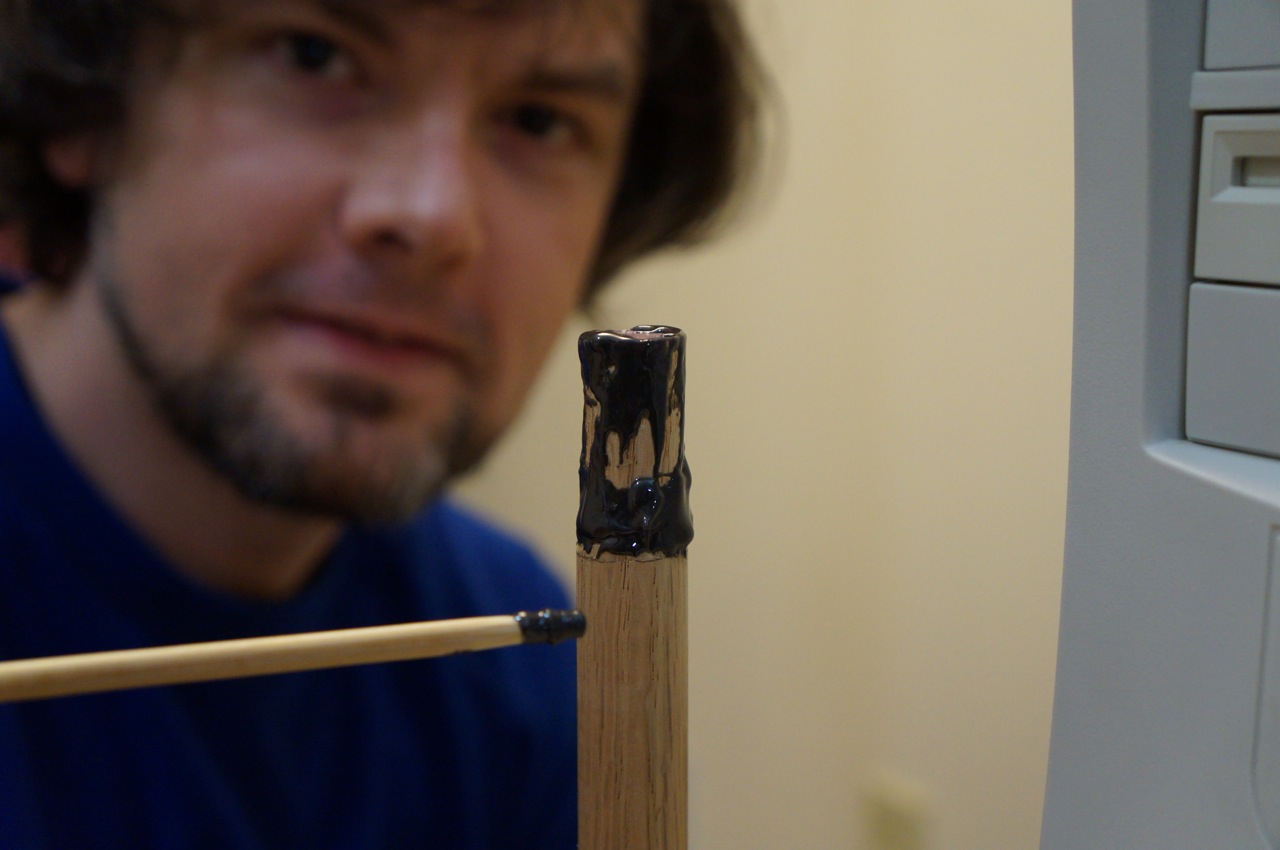
    Photo courtesy of Ryan Cox.
    Photo courtesy of Ryan Cox.

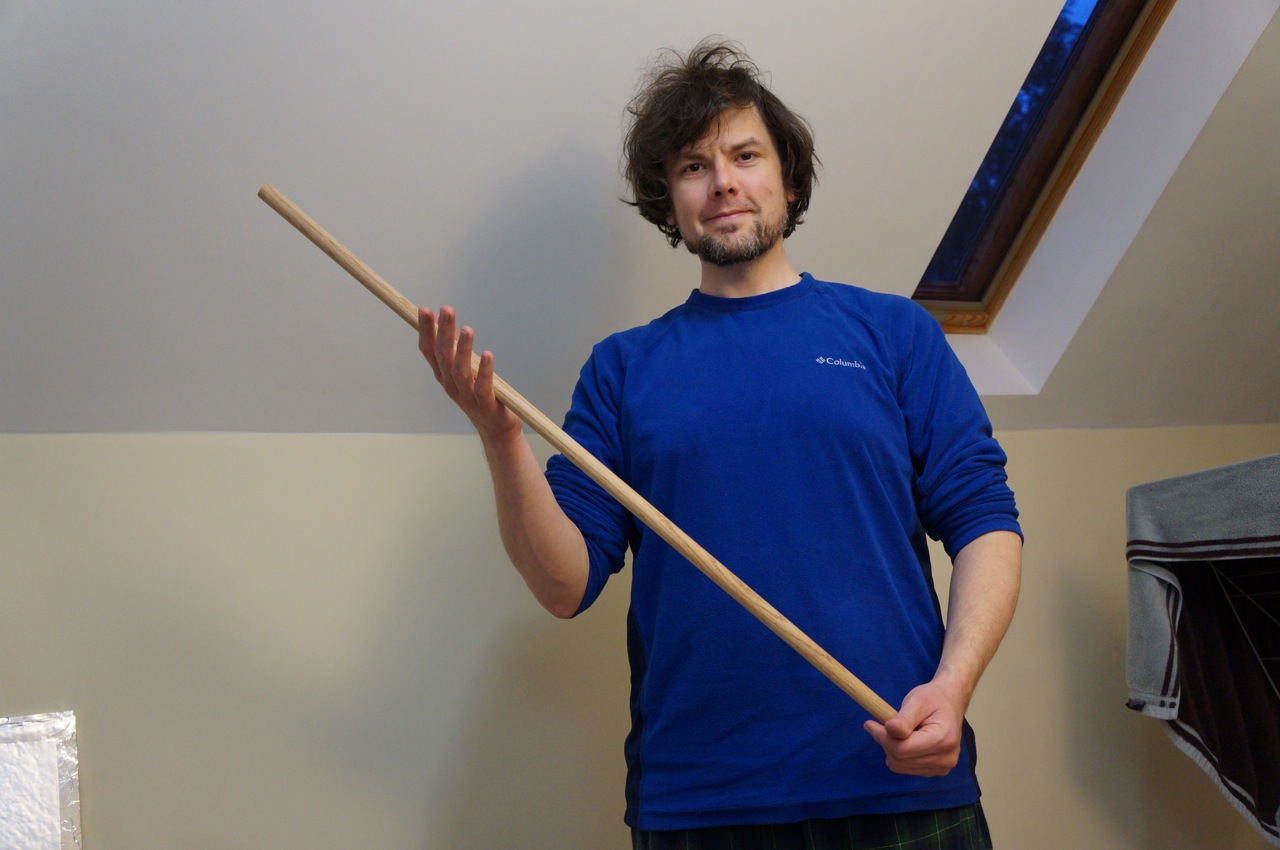
    My cousin Ryan Cox is a longtime practitioner of a variety of martial arts including kung fu and tai chi. Ryan and his two older brothers–Ian and Jarret–grew up learning, sparring, and developing uncanny skill in hand-to-hand combat and weapons sparring. While Ryan and his brothers have developed rhizomic networks to enhance their abilities and pass on what they have learned to others, Ryan has went the most far afield when he traveled to Wudang Mountain to train with the kung fu monks who reside there.

    Photo courtesy of Ryan Cox.
    Photo courtesy of Ryan Cox.

    When we were younger, I remember myself being the one drawn to the Star Wars mythos more than anyone else in my family, but now Ryan tells me that he was always interested in the Jedi, their mystique, and their lightsabers. In more recent years, he has learned a lot of the backstory of the Star Wars universe from books and video games. His knowledge in those realms far outstrips my own.

    So, I was intrigued when he began talking with me about building his own lightsaber for demonstrating his swordmanship and possibly sparring if the “blade” were strong enough to withstand strikes. The guide that follows illustrates the first lightsaber that I built for Ryan in the fashion of General Rahm Kota’s. I used off-the-shelf parts easily obtained at Home Depot or any hardware store. Since I built this lightsaber, Ryan has modified it more, and I have built two lightsabers for myself–one that resembles Luke Skywalker’s Return of the Jedi lightsaber and one that resembles Darth Maul’s The Phantom Menace double bladed lightsaber. This guide focuses on Ryan’s “Mark I” lightsaber.

    Pedagogically, I promote the idea that haptics, building, and making are integral parts to any kind of education. We are embodied beings who do things physically in the world–whether it be in real life or online. I enjoy building things in my own time as another way to think about things–in this case, Star Wars, science fiction, Jedi mythos, world building, canon vs. noncanon, and design considerations: rhetoric of technology, aesthetics, practicality, etc. In Ryan’s case, haptics, proprioception, and movement are integral to his learning and lived experience. I am looking forward to learning from him with this artifact that I designed and built. The modes are the same–physicality, materiality, and haptics–but our efforts converge from different directions for a kind of haptic, learning synergy.

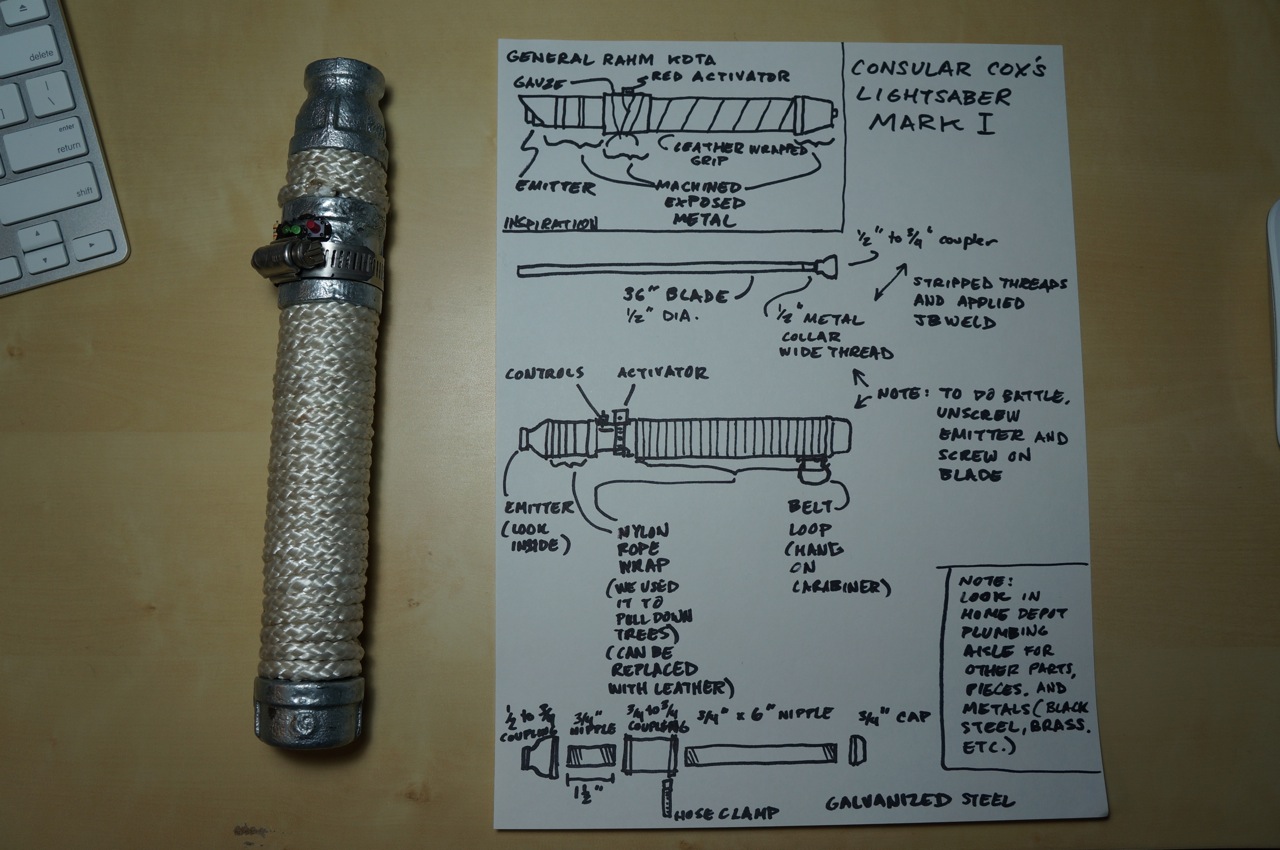
    I began the project by assembling the parts that I needed for creating the lightsaber’s hilt and belt clip. I carried an image of Rahm Kota’s lightsaber on my iPhone and went to the plumbing aisle of my local Home Depot.

    lightsaber-DSC01972

    These parts included:

    • 6″ x 3/4″ galvanized steel pipe
    • 3/4″ coupling
    • Two 3/4″ to 1/2″ coupling (one for display and one for sparring with permanently installed “blade”–these two couplings are interchangeable)
    • “Close” 3/4″ pipe (approximately 1 1/2″ long)
    • 3/4″ cap
    • D-ring
    • Carabiner
    • Hose clamps

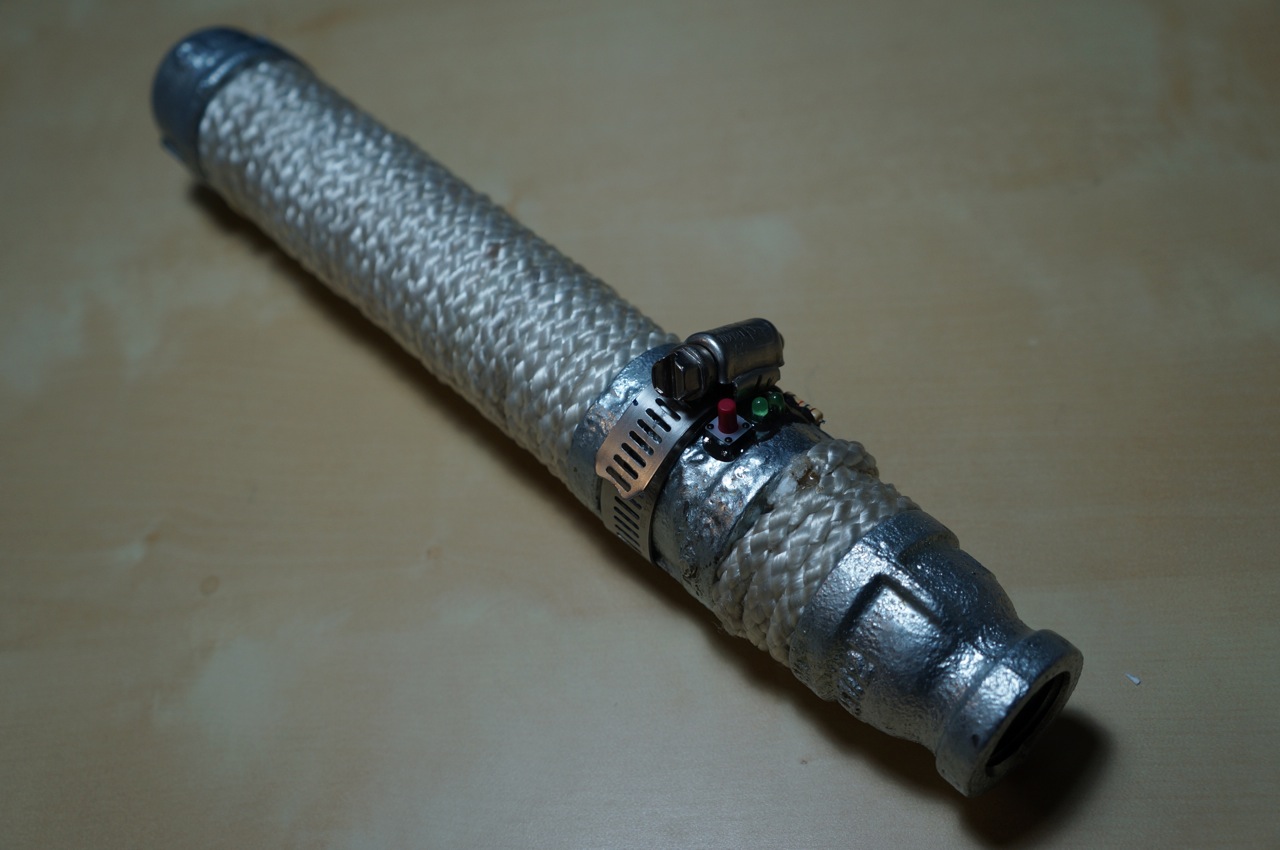
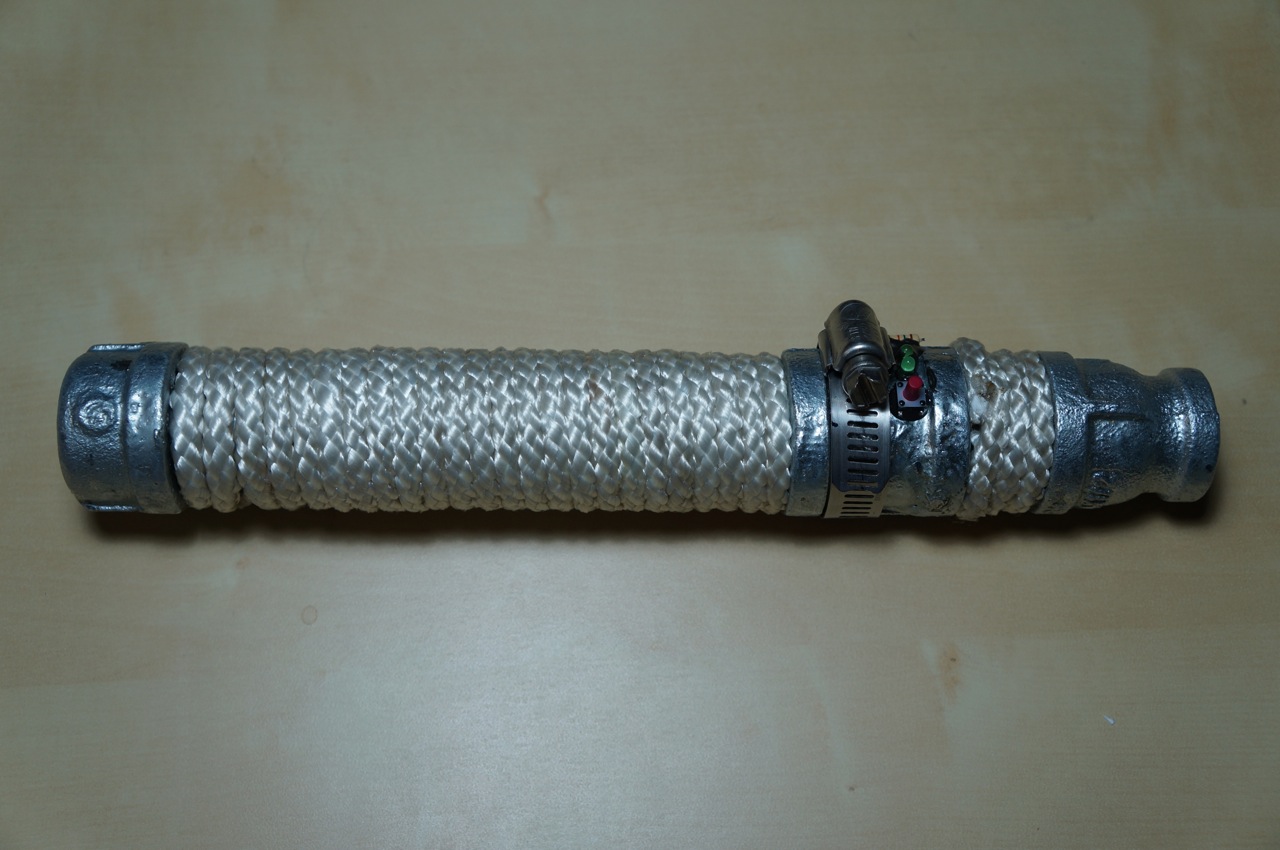
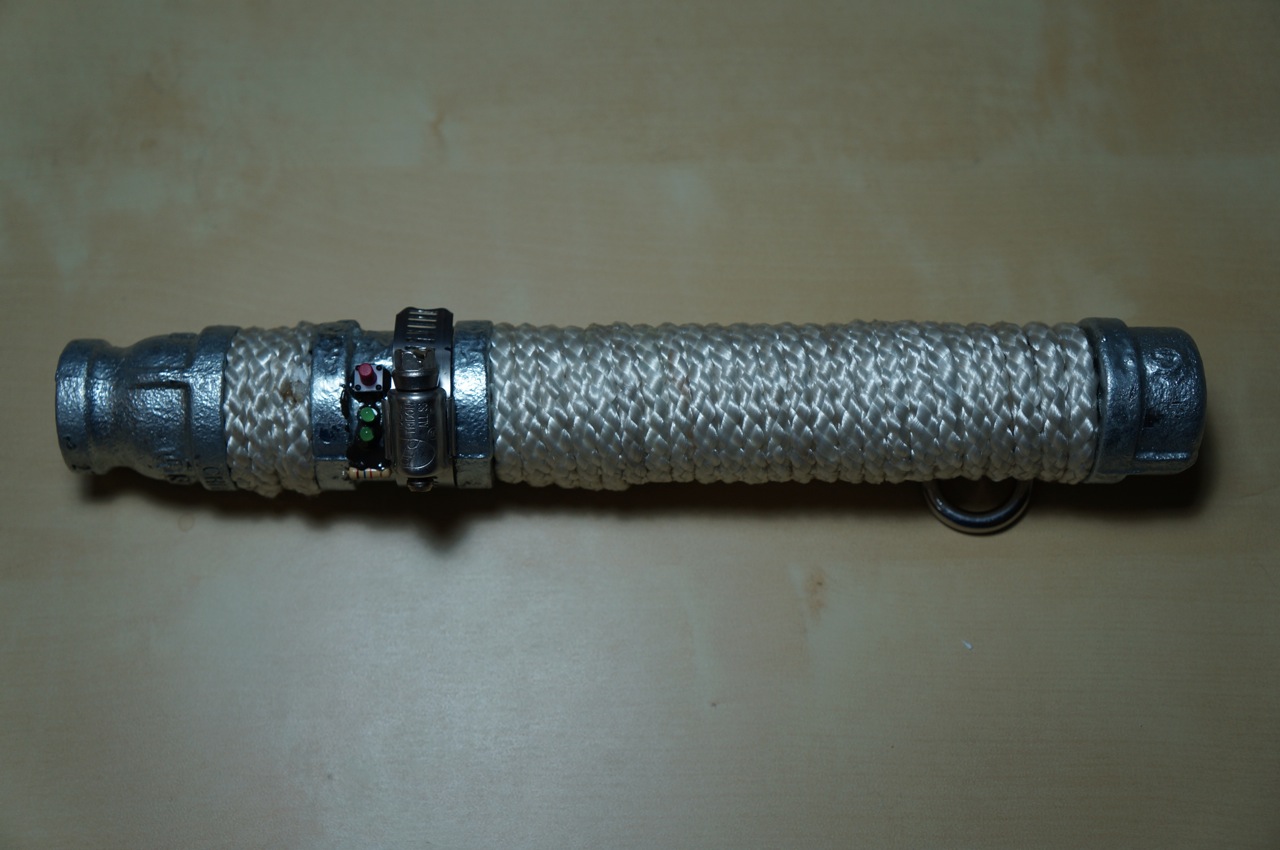
    Roughly, these parts are assembled to create the lightsaber:

    lightsaber-DSC01973

    Other parts that I used for this build include:

    • 1/4″ white nylon rope (grip wrap)
    • 36″ x 1/2″ oak dowel rod (scrapped due to paint problem)
    • 48″ x 1/2″ paint brush rod (cut to 36″ and replaced the oak dowel rod)
    • Doorbell button assembly (for parts)
    • 80mm computer case fan (for electromagnet assembly)
    • JB Weld
    • Rustoleum Florescent Yellow Paint

    To create the lightsaber’s handle, I screwed all of the handle components together except for the 3/4″ to 1/2″ coupling like this: 3/4″ cap | 6″ x 3/4″ pipe | 3/4″ to 3/4″ coupling | 3/4″ close pipe.

    lightsaber-DSC02005

    Then, I prepared the nylon rope to create the grip on the two pipe sections (6″ pipe and close pipe) by burning frayed ends to melt the nylon.

    lightsaber-DSC02009

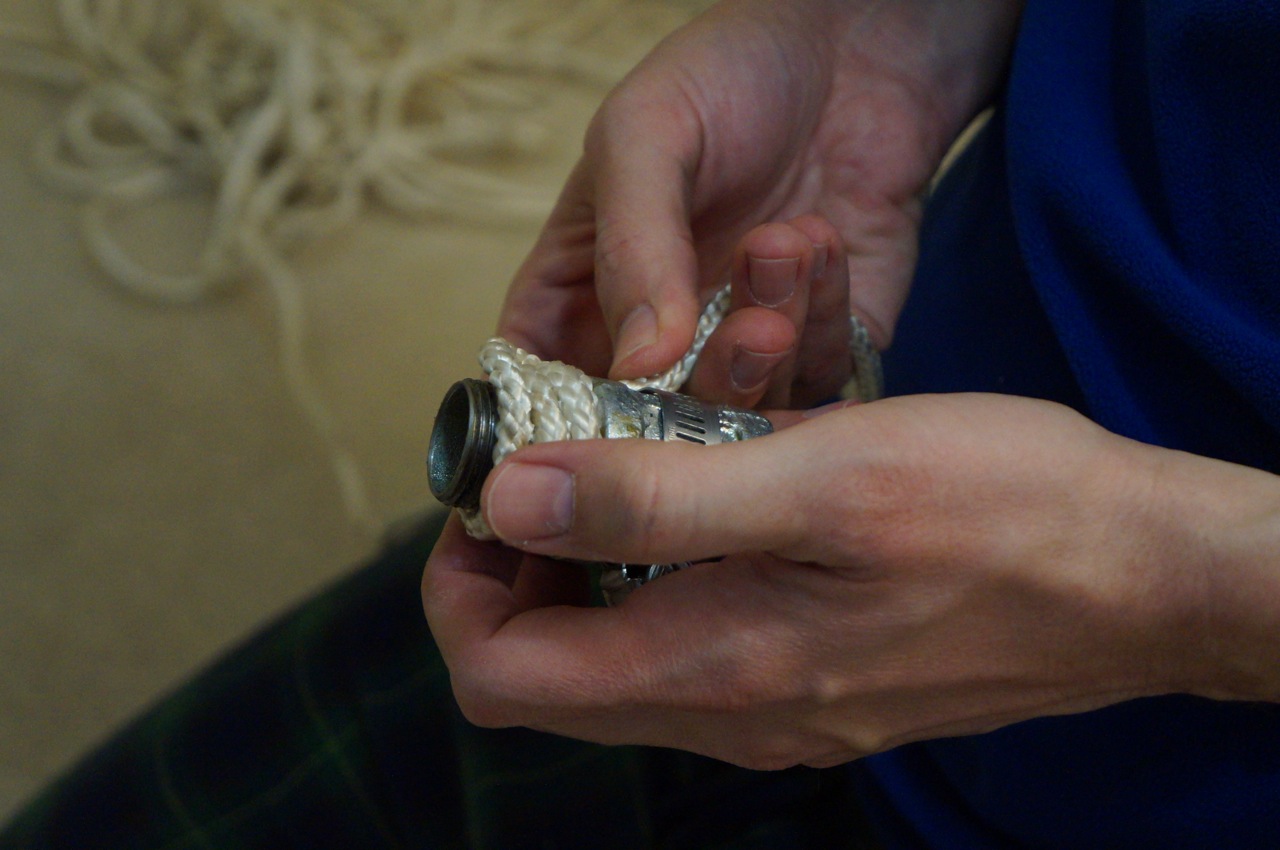
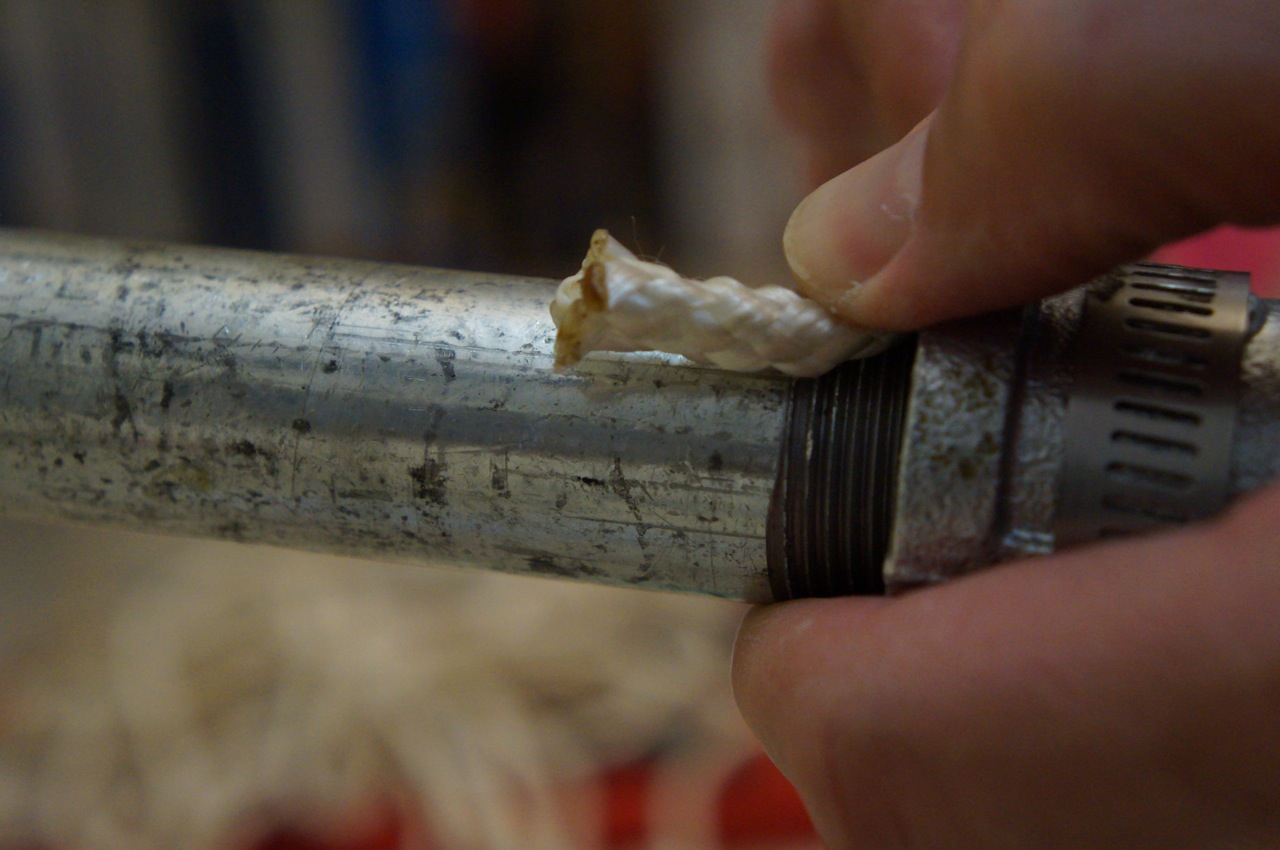
    Beginning at the business-end of the lightsaber, I tucked a small piece of rope under the first wrap against the 3/4″ coupling to hold the rope in place and prevent unraveling.

    lightsaber-DSC02011

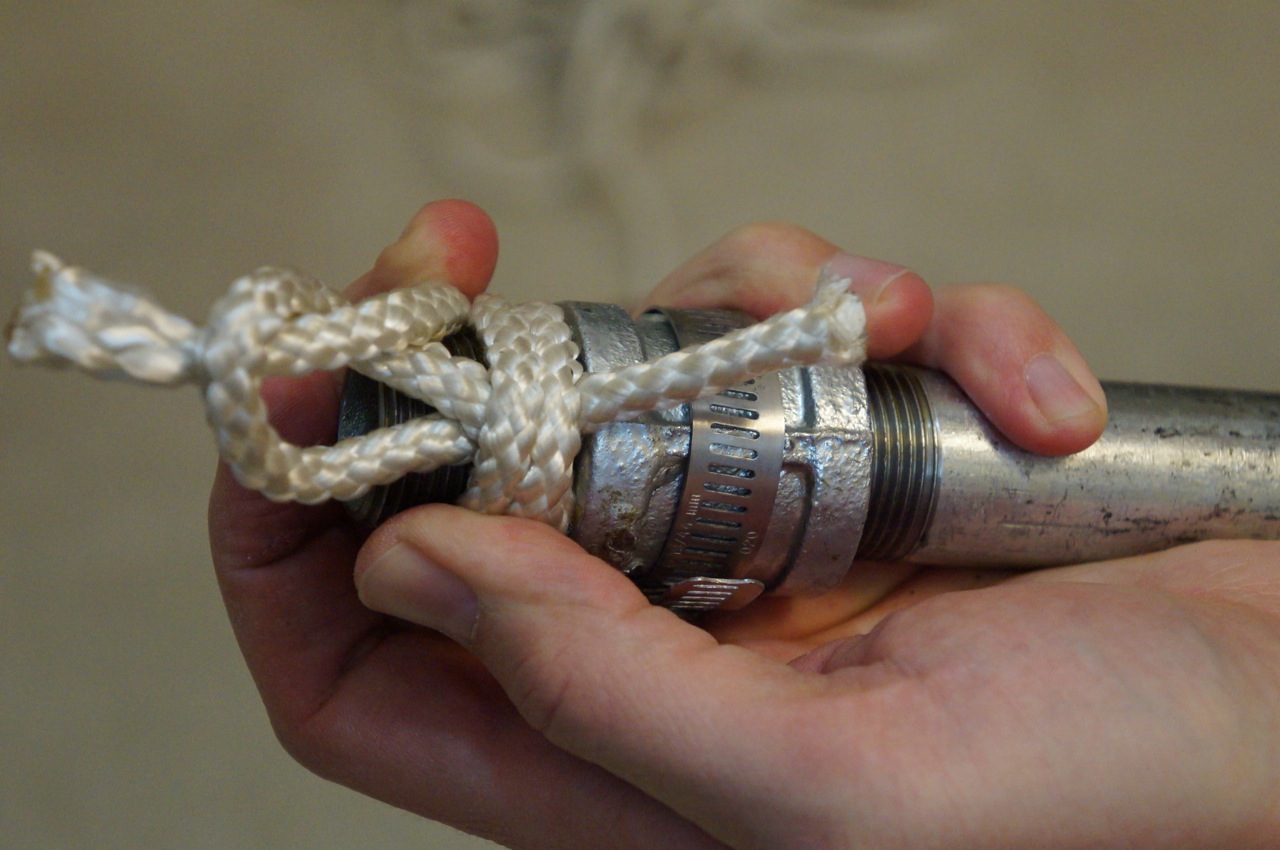
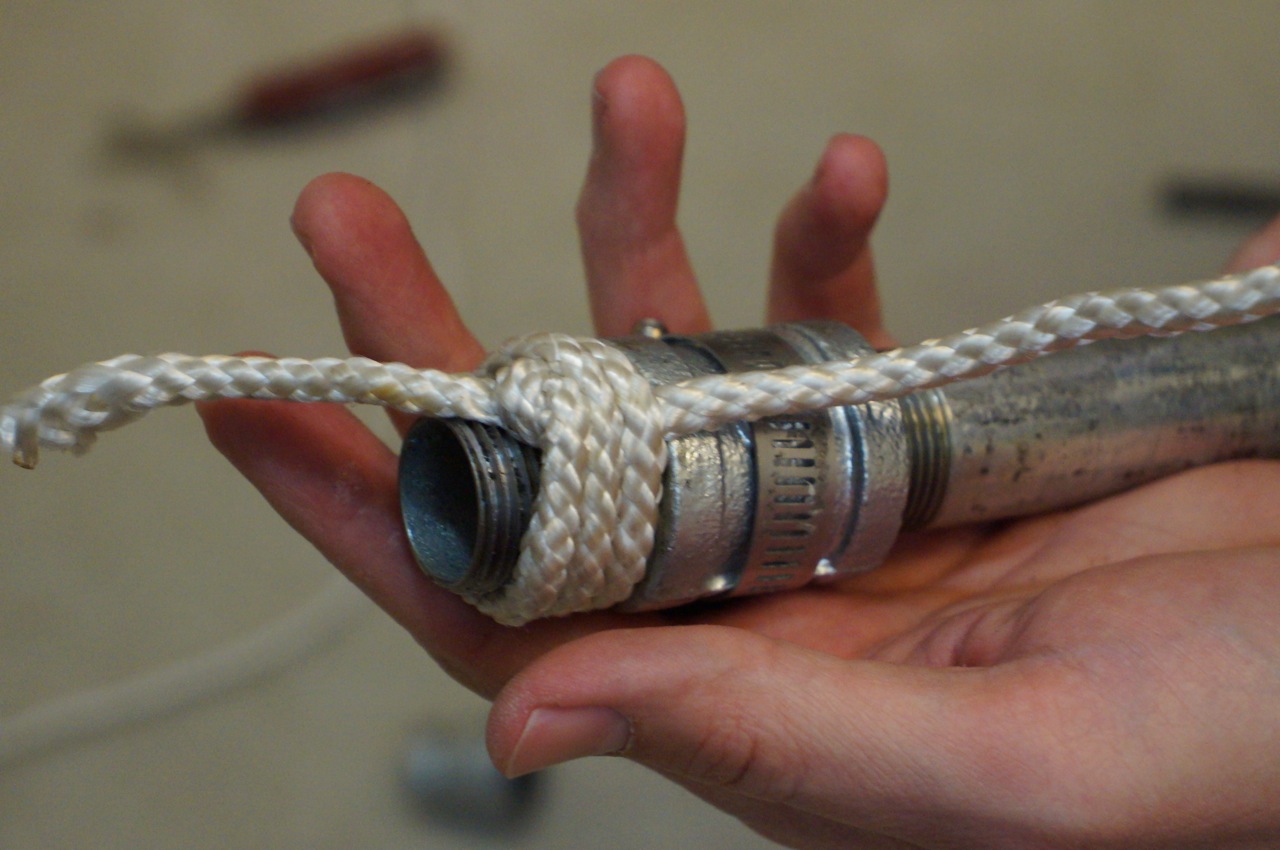
    At the top end, close to where the 3/4″ to 1/2″ coupling (or lightsaber emitter/business end), I created a loop with the rope under the last wrap, which I ran the last wrap through and pulled into the wrap, which hid the end of the rope under the wrap.

    lightsaber-DSC02019

    lightsaber-DSC02022

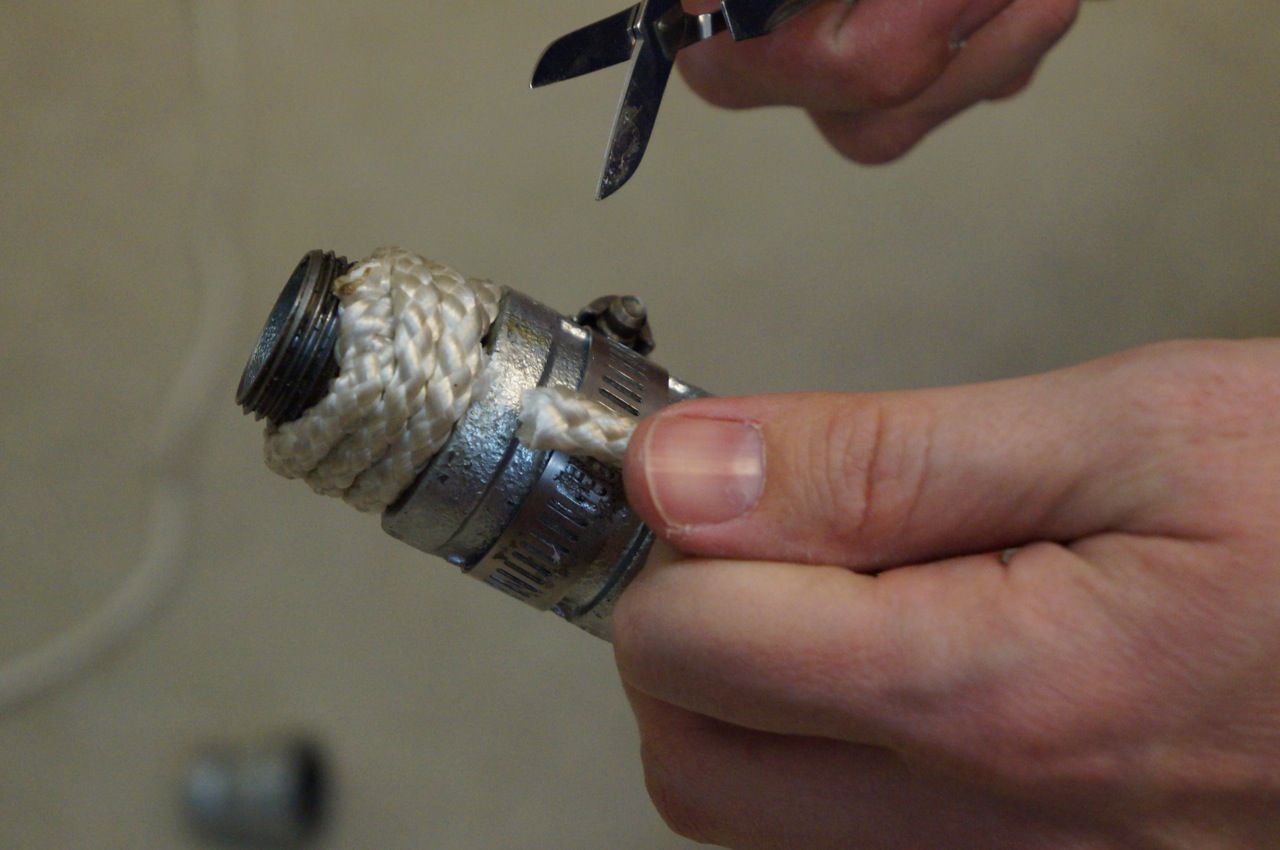
    I cut the loose ends.
    lightsaber-DSC02023Beginning on the other side of the 3/4″ coupling, I repeated these steps with the longer wrap of the 6″ pipe section. First, a small piece under the first wrap.

    lightsaber-DSC02036

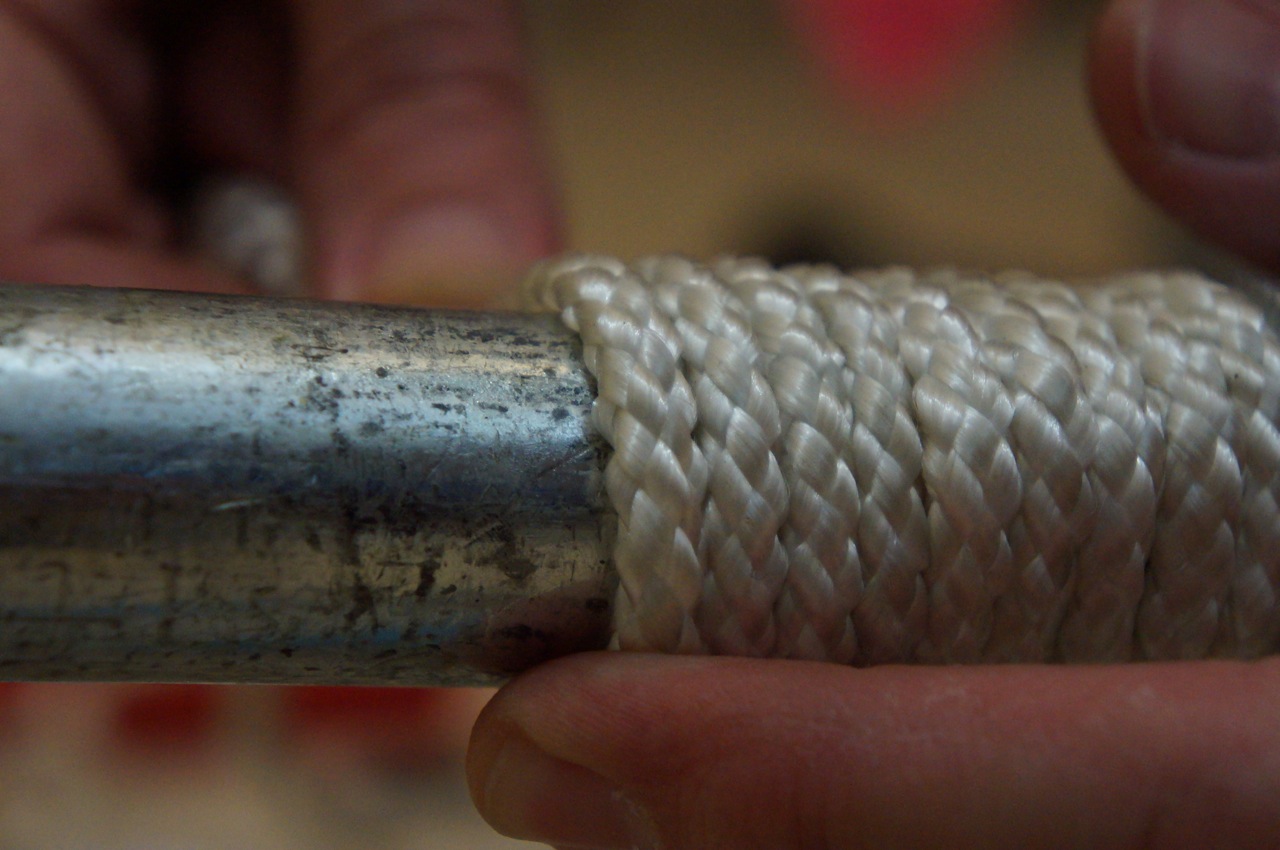
    I pulled the rope tight around the pipe and pushed each wrap down to keep the grip as tight as possible.lightsaber-DSC02041

    Mose tried to help with the process as much as possible.lightsaber-DSC02043

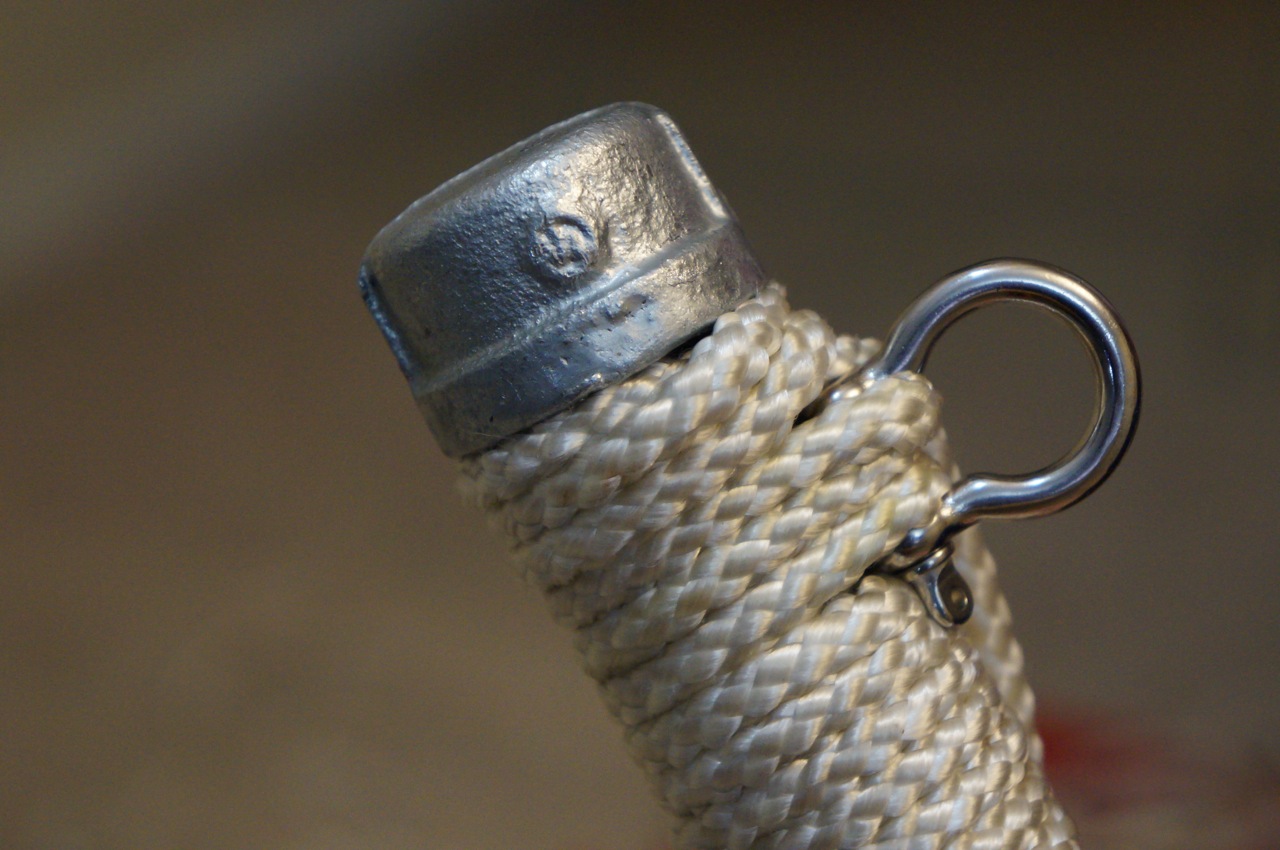
    At the end of the 6″ long pipe, close to where the end cap goes, I placed the D-Ring and ran the rope through its eye to connect it to the handle.

    lightsaber-DSC02050

    As in the shorter section wrap, I created a loop and pulled the end of the rope through and under the last lines of wrap to hide the end and prevent the grip from unraveling.

    lightsaber-DSC02051

    Finally, I installed the cap. Before doing this, I wrapped the grip higher than necessary so that the the cap would compress the wrap when tightly screwed onto the 6″ pipe.lightsaber-DSC02052

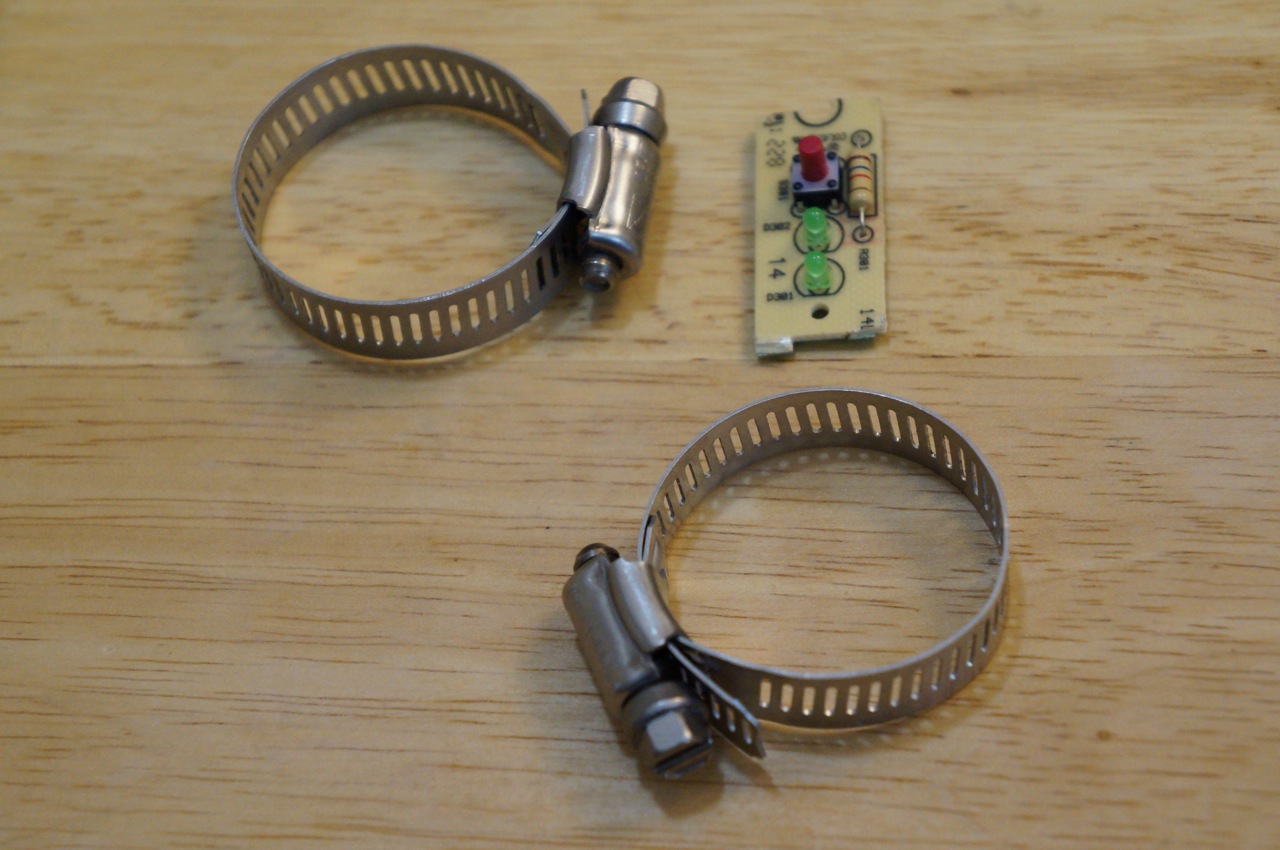
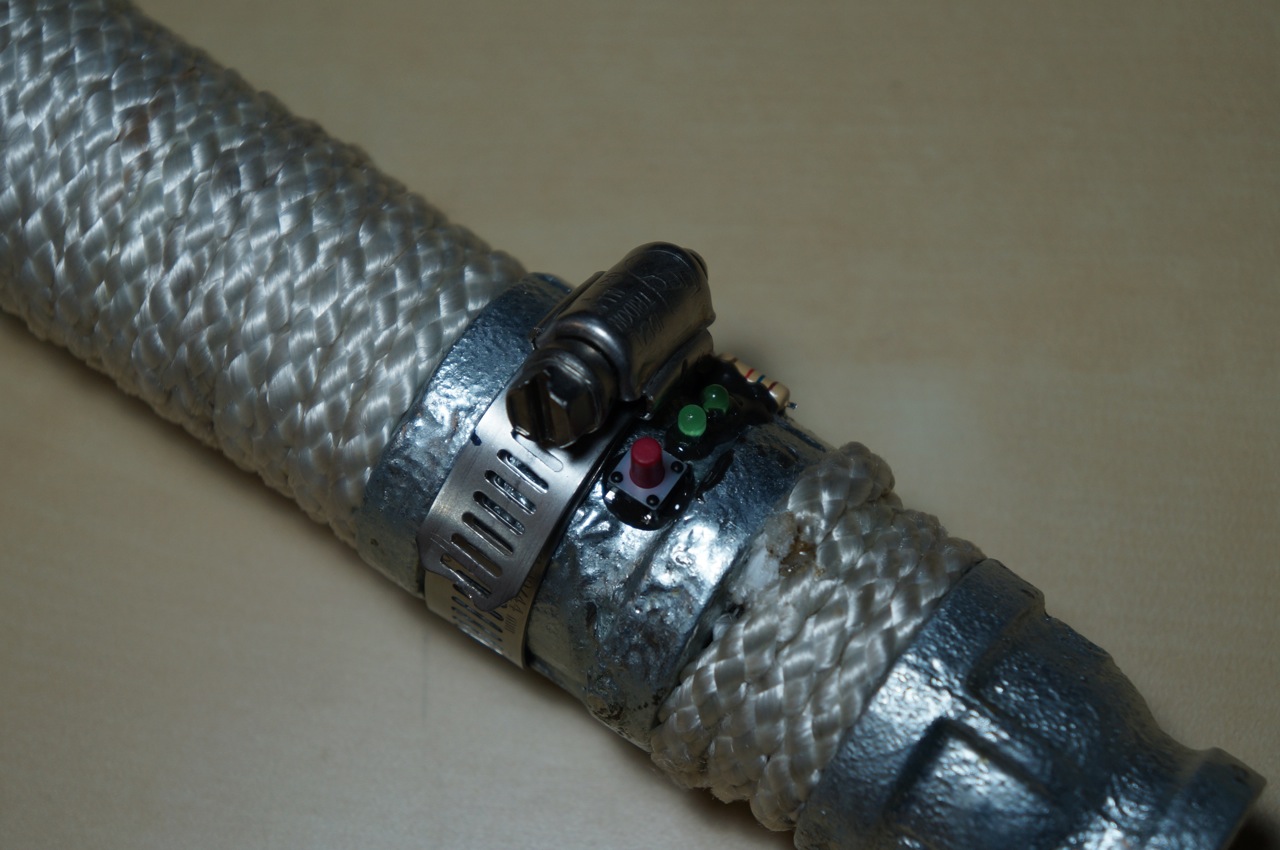
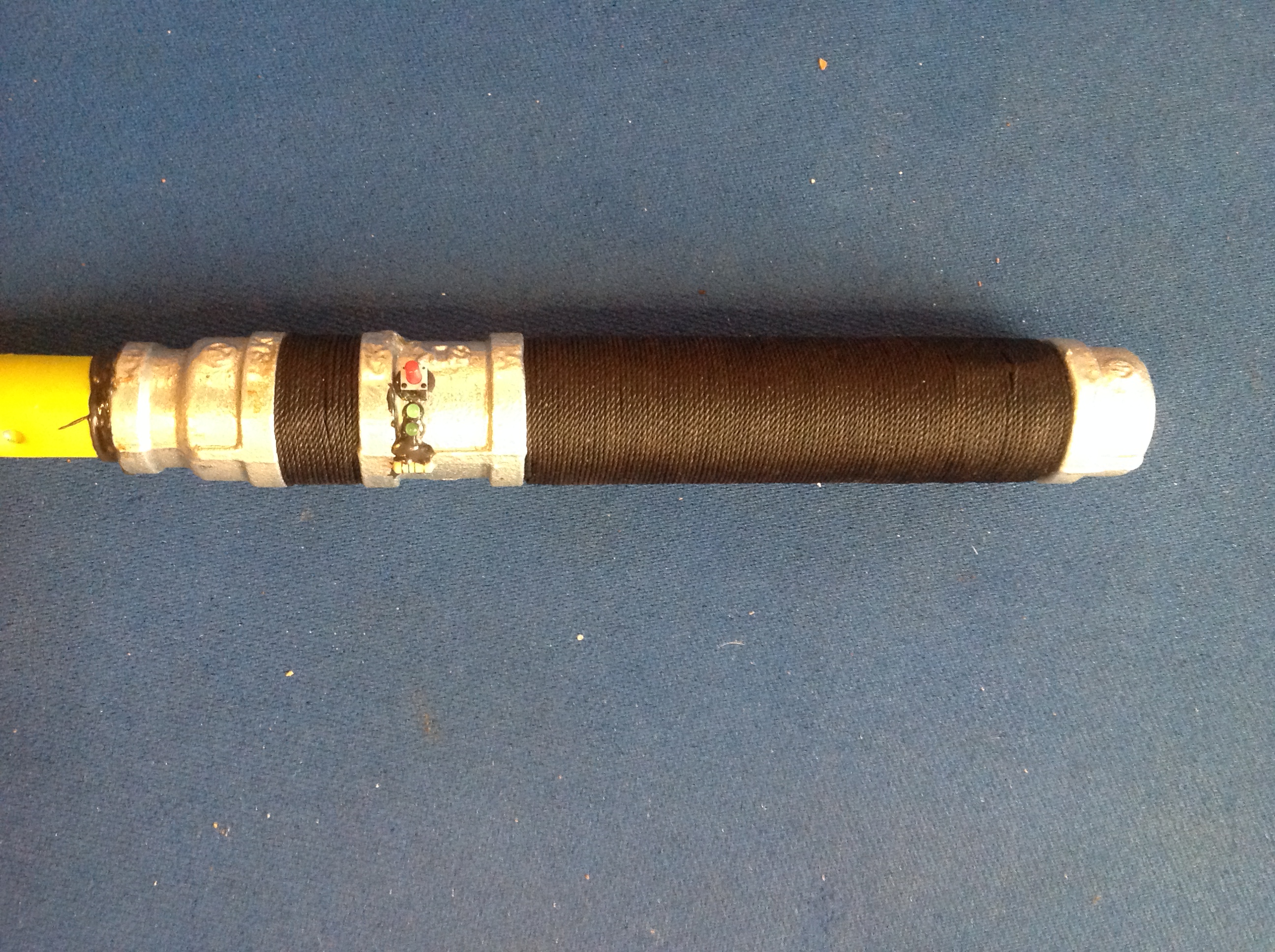
    Since Ryan would likely bang his lightsaber when sparring, I wanted to make it as practical as possible while giving it a technological appearance. First, I tried attaching a circuit board from an average doorbell button with two hose clamps.

    lightsaber-DSC02053 lightsaber-DSC02055 lightsaber-DSC02057

    While I thought this fit the rugged look that Ryan might like for his lightsaber, I thought that it would be more practical to use only one hose clamp and affix the doorbell components with JB Weld after removing them from the circuit board.

    lightsaber-DSC02090

    I liked this configuration best. The hose clamp protects the switch, lights (non-functional), and resistor.

    Next, I wanted the display emitter on the deactivated lightsaber (3/4″ to 1/2″ coupling) to look “realistic,” so I pulled the electromagnet from an 80″ computer fan, crushed it with my channelocks, and inserted it into the 3/4″ end of the 3/4″ to 1/2″ coupling. Repurposing the electromagnet draws on a visual/physical rhetoric of technology in the same way that movie props and set design use this for world building, extrapolating, and establishing plausibility.

    lightsaber-DSC02098 lightsaber-DSC02088

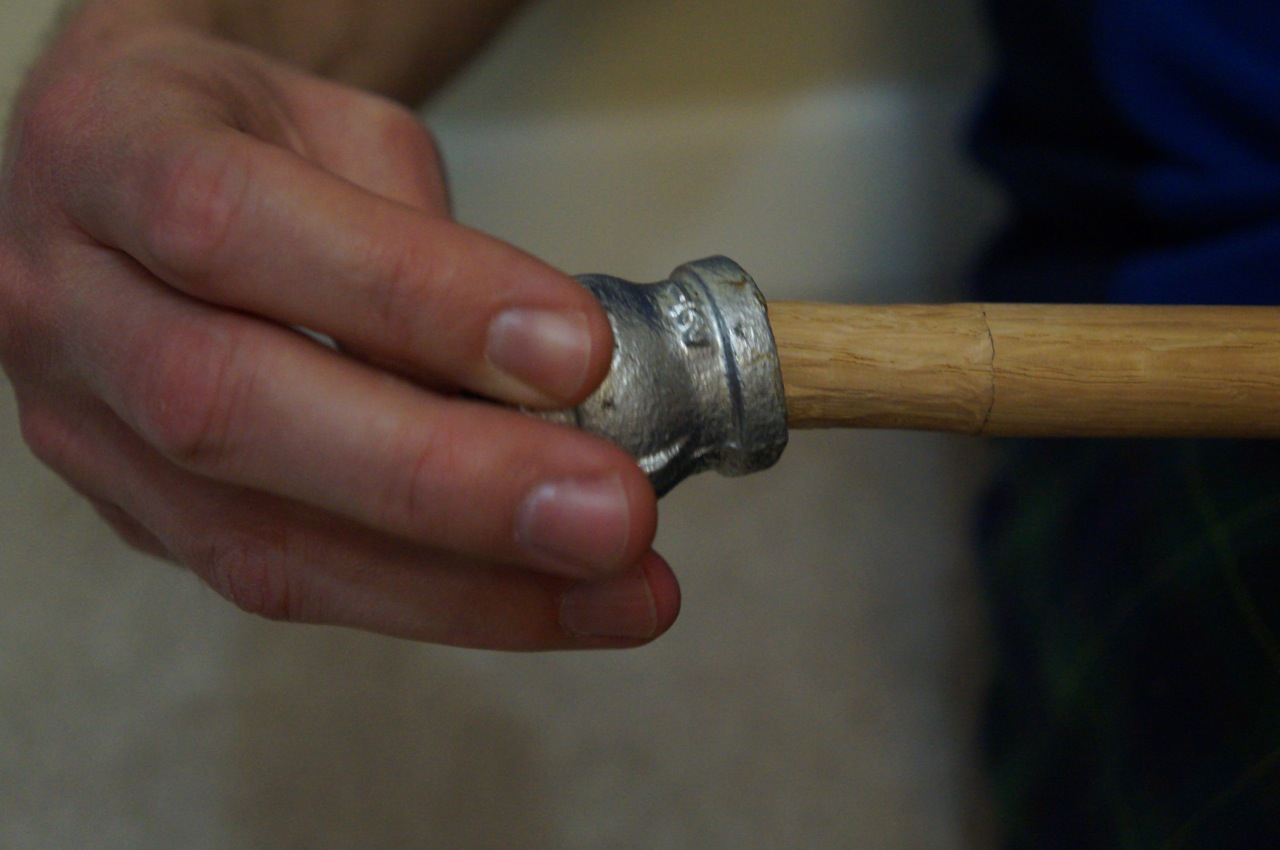
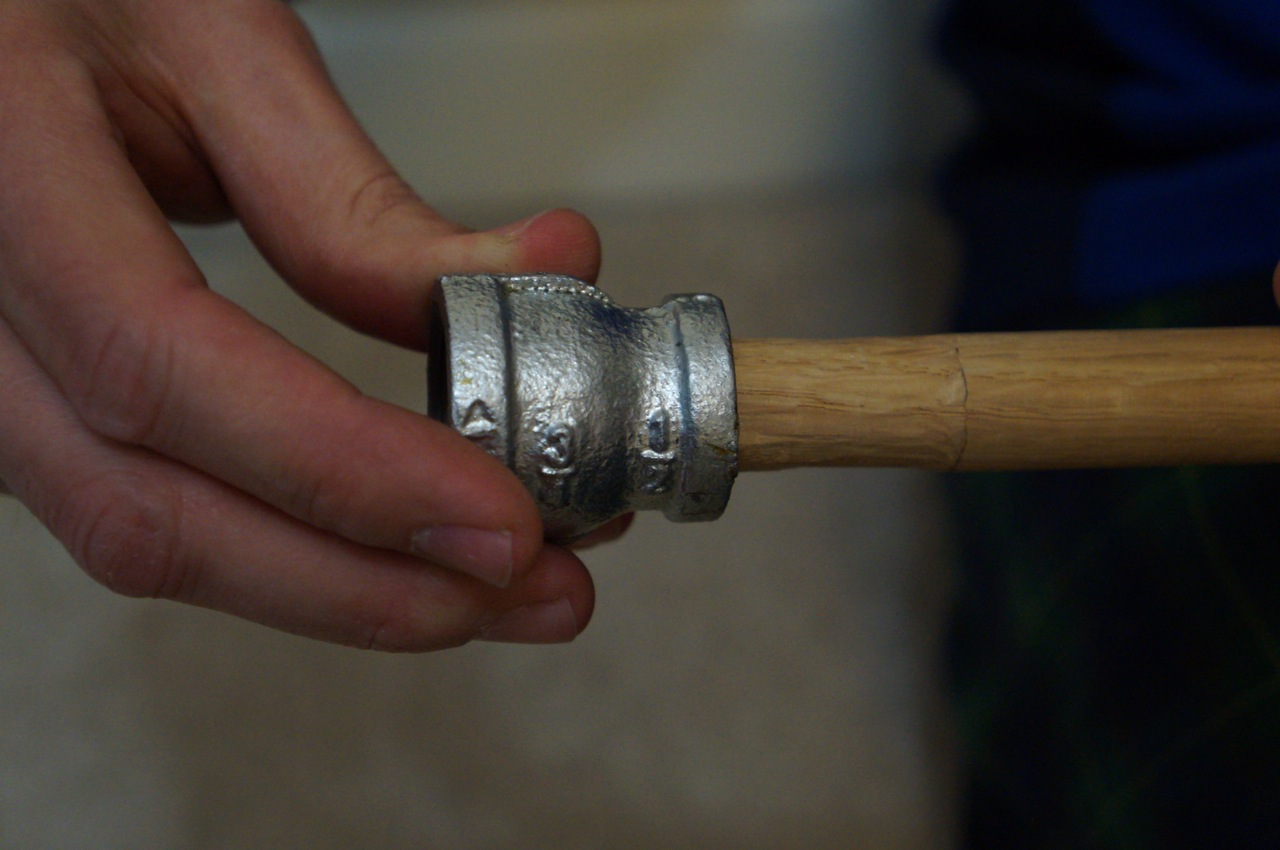
    The next phase of the lightsaber build involved the other sparring emitter. I needed to rigidly attach a wooden blade to the second 3/4″ to 1/2″ coupling in the 1/2″ end of the coupling and paint it to match the yellow blade color that Ryan sought (signifying the Consular Jedi).

    I began by taking an oak dowel rod and whittling one end enough to screw it into the 1/2″ end of the 3/4″ to 1/2″ coupling.

    lightsaber-DSC01976 lightsaber-DSC01981 lightsaber-DSC01982 lightsaber-DSC01983

    Then, I used JB Weld to permanently connect the coupling to the dowel rod.

    lightsaber-DSC01988

    I had to make sure that I did not put too much JB Weld on the tip closest to the 3/4″ pipe thread, which screw into the “close” end of the lightsaber when the blade needs to be drawn.lightsaber-DSC01989

    I made sure that it was centered and straight.
    lightsaber-DSC02000

    Finally, I painted the dowel rod above the coupling with a primer and then with the florescent yellow.

    lightsaber-DSC02058

    lightsaber-DSC02072

    Unfortunately, I misread the spray paint cans and ended up with a mess when the florescent yellow would not stick to the dried primer (I mistakenly picked up white primer + paint instead of simply primer).

    lightsaber-DSC02075
    Luckily, I had a paint brush handle in the garage that was long enough to serve the same purpose even if it might be made out of pine instead of oak.

    lightsaber-DSC02073

    I cut the paint brush handle down to 36″.

    lightsaber-DSC02077

    Set it up for painting with the remaining florescent yellow paint.

    lightsaber-DSC02080

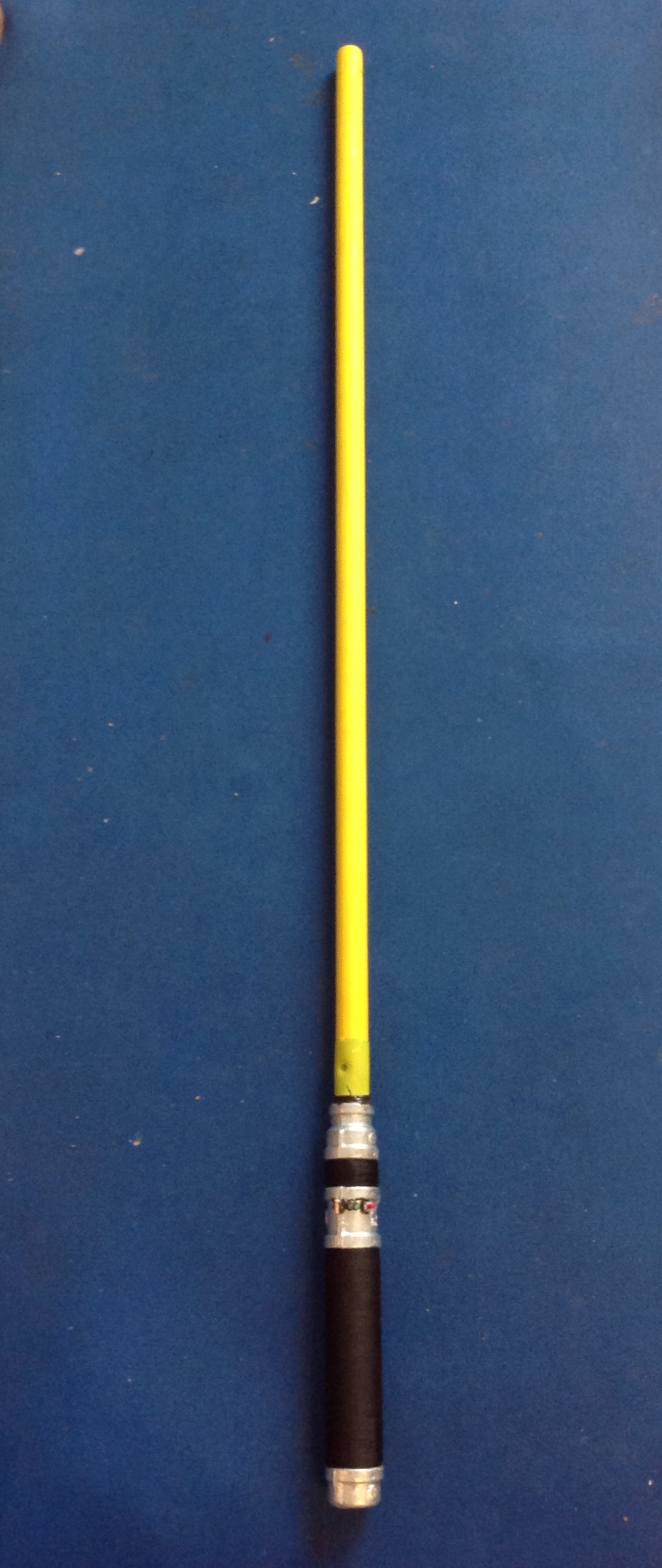
    Many coats later, it was a bright yellow befitting a Consular Jedi!

    After the paint dried, I screwed the metal end of the brush into another 3/4″ to 1/2″ coupling and bonded the blade to the coupling with JB Weld.

    lightsaber-DSC02094 lightsaber-DSC02095 lightsaber-DSC02096

    After everything had dried, I mated the blade with the lightsaber handle.

    lightsaber-DSC02102 lightsaber-DSC02103

    I was happy with the outcome of the lightsaber in deactivated mode, too.

    lightsaber-DSC02092 lightsaber-DSC02091 lightsaber-DSC02086

    I gave the lightsaber to Ryan as a birthday present. I included this explanatory diagram that explains how the saber is more than simply parts (e.g., the rope is from the same bundle that Ryan and I used when we cut trees down in my yard last year).lightsaber-DSC02085

    Since I build this lightsaber, Ryan removed the nylon rope grip and improved it with three layers of bank line or tarred twine. The result is quite impressive aesthetically and practically!

    IMG_8146
    Photo courtesy of Ryan Cox.
    IMG_0905
    Photo courtesy of Ryan Cox.

    I will post future posts on the lightsabers that I have built for myself and examples of our sparring (when we have the time for Ryan to teach me some things).

    UPDATE: Readers asked me to post photos of my other lightsabers–one inspired by Luke Skywalker’s lightsaber in Return of the Jedi and Darth Maul’s double-bladed lightsaber from The Phantom Menace. When I built these sabers for myself, I didn’t take as many photos of the process as in the lightsaber above for Ryan, but these photos should illustrate the basics of how to build similar DIY lightsabers.

    Luke Skywalker ROTJ Lightsaber and Stand

    IMG_4671This was the first version of Luke’s lightsaber. I am working from memory as I do not have the lightsaber in front of me to give the exact specifications. I believe that working from the left to the right: 3/4″ to 1/2″ reducer, 1/2″ threaded pipe 1″ long, 1/2″ to 3/4″ bushing, 3/4″ coupler, 3/4″ pipe 7″ long, 3/4″ coupler, 3/4″ to 1/2″ bushing, flat washer with eye bolt affixed (epoxied into bushing). The orange lightsaber control attached to the first coupler is from a computer motherboard heatsink (sawed in half with a hacksaw) and epoxied to the coupler. The wrap is nylon rope.

    IMG_4761In the next iteration, I replaced the nylon rope wrap with rubber o-rings that I ordered online (pack or 40 or 50). To install the o-rings, remove the last coupler on the right and roll down the o-rings one-by-one.

    To display Luke’s lightsaber, I used smaller pipes attached to a wood base (two different sizes of lumber screwed together through the metal base connected to the pipes).

    Darth Maul’s Double-Bladed Lightsaber

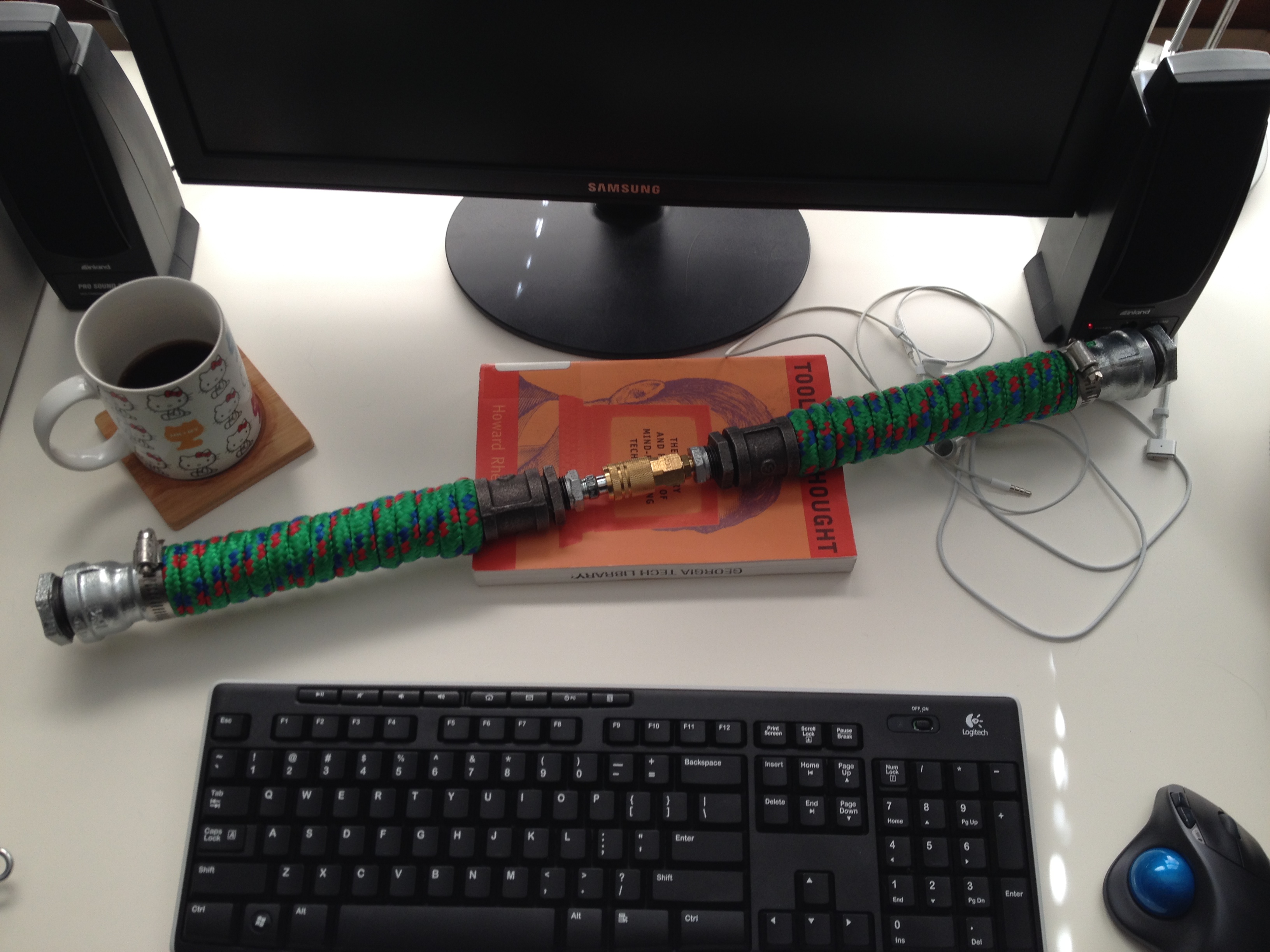
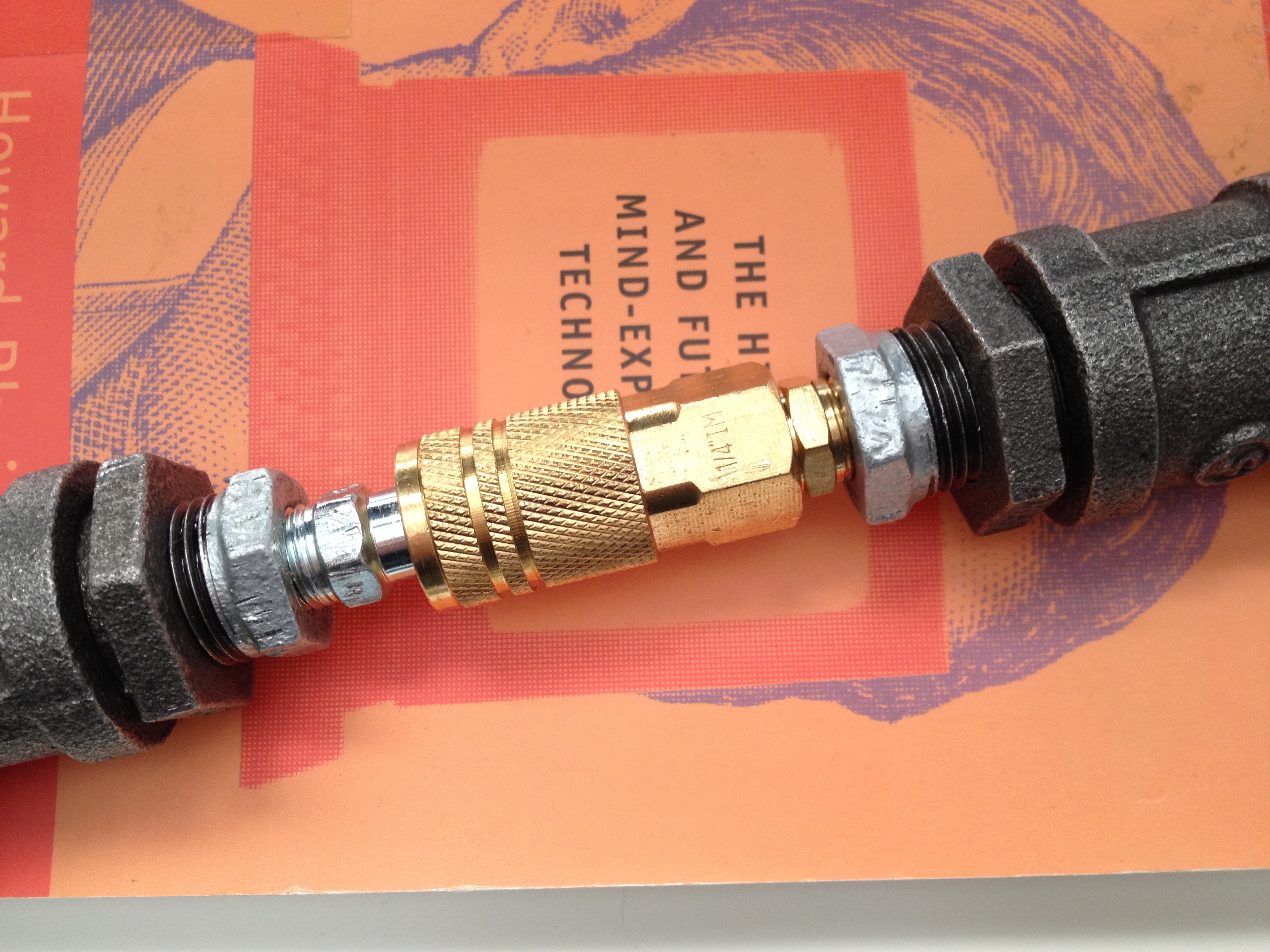
    IMG_4672I built this Darth Maul inspired lightsaber as a way to figure out an easy way of having a two bladed saber that can split into two separate lightsabers. My solution was to use quick disconnect air hose fittings.

    IMG_4673In order to make this work with the larger pipes used for Darth Maul’s lightsaber, which appears heftier in Episode I, I had to use two bushings to reduce down to the smaller size of the air hose fittings.

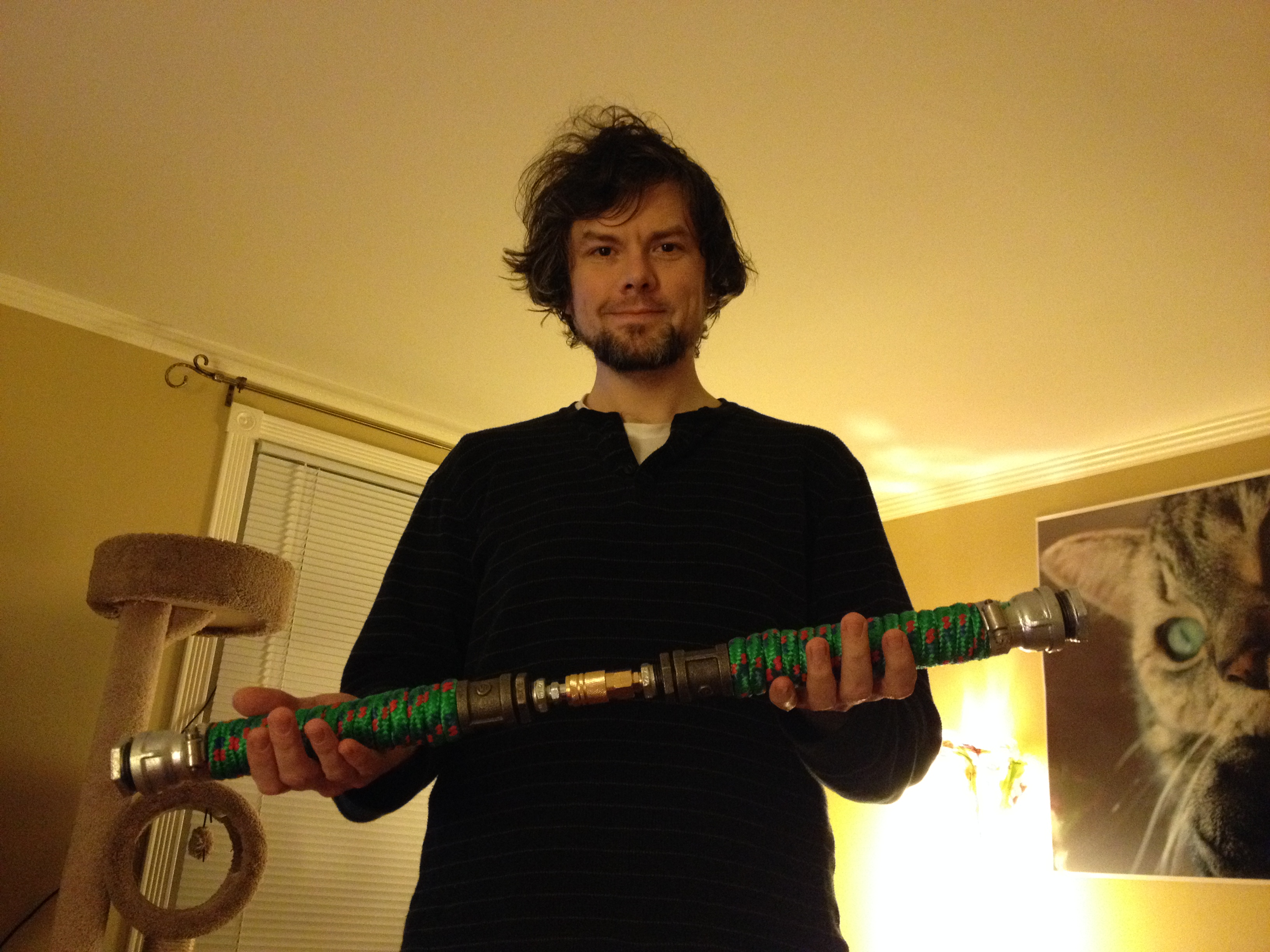
    IMG_4593Here is the double-bladed lightsaber connected.

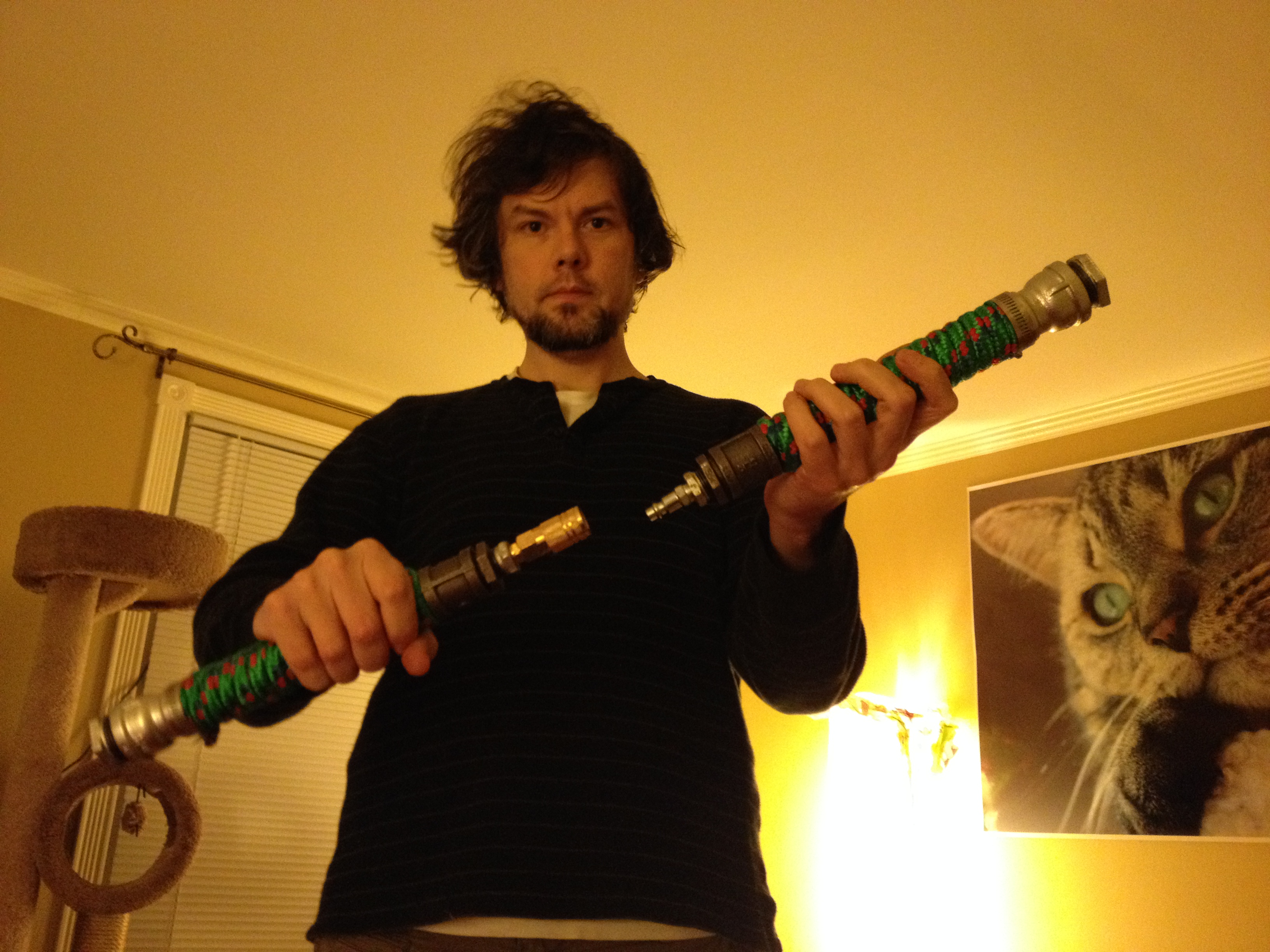
    IMG_4594Here is the double-bladed lightsaber disconnected into two separate sabers. I didn’t build blade attachments for this saber, so I couldn’t test how much pressure/stress could be applied to the quick disconnect coupler that holds everything together. I suspect that this kind of assembly can only be used for show rather than demonstration of saber techniques (as I had constructed the two sabers above). With further modification, I believe that someone could sheath the quick disconnect coupler with metal so that the saber appears more solid from end-to-end instead of having this smaller, weak point in the middle as this demonstration saber appears.

    I hope these extra photos and explanation help. Good luck with your builds, and please share any photos that you post online of your sabers in the comments below!

  • Recovered Writing: PhD in English, Independent Study with Mack Hassler, Literary Characters, Online Persona, and Science Fiction Scholars: A Polemic, Dec. 9, 2008

    This is the thirty-eighth post in a series that I call, “Recovered Writing.” I am going through my personal archive of undergraduate and graduate school writing, recovering those essays I consider interesting but that I am unlikely to revise for traditional publication, and posting those essays as-is on my blog in the hope of engaging others with these ideas that played a formative role in my development as a scholar and teacher. Because this and the other essays in the Recovered Writing series are posted as-is and edited only for web-readability, I hope that readers will accept them for what they are–undergraduate and graduate school essays conveying varying degrees of argumentation, rigor, idea development, and research. Furthermore, I dislike the idea of these essays languishing in a digital tomb, so I offer them here to excite your curiosity and encourage your conversation.

    In 2008, I began my Ph.D. work with Dr. Donald “Mack” Hassler. Ultimately, he directed my dissertation and we became friends.

    On the advice of friends in the SFRA and of having read Mack’s first Political Science Fiction collection while at the University of Liverpool, I wanted the opportunity to study at Kent State University and work with him.

    This is the third and final artifact that I produced during my coursework independent study with Mack focused on Philip K. Dick, postmodernism, play, parody, and performance. As an invested SFRA member and its then-publicity director, I was concerned about the chilling effects a troll and his sock-puppets wreaked on our email list at that time. Ultimately, Mack helped me steer the independent study in that direction to theoretically grapple with online discussions in real life (RL).

    Jason W. Ellis

    Dr. Donald M. Hassler

    Independent Study

    9 December 2008

    Literary Characters, Online Persona, and Science Fiction Scholars:  A Polemic

    Chaos often breeds life, when order breeds habit.

    –Henry Adams, The Education of Henry Adams (1918)

    This essay’s objects of study include the community of Science Fiction (SF) scholars, of which I am a member, as well as our practices of online communication and discussion.  In September 2008, the normal intermittent conversation on the email list of a long established, professional organization of SF scholars was disrupted, or derailed, which might be a better description, by the controversial, inflammatory, or perhaps unexpected emails of two list participants with different originating email address–one a dues paying member of the organization, and the other a non-paying email-only list member.  However, these two seemingly separate persons are in fact two online personas or characters created and operated by the same individual.  The real world person responsible for these personas is clearly playing with character and online identity engineering.  For the two personas, he constructs identity and narrative of self through verbal wit and word play that has its antecedents in literature, or what I call Pulp Media. This online, or New Media, practitioner of online persona engineering largely caught the SF scholar community woefully unprepared to meet his persona on the page, or rather on the screen. Instead of engaging the personas within cyberspace on the email discussion list, which often carries conversations about marginalized identities and the alien Other, many list participants chose to react against the list personas. Why did these scholars, arguably some of the most engaged persons dealing with issues of Otherness, attempt to expel, rather than embrace, the Othered personas?  Can SF scholarship overcome a privileging of literary texts, and expand their work to the realm of daily practices and the real world of science fictional technologies (i.e., the Internet) that facilitates their professional work?  Or, is SF scholarship divorced from the present through its overemphasis on the future or alternate worlds imagined in its traditional objects of study?

    I approach these questions first through a discussion of literary character and persona.  Then, I employ psychology as a bridge between literary character and online identity or persona. In this paper, I argue that character in Pulp Media is replicated in New Media with the recognizable exception being the proliferation of persona narrative construction online, which results in the necessity of reflective revision of our practices in cyberspace, including our supposedly isolated forums of discussion.

    The online personas on the SF email list are indicative of the doubleness of character in literature.  Obviously, writing the self and creating doubles of character in literature have a long history in literature.  The touchstone work is Saint Augustine’s Confessions (397-398 AD), in which he attempted to reflect on his life, memory, and self.  However, he realized that memory and self change over time and his record of self in the Confessions can be best thought of as a representation of self as recorded through the lens of memory.  Other forms of doubleness take on a more fictional aspect such as that in Mary Shelley’s Frankenstein (1818), and her characters: Victor the creator, and his created Monster.  However, the Monster also doubles humanity, because he falls in love, or desires companionship of a female mate.  Even though he is called the Monster, he is in fact very much human–one that is isolated, alone, and ostracized as the Other.  A more emphatic and explicit form of doubling takes place in Robert Louis Stevenson’s Strange Case of Dr. Jekyll and Mr. Hyde (1886).  The title’s namesakes equate to one person with a schizoid personality–a person split into different, and even competing identities. Though, as different as Hyde is from Jekyll, there still remains the underlying core of humanity and human identification. Still much later works, such as Philip K. Dick’s Do Androids Dream of Electric Sheep? (1968), continue to feature doubled characters.  In this case, the Replicants, android workers of the future, double humanity, and it is the ambiguously human characters who doubt their own humanity and fear the possibility of being the Other.  In these examples, there is a crisis of identity, because the division of self obviously destabilizes what is assumed to be a unified identity or sense of self.

    These crises exist in written form as literature and as words written by persons, each with a unique mind, and literature forms a corpus of evidence for the mind and its machinery.  Therefore, the early developments in the scientific study of self and identity came to rely on this evidence.  Sigmund Freud relied on classical literature (e.g., Oedipus Rex), and his love of British literature (e.g., Shakespeare’s Hamlet) to develop his theories of self and pathologies of mental illness.  The significance here being that there is an interconnection between Freud’s work on the mind and the pathology of mind, and literature. Freud’s theory of self established that our mind, and its underlying workings, is divided between the surface conscious mind–ego, and the subsurface unconscious mind–the superego and the id. Despite this division of mind, normal persons supposedly present an integrated sense of self or identity to the world. Further developments in the pathology of a unified public self was made by Eugen Bleuler, who extends Freud’s work with his categorization and naming of the schizophrenias, which included the now distinct pathology known as dissociative identity disorder, or the explicit division of self into distinct personas.  Following this work, violations of the unity of self in daily life are perceived to be indicative of disease or illness, and necessitating treatment or institutionalization. However, this phenomenon is presented in literature both before and after Freud and Bleuler’s work. Doubleness of character, doppelgangers, and literary personas in literature are high literary markers, and there is a profusion of such literary/psychological devices in literature following the wider popularization of psychoanalysis.  I do not mean to say that one necessarily follows from the other, but instead, there is an ever presence of human minds creating literature, which obviously leaves psychological traces embedded in the work. However, there must be a conscious as well as unconscious injection of these themes into literary works, particularly following the increase in awareness of mental disorders and key psychological concepts.  With that being said, doubleness pervades literature, and there is a recursive operation at play following the dispersal of the Freudian theory of mind.

    This pervasion is clearly evident in the doubleness inherent to the New Media, which derives in part from its literary and pathological precedents, but it also has to do with the material conditions of plugging one’s self into the network.  William Gibson, hovering over his Hermes 2000 typewriter, envisioned the physical jacking into cyberspace, a neologism of his creation that has since stuck, in his 1984 novel Neuromancer. There is a separation between the meat (i.e., body) and mind.  The meat confines the potential of self unleashed within the “consensual hallucination” within the computer network.  This is made more visually real a decade and a half later in the Wachowski Brother’s film, The Matrix (1999), when the human characters jack-in to the computer world they leave their weak bodies behind in Baudrillard’s “desert of the real,” and become the Übermensch within cyberspace.  The characters, including Case in Neuromancer, Neo in the Matrix, and Hiro Protagonist in Neal Stephenson’s Snow Crash (1992), each invent spectacular online identities with special powers and abilities that contrast, more or less, with the material reality of their bodily identity.  Is this not true of many persons of imagination that enjoy SF, comics, and video games as a way to leave, or at least ignore, the confines of material reality and explore the potential and promise of the undiscovered country of the imagination with their doubled selves?

    One such imaginative space, perhaps with the most potential for invention, is the Internet and its New Media technologies.  New Media has made possible a proliferation in the engineering of self and creation of persona–a doubling that occurs purposefully as well as incidentally.  Playing with character was largely confined to print, and it was not allowed in real life due to the pathology of a split identity.  The New Media proliferation of self and character experimentation has resulted in new possibilities as well as problems.  The possibilities include trying out new attitudes and beliefs in the relative protection of cyberspace, which is one of the themes of Greg Egan’s novel Diaspora (1998), albeit with digital beings that switch mental perspectives, which we might conceive as being central to identity. Another New Media possibility is the making connections and linking into new circuits and communities within the sprawling network.  This empowers the building of self through community and interaction that might otherwise be a challenge (e.g., geographically or demographically), or danger (e.g., a transgendered person talking with other transgendered persons in a community with groups openly violent to such persons).  Additionally, some persons create multiple online identities or characters as protection or to remove prejudice within online communities (e.g., a girl pretends to be a guy to avoid harassment, or a college-aged woman uses only her first initial and last name on email correspondence to avoid gender bias).  In contrast to these possibilities is the central problem and holdover from the real world–the assumption of a unified sense of self.  Even within cyberspace where doubling is essential to any interaction with the network, there remains the awareness of illness when there is a violation by others of an appearance of unity of self. There may be a sense of betrayal when the ruse, if you want to use that word, is uncovered. Other ways of responding to such a situation of online persona creation is deception.  There is the assumption of dealing with an individual behind the online persona or avatar, and that this is a one-to-one ratio. When one person has a chorus of voices, characters, or personas, this may lead to the feeling that there is deception–that one is hoodwinked.  However, the fact remains that New Media enables and in some cases, such as Blizzard’s massively multiplayer online role-playing game (MMORPG) World of Warcraft, encourages such multiple persona creation.  The technological assemblages of the Internet and New Media is built on multiplicity, copy-and-paste, and the passage of bits unencumbered by the realities of the persons corresponding with those bits of data. Nevertheless, there still exists for many the knee-jerk reaction of our real world conditioning that a violation takes place when the assumption of unified identity is breached, even in such an environment as cyberspace.

    The reaction of many of the participants, myself included, on the SF scholar email list strongly indicates that old habits die hard. Evidence for this comes from the fact that list participants overwhelmingly reacted against these Othered personas rather than engaging the play and internal logic of the two characters. There were exceptions, but it would probably have required a unanimous positive response to avert the ensuing chaos on the list.  Some of the not-so-positive responses to the personas, but more so the person behind the personas after the performance was uncovered, included calling him a “worthless clown” and “troll,” who pursues “juvenile antics.”  However, the following responses are more indicative of the interrelation of psychology to persons:  “kook,” “disturbed little creature,” “needs psychological help,” “loonie,” and “he is clearly undergoing some sort of emotional meltdown.” The online persona creator is no longer a human, but a “creature,” suffering an “emotional meltdown,” and “in need of help.”  Psychology, the science of self that originally derived its models from literature, comes full circle when brought to bear on an individual who exercises literary practices of character and persona creation in a New Media email list.  However, these same scholars whose slings and arrows amount to popular expressions of Freud would not consider Shelley or Dick “kooks.” Also, their scholarly engagement of Shelley and Dick’s characters and literary personas would be probative and deductive rather than invective.  It would be an embrace rather than a reaction or rejection of these practices of character and persona creation.

    In this spirit of embracing the Other, one list participant offered, “There may be ‘irrational exuberance’ but exuberance can be used productively.” Another sage called the emails “great fun” and a kind of “cyberhockey” with words flying around like so many pucks. Perhaps the person behind the email list personas took the postmodern to heart, and not in his studies but in his practices as an academic.  I contend that these personas are forms of “transgressive parody,” or what Patrick Novotny describes as:

    Parody in the postmodernist aesthetic is the transgression of aesthetic and representational norms. The postmodernist parody of aesthetic representation has been frequently carried to an extreme of self-negation, the playful celebration of the fragmentation and decomposition of the subject. With the collapse of the modern aesthetic tradition and the “implosion of metanarratives,” postmodernist discourse transgresses and disrupts the received assurances of traditional aesthetic forms and problematizes the boundaries and limits of representation. (100)

    Novotny’s work reveals that postmodern parody is much more than comic imitation.  Instead, the email list online personas transgress the norms of the list and academic discourse in order to challenge and potentially break down the metanarratives of SF scholarship in order to arrive at something new. In a sense, the chaos incited by the email personas, as Henry Adams wrote in a different context, “often breeds life” (249).  It seems evident that the person behind the personas self-negates through the creation of such elaborate online identities, but perhaps a recursion takes place in which the self-negated subject of the personas’ operator then in turn takes on these new and engineered identities.  The ways in which the personas disrupted the email list and the normal list conversations sent ripples through the list community.  I cannot peer into the mind of the personas’ operator and see his intentions for his acts of transgressive parody, but it is obvious from the list conversations and this paper, as something created as a result of the events on the email list, that the email list personas’ transgressions and disruptions have resulted in a change of course into uncharted territories.

    In our first trespass into these new areas, we should collectively reflect on what it is we do as SF scholars supposedly concerned about the plight of the alien Other.  The email list personas came from within our own member ranks, but the unexpectedness of the transgressive parody, something assumed to be relegated to the realm of literature, took center stage while many list members gawked at the intrusions from the (assumed) margins.  In this spectacular example, the persona creator, who pushes the boundaries and possibilities of New Media and community norms, is the outsider on the SF discussion list, because he is using New Media technologies in ways that many list members are unaccustomed to, or unwilling to acknowledge as constructive or at least inventive. We each write our identities online in a variety of ways, which are not far removed, and in fact overlap each of our email list personas.  Some of these include:  our professional websites display our professional histories and curriculum vitae; we post copious amounts of data on identity profiles on Facebook and MySpace; we blog about our personal and professional lives; we use Twitter and email to communicate and bounce ideas off one another; and we join virtual guilds and fight for honor in World of Warcraft.  The examples are too long to be fully listed here, but it is obvious that we construct identities online whether we intend to or not.  The mere act of communication builds some sense of identity in our own minds through our action to communicate and in the minds of our audience by what we have said.  Cyberspace and the New Media facilitate the writing of ourselves–in whatever way that we may choose to do so–and the creation of persona or personas in the digital domain. We must resist our assumptions, including the outmoded sense of a unified self, and make our best effort to connect with new technologies and the possibilities that they engender, especially when they are so interrelated with our own practices and SF objects of study. It is time for us to agree to bridge our professional practices to the seemingly far shore of our daily practices as human beings.


    Works Cited

    Adams, Henry.  The Education of Henry Adams:  An Autobiography. Cambridge, MA: Riverside Press, 1918.

    Novotny, Patrick.  “No Future! Cyberpunk, Industrial Music, and the Aesthetics of Postmodern Disintegration.”  Political Science Fiction.  Eds. Donald M. Hassler and Clyde Wilcox.  Columbia, SC:  University of South Carolina Press, 1997.  99-123.

  • Recovered Writing: PhD in English, Independent Study with Mack Hassler, David Foster Wallace, Philip K. Dick, and Transgressive Parody, Sept. 28, 2008
    This is the thirty-seventh post in a series that I call, “Recovered Writing.” I am going through my personal archive of undergraduate and graduate school writing, recovering those essays I consider interesting but that I am unlikely to revise for traditional publication, and posting those essays as-is on my blog in the hope of engaging others with these ideas that played a formative role in my development as a scholar and teacher. Because this and the other essays in the Recovered Writing series are posted as-is and edited only for web-readability, I hope that readers will accept them for what they are–undergraduate and graduate school essays conveying varying degrees of argumentation, rigor, idea development, and research. Furthermore, I dislike the idea of these essays languishing in a digital tomb, so I offer them here to excite your curiosity and encourage your conversation.

    In 2008, I began my Ph.D. work with Dr. Donald “Mack” Hassler. Ultimately, he directed my dissertation and we became friends.

    On the advice of friends in the SFRA and of having read Mack’s first Political Science Fiction collection while at the University of Liverpool, I wanted the opportunity to study at Kent State University and work with him.

    This is the second of three artifacts that I produced during my coursework independent study with Mack focused on Philip K. Dick, postmodernism, play, parody, and performance. As an invested SFRA member and its then-publicity director, I was concerned about the chilling effects a troll and his sock-puppets wreaked on our email list at that time. Ultimately, Mack helped me steer the independent study in that direction to theoretically grapple with online discussions in real life (RL).

    Jason W. Ellis

    Dr. Donald M. Hassler

    Independent Study

    28 September 2008

    David Foster Wallace, Philip K. Dick, and Transgressive Parody

    Mack Hassler set with an interesting task this week after the unfortunate death of David Foster Wallace.  Mack asked me to consider two questions:

    1) Is PKD like Wallace in respect to the concept of “transgressive parody,” which Patrick Novotny defines in his chapter to Hassler and Wilcox’s Political Science Fiction titled, “No Future!  Cyberpunk, Industrial Music, and the Aesthetics of Postmodern Disintegration,” as, “Parody in the postmodernist aesthetic is the transgression of aesthetic and representational norms” (100).

    2) How does PKD move beyond parody?

    In response to the first query, Philip K. Dick operates in a similar fashion to David Foster Wallace in terms of transgressive parody.  Both authors use their medium of choice, SF for Dick and the non-fiction essay for Wallace (unfortunately, I have not yet read his fiction including Infinite Jest), as the means for their transgressive parody.  Dick parodies the streamlined and perfect futures of Clarke and Asimov through the introduction of kibble, entropy, and the disintegration of reality–a theme that Novotny elaborates in his study of cyberpunk and postmodernism, and Dick obviously is a predecessor of the cyberpunk authors and enjoyed the potential of postmodern play.  On the other hand, Wallace apes the professional essay format and bends it to his own ends through the use of play (there’s that word again), such as through his hyper-footnoting (the best parts of many of his essays are in the footnotes, and his footnotes have footnotes), and his employment of catechresis, or taking the story or argument from one context and applying it elsewhere–much in the vein of Derrida.  Dick and Wallace parody the norms of the writing that they are doing, but they transgress those norms for their own ends rather than making a comic attack on the parodied norms.  The way to think about it is that they take the postmodern sensibility of “whatever” to heart.  They appropriate the norms of the fields in which they work and reshape them, not to make a direct satire of what’s come before, rather to create something new of their own design for their own creative endeavors.  Dick brings the entropic breakdown of the real world and the inner, psychic world to SF, which had largely ignored that important aspect of reality.  Wallace brings a truly reflective mind and sensibility of open curiosity to apparently mundane and boring writing assignments–he grasps those boring moments as a place to begin thinking about more important matters that are, on the surface, only tangentially connected.

    PKD moves beyond parody by using his works as a means of exploration of issues of self, identity, and subjectivity in an increasingly complex world.  On the surface, many of his works parody the cornerstones of the post-pulp era of SF.  For example, Ubik parodies aspects of SF such as space opera, but it does so only on the surface.  This isn’t Dick’s real target.  Instead, he uses the novel as a means to critique the nature of reality and the forces of entropy–two issues largely disregarded in SF until the New Wave.  Another example would be Do Androids Dream of Electric Sheep?  In that novel, Dick parts ways with Asimov and gives his androids a real soul and a sense of self-preservation.  However, he isn’t parodying Asimov’s R. Daneel Olivaw, but instead, he’s appropriating an element of the SF mega-text for his own purposes, which is to work through his own questions about reality, soul, and memory.

  • Recovered Writing: PhD in English, Independent Study with Mack Hassler, On Percy Bysshe Shelley’s “The Necessity of Atheism,” Sept. 17, 2008

    This is the thirty-sixth post in a series that I call, “Recovered Writing.” I am going through my personal archive of undergraduate and graduate school writing, recovering those essays I consider interesting but that I am unlikely to revise for traditional publication, and posting those essays as-is on my blog in the hope of engaging others with these ideas that played a formative role in my development as a scholar and teacher. Because this and the other essays in the Recovered Writing series are posted as-is and edited only for web-readability, I hope that readers will accept them for what they are–undergraduate and graduate school essays conveying varying degrees of argumentation, rigor, idea development, and research. Furthermore, I dislike the idea of these essays languishing in a digital tomb, so I offer them here to excite your curiosity and encourage your conversation.

    In 2008, I began my Ph.D. work with Dr. Donald “Mack” Hassler. Ultimately, he directed my dissertation to its successful completion. Through this process, we became colleagues and friends.

    On the advice of friends in the SFRA and of having read Mack’s first Political Science Fiction collection while at the University of Liverpool, I wanted the opportunity to study at Kent State University and work with him.

    This is the first of three artifacts that I produced during my coursework independent study with Mack focused on Philip K. Dick, postmodernism, play, parody, and performance. As an invested SFRA member and its then-publicity director, I was concerned about the chilling effects a troll and his sock-puppets wreaked on our email list at that time. Ultimately, Mack helped me steer the independent study in that direction to theoretically grapple with online discussions in real life (RL).

    Jason W. Ellis

    Dr. Donald M. Hassler

    Independent Study

    17 September 2008

    Discussion Notes on Shelley

    Shelley, Percy Bysshe.  “The Necessity of Atheism.” Romantic Period Writings 1798-1832:  An Anthology. Eds. Zachary Leader and Ian Haywood. New York:  Routledge, 1998.  77-79.

    NB:  Shelley and his friend, T.J. Hogg, were kicked out of Oxford for publishing this (69).

    He begins his proof by examining belief.  Mind/active and perception/passive.  The mind is active in investigating that which is perceived in order to clarify, but the mind cannot disbelief that which it perceives to be true. What Shelley calls, “the strength of belief,” is determined by, in order of highest to lowest importance, our senses, our experience (reason), and the experience of others. And it from these things that belief in a Deity derives.

    Working through these three strengths, he admits that if the Deity appears to someone via the senses, then that person must belief the Deity exists.  However, he employs what is best described as Occam’s Razor to seek the simpler explanation for the cause and effect of the creation of the universe or one’s own birth rather than the more complicated idea of a Deity. Finally, he establishes that we cannot trust other’s belief in a Deity that, “commanded that he should be believed, he proposed the highest rewards for faith, eternal punishments for disbelief” (79).  Belief for Shelley must be voluntary and established by the perception of an individual’s senses.

    He closes the essay by reprimanding those who would punish disbelievers, because one must and should only belief what they experience via the senses.  Furthermore, one has no choice but to believe this way without the influence of external pressure.  And, any person with a reflective mind will admit that there has been no proof for the existence of a Deity.

    Shelley, Percy Bysshe.  “Extract from A Refutation of Deism: In a Dialog.” Romantic Period Writings 1798-1832:  An Anthology. Eds. Zachary Leader and Ian Haywood. New York:  Routledge, 1998.  80-81.

    In this extract, Shelley is questioning the prevailing social order, maintained by the monarchy and church, and its requirement for what he calls a “supernatural intelligence” (80). Also, he considers the conflict between order and disorder in that system, and the supposed requirement for a “power” that supports order, and another, malignant, that supports disorder (80).

    In a thought experiment, he questions if order might have a penchant for evil, and disorder a hint at good.  Why do these divisions necessarily remain diametrically opposed? He answers that order and disorder are constructions that we map onto our understanding of the world and our relationship to it (80). Therefore, what is good for us is heavenly ordained and that which is ill for us is the work of Satan.

    He points out that order and disorder cannot be universal, because the criteria for those things are as varied and colored as the different people whose “opinions and feelings” create those criteria (80).

    The most powerful passage in this extract is when he establishes that good and evil are relative, not only in effect, but more importantly in the relationship between people and their perception of the external world. It is human attribution of good or evil to objects and events external to the perceiver rather than an extrinsic or universal attribution of those descriptions.

    And, connecting this extract to the previous, he concludes that one cannot reason the existence of a Deity, because what is believed to have divine motivation in the external world are really judgments and opinions of people mapped onto the events observed.

    Electronic Communications, Philip K. Dick, and Belief Systems

    What would Philip K. Dick do with a blog?  How might he have revolutionized the way we engage and think about belief and our perception of reality had he had a less restrictive method of communicating with fans and passers-by alike?

    I use my blog as a means of connecting with people personally as well as professionally.  Originally intended as a personal blog about my travels abroad in the UK, it changed over time along with my own professional transformation into a PhD student and active participant in professional organizations.  It allowed me to hone my writing ability through additional practice, and it facilitated feedback from those persons who happened to by blog by the almighty digital deity, Google.  Also, it is a self-promotion of sorts, not unlike those by SF authors such as Cory Doctorow or John Scalzi, but it represents my life and work as a professional academic who critically thinks about the relationship between science, technology, and culture.  It’s more than a calling card–it’s a bulletin board that I organize and run that facilitates a communal response to my observations and thoughts.

    Philip K. Dick would undoubtedly have had a different kind of blog than Doctorow, Scalzi, or I.  In his work, he questions the nature of reality and the human mind’s ability to perceive and react to the external world.  He realized, like Percy Bysshe Shelley, that our relationship to the external world is made possible by our senses and the interpretation of that sensory data by our mind. Thus, the supposed external world is actually a simulation that is ever present in our mind.  Dick questions, problematizes, and critiques our relationship to the external world in his myriad works, but it’s the latter works that specifically deal with perception and the questions of belief that Shelley raised in the early 18th century.

    Shelley argued that the only ways in which one may believe in a Deity is directly through our senses, reason, and the experience of others. He quickly dispenses with the last two as being unequivocally insufficient for proof in God. However, the first, direct sensory perception is the only sure way to prove that God exists, for the individual. It is here that Dick steps into the picture one and three-quarter centuries later.

    In his last works exploratory works, VALIS and the Exegesis, Dick describes his own direct sensory perception of a Deity, or more accurately, a Gnostic revelatory experience.  In these works, which would have been the pinnacle of blog writing had he had a digital outlet for communicating his experiences, he describes on the page what he remembers of the experiences of 2-4-74 as well as his reasoning through those experiences.  Dick follows what Shelley described two centuries before as the mind actively clarifying the sensory perception.  And as a reflective person, Dick offered many interpretations and counter-interpretations for his sensory experience in order to find his own way of understanding the experience. From the extended process of reasoning, Dick arrived at his own set of beliefs surrounding the experience, but he conceded that they were his experiences, and despite sharing them, one must arrive at that kind of belief on their own.  Additionally, he envisioned a future with less organized religion and more personal belief based on individualized experiences. In this sense, Dick is taking Shelley to task by establishing his own beliefs in a Deity.

    I wonder what Dick would have concluded had he explored these ideas online through blogging.  According to Sutin’s biography of Dick, Divine Invasions, Dick corresponded with friends and colleagues, but “he was blue because it seemed there was no one to talk with about the ideas that mattered to him” (273). Those ideas were those that he recorded as his verbose self-dialog in the Exegesis.  However, interpersonal communication with friends is a somewhat different dynamic than the largely anonymous online communication (hence the recent flame war initiated by the new SFRA troll). Would an online community foster or impede Dick’s personal exploration of his unique sensory experiences? In addition to the voluminous writing that he was doing at that time regarding his experience, an online forum would necessitate a certain level of response and tailoring subsequent material to his readership.  Perhaps this would have enhanced or altered his reasoning based on the suggestions and theories of others.  However, as Shelley pointed out, we cannot wholly trust the reports of others in our own interpretation of sensory experiences.  I’m confident that Dick would have been aware of this, but it would certainly have had some influence, however insignificant but subtle, on his own thinking.

    There are certainly issues today with online communication and the dissemination of ideologies and systems of belief.  I have heard anecdotally that online systems of communication assist individuals in finding or establishing smaller groups that share similar beliefs. Hence, Republicans find other Republicans, and Science Fiction fans find other Science Fiction fans. However, there’s certainly a cross pollination where, for example, Republicans find their way to the Science Fiction fan enclaves and either comment positively or negatively on something a SF fan has said, and vice versa.  It’s these interactions between borders that I find interesting, because a synthesis at best or a culture war at worst is taking place at these imaginary or invisible dividing lines.  Shelley and Dick would probably have found themselves on the same side, looking across the border at the unreflective infidels, and they would most assuredly have “guest blogged” on each other’s site.