Call for Papers: Image in Science Fiction: The Tenth Annual City Tech Science Fiction Symposium
Deadline for CFP: Friday, Oct. 31, 2025
Date and Time of Event: Tuesday, December 2, 2025, 9:00AM-5:00PM EST
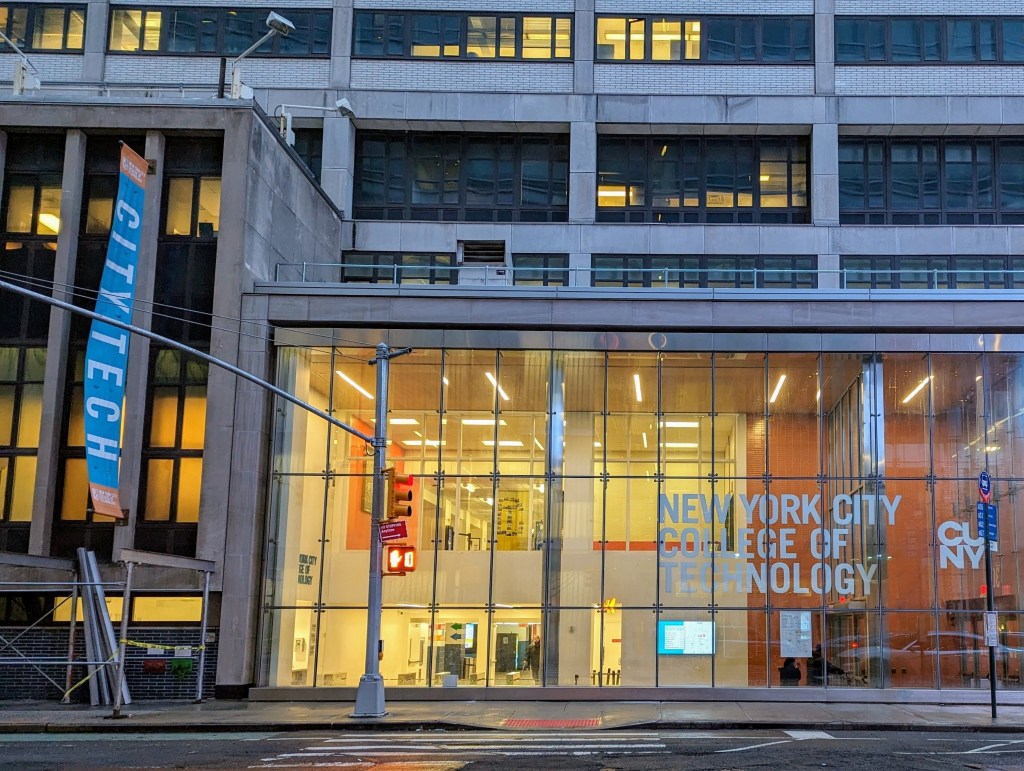
Location: Academic Building A-105, New York City College of Technology (City Tech), CUNY
Organizers: Jill Belli, Wanett Clyde, Jason W. Ellis, Leigh Gold, Kel Karpinski, Lucas Kwong, and Vivian Zuluaga Papp
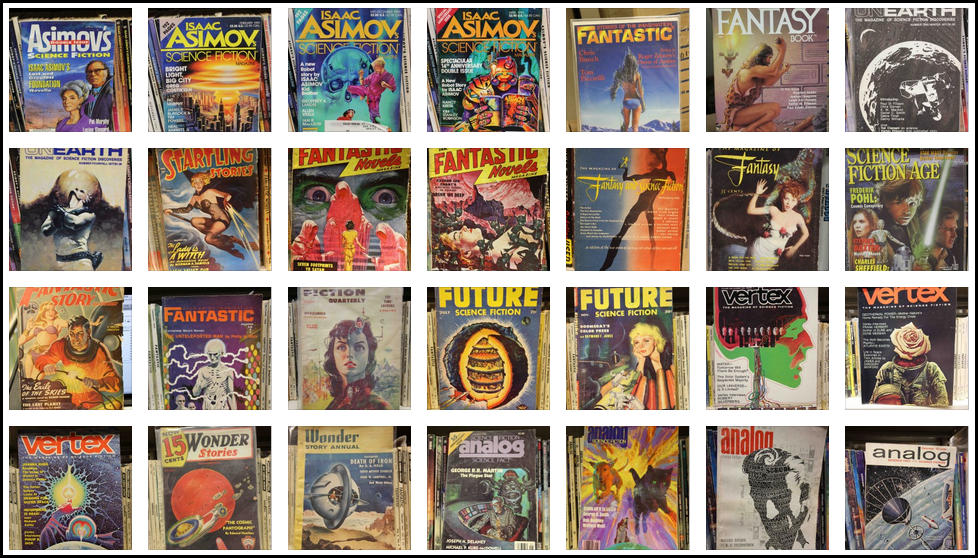
Science Fiction (SF) is an image driven genre. Whether described in text, see the “dull yellow eye” in Mary Shelley’s Frankenstein (1818)); rendered in the two-dimensional art of magazines like Analog; or brought to life in film, TV, and video games, SF imagery continually confirms Gérard Klein’s observation that “science fiction does not proceed directly from science, nor from philosophy, but from the “images (eikons) and representations (eidons)” that these disciplines “unknowingly” produce (“From the Images of Science to Science Fiction,” 2000). SF images abound; how those images are understood and interpreted iterates to infinity.
The Tenth Annual City Tech Science Fiction Symposium explores the many aspects, configurations, and meanings of the image in SF. We invite proposals for 10-20 minute scholarly paper presentations or 40-60 minute panel discussions related to the topic of image in SF broadly construed. Please send a 250-word abstract with title, brief 100-150-word professional bio, and contact information to Jason Ellis (jellis@citytech.cuny.edu) by Friday, October 31, 2025.
Topics with a connection to image in SF might include but certainly are not limited to:
image across modalities: textual, visual, interactive, etc.
images of race, ethnicity, sex, gender, sexuality, and other aspects of identity
images meant to shape understanding of stories and/or sell them (e.g., magazine covers, in-text illustrations, movie posters, trailers)
advertising images in and around SF (e.g., advertising to sell SF as well as non-SF advertising around SF ranging from Big Tobacco to the Johnson Smith Co.
fandom’s use, adaptation, and transformation of images
image and politics
image and meaning
image and representation
SF and photography
SF, simulacra, and simulation
Generative AI and SF
The event will be held in person at the New York City College of Technology (City Tech), CUNY in downtown Brooklyn, New York.
This event is free and open to the public as space permits: an RSVP will be included with the program when announced on the Science Fiction at City Tech website (https://openlab.citytech.cuny.edu/sciencefictionatcitytech/). Free registration will be required for participation.
The event is sponsored by the School of Arts and Sciences at the New York City College of Technology, CUNY.
The Annual City Tech Symposium on Science Fiction is held in celebration of the City Tech Science Fiction Collection, an archival holding of over 600-linear feet of magazines, anthologies, novels, and scholarship. It is in the Archives and Special Collections of the Ursula C. Schwerin Library (Library Building, L543C, New York City College of Technology, 300 Jay Street, Brooklyn, NY 11201). More information about the collection and how to access it is available here: https://openlab.citytech.cuny.edu/sciencefictionatcitytech/librarycollection/.
Click through here to see the other interviewees and topics covered in this special issue.
Editor Sean Scanlan sent out this press release for the issue:
A new issue of NANO: New American Notes Online has been published
Special Issue 17: The Interview
Publication date: June 2025
ISSN: 2160-0104 (Online)
NANO is an indexed, Open Access, and Open Source humanities journal. NANO never charges to submit or to read content. NANO is published by City Tech, part of the City University of New York.
NANO announces its new issue, an exploration of the ways that interviews connect people.
The interview is woven into our hyper-connected world through podcasts, Zooms, magazines, newspapers, social media, and they still occur in private settings. Interviews are ubiquitous. They can be formal and informal, closed or open-ended; they can yield quantitative and qualitative results; they can invoke power and symbolic capital. But, the interview can also be less about gate-keeping and more about the tension inherent in knowledge production and sharing. The eight interviews in this special issue of NANO create spaces of exchange, where the goal is not interrogation but collaboration, curiosity, and mutual understanding.
Two interviews focus on teaching. A multimedia project by Shauna Chung, Naila Butt, Sandy Fougeres, and Khemraj Persaud describe ways that interviews fuse writing and workplace readiness while the scholar Laura Westengard reveals the communal spaces where gothic and queer reinforce each other.
Two interviews focus on visual art. Jennifer Lockard Connerley discusses ways that academia and spirituality enhance portraiture while Bill Saylor reveals how his environmental and natural abstractions arise.
Two interviews focus on translation. Dana Crăciun acknowledges the difficulty of translation while Johannes Göransson eyes translation’s inherent creativity.
Two interviews focus on creativity and theory. The writer and editor Emily Hockaday discusses the challenges of running a science fiction magazine in the age of AI while Marcus Boon reflects on his interdisciplinary practices.
Editor’s Introduction for NANO Special Issue 17: The Interview
The event is free and open to the public. Pre-registration for this in-person event is not required. Participants and attendees who are not affiliated with the college will need to sign-in at the security desk before entering and walking down the hallway to the right to room A-105.
Program
9:00AM Opening Remarks
Jason Ellis and Justin F. Vázquez-Poritz
9:15AM Break
9:20AM Paper Session 1
Moderator: Wanett Clyde
Jason Ellis, “A History of Generative AI in SF”
Jacob Adler, “The End Zone: A.I. as a Commentary on the Human Condition in 17776”
Martijn J. Loos, “A Plea for Theory: The Relationship Between Real-World AI and its Representation in Science Fiction”
10:40AM Break
10:50AM Paper Session 2
Moderator: Kel Karpinski
Virginia L. Conn, “The Tyranny of Neutrality in AI 2041”
Nathan Lamarche, “Monotheistic Ethics in Caprica: The Consequences of AI Development on Queer Futurity”
Adam McLain, “Computational Poetics: Franny Choi’s Soft Science and the Dialogues to Come”
12:10PM Lunch
1:10PM Student Panel
Moderators: Jill Belli and Vivian Zuluaga Papp
Lucas Felipe
Christine Retirado
Malik Joseph
Journey Ford
2:00PM Break
2:10PM Asimov’s/Analog Writers’ Panel
Moderator: Emily Hockaday
Sarah Pinsker
Mercurio D. Rivera
Sakinah Hoefler
Matthew Kressel
3:50PM Break
4:00PM Keynote Address
Moderator: Leigh Gold
Marleen S. Barr, “Science Fiction/AI/Feminism: A Temporal Progression”
Participants
Jacob Adler has been part of the CUNY system for a number of years now, most recently as the Cataloging and Metadata Librarian for the Lloyd Sealy Library at the John Jay College for Criminal Justice. In September 2024, he contributed to Space, the Feminist Frontier, a scholarly book publication about feminist topics related to the Star Trek franchise. Since 2022 he has been involved with providing educational material about artificial intelligence, including creating academic research guides and delivering presentations in CUNY and throughout the Westchester Library System. Other than AI, his interests include media history, fiction writing, and tabletop role-playing games.
Marleen S. Barr is known for her pioneering work in feminist science fiction scholarship and has recently retired from teaching English at the City University of New York. She has won the Science Fiction Research Association Award for Lifetime Contribution to Science Fiction Scholarship. Barr is the author of Alien to Femininity: Speculative Fiction and Feminist Theory, Lost in Space: Probing Feminist Science Fiction and Beyond, Feminist Fabulation: Space/Postmodern Fiction, and Genre Fission: A New Discourse Practice for Cultural Studies. Barr has edited many science fiction critical anthologies and co-edited the science fiction issue of PMLA. She is the author of the novels Oy Pioneer! and Oy Feminist Planets: A Fake Memoir. Her When Trump Changed: The Feminist Science Fiction Justice League Quashes the Orange Outrage Pussy Grabber is the first single authored Trump short story collection. It is followed by This Former President: Science Fiction as Retrospective Retrorocket Jettisons Trumpism. Her latest critical anthology is Jewish Women Writers Create Science Fiction: Gender, Temporality–and Yentas.
Jill Belli is Associate Professor of English at New York City College of Technology, CUNY, where she happily teaches science fiction and utopian studies often. She’s working on long-standing projects on well-being & happiness in education and writing & revising in speculative fiction. Newer interests include nature writing, healing & illness, tarot & astrology as storytelling / intuitive literacy, and grief. Learn more about Jill and her interdisciplinary research and teaching: jillbelli.org.
Wanett Clyde is the Collections Management Librarian at CUNY’s New York City College of Technology, where in addition to managing the library’s collection she oversees the university archives. Her research seeks to explore the intersection of Black history and fashion history, drawing out under credited African-American contributors, their critical innovations and accomplishments, and other meaningful connections in the overlapping research spheres.
Virginia L. Conn is a Teaching Assistant Professor at Stevens Institute of Technology. She researches depictions of the “new socialist human” in socialist science fiction and how those depictions guided policy decisions in Mao-era China, Soviet Russia, and East Germany. She is currently working on her book manuscript, which offers a literary-material account of the relationship between socialist literary policies and the concurrent sociopolitical and technological drive to create the “new human” in daily life. She is also the managing editor of the Science Fiction Research Association Review.
Lucas Felipe is a student at City Polytechnic High School of Engineering, Architecture, and Technology.
Journey Ford is an Entertainment Technology student at the New York City College of Technology, CUNY.
Leigh Dara Gold is a Doctoral Lecturer in the English Department at City Tech. She currently teaches composition, fiction, drama, poetry, and several other literature classes. Her doctoral work, completed at NYU in 2011, explored mourning in the work of Else Lasker-Schüler using several theoretical approaches, among them feminist, trauma, and poetic theories. Since then she has deepened her focus on interdisciplinary work such as writing about Ursula K Le Guin, Mary Shelley and Le Guin’s intersections, Eastern philosophies and ethics in Le Guin’s work, trauma in women writers of science fiction, including Octavia Butler, and the role of the body in poetry. Leigh recently published an essay about Judith Merril in Jewish Women Science Fiction Writers Create Future Females: Gender, Temporality—and Yentas, edited by Marleen S. Barr (Lexington Books, 2024).
Emily Hockaday is the senior managing editor of Analog Science Fiction and Fact and Asimov’s Science Fiction Magazine. She coedited the horror anthology Terror at the Crossroads with Jackie Sherbow and is the editor of the speculative poetry anthology Heartbeat of the Universe. Hockaday is the author of Naming the Ghost, Blood Music, and In a Body. She has received grants from the De Groot Foundation, Café Royal Cultural Foundation, NYFA City Artist Corps, and Queens Council on the Arts. You can find her at www.emilyhockaday.com.
Sakinah Hoefler is a fiction writer, poet, and playwright. She’s a proud recipient of the 2023 Analog Award for Emerging Black Voices. Her work has been published both domestically and internationally, and her plays have been produced by places such as Cincinnati Playhouse in the Park and the University of Cincinnati’s College-Conservatory of Music. A former chemical engineer for the United States Department of Defense, she currently teaches writing at Princeton University. She resides in Newark, NJ with her wonderful husband and adorable son.
Malik Joseph is a student at City Polytechnic High School of Engineering, Architecture, and Technology.
Kel R. Karpinski (they/he) is the IT/ILL Librarian and Associate Professor at the New York City College of Technology, CUNY. Their research focuses on mid-century queer films and novels as they relate to sailors and hustlers in Times Square and how these texts map queer desire onto the city. Kel is also a zine maker and a NY Queer Zine Fair organizer.
Matthew Kressel is a multiple Nebula and World Fantasy Award nominated author and coder. His many works of short fiction have appeared in Analog, Asimov’s, Lightspeed, Clarkesworld, Tor.com/Reactor, Beneath Ceaseless Skies, and many other publications and anthologies, including multiple Year’s Bests. Eighteen of his stories will be included in his debut collection, Histories Within Us, coming from Senses Five Press in February. His far-future novel Space Trucker Jess is coming in 2025 from Fairwood Press. And his Mars-based novella The Rainseekers is forthcoming from Tordotcom in early 2026. Alongside Ellen Datlow, he runs the Fantastic Fiction at KGB reading series in Manhattan. And he is the creator of the Moksha submissions system, used by many of the largest fiction publishers today.
Nathan Lamarche is a Master of Arts in English student at the University of Alberta. Their current studies focus on writing centres and composition theory, Indigenous and queer fiction storytelling, and the relational impacts of technology on our perspectives of the self, with a keen interest on the development of AI technology through the anthropomorphisation of social-oriented technologies and services and their impacts on society, the parallel between Generative AI and monotheistics ethics, and AI’s disproportionate impact on cultural and queer marginalisation. They have received several awards and scholarships, including the Sarah Nettie Christie Scholarship, the Belcourt Brosseau Métis Awards, and The Kerry Wood Memorial Award in Arts.
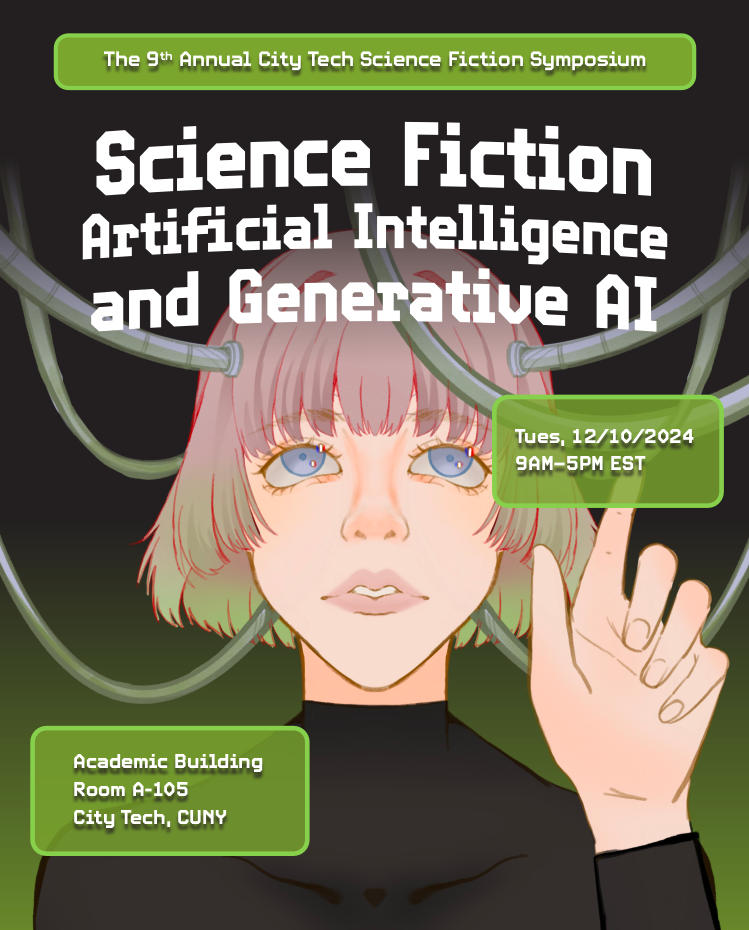
Vivian Li designed this year’s event poster. She is a graphic designer specializing in branding and visual storytelling, but more than anything she’s just another human who wants to make the world a brighter and more connected place through thoughtful design. She believes that in a world increasingly driven by technology and AI, design has the power to bring a vital human touch to the exciting digital landscape. Her mission is to craft visuals that resonate emotionally, adding warmth and personality to fast-paced modern experiences. Connect with her at: https://www.linkedin.com/in/vivian-l-8a177b19b/.
Martijn J. Loos is a Dutch PhD candidate at New York University’s department Comparative Literature. He has a RMA in Comparative Literary Studies from Utrecht University and has taught at University College Tilburg. He works at the intersection of science fiction and philosophy, with a special emphasis on the relationship between the (political) real and the science-fictional. He has published on, amongst others, H. P. Lovecraft, Octavia E. Butler, Ray Bradbury, and Ted Chiang. He enjoys Belgian beers and anything involving laser guns.
Adam McLain is a graduate student in the English department and law student at the School of Law at the University of Connecticut. He studies dystopian literature, legal theory, and sexual justice. They received bachelor’s in English from Brigham Young University, a master’s of theological studies from Harvard University, and a master’s in English from University of Connecticut.
Vivian Zuluaga Papp is a Doctoral Lecturer in the English Department here at City Tech. She has a BA in English from Columbia University, an MA in British and American Literature from Hunter College, and her Ph.D. is in Eighteenth-Century British Literature from Fordham University. Previously, she taught classes in Satire, Women in Science Fiction, Afrofuturism, and Imaginary Travel Narratives while a Postdoctoral Teaching Fellow at Fordham University. Her research interest is in the field of visual epistemology in seventeenth-century scientific texts and early forms of the novel. She is the author of a short science fiction story “Catbot’s in the Cradle,” which was published in Behind the Yellow Wallpaper: New Tales of Madness, and has a chapter coming out in a Science Studies anthology on real and imagined visual manifestations of the “unseeable” in Daniel Defoe’s A Journal of the Plague Year and Robert Boyle’s New Experiments Physico-Mechanicall, Touching the Spring of the Air and Its Effects.
Sarah Pinkser is the author of over sixty works of short fiction, one novella, two novels, and two collections. Her work has won four Nebula Awards (Best Novel, A Song For A New Day; Best Novelette, “Our Lady of the Open Road,” Best Novelette, “Two Truths And A Lie,” Best Short Story, “Where Oaken Hearts Do Gather,”), two Hugo Awards (“Two Truths And a Lie” and “Where Oaken Hearts Do Gather”), the Philip K Dick Award, the Locus Award, the Eugie Foster Award, and the Theodore Sturgeon Award, and been nominated for numerous Nebula, Hugo, Locus, and World Fantasy Awards. Her fiction has been translated into almost a dozen languages and published in magazines including Asimov’s, Strange Horizons, Fantasy & Science Fiction, and Uncanny and in many anthologies and year’s bests. Sarah’s first collection, the Philip K Dick Award winning Sooner or Later Everything Falls Into the Sea: Stories, was published by Small Beer Press in 2019, and her first novel, A Song For A New Day, was published by Penguin/Random House/Berkley in 2019. Her latest book is We Are Satellites, published in 2021. Her second collection, Lost Places, was published by Small Beer Press in 2023 and was followed by the Tordotcom novella Haunt Sweet Home in September 2024. She is also a singer/songwriter with four albums on various independent labels (the third with her rock band, the Stalking Horses). She lives in Baltimore, Maryland and can be found online at sarahpinsker.com and x.com/sarahpinsker.
Christine Retirado is a Communication Design student at New York City College of Technology, CUNY.
Mercurio D. Rivera is a writer whose short fiction has won readers’ awards for Asimov’s and Interzone magazines and has appeared in markets such as The Magazine of Fantasy & Science Fiction, Lightspeed, i09, Nature, Black Static, and various anthologies, podcasts, and “best of” collections. His novel Wergen: The Alien Love War (published by NewCon Press), which was nominated for the Arthur C. Clarke Award, tells stories of unrequited love set against the backdrop of humanity’s complicated relationship with an enigmatic alien species. And his Asimov’s story “Beyond the Tattered Veil of Stars,” was podcast by Dust Studios, and features Gillian Jacobs (of Community) and Justin Kirk (of Weeds), and is available anywhere you listen to podcasts.
Justin F. Vázquez-Poritz is the Dean of the School of Arts and Sciences at New York College of Technology, CUNY.
It’s hard for me to believe that it’s only been 10 years since I started teaching at City Tech in Brooklyn. My gray hair seems like a testament to it being far longer.
I’ve been able to accomplish a lot of things since landing in Brooklyn as evidenced by my CV and Teaching Portfolio. I’ve had the joy of teaching great students, and I’ve enjoyed the collegiality and comradery of excellent coworkers.
Some of the greatest hits of things that I’ve done–some alongside the best colleagues and others by myself–include:
Acquired, Shelved, and Built the Finding Aid for the City Tech Science Fiction Collection (with Alan Lovegreen, Wanett Clyde, Justin Vazquez-Poritz, Maura Smale, Morris Hounion, Laura Westengard, Lavelle Porter, Keith Muchowski, Anne Leonard, and Jessica Roman).
Inaugurated the Annual City Tech Science Fiction Symposium (with Aaron Barlow, Jill Belli, Mary Nilles for the first, and Lucas Kwong, Lavelle Porter, Wanett Clyde, Sean Scanlan, Leigh Gold, Kel Karpinski, and Emily Hockaday on subsequent ones).
Directed City Tech’s B.S. in Professional and Technical Writing Program.
Won some grants with Patrick Corbett to fund projects to leverage LEGO in writing classes and communication workshops.
Contributed as an NEH Faculty Fellow and co-developed four pedagogical modules for A Cultural History of Digital Technology: Postulating a Humanities Approach to STEM (directed by Anne Leonhardt and co-directed by Sandra Cheng, Satyanand Singh, and Peter Spellane).
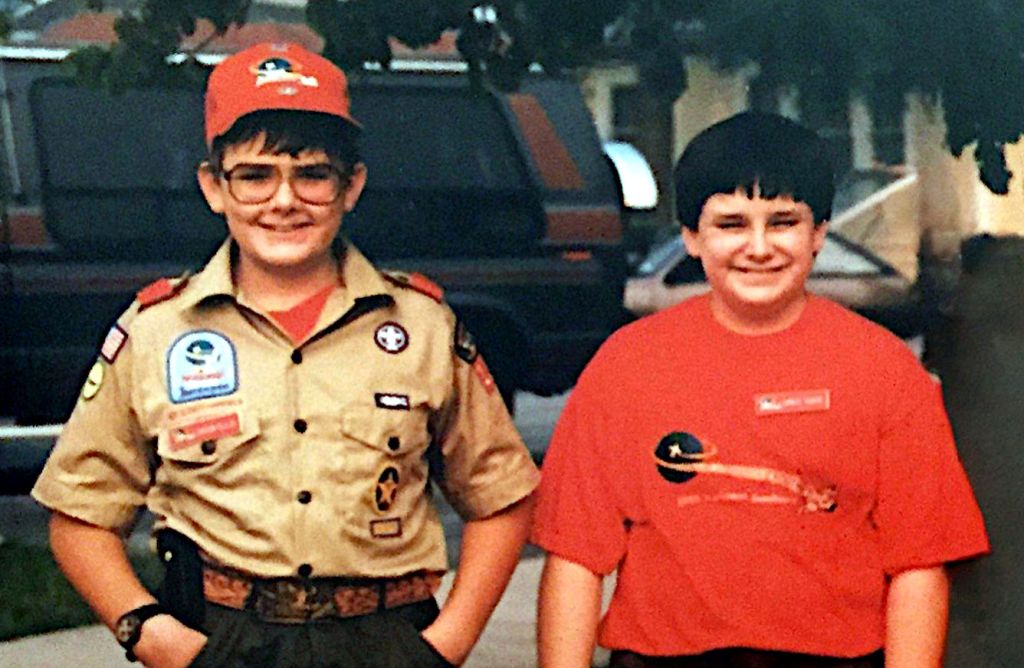
The photo above shows me (left) and Greg (right) as we’re about to leave for the 1989 National Scout Jamboree in Washington, DC. By that point, we had spent a lot of our early life together–same elementary school, Cub Scouts, Webelos, and then, Boy Scouts.
On the long bus ride to the Jamboree, he assembled a plastic model kit of the USS Enterprise USS-1701-D. Imagine his determination to build that model while the bus is bouncing around on the roadbed and young boys are shouting and carrying on around him. He laid out his sprues in the flimsy cardboard box–full color lid inverted to hold the plain cardboard bottom–and applied bits of modeling cement from a metal Testors tube to bind and hold the bits together. I thought that he was out of his mind to build that model on the trip, but he wasn’t out of his mind–he was focused. It meant something to him. It gave him an escape and outlet from everything else going on around him. It channeled his love of Star Trek: The Next Generation into something tangible and real–bringing the utopian world on the screen into a moment of his real lived experience.
Some years before that trip, I spent an afternoon with Greg at his house. We pulled out his older brother Jeff’s precious Star Wars toys–carefully preserved in their original boxes and meticulously stored in his bedroom closet–for otherworldly battles in outer space. We assembled the Kenner Death Star playset and strafed its villains with an X-Wing and the Millennium Falcon.
Greg was an aficionado of great toy lines based on children’s cartoons. He had an extensive collection of action figures from He-Man and the Masters of the Universe, and he proudly showed off the Miraj with a full compliment of heroes from Silverhawks. I can safely say that I’m as impressed now as I was then. And, I was awfully glad we got to play with them together.
Even earlier, I remember being sick in elementary school. I might have missed a week of school. When I returned to classes, I didn’t have a lot of get-up-and-go. Greg became my companion during PE–we would walk the track beside Glyndale Elementary School. While we walked, we talked about all sorts of things–things that I can’t recall but feel like something important, meaningful, revelatory.
An even earlier memory is of Greg, me, and a bunch of other boys pretending to be Transformers in the expansive field behind Glyndale. Sideswipe was my preferred character. Greg, however, took it to the next level as Megatron–nailing his character’s raspy electronic voice and striking an imposing silhouette with his arm canon raised.
The last time that I saw Greg was June 16, 2018. I had visited his parents Wayne and Faye–my Boy Scout Scoutmaster and Cub Scout Pack Leader respectively. Greg happened to be home, so I got to catch up with him some, too. Our lives had diverged in significant ways, but he was still the same determined and playful guy I had know in my youth. However, I also sensed there was a gap between who we were and who we had become that couldn’t be bridged in a brief visit.
Greg passed away last Monday on 1 Jul. 2024–about six weeks shy of his 47th birthday. Looking at his LinkedIn profile, it seems like he was still moving forward–starting his own company and getting certifications in cybersecurity, which makes the unexpected news that much harder to bear. Even when the bonds of friendship have frayed with time, we still can’t help wanting our old friends’ dreams come true and feeling heartbreak when they don’t.