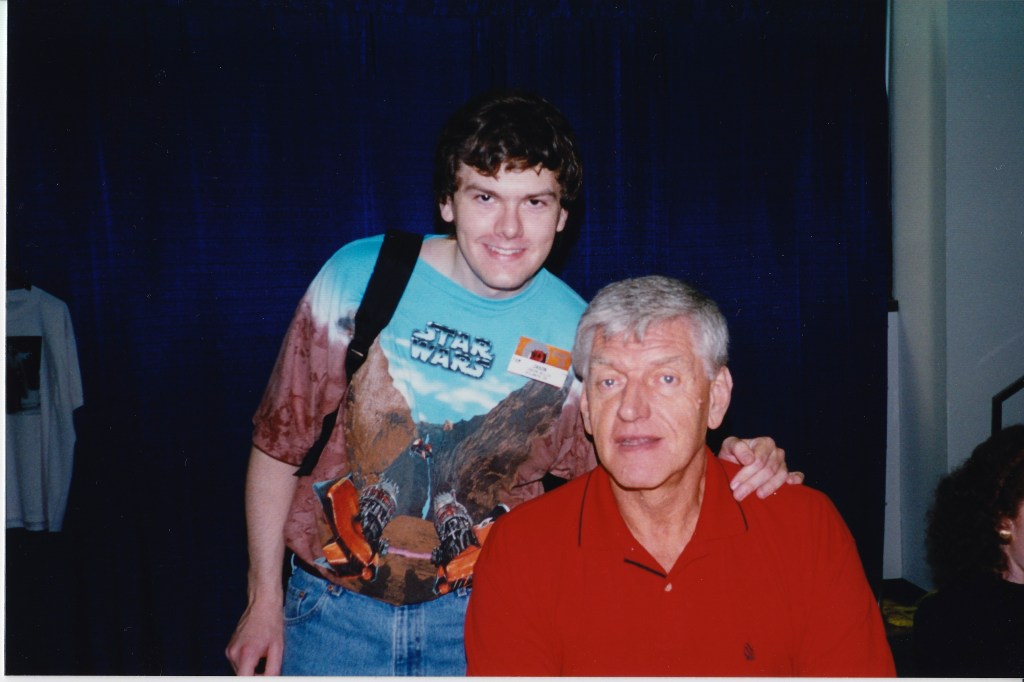
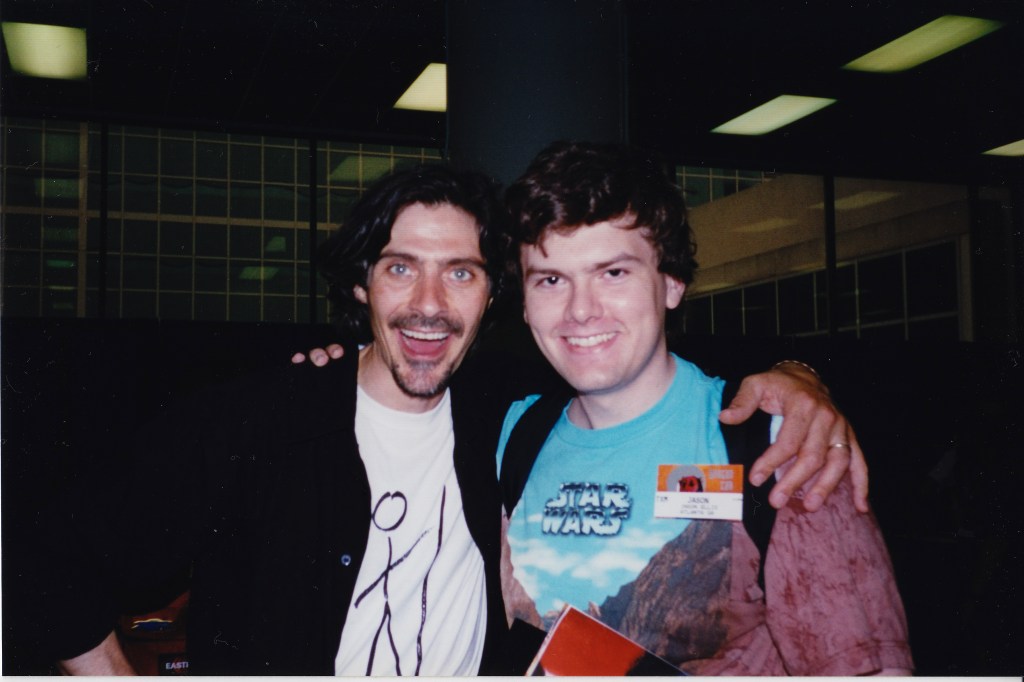
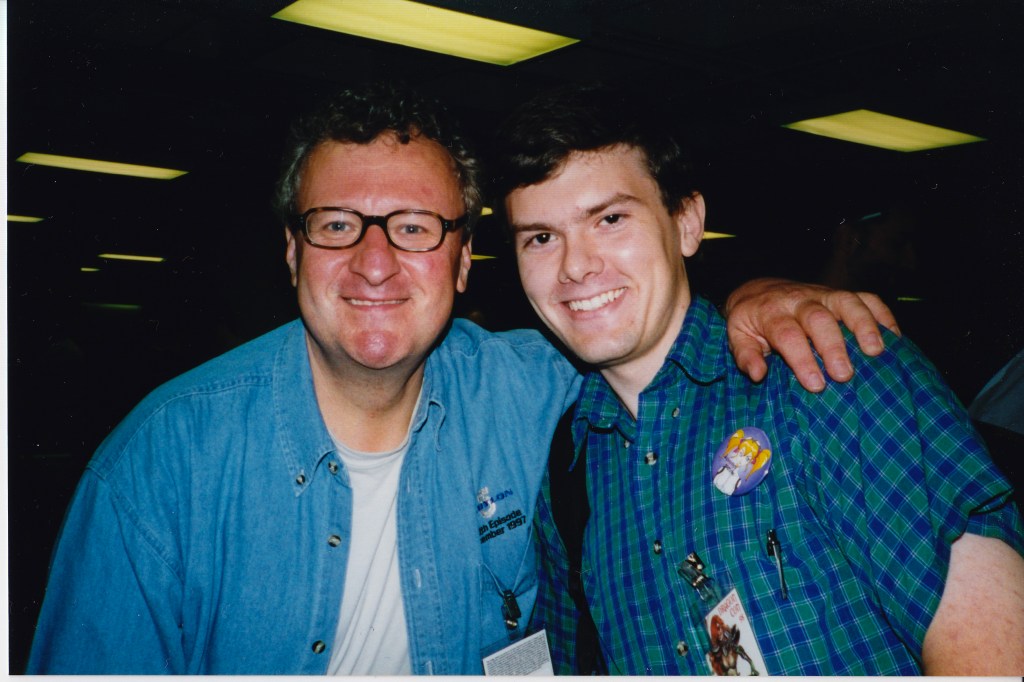
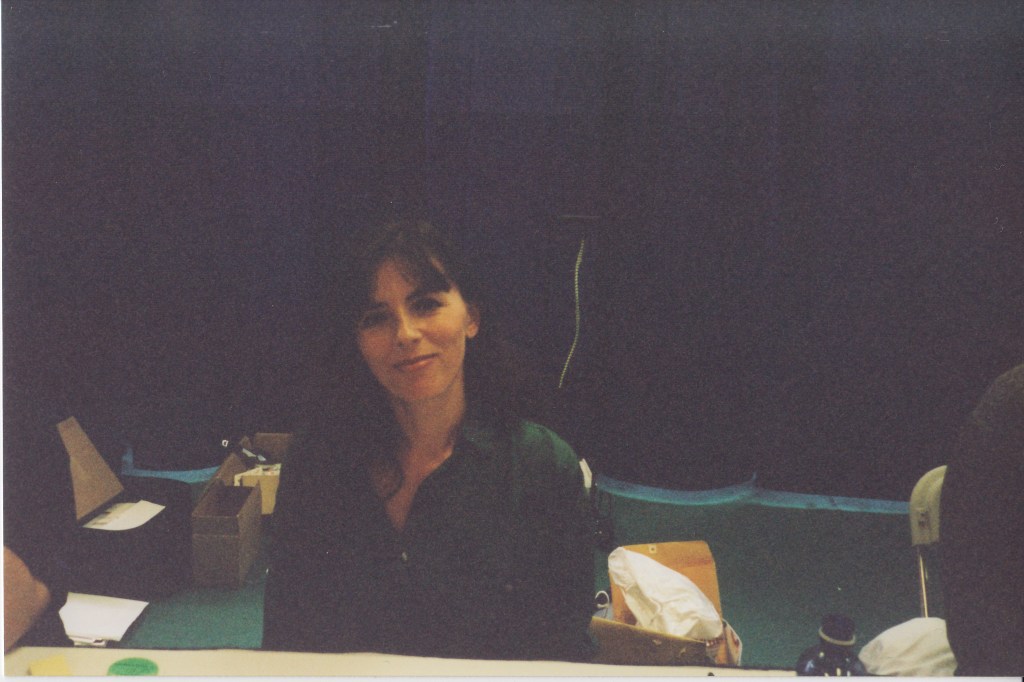
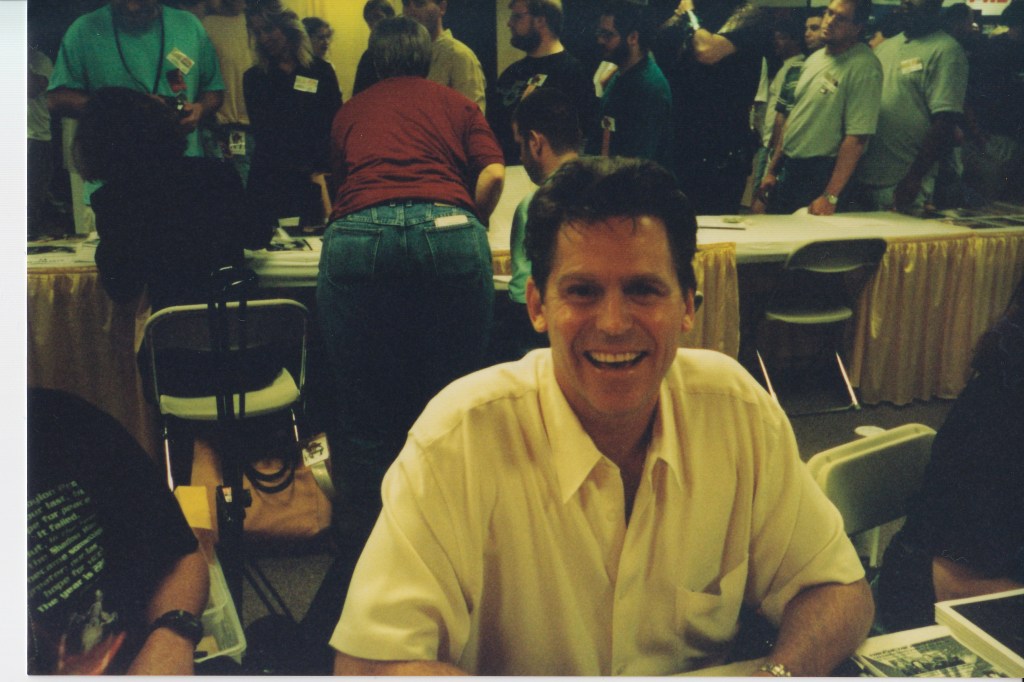
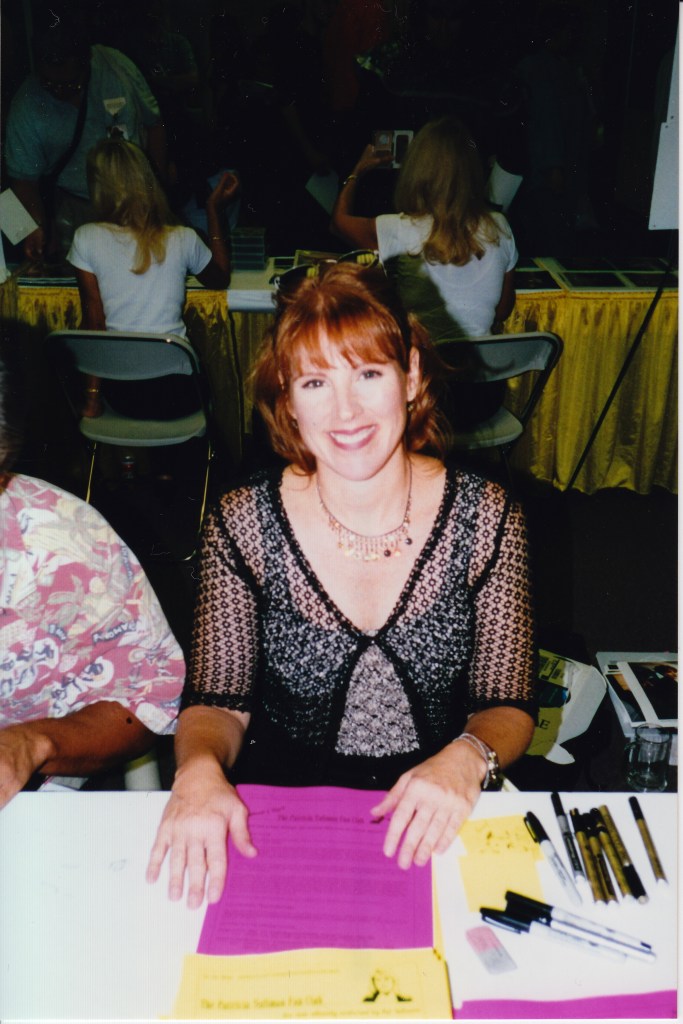
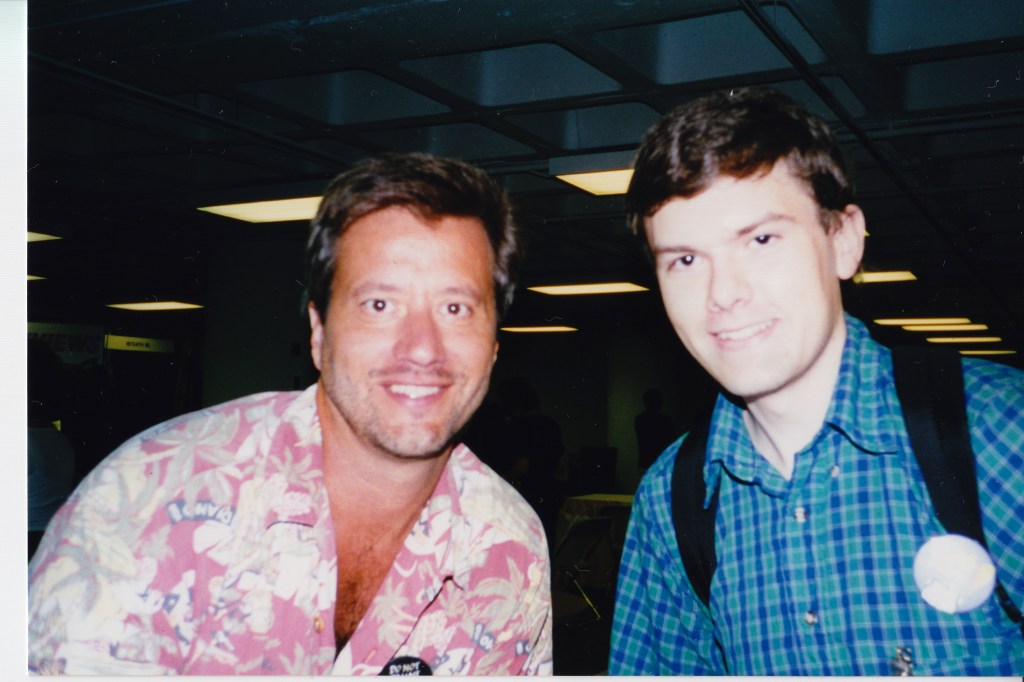
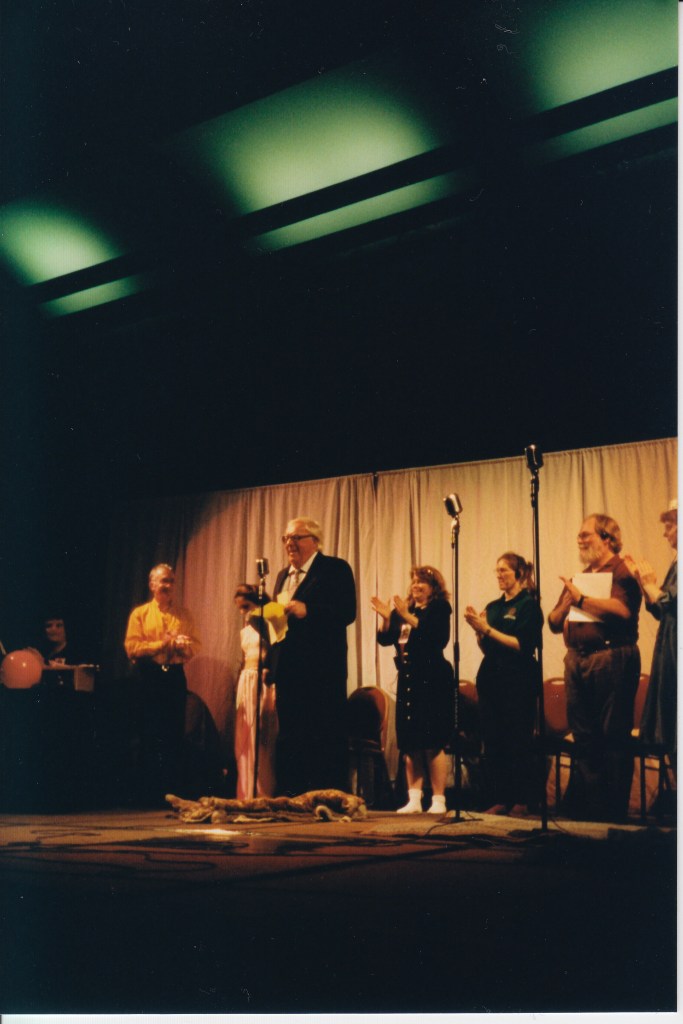
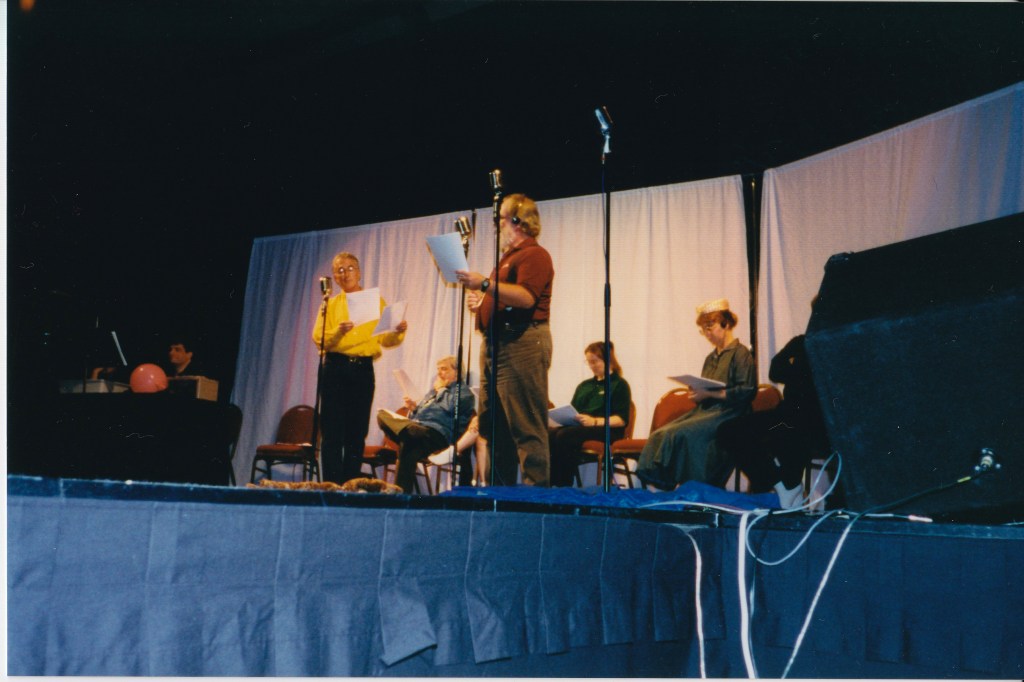
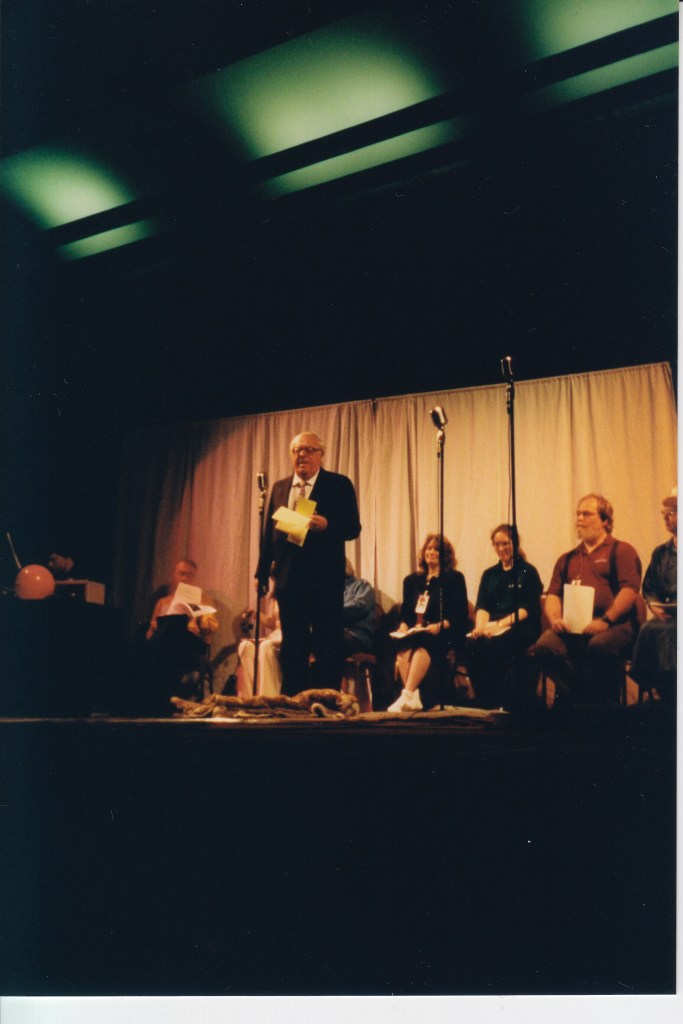
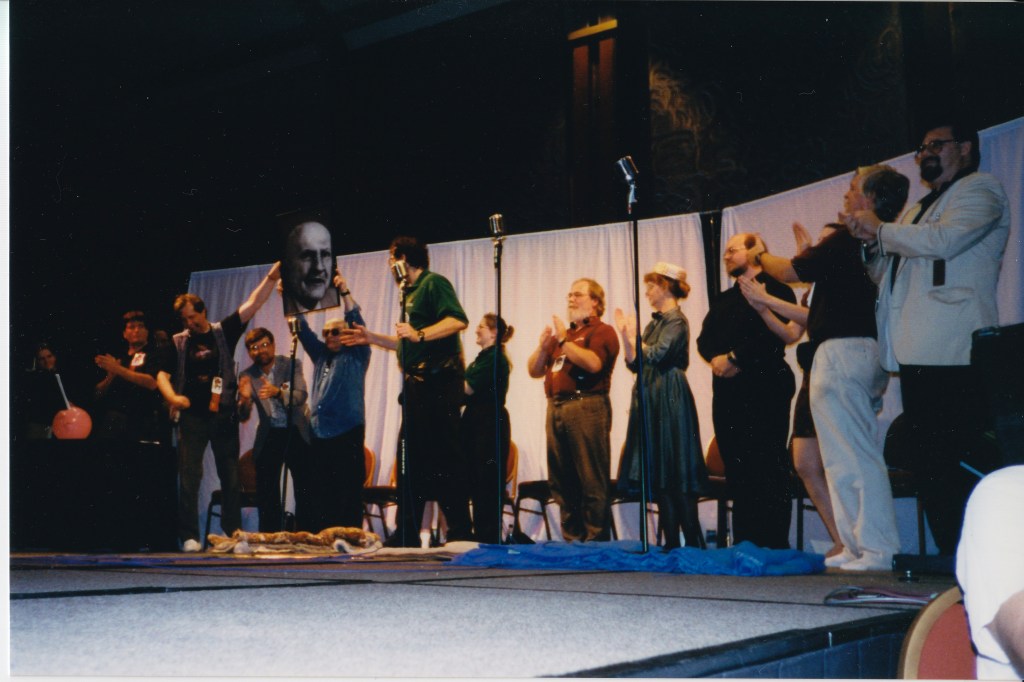
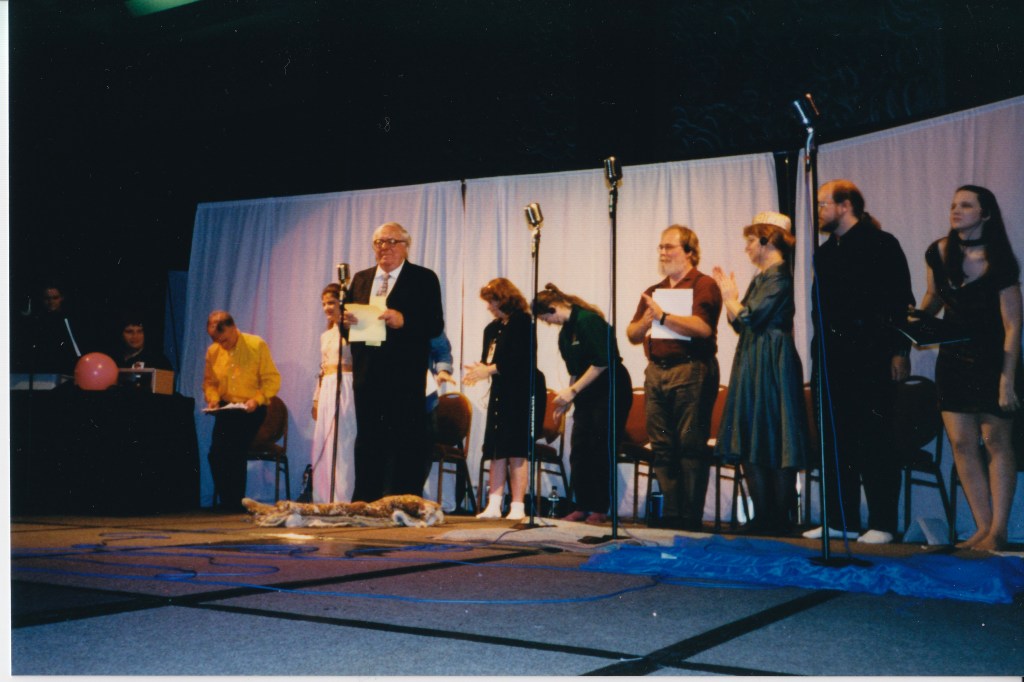
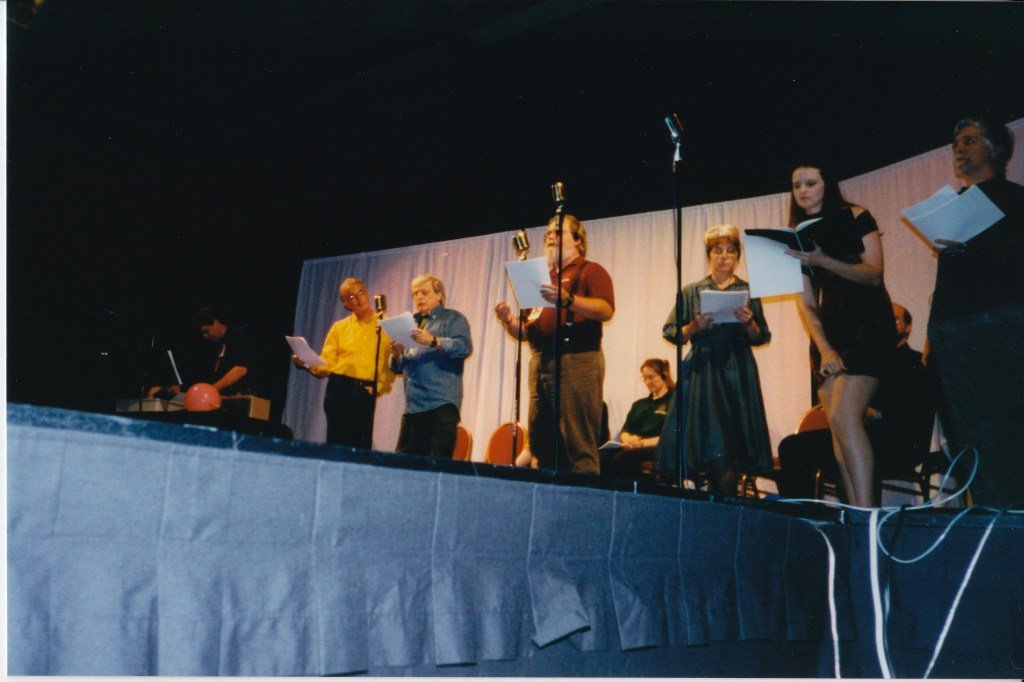
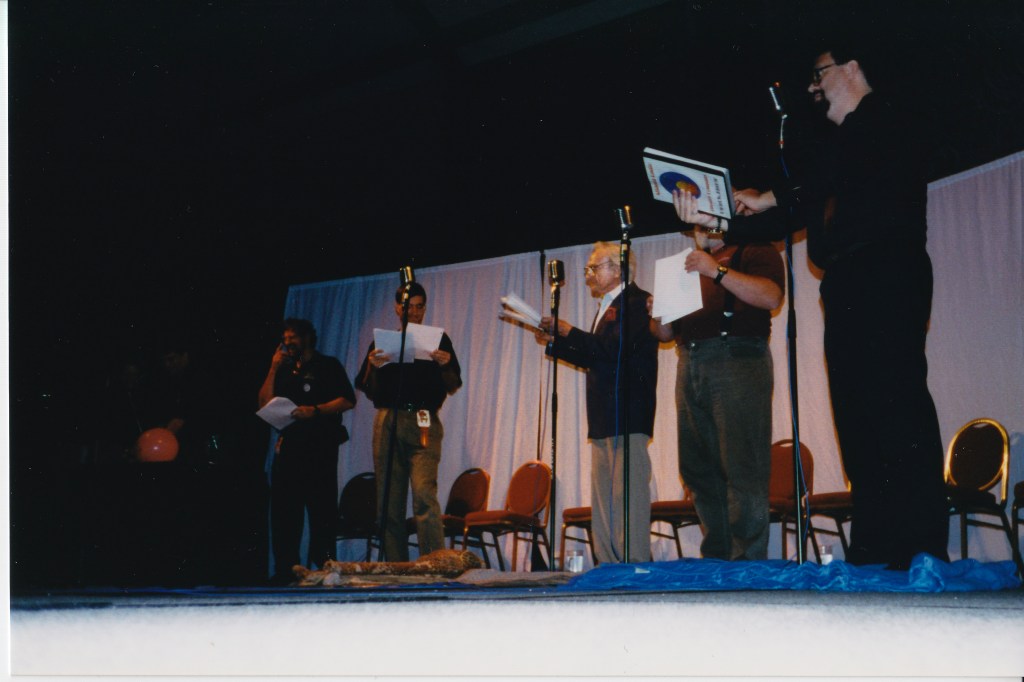
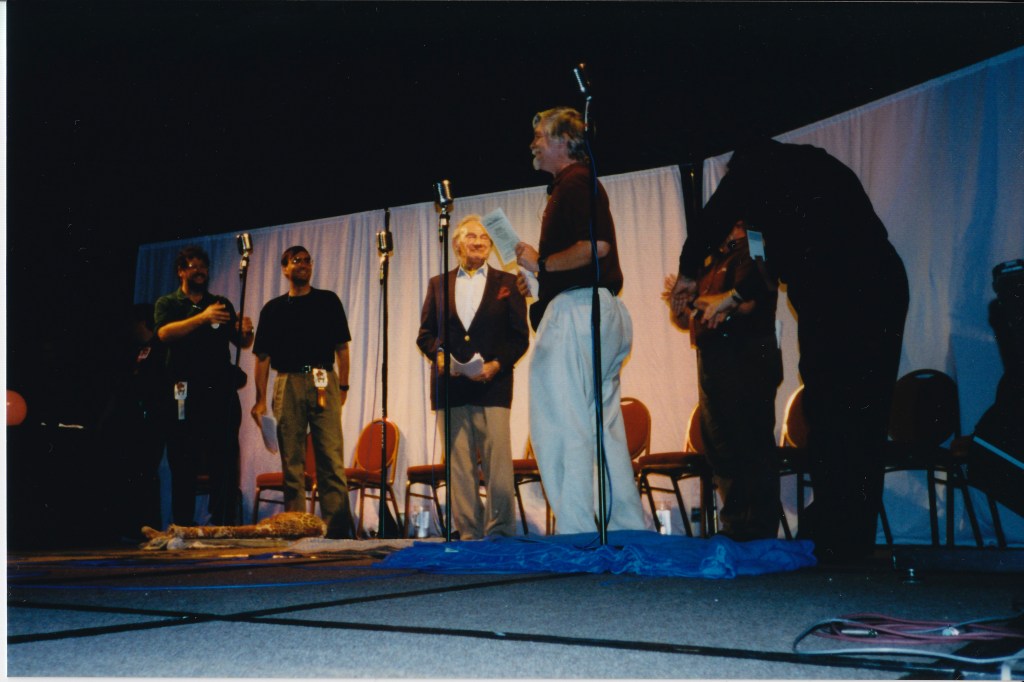
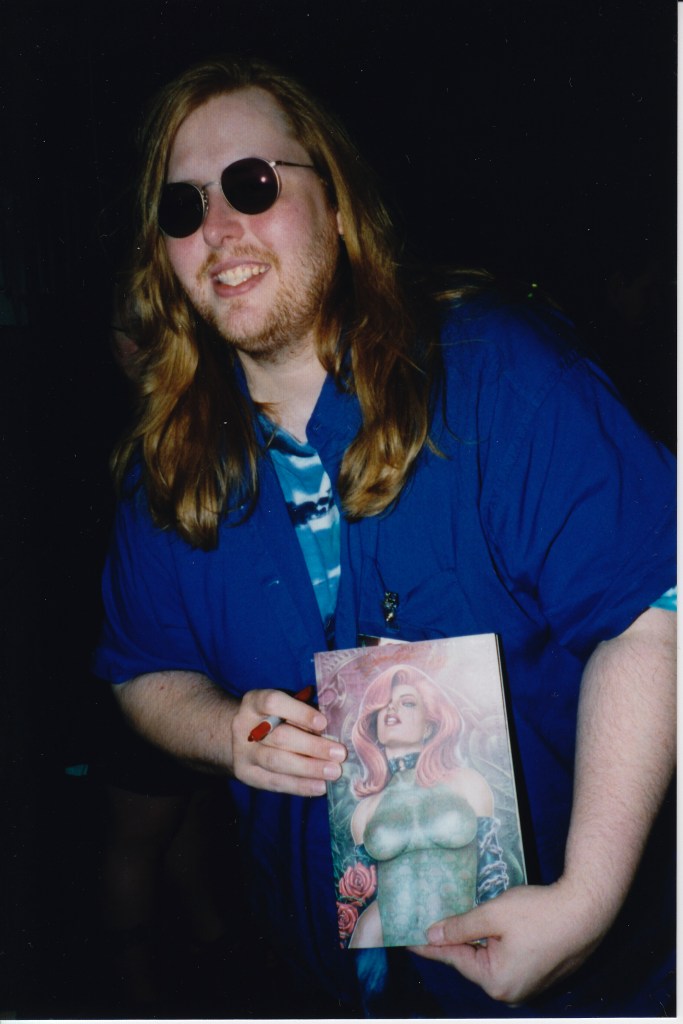
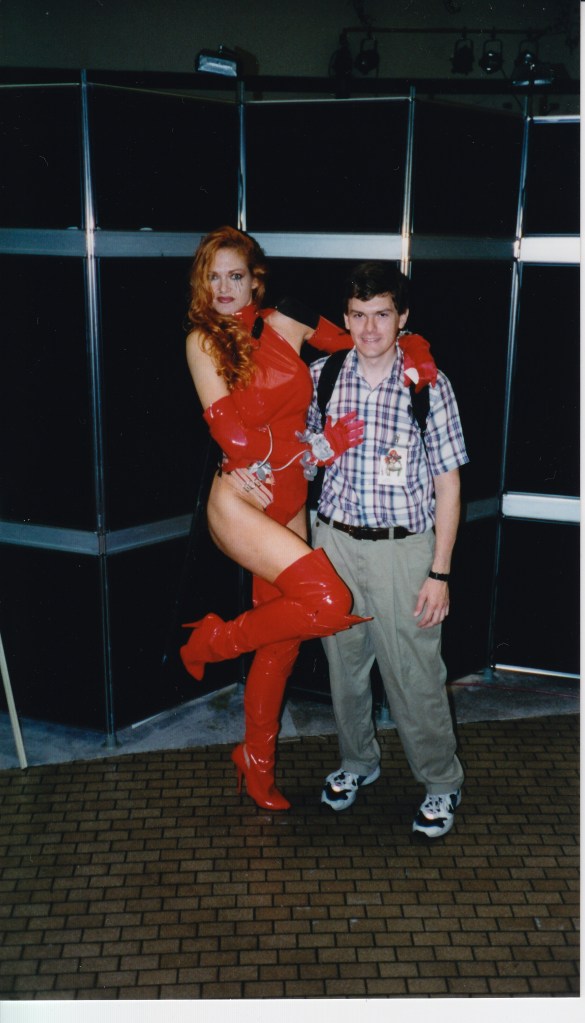
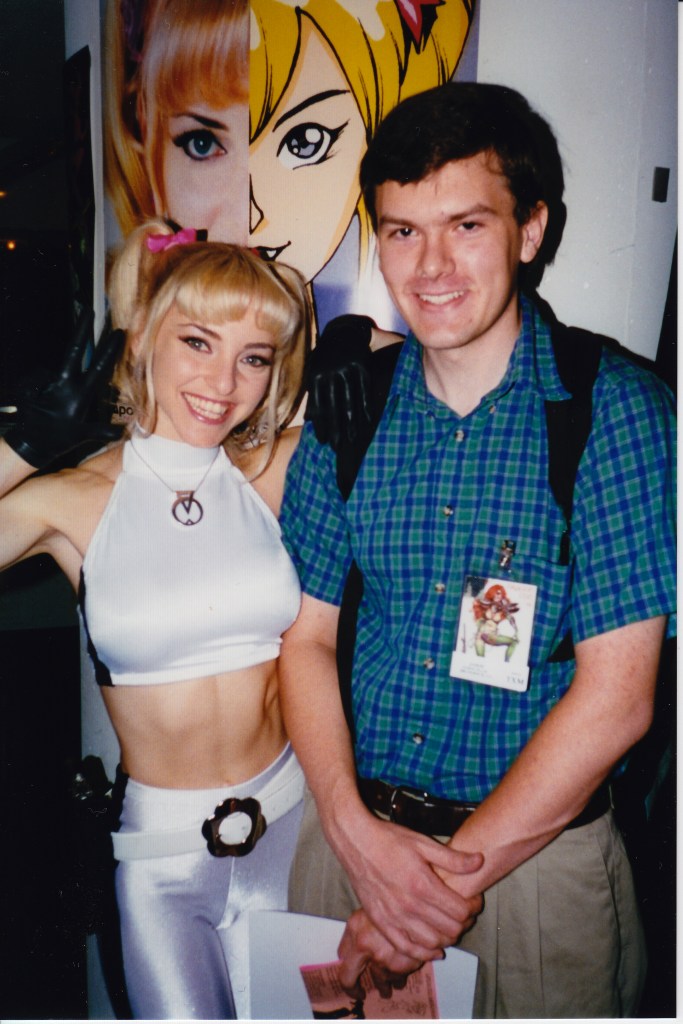
Before the 1998 Dragon*Con in Atlanta, Georgia, I had never been to a fan convention (con) before. I had been to small town comic book/baseball card shows, but there were no celebrities or cosplay at those.
My first girlfriend, who was a student at Wesleyan College, wanted to go, because she wanted autographs from Wendy and Richard Pini (Elfquest) or Marion Zimmer Bradley (The Mists of Avalon). I can’t find a guest list for 1998 and 1999–the two cons we attended together–and I recall from memory who was when.
Nevertheless, I do remember my interests at the con. I am a Star Wars fan, and I was watching Babylon 5 on TNT at that time, so I thought it would be cool to meet some of the actors in my favorite series. As an added bonus, Ray Bradbury and Harlan Ellison were attending, so I looked forward to meeting them, too (I plan to write more about this practice and my disavowal of it now, but I’ll save that for another post).
Looking at these photos now, it’s difficult to wrap my mind around the fact that 25 years separates then from now. While a lot of things have transpired during those 25 years leading up to my winding up in Brooklyn, New York, they seemingly passed in a blink of the eye.
Science Fiction Writers
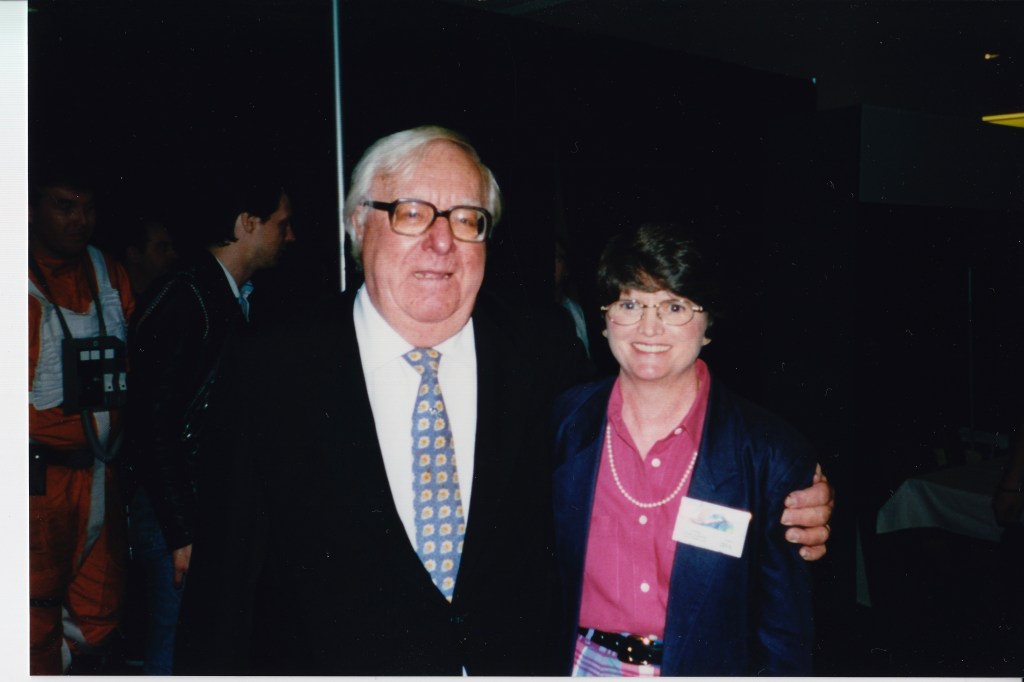
Ray Bradbury
I took this picture after Bradbury had made the introduction to the Atlanta Radio Theater Company’s “The Man Who Walked Through Elephants,” an adaptation of a Robert A. Heinlein story that is Bradburyesque.
After introducing myself, Bradbury besieged me, “Jason, it’s good to meet you, but where are your Argonauts!?”
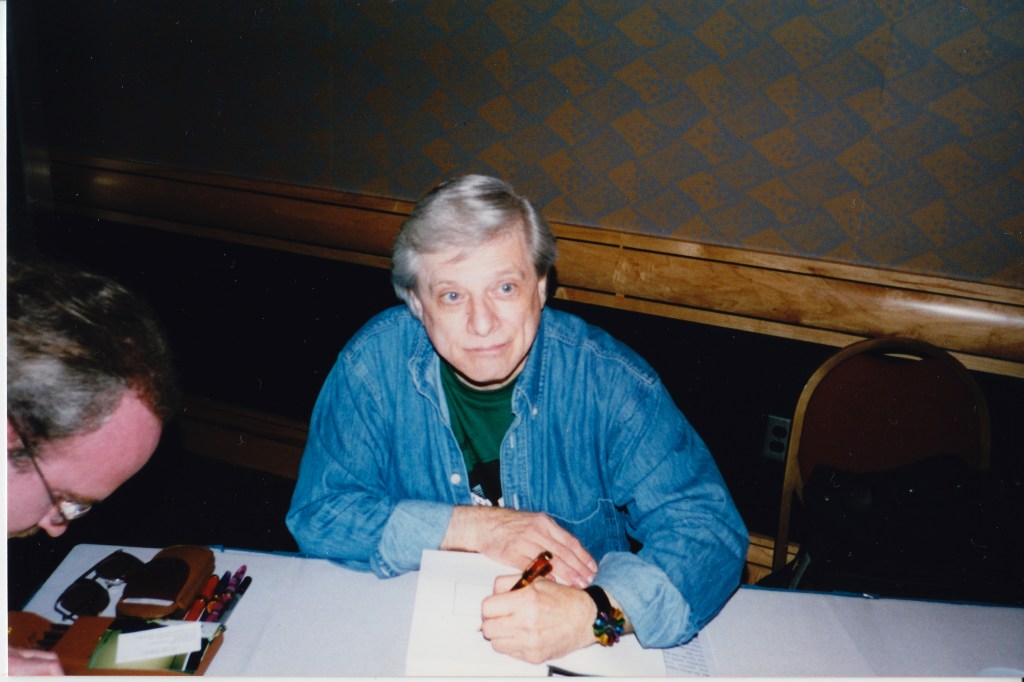
Harlan Ellison
The line for Harlan Ellison’s autograph was astonishingly long. Despite the cantankerousness attributed to him, he stood in his chair and shouted to us, “I’m not leaving until everyone who wants an autograph gets one!” Those of us in the crowd cheered! He was true to his word.
Star Wars
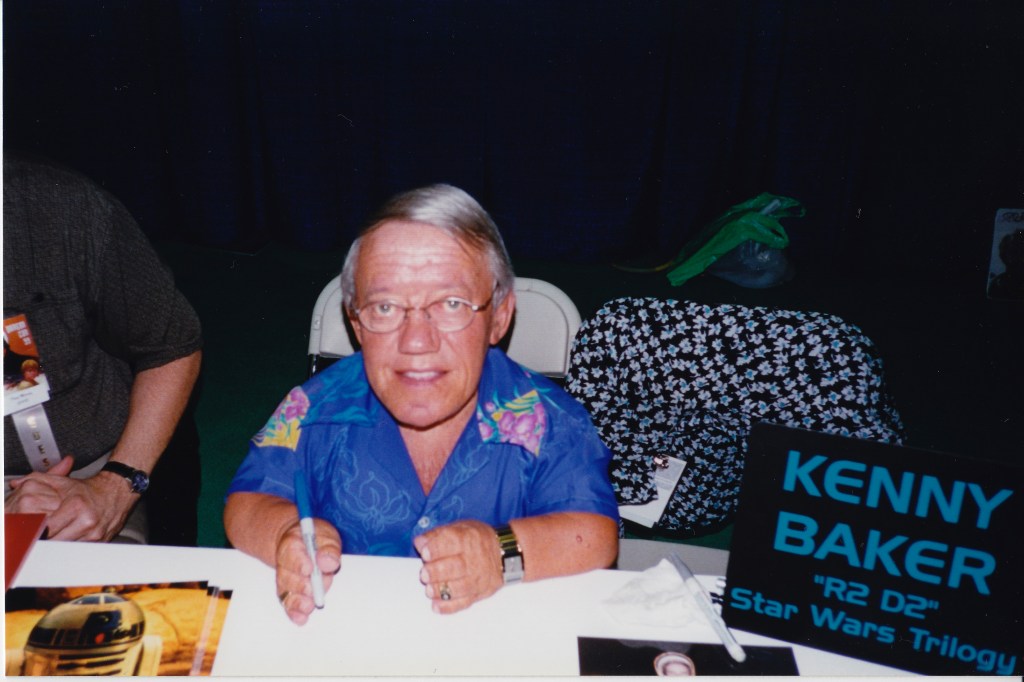
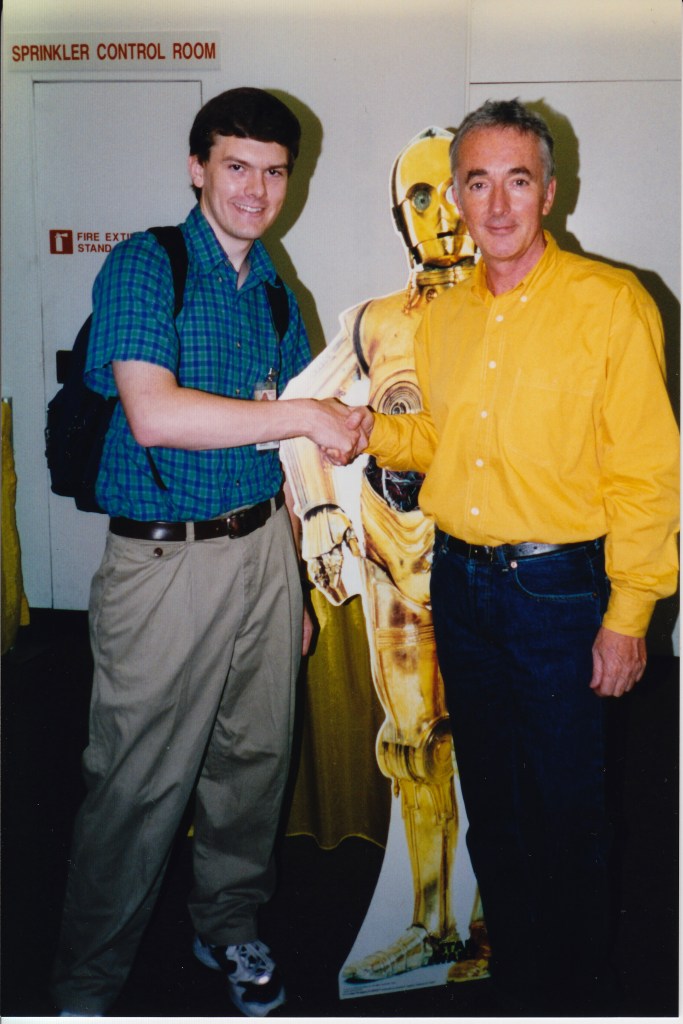
Meeting Kenny Baker, Anthony Daniels, and David Prowse was a highlight of my con experience. It was a strange experience meeting each actor. Having seen them play their roles behind masks and suits throughout my life was difficult for me to square with them in the flesh. Ecce homo.
Kenny Baker/R2-D2Anthony Daniels/C-3PODavid Prowse/Darth Vader
Babylon 5
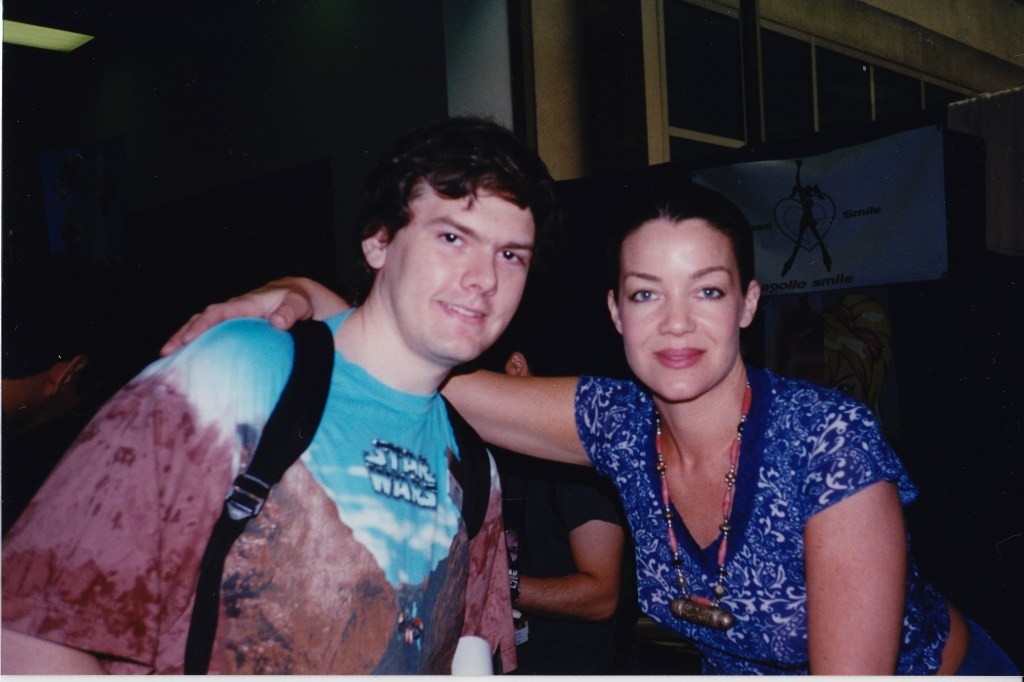
Babylon 5 was nearing the end of its first five season run, so it was great to meet much of the cast in person. I’ll begin with Jason Carter, because I wanted to be a Ranger prepared for action with a Denn’bok.
Jason Carter/Ranger Marcus ColePeter Jurasik/Londo MollariClaudia Christian/Commander Susan IvanovaMira Furlan/DelennJeff Conaway/Zack Allan
The Atlanta Radio Theatre Company produced two back-to-back shows one evening of the con. The first was “The Man Who Traveled Through Elephants,” an adaptation of a Robert A. Heinlein short story that is Bradburyesque. Ray Bradbury introduced it. Anthony Daniels and Harlan Ellison played roles in the production.
Rory Rammer, Space Marshall: The Space Cycloplex
The second ATRC production was a Rory Rammer, Space Marshall story featuring Jonathan Harris (Dr. Smith on the original Lost in Space TV series).
The last time that I went to Dragon*Con was 2011 to participate on a panel organized by the Science Fiction Research Association (SFRA). I had to wait in a long line to get my badge and then there were crowds of other attendees. I am uncomfortable in crowds. According to numbers on Wikipedia, the weekend event’s attendance was more than 46,000. That’s 2.5x as many attendees as when I first attended in 1998, which was 18,000. In 1999, there were 19,000. And the last time that I attended as a fan with my cousin Ryan and friend Bert in 2000 there were 20,000 attendees, which felt slightly claustrophobic to me. So, you might imagine how overwhelming the 2011 event felt to me while navigating through the crowds in various places of the con.
Of course, this is a personal thing. I’m not necessarily suggesting that cons should be smaller by design (though, that would be cool for folks like me), but there are gobs of people who aren’t concerned by crowds in the least and in fact thrive off all of the humans in one place. I’ll stay at home and let those folks enjoy future big cons!
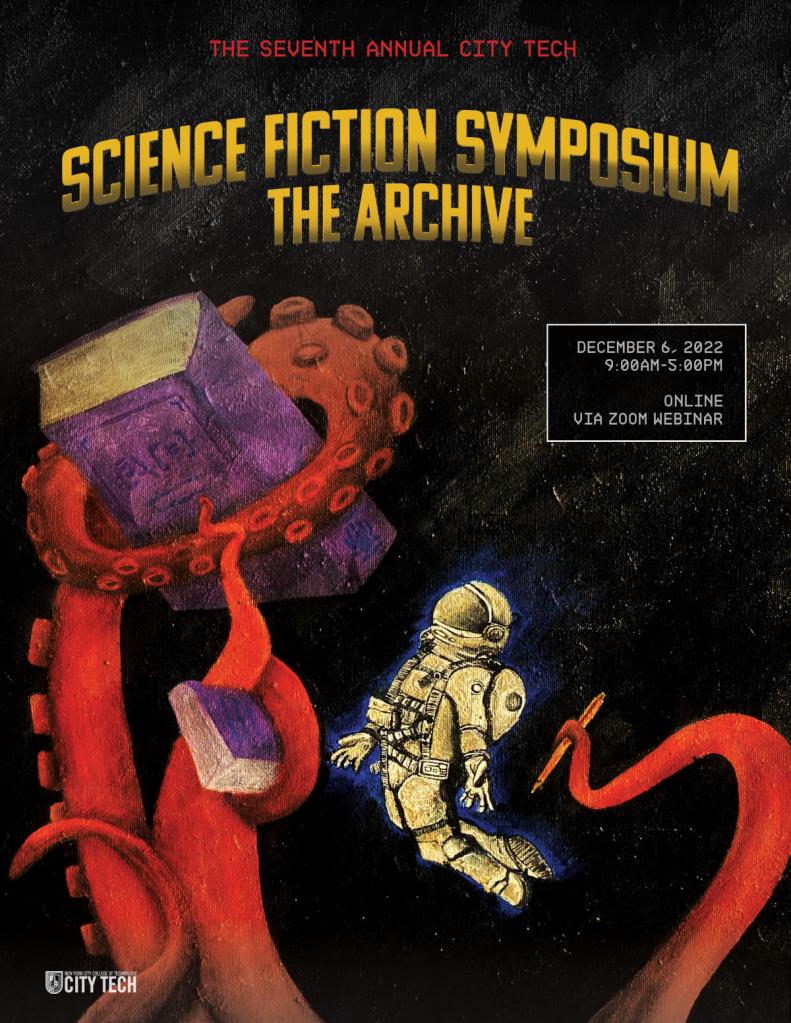
The Seventh Annual City Tech Science Fiction Symposium on the Archive and SF was held on Tuesday, Dec. 6, 2022 as a Zoom Webinar. You can read the full program here.
I started organizing these symposia with my colleagues at City Tech after we received the original 160 box donation that became the City Tech Science Fiction Collection. We’ve covered a lot of important topics at each symposium over the past seven years, but there’s still much to examine and discuss.
I’ve been so busy this semester that I didn’t announce the event here on dynamicsubspace.net. In case you missed the event, you can watch all of the sessions in the videos below.
Many thanks again to everyone who participated and contributed to this year’s event!
Opening Jason W. Ellis Justin Vazquez-Poritz
Paper Session 1: Archival Research Jill Belli – Moderator Jessica Aaron – “Preventing Planetary Patriarchy: Subversions of the White Man’s Ideal World in Early SF Pulps” Chris Leslie – “The Republic of (Interstellar) Letters: From the Archives of Asimov and Merril” Gillian Polack – “Story as Archive: How Speculative Fiction Novels Both Preserve and Interpret Cultural Material”
Panel Discussion: A Tale of Two Archives Jason Ellis (City Tech) Matthew Frizzell (Georgia Tech) Kel Karpinski (City Tech) Alison Reynolds (Georgia Tech) Lisa Yaszek (Georgia Tech)
Panel Discussion: Georgia Tech’s Sci Fi Lab: Archival Research, Octavia’s Ancestor’s Project, and Radio Play Lisa Yaszek – Moderator Panelists: Val Barnhart Laurence Copeland Killian Vetter Edeliz Zuleta
Analog Writers Panel and the Analog Emerging Black Voices Award Emily Hockaday – Moderator Kedrick Brown Meghan Hyland Kelsey Hutton Douglas Dluzen Trevor Quachri and Emily Hockaday – Award Presentation
Paper Session 2: Archives in SF Lucas Kwong – Moderator Jacob Adler – “Summit of Knowledge: Archiving the Fantastical” Rhonda Knight – “A Data Thief in the Archive: Reading Sofia Samatar’s ‘An Account of the Land of Witches’” Adam McLain – “‘Only an Echo’: The Memory of the Archive and the Archive of Memory in Lois Lowry’s The Giver“ Kenrick H. Kamiya Yoshida and Ida Yoshinaga – “An Okinawan Speculative Arts Archive”
Paper Session 3: Latinx SF in the Archive Leigh Gold – Moderator Matthew David Goodwin – “The Latinx Multiverse and the Fictional Recovery of Latinx Science Fiction” Dolores González Ortega and Valeria Seminario – “Inside the Latin American Science Fiction Archive: Challenges and Contributions to a Growing Academic Field”
Keynote Jeremy Brett – “Making Space: Science Fiction Archives and the Archival Citizen” Jason Ellis – Introduction and Moderator
The Sixth Annual City Tech Science Fiction Symposium on Access and Science Fiction will be held on Thursday, December 9, 2021 from 9:00am-5:00pm EST (GMT/UTC -5 hours) online via Zoom Webinar.
To participate in this free event, attendees will need to (1) Signup for a free Zoom account here (if you don’t already have one), and (2) Register here to receive access instructions to the Zoom Webinar. Participants may register any time before or during the event!
For those who would like to watch the event without registering, you can join the YouTube Livestream here.
In addition to the Zoom Webinar Chat and YouTube Live Chat, join the event conversation with the event hashtag #CityTechSF and follow us on Twitter @CityTechSF.
As indicated below in the program, some symposium content is pre-recorded to offer more time for discussion on the day of the event. Pre-recorded content includes author readings and full paper presentations. Some of this content is in production and will be posted soon.
9:00am-9:15am Opening Jason W. Ellis Justin Vazquez-Poritz
9:15am-10:05am Paper Session 1: Access to International SF Jill Belli – Moderator Emrah Atasoy – “Access to SF in Turkey and Turkish SF Abroad” Shanky Chandra – “Chinese Science Fiction: A Literary Genre, A Tool of Teaching Science or A Secret Weapon of China’s Soft Power?” Gillian Polack – “The Problem of Susan Australia, or, The Tyranny of Distance” | Watch Expanded Presentation
10:05am-10:10am Break
10:10am-11:00am Paper Session 2: Access to Science/Fiction/World A. Lavelle Porter – Moderator Chris Leslie – “Reevaluating the Inclusiveness of the Interstellar Republic of Letters” Katherine Buse and Anastasia Klimchynskaya – “Science Fiction and Citizen Science” Aaron Zwintscher – “Star Wars Biomes: Simulacra, Nature, and Passivity in No Dialogue Nature Shows”
11:00am-11:05am Break
11:05am-11:45am Discussion Panel: “Accessing the Feminist Science Fiction Archive, Or, Young Women Read Old Feminist SF” Lisa Yaszek – Moderator Panelists: Josie Benner Olivia Kiklica Jessica Taetle Edeliz Zuleta
11:45am-11:50am Break
11:50am-1:10pm Paper Session 3: Access, Inclusion, and Representation in SF Joy Sanchez-Taylor – Moderator Leigh Gold – “Confronting Language in the Science Fiction Text: Language, Access, and Trauma in Octavia Butler and Ursula K Le Guin” Katherine Pradt – “Shipping Supergirl: Discovering and Defending Lesbian Identity Through a DC Fandom” Sean Scanlan – “Cool Access and Access to Cool: Gibson’s Gun Moll, Dorotea Benedetti” Ida Yoshinaga – “Corporate Employment Practices Towards Greater Diversity of Story Development for SFF Screen Stories”
1:10pm-1:15pm Break
1:15pm-2:25pm Access, Accessibility, Bodies, and Minds in SF Lucas Kwong – Moderator Jacob Adler – “‘Everything Herein is Fantastic’: Accessibility and Inclusivity in Dungeons & Dragons” Ryan Collis – “Autistic Speculative Imaginings: Accessing and Creating Minor Literatures” Annette Koh – “Urban Planning for Cyborg Cities: Thinking about disabilities and mobilities in sci-fi as an urban planner”
2:25pm-2:30pm Break
2:30pm-3:55pm Analog Writers Panel and the Analog Emerging Black Voices Award Emily Hockaday – Moderator Panelists Alec Nevala-Lee Marie Vibbert Chelsea Obodoechina Trevor Quachri and Emily Hockaday – Award Presentation
3:55pm-4:00pm Break
4:00pm-5:00pm Keynote “Writing Ourselves In: Teaching Writing and Science Fiction with Wikipedia” Ximena Gallardo C. and Ann Matsuuchi Wanett Clyde – Introduction and Moderator
Ximena and Ann’s book chapter, “My Books Will Be Read By Millions of People!”: The LaGuardia Community College Octavia E. Butler Wikipedia Project,” that appears in Approaches to Teaching the Works of Octavia Butler, edited by Tarshia Stanley (Modern Language Association, 2019), has been made accessible via the CUNY institutional repository, Academic Works: https://academicworks.cuny.edu/lg_pubs/141/. This book was awarded Idaho State University’s 2021 Teaching Literature Award.
Participants
Jacob Adler has worked as the Metadata and Cataloging Librarian at the Bronx Community College Library since 2017. Before that he performed various other cataloging work, most notably at The Paley Center for Media from 2010 to 2016. In addition to his professional work he wrote a fantasy novel for the 2018 National Novel Writing Month contest; he continues to work on the novel and seek to get it published. He is especially interested in early television history, particularly the original 1959-1964 Twilight Zone television series. He is also currently pursuing a master’s degree in Museum Studies, which he is on track to receive in January 2022.
Emrah Atasoy, PhD, serves as a visiting postdoctoral scholar at University of Oxford’s Faculty of English between September 2021 and September 2022 as a recipient of the TUBITAK (The Scientific and Technological Research Council of Turkey) 2219 International Postdoctoral Research Fellowship Grant. His research interests include speculative fiction, futuristic narratives, critical future studies, utopian and dystopian studies, critical dystopia, science fiction, apocalyptic fiction, ecocriticism, posthumanism, Turkish speculative fiction, twentieth-century literature, and comparative literature. He was a visiting scholar at Penn State University under the supervision of Prof. Dr. Jennifer Wagner-Lawlor in the academic year 2015-16. His work has appeared in journals such as Studies in the Novel (2022, collaborative article with Prof. Dr. Thomas Horan), Utopian Studies, Librosdelacorte.es, Literary Voice, and Methis. Studia Humaniora Estonica. His monograph Epistemological Warfare and Hope in Critical Dystopia has been published by Nobel in 2021. His most recent publications include “Speculative Fiction Studies in Turkey: A Preliminary Survey” (2021), in Utopian Studies, “Dys/utopian Narratives on the Screen: Beyond the Binaries in Children of Men and Lobster” (2021), in The Postworld In-Between Utopia and Dystopia: Intersectional, Feminist, and Non-Binary Approaches in 21st Century Speculative Literature and Culture (2021, Routledge), edited by Tomasz Fisiak and Katarzyna Ostalska, and “Epistemological Warfare(s) in Dystopian Narrative: Zülfü Livaneli’s Son Ada and Anthony Burgess’s The Wanting Seed” in Speculations of War: Essays on Conflict in Science Fiction, Fantasy and Utopian Literature (2021, McFarland), edited by Annette M. Magid. He is a member of both Utopian Studies Society-Europe and the Society for Utopian Studies (SUS). His research at the University of Oxford is supported by TUBITAK BIDEB (The Scientific and Technological Research Council of Turkey) under Grant 2219-International Postdoctoral Research Fellowship Program.
Jill Belli is Associate Professor of English at New York City College of Technology, CUNY, where she happily teaches science fiction and utopian studies often. She’s working on long-standing projects on well-being & happiness in education and writing & revising in dystopian texts. Newer interests include looping as composing practice, tarot and astrology as storytelling and knowing, William Reynolds, and grief. Learn more about Jill and her interdisciplinary research and teaching: jillbelli.org.
Josie Benner is a Biomechanical Engineering Major and Science Fiction Minor at Georgia Tech. She works in Professor Lisa Yaszek’s Sci Fi Lab, with funding from Georgia Tech’s Center for Women, Science, and Technology and the Ivan Allen College for the Liberal Arts.
Shanky Chandra is a Ph.D. scholar from the Centre for Chinese and Southeast Asian Studies, Jawaharlal Nehru University, India, in New Delhi. His research interests include modern and contemporary Chinese Science Fiction. The title of his Ph.D. thesis is “Socio-Political and Cultural Factors in the Making of Chinese Science Fiction Writer Liu Cixin: Understanding The Three-Body Problem.” Chandra took his B.A. (2011) and M.A. (2013) in Chinese language and literature, and M.Phil. (2016) from Jawaharlal Nehru University at New Delhi, India. In 2013, the Ministry of Human Resource Development (MHRD) awarded the Chinese Government Scholarship to Shanky Chandra for Post Graduate Diploma at Beijing Language & Culture University (Higher level 1 & 2) 2013-2014. Chandra taught Chinese language and literature at St. Stephen’s College (2014-2019), Delhi University. He completed the Advance Mandarin Teacher Training Program from the National Taipei University of Education Chinese Language Education Center, Taipei, Taiwan, in July 2018. Recently, he spent one year at the Department of Modern and Contemporary Chinese Language and Literature at the School of Chinese Language and Literature of Beijing Normal University (BNU) as a senior visiting scholar under the supervision of Prof. Wu Yan (HYI fellowship). He is also a member of the International Forum of Chinese Language Teachers (国际汉语教师微信群) and its official Account e-journal (国际汉语教师500强公众号). Currently, he is a visiting fellow at Harvard Yenching Institute, Harvard University.
Ryan Collis is a second year PhD student in Education at York University in Ontario, Canada who researches the creation of learning spaces for autistic students. He holds degrees in English (BA, Queen’s ‘99), Computer Science (BScH, Queen’s ‘00), Education (BEd, OISE ‘05), and Science and Technology Studies (BScH, York ’19; MA, York ‘20). Ryan has been a high school teacher in the York Region District School Board since 2006 and is a founding member of the editorial board of the Canadian Journal of Autism Equity. Ryan lives with his wife and son in Ajax, Ontario.
Jason W. Ellis is an Associate Professor of English at the New York City College of Technology, CUNY, where he coordinates the City Tech Science Fiction Collection. He coedited The Postnational Fantasy: Postcolonialism, Cosmopolitics and Science Fiction (McFarland, 2011) and a special issue on Star Wars: The Force Awakens of New American Notes Online, and talked with Dr. Neil deGrasse Tyson about the relationship between SF and society on StarTalk Radio. He holds a Ph.D. in English from Kent State University, M.A. in Science Fiction Studies from the University of Liverpool, and B.S. in Science, Technology, and Culture from Georgia Tech.
Ximena Gallardo C. is a professor of English at LaGuardia Community College-CUNY. She has been a Wikipedia editor since 2012 and a WikiEducation instructor since 2014. Among her current Wikimedia projects are The LaGuardia WikiProject Octavia E. Butler and the LaGuardia and Wagner Archives GLAM initiative, as well as the Wikibooks projects Perspectives in Digital Literacy and Themes in Literature.
Leigh Dara Gold received her doctorate in German Literature in 2011 from New York University. She teaches Introduction to Poetry and English 1121 at New York City College of Technology, and Ancient Literature and Composition at Borough of Manhattan Community College. Her current research interests include science fiction’s role in the classroom, research on Ursula K. Le Guin, and connections between dance, literature, and philosophy.
Emily Hockaday is the managing editor and poetry editor for Asimov’s Science Fiction and Analog Science Fiction and Fact. Her first full-length poetry collection, Naming the Ghost, will be out in November 2022 with Cornerstone Press. You can find her online at www.emilyhockaday.com or @E_Hockaday.
Olivia Kiklica is a Computational Media Major and Science Fiction Fellow at Georgia Tech. She works in Professor Lisa Yaszek’s Sci Fi Lab, with funding from Georgia Tech’s Center for Women, Science, and Technology and the Ivan Allen College for the Liberal Arts.
Anastasia Klimchynskaya’s research brings together literary theory, sociology, and neuroscience to study how storytelling and narrative shape what (we believe) we know about the world. She received her PhD in Comparative Literature from the University of Pennsylvania, focusing on the way science fiction emerged as a literary form in the nineteenth century to express a new social and technoscientific paradigm. Her book project extends this work into the twenty-first century, using the two periods as foils for each other to examine how our fictions shape the innovation, use, and understanding of technoscientific advancements – and, in turn, how these advancements shape the very form of the stories we tell.
Lucas Kwong is an assistant professor of English at New York City College of Technology. His scholarship on fantastic fiction, religion, and colonialism has been published in Victorian Literature and Culture, Religion and Literature, and Journal of Narrative Theory. He also serves as the assistant editor for New American Notes Online, an online interdisciplinary scholarly journal, and as editor for City Tech Writer, a journal of student writing. He lives in Brooklyn with his wife.
Chris Leslie (he/him) is a visiting professor at the South China University of Technology whose research investigates the interactions among science, technology, and society. This paper is based on the research for his book From Hyperspace to Hypertext: Masculinity, Globalization, and Their Discontents, which will be published by Palgrave in 2022. Dr. Leslie is chair of the IFIP working group on the history of computing and a creative consultant for Zhejiang Hexin Toy Group in Yunhe, China.
Ann Matsuuchi is an instructional technology librarian and professor at LaGuardia Community College-CUNY. Past writing projects include those that focus on Samuel R. Delany and Wonder Woman, sf tv shows such as Doctor Who, and Asian American comic books. Ann teaches digital literacy, online cultures, and the fundamentals of internet studies. Current projects include one that focuses on Melvin Van Peebles, and a reference guide to Delany’s works.
Alec Nevala-Lee was a 2019 Hugo and Locus Award finalist for Astounding: John W. Campbell, Isaac Asimov, Robert A. Heinlein, L. Ron Hubbard, and the Golden Age of Science Fiction (Dey Street Books / HarperCollins), which was named one of the best nonfiction books of the year by The Economist. He is the author of three suspense novels from Penguin, including The Icon Thief, and his work has appeared in such publications as the New York Times, the Los Angeles Times, Salon, The Daily Beast, Analog Science Fiction and Fact, and two editions of The Year’s Best Science Fiction. His next book, Inventor of the Future: The Visionary Life of Buckminster Fuller, will be published by HarperCollins on August 2, 2022.
Evelyn Ng is a City Tech Communication Design student with a focus on illustration. She’s designed and illustrated the poster for “The Sixth Annual City Tech Science Fiction Symposium on Access and Science Fiction”. When she isn’t working, she spends her time looking through art publications to elevate her design techniques. See more of her work on Instagram and on her online portfolio.
Chelsea Obodoechina is a graduate student and teaching assistant. In her spare time, she writes short speculative fiction inspired by her academic background in sociology. Her works have been featured in Cast of Wonders, the Unfettered Hexes anthology, and Anathema: Spec from the Margins. She lives in Montreal, Canada with her family.
Gillian Polack, Ph.D. is an Australian speculative fiction writer based in Canberra, Australia. She was the 2020 recipient of the Ditmar (best novel, for her 2019 novel The Year of the Fruit Cake) and the Bertram A. Chandler (lifetime achievement in science fiction) awards. She is an ethnohistorian with a special interest in how story transmits culture, both Medieval and modern. Her current research examines how contemporary speculative fiction novels serve as vectors for cultural transmission. A study of this will be released in 2022 (Story Matrices: Cultural Encoding and Cultural Baggage in the Worlds of Science Fiction and Fantasy, Academic Lunare). Her research at Deakin University furthers this work. Dr Polack’s publications include ten novels, short stories, a monograph (History and Fiction, shortlisted for the William Atheling Jr Award for Criticism or Review) and various works of non-fiction. A list of her books can be found at https://gillianpolack.com/my-books/.
A. Lavelle Porter is an Assistant Professor of English at New York City College of Technology. He holds a B.A. in history from Morehouse College and a Ph.D. in English from the CUNY Graduate Center. His writing has appeared in venues such as The GC Advocate, Callaloo, The New Inquiry, Poetry Foundation, and the African American Intellectual History Society. He recently published The Blackademic Life: Academic Fiction, Higher Education, and the Black Intellectual with Northwestern University Press.
Katherine Pradt is a librarian at the Graduate Center of the City University of New York. In addition to supporting academic research and answering citation style questions (and troubleshooting the printers), she works to connect scholars to open-source tools and open access resources. She holds an MFA in addition to her library degree and is writing a novel set in occupied New York during the Revolutionary War.
Trevor Quachri, who took the reins of Analog Science Fiction and Fact as editor in 2012, started off as an editorial assistant in 1999 and worked his way up the ladder at Analog and Asimov’s Science Fiction, under Stanley Schmidt, Sheila Williams, and Gardner Dozois, respectively. On top of that, he’s also been a Broadway stagehand, collected data for museums, and executive produced a science fiction pilot for a basic cable channel. He lives in New Jersey with his fiancée, daughter, and way, way too many comic books.
Joy Sanchez-Taylor is a Professor of English at LaGuardia Community College (CUNY) whose research specialty is intersections between science fiction, fantasy, and critical race theory. Her book Diverse Futures: Science Fiction and Authors of Color (2021) examines the contributions of late twentieth and twenty-first century U.S. and Canadian science fiction authors of color to the genre. Dr. Sanchez-Taylor is currently working on a monograph project on diverse fantasy representations.
Sean Scanlan is Associate Professor of English at New York City College of Technology—CUNY where he specializes in literary technologies and American and global literature. He published “Global Homesickness in William Gibson’s Blue Ant Trilogy,” for the collection The City after 9/11: Literature, Film, Television (2016), and he is the founder and editor of NANO: New American Notes Online.
Jessica Taetle is a Computational Media Major and Science Fiction Fellow at Georgia Tech. She works in Professor Lisa Yaszek’s Sci Fi Lab, with funding from Georgia Tech’s Center for Women, Science, and Technology and the Ivan Allen College for the Liberal Arts.
Justin Vazquez-Poritz is the Dean of the School of Arts and Sciences at New York College of Technology, CUNY.
Marie Vibberthas sold over 70 short stories to professional publications such as Analog Science Fiction & Fact, The Magazine of Fantasy & Science Fiction, Nature, Vice’s Motherboard, Lightspeed, Escape Pod, and more. Her works have been translated into Chinese and Vietnamese. Her debut novel, Galactic Hellcats, came out in 2021. Publisher’s Weekly called it “A rip-roaring space heist.” By day she is a computer programmer at Case Western Reserve University.
Lisa Yaszek is Regents’ Professor in the School of Literature, Media, and Communication, where she explores science fiction as a global language crossing centuries, continents, and cultures. Yaszek’s books include Galactic Suburbia: Recovering Women’s Science Fiction (Ohio State, 2008); Sisters of Tomorrow: The First Women of Science Fiction (Wesleyan 2016); The Future is Female! 25 Classic Science Fiction Stories by Women (Library of America, 2018); and Literary Afrofuturism in the Twenty-FirstCentury (co-edited with Isiah Lavender III, Ohio State, 2020). Her ideas have been featured in The Washington Post, Food and Wine Magazine, and USA Today, and she has been an expert commentator for the BBC4’s Stranger Than Sci Fi, Wired.com’s Geek’s Guide to the Galaxy, and the AMC miniseries James Cameron’s Story of Science Fiction. A past president of the Science Fiction Research Association, Yaszek currently serves as a juror for the John W. Campbell and Eugie Foster Science Fiction Awards.
Ida Yoshinaga is an Assistant Professor of Science Fiction Film at the Georgia Institute of Technology, and her screen-studies research centers on the production relations between creative labor from racial/gender/class minority groups and majority-dominated management, within corporate transmedia. Along with workplace allyship between these two unequal statuses, she studies the global stratification of SFF-genre scriptwriting within the story development process, as well as produces and facilitates the development of cultural screenplays for Indigenous or 4th cinema and TV.the development of cultural screenplays for Indigenous or 4th cinema and TV.
Edeliz Zuleta is a Biomechanical Engineering Major and Science Fiction Minor at Georgia Tech. She works in Professor Lisa Yaszek’s Sci Fi Lab, with funding from Georgia Tech’s Center for Women, Science, and Technology and the Ivan Allen College for the Liberal Arts.
Aaron Zwintscher is an adjunct professor of English at the New York City College of Technology. He is also an ambient musician and noise artist.
The Third Annual City Tech Science Fiction Symposium was an amazing success! Here are videos from the symposium’s presentations and discussions from Nov. 27, 2018. Watch them all on YouTube via this playlist, or watch them as embedded videos below.
9:00am-9:20am
Continental Breakfast and Opening Remarks
Location: Academic Complex A105
Justin Vazquez-Poritz, Dean of the School of Arts and Sciences, New York City College of Technology
Jason W. Ellis, New York City College of Technology
9:20am-10:35am
Session 1: Affect and Experimentation
Location: Academic Complex A105
Moderator: Jason W. Ellis
Leigh Gold, “The Legacy of Frankenstein: Science, Mourning, and the Ethics of Experimentation”
Lucas Kwong, “The Island Of Dr. Moreau, Fantastic Ambivalence, and the Victorian “Science Of Religion”
Robert Lestón, “Between Intervals: A Soundscape for all Us Monsters”
10:45am-12:00am
Session 2: Identity and Genre
Location: Academic Complex A105
Moderator: Jill Belli
Anastasia Klimchynskaya, “Frankenstein, Or, the Modern Fantastic: Rationalizing Wonder and the Birth of Science Fiction”
Paul Levinson, “Golem, Frankenstein, and Westworld”
Joy Sanchez-Taylor, “Genetic Engineering and non-Western Modernity in Paolo Bacigalupi’s The Windup Girl and Larissa Lai’s Salt Fish Girl”
1:15pm-2:30pm
Session 3: American Culture and Media
Location: Academic Complex A105
Moderator: A. Lavelle Porter
Aaron Barlow, “‘Fraunkensteen’: What’s No Longer Scary Becomes Funny or, How American Popular Culture Appropriates Art and Expands the Commons”
Marleen S. Barr, “Trumppunk Or Science Fiction Resists the Monster Inhabiting the White House”
Sharon Packer, “Jessica Jones (Superhero), Women & Alcohol Use Disorders”
2:40pm-3:40pm
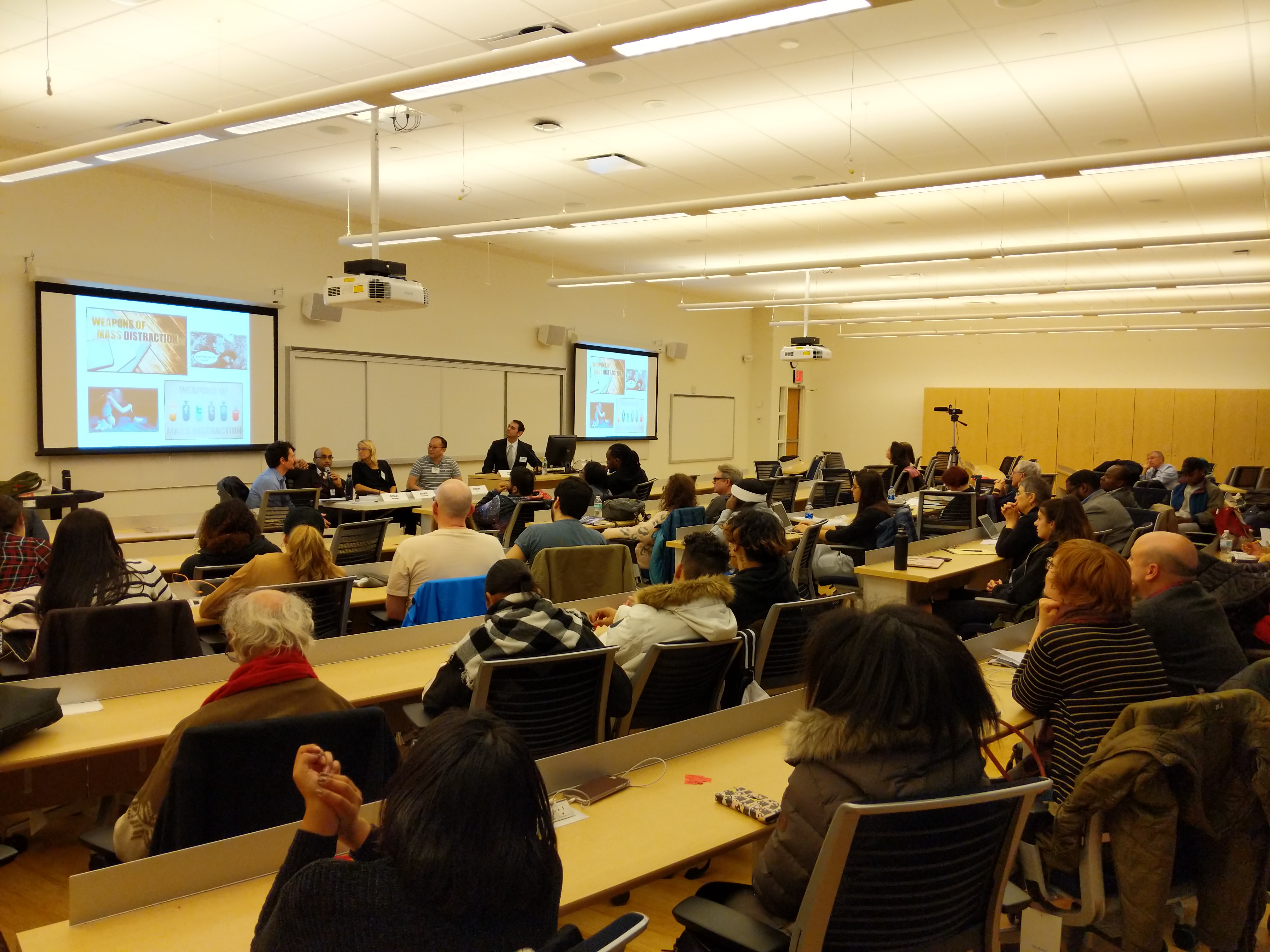
Student Round Table: “Shaping the Future: A Student Roundtable on Octavia Butler’s Parable of the Sower”
Location: Academic Complex A105
Moderator: A. Lavelle Porter
Panelists: Zawad Ahmed
Marvin Blain
Kartikye Ghai
Devinnesha Ryan
4:00pm-4:50pm
Frankenstein Panel: Mary Shelley’s Novel’s Influence on Scientists and Technologists
Location: Academic Complex A105
Moderator: Justin Vazquez-Poritz
Panelists:
Heidi Boisvert, Entertainment Technology Department
Robert MacDougall, Social Sciences Department
Ashwin Satyanarayana, Computer Systems Technology Department
Jeremy Seto, Biological Sciences Department
5:00pm-6:00pm
Closing and Tour of the City Tech Science Fiction Collection
Location: City Tech Library L543
Remarks by Jason W. Ellis
I delivered this presentation at the James Madison University Pulp Studies Symposium on October 7, 2016. The video above shows my presentation’s images, and the script of my talk is included below.
The paper is about introducing new audiences to old ideas for the benefit of two different City Tech audiences: 1) frame the historical publication context of science fiction short stories for students, and 2) illuminate the deep history of technological ideas for faculty fellows in the NEH-funded “Cultural History of Digital Technology” project.
[UPDATE: The symposium was a great success! Thank you to everyone who had questions and comments during our session. I posted photos taken by colleague Caroline Hellman over at the Science Fiction at City Tech website.]
Engagement, Learning and Inspiration in SF: Use Cases for the City Tech Science Fiction Collection
Jason W. Ellis
In the first issue of Amazing Stories dated April 1926, Hugo Gernsback writes:
By ‘scientifiction’ I mean the Jules Verne, H. G. Wells and Edgar Allan Poe type of story—a charming romance intermingled with scientific fact and prophetic vision … Not only do these amazing tales make tremendously interesting reading—they are always instructive. (Gernsback 3)
According to Gernsback, the literary genre that would become known as science fiction combines romance, scientific fact, and prophetic vision. The romance engages the reader in an interesting story. The facts instruct the reader in science and technology. The prophetic vision extrapolates from what is known into the not-yet-known and simultaneously inspires readers to realize that vision. I believe that Gernsback’s vision of SF is fundamental to arguments for SF collections at colleges with a pedagogical and community-serving commission like City Tech. Our college occupies several buildings in downtown Brooklyn and serves the educational needs of over 17,000 students. Historically a trade and vocational school, it has over time and by design developed into a senior college of the City University of New York (CUNY) system. Nevertheless, the students it serves and the fields it attempts to prepare them for are primarily focused on STEM career paths. While not all stakeholders recognize the importance that the humanities have to STEM graduates’ success and overall outlook, the administration’s support of the City Tech Science Fiction Collection signals at least one way in which the humanities—in this case via SF—is seen as supportive to the otherwise STEM-focused educational work of the college. In effect, SF and the collection serves as a source for engagement, learning, and inspiration for students who have much to gain from it as a literary genre that reveals the inextricable linkages between STEM and the humanities. While I cannot within the scope of this presentation explore all of these functions of SF, I will restrict myself to discussing how I have used the collection to support my teaching and pedagogical work at City Tech.
Teaching Science Fiction from a Historical Perspective
For students, my SF syllabus takes a historical approach to the genre. Following Brian Aldiss, I point to Mary Shelley’s Frankenstein as the genre’s beginning, because its plot pivots upon on an extrapolation of science and technology. Following this novel, I have students read a chronological progression of short stories that correspond with the movements in the genre: proto-science fiction and SF’s influences, H.G. Wells and his scientific romances, Jules Verne and his Voyages extraordinaires, Hugo Gernsback’s scientifiction and the pulps, John W. Campbell, Jr. and the Golden Age, the New Wave, Feminist SF, Cyberpunk, and contemporary SF. Looking at my current syllabus, which draws on readings from the Wesleyan Anthology of Science Fiction and a few stories in PDF form that are not in the anthology, over half appear for the first time in magazines held in the City Tech Science Fiction Collection, including: Isaac Asimov’s “Reason,” Astounding Science Fiction, April 1941; Tom Godwin’s “The Cold Equations,” Astounding Science Fiction August 1954; Robert Heinlein’s “All You Zombies—,“ The Magazine of Fantasy and Science Fiction, March 1959; Harlan Ellison’s “Repent, Harlequin! Said the Ticktockman,” Galaxy Magazine, December 1965; Philip K. Dick’s “We Can Remember It For You Wholesale,” The Magazine of Fantasy and Science Fiction April 1966; James Tiptree, Jr’s “The Women Men Don’t See,” The Magazine of Fantasy and Science Fiction December 1973; William Gibson’s “Burning Chrome,” Omni July 1982; and Octavia Butler’s “Speech Sounds,” Isaac Asimov’s Science Fiction Magazine Mid-December 1983. In addition to discussing each story in its historical context and its addressing Gernsback’s tripartite definition (along with other definitions, too), I show students photos of the magazines and their contents. I relate how these magazines were a big deal that introduced readers to engaging stories, new science and technology, and inspirational ideas via the haptic and tactile experience of reading printed magazines. Furthermore, the contents of a given magazine add an anthropological context to the magazines via editorials, letters, fandom, and advertising. Finally, the magazines help situate the readings for students, because they empower me to point at the library and take the readings out of the abstract realm of anthologization.
NEH-sponsored “Cultural History of Digital Technology” Project
While my students’ experience of SF is enriched by the historical materiality of our readings, City Tech’s faculty, who are engaged in pedagogical planning that bridges STEM and the humanities, share some of the same needs as my students. I have learned that my STEM-focused colleagues are experts in their fields, but many do not conceptualize SF on one level as a literary genre that addresses Gernsback’s tripartite definition: romance, scientific facts, and prophetic vision, or on another level as a literary form built on interdisciplinary STEM methodologies (i.e., building assemblages of ideas and constructing extrapolations) and focused on the effects of science and technology on humanity and vice versa (e.g., Asimov’s concept of “social science fiction” or Philip K. Dick’s epistemological and ontological adventures). Professor Anne Leonhardt of Architectural Technology and director of the NEH-funded project titled, “The Cultural History of Digital Technology: Postulating a Humanities Approach to STEM,” asked me to join and contribute my humanities-focused perspective. The project’s goal is to create six interdisciplinary pedagogical modules—on maps, fractals, robotics and sociality, geotagging, topology, and finally, robotics and the workplace. We do this by inviting speakers, holding reading groups, and participating in pedagogical workshops. The student-facing modules will integrate readings, classroom lecture and demonstration, and a hands-on activity. Initially, I helped with finding readings for two modules—fractals and topology, but as I describe below, I have leveraged the City Tech Science Fiction Collection’s magazine holdings and demonstrated that humanities folks can do more than find interesting readings. Also, I will use Gernsback’s definition as a measure of each considered story’s usefulness to the module’s goals.
3D Printing
The first module that I contributed readings to is called “Fractals: Patterning, Fabrication, and the Materiality of Thinking.” Its purpose is to bridge students’ understanding of mathematics to the natural world by using fractal geometry—the notion that Benoit Mandelbrot introduced as the process and principle of order and structure underlying the physical world. We teach students the underlying principles of fractal geometry, help them create a workflow using open-source tools to generate a 3D printable STL, or STereoLithography model, and finally, have them print their model using one of City Tech’s powder or plastic 3D printers.
Initially, I did not consider the City Tech Science Fiction Collection’s holdings, because everything was sitting in 160 boxes stacked floor to ceiling in my office and my former colleague, Alan Lovegreen’s office. Rudy Rucker’s “As Above, So Below” (1989), a story not widely anthologized but available on the author’s website, first came to mind, because I knew that both sides of his professional work touched on this topic. Rucker, a cyberpunk SF writer and mathematician, had written this story after his own attempts at discovering what is now called a “Mandelbulb,” or a three-dimensional plot of the Mandelbrot set, the recognizable image based on a simple iterative function explored in the work of Benoit Mandelbrot. In Rucker’s story, a mathematican hacks together a program that creates a three-dimensional Mandelbrot set that breaks out of his computer screen and takes him on a trippy voyage away from life and into a crabmeat can in his pantry where he can code and enjoy energy drinks for the rest of his life—as long as no one get hungry for canned crab. While it is an interesting story and Rucker’s work on the Mandelbulb is noted in the module, his story is more romantic and possibly prophetic, but less instructive.
Shortly thereafter, Alan and I finished moving and shelving the City Tech SF Collection, and I began searching for a better story in the collection’s magazines—a story that fulfills the Gernsbackian requirements and connects to both of the module’s topics: fractals and 3D printing. One such contender was Robert Heinlein’s “Waldo,” which tended to capture the materiality-emphasis of the module better than Rucker’s much later story. Published in August 1942 in Astounding Science Fiction as by Heinlein’s pseudonym Anson MacDonald, “Waldo” features on the cover with art by Hubert Rogers and story illustration by Paul Orban. The story is where the term for a remote manipulator system is coined—a waldo. However, the story is about a man named Waldo Jones who invents remote manipulators to enable his weakened body to act on the world. With his invention, he sets out to make smaller ones and smaller ones until they were capable of manipulating microscopic neural tissue and investigate the cause of his physical handicap. The idea then is that waldoes could be used to build up matter in the same way they were used to build smaller versions of themselves. Heinlein’s story fulfills Gernsback’s requirements—romance (intrigue and revenge), scientific fact (cybernetics), and prophetic vision (what possibilities might waldoes enable), but it does not fulfill both module topics as strongly.
Eventually, I found the story that is credited as the first SF describing 3D printing in detail: Eric Frank Russell’s “Hobbyist,” in the September 1947 issue of Astounding Science Fiction. Unlike “Waldo,” “Hobbyist” is not as widely anthologized, so having access to it in its original magazine was a bonus. If you are familiar with the contemporary video game, No Man’s Sky, then you have an idea about what “Hobbyist” is generally about. Astronaut Steve Ander and his companion parrot Laura crash land on a distant world and are in need of nickel-thorium alloy for fuel, which will hopefully get them a little closer to home. While scavenging around the crash site, Ander notices unsettling patterns of repetition in the world around him and discovers a structure that houses what amounts to a collection of life forms created in a 3D printer of sorts and maintained by an omnipotent being. The narrator describes it thus:
It was done by electroponics, atom fed to atom like brick after brick to build a house. It wasn’t synthesis because that’s only assembly, and this was assembly plus growth in response to unknown laws. In each of these machines, he knew, was some key or code or cipher, some weird master-control of unimaginable complexity, determining the patterns each was building—and the patterns were infinitely variable. (Russell 56)
“Hobbyist” satisfied the Gernsbackian requirements—romance (escape the planet), scientific fact (small scale engineering, iterative and fractal growth), and prophetic vision (might this technology make us gods?) and united both module topics. Capturing “Hobbyist” with my iPhone and Scanner Pro app, I shared the story with the other NEH Fellows— the story’s text and in-story illustrations by Edd Cartier and cover art by Alejandro de Cañedo. During meetings, I related the history of the magazine and how that adds to the importance of the story as a nodal point of STEM ideas expressed through SF long before 3D printing was first innovated in the 1980s, and even before it was described in theoretical terms by Richard Feynman in his well-known December 1959 American Physical Society presentation, “There’s Plenty of Room at the Bottom.”
Topology
The second module that I contributed to is called “Topology: Behind Escher’s Wizardry, A Look at the Development of Modeling and Fabrication.” Unlike the earlier fractal module, the topology module would involve programming to create each student’s 3D printed model. In addition to my role as the humanist on the team, I made this a personal challenge to relearn Wolfram Mathematica, a symbolic computation program that supports a relatively easy-to-use programming language, because I wanted to demonstrate how its could satisfy all aspects of teaching, coding, and modeling. I began by creating a Mathematica workbook that demonstrated topology concepts, such as points, lines, polygons, and dimensionality, and easy-to-follow programming tutorials of topological surfaces. Additionally, I showed how Mathematica exported 3D printable STL files of the topological models students would create.
Initially, we considered Edwin Abbott’s Flatland: A Romance of Many Dimensions (1884), but Professor Satyanand Singh, a colleague in the Mathematics department, suggested that we show a video based on Abbott’s story instead. This created an opportunity.
While performing serious play with Mathematica, I recalled Robert Heinlein’s “—And He Built a Crooked House” from the February 1941 issue of Astounding Science Fiction. Featuring cover art by Hubert Rogers and story illustrations by Charles Schneeman, the story is about an ambitious architect who designs a house in the shape of an unfolded tesseract, or a four-dimensional cube. Unfolded means to create a geometric net or the interconnected, component elements of the object. For example, a three-dimensional cube unfolds into a net composed of two-dimensional squares arranged in eleven different configurations. On the other hand, a tesseract, which is four-dimensional, unfolds into a net of connected three-dimensional cubes with 168 possible configurations! The architect’s innovative design is such an arrangement of three-dimensional cubes, which in this case, resembles the Cross of St. Peter. Unfortunately, having been built in California, there is an earthquake and the house collapses into itself forming a nondescript house-like cube. The incredulous architect and his nonplussed clients enter the domicile to investigate and become trapped within the structure’s weird, higher-dimensional geometry. It is an improbable story, but it captures the strangeness of higher dimensions and introduces topics for discussion. “—And He Built a Crooked House” fulfills Gernsback’s definition—romance (escape the counter-intuitive house-turned-maze), scientific fact (higher dimensionality), and prophetic vision (let’s use math to build innovative buildings), and it tangentially fulfills the module’s focus on topology.
The NEH project is on going, so there are opportunities to locate other stories and materials in the SF magazines held in the City Tech Science Fiction Collection. In my SF class, I hope to bring my students to the archives for special projects pre-arranged with the librarians. Professor Jill Belli is doing this now, and some of her students’ work will be features in a special session of the upcoming Symposium on Amazing Stories: Inspiration, Learning, and Adventure in Science Fiction on November 29 at City Tech, which I hope that you all will consider presenting or attending. Thank you for listening.
Works Cited
Gernsback, Hugo. “A New Sort of Magazine.” Amazing Stories April 1926: 3.
Heinlein, Robert. “—And He Built a Crooked House. Astounding Science Fiction, February 1941, 68-83.
Russell, Eric Frank. “Hobbyist.” Astounding Science Fiction, September 1947. 33-61