Category: Georgia Tech

  • Science Fiction, LMC3214: Final Paper Topics Were On a Broad Spectrum of SF Media

    I just finished grading my students’ final paper projects. Their task was to use several definitions of SF from a list that I had prepared for them (or others that they found on their own and properly cited) to evaluate whether a work that we had not discussed in class was SF or not. Through this analysis, they would come up with their own definition/litmus test for SF.

    I was very happy to read papers on a variety of SFnal works, including:

    • Joseph Kosinski’s film, TRON: Legacy (which I had reviewed for the SFRA Review before)
    • AMC’s production of The Walking Dead
    • H.P. Lovecraft’s At the Mountains of Madness
    • Orson Scott Card’s Ender’s Game
    • Tommaso Landolfi’s Cancerqueen (Cancroregina)
    • Octavia Butler’s Parable of the Sower
    • Halo: Combat Evolved (and its supplementary material in print)
    • David Brin’s Startide Rising
    • Marc Forster’s film, World War Z
    • Ridley Scott’s film, Blade Runner
    • Aldous Huxley’s Brave New World
    • Richard Schenkman’s film, The Man from Earth
    • X-COM: UFO Defense

    This list reveals that my students were interested in SF across a spectrum of media. There were papers on six literary works, four films, one television series, and two video games (this is further blurred by the video game/print crossover material).

    For those students who talked with me about their papers, I am particularly happy with the way their papers turned out. Having had those conversations, I can see a snapshot along their paper’s developmental process, which gives me better insight into the work that they likely did to push their arguments further than what we had discussed in class. Reflecting on this, I will add conference time to my future SF classes that meet over a full semester, but I will do more to have these smaller conversations with students–perhaps before class or during our daily break time–to get a better sense of their research and developing argument.

  • Science Fiction, LMC3214: All Good Things: Last Day of Class, Haptic Perception, and Lego

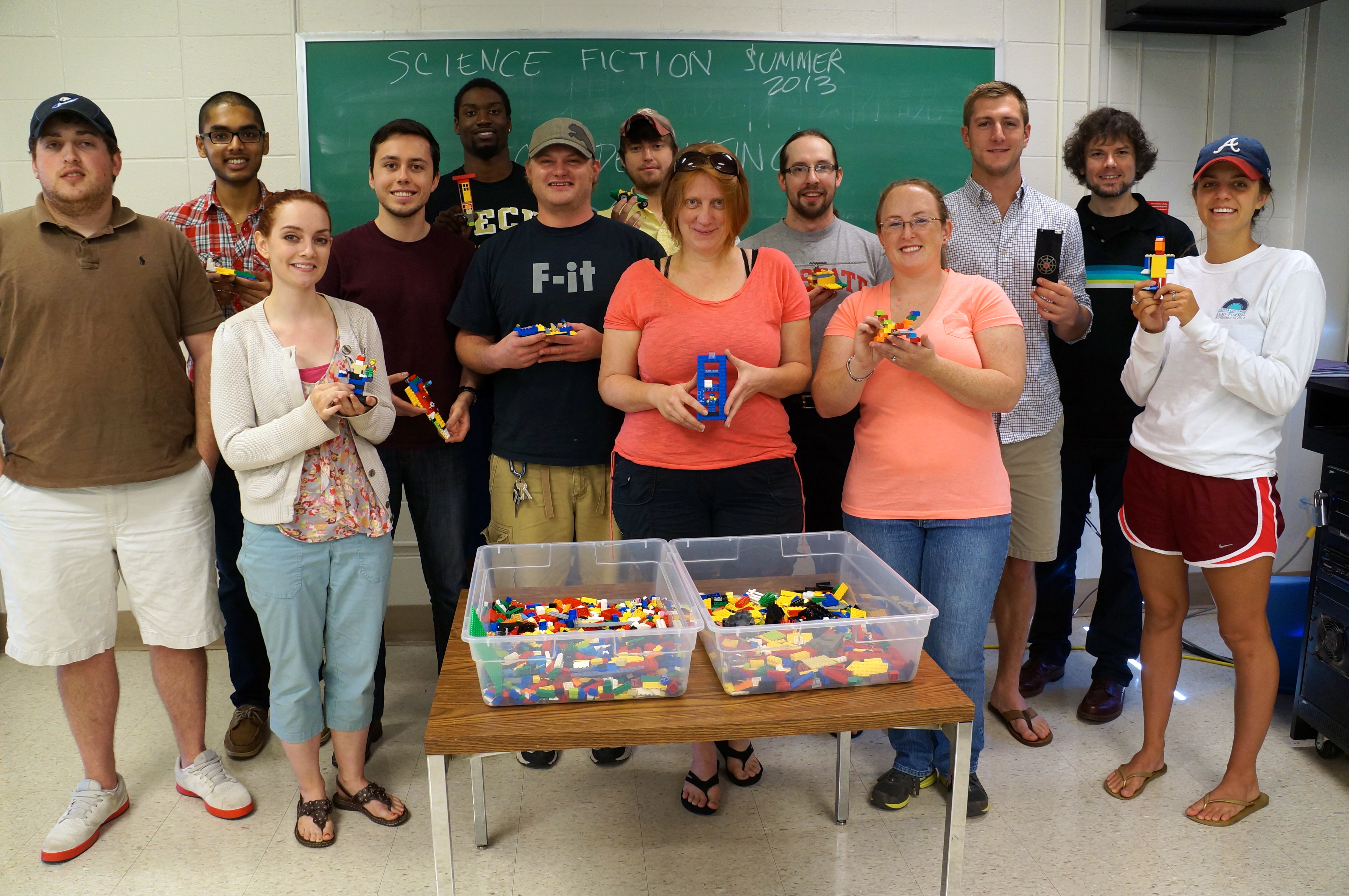
    The excellent group of students (and me in the back right) in my Science Fiction class. Photo by Carol Senf.
    The excellent group of students (and me in the back right) in my Science Fiction class holding up their SF-inspired Lego creations. Photo by Carol Senf.

    Today, unfortunately, was the last day of my Science Fiction class at Georgia Tech.

    At the beginning of class, my students completed their third exam. Unlike the previous exams, it only covered the material discussed in class this week: cyberpunk and Taiwanese SF. And unlike the previous 1 hour long exams, it was 30 minutes long.

    After the exam, we began what I called an SF debriefing with Lego. I framed this end of semester activity by having them think about WOVEN (written, oral, visual, electronic, and nonverbal) modes of communication. Then, I discussed the importance of one aspect of nonverbal communication: haptics. In the haptic mode, we touch, we build, and we visualize objects. It is an insanely important and often overlooked way in which our brains think, learn, and communicate with others. I told them that this activity was meant to allow them to think about and express some image or object from SF–either discussed in the class or not–that they liked or thought significant. To facilitate their work with haptics, I brought two bins full of Legos–some acquired from the local Lego Store and some from my secret stash. I told them to use up to 40 bricks/elements to build their model. After completing it, they would have a chance to hold it up and tell the class about it, and if they choose to do so, they could take it home as a gift and a memento of the class.

    I gave the students about 30 minutes to build, and I encouraged them to get out of their chairs, stand around the bins to dig for bricks, and talk with one another as they worked–talk about what they were building, trade bricks, help one another, etc. It didn’t take much encouragement on my part to get them going–they took off like a fleet of rockets!

    When each student had a chance to tell us about their creation, I would offer other connections and background information on their creation to further integrate it into the broader history of SF.

    After class, Professor Carol Senf, who was observing my class, was kind enough to take a group photo of the class (see above).

    I left my students with the encourage to continue their exploration of SF. I told them that I believe SF to be the most important contemporary literature. It examines the human condition, critiques our social relationships, imagines the effects of science and technology, and energizes our sense of awe and wonder. It can inspire us and it can teach us. Of course, it also can be smashing entertainment.

    When class was over, the conversation continued with those students who had other questions about SF (Was PKD really a drug fiend? Who are important/good contemporary SF writers? etc.) and kind words to say about the class.

    All that is left for my students is to complete their final papers testing a work of SF against definitions of the genre by others and themselves. I have to grade their third exams and their papers before I can submit grades next week. I am looking forward to reading their papers, but I am sad that this amazing class with these talented students is virtually at an end.


  • Science Fiction, LMC3214: Cyberpunk, William Gibson, and Retrocomputing Demo

    After my students took their second exam yesterday, I lectured on cyberpunk to accompany their readings: William Gibson’s “Burning Chrome” and Bruce Sterling’s “Preface” to Mirrorshades. I talked about its historical and cultural moment, proto-cyberpunk examples in the SF genre, and the movement itself. In particular, I contextualized the cyberpunk movement in terms of postmodernism and post-industrial society. We ran out of time while I was talking about Gibson’s contributions to the development of the cyberpunk movement. Besides my enjoyment of talking about cyberpunk, I was happy that my former professor Dr. Carol Senf was in attendance to observe my teaching.

    Today, we watched the William Gibson and Tom Maddox penned episode of The X-Files, “Kill Switch.” Released approximately 16 years after “Burning Chrome” in 1998, it is one of the best examples of cyberpunk in a visual medium–especially in the fact that it takes place in the here-and-now instead of the near future.

    Then, I lectured on The X-Files and cyberpunk film/television before returning to my notes on Gibson, Bruce Sterling, and Pat Cadigan.

    After the lecture, I launched into a retrocomputing demonstration with emulation and my personal collection of resurrected computer gear. I showed my students how to use the http://www.virtualapple.org website to see what cutting edge computing looked like in the early 1980s. Most of my students were born in the early to mid-1990s, so I wanted them to experience first hand how much extrapolation was being done on the part of the cyberpunks and Gibson in particular (of course, telling them about his Hermes 2000 typewriter and its celluloid keys and his recollection of getting inspiration for the cyberspace deck from the Apple IIc–something that his memory likely colored due to the fact that the IIc was released the same year as Neuromancer). Also, I brought in an Apple Powerbook 145 with Gibson’s Voyager Company ebook of the Sprawl trilogy pre-loaded and a Pentium-I PC with old software including Neuromancer (for DOS), Star Wars: Dark Forces (DOS), and the Star Trek Interactive Technical Manual (Windows). I took the U-shaped sheet metal case off my PC so that they could see the insides.

    I had to lug everything across campus in my carry-on sized suitcase with the PC strapped to the handle with nylon straps. I felt like Case in Neuromancer returning from his shopping expedition.

    Tomorrow: Taiwanese SF and review for the third exam.

  • Science Fiction, LMC3214: Revised Schedule for Last Week of Class

    This is the last week of my Science Fiction class. I decided to make some changes to the final week of class to cover the necessary material and to strike out into new territory. Here’s the revised schedule for Monday through Thursday:

    Monday: 9:20-10:20 Exam 2. 10:20-11:20 Lecture on Cyberpunk and short discussion of William Gibson’s “Burning Chrome” and Bruce Sterling’s Preface to Mirrorshades anthology.

    Tuesday: Begin with episode of the X-Files by William Gibson and Tom Maddox, “Kill Switch.” Followed by discussion and retrocomputing demonstration that looks at the computing origins of cyberpunk. Please bring your laptop today for the in-class activity.

    Wednesday: Global Perspectives unit on Taiwanese SF. First part of class: lecture on differences of cultural/historical development and issues of translation. Second part of class: Active learning exercise looking at translations. The two readings for today’s class are on T-Square under Resources.

    Thursday: 9:20-9:50 Exam 3. 9:50-11:20 Exploring your SF imagination with Lego. Think about your favorite trope, image, science, or technology from SF and how you might build it with Lego bricks. We will spend time in class building your creation and then sharing your creations with the class as a whole. If you bring your ideas to class, I will bring the bricks (and a camera to record your work)!

  • The Cute Insistence of Cats as an Impediment to Preparing Future Pedagogy

    Moses collapses on Donald A. Norman's Living with Complexity.
    Moses collapses on Donald A. Norman’s Living with Complexity.

    While preparing for my three fall semester classes and reading Donald A. Norman’s Living With Complexity, Moses decides to collapse on my book and immediately fall asleep. I believe that he is asserting his “Right to be Cute.”