Category: Georgia Tech

  • My Georgia Tech ENGL 1102 Class Description and Reading List for Spring 2012, “The Promise and Peril of the Digital Age Explored Through Science Fiction”

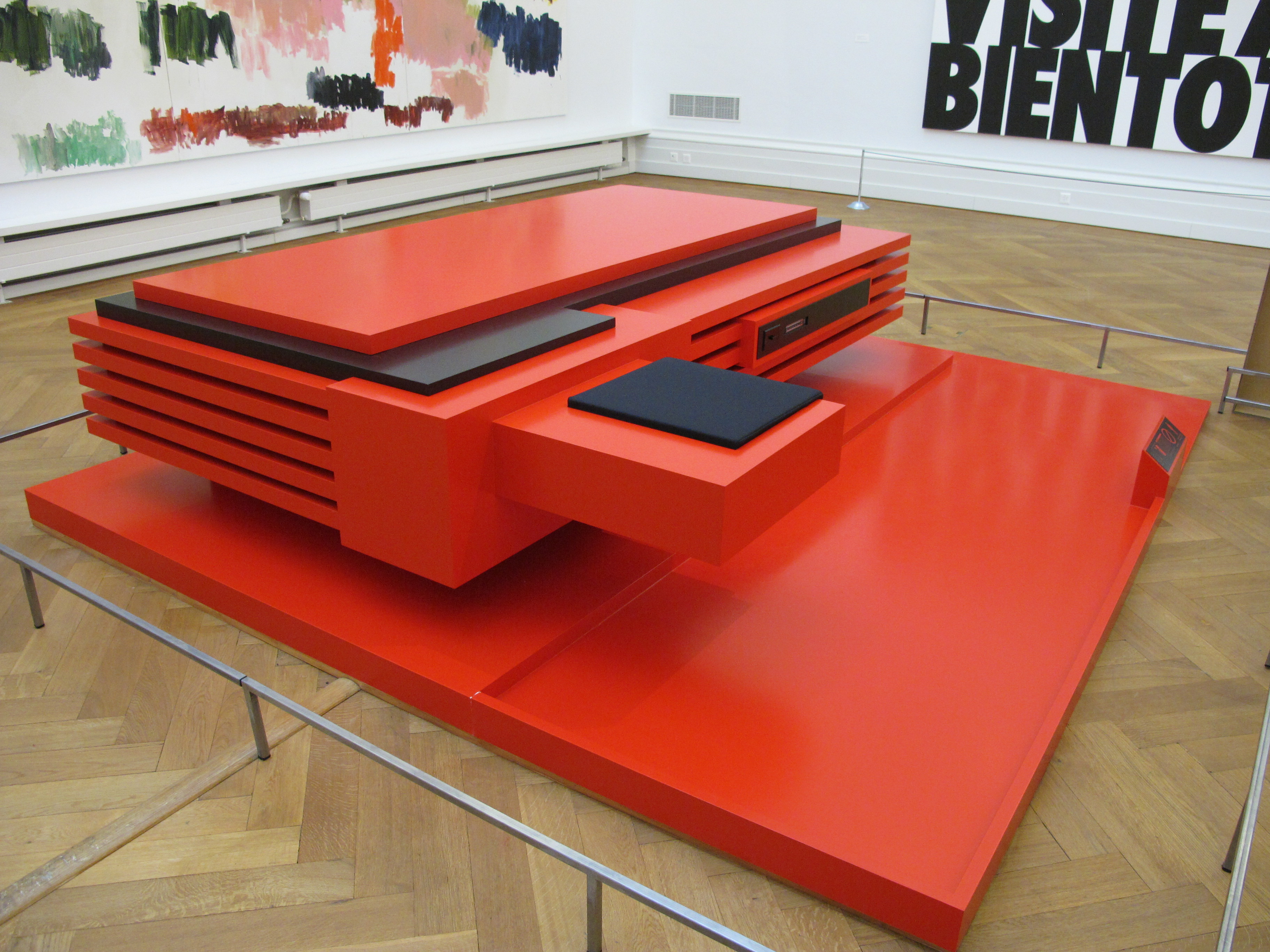
    Martin Widmer’s “Tomb [V’]” (2007).
    [UPDATE: I volunteered to teach three sections of ENGL1101 instead of three sections of ENGL1102 when the school made the request. This gives me an opportunity to immediately revise my ENGL1101 syllabus and try new things with my students!] In Spring 2013, I will be teaching three sections of ENGL 1102 (sections: P1, E, and M). For these sections, I will guide students toward completing and exceeding the desired educational outcomes with a class structured on the them, “The Promise and Peril of the Digital Age Explored Through Science Fiction.”

    Building on the rhetorical strategies and WOVEN modalities introduced in ENGL1101, this class further develops students’ communicative and critical thinking abilities by guiding students through challenging research-based projects. The research focus of this class is on the promise and peril of the contemporary digital age. Science fiction is a uniquely suited genre for considering the digital age, because it is the only literature that is firmly situated at the intersection of science, technology, and culture. Furthermore, science fiction is a literature about the present in which it is written rather than its imagined future. With this in mind, recent science fictions comment on our present and our near future in simultaneously promising and troubling ways. Drawing on science fiction across multiple media (including novels, films, and video games) and using newly acquired tools of critical theory from cultural studies and the study of science and technology, students will develop a number of research-based projects individually and collaboratively that explore how science fiction informs and critiques the on-going digital age. All of these projects will culminate in or include a digital component (e.g., blog posts, Twitter essays, Storify curations, online videos, and Omeka archives). Also, students will learn how to use digital humanities technologies to inform their thinking and research.

    Reading List:

    Oryx and Crake, Margaret Atwood, Anchor, 2004, 978-0385721677

    Ready Player One, Ernest Cline, Broadway, 2012, 978-0307887443

    Neuromancer, William Gibson, Ace, 2000, 978-0441007462

    River of Gods, Ian McDonald, Pyr, 2007, 978-1591025955

    Rainbows End, Vernor Vinge, Tor, 2007, 978-0812536362

    Online reading:

    Little Brother, Cory Doctorow [available here]

    Game List:

    CYPHER: Cyberpunk Text Adventure [available here]

    I am still developing the class syllabus and assignments. When these are completed, I will post copies in a subsequent post.

  • My ENGL 1101 Syllabus for “Writing the Brain: Composition and Neuroscience”

    My English composition students at Georgia Tech are now well into their second major project, so I figured that I should get in gear and post my syllabus for my newly designed, WOVEN (written, oral, visual, electronic, and nonverbal) focused ENGL 1101 syllabus. The title of my class is “Writing the Brain: Composition and Neuroscience.” Unlike the previous iteration of this class at Kent State called “The Brain and Writing,” I overhauled the whole class to only use nonfictional readings and more strongly emphasize multimodality in assignments and discussion. So far, I am very pleased with the results as demonstrated by the great work and commitment of my students. If you would like to read my syllabus, you can download it as a PDF here: ellis-jason-fall2012-1101-syllabus.

  • Paul Newman’s Contact With Science Fiction Criticism

    I just read on the New York Times that Paul Newman passed away.  He was one of my favorite actors, most notably as Butch Cassidy in George Roy Hill’s 1969, Butch Cassidy and the Sundance Kid, and as Reg Dunlop in the best Hockey movie ever, released the year that I was born, Slap Shot (1977).  Of course, Newman’s accomplishments as an actor go far beyond those two memorable roles, and one role in particular stands out in my mind, because it was the one that, in a way, served as my point of entry into Science Fiction discourse.

    At Georgia Tech, I chose the Senior Thesis option to complete my B.S. in Science, Technology, and Culture, instead of the Senior Seminar.  The thesis option was better for me, because I wanted my work to serve as my graduate school writing sample.  Professor, and Chair of the School of Literature, Communication, and Culture, Kenneth Knoespel, Professor Lisa Yaszek, and Professor Doug Davis (at Gordon College) guided me in my research.  The paper that I produced, “Networks of Science, Technology, and Science Fiction During the American Cold War,” went a long way on my initial steps on the SF studies path (that sounds very Tao).  Elements of my thesis made appearances at Georgia Tech’s Monstrous Bodies Symposium, and my first SFRA conference in White Plains, New York.  So, what does that have to do with Paul Newman?  The epigraph that I chose for that paper was delivered by Paul Newman, portraying General Leslie R. Groves in the film about the first two atomic bombs, Fat Man and Little Boy.  In the film, he said to J. Robert Oppenheimer (Dwight Schultz), “Sometimes, just standing here, I keep wondering–Are we working on them, or are they working on us?  Give them dignity doctor, then we can start talking about who can do what and what they mean.”  What better way to begin a paper on the interaction between technology and culture during the Cold War?  Those lines represent the central question to which my thesis was responding.  

    I’m not familiar with Paul Newman acting in any SF films, but he certainly had many connections to SF through his fellow actors, as evidenced above by working with Dwight Schultz of Star Trek:  The Next Generation fame.  However, the Guardian says that he began working in television on Tales of Tomorrow in 1952.  It would have been interesting to see Newman in a Science Fiction film, and who knows, I might even draft him in a story that’s yet to be written.

  • Blake’s 7 Revisited

    I just began watching Blake’s 7 [Wikipedia article here] again during my (limited) free time. I’m up to episode ten of season one, “Breakdown.” It’s a great episode that features Julian “General Veers” Glover playing Kayn, a Federation stooge neurosurgeon that goes nanners at the end.

    Blake’s 7 is a terrific example of how good television SF can be. I’m not suggesting that it’s the best there ever was, but the first and last seasons–particularly the series finale–are stronger than most SF produced for television in that era.

    The series continues to live on through fan-produced and BBC-produced audio dramas that star some of the original actors including Paul Darrow as Avon (by far the best television SF character ever).

    This bit of nostalgia reminded me of the final paper that I wrote for LCC 3214 – Science Fiction at Georgia Tech back in 2002. It has only the faintest glimmer of potential, but it’s where a lot of this graduate school nonsense all began. Thankfully, Professor Lisa Yaszek doesn’t hold this essay against me heh. I’ve included it below for your enjoyment. Please laugh with me on this one.

    Jason W. Ellis

    LCC3214 Science Fiction

    Final Paper Assignment

    Blakes 7, the BBC science fiction television show that ran from 1977-1981, has many characters who are either computers/robots or cyborgs. These characters are either all technology or their person has been radically altered by technology. Their character traits or level of technical mediation often is reflective of their role as “good” or “bad.” These representations bring into question concepts such as “human” and “identity” in a world where technological mediation is dictated by an oppressive government.

    Roj Blake is the main character of Blakes 7 and he is a cyborg. His life experiences have been mediated with the use of chemicals and psychological treatments designed to alter his memories and divert his way of thinking in a way different from how he would have wanted it to be. When the series opens in the episode, “The Way Back,” the first scene is of a menacing black video camera, topped by a red indicator light, diligently scanning the prosaic passing by of pedestrians along a corridor. The black video camera serves as an always watchful eye over the citizens of the Earth Federation. Among the pedestrians is Blake. He is meeting with a young woman, Ravella, who is going to take Blake to meet with a man who has news of Blake’s family–at least as far as Blake knows. As they are walking Ravella asks Blake, “And eating and drinking — you’ve managed to do without?” Blake answers in an irritated voice, “Well, since you were so insistent I’ve done without food or drink for thirty-six hours.” Ravella asks him if he feels any different. Blake says that he does not. She then says, “All our food and drink is treated with suppressants. Going without for a day and a half, they should be wearing off.” Blake says laughing, “Not that again.” Blake doesn’t know that he has been modified by the Federation after he gained prominence as a renegade leader against the Federation. Instead of making a martyr out of Blake, the Federation turned him into a pawn for their uses. They had him admit his guilt and then denounce the work he had once done against the Federation. Later Blake finds his way back to who he really is, but as is shown in later episodes the Federation programming is still a part of him. This long term programming does not cause him to be “bad,” but it will allow control over his thought processes to an extent that the Federation can bring Blake to them as part of a ruse.

    An extension to Federation reprogramming of people to serve a purpose is the use of Mutoids. In the second season episode “Duel,” Space Commander Travis has set a trap for Blake. Travis’ helmsman is a female Mutoid. Prior to the space battle between Travis’ ships and Blake’s Liberator, the Mutoid takes a small vial of liquid and places it in a recess on her chest. During their discussion the Mutoid refers to Travis as “an unmodified” and Travis acknowledges her “need for blood serum.” The Mutoid also notes, “Opponents of mutoid modification call us vampires.” The reason for this reference is made later in the episode when the Mutoid is in need of serum and she tries to supplant her needs by draining the blood out of bat like creatures. Then the Mutoid captures Jenna of Blake’s crew and the Mutoid extends a long hypodermic needle from her arm gauntlet, but Travis stops the Mutoid before she is allowed to use it. On the night before Jenna’s capture Travis and the Mutoid are waiting up in a tree for daylight. Travis asks the Mutoid, “Tell me something, do you remember who you were?” Travis is referring to the Mutoid’s life before she was “modified.” Travis is clearly attracted to the Mutoid and he tries to interest her with information about her past, “Your name was Keyeira…You were very beautiful, very much admired.” Unfortunately for Travis the Mutoid had no interest in her past life. Her transformation from Keyeira to the Mutoid was complete and unencumbered. The chemical and technological alterations to her body made her a cyborg. Her mental programming however made her much more like a robot in that she was self aware, but uninterested beyond what her duty was. The role of the Mutoid is a tool. She is to follow orders and be a contributing officer of the Earth Federation.

    During the second season the viewer is introduced to a clone of Blake in the episode, “Weapon.” Clonemaster Fen makes two clones of Blake based on the Federation’s “DNA identity profile” of Blake which the Clonemasters were able to deduce “a full genetic pattern” which they used to build the multiple Blakes. Clonemaster Fen says of these new Blakes, “We may copy life. We may not create new forms. This man is a copy of Blake, a physical copy only, because he was not grown from a cell taken from Blake. And since he has not Blake’s experiences, he cannot be Blake. We have given him some background knowledge, the beginnings of identity, and the basis of understanding.” This clone of Blake is a being grown in a laboratory and has its memory imprinted by technological means. It is a cyborg in that it was not born of woman and that its knowledge and mind were developed inside a computer and implanted with technological equipment. This clone soon meets up with another cyborg, Rashel.

    Rashel is a labor-grade slave who Coser, the inventor of IMIPAK, brings with him on his escape from the Federation. At the beginning of the episode, “Weapon,” Coser and Rashel are watching their space craft explode. Rashel keeps answering Coser as “yes, sir.” Coser responds loudly to her, “And don’t call me, sir. You’re not a slave anymore. You’re with me now. I set you free.” Not much is said of how a labor-grade slave comes to be, but looking at how the Federation has a special corp devoted to reprogramming of persons to fitted roles in society, I venture that Rashel was likewise programmed. This could have taken the form of being raised with psychological conditioning and administered drugs as in Huxley’s Brave New World, or she was like the Mutoid in “Duel,” with a unique past which was taken from her when she was reprogrammed by the Federation. Coser who says he has freed Rashel has his own problems adjusting to Rashel’s new station as a free person. He constantly bosses her around and physically acts out in rage about her sometimes not understanding a situation or something that he has said. After Rashel has been assaulted by a monster inhabiting the planet they are on, she says, “Perhaps that was the only one.” Coser angrily says, “Perhaps, perhaps! Just get on with it, will you?!” Rashel yells back to Coser, “Stop treating me like a bond slave! [Coser picks up the projector] You set me free.” In a way it seems that Rashel was programmed to fill a certain role in society and those around her who know her station respond in kind. Coser has his own programming to overcome, but he is soon killed by the weapon he created so he doesn’t have the chance to deprogram the remains of Federation control over him.

    Rashel and the clone Blake team up to make the Federation leave the abandoned planet where the action takes place in “Weapon.” Using IMIPAK they “tag” Servalan and Travis so that if anyone activated the trigger on IMIPAK Servalan, Travis and anyone else within a million miles range who has been tagged would be killed. The Clonemasters who made the Blake clone follow “the Rule of Life.” The clone Blake slips into this mode of thinking in his conversation with Coser when they first meet. Blake laces his fingers together and says, “All life is linked.” Servalan and Travis after obtaining IMIPAK wish to use it to demand absolute control over all. If someone is tagged with the IMIPAK projector then they could be killed at any point of their life with the IMIPAK trigger. When Coser was talking to the clone Blake about the potential of IMIPAK he said, “Selected victims, groups, whole populations. You can be like God.” The clone Blake understands the potential of this weapon and it violates the primary foundation of the Clonemaster’s programming. When the life of Rashel is threatened by Travis, the clone Blake throws his arms around her and says, “No! All life must have reverence.” The clone of Blake and the freed labor-grade slave, Rashel are more positive roles of cyborgs compared to Mutoids and the negative reprogramming done by the Federation. The Clonemasters value life and instilled that in the clone of Blake. Rashel was given the opportunity of freedom despite the one who freed her not quite coming to terms with that. Together they start out as Rashel says at the end of “Weapon,” “Then we could start to explore our planet.”

    The Mutoid is the most cyborg of the characters in that her memory is erased and her body has been modified to handle much different situations than an unmodified human. The trade off is that her body is dependent on a blood serum. In being the most modified of the characters she is representative of the Federation and evil. The less technically mediated characters are those of Blake, Blake’s clone, and the freed labor-grade slave, Rashel. These characters break out of their assigned and programmed roles that the Federation has prepared for them. In doing so they become identified as “good” and they work against the Federation which is “bad.” Blake’s clone and Rashel work together to claim a planet for themselves by using a Federation weapon against that oppressive government. Blake reclaims his memories and identity after being forced to do so when the renegade organization he once led asked him back after he had been reprogrammed by the Federation to denounce them.

    After Blake, Jenna, and Avon take control of the alien space ship that Blake calls the “Liberator,” they are introduced to the ship’s computer, Zen. In the third episode, “Cygnus Alpha,” Zen introduces himself and the crew begin to see how he operates and what his and the ship’s capabilities and limitations are. Zen can control the ship on voice command. It can also monitor ship’s internal (how badly have we been damaged?) and external sensors (are there ships following us?). Zen’s integration with the ship is not completely revealed. One way of looking at Zen is that of a robot who follows certain rules and obeys orders. The difference is that the robot is built into the ship and is referred to as a “computer.” Zen is not merely a device to figure things out and process information. Zen is able to perform assigned tasks and monitor other maintenance systems onboard ship such as the automatic repair function. There is a negative side to Zen’s abilities in that it can be “taken over” and controlled by remote. Another computer/robot called Orac was able to do this, and the alien builders of the “Liberator” were able to take control of Zen and fly the “Liberator” back to its home station.

    Blake’s crew also encounters another computer called Orac who becomes one of the crew. This computer is able to view all Federation communications traffic as well as it has access to all computer stored information owned by the Federation. It is able to do this because it was built by the creator of the computer chips of most of the Federation’s computer systems. In his chip design there is a special part that Orac has access to–a kind of backdoor. Orac’s processing ability and it’s almost infinite access to information reveals that it is a very powerful computer. Again, Orac is also much like a disembodied robot in that it is able to perform assign tasks and it operates on a set of built-in rules. Orac is able to control other computer systems including Zen in the “Liberator.” Orac is subject to subversion on some of the carrier waves it uses for communication with other computer systems because it extends into dimensions outside of our own. An intelligence in another dimension once tried to use this carrier wave to enter our universe/dimension through Orac.

    Zen and Orac serve positive roles in that they serve Blake and his crew. But they are subject to the same kind of problems that affect any centralized computer system. If the central computer is compromised then the whole system is compromised.

    The prison ship serves as an analogy for the Federation in general. The ship relies on the central computer. Blake is trying to convince Avon to assist with the takeover of the ship. Blake knows that Avon’s skills are invaluable to his plan. Blake quizzes Avon on his abilities to operate the prisoner ship’s computer in the second episode, “Space Fall.” Avon responds, “ I could open every door, blind all the scanners, knock out the security overrides, and control the computer. Control the computer and you control the ship.” The Federation is also integrated to a great deal with it’s computer systems. In later episodes which culminate to the second season’s finale, “Star One.” Star One is the hidden base of the Federation’s central computer system. This computer system organizes and modulates all systems of production, economies, and weather systems on all the Federation’s worlds. It’s location is hidden even from upper command of the Federation because knowledge of its existence and its control would be the ultimate power in the Federation.

    Centralized computer systems are the norm in Blakes 7. Those that serve good are often more humanized than those that serve the forces of oppression and the Federation. Orac and Zen have names whereas the computers of the Federation are merely “computers.” Orac and Zen talk and have a higher level of interaction with the characters than do the computers of the Federation. Federation computers often involve Federation personnel reading off displays and dials what is going on. Orac and Zen have human elements of thought and action. The Federation computers require a human mediator to supply information and retrieve information.

    Computers and cyborgs in Blakes 7 both offer insight into the ideas of human and machine integration and interaction. Computers fill the role of the robot and information processing systems. Computers which are on the side of “good” are often more human than those on the side of “bad.” Cyborgs are presented as varying degrees of humanity reprogrammed and modified to serve a role dictated by the oppressive Federation. Some cyborgs are able to break out of this programming and in turn innovate their own programming. Others must maintain their role because of chemical necessity as is the case of the Mutoids. Those cyborgs who are less chemically mediated tend to be the more positive roles such as Blake, the clone of Blake and the labor-grade slave, Rashel.

  • Ian McDonald’s Brasyl, Science Fiction, and Music

    I don’t know why, but my segment for the third Georgia Tech Sci-Fi Lab Radio Show wasn’t aired.  I listened to the show, and it was well done and had some good interviews.  Kinda sucks that I didn’t make it into the mix, but what can you do?  What I can do is post it here in text (below) and mp4 audio (here) for your reading/listening pleasure.  Enjoy!

    Good evening.  This is Jason Ellis bringing you another Science Fiction review.  I’m a PhD candidate at Kent State University, an alumnus of Georgia Tech, and a former SF Lab fellow.  Tonight, I’m reading a review of Ian McDonald’s Brasyl, spelled B-R-A-S-Y-L, which was originally published in SFRA Review number 281.  Also, I will talk about Brasyl’s connection to music, as well as the relationship between SF texts and music in general.  Let’s begin.

    Ian McDonald hacks reality in his latest novel, Brasyl.  It’s a postcolonial cyberpunk SF story that goes far beyond The Matrix.  Instead of humanity being plugged into a network run by a powerful machine intelligence, humanity and what we believe to be reality are merely bits flipping in the grand simulation memory of the largest of all possible computers:  the multiverse, parallel universes amounting to the sum of all possibilities.  The author combines Nick Bostrom’s philosophy of living within a computer simulation and Stephen Wolfram’s mathematical cellular automata with the latest developments in quantum theory to enact this paradigm shifting SF story.

    McDonald begins developing the reader’s estrangement by subtly disconnecting the naming of Brazil from its accepted origins while accurately and poetically constructing a past, present, and future space instantly recognized as Brazil.  It’s interesting that McDonald titled the novel Brasyl, which is the Erse word for “land of the blest,” according to Arthur Percival Newton in his 1970 work, The Great Age of Discovery.  Also, this name is connected to the Irish myth about a hidden island known as “Hy-Brazil.”  This sets the land and its name apart from the more accepted etymology of Brazil, which derives from “brasil,” the Portuguese word for embers originally used to describe red brazil wood.

    The story follows three emblematic protagonists in different times and universes, but all orbiting the physical space known as Brazil.  Football (i.e., soccer, not American football) is juxtaposed with religion, renaissance science, reality TV, and quantum theory to create a colorful rendition of Brazil.  What is that space?  Who are its inhabitants?  What groups desire to control the mythically lost island as well as the quantum nature of reality of which Brazil serves as locus?

    It’s the quantum nature of reality that’s the constant in the equation of Brasyl.  Within the narrative, a struggle exists between the Order, a group of quantum reality aware persons who dogmatically believe that parallel universes should be left alone to run unabated, and another group of freedom minded people who’ve learned how to hack reality, because reality is nothing more than a complex simulation running across all possible universes.  This conflict is played out in 1732 with the Irish Jesuit priest, Father Luis Quinn, 2006 with the reality TV producer Marcelina Hoffman, and 2032 with the bisexual, role assuming businessman, Edson Jesus Oliveira de Freitas.  The battle that Luis, Marcelina, and Edson find themselves in mirrors the history of Brazil and the historic conflicts fueled by religious evangelism and conversion, usurping resources from the land and people, and control of a country carved out of the Amazon similarly to the Congo in Joseph Conrad’s The Heart of Darkness (1902).  The rewards for those who wish to strike out from the simulation means the creation of something new and exploring a life not yet played through several times over.

    Appropriately enough, the most significant hack is the re-creation of the Estádio do Maracanã in Rio de Janeiro.  Therein lies the heart of McDonald’s postcolonial thesis.  Football, originally a European sport, is appropriated by Brazil and is subsequently integrated into Brazilian national identity.  They took a European (i.e., the colonizer) sport and improved upon it by developing arguably the best football players in the world.  Analogously, quantum theory originated in the minds of European and American thinkers (i.e., the power elite of the Northern hemisphere).  Again, quantum theory and its many strange ways are unraveled and utilized to recreate something close to the heart of Brazilian national culture.

    Brasyl continues McDonald’s record as both an SF writer of postcolonial narratives and a first rate author.  He recreates the richness of Brazil in this novel by sampling its language and history.  Also, he provides a useful glossary at the end of the text to assist readers with Brazilian words.  The author proves that estrangement from the Western norm need not take place on other planets or between the stars.  He poetically constructs the story and setting for Brasyl as beautifully and expertly as he does in other works such as the “Chaga Saga” including Evolution’s Shore (1995), Kirinya (1998), and Tendeléo’s Story (2000), which is set in Kenya.  Another recognized work by McDonald in the same vein as Brasyl is River of Gods (2006), which is set in India.  Just as connections may be drawn between River of Gods and Salman Rushdie’s Midnight’s Children (1981), it’s the author’s striking descriptions, metaphor, and pacing in their works that unite the talents of these two authors.  Not only is Brasyl a powerful work of SF, it’s also a fine work of literature.

    McDonald employs good scientific theory and an artful explanation of the quantum nature of reality and quantum computing necessary for the reader to see the underlying processes in the story as more than magical effects.  His making Brazil central to the battle for quantum reality is artfully accomplished via the Amazonian curupairá, a golden frog that secretes a chemical that empowers individuals to see the vastness of quantum reality.  Additionally, his depiction of hopping worlds echoes David Gerrold’s The Man Who Folded Himself (1973).

    The novel’s cyberpunk connections come from the technology employed by particularly characters.  The parallel 2032 world is featured as one vision of a cyberpunk world.  Edson has a pair of I-shades, which are heads-up display computers that connect to a network of overflowing information more vast than our current Internet but recalling the ubiquity of information in John Brunner’s The Shockwave Rider (1975).  His dead girlfriend’s doppelganger, the “other” Fia, comes from a parallel world where computers are integrated into our flesh as animated full body tattoos.  Edson’s Brazil is a world of complete surveillance and RFID chips that give away one’s movements and habits much like Stephen Spielberg’s Minority Report (2002), unless of course you’re as resourceful and enterprising as Edson.  However, McDonald breaks with earlier cyberpunk stories in that the quantum computers Edson steals are tools used for various real-world purposes rather than eye candy.

    Ian McDonald’s Brasyl is a significant work of SF deserving critical and academic attention.  The novel would be easily integrated into undergraduate postcolonial and philosophy reading lists.  Additionally, librarians should stock this title for the independent research that it will undoubtedly garner.  The author is at the top of his craft with Brasyl and I can sense my many other selves in parallel universes equally shouting its praises!

    Now, what does this text and other SF works have to do with music?  In this case, the author includes a playlist in the book’s appendix that includes twenty songs by Brazilian artists, most of which are available on the iTunes music store.  It begins with the percussive “No Tranco” by Siri, progreses through the electric stylings of Mylene’s “Nela Lagoa,” and ends with a late song by Milton Nascimento called, “O Cio da terra.”  This playlist is important to “getting” the novel, because the author drowns the reader in Brazilian past, present, and future.  Music provides a convenient and emotive avenue for the author to plunge the reader into something familiar, but different.  In this regard, music can be read as a cognitively estranging enterprise.

    Kathleen Ann Goonan works a similar magic in her Nanotech series beginning with Queen City Jazz.  Music is integral to the story as well as the way in which the author tells the story.  Goonan writes in her essay, “Science Fiction and All That Jazz,” which you can read on her website at http://www.goonan.com, “So how do music and science fiction mesh?  Art is conscious human design — as in technology, music, or literature — that takes what is available to experience and the senses and transforms it into something useful, beautiful, or both. Fiction’s deep rhythms demand tales of human change. Art is an attempt to defy, at least momentarily, the heat-death of the universe, to pluck random elements from the materials at hand and give them an arrow of time and a satisfying (if often edgy) order. To meld two major musical and literary ideas of the twentieth century, to portray human change in a technological, if musical, milieu, seems to me to be an interesting and almost inevitable enterprise.”  Therefore, the co-evolution and technological mediation taking place in SF and music leads to the co-creation and integration of works involving both.

    Another SF story that fuses text with music is Ursula K. Le Guin’s 1985 work, Always Coming Home.  Le Guin does something different than McDonald and Goonan by creating new works of music specifically for her novel.  She worked with Todd Barton to create songs and poetry of the fictional Kesh people.  The resulting collaboration is included with the first edition as a bundled audiocassette.  This additional dimension to the text contained in the novel elevates Always Coming Home to a higher level of anthropological SF that Le Guin is well known for.

    Music and SF are inextricably linked.  In fact, music is like the force from Star Wars.  Obi-Wan Kenobi describes it as, “an energy field, created by all living things, that surrounds us, penetrates us, and binds the galaxy together.”  Music does this too, and through it, it acts as another layer, another strata of networks connecting readers and authors, works and the world.

    Thanks for listening, and find out more about my take on SF criticism by visiting my blog, dynamicsubspace.net.