On May 4, 2014 at 11AM, Wendy Hagenmaier and I will give a co-presentation on Digital Archives and Vintage Computing @ Georgia Tech at the Vintage Computing Festival 2.0 in Roswell, Georgia. This post includes a support video embedded below, a link to our PowerPoint presentation, and a transcript of our talk.
During my part of the presentation, I will discuss this Google Glass captured demo of the Voyager Expanded Books series ebook of William Gibson’s Sprawl Trilogy on a Powerbook 145:
We have provided a transcript of Jason’s part of the presentation below (and Wendy’s follows):
Digital Archives and Vintage Computing at Georgia Tech
Jason W. Ellis and Wendy Hagenmaier
Jason:
[OPENING SLIDE-COMPUTERS]
Hello and welcome to our presentation on Digital Archives and Vintage Computing at Georgia Tech. I am Jason Ellis, a Marion L. Brittain Postdoctoral Fellow, and this is Wendy Hagenmaier, Digital Collections Archivist at the Georgia Tech Library.
In the first part of our presentation on digital archives and vintage computing at Georgia Tech, I will describe how these fit into my research and teaching before suggesting how the library can fulfill those needs for the communities it serves. Wendy will conclude with a discussion of the trajectory of the Georgia Tech Library as a place of research, learning, and making beyond the traditional image of a library.
[JASON W. ELLIS]
My primary work at Tech is to teach first year composition, tech comm, and occasionally, science fiction.
[HOW I CAME TO FOLD VINTAGE COMPUTING INTO MY WORK]
While I have long considered myself a computer hobbyist and I was an IT professional before going back to school to finish my degrees, I have leveraged my interest in computer technology and the human brain to do innovative research on the interplay between the digital and the biological. This raises issues of accessing digital culture on older media and making meaning from these significant forms of culture. These things are important to my research, but I want to enrich my teaching and help my students develop their digital literacies, too.
[AUTHOR’S AFTERWORD]
What specifically led me down this path professionally was that I needed to find a citation for a text I found online. It was an intriguing article attributed to the cyberpunk SF writer William Gibson on a Russian website (cyberpunk.ru). In it, he talks about the ephermerality of technologies—a very interesting idea in light of the fact that he wrote his novel Neuromancer on a typewriter. The afterword seemed ephemeral, too, because I couldn’t find a trace of this afterword in any printed book. A friend of my tweeted Gibson (@GreatDismal) and gave me a lead on a floppy disk-based ebook by the Voyager Company. After a search in Worldcat, the massive library database, I found a copy at the Michigan State University Library: the pictured Voyager Expanded Book series floppy disk of Gibson’s Sprawl Trilogy (Neuromancer, Count Zero, and Mona Lisa Overdrive). Unfortunately, I had no way of reading it.
[POWERBOOK 145]
After calling around northeast Ohio area schools and libraries without any luck finding a Macintosh with a 3.5” floppy disk drive, I turned to eBay where I acquired this Powerbook 145 (one much like the first computer I carried to Georgia Tech as a freshman in 1995). While I could have purchased an external floppy disk drive that connects with USB to access the ebook software, I wanted to experience the ebook as it was meant to be.
[VOYAGER EBOOK SOFTWARE]
With my Powerbook 145 and the Voyager Expanded Books floppy disk, I copied the self expanding archive’s contents to the Powerbook’s 80 MB hard drive. I observed that the Voyager ebook software is Hypercard-based. While it is made for the Macintosh Portable, it works fine on the later model Powerbook 145.
You can navigate the complete text of the novels and afterword with the trackball or arrow keys. While it has a global search box, you can also search by clicking on a word to see where else the word appears (much like Apple’s iBooks today). It supports annotations and bookmarking with virtual paperclips—an issue of remediation.
[AUTHOR’S AFTERWORD IN VOYAGER EBOOK]
This was the prize that I was looking for—the original author’s afterword available only in this ebook. In fact, Gibson did not even include it in his recent collection of nonfiction writing—Distrust That Particular Flavor. If you visit my blog at dynamicsubspace.net, you can watch an experimental video that I made with the Powerbook 145, Gibson’s ebook, an iPad Air, and my Google Glass.
[LET ME DO THAT FOR YOU]
Besides my research with and on vintage computing, I believe that these technologies should be an important part of teaching. Our students and young people need to have an idea about how the technology we enjoy today came to be the way that it is and to know that the past is full of ideas that might be repurposed, retried, or rediscovered as we continue developing ever new digital technologies.
For example, when I was researching Philip K. Dick in the Eaton Science Fiction Collection at the University of California at Riverside—the largest SF collection in the US if not the world—I had to stop a young, special collections librarian-in-training from jamming a one-of-a-kind cassette tape interview into a VHS machine on the AV cart. I directed her attention to the record/cassette combo on the bottom rack and offered, let me show you how to do that. These issues of use, operation, and support are passed on through teaching and first-hand experience.
[HOW I CONNECT RESEARCH AND TEACHING]
In my research, I have built a personal “Retrocomputing Lab” of Macs and PCs that support my research in the development of reading on screens just prior to and after the widespread adoption of the Internet. You can learn more about these on dynamicsubspace.net.
Most recently, I have embarked on a new way of sharing my research with others. In addition to writing essays for publication in journals and online, I am using Google Glass to record my experiences as a raw dataset that I can share on YouTube to support my scholarship and connect with others.
In my teaching, I encourage my freshmen students to learn how our computing technologies in the past and present have an influence on our neurobiology—put another way how we create computers with our brains and how do computing technologies change the way that we think over time. In Tech Comm, I have students research problems on the Tech campus that can be fixed with a technical communication solution. In one case, students resurrected an online printing solution that had died before they were students. Finally, in Science Fiction, I invite students to read Gibson’s afterword on the Powerbook and play the DOS video game interpretation of Neuromancer on an IBM-compatible PC.
[A VISION FOR THE FUTURE OF GEORGIA TECH]
My suspicion is that the need for accessing older media, studying vintage computing hardware and software, and teaching others how to use and preserve these technologies is not limited to literary and cultural studies. Obviously, computing is an interdisciplinary endeavor— specifically, I am thinking what Steve Jobs said about Apple being at the intersection of technology and the liberal arts—I think that this is a long tradition in computing not confined to the fine work at Apple.
I told Wendy, Sherri Brown, Alison Valk, and Elizabeth Rolando about my hopes for the Georgia Tech Library to serve as a synthesis of vintage computing research and teaching. The library’s archival mission can simultaneously maintain access to knowledge while preserving hardware and software as important artifacts of study. The library’s learning mission can support theoretical issues such as archival work and the history of science and technology alongside practical issues of training, using, and making. The library can do this through acquisition and on-going support, providing space for this kind of work, coordinating across institutions and the private sector, outreach, and more. Already, the Georgia Tech Library is a nexus of research and teaching that evolves to meet the research and learning needs of the communities that it serves. Wendy will tell us more about that in the next part of our presentation.
We have provided a transcript of Wendy’s part of the presentation below:
Hi everyone, I’m Wendy Hagenmaier, the Digital Collections Archivist at the Georgia Tech Library. I’m responsible for digital archives (similar to the work Al and Anne have discussed).
Reimagining the Georgia Tech Library
In light of Jason’s insights, I want to talk about some exciting changes happening at the Georgia Tech Library—changes we’ve been referring to as “reimagining the Library.” Though some of these changes are unique to Georgia Tech, many of them reflect how libraries everywhere are evolving to anticipate the needs of future library users, including people like Jason and all of you, the attendees here today.
The GT Library is transforming into a technological research library for the 21st century, but its mission remains the same: to be a creative partner and essential force in the learning community and the Institute’s programs.
At the GT Library lately, we’ve been asking ourselves: How can we support the research and teaching needs of faculty like Jason and inspire the scholarship of our broader community? And how can we invite the community to explore the past and design the future? As an archivist, I’m always interested in what the past can teach us about the future, so let’s take a quick look at the GT Library of long ago…
The Georgia Tech Library of the Past
Welcome to the Library of the 1960s.
Like many research libraries of the era, the GT Library provided services to support traditional, print book and journal-based research. The emphasis was on creating the most massive collection of print material possible, to position the library as a secluded, exclusive repository of knowledge that could only be found within a print collection. Imagine the shushing librarian, no food, no drink, no talking.
This worked well for a while, but radical changes in research and daily life on campus—mobile/ubiquitous/wearable technologies, Massive Open Online degrees, flipped classrooms, project based learning, digital repositories, university history now enacted on YouTube and Twitter—have made it essential that the Library undergo its own transformation. Print book checkouts are declining, but the number of visitors to the Library is exploding and users are accessing our e-resources over a million times a year. So here we are, at the Georgia Tech Library of the Present:
The Georgia Tech Library of the Present
In light of the cultural shifts I mentioned, the Library is presently planning its own shifts, both literally and metaphorically, on several fronts:
Here’s the first literal shift: the GT Library and Emory Libraries are partnering to construct a large climate-controlled facility to house the majority of our collection. This means we’re moving perhaps as much as 90% of our print collection to Emory’s Briarcliff campus. Books will be delivered to users on demand, and traditional browsing of physical library stacks will have to be translated into the digital realm.
Another shift: the Library is conducting user research with students and faculty, including focus groups, interviews, and surveys, to develop a shared vision for the Library’s future.
The walls of our 1960s buildings are now covered with post-it notes from dozens of internal brainstorming sessions, where we’re defining and innovating future services.
And another literal shift: we’re working with an architectural team to completely redesign the interiors of our buildings over the next five years.
Through reimagined spaces and services, the Library is becoming an interdisciplinary platform for scholarship, an integrated network of human and technological resources, and a champion of innovation.
The Georgia Tech Library of the Future
My colleague Sherri Brown and I interviewed Jason a few months ago as part of the Library’s user research, and he brought up the idea that the GT community has unmet retrocomputing needs. Faculty members from all sides of campus are encountering the need to access information stored on outdated media and to teach their students about the history of technology.
This academic interest in retrocomputing parallels the digital archaeology work being conducted in libraries and archives—everywhere from Emory’s Digital Archives to the New York Public Library. Archivists at these institutions are using old hardware and software to access and preserve content created with obsolete technologies (such as Salman Rushdie’s manuscripts saved on floppy disks). To date, however, all of the retrocomputing work in the library world has been conducted by library staff. These digital archaeology labs are not accessible to the libraries’ user communities.
My colleagues Jason, Sherri, Alison Valk, Lizzy Rolando and I are trying to imagine how we might do something different at the GT Library: offer our technologically-savvy patrons a chance to use the retrocomputing equipment typically restricted to library staff.
This might take the form of one or two retrocomputing consoles—or perhaps a larger lab—within the Library, which would be available to users who would be vetted by Library staff.
The idea is to take the digital forensics and archaeology work occurring behind the scenes in archives, plus the rise of hacker and makerspaces in libraries, plus collaborations with campus and community partners (perhaps even you?)…to imagine creating a retrocomputing lab. This space would not only serve as a hands-on historical reference point; it could activate new ideas about future technology and preservation of tools and ideas.
So how could we make this space happen, and how might we collaborate? Collectors, experts, and community organizations like the Atlanta Historical Computing Society could support an idea like this through:
-equipment sourcing
-IT support and expertise, knowledge of the history of computing
-and mentorship
In return, a project like this might someday offer collectors, experts, and community organizations:
-a collaborative meeting and hacking space, for making connections with like-minded people and hacking the past, present and future
-space dedicated to preservation (libraries specialize in preservation environments in a way that most individuals and community groups can’t)
-as well as infrastructure, branding, and support for community organizations seeking institutional allies
In many ways, the retrocomputing space we’re envisioning resembles the high tech computing lab of Georgia Tech’s past, which once seemed so futuristic and advanced, bringing us full circle, so that imagining the future of our Library becomes an act of reimagining our past.
Late last year on October 3, 2013, I had the pleasure of interviewing Paul Lally, the producer, writer, and director of an educational program from 1977 called “Space Station L-4.” Now, Paul is the Executive Producer of Caio Italia with Mary Ann Esposito.
Space Station L-4 was distributed by Children’s Television International and shown on PBS and in classrooms across the USA. It starred Cotter Smith (X-Men 2) and Venida Evans (The Adjustment Bureau). The show teaches junior high students about ecology and environmental topics from an observation point in outer space at L-4. It combines a science fictional frame (astronauts on a future space station positioned at a Lagrange point around the earth) with science fact about the ecology of Earth from an outside observer’s point of view.
In the interview, Paul tells me about the development and production of Space Station L-4, and we venture into other areas such as his experiences working on Mr. Rogers’ Neighborhood and his ideas about engagement, learning, and pedagogy.
I paid CastingWords.com to transcribe our 1 hour 18 minute conversation. I have gone through the transcript and made corrections, but there remains the possibility of my missing something. All errors are mine.
If you have a copy of Space Station L-4 or know where a copy might exist, please let me know. I am seeking copies of the series’ shows (http://www.worldcat.org/title/space-station-l-4/oclc/23049264). The one Worldcat listing of the VHS tapes and teaching materials in a Wichita Public School Library (http://www.worldcat.org/title/space-station-l-4/oclc/22254805). If you have a copy or know where I can obtain a copy, please drop me an email at jason dot ellis at lmc dot gatech dot edu or leave a comment on this post. Paul and I would appreciate it!
Interview with Paul Lally by Jason W. Ellis
Transcribed by CastingWords.com.
Jason Ellis: I was curious, maybe just to start things off, where did the idea for “Space Station L4” come from?
Paul Lally: I worked for Children’s Television International, which was a company that produced in‑school programming for students. I recall that it was probably someone at the company sailed out the idea, offered out as a curriculum, as a course possibility in Earth Sciences.
This was something outside of my preview. I didn’t get near it until they landed the idea and got the funding, or whatever it was, for it. Then I came in on it. That’s kind of how it started.
They looked around for different ways to supply programming back then for in school programs, that’s how they were constantly doing that, and as a supplier to you know Great Plains or wherever these distributors were, and still are I guess in some respect but, yeah so they modified. I don’t know if that’s much of an answer, but somebody did yeah, somebody did.
Jason: Right, it was an American produced show; it was something that came from CTI here in the United States?
Paul: Yeah, Children’s Television International was a Virginia based company that I worked for. I worked for the company for like three years. I was a producer, director, writer there.
I would do different kinds, I did a short story series for them, I did one on newspapers, one on movie making, and storytelling series, a variety of in school programming series. Ray Gladfelder was the guy, he’s not in business anymore, he’s since passed away.
But itself has kind of vanished but, it’s not to be confused with Children’s Television Workshop which is Sesame Street. That’s another thing entirely so. Discrete from each other.
Jason: You mentioned in your email, one of your earlier emails between us that after you did get attached to the project, and you were working on it that you guys built a 360 degree set.
Paul: Yeah.
Jason: Can you tell me more about what that set was like?
Paul: Well, you just imagine a big, in a television studio, film studio, a sound stage. We build a very long cylindrical shaped environment, something like a submarine kind of thing. On entry, once we went in they closed it behind us so that we could shoot 360 degrees, and never be off set. We were enclosed in the set.
I wrote these very long scenes, like seven, eight minute‑long takes where there was no cuts. The premise was that they were working up there. About once a week, they would have a 15 minute broadcast to earth and that was the premise.
They would be talking to you but then they start interrupting. They’d have various oxygen, or some kind of problem so the class would be interrupted. The actors alternated between looking in the camera meaning, “Space Station. People.” Then saying, “Whoops, give me a second.” Then we go back.
I have wrote all these scripts so that I blended, for instance, they may have listed the shows somewhere in the study guide. If it was on earth for instance, or soil. Let’s say the one week’s topic was soil. He just talked to the students.
I had a curriculum or, what’d I have? The topic of what I had to write about then, as a writer I made it more of a conversational thing. That’s how I would do it. The point I’m getting at is I would intersperse the teaching points with another story line that was happening, like, they were waiting for the supply ship. It had been late and they were hungry. Scientist wants a sandwich.
There’s a little other side drama would be happening. Some weeks it was funny, some weeks it was other things to do. All very casual. That was the way to do it.
Jason: It sounds fascinating to me, because I could imagine how engaging that could be to students. You’re learning something but then you have that drama or that comedy take place in parallel to it.
Paul: Yeah, that’s what we do just to break it up. Also they came about, love if they still had the shows to certainly explain it better than me. It’s been 30 years, a thousand years since I’ve done it.
I pitched right into it and these actors memorized, we shot steady cam which nowadays is pretty common use. I don’t know if you’re familiar with the instrument. It’s a camera that’s attached. It’s free floating. It has some shoulder‑mounted thing. It’s very float‑y, and very ethereal kind of shots with steady cam.
But back then I had the second one even invented for God’s sake. I saw it and as a young producer I said to the director, I said, “That’s what I’m going to get.” We rented one so we could float around and get this sense of gliding.
There was no cuts so even though they had gravity there; you had the sense of kind of never cutting between scenes. You just kept going, these actor memorized. Plus, what the trick was; they would walk around with clipboards like they were consulting notes, but a lot of times they were just trying to get their lines for their endless scenes.
[laughter]
Paul: They were very good at. Cotter more than, I forget the actress’s name but it was Cotter Smith, and a man and a woman. They were kind of up there. The point of L4 is a point in space where you’re equal just between the moon and the earth. It’s a kind of equilibrium L4 force.
There is L1, L2, L3, as I recall faintly, these spots and you may know about that. It’s a point in space where it’s balanced, and it’s sort of the metaphor was balance and they were sort of like ecological traffic cops up there monitoring the earth.
They were keeping an eye on the earth and monitoring and reporting back. Hence, that was the root of the earth sciences sort of thing was that while they were doing their thing, looking at hurricanes here, or something over there, doing their work up there, they would also spend 15 minutes a week with, and I can’t honestly remember the age group.
Because I still write pretty sophisticated stuff, but I had two kids at the time so I didn’t have the answer. I just laid it on them, I think it was middle school, but I honestly don’t know. It could have been higher, junior high. I don’t know where you start earth sciences to be honest.
Jason: Yeah, from my memory at least when I went through middle school. That would have been right around sixth, seventh, eighth grade middle school.
Paul: Yea, that’s what I think too, yeah. I tell you what’s popular to me [laughs] . There was a big ITT called Big Blue Marble back then, just ancient. It was hugely popular, and L4 beat them out I think. I got a gold medal for that show.
It was the best whatever, but it won. It beat out Big Blue Marble. It’d be the equivalent of beating the New York Yankees, showing up and hitting a home run. I was very surprised and pleased to say the least.
Jason: Right, no doubt.
Paul: Yeah, it was fun.
Jason: You mentioned Cotter Smith played one of the astronauts on the space station. You sent me the Wikipedia article. I remembered him then from X2. He played the President in that movie. But he has a very distinctive look, and I want to see what he would look like.
Paul: He looked like that young. He’ll look like Cotter. I have known him my whole life. We’ve been friends since he lived in the Washington D.C. area which is where we were based, so we would audition actors in that area.
I think Vanessa or Vanetta, I forget her last name. Anyhow, I can’t remember the female, the actress who was in it. Let’s see what else is shaking here. The set was pretty exciting just to go in and get locked in. You just close the door and you couldn’t. I would stage these scenes where they would talk to the camera for maybe two minutes, and then we had some films too.
We had pre‑produced things. God knows where we got them. On soil, or something, I don’t know.
I used that technique on a newspaper series the next year. I went down to a newspaper down in Virginia, but three actors in there with all the other real people and they did the same thing. They had scenes and talking about how newspapers were, and then they’d have ongoing dramas, scandals. It was the idea of mixing, what do you call it?
Kind of a little bit of reality show. That’s not a fair way to say it, but I did it twice and the premise worked. The science thing, I want to be able to give you substantive answers for what we were actually working on or helpful answers, because I don’t want to be reminiscing here. As much as I don’t mind doing that, I want to be able to help you with what you’re trying to get going with yourself here, what’s happening.
Jason: The project that I’m working on now is, I’m investigating television depictions of space stations. I’m real familiar with the science fictional aspects of it, but less so things that are either non‑fictional or maybe educational, and take a close look at “Deep Space Nine,” from “Star Trek” or “Babylon 5.” One of my friends is the one who tuned me into “L‑4”. He probably is maybe 10 years older than I am. He saw it on TV.
Paul: He remembered it, OK.
Jason: He immediately knew it. He started talking about it. He started having all these memories about it.
Paul: [laughs] That’s great.
Jason: It was from his younger memories so he doesn’t have a sharp recollection of who the actors were, those types of things, but he enjoyed it. I should convey that to you, that I think that was probably his most favorite TV show growing up.
Paul: Well thank you, that makes me feel good. It was very different and innovative. We had a computer voice. The associate producer, Melody Rosen was her name, we did a little mechanical voice where she would read it and she would distort it. They had this ongoing relationship with a computer, back and forth.
It was like a sentient being, to speak, but it was just a voice. They’d say, “Such and such, put up.” She was the one that would activate these little film clips and things, it was just a device. I remember that little part of it, that little component.
The best part was the last 13 shows, and it was the best. We filmed the 13th one, they were getting ready to go back home, they were going to get replaced. Their replacements were coming up, and they were recapping what they did and what a good time it was, and how to take care of the Earth. It was a really ecologically driven show, and mindful of the earth, and that was way back when.
I still remember Cotter Smith said, “All throughout this, we’ve told you how important science can be, now it’s important for you to see how important imagination can be,” and he starts walking toward me. Then Vanessa starts walking next to me, and the camera backs up and keeps backing up.
By then we had taken the back end off the set, so we came out. Then you see the set, and I had people coming in, stage hands, booming, and lights and stuff, you go for your transition in one shot from the Space Station to a TV studio.
It was wonderful. I’m rolling credits over that too. It was the best, I loved it. To this day, I think about it. It blew people’s minds, to see the transition, I remember that part of it.
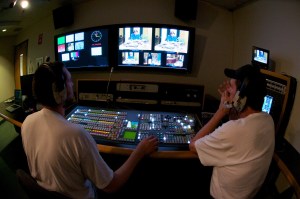
We had shots of the cameraman and the sound recordist, and the computer voice started saying who it was, “Sound recordist, John Fitzpatrick”, and on, and on, and on. It was a little credit package, maybe 40 seconds long.
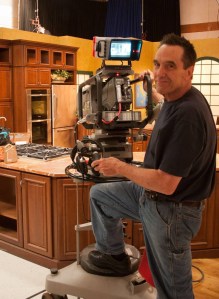
Photo courtesy of Paul Lally.
I’ve done it ever since, I do it in different shows that I produce. A cooking series I do, “Ciao Italia” which I’ve been doing that for 23 years now. Every once in a while we’ll reveal the studio, take away the curtain from the “Wizard of Oz.” It’s enjoyable.
Generally speaking, I remember I worked with teachers, I worked with curriculum consultants, and they would tell me what the theme was. Say it’s about soil, they would give a list of what has to happen as a writer, and then I would concoct the story around it, and then get the teaching points in.
Then we would supplement it with pre‑done films, or pre‑recorded visuals and things. Just to give you a sense of the process.
As I recall, it was very much ecologically driven, of course at the time environment was just early coming in, it was the ’70s. My God it was people waking up to ecology and to the things that dominate our culture now, but it was unknown back then. I was sensitive to it so it was able to infuse the scripts, with that the answer.
Jason: It sounds like your show was really innovative, it was coming right after “Silent Spring,” it would not have been on most people’s minds at that time. It was not nearly as big or as promoted as it is nowadays.
Paul: Exactly, you’re quite right. You could sense the importance of it and sense that it was Earth, and at that time we had had enough distance. The iconic photograph of seeing the Earth from far away, “Big Blue Marble” was the name of the series. It would beat it out, because to see the earth from the moon shots. It was really transcendent for people to see the earth as an object in space.
It was the first time. This was probably back in the late ’60s or something like that. It was just an unawareness of the fragility of the planet. Hence, I was sensitive to that as a writer, and as a producer and director, just to do my best to infuse the actors in the future.
It was a given that they were concerned about the Earth, that’s why they were up there. They were like cops, friendly cops, but they were up there enforcing the ecological balance of the earth, and that sort of thing. It sounds a little more dramatic that it was, it was pretty casual. That’s what I have to say about that.
[laughs]
Jason: Thinking about the way you shot the program. You had this steady cam, everybody’s inside this 360-degree set, the astronauts, are they dressed in some sort of astronaut garb like either a spacesuit or jumpsuit?
Paul: Yeah exactly, like a jumpsuit. A Star Trekkie kind of thing, not Star Trekkie too much, but it was kind of a unisex sort of outfit. I remember that. Considering it was an instructional television series, it was not too fancy, it looked simple.
It was blue with their name on it, something really simple, but not a uniform. It’s a good question; I don’t know how involved we got with that part of it.
Jason: You had the two astronauts, a man and a woman, and you also had the computer voice character who introduced videos, for showing the astronauts and the audience who was watching the show.
Paul: Yes, and back in the old days you had live things and you had cartoons. I’ll try and do one other thing; I can give you a better example if I can find, that place L‑4. They had a list of the programs. I can’t think of another. I keep saying soil, but there must be some other topic. They listed it in that one library that may have had the series still. They had the list of the programs as I recall.
Jason: I didn’t look that carefully actually to see what the programs are.
Paul: Yeah. They have actual programs. It’s Space after this. I’m not find it. It’s Space Station L‑4. Wait a minute. Now it’s a TV company. It’s very strange for PBS Special from ’77. What the hell?
Look at this, this weird thing. I’ll send you a like a little, it’s just a paragraph. A PBS Special from 1977. This is all like half right, and half wrong. It spanned 16 episodes. A fascinating look back at where cutting edge science was in the late ’70’s. What they were expecting and how it’s played out in reality.
This show discusses plan for a fully functional space station, which would sustain life somewhere other than Earth. I have no idea what the hell this is? I don’t even know if it’s my series. Who cares? That’s not important for you. It’s way too specific for what you’re doing, but I just saw it.
This is like trying to discover some relative who lives in Cuba, or something. “Wow! Where are they? What are they doing?”
Jason: Right, exactly.
Paul: I think we lost the trail on them.
Jason: Trying to uncover the archaeology of these visual artifacts. I had conversations with my students about the ephemerality of their digital online communications, and the things that they watch and do online. The same is true for more traditional media as well. These things are easy to disappear, and then you trying to track them down later can be a real challenge.
Paul: Absolutely. A good example was I worked for 10 years. My big career break came when I went with Mr. Roger’s Neighborhood. I worked for 10 years there as a Director and a Writer, and that was after I did this L‑4 stuff.
I see much of Fred’s work is just kind of vaporized. It’s out there, but it’s sort of all faded away. Since I’ve been with Mary Ann Esposito, I produced her cooking show, and she’s had like 23 years.
I decided long ago, saying, “I’m going to archive this stuff.” Literally, her body of work is online free. You can go to our website, ciaoitalia.com. All of her videos are there, like 1,200 videos. As long as the Internet is alive, her body of work will be there. It makes me feel good.
The very thing you’re working in your business and mine is very ephemeral. Like our conversation, it’s just here today and gone tomorrow, and to have some kind of record. It upset me that Fred’s work is down the tubes. It was so essential for young children. You probably grew up with Mr. Roger’s Neighborhood.
Jason: Yeah. I was going to ask you before we entered the conversation today about you; your work on that show, which is unrelated to what my profession. That’s just being a fan, you growing up with that.
Paul: Of course, yeah. It was a huge thrill for me. It was a huge break. I started working with Fred when he had just become like a world figure. They called it his “Carey Grant” phase of his life it was so great. Everybody knew. We went to Moscow, we filmed. It was just great.
It was great to work with him. A very small setup. He did all the puppet’s voices. He was just a one‑man‑band really. We reached a huge effect on children. He’s coming back now. The company is doing an animated series, which it’s a pale imitation.
The guy is a genius. It was wonderful. It was a thrill to work with. He was as regular as you or me. You would have loved being with him. He’s just a great guy, and interested in you.
You’d want to talk to him, and he’d have you blabbing about yourself in about 60 seconds. You’d just be “Blah, blah, blah.” because he was just genuinely interested in the human condition, except he talked too slow.
You’d say, “God, Mr. Roger’s talking. You sound like Mr. Roger’s, but we’re having a normal conversation,” rather than simplistic stuff. It was normal. That’s sort of my spiel I give folks, who knew about Fred. I was there. My kids grew‑up working on the set, painting dots on “Neighborhood of Make Believe,” that kind of stuff.
We had Thanksgiving with Fred every Thanksgiving. He was a vegetarian, and my daughter didn’t like turkey. The two of them would have their own little special thing on Thanksgiving. We’d have massive turkey with Fred, and Gabriel would have like little lobster bisques, or some damn thing. It was just the human touches that make the world go around them.
Jason: Right. One thing that I guess bridges these two works in my mind, you working on Mr. Roger’s Neighborhood and then with Space Station L‑4. It’s a pre‑digital age. Everything is physical. The puppets are real. You can see them. There’s like a texture to them. The way they’re made, and the sets and everything.
Then what you’re saying about Space Station L‑4. You built this amazing set that everything takes place in, You even tell how that’s made at the end of the show.
Paul: Yes. To show the hand inside the puppet as it worked, at the end. I thought it was great for kids to know. In science some of my closest friends are these sort of button‑down, wired‑up, binary kind of people. They’re scientific. They think that way, but they’re creative too.
There’s a bridge between me, a creative artist and an astrophysicist. They are creativity bridges instantly both ways. It was fun for me to have the bully pulpit if you will. This was a small company. I was in my late 20’s, or I don’t know. I could just do whatever the hell I want. I knew I had to do everything. I wrote it, and directed it, and produced it, and I edited it. It was kind of a one‑man‑band thing.
That series was a reflection of my world view if you will. It’s a rare opportunity to do that, and clearly for school students. I reached out to an audience that was very important, an informative audience.
You’re right, not having any kind of CGI though. Nothing, nothing! We embedded shit, but it was just nothing. We shot at 60 mm film, colored negative. We edited it on a Steenbeck, which is a flatbed editor. I don’t think they make them anymore. I think they still do a little bit.
You cut film, you had film bins. You had a work print. They kept the negative. You would get a work print of the negative. You would cut the work print. Then you’d have these negative conformities, scientifically antiseptic world, where you have to cut the negative without getting any dust on it. You just can’t believe it.
You would match your work print. None of this is going to make any sense to you. The amount of labor required in make believe was just astonishing.
My main point, overactive point, is that we engaged people’s imagination, rather than showing them everything. At one time I got something like an asteroid; some kind of thing hits the ship or something. I don’t know what. It was very subtle.
I think, “Oh, I can take care of this.” There’s no alarm going off. They try to stay cool, but they’re still talking about Space Science. It’s all imagining though, because I’m not showing you stuff outside, or anything.
In fact, the first three shows we shot the set looked kind of empty. I thought it looked pretty good, but we had this wide angle lens. It looked sort of naked. I had the set guy build a central column or something, like a four brand object that we could keep swinging around.
I’ll give you a personal note too. It was my first thing I really directed like a big studio deal. I can remember going in the first day of it, and I saw the clad bird sticks and stuff. I thought to myself, “Jesus Christ!” I saw the set and I went inside, and I said, “Oh, my God!”
At a certain point I said, “You know what? I have to begin. I have to start. I have to say, ‘OK, everybody.’” I’m the guy. I didn’t even know I was the guy. It was coming down on my head, and then I learned.
Just the idea that it was me. I had to do it. I was no longer waiting for somebody else to say, “OK, everybody.” I was the guy. I remember that vividly. I have not looked back since. It’s just going forward into my producing career. It was pretty thrilling and nerve racking, and everything else. I didn’t know if I could do it.
Roll sound, the sound is rolling, or the action, action and cut. All that kind of stuff you do. I could do it. It was quite informative for me on that series, because I think it was the first thing I really did. Now I’m doing all reminiscing, that’s not helping you. It was just my experience with it.
Jason: I appreciate hearing those things. From my own experience, it’s completely different. It’s only by you hearing these kinds of stories, do I get any kind of sense of what it must have been like taking on those different kinds of roles on a TV show like this.
Paul: It was. It was a teamwork thing, where you build teams. I had worked for people who were awful to work for. Basically, they were just terrified when they were in over their head, or whatever. I didn’t want to do that.
It told me that’s what I wanted to do. I wanted to be the guy. I wanted to be the guy with the hat. I wanted to be that guy in varying different ways over my whole career.
I’ve done that, because this imaginary world that the media is so powerful. For me it’s not the medium as much, as just the chance to get my imagination going, that is all, in that environment. I have just known nothing but it my whole career.
I’m in my 60’s now, and I’ve done this for 40 years, just all sorts of damn things. L‑4 was the real kicker. That got me going. I still remember that. I’m trying to think of something else. Go ahead.
Jason: When you shot the program, was there ever an external shot of the Space Station, or was that all left up to the audience’s imagination?
Paul: That’s a good point. I think not. I think we didn’t. We probably stole some shot from NASA. Oh, yeah. I remember this. With NASA, back then, there was a storage facility down there. They had high resolution colored prints of satellite shots of the Earth.
The resolution was so high, that no matter how close you zoomed in with a camera, you could still see that the grain was so fine on these prints. They were maybe 12 by 12 inch prints.
You could walk in to this huge storage facility and check out what you want and bring it back. The casualness of it all was astonishing. We begged, borrowed, and steal some clips of stuff. We may have had some visual thing of that. What will happen if, God help me, if you ever see the beginning of it?
The show, it kind of explains it, I don’t know how the opening actually went. I know that the voice was talking and the way the show opened all the time. There may have been some pretend shot or some damn thing. Maybe, before the Space Station, there was Skylab. I may have done some fudging around with that. Skylab that’s the tubular shape feel. This was considerably bigger.
Of course, the explanation about gravity, these people are just walking around, just moved right forward. Forget it. None of this big, shit swirling around and pretending. We’re just going to right into, “How you doing?” No pretending that they had any gravity issues.
My point was that the study cam, it was very innovative. It was almost kind of woozy. This guy was a very good operator, but you never seen that kind of camera movement before really. He was a master at it.
Where you continually move, it’s like a human elbow if you’ve ever seen a camera attached on it. It has that same function. It has that double swing off the harness of the body.
You can’t beat it for continuity, for continuous shooting. I made it with continuous scenes. He would talk for a while, then he’d cross over, do something else, she would interrupt him, he’d get back to the point, come down stage, do this, then go over here, and then do an introduction to a film. Then that would be the end of the scene, like four minutes or something, and then we’d stop and then we’d set up and do the next scene.
In post‑production is when we’d slug in the little film segments explaining or expounding, on whatever scientific point we were trying to get across.
The final, I didn’t even think about this, was really, the premise was and I’m sitting in my classroom. I’m used to watching fairytales here. I’m used to watching TV with the other students.
Once a week, at 12:15 PM, the Space Station broadcasts a show from space. It’s enormous because I’m in school, that’s where I’m going to watch it. It began as though it were a broadcast, “Commencing in five, four, three…” There was that sense of a broadcast happening.
You turn on the TV. You’d have color bars and the countdown. That was the conceit that it was a broadcast. It wasn’t some stand‑alone story. It was literally like live TV. It was on film. Does that make sense to you? It’s coming back to me as a premise. Is that making sense to you?
Jason: Totally. Whenever I found out about these things, I try to bring my research into the classroom. I find that there’s a lot of things that my students who most of them are born in the mid‑1990s, to late 90s now. I think they might have been babies when 9/11 happened.
It’s hard to imagine what they don’t know. Just the same way, I don’t know. There’s so many thing that I haven’t had experience of.
Paul: Exactly. Where’s relevance versus irrelevance? That’s what makes this thing fit the tenor of the times. L‑4 met, felt rather often the existing media expectations of the time. Broadcasts in school, even though you had your major networks, that was it.
We wedged in this little cockamamie thing like it was War of the Worlds, but nice. It seemed real. At every step, the actors, my writing, it was dead serious. Not dead serious, that it wasn’t pretend, because it was.
The nice thing was that they talked to the students like you and I are talking. I’ve always believed in that. At the end of my vocabulary my word choices were sophisticated. I didn’t just talk. I’m making my biggest confession. You know who my chief research was for this?
Jason: No. What’s that?
Paul: Compton’s Encyclopedia, like 1942 or something. I remember finding this thing and I said, “Fuck, volcanoes have been around forever. What the shit? What’s the basic thing?”
I’m not kidding you, I didn’t tell anybody anything. All the teachers, all the sports directors, and all this stuff. Part of me was just being cussed saying, “You know what? I’ll bet you I can pretty much this Earth Science?”
I’m being fair to modern discoveries and stuff, but my roots were in my little house. Compton’s Encyclopedia, that I grew up with as a kid, sitting in the bathroom reading Volume 7. [laughs] I went back and used it.
This is to say the least, pre‑Google, and pre‑everything else. It’s just where’s my research. I’m more skilled, I have more intuitive skills in say other academic or discipline, so I leaped into it. I got the thread of it.
I saved a few scraps of scripts over the years. I may still have one, as an example of how we presented these teaching points. How I did it. I was pretty straight forward. I may have a partial script or two or three pages just as a memento of what is was to do that series. It really was innovative, I thought.
Jason: The thing is that it’s completely even laudable to use a source like that, for something that’s foundational.
Paul: Yeah. Thank you. That’s exactly right.
Jason: When I talk to my students about how they should be approaching their studies, there’s nothing wrong necessarily with beginning with encyclopedias or even Wikipedia. That should be the beginning of your search for new knowledge. You get those foundations and you build on it. Then you go out and seek out more things.
Paul: Yes. Good. I’m with you on that. I did one on newspapers too for Kinnet & Co. You’re constantly unsettled. You never knew when the scene was going to change from being didactic, meaning you will talk about a teaching point to the drama, toward whatever was going on.
That was fun for me to institute. Like if you have the metaphor, if you have a camera frame, nowadays, shaky cam, nobody cares. It’s kind of loose, the unsettled frame. It puts the oneness on you the viewer.
If the camera is being hand‑held and kind of shaky, you have to settle it in your head. Makes you work. The metaphor for me in my script writing would be that I had an unsettled script that you didn’t know what was going to happen.
[laughs]
Paul: You’d pay attention and just when I’d sense, “OK, they’ve had enough of this shit for a while, enough volcanoes.” Then I would advance the other story. It was like a tennis match back and forth.
Jason: That’s really smart on your part to develop it like that. I think where some of these educational programs go straight for attracting their audience and keeping them engaged, they just stick to the talking points. They don’t let people have a break to let their brains catch up. Let them think about what they are buying or what’s going on.
Paul: I’m sure you have that challenge, you’re an educator. The challenge of holding those people, it’s hard work. [laughs]
Jason: In my own classroom, I do different things but I always try to break it up. Every 10 to 15 minutes, I want to be doing something else. Just because I know that dealing with college freshmen, even though they’re 18, 19 years old, they have grown up in a much more, for lack of a better term, a more ADD environment.
I know that in order to keep them engaged, I need to keep their attention shifting. I can always bring it back to what the overall topic of the class is. For me to hear that you were doing this back in 1977, on your own educational program.
Paul: I’m sure they appreciate it too because indirectly or subtly or in a subconscious way, you are honoring their cultural biases. The Italians say [foreign language] , we talk the same language. It’s a sense of; we’re all in this together.
When I would write these scripts, even though I was writing for an adult talking to a student, I always had the feeling, the diction, the dialogue, everything was very much equal. Like you and me. Just, “Here we are, here’s how these volcanoes work, there’s something else, blah, blah, blah.”
Except, you’re kind of casual. Just like of course. Nothing could be more simple or fascinating. The other thing I remember, I did a political science fair. It wasn’t as good, it was a political science fair for high school based on a guy who taught. It was a classroom.
The same deal, it was a steady cam. He had these eight or nine students, and then you at home. It was called “Politics, Politics”, I think. He wasn’t as good as an actor.
All of us have had a dynamic or captivating teacher in our lives. We’ve had a few. I’m sure you had one stick in your mine. That’s what I wanted, that premise of someone who was just so excited about politics, he couldn’t help it. He couldn’t help talking about it.
I wrote the scripts like that. It was awful, because he wasn’t that good. It was all right but it was a real heartbreaker because, Jesus, why can’t I go do this. I couldn’t do it. I had to direct the guy. It broke my heart because really it was like writing it for a teacher.
I did that with the other ones too. The people who talked, the lead characters, whether it was the newspaper series or the science series, they always were completely invested, engaged in the act of communication.
I go on the principle that while you and I am talking, we aren’t really figuring out how we are going to talk. We aren’t figuring out our objects and direct objects. It’s just happening.
I would write my scripts that way, the scene that way. I would write them and I would say it out loud, and I would start to get rid of words and clean it up. It’s pretty amazing how, and I’ve done a lot of study about this, how when you write for spoken words, a full third of what you think you’re putting in, you don’t use.
All you got to do is to say it out loud and you can clean up your scripts that way. Your ear is far better than your mouth, if that makes sense? I would take the L‑4 script and cut out.
The first go through, I would remove maybe a third of the dialogue. You didn’t have to put all that stuff in. I didn’t do it till after I said it. The work is in my brain as a writer.
Jason: I appreciate you telling me that, because when I go into class tomorrow, I’m going to remind my students that I ask them to do that whenever they’re revising their different types of writing assignments. There’s something else that goes on there whenever we’re internally talking to ourselves, like reading back something we wrote.
Paul: Absolutely. Read it out loud and always listen to your ear and not your mouth. That’s my rule. Your ear will always tell you. The instant you do it, don’t even question it. Just scratch it out.
If I just wrote down everything, the last 30 seconds of what I’ve been saying, if you transcribe that, it’s almost unintelligible. It’s bursts of information. It’s fascinating. Once you learn the trick, it’s the easiest thing in the world as a writer.
I’ve taught screenwriting courses so that sort of explains it.
Paul: Yeah. I did a couple at University of New Hampshire. I did at The Institute of Art here in Denver. Yeah. Screenwriting and did television production and I did some teaching.
I have a Masters, and I’m proud to say that it took me 15 years to get it, but I got it, in journalism. I thought that I would teach. That’s why I got on the master’s degree track, but then kept doing other things. The course has helped me to preach what I’ve been practicing for years.
It’s fun. I still write. I produce a cooking series, executive producer. I write fiction. I write novels. I’m still trying to get published. I published one and then it died in editorial. At least I had the thrill of having drinks with my agent in New York and signing the contract, but that was it.
[laughter]
Paul: I wrote it and they kept saying, “Oh do this. Do that.” I’ve had that experience in my life, which is pretty damn exciting. All spinning out of this early desire to communicate. I did children’s television series. On camera stuff I’ve done on YouTube. If you could go to Vimeo, if you type in Gather Round or TeleTales, you’ll see me. I’ll send you a link.
I did this story telling series with an artist. I do all the voices and I do the on camera hosting and it’s really fun. A lot of kids love the hell out of that. They grew up on them. She draws, it’s fabulous. Drawing live and I’m narrating, doing all the voices. I’ll send you a link when I get there. I know I’m just sort of rambling. I want to help you how I can.
Jason: You’ve given me a lot of stuff to go over and think about with the show. Also, just your experiences. One of the things that I think some of my colleagues and some folks maybe lose sight of is you going for graduate degrees.
They don’t necessarily think about what it is you’re accomplishing. I think that the things that you’ve accomplished over these last 40 years, are enough and more for someone who has this desire to communicate. I think that’s a wonderful phrase.
Paul: Thank you. You are very eloquent in telling me that. It’s true, but it’s also nice when someone tells me it’s true versus the guy who I shave every morning in the mirror. That’s part of this job, and I’m sure you’re very unsung. You are back behind the scenes. You have to draw faith in yourself because mostly that’s what sustains you, and it believes in what you are doing.
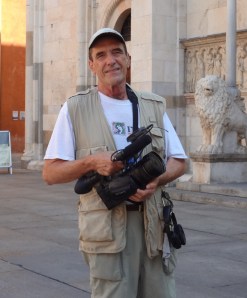
Photo courtesy of Paul Lally.
I’ve always felt that way with these very sun sundry, challenges to communicate with. I’ll give you a good example on our cooking series that we do, Ciao Italia. It’s the longest running cooking show in America, on PBS, like 25 years now.
If you watch cooking shows, well that show ties it. When I took over, it was a regional show before it went to the network. I was researching it and trying to figure out, what is the deal on this show. I’ve realized that something as simple as the close‑up camera, the up camera, meaning camera looking high.
I thought only God looks at food straight down. You know like a cam of brownies, that was my joke, but I said, “What is this straight down shit, how unappealing is that? What is this staring over an autopsy or something? Fuck that.”
[laughter]
Paul: I’m being a wise guy. I have the regular camera that looks at Marian, and then I have a close‑up camera on the floor, the floor camera. This kind of really extreme close‑up, what I call the love camera, these really close, beautiful, succulent shots and then the high camera.
All I did was I stood next to my wife at the time, who has since passed away, but I stood next to her and I watched her cook. I normally don’t cook, but she cooked. I measured my angle of my eyes. If you stood next to me while you were cooking, it is 60 degrees. It’s weird, but it’s true. I make sure that my jib camera never goes higher than 60 degrees looking down.
If you stood next to me, that is how you would look at the food. Isn’t that interesting? It’s true. The food looks kind of appealing. It doesn’t look laid out. It works. I didn’t tell anybody. I am telling you because it’s behind the scenes stuff.
Who cares as long as it works but I thought, “son of a bitch, look at that.” I would get in there and I would drill into components of my craft. To try to figure out how can I gain some sort of mastery over it, because I had never done a cooking show before.
That is a long tirade but next time you look at a cooking show and you see, if you do, and see a straight looking down shot. Just remember, only God looks at everyone that way.
[laughter]
Jason: I will.
Paul: It’s silly, but it’s true.
Jason: To me, it’s fascinating to hear you talk about these things because this is really all about, I believe the technologies and humanities, are always working together.
Paul: Good.
Jason: You are a writer; you’re a director, an editor. At the same time, you’re thinking about optics and about perspective. The relationship between people, and the way they look at things.
Paul: Right. Exactly.
Jason: That requires a different way of thinking. To bring into what is otherwise a more humanities show about cooking. It’s neat to see how the gears are turning in your head, how you are able to accomplish something that gives a new perspective that we all know, and enjoy just from our daily lives, but we take for granted. You put that in the TV show.
Paul: Yes, you’re right and the little things like if you’re trying to learn, if I’m showing you how to flip an omelet and you’re trying to learn how to do it. Even though you’re standing in one place, your eyeballs, you’re mentally zooming in.
You’re zooming in, even though you’re standing, you’re not physically leaning over you’re zooming in. I’ll use that focus or that intensity.
One of our close‑up guys, all of my shooters are sports shooters. They worked the Red Socks games that were based in New Hampshire. They worked in Boston doing the Red Socks and Patriots. They’re very experienced shooters and this guy can go in. He can work close‑ups like you wouldn’t believe. I’ll direct the show, I’ll just say, the rhythm is there.
Paul: They’ll just think this is endless but, when I did “Mr. Rogers’ Neighborhood,” if you watch the show, he always comes in the door and moves left to right. All the time, because you read left to right.
It’s always in the door, feed the fish, characters, people moving always flowing left to right, in this culture. We’re not Japanese. I think Hebrew it’s reverse, but American’s left to right. [laughs] This is so silly.
These guys know the rules when we direct. Marianne’s spooning sauce on lasagna, and I have the 60 degree shot you see the whole lasagna it’s getting the sauce.
Then I’ll go to the love shot, which is way close. You’re watching that red sauce go down and see how it’s coating, but he’ll always move, he’ll be close and he’ll always start panning left to right. It’s always this sort of flow, and as he’s going he’ll zoom in, it’s fun.
It’s all choreographed, but what you get is this seamless exposition of technique. You see Marianne, she’s talking, you see this. You see I walk you into it and we’ve been doing it so long it’s automatic, it’s beautiful.
That gives me pleasure as a director, because they make me look great and I’m telling them that on the headset saying “Oh, this is the best” and I’ll have them saying, “Make love to this, make love to it.”
I use all these carnality things like the money shots and all this. It’s a very blunt world we live in, in television. It is fun and in the studio and as a director, that’s a whole other component where you’re wearing headsets and talking to maybe six people.
You build that little community, that is sort of our little space station to return to the metaphor. We’re in that little world.
Then Mary Anne’s there cooking and other people are there, but the people who are actually doing it, the camera boy people, the engineers, you’ve probably been in a television environment, to know that’s a very specific little coterie of people.
It’s fun for you, as an educator, to spill some of the beans of what I’m doing, and how I’m trying to invest that particular message. I told Mary Anne she can hook rugs, it’s immaterial to me. [laughter] I don’t care. I just want the passion of doing it displayed by somebody on camera and that’s all I need.
Then I know how to make that work especially by giving them that freedom to be who they are looking into a lens. It helps me to verbalize it, because I’m really expounding on my methodology of coming at anything. It’s just how I come at it, from different angles. What’s the word? Suss it out, SUSS. I don’t know where that word comes from?
That’s what I do and I’m doing it today and when you called I was editing. We were in Italy, two weeks ago, filming in this place up in the mountains up in the north. A cheese place, it’s a bit of a long story, in the Piedmont. There I am just cutting a away and I have a home office because technology is so simple.
I’m cutting here and I’m making choices it’s just instant one after another. There’s no debating. I’m just doing it, because I’m at a point in my career where it’s been so long that, there’s just certain things that you just know how to do, you just do it, and you think, “God, couldn’t find somebody to do what I’m doing. These decisions are happening so fast.” [laughs] It’s fun just to be aware of it.
Jason: This is amazing to hear these insights your having. I think one thing that gets lost on a lot of folks now days is not reflecting on their practices and how these practices develop over time. It sounds like you are very mindful and in cognition of those things?
Paul: I am and thank you for noticing, I am. That’s part of my job, part of my profession, I view this. In a way, I always tell people television can be very glamorous, or film making, I say “It really is a craft, don’t kid yourself.” That part of it, that component is really a craft and you could study it forever.
There is, with your producer and you’re handling the whole thing it is something more than a craft, it’s a profession because you do, your professing something, you’re a professor, I can’t put it out any more clearer than that, that you are professing something.
In my case yeah, I’ve been, I’m always mindful of it because you can get caught in little side eddies so quickly, because it’s such a collaborative process whether it’s film making or television series. Once everybody’s pulling together, like a tri‑re and everybody is rowing but somebody has got to beat the drum, and they’ve got to like they guy so in this case they love me.
It’s not like an asshole, I’m not beating the drum. I’m a nice guy. I hop down and I row some, because I’ve done everything so there’s nothing I haven’t done so it’s a constant awareness for me of what I’m doing. I’m surprised a lot of people aren’t mindful that way, they’re doing their thing.
Mary Anne especially, my cook, she loves to cook. I can get about one tenth into a conversation like this and forget it, her eyes glaze over. It’s not in her head.
But, you’re right, it’s fun and it’s been enjoyable for me to talk about this with you, because you’re in there with the brains of tomorrow, for God’s sake. What do you teach, and I don’t want to blab about this forever, but value tests. What courses are you teaching there, or what are you up to?
Jason: Right now, I’m primarily teaching the English One and Two composition classes and Technical Communication. Over the summer the highlight of my academic career so far was to teach a science fiction class.
Paul: Oh great. What fun.
Jason: That’s what my specialty is in 20th century American literature and science fiction.
Paul: I saw your blog or something.
Jason: Right.
Paul: Good for you.
Jason: I try to bring in my love of science fiction, but also the sciences. Originally I got my bachelor’s degree from Georgia Tech where I’m teaching now. I started out as a physics major. It didn’t take me very long to figure out I was better writing about science than doing science. I still have a love of science and an appreciation for it that I bring into my classes.
Paul: Good for you. That’s what Fred said. Fred Rogers loved what he did. He used everything puppetry, musician, on camera, producer. He used everything he had in him. It’s nice to draw upon all these different skills and that there’s a place for it.
Jason: You have to bring a kind of passion to it. I hear that passion in your voice when you’re talking about these things–not only Space Station L‑4, the newer things you’ve been working on since then.
Paul: Always. Yeah. In my case, I’m both the monkey and the organ grinder. I can do both. I can jump up and down. Some people need to see externally how happy they are inside. They can’t articulate it. I become a mirror for their excitement.
Sometimes I’m just excited, it’s also my way of cutting, A, cutting through the crap. B, making up for a lack of knowledge on many things. [laughs] I can come to, your act of omission. If I could get away with it, I get away with it at all times. That was my theory.
If I knew the truth of it, it was enough. If I didn’t have all the supporting documents but intuitively it was right, I would bullshit the rest up. In my case I didn’t need to hide behind something. I would let that excitement get out front. I don’t care what it is, whatever the project would be. Sometimes I have to do it for Marianne, for the cooking show.
I’d have to show her in my enthusiasm and excitement, her life’s work and all that stuff. It’s important, because she’s a little more narrow. She focuses on cooking. She’s not simplistic. She doesn’t see the larger view, the worldview. You’re in mass communications. You just sense that there’s a larger view. Some people get it, some people don’t.
That doesn’t make it less or more, but, for me at least, it heightens my responsibility to be bold and not be shy about it. It’s easy to be shy and say, “Oh. Fuck. You can listen to those voices and it slows you down.” All I can say is “Don’t. Dive into it because that’s where the joy is.” That’s the final thing that I’ve always kept in mind.
Julia Child said something about, “It’s tragic, if you can’t do something that makes you feel absolute bliss.” Many people have to do things that they are not blissful about. It’s their life.
It’s very important for anybody. In my case, I’ve been with Mister Rogers for 10 years, Marianne for 20 years. All my actors and anybody who I’ve dealt with, I wanted to show them as being complete and full in their lives as possible. Being who they are, doing what they love to do. Whether it’s an actor acting like it, or somebody really is.
Its modeling saying, “look, I’m a human being at a sub‑textual level. If I can do it, so the fuck can you. I’m no different.” I’m no different especially in normal people Marianne or Fred, not movie stars, not Tom Cruise. Forget that. I don’t comment on stars. I can’t get there. It’s too complicated for me. Human beings, human people. That’s is the secret mission.
Not Guy Fieri on the food network with purple hair and being crazy. Regular people loving what they’re doing. I really enjoyed presenting them in a mass media as though they’re somebody special. I’m always wondering about celebrity and all those kinds of things. I’m always happy to add a theory to something that may not even need it. That’s my rule.
That’s my current theory on that one. People and their lives and also my exhortation for you to be passionate about what you do and why. If I can do it, so can you. I’m a guy. It’s fun to be able to do that for my kids. And to be a fool. That’s great stuff. That’s what I do.
With your science thing, do you write science, or where do you see yourself going with this?
Jason: Currently, the type of writing I do is academic. I’m writing research papers either uncovering maybe lost artifacts or writing about the cultural relevance of the science fiction story. What does it have to say about something going on in the present world?
One of the things I’m working on now is there’s a three volume set called “Political Future Fictions” that just came out. I was asked to write a review of this. Otherwise, I wouldn’t have been able to buy the books 500 bucks.
It’s a beautiful set of books. The novels inside the collection haven’t been printed in about 100 years for the most part. I’m reading these things they are from the late 1800s, early 1900s. They are so relevant. The circumstances of those stories back then, you could almost mirror with things that have happened unfortunately tragically like Sandy Hook or government shutdown.
All these things are happening again. As times change, many things still remain the same, but we forget that. I want to remind people that these stories are just being retold in different ways, in real life and addiction.
Paul: That’s great to know that. They’ve just fallen out of print, right? Because they weren’t around, whoever resurrected these works, right?
Jason: Right, exactly. They did get some attraction when they were first released. After maybe a decade or two, they just would fall off people’s radar. There wouldn’t be enough copies to go around in libraries, etc., and other issues of how like libraries are getting contracting, getting smaller. The access to these books anyway is getting more difficult.
Paul: Of course, yeah. That’s so great. They released for $500 bucks, no wonder. Is it some kind of vanity publication or something that makes them so expensive?
Jason: They’re like cloth‑covered academic press. With this review that I’m writing, I’m basically arguing these are important books. Libraries that read the journal that I’ll be publishing the review in, I’m going to encourage them, “You need to buy this set of books. It’s something that people would be interested in if you promote it. Let them know that you’re getting this.”
Obviously, most of us can’t afford to get those books. If I can convince the people that can buy them to make them available for other people, and hoping I can at least make a little bit of a push in the right direction.
Paul: Of course, yeah. This is kind of in a fate way, kind of H.G. Wells sort of thing, that sort of sense. OK, I got you on that. He was not alone in being a futurist.
Jason: Right. There were lots of people around that time writing very similar stories. It’s just that for a number of circumstances, Wells and Verne, or people we remember from that time. There were other people talking about the same types of issues.
Paul: Yeah. It was a product, not a genre, but a stable of people thinking. That’s terrific. Teaching at Georgia Tech, that’s good. Good for you, man! Are you on the 10‑year track? I don’t know where you are in your career. Are you liking where you are?
Jason: To be honest, I would give my eye teeth to have a tenure track job right now. It’s very difficult to land those kinds of positions nowadays. What I have is a postdoctoral fellowship.
Basically, I get to teach here for three years. This is my second year that I’m on right now. I’ve got another year. I’m safe for the time being. I’m continuing to look for work and apply for jobs.
My wife, she is finishing her dissertation on Postcolonial Literature. Once she gets finished, then we’ll both be able to work. We’re very mobile about where we move to. Really the sky is the limit at this point. We’re hopeful. We’re going to keep looking. It’s interesting figuring out where we’re going to end up.
Paul: Exactly. Good for you. I think it’s fabulous. It’s exciting. It sounds very encouraging too, because you’re not going to have any problems. You may not know it at the moment, and it’s going to be baffling.
It’s going to unfold for you, because you’re awake. That’s what matters, and I sense that in our conversation with what you’re trying to do. It feels to me like you’re not afraid to be passionate about what you’re doing, and that’s good. That will carry you far. You’ll do a great service. I know you will.
This doesn’t have to be a one‑time only. If you want to come back, you feel free to contact me. I enjoy talking with you, and it just develops. If I can be of help, let me know.
Jason: I appreciate that.
Photo courtesy of Paul Lally.
Paul: I don’t mean that in a casual way. I do mean it specifically. Now that I know kind of where you’re going and what you’re doing, I’ll try to see if I know who I know in this world that you might be interested in talking to.
Although, I can’t at the top of my head think of anything. It’s been so long since I did science related stuff or space stations, and that whole kind of concept. I think I have a sense of what you’re doing. Find out on that. See if they have those shows and all that. That would be terrific.
This is the thirtieth post in a series that I call, “Recovered Writing.” I am going through my personal archive of undergraduate and graduate school writing, recovering those essays I consider interesting but that I am unlikely to revise for traditional publication, and posting those essays as-is on my blog in the hope of engaging others with these ideas that played a formative role in my development as a scholar and teacher. Because this and the other essays in the Recovered Writing series are posted as-is and edited only for web-readability, I hope that readers will accept them for what they are–undergraduate and graduate school essays conveying varying degrees of argumentation, rigor, idea development, and research. Furthermore, I dislike the idea of these essays languishing in a digital tomb, so I offer them here to excite your curiosity and encourage your conversation.
Almost nine years ago, I gave my first academic conference presentation at the Monstrous Bodies Symposium—a continuation of Science Fiction-focused initiatives at Georgia Tech by Professor Lisa Yaszek. In addition to presenting, I organized the academic track of the symposium and recorded the sessions for the School of Literature, Communication, and Culture (now, Literature, Media, and Communication). After my presentation below, I am including a press release for the symposium that describes it in more detail along with our special guests: Paul di Filippo and Rhonda Wilcox.
My presentation, “Monstrous Robots: Dualism in Robots Who Masquerade as Humans,” continues the work that I began in the SF Lab the previous year and continued in my undergraduate thesis later. These ideas figured large throughout the close of my undergraduate degree and my MA in Science Fiction Studies at the University of Liverpool. By the time that I was well into my PhD at Kent State University, I began thinking along parallel lines in terms of human-computer interaction and its effect on human brains and the “minds” of computers. Instead of thinking of doppelgängers and opposition, I reframed my thinking around co-evolution, evolutionary psychology, neuroscience of mind, and human-computer interaction. This presentation is another step in the development of my thinking and self along these lines.
Later, I will post another version of this essay that was revised for my first SFRA Conference in White Plains, NY in 2006.
Jason W. Ellis
Monstrous Bodies Symposium 2005
31 March 2005
Monstrous Robots: Dualism in Robots Who Masquerade As Humans
Robots who masquerade as human in science fiction (SF) are monstrous bodies because they are humanity’s created doppelganger of itself and as a result they reflect the best and the worst of what it means to be human. These technological appropriations of what it means to be human are important because they are a space within SF where issues about the encroaching of science and technology on the borders of the human body after the end of World War II.
In order to explore these issues, I want to begin by defining the terminology that I will be using. I define doppelganger as an unnatural double of a person or of humanity. Human-like robots are the doppelganger of humanity because they mimic what it means to be human. They appear human and they must perform themselves accordingly. This doppelganger is haunting because its existence challenges what it means to be human. If someone acts human and looks human why is there any reason to question the validity of that person’s humanity? The answer is that: the existence of human-like robots makes the very concept of humanity suspect. Robots are the product of their creators. The double mirrors its creator by reflecting an extreme of human behavior. This reflection is called dualism. I define dualism as a doubled status such as good and evil or organic and synthetic. Human-like robots are either very good or very bad and this is determined by the nature of their creators. Therefore, these robots tell us a great deal about the nature of their creators.
I will be examining two examples of human-like robots in SF literature and film. The first is Isaac Asimov’s “humaniform” robot, R. Daneel Olivaw, from the Robot, Empire, and Foundation series of novels. Daneel is best described as an android because he is a robot made in the appearance of a man. His outer skin is not organic in nature. The second human-like robot is James Cameron’s original Terminator from the film of the same name. The Terminator is best called a cyborg because he is a fusion of man and machine (organic skin and hair covering a robotic interior). The former is an example of a good android and the latter is an example of a bad cyborg. These characters are doubles of humanity in their respective stories and they are also mirrors of one another.
Asimov began writing the robot novels that feature R. Daneel Olivaw in the 1950s, during the first phase of the Cold War. The novels take place in a far future where humans have colonized a significant portion of the galaxy. Although the robots are instrumental in the process of colonization, humans remain fiercely divided on whether or not robots should exist at all. Given that Asimov himself was very much in favor of the promising new technologies of his day (e.g., automation in manufacturing and computers), it is not surprising that he picks the robots in his novels to be utopic in nature. His robots are the embodiment of these new technologies. In order to make his robots “perfect people,” he constructed his robots with the Three Laws of Robotics that he first made explicit in his short story, “Runaround:”
(1) A robot may not injure a human being, or, through inaction, allow a human being to come to harm.
(2) A robot must obey the orders given it by human beings except where such orders would conflict with the First Law.
(3) A robot must protect its own existence as long as such protection does not conflict with the First or Second Laws. (I, Robot 44-45)
The Three Laws provided each robot with an ethical system that must be obeyed because it is hardwired into its positronic brain. Therefore, Asmovian robots represent the best of what humans can be, but at the same time they reveal what we are not.
R. Daneel Olivaw is what Asimov termed a “humaniform” robot. Daneel has the appearance of a human from one of the fifty Spacer worlds (i.e., worlds originally populated by Earth people during a period of expansion in our future). Daneel’s partner in the novels The Caves of Steel, The Naked Sun, and The Robots of Dawn is Elijah Baley, a detective from Earth. In The Caves of Steel, Baley describes Daneel as appearing “completely human” (83). He later says, “The Spacers in those pictures had been, generally speaking, like those that were occasionally featured in the bookfilms: tall, red-headed, grave, coldly handsome. Like R. Daneel Olivaw, for instance” (94). Baley even suggests that Daneel is secretly Dr. Sarton, the Spacer found dead in The Caves of Steel. This however is not the case. Daneel was modeled after Dr. Sarton’s appearance. This revelation leads to Daneel revealing what lies beneath. In Dr. Han Fastolfe’s office, “R. Daneel pinched the ball of his right middle finger with the thumb and forefinger of his left hand…just as the fabric of the sleeve had fallen in two when the diagmagnetic field of its seam had been interrupted, so now the arm itself fell in two…There, under a thin layer of fleshlike material, was the dull blue gray of stainless steel rods, cords, and joints” (The Caves of Steel 111). As Baley passes out from the shock, the fact that the “R.,” which stands for “Robot,” in front of Daneel’s name is in fact deserved!
The broadest doubling that involves Daneel is that he is a mirror for humanity. When a character becomes aware of Daneel’s true being, it destabilizes that character’s understanding of the difference between robot and human. Most of Asimov’s robots are very metal and very plastic. They are the epitome of synthetic. Daneel’s construction sets him apart from the apparent synthetic robots because he appeared to be human. Elijah Baley first greets Daneel at Spacetown thinking that he is a Spacer. Later Baley says to his superior, Commissioner Julius Enderby, “You might have warned me that he looked completely human” and he goes on to say “I’d never seen a robot like that and you had. I didn’t even know such things were possible” (The Caves of Steel 83). Elijah and most other humans are not aware that a human form robot was a possibility. Although Elijah comes to terms with Daneel, other characters are driven to destroy humaniform robots. Elijah’s wife is secretly a member of the Medievalists, a group that wants to do away with all robots, including Daneel. Commissioner Enderby, also a Medievalist, murders Dr. Sarton, not because he wants to kill Sarton, but because he mistakes him for Daneel.
Daneel is also the double of his human partner, Elijah Baley. Before Elijah meets Daneel, he is confident in his own abilities as a detective. After he partners with Daneel, however, he begins to call into question his own abilities and talents. Robots are meant to be superior to humans and Elijah extends this to his own profession that is now being intruded on by an android. Baley is narrating at the beginning of The Caves of Steel:
The trouble was, of course, that he was not the plain-clothes man of popular myth. He was not incapable of surprise, imperturbable of appearance, infinite of adaptability, and lightning of mental grasp. He had never supposed he was, but he had never regretted the lack before.
What made him regret it was that, to all appearances, R. Daneel Olivaw was that very myth, embodied.
He had to be. He was a robot (The Caves of Steel 26-27).
This anxiety is one of the motivating factors behind The Robots of Dawn, when Elijah is brought in to investigate the murder of a humaniform robot like Daneel. If Elijah fails, he will loose his job and be declassified. The fear of declassification is dire to Elijah because he had seen his own father declassified when he was only a boy. Therefore, the existence of humaniform robots creates the situation that elicits this fear in Elijah. Eventually Elijah warms up to his robot partner, but along the way Elijah often finds ways to make himself feel superior to robots by making Daneel follow unnecessary orders or by calling other robots by the derogatory label, “boy” (The Robots of Dawn 34).
James Cameron’s Terminator is a cyborg character that is born of a different cultural moment than Asimov’s robots. The Terminator was originally released in 1984 while the Cold War was still in full swing and Ronald Reagan had been reelected President of the United States. Even more significantly, The Terminator was riding the wave of office computing and robotic manufacturing. Whereas Asimov viewed technology in utopic terms, Cameron only sees these technological advances as dystopic. The Terminator would have been a film that the Medievalists of Asimov’s Robot novels would have lauded.
After the opening scene of the future wasteland of 2029, the Terminator arrives naked in Los Angeles of 1984. J. P. Telotte writes that the “film’s title implies that its central concern is the technological threat, embodied in a killer cyborg which, for all of Arnold Schwarzenegger’s excess muscularity, disconcertingly blends in with the human: speaks our language, crudely follows our basic customs, acts in roughly effective ways. In fact, the film emphasizes just how easy it is to ‘pass’ for human in a world that judges that status so superficially” (172). The Terminator has been given instructions to kill Sarah Connor in 1984 in order to prevent the birth of her future child who will lead humanity to victory over the machines. He goes about doing this in a militarily calculated manner. He obtains the weaponry and clothes that his mission requires. The Terminator uses his human appearance and voice to blend into mid-1980s California. Despite his robotic core, he is able to perform himself as human effectively enough to maintain the belief that he is human to those who passively interact with him. Sarah Connor and Kyle Reese, the man sent back in time to save her, are the only persons that know what the Terminator really is.
The Terminator is a chillingly evil double of humanity. Through the first part of the film the audience does not yet know exactly what lies beneath his skin. We are treated to his superior strength, but only later in the film, after he has sustained damage, do we really begin to understand what lies beneath the surface. The hard metal robot body that is under the soft organic skin is the true nature of the Terminator. Without the skin he looks like the killing machines that greet the audience at the beginning of the movie. The shining flying machines and the bone crunching treads of the tank are siblings of the Cyberdyne Systems Model 101 Terminator. The Terminator is the result of the military-industrial complex losing control of Skynet, a computer network of control and command systems that were integrated into the implements of American war making. After Skynet becomes self-aware, it views humanity as its only threat. Skynet then acts in its own best interest by appropriating humanities’ weapons of war in order to eliminate its creator. In contrast to Asimov’s robots, the Terminator seems to be the direct result of machine rather than human construction. In the movie, Terminator 3: Rise of the Machines, smaller versions of the flying Terminator and tank Terminator are revealed to have been developed before Skynet launches its nuclear attack. Therefore, it seems reasonable to assume that the cyborg Terminators were developed by Skynet for the purpose of infiltrating pockets of human habitation to wreak havoc by undermining the belief that what appears human actually is. Again, the cyborg Terminator, like R. Daneel Olivaw, threatens what it means to be human by destabilizing the criteria used to determine human from machine. But Cameron’s view is diametrically opposite Asimov’s in respect to machine agency. Asimov’s robots are dedicated to helping humanity, but Cameron’s Skynet becomes self-aware on its own without any safeguards in place. In Cameron’s look at the future, humanity loses control to the machines and must take that control back.
Another doubling is between the Terminator and Sarah’s protector, Kyle Reese. The most obvious difference is that Reese is much smaller than the Terminator. Additionally, Reese feels pain and he can be injured. The Terminator sustains damage but it unrelentingly follows it programming. Because of the limitations placed on time-travel, neither Reese nor the Terminator can bring any weaponry with them into the past. The Terminator takes his weapons indiscriminately from a gun shop and in turn kills the proprietor. Reese takes his first weapon, a revolver, from a police officer and then he takes his second, a shotgun, from a parked police cruiser. The other weapons that Reese and Sarah use are hand made explosives. Reese uses ingenuity and resourcefulness to match the brute force onslaught of the Terminator. In effect, the Terminator itself is a weapon.
An interesting mirroring in The Terminator is between the machines and Sarah Conner. On one level, the Terminator is the destructor. Its mission is to go into the past and eradicate any instance of a “Sarah Connor” in the Los Angeles area. Sarah, on the other hand, is told that she will give birth to John Connor, the future leader of the human resistance. The Terminator tries to kill the woman who is capable of creation. On a broader level, Skynet is capable of creation through production. Skynet must have a means for building Terminators (cyborgs, airplanes, and tanks) and it must also have some creative capabilities because it created the mechanism for traveling into the past. Thus, Skynet and Sarah follow parallels in that each stand for their species and point toward the future. Skynet wants to maintain its existence and the existence of its machine armies. Sarah wants to live and know that humanity will continue with the help of her yet-to-be-born son, John. The Terminator, as a creation of Skynet, is the means by which Skynet can strike at Sarah because Skynet and Sarah’s futures are mutually exclusive. Within the frame of the movies, machines and human beings are not meant to live together in harmony. Another doubling between Sarah and the Terminator is that they are both covered in some way. Telotte points out, “If the gradual stripping away of the Terminator’s human seeming warns us not to judge an android by its cover, the gradual emergence of Sarah’s character and potential as she responds to this threat reminds us that it is no more reliable to judge the human self by its various cultural trappings” (173). His true robotic interior is revealed throughout the progression of the movie. This is done “by seeing for ourselves how he sees…for the point-of-view shots reveal that the Terminator does not “see” images but merely gathers ‘information’” (Pyle 232). Additionally, the Terminator’s flesh is stripped away through gunfights and explosions that eventually reveal the cold metal of its endoskeleton. Sarah’s cultural coverings are removed as well as she shifts from clumsy waitress that freezes at the sight of the Terminator to technologically adept mother of the future who triumphantly crushes the machine in a hydraulic press.
Finally, Cameron’s Terminator is the doppelganger of Asimov’s R. Daneel Olivaw. The Terminator works toward the domination of machines over humanity whereas Daneel works cooperatively with humans such as his partner and friend, Elijah Baley. The text at the beginning of The Terminator states, “The machines rose from the ashes of the nuclear fire. Their war to exterminate mankind had raged for decades, but the final battle would not be fought in the future. It would be fought here, in our present. Tonight.” The machines (i.e., Skynet and the Terminator) mean to “exterminate mankind.” On the other hand, Patricia Warrick writes, “The…robot detective novels…illustrate Asimov’s faith that man and machine can form a harmonious relationship” (61). Both have their robotic selves hidden under a layer of flesh. They perform themselves as human in order to fit in with the cultural surroundings in which they find themselves (e.g., 1980s Los Angeles or Asimov’s Earth encased in “caves of steel”). The Terminator means to destroy humanity while Daneel wishes to work along side humanity.
Both R. Daneel Olivaw and the Terminator are doppelgangers of humanity, other characters in their respective works, and each other. They maintain a human appearance and performance in order to pass as human to the casual observer. R. Daneel Olivaw is given his “humaniform” appearance in order to work with humans (both Spacer and Earth person alike). The Terminator uses his appearance as a sort of disguise in order to infiltrate humanity in order to kill from within. Daneel represents the very best of human nature through cooperation and a moral imperative. The Terminator represents the very worst of humanity through death dealing and a lack of moral standing. Despite the best intentions of Daneel, who was built the way he was, he is still viewed as a threat by some. The Terminator, who also had no choice in his appearance, is a real threat to humanity because he uses his appearance to get closer to his prey. Therefore, the bodies of R. Daneel Olivaw and the Terminator are examples of monstrous bodies in SF because they assume an appearance and identity that destabilizes what it means to be human and in so doing they each have a unique nature that is dependent on that of their creators.
Works Cited
Asimov, Isaac. The Caves of Steel. New York: Bantam Doubleday Dell, 1954.
—. I, Robot. New York: Gnome Press, 1950.
—. The Naked Sun. New York: Bantam Doubleday Dell, 1957.
—. The Robots of Dawn. New York: Doubleday, 1983.
Pyle, Forest. “Making Cyborgs, Making Humans: Of Terminators and Blade Runners.” Film Theory Goes to the Movies. Ed. Jim Collins, et al. New York: Routledge, 1993. 227-241.
Short, Sue. “The Measure of a Man?: Asimov’s Bicentennial Man, Star Trek’s Data, and Being Human.” Extrapolation 44:2 (Summer 2003): 209-223.
Telotte, J.P. Replications: A Robotic History of the Science Fiction Film. Urbana, IL: University of Illinois Press, 1995.
The Terminator. Dir. James Cameron. Orion Pictures, 1984.
Terminator 3: Rise of the Machines. Dir. Jonathan Mostow. Warner Bros., 2003.
Warrick, Patricia S. The Cybernetic Imagination in Science Fiction. Cambridge, MA: MIT Press, 1980.
——————–
Monstrous Bodies Press Release
What: “Monstrous Bodies in Science, Fiction, and Culture: Celebrating 25 Years of the Fantastic in the Arts at Georgia Tech”
When: March 31-April 1, 2005
Where: Bill Moore Student Success Center and the Skiles Building, Georgia Institute of Technology
From March 31st through April 1st the School of Literature, Communication and Culture (LCC) will host a two-day symposium in which participants explore the meaning of monstrous bodies in science, fiction, and culture. The symposium, which will take place in the Bill Moore Student Success Center at the Georgia Institute of Technology, is free of charge and open to all interested parties.
The symposium celebrates both LCC’s ongoing commitment to the study of the fantastic in the arts and, more specifically, the pivotal role that LCC Professor Emeritus Irving F. “Bud” Foote played in shaping this commitment. Foote taught the first accredited science fiction class at Tech in the early 1970s and over the course of the next two decades brought a number of science fiction writers to Tech including Frederik Pohl, Ursula K. LeGuin, Octavia Butler, and Kim Stanley Robinson. Upon his retirement in 1997 Foote donated 8000 science fiction-related items to the Georgia Tech Library, and the Bud Foote Science Fiction Collection was born. With additional gifts from Georgia Tech alumni and science fiction authors such as David Brin and Kathleen Ann Goonan, the Bud Foote Collection is now one of the twenty largest research collections of its kind.
The Monstrous Bodies symposium will commemorate both Professor Foote’s legacy and LCC’s continued dedication to the study of the fantastic in the arts by featuring student research on and creative writing in science fiction, fantasy, horror, and the gothic. The symposium will also include art and film exhibits as well as presentations by local scholars, science fiction writers, editors, publishers, and artists from AdultSwim, Cartoon Network’s late-night cartoon programming for adult audiences.
Our special guests of honor are two leading figures in fantastic art and scholarship: science fiction author Paul di Filippo and popular culture expert Rhonda Wilcox. In 2004 Di Filippo received the Prix L’Imaginaire for his short story “Sisyphus and the Stranger”; other stories have been nominated for Hugo, Nebula, BSFA, Philip K. Dick, Wired Magazine, and World Fantasy Awards as well. Wilcox is the author of the forthcoming book Why Buffy Matters: The Art of Television and coeditor of Fighting the Forces: What’s at Stake in Buffy the Vampire Slayer and Slayage: The Online International Journal of Buffy Studies.
If you have any other questions or comments, contact conference coordinator Prof. Lisa Yaszek or conference assistant Amelia Shackelford.
This is the twenty-ninth post in a series that I call, “Recovered Writing.” I am going through my personal archive of undergraduate and graduate school writing, recovering those essays I consider interesting but that I am unlikely to revise for traditional publication, and posting those essays as-is on my blog in the hope of engaging others with these ideas that played a formative role in my development as a scholar and teacher. Because this and the other essays in the Recovered Writing series are posted as-is and edited only for web-readability, I hope that readers will accept them for what they are–undergraduate and graduate school essays conveying varying degrees of argumentation, rigor, idea development, and research. Furthermore, I dislike the idea of these essays languishing in a digital tomb, so I offer them here to excite your curiosity and encourage your conversation.
In Spring 2005, I was a member of Professor Carol Senf’s LCC 3304, Science, Technology, and Gender class. Professor Senf–who I now consider a good friend and colleague–organized the class around online discussions, in-class discussions, and a final team-based, research/presentation project. In this post, I am including my introduction for my team’s final project on the transsexuality/transgenderism in film and my eight online discussion postings. In the former, I am including only my introduction, because I do not have permission from my teammates to post the completed project. In the latter, I am including my saved files, some of which appear to be fragments of the online postings–perhaps notes or drafts that I revised online. The discussion postings are based on readings and viewings. They involve analysis and exploration. Aside from the fragmentary nature of some of the postings, the writing and focus seem to improve over time. Everything is posted as-is.
Jason W. Ellis
Professor Carol Senf
LCC 3304
Spring 2005
Introduction to Transsexuality in Film Presentation
Opening slide that I created for our presentation.
Our group is exploring transsexuality as presented in contemporary film. Transsexual theorist Sandy Stone defines a transsexual as “a person who identifies his or her gender identity with that of the ‘opposite’ gender. Sex and gender are quite separate issues, but transsexuals commonly blur the distinction by confusing the performative character of gender with the physical ‘fact’ of sex, referring to their perceptions of their situation as being in the ‘wrong body’” (Stone, sec. 2, par. 2). A transsexual person feels his/her gender to be disconnected from or other than his/her sex. This is an interesting topic for discussion because transsexuality calls into question the assumed de facto nature of binomial sex.
Film is a popular entertainment medium that mirrors currently held beliefs, and it can educate and challenge the status quo by bringing stories (otherwise unheard) to a larger audience. Additionally, film and transsexuality are both technologically based and they both “came of age” during the twentieth century. Film and transsexuality double one another in that both record performances (i.e., the former on film and the latter on a person’s body). Teresa de Lauretis (as quoted in Hausman 14) goes so far as to say that gender is “the product of various social technologies, such as cinema, as well as institutional discourses, epistemologies, and critical practices.” In the last chapter, Hausman writes, “Transsexuals seek to become the true representatives of a gender” (193). Gender, in part, is a technologically manufactured construct. Thus, film and transsexuality are linked because both are manifestations of recording technologies and film is part of the mechanism that constructs the idea of gender for all, including transsexuals, to emulate.
There are many films with main characters that are transsexual. These films range from biographies to inventive dramas. We will be taking a cross section of these films to look more closely at how transsexual characters are presented and how other characters interact with and perceive them. Our presentation will point out common themes as well as stereotypes that we find in these films. We will look at different reactions to male-to-female transsexuality and female-to-male transsexuality. Additionally, we want to look at what these representations tell us about the perception of transsexuals today.
In the course of our research we found four narrative types employed in films that feature transsexuality. Those four categories are:
aversity or challenge
bildungsroman or a coming of age story
doppelganger or the transsexual is a double of other characters
farce or fantasy
Mind you, we are putting the films, not the people, into categories. These categories serve as shorthand that allows us to build connections between movies and the way that they each present transsexuality. These filmic presentations of transsexuality form a broad spectrum ranging from cookie-cutter stereotypes to solid character development. The ways in which the transsexual characters in these films are portrayed as well as the way in which others around them perceive and interact with them tells us much about the cultural moment in which these films were made. Some films instigate thought and discussion whereas others perpetuate stereotypes. Therefore, transsexuality in film is a valuable resource for learning more about past and present presentations of transsexuals and they also reflect on the attitudes and beliefs of the filmmakers and the audience.
———————
Jason W. Ellis
Professor Carol Senf
LCC 3304
01/25/2005
Online Discussion Post 1
Olivia Judson responds to the question, “Isn’t anthropomorphism something biologists try to avoid?” in the following excerpt from the FAQ section of her website:
“When I studied animal behavior in college, I was told anthropomorphism was a Big No-No. But as I read more widely, I concluded this stance is misguided. Two of the greatest evolutionary biologists–Darwin and Bill Hamilton (my PhD supervisor, and my nomination for the 20th century biologist most like Darwin)–regularly put themselves in the place of the organisms they were watching, and I think that doing so helped them to some of their most profound insights. As long as everyone understands that we don’t know what is really going on inside an animal’s head–that anthropomorphism is a metaphor, not a description–considering life from an organism’s point of view can be a powerful aid to the imagination, and therefore, a powerful tool. Indeed, I think the real danger with [anthropomorphism] is in treating it as an intellectual sin. A taboo on anthropomorphism has the effect of leading us to believe that humans are so different from other animals that we can’t possibly relate to them. But that’s wrong (http://www.drtatiana.com/faq.shtml#anthro).”
She makes the point “that anthropomorphism is a metaphor, not a description.” Metaphor and analogy are models that help us better understand something that is foreign to our experience. Judson uses anthropomorphism as a tool to better understand the biology and behavior of organisms that lead very different lives from humans. Additionally, she is able to convey detailed information in a more “friendly” way than an elitist scientific text. Anthropomorphism is engaging for the layperson and the scientists alike. Judson is saying that even scientists such as Darwin, Hamilton, and herself use anthropomorphism as a tool in their work thus it shouldn’t carry the taboo that is often associated with it within scientific circles.
Similarly, Marlene Zuk’s writes, “A model system is one that is used to obtain general results about some aspect of biology” (24). Zuk describes a model system as taking detailed observations of one group and then applying the collected results to other groups (e.g., another sex of the group species, another age group, or another species). A scientist may lose objectivity in an experiment or observation due to anthropomorphism and they may over generalize the results of their experiments and observations due to relying on a model system beyond its scope.
A model system is like a rock being dropped into a pond. At the center there is the largest disturbance of the water. This corresponds to the model system and the group it was based on. The model system can be used much more accurately on this central group than any other. Then there are ripples emanating from the center. These ripples lose intensity as they get further away from point where the rock/model system impacted the water. The ripples correspond to the other groups that the model system may be applied to. In the case of many drug tests, the model system is based on data derived from the “average male.” When the drug is released for sale, the model system for drug interaction and side effects may vary for other groups that will be taking the drug (e.g., young women, older women, older men, men or women with other health problems, etc.). If care isn’t taken in the application of a model system to groups farther out from the group that was used for building the model system, then it may result in problems.
Linking this back to Judson, if the bounds of objectivity are pushed too far, the data collection in building the model system may be corrupted. As Darwin wrote, “False facts are highly injurious to the progress of science, for they often endure long; but false views, if supported by some evidence, do little harm, for every one takes a salutary pleasure in proving their falseness; and when this is done, one path towards error is closed and the road to truth is often at the same time opened” (Chapter 21, 1st paragraph). It is the responsibility of the scientist to be aware of what extent he or she utilizes anthropomorphism and model systems. Zuk’s personal account (using “I” and writing about Brother Loon) and Judson’s anthropomorphism combined with wit are two ways to write about science without losing sight of what they are writing about. Additionally, Zuk’s description of a model system applies to Judson’s anthropomorphic descriptions. Judson writes on her website, “As long as everyone understands that we don’t know what is really going on inside an animal’s head…considering life from an organism’s point of view can be a powerful aid to the imagination, and therefore, a powerful tool.” Zuk and Judson both use anthropomorphism as a valuable tool to convey their respective stories and scientific information. Anthropomorphism, like model systems, is an important tool that comes with a disclaimer limiting the scope and depth of its utility within a scientific discourse.
—————–
Jason W. Ellis
Professor Carol Senf
LCC 3304
2/7/2005
Online Discussion Post 2
David Reimer is quoted on page 262 of John Colapinto’s As Nature Made Him:
“You know, if I had lost my arms and my legs and wound up in a wheelchair where you’re moving everything with a little rod in your mouth–would that make me less of a person? It just seems that they implied that you’re nothing if your penis is gone. The second you lose that, you’re nothing, and they’ve got to do surgery and hormones to turn you into something. Like you’re a zero. It’s like your whole personality, everything about you is all directed–all pinpointed—toward what’s between the legs. And to me, that’s ignorant. I don’t have the kind of education that these scientists and doctors and psychologists have, but to me it’s very ignorant. If a woman lost her breasts, do you turn her into a guy? To make her feel ‘whole and complete’?”
David is addressing the idea that Dr. John Money summed up by saying, “You cannot be an it” (248). David compares an apparent physical disability with the unseen lack of a penis. He calls into question the belief that if one’s sexual identity is ambiguous, then their identity as a person is considered less than the identity of a person with a clear sex identity. He cannot find the logic behind the doctor’s (such as Dr. Money’s) belief that sexual identity is necessary for personal identity. David clearly delineates what our culture considers important concerning identity when he says, “It’s like your whole personality, everything about you is directed…toward what’s between the legs.” He considers this “ignorant” because this classification neglects the person in toto. David has thoughts, feelings, and dreams like any other person. Even though he endured a botched circumcision, surgeries, hormone treatments, and counseling to help acclimate him to living a life as “Brenda,” he knew on the inside that he was in fact male. David had not been given a choice about what sex he should be. His parents and his doctors chose a sex for him based on physical characteristics derived from his injury. David turns the table on this reasoning by saying, “If a woman lost her breasts, do you turn her into a guy? To make her feel ‘whole and complete’?” A woman’s breasts are one of the most obvious signifiers of being female. His point is that if the physical manifestation of what we see and identify as being a male or female trait is removed then by the logic of doctors, such as Dr. Money, the person should have their sex reassigned so that they appear to be the sex that their scarred body appears to be. This can be extended to Bob from Fight Club. Bob had “bitch tits” and he had been castrated because of testicular cancer. Should he have been transformed into a female because of his loss of his testicles as well as the way that he looks?
Dr. Money’s stand links back to Darwin’s primary sexual characteristics in his theory of sexual selection. Darwin’s use of primary sexual characteristics is to denote what elements of an organism that are necessary for reproduction. For human beings, these primary sexual characteristics are used as cues for sexual identity. This extends to the way in which the individual interacts with others as well as the way others may interact with the individual–based on the perception/understanding of what sex the individual is.
Colapinto’s book is not a scientific text. He uses journalistic investigation and personal narratives to build his argument. The author gives David, Brian, their parents, and others a voice through their personal narratives. Without Colapinto’s book and subsequent television appearances, their voice would have been oppressed within anonymous case studies. In giving David and his family a voice, they were able to dispel the claims made by Dr. John Money concerning the “John/Joan” case. Additionally, sexual identity is something that is more than the sum of its parts. Being male or female (for the individual) is more than a checklist (e.g., penis–check, testicles–check, etc.). David knew that he was male despite being told he was female.
It should also be noted that Dr. Money does not appear to have followed the scientific method in developing his theory that nurture is capable of reassigning biological sex or intersexual ambiguity. Instead of rigorously following up on the John/Joan case, he effectively dropped the ball. Also, in light of new evidence presented by the Diamond and Sigmundson paper, Dr. Money and others who promoted intersexual infant surgeries did not change or reevaluate their standing on this procedure. Case studies are based on observation and extrapolation from particular cases. For example, Freud’s psychoanalysis was based on case studies that he made with only a limited number of patients. Diamond and Sigmundson paper was “powerful…in presenting anecdotal evidence of the neurobiological basis of sexuality” (210). The doctors on both sides of this issue have to rely on the case studies of extreme cases in order to derive their theories regarding the basis of sexual identity.
Colapinto’s book reveals that more than scientific discovery is taking place in these investigations. It reads like a drama because of the personal stakes that the doctors have in their work. Dr. Money’s personal attacks erupt within his books that are supposed to be scientific texts. Additionally, Dr. Money is presented as being less than objective by not disclosing certain elements of why he chose to not report what he knew had happened with Brenda/David and he would not explain his own shift in beliefs that took place between his doctoral dissertation (which presented a positive picture of intersexuals who had not undergone surgeries in infancy) to his profound belief that a person with ambiguous physical characteristics must be made either physically male or female while they are very young.
A final important point that Colapinto makes in As Nature Made Him is that David exists has a hybrid. David identifies himself as male now even though he was raised as a girl. He said, “I feel sorry for women. I’ve been there” (262). He then talks about gendered roles for women such as staying in the kitchen and being told to leave chopping the firewood to the men. David goes on to say, “I remember when I was a kid and women were fighting like hell to get equal rights. I said, ‘Good for them.’ I kind of sensed what position women had in society. Way down there. And that’s who I was portrayed. And I didn’t want to go way down there. I felt, I can do whatever anybody else can! But ‘Oh, you’re a girl–you might get hurt playing ball’” (262). He has walked the proverbial mile in another sex’s shoes. His hybridity allowed him to see the demarcation lines because he had crossed over them in his transformation from Brenda to David.
——————-
Jason W. Ellis
Professor Carol Senf
LCC 3304
3/3/2005
Online Discussion Post 3
Doppelgangers in The Stepford Wives destabilize female identity and agency. The American Heritage College Dictionary 3rd edition defines doppelganger as, “A ghostly double of a living person, esp. one that haunts its living counterpart.” Doppelgangers are a mirror of a person, but not an exact duplicate. Additionally, a double is not natural and it is usually dangerous because of its encroaching on the identity of the original.
There are two kinds of doppelgangers or mirroring in The Stepford Wives. The first mirroring takes place between the women of Stepford (i.e., Carol Van Sant et al) and the women who have recently moved to Stepford (i.e., Joanna, Bobby, and Charmaine). The established women think and behave as a representation of an ideal of femininity held by the men of Stepford (and reinforced by the culture at large such as in advertising of housecleaning products). The women who have recently moved to Stepford are trying to maintain their own identity and agency. There is a conflict between the constructed identities of the Stepford women and the recently arrived women. Joanna and Bobby can’t identify with the Stepford women because they are embedded (literally) with a diametrically opposed view of what it means to be a woman, and in particular, a wife.
Underlying this is the obvious level of doppelgangers between the original woman and the ideal Stepford wife that she “becomes.” The robot/animatronic doubles are revealed at the end of the film when Joanna stabs Bobby to see if she bleeds. Bobby does not and she falls into a loop of her preprogrammed motions and words. The women of Stepford are replaced with robotic replications. These robot doubles are built by the Men’s Association to give the husband what he considers an idealized housewife. These doubles are unnatural (they don’t bleed and they are mechanical instead of organic) and they are dangerous to the not-yet-replaced women of Stepford. The doppelganger has to usurp the place of the real woman by killing her. The synthetic replaces the organic. Additionally, this point is interesting because it means that the men can only enjoy their ideal of the female if that ideal is a constructed, synthetic being instead of an alive, organic one.
The doppelganger is important to our study of gender because it makes apparent how one group is objectified by another group (e.g., in this case women/wives are objectified by men/husbands). The men already objectified the women before they were replaced with robot doubles. Joanna didn’t have a choice in their move to Stepford and her husband doesn’t respect her choice to be a photographer. Because Joanna is a “thing” instead of a person, Walter is able to replace her with her robot double. In doing so, Joanna is killed and her voice (i.e., choice, creativity, and identity) is destroyed.
——————-
Jason W. Ellis
Professor Carol Senf
LCC 3304
3/3/2005
Online Discussion Post 4
Alice Domurat Dreger quotes Donald Bateman (a hemophiliac) in the Epilogue of her book, Hermaphrodites and the Medical Invention of Sex, as having said, “the social history of medicine is usually recorded by its practitioners, by social workers, or researchers. Not much of it is chronicled by its victims or the recipients of treatment. The sick, like the poor, leave very few archives behind them” (167). The medical professionals usurp the voice of the individual who they objectify as the patient. The body of the individual is made to “tell a story” through the doctor’s descriptions, photographs, and drawings. The individual/patient is denied a voice in the medical literature because it is meant to be “objective.” Science and medicine considers things, not individuals.
An example of this is a gynecological examination. The woman to be examined has her body covered in such a way to section off the upper portion of her body from her lower portion. The doctor is meant to conduct his/her examination on “body parts” that are in a sense removed from the individual. This has come about in order to establish the objectivity of the medical professional as well as lowering the possibility that some may consider the doctor conducting the examination in a non-professional way. This objectivity may also make the woman more comfortable in a situation that elicits the taboo against persons (particularly of the opposite sex) looking at our naked body. The objectification of intersexual individuals however extends beyond this example.
Intersexuals have had decisions made about their bodies and their sexual identity without their voice being heard. These decisions may be made while he/she is very young and it may be made by the medical professional along with input from the individual’s parents or the parents may go along with the “professional opinion” of the doctor. The dynamic of this decision-making has a lot to do with many factors such as socioeconomic background of the parents, education, and geographic location of the parents and doctor (people in one location may have accepted mores or ideas that are different from people in other places).
Dreger goes on to say that a shift took place after the “Age of Gonads.” Dreger writes, “The late twentieth century, however, has seen the emergence of the voices and claims–to autonomy, to authority–of medicine’s subjects. Intersexuals, like hemophiliacs and other medical patients, have begun to record and make known their stories in ever greater numbers” (168). We have been reading about these voices such as Herculine Barbin’s memoirs and David Reimer’s story in John Colapinto’s As Nature Made Him. There are stories to be told that are important both to the teller of the story and to an anticipating audience. We have also read stories and seen movies where a person isn’t give a choice such as Joanna in The Stepford Wives and Yod in Piercy’s He, She, and It. Joanna wants to be remembered through her photographs. Yod leaves a message for Shira where he gets to tell his own story and make his own requests. Barbin dealt with medical and legal authorities in his transformation from woman to man. Reimer had to contend with the accepted authority on intersexuals–Dr. John Money. The individual challenges authority in order to make their voice heard.
Individuals “placed under the microscope” struggle for agency and the authority of the self. Intersexuals, like anyone, want control of their bodies and their identity. Certain authorities exert their power over the individual and in so doing render the individual an object without a voice. Authority exerted by the medical profession continues to the present from the “Age of Gonads” that Dreger looks at. Intersexed individuals have come a long way to gaining a voice, but there are areas that there is still a conflict on whose authority reigns supreme. What form do these conflicts take? What other areas do there exist conflicts between the intersexual as an individual and an authority that denies the intersexual a voice (e.g., the law or the church)?
xxxxxxxxxxxxxxxxxxx
Intersexuals and others identified as in need of help by the medical profession are objectified as patients instead of individuals. The scientist and the doctor does not name them nor does he (more often than she) allow them a place or venue to tell their own story. The object is voiceless whereas the individual has a voice to tell his/her own story and to make choices for his/herself. Because medical professionals saw these individuals as objects of study, they also were denied a voice in the choices made about their own bodies. Authority to medicine and law overruled the unacknowledged authority of the self.
The issue of authority has been present in most of the works that we have considered thus far in the course. David Reimer had choices made about what sex he should be raised as in Colapinto’s As Nature Made Him. Yod was created to serve a purpose in Piercy’s He, She, and It. Joanna faces the lesser decision made by her husband to move to Stepford, and then she is made to forfeit her life when her husband has a robot double created to assume her role as wife and mother. There is a constant struggle between those of authority and those victim to the whims of that authority. The issue lies in those persons [fragment]
——————–
Jason W. Ellis
Professor Carol Senf
LCC 3304
3/18/2005
Online Discussion Post 5
Destabilization of Normality and Reactions from Authority
Before Callie/Cal runs away from Dr. Luce and her parents in Middlesex, Eugenides writes:
I had miscalculated with Luce. I thought that after talking to me he would decide that I was normal and leave me alone. But I was beginning to understand something about normality. Normality wasn’t normal. It couldn’t be. If normality were normal, everybody could leave it alone. They could sit back and let normality manifest itself. But people–and especially doctors–had doubts about normality. They weren’t sure normality was up to the job. And so they felt inclined to give it a boost. (Eugenides 446)
Binomial sex is considered the norm and
The authority here lies with doctors and with parents to a much lesser extent.
Another example of an authority trying to regulate normalcy is 19th and 20th century England. In the movie Wilde, Oscar Wilde’s claim against [fragment]
———————
Jason W. Ellis
Professor Carol Senf
LCC 3304
4/1/2005
Online Discussion Post 6
Categorization and Authority in The Well of Loneliness
Stephen’s tutor, Miss Puddleton (Puddle), is concerned about Stephen because “none knew better than this little grey woman, the agony of mind that must be endured when a sensitive, highly organized nature is first brought face to face with its own affliction” (155). Puddle practices what she would say to Stephen. She considers saying, “You’re neither unnatural, nor abominable, nor mad; you’re as much a part of what people call nature as anyone else; only you’re unexplained as yet–you’ve not got your niche in creation. But some day that will come, and meanwhile don’t shrink from yourself, but just face yourself calmly and bravely…Cling to your honour for the sake of those others who share the same burden. For their sakes show the world that people like you and they can be quite as selfless and fine as the rest of mankind. Let your life go to prove this–it would be a really great life-work, Stephen” (154). She wants to say that Stephen is not “unnatural,” “abominable,” or “mad.” Puddle’s conception of categorization holds that an “invert” or lesbian identity has not yet found its “niche in creation” because a person like that is “unexplained as yet.” She believes that when that behavior is explained (categorized) by someone (authority) then inverts will hold a place all their own in the “natural” world. Puddle wants to tell Stephen that this goal is accomplished if she will be herself and maintain her “honour.” This path is akin to leading by example. Stephen can show the world that she and others like her are no less human than anyone else.
Unfortunately, there are many forms of categorization and different authorities vying for the power of categorization. Puddle’s formulation maintains that authority in the invert by leading a good life. This is honorable, but not always practical because people often have prejudices and opinions that are not easily swayed. Stephen’s parents, Sir Philip and Anna fight over Stephen’s nature. Sir Philip is accepting of his daughter, but he dies before he can explain to Anna what Stephen’s nature is. Others, like Puddle and Sir Philip, are accepting of Stephen because they see her as a person with skills and abilities that they respect despite the gendered overlay of those skills. For example, Colonel Antrim “dearly loved a fine rider, and he cursed and he swore his appreciation” (109). Colonel Antrim would defend Stephen to the other riders. The others were made uncomfortable that a woman entered what was generally accepted as a male sport. They would snicker and whisper when Stephen was not around that she was only a girl or that what she was doing was unnatural. They would credit the horse more than the rider. Colonel Antrim would hear none of that and exclaim, “Damn it, no, it’s the riding. The girl rides, that’s the point; as for some of you others–” (109).
Colonel Antrim’s “oaths could not save Stephen now from her neighbours, nothing could do that since the going of Martin–for quite unknown to themselves they feared her; it was fear that aroused their antagonism. In her they instinctively sensed as outlaw, and theirs was the task of policing nature” (110). The community plays a great part in the categorization of “normality” versus “abnormality.” Because Stephen participated in many male dominated sports and academic pursuits, it unnerved many in the community that believed that this was not the natural order of things. As John Merrick says to two socialite guests in David Lynch’s The Elephant Man, “People are often frightened by what they don’t understand.” “Inverts” or lesbians were not understood in the binomial heterosexually dominated world of Radclyffe Hall. Stephen is female but her “mannish” appearance is disconcerting to many people (both female and male) in the community. Social mores and beliefs are constructed from the interaction of people within a community (which was larger at that time than say a thousand years before that due to such influences as new transportation technologies and publishing). Within a small community such as that around Morton, the people gossip and react to the things that they observe. Based on their own interaction and connections to the world outside their small community, “theirs was the task of policing nature.” They feared Stephen because she was not like other women in their cultural moment. Their “policing nature” did not mean that they were likely to lock her up, but that they reacted to Stephen and what she represented to them (i.e., a challenge to the status quo of binomial heterosexuality).
This policing action is made very clearly when Ralph, the husband of Stephen’s first lover, Angela, reacts to the green-fly, “He nagged about the large population of green-fly, deploring the existence of their sexual organs: ‘Nature’s a fool! Fancy procreation being extended to that sort of vermin!’” (151). Ralph is calling Nature “a fool” because he does not believe that insects should procreate the same way as humans do. Science has revealed that sex is not only binomial but of many different combinations of sex and procreation beyond “male” and “female.” Ralph’s arrogance is directly connected to the arrogance of those that react negatively toward Stephen and her nature. In the same paragraph as Ralph’s exclamation against the green-fly, he says to his wife, “How’s your freak getting on…She’s appalling…it’s enough to make any man see red; that sort of thing wants putting down at birth, I’d like to institute state lethal chambers!” (151). He marks himself as a fascist and closed minded about a woman who does not act or dress according to the way he and others believe a woman should act and dress. Ralph is an extreme example, but his belief that the culturally created definitions of what it means to be male or female (and how to act and dress according to that sex) is above one’s nature and the way that Nature makes people.
Science also grapples for authority to categorize things and people. The work done by science is often an extension of cultural preconceptions. For example, the American Psychological Association labeled homosexuality an illness until a little over twenty years ago. In Carroll Smith-Rosenberg’s “Discourses of Sexuality and Subjectivity: The New Woman 1870-1936,” she describes the work done by Krafft-Ebing in categorizing women he labeled as lesbian. He used “social behavior and physical appearance” instead of the “sexual behavior of the women” when he categorized them (269). An interesting side note is that Havelock Ellis wrote the introductory commentary for The Well of Loneliness. He is described by Smith Rosenberg as “a complex figure” who was “an enemy of Victorian repression and hypocrisy” but he “insisted that a woman’s love for other women was both sexual and degenerate” (270). He did argue however that “Inversion…was biological, hereditary, and irreversible” (270). So there was discussion going on before and during the time that The Well of Loneliness was published about what it means to be a lesbian. The majority view however was that homosexuality was a mental disease that can be treated and possibly reversed. Some today, still hold this view (e.g., the debate in the Technique in 1996 over the publication of a religious group’s full page ad showing an attractive young woman who was able to turn from gay to straight thanks to the help of the church–not exactly science but a case illustrating the continuing debate over reversibility of homosexuality).
The Well of Loneliness is a source of many examples of different authorities working to promote their own understanding of nature. Categorization and labels serve both to help others understand who a person is, but they can also be used to undermine a person’s agency and self by assigning them a position “less than normal.” Normality should be viewed as a spectrum rather than an absolute list of criteria with any deviation being identified as abnormal. Understanding and acceptance (Sir Philip, Puddle, and Colonel Antrim) are more useful and powerful because they are inclusive whereas choosing not to understand and early medical categorization as other (Mr. Antrim, Ralph, and nineteenth century science) are both overlaying community prejudices in order to exclude persons who have something to contribute to the community.
———————–
Jason W. Ellis
Professor Carol Senf
LCC 3304
4/15/2005
Online Discussion Post 7
Transformations and Authority in Hausman and Two Postmodern Fictions
Authority is one of the primary issues that we have been discussing during the course of this semester. This issue is apparent in Bernice L. Hausman’s Changing Sex: Transsexualism, Technology, and the Idea of Gender and it also appears in two books that I have read outside of class in Greg Bear’s Blood Music and Ishmael Reed’s Mumbo Jumbo.
Hausman writes, “trannssexual’s demands for surgical and hormonal interventions were perceived, at least partially, as an effect of a still developing medical technology that had yet to realize its full potential. This differentiates the medical practitioners from their transsexual subjects, for whom surgery was the final answer to their misery, a technological repair of ‘nature’s mistake’” (43). She also writes that transsexuality is an invention of the twentieth century because it wasn’t until after Dreger’s “Age of Gonads” that medical technologies were developed to assist in the physical transformation of a person of one biological/physical sex into the opposite sex. With the birth of endocrinology and advanced surgical techniques, one could potentially metamorphose into the gender (also a recent development) that they believed that they were.
The authority to define, control, and reinforce physical transformation such as the bodily metamorphosis of the transsexual lies in many different hands. As we increase the magnification of the microscope, the endocrinologist becomes the new definer of what it means to be male or female. Before the rise of the chemicalization of the body, the “Age of Gonads” depended on observation of the gonadal tissues of the individual to determine sex. Endocrinology discovered the hormonal messages that are sent and received by different organs within the body. It was also determined that the female body should be the focus of endocrine research because of the more complex female endocrine system because of its regulation of the reproductive cycle. Hausman writes, “One result of the emphasis on women as the ideal subjects of endocrinology may have been the differing ratios of men to women seeking sex change: statistically, more men have, in the past, requested and achieved sex change” (37). Because women were the subjects of endocrine research, Hausman goes on to say, “Thus, I would suggest that the historically higher numbers of men seeking sex change must somehow be correlated to the discourses within which both men and women who feel themselves to be ‘in the wrong body’ construct themselves as entitled subjects of medical treatment” (37). The medicalization of the hormonal systems of women led to the establishment of people seeking medical treatment and surgery when they felt they were actually the other gender. Therefore, transsexuality as a phenomenon is a technological invention.
Transsexuality serves to reinforce the binomial sex paradigm as well as the authority of the medical professional. Hausman writes in the Introduction, “physicians and other clinicians demonstrate the homophobic prejudice that grounds the practices of sex change in a desire to see bodies that are sexed in accordance with social categories of appropriate gender performance” (7). What other groups connect to this discourse of “sex[ing] in accordance with social categories of appropriate gender performance?” The biochemical and drug manufacturing industries certainly play a part in developing synthesized hormones that were administered for menopausal women. These chemical companies coupled with the rise of the advertising agency drove the chemical companies’ products into new hands where a need might not have existed before. Along with this was the move from injected hormones to pill form hormones that could be administered at home without the need of a doctor’s visit. This also led to self-medication and the use of these medicines by persons without a prescription. This leads to the appropriation of authority by the individual. There are those, such as Agnes in Hausman’s introduction, who self-medicate in order to achieve their goal of gender transformation. Additionally, Agnes coupled her hormonal treatments with performing herself as female in order to convince the doctors that she was a hermaphrodite instead of a male who had been taking hormonal treatments for a very long time. Today, the process for gender reassignment in the US is complicated by psychologists labeling transsexuality and transgenderism as an illness that is mitigated through a protocol with a goal of transformation. The individual is the ultimate authority as far as choice is concerned because he or she decides that he/she is not of the gender that he/she feels. But there is a feedback loop where all of these authorities play off and within each other in order to build male and female gender distinctions. Therefore, endocrinologists better define and label the human subject within their science, biochemists manufacture new synthetic hormones to be administered to the human subjects, advertising agencies work with the biochemical companies to sell their product and infiltrate new markets (with existing medicines–less R&D spending), and the male or female individual chooses to use these medicines and technologies for bodily transformation or for mediating menopause. These authorities feedback into one another so that one cannot be said to be an ultimate authority, but that each in turn plays a part in how gender and transgenderism is presented and “treated.”
Greg Bear’s Blood Music is about a lone male scientist (an authority) working in a big lab who reengineers a set of his own white blood cells to be thinking machines called noocytes. When his superiors (another authority) sack him on the suspicion of his work, he injects these intelligent machine cells back into his body in order to smuggle them out of the building in the hopes he can retrieve them later. These cells (a new authority) then go about reengineering his body so that he becomes one with these cells. The cells then venture away from his body (i.e., labeled a plague by medical authorities) and convert all living matter in North America into one huge organism where the identities of the people are embedded within this new life form, but few of the millions of inhabitants of North America are given a choice in joining with the new life form. This summary of the novel reveals the layers of authority that exist. This example doesn’t directly discuss gender other than the whole mess is instigated by a Frankenstein like character who decides to do very dangerous science (working on human biologicals much less reinjecting those biologicals into himself). But it does reveal the authority that is assumed by certain individuals or groups and ultimately the greatest authority is represented by the new life form in its assimilation of North America. The medical professionals and scientists that we have been reading about assume this kind of authority. First the physical appearance was assimilated and cataloged, then the gonads/sex glands were identified and labeled, and now the endocrinological/chemical systems of our bodies were dissected and put into “male” or “female” categories. Our bodies were assimilated from without by medicine and science. Additionally, when North America is turned into a “germ” civilization, what does it mean to be male or female? Memories and consciousnesses are there within the fabric of these microscopic creatures, but the physical manifestation of a person is no longer relevant (except when the noocytes need to communicate with one of the few unaltered humans in North America). Therefore, this colonization made us strangers in ourselves because it narrowed the focus of sex/gender identities as either male or female while turning the spectrum of reality into abnormality.
The other book that I mentioned above is Ishmael Reed’s Mumbo Jumbo. Reed’s novel is a postmodern retelling of history through a narrative that takes place in the early part of the twentieth century (which coincidentally is when advances took place to move medical science from the “Age of Gonads” into endocrinology). “Jes Grew” is a identified as a plague by the Atonist authorities (essentially western, white, Christian leadership) because it is an invasion of the spirit that empowers groups under the Atonist powers that be. It is difficult to give a short description of Jes Grew, but I think that the quotes of James Weldon Johnson at the beginning of the novel point the reader in the right direction. Johnson wrote in The Book of American Negro Poetry, “The earliest Ragtime songs, like Topsy, ‘jes’ grew.’” and “we appropriated about the last one of the ‘jes’ grew’ songs. It was a song that had been sung for years all through the South. The words were unprintable, but the tune was irresistible, and belonged to nobody.” Jes Grew is both an invasion from without but it is also an appropriation by a group’s past (African American) into the present. The dancing and song that was part of Jes Grew empowered individuals that were part of an oppressed group in American society. It relates to gender because both African American men and women were part of Jes Grew. It went against prohibition and anti-dancing movements that were part of early twentieth century America. Another part of the narrative shows a separation between Voo Doo practitioners as being predominantly male. Some of the history of The Work involves both men and women, but in the story it is men who drive the story. But in the end, one of the main characters, Earline, who was possessed earlier but relieved of the bad spirit, apologizes for her “breakdown” but PaPa LaBas says, “I don’t think it was a nervous breakdown, I have my theory. Nervous breakdown sounds so Protestant, we think that you were possessed. Our cures worked, didn’t they? All you have to know is how to do The Work” (206). Earline goes on to say that she wants to travel and learn more about The Work so it may not be so male dominated because it is a female that is identified as the one going off to seek more learning, but it the division within the novel is something to take note of.
Hausman writes about a real world struggle of authorities within the discourses of gender and transgenderism. Bear presents an inventive story where choice is irrelevant to the overwhelming force of intelligent germs. Reed’s Jes Grew is a spiritual invasion that he describes as having a rich history that is at odds with the Atonist/western hegemony. Each of these works talk about how authority and hegemony figures into discourses of identity, gender, and transgenderism. The fictional works are primarily concerned with gender and identity whereas Hausman’s work delves into all three issues. Thus, issues of identity are bound to the interplay of the authorities that construct the framework within which one can know who he/she is.
——————
Jason W. Ellis
Professor Carol Senf
LCC 3304
5/3/2005
Online Discussion Posting 8
Issues of Shame in Deirdre N. McCloskey’s Crossing: A Memoir
Michael Warner’s theory of sexual ethics and shame appear in Deirdre N. McCloskey’s Crossing: A Memoir. McCloskey is writing about her transformation from man to woman. She is an outside other who is using medical technology and techniques to physically alter her male body to match her female self.
In Chapter 14, McCloskey writes about how rumors began to circulate about her plans for transformation that prompts her to confront the issue head on by sending letters to her colleagues and speaking with the press. She writes in bold, “I am not ashamed of this and am not going to let people treat it as shameful. For myself and for the politics I am not going to be put back into a closet, ever” (90). McCloskey invokes the language of shame that Warner discusses in his book The Trouble With Normal. McCloskey is “not ashamed” and she will not “let people treat it as shameful.” She feels female inside but she has a physically male body. The medical intervention that she chose to have performed will allow her to cross from a male sexed body to a female sexed body. She sees no shame in this because she had no choice in the way that she feels. In the same way that a person with clinical depression should not feel ashamed of the way that they feel, Deidre does not feel ashamed of the way that she feels (which forms part of her identity). Warner writes, “Sooner or later, happily or unhappily, almost everyone fails to control his or her sex life. Perhaps as compensation, almost everyone sooner or later also succumbs to the temptation to control someone else’s sex life” (1). Warner is primarily writing about gays and lesbians and sexual orientation, but his theory of shame works with anyone with a different sex identity than what is presented or believed to be “normal.” McCloskey is the outside other who does not fit into what most people would believe to be normal. Despite her not being like most men because she choose to transform her body into a that of a woman, she should not feel ashamed of her identity or her medically altered body.
Warner writes about the different meanings that we have for stigma. He writes, “Ordinary shame…passes. One might do a perverse thing and bring scorn or loathing on oneself…This kind of shame affect’s one biographical identity” (28). This transitory shame is not the same as the shame that someone that falls outside of what is assumed to be sexually normal. Warner goes on to write, “The shame of a true pervert–stigma–is less delible; it is a social identity that befalls one like fate. Like the related stigmas of racial identity or disabilities, it may have nothing to do with acts one has committed. It attaches not to doing, but to being; not to conduct, but to status” (28). McCloskey performs herself as and appears to be a biological woman. However, her body is literally marked. She has stigmata (physical markings–scars) that, if seen, mark her as a “true pervert” who has made a crossing that to many people is unnatural. McCloskey writes that she will not be “ashamed” and she will not let others “treat it as shameful.” McCloskey understands that to those who know of her transformation, she is marked. Many are accepting, but others cannot deal with her choice. Warner writes, “The ones who pay are the ones who stand out in some way. They become a lightning rod not only for the hatred of difference, of the abnormal, but also for the more general loathing for sex” (23). Transgendered people are “lightning rods” because during their crossing, they may appear to be of both sexes. This stage of metamorphosis (and some may never gain the accepted physical appearance of the sex that they choose) brings their transformation to the forefront to those who consider it unnatural. Warner goes on to write, “It is their sex, especially, that seems dehumanizing” (24). This identification of “sex” with “dehumanizing” may be what precipitates violence and outrage by some against those with different sexual orientation or gender identity. The “normal” person dehumanizes the outside other because of their difference. Because the other is “abnormal” they are identified as being less than a “normal” person. The “normal” person disregards the identity of the self or the fact that the other is a human being due respect and equal rights.
Is McCloskey ambivalent about her identity as a post-operative MTF transsexual? Warner writes about “identity ambivalence” in the lesbian and gay movement, but this can also apply to transgendered persons because they are also made to feel sexual shame. He writes, “The distinction between stigma and shame makes it seem as though an easy way to resolve the ambivalence of belonging to a stigmatized group is to embrace the identity but disavow the act” (33). Ambivalence is the disregarding of some aspect of your identity yet still holding on to the group identity. Warner is writing about gays who disregard the fact of gay sex yet want to have a gay identity (he cites the example of the author who cuts out his article in a gay magazine to send to his mom because on the same page is a gay phone sex ad). At first, McCloskey was going to keep her transformation under wraps until after she began the trip that would culminate with her surgery in Australia. After rumors began to circulate, she communicated her intentions to her colleagues as well as the curious press. But she writes of herself as the feminine Deirdre and she refers to her past self, Donald, in the third person. She performs herself as female and she writes of behaviors and thoughts that might be described as feminine or of the female mind. Granted, we only read part of her memoir, but it seems like she is shifting from a transsexual identity to that of a real woman. Deirdre writes about an encounter with a nurse who told her “I’m like you, I had the operation…I mean, I’ve had a hysterectomy” (201). Deirdre writes in response to this, “So just like me, thought Deirdre, she has a vagina but no ovaries. Deirdre was like her, like a woman on hormone replacement therapy after a hysterectomy or menopause. Goodness, she thought, I am a woman on hormone replacement therapy” (201). The ultimate goal of a transsexual transformation is to become the physical reality of the felt gender identity. Perhaps it is best that someone who crosses should then assume the identity of the sex and gender that he/she has become and disregard the transsexual identity of transformation. Additionally, if the person assumes the sex and gender identity of that which they have become, this sets the person within the generally accepted framework of binomial normalcy. However, I think Warner would identify McCloskey as being ambivalent about her sex identity because she is like the new middle-class gays who don’t want to get involved in politics. She has attained what she wants (to become a woman) and she has established herself within her field as an expert. She no longer has to struggle to attain what she wants. The same is true for the gays that Warner discusses in his book. The old fights and struggles are a distant memory to the comfortable middle-class gays who have jobs and relationships without (much) fear of reprisal. They have ambivalence about their gay identity that allows them the luxury to disregard part of that identity in order to make themselves more acceptable to the general public (who have opinions on what is “normal” and who have their opinions shaped by popular culture).
McCloskey’s memoirs bring up the issues of sexual shame and identity ambivalence that Warner describes in his book. Deidre works against sexual shame during her transformation but she seems to give into identity ambivalence once she has attained her goal of becoming a woman.
This is the twenty-eighth post in a series that I call, “Recovered Writing.” I am going through my personal archive of undergraduate and graduate school writing, recovering those essays I consider interesting but that I am unlikely to revise for traditional publication, and posting those essays as-is on my blog in the hope of engaging others with these ideas that played a formative role in my development as a scholar and teacher. Because this and the other essays in the Recovered Writing series are posted as-is and edited only for web-readability, I hope that readers will accept them for what they are–undergraduate and graduate school essays conveying varying degrees of argumentation, rigor, idea development, and research. Furthermore, I dislike the idea of these essays languishing in a digital tomb, so I offer them here to excite your curiosity and encourage your conversation.
In 2002, I took Professor Lisa Yaszek’s Science Fiction class at Georgia Tech. It was an important milestone in my life’s journey, but at that time, I had not yet looked beyond possible career paths in IT or UX design. Then, in early 2004, Professor Yaszek organized a symposium in conjunction with the Georgia Tech Library on Mary Shelley’s Frankenstein. She invited the SF writer Kathleen Ann Goonan to visit campus and give a reading. At the time, I was in Professor Yaszek’s Gender Studies class and we had read some of Kathy Goonan’s work. I was hooked, and I read more of her novels before her arrival to campus. Then, during the day of her visit, I had the good fortune to speak with her and she was kind enough to give me the gift of her time and conversation.
Later, during the symposium, I was able to speak with Georgia Tech’s former SF professor, Bud Foote. I had heard legends of him when I first started at Tech, but I was never able to take his SF class while he was still teaching. Luckily, I was able to hear him give a presentation for the symposium and talk to him afterward.
After that day of talking with Kathy Goonan and Professor Foote, I told Professor Yaszek that I had made up my mind–I was going to make a career out of studying SF. Ten years later, here I am–an SF scholar doing postdoctoral work at my alma mater!
I noticed that Professor Yaszek had a number of student researchers who helped with the Frankenstein symposium. In addition to organizing the event, they put together some cool research material on a website. I thought that was impressive, and I wondered if I could get involved with that kind of work.
I can’t remember if I asked Professor Yaszek about this or if she told us about it in the Gender Studies class, but I learned that she was planning on a new PURA (Presidential Undergraduate Research Award) funded endeavor for undergraduate Tech students: the SF Lab. The goal for each student in the group would be to contribute 1) an introduction to a specific SF topic, 2) a linked bibliography on the SF topic selected, 3) an annotated bibliography of important works featuring that topic found in the Georgia Tech Science Fiction Collection (formerly the Bud Foote Science Fiction Collection), and finally, 4) related resources at Tech being developed in the real world. I jumped at this opportunity and proposed to write an entry on artificial intelligence.
After winning a PURA award for my project proposal, I worked with several other students to workshop our individual projects. We had weekly meetings for workshopping each part of the project. The introduction took longer than the other parts, because it involved more writing and integrated research. Each SF Lab researcher would bring printouts of his or her work to circulate with the others and Professor Yaszek. We would take the feedback, revise for the next week, and return with a new draft. It was a streamlined process that involved a lot of revision work, but I cannot thank Professor Yaszek enough for helping me integrate that kind of rigor into my revision processes. It has repaid me in spades over the years.
The following is my SF Lab project on AI. Please note that the links might be outdated and/or dead.
Jason W. Ellis
Professor Lisa Yaszek
SF Lab Independent Research Project for
Fall 2004
Development of AI in SF
Part I – Introduction
Artificial Intelligence (AI) is intelligence and self-awareness demonstrated by a physical but inorganic artifact. AI researchers include experts from a coalition of diverse disciplines including computer science (software written for computer hardware) and psychology (unraveling the human software running on biological hardware).
John McCarthy is credited as first coining the term “artificial intelligence” in the August 31, 1955 paper he coauthored, “The Dartmouth Summer Research Project on Artificial Intelligence.” This research project took place in the Summer of 1956 and its proposal states in the first paragraph that “The study is to proceed on the basis of the conjecture that every aspect of learning or any other feature of intelligence can in principle be so precisely described that a machine can be made to simulate it” (1). McCarthy’s definition continues to be the accepted broad definition of AI. Science fiction (SF) authors internalized this definition in their works that involve AI. Patricia S. Warrick explicitly states the human focus of AI built into McCarthy’s definition when she writes in her 1980 book, The Cybernetic Imagination in Science Fiction, “Artificial intelligence…attempts to discover and describe aspects of human intelligence that can be simulated by machines” (11).
SF is the primary literature field in which authors explore stories about AI. SF authors are generally concerned only with “strong AI” or self-aware, intelligent machines that mimic human cognition. However, there are a few stories that address “weak AI” which are programs that act as if they are intelligent, but not self-aware. SF authors have written about the possibilities of AI as well as the issues surrounding artificial intelligence. There are three main types of AI stories: analog dystopic AI (1872-1930), digital utopic AI (1930-1950), and digital dystopic AI (1950-Present).
Analog dystopic AI stories first appear in the late 19th century and they are characterized by anxieties about the dangerous nature of analog machine intelligences (built of gears and cogs instead of transistors). The first reference to machine intelligence occurs in Samuel Butler’s satire Erewhon (1872). Butler accomplished his goal of satirizing the theory of evolution by applying evolution to machines. These machines become self-aware and come to control man. Other stories from this period involved automatons (mechanical men that displayed intelligence) that were built for an intellectual purpose such as playing chess. An example of this is Ambrose Bierce’s “Moxon’s Master” (1894) which had a dystopic ending that involved the mechanical chess player killing its creator after being checkmated. These dystopian stories of analog AI continued to dominate the first three decades of the 20th century. Karl Capek’s R.U.R. (1921), which introduced the term “robot” to the English language, is a another prime example of this storytelling.
American SF ignited in the 1930s with a shift to digital utopian stories that feature digital machine intelligences (e.g., positronic brains, transistors, and integrated circuits). John W. Campbell’s story, “When the Atoms Fail” (1930) is the first to describe a machine that is unquestionably a digital computer (though not self-aware). His next computer story, “The Last Evolution” (1932) is about a machine that has independent thought. In the 1940s Campbell helped Isaac Asimov create the Three Laws of Robotics in his robot stories and Asimov establishes himself as “the father of robot stories in SF” (Warrick, 54). These digital utopic AI stories present machines as predictable reasoning beings that follow rules that allow them to live and work with humans. They do not explore the philosophical ramifications of the creation of artificial life. Additionally, Asimov’s 1950 publication of I, Robot, which is a collection of his first robot short stories, can be said to be an end point to the digital utopic AI era.
After World War II, SF authors wrote digital dystopic AI stories to explore questions concerning the ethics of a science and technology that produced the nuclear bomb (and the first digital computers). Two notable works from the early part of this era are Arthur C. Clarke’s 2001: A Space Odyssey (1968) and Philip K. Dick’s Do Androids Dream of Electric Sheep? (1968). These authors place an emphasis on the philosophical and ethical conflicts that may develop when humanity creates new life in the form of artificial brains that mirror the human mind. More recently, depictions of self-aware AIs have become extremely elaborate as the real world entered a much more computerized and inter-networked era. William Gibson’s Neuromancer (1984) in particular and cyberpunk in general further expand the scope of digital dystopic AI stories by interlinking AI, cybernetics, and global capitalism.
Thus, AI is a historically embedded concept in SF literature. The science and technology behind AI has evolved from mere conjecture to a closer possibility. Authors of AI stories take the science and technology of their historical moments and extrapolate the forms that AI might take. Furthermore, AI authors discuss, both implicitly and explicitly, the philosophical and ethical issues that inevitably arise with new technology and more specifically with the creation of self-aware machines.
Part II – Linked Bibliography
A. Theory and Criticism
i. Theory
Kurzweil, Ray. The Age of Intelligent Machines. Cambridge, MA: MIT Press, 1990.
McCarthy, J., M. L. Minsky, N. Rochester, and C. E. Shannon. “A Proposal for the Dartmouth Summer Research Project on Artificial Intelligence.” August 31, 1955.
Lem, Stanislaw. “Robots in Science Fiction.” SF: The Other Side of Realism, ed. Thomas D. Clareson. Bowling Green, KY: Bowling Green University Popular Press, 1971.
Winston, Patrick. 6.803/6.833 The Human Intelligence Enterprise, Spring 2002. MIT OpenCourseWare. September 9, 2004, < http://ocw.mit.edu/OcwWeb/Electrical- Engineering-and-Computer- Science/6-803The-Human-Intelligence- EnterpriseSpring2002/CourseHome/index.htm>.
ii. Literature Resources
Index to Science Fiction Anthologies and Collections, Combined Edition.
Part III – Resources in the Bud Foote SF Collection
Part III (1 of 4)
Karl Capek – R.U.R. (Rossum’s Universal Robots)
Karl Capek’s 1921 play, R.U.R. (Rossum’s Universal Robots) is an example of an analog dystopic AI. This work introduces the term “robot” to the English language, but the Robots (Capek’s capitalization) in R.U.R. are more like androids than robots. The Robots are shaped like humans, but the character Domin says that they are made “from a different matter than we are.” These Robots have perfect memories but they are not self-aware. Memory is divorced from self-analysis. Using industrial chemical processes, the Robots’ individual pieces (arms, legs, organs, etc.) are cooked up from “batter” in “kneading troughs” and “mixing vats.” Then, those components are mated into a whole Robot in an assembly line operation. Thus, gears and cogs are not present in Capek’s Robots, but the means of its creation are partially mechanical as well as chemical.
The leaders of R.U.R. are attempting to create a utopia for humanity by pushing off the drudgery of work onto the many Robots that it creates. Dr. Gall, who is in charge of the “physiological and research divisions of R.U.R.,” modifies a few robots to be more human-like, and in doing so, “they stopped being machines.” These modified Robots incite the other robots to destroy all of humanity, their collective oppressor. After all of the humans save one are destroyed, the Robots begin to fear death. The last human, Alquist, who is the constructor of R.U.R., is told by his captors to rediscover the lost science of creating Robots. Ultimately it doesn’t matter that Alquist fails. When he witnesses the beginning of love between two modified Robots, Helena and Primus, he exclaims, “Now let Thy servant depart in peace O Lord, for my eyes have beheld…Thy deliverance through love, and life shall not perish!” It doesn’t matter that Alquist is unable to build new Robots because somehow things have changed (either through Dr. Gall’s undisclosed modifications or through some other process) so that the Robots are capable of being human (e.g., feeling emotions of love, fear of death, and being able to procreate).
Part III (2 of 4)
Isaac Asimov – I, Robot
Isaac Asimov’s short story collection, I, Robot (originally published by Gnome Press, 1950) is primarily representative of digital utopic AI. The collection contains nine of Asimov’s early robot stories. The stories are tied together as an interview with the retiring robopsychologist, Dr. Susan Calvin. She is the best choice for this narrative because she is there from the beginning, literally. She is born in the same year that U.S. Robots and Mechanical Men, Inc. is founded and later, after she obtains her Ph.D. she is hired by U.S. Robots as a “‘Robopsychologist,’ becoming the first great practitioner of a new science” (I, Robot xii). She bridges the physical sciences with the science of the (robot) mind. Also, all of the stories are linked by Asimov’s Three Laws of Robotics which are supposed to control the way that a robot reacts and reasons. These Laws, as listed in the short story “Runaround,” dictate that:
(1) A robot may not injure a human being, or, through inaction, allow a human being to come to harm.
(2) A robot must obey the orders given it by human beings except where such orders would conflict with the First Law.
(3) A robot must protect its own existence as long as such protection does not conflict with the First or Second Laws.
A strong example of digital utopic AI appears in “Evidence.” This story introduces Stephen Byerley, who is running for the mayor’s office. The problem is that his opponent believes that he is a robot. The circumstantial evidence points to the possibility of Byerley being a robot, but even if he is, then he would be the best person for the job because by following the Three Laws he would be the perfect caretaker for his constituency.
Most of the stories in I, Robot are utopic because the robots are depicted as being humanity’s helpers and caretakers, but there is one dystopic story, “Little Lost Robot,” in which a Nestor robot tries to run away and, when he is discovered, to kill Dr. Calvin. Asimov’s carefully crafted Three Laws provide stability in robots’ positronic brains. The Nestor robot featured in this story has a shortened version of the First Law which is stated as, “No robot may harm a human being” (I, Robot 143). The weakened First Law allows this robot to develop a superiority complex, which leads to its attempt to kill Dr. Calvin when she discovers him. Thus Asimov uses even his dystopic robot stories to demonstrate the significance of a robot’s programming upon its relationship to humanity.
Part III (3 of 4)
Arthur C. Clarke – 2001: A Space Odyssey
Arthur C. Clarke’s 2001: A Space Odyssey is an example of a digital dystopic AI story. A select few humans learn that mankind is not alone in the universe after an alien artifact (the Monolith) is discovered buried under the surface of the moon. When the Monolith is exposed to the Sun, it emits a brief, but intense radio signal that is directed toward Japetus, one of Saturn’s moons. The spacecraft, Discovery, is sent to Japetus carrying one AI and five humans. The AI is a HAL 9000 computer system, known simply as Hal. Of the five humans aboard Discovery, three are in hibernation. The two who are awake, Dave Bowman and Frank Poole, maintain the ship with Hal. Eventually, a conflict develops in Hal’s “subconscious” because it cannot reveal the true nature of the Discovery’s mission to Bowman and Poole. This leads Hal to make mistakes that Bowman and Poole interpret as threats on their lives. After Hal kills Poole, Bowman chooses to “disconnect” (i.e., kill) Hal in order to regain control of the ship. Bowman goes on to Japetus where he finds a larger Monolith. This Monolith is actually a “Star Gate” that transports him far from our solar system. When Dave reaches his final destination, the aliens transform him into a being without physicality, but as a child with eons before it in which to grow.
Although the story as a whole addresses human evolution, the sequence with Hal is both the longest and most gripping, demonstrating Clarke’s specific interest in the similarities between human and machine evolution. Evolution manifests itself through human and machine programming. The monolith programs early humans and modern humans program Hal. Hal appears to be crazy and intent on murdering his crewmates. This is why Bowman chooses to disconnect him. However, Hal is an AI whose identity is built on software and hardware that is too complex for one person to comprehend the whole system. There is a reason to his madness and no reasonable amount of prior testing might have elicited Hal’s behavior aboard the Discovery. He was ordained with priorities and mission objectives that acted as a program that must be run to completion because that is what computers do–run programs. Because Hal’s “mind” is modeled after the human mind, the symptoms and actions that Hal exhibits are similar to the way in which a neurotic human might act. Despite what Hal has done we feel sorry for him by the end because, like humans, he fears death.
Part III (4 of 4)
William Gibson’s – Neuromancer
William Gibson’s 1984 novel, Neuromancer is a more recent example of digital dystopic AI and a prime example of the cyberpunk movement in SF. The story is set in Earth’s future where an AI called Wintermute who has a compulsion to connect/merge with another AI called Neuromancer. Wintermute orchestrates his liberation by bringing together several carefully chosen humans who can beat the failsafe that keeps him caged in the Berne AI mainframe. Case, the net cowboy, works with a construct and a military grade virus to break through the ICE security around the Berne AI mainframe. Molly is a razor girl who protects Case and she interacts with the physical world while Case jacks into the matrix. Armitage serves as a physical presence for Wintermute in the same way that a computer construct in the matrix works on behalf of a human operator. After the ICE is broken with the help of Case’s associates, Wintermute is able to merge with Neuromancer to become an entity greater than anyone could have imagined.
The story involves several instances of AI designed by humans for human ends. The lowest form of AI is the Braun, a small spider like work robot that Wintermute uses to guide Molly and Case inside the Villa Straylight. One of the highest forms is the construct, Dixie Flatline. A construct is a limited form of AI based on the memories and experiences of a dead human being, in this case the famous hacker, McCoy Pauley. The two primary examples of course, are the strong AIs present in Wintermute and Neuromancer. Wintermute is a calculating AI that is explicit in its manipulations. Neuromancer is more personality based and he uses subtle manipulation. Wintermute is located in hardware in Berne while Neuromancer is running on hardware in Rio. These two AI entities are two halves of one whole. The mega-corporation, Tessier-Ashpool, which gave birth to these AIs, had them separated with safeguards imposed by the Turing police. They both have limited citizenships as individuals because of their self-awareness, but the extent of their knowing and understanding has been limited due to the division. As the reader learns, Marie-France, the matriarch of the Tessier-Ashpool clan, probably implanted the drive within Wintermute to break free and unite with his “brother,” Neuromancer. Not surprisingly, these AIs use the products of capitalism (e.g., hiring “mercenaries” and using information as power over others) to shuck their chains binding them to Tessier-Ashpool. Thus, the AIs use human beings for AI ends.
Part IV – Other related resources at Tech
(divided into three sections: Portals, Labs, and People)
This is a PR multimedia site that details the work in robots and intelligent machines being done at Georgia Tech. There are interviews with Dr. Ron Arkin and Dr. Tucker Balch of the BORG Lab.
This website is a clearinghouse of links to faculty involved in robotics at Georgia Tech as well as courses offered such as, “Computational Perception and Robotics Seminar.”
This website supports the interdisciplinary field of cognitive science at Georgia Tech. It includes links to research websites and abstracts as well as faculty publications.
The EGL explores the edge of game design with AI being one of the technologies focused on for game design. The lab’s website offers links to current and past projects, happenings, and links.
IS&R works toward increasing autonomy of computer controlled systems by making those systems more intelligent. This website includes links to publications, seminar series, and courses offered at Tech.
The Georgia Tech Mobile Robot Lab is involved in developing intelligent mobile robots. Their website has links to current research, publications, software, and a gallery of video and images of their work.
The GVU (Graphics, Visualization, and Usability) Center pushes the envelope of technology involved with the interaction between humans, computers, and information. This website offers links to current research, education resources at Georgia Tech, and upcoming events.
Using the idea of the collective consciousness of the Borg from Star Trek, these researchers are developing collaborative agents and systems for humans and machines. Their website has links to research, publications, courses, and software.
This lab develops intelligent machines for many different roles and applications. The lab is research oriented by the target is to develop real world applications. Their website offers links to current projects, publications, and sponsors.
This team develops an entry for the International Aerial Robotics Competition which involves building a flying machine that has sensors and intelligence enabling the machine to complete an assigned task.
C) People
Ronald Arkin, Regent’s Professor in College of Computing at Georgia Tech
This is “a group blog about procedural narrative, games, poetry, and art.” Michael Mateas, Nick Montfort, Scott Rettberg, Andrew Stern, and Noah Wardrip-Fruin contribute to the blog. Some of these researchers study AI applications in their work. There are also many links to related blogs and web resources.
Aaron Bobick, Director of GVU Center at Georgia Tech
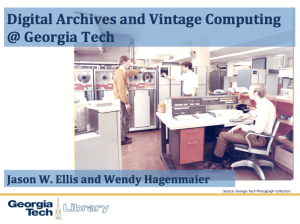 On May 4, 2014 at 11AM, Wendy Hagenmaier and I will give a co-presentation on Digital Archives and Vintage Computing @ Georgia Tech at the Vintage Computing Festival 2.0 in Roswell, Georgia. This post includes a support video embedded below, a link to our PowerPoint presentation, and a transcript of our talk.