Category: Kent State

  • I Have Been Chosen as a 2011-2012 David B. Smith Fellowship Recipient

    I learned last week by mail that I have been chosen as a 2011-2012 recipient of Kent State University’s David B. Smith Fellowship. According to the congratulatory letter from Dr. Mary Ann Stephens, Dean of Graduate Studies, the David B. Smith Fellowship is “an award given annually in honor of David B. Smith, a magna cum laude graduate of Kent State University, who passed away in 1982. This Fellowship is to recognize outstanding scholarship and research potential.”

    I am deeply honored to have been nominated for this award by Dr. Tammy Clewell, Coordinator of Graduate Studies, Department of English, and I express my sincere gratitude to the fellowship selection committee headed by Dr. Stephens. I would like to express my heartfelt gratefulness to Mr. and Mrs. Robert W. Smith for creating this fellowship in the memory of their son. I hope that my continuing work will reflect positively on this fellowship and what it represents.

    Dr. Donald “Mack” Hassler, my dissertation director, and I will attend the Doctoral Students’ Academic Commitment Ceremony in October 2011 where I will be presented with this award.

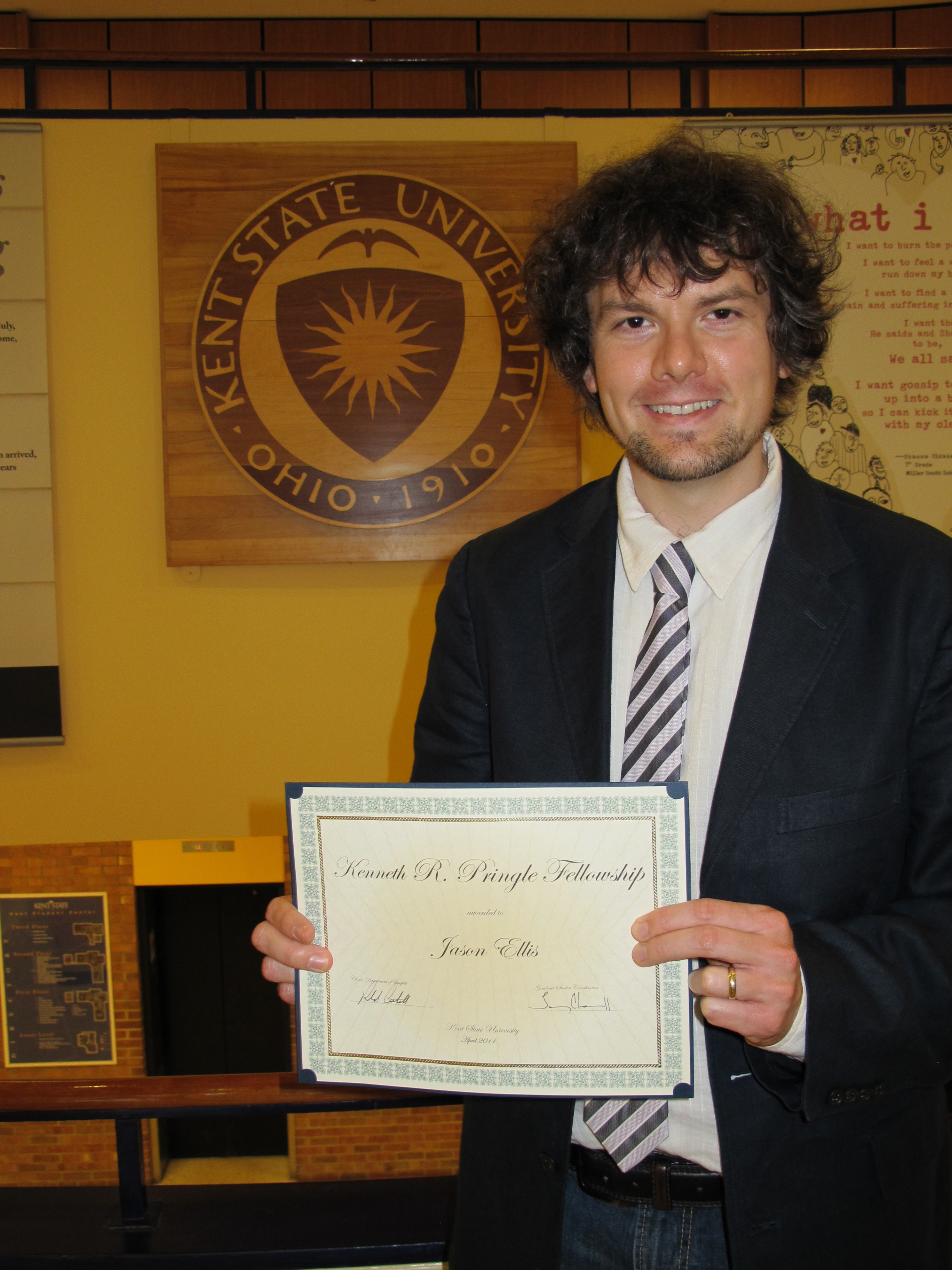
  • I Received a Kenneth R. Pringle Research Fellowship for 2011-2012

    At last night’s Kent State English Department Awards Ceremony, I received a Kenneth R. Pringle Research Fellowship for the 2011-2012 school year. This fellowship gives me a service free semester to focus on research and writing. I plan to use this time, in part, to travel to several special collections to perform research related to my dissertation and a few unpublished articles.

    The award ceremony was well attended by students and faculty in the English Department. Y and I represented the English Literature PhD students.

    It was the last ceremony presided over by current Chair Ron Corthell, who is leaving the department after 30 years of service. Professor Donald “Mack” Hassler presented Professor Corthell with an Old English decree (and some good-natured ribbing) for his service to the department. I can attest to the good work of Professor Corthell, because he helped me deal with attacks on my blog publishing as a graduate student (here and here) and with professional issues relating to students. I wish Professor Corthell the best in his future work.

  • Path to Professionalization: Finding My Ratio of Publication to Service

    This past Friday, Tammy Clewell hosted the second Job Placement Workshop for this school year. The topic for the workshop was how to build a kick ass curriculum vitae.

    I have been working on my C.V. since I was an undergraduate at Georgia Tech and I began applying to graduate schools. Like the characters in The Guild, I thought of the C.V. as a record of my achievements and development as a professional scholar. I thought about what I needed to do to get the kind of research-1 position that I wanted after completing my PhD. I knew that I needed publications, which meant that I needed to do more reading, research, and writing. While at Liverpool, I began writing reviews for SFRA Review with this goal in mind. I considered reviewing a kind of intellectual exercise that would yield benefits in the more important refereed publications in journals and books. Also, reviewing would show search committees that I regularly kept up with the field by reading and seeing things that were on the cutting edge.

    I also knew that I needed to do some conferencing, so I did a lot of that. I have prepared papers and participated on roundtable discussions at SFRA, ICFA, SLSA, and others. Again, writing essays to present at conferences improves your argumentation and keeps you knee deep in research. These are good things, and I duly noted on my C.V.

    Since returning to academia in 2002, even before I had decided on my current career path, I began offering my labor and expertise in service positions. The most important of these landed on my C.V. in the proper place, but it was at the job placement workshop that I began to question how much time I had invested in service roles including those that didn’t make the C.V. cut.

    One of the recommendations that I received at the workshop had to do with organizing the service category of my C.V., and in particular, one of the commenters said that I had done a lot of service. Additionally, I was warned against presenting myself as the kind of person who does all of the grunt work. By moving things around, I believe that I can streamline my C.V. in this regard, but this comment made me pause to think about how much work I have done for others at the cost of working on things that I really need to focus on right now: publications and dissertation.

    What I come to realize is that there are some really important service things that I do want to pursue: namely, Vice President of the SFRA. I feel that I can do something good for the organization while also giving me the experience of helping run an international academic organization (so, please vote Ellis!).

    There are other things that are rewarding, but they take a lot of time away from the writing that I need to focus on as I finish my PhD. I will have to transition out of these commitments in the future, so that I can devote that time to getting another publication sent out and more pages of my dissertation completed.

    The lesson to take away from this is to remember to make a ratio of publications, conferencing, and service that fit your goals and personal development. It is okay to say ‘no’ if you don’t have the time to do something, but it is also okay to say ‘yes’ when you have the time to help. Service to others can be a rewarding, enjoyable, and challenging opportunity, but you have to make sure that you take care of yourself before committing to it.
  • Reading List for PhD Minor Exam on the Works of Philip K. Dick

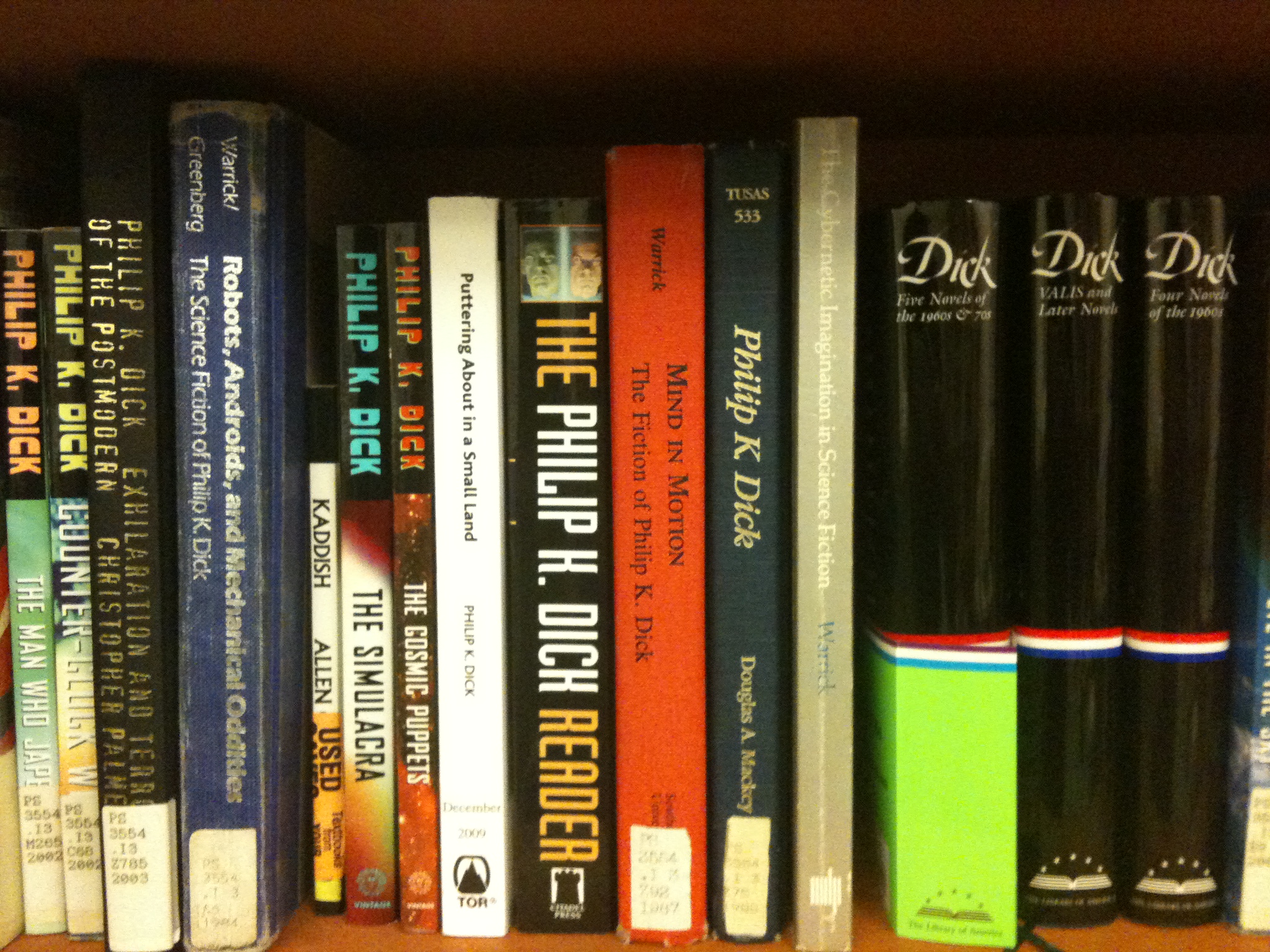
    In June 2010, I will take my three PhD exams in the Kent State University English Literature PhD program.  For these exams, I convened a committee of trusted professors, each administering one exam. I choose to take my exams in these areas: 20th Century American Literature (administered by Kevin Floyd), Postmodern Theory (administered by Tammy Clewell), and the Philip K. Dick Canon (administered by Donald “Mack” Hassler). Below, I have included my Philip K. Dick reading list. Go here to read my Postmodern Theory exam list, and here to read my 20th Century American Literature exam list.

    PhD Minor Area Exam:  Philip K. Dick’s Fiction and Non-Fiction, and Critical Works

    Director:  Donald “Mack” Hassler

    Novels by Philip K. Dick, organized by date of composition.

    1. Dick, Philip K. Gather Yourselves Together.  1950.  1994.
    2. —. Voices from the Street.  1952.  2007.
    3. —. Vulcan’s Hammer .  1953.  1960.
    4. —. Dr. Futurity.  1953.  1960.
    5. —. The Cosmic Puppets.  1953.  1957.
    6. —. Solar Lottery.  1954.  1955.
    7. —. Mary and the Giant.  1954.  1987.
    8. —. The World Jones Made.  1954.  1956.
    9. —. Eye in the Sky.  1955.  1957.
    10. —. The Man Who Japed.  1955.  1956.
    11. —. The Broken Bubble.  1956.  1988.
    12. —. Puttering About in a Small Land.  1957.  1985.
    13. —. Time Out of Joint.  1958.  1959.
    14. —. In Milton Lumky Territory.  1958.  1985.
    15. —. Confessions of a Crap Artist.  1959.  1975.
    16. —. The Man Whose Teeth Were All Exactly Alike.  1960.  1982.
    17. —. Humpty Dumpty in Oakland.  1960.  1986.
    18. —. The Man in the High Castle.  1961.  1962.
      2009/12/2
    19. —. We Can Build You.  1962.  1972.
    20. —. Martian Time-Slip.  1962.  1964.
    21. —. Dr. Bloodmoney, or How We Got Along After the Bomb.  1963.  1965.
    22. —. The Game-Players of Titan.  1963.  1963.
    23. —. The Simulacra. 1963.  1964.
    24. —. The Crack in Space.  1963.  1966.
    25. —. Now Wait for Last Year.  1963.  1966.
    26. —. Clans of the Alphane Moon.  1964.  1964.
    27. —. The Three Stigmata of Palmer Eldritch.  1964.  1965.
    28. —. The Zap Gun.  1964.  1967.
    29. —. The Penultimate Truth.  1964.  1964.
    30. —. Deus Irae.  1964.  1976.  (Collaboration with Roger Zelazny).
    31. —. The Unteleported Man.  1964.  1966.  (Republished as Lies, Inc. in 1984).
    32. —. The Ganymede Takeover.  1965.  1967.  (Collaboration with Ray Nelson).
    33. —. Counter-Clock World.  1965.  1967.
    34. —. Do Androids Dream of Electric Sheep? 1966.  1968.
    35. —. Nick and the Glimmung.  1966.  1988.
    36. —. Ubik.  1966.  1969.
    37. —. Galactic Pot-Healer.  1968.  1969.
    38. —. A Maze of Death.  1968.  1970.
    39. —. Our Friends from Frolix 8.  1969.  1970.
    40. —. Flow My Tears, The Policeman Said.  1970.  1974.
    41. —. A Scanner Darkly.  1973.  1977.
    42. —. Radio Free Albemuth.  1976.  1985.
    43. —. VALIS. 1978.  1981.
    44. —. The Divine Invasion.  1980.  1981.
    45. —. The Transmigration of Timothy Archer.  1981.  1982.

    Short Fiction by Philip K. Dick, needs elaboration by individual stories.

    1. The Philip K. Dick Reader.  1997.
    2. Robots, Androids, and Mechanical Oddities:  The Science Fiction of Philip K. Dick.  Eds. Patricia S. Warrick and Martin H. Greenberg.  1984.

    Selected Stories of Philip K. Dick.  2002.

    Non-Fiction by Philip K. Dick

    1. Dick, Philip K.  “The Android and the Human.” Vector:  Journal of the British Science Fiction Association 64 (March/April 1973):  5-20.
    2. —. The Dark Haired Girl.  1988.

    Critical Works

    1. Fitting, Peter.  “Ubik:  The Deconstruction of Bourgeois SF.” Science Fiction Studies 2:1 (1975).  19 October 2007 <http://www.depauw.edu/sfs/backissues/5/fitting5art.htm&gt;.
    2. Haney, William S. II. Culture and Consciousness:  Literature Regained.  Lewisburg:  Bucknell University Press, 2002.
    3. Kucukalic, Lejla. Philip K. Dick:  Canonical Writer of the Digital Age.  New York:  Routledge, 2009.
    4. Mackey, Douglas A. Philip K. Dick.  Boston:  Twayne Publishers, 1988.
    5. Palmer, Christopher. Philip K. Dick:  Exhilaration and Terror of the Postmodern.  Liverpool:  Liverpool UP, 2003.
    6. On Philip K. Dick:  40 Articles from Science-Fiction Studies.  <more information>.
    7. Sutin, Lawrence. Divine Invasions: A Life of Philip K. Dick.  New York:  Carroll & Graf, 2005.
    8. Suvin, Darko.  “P.K. Dick’s Opus:  Artifice as Refuge and World View.” Science Fiction Studies 2:22 (1975).  19 October 2007 <http://www.depauw.edu/sfs/backissues/5/suvin5art.htm&gt;.
    9. Vest, Jason P. The Postmodern Humanism of Philip K. Dick.  Lanham, MD:  Scarecrow Press, 2009.
    10. Warrick, Patricia S. The Cybernetic Imagination in Science Fiction. Cambridge: MIT Press, 1980.
    11. —.Mind in Motion:  The Fiction of Philip K. Dick.  Carbondale and Edwardsville:  Southern Illinois UP, 1987.
  • Reading List for PhD Minor Exam in Postmodern Theory

    In June 2010, I will take my three PhD exams in the Kent State University English Literature PhD program.  For these exams, I convened a committee of trusted professors, each administering one exam. I choose to take my exams in these areas: 20th Century American Literature (administered by Kevin Floyd), Postmodern Theory (administered by Tammy Clewell), and the Philip K. Dick Canon (administered by Donald “Mack” Hassler). Below, I have included my Postmodern Theory reading list. Go here to read my 20th century American literature exam list, and here to read my Philip K. Dick exam list.

    PhD Minor Exam Area:  Postmodern Theory

    Director:  Tammy Clewell

    Texts:

    1. Baudrillard, Jean. Simulacra and Simulation.
    2. Berman, Marshall. All That Is Solid Melts Into Air.
    3. Bertens, Hans. The Idea of the Postmodern:  A History.
    4. Broderick, Damien. Reading by Starlight: Postmodern Science Fiction.
    5. Bukatman, Scott. Terminal Identity:  The Virtual Subject in Postmodern Science Fiction.
    6. Butler, Judith. Bodies That Matter.
    7. de Certeau, Michel. The Practice of Everyday Life.
    8. Deleuze, Gilles and Félix Guattari. A Thousand Plateaus:  Capitalism and Schizophrenia.
    9. Derrida, Jacques. Of Grammatology.
    10. Eagleton, Terry. The Illusions of Postmodernism.
    11. Foucault, Michel. The History of Sexuality Volume 1:  An Introduction.
    12. Habermas, Jürgen.  “Modernity: An Incomplete Project.”
    13. Haraway, Donna. Modest_Witness@Second_Millennium.FemaleMan©Meets_OncoMouse™: Feminism and Technoscience.
    14. —. Simians, Cyborgs and Women: The Reinvention of Nature.
    15. Harvey, David. The Condition of Postmodernity.
    16. Hassan, Ihab. The Postmodern Turn.
    17. Hayles, N. Katherine. How We Became Posthuman: Virtual Bodies in Cybernetics, Literature, and Informatics.
    18. Huyssen, Andreas. After the Great Divide.
    19. Hutcheon, Linda. A Poetics of Postmodernism: History, Theory, Fiction.
    20. Jameson, Fredric. Postmodernism:  Or, The Cultural Logic of Late Capitalism.
    21. —. Archaeologies of the Future: The Desire Called Utopia and Other Science Fictions.
    22. Latour, Bruno. We Have Never Been Modern.
    23. Lyotard, Jean-François. The Postmodern Condition:  A Report on Knowledge.
    24. McHale, Brian. Postmodernist Fiction.
    25. Norris, Christopher. What’s Wrong with Postmodernism?
    26. Perryman, Mark ed. Altered States: Postmodernism, Politics, Culture.
    27. Poster, Mark. The Information Subject.
    28. Vattimo, Gianni. The Transparent Society.
    29. Wilde, Alan. Horizons of Assent: Modernism, Postmodernism, and the Ironic Imagination