Category: Making

  • Grizzly Sawdust Collector Assembly Project

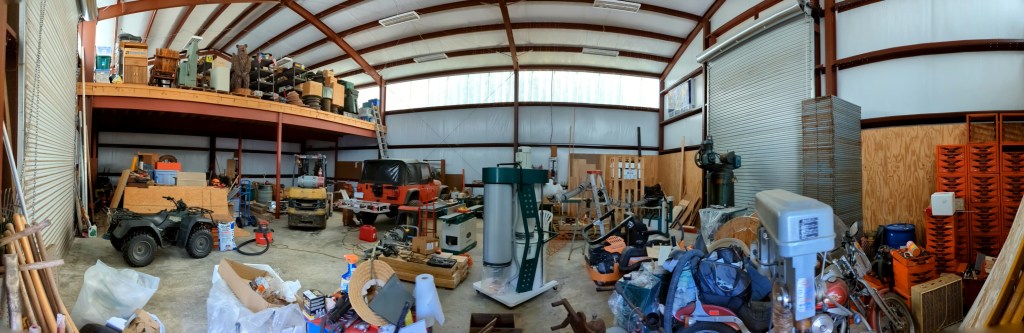
    Shop panorama with Grizzly dust collector in the center.

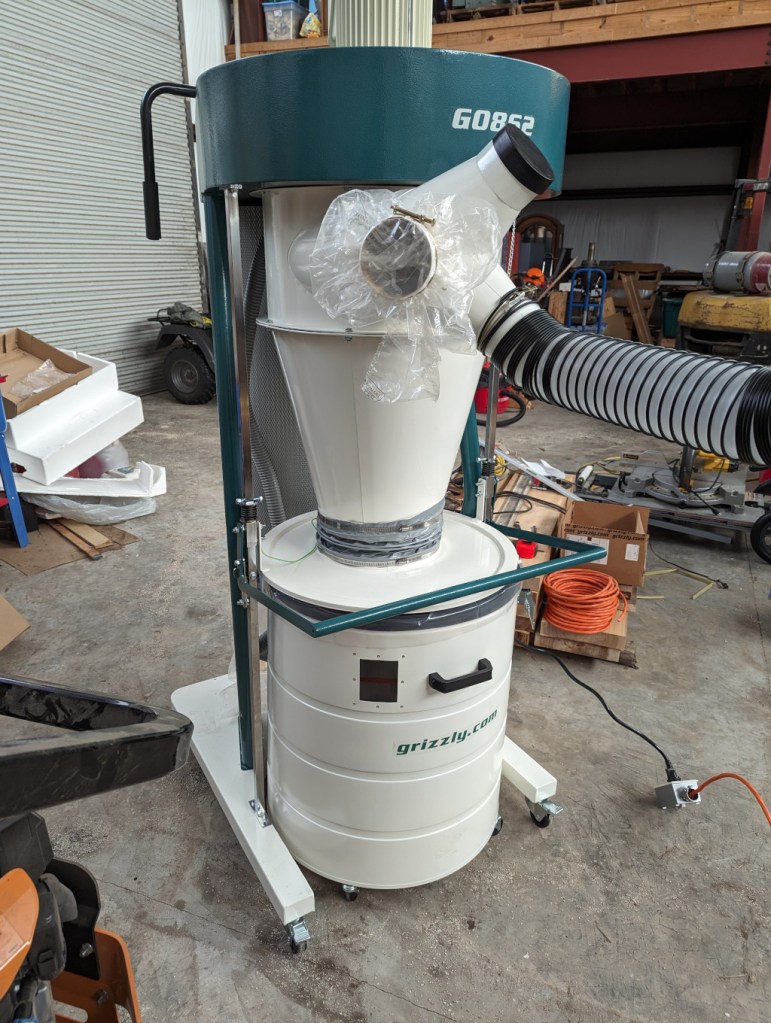
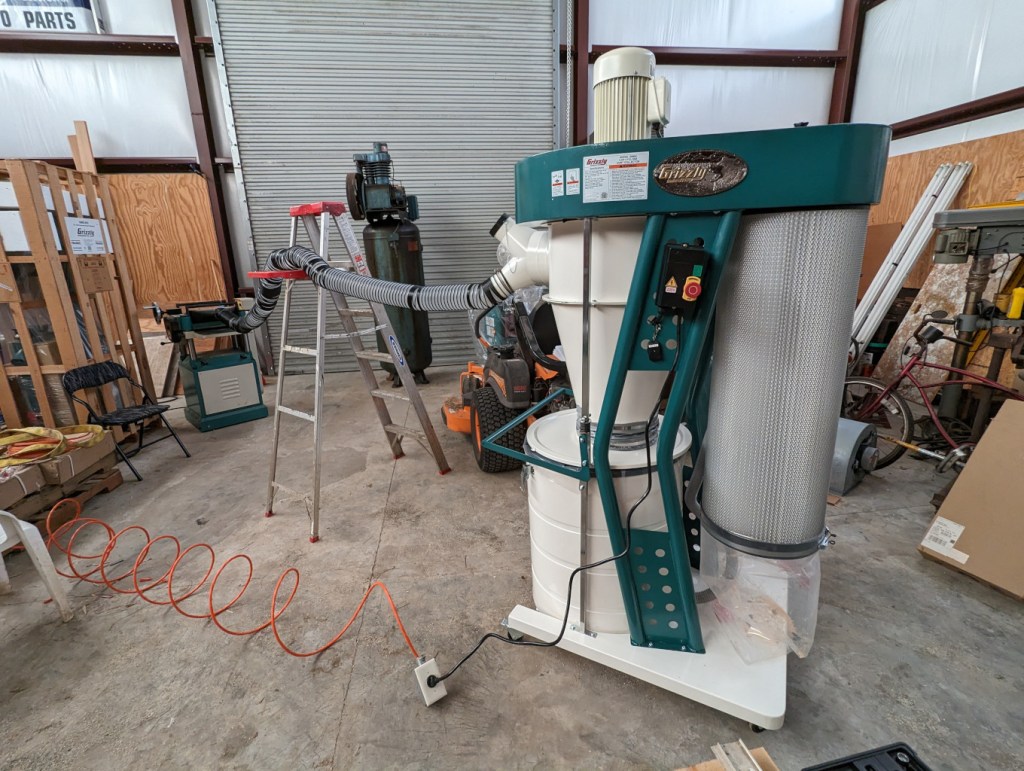
    While I was visiting my folks, one of the larger projects that needed to be done was assembling the Grizzly G0862 3 hp dust collector (completed in the center of the photo above) for his planer, edger, and table saw.

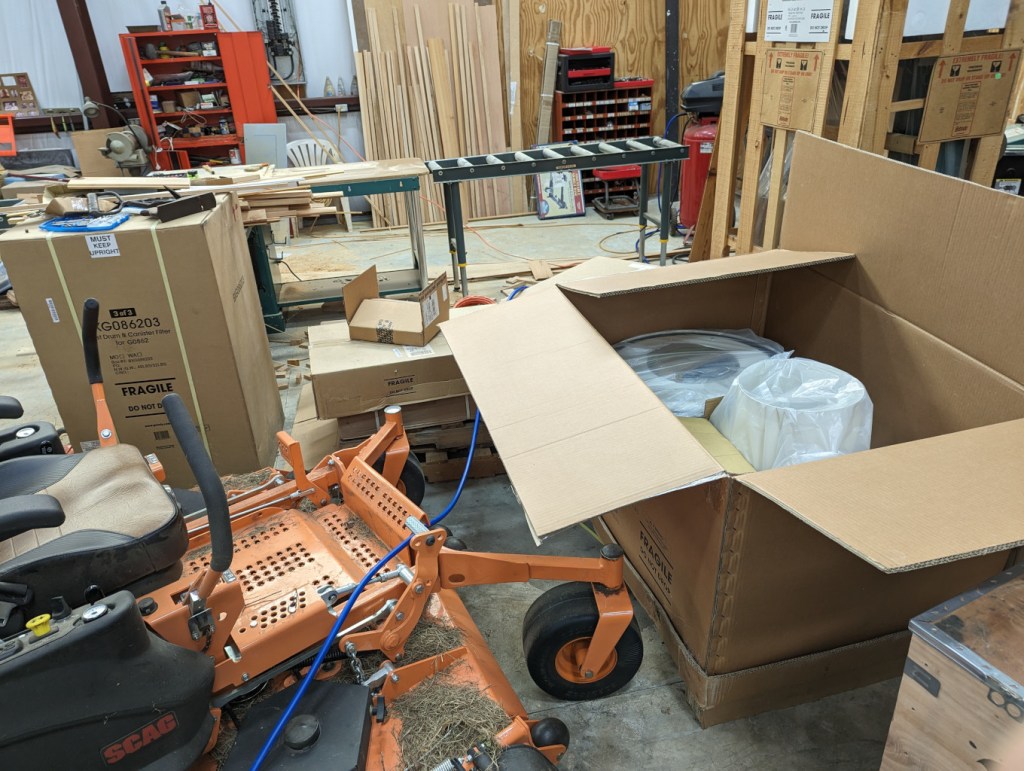
    Grizzly G0862 dust collector boxes.

    It began with these three boxes and their contents.

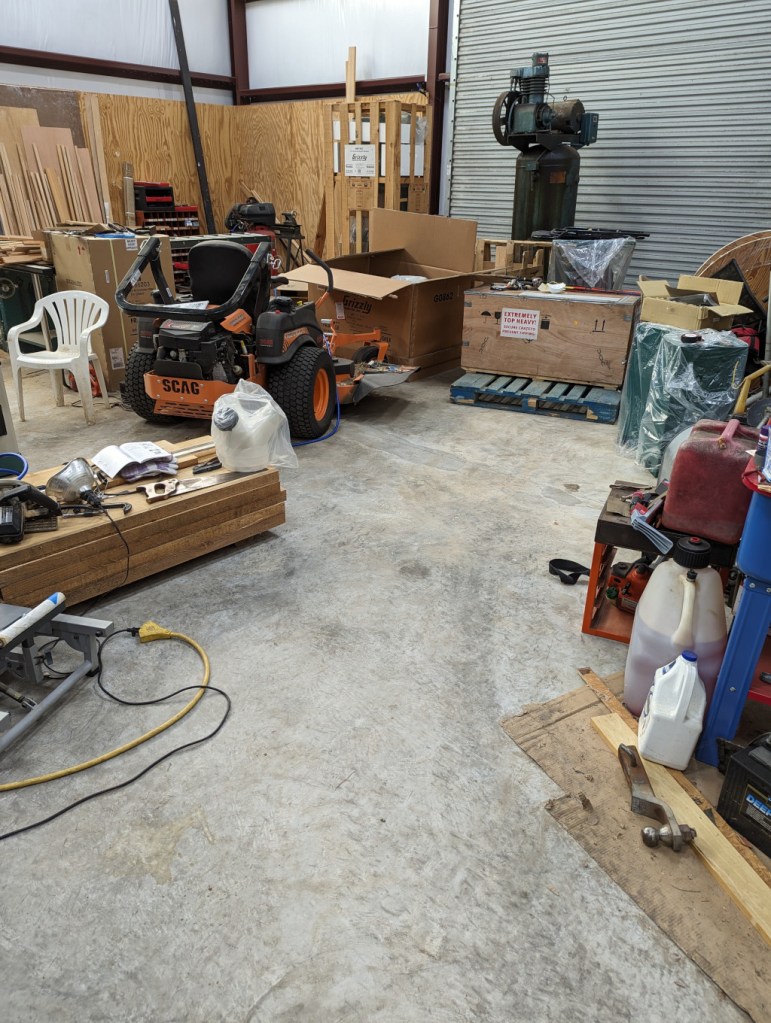
    Floor space for building the dust collector.

    Then, I made space to put the dust collector together in a space near all three machines. Note the stack of thick rough cut boards on the left side. These will be planed and edged before being installed as the stair treads in my folks’ house.

    The instructions call for having two helpers to lift the top motor assembly while a third person secures it to the supports with bolts. Thankfully, my dad’s forklift was running, so we repositioned the forks close together, picked up the top motor assembly, and positioned the stand beneath the motor assembly while we threaded the bolts.

    Dust collector drum close-up.

    The only trouble that we had during assembly was securing the collection drum to its lid. It only has two buckles that lock down to secure the drum to the lid. Then, you raise the drum off the floor and the suction during option keeps the lid and drum mated. However, the two buckle system–despite adjusting the buckle lengths–didn’t always hold the drum and lid together. I removed the two drum bumpers from the base, which helped the drum better align with the lid for a more secure connection. It seems that adding one or two buckles would avoid this problem. Another solution would be to run a nylon tie strap around the drum over the closed buckles to keep them from releasing.

    Dust collector in the foreground. Planer in the background.

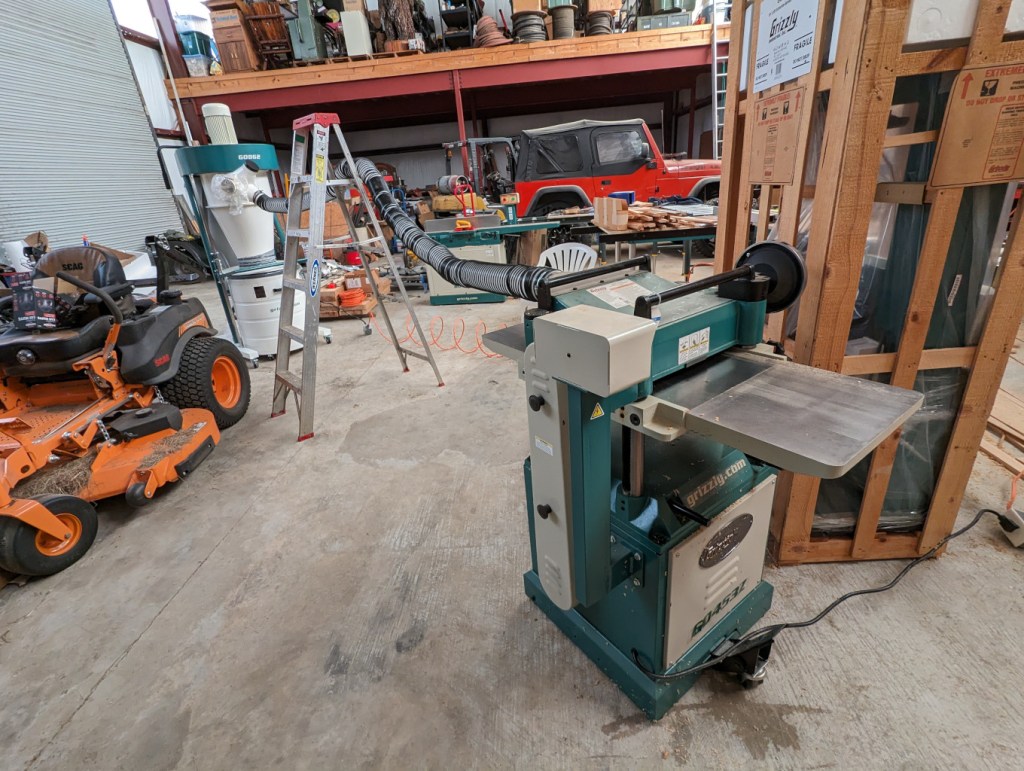
    After connecting the dust collector to 220v, we did a test run with the planer and it worked spectacularly. Now, my dad will use this to plane and edge the stair treads out of rough cut cypress boards sourced from trees that he cut down on.

    Planer in the foreground. Dust collector in the background.

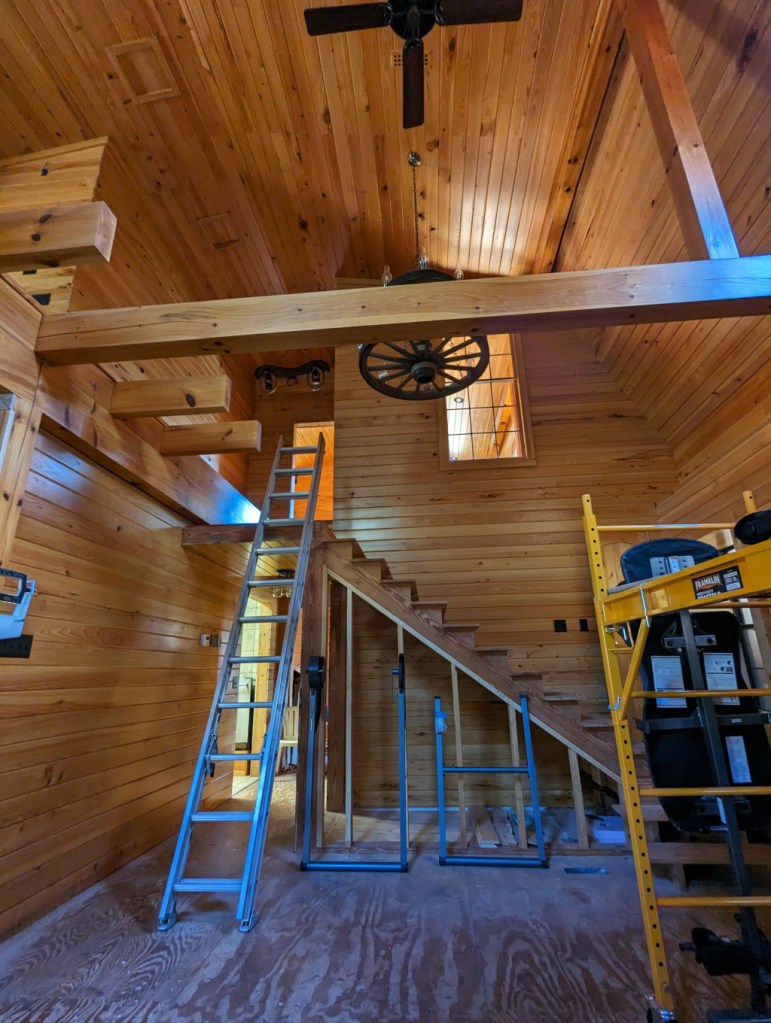
    Eventually, the new cypress stair treads will go on the currently roughed-in stairs between the first and second floors.

  • How to Refinish Hardwood Floors

    Refinished hardwood floor in downstairs bedroom.

    When Y and I lived in Atlanta, our house had a downstairs bedroom that we used for an office. However, it was an odd room. The kitchen and downstairs bathroom had tiled floors, and the rest of the downstairs–dining room, living room, and den–had hardwood floors. That downstairs bedroom had medium pile carpet. When our friend Masaya asked if he could visit us, we thought it was a good opportunity to refinish the downstairs bedroom as a guest room with hardwood floors. Here’s how we refinished its floor to match the stain of the rest of the downstairs.

    First, I pulled up the carpet in the closet and a corner of the room to verify that it was the same kind of oak flooring as the rest of the downstairs. Having verified this, I began cutting and rolling the carpet and padding.

    Refinishing a carpet covered hardwood floor. First, remove the carpet and padding.

    The padding had been glued down–thankfully not over the entire floor–but enough that I had to scrape some of it and the glue off the wood flooring using a paint scraper. However, I went slow and carefully to make sure that I didn’t gouge the wood with the tool. Whatever I didn’t get up, I knew that I could sand down eventually.

    Refinishing a carpet covered hardwood floor. Second, scrape the carpet padding and glue off the wood floor.

    Then, I used a hammer to pull up the carpet tack strips around the edges of the room and vacuumed the floor clean.

    Refinishing a carpet covered hardwood floor. Third, pull up the carpet tack strips and vacuum the floor clean.

    For the next step, I went to the local Home Depot Rental Office to rent a stand-up belt sander for floors. This thing weighed about 100 pounds. It’s weight combined with a handle operated mechanism to engage the sanding belt against the floor and pull it forward made quick work of sanding the floor and removing all old paint, glue, and stains. As the wood wasn’t in too bad of shape, I used a fine grit sandpaper. Also note that when you use a floor sander like this, you want to move in the direction of the boards and give each pass a little overlap for an even finish across the whole floor. Also, you can see that I have the windows open. Even though the sander has a bag to catch the sawdust, it can’t catch it all. Open your windows and cover outlets and air returns to keep that dust from getting into places it shouldn’t be.

    Refinishing a carpet covered hardwood floor. Fourth, use a belt sander to sand most of the floor's surface.

    Halfway through, I changed out the belt for a fresh one. This probably wasn’t necessary, but I might have noticed some change in the sanded floor’s finish by this point in the project.

    Refinishing a carpet covered hardwood floor. Changing the floor belt sander's sandpaper belt.

    After using the belt sander over the whole floor, I saw some spots that needed additional work. When I did these spots, I went over the entire run as just using it in one spot might leave a dip in the floor. As I worked, I used the shop vac to keep the floor as clean as possible from the extra sawdust produced by the sander. And, around the edges of the room and inside the edges of the closets, we used a handheld orbital sander and sanding blocks to sand the 2″ or so on all sides that the belt sander was unable to reach due to its design.

    Refinishing a carpet covered hardwood floor. Fifth, use a belt sander to sand troublesome spots but cover the entire run to avoid dips.

    After returning the belt sander to Home Depot, we cleaned the floor again and applied water to the wood with cloths to “pop the grain.” This makes the wood more receptive to the stain so less is needed to achieve the results that you want.

    Refinishing a carpet covered hardwood floor. Sixth, just before applying the stain or stain/poly combo, get the floor damp to "pop the grain."

    Before, we had taken photos of the existing hardwood floors in the house using natural light to capture the best image of the stain. We took this to Home Depot and matched it to a water-based stain and polyurethane combo so that we could finish the floor as soon as possible and give it time to cure and air out before moving furniture back in anticipation of our friend’s arrival.

    With the wood damp, I stirred the stain/poly combo according to the instructions on the can and poured out some into a paint tray. Then, I dipped a foam paint/finish applicator into the stain/poly and gently worked it into the wood in the direction of the boards.

    Refinishing a carpet covered hardwood floor. Seventh, stir the stain/poly combo according to the directions, pour it into a paint tray, and work it into the wood in the direction of the boards..

    Once completed, give the floor enough time to air out and cure before moving things back in. If you don’t have to walk on it, just wait until its met the cure time as this will give you the strongest possible finish.

    Refinishing a carpet covered hardwood floor. Eighth, give the finished floor enough time to air out and cure.

    I didn’t want to pull up the baseboard, so I went back after the floor’s finish had cured and repainted the baseboard (putting down plastic, taping the edge, and putting enough coats to hide the stain that hit it). In hindsight, I should have taped the baseboard to protect it. However, the best option is to pull up the baseboard and reinstall after refinishing the floor.

    We were very happy with the results. It was ready for our friend’s visit and we used it as an office again after he returned to Japan.

  • Weezer Performance Stage at Key Arena Nov. 2001 LEGO MOC

    In Fall 2001, I flew out to Seattle to visit friends and go to two shows–Tori Amos at the Paramount and Weezer at Key Arena.

    After I returned home, I built this LEGO MOC (my own creation) of the Weezer stage. At that point, I only had some Star Wars LEGO sets, so I had to pick up some additional bricks and minifigures to create this model. Notably, I purchased the cheapest Harry Potter set (for the bespectacled Rivers Cuomo) and a large brick assortment set for the stage base and back.

    I based the stage arrangement on Weezer’s stage design at the Key Arena performance. They had a backdrop covered with equally distant squares. Lights behind the black squares illuminated and played lights on the backdrop. In front of the stage back was a large stylized “W” that descended from above when the band began playing.

    To mount the stage back at 90 degrees to the stage base, I used stub-and-fork friction joint bricks.

    For the backdrop lights, I used battery-powered Christmas lights.

    For the stylized “W,” I cut it out from card stock.

    Also, I used card sock to cut out guitar and bass shapes that I taped to rods that the minifigures held.

    Apologies for the quality of the photos. I took the photos with my second digital camera. The first was a Sony Mavica with 3.5″ floppy disk. I sold it and purchased a Sony Cyber-Shot DSC-P3 (I think). I’m lucky to have these photos as I think I took them more to experiment with the camera than to memorialize the LEGO model!

  • LEGO Ghostbusters 21108 in Front of Hook and Ladder Company 8 in NYC, Composite Image Made with GIMP

    Thinking about the composite image of the Bandai 1/144 scale Millennium Falcon in space that I created using GIMP (GNU Image Manipulation Program) led me to imagine creating a different composite of the LEGO 21108 Ghostbusters set from 2014 in front of the filming location of the Ghostbuster’s headquarters, Hook and Ladder Company 8 in Manhattan.

    I started with these photos that I had taken in 2015:

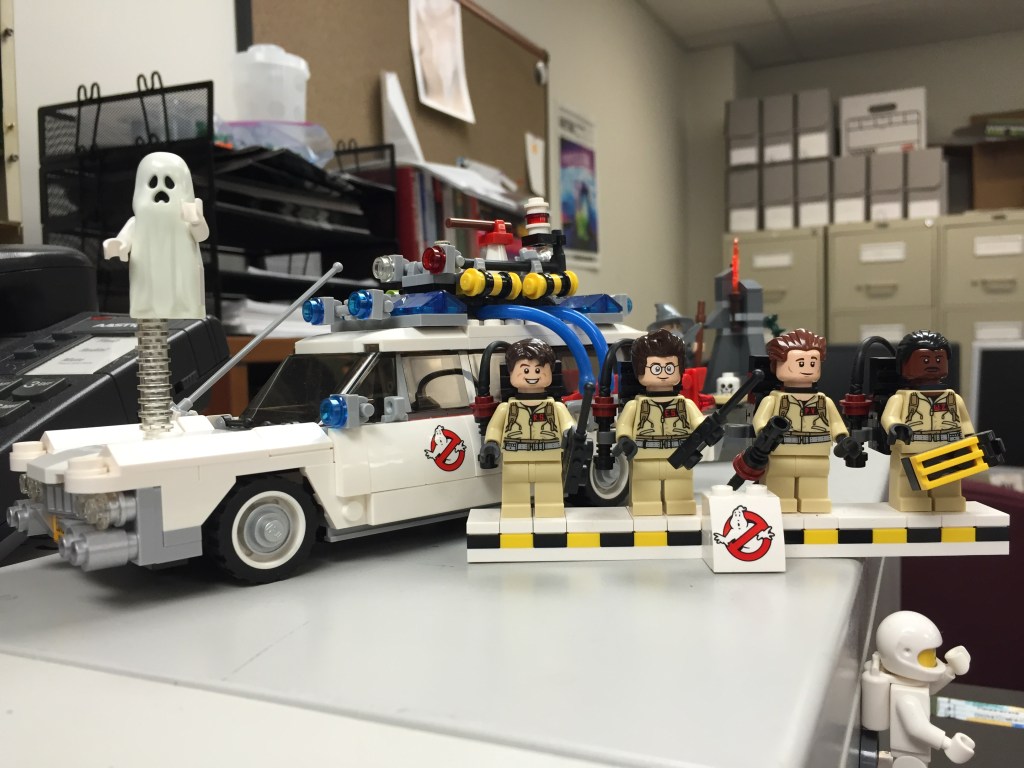
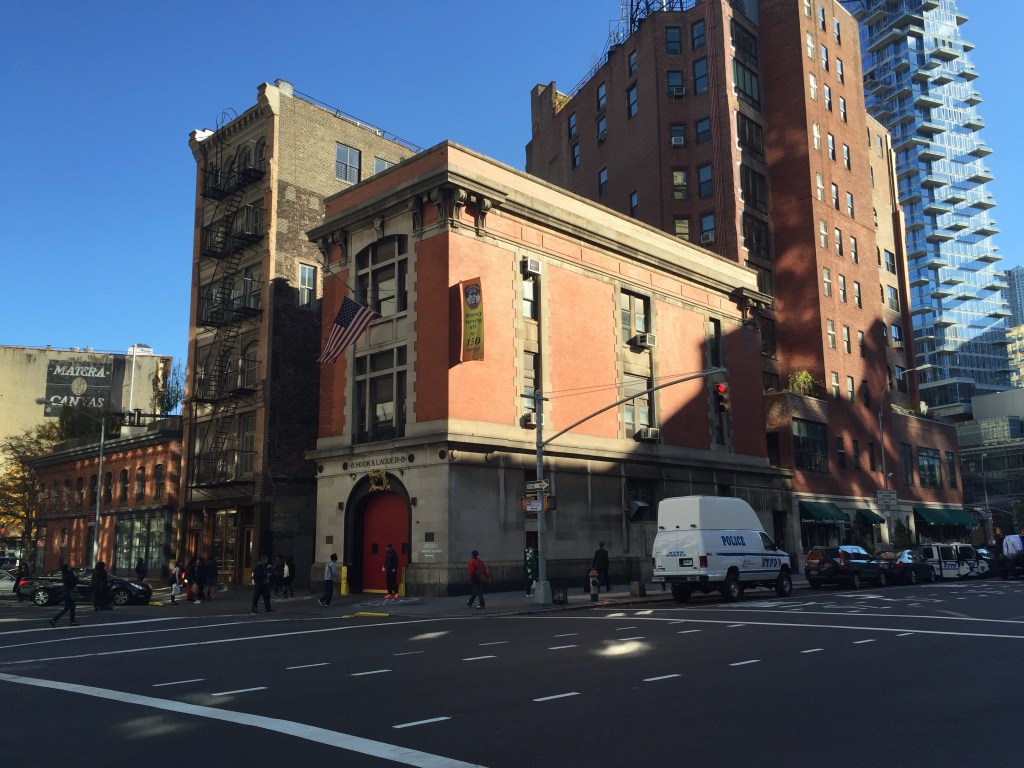
    On the left is a photo that I took of the Ghostbusters LEGO 21108 set on my desk at City Tech. All of the elements that I needed are here, but I realized that I would have to break it down into parts to create the composite image–ghost, Ecto-1, Ray, Ego, Peter, and Winston. On the right above is a photo that I took of the Hook and Ladder Company 8 building in Manhattan. Due to the time of day that the photo was taken, the front of the building is in shadow and there are sightseers in front of the firetruck door that need to be removed.

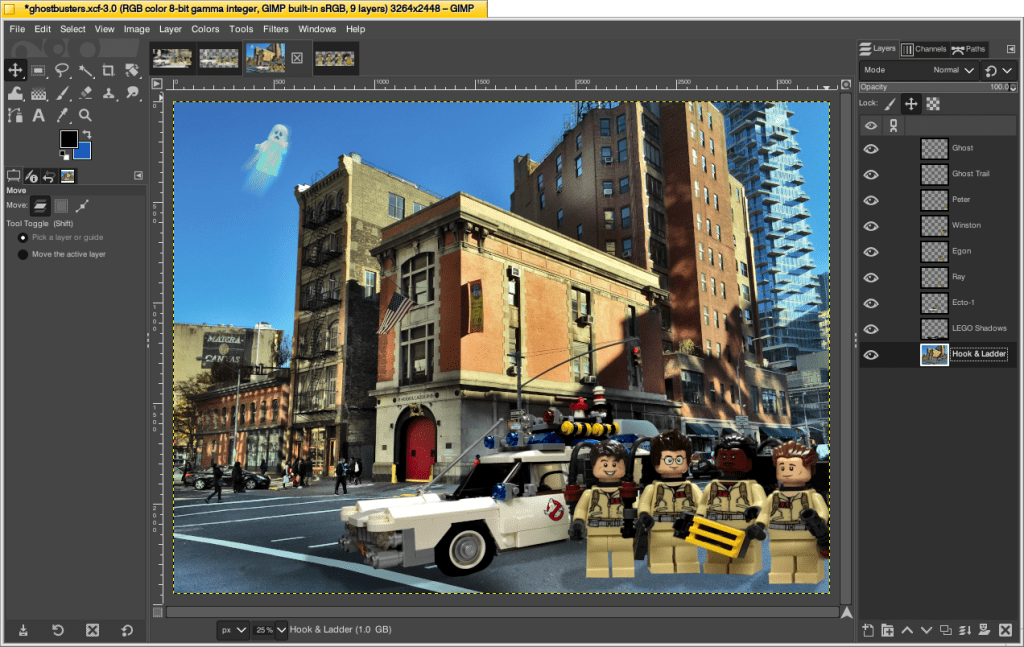
    I setup my work document in GIMP in the following way.

    First, I pasted the hook and ladder photo as the bottom-most layer. I adjusted the colors and reduced the shadows to help the firehouse pop in the center of the photo. I used the lasso tool (creating irregular shapes instead of squares or circles helps with blending later) and clone tool to copy material over the sightseers in the front of the firehouse and to remove a light reflection on the road surface in front of the pedestrian walking line in the lower left. I smoothed out these fixes with the smudge tool.

    Then, I cut out the ghost, Ecto-1, and four Ghostbusters and pasted each into its own independent layer and adjusted colors appropriately. Because the Ghostbusters are obscuring part of Ecto-1 in the original photo, I needed to arrange the composition so that they hid the back of the vehicle. But, I had to use the clone tool to repair some aspects of the car (e.g., the clear 1×1 round studs that had supported the ghost needed to be removed and the white surface of the hood restored), and some of the exterior windows and side panels peeked through gaps between the Ghostbusters (I used the clone tool and lasso tool to create the rear windows and side panels). Also, I wanted to arrange them so that it appeared more like a group shot instead of a line as in the display for the original set. To achieve this, I flipped horizontally Winston and Peter’s images to that they are turned toward Ray and Egon to their right. Unfortunately, this flips their name tags, but maybe no one will notice! Also, I increased their size by 120% to make them appear further away from Ecto-1 and closer to the viewer. I’ll return to the ghost below.

    Next, I added a layer between the firehouse image and Ecto-1 (being the lowest layer of the LEGO images). I used the paintbrush with a large brush to paint black “shadow” under Ecto-1 and falling from right to left on each Ghostbuster member. I reduced the opacity of the layer to lighten its appearance so that the shadow wasn’t too harsh.

    Finally, I transformed the ghost layer and rotated it to about 60 degrees. I adjusted its colors to give it a neon green hue. I then duplicated the layer. On the lower ghost layer, I applied a linear blur to give it a flowing, streak effect, which I positioned under the ghost to give it implied ethereal movement.

    The final product isn’t perfect, but it was fun to make and it helped me learn/reinforce workflow practices in GIMP.

    Don’t let perfection hold you back from using tools to make things that bring you joy. Each time you make something, you learn new things and get better at doing the things you’ve learned before. If you have the time, energy, and material, you can always take another stab at the thing you did before to make a better iteration. Though, I recommend starting fresh each time instead of making adjustments to something you’ve already made. The process of building and making from start to finish can yield wildly divergent and better outcomes that can be surprising and unexpected. Tweaking what you’ve already done might yield something interesting, but the constraints of the original project might limit what is ultimately possible.

  • LEGO Mashup MOC of Gandalf 30213 and Fierce Flyer 31004

    Back in 2013, I built a small LEGO MOC scene depicting Gandolf (from The Hobbit 30213 polybag set) riding on one of the great eagles (LEGO Creator Fierce Flyer 31004). The scene shows a miniature river flanked by mountainsides. I used one of the mountains to anchor a Technic support that buoyed the eagle carrying Gandolf on an important Middle Earth mission. Positioned correctly, the support isn’t seen and the eagle appears to be in midflight.