Category: Science Fiction

  • Recovered Writing, PhD in English, Methods in the Study of Literature, Project 1/5, Literary Area and Reading List, September 25, 2008

    This is the forty-seventh post in a series that I call, “Recovered Writing.” I am going through my personal archive of undergraduate and graduate school writing, recovering those essays I consider interesting but that I am unlikely to revise for traditional publication, and posting those essays as-is on my blog in the hope of engaging others with these ideas that played a formative role in my development as a scholar and teacher. Because this and the other essays in the Recovered Writing series are posted as-is and edited only for web-readability, I hope that readers will accept them for what they are–undergraduate and graduate school essays conveying varying degrees of argumentation, rigor, idea development, and research. Furthermore, I dislike the idea of these essays languishing in a digital tomb, so I offer them here to excite your curiosity and encourage your conversation.

    If I had to pick one seminar at Kent State University as being the most important to my shifting my thinking and rigor into running gear, it would have to be Professor Tammy Clewell’s Methods in the Study of Literature class. Methods is the introductory class that all PhD students have to take. Each year, a different faculty member teaches this class, and I am glad that the planets aligned for me to take this class from Professor Clewell. My joy for taking this class derives from Professor Clewell’s laser-beam accurate and calmly delivered criticisms. She expected rigor in our work, but she delivered her appraisals and commentary kindly. There was no malace in her demeanor—only the daily expectation of meticulousness, demonstration of preparedness, and application of theory. Her candor about higher education and the challenges of scholarship were eye-opening and appreciated. I was very happy to take another class from Professor Clewell the following year and even more so when she agreed to lead my postmodern theory exam and join my dissertation committee. For all of her efforts teaching, advising, and advocating, I am eternally grateful.

    This is the first of five Recovered Writing posts from Professor Clewell’s Methods seminar. Each post is one project from the seminar. They should be considered parts of a semester-long process of entering professional discourse. These are attempts at learning, arguing, and improving. The culmination of this work is the fifth project/post in this subseries—a publishable-length essay, “The Image of Women in Philip K. Dick’s Ubik.”

    In the first project, each student defined his or her specialization and created a reading list. Since this was at the beginning of my tenure at Kent State as a PhD student, my concentrations and reading list changed over time. However, it was incredibly useful to set a draft of this important framework down in writing at this point of my academic career.


    Jason W. Ellis

    Professor Tammy Clewell

    Methods in the Study of Literature

    25 Sept. 2008

    Project #1: Literary Area and Reading List

    I am declaring twentieth-century American literature as the focus of my doctoral study at Kent State University. American literature produced during the past century is mapped onto a variety of movements and genres that serve as guides rather than absolute categories, because many authors inhabit more than one category and they are organic structures connected in many ways by multiple networks of history, technology, and culture. Significant movements include Modernism (Pound and Williams), the Harlem Renaissance (Wright and Hurston), the Lost Generation (Hemingway, Fitzgerald, Pound, and Dos Passos), the Futurians (Asimov, Pohl, Kornbluth, and Merril), the Beat Generation (Kerouac, Ginsberg, and Burroughs), New Journalism (Capote, Wolfe, and Thompson), New Wave Science Fiction (Dick, Ellison, and Delany), and Postmodernism (Pynchon, Reed, Vonnegut, and Gibson).

    Within this network of literature, I make the best connection with Postmodernism and post-World War II Science Fiction including New Wave. New Wave began as a British SF movement with Michael Moorcock taking over the editorship position at New Worlds magazine in 1964. Noteworthy British New Wavers include Moorcock, Brian Aldiss, and J.G. Ballard. What’s important about New Wave is that it is the point at which SF matures. It is characterized by literary experimentation, incorporation of the soft sciences (e.g., psychology), breaking accepted social norms, and focusing on characters. In America, the movement’s touchstone is Harlan Ellison’s 1964 edited collection, Dangerous Visions. It included works by Philip K. Dick and Samuel R. Delany among many other SF authors from both sides of the pond. Other major American New Wave authors include Ursula K. Le Guin, Joanna Russ, and Roger Zelazny. My interest in Postmodernism comes from the fact that it co-evolves with New Wave and the two movements share many similar themes and concerns such as post-capitalism and challenges to the individual.

    I choose Philip K. Dick’s 1969 SF novel, Ubik, for the subject of a paper exploring the significance of this work in relation to a dialog with other works such as Pynchon’s The Crying of Lot 49 (1966) and Vonnegut’s Breakfast of Champions (1973). The novel is about Joe Chip, a man with psychic blocking powers employed by a company that hires out such persons to protect corporate interests. Following an ambush on assignment, Chip is put into “half-life,” or cryonic storage, because his injuries are too severe for immediate repair. While in half-life, he is threatened by a predatory psychic also in half-life and the only protection is a ubiquitous commercial product called “Ubik.” Dick questions the nature of reality and the individual’s connection to reality through consumerism in Ubik. Additionally, he destabilizes the nature of reality for his characters as well as the reader.

    This work, originally considered mere genre fiction, should be reexamined with greater seriousness. The author’s other works are in continuous print and there is greater recognition of his work thanks to the many filmic interpretations including Blade Runner (1982), Total Recall (1990), Minority Report (2002), and A Scanner Darkly (2006), as well as the recent Library of America publication of Philip K. Dick: Four Novels of the 1960s (2007), which includes Ubik. Also, other SF authors have gained increased attention in recent years such as the inclusion of Ursula K. Le Guin in The Norton Anthology of American Literature: Volume E: Literature since 1945.   Therefore, Ubik deserves increased consideration and further analysis in order to situate it within the larger framework of literary texts and culture in which it is situated.

    Twentieth-Century American Literature Reading List

    Chopin, Kate. The Awakening (1899).

    London, Jack. The Call of the Wild (1903).

    Sinclair, Upton. The Jungle (1906).

    Cather, Willa. O Pioneers! (1913).

    Gilman, Charlotte Perkins. Herland (1915).

    Frost, Robert. Mountain Interval (1916).

    Sandburg, Carl. Chicago Poems (1916).

    Millay, Edna St. Vincent. “Renascence” (1917).

    Anderson, Sherwood. Winesburgh, Ohio (1919).

    Millay, Edna St. Vincent. A Few Figs From Thistles (1920).

    Cummings, E. E. Tulips and Chimneys (1923).

    William, Carlos Williams. Spring and All (1923).

    Fitzgerald, F. Scott. The Great Gatsby (1925).

    Stein, Gertrude. The Making of Americans (1925).

    Hemingway, Ernest. The Sun Also Rises (1926).

    Wilder, Thornton. The Bridge of San Luis Rey (1927).

    Faulkner, William. The Sound and the Fury (1929).

    Hemingway, Ernest. A Farewell to Arms (1929).

    Faulkner, William. As I Lay Dying (1930).

    Buck, Pearl S. The Good Earth (1931).

    Stein, Gertrude. The Autobiography of Alice B. Toklas (1933).

    Faulkner, William. Absalom, Absalom! (1936).

    Hurston, Zora Neale. Their Eyes Were Watching God (1937).

    Steinbeck, John. Of Mice and Men (1937).

    Dos Passos, John. U.S.A. (1938).

    Steinbeck, John. The Grapes of Wrath (1939).

    Hemingway, Ernest. For Whom the Bell Tolls (1940).

    Wright, Richard. Native Son (1940).

    Welty, Eudora. A Curtain of Green: And Other Stories (1941).

    Smith, Betty. A Tree Grows in Brooklyn (1943).

    Hersey, John. Hiroshima (1946).

    Lowell, Robert. Lord Weary’s Castle (1946).

    Warren, Robert Penn. All the King’s Men (1946).

    Williams, Tennessee. A Streetcar Named Desire (1947).

    Mailer, Norman. The Naked and the Dead (1948).

    Merril, Judith. “That Only a Mother” (1948).

    Pound, Ezra. The Pisan Cantos (1948).

    Miller, Arthur. Death of a Salesman (1949).

    Asimov, Isaac. I, Robot (1950).

    Salinger, J.D. The Catcher in the Rye (1951).

    Ellison, Ralph. Invisible Man (1952).

    Hemingway, Ernest. The Old Man and the Sea (1952).

    O’Connor, Flannery. Wise Blood (1952).

    Steinbeck, John. East of Eden (1952).

    Vonnegut, Jr., Kurt. Player Piano (1952).

    Kornbluth, Cyril M. and Fredrick Pohl. The Space Merchants (1953).

    O’Connor, Flannery. A Good Man Is Hard to Find (1955).

    Ginsberg, Allen. Howl and Other Poems (1956).

    Kerouac, Jack. On the Road (1957).

    Burroughs, William S. Naked Lunch (1959).

    Heller, Joseph. Catch-22 (1961).

    Dick, Philip K. The Man in the High Castle (1962).

    Kesey, Ken. One Flew Over the Cuckoo’s Nest (1962).

    Plath, Sylvia. The Bell Jar (1963).

    Bellow, Saul. Herzog (1964).

    Hemingway, Ernest. A Moveable Feast (1964).

    Dick, Philip K. The Three Stigmata of Palmer Eldritch (1965).

    Ellison, Harlan. “’Repent, Harlequin!’ Said the Ticktockman” (1965).

    O’Connor, Flannery. Everything That Rises Must Converge (1965).

    Capote, Truman. In Cold Blood (1966).

    Pynchon, Thomas. The Crying of Lot 49 (1966).

    Sexton, Anne. Live or Die (1966).

    Ellison, Harlan. “I Have No Mouth, and I Must Scream” (1967).

    Dick, Philip K. Do Androids Dream of Electric Sheep (1968).

    Wolfe, Tom. The Electric Kool-Aid Acid Test (1968).

    Dick, Philip K. Ubik (1969).

    Le Guin, Ursula K. The Left Hand of Darkness (1969).

    Vonnegut, Jr., Kurt. Slaughterhouse-Five (1969).

    Warren, Robert Penn. Audubon (1969).

    Thompson, Hunter S. Fear and Loathing in Las Vegas: A Savage Journey to the Heart of the American Dream (1971).

    Levin, Ira. The Stepford Wives (1972).

    Reed, Ishmael. Mumbo Jumbo (1972).

    Pynchon, Thomas. Gravity’s Rainbow (1973).

    Vonnegut, Jr., Kurt. Breakfast of Champions (1973).

    Le Guin, Ursula K. The Dispossessed (1974).

    Delany, Samuel R. Dhalgren (1975).

    Silko, Leslie Marmon. Ceremony (1977).

    Wolfe, Tom. The Right Stuff (1979).

    Toole, John Kennedy. A Confederacy of Dunces (1980).

    Walker, Alice. The Color Purple (1982).

    Mamet, David. Glengarry Glen Ross (1984).

    Gibson, William. Neuromancer (1984).

    DeLillo, Don. White Noise (1985).

    Morrison, Toni. Beloved (1987).

    Stephenson, Neal. Snow Crash (1992).

    Powers, Richard. Galatea 2.2 (1995).

    Palahniuk, Chuck. Fight Club (1996).

    Roth, Philip. American Pastoral (1997).

  • Recovered Writing, PhD in English, World War I Literature, Presentation on Weapons and Tactics, 31 January 2008

    This is the forty-sixth post in a series that I call, “Recovered Writing.” I am going through my personal archive of undergraduate and graduate school writing, recovering those essays I consider interesting but that I am unlikely to revise for traditional publication, and posting those essays as-is on my blog in the hope of engaging others with these ideas that played a formative role in my development as a scholar and teacher. Because this and the other essays in the Recovered Writing series are posted as-is and edited only for web-readability, I hope that readers will accept them for what they are–undergraduate and graduate school essays conveying varying degrees of argumentation, rigor, idea development, and research. Furthermore, I dislike the idea of these essays languishing in a digital tomb, so I offer them here to excite your curiosity and encourage your conversation.

    During my second semester at Kent State University as a PhD student, I was a member of Professor Robert Trogdon’s World War I Literature seminar. Professor Trogdon created a terrific syllabus of readings and facilitated insightful discussions. While we focused on the prose and poetry surrounding or focused on WWI, I found it to be a uniquely suited class for thinking about the history of science and technology in early 20th-century literature. My greatest success in this class was my final paper on H.G. Wells’ “The Land Ironclads” and the invention of the British tank, which I continued writing after the class and eventually presented in shortened form at SLSA and published in the prestigious Wellsian journal. The essay included below is a paper that I wrote for a presentation on the weapons and tactics of World War I. This early research in the class and my previous reading of H.G. Wells led me to pitch “The Land Ironclads” essay idea to Professor Trogdon.

    Jason W. Ellis

    Professor Robert Trogdon

    World War I Literature

    31 January 2008

    WWI Literature Presentation – Weapons and Tactics

                The Great War illustrates the disconnection between the vast technological developments at the turn of the century and the implementation of those new technologies in the waging of war. Whereas the new weaponry of the Great War would go on to be used in innovative ways in World War II, the overall strategies employed, particularly on the Western Front, was that of attrition. However, there was certainly a number of innovations, and the networks of war making and technology fed into one another, which eventually produced new weapons and tactics that left an ineradicable mark on history.

    The most recognizable aspect of the First World War is trench warfare. The Western Front stabilized early in the war after the Allies and Central forces were unable to outflank one another. This stalemate initially prompted a breakdown in imaginative thinking regarding strategies to breakthrough, which resulted in enormous losses. Essentially, troops in forward trenches would charge forward toward the exposed “No Man’s Land” while their artillery fired on enemy positions. Aside from the uneven terrain due to artillery craters, these front line soldiers encountered a new impediment to crossing to the enemy lines: barbed wire. It was first patented by Joseph Glidden in 1874 in the United States. In use, it was stretched parallel to the front trenches of each side to prevent advances from the other side. Soldier caught in the barbed wire were gunned down and left to die hanging.

    Germany revealed its first advantage early in the war through the extensive use of machine guns, which they had stockpiled in the years leading up to the war. The first machine guns used in First World War were typically tripod mounted, and were water, oil, or air cooled (predominantly the first). Despite their weight, a crew of several soldiers could easily setup a machine gun quickly from a defensible position, or it may be hidden within a secure enclosure. These machine guns had a theoretical sustained rate of fire of up to 600 rounds per minute, but firing was often limited to controlled bursts rather than continuous use due to the possibility of overheating. The first self-powered, force recoil machine gun was patented by Hiram Maxim in Britain in 1883. The British had access to the Maxim oil-cooled gun and the Vickers water-cooled gun, both in .303 British caliber, but their numbers were limited, because, “the British army high command could see no real use for the [machine gun that Maxim] demonstrated to them in 1885; other officers even regarded the weapon as an improper form of warfare” (“Machine Guns” par. 9). However, the Germans had no such qualms about the use of machine guns, and they made an almost identical copy called the Maschinengewehr 08 (MG08) that fired 7.92x57mm Mauser rounds. At the outbreak of war, Germany had “approximately 12,000 MG08s…available to battlefield units” (“Maschinengewehr” par. 5). Due to the weight of the gun, it’s cooling requirements, and heavy consumption of ammunition, the machine gun was originally a defensive weapon. German soldiers more than aptly demonstrated its defensive capabilities to the Allies during the first phase of the war. Later, machine guns were adapted to mobile platforms such as carts, tanks, airplanes, and ships.

    Artillery served a central offensive role in trench warfare. It served a clearing function by cutting through barbed wire defenses in No Man’s Land, though with lackluster success. Additionally, it supported infantry soldiers by first attempting to weaken the enemy’s defenses and ability to return fire, and leading the way during advances past enemy lines. However, this didn’t always work out as planned, which was evidenced by the Allied losses at the battle of Verdun after their 1.5 million shells left only “superficial” damage to Germany’s well fortified deep trench system (Robbins 56).

    There are three types of artillery: guns, howitzers, and mortars. Guns are very large, long barreled machines that fire a large projectile. Howitzers are shorter range artillery weapons with a short barrel, and fire a smaller projectile. And finally, mortars are easily conveyed by troops in trenches and fire small projectiles nearly vertically that fall down onto the enemy. Initially, these used shrapnel rounds to attack troops, but later in the war there was a shift to high explosive rounds.

    Poison gas, which was first used in the Great War, is another offensive weapon employed throughout the conflict. Simply put, poison gases are chemical agents tailored to kill, maim, and/or serious disable enemy soldiers. The first use of poison gas (excluding early forms of tear gas) took place at Ypres salient on 22 April 1915 when the Germans utilized favorable winds to carry 150 tons of chlorine gas to the French lines. The gas of choice in the war initially was chlorine, which was easily produced, but difficult to release. That problem was solved through the use of canisters and later shells. Chlorine gas breaks down tissues, particularly in the lungs, when it dissolves in water producing hydrochloric acid. The common cause of death by chlorine gas is asphyxiation due to the destruction of lung tissue and the accumulation of fluid. A poison gas arms race developed after the use of chlorine. As one side developed protections in the form of masks and breathers, the other side would redouble its efforts in creating a more deadly chemical that circumvented those protections. Other well-known gases developed during the Great War include the toxic, mucous membrane irritant phosgene, the paralyzing hydrocynanide, and the blistering agent dichlordiethyl sulphide, or mustard gas (Hartcup 102 and 106). Both sides of the war developed poison gas, delivery systems, and protections, and these agents were used throughout the war.

    Poison gas, artillery, machine guns, and barbed wire promoted an unimaginative solution to the war through attrition. These weapons were employed without a retooling of the methods of warfare in an age of intense technological development. However, three technologies provided the promise for new ways of seeing and thinking about warfare at the turn of the century: tanks, airplanes, and submarines.

    Motorized tractors in warfare were considered as a possibility following the development of petrol-based engines. However, the first image of the modern battle tank was envisioned by H.G. Wells in his 1903 short story, “The Land Ironclads,” which reveals the battle potential of mechanized warfare in a thinly veiled bourgeoisie triumph over the simple proletariat. Appropriately enough, the British were the first to develop a tank for deployment in the Great War. Unfortunately, its strategic potential was limited by planning and numbers when first unleashed on the Western Front on 15 September 1916 at Flers Courcellette (Hartcup 86). This first model of British tank is described as, “cumbersome and unreliable,” and, “whose movements as yet inspired more awe than fear amongst those Germans who observed it” (Robbins 56).   Germany developed approximately twenty tanks in response, but there was only one reported tank battle between British and German tanks during the war (Hartcup 91).

    Another new technology used in the war were airplanes. They were initially used for aerial reconnaissance, but their role evolved as the conflict progressed. The number of aircraft produced increased during the war, and they were outfitted with two means of attack: machine guns and bombs. Both of these involved major engineering work. Machine guns, mounted on the fuselage of the aircraft had to be synchronized with the propellers so that bullets would pass between the rotor blades as the plane was in flight. Bomb delivery evolved from hand dropping shells and grenades to mechanically releasing heavier bombs, which necessitated the invention of bomb sighting mechanisms. Furthermore, the development of air to ground warfare precipitated the inauguration of air-to-air combat. The airplane didn’t have as central a role in operations as in World War II, but it was seen as the future well before the Great War in H.G. Wells’ 1908 novel, The War in the Air.

    A third and final major weapon in the Great War is the submarine. The German Unterseeboot or U-boat is an underwater submersible with a diesel power plant for continuous underwater operations, and it was equipped with a deck gun, torpedoes, and (optionall) mine laying capability. Without detection mechanisms early in the war, Germany was able to declare the waters around Britain a war zone and thereby effectively wage unrestricted warfare. However, this position was relaxed momentarily following the diplomatic fallout after the RMS Lusitania sinking by U-20 on 15 May 1915. Later, Germany shifted to unrestricted submarine warfare beginning on 1 February 1917, which precipitated the United States’ involvement in the Great War.

    These are only a sampling of the technology, weapons and tactics utilized in the First World War. Others include flamethrowers, grenades, improved infantry rifles and bullets, British Q-ships, new battleships, the battlecruiser, improved naval guns, naval mines, and zeppelins. There are two final points that I would like to make about these technologies and their uses. First, the technology at the turn of the century influenced the war, and the war influenced the development of new technologies. And second, these technologies left a lasting mark on the physicality of future technologies as well as the human bodies engaged in their use from 1914 to 1918.

    Works Cited

    Duffy, Michael. “Machine Guns.” FirstWorldWar.com. 3 May 2003. 30 January 2008 <http://www.firstworldwar.com/weaponry/machineguns.htm&gt;.

    —. “Maschinengewehr.” FirstWorldWar.com. 3 May 2003. 30 January 2008 <http://www.firstworldwar.com/atoz/mgun_mg.htm&gt;.

    Hartcup, Guy. The War of Invention: Scientific Developments 1914-1918. New York: Brassey’s Defense Publishers, 1988.

    Robbins, Keith. The First World War. Oxford: Oxford UP, 1984.

    Wells, H.G.. “The Land Ironclads.” Selected Stories of H.G. Wells. Ed. Ursula K. Le Guin. New York: Random House, 2004.

    —. The War in the Air: And Particularly How Mr. Bert Smallways Fared While It Lasted. New York: The Macmillan Company, 1908.

  • Recovered Writing, PhD in English, Queer Studies, Final Paper, “Transsexual Technology: The Political Potential of Gender Shifting Technologies,” May 8, 2008

    This is the forty-fifth post in a series that I call, “Recovered Writing.” I am going through my personal archive of undergraduate and graduate school writing, recovering those essays I consider interesting but that I am unlikely to revise for traditional publication, and posting those essays as-is on my blog in the hope of engaging others with these ideas that played a formative role in my development as a scholar and teacher. Because this and the other essays in the Recovered Writing series are posted as-is and edited only for web-readability, I hope that readers will accept them for what they are–undergraduate and graduate school essays conveying varying degrees of argumentation, rigor, idea development, and research. Furthermore, I dislike the idea of these essays languishing in a digital tomb, so I offer them here to excite your curiosity and encourage your conversation.

    This is the last of seven posts of material from Professor Kevin Floyd’s Queer Studies seminar at Kent State University.

    At the time, I was heavily interested in Michael Bay’s Transformers and the roots of his film in the 1980s Japanese toys and cartoons of the same name. On another project, I was thinking about how Transformers heralded a new kind of SF cinema–a project shelved and likely a future Recovered Writing post in its own right. In this project, I was thinking about how Transformers are gendered in various ways and how technologies in general are assigned genders that shift and transform–hence this research paper. Below, I am including my proposal followed by the resulting essay to illustrate how the project itself shifted and transformed from its genesis to its conclusion. I presented a short version of this essay at the annual Society for Literature, Science, and the Arts conference in 2008 (this will likely get resurrected as a Recovered Writing post, too–with a link back to this post).

    Proposal:

    Jason W. Ellis

    Professor Kevin Floyd

    Queer Studies

    20 April 2008

    Paper Proposal: Reversing the Order: Transsexualizing Technology

                Transsexual and transgender discourse often situates transsexual identities as being facilitated or created by technology (e.g., medical or scientific–technology of the modern era). This creates a hierarchy in which the transsexual is subordinated to technology. Without the social changes facilitated by technology in the modern era and the medical classificatory and surgical techniques developed in the late 1800s and early 1900s, transsexuals as a group would not have group identification or the means for transforming his/her sex to match his/her self-identified gender. Furthermore, it would not have made possible Sandy Stone’s insightful posttranssexual subjectivity.

    Technology features centrally or implicitly within any discussion involving the transformation of bodies to a desired, gendered subjectivity. Janice Raymond’s charged and condemning work, The Transsexual Empire (1979), is the early touchstone work of the last three decades of transsexual/transgender discourse, and technology significantly in her argument. Raymond sometimes pities transsexuals as falling into the medical-technology matrix that facilitates male-to-female (MTF) transsexual transformations, while simultaneously railing against what she terms the MTF penetrative act of men subverting feminism. Admittedly, she is approaching this from a radical lesbian feminist perspective predating the coalition politics of the 1980s and 1990s, but the prime factor of her work is the technology that makes transsexual transformation possible.

    Over a decade later, Sandy Stone, a sound engineer turned queer scholar who Raymond outed in The Transsexual Empire as infiltrating a women-only record label, responded to Raymond’s claim that transsexuals rely on appropriating the feminist political project for their own ends. In her “A Posttranssexual Manifesto,” Stone calls not only for a transsexual politics, but also a reconfiguration or re-imagining of transsexuality. Again, technology lies just beneath the surface in her argument as well as in the anecdotes of her own life. This is even further reinforced in her recent book, The War of Desire and Technology at the Close of the Mechanical Age (1995).

    Following Stone’s groundbreaking work, technology continues to be a significant aspect of transsexual/transgender discourse. In her introduction to the transgender special issue of GLQ, Susan Stryker writes, “transsexual technology would be my vehicle for what Jacques Lacan called, in another context, ‘an impulsive leap into the real through the paper hoop of fantasy’” (151). Despite her gesture toward a “transsexual technology,” Stryker, as liberated as she is by accepting for herself the transsexual sign, is still bound by the realities of “regulated technologies” that make transition possible (151-152). It is the purpose of this paper to invert the hierarchy of technology and transsexual subjectivity. The floating sign of technology (representing multiple technologies for diverse purposes and the engineering and science that promotes a progressive increase, circulation, and sprawl of that technology) is as much made possible by transsexual subjectivity as that subjectivity is made possible through reconstructed, refigured, and transformed bodies (there is more to be said about non-surgical transgender subjectivities in the paper).

    A unique, and as yet critically unexplored, work that is situated at the convergence of technology, subjectivity, and gender is Michael Bay’s recent film, Transformers (2007). Beneath the surface of otherworldly, human technology doppelganger robots fighting it out within a Global War on Terror narrative, the Transformers themselves enter into transsexual/transgender discourse. Their necessary “passing” and aping unnecessary gender roles (some interestingly in the film and others significantly cut) indicates a deeper narrative that connects to transsexual discourse. Additionally, the rich history of the Transformers franchise dating back to the mid-1980s in the United States, also presents further correspondence between embodied technology and transsexuals.

    Beginning with a discussion of Transformers and transsexual/transgender discourse, I establish a deconstructionist argument against the technology-transsexual hierarchy. I show how, through example and recent scholarship, transsexual subjectivity and technology do not necessarily supersede one another in any necessary order. Technology and transsexual subjectivity is shown as operating within a decentralized network of possibilities rather than in a one-to-one causative relationship. Through this argument, I aim at Stryker’s charge that, “As a field, transgender studies promises to offer important new insights into such fundamental questions as how bodies mean or what constitutes human personhood” (155). Personhood is neither part of or given to technology is a subordinate sense, but rather, situated within a diffuse, rhizomatic network.


    Working Bibliography

    Bay, Michael, dir. Transformers. Perf. Shia LaBeouf, Megan Fox, Josh Duhamel, Peter Cullen, and Hugo Weaving. Dreamworks and Paramount Pictures. 2007.

    Elliot, Patricia and Katrina Roen. “Transgenderism and the Question of Embodiment: Promising Queer Politics?” GLQ 4:2 (1998): 231-261.

    Furman, Simon. Transformers: The Ultimate Guide. New York: DK Publishing, 2007.

    Morris, Meyer. “I Dream of Jeannie: Transsexual Striptease as Scientific Display.” TDR 35.1 (Spring 1991): 25-42.

    Namaste, Ki. “‘Tragic Misreadings’: Queer Theory’s Erasure of Transgender.” Queer Studies: A Lesbian, Gay, Bisexual, and Transgender Anthology. Ed. Brett Beemyn and Mickey Eliason. New York: New York UP, 1996. 183-203.

    Raymond, Janice G. The Transsexual Empire: The Making of the She-Male. Boston: Beacon Press, 1979.

    Stone, Allucquère Rosanne. The War of Desire and Technology at the Close of the Mechanical Age. Cambridge, MA: MIT Press, 1995.

    Stone, Sandy. “The Empire Strikes Back: A Posttranssexual Manifesto.” Sex/Machine: Readings in Culture, Gender, and Technology. Ed. Patrick D. Hopkins. Bloomington and Indianapolis: Indiana UP, 1998. 322-341.

    —. “Split Subjects, Not Atoms; or, How I Fell in Love with My Prothesis.” The Cyborg Handbook. Ed. Chris Hables Gray. New York: Routledge, 1995. 393-406.

    Stryker, Susan. “The Transgender Issue: An Introduction.” GLQ 4:2 (1998): 145-158.

    —————————

    Final Paper

    Jason W. Ellis

    Professor Kevin Floyd

    Queer Studies

    8 May 2008

    Transsexual Technology: The Political Potential of Gender Shifting Technologies

    Summer blockbusters are a guilty pleasure produced with A-list actors and actresses, formulaic plots, and fantastically expensive special effects edited together into two hours of mind-numbing heteronormative reinforcing cinematic bliss. These movies, which are often disregarded and resigned to low culture status by film scholars, nevertheless touch the lives of millions of viewers. In direct and tangential ways, the images on the big screen affect the audience. The images may represent real world debates or events of the here-and-now. They may indirectly lead to a chain of associative thoughts originally only gestured by the flashes of light on the screen. It is the latter that led to the genesis of this essay.

    Bear with me while I tell you a story about “a boy and his first car” (Clines 32). Actually, I’m more interested in the car than the boy, because the car also happens to be a robot from another planet. Michael Bay’s 2007 special effects extravaganza, Transformers, has many obvious connections to embodied autonomous technology and the Global War on Terror.[1] After watching the film on several occasions, an easily missed, but altogether compelling image lifted from the screen into real world queer studies discourse. This has to do with the tongue-tied, computer generated character, the Autobot Bumblebee,[2] who bodily transforms between the anthropomorphized otherworldly robot soldier in the Autobot-Decepticon war, and vehicular Earth technology, namely a yellow Chevrolet Camaro.[3] What struck my attention was the way this alien robot engages gender through human language in contrast to the other gendered robot characters in the film. The other Autobots and Decepticons assume a recognizable male voice, emphasizing a bodily male gender associated with male pronouns, while Bumblebee vacillates between aped male and female voices from Earthly cultural artifacts–radio, television, and film. The sexually ambiguous body of the towering robot warrior is also lacking a definitive gender sign due to, as Sam Witwicky (Shia LaBeouf) describes it, “you talk through the radio?” Bumblebee remixes gendered voice performances to generate his/her own voice–his/her own subjectivity and the mechanism through which this character communicates is the radio. Bumblebee’s “transgender” vocalizations include Nichelle Nichols’ portrayal of Star Trek Chief Communications Officer Uhura saying, “Message from Starfleet, captain,” followed by Orson Welles as Professor Pierson in the Mercury Theater radio production of H. G. Wells’ The War of the Worlds observing, “Through the inanimate vastnesses of…space.”[4] Thus, Bumblebee uses these and other definitively gendered voices to construct his own narrative and voice in order to interact and engage the clearly heteronormative discourse established by the teenage love interest subplot of Sam and Mikaela (Megan Fox).

    There is another important aspect of Bumblebee’s gendered voice that brought the film into focus with queer theory. That has to do with the character’s “vocal processor.” The Autobot medical officer Ratchet says, “His vocal processors were damaged in battle. I’m still working on them.” While he says this, he extends an array of red laser light at Bumblebee’s throat that gives Bumblebee obvious discomfort. The interesting gendered pronoun usage by Sam and Mikaela, which assumed Bumblebee to be male, and Bumblebee’s doctor’s likewise use of the pronoun “his,” marks the transforming Camaro as a male amongst other male gendered anthropomorphized robots. Thus, the gender signifier of voice is a central aspect of Bumblebee’s robot subjectivity within the heteronormative network in which it’s placed, and that enforced transformation is a painful one.

    What struck me about Bumblebee’s character was that he represents a wholly technologized form of transsexuality. As a transforming robot, capable of reconfiguring its body, and inventively playing with gendered voices for linguistic communication, Bumblebee gestures toward an idealized transsexual subjectivity–one, sans the technological gatekeepers such as psychologists, endocrinologists, and surgeons, that lies at the intersection of bodily transformative technologies and the transsexual subject, which I define as a human subject established by the bodily need, enacted as a demand, to transform the body from one set of sex signifiers to its heterosexual opposite such that the outward appearance mirrors an interior gender belief. Thus, Bumblebee and Transformers joins queer theory discourse as a representation of transsexual embodied technology on the big-screen.

    Before returning to the example of Bumbleebee, where does technology fit into transsexual discourse? Transsexual studies has long centered on cultural explanations and manifestations of the transsexual through a historical analysis. However, a split in the discourse developed, which Susan Birrell and Cheryl L. Cole gesture towards in their sports media study of the Renee Richards outing on the tennis court. Birrell and Cole, drawing on Anne Bolin’s “Transsexualism and the Limits of Traditional Analysis,” points to the, until recently, predominant modes of transsexual analysis:

    The knowledge that organizes our understanding of transsexualism has been divided into two major approaches: clinical approaches that characterize the psychiatric and psychological research and are based on a medical model in which transsexualism is constituted as an individual problem…and sociocultural approaches taken by ethnomethodologists and anthropologists, which focus on “the relationship of…transsexualism to the culture at large.” (Birrell and Cole 4)

    However, underlying the clinical and the sociocultural approaches to studying transsexualism is technology. Transsexual subjectivity depends on the transformative potential of technology to facilitate the desired bodily change. Bernice L. Hausman provides a convincing argument that transsexual subjectivity is dependent upon technology in her influential work, Changing Sex: Transsexualism, Technology, and the Idea of Gender. I agree with Hausman regarding the influence of technology on the development and creation of transsexual subjectivity. Medical technologies materially substantiate the transformations of bodies from one physical sex to another. Her argument challenges cultural critiques of transsexuality, which disregard the importance of technology in constructing transsexual subjects. However, I find that technology, even if glossed over, is still of primary importance to cultural/historic and technological subjectivity arguments. Thus, I see technology as a common denominator of these ideologically opposed discussions. If you map these two opposing arguments along a Cartesian plane on X and Y axes, then my argument is at a right angle to these, projecting outward into three dimensional space along the Z axis. I argue that technology, marked by its convergence with transsexuality and delineated by gender, substantiates culturally in much the same way that transsexuality subjectively manifests itself via Hausman’s techno-central argument. This leads to a number of questions. How do transsexuals affect technology? How do gender signifiers operate on technology? What is the transformative potential of technology within a cultural context? Is there such a thing as “transsexual technologies?”

    In order to answer these questions, it is necessary to uncover the confluence of technology with transsexual subjectivity. Hausman’s argument is about technology creating transsexual subjectivity. That is clear enough, but what about technology and its appearance in cultural critiques? The most recognizable and possibly acerbic example in this category is Janice Raymond’s 1979 work, The Transsexual Empire: The Making of the She-Male. From a radical feminist perspective, she makes a totalizing argument that “male-to-constructed-female” transsexuals rape women by subversively penetrating the women’s movement, or as Sandy Stone summarizes it, “I read Raymond to be claiming that transsexuals are constructs of an evil phallocratic empire and were designed to invade women’s spaces and appropriate women’s power” (324). There’s an interesting Cold War charm to her subversive critique of transsexuals tapping into the hard-fought gains of women during Second Wave Feminism. She specifically outs Sandy Stone, a transsexual, for subverting the woman-only operated record label, Olivia Records through her employment as a sound engineer. This initiated a public dispute, not between Stone and her employer, but over the supposed betrayal of a transsexual in a woman-only domain (Hausman 144:8).[5] Therefore, the text is tangentially engaged with Cold War paranoia of subversion from the invading Other, which further connects it to the overarching technological apparatus of the Cold War’s military-industrial complex.

    A more significant aspect to Raymond’s book is her use of technology-laden words in the text. She insists on the use of “constructed” throughout The Transsexual Empire. She gestures toward a critique of “‘nature’ versus technology” (Raymond 1). Also, she discusses chromosomes and a clinical etymology of the term “transsexual” (Raymond 4-5 and 20-21). Furthermore, she says of the “fetishization” of the female body by the male-to-female transsexual:

    In this sense transsexualism is fetishization par excellence–a twisted recognition on the part of some men and incarnated in the usurped female biology. This usurpation of female biology, of course, is limited to the artifacts of female biology (silicone breast implants, exogenous estrogen therapy, artificial vaginas, etc.) that modern medicine has surgically and hormonally created. Thus transsexual fetishization is further limited not even to the real parts of the real whole, but to the artifactual parts of the artifactual whole. (Raymond 31).

    In this passage, Raymond equates transsexualism to fetishism that is attained through medical techniques and technological artifacts that carry the signifier of female. Therefore, technology is a deep-seated element of the touchstone example of transsexual cultural critique, and there is, even here, a motion toward the transsexual instantiation by technology (i.e., a built or constructed subjectivity).

    Michel Foucault’s 1978 (English trans.) The History of Sexuality, Volume 1: An Introduction provides an important link between the cultural and technological critiques of transsexuality. In this work, Foucault presents a paradigm shifting idea regarding the employment and diffusion of power. Instead of the classical notion of institutions and governments wielding power from above, he argues convincingly that power is diffuse and interpenetrates subjects on a local level, yet he maintains a certain distance from individual subjectivities in his theory. For this formulation, there is no constitutive outside. What he terms the knowledge/power dynamic is a network encompassing us all, with interaction producing the effects of power.

    In his formulation of the knowledge/power dynamic, Foucault talks about “technologies of sex” in this significant passage:

    This history of sexuality, or rather this series of studies concerning the historical relationships of power and the discourse on sex, is, I realize, a circular project in the sense that it involves two endeavors that refer back to one another. We shall try to rid ourselves of a juridical and negative representation of power, and cease to conceive of it in terms of law, prohibition, liberty, and sovereignty. But how then do we analyze what has occurred in recent history with regard to this thing–seemingly one of the most forbidden areas of our lives and bodies–that is sex? How, if not by way of prohibition and blockage, does power gain access to it? Through which mechanisms, or tactics, or devices? But let us assume in turn that a somewhat careful scrutiny will show that power in modern societies has not in fact governed sexuality through law and sovereignty; let us suppose that historical analysis has revealed the presence of a veritable “technology” of sex, one that is much more complex and above all much more positive than the mere effect of a “defense” could be; this being the case, does this example–which can only be considered a privileged one, since power seemed in this instance, more than anywhere else, to function as prohibition–not compel one to discover principles for analyzing power which do not derive from the system of right and the form of law? Hence it is a question of forming a different grid of historical decipherment by starting from a different theory of power; and, at the same time, of advancing little by little toward a different conception of power through a closer examination of an entire historical material. We must at the same time conceive of sex without the law, and power without the king. (Foucault 90-91, emphasis mine)

    Foucault is working through the ouroboros relationship that he establishes between power and the discourses of sex. In his analysis, he focuses on sex and its bodily pleasures rather than gender. Furthermore, he talks about a “technology of sex,” which refers to the institutions responsible for codifying, categorizing, and pathologizing sex, especially in the nineteenth century. However, these “technologies of sex” have positive potential, and they serve as the means by which Foucault shows that power is diffuse, because if these developments were merely top-down prohibitions, they would not have unsanctioned positivity. He is interested in the micropolitical interactions and distributions of power, and the “technologies of sex” are part of that network.

    Gender must be incorporated into this account of “technologies of sex” in order to formulate the relationship between transsexual subjectivity and technology.   Teresa de Lauretis does this in her significant essay, “The Technology of Gender,” which is included in her 1987 collection, Technologies of Gender: Essays on Theory, Film, and Fiction. In this essay, she expands on Foucault’s notion of “technology of sex” to also encompass a “technology of gender.” Her approach integrates with this paper’s original example, because she uses her film theory background to discuss gender as representation and the way film is itself a “technology of gender.” She builds on Foucault’s work when she writes:

    A starting point may be to think of gender along the lines of Michel Foucault’s theory of sexuality as a “technology of sex” and to propose that gender, too, both as representation and as self-representation, is the product of various social technologies, such as cinema, and of institutionalized discourses, epistemologies, and critical practices, as well as practices of daily life.

    Like sexuality, we might then say, gender is not a property of bodies or something originally existent in human beings, but “the set of effects produced in bodies, behaviors, and social relations,” in Foucault’s words, by the deployment of “a complex political technology.” But it must be said first off, and hence the title of this essay, that to think of gender as the social or bio-medical apparati, is to have already gone beyond Foucault, for his critical understanding of the technology of sex did not take into account its differential solicitation of male and female subjects, and by ignoring the conflicting investments of men and women in the discourses and practices of sexuality. Foucault’s theory, in fact, excludes, though it does not preclude, the consideration of gender. (2-3)

    She connects with Foucault’s theory of sexuality by pointing out how Foucault’s ideas and her own are the “product of various social technologies.”   Importantly, she makes the move to show that sexuality and gender are not embedded in bodies, as is sex. However, de Lauretis theorizes below the level of Foucault, because she goes down to the level of individual, gendered subjectivities whereas Foucault maintains a distance away from the level of the person. Also, this is not to say that Foucault’s theory cannot accommodate the individual, but it was not the extent of his project. Therefore, de Lauretis digs deeper into the subjective in order to uncover the meeting of gender and technology.

    She develops the idea of “technology of gender” by first describing that, “The construction of gender is the product and the process of both representation and self-representation” (de Lauretis 9). Gender is represented within the social either by gendered subjects or by technologies that represent it. Also, gender is “constructed” and “produced” from “processes.” It is here, that she directly gestures toward what I term “transsexual technology,” which I will discuss shortly. She continues to elaborate on this when she writes:

    The construction of gender goes on today through the various technologies of gender (e.g., cinema) and institutional discourses (e.g., theory) with power to control the field of social meaning and thus produce, promote, and “implant” representations of gender. But the terms of a different construction of gender also exist, in the margins of hegemonic discourses. Posed from outside the heterosexual social contract, and inscribed in micropolitical practices, these terms can also have a part in the construction of gender, and their effects are rather at the “local” level of resistances, in subjectivity and self-representation. (de Lauretis 18)

    For de Lauretis, gender is constructed through “technologies of gender” as well as by “institutional discourses.” Furthermore, the manifestation of gender production takes place on the micropolitical level involving individuals. The “technologies of gender” are of most importance to this paper’s project to address the gendering of technology and the transsexually aligned transformative potential of that technology, and its relationship to the persons engaged in its use.

    Now, we arrive at the other end of the transsexual discursive spectrum. Raymond’s seething cultural study embedded with unrecognized technology gives way to Foucault and de Lauretis’ separate and respective arguments about the interconnection between sex and technology, and gender and technology. It is from this overarching discourse of transsexuality, sex, gender, and technology that Bernice L. Hausman wrote her remarkable 1995 book, Changing Sex: Transsexualism, Technology, and the Idea of Gender. Her convincing thesis in the book is that transsexual subjectivity is made possible by the intervention of technology, that without technology, transsexuality would not be possible as a phenomenon or a subject position. As she remarks:

    The emergence of transsexualism in the mid-twentieth century depended on developments in endocrinology and plastic surgery as technological and discursive practices. This would seem to be a self-evident claim, insofar as “sex change” is impossible without the technological and ideological support provided by medical practitioners and the medical establishment. However, these links between medical technology, medical practice, and the advent of “sex change” in the twentieth century have been ignored by most scholars who study the subject, who more usually understand transsexualism as representative of a transhistorical desire of some human subjects to be the other sex. (Hausman 2)

    Hausman makes it evident that transsexualism and the desire for surgical intervention inextricably links transsexuality and technology. Her argument convincingly shows that there is more going on at the level of transsexual subjectivity than an evolutionary desire for bodily sex change. As she details later in the book, the convergence of medical practice, psychology, endocrinology, and surgical intervention all made possible the transsexual subject. Without these things, the key element for desire and knowledge of the possibility of change would be eliminated, and there would be something categorically different than what is now understood as the transsexual subject. Thus, as she goes on to say, “transsexuals are subjects who choose to engineer themselves” (Hausman 9). Furthermore, the demand for bodily transformation is what distinguishes the transsexual:

    By demanding technological intervention to “change sex,” transsexuals demonstrate that their relationship to technology is a dependent one. Ostensibly, the demand for sex change represents the desperation of the transsexual condition: after all, who but a suffering individual would voluntarily request such sever physical transformation? Yet it is through this demand that the subject presents him/herself to the doctor as a transsexual subject; the demand for sex change is an enunciation that designates a desired action and identifies the speaker as the appropriate subject of that action. Demanding sex change is therefore part of what constructs the subject as a transsexual: it is the mechanism through which transsexuals come to identify themselves under the sign of transsexualism and construct themselves as its subjects. Because of this, we can trace transsexuals’ agency through their doctors’ discourses, as the demand for sex change was instantiated as the primary symptom (and sign) of the transsexual. (110)

    The interaction between the transsexual and the medical professional, gatekeeper of the transformative pharmacological and surgical technologies, via the demand made on the part of the transsexual, constructs transsexual subjectivity. Additionally, Hausman expresses it more clearly, “That the demand for sex change became the key signifier for transsexualism demonstrates the centrality of technology to the consolidation of transsexual subjectivity–asking for technologically mediated sex change is in one and the same gesture to name oneself as transsexual and to request recognition as a transsexual from the medical institution” (129). This is what distinguishes transsexuality from other Foucauldian “technology of sex” categories. The transsexual claims this subjectivity for his/herself through the performative act of demanding technological intervention, whereas other marginalized groups need not make demands for technological transformation to be considered, for example, gay subjects or lesbian subjects.

    The transsexual demand for transformation illustrates the integration of technology with the transsexual subject, and it is this point that connects to my earlier question of “inverting” the relationship of technology and transsexuality. However, where does gender fit back into this picture? I have been discussing the transformation of bodily sex to match the transsexual’s internal formulation of gender. Hausman observes, “It is possible that the concept of gender identity gone awry (that is, the conviction of being the other sex) covers over some kind of subjectivity that would more openly demonstrate the dependence of transsexualism on a demand for technological intervention–a demand, in other words, to engineer oneself as a human subject” (137). In other words, technologically mediated bodily intervention may have more to do with human subjectivity than gender per se. However, she later addresses the issue of gender and subjectivity:

    Gender, which has been theorized as the dominant determinant of subjectivity in transsexualism, serves to mask other divisions central to the phenomenon (as well as to the contemporary cultural formation) through a strategy of containment. The transsexual’s investment in traditional gender ideologies serves as a cover for another, more radically destabilizing structure of subjectivity–a compulsive relation to technology through which the transsexual demands recognition as a subject of the other sex. Rather than its “first cause,” the sex/gender system represents the goal of transsexualism. Demanding physical transformation through surgical and hormonal technologies, transsexuals seek admittance into the cultural system of gender difference as its recognizable subjects. (139)

    So, not only are transsexuals aware that their gender doesn’t match their bodily sex, but the realization of transformation provides access to “the cultural system of gender difference as its recognizable subjects.” Technological transformation is the access card for navigating gendered culture. With the undesired sexed body, the transsexual is unable to engage those aspects of culture that are limited to or provided for particular gendered subjects. Therefore, the technological alignment of bodily sex and gender provides the transsexual subject a certain carte blanche regarding gendered social life.

    Thus far, I have demonstrated the progression from the cultural explanations of transsexuality, represented by Raymond, to the more recent developments revealing the convergence of sex, gender, and technology, culminating with the technology enabled, transsexual subject in the works of Foucault, de Lauretis, and Hausman. The internal sex and gender conflict within the transsexual subject serve to evoke the subject’s demand for technological intervention in resolving the sex/gender crisis. What I mean by technology, borrowing from Hausman, is “cultural technologies”, such as those described by Foucault in his theory of sexuality, as well as “material technologies,” such as artifacts and practices, which in this context refer to surgical techniques, hormone treatments, and surgery (Hausman 14-15). Understanding the dual aspects of technology is essential to understanding the means by which transsexual subjectivity comes about. Furthermore, the interpenetration of the transsexual subject with transformative technologies may mark that technology, and implicate technology in general with the sliding signifier of gender. Is technology inherently transsexual? What are transsexual technologies, and how do they operate?

    All technology may be conceived as transsexual, because all technology carries the potentially transformative sign of gender. Just as one technology (e.g., artifact, technique, or system) may be repurposed, modified, extended, streamlined, or reconstituted as an element of another technology, that technology may carry different gender signifiers depending on application, setting, subject user, or a host of other culturally constructed representations of gender as applied to or constructed by that, or other, technology.

    Returning to the example from the beginning of the essay, consider Bumblebee’s Earth form technology–the Chevrolet Camaro automobile. In the here-and-now, the Chevrolet Camaro is not autonomous and it has no volition of its own. It is a technological artifact designed by teams of engineers, built by factory workers and automated robots, and marketed and sold by men and women around the world with particular populations and cultural considerations in mind. Consumers meet the sellers in the marketplace to purchase the Chevrolet Camaro end product as a stockroom item or a customized special order. Additionally, these buyers are purchasing the images and representations associated with the car that bleed gender.

    What does the car signify? For some buyers, it may signify a character from a big-budget Hollywood film as long as it has the appropriate body color and black racing stripes. This signification probably doesn’t hold for other buyers. That’s the point. These technological signifiers are slippery and always shifting. They are complex and effect people in different ways. The car’s body style, accessories, and color all signify different things, with the representations of gender being paramount among those. Technologies carry gender signifiers, and those signifiers may be changed on the surfaces of technology. Cars with one set of signifiers, when sold or traded, may acquire new signifiers by the new owner via re-accessorization or a paint job. Also, these surfaces may be material surfaces or ideological representations maintained within the networks of knowledge/power through the minds of individual gendered subjects. Furthermore, these gendered signifiers create transsexual technology, because technology carries the transformative potential to represent and signify male or female gender while reinforcing and promoting heteronormativity. The culturally created gender signifiers that mark real human bodies, thus creating subjectivity, also marks the technology created and exploited by those human subjects. Transsexuals carry the burden of heteronormative gender signifiers and the very technology that substantiates their subjectivity carries and reinforces that same male-female gender system.

    This revisioning of the technology that interpenetrates modern life, as well as constructs transsexual subjectivity, is transsexual in the sense that it carries the potential for gender transformation and it reinforces heteronormativity. However, might this also point the way for new forms of political resistance and gender subversion? If technology is inherently transsexual, might it be deployed to challenge heteronormative gender dimorphism? Can technology be used to modify our understandings of sex, gender, and gendered subjectivity?

    I am confident that the answer is yes, and technological challenges to gender via the transsexual technology I have theorized are already underway. A recent example is David Levy’s 2007 book, Love + Sex With Robots: The Evolution of Human-Robot Relations. Levy argues that humans will be having sex with robots in the not-too-distant future. This raises questions about the kinds of sex and the gender options human subjects may desire in their technological concubines and gigolos, which is further explored in Greg Pak’s earlier, 2003 film, Robot Stories. Pak’s film, billed as “science fiction from the heart,” is a series of vignettes revealing the way people in the future interact with robot lovers and companions, though not necessarily in the overt technofetishistic way that is the boon of much Science Fiction. Additionally, there are the alt.sex.fetish.robots (A.S.F.R.), or technosexual enthusiasts who fantasize about sex with the technological Other. And, there is the interest in teledildonics, or the ability to have sex at a distance with the mediation of technology, and websites such as fuckingmachines.com, which features women having sex with a variety of remote controlled devices that feature large motors and/or hydraulics connected to an assortment of ersatz penises. A non-motorized example is the Real Doll, a life size and substantive male or female human simulacrum that is also available in a variety of “shemale” configurations–female body with penis, penis and testicles, or penis and vagina. The Real Doll (realdoll.com), already well-known online and from the HBO program Real Sex and The Howard Stern Show, entered mainstream cineplexes through Craig Gillespie’s 2007 film, Lars and the Real Girl, in which Lars (Ryan Gosling) deals with his problems interacting with women by publically dating a Real Doll he names Bianca and treats as if she were alive. And a final example is the obvious strap-on dildo, which provides instant access to the male signifying phallus for a range of sexual situations that break gender and heterosexist norms.

    These examples demonstrate the transformative nature of technology to carry shifting gender signifiers further by emphasizing the potential of transsexual technology. Transsexual technologies are tame and explicit. Additionally, there are obvious alliances between transsexual technology and Donna J. Haraway’s cyborg, “a cybernetic organism, a hybrid of machine and organism, a creature of social reality as well as a creature of fiction” (434). Transsexual technology and its power of shifting gender signifiers integrate into what Haraway calls “cyborg sex.” She writes that, “Cyborg ‘sex’ restores some of the lovely replicative baroque of ferns and invertebrates (such nice organic prophylactics against heterosexism). Cyborg replication is uncoupled from organic reproduction” (435). Cyborgs replicate rather than reproduce. Cyborg integration with technology substantiates their subjectivity in much the same way as transsexual subjectivity is constructed by technology. Transsexuals are cyborgs in the sense that their bodily existence is mediated by technology. Cyborgs are transsexuals in the sense that they both have the transformative potential embedded in technologically shifting gender signifiers. Transsexual technology is a tendril branching from and feeding back into cyborg and transsexual subjectivities. Thus, it represents shifting gender signifiers and instantiates recoding as well as challenges to heterosexism.

    Sandy Stone picked up on the transformative potential of transsexual identity when she wrote her 1991 magnum opus, “The Empire Strikes Back: The Posttranssexual Manifesto,” which is a demand for the status of “speaking subject” without reinscription into heterosexism (Stone 333). However, she writes, “I could not ask a transsexual for anything more inconceivable than to forgo passing, to be consciously “read,” to read oneself aloud–and by this troubling and productive reading, to begin to write oneself into the discourses by which one has been written–in effect, then, to become a (look out–dare I say it again?) posttranssexual” (Stone 336). As Hausman has said, transsexuals engineer their subjectivity through technology. Here, there are obvious parallels between engineering and “writing oneself.” Stone gestures toward moving beyond mere rewriting, into the realm of what she calls the “posttranssexual.”[6] Through posttranssexuality, she hopes to reveal the “intertextual possibilities of the transsexual body” (334). For Stone, the transsexual body is at the interstice of gender, technology, and subjectivity, but it’s bound by the current system of gender dualism. She wants to move the transsexual body into the truly postmodern, which would allow for reinscription of transsexuality and gender in general. Therefore, it’s this powerful aspect of her theory that also applies to the transformative potential embedded in social and material technologies.

    Technology–cultural and mechanic–has the transforming potential for creating transsexual subjectivity, and it contains within itself, in all of its myriad forms, the sliding gender modifier also present in transsexual and cyborg subjects. Transsexual technologies’ reflection of gender signifiers transparently empower human subjects to problematize, challenge, remix, and transform the dimorphic gender landscape and ultimately reveal that there is “more than meets the eye.”


    Works Cited

    Bay, Michael, dir. Transformers. Perf. Shia LaBeouf, Megan Fox, Josh Duhamel, Peter Cullen, and Hugo Weaving. Dreamworks and Paramount Pictures. 2007.

    Birrell, Susan and Cheryl L. Cole. “Double Fault: Renee Richards and the Construction and Naturalization of Difference.” Sociology of Sports Journal 7 (1990): 1-21.

    Bolin, Anne. “Transsexualism and the Limits of Traditional Analysis.” American Behavioral Scientist 31:1 (September/October 1987): 41-65.

    Clines, Peter. “Transformers.” Creative Screenwriting 14:3 (May-June 2007): 32-33.

    Foucault, Michel. The History of Sexuality, Volume 1: An Introduction. Trans. Robert Hurley. New York: Vintage Books, 1990.

    Gillespie, Craig. Lars and the Real Girl. Perf. Ryan Gosling and Emily Mortimer. MGM. 2007.

    Haraway, Donna J. “A Cyborg Manifesto: Science, Technology, and Socialist-Feminism in the Late Twentieth Century.” Sex/Machine: Readings in Culture, Gender, and Technology. Ed. Patrick D. Hopkins. Bloomington and Indianapolis: Indiana UP, 1998. 434-467.

    Hausman, Bernice L. Changing Sex: Transsexualism, Technology, and the Idea of Gender. Durham: Duke UP, 1995.

    Levy, David. Love + Sex With Robots: The Evolution of Human-Robot Relations. New York: HarperCollins, 2007.

    Pak, Greg, dir. Robot Stories. Kino Video. 2004.

    Raymond, Janice G. The Transsexual Empire: The Making of the She-Male. Boston: Beacon Press, 1979.

    Stone, Sandy. “The Empire Strikes Back: A Posttranssexual Manifesto.” Sex/Machine: Readings in Culture, Gender, and Technology. Ed. Patrick D. Hopkins. Bloomington and Indianapolis: Indiana UP, 1998. 322-341.


    [1] I presented on this topic in an essay titled, “Michael Bay’s Transformers, the Global War on Terror, and the New Post-9/11 SF Narrative,” at the Association for the Fantastic in the Arts annual conference in Orlando, Florida on 19-23 March 2008.

    [2] The term “Autobot” is explained in the film as signifying “autonomous robots,” and Bumblebee’s name is a reference to the character’s name in the original animated television series called The Transformers, which aired from 1984 to 1987 in syndication.

    [3] Bay chose Chevrolet’s recent Camaro muscle car concept vehicle as Bumblebee’s Earth mode transformation over the original Volkswagen Beetle. When the Camaro goes back into production in 2009 after a seven-year hiatus, it will reportedly have a 400 hp engine in opposition to the 53 hp Volkswagen flat-4 engine. More on automobile gendering later.

    [4] Listening to the mp3 of the original broadcast, available from archive.org, I believe the word “sidereal” was excised during the editing process to make this sequence involving several different voices faster and more cohesive in conveying Bumblebee’s message.

    [5] As you sow, so you shall reap. Sandy Stone later became a student of Donna J. Haraway, and produced an influential response to Raymond’s work titled, “The Empire Strikes Back: A Posttranssexual Manifesto.” I will return to this in the conclusion.

    [6] About her choice to use the term “posttranssexual:” in the front matter of the online version of the essay,” Stone says, “‘Posttranssexual’ was an ironic term, since when this essay was first published everything in theory was post-something-or-other. I was looking for a way forward.   ‘Transgender’ is way better.”

  • How to Build a Sparring Lightsaber with Parts from Home Depot and Spare Parts (with thoughts on learning and haptics)

    Photo courtesy of Ryan Cox.
    Photo courtesy of Ryan Cox.

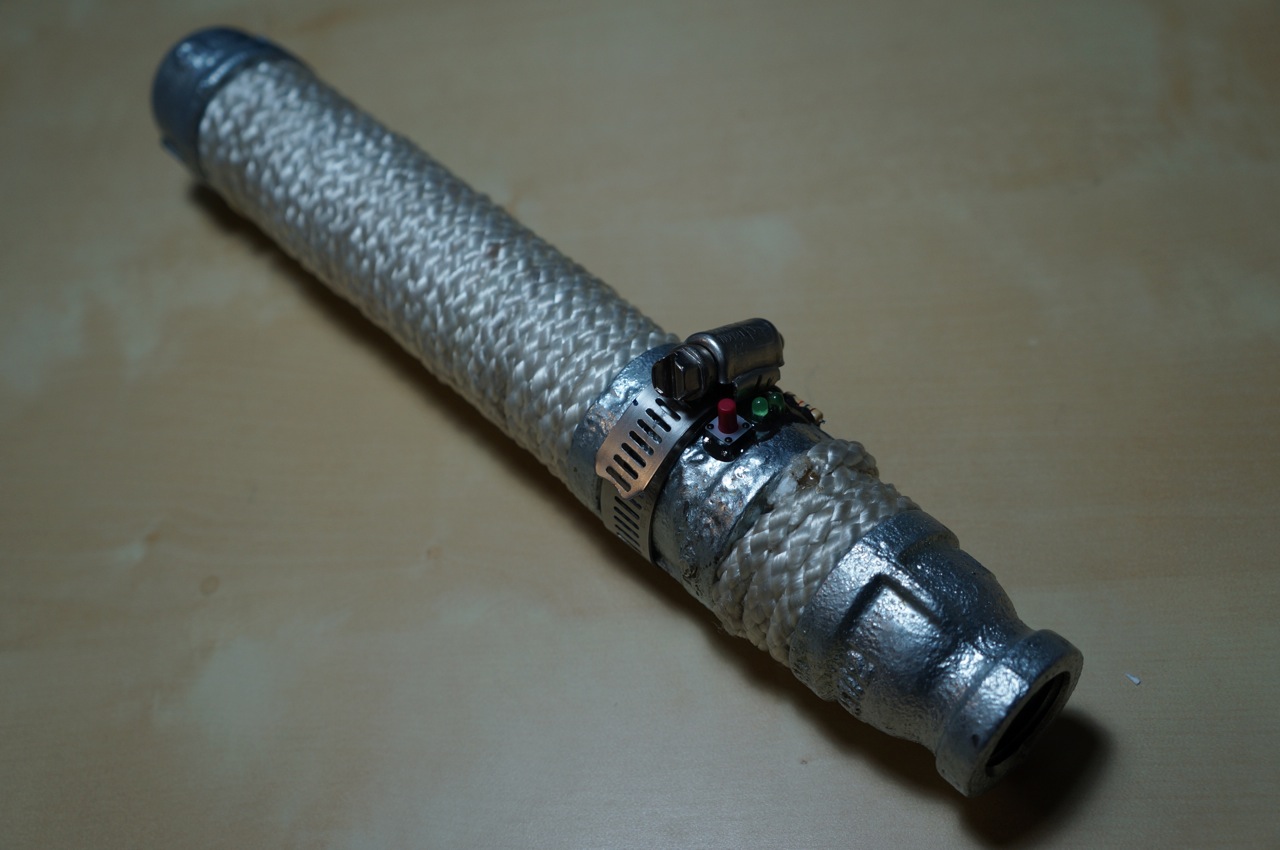
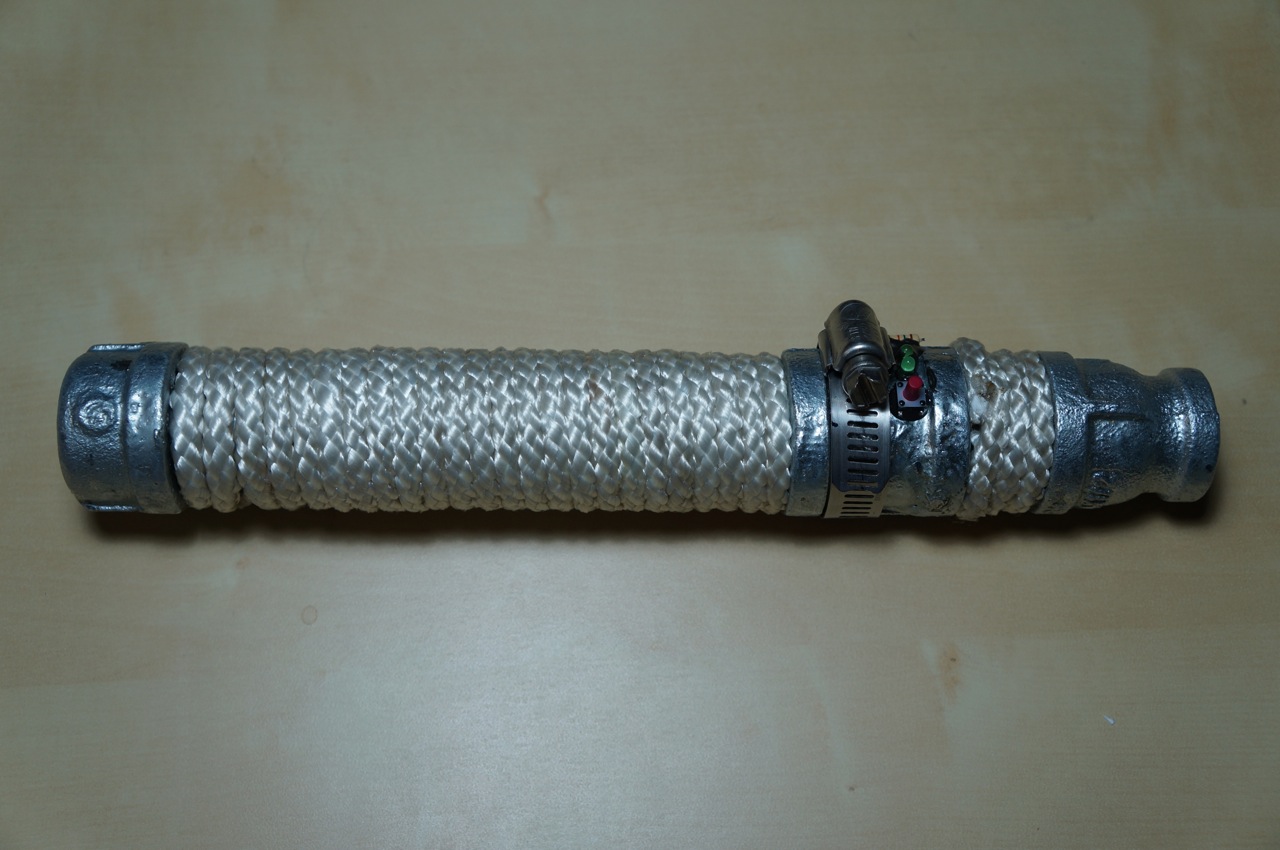
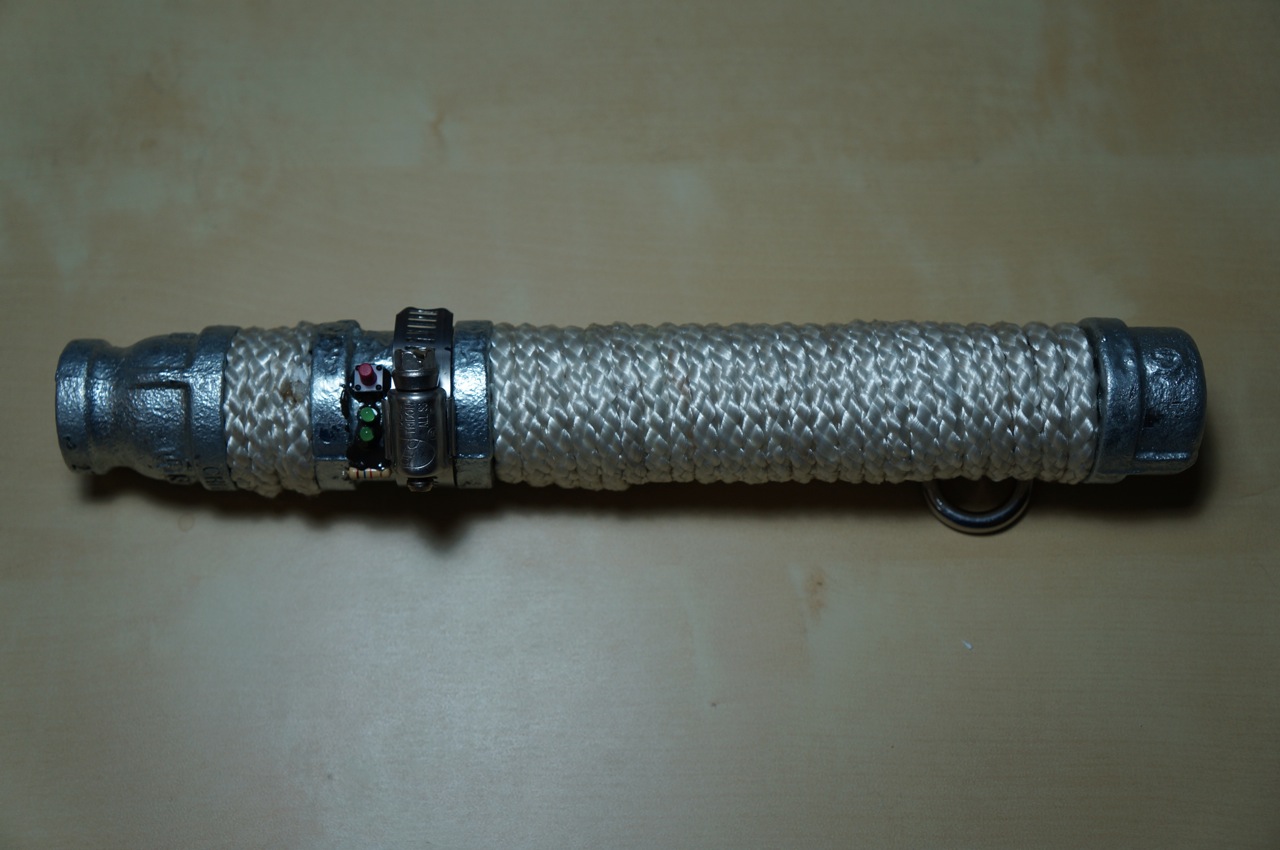
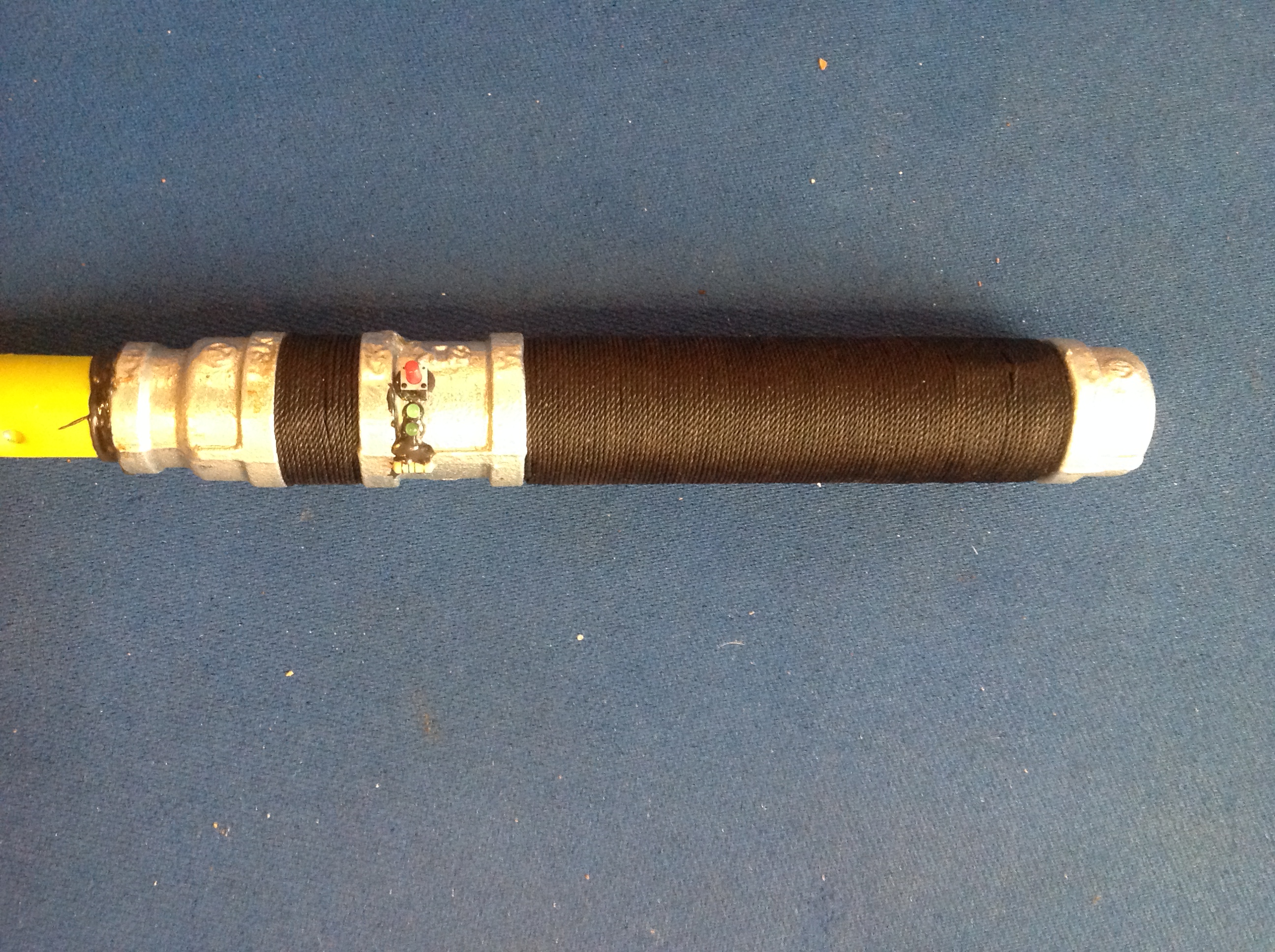
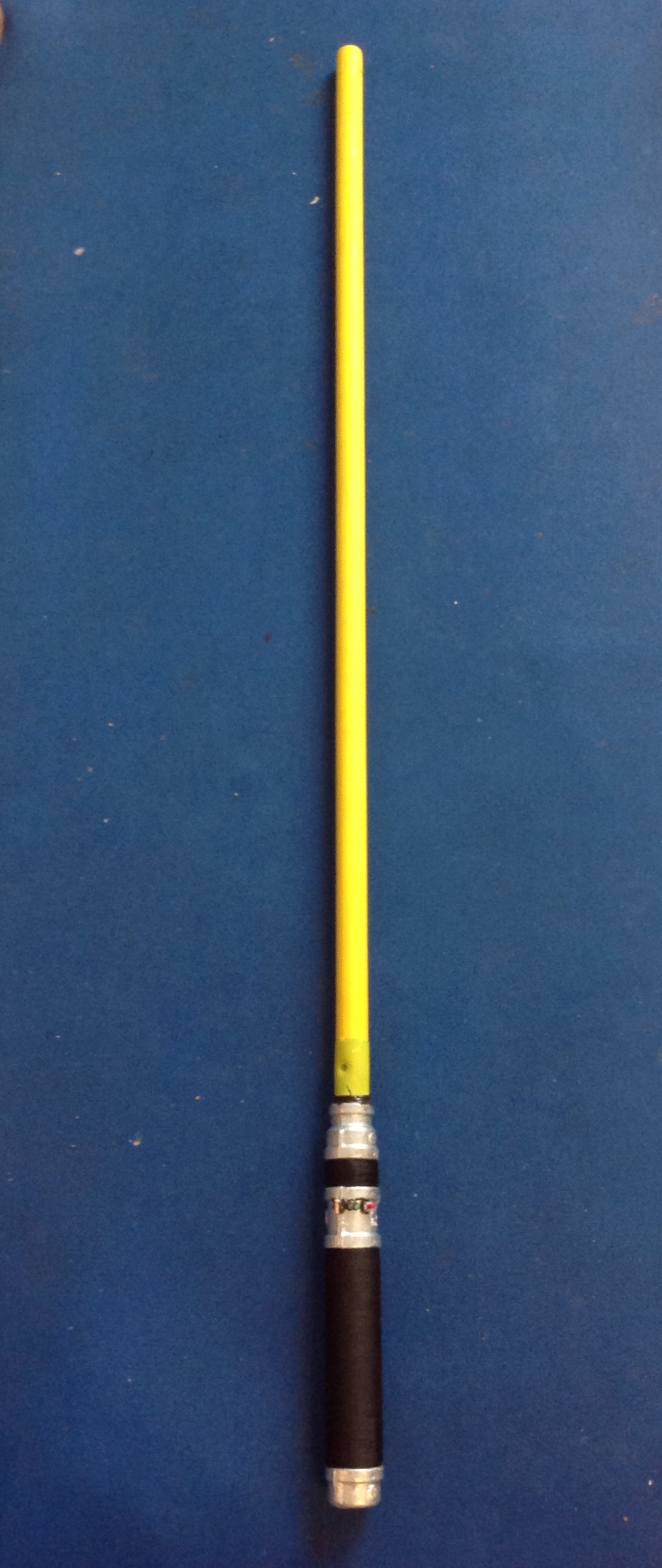
    My cousin Ryan Cox is a longtime practitioner of a variety of martial arts including kung fu and tai chi. Ryan and his two older brothers–Ian and Jarret–grew up learning, sparring, and developing uncanny skill in hand-to-hand combat and weapons sparring. While Ryan and his brothers have developed rhizomic networks to enhance their abilities and pass on what they have learned to others, Ryan has went the most far afield when he traveled to Wudang Mountain to train with the kung fu monks who reside there.

    Photo courtesy of Ryan Cox.
    Photo courtesy of Ryan Cox.

    When we were younger, I remember myself being the one drawn to the Star Wars mythos more than anyone else in my family, but now Ryan tells me that he was always interested in the Jedi, their mystique, and their lightsabers. In more recent years, he has learned a lot of the backstory of the Star Wars universe from books and video games. His knowledge in those realms far outstrips my own.

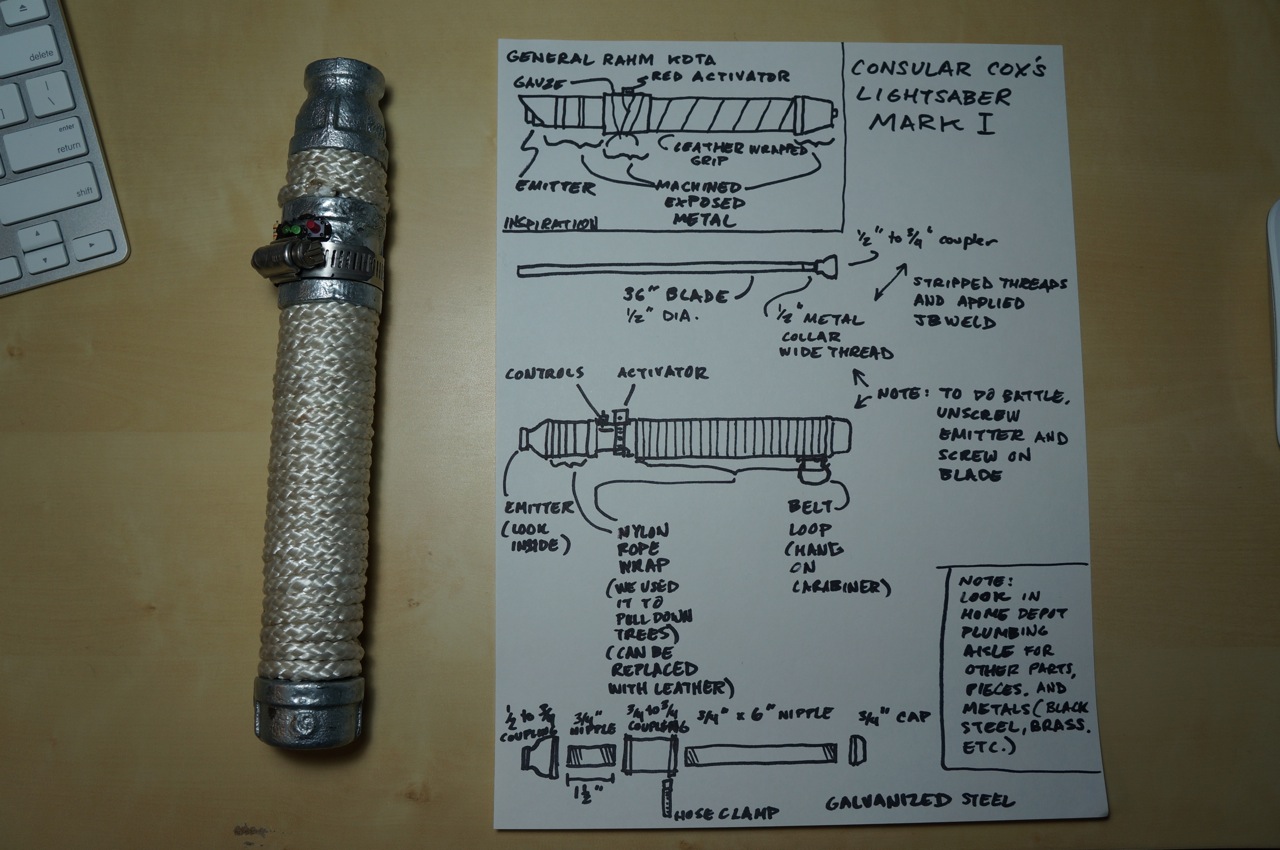
    So, I was intrigued when he began talking with me about building his own lightsaber for demonstrating his swordmanship and possibly sparring if the “blade” were strong enough to withstand strikes. The guide that follows illustrates the first lightsaber that I built for Ryan in the fashion of General Rahm Kota’s. I used off-the-shelf parts easily obtained at Home Depot or any hardware store. Since I built this lightsaber, Ryan has modified it more, and I have built two lightsabers for myself–one that resembles Luke Skywalker’s Return of the Jedi lightsaber and one that resembles Darth Maul’s The Phantom Menace double bladed lightsaber. This guide focuses on Ryan’s “Mark I” lightsaber.

    Pedagogically, I promote the idea that haptics, building, and making are integral parts to any kind of education. We are embodied beings who do things physically in the world–whether it be in real life or online. I enjoy building things in my own time as another way to think about things–in this case, Star Wars, science fiction, Jedi mythos, world building, canon vs. noncanon, and design considerations: rhetoric of technology, aesthetics, practicality, etc. In Ryan’s case, haptics, proprioception, and movement are integral to his learning and lived experience. I am looking forward to learning from him with this artifact that I designed and built. The modes are the same–physicality, materiality, and haptics–but our efforts converge from different directions for a kind of haptic, learning synergy.

    I began the project by assembling the parts that I needed for creating the lightsaber’s hilt and belt clip. I carried an image of Rahm Kota’s lightsaber on my iPhone and went to the plumbing aisle of my local Home Depot.

    lightsaber-DSC01972

    These parts included:

    • 6″ x 3/4″ galvanized steel pipe
    • 3/4″ coupling
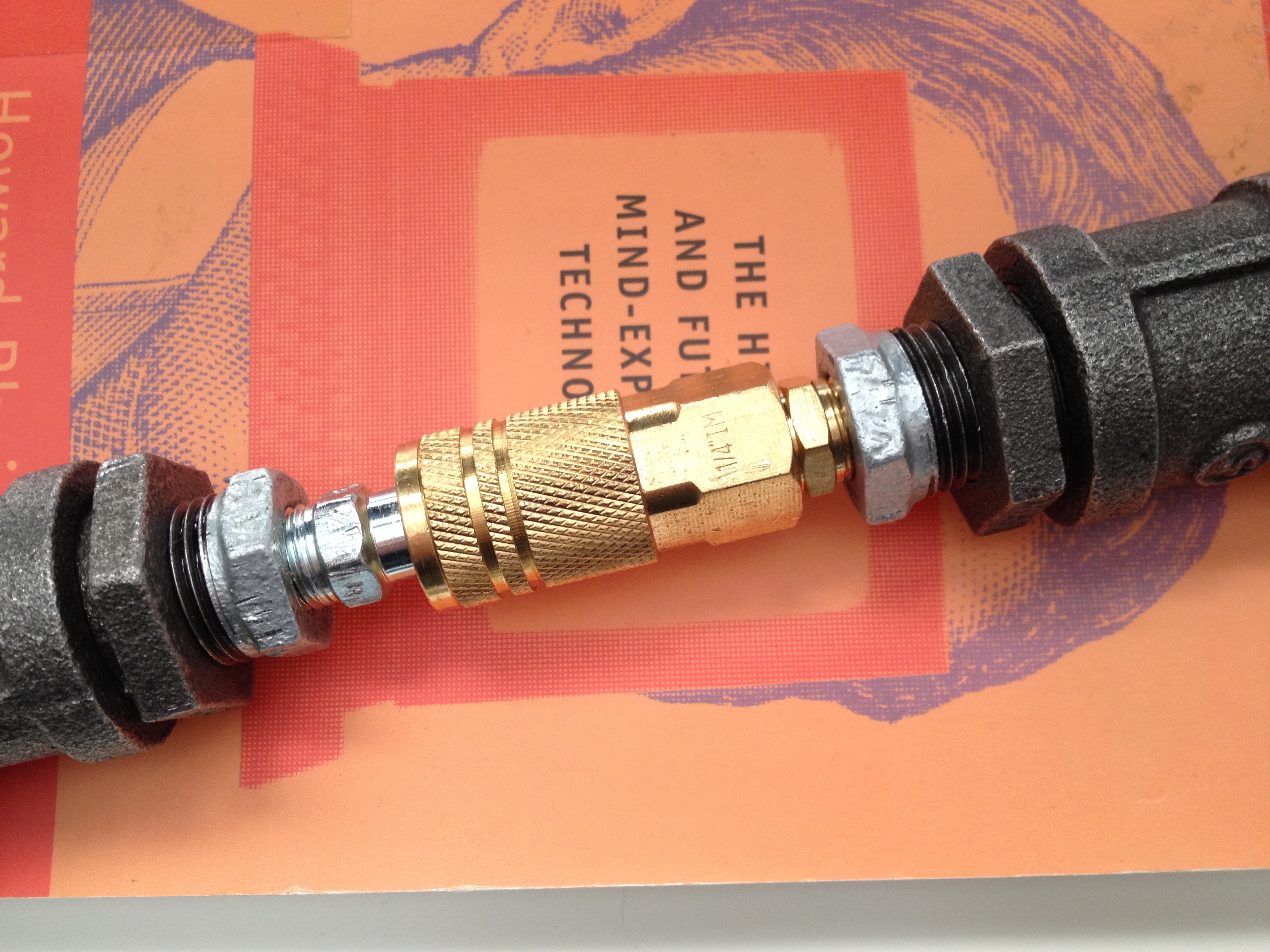
    • Two 3/4″ to 1/2″ coupling (one for display and one for sparring with permanently installed “blade”–these two couplings are interchangeable)
    • “Close” 3/4″ pipe (approximately 1 1/2″ long)
    • 3/4″ cap
    • D-ring
    • Carabiner
    • Hose clamps

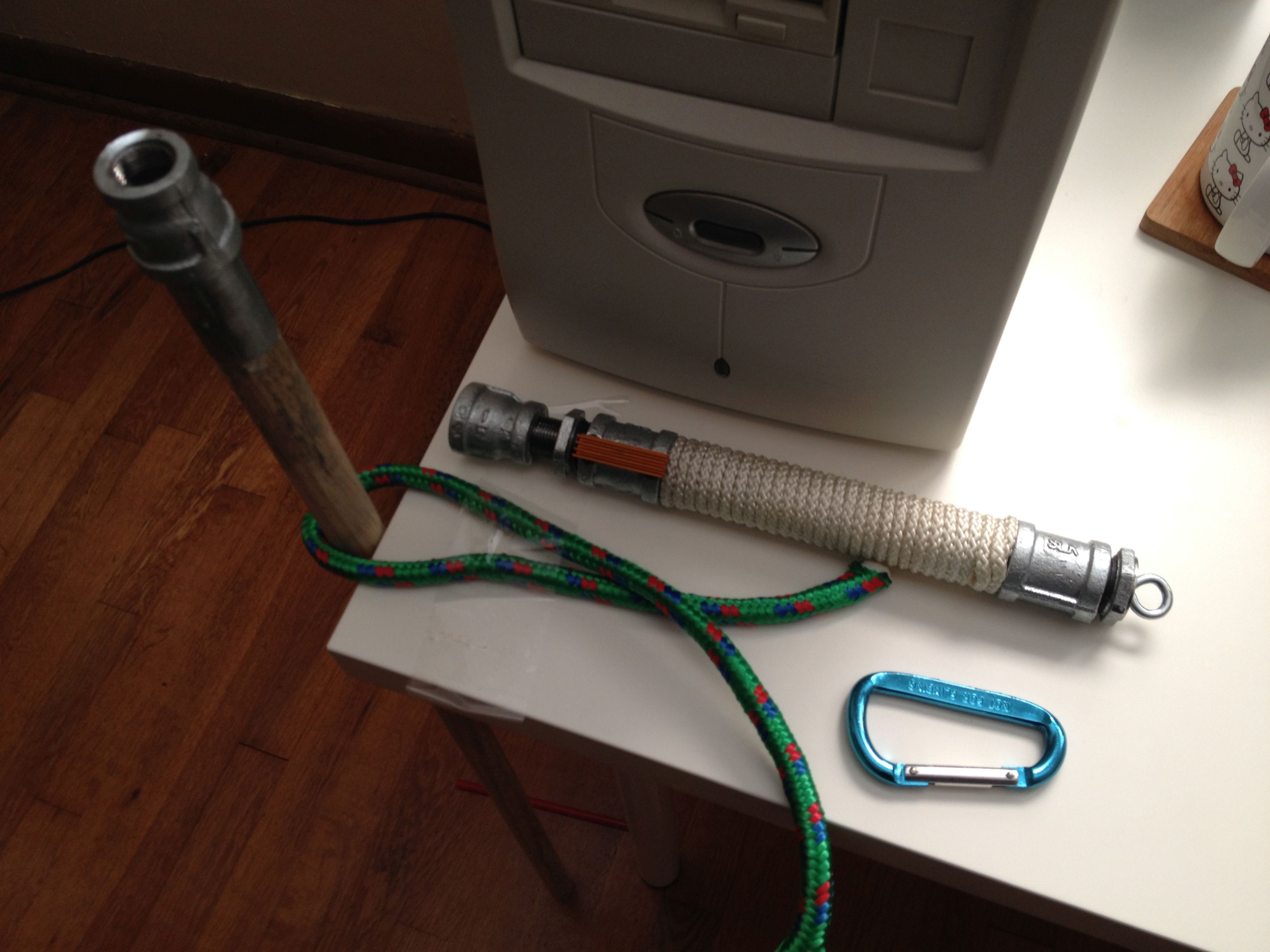
    Roughly, these parts are assembled to create the lightsaber:

    lightsaber-DSC01973

    Other parts that I used for this build include:

    • 1/4″ white nylon rope (grip wrap)
    • 36″ x 1/2″ oak dowel rod (scrapped due to paint problem)
    • 48″ x 1/2″ paint brush rod (cut to 36″ and replaced the oak dowel rod)
    • Doorbell button assembly (for parts)
    • 80mm computer case fan (for electromagnet assembly)
    • JB Weld
    • Rustoleum Florescent Yellow Paint

    To create the lightsaber’s handle, I screwed all of the handle components together except for the 3/4″ to 1/2″ coupling like this: 3/4″ cap | 6″ x 3/4″ pipe | 3/4″ to 3/4″ coupling | 3/4″ close pipe.

    lightsaber-DSC02005

    Then, I prepared the nylon rope to create the grip on the two pipe sections (6″ pipe and close pipe) by burning frayed ends to melt the nylon.

    lightsaber-DSC02009

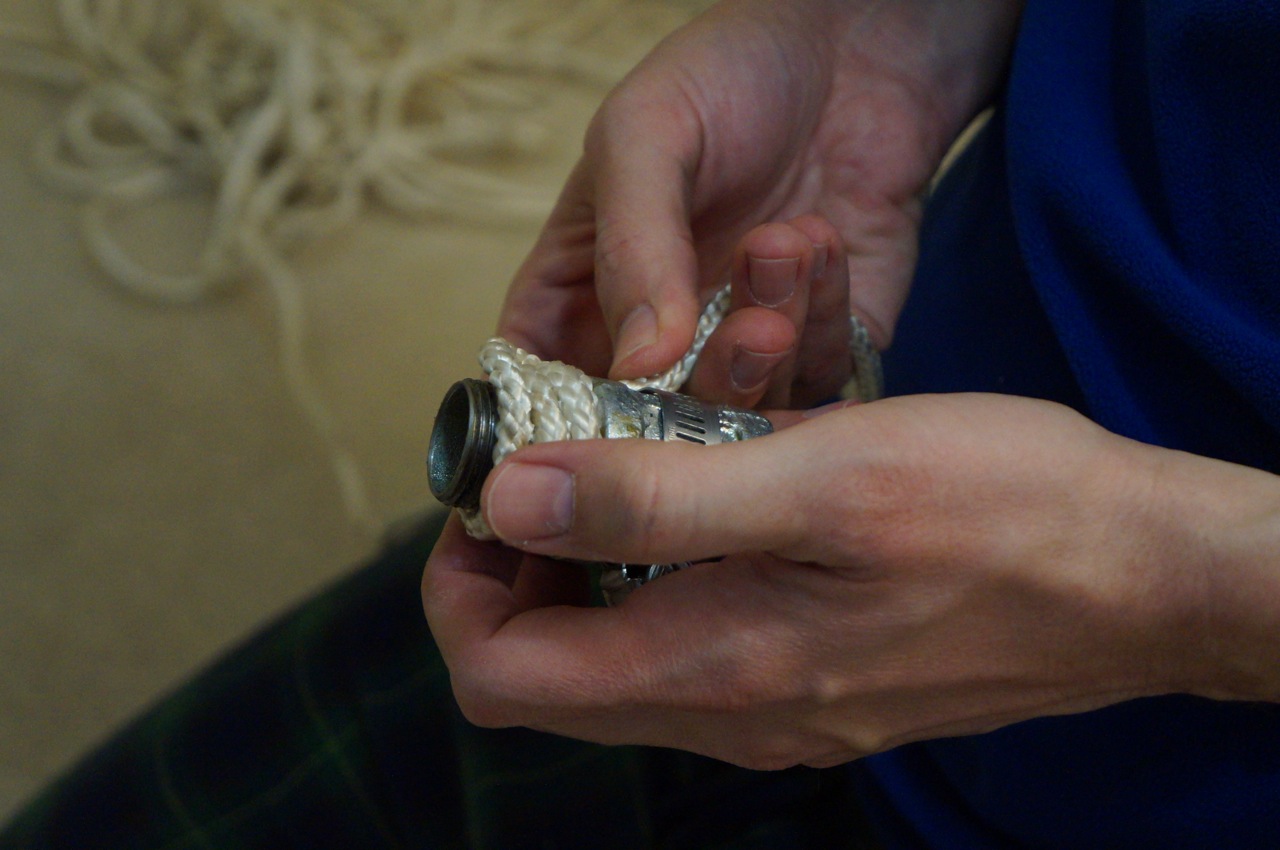
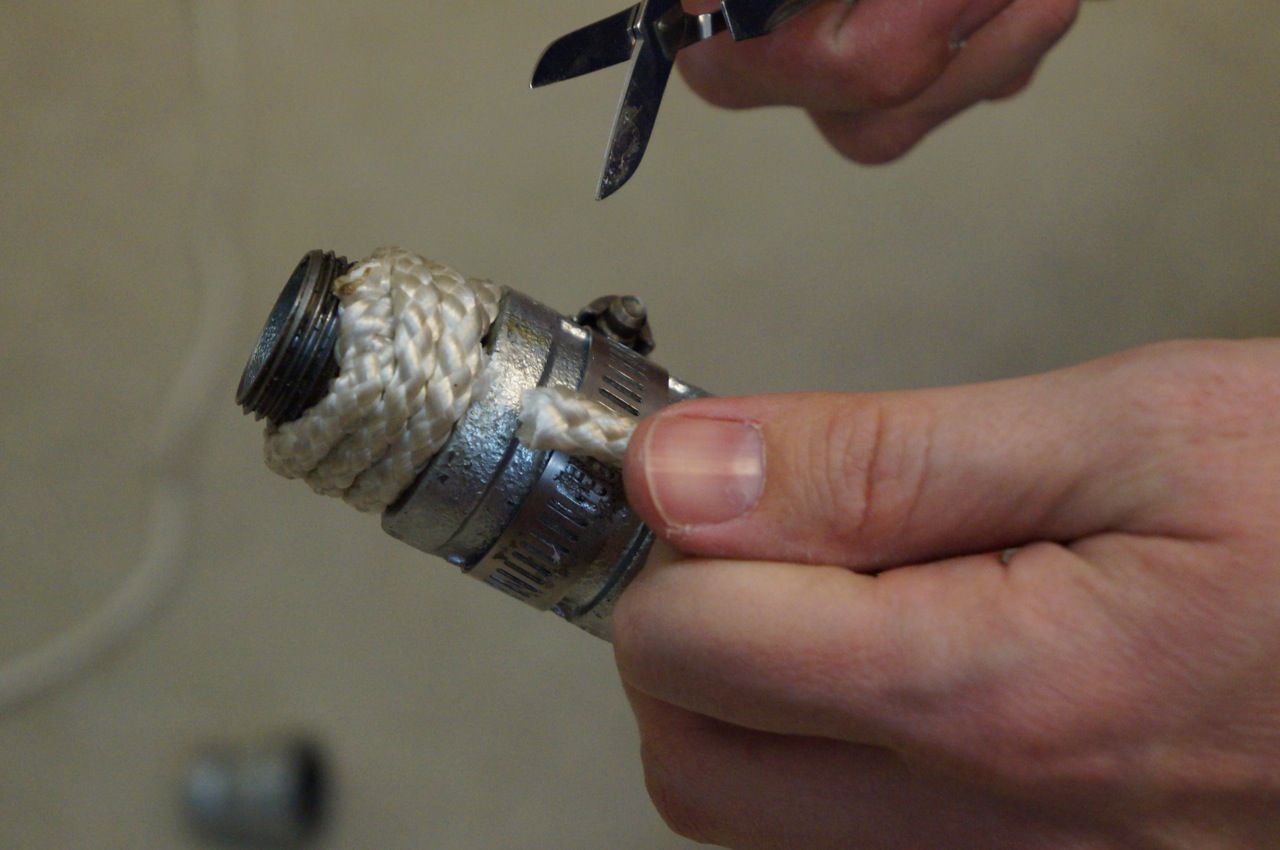
    Beginning at the business-end of the lightsaber, I tucked a small piece of rope under the first wrap against the 3/4″ coupling to hold the rope in place and prevent unraveling.

    lightsaber-DSC02011

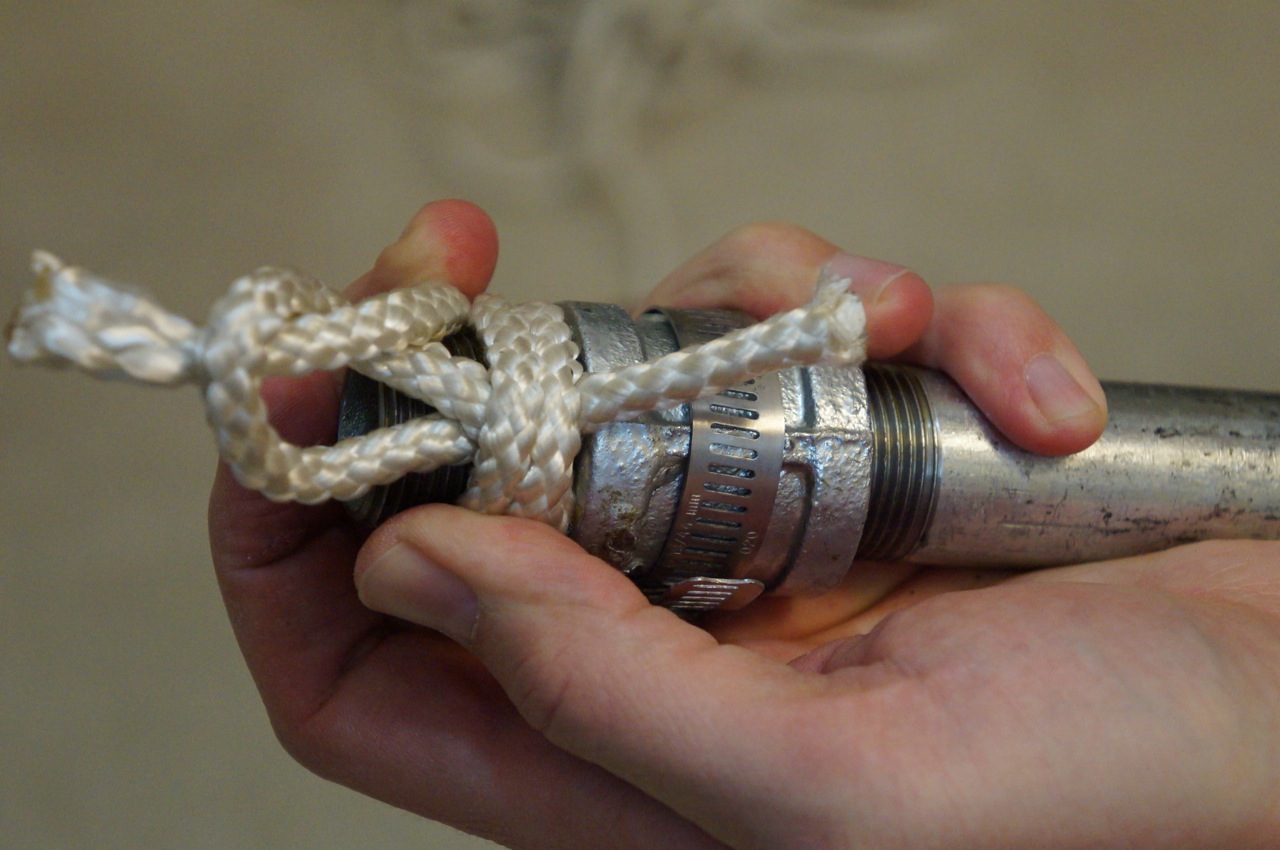
    At the top end, close to where the 3/4″ to 1/2″ coupling (or lightsaber emitter/business end), I created a loop with the rope under the last wrap, which I ran the last wrap through and pulled into the wrap, which hid the end of the rope under the wrap.

    lightsaber-DSC02019

    lightsaber-DSC02022

    I cut the loose ends.
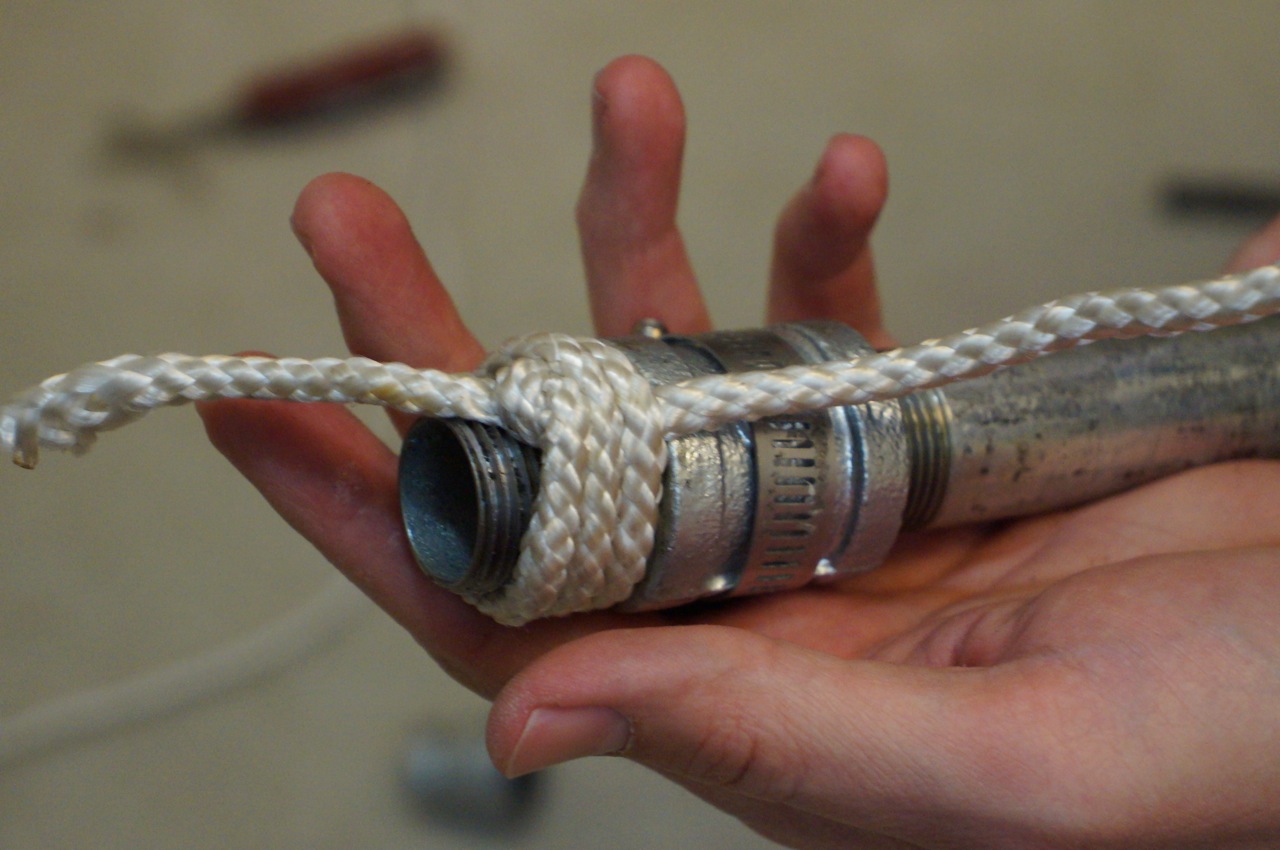
    lightsaber-DSC02023Beginning on the other side of the 3/4″ coupling, I repeated these steps with the longer wrap of the 6″ pipe section. First, a small piece under the first wrap.

    lightsaber-DSC02036

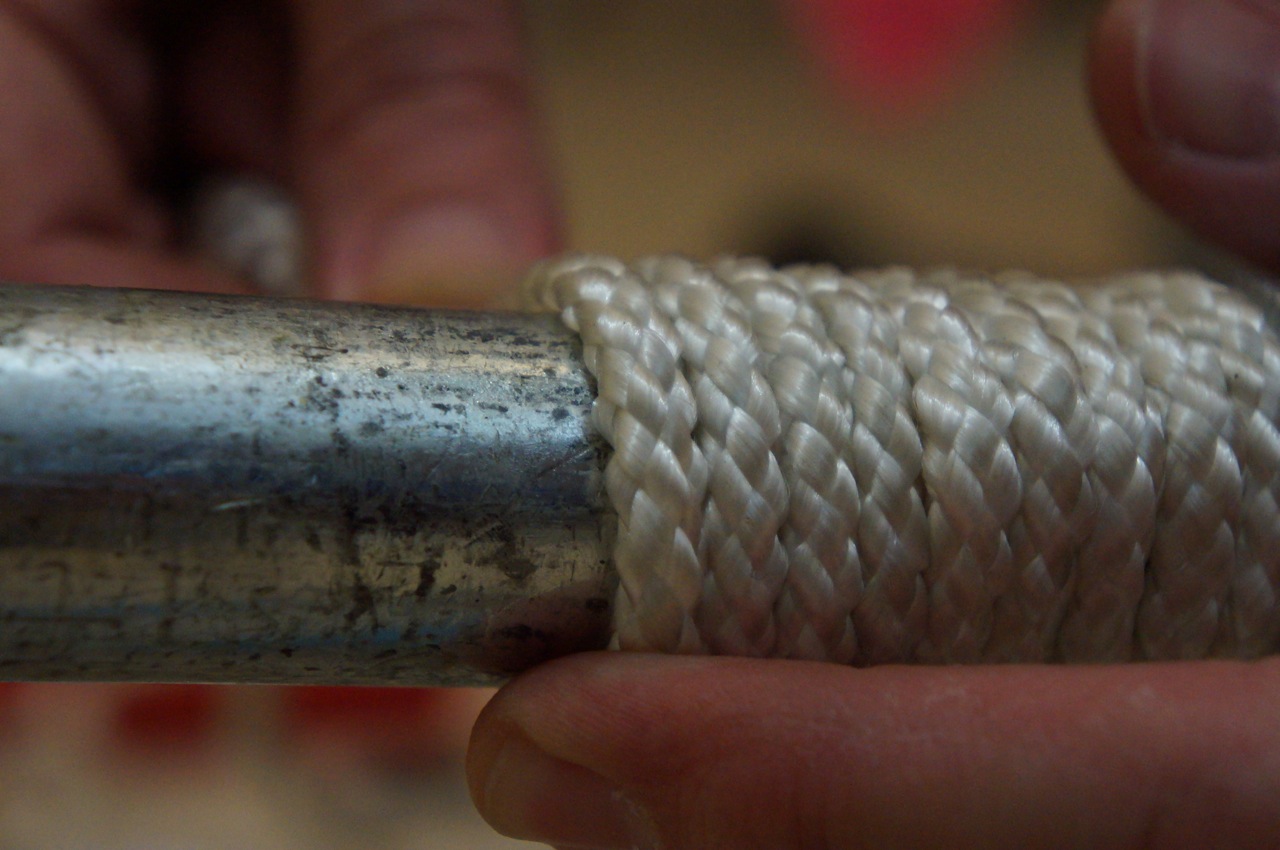
    I pulled the rope tight around the pipe and pushed each wrap down to keep the grip as tight as possible.lightsaber-DSC02041

    Mose tried to help with the process as much as possible.lightsaber-DSC02043

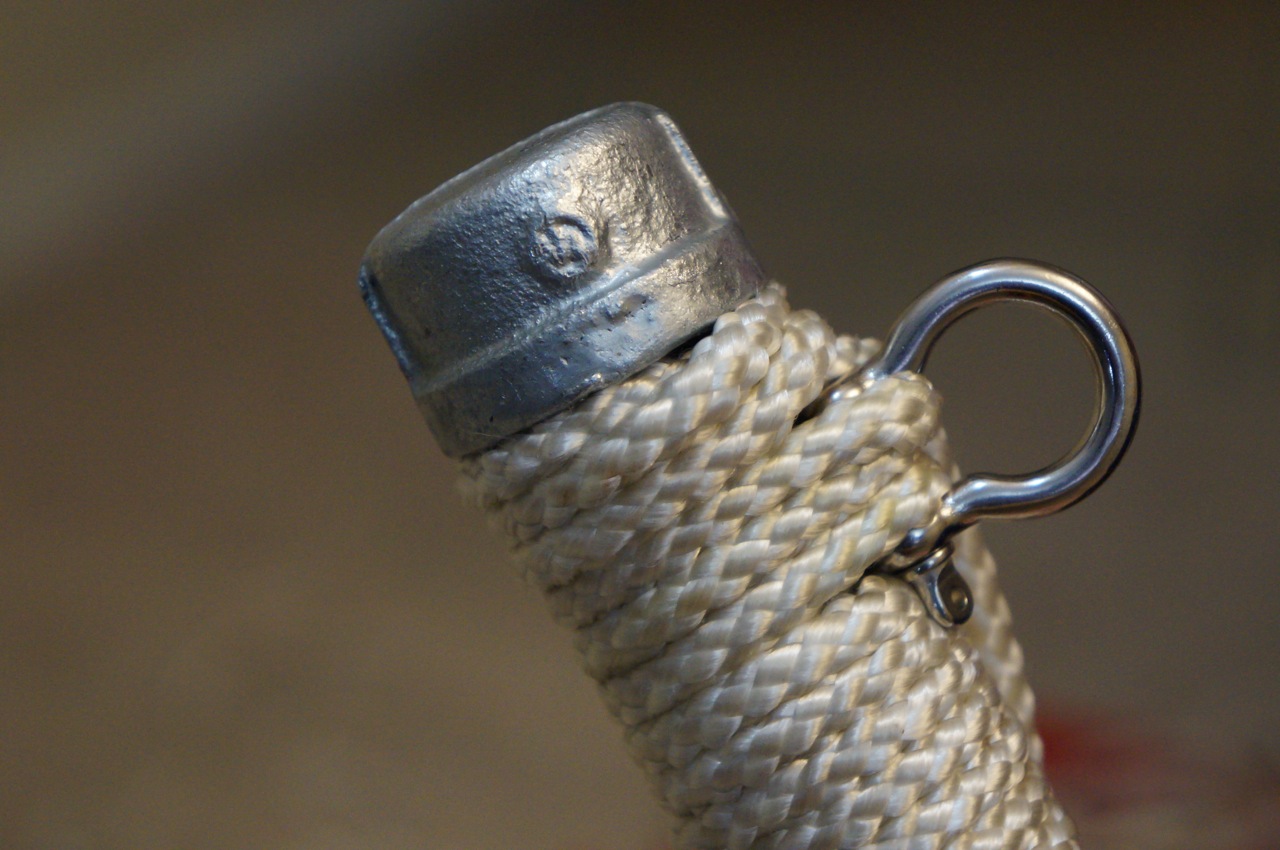
    At the end of the 6″ long pipe, close to where the end cap goes, I placed the D-Ring and ran the rope through its eye to connect it to the handle.

    lightsaber-DSC02050

    As in the shorter section wrap, I created a loop and pulled the end of the rope through and under the last lines of wrap to hide the end and prevent the grip from unraveling.

    lightsaber-DSC02051

    Finally, I installed the cap. Before doing this, I wrapped the grip higher than necessary so that the the cap would compress the wrap when tightly screwed onto the 6″ pipe.lightsaber-DSC02052

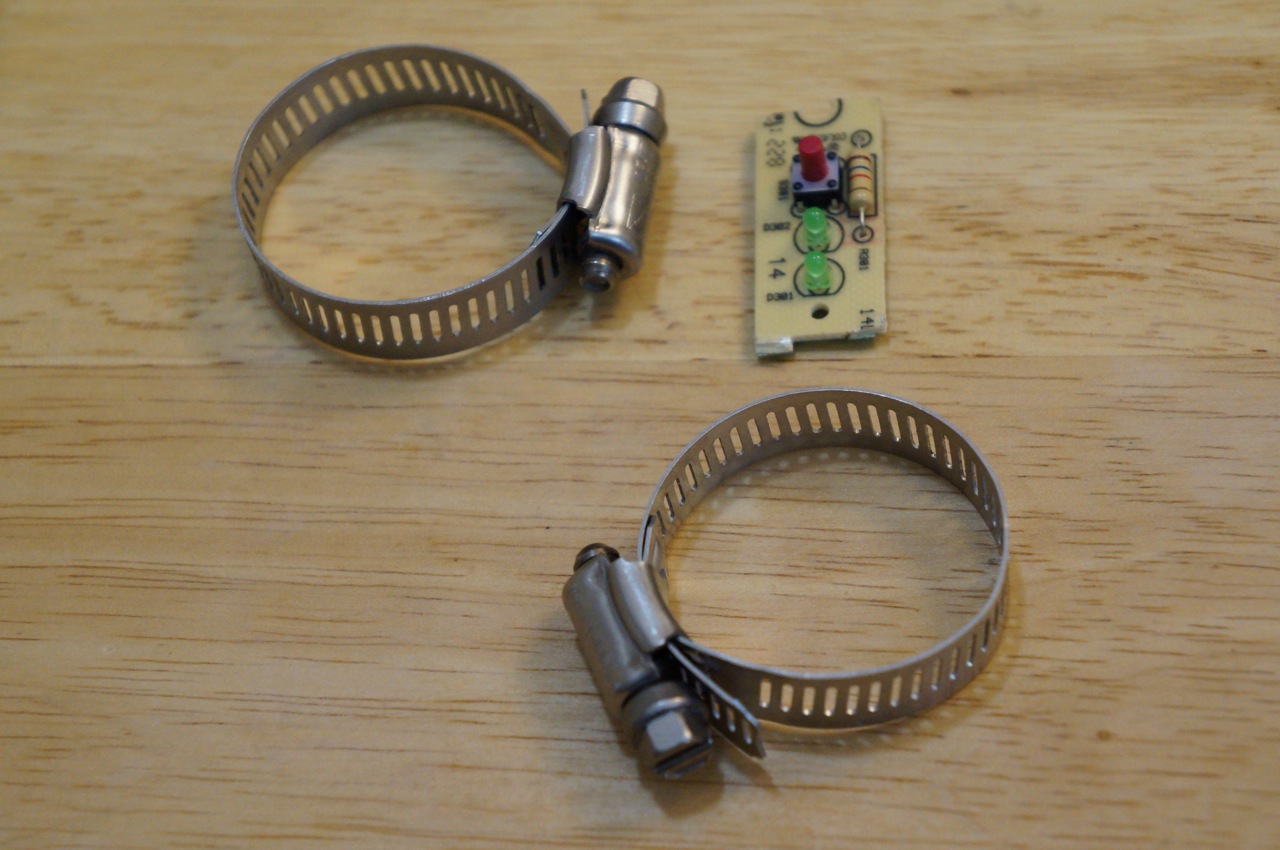
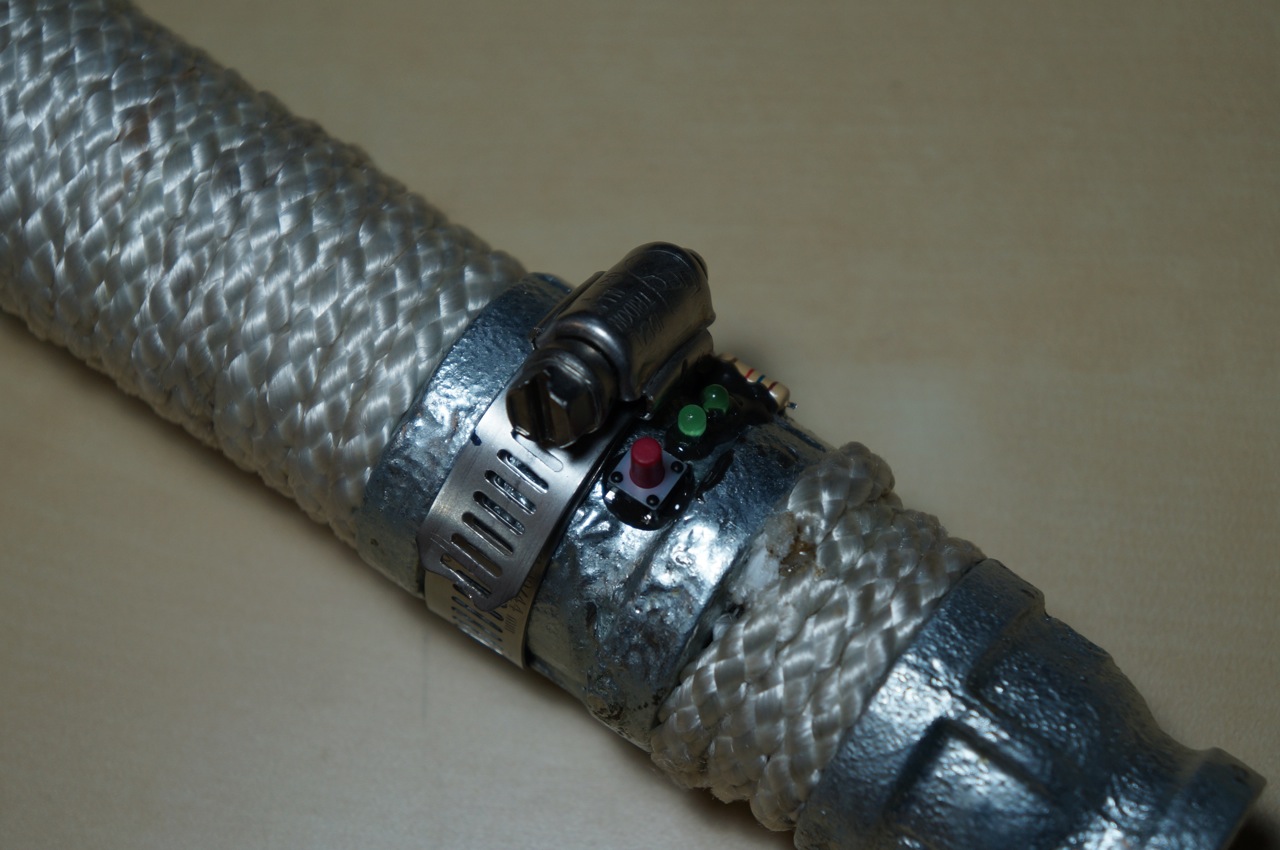
    Since Ryan would likely bang his lightsaber when sparring, I wanted to make it as practical as possible while giving it a technological appearance. First, I tried attaching a circuit board from an average doorbell button with two hose clamps.

    lightsaber-DSC02053 lightsaber-DSC02055 lightsaber-DSC02057

    While I thought this fit the rugged look that Ryan might like for his lightsaber, I thought that it would be more practical to use only one hose clamp and affix the doorbell components with JB Weld after removing them from the circuit board.

    lightsaber-DSC02090

    I liked this configuration best. The hose clamp protects the switch, lights (non-functional), and resistor.

    Next, I wanted the display emitter on the deactivated lightsaber (3/4″ to 1/2″ coupling) to look “realistic,” so I pulled the electromagnet from an 80″ computer fan, crushed it with my channelocks, and inserted it into the 3/4″ end of the 3/4″ to 1/2″ coupling. Repurposing the electromagnet draws on a visual/physical rhetoric of technology in the same way that movie props and set design use this for world building, extrapolating, and establishing plausibility.

    lightsaber-DSC02098 lightsaber-DSC02088

    The next phase of the lightsaber build involved the other sparring emitter. I needed to rigidly attach a wooden blade to the second 3/4″ to 1/2″ coupling in the 1/2″ end of the coupling and paint it to match the yellow blade color that Ryan sought (signifying the Consular Jedi).

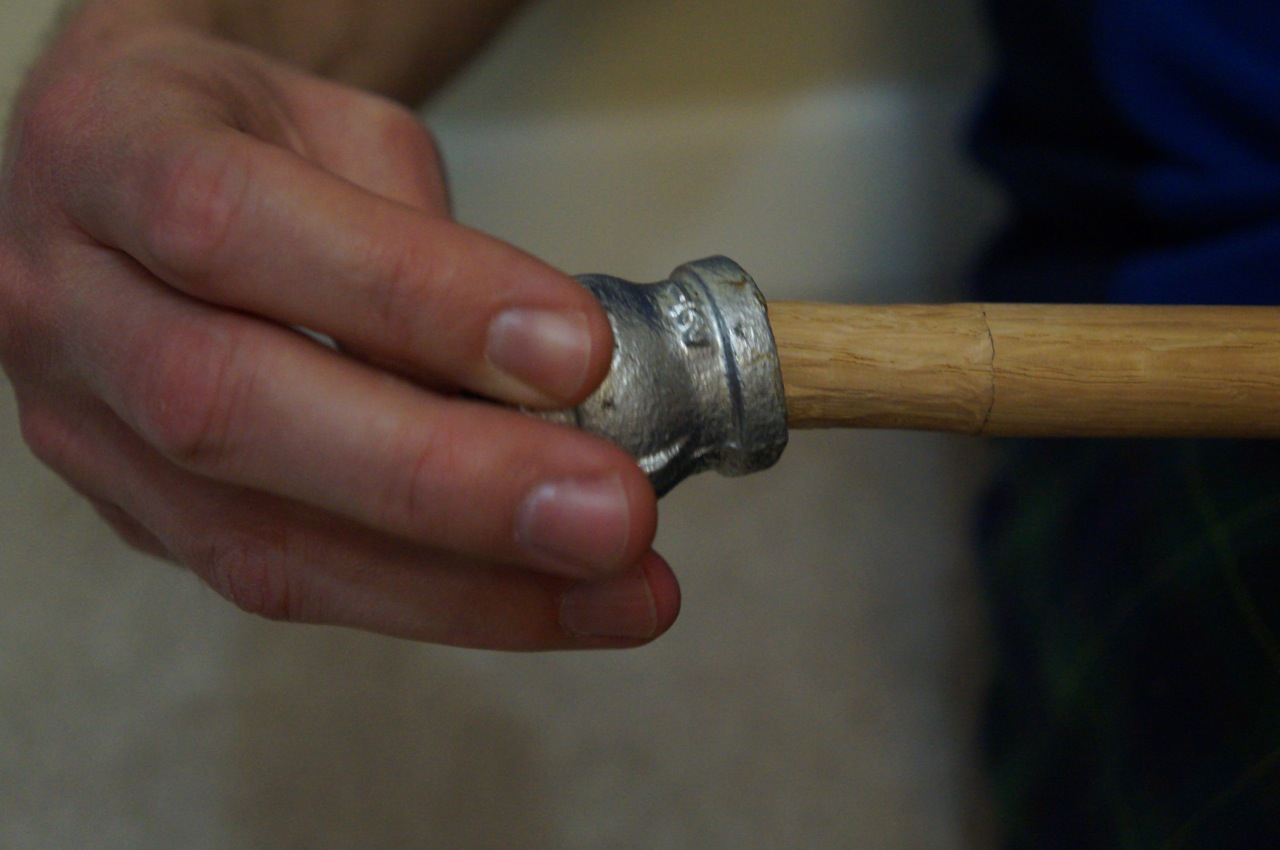
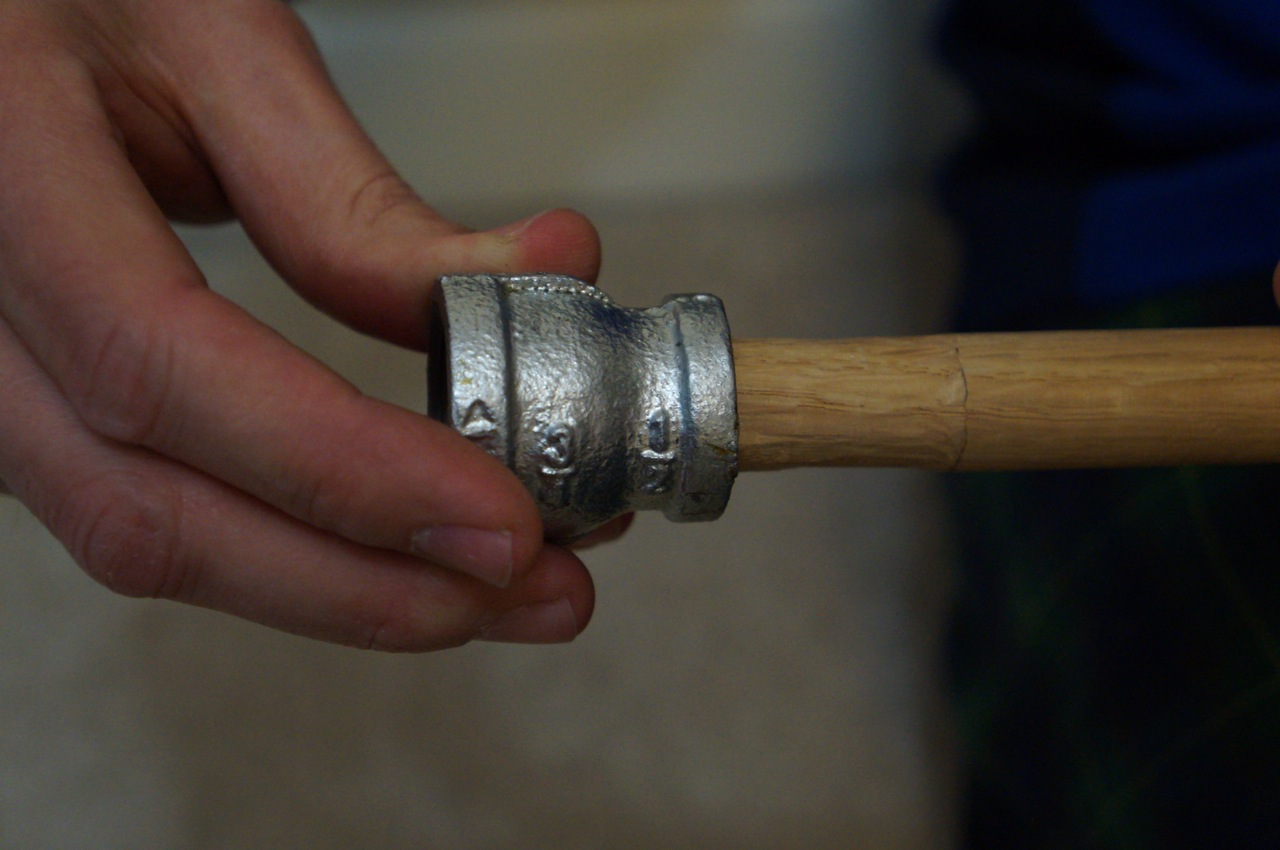
    I began by taking an oak dowel rod and whittling one end enough to screw it into the 1/2″ end of the 3/4″ to 1/2″ coupling.

    lightsaber-DSC01976 lightsaber-DSC01981 lightsaber-DSC01982 lightsaber-DSC01983

    Then, I used JB Weld to permanently connect the coupling to the dowel rod.

    lightsaber-DSC01988

    I had to make sure that I did not put too much JB Weld on the tip closest to the 3/4″ pipe thread, which screw into the “close” end of the lightsaber when the blade needs to be drawn.lightsaber-DSC01989

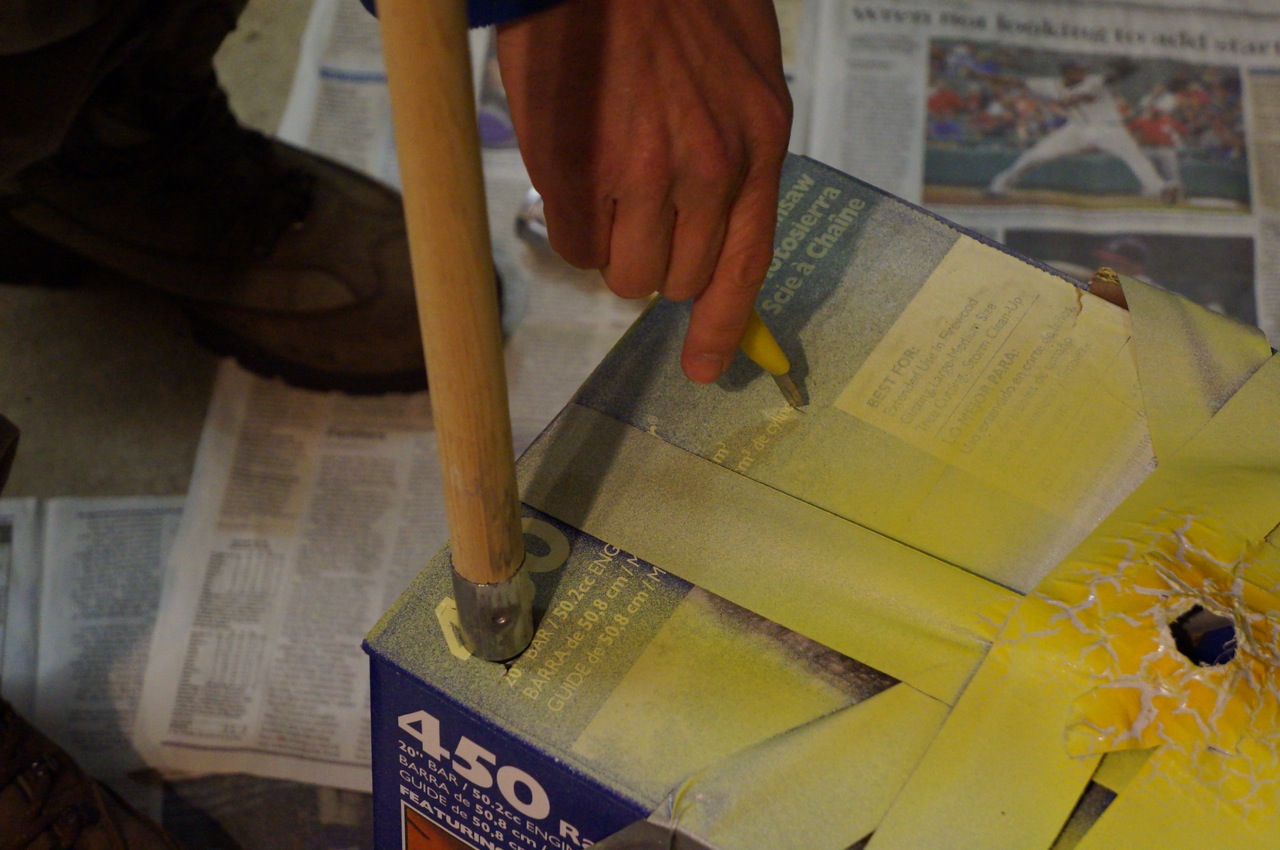
    I made sure that it was centered and straight.
    lightsaber-DSC02000

    Finally, I painted the dowel rod above the coupling with a primer and then with the florescent yellow.

    lightsaber-DSC02058

    lightsaber-DSC02072

    Unfortunately, I misread the spray paint cans and ended up with a mess when the florescent yellow would not stick to the dried primer (I mistakenly picked up white primer + paint instead of simply primer).

    lightsaber-DSC02075
    Luckily, I had a paint brush handle in the garage that was long enough to serve the same purpose even if it might be made out of pine instead of oak.

    lightsaber-DSC02073

    I cut the paint brush handle down to 36″.

    lightsaber-DSC02077

    Set it up for painting with the remaining florescent yellow paint.

    lightsaber-DSC02080

    Many coats later, it was a bright yellow befitting a Consular Jedi!

    After the paint dried, I screwed the metal end of the brush into another 3/4″ to 1/2″ coupling and bonded the blade to the coupling with JB Weld.

    lightsaber-DSC02094 lightsaber-DSC02095 lightsaber-DSC02096

    After everything had dried, I mated the blade with the lightsaber handle.

    lightsaber-DSC02102 lightsaber-DSC02103

    I was happy with the outcome of the lightsaber in deactivated mode, too.

    lightsaber-DSC02092 lightsaber-DSC02091 lightsaber-DSC02086

    I gave the lightsaber to Ryan as a birthday present. I included this explanatory diagram that explains how the saber is more than simply parts (e.g., the rope is from the same bundle that Ryan and I used when we cut trees down in my yard last year).lightsaber-DSC02085

    Since I build this lightsaber, Ryan removed the nylon rope grip and improved it with three layers of bank line or tarred twine. The result is quite impressive aesthetically and practically!

    IMG_8146
    Photo courtesy of Ryan Cox.
    IMG_0905
    Photo courtesy of Ryan Cox.

    I will post future posts on the lightsabers that I have built for myself and examples of our sparring (when we have the time for Ryan to teach me some things).

    UPDATE: Readers asked me to post photos of my other lightsabers–one inspired by Luke Skywalker’s lightsaber in Return of the Jedi and Darth Maul’s double-bladed lightsaber from The Phantom Menace. When I built these sabers for myself, I didn’t take as many photos of the process as in the lightsaber above for Ryan, but these photos should illustrate the basics of how to build similar DIY lightsabers.

    Luke Skywalker ROTJ Lightsaber and Stand

    IMG_4671This was the first version of Luke’s lightsaber. I am working from memory as I do not have the lightsaber in front of me to give the exact specifications. I believe that working from the left to the right: 3/4″ to 1/2″ reducer, 1/2″ threaded pipe 1″ long, 1/2″ to 3/4″ bushing, 3/4″ coupler, 3/4″ pipe 7″ long, 3/4″ coupler, 3/4″ to 1/2″ bushing, flat washer with eye bolt affixed (epoxied into bushing). The orange lightsaber control attached to the first coupler is from a computer motherboard heatsink (sawed in half with a hacksaw) and epoxied to the coupler. The wrap is nylon rope.

    IMG_4761In the next iteration, I replaced the nylon rope wrap with rubber o-rings that I ordered online (pack or 40 or 50). To install the o-rings, remove the last coupler on the right and roll down the o-rings one-by-one.

    To display Luke’s lightsaber, I used smaller pipes attached to a wood base (two different sizes of lumber screwed together through the metal base connected to the pipes).

    Darth Maul’s Double-Bladed Lightsaber

    IMG_4672I built this Darth Maul inspired lightsaber as a way to figure out an easy way of having a two bladed saber that can split into two separate lightsabers. My solution was to use quick disconnect air hose fittings.

    IMG_4673In order to make this work with the larger pipes used for Darth Maul’s lightsaber, which appears heftier in Episode I, I had to use two bushings to reduce down to the smaller size of the air hose fittings.

    IMG_4593Here is the double-bladed lightsaber connected.

    IMG_4594Here is the double-bladed lightsaber disconnected into two separate sabers. I didn’t build blade attachments for this saber, so I couldn’t test how much pressure/stress could be applied to the quick disconnect coupler that holds everything together. I suspect that this kind of assembly can only be used for show rather than demonstration of saber techniques (as I had constructed the two sabers above). With further modification, I believe that someone could sheath the quick disconnect coupler with metal so that the saber appears more solid from end-to-end instead of having this smaller, weak point in the middle as this demonstration saber appears.

    I hope these extra photos and explanation help. Good luck with your builds, and please share any photos that you post online of your sabers in the comments below!

  • Recovered Writing: PhD in English, Independent Study with Mack Hassler, Literary Characters, Online Persona, and Science Fiction Scholars: A Polemic, Dec. 9, 2008

    This is the thirty-eighth post in a series that I call, “Recovered Writing.” I am going through my personal archive of undergraduate and graduate school writing, recovering those essays I consider interesting but that I am unlikely to revise for traditional publication, and posting those essays as-is on my blog in the hope of engaging others with these ideas that played a formative role in my development as a scholar and teacher. Because this and the other essays in the Recovered Writing series are posted as-is and edited only for web-readability, I hope that readers will accept them for what they are–undergraduate and graduate school essays conveying varying degrees of argumentation, rigor, idea development, and research. Furthermore, I dislike the idea of these essays languishing in a digital tomb, so I offer them here to excite your curiosity and encourage your conversation.

    In 2008, I began my Ph.D. work with Dr. Donald “Mack” Hassler. Ultimately, he directed my dissertation and we became friends.
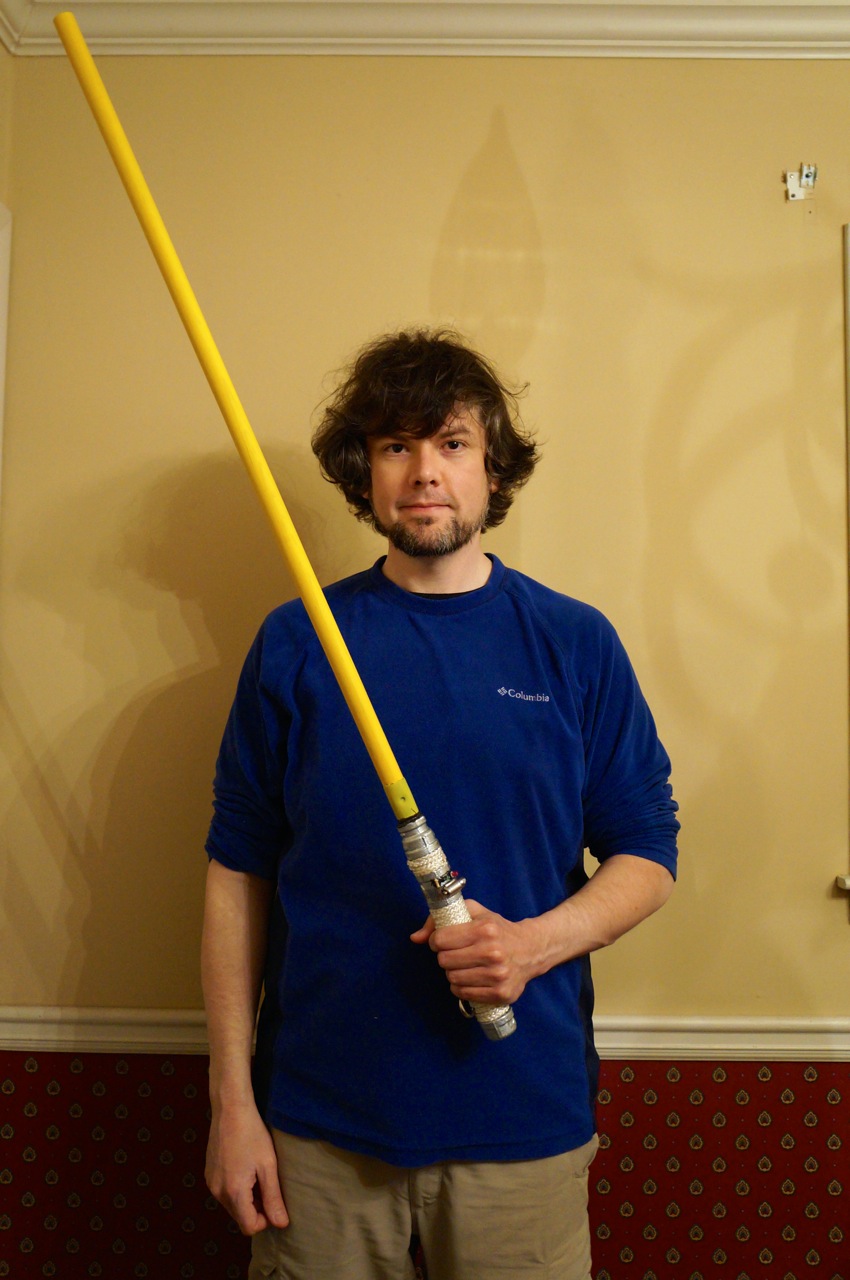
    On the advice of friends in the SFRA and of having read Mack’s first Political Science Fiction collection while at the University of Liverpool, I wanted the opportunity to study at Kent State University and work with him.

    This is the third and final artifact that I produced during my coursework independent study with Mack focused on Philip K. Dick, postmodernism, play, parody, and performance. As an invested SFRA member and its then-publicity director, I was concerned about the chilling effects a troll and his sock-puppets wreaked on our email list at that time. Ultimately, Mack helped me steer the independent study in that direction to theoretically grapple with online discussions in real life (RL).

    Jason W. Ellis

    Dr. Donald M. Hassler

    Independent Study

    9 December 2008

    Literary Characters, Online Persona, and Science Fiction Scholars:  A Polemic

    Chaos often breeds life, when order breeds habit.

    –Henry Adams, The Education of Henry Adams (1918)

    This essay’s objects of study include the community of Science Fiction (SF) scholars, of which I am a member, as well as our practices of online communication and discussion.  In September 2008, the normal intermittent conversation on the email list of a long established, professional organization of SF scholars was disrupted, or derailed, which might be a better description, by the controversial, inflammatory, or perhaps unexpected emails of two list participants with different originating email address–one a dues paying member of the organization, and the other a non-paying email-only list member.  However, these two seemingly separate persons are in fact two online personas or characters created and operated by the same individual.  The real world person responsible for these personas is clearly playing with character and online identity engineering.  For the two personas, he constructs identity and narrative of self through verbal wit and word play that has its antecedents in literature, or what I call Pulp Media. This online, or New Media, practitioner of online persona engineering largely caught the SF scholar community woefully unprepared to meet his persona on the page, or rather on the screen. Instead of engaging the personas within cyberspace on the email discussion list, which often carries conversations about marginalized identities and the alien Other, many list participants chose to react against the list personas. Why did these scholars, arguably some of the most engaged persons dealing with issues of Otherness, attempt to expel, rather than embrace, the Othered personas?  Can SF scholarship overcome a privileging of literary texts, and expand their work to the realm of daily practices and the real world of science fictional technologies (i.e., the Internet) that facilitates their professional work?  Or, is SF scholarship divorced from the present through its overemphasis on the future or alternate worlds imagined in its traditional objects of study?

    I approach these questions first through a discussion of literary character and persona.  Then, I employ psychology as a bridge between literary character and online identity or persona. In this paper, I argue that character in Pulp Media is replicated in New Media with the recognizable exception being the proliferation of persona narrative construction online, which results in the necessity of reflective revision of our practices in cyberspace, including our supposedly isolated forums of discussion.

    The online personas on the SF email list are indicative of the doubleness of character in literature.  Obviously, writing the self and creating doubles of character in literature have a long history in literature.  The touchstone work is Saint Augustine’s Confessions (397-398 AD), in which he attempted to reflect on his life, memory, and self.  However, he realized that memory and self change over time and his record of self in the Confessions can be best thought of as a representation of self as recorded through the lens of memory.  Other forms of doubleness take on a more fictional aspect such as that in Mary Shelley’s Frankenstein (1818), and her characters: Victor the creator, and his created Monster.  However, the Monster also doubles humanity, because he falls in love, or desires companionship of a female mate.  Even though he is called the Monster, he is in fact very much human–one that is isolated, alone, and ostracized as the Other.  A more emphatic and explicit form of doubling takes place in Robert Louis Stevenson’s Strange Case of Dr. Jekyll and Mr. Hyde (1886).  The title’s namesakes equate to one person with a schizoid personality–a person split into different, and even competing identities. Though, as different as Hyde is from Jekyll, there still remains the underlying core of humanity and human identification. Still much later works, such as Philip K. Dick’s Do Androids Dream of Electric Sheep? (1968), continue to feature doubled characters.  In this case, the Replicants, android workers of the future, double humanity, and it is the ambiguously human characters who doubt their own humanity and fear the possibility of being the Other.  In these examples, there is a crisis of identity, because the division of self obviously destabilizes what is assumed to be a unified identity or sense of self.

    These crises exist in written form as literature and as words written by persons, each with a unique mind, and literature forms a corpus of evidence for the mind and its machinery.  Therefore, the early developments in the scientific study of self and identity came to rely on this evidence.  Sigmund Freud relied on classical literature (e.g., Oedipus Rex), and his love of British literature (e.g., Shakespeare’s Hamlet) to develop his theories of self and pathologies of mental illness.  The significance here being that there is an interconnection between Freud’s work on the mind and the pathology of mind, and literature. Freud’s theory of self established that our mind, and its underlying workings, is divided between the surface conscious mind–ego, and the subsurface unconscious mind–the superego and the id. Despite this division of mind, normal persons supposedly present an integrated sense of self or identity to the world. Further developments in the pathology of a unified public self was made by Eugen Bleuler, who extends Freud’s work with his categorization and naming of the schizophrenias, which included the now distinct pathology known as dissociative identity disorder, or the explicit division of self into distinct personas.  Following this work, violations of the unity of self in daily life are perceived to be indicative of disease or illness, and necessitating treatment or institutionalization. However, this phenomenon is presented in literature both before and after Freud and Bleuler’s work. Doubleness of character, doppelgangers, and literary personas in literature are high literary markers, and there is a profusion of such literary/psychological devices in literature following the wider popularization of psychoanalysis.  I do not mean to say that one necessarily follows from the other, but instead, there is an ever presence of human minds creating literature, which obviously leaves psychological traces embedded in the work. However, there must be a conscious as well as unconscious injection of these themes into literary works, particularly following the increase in awareness of mental disorders and key psychological concepts.  With that being said, doubleness pervades literature, and there is a recursive operation at play following the dispersal of the Freudian theory of mind.

    This pervasion is clearly evident in the doubleness inherent to the New Media, which derives in part from its literary and pathological precedents, but it also has to do with the material conditions of plugging one’s self into the network.  William Gibson, hovering over his Hermes 2000 typewriter, envisioned the physical jacking into cyberspace, a neologism of his creation that has since stuck, in his 1984 novel Neuromancer. There is a separation between the meat (i.e., body) and mind.  The meat confines the potential of self unleashed within the “consensual hallucination” within the computer network.  This is made more visually real a decade and a half later in the Wachowski Brother’s film, The Matrix (1999), when the human characters jack-in to the computer world they leave their weak bodies behind in Baudrillard’s “desert of the real,” and become the Übermensch within cyberspace.  The characters, including Case in Neuromancer, Neo in the Matrix, and Hiro Protagonist in Neal Stephenson’s Snow Crash (1992), each invent spectacular online identities with special powers and abilities that contrast, more or less, with the material reality of their bodily identity.  Is this not true of many persons of imagination that enjoy SF, comics, and video games as a way to leave, or at least ignore, the confines of material reality and explore the potential and promise of the undiscovered country of the imagination with their doubled selves?

    One such imaginative space, perhaps with the most potential for invention, is the Internet and its New Media technologies.  New Media has made possible a proliferation in the engineering of self and creation of persona–a doubling that occurs purposefully as well as incidentally.  Playing with character was largely confined to print, and it was not allowed in real life due to the pathology of a split identity.  The New Media proliferation of self and character experimentation has resulted in new possibilities as well as problems.  The possibilities include trying out new attitudes and beliefs in the relative protection of cyberspace, which is one of the themes of Greg Egan’s novel Diaspora (1998), albeit with digital beings that switch mental perspectives, which we might conceive as being central to identity. Another New Media possibility is the making connections and linking into new circuits and communities within the sprawling network.  This empowers the building of self through community and interaction that might otherwise be a challenge (e.g., geographically or demographically), or danger (e.g., a transgendered person talking with other transgendered persons in a community with groups openly violent to such persons).  Additionally, some persons create multiple online identities or characters as protection or to remove prejudice within online communities (e.g., a girl pretends to be a guy to avoid harassment, or a college-aged woman uses only her first initial and last name on email correspondence to avoid gender bias).  In contrast to these possibilities is the central problem and holdover from the real world–the assumption of a unified sense of self.  Even within cyberspace where doubling is essential to any interaction with the network, there remains the awareness of illness when there is a violation by others of an appearance of unity of self. There may be a sense of betrayal when the ruse, if you want to use that word, is uncovered. Other ways of responding to such a situation of online persona creation is deception.  There is the assumption of dealing with an individual behind the online persona or avatar, and that this is a one-to-one ratio. When one person has a chorus of voices, characters, or personas, this may lead to the feeling that there is deception–that one is hoodwinked.  However, the fact remains that New Media enables and in some cases, such as Blizzard’s massively multiplayer online role-playing game (MMORPG) World of Warcraft, encourages such multiple persona creation.  The technological assemblages of the Internet and New Media is built on multiplicity, copy-and-paste, and the passage of bits unencumbered by the realities of the persons corresponding with those bits of data. Nevertheless, there still exists for many the knee-jerk reaction of our real world conditioning that a violation takes place when the assumption of unified identity is breached, even in such an environment as cyberspace.

    The reaction of many of the participants, myself included, on the SF scholar email list strongly indicates that old habits die hard. Evidence for this comes from the fact that list participants overwhelmingly reacted against these Othered personas rather than engaging the play and internal logic of the two characters. There were exceptions, but it would probably have required a unanimous positive response to avert the ensuing chaos on the list.  Some of the not-so-positive responses to the personas, but more so the person behind the personas after the performance was uncovered, included calling him a “worthless clown” and “troll,” who pursues “juvenile antics.”  However, the following responses are more indicative of the interrelation of psychology to persons:  “kook,” “disturbed little creature,” “needs psychological help,” “loonie,” and “he is clearly undergoing some sort of emotional meltdown.” The online persona creator is no longer a human, but a “creature,” suffering an “emotional meltdown,” and “in need of help.”  Psychology, the science of self that originally derived its models from literature, comes full circle when brought to bear on an individual who exercises literary practices of character and persona creation in a New Media email list.  However, these same scholars whose slings and arrows amount to popular expressions of Freud would not consider Shelley or Dick “kooks.” Also, their scholarly engagement of Shelley and Dick’s characters and literary personas would be probative and deductive rather than invective.  It would be an embrace rather than a reaction or rejection of these practices of character and persona creation.

    In this spirit of embracing the Other, one list participant offered, “There may be ‘irrational exuberance’ but exuberance can be used productively.” Another sage called the emails “great fun” and a kind of “cyberhockey” with words flying around like so many pucks. Perhaps the person behind the email list personas took the postmodern to heart, and not in his studies but in his practices as an academic.  I contend that these personas are forms of “transgressive parody,” or what Patrick Novotny describes as:

    Parody in the postmodernist aesthetic is the transgression of aesthetic and representational norms. The postmodernist parody of aesthetic representation has been frequently carried to an extreme of self-negation, the playful celebration of the fragmentation and decomposition of the subject. With the collapse of the modern aesthetic tradition and the “implosion of metanarratives,” postmodernist discourse transgresses and disrupts the received assurances of traditional aesthetic forms and problematizes the boundaries and limits of representation. (100)

    Novotny’s work reveals that postmodern parody is much more than comic imitation.  Instead, the email list online personas transgress the norms of the list and academic discourse in order to challenge and potentially break down the metanarratives of SF scholarship in order to arrive at something new. In a sense, the chaos incited by the email personas, as Henry Adams wrote in a different context, “often breeds life” (249).  It seems evident that the person behind the personas self-negates through the creation of such elaborate online identities, but perhaps a recursion takes place in which the self-negated subject of the personas’ operator then in turn takes on these new and engineered identities.  The ways in which the personas disrupted the email list and the normal list conversations sent ripples through the list community.  I cannot peer into the mind of the personas’ operator and see his intentions for his acts of transgressive parody, but it is obvious from the list conversations and this paper, as something created as a result of the events on the email list, that the email list personas’ transgressions and disruptions have resulted in a change of course into uncharted territories.

    In our first trespass into these new areas, we should collectively reflect on what it is we do as SF scholars supposedly concerned about the plight of the alien Other.  The email list personas came from within our own member ranks, but the unexpectedness of the transgressive parody, something assumed to be relegated to the realm of literature, took center stage while many list members gawked at the intrusions from the (assumed) margins.  In this spectacular example, the persona creator, who pushes the boundaries and possibilities of New Media and community norms, is the outsider on the SF discussion list, because he is using New Media technologies in ways that many list members are unaccustomed to, or unwilling to acknowledge as constructive or at least inventive. We each write our identities online in a variety of ways, which are not far removed, and in fact overlap each of our email list personas.  Some of these include:  our professional websites display our professional histories and curriculum vitae; we post copious amounts of data on identity profiles on Facebook and MySpace; we blog about our personal and professional lives; we use Twitter and email to communicate and bounce ideas off one another; and we join virtual guilds and fight for honor in World of Warcraft.  The examples are too long to be fully listed here, but it is obvious that we construct identities online whether we intend to or not.  The mere act of communication builds some sense of identity in our own minds through our action to communicate and in the minds of our audience by what we have said.  Cyberspace and the New Media facilitate the writing of ourselves–in whatever way that we may choose to do so–and the creation of persona or personas in the digital domain. We must resist our assumptions, including the outmoded sense of a unified self, and make our best effort to connect with new technologies and the possibilities that they engender, especially when they are so interrelated with our own practices and SF objects of study. It is time for us to agree to bridge our professional practices to the seemingly far shore of our daily practices as human beings.


    Works Cited

    Adams, Henry.  The Education of Henry Adams:  An Autobiography. Cambridge, MA: Riverside Press, 1918.

    Novotny, Patrick.  “No Future! Cyberpunk, Industrial Music, and the Aesthetics of Postmodern Disintegration.”  Political Science Fiction.  Eds. Donald M. Hassler and Clyde Wilcox.  Columbia, SC:  University of South Carolina Press, 1997.  99-123.