Category: Science Fiction

  • Science Fiction, LMC 3214: Concluding Frankenstein and Learning Exercise on the Sublime and Beautiful

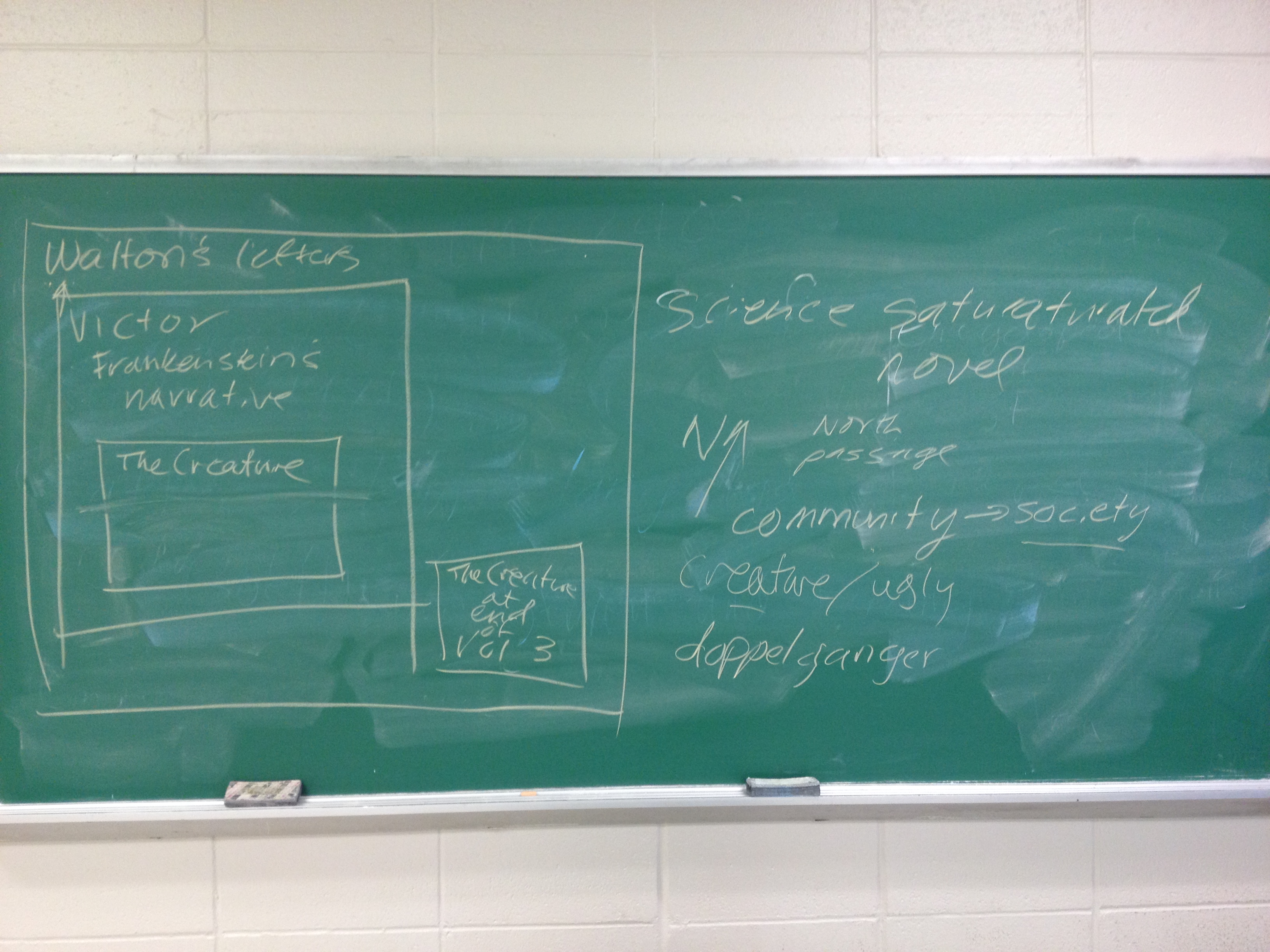
    Frames and science saturation.
    Frames and science saturation.

    In today’s class, we finished discussing Mary Shelley’s Frankenstein by discussing Volumes II and III and coving some major themes.

    To begin class, I wanted to have all of the students think about the sublime and the beautiful to better understand Mary Shelley’s engagement of those ideas in the settings and characterization in Frankenstein. First, I asked all of the students to quickly read summaries of the first three sections of Immanuel Kant’s Observations on the Feeling of the Beautiful and the Sublime on Wikipedia here. I also briefly described these sections to provide a rough sketch of what they would be reading. Then, I split the class into two halves: one half would find a picture or photo that represented Kant’s ideas of beauty and one half would find a picture or photo that represented Kant’s ideas of the sublime. Once they found an appropriate image, they would email a link to me with the subject “beauty” or “sublime.” This took about 10 minutes. Finally, I showed these images in front of the class and I invited the students to tell us why they choose it and then as a class we discussed how these worked or not as examples. I also found some examples that represented beauty and sublimity (I choose something technological to introduce a curveball to our discussion). We also looked at some of my photos of Mont Blanc and Chamonix from 2011.

    Some of the themes that we covered during the discussion of the last half of the novel included:

    • Epistolary and narrative frames
      • Issues of voice, authenticity, and mutual understanding/misunderstanding.
      • Rhetoric and empathy.
    • Science saturated novel
      • Victor, the Creature, and Walton are all scientists of a kind.
      • Victor chooses rationality/science cover irrationality/alchemy, his research leads to new discoveries, his research is reproducible. He learns the scientific method, applies it to a new hypothesis (creating life/reanimating tissues), and discovers new knowledge/techniques with real results (albeit without considering his responsibility to his creation).
      • The Creature uses rationality to figure things out and learn. He uses observations to learn language, which in turn allows him to learn about social and global relationships. His observations of the De Lacey family is almost like a sociological lab report. He uses deductive and inductive reasoning.
      • Walton is on a “voyage of discovery.” Search for knowledge (source of Earth’s magnetic field and geography) and acquisition of fame/wealth from discovering a passage to the Americas through the North Pole.
    • A Critique of the Age of Enlightenment
      • knowledge from science and rationality can have positive and negative effects on society (Victor waffles on this point in his thinking and conversations with Walton).
      • Connected this to the horrors of the 20th Century: World War II > Germany (weapons and genocide) and the United States (the atomic bomb)
    • Power of the novel from its ambiguities and tone (tension between positions)
    • Influence of Mary Wollstonecraft and William Godwin
    • Different interpretations of doppelgangers in the novel and issues of surface/appearance and psychology/inner self.
    • Issues of community, social responsibility, and isolation.

    I am fortunate to work with this dedicated group of students. They have raised exciting points and asked daring questions. If the first week is any indication of the following four, we will share many more interesting discussions on SF. Next week we will discuss Influences of SF, Voyages Extraordinaires, Scientific Romances, and the Pulps.
  • Science Fiction, LMC3214 Continues: Definitions of SF Active Learning Exercise and Conclude Frankenstein Tomorrow

    For today’s class, I had planned on us spending about half the class on definitions of SF before continuing our discussion of Mary Shelley’s Frankenstein. Happily, nearly all of my students showed up for class today, but this turned the class into one completely devoted to SF definitions.

    On the first day of class, we discussed the differences between science fiction (SF) and sci-fi. The students took turns writing examples that they knew on the board along a spectrum from SF (subjectively: the good stuff, significant, more than entertainment) and sci-fi (subjectively: the not-so-good-stuff, less significant, entertainment is primary vector). I wrote about this exercise on Monday here.

    Yesterday, some students asked questions that pointed toward better clarification of what science fiction is. I had planned to save that for next week when I introduce the major paper assignment in the class, which involves their working with and formulating definitions of SF. However, it seemed that it might be more useful to give my students something to test SF–including Mary Shelley’s Frankenstein–against.

    I wanted to do another active learning exercise, but I wanted to have everyone in class contribute to the discussion instead of primarily interacting within their teams (as we did on Tuesday and I wrote about previously). To help them think about a variety of definitions of SF, I pulled 14 definitions from the list on Wikipedia here and created this handout: ellis-jason-science-fiction-definitions. When they came into class, I asked them to sign in on the attendance sheet, but unlike normally, I had numbered where they sign their names. I asked them to remember the number next to where they sign in for attendance. Then, I passed out a handout with the list of definitions numbered from 1 to 13. Each of these entries included the writer’s name, the year of publication, and the definition. These ranged from Hugo Gernsback to Kim Stanley Robinson. Next, I instructed them to read and think about their assigned definition, research the writer and prepare notes on the person to share with the class, and argue why a work of SF that they know is an example (and if possible, a counter example) of that definition. I gave them 15 minutes to conduct their research and formulate their response. Then, we went around the room from 1 to 13 with each student identifying the writer/editor/critic, reading the definition aloud, teaching the class about the person, and explaining their supporting/detracting examples.

    While I am glad that everyone in the class had a chance to contribute and draw on their knowledge of SF, I think that the exercise as a whole took longer than I had planned. In the future, I will break the assignment into a few definitions split between teams as I had done with the exercise on Tuesday (researching the Age of Enlightenment, the Scientific Revolution, the Industrial Revolution, and Romanticism).

    In the last few minutes of class, I briefly recapped some of the important points about Frankenstein that would lead us into a full discussion of Volumes 2 and 3 on Thursday: epistolary novel, narrative frames, and Walton/Frankenstein/Creature as scientists and scientific practitioners.

  • Science Fiction, LMC3214 Continues: Frankenstein Vol 1 and Active Learning

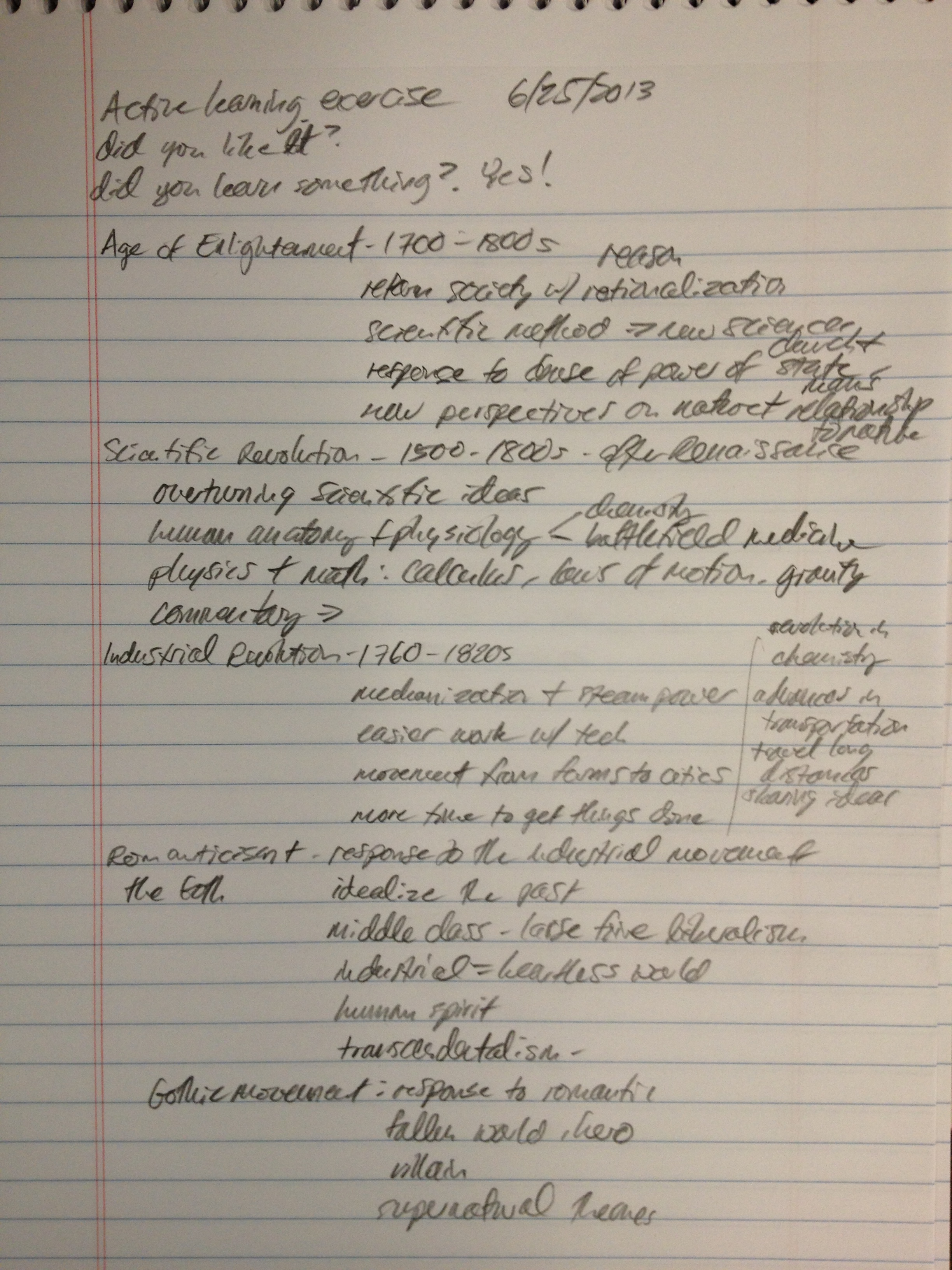
    My notes on what my students taught the class.
    My notes on what my students taught the class.

    During today’s Science Fiction class, we began discussing volume 1 of Mary Shelley’s 1831 edition of Frankenstein. After a brief lecture on Mary Shelley, her family, and the fateful June 1816 trip to Switzerland, I wanted to talk about how historical and cultural forces made it possible for a work like Frankenstein to come into existence. However, instead of lecturing about the Age of Enlightenment, the Scientific Revolution, Industrial Revolution, and Romanticism (and the Gothic), I decided to roll out an active learning exercise to facilitate peer learning. I divided my students into teams of three based on where they were sitting in the class. I reminded them to swap contact information with each other for sharing notes, studying, etc. Then, I explained the exercise to the class as a whole: I would assign each team a topic to research for 20 minutes using Wikipedia and EDU TLD sources on their laptops, tablets, and smart phones. Of course, I said that they could also rely on any knowledge that they already have, but they will have to share that knowledge with their team mates. While researching and talking about their assigned topic, they should compile a list of the most important ideas and/or figures and teach the class those topics. I walked around the class and told each group their assigned topic from the list above. After about 15 minutes I saw that the teams had completed the task, so I asked them to wrap it up and I called for a team to volunteer to present. Each team gave a superlative summary that I could add to, build on, and reference during our discussion of Frankenstein. I asked the students if they liked the exercise. There was no response, and my question was probably not a fair one to ask. Next, I asked if they learned something from the exercise, and they unanimously said, yes! Now that I’ve seen active learning work in my classroom, I will definitely think of other active, peer learning exercises to keep my classes dynamic and engaging for my students.

  • Science Fiction, LMC 3214 at Georgia Tech, Summer 2013 Begins (Syllabus Attached)

    BNiVMYdCYAARX6K.jpg-large
    SF vs Sci-Fi Brainstorming.

    Today, I began teaching my first Science Fiction class at Georgia Tech (LMC 3214 SS2). It is a short-session class, so my students and I will explore the history of SF in only five weeks on a grueling 4 days per week, 2 hours per day schedule.

    During our first class today, we introduced ourselves, discussed the syllabus and schedule [available here: ellis-jason-syllabus-lmc3214-summer2013], and discussed the difference between SF and Sci-Fi.

    Following a short break after reading the syllabus, I conducted an interactive exercise where I wrote “Science Fiction (SF)” on the left side of the chalkboard and “Sci-Fi” on the right side. I sketched out the differences between the two terms and how we might use them to identify different types of SF. Then, I handed the chalk to a student who I asked to go to the board and write a type of SF that she liked in the spot that she felt best represented it in the SF/Sci-Fi continuum. As a class, we would discuss these examples. The other students and I would help point out how we might view these examples in different ways along the SF/Sci-Fi axis. Each student would hand off the chalk to the next student. We completed two rounds of this before running out of time in class.

    I think that I have an excellent group of students. Most are SF fans invested in the genre in one media form or another. Some students are there for pragmatic reasons. I believe that as the class unfolds all of my students will find interesting and significant connections to their thinking, life, and work.

    Tomorrow, we begin discussing Mary Shelley’s Frankenstein.

  • Notes and Photos from Minister Faust’s LMC Distinguished Speaker Presentation at Georgia Tech

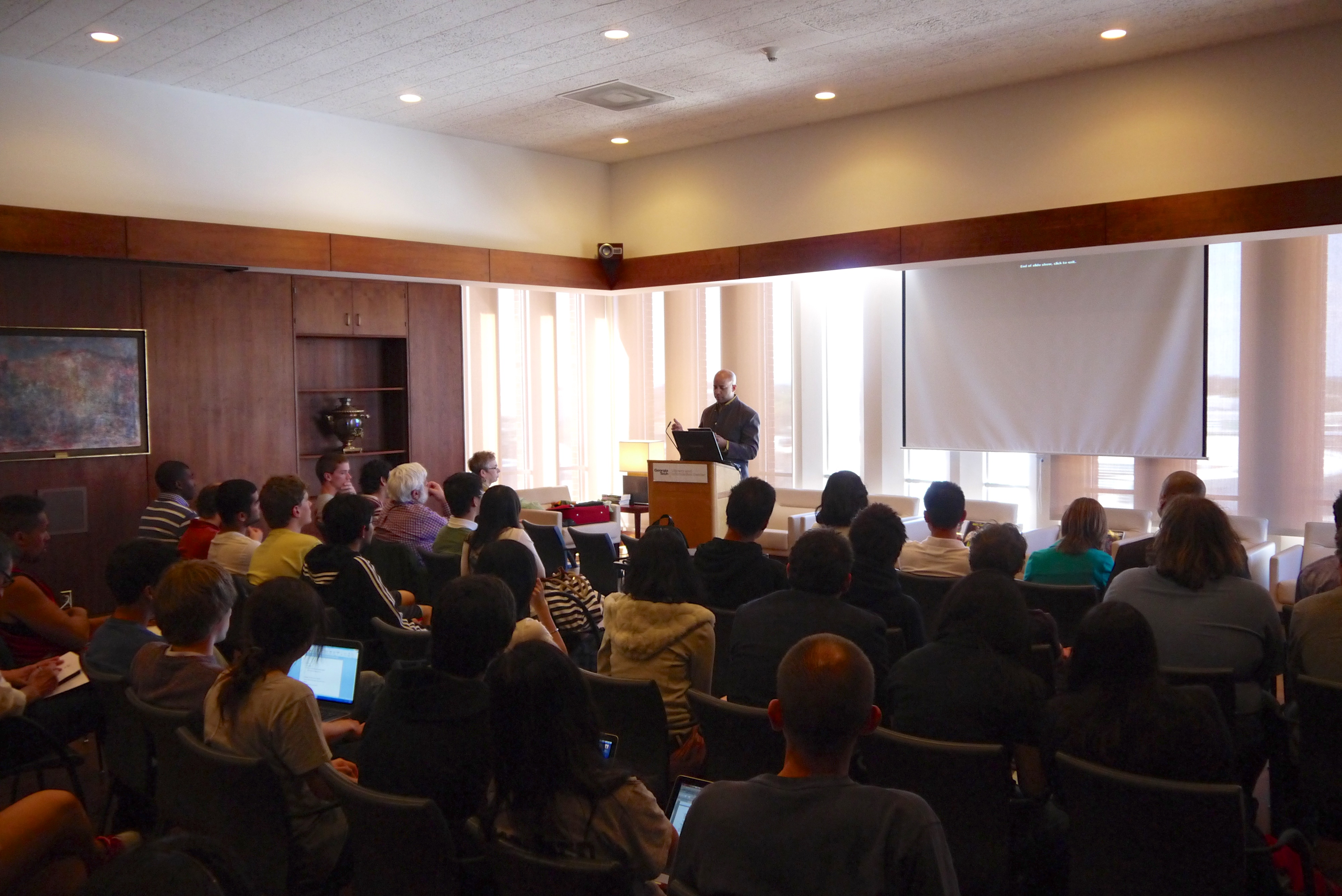
    Minister Faust in the Ferst Room.
    Minister Faust in the Ferst Room.

    On Monday, April 1, Minister Faust, the Canadian science fiction writer, delivered a presentation and performed readings from his published fiction to a full audience in Georgia Tech Library’s Ferst Room. His visit to Georgia Tech was part of the School of Literature, Media, and Communication’s Distinguished Speaker Series. There were also three nearby high school classes in attendance through telepresence technology.

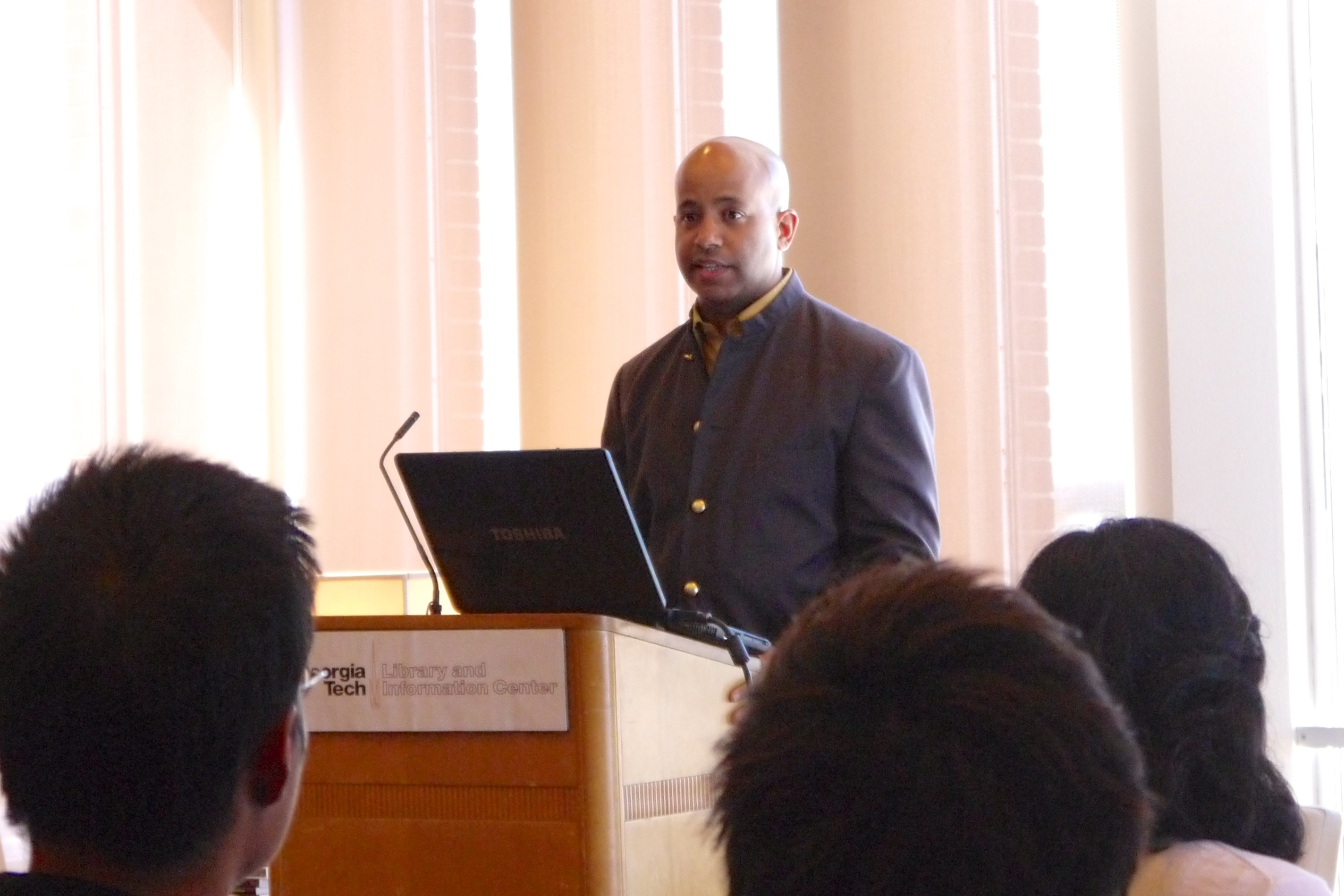
    Minister Faust began with a presentation titled, “Afrofuturism, E-Town, Imhotep-Hop and Me.” In this presentation, he sketched Canada’s historical, cultural, and political landscape, followed with background on his hometown, Edmonton and the neighborhood that he calls “Kush,” and concluded with an overview of Afrofuturism and his unique approach to storytelling that he calls, “Imhotep-Hop.”

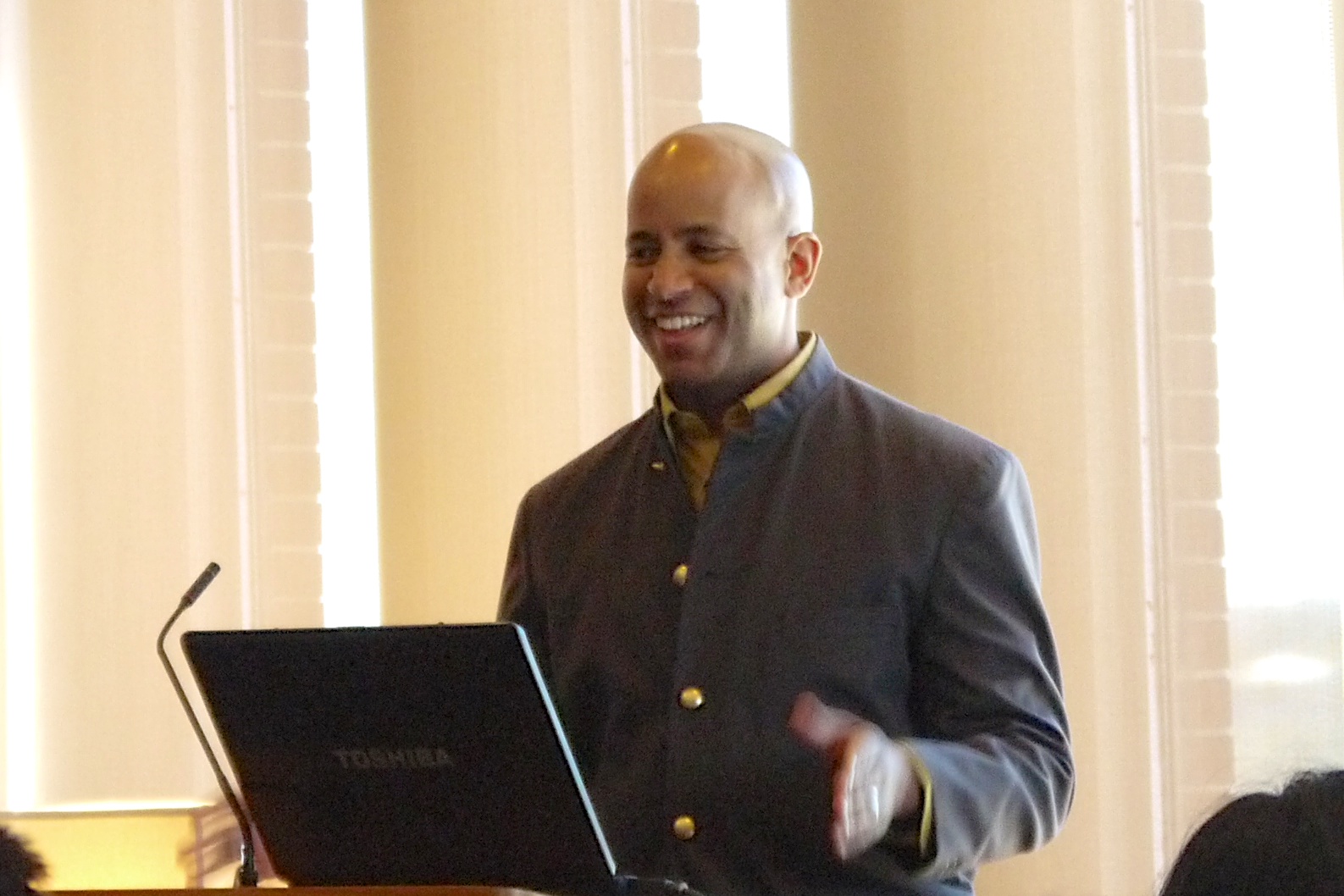
    Minister Faust reads to his audience.
    Minister Faust reads to his audience.

    Imhotep-Hop builds on the science fiction genealogy of cyberpunk > steampunk > Afrofuturism > steamfunk. Like those inventive subgenres, it is a kind of culture jamming. Like its namesake, it is grounded in intellectualism and the desire for gaining and sharing knowledge. However, Minister Faust recognizes that fiction must be entertaining. He uses allegory and humor to convey interesting and engaging stories about serious matters. Perhaps most importantly, Imhotep-hop indicates the past (ancient African stories and mythologies, presented as allegory) and present (the here-and-now) while pointing toward the future.

    Following his presentation, Minister Faust read from two of his novels: The Coyote Kings Book One: Space Age Bachelor Pad and The Alchemists of Kush.

    Minister Faust performing his reading.
    Minister Faust performing his reading.

    This is the second time that I have had the pleasure and honor of attending a reading by Minister Faust. The first time that I met him was at the 2012 Science Fiction Research Association Conference in Detroit. His reading there, like this one at Georgia Tech, was electric! Instead of simply reading from his novels as a speaker and author, Minister Faust performs his characters. His face, hands, and arms form an orchestra with his talented and powerful voice to convey urgency and surprise, excitement and peace, hostility and love. As he reads a scene to the audience, you are drawn into the story as much if not more so than a Console Cowboy sucked into the other worldly expanse of William Gibson’s cyberspace. Good storytelling, like that performed by Minister Faust, is a far more satisfying virtual reality than any generated in the Crytek or Unreal engines.

    Minister Faust presenting.
    Minister Faust presenting.

    Dr. Lisa Yaszek scheduled Monday’s reading to accommodate one of my ENGL1101 classes. As a former Tech undergraduate, I understand how vitally important it is to students’ personal development and enrichment by attending special events and presentations. Some of my fondest memories of my Tech years include meeting Stephen Wolfram and watching Honda’s Asimo robot in person (twice). Furthermore, one of these meetings–spending the day with science fiction writer Kathleen Ann Goonan changed the direction of my life forever. At the end of that day, I told Dr. Yaszek that I had made up my mind to study science fiction professionally–and I did!

    Minister Faust presenting.
    Minister Faust presenting.

    My students from that class and my other two sections were in attendance. Several of my students asked Minister Faust probing and insightful questions about the creative process, the relationship between writing and improving one’s mood, and the influence of his cultural experience on his personal writing style.

    Minister Faust presenting.
    Minister Faust presenting.

    Building on Dr. Laura Otis’s previous Distinguished Speaker Series talk [which I wrote about here], I asked Minister Faust, what kind of conscious thinking does he do as he writes (e.g., verbally, visually, haptically, aurally, etc)? I was very happy to learn that he thinks multimodally depending on the content of a scene or the direction from which he comes when building his stories (verbally first sometimes, visually first at others, or aurally/musically for others). Ultimately, his thinking in different modes is expressed verbally in writing.

    Minister Faust presenting.
    Minister Faust presenting.

    He also gave a second reading on the morning of Tuesday, April 2. Unfortunately, I was unable to attend. However, I am eager to find out which of my students went to that reading!

    Me and Minister Faust.
    Me and Minister Faust.

    In addition to visiting Minister Faust’s official website to purchase his books directly from the author at a discount, you can purchase his books in print from Amazon here or in Kindle ebook format here.

    I also highly recommend that you watch his TEDxEdmonton talk here and this interview featuring him talking about the fiction of Philip K. Dick in three parts here, here, and here .

    Minister Faust is doing very important work through his writing. It is entertaining and educational; It is lighthearted and serious. I believe that it will be read and remembered in the SF pantheon. I am happy and thankful that he shared some of that work with the Georgia Tech community.