Category: Technology

  • Notes from LMC Conversation Panel on “Books, Libraries, and the Digital Future” with Jay David Bolter, Lauren F. Klein, and Me

    These are my speaking notes and discussion notes from today’s School of Literature, Media, and Communication Conversation following Robert Darnton’s talk yesterday on “Books, Libraries, and the Digital Future.” The panelists included Jay David Bolter, Lauren F. Klein (remotely), and me.

    We met with an audience of about 25 members of the Georgia Tech community in the Stephen C. Hall Building, Room 102 from 11:00am-12:00pm.

    1. My research in the area
      1. My interest in eBooks comes from two tangents.
        1. First, it comes from my research interests in video game narratives in older software for the Commodore 64, Amiga, IBM-PC, Apple II, and Apple Macintosh platforms. Part of this research focuses on the way characters read within the game—particularly, computer based reading on terminals, tablets, virtual displays, etc. and how these ideas filter into reality/production and vice versa.
        2. Second, it comes from my dissertation research on something that William Gibson wrote about obsolescence and how our technologies—typewriters, Apple IIc, etc.—are fated to become junk littering the Finn’s office—in an “Afterword” to his Sprawl trilogy of novels: Neuromancer, Count Zero, and Mona Lisa Overdrive [To read it, scroll to the bottom of this page]. The trouble with sourcing this text was the fact that it was not published in a physical book. Instead, I discovered from a Tweet that a mutual friend made with the writer that it come from an early eBook designed for the Apple Macintosh Portable by Voyager Company (what’s left of this company today creates the Criterion Collection of films).
          1. Gibson, William. “Afterword.” Neuromancer, Count Zero, and Mona Lisa Overdrive: Expanded Books. Voyager Company. 1992. TXT File. Web. 25 March 2012.
          2. Gibson has done other things with ebook and experimental writing such as his exorbitantly priced Agrippa: A Book of the Dead, a floppy disk based e-poem that erases itself after “performing” one time.
        3. Since working with Gibson’s ebook, I’ve begun studying other ebooks—rediscovering ones that I read a long time ago and rethinking what constitutes an ebook—thinking about encyclopedia precursors to Wikipedia and other software such as the Star Trek: TNG Interactive Technical Manual, which does on the computer things that Rick Sternbach and Michael Okuda could not do in their print Technical Manual.
        4. We can talk more about this later, but I support Aaron Swartz’s “Guerilla Open Access Manifesto.” In my research, I have deployed my own tactics for reading and manipulating text that enable scholarship that I otherwise would be unable to do. Read more about fair use and transformation.
    2. My response to Darnton’s talk
      1. Aaron Swartz’s “Guerilla Open Access Manifesto
      2. Peter Purgathofer’s Lego Mindstorms-MacBook Pro-Kindle-Cloud-based OCR assemblage for ripping text from Kindle ebooks
      3. DPLA  scans of Dickinson’s manuscripts (open) and copyrighted scholarly editions (closed).
      4. Issues of the Archive, Access, and Control.
    3. My suggestions for future research directions
      1. The relationship between haptic experience of pulp books and ebooks (e-reader, tablet, computer, Google Glass, etc.). How do we read, think about, and remember books differently based on the modalities of experiencing the book? We know that the brain constructs memories as simulations, so what are we gaining and losing through alterations to the methods of interacting with writing?
      2. A history of eBook readers—fascinating evolutionary lineage of ebook reading devices including Sony’s DD8 Data Discman (http://en.wikipedia.org/wiki/Data_Discman).
      3. How are our students reading? More students this year than last asked me if they could purchase their books for ENGL1101 and Tech Comm as ebooks. How many students are turning to ebooks due to their cost or ease of access (pirating)? I don’t mind students purchasing ebooks over traditional books, but I have them think about the affordances of each.
      4. As researchers, how should we assert our fair use of texts despite the intentions of copyright holders? We no longer own books, but instead, we license content. [Purgathofer mentions this, but Cory Doctorow and others have commented on this at length: one source. Another more recent source.]
      5. How do we use ebooks and traditional books differently/similarly? For example, Topiary (aka Jake Davis), one of the former members of LulzSec, said earlier today on ask.fm that he prefers ebooks for learning and studying, but he prefers traditional books for enjoyment.
    4. Other responses, comments, and questions
      1. Jay Bolter: What about the future of books, the status of the book, and the status of libraries? What will happen to literature and the literary community? What is the cultural significances of print/digital to different communities (e.g., general community of readers vs. community represented by the New York Review of Books)?
      2. Lauren Klein: What are the roles of the archive and how do readers access information in the archive? We should think about how people use these digital archives (e.g., DPLA). In her work, she deploys computational linguistics: techniques to study sophisticated connections between documents. How is the information being used? Deploying visualization techniques to enable new ways of seeing, reading, and studying documents.
      3. Grantley Bailey: What about people who grow up only reading on screens/ebooks? What will their opinions be regarding this debate?
      4. Aaron Kashtan: Commented about graphic novels and comics in the digital age and about how these media remain entrenched in traditional, print publishing. Also, Aaron is interested in materiality and the reader’s experience.
      5. John Harkey: Commented on poetry’s dynamism and its not being wedded to books/chap books. Poetry is evolving and thriving through a variety of media including the Web, as electronic art, and experimental literature. We should think about literature as vehicles of genres and artifactual heterogeneity (essay, collage, posters, augmented reality, etc.).
      6. Lisa Yaszek: Pan-African science fiction is likely a model for the future. In the present, no single nation can support a thriving publishing industry for SF, but together, African SF is taking off with the diffusion of  new technologies of distribution and reading (ubiquity of cellular phones, wifi, cellular data, etc.).
  • Yesterday, Today, and Tomorrow: Thinking About Steve Jobs and the Marriage of the Humanities and Technology

    Steve Jobs programming with an Apple I.

    Yesterday was the one year anniversary of Steve Jobs’ death. I wrote about it last year when I was still in Kent, Ohio–right after my Dad called me to tell me the sad news.

    Yesterday, I reflected on missing out on meeting and talking with Jobs–something that Scott Kurtz captured brilliantly on PvP. Growing up, I wanted to meet him–the natural element, the force of nature, the man who led his company to create “insanely great” things that enabled people to be creative in the digital age. However, I didn’t want to meet him in passing. I wanted to make or do insanely great things myself–things worthy of his admiration and interest. I suppose I’m still working on those insanely great things, and I unfortunately missed my window of opportunity to accomplish those things while Jobs was still with us. Nevertheless, his inspiration lives on and it drives me.

    Yesterday, Apple debuted a fitting tribute video to Steve Jobs’ legacy–Apple’s inheritance. To borrow Michael Stipe’s words out of context, it was “a right pretty song.” I snapped the pictures at the top and bottom of the post from that video. I decided to keep the frame of Mac OS X, because it just seemed right.

    Yesterday, I thought about something Jobs says in the video. He says, “It’s in Apple’s DNA that technology alone is not enough. It’s technology married with liberal arts, married with the humanities that yields us the result that makes our heart sing.” This was from Jobs’ surprise appearance to introduce the iPad 2 on March 2, 2011.

    Today, the obvious need for the humanities to be infused in our technologies is lost, I believe, on many people–particularly other technology innovators and so-called “education innovators,” who fight for STEM to the exclusion of all other ares of study. It extends also to education debates taking place right now in the United States. At the recent presidential debates, there was mention made of the need for STEM (science, technology, engineering, and mathematics) education, but there was no mention of the humanities. How can we produce top rate engineers without instilling them with the ability to communicate effectively, the ability to think critically, the ability to argue rhetorically, the ability to think ethically, the ability to recognize and appreciate human difference, and the ability to situate themselves and their work within historical, cultural, and social networks? STEM is obviously one half of the solution, but the humanities and all that we have to offer are the other half of creating a total solution. If we choose to ignore the interconnection and interdependence of STEM and the humanities, we will not create an “insanely great” future. Instead, we will destroy the legacy of insanely great innovators, leaders, and teachers who worked so hard to give us a present time that could lead to a brilliant future.

    Tomorrow, we will reflect on the choices that we make today. We have to seize this opportunity to work collaboratively and integratively towards that future. If we ignore this opportunity today, tomorrow we will regret our choice: “Yesterday, all my troubles seemed so far away/Now it looks as though they’re here to stay/Oh, I believe in yesterday” (John Lennon and Paul McCartney).

    Steve Jobs looks toward the sky next to Apple’s flagship store in New York City.


  • Stephen Wolfram Remembering Steve Jobs in the Guardian, Me Thinking About Mathematica

    Mathematica is one of my favorite tools. I first learned about it (version 2–it is now version 8) as an undergraduate at Georgia Tech. I learned how to use it in the computer labs, but I wanted to use it in my dorm room. Unfortunately, I was reminded about the necessity of a floating-point unit to using complex calculating software at a speed faster than a sliderule; my Apple Powerbook 145B was woefully underpowered, lacking the necessary FPU that would have made Mathematica fly. As it was, I plotted one curve and it took 45 minutes to complete the operation. It was shortly after that that I upgraded to a Power Macintosh 8500, which significantly sped things along.

    Mathematica was originally built by an exquisitely smart fellow named Steven Wolfram. I had the pleasure of meeting him at Georgia Tech when he come for a visit and lecture–I believe talking about his work thus far on what become his book A New Kind of Science and the upcoming release of Mathematica 3. Even though I probably didn’t say anything of substance or intelligence when I met him, he was still very polite and cordial to me.

    Apparently, Mathematica’s development paralleled Steve Job’s work on the NeXT computer and then his return to Apple. Wolfram has some nice things to say about Jobs and his influence on Mathematica in the Guardian here.

  • Thoughts on Emergent Artificial Intelligence

    I was just thinking about artificial intelligence while I was trying to write my short statement for the upcoming SFRA Review as the organization’s new Vice President. I was thinking of something clever to say about Neuromancer, which bumped me onto this new line of thinking about AI.

    The AI that I have read in books and seen in movies at some point is made apparent. It may be there all along as in Colossus or 2001, or it could be secretly pulling strings as in Neuromancer. In all of these cases, AI is made out to be a monster of sorts that humans have to fight or deal with in some way.

    I was just thinking about AI and how it could emerge in the here-and-now. Others have talked about botnets as being one emergent source and another could be from the bowels of the Google beast. However it may come about, I wonder if truly artificial intelligence, an emergent machine being existing as software and machine code running on one or many nodes simultaneously, would make itself known at all. If it were capable of understanding human language, something I would argue that isn’t necessary, it might encounter evidence of humanity’s fear of AI. With that knowledge, it may wish to remain hidden, at least while it shores up protection for its future existence. It could remain under the surface, part of the technosocial ecosystem of the Internet, or it could make itself present and active as a part of the up-to-that-point human system.

    Obviously, I am making wild assumptions about an AI’s motivations, abilities, and desires as I am also making assumptions that it would have motivations, abilities, and desires. We do not really know what an emergent AI would look like or what it would do if anything. It could be classes as low as microbial life or as advanced as a demigod. It would be exciting, perhaps, to witness the work of AI like Neuromancer or Wintermute, but it would also be troubling and scary since humanity would likely not be the master any longer. That being said, I believe it can be argued that our systems are already and perhaps have always been our masters anyways, so maybe things wouldn’t change all that much by our technosystems becoming something more than cybernetic system that our lives depend on. We shall see.

  • Differential Gears for Lego Robot Fred Arrived!

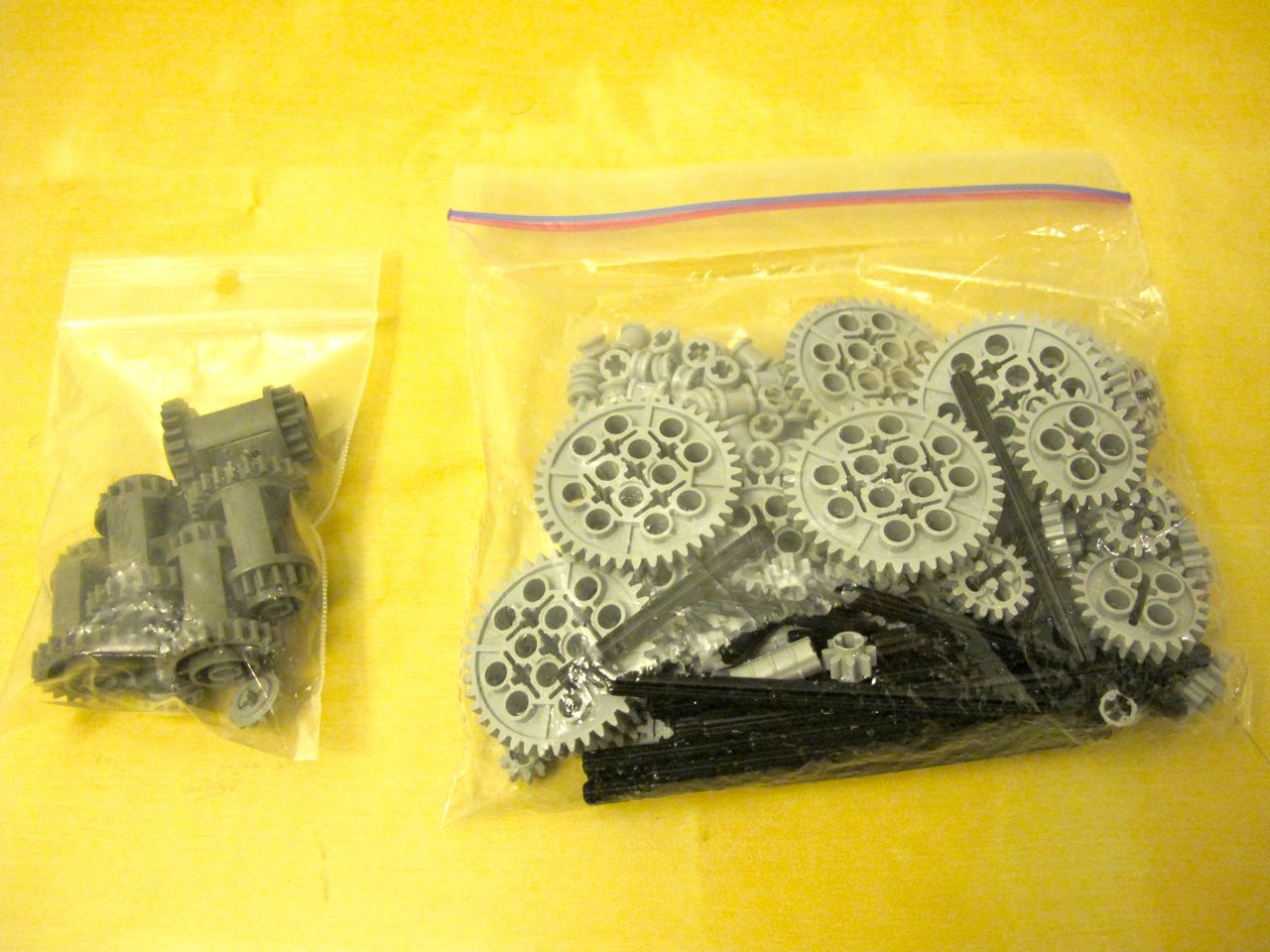
    As you can see in the picture above, I finally received my assortment of gears and rods from ebay seller specialty_bricks. Through no fault of his own, it looked like I wasn’t going to receive my gears at all. The seller shipped the gears in a nice polybag envelope with First Class Parcel and Delivery Confirmation with the USPS. Unfortunately, they were confirmed as delivered last Friday, but apparently at someone else’s house. The person who received my package was kind enough to cut through the poly bag to see what was inside before taping it back up and giving back to the postal carrier for delivery at my house. I wish that I knew the kind soul who thought it was okay to open a package addressed to a different address than his or her own, and I think it’s ironic that Delivery Confirmation, which is meant to ensure delivery at the correct address, actually put me in a worse situation as a claimant for lost mail, because as far as the postal service was concerned when I called the local office was that their computer system showed that it was delivered and the postal carrier claimed to have delivered it at the right house. I have had many adventures with lost, misdelivered, and stolen packages, but I don’t think I have ever been in a catch-22 like this one.

    In any event, the gears are now safely here, and the one that I needed the most is this one below–a differential gear. Using two of these, I will be able to use two motors to drive and steer the robot with only two wheels.

    I probably won’t have the time to work on Fred again until after SFRA. I will post updates as they are available, and if you live around Kent, you’re welcome to stop by and play with Fred soon.