Tag: Apple

  • The Debut of the Apple Disk II, Ambiguous Terminology, and the Effects of Memory: Digging Deeper into an Anecdote from Kirschenbaum’s Mechanisms

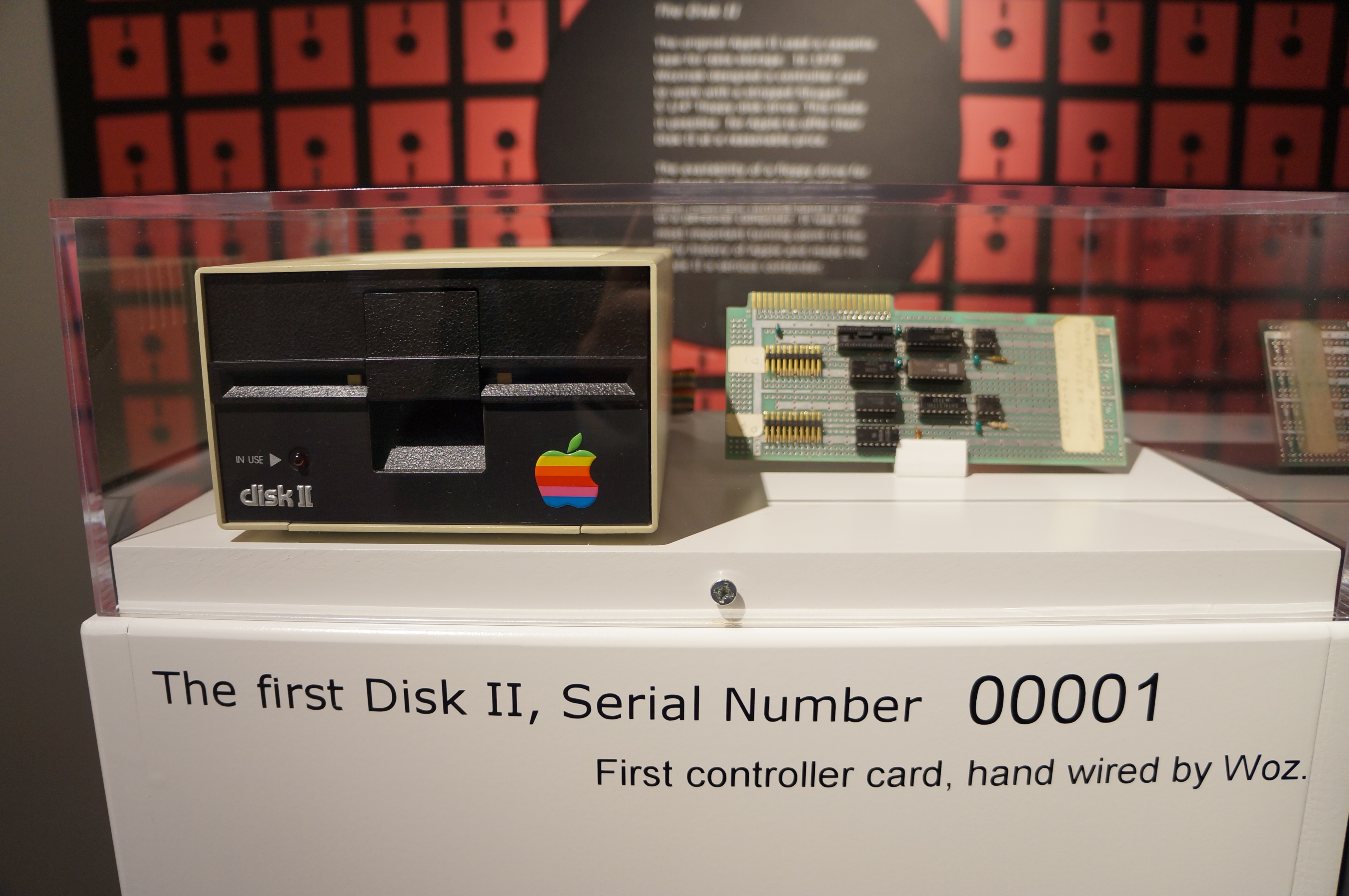
    The first Apple Disk II and controller card hand wired by Wozniak. Photo taken at the Apple Pop-Up Museum in Roswell, GA.
    The first Apple Disk II and controller card hand wired by Wozniak. Photo taken at the Apple Pop-Up Museum in Roswell, GA.

    Matthew Kirschenbaum constructs a compelling and interesting argument in his book Mechanisms: New Media and the Forensic Imagination (2008). He argues that while new media and computer software might seem ephemeral and intangible, it has in fact physicality, a many-layered history, and emerging archaeological protocols (developed by Kirschenbaum and many others).

    However, one section titled “Coda: CTRL-D, CTRL-Z” attracted my attention, because its use of the term “recover” in a story about the debut of the Apple Disk II seemed to imply computer disk data recovery instead of what historically happened, which was the manual rewriting of the software that had been accidentally overwritten during a botched disk copy operation.

    Kirschenbaum uses the story of Steve Wozniak and Randy Wigginton’s development of software to control the reading and writing of data to Apple’s Disk II, which was based on Shugart’s 5 1/4″ floppy disk drive, before its unveiling at the 1978 CES in Las Vegas to establish an analogy: “Nowadays we toggle the CTRL-D and CTRL-Z shortcuts, deleting content and undoing the act at a whim. Gone and then back again, the keyboard-chorded Fort and Da of contemporary knowledge work” (Kirschenbaum 69). The idea is that computer facilitate a kind of gone and back again play as described by Freud. Of course, the keyboard shortcuts that he refers to are not universal across platforms or software, but the concept is pervasive. Nevertheless, my focus is not on that concept per se but instead on the Apple Disk II debut anecdote, the terminology surrounding what actually happened, and how that relates to the kinds of work that we do in new media archaeology.

    After introducing the story of the Apple Disk II’s debut at CES, Kirschenbaum cites a passage from Steven Weyhrich’s Apple II History website:

    “When they got to Las Vegas they helped to set up the booth, and then returned to working on the disk drive. They stayed up all night, and by six in the morning they had a functioning demonstration disk. Randy suggested making a copy of the disk, so they would have a backup if something went wrong. They copied the disk, track by track. When they were done, they found that they had copied the blank disk on top of their working demo! By 7:30 am they had recovered the lost information and went on to display the new disk drive at the show.” (Weyhrich par. 13, qtd. in Kirschenbaum 69).

    First, it should be noted that Weyhrich uses the term “recovered” to describe the way that the “lost information” was brought back from the brink of the overwritten disk. Then, Kirschenbaum reads Weyhrich’s account above in the following way:

    “Thus the disk handling routines that took the nascent personal computer industry by storm were accidentally overwritten on the very morning of their public debut–but recovered and restored again almost as quickly by those who had intimate knowledge of the disk’s low-level formatting and geometry” (Kirschenbaum 69).

    Weyhrich uses the term “recovered” to refer to the software Wozniak and Wigginton had lost during the bad copy operation. Kirschenbaum borrows Weyhrich’s “recovered” and adds “restored” to describe the final state of the software on Wozniak and Wigginton’s floppy disks for use on the CES show floor. When I first read Kirschenbaum’s book, his reading seemed unncessarily ambiguous. On the one hand, Kirschenbaum does not directly say that the two Apple engineers used their knowledge of controlling the disk drive and reading low-level information on the floppy disks to “recover” the lost data–i.e., use the drive and disk technology to salvage, rescue, or retrieve what remains on the disk but otherwise might seem lost to someone with less advanced knowledge. On the other hand, Kirschenbaum’s reading of the incident–“recovered and restored again almost as quickly”–is implicitly aligned with his own project of the physicality of data stored on new media storage devices. One could mistakenly believe that Wozniak and Wigginton had restored the lost data from the overwritten floppy disk.

    Steven Wozniak writes about this episode in his autobiography, iWoz: Computer Geek to Cult Icon (2006). Before turning to Wozniak’s later recall of this event in 1978, I would like to look at the two sources that Weyhrich cites on the passage that Kirschenbaum cites in his argument.

    Weyhrich’s first of two footnotes on his passage points to page 168 of Gregg Williams and Rob Moore’s 1985 interview with Steve Wozniak titled, “The Apple Story, Part 2: More History And The Apple III” in the January 1985 issue of Byte magazine. In the interview, Wozniak tells them:

    “We worked all night the day before we had to show it [the disk drive] at CES. At about six in the morning it was ready to demonstrate. Randy thought we ought to back it up, so we copied the disk, track by track. When we were done, he looked down at them in his hands and said, “Oh, no! I wrote on the wrong one!” We managed to recover it and actually demonstrated it at CES” (Williams and Moore 168).

    In this primary source, we see Wozniak using  the term “recover” to indicate that they were able to get the demonstration operational in time for CES that day, but what form the “recovery” took place is not explained. Was it data recovery in the technical sense or data recovery in the hard work sense of re-writing the code?

    Weyrich’s second footnote on his passage points to Paul Freiberger and Michael Swaine’s “Fire In The Valley, Part Two (Book Excerpt)” in the January 1985 issue of A+ Magazine. While I have been unable to find a copy of this magazine, I did refer to the book that this excerpt was taken from: Freiberger and Swaine’s Fire in the Valley (1984). On page 286, they write in regard to Wozniak and Wigginton’s disk dilemma at CES:

    “Wigginton and Woz arrived in Las Vegas the evening before the event. They helped set up the booth that night and went back to work on the drive and the demo program. They planned to have it done when the show opened in the morning even if they had to go without sleep. Staying up all night is no novelty in Las Vegas, and that’s what they did, taking periodic breaks from programming to inspect the craps tables. Wigginton, 17, was elated when he won $35 at craps, but a little later back in the room, his spirits were dashed when he accidentally erased a disk they had been working on. Woz patiently helped him reconstruct all the information. They tried to take a nap at 7:30 that morning, but both were too keyed up” (Freiberger and Swaine 286).

    Unlike Wozniak’s “recover” in the Williams and Moore interview above, Freiberger and Swaine use the term “reconstruct” in their narrative about the pre-CES development of the Disk II demonstration software. Unlike the term recover, which means to regain what is lost, reconstruct means to build something again that has been destroyed. Freiberger and Swaine’s selection of this term seems more accurate when considering what Wozniak says about this episode in his autobiography:

    “We set up in our booth and worked until about 6 a.m., finally getting everything working. At that point I did one very smart thing. I was so tired and wanted some sleep but knew it was worth backing up our one good floppy disk, with all the right data. . . . But when I finished this backup, I looked at the two unlabeled floppy disks and got a sinking feeling that I’d followed a rote pattern but accidentally copied the bad floppy to the good one, erasing all the good data. A quick test determined that this is what happened. You do things like that when you are extremely tired. So my smart idea had led to a dumb and unfortunate result. . . . We went back to the Villa Roma motel and slept. At about 10 a.m. I woke up and got to work. I wanted to try to rebuild the whole thing. The code was all in my head, anyways. I managed to get the good program reestablished by noon and took it to our booth. There we attached the floppy and started showing it” (Wozniak and Smith 218-219).

    In this account, Wozniak says that he is responsible for overwriting the good disk with the bad (as opposed to what he said to Williams and Moore for the 1985 Byte magazine interview), but most important is the terms that he uses to describe how he made things right: “I wanted to try to rebuild the whole thing.” He “reestablished” the program by reentering “the code . . . in [his] head” into the computer that they had on-hand. Wozniak’s word choice and description makes it clearer than in his earlier interview that he had to remake the program from memory instead of attempting to “recover” it from the overwritten media itself. While, it might have been theoretically possible for someone as well versed in the mechanism that by that point he had had a significant hand in redesigning from the original Shugart drive mechanism and controller card and of course his development with Wigginton of the software that controlled the hardware to read and write floppy disks in the Apple Disk II system (computer-controller card-disk drive), Wozniak, who reports throughout his autobiography as an engineer who works things out in head meticulously before putting his designs into hardware or software, took the easiest path to the solution of this new media problem: write out the software again from memory.

    Memory, of course, is another tricky element of this story. It was my memory of Wozniak’s exploits that drew me to this passage in Kirschenbaum’s book. My memory of Kirschenbaum’s argument informed the way that I interpreted what I thought Kirschenbaum meant by using this episode as a way of making his Fort-Da computer analogy. Kirschenbaum’s memory of the episode as it had been interpreted secondhand in Weyhrich’s history of the Apple II informed how he applied it to his argument. Wozniak’s own memory is illustrated as pliable through the subtle differences in his story as evidenced in the 1985 Byte magazine interview and twenty-one years later in his 2006 autobiography.

    Ultimately, the episode as I read it in Kirschenbaum’s Mechanisms was caught in an ambiguous use of language. The use of certain terms to describe the work that we do in new media–in its development, implementation, or daily use–relies on the terminology that we use to describe the work that is done to others–lay audience or otherwise. Due to the kind of ambiguity illustrated here, we have to strive to select terms that accurately and explicitly describe what it is we are talking about. Of course, primary and secondary accounts contribute to the possibility of ambiguity, confusion, or inaccuracy. Sometimes, we have to dig more deeply through the layers of new media history to uncover the fact that illuminates the other layers or triangulate between differing accounts to establish a best educated guess about the topic at hand.

    Works Cited

    Freiberger, Paul and Michael Swaine. Fire in the Valley: The Making of the Personal Computer. 2nd ed. New York: McGraw-Hill, 1984. Print.

    Kirschenbaum, Matthew G. Mechanisms: New Media and the Forensic Imagination. Cambridge: MIT Press, 2008. Print.

    Weyhrich, Steven. “The Disk II.” Apple II History. Apple II History, n.d. Web. 13 Sept. 2015.

    Williams, Gregg, and Rob Moore. “The Apple Story, Part 2: More History And The Apple III”, Byte, Jan 1985: 167-180. Web. 13 Sept. 2015.

    Wozniak, Steve and Gina Smith. iWoz: Computer Geek to Cult Icon. New York: W. W. Norton & Co., 2006. Print.

  • My SFRA 2015 Conference Presentation: The Cyberspace Deck as a Mechanism: Gibson’s Sprawl Trilogy as a Voyager Expanded Book

    The presentation that I will be giving tomorrow afternoon at 1:00PM at the annual Science Fiction Research Association Conference (this year at Stony Brook University on June 25-27, 2015) will be nothing like the title and abstract that I submitted earlier this year, but that’s a good thing. Over the past several months, my reading and research has focused on one small corner of that original abstract: The Voyager Company’s Expanded Book Edition of William Gibson’s Neuromancer with Count Zero and Mona Lisa Overdrive (1992). I began to see the cyberspace deck as an important image and mechanism connecting Gibson’s fictional world with our contemporary shift from written to digital culture.

    Above,  you can watch a demo video that will accompany my presentation as a backdrop to my talk, and below, you can find my paper’s abstract, useful links, and my works cited list for reference. I will have handouts of this information available at the session tomorrow, too.

    Title:

    The Cyberspace Deck as a Mechanism: Gibson’s Sprawl Trilogy as a Voyager Expanded Book

    Abstract:

    Instead of focusing on the epistemology or ontology of cyberspace, this paper explores the cyberspace deck in William Gibson’s fictions as a mechanism of inscription. It does this by charting Gibson’s inspiration in the Apple IIc, his comparison of it to the first Apple PowerBooks, and the publication of his cyberspace deck-infused fictions as the Voyager Company Expanded Book edition in 1992. Through discussing these connections, it addresses other issues of importance for the current shift from written culture to digital culture, such as the effect of reading on screens as opposed to print, and the effect of digital culture on the human brain.

    Useful Links:

    Conference Demo Video (embedded above): http://youtu.be/fU8K2DuTfeE

    Google Glass, iPad, PowerBook 145 Demo Video: https://youtu.be/-XrIqLdx3EU

    Mini vMac Emulation Software: http://gryphel.com/c/minivmac/index.html

    Emaculation Emulation Community: http://www.emaculation.com/doku.php

    Works Cited

    Casimir, Jon. “Voyager Seeks to Improve Thinking.” Sydney Morning Herald (23 May 1995): n.p. Web. 18 May 2015.

    DeStefano, Diana and Jo-Anne LeFebre. “Cognitive Load in Hypertext Reading: A Review.” Computers in Human Behavior 23 (2007): 1616-1641. Web. 22 June 2015.

    Gibson, William. “Afterword.” Neuromancer with Count Zero and Mona Lisa Overdrive. Santa Monica, CA: Voyager Company, 1992. n.p. 3.5” Floppy Disk.

    —. Burning Chrome. New York: EOS, 2003. Print.

    —. Count Zero. New York: Ace, 1987. Print.

    —. Mona Lisa Overdrive. New York: Bantam, 1989. Print.

    —. Neuromancer. New York: Ace, 1984. Print.

    —. Neuromancer with Count Zero and Mona Lisa Overdrive. Santa Monica, CA: Voyager Company, 1992. 3.5” Floppy Disk.

    —. Package. Neuromancer with Count Zero and Mona Lisa Overdrive. Santa Monica, CA: Voyager Company, 1992. 3.5” Floppy Disk.

    Kirschenbaum, Matthew G. Mechanisms: New Media and the Forensic Imagination. Cambridge, MA: MIT Press, 2008. Print.

    Markley, Robert. “Boundaries: Mathematics, Alientation, and the Metaphysics of Cyberspace.” Configurations 2.3 (1994): 485-507. Web. 23 June 2015.

    Matazzoni, Joe. “Books in a New Light.” Publish (October 1992): 16-21. Print.

    Mazlish, Bruce. The Fourth Discontinuity: The Co-Evolution of Humans and Machines. New Haven: Yale UP, 1993. Print.

    Sellen, Abigail J. and Richard H.R. Harper. The Myth of the Paperless Office. Cambridge, MA: MIT Press, 2002. Print.

    Virshup, Amy. “The Teachings of Bob Stein.” Wired (April 2007): n.p. Web. 5 Jan. 2015.

    Wolf, Maryanne. Proust and the Squid: The Story and Science of the Reading Brain. New York: Harper Perennial, 2007.

  • Personal Digital Archaeology: Jason’s Icons 1.0, Feb. 7, 1997

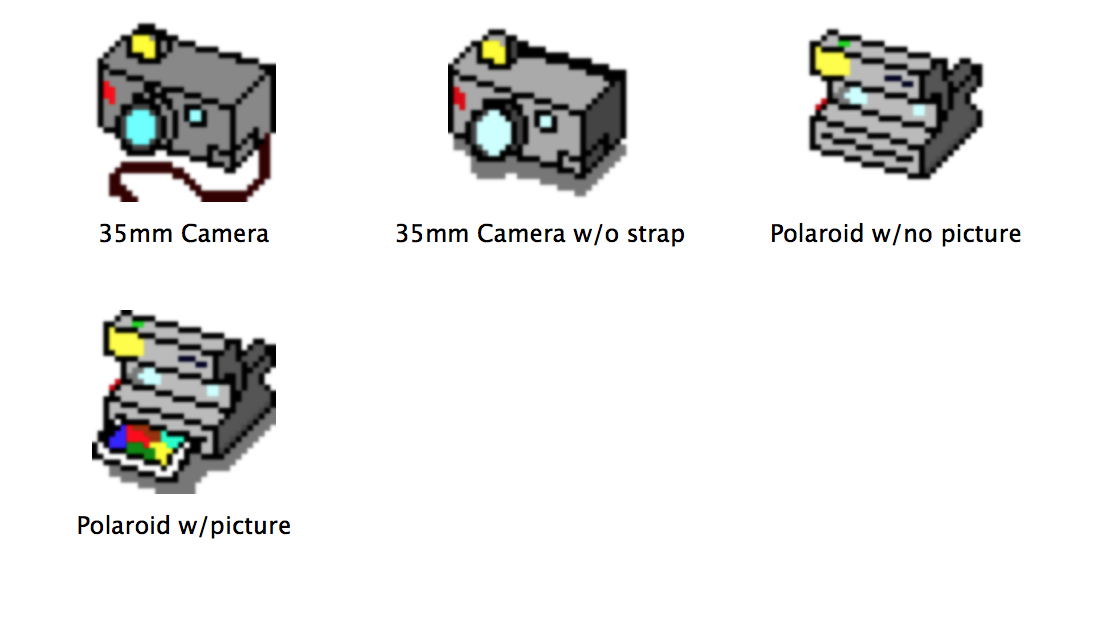
    I have been spending some time digging through my past online and conducting personal, digital archaeology. While doing this research, I ran across a collection of Macintosh icons that I made back in 1997 and bundled on Feb. 7, 1997. I likely used ResEdit to make the icons (32 x 32 pixels).

    You can download the collection in its original HQX/SIT container from here on the Info Mac Archive.

    In the archive, I included a Read Me file with my reasoning behind making the icons set. Also, it reminded me of my first email address at Georgia Tech, which was replaced when I returned to complete my studies in 2001. The Read Me file includes this text:

    Jason’s Icons v1.0

    February 7, 1997

    Dear Downloader, These are some icons that I created out of pure desperation to label the folder contents of one of my hard drive partitions. This is how I use them:  After careful consideration I have decided to let other people enjoy the fruit of my labors and perhaps spread a little happiness throughout the world. (Hey, I can dream!) If you do happen to use these icons and have any suggestions for a new set or would just like to say “hi,” please feel free to contact me at my email address listed below.

    Sincerely, Jason Woodrow Ellis

    gt0567b@prism.gatech.edu

    I grouped the icons into these folders (some for reasons lost to me): Cameras, Enjoyment Icons, Internet Metaphor, Office Equipment, Tools of Torture, and Video Equipment.

    Jason's Icons: Enjoyment Icons
    Jason’s Icons: Enjoyment Icons
    Internet Metaphor
    Internet Metaphor
    Jason's Icons: Office Equipment
    Jason’s Icons: Office Equipment
    Jason's Icons: Tools of Torture
    Jason’s Icons: Tools of Torture
    Jason's Icons: Video Equipment
    Jason’s Icons: Video Equipment
    Jason's Icons: Cameras
    Jason’s Icons: Cameras
  • Second Donation to Georgia Tech Library Archive’s Retrocomputing Lab: Power Macintosh 8500

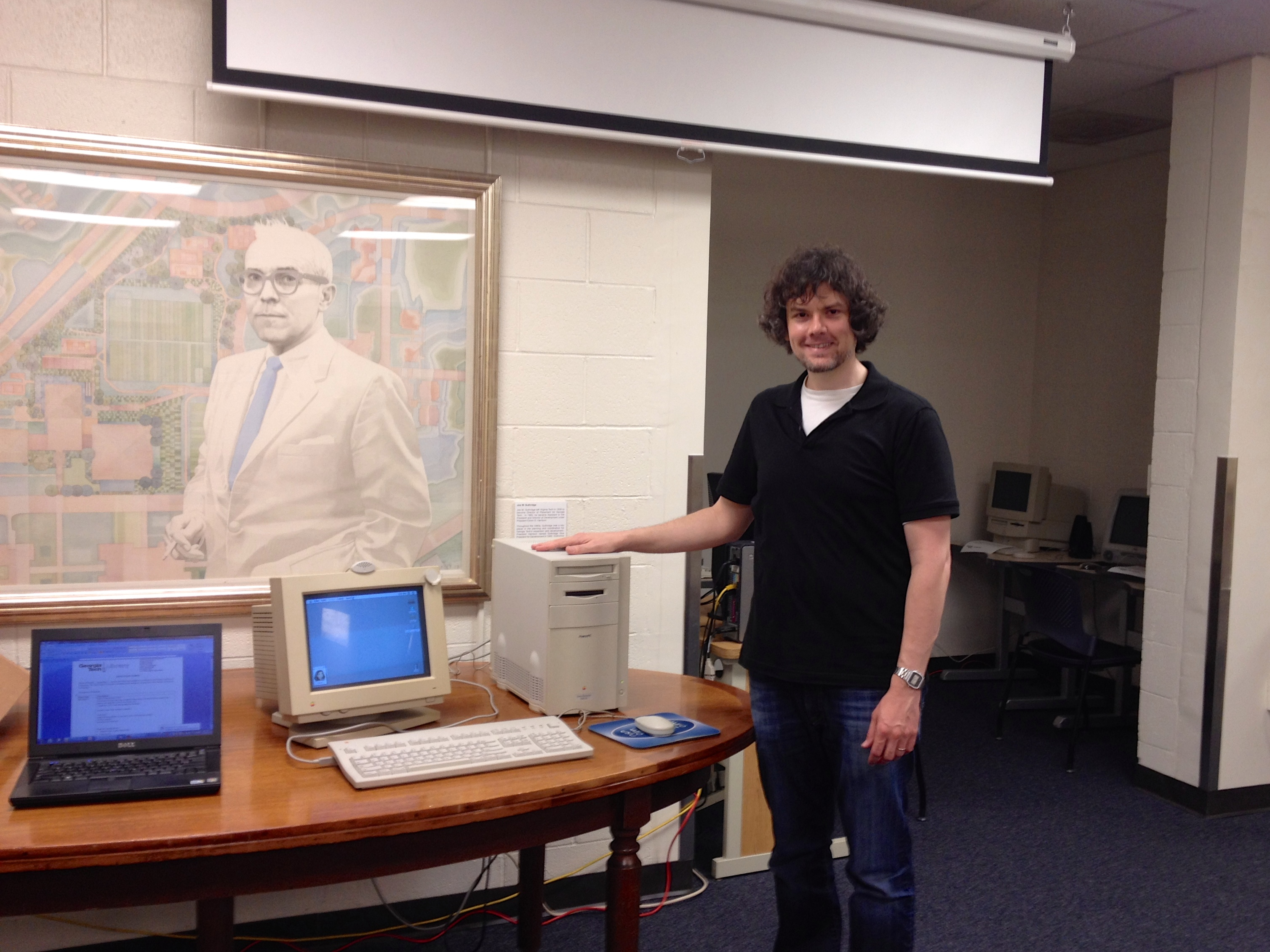
    Me and the Power Macintosh 8500/120 in the Georgia Tech Library Archives.
    Me and the Power Macintosh 8500/120 in the Georgia Tech Library Archives.

    When I met with Georgia Tech Library Archives’ Department Head Jody Lloyd Thompson and Digital Collections Archivist Wendy Hagenmaier to donate three vintage computers (a Dell Dimension 4100, Apple Performa 550, and Apple iMac) and other computing hardware a week and a half ago, I noticed that they had room for one more computer, so I pitched them the idea of my making another donation to fill the gap between the Performa 550’s 68030 processor and the iMac’s G3 processor:  an Apple Power Macintosh 8500/120. They agreed to accept, so I set about preparing the computer for them.

    IMG_5166

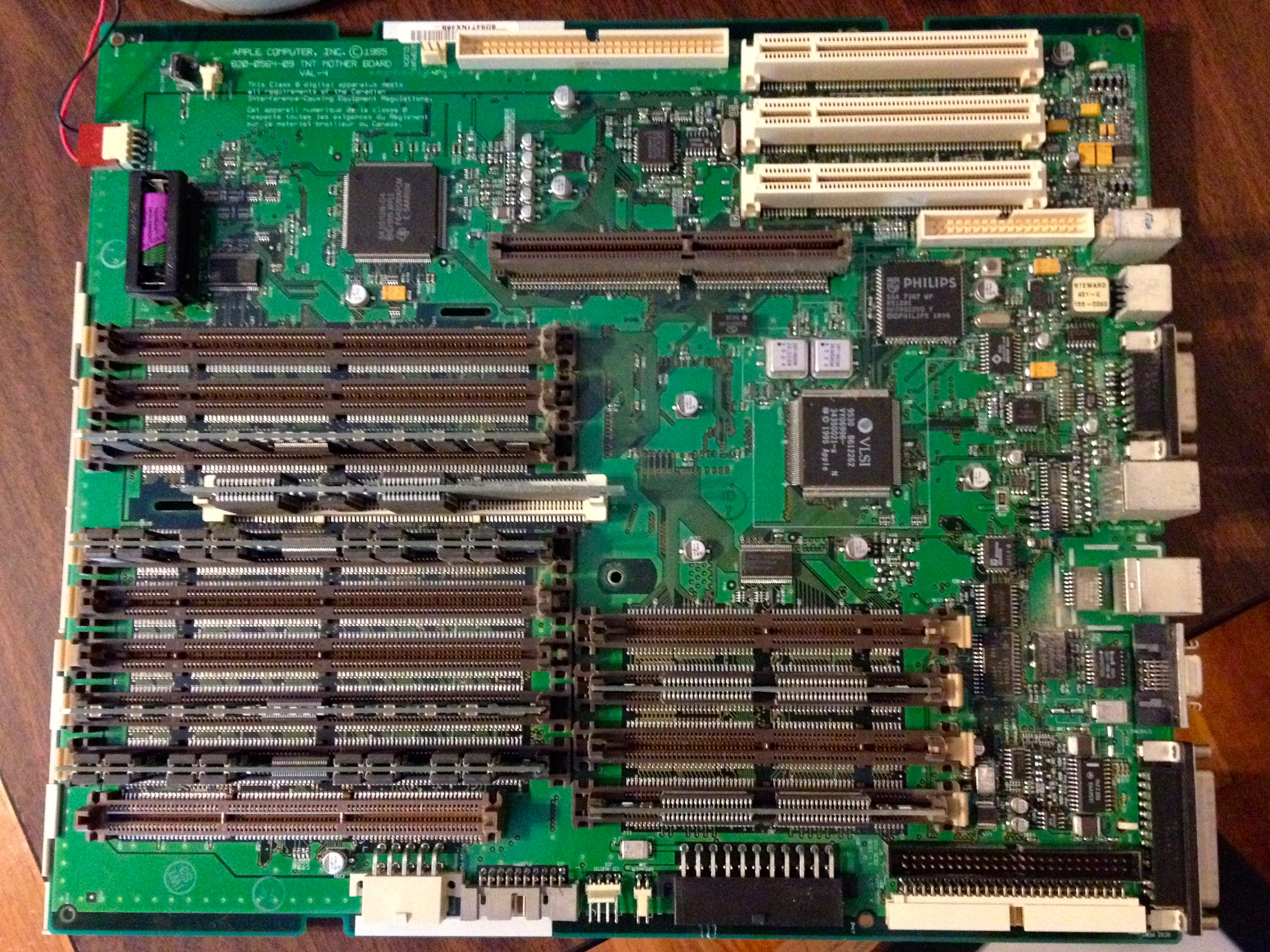
    My Power Macintosh 8500 was in very good shape, but like many vintage computers with persistent clocks, it needed a new lithium battery.

    To replace the Power Macintosh 8500's on-board battery (upper left corner of photo), you have to remove the motherboard.
    To replace the Power Macintosh 8500’s on-board battery (upper left corner of photo), you have to remove the motherboard.

    I replaced the battery, installed Mac OS 7.5.5, a number of different software titles (including Apple’s Plaintalk Speech Recognition–I threw in a Plaintalk powered microphone, Project X/Hot Sauce, and Cyberdog). I discovered that the plastic inside the case did not age well. The PowerMac 8500 has a lot of plastic components that are held together with flexible tabs or clips. When I applied a small amoung of pressure on the tip of these clips to release them, most of them would break. Luckily, the case ties together very well, so I only had to piece some parts back together with clear tape (the power button/light assembly) and metal duct tape (one drive plate cover on the front of the case). To help dissipate heat, I  added a rear slot fan made by Antec.

    I made a video demoing the finalized system, which I’m including embedded below (I apologize for the flicker, but my digital camera doesn’t have enough adjustment features to match the refresh rate on the Apple 14″ Color Display).

    In addition to the Power Macintosh 8500, I gave the Archives a box full of software and late-1990s/early-2000s video games for Macintosh. These might help facilitate more connections around campus (Computer Science, Media Studies, and Game Studies).

    As I’m leaving soon for City Tech, I believe that we can do more together in our work with vintage computing. I floated the idea of a symposium, conference, or some other kind of connected project. Also, from what little I have learned so far, there’s a lot of investment and interest in computer technology in NYC (and Brooklyn in particular). I am looking forward to making new connections with others studying retrocomputing and New Media. I know that many opportunities await.

  • Inaugural Donation to Georgia Tech Library Archive’s Retrocomputing Lab

    Wendy Hagenmaier, Jason W. Ellis, and Jody Thompson next to Apple Performa 550 and iMac.
    Wendy Hagenmaier, Jason W. Ellis, and Jody Thompson next to Apple Performa 550 and iMac.

    Yesterday, I had the pleasure of making the first donation of three computers to the Georgia Tech Library Archives, which is launching its own Retrocomputing Lab for scholars and students to use. The Georgia Tech Library Archives is already well-known for its significant Georgia Tech Science Fiction Collection and other holdings.

    I met with Department Head Jody Lloyd Thompson and Digital Collections Archivist Wendy Hagenmaier to setup the three computers and talk about each machine’s provenance and current operation. We set the computers up on the right side as you enter the Georgia Tech Library Archives. This is a temporary location as the Archives makes plans for their use in Archives for the time being and possibly more in the future as part of the on-going Georgia Tech Library renovation project.

    Apple Performa 550 and iMac.
    Apple Performa 550 and iMac.

    From my personal collection–which I am having to cull before moving to Brooklyn for my new job at City Tech, I donated three computers: an Apple Performa 550 (1994), Apple iMac (1999), and Dell Dimension 4100 (2001). Before donating the computers, I refurbished each to be in as factory-fresh condition as possible.

    For the Peforma 550, I installed a PDS ethernet NIC and replaced the SCSI hard drive with one that was less noisy than its original one. Then, I installed Mac OS 7.6.1 and some software including the AfterDark Star Trek: The Next Generation screensaver and ClarisWorks, and utilities for working with files and disk images.

    For the slot-loading, DV iMac, I replaced the motherboard battery and performed a fresh install of Mac OS 9.2.1. The optical drive suffers from a weak ejection mechanism. I made sure that the bottom plastic bezel fit properly, but reseated it had no effect on improving the drive’s ability to eject discs correctly. I warned the librarians about this, and recommended buying an external, Firewire optical drive and using the paperclip ejection method in the meantime.

    Dell Dimension 4100.
    Dell Dimension 4100.

    For the Dell Dimension 4100, I installed a 3Com NIC donated by Mark Warbington. I installed Windows 98 Second Edition and painstakingly installed the drivers for the components in the Dell (this was a laborious process, because despite having the Service Tag number, some recommended drivers did not work on all of the components).

    I provided two sets of speakers–one for the Performa 550 (it’s internal speakers had stopped working about a year ago) and one for the Dell Dimension 4100. In the event of future hardware problems, I gave them spare AGP video cards, optical drives, a 3.5″ floppy disk drive.

    Also, I gave them some spare motherboards, controller cards, and hard drives that might be useful for displays in the Library.

    The Georgia Tech Library Archives have big plans for making digital archival work and learning an integral component of what they do. If you have functional and working computer hardware or software, you should consider donating it to the Georgia Tech Library Archives, or if you have technical skills for working on older hardware and software, you can donate your expertise and time, too. Contact Jody and Wendy by email or phone here: Georgia Tech Library Archives contact information here.

    Oct. 21, 2023 Update: Video link removed as it no longer exists.