On my way back from CVS this past week in the evening, the art piece above exhibited in the window of 440 Gallery (located at 440 6th Ave, Brooklyn) caught my attention. I immediately thought of “a tempest in a teapot,” but this was a tempest erupting out of a tiny cardboard box. I learned that it a work by Fred Bendheim titled, “Out of the Box.” There’s always interesting things like this on display at 440 Gallery.
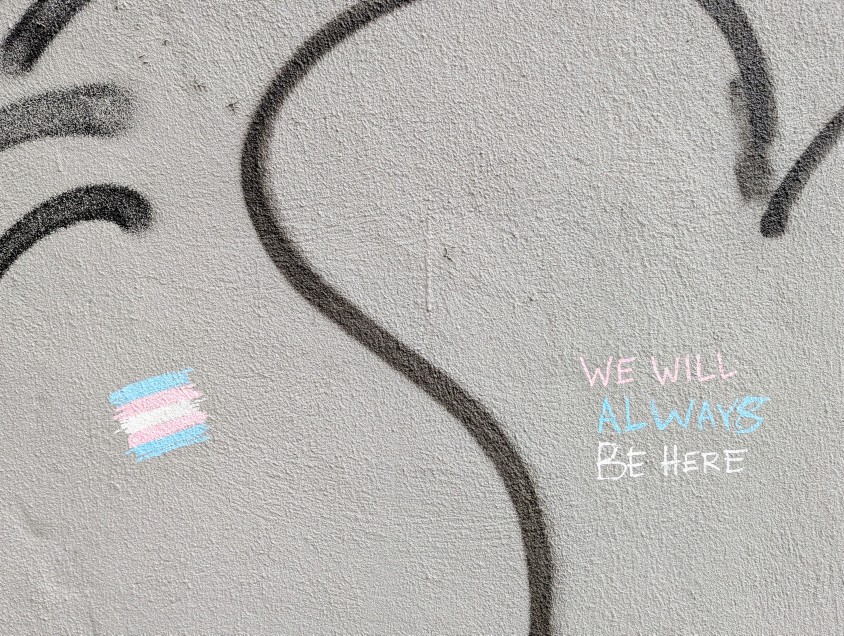
Walking down 3rd Avenue in Brooklyn yesterday, I saw that someone had added something to a larger graffiti: a small transgender flag and the words: “We Will Always Be Here.”
As I’ve posted before, trans rights are human rights.
If you actually believe in freedom and individual rights, you believe in rights for everyone.
Put another way and borrowing a metaphor from JFK, guaranteeing personal freedoms and rights for the least advantaged is like a rising tide that lifts all boats.
Rights are not a zero-sum game. Ensuring rights and freedoms for more people supports everyone’s rights and freedoms. When you advocate for taking away rights and freedoms from one group, that’s fascistic. Ultimately, taking away others’ rights erode and likely lead to erasure of your own.
The hysteria over trans persons manufactured by the right is not so much about an infinitesimal minority’s rights to life, liberty, and the pursuit of happiness. It’s an attempt to erase a group of people from public space and social participation. It’s one beachhead in a multi-headed attack on foundational American ideals.
These attacks are also anti-scientific regarding the reality of both sex and gender. Ignoring transgendered persons about their lived experience and the deep and vast knowledge from biological, psychological, sociological, historical, and legal experts focusing on transgender issues is obviously guided by bigotry and willful ignorance.
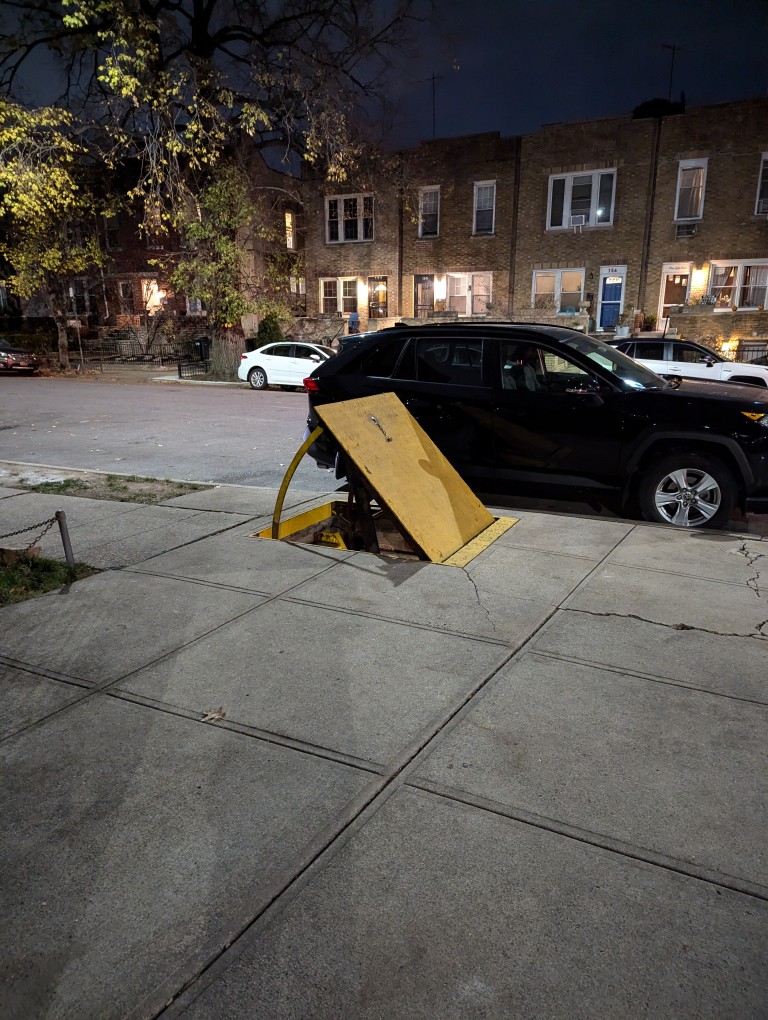
At the corner of Prospect Avenue and Terrace Place in Park Slope, Brooklyn last December, Y and I saw this passageway opened to an underground passage way. I didn’t look closely at the raised metal cover, so I’m not sure if it was ConEdison, MTA, or another utility. No workers were around, so they didn’t offer a clue either. Looking below inside, the walls of the passageway were covered with spray painted graffiti.
Last night, I recorded this final exam review for my Introduction to Language and Technology ENG1710 students. These are the slides that I’m using in the background. The following are the readings that my students and I discussed over the past 14 weeks that comprise the exam review:
Lewis Carroll, “Jabberwocky”
Ted Chiang, “The Truth of Fact, the Truth of Feeling”
Victoria Fromkin, “What is Language?” from An Introduction to Language
Stephen Jay Klein, “What is Technology?”
Salikoko S. Mufwene, “Language as Technology: Some Questions That Evolutionary Linguistics Should Address”
Walter J. Ong, “Writing is a Technology That Restructures Thought,” in The Written Word: Literacy in Transition,
Bruce Mazlish, “The Fourth Discontinuity”
Jacques Derrida, “Linguistics and Grammatology,” translated by Gayatri Chakravorty Spivak
Donna Haraway, “A Cyborg Manifesto”
N. Katherine Hayles, How We Became Posthuman, Chapter 1: “Toward Embodied Virtuality”
Marshall McLuhan, Understanding Media: The Extensions of Man, Chapter 1: “The Medium is the Message”
Friedrich Kittler, “Gramophone Film Typewriter”
J. David Bolter and Richard A. Grusin, “Remediation”
Lisa Gitelman, Always Already New, “Introduction”
Fred Turner, “Where the Counterculture Met the New Economy: The WELL and the Origins of Virtual Community”
Lev Manovich, Language of New Media, Chapter 1: What is New Media?”
Alexander Galloway, “What is New Media? Ten Years After The Language of New Media”
Laurie McNeill and John David Zuern, “Online Lives 2.0: Introduction”
Anil Dash, “The Lost Infrastructure of Social Media”
David Nofre, Mark Priestley, and Gerald Alberts, “When Technology Became Language: The Origins of the Linguistic Conception of Computer Programming, 1950-1960”
Marie Hicks, Introduction to Programmed Inequality: How Britain Discarded Women Technologists and Lost Its Edge in Computing
Jacques Derrida, “Signature Event Context”
William Hart-Davidson, “On Writing, Technical Communication and Information Technology: The Core Competencies of Technical Communication”
Dan Milmo, Seán Clarke, and Garry Blight, “How AI Chatbots Like ChatGPT or Bard Work—Visual Explainer”
Alan F. Blackwell, “Are You Paying Attention?” from Moral Codes
Lorena O’Neil, “These Women Warned of AI’s Dangers and Risks Long Before ChatGPT”
Maria Christoforaki and Oya Beyan, “AI Ethics—A Bird’s Eye View”