The Internet Archive has a tremendous collection of magazines across all disciplinary possibilities. Most are contained in The Magazine Rack. You can read them online, download them individually, or bulk download them using Jeff Kaplin’s instructions from 2012. Though, I have modified Kaplin’s wget command when files stopped downloading due to changes at archive.org, wget, or both:
When I was working at Mindspring in Atlanta in the late 1990s/early 2000s, I had to move on short notice. The only apartment that I could find quickly and at a low price that I could afford was a two-bedroom at the historic Bolton Apartments near downtown Atlanta.
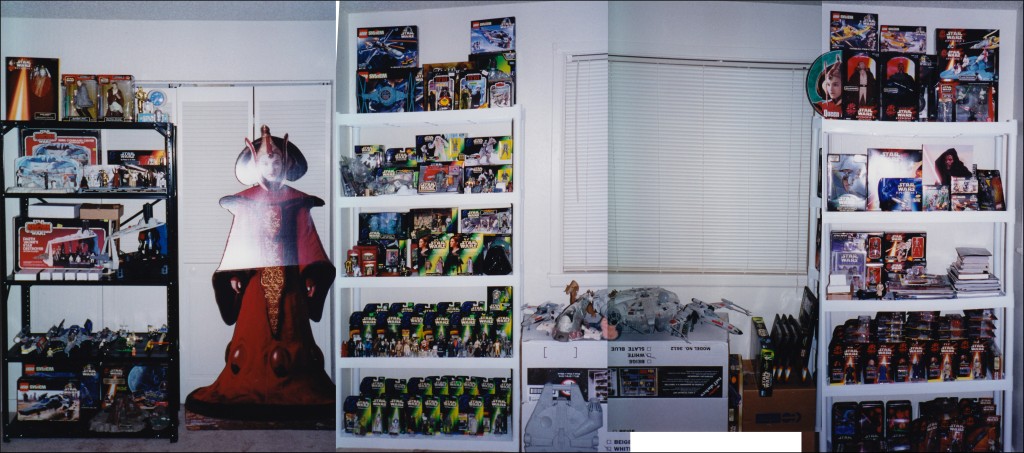
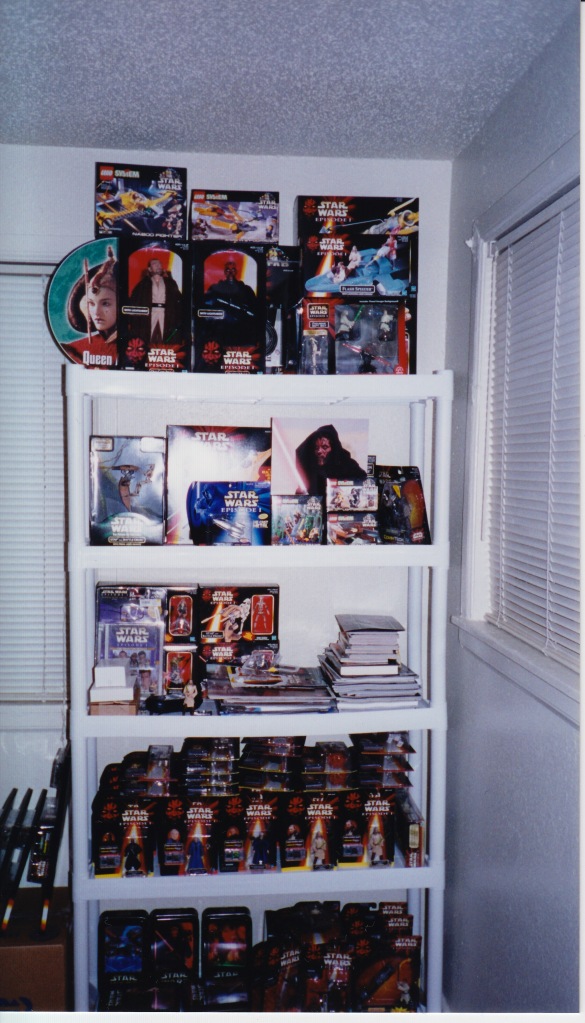
Living alone, I didn’t need a two-bedroom apartment, but it was advantageous in two regards. First, I was able to shelter my grandparents, uncle, and dad during Hurricane Floyd, and second, it gave me room to rebuild a Star Wars collection.
When I was a child, my Star Wars toys were the Cadillacs of my toy collection. They gave me many hours of enjoyment and they survived better than they might have elsewhere. Despite how much I loved them, I sold them off just before going to college at Georgia Tech–thinking that I needed to part with youthful things to attain a more serious mindset in my pursuit of a Physics degree.
I had kept a few dear Star Wars action figures–especially an R2-D2 with Sensorscope from The Empire Strikes Back (1980) that my grandmother had driven to Savannah to find for me. I also had a complete Yoda with orange snake action figure that I had purchased at Comics Plus in Macon. And a few vehicles include the Power of the Force 2 (POTF2) Millennium Falcon and Slave I.
From those humble beginnings, I began to acquire more Star Wars paraphernalia, merchandise, and toys. A lot of this rejuvenated interest came from the release of The Phantom Menace (1999) and the onslaught of new action figures, dolls, and LEGO sets (the latter’s licensing began in 1999).
On my days off from Mindspring, my hobby involved driving around to department stores, comic book shops, and flea markets looking for Star Wars collectibles. While my rent was low, it was in retrospect unwise of me to invest so much money and time in the collection. It brought me enjoyment at the time, but it eventually caused me a lot of stress and headache. It was both ends of madness–euphoria and the crash.
The work at Mindspring, after the Earthlink merger, became less fun. Others in the call center decided to play the numbers game and win–leading to more call backs and angrier customers–and left the rest of us the job of fulfilling our original mission to support our customers and lose. I decided to pack it in and move back to Brunswick to regroup. I’m glad that I did, because I eventually got back into Georgia Tech and made my way to where I am now at City Tech.
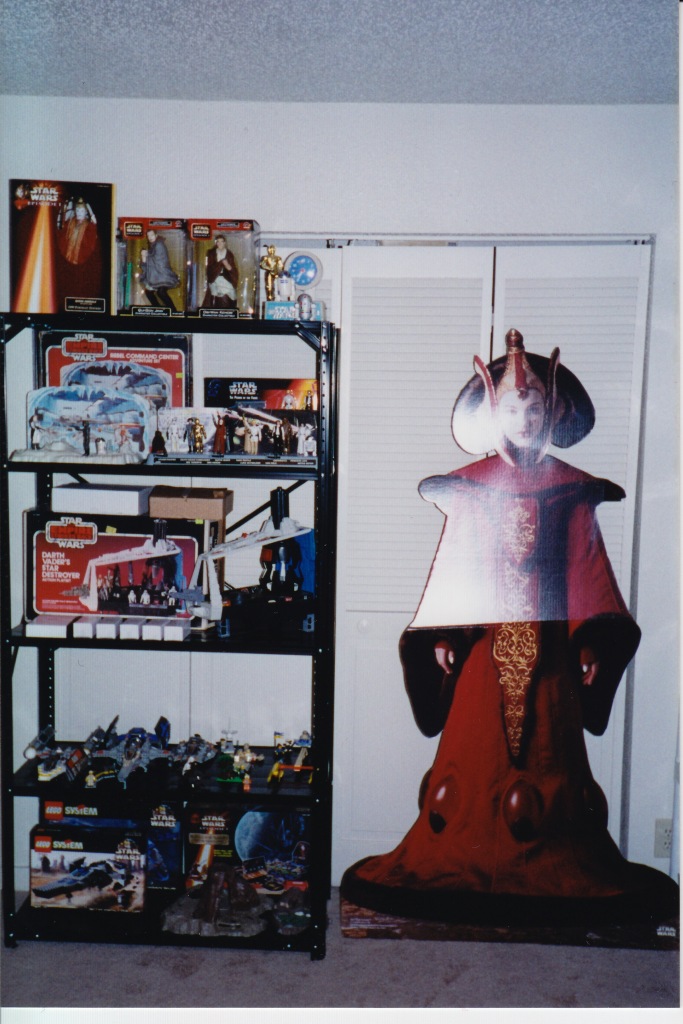
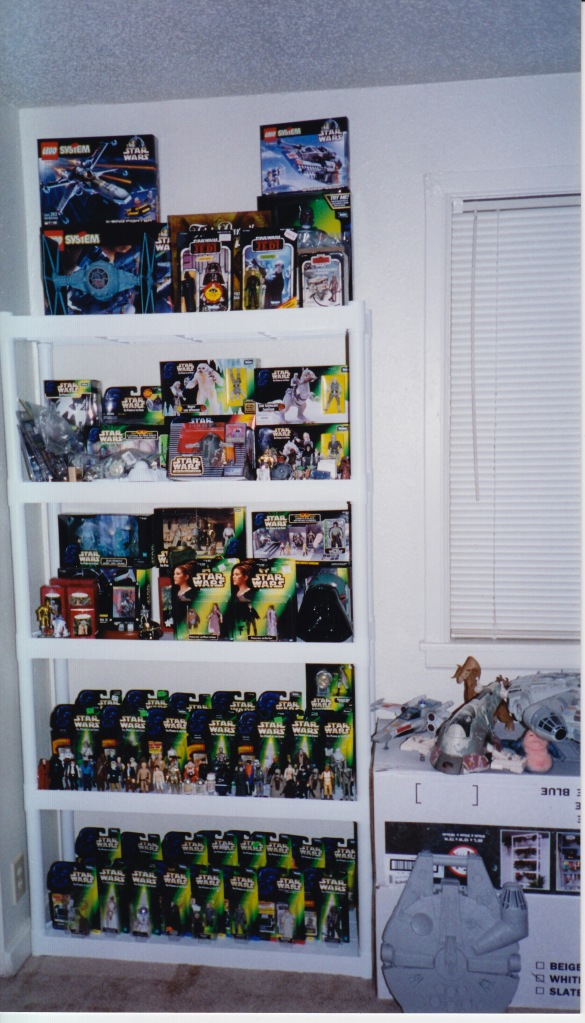
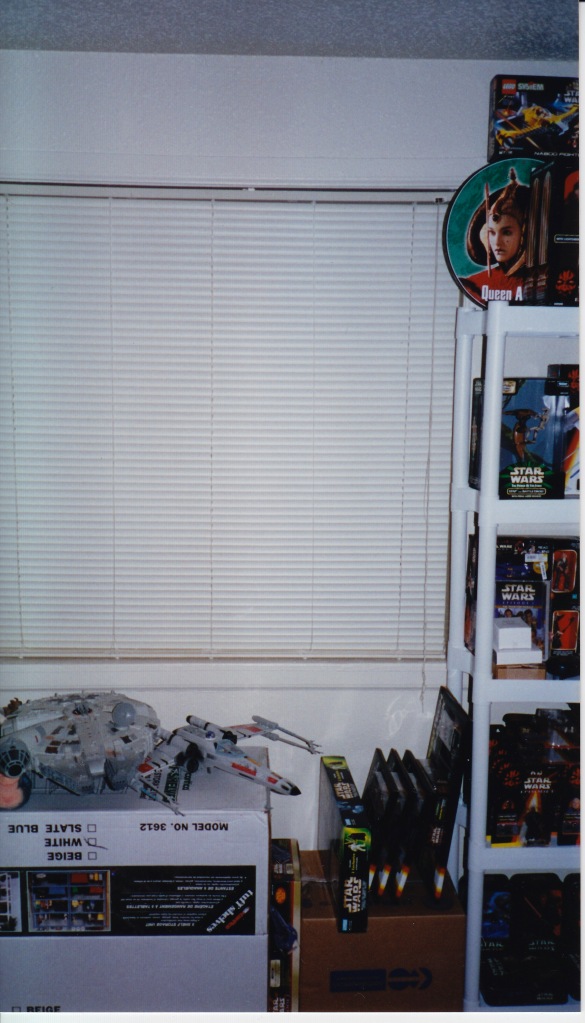
Here are some highlights shown in the photos of the collection above from left to right.
Photo 1
Photo 2
Photo 3
Photo 4
Rebel Command Center Adventure Set with original 3 figures. Mail-in Display Stand with complete set of original Kenner Star Wars action figures. Darth Vader’s Star Destroyer Action Playset. First LEGO sets including Y-Wing, Darth Vader’s Advanced TIE Fighter, Snowspeeder, and Anakin’s Pod Racer. Dagobah Playset.
POTF2 TIE Fighter. Carded Kenner ROTJ Darth Vader and Luke Skywalker (Jedi Knight) action figures. Vehicle Energizer in box. Lots of boxed and carded POTF2 action figures and playsets. Kenner Yodas with brown and orange snakes. Pewter Boba Fett figurine. Near complete set of Star Wars and Empire Kenner action figures. POTF2 X-Wing (small), Slave I, Jabba, Millennium Falcon.
POTF2 Millennium Falcon and X-Wing (large). Multipack action figure sets and carded Comtech Reader.
More Episode 1 action figures and toys than you can shake a stick at.
L to R: Jason Ellis, Lavelle Porter, and Jessica Roman
Over the past three days, I worked with my City Tech colleagues–Laura Westengard, Lavelle Porter, and Lucas Kwong–and student–Jessica Roman–to inventory the City Tech Science Fiction Collection. Two years ago, I began the collection’s finding aid by cataloging the 4,000+ magazines. Last year, I inventoried the collection’s nearly 1,700 monographs and anthologies. This year, we are creating an inventory of the remaining parts of the collection: scholarly journals and novels. Read details of our progress on the Science Fiction at City Tech OpenLab site here.
I delivered this presentation at the James Madison University Pulp Studies Symposium on October 7, 2016. The video above shows my presentation’s images, and the script of my talk is included below.
The paper is about introducing new audiences to old ideas for the benefit of two different City Tech audiences: 1) frame the historical publication context of science fiction short stories for students, and 2) illuminate the deep history of technological ideas for faculty fellows in the NEH-funded “Cultural History of Digital Technology” project.
[UPDATE: The symposium was a great success! Thank you to everyone who had questions and comments during our session. I posted photos taken by colleague Caroline Hellman over at the Science Fiction at City Tech website.]
Engagement, Learning and Inspiration in SF: Use Cases for the City Tech Science Fiction Collection
Jason W. Ellis
In the first issue of Amazing Stories dated April 1926, Hugo Gernsback writes:
By ‘scientifiction’ I mean the Jules Verne, H. G. Wells and Edgar Allan Poe type of story—a charming romance intermingled with scientific fact and prophetic vision … Not only do these amazing tales make tremendously interesting reading—they are always instructive. (Gernsback 3)
According to Gernsback, the literary genre that would become known as science fiction combines romance, scientific fact, and prophetic vision. The romance engages the reader in an interesting story. The facts instruct the reader in science and technology. The prophetic vision extrapolates from what is known into the not-yet-known and simultaneously inspires readers to realize that vision. I believe that Gernsback’s vision of SF is fundamental to arguments for SF collections at colleges with a pedagogical and community-serving commission like City Tech. Our college occupies several buildings in downtown Brooklyn and serves the educational needs of over 17,000 students. Historically a trade and vocational school, it has over time and by design developed into a senior college of the City University of New York (CUNY) system. Nevertheless, the students it serves and the fields it attempts to prepare them for are primarily focused on STEM career paths. While not all stakeholders recognize the importance that the humanities have to STEM graduates’ success and overall outlook, the administration’s support of the City Tech Science Fiction Collection signals at least one way in which the humanities—in this case via SF—is seen as supportive to the otherwise STEM-focused educational work of the college. In effect, SF and the collection serves as a source for engagement, learning, and inspiration for students who have much to gain from it as a literary genre that reveals the inextricable linkages between STEM and the humanities. While I cannot within the scope of this presentation explore all of these functions of SF, I will restrict myself to discussing how I have used the collection to support my teaching and pedagogical work at City Tech.
Teaching Science Fiction from a Historical Perspective
For students, my SF syllabus takes a historical approach to the genre. Following Brian Aldiss, I point to Mary Shelley’s Frankenstein as the genre’s beginning, because its plot pivots upon on an extrapolation of science and technology. Following this novel, I have students read a chronological progression of short stories that correspond with the movements in the genre: proto-science fiction and SF’s influences, H.G. Wells and his scientific romances, Jules Verne and his Voyages extraordinaires, Hugo Gernsback’s scientifiction and the pulps, John W. Campbell, Jr. and the Golden Age, the New Wave, Feminist SF, Cyberpunk, and contemporary SF. Looking at my current syllabus, which draws on readings from the Wesleyan Anthology of Science Fiction and a few stories in PDF form that are not in the anthology, over half appear for the first time in magazines held in the City Tech Science Fiction Collection, including: Isaac Asimov’s “Reason,” Astounding Science Fiction, April 1941; Tom Godwin’s “The Cold Equations,” Astounding Science Fiction August 1954; Robert Heinlein’s “All You Zombies—,“ The Magazine of Fantasy and Science Fiction, March 1959; Harlan Ellison’s “Repent, Harlequin! Said the Ticktockman,” Galaxy Magazine, December 1965; Philip K. Dick’s “We Can Remember It For You Wholesale,” The Magazine of Fantasy and Science Fiction April 1966; James Tiptree, Jr’s “The Women Men Don’t See,” The Magazine of Fantasy and Science Fiction December 1973; William Gibson’s “Burning Chrome,” Omni July 1982; and Octavia Butler’s “Speech Sounds,” Isaac Asimov’s Science Fiction Magazine Mid-December 1983. In addition to discussing each story in its historical context and its addressing Gernsback’s tripartite definition (along with other definitions, too), I show students photos of the magazines and their contents. I relate how these magazines were a big deal that introduced readers to engaging stories, new science and technology, and inspirational ideas via the haptic and tactile experience of reading printed magazines. Furthermore, the contents of a given magazine add an anthropological context to the magazines via editorials, letters, fandom, and advertising. Finally, the magazines help situate the readings for students, because they empower me to point at the library and take the readings out of the abstract realm of anthologization.
NEH-sponsored “Cultural History of Digital Technology” Project
While my students’ experience of SF is enriched by the historical materiality of our readings, City Tech’s faculty, who are engaged in pedagogical planning that bridges STEM and the humanities, share some of the same needs as my students. I have learned that my STEM-focused colleagues are experts in their fields, but many do not conceptualize SF on one level as a literary genre that addresses Gernsback’s tripartite definition: romance, scientific facts, and prophetic vision, or on another level as a literary form built on interdisciplinary STEM methodologies (i.e., building assemblages of ideas and constructing extrapolations) and focused on the effects of science and technology on humanity and vice versa (e.g., Asimov’s concept of “social science fiction” or Philip K. Dick’s epistemological and ontological adventures). Professor Anne Leonhardt of Architectural Technology and director of the NEH-funded project titled, “The Cultural History of Digital Technology: Postulating a Humanities Approach to STEM,” asked me to join and contribute my humanities-focused perspective. The project’s goal is to create six interdisciplinary pedagogical modules—on maps, fractals, robotics and sociality, geotagging, topology, and finally, robotics and the workplace. We do this by inviting speakers, holding reading groups, and participating in pedagogical workshops. The student-facing modules will integrate readings, classroom lecture and demonstration, and a hands-on activity. Initially, I helped with finding readings for two modules—fractals and topology, but as I describe below, I have leveraged the City Tech Science Fiction Collection’s magazine holdings and demonstrated that humanities folks can do more than find interesting readings. Also, I will use Gernsback’s definition as a measure of each considered story’s usefulness to the module’s goals.
3D Printing
The first module that I contributed readings to is called “Fractals: Patterning, Fabrication, and the Materiality of Thinking.” Its purpose is to bridge students’ understanding of mathematics to the natural world by using fractal geometry—the notion that Benoit Mandelbrot introduced as the process and principle of order and structure underlying the physical world. We teach students the underlying principles of fractal geometry, help them create a workflow using open-source tools to generate a 3D printable STL, or STereoLithography model, and finally, have them print their model using one of City Tech’s powder or plastic 3D printers.
Initially, I did not consider the City Tech Science Fiction Collection’s holdings, because everything was sitting in 160 boxes stacked floor to ceiling in my office and my former colleague, Alan Lovegreen’s office. Rudy Rucker’s “As Above, So Below” (1989), a story not widely anthologized but available on the author’s website, first came to mind, because I knew that both sides of his professional work touched on this topic. Rucker, a cyberpunk SF writer and mathematician, had written this story after his own attempts at discovering what is now called a “Mandelbulb,” or a three-dimensional plot of the Mandelbrot set, the recognizable image based on a simple iterative function explored in the work of Benoit Mandelbrot. In Rucker’s story, a mathematican hacks together a program that creates a three-dimensional Mandelbrot set that breaks out of his computer screen and takes him on a trippy voyage away from life and into a crabmeat can in his pantry where he can code and enjoy energy drinks for the rest of his life—as long as no one get hungry for canned crab. While it is an interesting story and Rucker’s work on the Mandelbulb is noted in the module, his story is more romantic and possibly prophetic, but less instructive.
Shortly thereafter, Alan and I finished moving and shelving the City Tech SF Collection, and I began searching for a better story in the collection’s magazines—a story that fulfills the Gernsbackian requirements and connects to both of the module’s topics: fractals and 3D printing. One such contender was Robert Heinlein’s “Waldo,” which tended to capture the materiality-emphasis of the module better than Rucker’s much later story. Published in August 1942 in Astounding Science Fiction as by Heinlein’s pseudonym Anson MacDonald, “Waldo” features on the cover with art by Hubert Rogers and story illustration by Paul Orban. The story is where the term for a remote manipulator system is coined—a waldo. However, the story is about a man named Waldo Jones who invents remote manipulators to enable his weakened body to act on the world. With his invention, he sets out to make smaller ones and smaller ones until they were capable of manipulating microscopic neural tissue and investigate the cause of his physical handicap. The idea then is that waldoes could be used to build up matter in the same way they were used to build smaller versions of themselves. Heinlein’s story fulfills Gernsback’s requirements—romance (intrigue and revenge), scientific fact (cybernetics), and prophetic vision (what possibilities might waldoes enable), but it does not fulfill both module topics as strongly.
Eventually, I found the story that is credited as the first SF describing 3D printing in detail: Eric Frank Russell’s “Hobbyist,” in the September 1947 issue of Astounding Science Fiction. Unlike “Waldo,” “Hobbyist” is not as widely anthologized, so having access to it in its original magazine was a bonus. If you are familiar with the contemporary video game, No Man’s Sky, then you have an idea about what “Hobbyist” is generally about. Astronaut Steve Ander and his companion parrot Laura crash land on a distant world and are in need of nickel-thorium alloy for fuel, which will hopefully get them a little closer to home. While scavenging around the crash site, Ander notices unsettling patterns of repetition in the world around him and discovers a structure that houses what amounts to a collection of life forms created in a 3D printer of sorts and maintained by an omnipotent being. The narrator describes it thus:
It was done by electroponics, atom fed to atom like brick after brick to build a house. It wasn’t synthesis because that’s only assembly, and this was assembly plus growth in response to unknown laws. In each of these machines, he knew, was some key or code or cipher, some weird master-control of unimaginable complexity, determining the patterns each was building—and the patterns were infinitely variable. (Russell 56)
“Hobbyist” satisfied the Gernsbackian requirements—romance (escape the planet), scientific fact (small scale engineering, iterative and fractal growth), and prophetic vision (might this technology make us gods?) and united both module topics. Capturing “Hobbyist” with my iPhone and Scanner Pro app, I shared the story with the other NEH Fellows— the story’s text and in-story illustrations by Edd Cartier and cover art by Alejandro de Cañedo. During meetings, I related the history of the magazine and how that adds to the importance of the story as a nodal point of STEM ideas expressed through SF long before 3D printing was first innovated in the 1980s, and even before it was described in theoretical terms by Richard Feynman in his well-known December 1959 American Physical Society presentation, “There’s Plenty of Room at the Bottom.”
Topology
The second module that I contributed to is called “Topology: Behind Escher’s Wizardry, A Look at the Development of Modeling and Fabrication.” Unlike the earlier fractal module, the topology module would involve programming to create each student’s 3D printed model. In addition to my role as the humanist on the team, I made this a personal challenge to relearn Wolfram Mathematica, a symbolic computation program that supports a relatively easy-to-use programming language, because I wanted to demonstrate how its could satisfy all aspects of teaching, coding, and modeling. I began by creating a Mathematica workbook that demonstrated topology concepts, such as points, lines, polygons, and dimensionality, and easy-to-follow programming tutorials of topological surfaces. Additionally, I showed how Mathematica exported 3D printable STL files of the topological models students would create.
Initially, we considered Edwin Abbott’s Flatland: A Romance of Many Dimensions (1884), but Professor Satyanand Singh, a colleague in the Mathematics department, suggested that we show a video based on Abbott’s story instead. This created an opportunity.
While performing serious play with Mathematica, I recalled Robert Heinlein’s “—And He Built a Crooked House” from the February 1941 issue of Astounding Science Fiction. Featuring cover art by Hubert Rogers and story illustrations by Charles Schneeman, the story is about an ambitious architect who designs a house in the shape of an unfolded tesseract, or a four-dimensional cube. Unfolded means to create a geometric net or the interconnected, component elements of the object. For example, a three-dimensional cube unfolds into a net composed of two-dimensional squares arranged in eleven different configurations. On the other hand, a tesseract, which is four-dimensional, unfolds into a net of connected three-dimensional cubes with 168 possible configurations! The architect’s innovative design is such an arrangement of three-dimensional cubes, which in this case, resembles the Cross of St. Peter. Unfortunately, having been built in California, there is an earthquake and the house collapses into itself forming a nondescript house-like cube. The incredulous architect and his nonplussed clients enter the domicile to investigate and become trapped within the structure’s weird, higher-dimensional geometry. It is an improbable story, but it captures the strangeness of higher dimensions and introduces topics for discussion. “—And He Built a Crooked House” fulfills Gernsback’s definition—romance (escape the counter-intuitive house-turned-maze), scientific fact (higher dimensionality), and prophetic vision (let’s use math to build innovative buildings), and it tangentially fulfills the module’s focus on topology.
The NEH project is on going, so there are opportunities to locate other stories and materials in the SF magazines held in the City Tech Science Fiction Collection. In my SF class, I hope to bring my students to the archives for special projects pre-arranged with the librarians. Professor Jill Belli is doing this now, and some of her students’ work will be features in a special session of the upcoming Symposium on Amazing Stories: Inspiration, Learning, and Adventure in Science Fiction on November 29 at City Tech, which I hope that you all will consider presenting or attending. Thank you for listening.
Works Cited
Gernsback, Hugo. “A New Sort of Magazine.” Amazing Stories April 1926: 3.
Heinlein, Robert. “—And He Built a Crooked House. Astounding Science Fiction, February 1941, 68-83.
Russell, Eric Frank. “Hobbyist.” Astounding Science Fiction, September 1947. 33-61
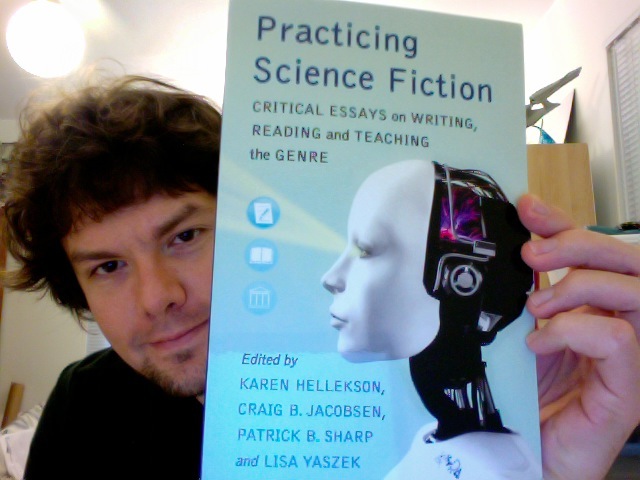
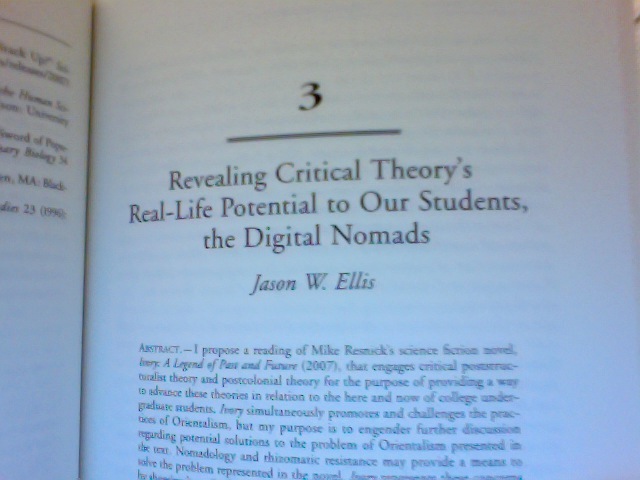
I received a nice Media Mail surprise today: Karen Hellekson sent me a complimentary copy of the book that she edited along with Craig B. Jacobsen, Patrick B. Sharp, and Lisa Yaszek from McFarland Publishers titled Practicing Science Fiction: Critical Essays on Writing, Reading, and Teaching the Genre. I’m particularly tickled about this arrival, because this is my first book chapter! My long ago essay, originally written for Masood Raja’s Postcolonialism course during my first year at Kent State and substantially rewritten since then for conferences and now this book project, has finally seen the light of day in print as chapter three of this collection titled, “Revealing Critical Theory’s Real-Life Potential to Our Students, the Digital Nomads.”
I have included a copy of the Practicing Science Fiction’s overview and chapter abstracts below, copied from Karen’s website. Please pick up a copy from the publisher here or on amazon.com here. Royalties from the collection go to the Science Fiction Research Association, of which I am a member and the organization’s publicity director.
About the book:
Practicing Science Fiction
Karen Hellekson, Craig Jacobsen, Patrick Sharp, and Lisa Yaszek
Overview
The edited volume Practicing Science Fiction: Critical Essays on Writing, Reading and Teaching the Genre (ISBN 978-0-7864-4793-0) seeks to add to the academic literature related to reading, writing, and teaching science fiction. By presenting these ideas together, we hope to show the synergy between these modes of engagement and analysis. No edited volume has addressed the intersection among these three topics. The concerns of reading, writing, gender, and media—the topics that comprise the four sections of the book—are used to distance and critique concerns of interest to those interested in intellectual growth. The contributors to the teaching section discuss how science fiction texts lend themselves to teaching things other than SF literature. The writing section is not a how-to, but rather analyses of inscription and reinscription of knowledge and tradition through reading and writing. Finally, the sections on media and women contain close readings of exemplar texts related to larger issues such as female agency, memory, and ecodystopia that are usefully articulated through the distancing of SF.
Abstracts
From Practicing Science Fiction: Critical Essays on Writing, Reading and Teaching the Genre (c) 2010 SFRA by permission of McFarland & Company, Inc., Publishers, http://www.mcfarlandpub.com.
Part 1. Teaching
Teaching with Science Fiction
Section edited by Craig Jacobsen
The essays in this section demonstrate that pedagogical studies are integral to, rather than tangential to, the scholarship of science fiction. Understanding science fiction requires more than just being able to dissect a story or novel, or apply a theoretical viewpoint to a film. A profound understanding of science fiction means realizing what science fiction can be made to reveal about the world. (pp 7–12)
1. Grokking Rhetoric through Science Fiction: A Practical Examination of Course Construction
Jen Gunnels
Traditional teaching methods and materials for core curriculum all too often leave the student disengaged, or worse, confused. A text’s placement in the Western canon does not automatically make it accessible or engaging. It can leave the students bored and unconnected, and it can give them an inaccurate perception of rhetorical thought and the writing process. That is not to say that the canon is not important—it is—but often undergraduate core courses, especially mass courses such as rhetoric and composition, fall back on the same few texts. A reliance on canonical material—canonical to the instructor, but often unfamiliar to undergraduates—splits student focus between understanding the materials used to illustrate the concepts and the concepts themselves. A more accessible literature has the potential to free the student to concentrate on the new, often complicated, ideas being presented, and science fiction in particular can engage students who are studying core subjects by providing exemplar texts that clearly and compellingly illustrate major fundamental points. Here, I examine the use of science fiction in teaching basic undergraduate rhetoric and composition, and I reenvision its implementation. I include basic rhetorical elements that a course should cover, and I analyze a sample assignment, a brief rhetorical analysis of Tom Godwin’s 1954 story “The Cold Equations,” to illustrate basic rhetorical tools and wider arguments affecting rhetorical choices. (pp 13–23)
2. Incorporating Science Fiction into a Scientific Rhetoric Course
Michael J. Klein
Many of the scientific and technological achievements of the past century were prefigured by writers of speculative or science fiction. The scientific and technological achievements we view as commonplace (e.g., the Internet, wireless communication, advances in reproduction) were often discussed by literary authors decades before their “discovery.” Conversely, advances in science and technology drove authors to further their speculations and logically extend the discoveries of the day in their writing. In that spirit, I decided to expand the traditional canon of works I used in a scientific rhetoric course to include works of science fiction. The students in the course compared and contrasted the representation of science and scientists in fictional and factual accounts, examined the ways in which texts become important to a culture and a discourse community, and identified the means by which science informed science fiction, and vice versa, during the past century. I found that for undergraduates, the addition of literature made the concepts of scientific rhetoric more accessible and fostered greater conversation between students studying different subjects. The students in the humanities and social sciences used the literary works as a stepping stone to understanding the discourse within the scientific community. Conversely, students in the sciences and engineering recognized and appreciated the humanistic elements of science by seeing parallels in the works of fiction. These results speak to the benefits of increased dialogue among disciplines that address the concepts of science and technology. (pp 24–36)
3. Revealing Critical Theory’s Real-Life Potential to Our Students, the Digital Nomads
Jason W. Ellis
I propose a reading of Mike Resnick’s science fiction novel, Ivory: A Legend of Past and Future (2007), that engages critical poststructuralist theory and postcolonial theory for the purpose of providing a way to advance these theories in relation to the here and now of college undergraduate students. Ivory simultaneously promotes and challenges the practices of Orientalism, but my purpose is to engender further discussion regarding potential solutions to the problem of Orientalism presented in the text. Nomadology and rhizomatic resistance may provide a means to solve the problem represented in the novel. Ivory represents these concerns by showing how the fictional problem and its solution in fact epitomize our everyday digitalized and online existence. The novel explores models and provides examples of the online technologies that digital nomad students may use for self-empowerment and personal protection from the encroachment on their lives by the state and by global capital. (pp 37–50)
Part 2. Reading
Reading and Writing SF
Section edited by Patrick Sharp
The attempts of some to divide the sciences and humanities into two cultures ignore the fact that both contribute to the same system of genres that circulate throughout our culture. Scientists regularly draw on SF to make the case for why their science is important and worthy of funding. Authors of SF regularly draw on scientific narratives as they develop their “charming romances.” Though the system of genres in our culture has evolved over time, this interchange between science and SF has remained constant. The essays in this section explore specific texts as sites of this ongoing exchange between the interconnected subcultures of science and literature. They also address the importance of literacy—in regards to both science and literature—to the traditions of SF reading and writing. (pp 53–57)
4. Reading/Writing Martians: Seeing Technē and Poiēsis in The War of the Worlds
Charles Harding
From its opening lines, The War of the Worlds is concerned with seeing, or comprehending, through reading and writing. Wells’s novel emerges from a cultural environment in which a lack of foresight and illiteracy mark future-war stories and scientific discourse. Wells interrogates this cultural blindness and fosters competency by presenting his narrator as a scientific—that is, a knowing—spectator of the Martian invasion. The narrator strives to distinguish himself from those who exhibit nescience in relation to the attack. His insight proceeds from his ability to read—to comprehend and translate—what emerges from the Martian cylinders. The Martians figure as a prevision of a technologized future, and the narrator’s scrutiny of their features and annihilative machinery reveals a potentially dangerous element in humanity’s relationship to technology. This danger manifests in the Martians’ degenerate technē, their transformation of the world into a totally mechanized and depersonalized system. Despite the forbidding nature of this futuristic world, the possibility remains that it may be averted. This possibility lies in poiēsis, or artistic producing, which in The War of the Worlds culminates in the narrator’s rewriting of the invasion. According to Heidegger, poiēsis constitutes a space for an essential reflection on the danger for humanity in technology. Wells’s novel offers an opportunity for reflection on future humankind, embodied in the Martians, and its relationship to advanced technology by inviting readers to see alongside the narrator as he scrutinizes the Martians and their technē. With The War of the Worlds, Wells suggests that science fiction must be knowing fiction. (pp 58–73)
5. The Creation of Heinlein’s “Solution Unsatisfactory”
Edward Wysocki
Robert Heinlein’s short story “Solution Unsatisfactory,” which appeared in Astounding Science-Fiction in May 1941 under the pen name Anson MacDonald, is well known for its presentation of a precarious world situation after the development of a nuclear weapon. This story appeared well before the establishment of the Manhattan Project for the development of an atomic bomb. Knowledge of the state of nuclear physics in the time before the story’s creation is presented to show that its concept grew from an uncertainty regarding the means by which an atomic bomb could be constructed. The source of basic premise of the story, the use of radioactive dust rather than a bomb, is identified as Astounding’s editor, John W. Campbell Jr. Development of the story, while retaining the basic weapon concept, was then taken by Heinlein in a different direction than had been originally suggested to him. Possible sources of technical information available to Heinlein are then considered, and a connection shown to a friend of Heinlein who had just received his PhD in the field of nuclear physics, Robert Cornog. The dust idea presented in the story occurred shortly before the same idea appeared in a report developed to suggest possible military applications of atomic fission. Although the close timing between the work of fiction and the report has been noted previously in the literature, no effort had apparently been made to establish a connection. In this essay, I propose a definite connection. (pp 74–86)
6. Entropy, Entertainment, and Creative Energy in Ben Bova
Donald M. Hassler
Even though Ben Bova is discounted by some as an “easy” writer or, perhaps, even because of this fact, his usefulness as a representative of the genre has impressed me. Further, I like his storytelling both for its ease and for its consistency. So this essay is one of several I have written attempting to account for genre effects in SF. I discuss several recent Bova novels, each dealing with the extrapolation of what we know of one of the planets in our system; and I find, in fact, some rich resonance of what I call “genre effects” in these books. I write in part as a fan, as well as an academic who hopes to set enthusiasm into the larger context of literary study. Many of Bova’s storytelling techniques seem outdated because they appear in the same milieux as postmodern experimentation, and I evoke the family romance metaphor from Freud—we tend to seek out and to feel comfortable with the “generation” of our fathers. Much of my point, then, about Bova’s effects is captured in what I label in the title as “the entropy” of reading and genre. I argue that the vigorous generation, or family sense, in these science stories allows us to see beyond. (pp 87–96)
Part 3. Media
Media and Science Fiction
Section edited by Karen Hellekson
The proliferation of nonprint SF texts, such as film, television, Web content, comic books, and video games, indicates that SF remains a valuable and generative mode of storytelling. All three essays use close readings of exemplar nonprint texts to draw conclusions about contemporary concerns. And all three essays rely on texts that are themselves part of a larger multimedia megatext, be it the Doctor Who or Watchmen universes, or the film megatext created by the subgenre of the ecodystopia. All three essays rely on displacement—of genre, of medium, of message, of memory. They illustrate the power of nonprint SF as a tool to effectively engage with contemporary concerns. (pp 99–103)
7. Remembering Torchwood: Investigating the Postmodern Memory Crisis on the Small Screen
Susan A. George
In this analysis of the importance and reliability of memory in the context of postmodern SF, I use close readings of two exemplar episodes ( “Adam” and “Sleeper”) of the television program Torchwood (2006–9) to explore the fundamental nature of humanity. Torchwood asserts that some essential qualities escape quantification. These qualities define the human and separate the human from the nonhuman. Memory is the locus of these qualities, not some metaphysical or religious construct called the human soul. (pp 104–16)
8. Text’s Resistance to Being Interpreted: Unconventional Relationship between Text and Reader in Watchmen
Ho-Rim Song
Alan Moore and Dave Gibbons’s graphic novel Watchmen (1986–87) experiments with postmodern literary devices, forms, and style to problematize the conventional concept of interpretation. In particular, the text deconstructs the conventional relationship between text and readers as the interpreted and the interpreter, and by doing so, it calls into question readers’ perception of their own reality as well as that of the text. Watchmen ultimately claims that interpretation, or the act of finding truth or meaning, is meaningless for our postmodern reality. (pp 117–29)
9. “Breathe, baby, breathe!” Ecodystopia in Brazilian Science Fiction Film
Alfredo Suppia
This analysis of four ecodystopian Brazilian SF films—Claudinê Perina Camargo’s 93° Tunnel (1972), José de Anchieta’s Stop 88 (1978), Roberto Pires’s Nuclear Shelter (1981), and Marcos Bertoni’s Armadillo Blood (1986)—demonstrates that ecodystopia is one of the most structured and long-lasting manifestations of science fiction in Brazilian cinema, offering critical and speculative visions at the crossroads of social, political, and environmental issues that continue to remain strikingly relevant today. These films shed light on Brazilian anxieties regarding modernization in the atomic era that reflect greater world ecological concerns that are only becoming more compelling. (pp 130–45)
Part 4. Women
Women and Writing
Section edited by Lisa Yaszek
Women’s science fiction has taken a wide variety of forms over the past two centuries, but nearly all such writers have grappled with two fundamental questions: who counts as a hero in a technoscientific world, and what story forms best convey this heroism to readers? These questions are very much at the heart of the four essays included in this section. The first two authors examine how two iconic women writers, Joanna Russ and Octavia Butler, complicate received ideas about the nature of the science fiction hero. The second set of authors explore how women writing science fiction use their narrative practices to meditate on the nature of storytelling itself. (pp 149–53)
10. Hail the Conquering Campbellian S/Hero: Joanna Russ’s Alyx
Eileen Donaldson
For many theorists, both feminist and not, the figure of an archetypal, active female warrior hero has been problematic. Many feminists believe it is gender stereotyping to suggest that women are unable to possess the force of the archetypal warrior hero and that this archetype is ultimately available to both men and women. I briefly define the nature of the archetypal hero and an argument is made for the active female s/hero who possesses the “masculine” powers of the hero and thus allows the archetypal power of the active warrior hero to pass to women. Joseph Campbell’s work on the archetypal hero of myth is drawn on extensively. One of the genres that allow an exploration of the s/hero is SF. I explore the s/hero in SF, particularly as she is evoked in Joanna Russ’s Alyx stories, published as short stories first and then collected in 1983 and published as The Adventures of Alyx. (pp 154–67)
11. Essentialism and Constructionism in Octavia E. Butler’s Fledgling
Kristen Lillvis
Although critics have argued that science fiction writer Octavia E. Butler confines her heroines to biologically determined sex and gender roles, in this article, I look beyond genetic predispositions and explore the influence of social and material conditions on her characters’ beliefs and actions. I use Butler’s final novel, Fledgling (2005), to investigate acts of sexual violence, demands of heterosexual sexual practices, and traditional notions of maternal roles as they affect the novel’s human and vampire species as well as Butler’s protagonist, a genetically engineered being whose biology aligns her with both species but whose amnesia frees her from a socially constructed consciousness. I posit that although biological tendencies may exist in the novel, Butler uses her heroine’s atypical beliefs about and responses to female behavioral norms to demonstrate that sex-specific characteristics become unavoidable truths only for the individuals and societies that choose to accept them as such. (pp 168–82)
12. Joanna Russ and the Murder of the Female Child: We Who Are About To…
Rebekah Sheldon
In this essay, I investigate the violation of the rescue of the female child theme in Joanna Russ’s 1977 novel We Who Are About To…. In stories like “The Second Inquisition” (1970), Russ positions the reader as the double of the child in the plot and rescues both by engendering the story as a hero. I assert that We Who Are About To… rends open this closed loop through its refusal of proper narrative structure and its murder of the female child. I interpret this murder as an interrogation of the metaphysics of presence implicit in the rescue thematic, a move to a deconstructive writing practice and a liberation of the child from service as the site of future redemption. (pp 183–96)
13. Learning to Listen, Listening to Learn: The Taoist Way in Ursula K. Le Guin’s The Telling
James H. Thrall
Ursula K. Le Guin’s The Telling (2000) is more than simply a novel steeped in Taoism. It is, in fact, an attempt to make a political point by imagining a novel in a Taoist mode. Her protagonist moves beyond merely studying the Telling, a way of life modeled on Taoism, to becoming a practitioner herself. Le Guin contrasts her construction of the Telling’s grassroots system of communicating life wisdom through story with hierarchical systems of domination and control. By emphasizing the importance of properly engaged listening, which she sees as a key aspect of both Taoism’s and the Telling’s feminist principle, Le Guin advocates an alternative politics that embraces “peaceful anarchy” rooted in cooperation and discernment rather than conflict. (pp 197–212)
Citation information
Hellekson, Karen, Craig Jacobsen, Patrick Sharp, and Lisa Yaszek, eds. Practicing Science Fiction: Critical Essays on Writing, Reading and Teaching the Genre. Jefferson, NC: McFarland, 2010.