Tag: Collection

  • My Humble Star Wars Collection

    star wars action figure collection of assorted figures, vehicles, playsets, and models
    star wars action figure collection of assorted figures, vehicles, playsets, and models


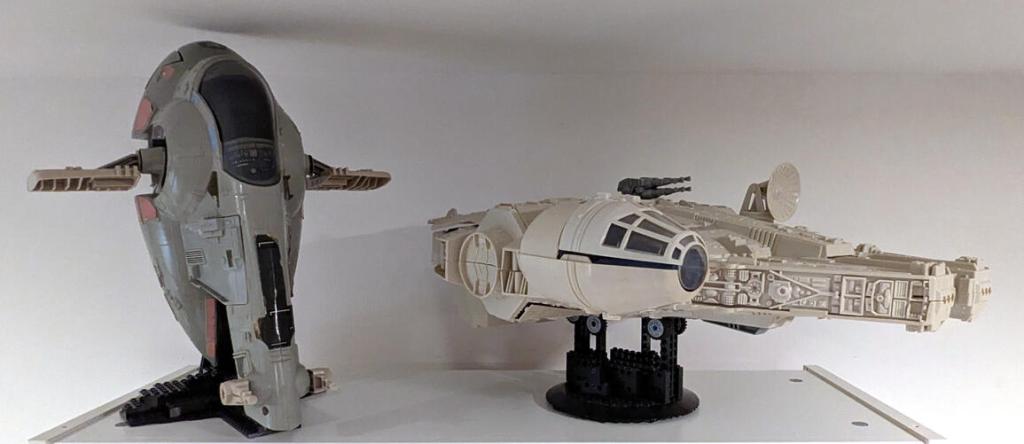
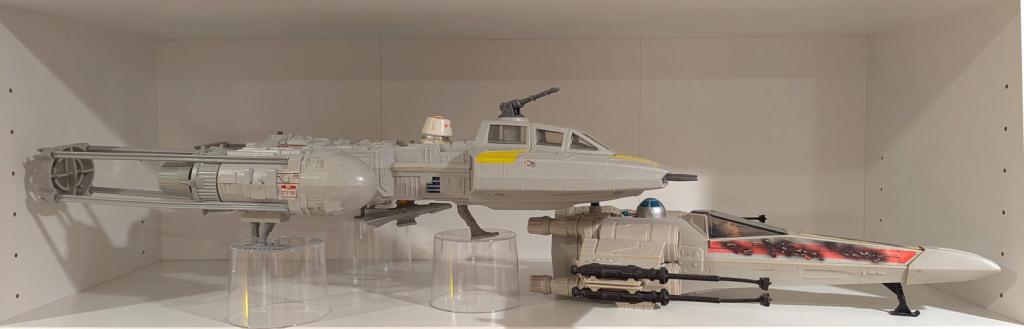
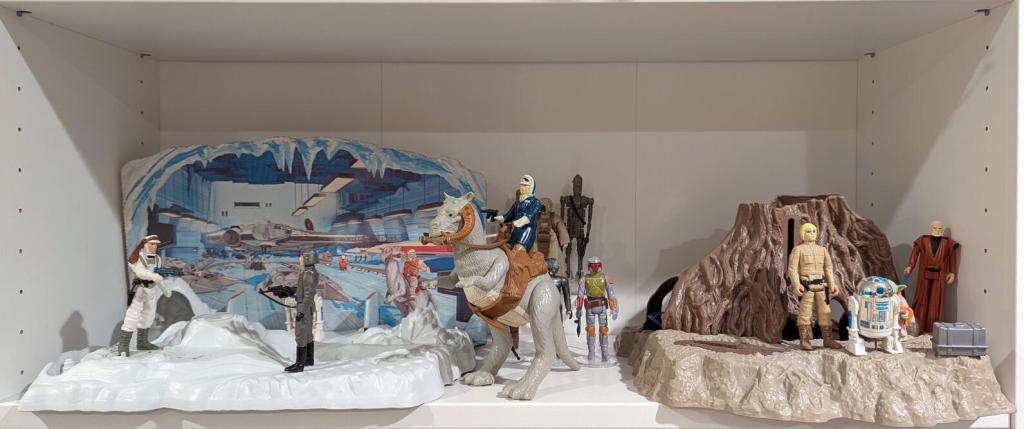
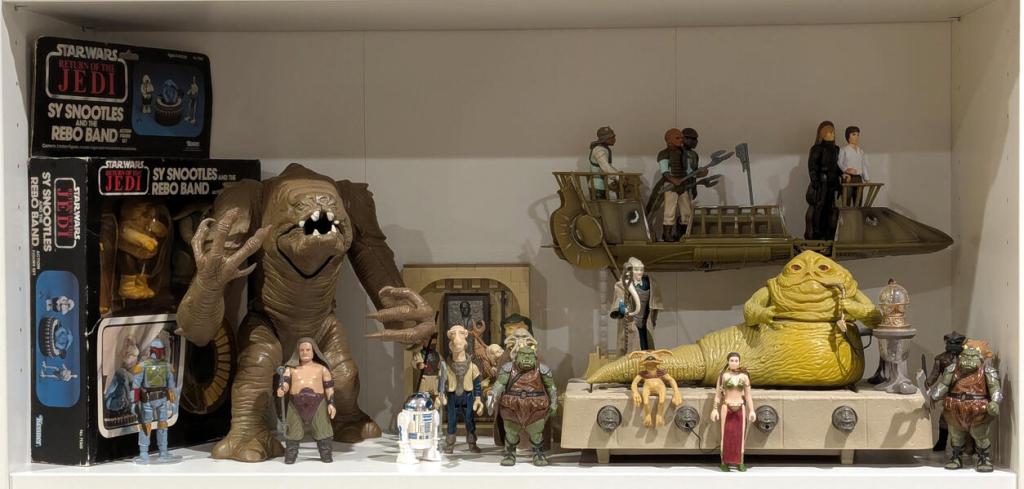
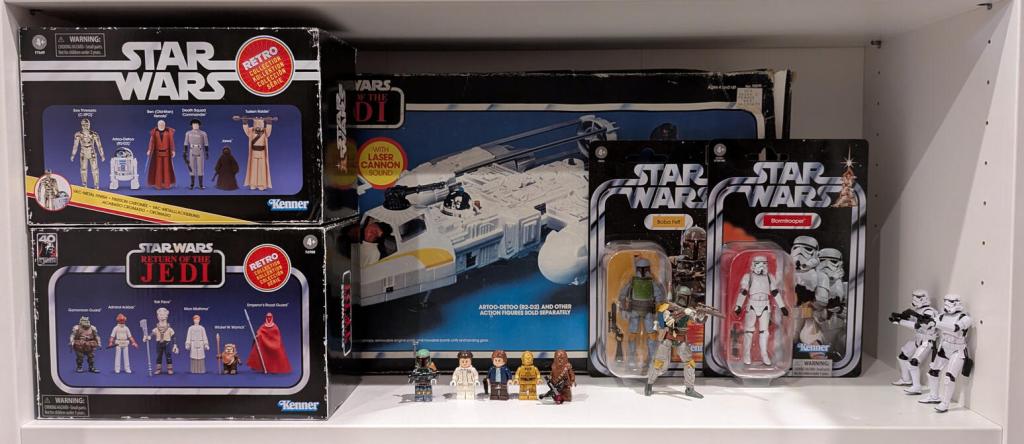
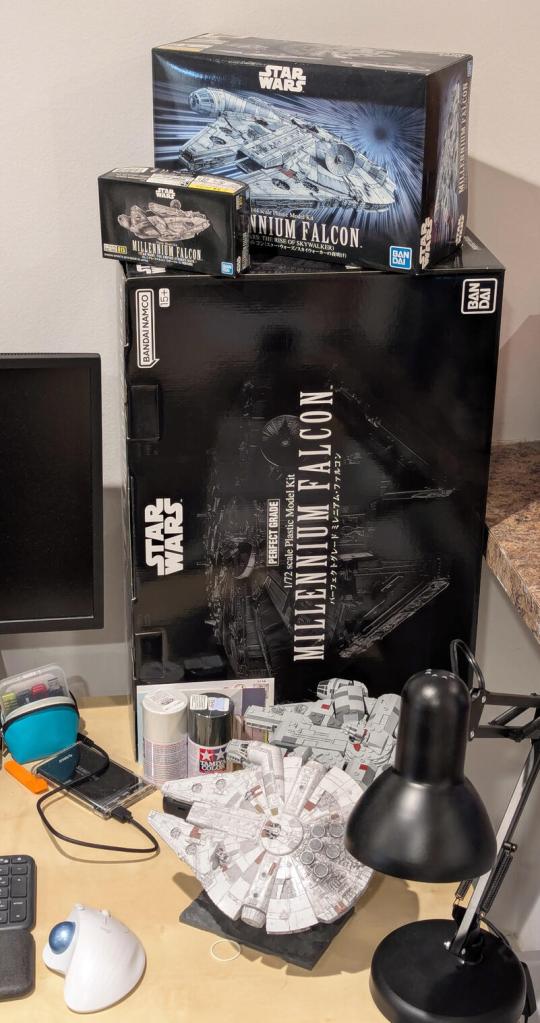
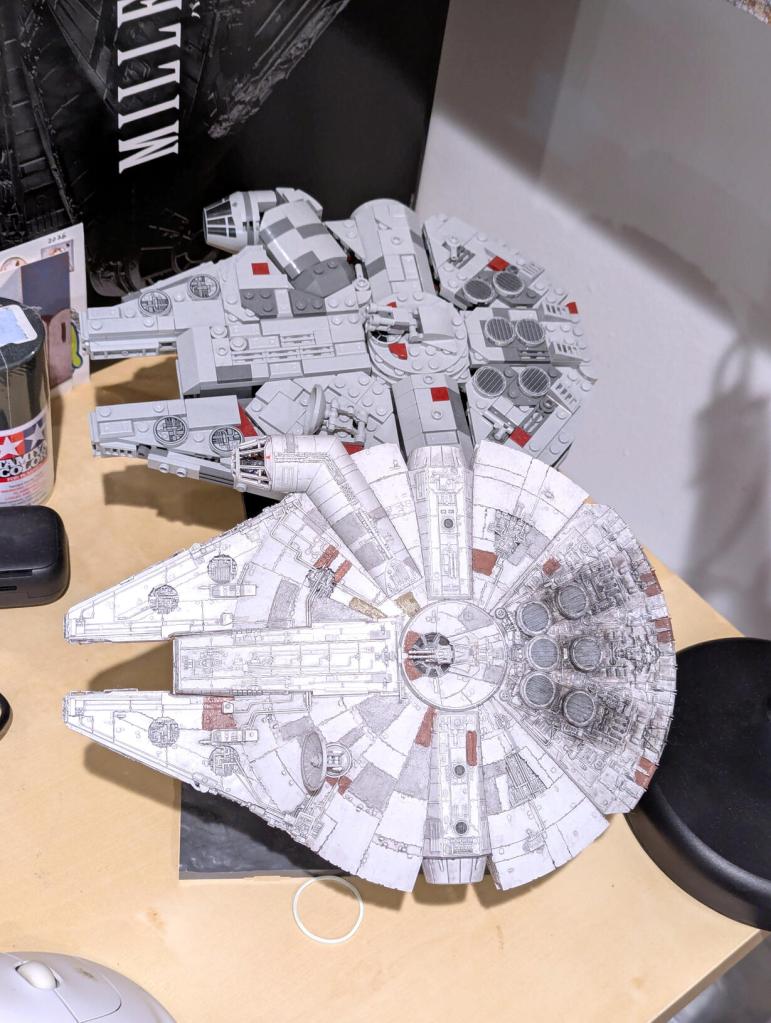
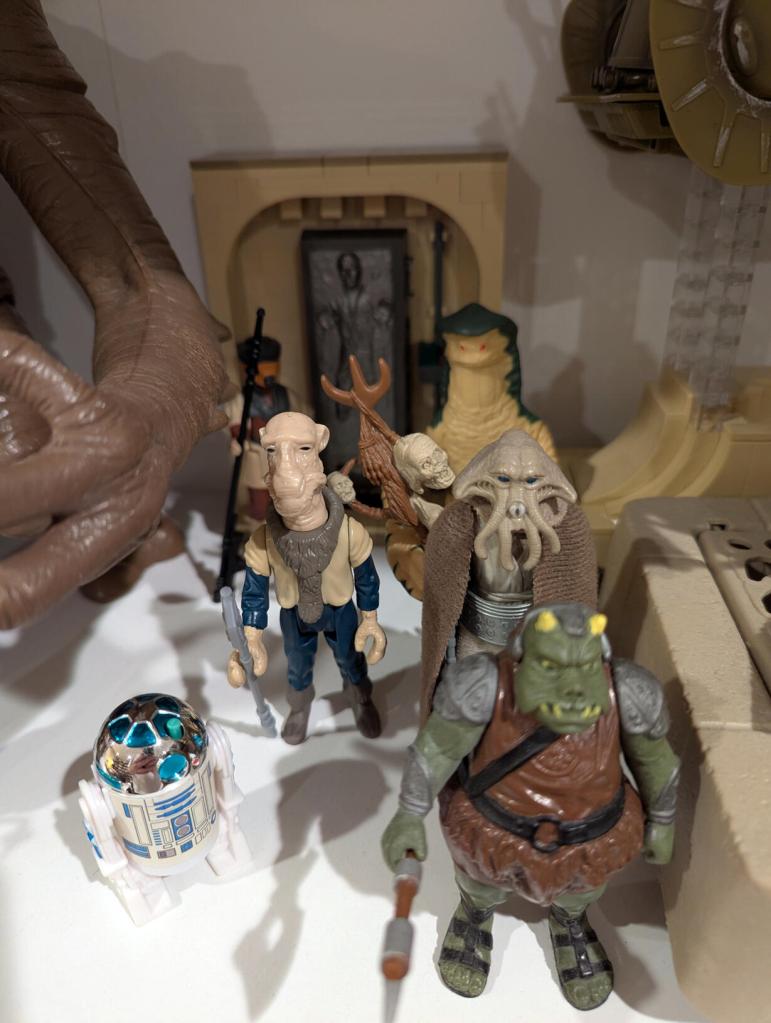
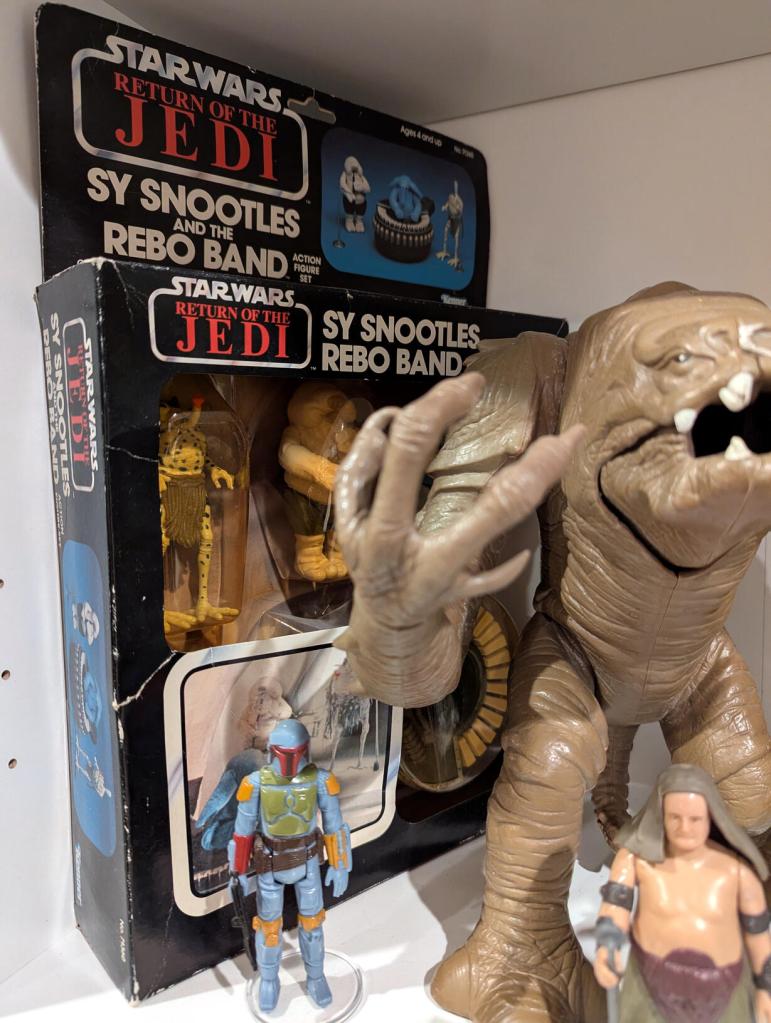
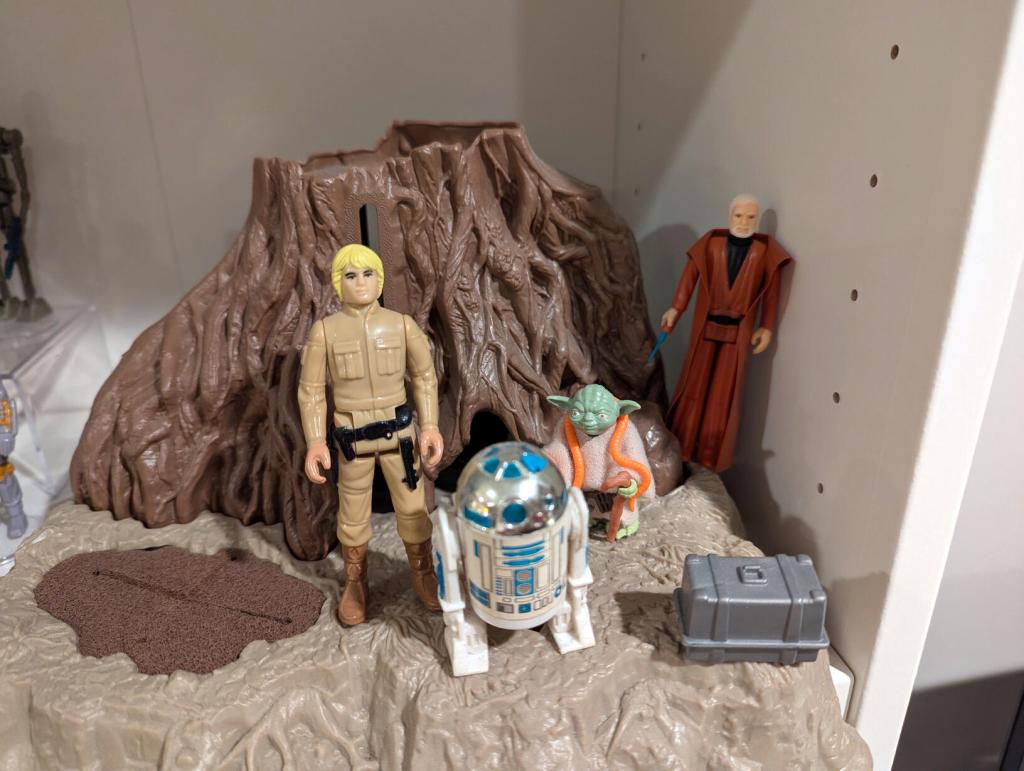
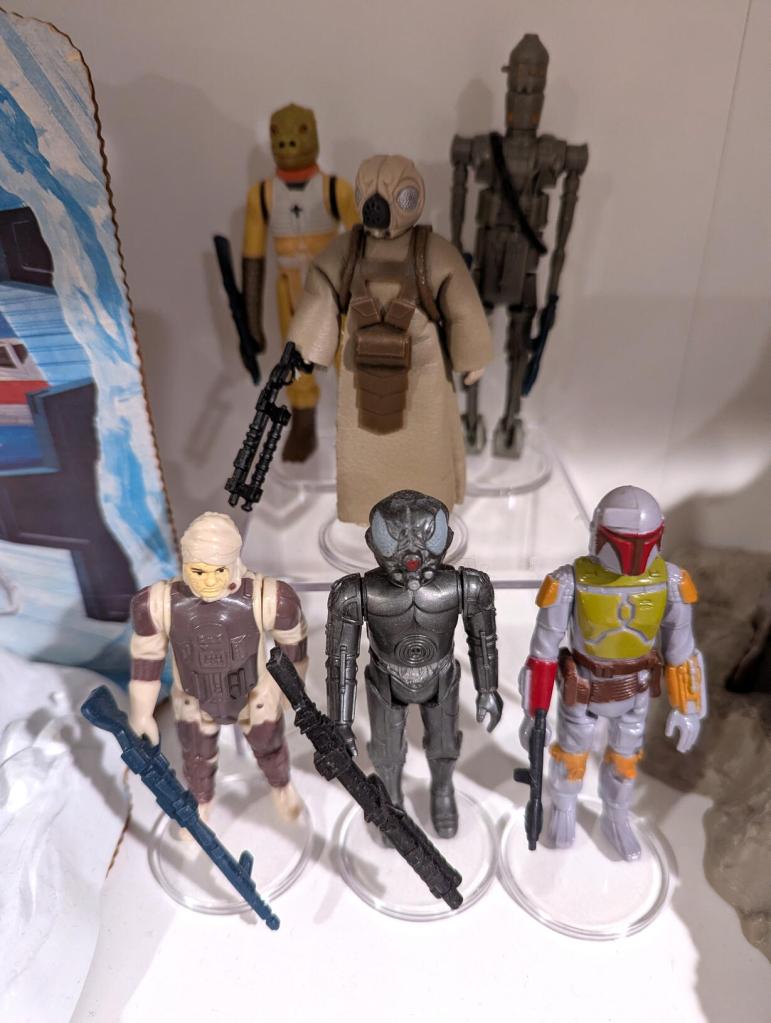
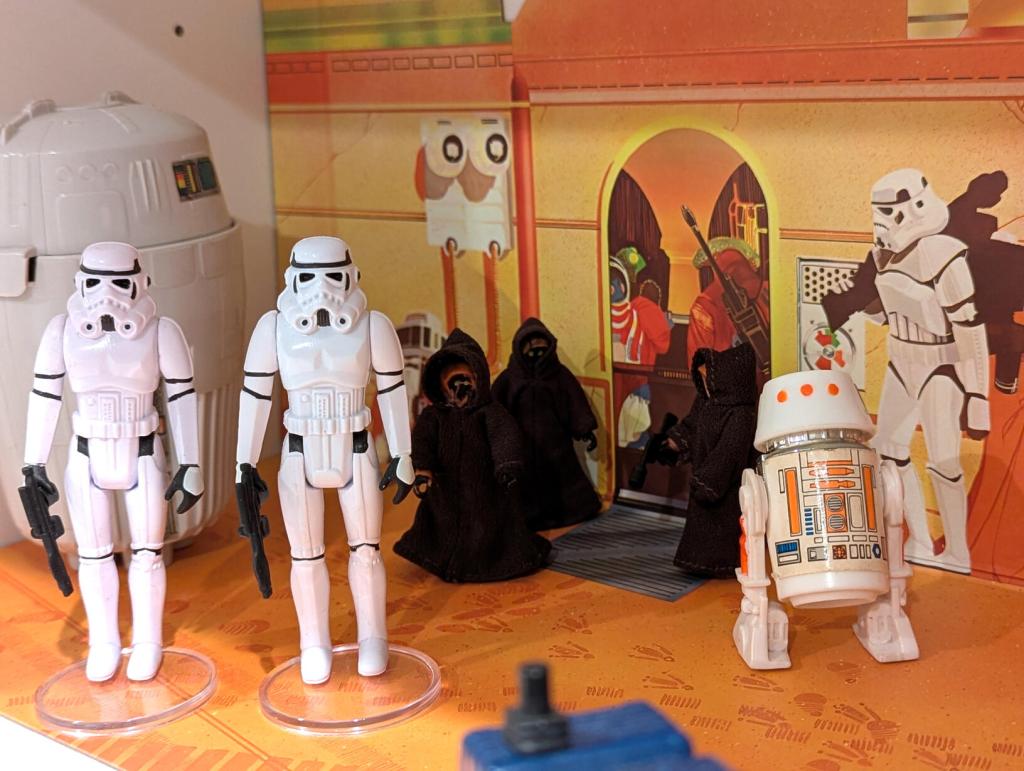
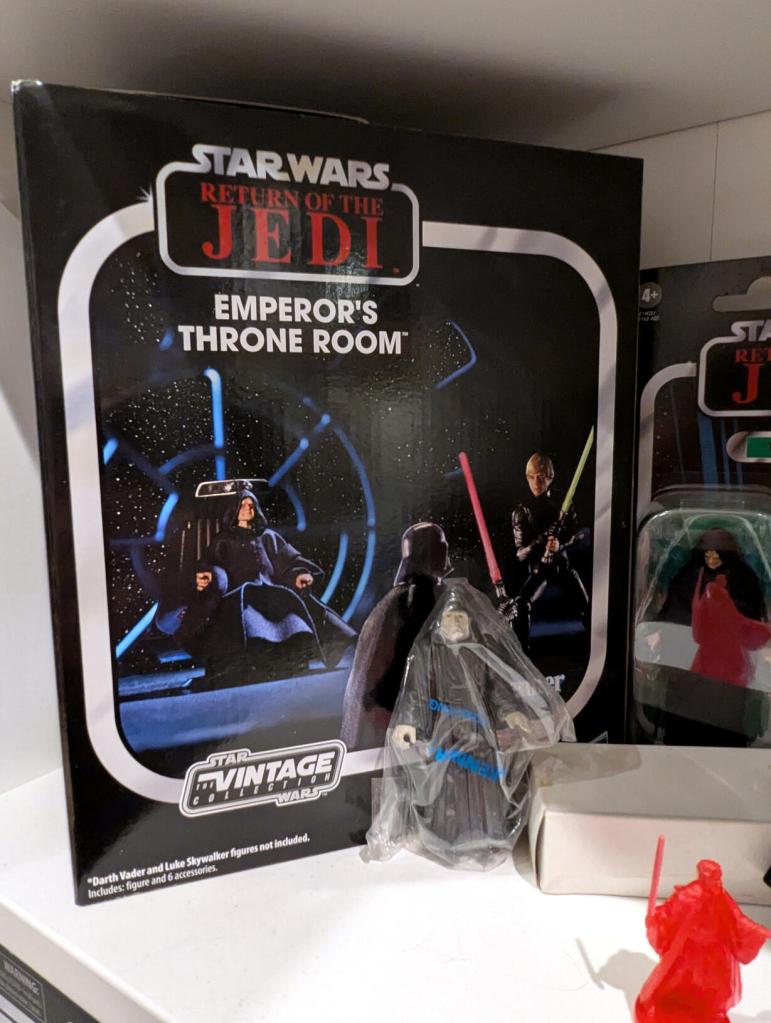
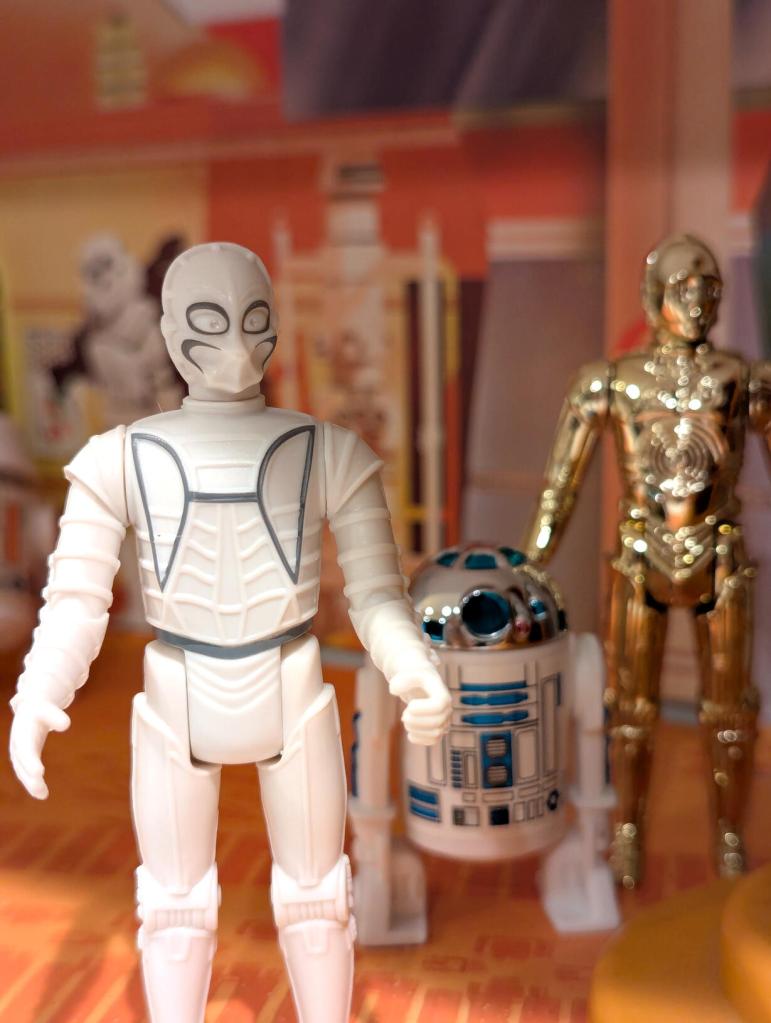
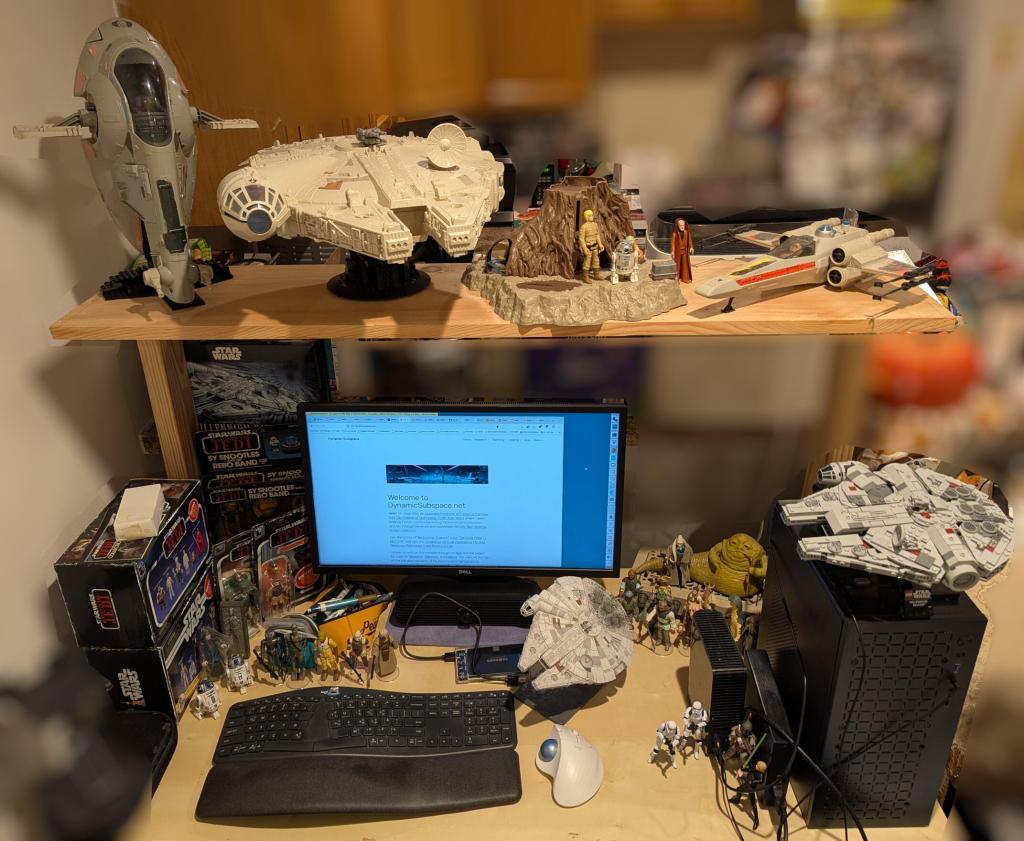
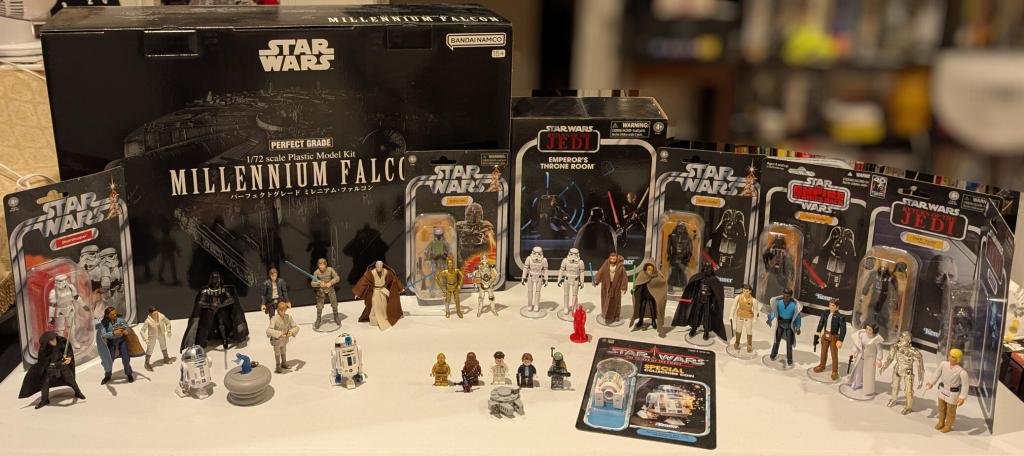
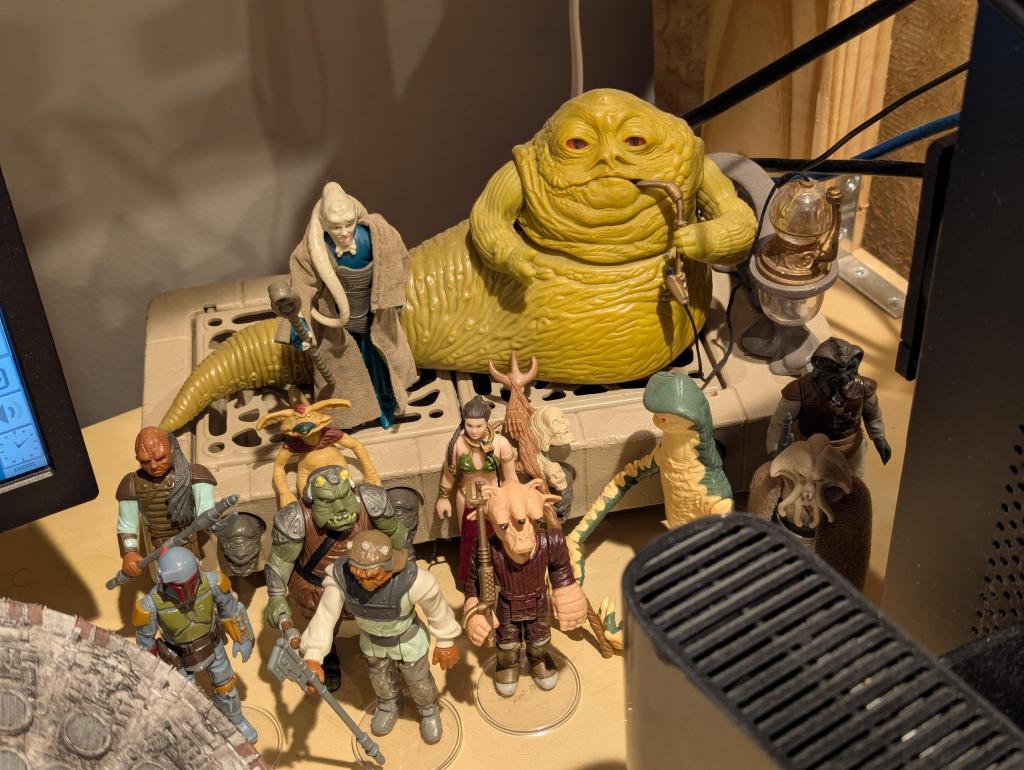
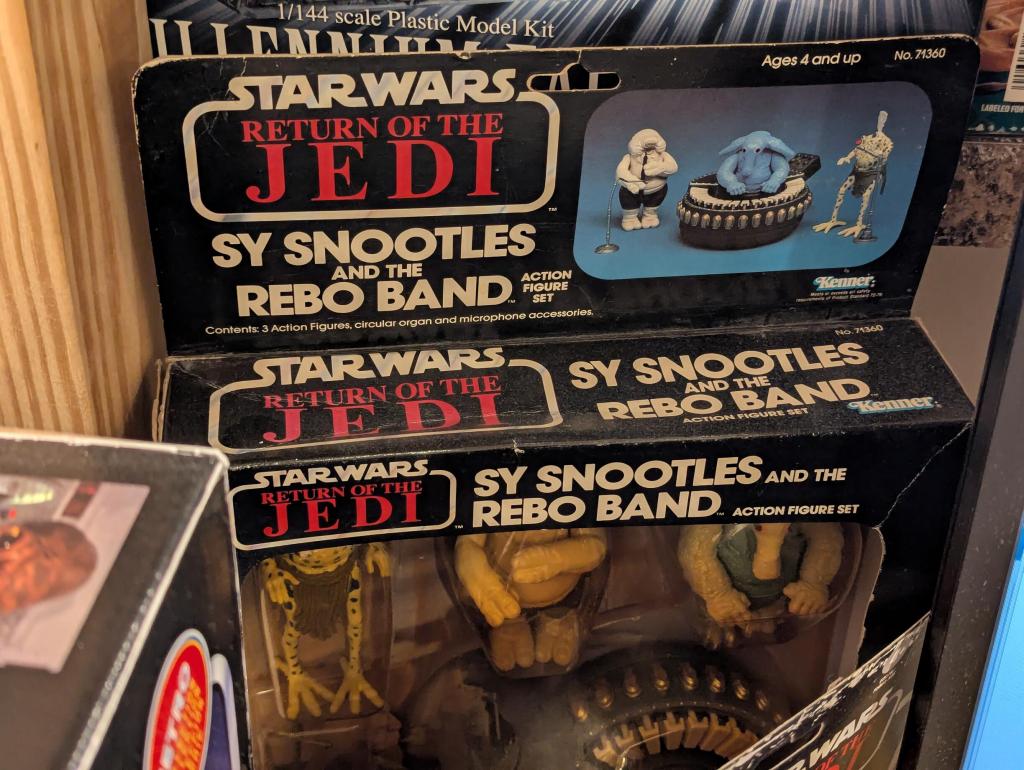
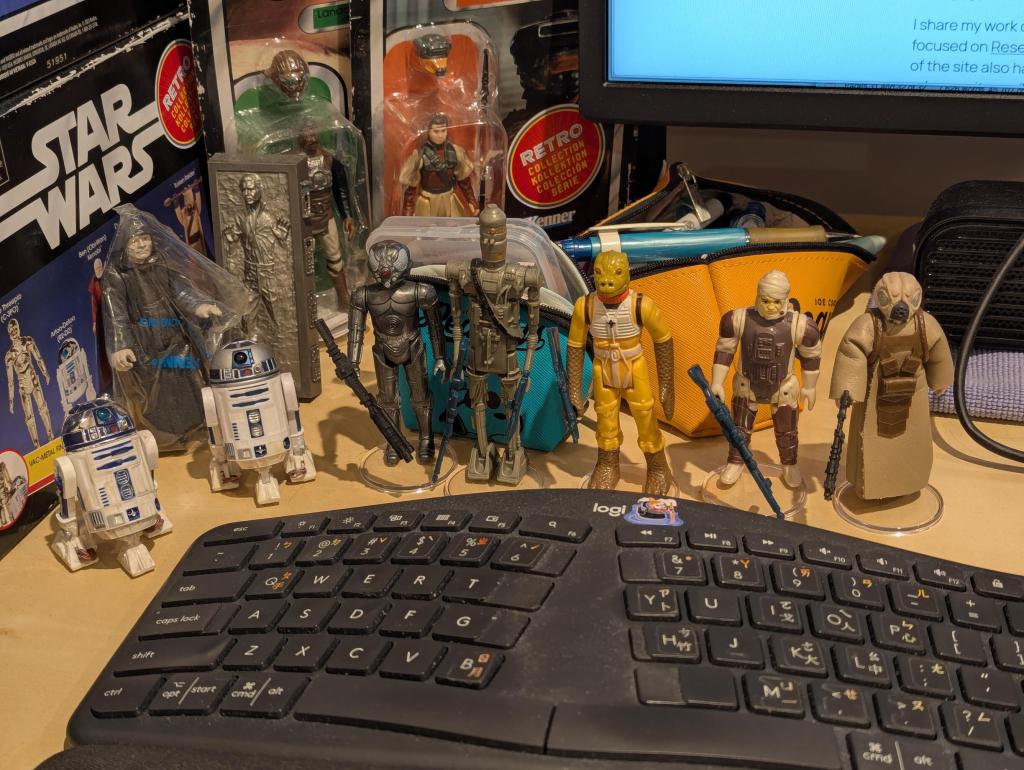
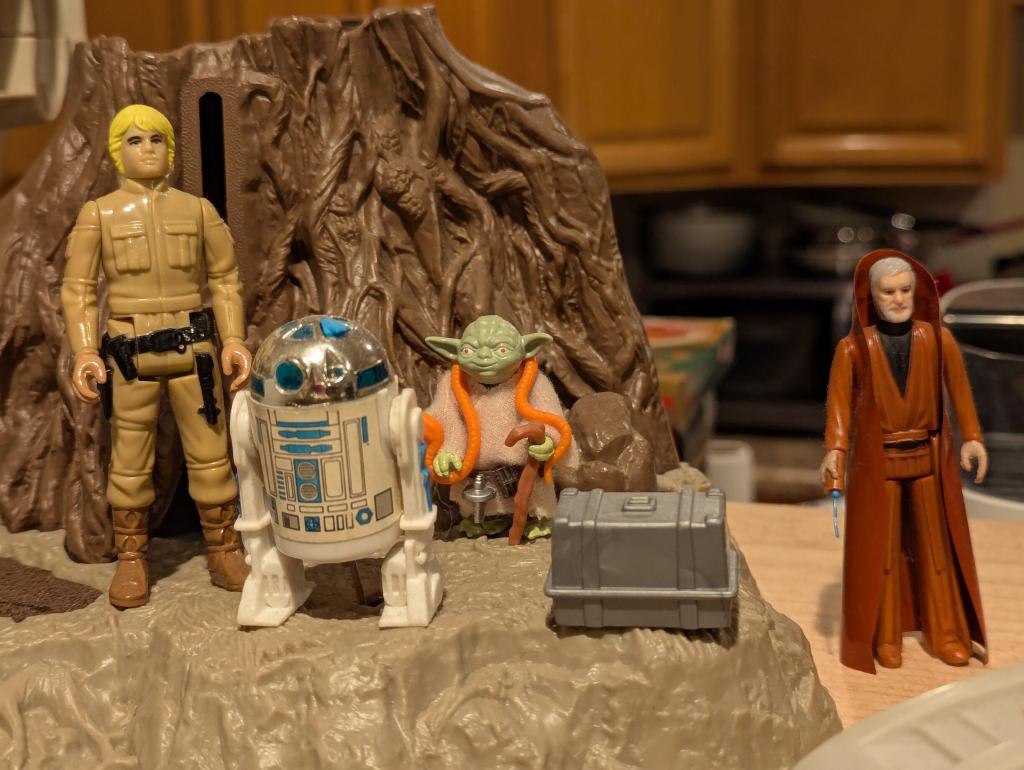
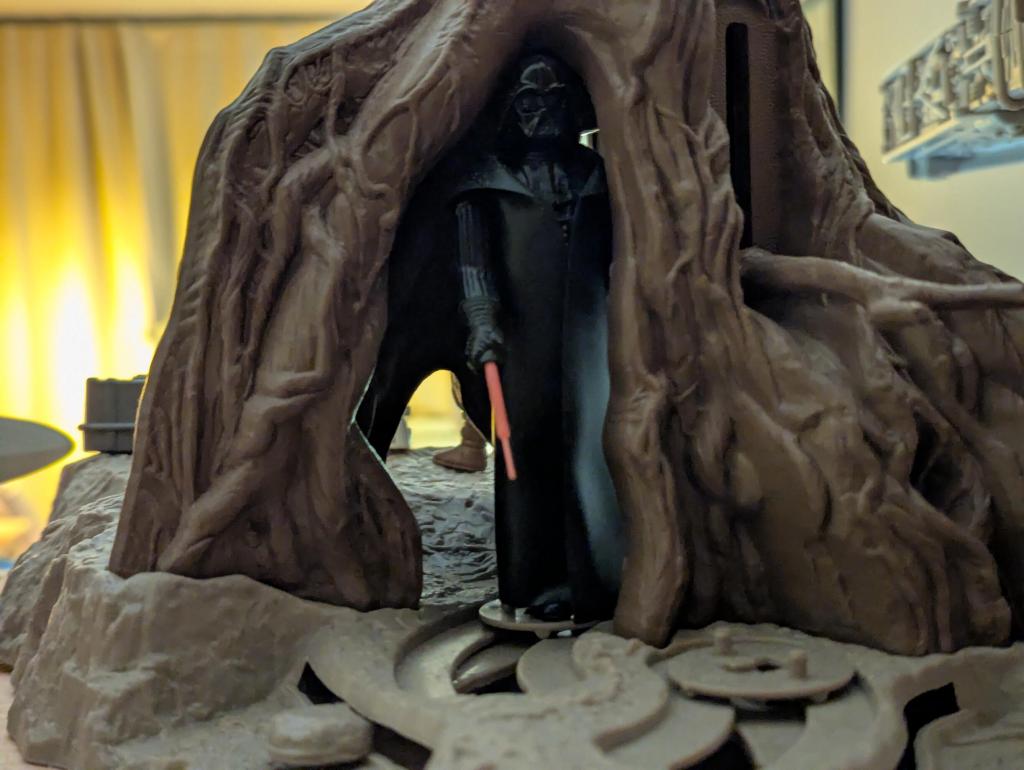
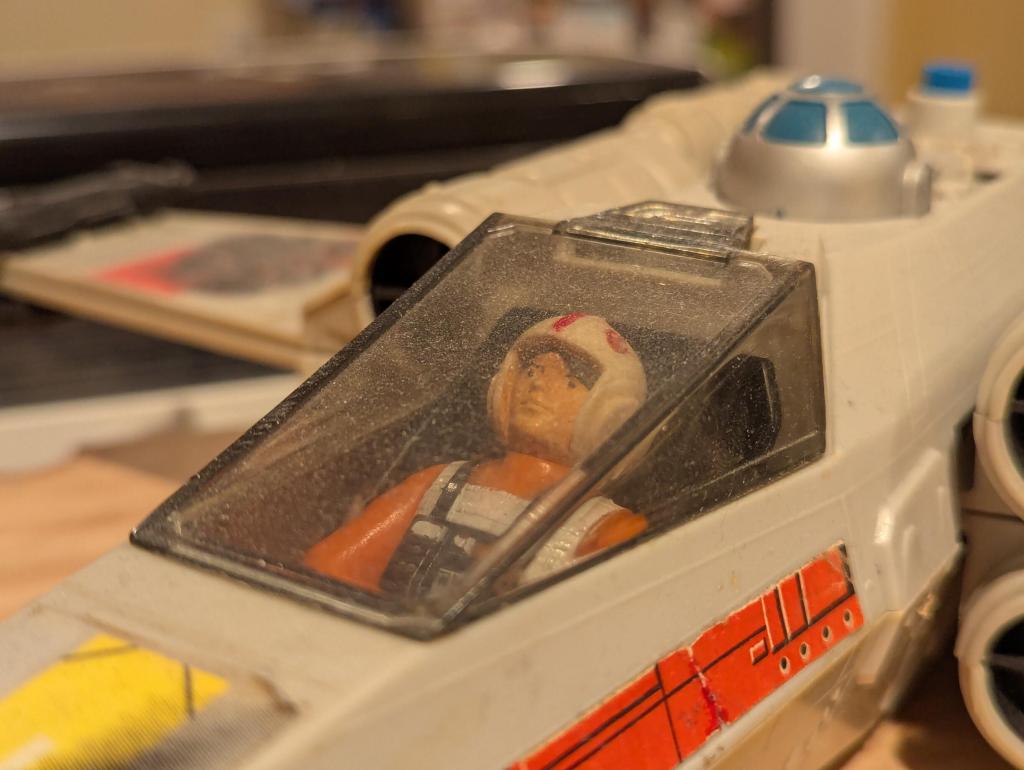
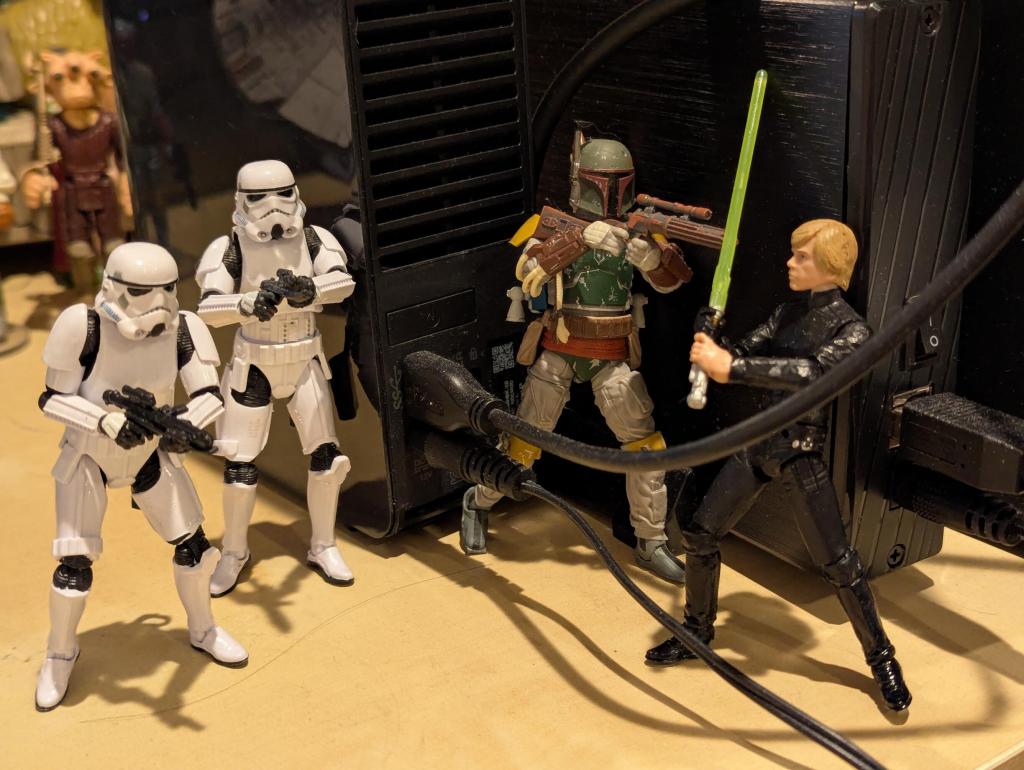
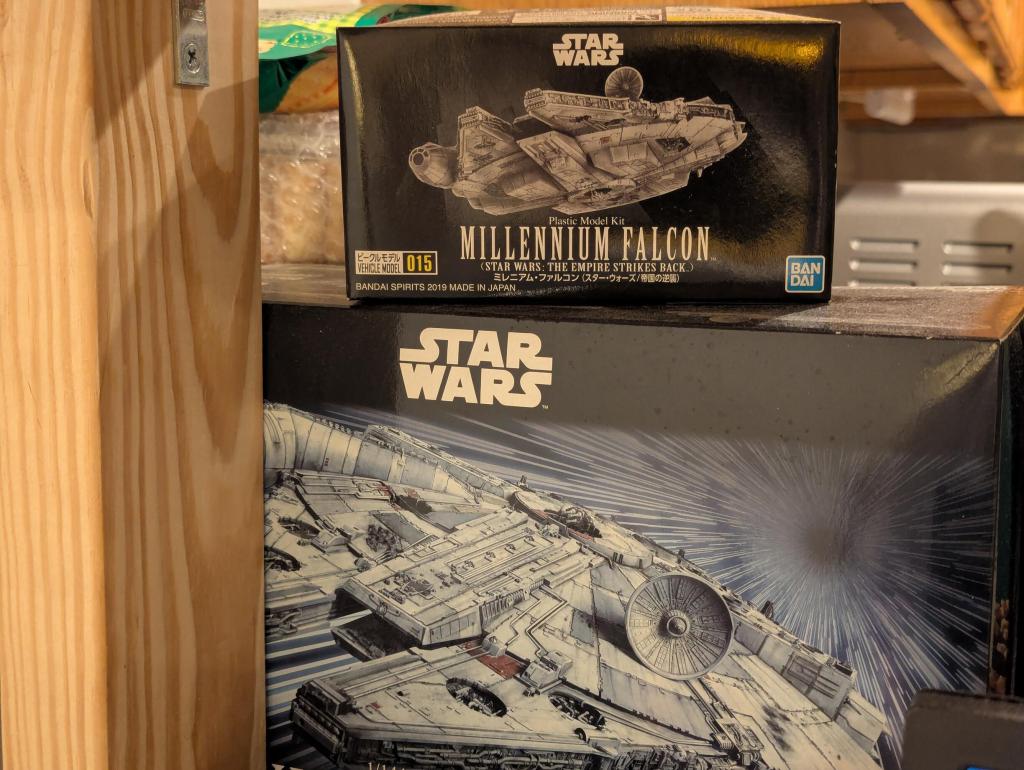
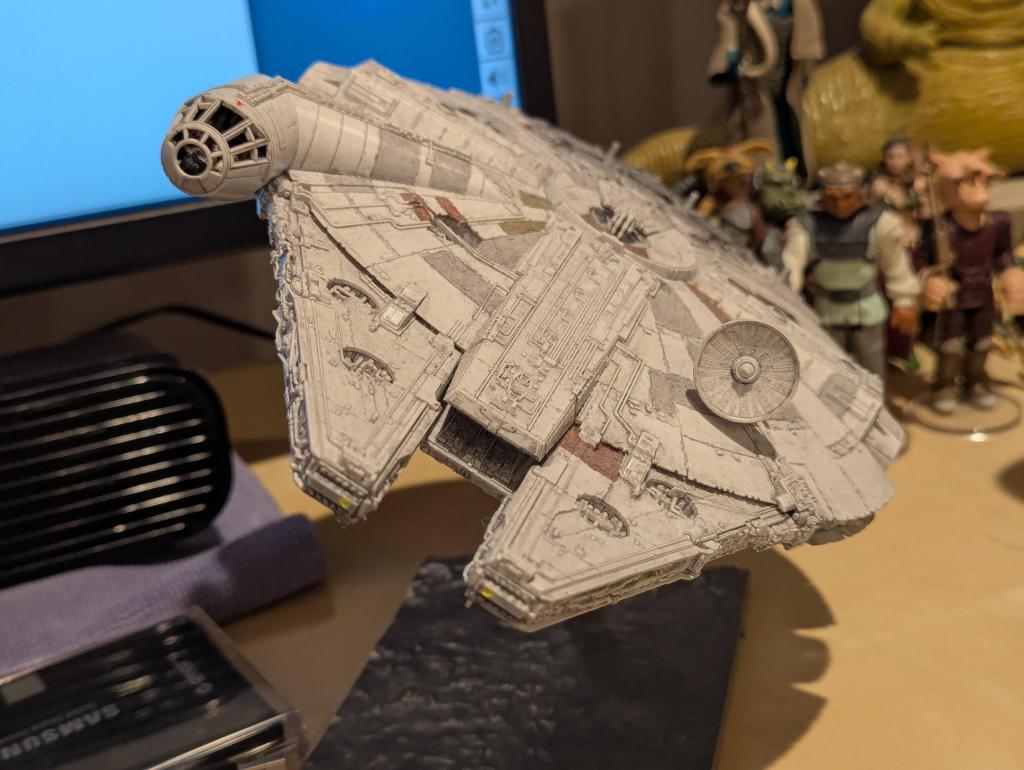
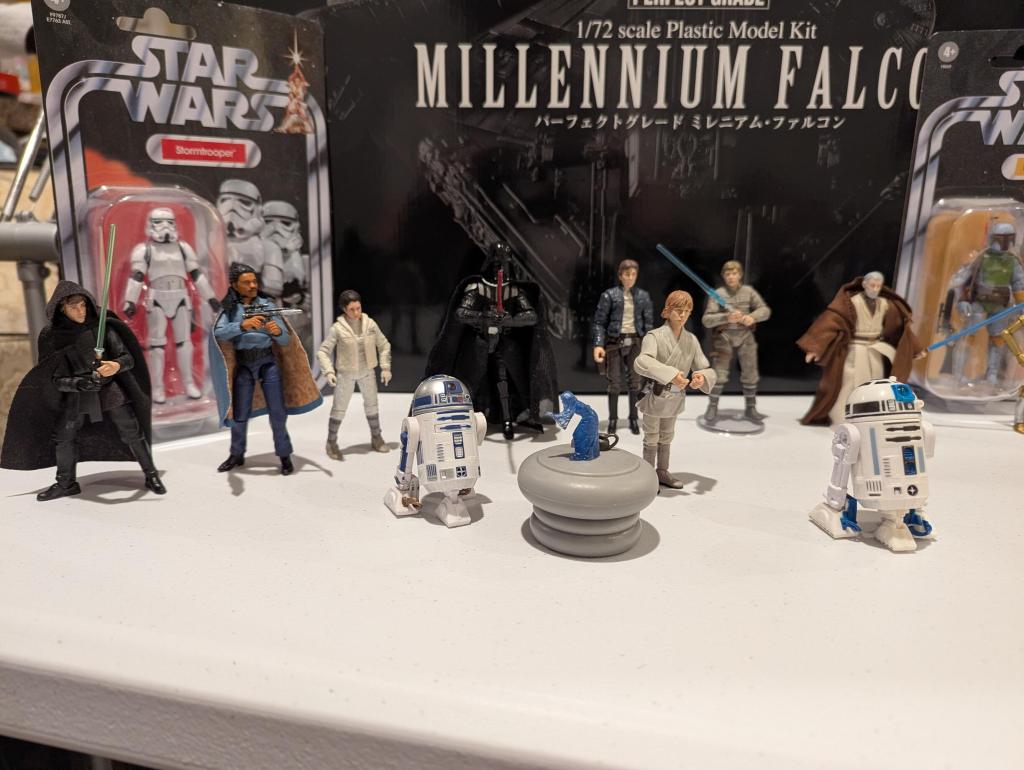
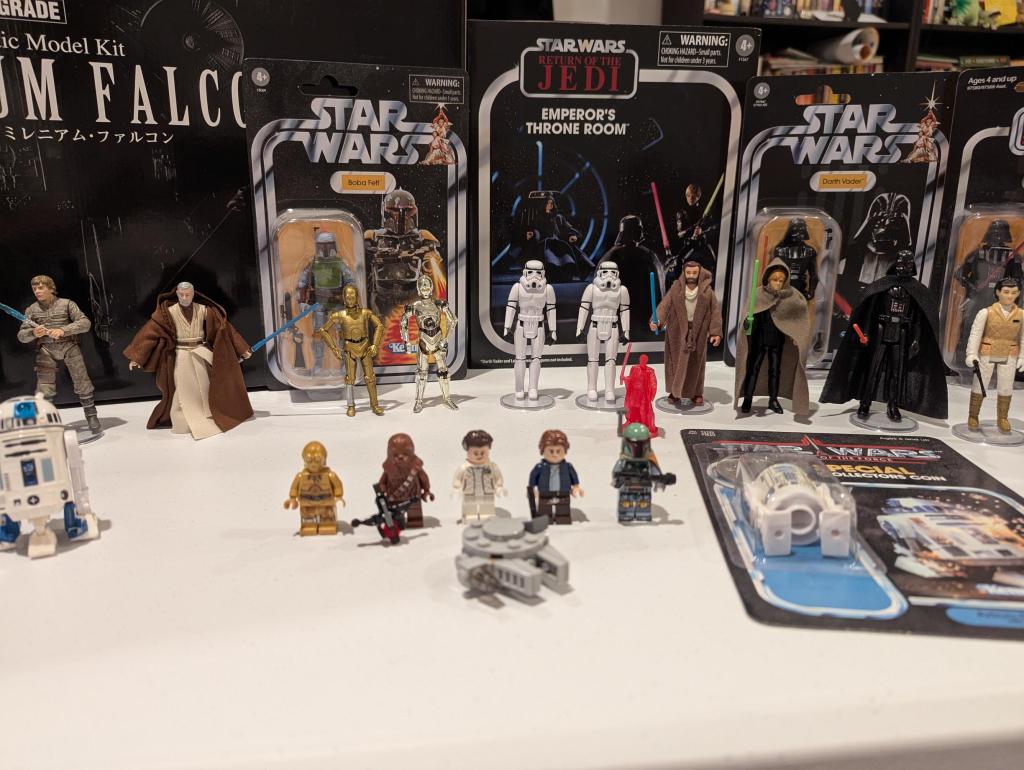
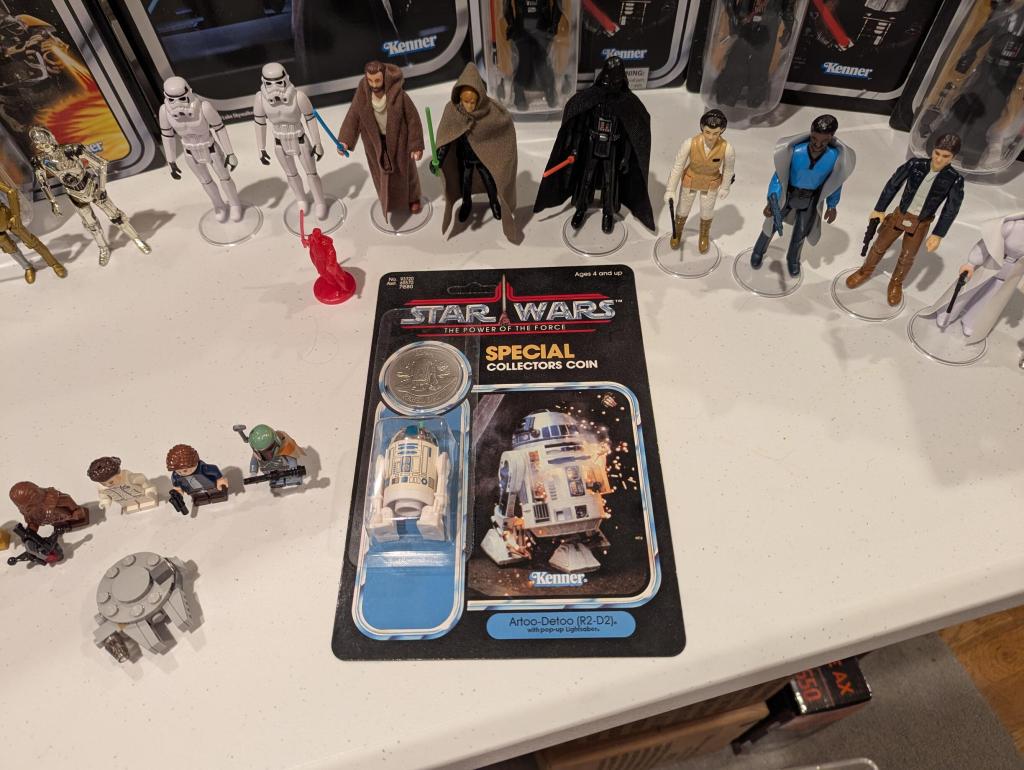
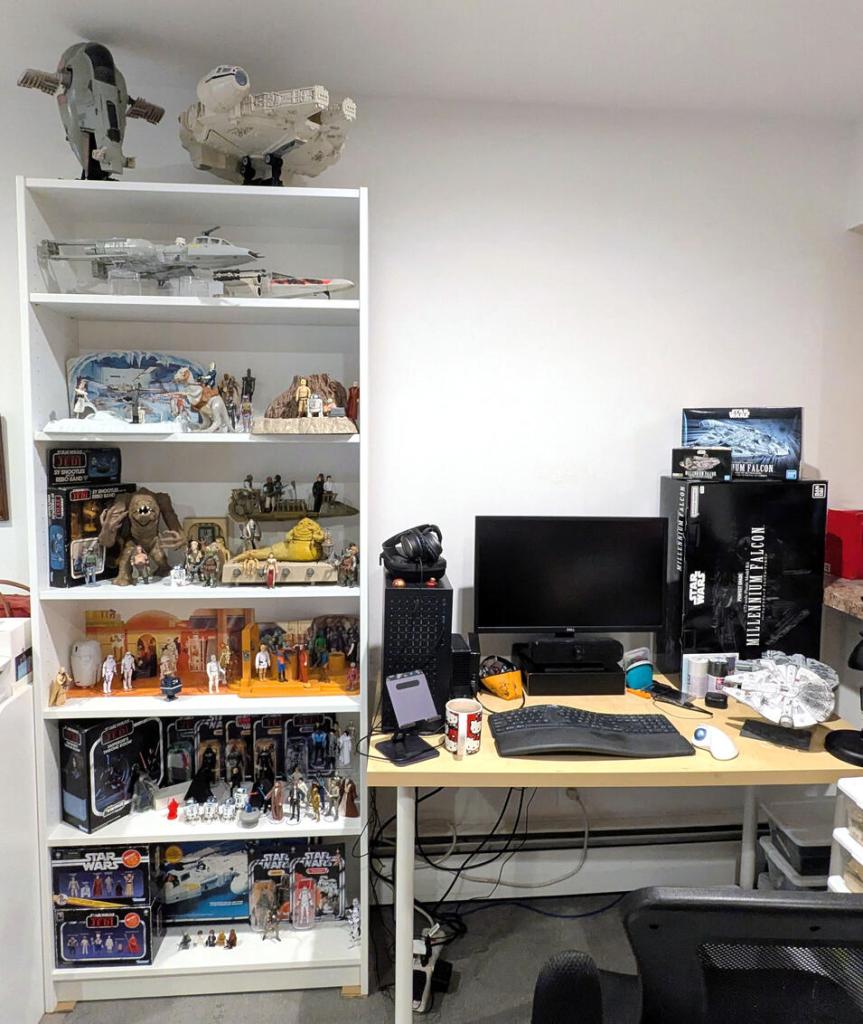
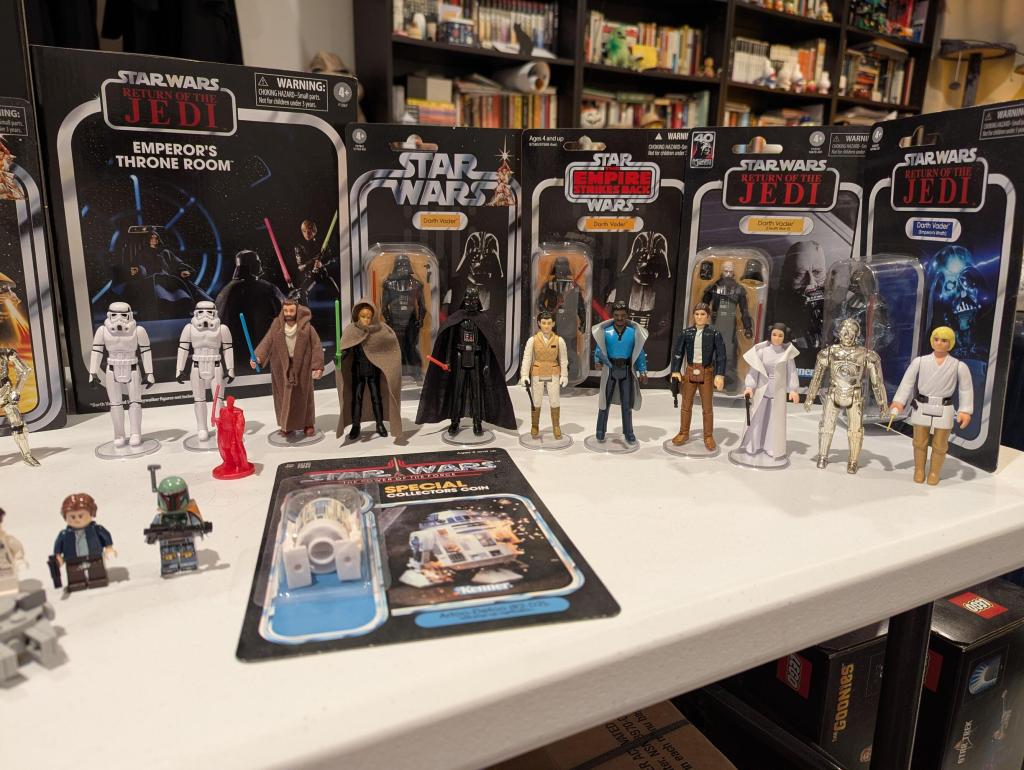
    Panning around my desk at home is the Star Wars version of the original opening toThe Ray Bradbury Theater. My favorites are the Kenner line of action figures. To the left of my computer monitor is Sy Snootles and the Rebo Band set, which is sealed in its original box and blister pack, but the cover plastic has yellowed and Max Rebo’s skin has faded to a lighter blue. To the right and behind my home-built mini-AI workstation is Jabba the Hutt smoking hooka and reclining on his throne. Klatuu, Amanaman, Bib Fortuna and others mill about. Slave Leia, a Kenner-inspired action figure by Stan Solo Creations, completes the scene. A 1/144 scale Bandai Millennium Falcon (ESB version) swoops away from Jabba’s den around my computer. Directly in front of my keyboard are The Emperor safely sealed in a mail-away baggie, and bearing arms in a row are the bounty hunters contracted by Darth Vader aboard The Executor to locate the Millennium Falcon—Zuccuss, IG-88, Bossk, Dengar, and 4-LOM, but wait, Boba Fett should be here. Oh, he’s just above my monitor in the cockpit of Slave I that is posed mid-flight thanks to a LEGO Technics stand that I built for it. To its right is the Millennium Falcon on another custom LEGO display stand. The Dagobah Playset completes the shelf with Luke, R2-D2, Yoda, and Obi-Wan Kenobi looking across at an X-Wing Fighter with Battle Damage stickers applied (Darth Vader awaits hidden in the Cave of Evil). To the right of my trackball are two Stormtrooper from Hasbro’s updated 3 3/4”-line called The Vintage Collection that I fondly think of as Tag and Bink. To my right is The Emperor’s Thone Room playset and the huge box containing an unassembled Bandai Perfect Grade 1/72 scale Millennium Falcon (ANH version).

    Living in a one-bedroom apartment in Brooklyn requires creativity when it comes to one’s hobbies. My simple solution for my Star Wars collecting is to surround my desk area with my action figures and models. I have a mixture of original Kenner 3.75″ action figures, vehicles, and playsets; Hasbro re-issued “Retro Collection” figures; Stan Solo Creations re-issues and originals; Hasbro modern 3.75″ figures including “The Vintage Collection;” LEGO minifigures and sets, and Bandai Millennium Falcon models (1:350, 1:144, and 1:72 scale–the middle one is built, the other two remain to be assembled and painted).

    star wars action figure collection of assorted figures, vehicles, playsets, and models
    star wars action figure collection of assorted figures, vehicles, playsets, and models
    star wars action figure collection of assorted figures, vehicles, playsets, and models
    star wars action figure collection of assorted figures, vehicles, playsets, and models
    star wars action figure collection of assorted figures, vehicles, playsets, and models
    star wars action figure collection of assorted figures, vehicles, playsets, and models
    star wars action figure collection of assorted figures, vehicles, playsets, and models
    star wars action figure collection of assorted figures, vehicles, playsets, and models
    star wars action figure collection of assorted figures, vehicles, playsets, and models
    star wars action figure collection of assorted figures, vehicles, playsets, and models
    star wars action figure collection of assorted figures, vehicles, playsets, and models
    star wars action figure collection of assorted figures, vehicles, playsets, and models
    star wars action figure collection of assorted figures, vehicles, playsets, and models

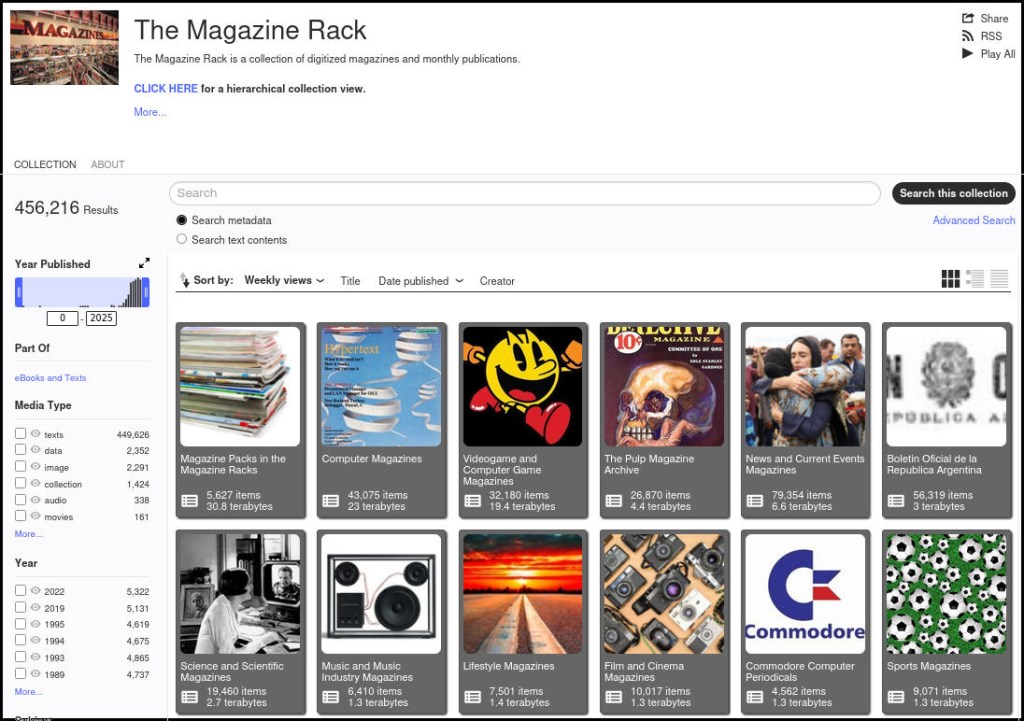
  • The Magazine Rack at the Internet Archive

    The Internet Archive has a tremendous collection of magazines across all disciplinary possibilities. Most are contained in The Magazine Rack. You can read them online, download them individually, or bulk download them using Jeff Kaplin’s instructions from 2012. Though, I have modified Kaplin’s wget command when files stopped downloading due to changes at archive.org, wget, or both:

    wget -r -l 1 -nc -np -nH --cut-dirs=3 -A .cbz,.cbr,.pdf -e robots=off -l1 -i itemlist.txt -B https://archive.org/download/

  • The Madness of Star Wars Collecting: My Collection at Bolton Apartments in Atlanta

    When I was working at Mindspring in Atlanta in the late 1990s/early 2000s, I had to move on short notice. The only apartment that I could find quickly and at a low price that I could afford was a two-bedroom at the historic Bolton Apartments near downtown Atlanta.

    Living alone, I didn’t need a two-bedroom apartment, but it was advantageous in two regards. First, I was able to shelter my grandparents, uncle, and dad during Hurricane Floyd, and second, it gave me room to rebuild a Star Wars collection.

    When I was a child, my Star Wars toys were the Cadillacs of my toy collection. They gave me many hours of enjoyment and they survived better than they might have elsewhere. Despite how much I loved them, I sold them off just before going to college at Georgia Tech–thinking that I needed to part with youthful things to attain a more serious mindset in my pursuit of a Physics degree.

    I had kept a few dear Star Wars action figures–especially an R2-D2 with Sensorscope from The Empire Strikes Back (1980) that my grandmother had driven to Savannah to find for me. I also had a complete Yoda with orange snake action figure that I had purchased at Comics Plus in Macon. And a few vehicles include the Power of the Force 2 (POTF2) Millennium Falcon and Slave I.

    From those humble beginnings, I began to acquire more Star Wars paraphernalia, merchandise, and toys. A lot of this rejuvenated interest came from the release of The Phantom Menace (1999) and the onslaught of new action figures, dolls, and LEGO sets (the latter’s licensing began in 1999).

    On my days off from Mindspring, my hobby involved driving around to department stores, comic book shops, and flea markets looking for Star Wars collectibles. While my rent was low, it was in retrospect unwise of me to invest so much money and time in the collection. It brought me enjoyment at the time, but it eventually caused me a lot of stress and headache. It was both ends of madness–euphoria and the crash.
    The work at Mindspring, after the Earthlink merger, became less fun. Others in the call center decided to play the numbers game and win–leading to more call backs and angrier customers–and left the rest of us the job of fulfilling our original mission to support our customers and lose. I decided to pack it in and move back to Brunswick to regroup. I’m glad that I did, because I eventually got back into Georgia Tech and made my way to where I am now at City Tech.

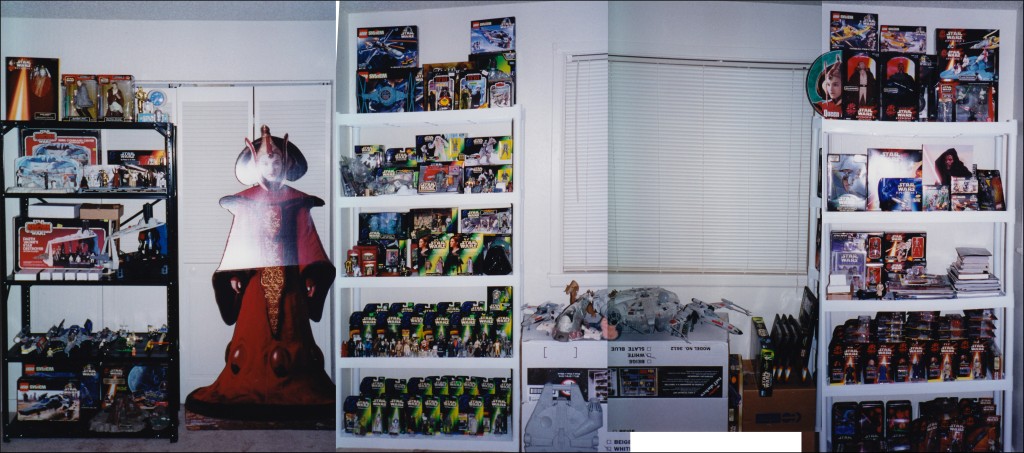
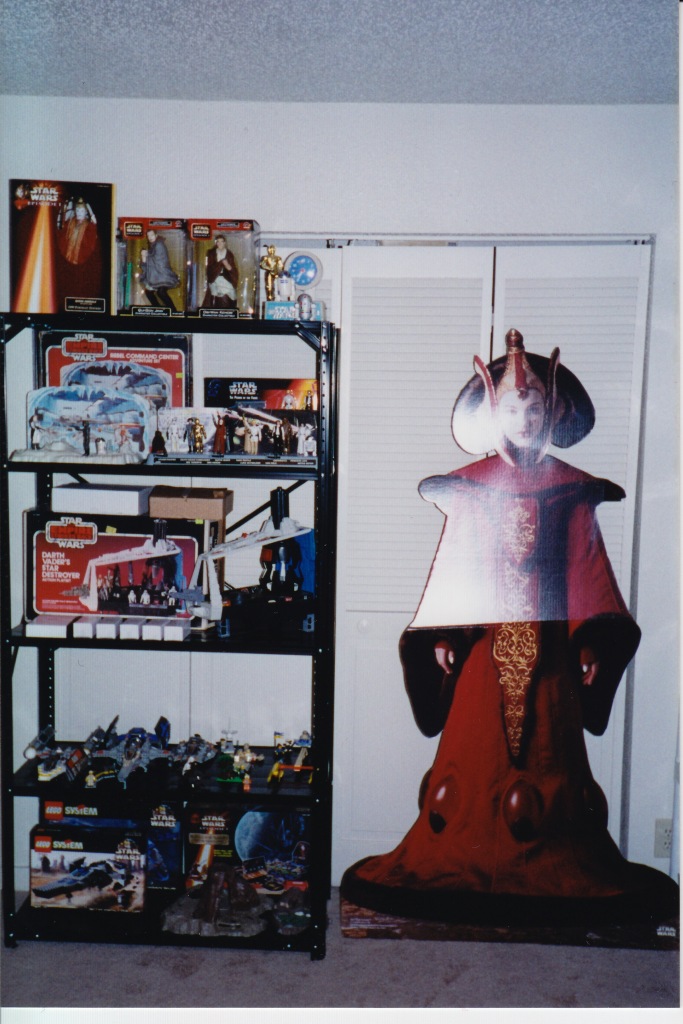
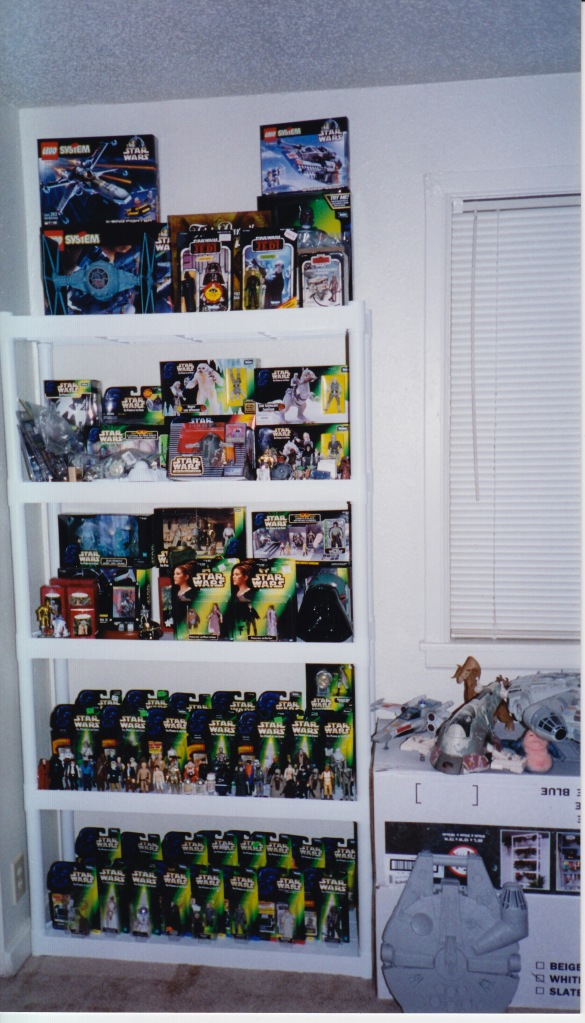
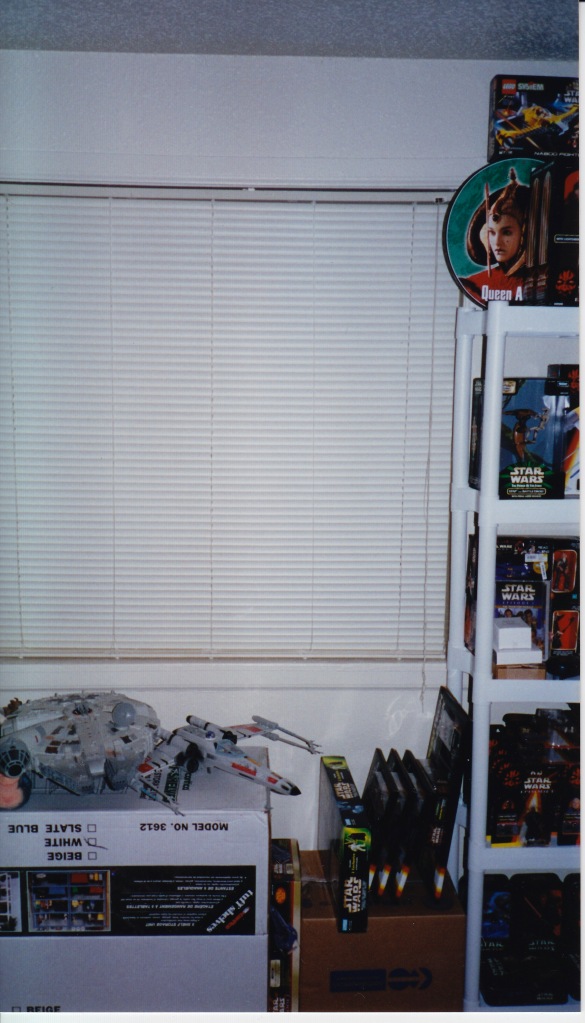
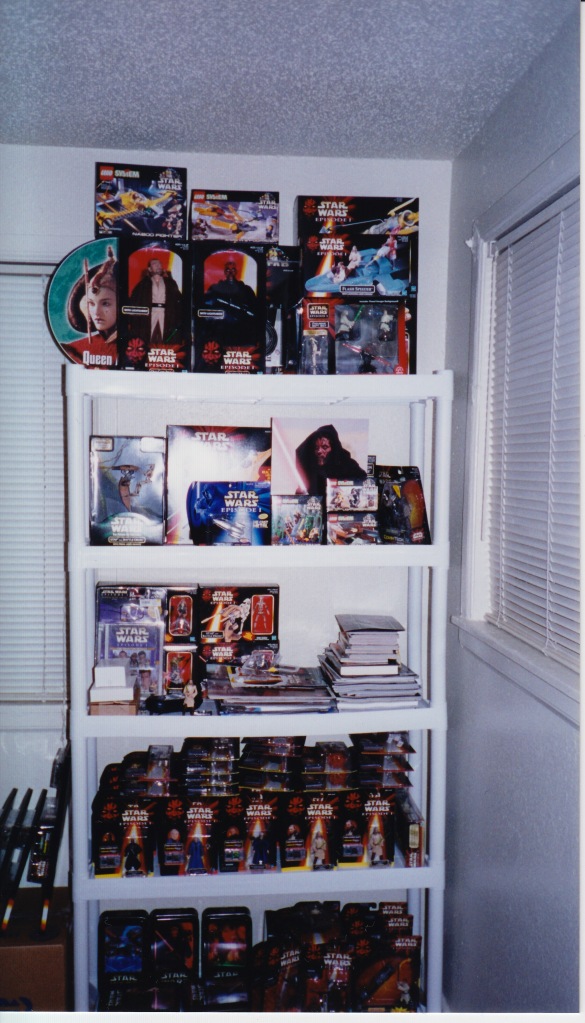
    Here are some highlights shown in the photos of the collection above from left to right.

    Photo 1Photo 2Photo 3Photo 4
    Rebel Command Center Adventure Set with original 3 figures. Mail-in Display Stand with complete set of original Kenner Star Wars action figures. Darth Vader’s Star Destroyer Action Playset. First LEGO sets including Y-Wing, Darth Vader’s Advanced TIE Fighter, Snowspeeder, and Anakin’s Pod Racer. Dagobah Playset.POTF2 TIE Fighter. Carded Kenner ROTJ Darth Vader and Luke Skywalker (Jedi Knight) action figures. Vehicle Energizer in box. Lots of boxed and carded POTF2 action figures and playsets. Kenner Yodas with brown and orange snakes. Pewter Boba Fett figurine. Near complete set of Star Wars and Empire Kenner action figures. POTF2 X-Wing (small), Slave I, Jabba, Millennium Falcon. POTF2 Millennium Falcon and X-Wing (large). Multipack action figure sets and carded Comtech Reader. More Episode 1 action figures and toys than you can shake a stick at.
  • City Tech Science Fiction Collection Inventory

    IMG_20180711_144220
    L to R: Jason Ellis, Lavelle Porter, and Jessica Roman

    Over the past three days, I worked with my City Tech colleagues–Laura Westengard, Lavelle Porter, and Lucas Kwong–and student–Jessica Roman–to inventory the City Tech Science Fiction Collection. Two years ago, I began the collection’s finding aid by cataloging the 4,000+ magazines. Last year, I inventoried the collection’s nearly 1,700 monographs and anthologies. This year, we are creating an inventory of the remaining parts of the collection: scholarly journals and novels. Read details of our progress on the Science Fiction at City Tech OpenLab site here.

  • Engagement, Learning and Inspiration in SF: Use Cases for the City Tech Science Fiction Collection

    I delivered this presentation at the James Madison University Pulp Studies Symposium on October 7, 2016. The video above shows my presentation’s images, and the script of my talk is included below.

    The paper is about introducing new audiences to old ideas for the benefit of two different City Tech audiences: 1) frame the historical publication context of science fiction short stories for students, and 2) illuminate the deep history of technological ideas for faculty fellows in the NEH-funded “Cultural History of Digital Technology” project.

    [UPDATE: The symposium was a great success! Thank you to everyone who had questions and comments during our session. I posted photos taken by colleague Caroline Hellman over at the Science Fiction at City Tech website.]


    Engagement, Learning and Inspiration in SF: Use Cases for the City Tech Science Fiction Collection

    Jason W. Ellis


    In the first issue of Amazing Stories dated April 1926, Hugo Gernsback writes:

    By ‘scientifiction’ I mean the Jules Verne, H. G. Wells and Edgar Allan Poe type of story—a charming romance intermingled with scientific fact and prophetic vision … Not only do these amazing tales make tremendously interesting reading—they are always instructive. (Gernsback 3)

    According to Gernsback, the literary genre that would become known as science fiction combines romance, scientific fact, and prophetic vision. The romance engages the reader in an interesting story. The facts instruct the reader in science and technology. The prophetic vision extrapolates from what is known into the not-yet-known and simultaneously inspires readers to realize that vision. I believe that Gernsback’s vision of SF is fundamental to arguments for SF collections at colleges with a pedagogical and community-serving commission like City Tech. Our college occupies several buildings in downtown Brooklyn and serves the educational needs of over 17,000 students. Historically a trade and vocational school, it has over time and by design developed into a senior college of the City University of New York (CUNY) system. Nevertheless, the students it serves and the fields it attempts to prepare them for are primarily focused on STEM career paths. While not all stakeholders recognize the importance that the humanities have to STEM graduates’ success and overall outlook, the administration’s support of the City Tech Science Fiction Collection signals at least one way in which the humanities—in this case via SF—is seen as supportive to the otherwise STEM-focused educational work of the college. In effect, SF and the collection serves as a source for engagement, learning, and inspiration for students who have much to gain from it as a literary genre that reveals the inextricable linkages between STEM and the humanities. While I cannot within the scope of this presentation explore all of these functions of SF, I will restrict myself to discussing how I have used the collection to support my teaching and pedagogical work at City Tech.


    Teaching Science Fiction from a Historical Perspective

    For students, my SF syllabus takes a historical approach to the genre. Following Brian Aldiss, I point to Mary Shelley’s Frankenstein as the genre’s beginning, because its plot pivots upon on an extrapolation of science and technology. Following this novel, I have students read a chronological progression of short stories that correspond with the movements in the genre: proto-science fiction and SF’s influences, H.G. Wells and his scientific romances, Jules Verne and his Voyages extraordinaires, Hugo Gernsback’s scientifiction and the pulps, John W. Campbell, Jr. and the Golden Age, the New Wave, Feminist SF, Cyberpunk, and contemporary SF. Looking at my current syllabus, which draws on readings from the Wesleyan Anthology of Science Fiction and a few stories in PDF form that are not in the anthology, over half appear for the first time in magazines held in the City Tech Science Fiction Collection, including: Isaac Asimov’s “Reason,” Astounding Science Fiction, April 1941; Tom Godwin’s “The Cold Equations,” Astounding Science Fiction August 1954; Robert Heinlein’s “All You Zombies—,“ The Magazine of Fantasy and Science Fiction, March 1959; Harlan Ellison’s “Repent, Harlequin! Said the Ticktockman,” Galaxy Magazine, December 1965; Philip K. Dick’s “We Can Remember It For You Wholesale,” The Magazine of Fantasy and Science Fiction April 1966; James Tiptree, Jr’s “The Women Men Don’t See,” The Magazine of Fantasy and Science Fiction December 1973; William Gibson’s “Burning Chrome,” Omni July 1982; and Octavia Butler’s “Speech Sounds,” Isaac Asimov’s Science Fiction Magazine Mid-December 1983. In addition to discussing each story in its historical context and its addressing Gernsback’s tripartite definition (along with other definitions, too), I show students photos of the magazines and their contents. I relate how these magazines were a big deal that introduced readers to engaging stories, new science and technology, and inspirational ideas via the haptic and tactile experience of reading printed magazines. Furthermore, the contents of a given magazine add an anthropological context to the magazines via editorials, letters, fandom, and advertising. Finally, the magazines help situate the readings for students, because they empower me to point at the library and take the readings out of the abstract realm of anthologization.


    NEH-sponsored “Cultural History of Digital Technology” Project

    While my students’ experience of SF is enriched by the historical materiality of our readings, City Tech’s faculty, who are engaged in pedagogical planning that bridges STEM and the humanities, share some of the same needs as my students. I have learned that my STEM-focused colleagues are experts in their fields, but many do not conceptualize SF on one level as a literary genre that addresses Gernsback’s tripartite definition: romance, scientific facts, and prophetic vision, or on another level as a literary form built on interdisciplinary STEM methodologies (i.e., building assemblages of ideas and constructing extrapolations) and focused on the effects of science and technology on humanity and vice versa (e.g., Asimov’s concept of “social science fiction” or Philip K. Dick’s epistemological and ontological adventures). Professor Anne Leonhardt of Architectural Technology and director of the NEH-funded project titled, “The Cultural History of Digital Technology: Postulating a Humanities Approach to STEM,” asked me to join and contribute my humanities-focused perspective. The project’s goal is to create six interdisciplinary pedagogical modules—on maps, fractals, robotics and sociality, geotagging, topology, and finally, robotics and the workplace. We do this by inviting speakers, holding reading groups, and participating in pedagogical workshops. The student-facing modules will integrate readings, classroom lecture and demonstration, and a hands-on activity. Initially, I helped with finding readings for two modules—fractals and topology, but as I describe below, I have leveraged the City Tech Science Fiction Collection’s magazine holdings and demonstrated that humanities folks can do more than find interesting readings. Also, I will use Gernsback’s definition as a measure of each considered story’s usefulness to the module’s goals.


    3D Printing

    The first module that I contributed readings to is called “Fractals: Patterning, Fabrication, and the Materiality of Thinking.” Its purpose is to bridge students’ understanding of mathematics to the natural world by using fractal geometry—the notion that Benoit Mandelbrot introduced as the process and principle of order and structure underlying the physical world. We teach students the underlying principles of fractal geometry, help them create a workflow using open-source tools to generate a 3D printable STL, or STereoLithography model, and finally, have them print their model using one of City Tech’s powder or plastic 3D printers.

    Initially, I did not consider the City Tech Science Fiction Collection’s holdings, because everything was sitting in 160 boxes stacked floor to ceiling in my office and my former colleague, Alan Lovegreen’s office. Rudy Rucker’s “As Above, So Below” (1989), a story not widely anthologized but available on the author’s website, first came to mind, because I knew that both sides of his professional work touched on this topic. Rucker, a cyberpunk SF writer and mathematician, had written this story after his own attempts at discovering what is now called a “Mandelbulb,” or a three-dimensional plot of the Mandelbrot set, the recognizable image based on a simple iterative function explored in the work of Benoit Mandelbrot. In Rucker’s story, a mathematican hacks together a program that creates a three-dimensional Mandelbrot set that breaks out of his computer screen and takes him on a trippy voyage away from life and into a crabmeat can in his pantry where he can code and enjoy energy drinks for the rest of his life—as long as no one get hungry for canned crab. While it is an interesting story and Rucker’s work on the Mandelbulb is noted in the module, his story is more romantic and possibly prophetic, but less instructive.

    Shortly thereafter, Alan and I finished moving and shelving the City Tech SF Collection, and I began searching for a better story in the collection’s magazines—a story that fulfills the Gernsbackian requirements and connects to both of the module’s topics: fractals and 3D printing. One such contender was Robert Heinlein’s “Waldo,” which tended to capture the materiality-emphasis of the module better than Rucker’s much later story. Published in August 1942 in Astounding Science Fiction as by Heinlein’s pseudonym Anson MacDonald, “Waldo” features on the cover with art by Hubert Rogers and story illustration by Paul Orban. The story is where the term for a remote manipulator system is coined—a waldo. However, the story is about a man named Waldo Jones who invents remote manipulators to enable his weakened body to act on the world. With his invention, he sets out to make smaller ones and smaller ones until they were capable of manipulating microscopic neural tissue and investigate the cause of his physical handicap. The idea then is that waldoes could be used to build up matter in the same way they were used to build smaller versions of themselves. Heinlein’s story fulfills Gernsback’s requirements—romance (intrigue and revenge), scientific fact (cybernetics), and prophetic vision (what possibilities might waldoes enable), but it does not fulfill both module topics as strongly.

    Eventually, I found the story that is credited as the first SF describing 3D printing in detail: Eric Frank Russell’s “Hobbyist,” in the September 1947 issue of Astounding Science Fiction. Unlike “Waldo,” “Hobbyist” is not as widely anthologized, so having access to it in its original magazine was a bonus. If you are familiar with the contemporary video game, No Man’s Sky, then you have an idea about what “Hobbyist” is generally about. Astronaut Steve Ander and his companion parrot Laura crash land on a distant world and are in need of nickel-thorium alloy for fuel, which will hopefully get them a little closer to home. While scavenging around the crash site, Ander notices unsettling patterns of repetition in the world around him and discovers a structure that houses what amounts to a collection of life forms created in a 3D printer of sorts and maintained by an omnipotent being. The narrator describes it thus:

    It was done by electroponics, atom fed to atom like brick after brick to build a house. It wasn’t synthesis because that’s only assembly, and this was assembly plus growth in response to unknown laws. In each of these machines, he knew, was some key or code or cipher, some weird master-control of unimaginable complexity, determining the patterns each was building—and the patterns were infinitely variable. (Russell 56)

    “Hobbyist” satisfied the Gernsbackian requirements—romance (escape the planet), scientific fact (small scale engineering, iterative and fractal growth), and prophetic vision (might this technology make us gods?) and united both module topics. Capturing “Hobbyist” with my iPhone and Scanner Pro app, I shared the story with the other NEH Fellows— the story’s text and in-story illustrations by Edd Cartier and cover art by Alejandro de Cañedo. During meetings, I related the history of the magazine and how that adds to the importance of the story as a nodal point of STEM ideas expressed through SF long before 3D printing was first innovated in the 1980s, and even before it was described in theoretical terms by Richard Feynman in his well-known December 1959 American Physical Society presentation, “There’s Plenty of Room at the Bottom.”


    Topology

    The second module that I contributed to is called “Topology: Behind Escher’s Wizardry, A Look at the Development of Modeling and Fabrication.” Unlike the earlier fractal module, the topology module would involve programming to create each student’s 3D printed model. In addition to my role as the humanist on the team, I made this a personal challenge to relearn Wolfram Mathematica, a symbolic computation program that supports a relatively easy-to-use programming language, because I wanted to demonstrate how its could satisfy all aspects of teaching, coding, and modeling. I began by creating a Mathematica workbook that demonstrated topology concepts, such as points, lines, polygons, and dimensionality, and easy-to-follow programming tutorials of topological surfaces. Additionally, I showed how Mathematica exported 3D printable STL files of the topological models students would create.

    Initially, we considered Edwin Abbott’s Flatland: A Romance of Many Dimensions (1884), but Professor Satyanand Singh, a colleague in the Mathematics department, suggested that we show a video based on Abbott’s story instead. This created an opportunity.

    While performing serious play with Mathematica, I recalled Robert Heinlein’s “—And He Built a Crooked House” from the February 1941 issue of Astounding Science Fiction. Featuring cover art by Hubert Rogers and story illustrations by Charles Schneeman, the story is about an ambitious architect who designs a house in the shape of an unfolded tesseract, or a four-dimensional cube. Unfolded means to create a geometric net or the interconnected, component elements of the object. For example, a three-dimensional cube unfolds into a net composed of two-dimensional squares arranged in eleven different configurations. On the other hand, a tesseract, which is four-dimensional, unfolds into a net of connected three-dimensional cubes with 168 possible configurations! The architect’s innovative design is such an arrangement of three-dimensional cubes, which in this case, resembles the Cross of St. Peter. Unfortunately, having been built in California, there is an earthquake and the house collapses into itself forming a nondescript house-like cube. The incredulous architect and his nonplussed clients enter the domicile to investigate and become trapped within the structure’s weird, higher-dimensional geometry. It is an improbable story, but it captures the strangeness of higher dimensions and introduces topics for discussion. “—And He Built a Crooked House” fulfills Gernsback’s definition—romance (escape the counter-intuitive house-turned-maze), scientific fact (higher dimensionality), and prophetic vision (let’s use math to build innovative buildings), and it tangentially fulfills the module’s focus on topology.

    The NEH project is on going, so there are opportunities to locate other stories and materials in the SF magazines held in the City Tech Science Fiction Collection. In my SF class, I hope to bring my students to the archives for special projects pre-arranged with the librarians. Professor Jill Belli is doing this now, and some of her students’ work will be features in a special session of the upcoming Symposium on Amazing Stories: Inspiration, Learning, and Adventure in Science Fiction on November 29 at City Tech, which I hope that you all will consider presenting or attending. Thank you for listening.

    Works Cited

    Gernsback, Hugo. “A New Sort of Magazine.” Amazing Stories April 1926: 3.

    Heinlein, Robert. “—And He Built a Crooked House. Astounding Science Fiction, February 1941, 68-83.

    Russell, Eric Frank. “Hobbyist.” Astounding Science Fiction, September 1947. 33-61