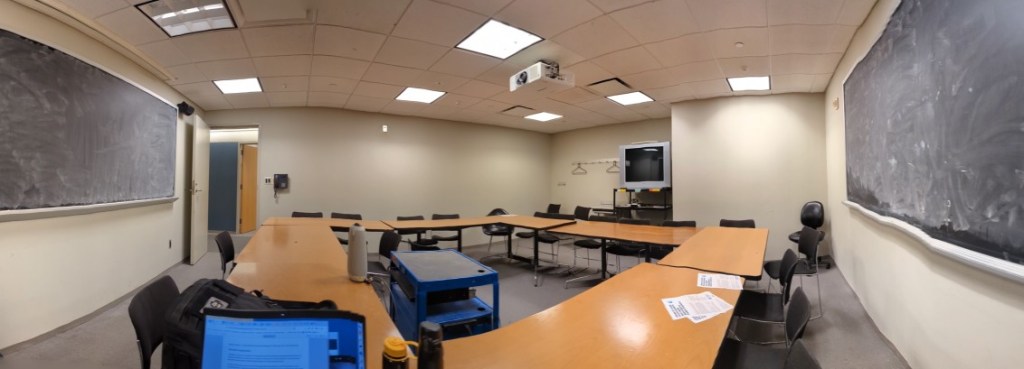
Last night, I stuck around after my first co-taught Interactive Technology and Pedagogy I class at the CUNY Graduate Center. The class went very well. Students demonstrated that they had done the reading and some brought deep perspectives from their disciplines to bear on our first discussion on technology and media.
Thankfully, there were no classes afterwards, because after everyone cleared out, I used the classroom to meet with a City Tech student over Zoom for her Individualized Study of ENG3790 Information Architecture.
I visited the CUNY Graduate Center on 5th Avenue in Manhattan to get an adjunct faculty ID made, because I’ll be co-teaching Interactive Technology and Pedagogy I: History and Theory (ITCP 70010) this fall. This course is part of the Interactive Technology and Pedagogy (ITP) Certificate Program, which when offered the opportunity to contribute to this program, I jumped at! It is aligned with some of the work that I do in the Professional and Technical Writing Program at City Tech, which involves using technology for communicating and learning about the history of digital technologies, and it is a kindred program with the learning to teach with technology aspects of the Brittain Fellowship at Georgia Tech. I’m excited to work with the program’s graduate students beginning in a couple of weeks.
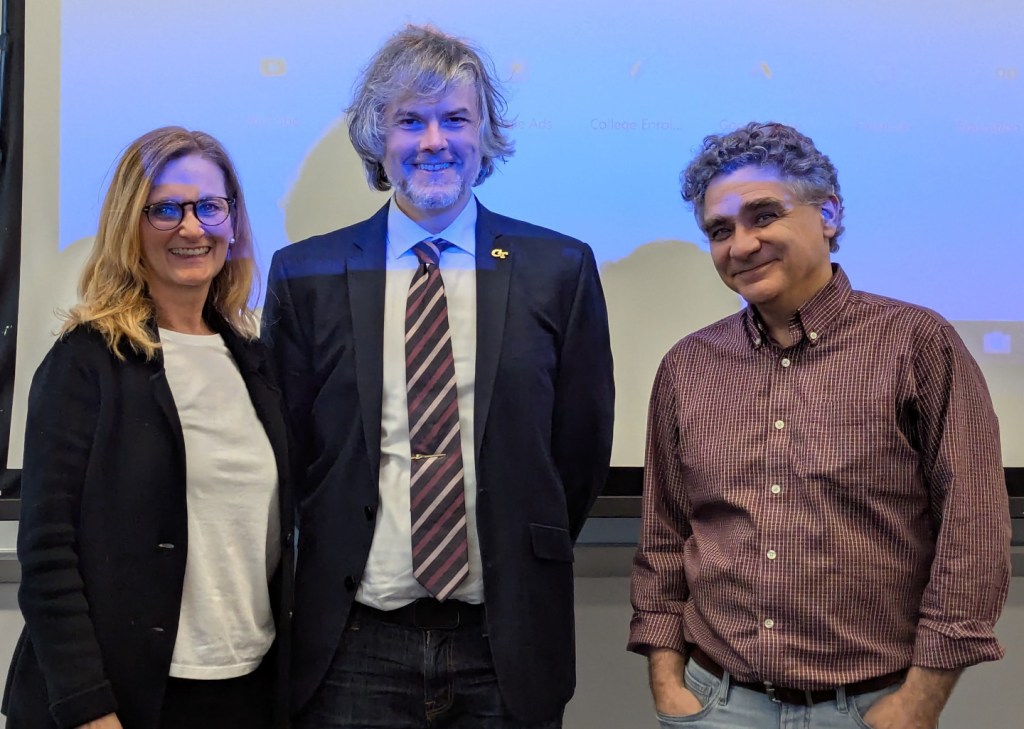
Toward the end of lecture, when I was talking about lessons learned from Hart-Davidson’s essay, which includes being a life-long learner and keeping up-to-date on changing technologies of writing and communication, Prof. Sarah Schmerler, a City Tech English department colleague with a shared interest in Generative AI technologies, stopped by and participated in the class discussion with my students. It was informal and impromptu, but I think my students enjoyed their perspective and lived experience. I enjoyed our conversation during and after class.
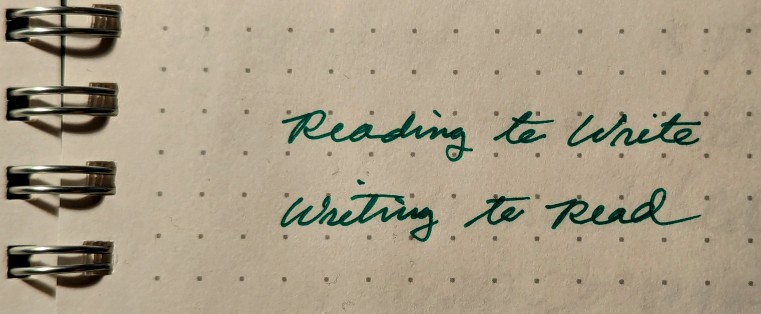
I wanted to jot down some of the conversation and additional thoughts spun off from the conversation here:
How can you expect to be a good writer without learning, at least in part, from reading many examples of writing by others?
Writing is reading in reverse. Instead of the words coming into you from the world, you are sending the words out into the world.
Reading and writing go hand-in-hand. Developing skill in one, enriches the other.
Reading heuristics, such as lateral reading and vertical reading, can support getting as much as possible out of one’s reading time, energy, and needs (e.g., is this for a research thesis vs. learning enough about something for a journalistic article).
Our needs–enjoyment, learning, work, etc.–play a key role in what strategies (large scale) and tactics (smaller scale) we employ to accomplish reading goals.
Reading can be a passive exercise, but active reading that engages the text and combines cognition, reasoning, and imagination yields the greatest returns in terms of understanding, analysis, and memory.
Isolation, quiet contemplation, and dedicated time can aid the development of reading and writing.
Teaching writing requires a rethink on how we approach reading and how important reading is to developing writing skill.
Students do lots of different kinds of reading, which we as educators can tap into and help the student connect their reading interests to writing development. Furthermore, it can open doors to other kinds of reading that they were not previously aware of. Knowing where they are and interested can lead to possibilities and knowledge that were around them but unseen. Browsing and finding the neighborhood, in Prof. Schmerler’s terms, connects students to new reading opportunities.
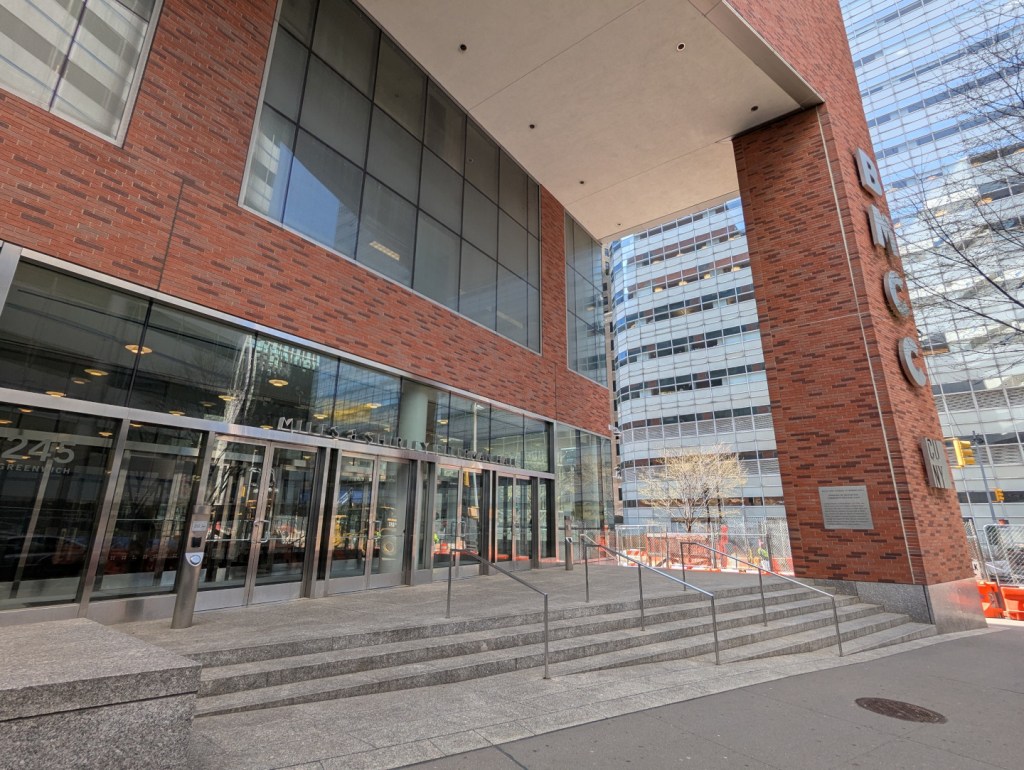
Yesterday, about twenty faculty and students gathered in BMCC’s Fiterman Hall room 1304 to discuss the effects of Generative AI on college writing, higher education, and society-in-general for the Spring 2025 Robert Lapides Faculty Forum. I was honored to have been invited to participate.
For my part in the conversation, I came at the issue from four vectors: as a science fiction scholar, a writing instructor, a technical communication instructor, and computer hobbyist. My desire to learn how Generative AI works and to pass on what I have learned to my students is informed by my adherence to William Gibson’s axiom, “the street finds its own use for things,” which is coupled with Donna Haraway’s “Cyborg Manifesto” and claiming the tools of technology for our own purposes to build the network, community, and world that we want.
While it was scheduled for only two hours, we ran over by 20 minutes–something the organizers said hadn’t happened before. I think that if time hadn’t been called, we might still be there into the wee hours.
The BMCC students in attendance demonstrated their engagement and concern about these technologies in the classroom and their everyday lives.
I closed my comments in response to a question about how we might use Generative AI to fight back against authoritarianism. I offered an assemblage of open source generative AI, a bit of Harlan Ellison’s “‘Repent, Harlequin!’ Said the Ticktockman” (1965), and Orson Scott Card’s Ender’s Game (1985).
Besides the substance of the discussion, I think meeting colleagues at BMCC might have opened doors for further work on AI matters and the annual City Tech Science Fiction Symposium. Stay tuned!
I’ll be speaking on a discussion panel about Artificial Intelligence, Generative AI, and College Writing at Borough of Manhattan Community College, CUNY (BMCC), Fiterman Hall 1304 on Wednesday, April 2 from 2-4 PM. If you’re free, it would be great if you could join us for what I think will be a lively in-person conversation. Details are below and the event flyer is posted above and below.
The Spring 2025 Robert Lapides Faculty Forum
Wednesday April 2 Fiterman Hall 1304 (245 Greenwich St.) 2-4 pm
A Step Toward the Unified Macro-Mind or a Cybernetic Lawnmower in the Groves of Academia? : Generated Text and the Future of College Writing
Recently, Large Language Models and generated texts have sent shockwaves through the academic community. Do they represent the initial glimmerings on a new horizon of transhuman creativity or are they, in Noam Chomsky’s phrase, merely “glorified autofill,” a “high-tech plagiarism” based on a self-cannibalizing database? Where old-fashioned plagiarism now seems like a relatively simple matter of ethics and originality, Artificial Intelligence and the looming specter of the Literary Chatbot bring a whole host of more tangled issues of Perception, Knowledge, Autonomy, and Class Warfare into the classroom.
Many believe the neural net models of cognition don’t begin to pierce the mystery of the mind—Roger Penrose and others remain unconvinced that human thinking can be reduced meat-puppet computation, while John Searle’s Chinese Room parable undermines the idea that mere symbol-juggling can ever result in emergent consciousness. Still, techno-optimists believe we are at the precipice of an age of cyborg enhancements in which human potential will be radically expanded and the primate mind will be uploaded into Cloud-dwelling immortality.
We will be discussing these issues and many others in an open symposium with CUNY professors Jason Ellis, Carlos Hernandez, Lisa Sarti, and Shane Snipes. We encourage our colleagues to come to voice their concerns and hopes on this increasingly crucial and urgent matter.
The event is named in memory of Robert Lapides, a past English department professor at BMCC. Reading his obituary, you get the sense that he did good work that saved voices from the past from erasure, and created space for voices in the present to carry the work forward.
“Robert Lapides, professor emeritus in the English Department, husband of Professor Diane Dowling, died on January 1, 2021. At BMCC for over 40 years, Professor Lapides will be remembered for his passion, his life-long fight for social, economic, and racial justice, and his commitment to building communities where differences can be expressed. Never afraid to speak up or ask questions, he was genuinely interested in his students and colleagues. His intense curiosity about people, places, politics, history, literature, psychology, religion–about what it means to be human–informed all his efforts. He encouraged his students to embrace their humanity, including the parts of themselves they felt they needed to hide, building their courage to write honestly. His legacy can be found in his influence on the many students and colleagues he worked with, the online communities he created, in his faculty magazine Hudson River, and for editing Lodz Ghetto, collected writings left behind by Jews confined to the Lodz Ghetto in WWII. Until the end, he was working on his book about the creative development of Charles Dickens, which will be published posthumously” (from Ellen Moody’s Under the Sign of Sylvia blog, 25 Mar. 2021).