Tag: Georgia Tech

  • Recovered Writing, Brittain Fellowship, CETL Brown Bag, Writing the Brain: Using Twitter and Storify, Oct. 2, 2013

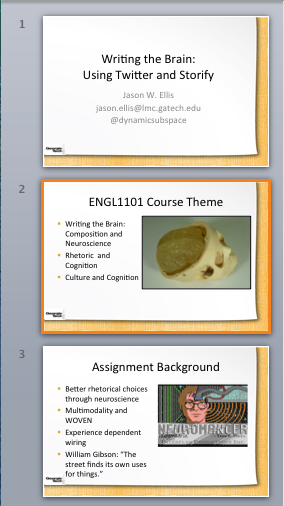
    Slides from "Writing the Brain" PowerPoint.
    Slides from “Writing the Brain” PowerPoint.

    This is the sixty-second post in a series that I call, “Recovered Writing.” I am going through my personal archive of undergraduate and graduate school writing, recovering those essays I consider interesting but that I am unlikely to revise for traditional publication, and posting those essays as-is on my blog in the hope of engaging others with these ideas that played a formative role in my development as a scholar and teacher. Because this and the other essays in the Recovered Writing series are posted as-is and edited only for web-readability, I hope that readers will accept them for what they are–undergraduate and graduate school essays conveying varying degrees of argumentation, rigor, idea development, and research. Furthermore, I dislike the idea of these essays languishing in a digital tomb, so I offer them here to excite your curiosity and encourage your conversation.

    In this Recovered Writing post, I am including two PDF files that I used in my presentation on “Writing the Brain: Using Twitter and Storify” for the 2 October 2013 CETL Brown Bag Workshop. The first is my PowerPoint presentation file and the second is my handwritten presentation notes. Normally, I type up a carefully written script for my presentations, but in this case, I wrote my speaking notes out by hand. While I was driven my a tight deadline imposed by several other responsibilities converging at the same time, I saw this as an opportunity to experiment with a way of presenting that I normally don’t do and I wasn’t completely comfortable doing. As I tell my students, we grow by challenging ourselves, doing new things, and experimenting with new approaches. This was one such attempt on my part.
  • Science Fiction, LMC 3214, Summer 2014: Proto-SF, Voyages Extraordinaires, and Scientific Romances

    Since I will be out of town on business during Wednesday’s class, I made this lecture video for my on-campus and off-campus students. It is available as an MP4 on T-Square > Resources, too.

    Besides covering proto-SF, Voyages Extraordinaires, and Scientific Romances, we are reading H.G. Wells’ “The Star” and E.M. Forster’s “The Machine Stops.” I am looking forward to reading what everyone has to say on Twitter using the #lmc3214 hashtag!

    Next week, we begin discussing the Hugo Gernsback and the SF Pulps!

  • Science Fiction, LMC 3214, Summer 2014: Mary Shelley’s Frankenstein (Day 2 of 2)

    Georgia Tech: Engineering Great Minds.
    Georgia Tech: Engineering Great Minds.

    During today’s LMC 3214 Science Fiction class, I continued my lecture on the importance of the Biology of Mind to Frankenstein specifically and Science Fiction generally.

    In the last lecture, I ended on a discussion of the empiricist vs. rationalist debates. Then, I turned to the questions, “How and why do we enjoy literature?” I discussed solving puzzles (finding solutions), feeding our imagination (the novum), deploying our theory of mind and observing theory of mind at play in the novel, recognizing how the brain is a virtual reality simulator (it simulates our experience of the world and our experience of imagined worlds in fiction–in both cases there is a divide between us and the world itself–even more so in the case of the epistolary novel form), and finally, understanding that each person’s experience of the novel will be different based on wiring, hormonal production/reception, memories, and associations (we discussed how we observe this in the novel and how it is important to Romanticism).

    I ended the lecture on an etymology of hubris and nemesis and a discussion about how the novel is a critique of the Age of Enlightenment.

    In the last half of class, I asked the on-campus students to lead the discussion and raise those points, passages, or questions that they were most interested in concerning the novel. Our discussion ranged from Jurassic Park connections to women’s biological rights to the Creature’s missed potential due to his undutiful creator.

    There’s no class on Monday for Memorial Day or Wednesday due to a professional trip. Our class lecture for Wednesday (LS and QUP sections) will be available on T-Square under Resources as an MP4 video. In that lecture, I will discuss proto-SF, Voyages Extraordinaires, and Scientific Romances.We will continue our conversations on Twitter through this weekend and next week. We will resume normal classroom meetings and lecture recording on June 2.

  • Science Fiction, LMC 3214, Summer 2014: Mary Shelley’s Frankenstein (Day 1 of 2)

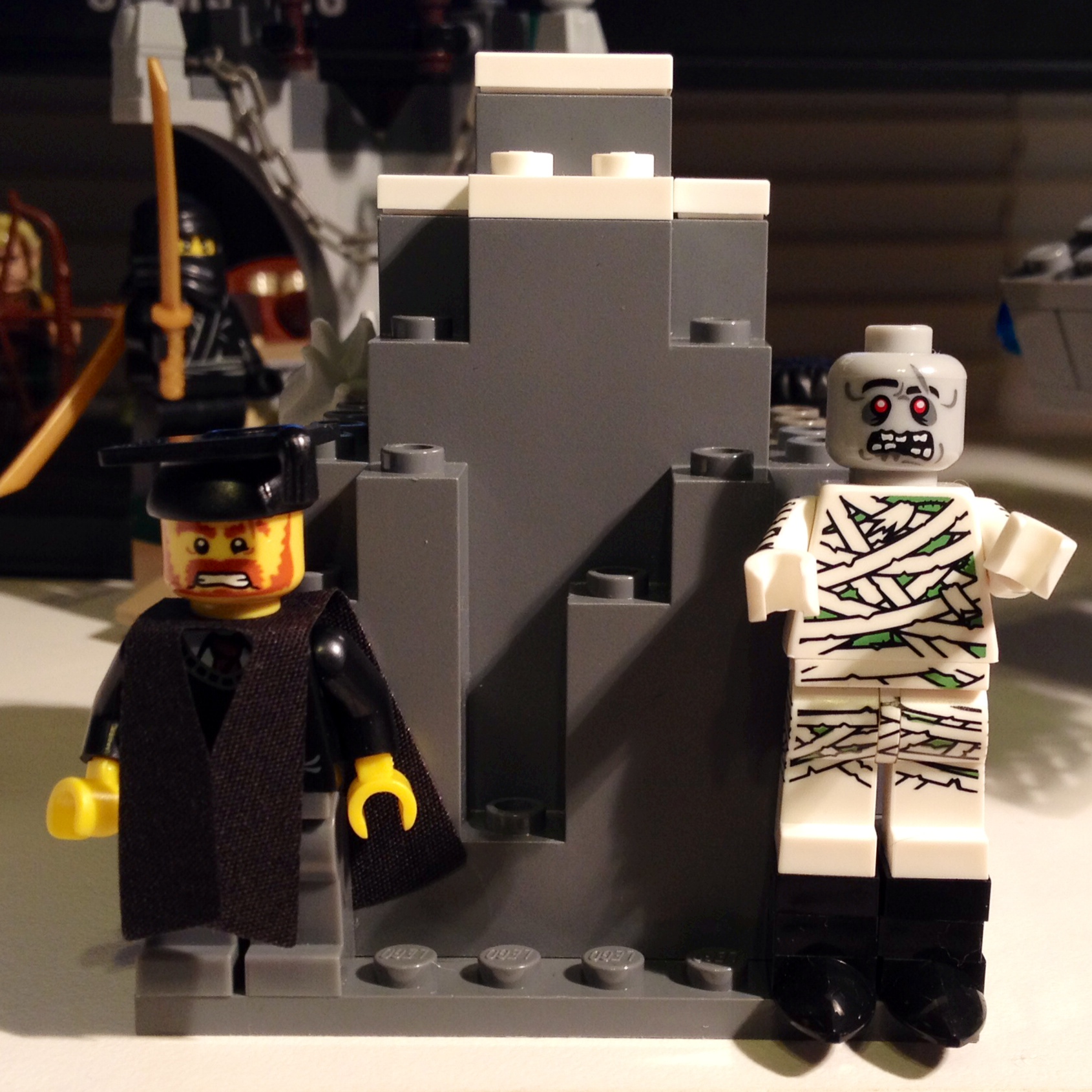
    Popular or Sci-Fi depictions: The Creature in Boris Karloff disguise and Victor Frankenstein as the mad scientist.
    Popular or Sci-Fi depictions: The Creature in Boris Karloff disguise and Victor Frankenstein as the mad scientist.

    Today, my LMC 3214 students and I shifted our attention away from contemporary science fiction as represented by Ted Chiang’s “The Truth of Fact, the Truth of Feeling” towards the beginning of the genre.

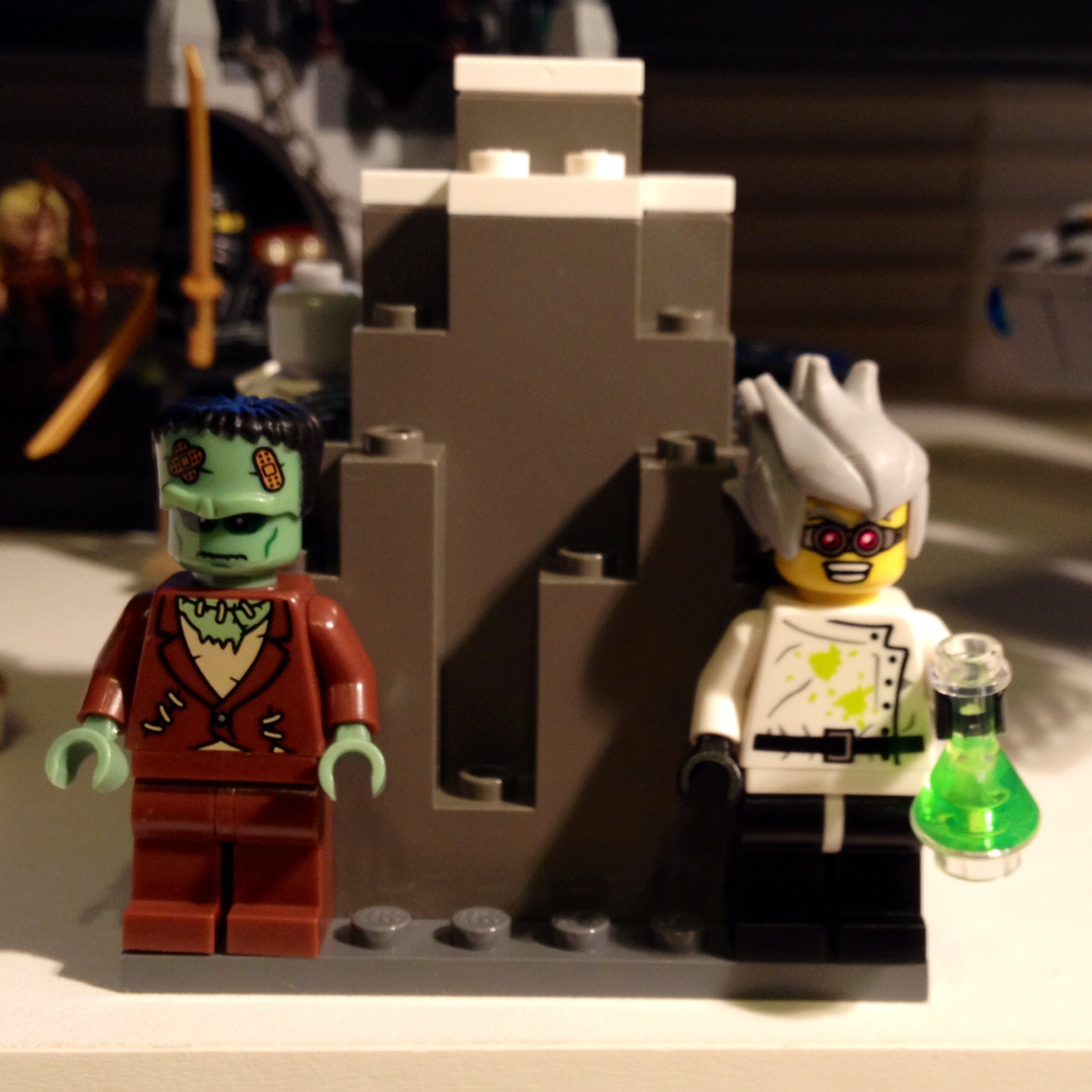
    My goal was to shift my students’ thinking about Frankenstein away from the popular conception (photo above) to the novel’s original depiction of these important characters in science fiction and English literature (photo to the right, below). When time and materials permit, I will bring in other Lego models to illustrate some of my larger points in class.

    SF original: Mary Shelley's learned and angry Victor Frankenstein and grotesque, gargantuan Creature.
    SF original: Mary Shelley’s learned and angry Victor Frankenstein and grotesque, gargantuan Creature.

    During today’s class, I lectured on precursors of the genre beginning with the Epic of Gilgamesh (connecting each of these earlier works to either Chiang’s story or Frankenstein to illustrate how the themes in SF influences still remain today) and moved forward to modernity. I glossed the Age of Enlightenment, the Scientific Revolution, the Industrial Revolution, Romanticism, and the Gothic.

    With that groundwork established, we began discussing Mary Shelley’s Frankenstein (1818). I lectured on her biography and significant themes in the novel (science saturated novel, all three protagonists are scientists–Walton, Victor, and the Creature, and the biology of mind). The latter theme of mind (empiricism vs. rationalism) was what I rounded out the lecture with by discussing how the rationalists via Noam Chomsky eventually won out over the empiricists (the tabula rasa/the blank slate).

    My students are building their discussions on Twitter using the hashtag #lmc3214. Please join in and participate in the conversation!

  • Science Fiction, LMC 3214, Summer 2014: Definitions of SF and Ted Chiang’s “The Truth of Fact, the Truth of Feeling”

    During Wednesday’s class, we will continue laying groundwork for our work in Science Fiction, LMC 3214 this summer. First, we will discuss the assigned reading: Ted Chiang’s “The Truth of Fact, the Truth of Feeling.” Then, while exploring the list of SF definitions that I assembled for us, we will test Chiang’s novella against those definitions. These definitions will also be a continuing part of our discussions in the weeks ahead.

    If you are interested in Chiang’s story, you might want to listen to this speech that Chiang gave at EXPO 1: New York on July 8, 2013:

    Next week, we will turn away from contemporary SF and go back to its beginning, which I will argue (as others have done before me) is Mary Shelley’s Frankenstein (1818, NB: we will be reading the 1831 edition).