Despite being scrawled with a paint marker by an anonymous tagger on a filthy concrete support column in the Home Depot parking lot on 3rd Avenue in Brooklyn, NY, I paused to ruminate on its written message, “Stop Being Afraid Ⓐ.” Perhaps contemplating this message will be beneficial to you, too.
An anthropomorphic cat wearing coveralls, working with advanced computers. Image generated with Stable Diffusion.
As I wrote about recently about my summertime studying and documented on my generative artificial intelligence (AI) bibliography, I am learning all that I can about AI–how it’s made, how we should critique it, how we can use it, and how we can teach with it. As with any new technology, the more that we know about it, the better equipped we are to master it and debate it in the public sphere. I don’t think that fear and ignorance about a new technology are good positions to take.
I see, like many others do, that AI as an inevitable step forward with how we use and what we can do with computers. However, I don’t think that these technologies should only be under the purview of big companies and their (predominantly) man-child leaders. Having more money and market control does not mean one is a more ethical practitioner with AI. In fact, it seems that some industry leaders are calling for more governmental oversight and regulation not because they have real worries about AI’s future development but instead because they are in a leadership position in the field and likely can shape how the industry is regulated through industry connections with would-be regulators (i.e., the revolving door of industry-government regulation in other regulatory agencies).
Of course, having no money or market control in AI does not mean one is potentially more ethical with AI either. But, ensuring that there are open, transparent, and democratic AI technologies creates the potential for a less skewed playing field. While there’s the potential for abuse of these technologies, having these available to all creates the possibility for many others to use AI for good. Additionally, if we were to keep AI behind locked doors, only those with access (legally or not) will control the technology, and there’s nothing to stop other countries and good/bad actors in those countries from using AI however they see fit–for good or ill.
To play my own small role in studying AI, using generative AI, and teaching about AI, I wanted to build my own machine learning-capable workstation. Before I made any upgrades, I maxed out what I could do with a Asus Dual RTX 3070 8GB graphics card and 64GB of RAM for the past few months. I experimented primarily with Stable Diffusion image generation models using Automatic1111’s stable-diffusion-webui and LLaMA text generation models using Georgi Gerganov’s llama.cpp. An 8GB graphics card like the NVIDIA RTX 3070 provides a lot of horsepower with its 5,888 CUDA cores and memory bandwidth across its on-board memory. Unfortunately, the on-board memory is too small for larger models or adjusting models with multiple LORA and the like. For text generation, you can layer some of the model on the graphic’s card memory and your system’s RAM, but this is inefficient and slow in comparison to having the entire model loaded in the graphics card’s memory. Therefore, a video card with a significant amount of VRAM is a better solution.
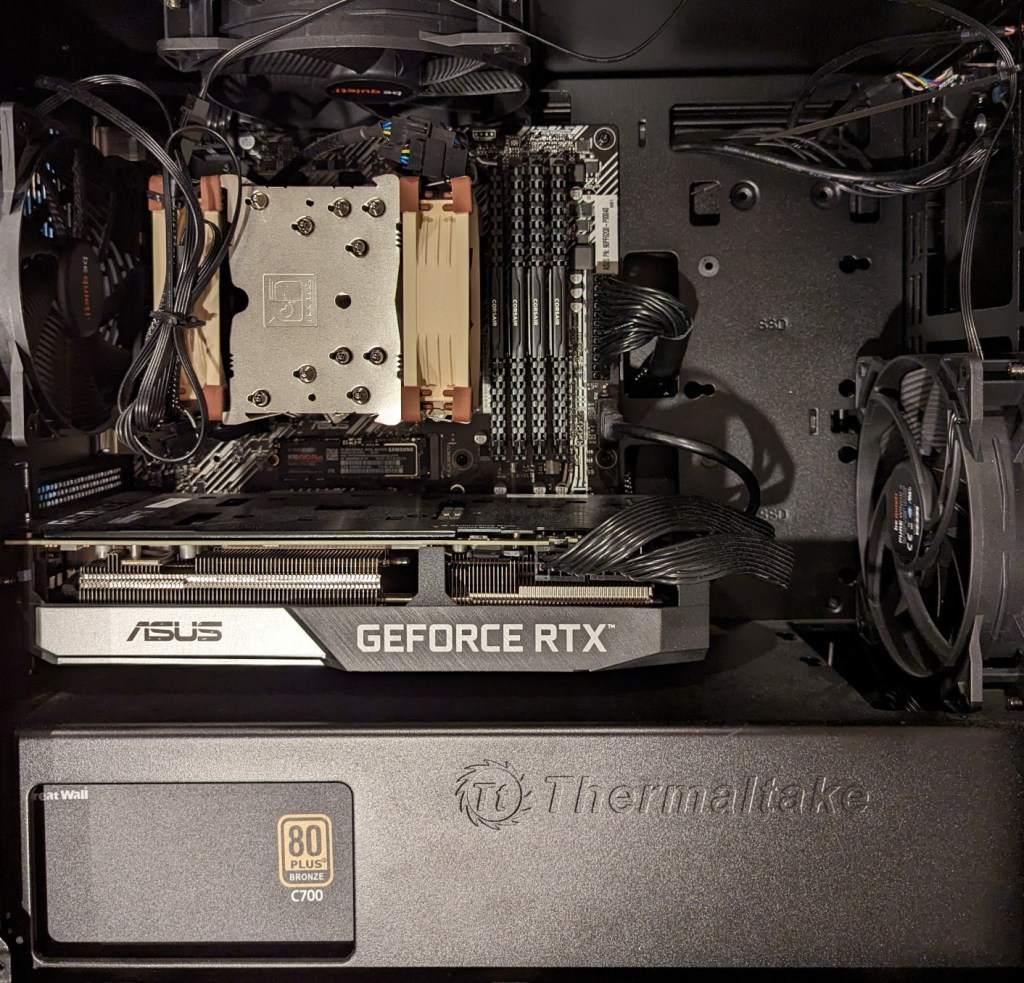
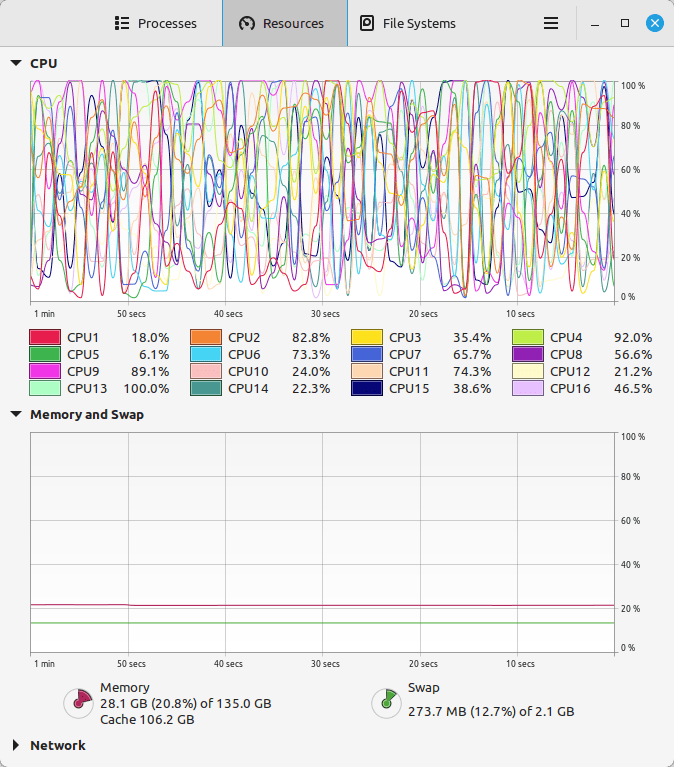
For my machine learning focused upgrade, I first swapped out my system RAM for 128GB DDR4-3200 (4 x 32GB Corsair shown above). This allowed me to load 65B parameters into system RAM with my Ryzen 7 5800X 8 core/16 thread CPU to perform the operations. The CPU usage while it is processing tokens on llama.cpp looks like an EEG:
While running inference on the CPU was certainly useful for my initial experimentation and the CPU usage graph looks cool, it was exceedingly slow. Even an 8 core/16 thread CPU is ill-suited for AI inference in part due to how it lacks the massive parallelization of graphics processing units (GPUs) but perhaps more importantly due to the system memory bottleneck, which is only 25.6 GB/s for DDR4-3200 RAM according to Transcend.
Video cards, especially those designed by NVIDIA, provide specialized parallel computing capabilities and enormous memory bandwidth between the GPU and video RAM (VRAM). NVIDIA’s CUDA is a very mature system for parallel processing that has been widely accepted as the gold standard for machine learning (ML) and AI development. CUDA is unfortunately, closed source, but many open source projects have adopted it due to its dominance within the industry.
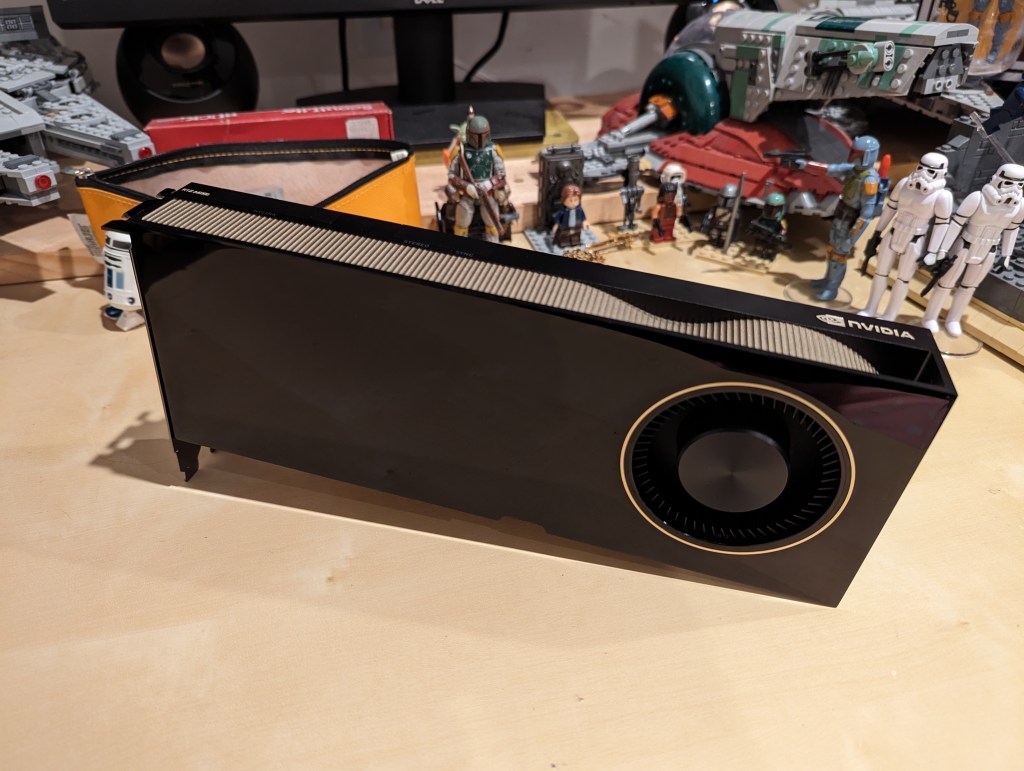
My primary objective when choosing a new video card was that it had enough VRAM to load a 65B LLaMA model (roughly 48GB). One option for doing this is to install two NVIDIA RTX 3090 or 4090 video cards with each having 24GB of VRAM for a total of 48GB. This would solve my needs for running text generation models, but it would limit how I could use image generation models, which can’t be split between multiple video cards without a significant performance hit (if at all). So, a single card with 48GB of VRAM would be ideal for my use case. Three options that I considered were the Quadro 8000, A40, and RTX A6000 Ampere. The Quadro 8000 used three-generation-old Turing architecture, while the A40 and RTX A6000 used two-generation-old Ampere architecture (the latest Ada architecture was outside of my price range). The Quadro 8000 has memory bandwidth of 672 GB/s while the A40 has 696 GB/s and the A6000 has 768 GB/s. Also, the Quadro 8000 has far fewer CUDA cores than the other two cards: 4,608 vs. 10,572 (A40) and 10,752 (A6000). Considering the specs, the A6000 was the better graphics card, but the A40 was a close second. However, the A40, even found for a discount, would require a DIY forced-blower system, because it is designed to be used in rack mounted servers with their own forced air cooling systems. 3D printed solutions that mate fans to the end of an A40 are available on eBay, or one could rig something DIY. But, for my purposes, I wanted a good card with its own cooling solution and a warranty, so I went with the A6000 shown below.
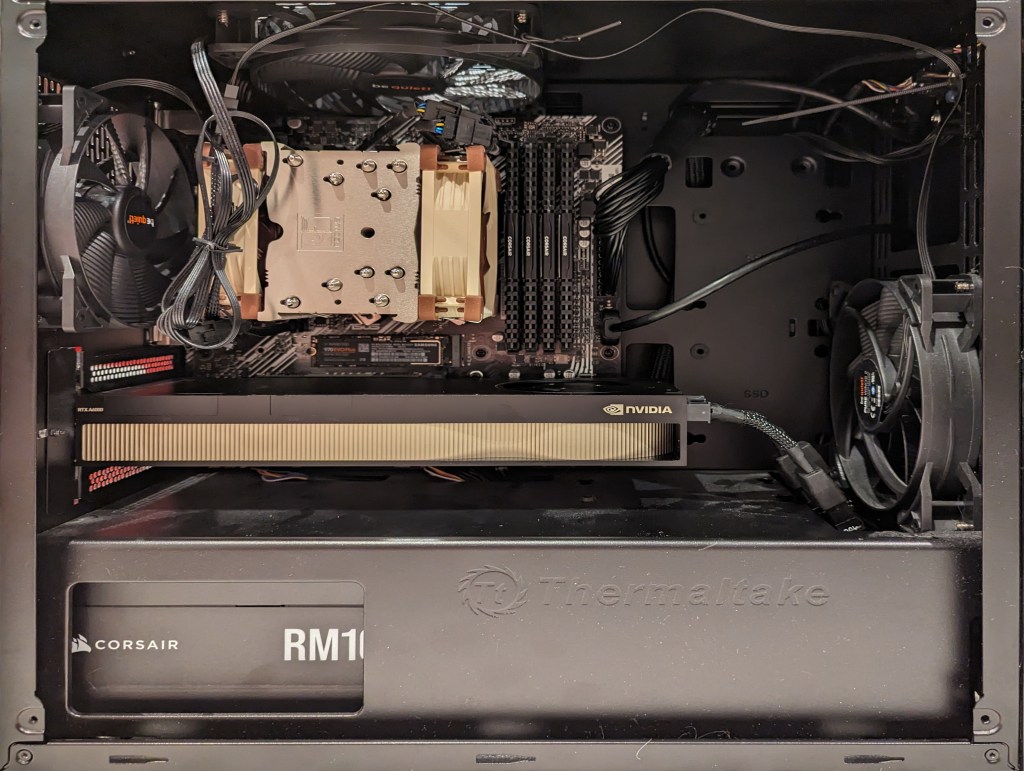
Another benefit to the A6000 over the gaming performance-oriented 3090 and 4090 graphics cards is that it requires much less power–only 300 watts at load (vs ~360 watts for the 3090 and 450 watts for the 4090). Despite this lower power draw, I only had a generic 700 watt power supply. I wanted to protect my investment in the A6000 and ensure it had all of the power that it needed, so I opted to go with a recognized name brand PSU–a Corsair RM1000x. It’s a modular PSU that can provide up to 1,000 watts to the system (it only provides what it is needed–it isn’t using 1000 watts constantly). You can see the A6000 and Corsair PSU installed in my system below.
Now, instead of waiting for 15-30 minutes for a response to a long prompt ran on my CPU and system RAM, it takes mere seconds to load the model on the A6000’s VRAM and generate a response as shown in the screenshot below of oobabooga’s text-generation-webui using the Guanaco-65B model quantized by TheBloke to provide definitions of science fiction for three different audiences. The tool running in the terminal in the lower right corner is NVIDIA’s System Management Interface, which can be opened by running “nvidia-smi -l 1”.
Our computers and other computing devices store some of our most important belongings: photos, videos, music, syllabi, research, and manuscripts. We owe it to ourselves to maintain and protect these things through best practices in computer maintenance, security, backups, and training. During the upcoming winter break, I would like to encourage everyone to spend some time putting your cyber-house in order before the spring semester begins.
To help you with this and to promote best practices, I will hold a workshop in DevLab on Wednesday, Dec. 4 from 4:00-5:00PM before D-Ped. Workshop participants are encouraged to bring their Mac or PC to the meeting. Tablets are also welcome.
If you have a question for the workshop that I cannot answer off the top of my head, we can use the workshop as an opportunity to learn something new together.
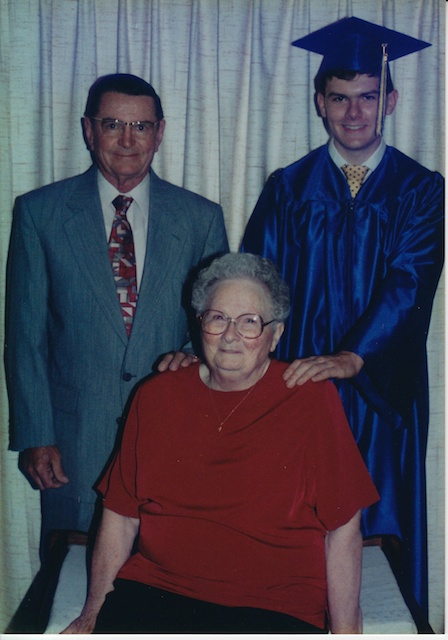
Papa and Granny Ellis with me after high school graduation in 1995.
Early Monday morning, I received an unexpected phone call from my Dad. Obviously upset, he told me that my Granny Ellis had passed away during the night. It was hard to wrap my head around this fact. She was 94 years old, and she marshaled on despite numerous health problems–especially later in life. She was from “old stock,” a heartier stock that could weather setbacks and troubles without much complaint or fuss.
She was my last grandparent to pass away. I am very fortunate to have had so much time to spend and learn from my grandparents. Wilma, Papa Gerald, Papa Ellis, and Granny Ellis contributed in so many ways to my emergence as the person that I am today. I feel somewhat disconnected now from the past anchored by my grandparents–grandparents who I spent time with every day, every week, every summer when I was younger and who I called once a week no matter where I might be in: in Atlanta, Liverpool, or Ohio.
There are a couple of things that immediately come to mind in remembering Granny Ellis. The first has to do with food and the second has to do with the surprising power of memory.
When I was younger, I would usually spend Wednesday afternoons and some weekends with my Granny and Papa Ellis. More often than not, I wanted to “play” with my Legos or other toys, but what no one knew–even myself–was that I was learning. I was modeling. I was thinking through narrative. I was thinking about the possibilities in social interaction, engineering, and creativity.
Granny Ellis let me explore through my play without interruption–except when it was necessary, as she would remind me, to eat. She believed in making sure that I was well fed. With energy stores fulfilled, she would release me from an empty bowl of chili or a now barren plate where once sat made-from-scratch biscuits to return to my building, my thinking, my “play.” In her own way, I believe that she recognized that I needed to do those things to make sense of a world far different from the one she was born into so many years before. She recognized that even play is an important part of learning.
Then, many years after those afternoons on the carpeted floor hunting for the right brick, Granny Ellis developed neurological problems. Papa Ellis would need to guide Granny around. It was like she was there, trapped behind her eyes, unable to express herself as she had when I was younger. However, her doctors began experimenting with different medicines to combat what were ultimately long undiagnosed micro-seizures and dementia, she regained to some extent her old self. You could speak with her once again and she could recall the past remarkably well. Unfortunately, her short term memory was impaired–she could not remember from day-to-day or even minute-by-minute on most occasions.
Due to Granny Ellis’ trouble with short term memory, I expected her to not remember my wife Y after I introduced her. To my overwhelming joy, Granny Ellis not only remembered that I was married to a beautiful girl named Y, but she also remembered to ask how Y and I were doing. Granny’s face would light up when she saw Y on the too few occasions that we could both travel to Brunswick to visit. Despite these few encounters, Granny Ellis overcame her brain’s degenerative hurdles to hold on to that memory. Did her love for Y and me play some role in her brain’s ability to build a lasting long term memory from her short term memory? This question deserves further investigation. In the meantime, I believe that she expressed her love through her memory of Y, and I am glad that I now have that memory to hold onto in my life.
Our friends and family (and especially our grandmothers) have a lot to teach us. We can learn from them and our experiences. We can reflect on what they did–how they demonstrated solid pedagogical practices for learning and enabling learning–in our own thinking about the theory and practice of teaching.