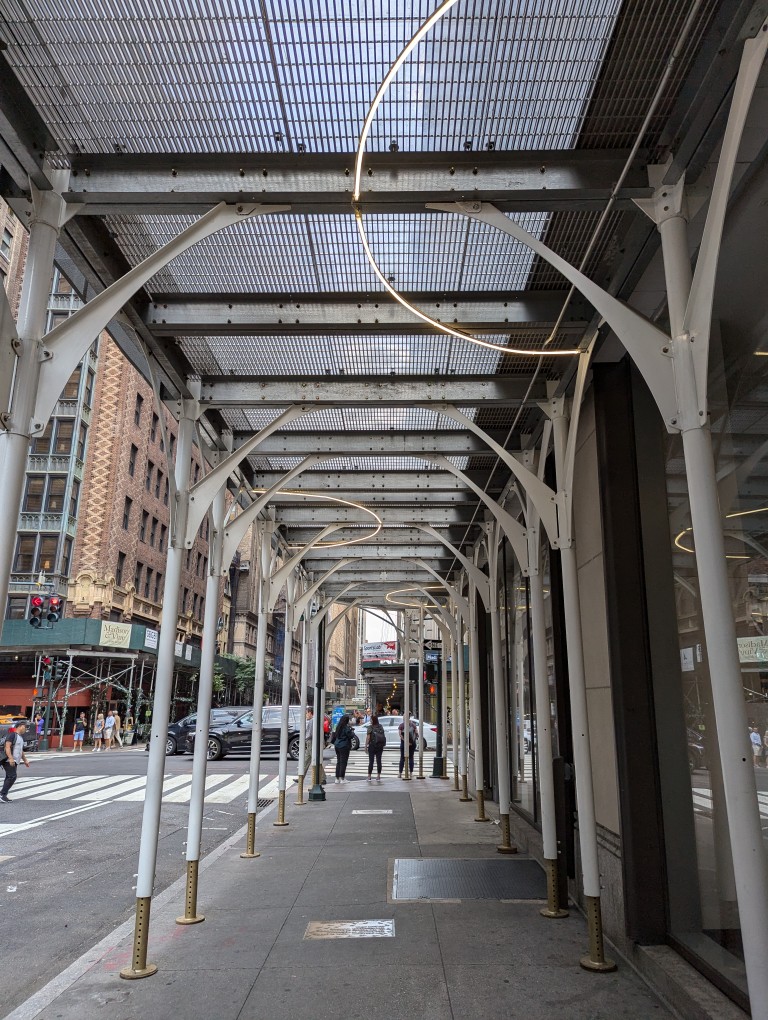
This is one of the more interesting sidewalk sheds–scaffolding that covers sidewalks and protects pedestrians below where building work is being done above–that I’ve seen in NYC. It’s near Bryant Park in Manhattan. In addition to be cleaner looking scaffolding, it features semicircular lighting that probably looks nice after dark. Most scaffolding in the city looks like what you can see in the background on the left–utilitarian and spartan. According to Gothamist, there’s about 400 miles of scaffolding spread throughout the five boroughs. Between the buildings and the scaffolding, it’s easy to imagine where Isaac Asimov got the idea for the setting in The Caves of Steel (1953).
Jim Rennert’s Listen is an imposing sculpted figure where Robert Indiana’s Love sculpture used to be in Manhattan. Of the two, I think there’s a lot more value in its message of being silent so that you can listen to what others have to say. One must be silent to listen. Listening is the foundation of understanding, trust, and cooperation. Unfortunately, there were no crowds around this statue like there used to be for the LOVE sculpture. This important symbol seems to be less photogenic for some.
An exposed brick NYC apartment created with Stable Diffusion.
Having lived in apartments of one kind or another in different cities and countries over the past 30 years, there is one fact that is unavoidable: many tenants don’t care about others. This can take many forms–from leaving packages outside, leaving laundry in the on-site washer and dryer, not breaking down boxes for recycling, leaving trash outside of bins for the rats to tear apart, etc.
However, one of the worse offenses one apartment dweller can do to another is disturb another’s peaceful habitation through loud noise. This can include screaming babies, barking dogs, loud stereo music or movies, and perhaps worst of all, bass. It seems strange to me that other tenants, who must have heard their neighbors at one point or another, don’t think about that and consider how they can adjust their noise production and environment to lessen the chance that their clamor won’t bother someone else. You know, that whole golden rule thing. Though, I’m ready to admit that I’m naive about others’ motivations and their lack of concern about others.
Perhaps its the selfish orientation of some on the renting side of things is also an orientation on the landlord side of things. Observing the cheap construction of luxury apartment buildings near where I live, which are all glossy surface but shoddy underneath, I’m not surprised that the more modest abodes that Y and I can afford are of an equally poor construction. This selfishness on the part of building owners to cut costs by building apartments without a modicum of quality-of-life considerations, such as insulation filled walls (fiberglass or blown closed-cell), no soundproofing (e.g., loaded mass vinyl (LMV) or other dense lining), minimal concrete board except (perhaps) where code absolutely calls for it, or positive pressure ventilation in stairways (to keep odors out). Of course, these things cost money, but considering rental prices and the posh lifestyles of the most lucrative landlords, it’s obviously not for a lack of resources–it’s a lack of will to invest in the quality of life of those who pay exorbitantly for less than stellar accommodations to live in.
So, it’s down to the tenant to do what they can to improve their living environment that is bombarded by the sounds of neighbors and the city outside and the other byproducts of enclosed living spaces–odors of cooking and smoking.
I’ve tried a lot of tricks to keep others’ sounds and odors out of my living space, and in so doing, keep my sounds and odors in my space so as not to bother others. The following are a few of those things.
Apartment Entrance
The front door of an apartment is one of the worst offenders for allowing sound (and smells) into an apartment. This is especially true when the door is hung improperly or damaged (e.g., steel doors can be dented or bent). Also, less expensive doors are hollow, which allows sounds to pass into the apartment.
One of the easiest fixes for keeping out sound and smells is installing a door sweep that seals against the door’s threshold. The kind that I use slips on and has multiple sweeps to give a better seal. When I move, it is easily slipped off.
Another culprit is how well the door seals against the frame. The previous tenant where I now lives did a remarkable job installing weatherstripping around the exterior of the door–likely due to sound and odor issues that we’ve had to deal with. For this kind of installation, they would have had to drill pilot holes for each screw that holds the aluminum frame of the rubber weatherstripping insulation against the steel door frame. The only way that they could have improved upon this is adding a strip of caulk behind the weatherstripping frame before screwing it down. Otherwise, this has helped tremendously for keeping out sounds and smells.
Our neighbors across the landing from our door often slam their door (as did the previous tenants). Before, I hung moving blankets on the door and had a heavy curtain that I would pull over the door when Y and I were inside the apartment (to hide the blue blankets).
Recently, I figured out a better solution that keeps out far more noise to the point that we aren’t always aware of our neighbors comings and goings (as it should be!). I purchased a large roll of 2″ thick upholstery foam, neodymium magnets with countersunk holes, 3/16″ x 2″ long countersunk bolts, 1″ washers, and 3/16″ nuts. I ran the bolts through the magnets and attached the magnets to the steel entrance door. I cut the foam so that it overlapped the frame of the door (to cover where the door and frame meet). Then, I pushed the bolts through the foam–beginning at the bottom and working my way up–adding a washer and nut to each bolt as I went. I cut small holes around the handle, deadbolt, and peephole.
Interior Doors
When the source of sounds might be on the other side of closets, bathrooms, or bedroom, I’ve used those spaces as sound buffers when not in use. To do this, I applied weatherstripping to the inside edge of the door jamb for those interior doors and keep those doors shut as much as possible. This puts another barrier between me and the source of the sound.
Floors
Noise from neighbors–especially sounds from music, movies and television, parties, and shouting–often come through the floor from the unit directly beneath you. The more material that you can put down that can stop sound (e.g., mass loaded vinyl) or muffle it (e.g., felt underlayment and high pile carpet), the better. In my case, I covered as much of the floor with carpet with a felt underlayment (living room) and carpet with rubber backing (bedroom). I haven’t tried MLV under a carpet, but if I were, I would check it regularly to make sure that it doesn’t act as a moisture barrier and collect water underneath, which could ruin the floor that it was on top of. Breathable material like heavy felt and carpet is probably a safer bet.
Also, carefully inspect around the edges of rooms, doors, and closet interiors for any gaps or openings. I use caulk to fill these gaps–it can stop sound and odors from entering below. It can also stop insects from migrating into your unit. I use acrylic caulks so clean up is easy with soap and water. To apply caulk, use a small tube or a larger tube and caulk gun to apply. Then, wet the tip of your index finger and lightly pull it from the far end of where you applied towards you. This gives the caulk its bead and blends it into the two adjoining surfaces. Use a paper towel to carefully wipe up any excess and wash your hands with soap.
Walls
If you have neighbors on either side of your unit, you can add some barriers to muffle sound. These interventions have also helped with containing the sounds within my apartment and reducing echo (because there is no insulation in any of the exterior or interior walls, echo is far more noticeable than in solid construction). One type of sound blocker and absorber is bookshelves loaded with books. Though, remember to keep enough space behind the shelves for air circulation, which will keep your books healthy and free of mold.
Hanging fabric items–especially quilts and rugs–on the wall will help absorb some of our sound and muffle sound that might come in from outside the apartment. Like with anything that I put on the floor, I make sure that it is breathable and not a moisture barrier that can collect water and ruin the building material or promote mold growth in a wet environment.
Windows
A lot of noise originates from the sidewalk and street below our apartment. Besides ensuring the windows are properly sealed and closed, we also double hang sets of thick blackout curtains–one set fits inside the window frame on a tension rod and the second set is mounted on rods attached to the wall face and hangs to the floor. Pulled together, these muffle a lot of daily noise and they cut out all light when we’re trying to sleep at night.
White Noise and Air Filters
All noise can’t be eliminated, but it can be masked. This is especially important when we’re trying to sleep. As a final precaution, we turn on a large air cleaner set to its medium fan speed to create a background of white noise while recirculating and cleaning the air in the apartment–two birds, one stone.
Also, we keep another air cleaner on the kitchen counter running on low speed 24/7. It uses a charcoal filter to remove odors from the air–ours from cooking and any that might find their way into the apartment from outside.
Appliances
Some noise–like a film murder fiend–is already inside. Our wall insert air conditioner is a case in point. Occasionally, its front face will vibrate and sound like the whole apartment is shaking apart. Using a found object–like a toy foam disk–inserted between the frame and face eliminated the errant racket.
Other Options and Observations
The bed is a tough nut to crack when bass is involved. Pulling the bed away from the wall a few inches helps some with ambient pulses, but the low frequency vibration of bass will travel up the feet of the bed into the mattress, through the pillow, into your ear pressed against the pillow or your head lying back into the pillow. Reducing the surface area of the feet–where it contacts the floor–seems like it might reduce how much vibration is absorbed and transmitted. There are risers made out of dense rubber that might help, but reviews are typically not positive. I’ve read some inventive ideas online involving springs, fulcrums, and isolators–essentially turning your bed into a large turntable antivibration system–but it would require a lot of material, know-how, and capital to make that work correctly.
If I could afford it, I would like to try installing a floating floor: lay down a felt underlayment and snap together a Pergo-like laminated floor on top of it. Then, I would lay out a layer of MLV and then a carpet over that. This might improve sound blocking over just a carpet due to its mass. However, bass will easily penetrate even another floor.
Bass is probably the worst aspect of living near others. Audio manufacturers and the entertainment industry promote thumping bass as essential to almost any kind of music. I get that a beat can get you moving, but the fact that bass is an omnidirectional vibration that travels through most materials and at great distance, it would seem that some sense would prevail in how people enjoy it. Of course, I’m delusional in thinking that would be the case.
While lots of online discussions about noisy neighbors include voices that say, “just go talk to them,” I can attest that over the past 30 years I have never had a positive interaction or lasting change with any neighbor regarding noise despite being as nice and neighborly as possible to them. From those interactions, I have gathered that those folks just don’t like doing something counter to what they are already doing, and/or they don’t care because the problem isn’t theirs. However, I suspect that if someone caused them trouble they wouldn’t turn the other cheek. It’s not so much “do unto others as you would have them do unto you” as “do what you want and others be damned.”
When Y and I moved to Brooklyn, we gave our Toyota Corolla to my folks who have been driving it for the past nine years. On my recent trip to visit them, they let me borrow the car so Y and I could get around and out of the city during my sabbatical. One of the highlights of the 14 hour drive back to New York City was crossing the Verrazzano-Narrows Bridge from Staten Island to Brooklyn on the lower deck.
Also, I want to give a shout out to Woodard’s Auto Center in Nahunta, Georgia for getting my old car up to snuff–new plugs, new battery, new tires, oil change, and winterize–for the long drive north. If you’re in their neck of the woods and need your car or truck serviced, Mr. (Jimmy) Woodard and his sons Jim and Tim are highly recommended!
Tomorrow, I’ll share some of the things that I did to the car’s interior to make the drive as comfortable as possible and avoiding a potential fire due to a rat’s nest.