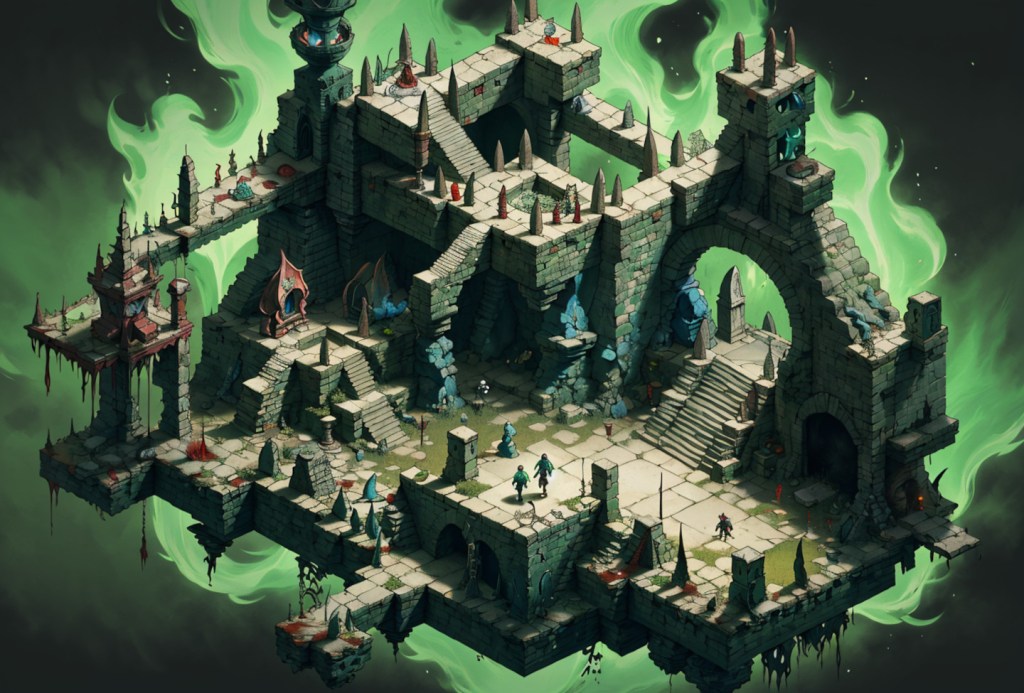
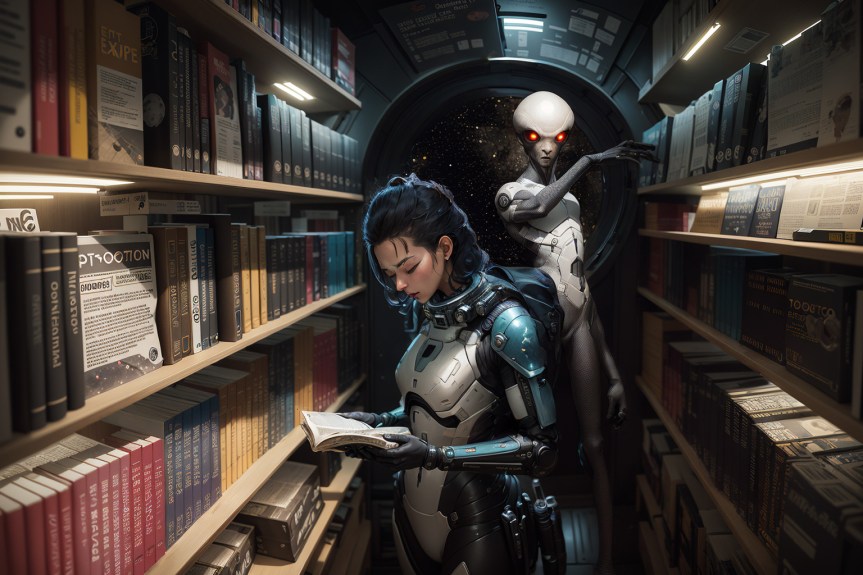
Isometric RPG dungeon image created with Stable Diffusion.
Yesterday, one of my top students visited my virtual office hours on Zoom to talk about their research paper. During our conversation, he made impassioned arguments that I add chapters on Video Games and Table Top Gaming to Yet Another Science Fiction Textbook (YASFT), the OER textbook that I published earlier this year and am teaching with for the first time this semester. He’s right–it does need coverage of those topics not just for completeness but also because it’s how many students make a deeper connection to the genre (with television and film often being an introduction). It’s something that I plan to work on when I get a chance.
Fall 2024 classes begin on Wednesday, August 28. Originally, I was hoping to teach City Tech’s ENG2420, Science Fiction course in person this semester, but the in-person section had too few students to run. Thankfully, after the administration switched the class to being online, asynchronous and sending a message blast to prospective students, the new online class quickly filled up. Since City Tech recently switched to a new learning management system (LMS) called Brightspace, I’m going to experiment teaching the class on it instead of using our open learning system, OpenLab. However, I will still create my video lectures as YouTube videos, so they will be public facing for anyone interested in following along or using them in their own classes. Also, this will be my first time teaching the class using my open educational resource (OER) Yet Another Science Fiction Textbook. Here’s to a positive and productive semester!
The next academic year is just around the corner, so I wanted to give a shout out for the open educational resource (OER) that I published earlier this year, Yet Another Science Fiction Textbook (YASFT), an over 60,000 word textbook on the history of SF literature that includes a syllabus, video lectures, and more.
And, if you’re an educator needing open and free teaching materials and textbooks, here are some useful resources where you can find OERs:
I’m very happy to announce the launch of a new open educational resource (OER) that I’ve been working on for awhile!
It’s called Yet Another Science Fiction Textbook (YASFT). It’s over 60,000 words and includes additional resources that can be helpful for readers, students, and instructors.
YASFT is released under an Attribution-NonCommercial-ShareAlike 4.0 International Creative Commons License. It’s freely available to be read as it is. However, if anyone would like to use it in another way, there are licensing terms that must be followed: “This license requires that reusers give credit to the creator. It allows reusers to distribute, remix, adapt, and build upon the material in any medium or format, for noncommercial purposes only. If others modify or adapt the material, they must license the modified material under identical terms.”
You can find YASFT under the Teaching menu above or directly here.
Its abstract and table of contents are included below.
Abstract
Yet Another Science Fiction Textbook (YASFT) is an open educational resource or OER, meaning it is freely available for anyone to use and learn with. It provides a chronological history of Science Fiction (SF) with an emphasis on literature and film, and it includes other useful resources, such as a glossary of terms, an extensive list of SF definitions, additional resources, a syllabus with hyperlinked readings available online, and video lectures. It tells a story, but not the only story, about SF history. It’s also an experiment in using generative artificial intelligence (AI) to assist with editing a large body of text, in this case over 60,000 words.
Table of Contents
    Front Matter
        What is YASFT?
        Who made YASFT?
        Why was YASFT made?
        Why is it called YASFT?
        How can YASFT be used?
        How was YASFT made?
        Acknowledgements
    Preface
    Origins of Science Fiction
        Early Fantastic Stories
        Scientific Revolution
        Age of Enlightenment
        Romanticism
        The Gothic
    Mary Shelley’s Frankenstein
        Science-Saturated Novel
        Victor Frankenstein’s Hubris
        Critique of the Age of Enlightenment
        Tabula Rasa
    Proto-SF
        Historical Context
        Edgar Allan Poe
        Nathaniel Hawthorne
        Jules Verne
        H. G. Wells
        E. M. Forster
    Pulp SF
        Historical Context
        Overview of Pulp SF
        Hugo Gernsback
        E. E. “Doc” Smith
        C. L. Moore
        Edgar Rice Burroughs
        H. P. Lovecraft
    SF Film Serials of the 1930s and 1940s
        Buck Rogers
        Flash Gordon
    Golden Age SF
        Historical Context
        Overview of Golden Age SF
        John W. Campbell, Jr.
        Isaac Asimov
        Ray Bradbury
        Robert A. Heinlein
        Frank Herbert
        Tom Godwin
    SF Film Through the 1950s
        Film vs. Literature
        Early SF Film
        1950s SF Film Boom
        Forbidden Planet
    New Wave SF
        Historical Context
        Overview of New Wave SF
        J.G. Ballard
        Harlan Ellison
        Philip K. Dick
        Samuel R. Delany
    Star Trek
        “The City on the Edge of Forever”
    Feminist SF
        Historical Context
        Beginnings of Feminist SF
        Definitions of Feminist SF
        Joanna Russ
        Marge Piercy
        Pamela Zoline
        James Tiptree, Jr.
        Ursula K. Le Guin
        Octavia E. Butler
    Afrofuturism
        Steven Barnes
        Tananarive Due
        Nalo Hopkinson
        Nnedi Okorafor
    Cyberpunk
        Historical Context
        Coining the Cyberpunk Term
        Cyberpunk Characteristics
        William Gibson
            Sprawl Trilogy and Stories
            Hermes 2000 and Floppy Disk eBooks
            The X-Files, “Kill Switch”
        Bruce Sterling
        Pat Cadigan
    Contemporary Science Fiction
        Historical Context
        Ted Chiang
        N. K. Jemisin
        Cory Doctorow
        Charlie Jane Anders
        Martha Wells
        Mary Robinette Kowal
        Ken Liu
        R. F. Kuang
    SF Film from 1960 Onward
        1960s
        1970s
        1980s
        1990s
        2000s
        2010s
    Global Perspective: Taiwanese SF
        Brief Taiwanese History
        Taiwanese SF Overview
        Taiwanese Fandom
        Cultural Comparisons
        Issues with Translation
    How to Keep Up With Science Fiction
    Appendices
        Appendix 1: Glossary of Science Fiction Terms
        Appendix 2: Chronological List of SF Definitions of Science Fiction with MLA Citations
        Appendix 3: Further Reading
            Textbooks
            Readers
            Teaching
            Online Research
        Appendix 4: Sample Syllabus with Hyperlinked Readings
        Appendix 5: Lecture Videos
        Appendix 6: Version History
These past two weeks, I’ve been working on a sabbatical side project. I put my primary research project on hold so that I could think about it some more before proceeding. In the meantime, I’m using generative AI to help accelerate my work on an open educational resource (OER) focused on Science Fiction (SF) that I plan to launch soon. The writing is done on the project. What I am doing now is using an large language model (LLM) that I’m running on my desktop workstation to help me with editing. I think the end product will be pretty cool, and it will be something anyone is free to use after it’s launched. Stay tuned!