I’ll be speaking on a discussion panel about Artificial Intelligence, Generative AI, and College Writing at Borough of Manhattan Community College, CUNY (BMCC), Fiterman Hall 1304 on Wednesday, April 2 from 2-4 PM. If you’re free, it would be great if you could join us for what I think will be a lively in-person conversation. Details are below and the event flyer is posted above and below.
The Spring 2025 Robert Lapides Faculty Forum
Wednesday April 2 Fiterman Hall 1304 (245 Greenwich St.) 2-4 pm
A Step Toward the Unified Macro-Mind or a Cybernetic Lawnmower in the Groves of Academia? : Generated Text and the Future of College Writing
Recently, Large Language Models and generated texts have sent shockwaves through the academic community. Do they represent the initial glimmerings on a new horizon of transhuman creativity or are they, in Noam Chomsky’s phrase, merely “glorified autofill,” a “high-tech plagiarism” based on a self-cannibalizing database? Where old-fashioned plagiarism now seems like a relatively simple matter of ethics and originality, Artificial Intelligence and the looming specter of the Literary Chatbot bring a whole host of more tangled issues of Perception, Knowledge, Autonomy, and Class Warfare into the classroom.
Many believe the neural net models of cognition don’t begin to pierce the mystery of the mind—Roger Penrose and others remain unconvinced that human thinking can be reduced meat-puppet computation, while John Searle’s Chinese Room parable undermines the idea that mere symbol-juggling can ever result in emergent consciousness. Still, techno-optimists believe we are at the precipice of an age of cyborg enhancements in which human potential will be radically expanded and the primate mind will be uploaded into Cloud-dwelling immortality.
We will be discussing these issues and many others in an open symposium with CUNY professors Jason Ellis, Carlos Hernandez, Lisa Sarti, and Shane Snipes. We encourage our colleagues to come to voice their concerns and hopes on this increasingly crucial and urgent matter.
The event is named in memory of Robert Lapides, a past English department professor at BMCC. Reading his obituary, you get the sense that he did good work that saved voices from the past from erasure, and created space for voices in the present to carry the work forward.
“Robert Lapides, professor emeritus in the English Department, husband of Professor Diane Dowling, died on January 1, 2021. At BMCC for over 40 years, Professor Lapides will be remembered for his passion, his life-long fight for social, economic, and racial justice, and his commitment to building communities where differences can be expressed. Never afraid to speak up or ask questions, he was genuinely interested in his students and colleagues. His intense curiosity about people, places, politics, history, literature, psychology, religion–about what it means to be human–informed all his efforts. He encouraged his students to embrace their humanity, including the parts of themselves they felt they needed to hide, building their courage to write honestly. His legacy can be found in his influence on the many students and colleagues he worked with, the online communities he created, in his faculty magazine Hudson River, and for editing Lodz Ghetto, collected writings left behind by Jews confined to the Lodz Ghetto in WWII. Until the end, he was working on his book about the creative development of Charles Dickens, which will be published posthumously” (from Ellen Moody’s Under the Sign of Sylvia blog, 25 Mar. 2021).
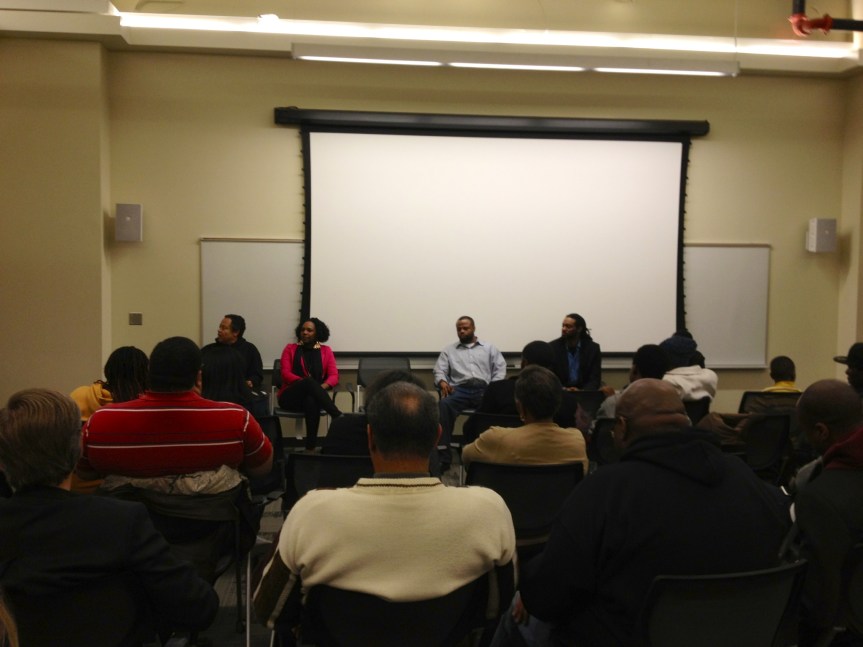
Audience and panelists at the State of Black SF Film Festival.
Tonight, it was standing room only in Georgia Tech’s Hall Building Room 102 for the 2013 State of Black Science Fiction Film Festival. Co-presented by the School of Literature, Media, and Communication and the State of Black Science Fiction Collective, it presented a number of cutting edge and independent films and opened conversation between filmmakers, writers, and critics. Professor Lisa Yaszek introduced the festival and Georgia Tech’s long history with science fiction via her predecessor Bud Foote, and Milton Davis and Balogun Ojetade organized the festival, introduced the films, and lead the post-screening panel discussion.
All of the films were exceptionally great! I have listed the films shown below with links to the video or more information where available.
Clayton Ziga’s “I am Designer” imagines a world where adoptive children can be surgically and technologically redesigned to meet the wants of their adoptive parents.
Matthew Savage’s dieselpunk, noirish short film “Reign of Death,” pits a gumshoe against an allegedly murderous robot. I really liked the integration of the CGI robot with the Sin City-esque visual feel of the moving picture.
Tommy Bottoms showed off his webseries, “Eternal.” It was billed as “True Blood meets The Wire,” and it combines the gritty reality of life with action and humor. In the episodes that we saw, I have to say that my favorite line of the whole night came when the main character Josh Davis, not understanding how the vampires around him seemingly vanish in thin air, exclaims, “Fucking magic tricks!”
We caught a glimpse of Teresa Dowell-Vest’s “Genesis: New American Superheroes,” which is about a couple who survived the Tuskeegee Experiment, went on to become scientists, and bestow science-derived gifts to their their five children: Tage/Power of Earth, Xavier/Power of Water, Xander/Power of Fire, Jordan/Power of Wind, and Quincey/Power of Technology and Knowledge.
Bree Newsome treated the audience to her Southern tale of horror titled, “Wake.” A woman gets more than she bargains for when she conjures a man to marry after ridding herself of her controlling father. Besides being creepy, disturbing, and occasionally funny, I enjoyed its playful use of language.
Balogun Ojetade showed the audience an excerpt from the larger steamfunk project titled, “Rite of Passage: Initiation.” In the scene, Harriet Tubman challenges her student Dorthy to a martial arts contest.
Finally, Donnie Leapheart presented two episodes of his action-packed webseries Osiris. This SF thriller is about a seemingly immortal man fighting back against corporate interests who want to commoditize and sell his ability to live forever. The two episodes that we saw were slick and clever. I was also impressed by the high production value of this series made for the web.
After the screening, Davis and Ojetade lead a panel discussion with Teresa Dowell-Vest, Donnie Leapheart, Tommy Bottoms, Bree Newsome, and Steve Barnes (writer, critic, and martial artist). What follows are my notes and paraphrasing from the conversation.
Question: What makes something black SF?
Bottoms: It can be the production side, actors, or story. However, anyone should be able to enjoy these films, not necessarily an exclusive black audience.
Dowell-Vest: She aims to create a body of work that transcends race and is enjoyable to a broad audience.
Leapheart: He embraces the idea of black SF, because he knows that there are black nerds, but they don’t get represented. Since SF is the biggest grossing genre for a broad audience, why are not more black filmmakers putting their voice out there in SF to reach that audience?
Barnes: He breaks down the definitions of SF, fantasy, and horror to help develop the terminology of the discussion. Broadly speaking, all fiction is fantasy, because fiction is not real. However, what we think of as fantasy involves a world that is unlike our own and operates by a set of rules significantly different than our own. SF is a subset of fantasy that must follow the rules of science, but it can be allowed to break one rule–such as time travel–to produce stories around: what if, if only, and if this goes on. Horror is another subset of fantasy in which the dominant mode is fear and it generates dread in the audience. There are many different kinds of horror: SF horror, fantasy horror, psychological horror, etc.
Question: How and why are black people portrayed negatively in the media?
Newsome: Where do we start!?
Bottoms: Right now, our culture embraces this as entertainment. At least in the past with Blaxploitation, social consciousness and positive endings were an integral part of the early wave of these films.
Newsome: We are fighting and combating stereotypes. Media is not separate from the social world.
Barnes: Negative portrayals are likely not something done with conscious intent, but are the way people actually thought. Put another way, they are not trying to make a group look negative. Instead, they are simply presenting their internalized beliefs. Furthermore, it has a lot to do with one group in a superior position defining itself against others.
Leapheart: We can blame the media, whites, etc., but if you look online there are many negative videos produced by blacks with loads of views and other positive videos with very few views. Is art imitating life or life imitating art? Should we give people what they want (or think that they want), or do we keep doing our own thing?
Dowell-Vest: She is concerned about the declining representation on television. At one point, we had a menu of options (e.g., Cosby, A Different World, In Living Color, etc.), but now it seems to be all on the shoulders of the character Olivia Pope in the show Scandal. If she were played by a white woman, would we be having this conversation? She sees a cycle of fight-struggle-complacency, and she worries that we are now in a period of complacency. True art and storytelling come from bucking the status quo.
Barnes: In the history of network television, there have only been four successful black-starring hour-long dramas. This is why so much rides on Olivia Pope and Scandal. He also mentioned the TV series Deception.
Newsome: Waits for a time when we don’t have to rely on only one show to represent all black people.
Question: What is the future of black film (while considering Quintin Tarantino’s Django Unchained)?
Bottoms: Don’t tell someone that they can’t make a film. If you think that you can do it better, then you go out and make it. He enjoyed Django Unchained despite the problems that some people had with its language–how else could you do it, he asked?
Barnes: Loved Django Unchained. He went to see it with one of Louis Farrakhan’s body guards, who laughed his ass off. Only five directors could have pulled off this film, and four didn’t want to do it. Taratino grew up around black people, and he represented what he knew from his perspective. Anyone can write about others’ experiences, and we have a right to disagree with their perspective. A good thing about Django Unchained is that it proved that a movie with central black characters can sell to an international audience. He asked the audience a pointed question: When was the last time that you saw a film with slaves? Amistad? No, it debated their freedom. Beloved? They were ex-slaves. This is the third rail of cinema, and Taratino is crazy enough to go there and he made people laugh doing it. The film is not a perfect thing, but it is a good thing.
Dowell-Vest: She is from Virginia, and for her, Nat Turner is very real history. There is something significant about that moment when the oppressed have their time or their revenge. It can be soul serving or spiritually serving. She felt that Taratino had given her what she needed.
Newsome: You can’t say he can’t make something because of his race, because then, you say that I can’t make a kind of film due to my race.
Leapheart: Concerned that despite the high a film like this might give us now, it is likely not the beginning of a new wave. Instead, its momentum will dissipate.
Barnes: Yet, a film like this sets the ground for the future: experience, learning, jobs. It is up to you guys (the filmmakers on the panel) to make the future.
Bottoms: There is this thing that I’ve heard about called the Internet, and it gives us new options, choices, and a chance for change. However, change takes time.
Unfortunately, at that point, we had to close it down for the evening. This was an exciting event that reminded me it was very good to be back in Atlanta at Georgia Tech.
The conversation continues at the State of Black Science Fiction group on Facebook here. See you there!