
Thankfully, the temperature was low enough for going out for a walk two days ago. We saw this beautiful sunset down 21st Street in Brooklyn.
Thankfully, the temperature was low enough for going out for a walk two days ago. We saw this beautiful sunset down 21st Street in Brooklyn.
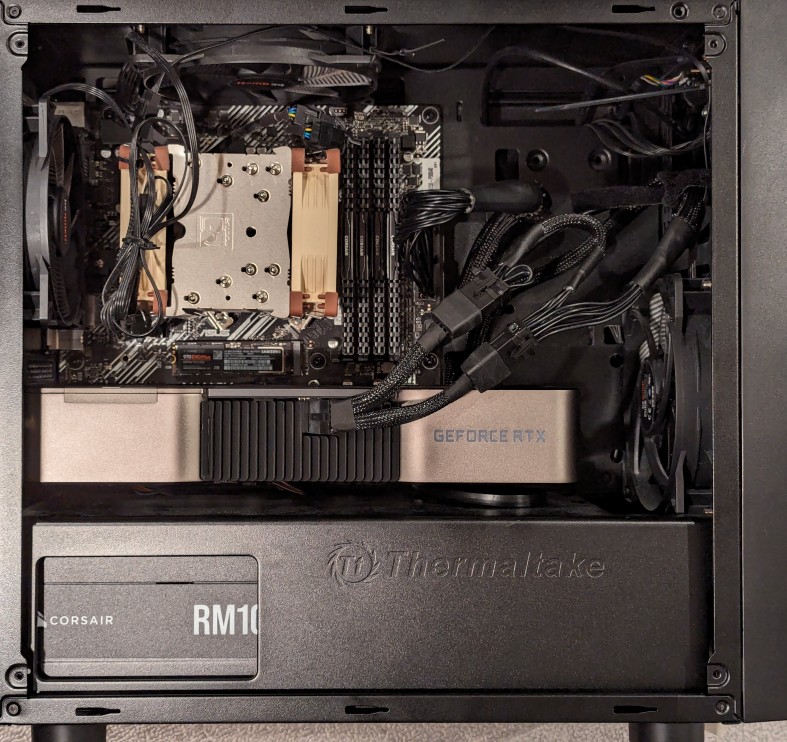
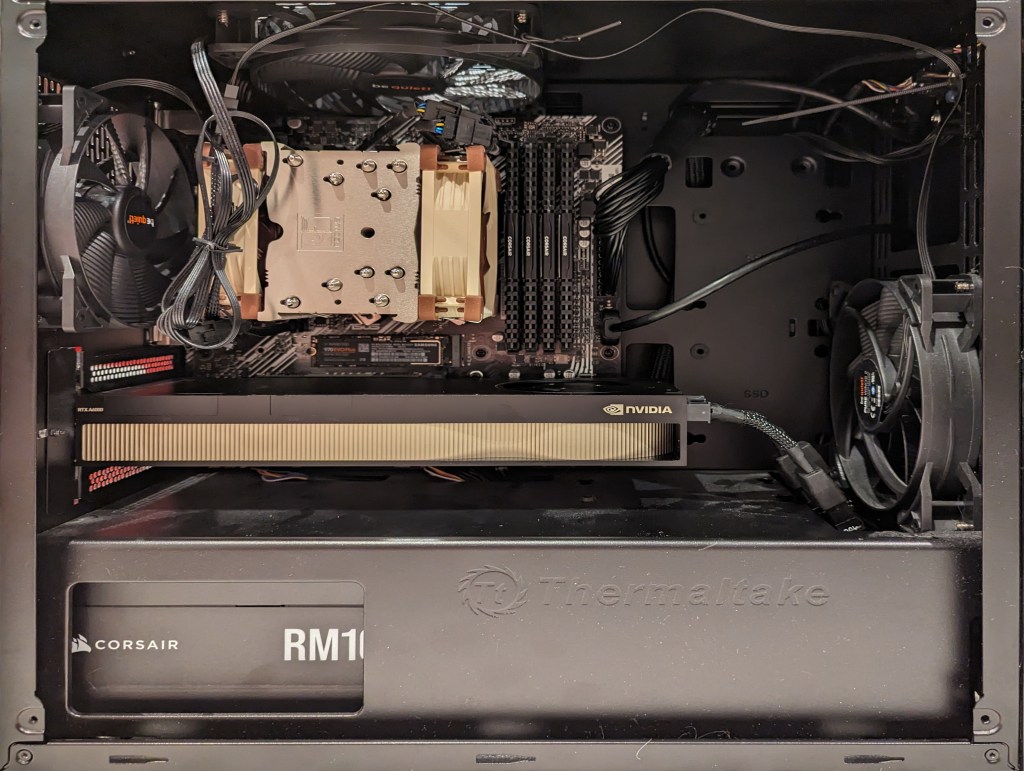
As I documented last year, I made a substantial investment in my computer workstation for doing local text and image generative AI work by upgrading to 128GB DDR4 RAM and swapping out a RTX 3070 8GB video card for NVIDIA’s flagship workstation card, the RTX A6000 48GB video card.
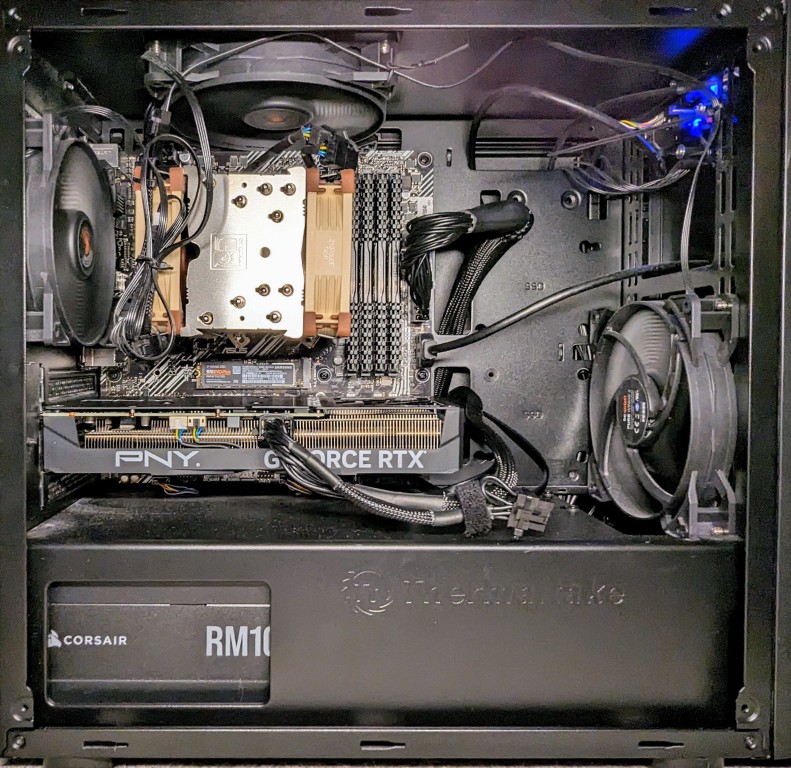
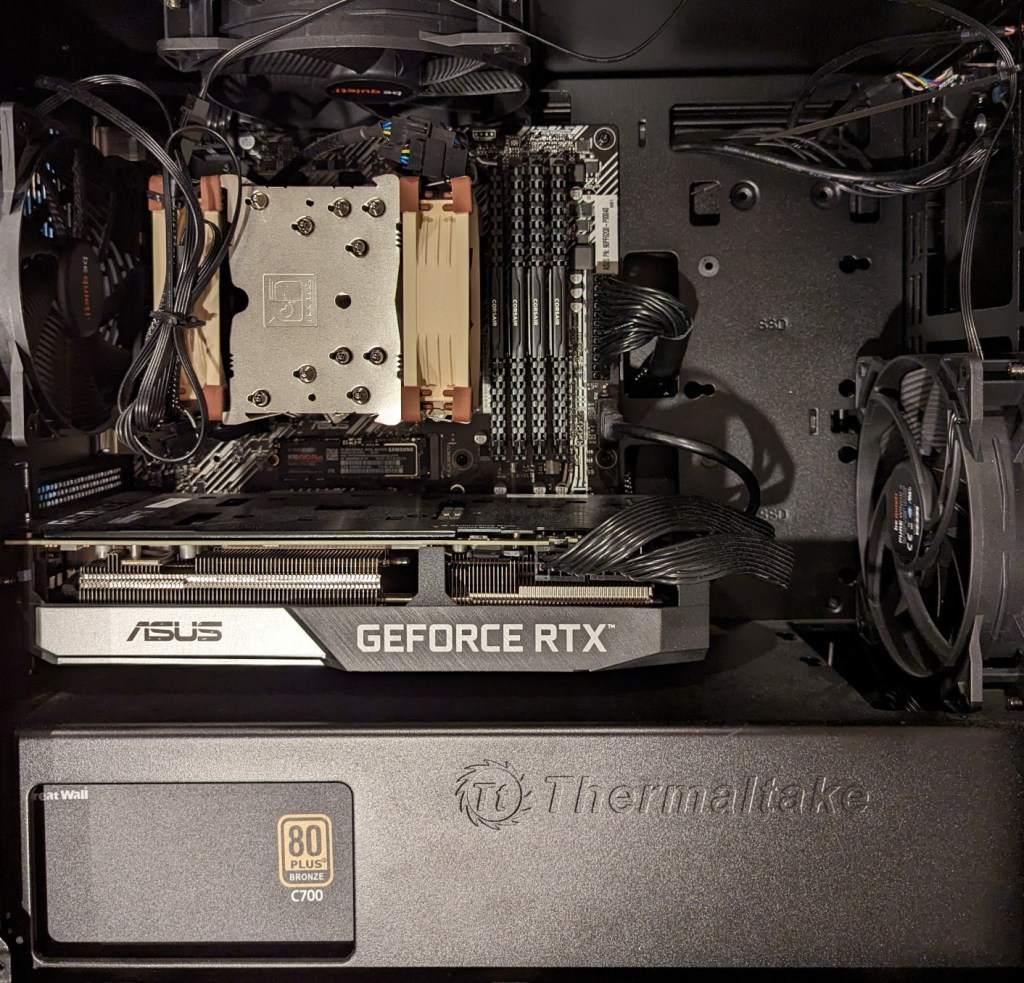
After I used that setup to help me with editing the 66,000 word Yet Another Science Fiction Textbook (YASFT) OER, I decided to sell the A6000 to recoup that money (I sold it for more than I originally paid for it!) and purchase a more modest RTX 4060 Ti 16GB video card. It was challenging for me to justify the cost of the A6000 when I could still work, albeit more slowly, with lesser hardware.
Then, I saw Microcenter begin selling refurbished RTX 3090 24GB Founder Edition video cards. While these cards are three years old and used, they sell for 1/5 the price of an A6000 and have nearly identical specifications to the A6000 except for having only half the VRAM. I thought it would be slightly better than plodding along with the 4060 Ti, so I decided to list that card on eBay and apply the money from its sale to the price of a 3090.
As you can see above, the 3090 is a massive video card–occupying three slots as opposed to only two slots by the 3070, A6000, and 4060 Ti shown below.
The next hardware investment that I plan to make is meant to increase the bandwidth of my system memory. The thing about generative AI–particularly text generative AI–is the need for lots of memory and more memory bandwidth. I currently have dual-channel DDR4-3200 memory (51.2 GB/s bandwidth). If I upgrade to a dual-channel DDR5 system, the bandwidth will increase to a theoretical maximum of 102.4 GB/s. Another option is to go with a server/workstation with a Xeon or Threadripper Pro that supports 8-channel DDR4 memory, which would yield a bandwidth of 204.8 GB/s. Each doubling of bandwidth roughly translates to doubling how many tokens (the constituent word/letter/punctuation components that generative AI systems piece together to create sentences, paragraphs, etc.) are output by a text generative AI using CPU + GPU inference (e.g., llama.cpp). If I keep watching for sales, I can piece together a DDR5 system with new hardware, but if I want to go with an eight-channel memory system, I will have to purchase the hardware used on eBay. I’m able to get work done so I will keep weighing my options and keep an eye out for a good deal.

In the November 1977 issue of Analog Science Fiction/Science Fact magazine, Martin Buchanan published a feature article on personal computers titled, “Home Computers Now!” In it, he opens with a scenario about how PCs can automate family life and then goes into the nuts and bolts of how computers work, what to look for in a kit, and what the future of computing looks like. It was at the end of the article that this passage stood out to me:
"With cheap processors, cheap memory, and cheap communications, what can't we do? The effects on individuals and society will be major and unpredictable. Today's personal computer is just a beginning" (Buchanan 74).
Buchanan, Martin. “Home Computers Now!” Analog, Nov. 1977, pp. 61-74.

Having lived in apartments of one kind or another in different cities and countries over the past 30 years, there is one fact that is unavoidable: many tenants don’t care about others. This can take many forms–from leaving packages outside, leaving laundry in the on-site washer and dryer, not breaking down boxes for recycling, leaving trash outside of bins for the rats to tear apart, etc.
However, one of the worse offenses one apartment dweller can do to another is disturb another’s peaceful habitation through loud noise. This can include screaming babies, barking dogs, loud stereo music or movies, and perhaps worst of all, bass. It seems strange to me that other tenants, who must have heard their neighbors at one point or another, don’t think about that and consider how they can adjust their noise production and environment to lessen the chance that their clamor won’t bother someone else. You know, that whole golden rule thing. Though, I’m ready to admit that I’m naive about others’ motivations and their lack of concern about others.
Perhaps its the selfish orientation of some on the renting side of things is also an orientation on the landlord side of things. Observing the cheap construction of luxury apartment buildings near where I live, which are all glossy surface but shoddy underneath, I’m not surprised that the more modest abodes that Y and I can afford are of an equally poor construction. This selfishness on the part of building owners to cut costs by building apartments without a modicum of quality-of-life considerations, such as insulation filled walls (fiberglass or blown closed-cell), no soundproofing (e.g., loaded mass vinyl (LMV) or other dense lining), minimal concrete board except (perhaps) where code absolutely calls for it, or positive pressure ventilation in stairways (to keep odors out). Of course, these things cost money, but considering rental prices and the posh lifestyles of the most lucrative landlords, it’s obviously not for a lack of resources–it’s a lack of will to invest in the quality of life of those who pay exorbitantly for less than stellar accommodations to live in.
So, it’s down to the tenant to do what they can to improve their living environment that is bombarded by the sounds of neighbors and the city outside and the other byproducts of enclosed living spaces–odors of cooking and smoking.
I’ve tried a lot of tricks to keep others’ sounds and odors out of my living space, and in so doing, keep my sounds and odors in my space so as not to bother others. The following are a few of those things.
The front door of an apartment is one of the worst offenders for allowing sound (and smells) into an apartment. This is especially true when the door is hung improperly or damaged (e.g., steel doors can be dented or bent). Also, less expensive doors are hollow, which allows sounds to pass into the apartment.
One of the easiest fixes for keeping out sound and smells is installing a door sweep that seals against the door’s threshold. The kind that I use slips on and has multiple sweeps to give a better seal. When I move, it is easily slipped off.

Another culprit is how well the door seals against the frame. The previous tenant where I now lives did a remarkable job installing weatherstripping around the exterior of the door–likely due to sound and odor issues that we’ve had to deal with. For this kind of installation, they would have had to drill pilot holes for each screw that holds the aluminum frame of the rubber weatherstripping insulation against the steel door frame. The only way that they could have improved upon this is adding a strip of caulk behind the weatherstripping frame before screwing it down. Otherwise, this has helped tremendously for keeping out sounds and smells.


Our neighbors across the landing from our door often slam their door (as did the previous tenants). Before, I hung moving blankets on the door and had a heavy curtain that I would pull over the door when Y and I were inside the apartment (to hide the blue blankets).
Recently, I figured out a better solution that keeps out far more noise to the point that we aren’t always aware of our neighbors comings and goings (as it should be!). I purchased a large roll of 2″ thick upholstery foam, neodymium magnets with countersunk holes, 3/16″ x 2″ long countersunk bolts, 1″ washers, and 3/16″ nuts. I ran the bolts through the magnets and attached the magnets to the steel entrance door. I cut the foam so that it overlapped the frame of the door (to cover where the door and frame meet). Then, I pushed the bolts through the foam–beginning at the bottom and working my way up–adding a washer and nut to each bolt as I went. I cut small holes around the handle, deadbolt, and peephole.


When the source of sounds might be on the other side of closets, bathrooms, or bedroom, I’ve used those spaces as sound buffers when not in use. To do this, I applied weatherstripping to the inside edge of the door jamb for those interior doors and keep those doors shut as much as possible. This puts another barrier between me and the source of the sound.

Noise from neighbors–especially sounds from music, movies and television, parties, and shouting–often come through the floor from the unit directly beneath you. The more material that you can put down that can stop sound (e.g., mass loaded vinyl) or muffle it (e.g., felt underlayment and high pile carpet), the better. In my case, I covered as much of the floor with carpet with a felt underlayment (living room) and carpet with rubber backing (bedroom). I haven’t tried MLV under a carpet, but if I were, I would check it regularly to make sure that it doesn’t act as a moisture barrier and collect water underneath, which could ruin the floor that it was on top of. Breathable material like heavy felt and carpet is probably a safer bet.


Also, carefully inspect around the edges of rooms, doors, and closet interiors for any gaps or openings. I use caulk to fill these gaps–it can stop sound and odors from entering below. It can also stop insects from migrating into your unit. I use acrylic caulks so clean up is easy with soap and water. To apply caulk, use a small tube or a larger tube and caulk gun to apply. Then, wet the tip of your index finger and lightly pull it from the far end of where you applied towards you. This gives the caulk its bead and blends it into the two adjoining surfaces. Use a paper towel to carefully wipe up any excess and wash your hands with soap.

If you have neighbors on either side of your unit, you can add some barriers to muffle sound. These interventions have also helped with containing the sounds within my apartment and reducing echo (because there is no insulation in any of the exterior or interior walls, echo is far more noticeable than in solid construction). One type of sound blocker and absorber is bookshelves loaded with books. Though, remember to keep enough space behind the shelves for air circulation, which will keep your books healthy and free of mold.

Hanging fabric items–especially quilts and rugs–on the wall will help absorb some of our sound and muffle sound that might come in from outside the apartment. Like with anything that I put on the floor, I make sure that it is breathable and not a moisture barrier that can collect water and ruin the building material or promote mold growth in a wet environment.

A lot of noise originates from the sidewalk and street below our apartment. Besides ensuring the windows are properly sealed and closed, we also double hang sets of thick blackout curtains–one set fits inside the window frame on a tension rod and the second set is mounted on rods attached to the wall face and hangs to the floor. Pulled together, these muffle a lot of daily noise and they cut out all light when we’re trying to sleep at night.

All noise can’t be eliminated, but it can be masked. This is especially important when we’re trying to sleep. As a final precaution, we turn on a large air cleaner set to its medium fan speed to create a background of white noise while recirculating and cleaning the air in the apartment–two birds, one stone.
Also, we keep another air cleaner on the kitchen counter running on low speed 24/7. It uses a charcoal filter to remove odors from the air–ours from cooking and any that might find their way into the apartment from outside.

Some noise–like a film murder fiend–is already inside. Our wall insert air conditioner is a case in point. Occasionally, its front face will vibrate and sound like the whole apartment is shaking apart. Using a found object–like a toy foam disk–inserted between the frame and face eliminated the errant racket.

The bed is a tough nut to crack when bass is involved. Pulling the bed away from the wall a few inches helps some with ambient pulses, but the low frequency vibration of bass will travel up the feet of the bed into the mattress, through the pillow, into your ear pressed against the pillow or your head lying back into the pillow. Reducing the surface area of the feet–where it contacts the floor–seems like it might reduce how much vibration is absorbed and transmitted. There are risers made out of dense rubber that might help, but reviews are typically not positive. I’ve read some inventive ideas online involving springs, fulcrums, and isolators–essentially turning your bed into a large turntable antivibration system–but it would require a lot of material, know-how, and capital to make that work correctly.
If I could afford it, I would like to try installing a floating floor: lay down a felt underlayment and snap together a Pergo-like laminated floor on top of it. Then, I would lay out a layer of MLV and then a carpet over that. This might improve sound blocking over just a carpet due to its mass. However, bass will easily penetrate even another floor.
Bass is probably the worst aspect of living near others. Audio manufacturers and the entertainment industry promote thumping bass as essential to almost any kind of music. I get that a beat can get you moving, but the fact that bass is an omnidirectional vibration that travels through most materials and at great distance, it would seem that some sense would prevail in how people enjoy it. Of course, I’m delusional in thinking that would be the case.
While lots of online discussions about noisy neighbors include voices that say, “just go talk to them,” I can attest that over the past 30 years I have never had a positive interaction or lasting change with any neighbor regarding noise despite being as nice and neighborly as possible to them. From those interactions, I have gathered that those folks just don’t like doing something counter to what they are already doing, and/or they don’t care because the problem isn’t theirs. However, I suspect that if someone caused them trouble they wouldn’t turn the other cheek. It’s not so much “do unto others as you would have them do unto you” as “do what you want and others be damned.”

Despite being woefully behind on the Star Wars transmedia juggernaut, I decided to watch the live-action Ahsoka series this week. While I haven’t seen the animated series Star Wars: The Clone Wars or Star Wars Rebels, which provide the major narrative threads for Ahsoka, I’ve kept up enough with the plot points tangentially (sometimes via LEGO) to respect the characterological mining and intertextual connections that make Ahsoka an interesting story that also does a lot of fan service.
And, I don’t mean fan service in a negative way. The animated stories that provide the foundation for this new live-action series are what kept the Star Wars universe alive for a lot of fans and introduced that universe to a new set of fans. Star Wars might not have have needed an animated lifeline in the same way that Star Trek did in the 1970s, but the animated stories and the fact that it was created forthrightly as canon shows how live-action and animation can both do the heavy lifting of transmedia storytelling of such an important cultural franchise as is Star Wars.
It’s been awhile since Sean Scanlan and I edited a issue of New American Notes Online (NANO) on transmedia storytelling in Star Wars. Maybe it’s time for a new installment!
