Tag: Posthuman

  • Thoughts on Posthumanism, Social Justice, and Environmentalism on the Ivan Allen College Website

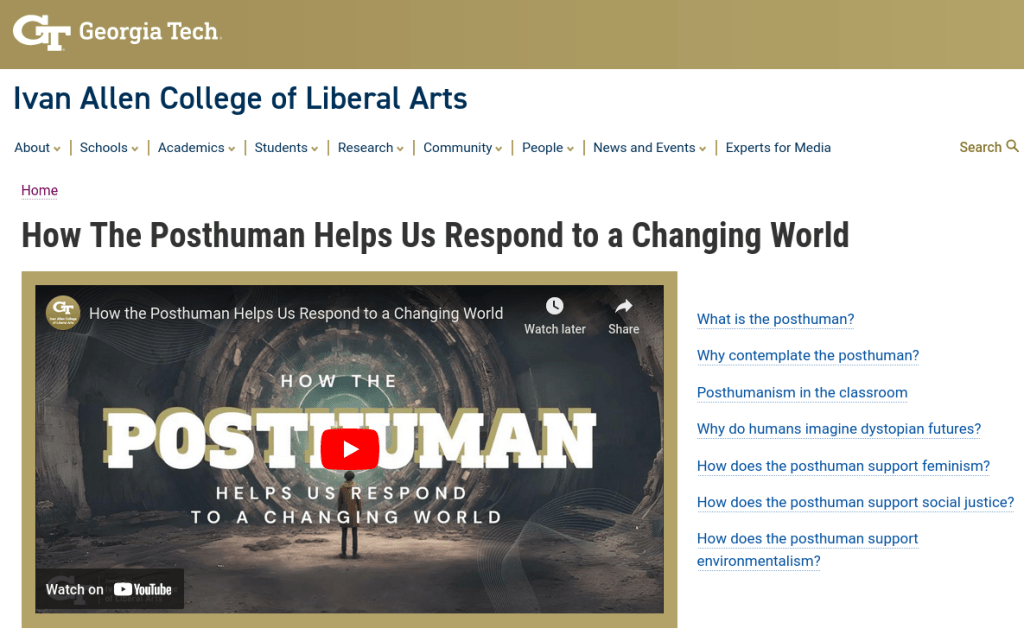
    Screenshot of top of article titled, "How the Posthuman Helps Us Respond to a Changing World." Link to article in the text below.

    How can we leverage posthumanist ideas to respond to the world’s social and ecological crises? My colleagues at Georgia Tech (Lisa Yaszek, Regents Professor of Science Fiction Studies; Zita Hüsing, Assistant Director of the Writing and Communications Program and Marion L. Brittain Postdoctoral Fellow; and Paul B. Foster, Associate Professor of Chinese) and I give our perspectives in this brief multimodal article that might be great to share with students if you need a resource that succinctly breaks down what posthumanism is and addresses its connections to feminism, social justice, and environmentalism.

    Previously, Lisa Yaszek and I wrote an book chapter on Posthumanism and Science Fiction for The Cambridge Companion to Literature the Posthuman (2016). You can read our chapter here.

    If you’d like to talk about posthumanism or collaborate on a related project, drop me a line at my email address in the about box to the right.

  • Program and Registration for Access and Science Fiction: The Sixth Annual City Tech Science Fiction Symposium

    Registration and Viewing

    The Sixth Annual City Tech Science Fiction Symposium on Access and Science Fiction will be held on Thursday, December 9, 2021 from 9:00am-5:00pm EST (GMT/UTC -5 hours) online via Zoom Webinar.

    To participate in this free event, attendees will need to (1) Signup for a free Zoom account here (if you don’t already have one), and (2) Register here to receive access instructions to the Zoom Webinar. Participants may register any time before or during the event!

    For those who would like to watch the event without registering, you can join the YouTube Livestream here.

    In addition to the Zoom Webinar Chat and YouTube Live Chat, join the event conversation with the event hashtag #CityTechSF and follow us on Twitter @CityTechSF.

    As indicated below in the program, some symposium content is pre-recorded to offer more time for discussion on the day of the event. Pre-recorded content includes author readings and full paper presentations. Some of this content is in production and will be posted soon.

    Leading up to this year’s special keynote event on “Writing Ourselves In: Teaching Writing and Science Fiction with Wikipedia” by Ximena Gallardo C. and Ann Matsuuchi, everyone is invited to join the Opening Access to SF: City Tech Science Fiction Edit-a-thon 2021 Dec. 6-Dec. 10. More information is available in this flyer.

    Program

    9:00am-9:15am
    Opening
    Jason W. Ellis
    Justin Vazquez-Poritz

    9:15am-10:05am
    Paper Session 1: Access to International SF
    Jill Belli – Moderator
    Emrah Atasoy – “Access to SF in Turkey and Turkish SF Abroad”
    Shanky Chandra – “Chinese Science Fiction: A Literary Genre, A Tool of Teaching Science or A Secret Weapon of China’s Soft Power?”
    Gillian Polack – “The Problem of Susan Australia, or, The Tyranny of Distance” | Watch Expanded Presentation

    10:05am-10:10am
    Break

    10:10am-11:00am
    Paper Session 2: Access to Science/Fiction/World
    A. Lavelle Porter – Moderator
    Chris Leslie – “Reevaluating the Inclusiveness of the Interstellar Republic of Letters”
    Katherine Buse and Anastasia Klimchynskaya – “Science Fiction and Citizen Science”
    Aaron Zwintscher – “Star Wars Biomes: Simulacra, Nature, and Passivity in No Dialogue Nature Shows”

    11:00am-11:05am
    Break

    11:05am-11:45am
    Discussion Panel: “Accessing the Feminist Science Fiction Archive, Or, Young Women Read Old Feminist SF”
    Lisa Yaszek – Moderator
    Panelists:
    Josie Benner
    Olivia Kiklica
    Jessica Taetle
    Edeliz Zuleta

    11:45am-11:50am
    Break

    11:50am-1:10pm
    Paper Session 3: Access, Inclusion, and Representation in SF
    Joy Sanchez-Taylor – Moderator
    Leigh Gold – “Confronting Language in the Science Fiction Text: Language, Access, and Trauma in Octavia Butler and Ursula K Le Guin”
    Katherine Pradt – “Shipping Supergirl: Discovering and Defending Lesbian Identity Through a DC Fandom”
    Sean Scanlan – “Cool Access and Access to Cool: Gibson’s Gun Moll, Dorotea Benedetti”
    Ida Yoshinaga – “Corporate Employment Practices Towards Greater Diversity of Story Development for SFF Screen Stories”

    1:10pm-1:15pm
    Break

    1:15pm-2:25pm
    Access, Accessibility, Bodies, and Minds in SF
    Lucas Kwong – Moderator
    Jacob Adler – “‘Everything Herein is Fantastic’: Accessibility and Inclusivity in Dungeons & Dragons”
    Ryan Collis – “Autistic Speculative Imaginings: Accessing and Creating Minor Literatures”
    Annette Koh – “Urban Planning for Cyborg Cities: Thinking about disabilities and mobilities in sci-fi as an urban planner”

    2:25pm-2:30pm
    Break

    2:30pm-3:55pm
    Analog Writers Panel and the Analog Emerging Black Voices Award
    Emily Hockaday – Moderator
    Panelists
    Alec Nevala-Lee
    Marie Vibbert
    Chelsea Obodoechina
    Trevor Quachri and Emily Hockaday – Award Presentation

    3:55pm-4:00pm
    Break

    4:00pm-5:00pm
    Keynote
    “Writing Ourselves In: Teaching Writing and Science Fiction with Wikipedia”
    Ximena Gallardo C. and Ann Matsuuchi
    Wanett Clyde – Introduction and Moderator

    Leading up to this special keynote event, everyone is invited to join the Opening Access to SF: City Tech Science Fiction Edit-a-thon 2021 Dec. 6-Dec. 10.

    Ximena and Ann’s book chapter, “My Books Will Be Read By Millions of People!”: The LaGuardia Community College Octavia E. Butler Wikipedia Project,” that appears in Approaches to Teaching the Works of Octavia Butler, edited by Tarshia Stanley (Modern Language Association, 2019), has been made accessible via the CUNY institutional repository, Academic Works: https://academicworks.cuny.edu/lg_pubs/141/. This book was awarded Idaho State University’s 2021 Teaching Literature Award.

    Participants

    Jacob Adler has worked as the Metadata and Cataloging Librarian at the Bronx Community College Library since 2017. Before that he performed various other cataloging work, most notably at The Paley Center for Media from 2010 to 2016. In addition to his professional work he wrote a fantasy novel for the 2018 National Novel Writing Month contest; he continues to work on the novel and seek to get it published. He is especially interested in early television history, particularly the original 1959-1964 Twilight Zone television series. He is also currently pursuing a master’s degree in Museum Studies, which he is on track to receive in January 2022.

    Emrah Atasoy, PhD, serves as a visiting postdoctoral scholar at University of Oxford’s Faculty of English between September 2021 and September 2022 as a recipient of the TUBITAK (The Scientific and Technological Research Council of Turkey) 2219 International Postdoctoral Research Fellowship Grant. His research interests include speculative fiction, futuristic narratives, critical future studies, utopian and dystopian studies, critical dystopia, science fiction, apocalyptic fiction, ecocriticism, posthumanism, Turkish speculative fiction, twentieth-century literature, and comparative literature. He was a visiting scholar at Penn State University under the supervision of Prof. Dr. Jennifer Wagner-Lawlor in the academic year 2015-16. His work has appeared in journals such as Studies in the Novel (2022, collaborative article with Prof. Dr. Thomas Horan), Utopian Studies, Librosdelacorte.es, Literary Voice, and Methis. Studia Humaniora Estonica. His monograph Epistemological Warfare and Hope in Critical Dystopia has been published by Nobel in 2021. His most recent publications include “Speculative Fiction Studies in Turkey: A Preliminary Survey” (2021), in Utopian Studies, “Dys/utopian Narratives on the Screen: Beyond the Binaries in Children of Men and Lobster” (2021), in The Postworld In-Between Utopia and Dystopia: Intersectional, Feminist, and Non-Binary Approaches in 21st Century Speculative Literature and Culture (2021, Routledge), edited by  Tomasz Fisiak and Katarzyna Ostalska, and “Epistemological Warfare(s) in Dystopian Narrative: Zülfü Livaneli’s Son Ada and Anthony Burgess’s The Wanting Seed” in Speculations of War: Essays on Conflict in Science Fiction, Fantasy and Utopian Literature (2021, McFarland), edited by Annette M. Magid. He is a member of both Utopian Studies Society-Europe and the Society for Utopian Studies (SUS). His research at the University of Oxford is supported by TUBITAK BIDEB (The Scientific and Technological Research Council of Turkey) under Grant 2219-International Postdoctoral Research Fellowship Program.

    Jill Belli is Associate Professor of English at New York City College of Technology, CUNY, where she happily teaches science fiction and utopian studies often. She’s working on long-standing projects on well-being & happiness in education and writing & revising in dystopian texts. Newer interests include looping as composing practice, tarot and astrology as storytelling and knowing, William Reynolds, and grief. Learn more about Jill and her interdisciplinary research and teaching: jillbelli.org.

    Josie Benner is a Biomechanical Engineering Major and Science Fiction Minor at Georgia Tech. She works in Professor Lisa Yaszek’s Sci Fi Lab, with funding from Georgia Tech’s Center for Women, Science, and Technology and the Ivan Allen College for the Liberal Arts.

    Shanky Chandra is a Ph.D. scholar from the Centre for Chinese and Southeast Asian Studies, Jawaharlal Nehru University, India, in New Delhi. His research interests include modern and contemporary Chinese Science Fiction. The title of his Ph.D. thesis is “Socio-Political and Cultural Factors in the Making of Chinese Science Fiction Writer Liu Cixin: Understanding The Three-Body Problem.” Chandra took his B.A. (2011) and M.A. (2013) in Chinese language and literature, and M.Phil. (2016) from Jawaharlal Nehru University at New Delhi, India. In 2013, the Ministry of Human Resource Development (MHRD) awarded the Chinese Government Scholarship to Shanky Chandra for Post Graduate Diploma at Beijing Language & Culture University (Higher level 1 & 2) 2013-2014. Chandra taught Chinese language and literature at St. Stephen’s College (2014-2019), Delhi University. He completed the Advance Mandarin Teacher Training Program from the National Taipei University of Education Chinese Language Education Center, Taipei, Taiwan, in July 2018. Recently, he spent one year at the Department of Modern and Contemporary Chinese Language and Literature at the School of Chinese Language and Literature of Beijing Normal University (BNU) as a senior visiting scholar under the supervision of Prof. Wu Yan (HYI fellowship). He is also a member of the International Forum of Chinese Language Teachers (国际汉语教师微信群) and its official Account e-journal (国际汉语教师500强公众号). Currently, he is a visiting fellow at Harvard Yenching Institute, Harvard University.

    Ryan Collis is a second year PhD student in Education at York University in Ontario, Canada who researches the creation of learning spaces for autistic students. He holds degrees in English (BA, Queen’s ‘99), Computer Science (BScH, Queen’s ‘00), Education (BEd, OISE ‘05), and Science and Technology Studies (BScH, York ’19; MA, York ‘20). Ryan has been a high school teacher in the York Region District School Board since 2006 and is a founding member of the editorial board of the Canadian Journal of Autism Equity. Ryan lives with his wife and son in Ajax, Ontario.

    Jason W. Ellis is an Associate Professor of English at the New York City College of Technology, CUNY, where he coordinates the City Tech Science Fiction Collection. He coedited The Postnational Fantasy: Postcolonialism, Cosmopolitics and Science Fiction (McFarland, 2011) and a special issue on Star Wars: The Force Awakens of New American Notes Online, and talked with Dr. Neil deGrasse Tyson about the relationship between SF and society on StarTalk Radio. He holds a Ph.D. in English from Kent State University, M.A. in Science Fiction Studies from the University of Liverpool, and B.S. in Science, Technology, and Culture from Georgia Tech.

    Ximena Gallardo C. is a professor of English at LaGuardia Community College-CUNY. She has been a Wikipedia editor since 2012 and a WikiEducation instructor since 2014. Among her current Wikimedia projects are The LaGuardia WikiProject Octavia E. Butler and the LaGuardia and Wagner Archives GLAM initiative, as well as the Wikibooks projects Perspectives in Digital Literacy and Themes in Literature.

    Leigh Dara Gold received her doctorate in German Literature in 2011 from New York University. She teaches Introduction to Poetry and English 1121 at New York City College of Technology, and Ancient Literature and Composition at Borough of Manhattan Community College. Her current research interests include science fiction’s role in the classroom, research on Ursula K. Le Guin, and connections between dance, literature, and philosophy.

    Emily Hockaday is the managing editor and poetry editor for Asimov’s Science Fiction and Analog Science Fiction and Fact. Her first full-length poetry collection, Naming the Ghost, will be out in November 2022 with Cornerstone Press. You can find her online at www.emilyhockaday.com or @E_Hockaday.

    Olivia Kiklica is a Computational Media Major and Science Fiction Fellow at Georgia Tech. She works in Professor Lisa Yaszek’s Sci Fi Lab, with funding from Georgia Tech’s Center for Women, Science, and Technology and the Ivan Allen College for the Liberal Arts.

    Anastasia Klimchynskaya’s research brings together literary theory, sociology, and neuroscience to study how storytelling and narrative shape what (we believe) we know about the world. She received her PhD in Comparative Literature from the University of Pennsylvania, focusing on the way science fiction emerged as a literary form in the nineteenth century to express a new social and technoscientific paradigm. Her book project extends this work into the twenty-first century, using the two periods as foils for each other to examine how our fictions shape the innovation, use, and understanding of technoscientific advancements – and, in turn, how these advancements shape the very form of the stories we tell.

    Annette Koh is a lecturer in the department of urban and regional planning at California State Polytechnic University, Pomona. Her work and teaching focus on the politics of participation, youth engagement, and placemaking. An obsession with narrative and speculative approaches to city planning has manifested in an essay The Right to the City: Urbanism, Planning and Cities in Science Fiction and Fantasy, the chapter “Unofficial Archives of Urban Life How to Rewrite the Canon of Cities” for a tumblr book and a world-building workshop in October 2021 for an urban planning studio at Hunter College. She wrote two essays for ProgressiveCity.net –  Placemaking When Black Lives Matter; Decolonial Planning in North America – which were then published in the book Transformative Planning: Radical Alternatives to Neoliberal Urbanism. In 2017 and 2018, she collaborated with fellow PhD students and faculty to co-organize the Decolonizing Cities symposia at the University of Hawai‘i at Manoa.

    Lucas Kwong is an assistant professor of English at New York City College of Technology. His scholarship on fantastic fiction, religion, and colonialism has been published in Victorian Literature and CultureReligion and Literature, and Journal of Narrative Theory.  He also serves as the assistant editor for New American Notes Online, an online interdisciplinary scholarly journal, and as editor for City Tech Writer, a journal of student writing. He lives in Brooklyn with his wife.

    Chris Leslie (he/him) is a visiting professor at the South China University of Technology whose research investigates the interactions among science, technology, and society. This paper is based on the research for his book From Hyperspace to Hypertext: Masculinity, Globalization, and Their Discontents, which will be published by Palgrave in 2022. Dr. Leslie is chair of the IFIP working group on the history of computing and a creative consultant for Zhejiang Hexin Toy Group in Yunhe, China.

    Ann Matsuuchi is an instructional technology librarian and professor at LaGuardia Community College-CUNY. Past writing projects include those that focus on Samuel R. Delany and Wonder Woman, sf tv shows such as Doctor Who, and Asian American comic books. Ann teaches digital literacy, online cultures, and the fundamentals of internet studies. Current projects include one that focuses on Melvin Van Peebles, and a reference guide to Delany’s works.

    Alec Nevala-Lee was a 2019 Hugo and Locus Award finalist for Astounding: John W. Campbell, Isaac Asimov, Robert A. Heinlein, L. Ron Hubbard, and the Golden Age of Science Fiction (Dey Street Books / HarperCollins), which was named one of the best nonfiction books of the year by The Economist. He is the author of three suspense novels from Penguin, including The Icon Thief, and his work has appeared in such publications as the New York Times, the Los Angeles Times, Salon, The Daily BeastAnalog Science Fiction and Fact, and two editions of The Year’s Best Science Fiction. His next book, Inventor of the Future: The Visionary Life of Buckminster Fuller, will be published by HarperCollins on August 2, 2022.

    Evelyn Ng is a City Tech Communication Design student with a focus on illustration. She’s designed and illustrated the poster for “The Sixth Annual City Tech Science Fiction Symposium on Access and Science Fiction”. When she isn’t working, she spends her time looking through art publications to elevate her design techniques. See more of her work on Instagram and on her online portfolio.

    Chelsea Obodoechina is a graduate student and teaching assistant. In her spare time, she writes short speculative fiction inspired by her academic background in sociology. Her works have been featured in Cast of Wonders, the Unfettered Hexes anthology, and Anathema: Spec from the Margins. She lives in Montreal, Canada with her family.

    Gillian Polack, Ph.D. is an Australian speculative fiction writer based in Canberra, Australia. She was the 2020 recipient of the Ditmar (best novel, for her 2019 novel The Year of the Fruit Cake) and the Bertram A. Chandler (lifetime achievement in science fiction) awards. She is an ethnohistorian with a special interest in how story transmits culture, both Medieval and modern. Her current research examines how contemporary speculative fiction novels serve as vectors for cultural transmission. A study of this will be released in 2022 (Story Matrices: Cultural Encoding and Cultural Baggage in the Worlds of Science Fiction and Fantasy, Academic Lunare). Her research at Deakin University furthers this work. Dr Polack’s publications include ten novels, short stories, a monograph (History and Fiction, shortlisted for the William Atheling Jr Award for Criticism or Review) and various works of non-fiction. A list of her books can be found at https://gillianpolack.com/my-books/.

    A. Lavelle Porter is an Assistant Professor of English at New York City College of
    Technology. He holds a B.A. in history from Morehouse College and a Ph.D. in
    English from the CUNY Graduate Center. His writing has appeared in venues such as
    The GC Advocate, Callaloo, The New Inquiry, Poetry Foundation, and the African
    American Intellectual History Society
    . He recently published The Blackademic Life: Academic Fiction, Higher Education, and the Black Intellectual with Northwestern University Press.

    Katherine Pradt is a librarian at the Graduate Center of the City University of New York. In addition to supporting academic research and answering citation style questions (and troubleshooting the printers), she works to connect scholars to open-source tools and open access resources. She holds an MFA in addition to her library degree and is writing a novel set in occupied New York during the Revolutionary War.

    Trevor Quachri, who took the reins of Analog Science Fiction and Fact as editor in 2012, started off as an editorial assistant in 1999 and worked his way up the ladder at Analog and Asimov’s Science Fiction, under Stanley Schmidt, Sheila Williams, and Gardner Dozois, respectively. On top of that, he’s also been a Broadway stagehand, collected data for museums, and executive produced a science fiction pilot for a basic cable channel. He lives in New Jersey with his fiancée, daughter, and way, way too many comic books.

    Joy Sanchez-Taylor is a Professor of English at LaGuardia Community College (CUNY) whose research specialty is intersections between science fiction, fantasy, and critical race theory. Her book Diverse Futures: Science Fiction and Authors of Color (2021) examines the contributions of late twentieth and twenty-first century U.S. and Canadian science fiction authors of color to the genre. Dr. Sanchez-Taylor is currently working on a monograph project on diverse fantasy representations.

    Sean Scanlan is Associate Professor of English at New York City College of Technology—CUNY where he specializes in literary technologies and American and global literature. He published “Global Homesickness in William Gibson’s Blue Ant Trilogy,” for the collection The City after 9/11: Literature, Film, Television (2016), and he is the founder and editor of NANO: New American Notes Online.

    Jessica Taetle is a Computational Media Major and Science Fiction Fellow at Georgia Tech. She works in Professor Lisa Yaszek’s Sci Fi Lab, with funding from Georgia Tech’s Center for Women, Science, and Technology and the Ivan Allen College for the Liberal Arts.

    Justin Vazquez-Poritz is the Dean of the School of Arts and Sciences at New York College of Technology, CUNY.

    Marie Vibbert has sold over 70 short stories to professional publications such as Analog Science Fiction & Fact, The Magazine of Fantasy & Science Fiction, Nature, Vice’s Motherboard, Lightspeed, Escape Pod, and more.  Her works have been translated into Chinese and Vietnamese.  Her debut novel, Galactic Hellcats, came out in 2021.  Publisher’s Weekly called it “A rip-roaring space heist.”  By day she is a computer programmer at Case Western Reserve University.

    Lisa Yaszek is Regents’ Professor in the School of Literature, Media, and Communication, where she explores science fiction as a global language crossing centuries, continents, and cultures. Yaszek’s books include Galactic Suburbia: Recovering Women’s Science Fiction (Ohio State, 2008); Sisters of Tomorrow: The First Women of Science Fiction (Wesleyan 2016); The Future is Female! 25 Classic Science Fiction Stories by Women (Library of America, 2018); and Literary Afrofuturism in the Twenty-First Century (co-edited with Isiah Lavender III, Ohio State, 2020). Her ideas have been featured in The Washington Post, Food and Wine Magazine, and USA Today, and she has been an expert commentator for the BBC4’s Stranger Than Sci Fi, Wired.com’s Geek’s Guide to the Galaxy, and the AMC miniseries James Cameron’s Story of Science Fiction. A past president of the Science Fiction Research Association, Yaszek currently serves as a juror for the John W. Campbell and Eugie Foster Science Fiction Awards.

    Ida Yoshinaga is an Assistant Professor of Science Fiction Film at the Georgia Institute of Technology, and her screen-studies research centers on the production relations between creative labor from racial/gender/class minority groups and majority-dominated management, within corporate transmedia. Along with workplace allyship between these two unequal statuses, she studies the global stratification of SFF-genre scriptwriting within the story development process, as well as produces and facilitates the development of cultural screenplays for Indigenous or 4th cinema and TV.the development of cultural screenplays for Indigenous or 4th cinema and TV.

    Edeliz Zuleta is a Biomechanical Engineering Major and Science Fiction Minor at Georgia Tech. She works in Professor Lisa Yaszek’s Sci Fi Lab, with funding from Georgia Tech’s Center for Women, Science, and Technology and the Ivan Allen College for the Liberal Arts.

    Aaron Zwintscher is an adjunct professor of English at the New York City College of Technology. He is also an ambient musician and noise artist.

  • Working Bibliography for Digital Fabrication Module of “A Cultural History of Digital Technology” at City Tech

    This is a 3D print of a Mandelbulb that I created with Mandelbulb3D, Fiji, and meshlab.
    This is a 3D print of a Mandelbulb that I created with Mandelbulb3D, Fiji, and meshlab.

    I’m an NEH Fellow for City Tech’s “A Cultural History of Digital Technology” project. It brings together faculty from across the college to design humanities-course modules and a new course proposal that brings the six modules together. I am contributing to the Digital Fabrication Module of the course curriculum that the team will develop.

    I put together the following bibliography of Science Fiction, critical work, video games, and software as part of my contribution to the project and the upcoming curricular work. Following my bibliography, I have included the preliminary viewings and readings for this module (which were selected before I joined the project as a fellow) for those interested in learning more about these topics.

    Working Bibliography

    Fiction: 3D Printing (chronological)

    Heinlein, Robert A. “Waldo.” Astounding Science Fiction Aug. 1942: 9-53.

    Smith, George O. “Identity.” Astounding Science Fiction Nov. 1945. 145-180.

    Russell, Eric F. “Hobbyist.” Astounding Science Fiction Sept. 1947: 33-61.

    Sheckley, Robert. “The Necessary Thing.” Galaxy Science Fiction June 1955. 55-66.

    Clarke, Arthur C. The City and the Stars. Harcourt Brace/SFBC, 1956.

    Stephenson, Neal. The Diamond Age, or, A Young Lady’s Illustrated Primer. Bantam Spectra, 1995.

    Gibson, William. All Tomorrow’s Parties. Viking Press, 1999.

    Brin, David. Kiln People. Tor, 2002.

    Marusek, David. Counting Heads. Tor, 2005. [expansion of his novella We Were Out of Our Minds with Joy, 1995].

    Doctorow, Cory. “Printcrime.” Nature vol. 439 (12 Jan. 2006): 242.

    Sterling, Bruce. “Kiosk.” The Magazine of Fantasy and Science Fiction Jan. 2007: 68-113.

    Doctorow, Cory. Makers. HarperVoyager, 2009.

    Stross, Charles. Rule 34. Ace Books, 2011.

    Hamilton, Peter F. Great North Road, Macmillan UK, 2012.

    Gibson, William. The Peripheral. G.P. Putnam’s Sons, 2014.

    Newman, Emma. Planetfall. Roc, 2015.

    Robinson, Kim Stanley. Aurora. Orbit, 2015.


    Fiction: Fractals (chronological)

    Langford, David. “Blit.” Interzone Sept./Oct. 1988: 40-42.

    Rucker, Rudy. “As Above, So Below.” in The Microverse. Ed. Byron Preiss. Bantam Spectra, 1989. 334-340.

    Shiner, Lewis. “Fractal Geometry.” in The Edges of Things. WSFA Press, 1991. 59.

    Anthony, Piers. Fractal Mode. Ace/Putnam, 1992. [second novel in his Mode series].

    Di Filippo, Paul. “Fractal Paisleys.” The Magazine of Fantasy and Science Fiction May 1992: 72-106.

    Charnock, Graham. “On the Shores of a Fractal Sea.” in New Worlds 3. Ed. David Garnett. Gollancz, 1993. 125-136.

    Luckett, Dave. “The Patternmaker.” in The Patternmaker: Nine Science Fiction Stories. Ed. Lucy Sussex. Omnibus Books, 1994. 3-18.

    Pickover, Clifford A. Chaos in Wonderland: Visual Adventures in a Fractal World. St. Martin’s Press, 1994.

    Turzillo, Mary A. “The Mandelbrot Dragon.” in The Ultimate Dragon. Eds. Keith DeCandido, John Betancourt, and Byron Preiss. Dell, 1995. 167-172.

    Williamson, Jack. “The Fractal Man.” 1996. in At the Human Limit. Haffner Press, 2011. 187-204.

    Leisner, William. “Gods, Fate, and Fractals.” in Strange New Worlds II. Eds. Dean Wesley Smith, John J. Ordover, and Paula M. Block. Pocket Books, 1999. 166-183.

    Thompson, Douglas. Ultrameta: A Fractal Novel. Eibonvale Press, 2009.

    Patrice, Helen. “Mandelbrot Universe.” Dreams & Nightmares no. 92 (May 2012): n.p.

    Strasser, Dirk. “The Mandelbrot Bet.” in Carbide Tipped Pens: Seventeen Tales of Hard Science Fiction. Eds. Ben Bova and Eric Choi. Tor, 2014. 365-378.


    Non-Fiction (chronological)

    Snow, C.P. The Two Cultures and the Scientific Revolution. Cambridge UP, 1961.

    Rucker, Rudy. “In Search of a Beautiful 3D Mandelbrot Set.” RudyRucker.com. 5-14 Sept. 1988 (revised 24 Sept. 2009).

    Hayles, N. Katherine. How We Became Posthuman: Virtual Bodies in Cybernetics, Literature, and Informatics. University of Chicago Press, 1999.

    Thurs, Daniel Patrick. “Tiny Tech, Transcendent Tech: Nanotechnology, Science Fiction, and the Limits of Modern Science Talk.” Science Communication vol. 29, no. 1 (Sept. 2007): 65-95.


    Video Games (chronological)

    Rescue on Fractalus!, https://en.wikipedia.org/wiki/Rescue_on_Fractalus! and https://archive.org/details/a2_Rescue_on_Fractalus_1985_Lucasfilm_Games_cr_Blade.

    .kkrieger, http://web.archive.org/web/20120204065621/http://www.theprodukkt.com/kkrieger.

    No Man’s Sky, http://www.no-mans-sky.com.


    Software

    KPT Bryce 1.0 (1994), https://www.youtube.com/watch?v=MY8GPU5osx4 and https://www.youtube.com/watch?v=ZGLjPYgs8bg and http://kai.sub.blue/en/frax.html and http://fract.al.

    The Mandelbrot Set in HTML5 Canvas and Javascript, http://tilde.club/~david/m/.

    Julia Map, http://juliamap.googlelabs.com/.

    FracalLab, http://hirnsohle.de/test/fractalLab/.

    Paul Lutus, The Mandelbrot Set, http://arachnoid.com/mandelbrot_set/index.html.


    Preliminary Viewings

    NOVA, “Fractals: Hunting the Hidden Dimension,” http://www.pbs.org/wgbh/nova/physics/hunting-hidden-dimension.html.

    Benoit Mandelbrot TED Talk, Fractals and the Art of Roughness, https://www.ted.com/talks/benoit_mandelbrot_fractals_the_art_of_roughness?language=en.


    Preliminary Readings

    Devlin, Keith. The Language of Mathematics: Making the Invisible Visible. W. H. Freeman, 1998. 188-220.

    Flake, Gary. The Computational Beauty of Nature: Computer Explorations of Fractals, Chaos, Complex Systems, and Adaptation. MIT Press, 1998. 59- 110.

    Mandelbrot, Benoit. The Fractal Geometry of Nature. W.H. Freeman, 1983. 4- 38.

    Mandelbrot, Benoit. Fractals: Form, Chance, and Dimension. W.H. Freeman, 1977.

    Samuel, Nina. ed. The Islands of Benoit Mandelbrot: Fractals, Chaos, and the Materiality of Thinking. Bard Graduate Center, 2012.18-56.


  • Recovered Writing, PhD in English, Comprehensive Exam 2 of 3, Postmodern Theory, Dr. Tammy Clewell, 3 June 2010

    This is the fifty-ninth post in a series that I call, “Recovered Writing.” I am going through my personal archive of undergraduate and graduate school writing, recovering those essays I consider interesting but that I am unlikely to revise for traditional publication, and posting those essays as-is on my blog in the hope of engaging others with these ideas that played a formative role in my development as a scholar and teacher. Because this and the other essays in the Recovered Writing series are posted as-is and edited only for web-readability, I hope that readers will accept them for what they are–undergraduate and graduate school essays conveying varying degrees of argumentation, rigor, idea development, and research. Furthermore, I dislike the idea of these essays languishing in a digital tomb, so I offer them here to excite your curiosity and encourage your conversation.

    After completing two years of course work in the PhD in English program at Kent State University, I began preparing for my comprehensive exams with faculty who I hoped to also work with when I moved on to the dissertation stage.

    After having taken two classes with Dr. Tammy Clewell, I was very happy that she agreed to lead my exam on postmodern theory. Leading up the exam, Dr. Clewell and I negotiated on my reading list–considering those texts that were essential, foundational works and those that supported the kinds of work that I wanted to do on my dissertation. After the list was completed, we scheduled meetings to discuss the core questions in postmodern theory. These were the best part about the process, because they required me to know how to articulate in spoken language the major debates and arguments before I sat down for the exam. Speaking face-to-face requires a different kind of thinking and preparedness. After successfully passing these discussion interviews, I was able to proceed to the written exams a day after taking my major exam on 20th-century American literature. Unlike the five hour major exam, I only had four hours to write my response to this exam.

    A serendipitous outcome of our conversations was Dr. Clewell introducing me to the neurohumanities and cognitive cultural studies. Our informal discussions about these topics led to my dissertation project. Had she not asked me one day, “Jason, what do you know about the brain,” my dissertation would likely have looked VERY different. I am deeply grateful for Dr. Clewell introducing me to these ideas and then inviting me to join an interdisciplinary neurohumanities reading group that she organized later. Our reading group and our readings informed much of my thinking after the exams while I was completing the dissertation.

    Below, I have included my written responses to Dr. Clewell’s postmodern theory exam. Question 1 concerns the major debates. Question 2 is about the posthuman. Question 3 explores the relationship between science fiction and postmodernism.

    Jason W. Ellis

    Dr. Tammy Clewell

    PhD Minor Exam: Theory

    3 June 2010

    Question 1

                Poststructuralism and postmodernism are often invoked together, because they share an affinity for challenging the modes of thought and systems of analysis that historically precede theme. However, they are in fact also continuations or ironic reinventions of culture and philosophy of the last few hundred years. Poststructuralism is a philosophical reaction to structuralism’s form and order, and postmodernism is a continuation of modernism’s decentering of the subject while critiquing discourse and its own position within discourse. In the following discussion, I will better define these terms and engage some of the major overlapping discussions by major theorists in the field.

    Poststructuralism is a set of linguistic, philosophical, and cultural theories that primarily challenge and react to the earlier structuralist theories, which were popular from around the 1950s to the 1970s. Structuralism holds that there are deep structures underneath all phenomena that prescribe how those phenomena develop. The world itself is ordered by interconnected systems, and each system works by its own set of rules or grammar. These systems can be analyzed by structuralist analysis, because the rules are thought to operate in similar ways. Thus, the world can be known completely through analysis of its systems and their rules of operation.

    Poststructuralists reacted against structuralism, because they felt that it was oppressive and too ordered. It was considered oppressive, because it didn’t allow room for human agency. The structures operate through people rather than people acting on structures. Its ordering and clear delineations of rules ruled out chance or the apparent complexity of the real world. Instead of finding patterns of similarity, which tend to exclude, the poststructuralists sought to look at the world in terms of difference rather than similarity. There are provocative gaps and contradictions in the way systems operate that challenge the predictability proposed by structuralism. In particular for deconstructionists, including Derrida, structuralism is a totalizing theory with an authoritarian premise that is not open-ended enough to account for difference.

    Postmodernists likewise chafe at universalizing theories including structuralism. Poststructuralism can be called a postmodern theory, because it is one among many other theories and political interventions that are reactions to totalizing and universalizing beliefs bound to Western Enlightenment thought: progress as political improvement of humanity and mastery over Nature through the accumulation of knowledge and technology. Not to fall into a totalizing trap, it is important to note that it is through modernity, defined as the period beginning with the Enlightenment through the Industrial Revolution to the Second World War, that many of the ideas that are now considered postmodern first began to be formulated. This is particularly important to the refutation of the liberal humanist idea of identity or a centered self. I will respond more to this in the second question below. For now, it suffices to say that I define postmodernism as the array of cultural theories and attitudes that have developed as skepticism colored with irony, emphasizing language and power relations, toward long standing Western universalized theories and beliefs including: the idea of human progress, the power of reason and rationality, objective reality, and the human. Modernism had already brought into question many of these issues, especially concerning the human as center of the self and of the world, but postmodernism extends and critiques these earlier reformulations.

    In the rise of poststructuralism and postmodernism, often linked to post-industrial society after World War II, two polarizing debates developed between poststructuralists and other theorists who held on to forms of structuralist analysis. The first of these that I will discuss is between Jacques Derrida and Michel Foucault regarding Derrida’s groundbreaking theory of deconstruction, and the second is between Jean-Francois Lyotard and Fredric Jameson regarding legitimating grand narratives.

    Derrida developed the approach known as deconstruction in reaction to what he saw as the totalizing and universalizing tendencies of structuralism. My discussion of deconstruction carries the caveat that deconstruction is not a method, a critique, or an analysis. It is not a procedural operation that arrives at a particular and desired output. Derrida describes it as an event, because each deconstruction is different. It is not a critique in the Kantian sense (i.e., critique vs. dogma), because it relies on language. Language is dogmatic due to its invoking metaphysics through the being assumed in all signified-transcending signifiers relationships. Finally, it is not an analysis, because the whole text—words, sentences, etc.—is interconnected and dependent upon the whole. Any cutting up of a text for analysis is arbitrary and there is no single meaningful way to divide a text for analysis as such. These are all negative descriptions that say what deconstruction is not. Derrida prefers these definitions, because they do not cut off what deconstruction means by saying emphatically what it is. I will use the terms method and approach as a short hand in the discussion that follows. These terms can be thought of as being written under erasure for lack of better terms describing deconstruction.

    Derrida is skeptical of the Western philosophical privileging of speech over writing. He argues that the West is logocentric (i.e., grounded on logos, which in Greek means word and rationality). Logocentrism in the West derives from phonocentrism, or the privileging of speech. This has to do with the belief that logos in speech is present while writing is not present. The nonpresence of writing implies that it is open to interpretation and hence not as rational or concrete in its meaning as the presence of speech. Derrida demonstrates that all language, including its usage in speech, is open to interpretation by the reader or hearer. Furthermore, language is a system of signs and since signs are written, he sees no reason why writing should be prioritized under that of speech.

    Deconstruction is an attempt to reach the limits of interpretation of a text by demonstrating how the structure of the text and its authorial genesis cannot be supported by the text itself. In other words, the text itself is always already deconstructing. It is a matter of engagement of the text through an interpretive reading to show its irreconcilable and built-in contradictions. Its core concept is that of differance (i.e., difference with an ‘a’, and due to time, I will omit the stress on the e). Differance is the name Derrida gives to the very basis of how language works and to the operations of deconstruction. In regard to language, Derrida, building on the work of Ferdinand de Saussure, argues that words are not substitutes for the real, but instead, words are linked together metonymically in a chain. Signifiers are linked to signifiers, and one word triggers connections with other words as metonymic connections rather than metaphoric replacements. This shows that language is in movement and that slippages in meaning are possible as a result of that movement. It is from the basis of metonymy in language that Derrida made the differance neologism based on the French verb ‘differer,’ which can mean to differ and to defer. Differance means both of these things at the same time. Signifiers differ from one another and they defer meaning along a whole chain of signifiers. Meaning is thus endlessly deferred and indeterminate. There are apparent meanings for things due to the ‘self-effacing trace,’ or the difference between words that give an apparent meaning, but the operation of both the trace and deferral render fixed meanings impossible. Differance is a description of the operations of language and it performs the operation that it describes. Specifically in terms of deconstruction, differance is the middle way for the tension between unity and difference. Differance then becomes the excess or space between texts. It is in opposition to Hegel’s third term or Habermas’ unity and consensus. Derrida sees Hegel and Habermas enforcing synthesis where there should be difference. Differance is an alternative to unity and an acknowledgement of the excess between interpretations. It resists efforts to erase Otherness or multiplicity. Furthermore, meaning is, according to Derrida, disseminated: there is an effect of meaning, but meaning is dispersed and specific meanings are irresolvable. Thus, deconstruction is always already present in a given text, and the deconstructive reading of a text relies on what is there in the text itself. Deconstruction relies on textuality, or the importance and centrality of texts, and how a single text can be different from itself via another reading and how each text can be a trace of other texts, which invokes Barthes concept of intertextuality. Texts are not alone, but connected to one another via the trace.

    Foucault’s concept of discourse can be seen as more closely aligned with the structuralists than Derrida’s deconstruction. Foucault’s emphasis was not on language and the individual text, but instead, he focused on discourse—the conversation and connections between texts and the relationships of power that those connections represent and develop. Discourse does involve texts in the promotion and implementation of the discourse and its power networks, but it is not something contained within a single text. For Foucault, discourse refers to systems of belief, knowledge, and practices that are governed by internalized rules. Discourse comes about and operates by power relationships. The discourse and the power relationships tied up within a discourse can change over time. The power in a discourse is distributed through networks that are all inclusive—there is no constitutive outside to discourse. Discourses change over time and they may disappear all together. Furthermore, discourses do not carry universal truths, but they do establish their own beliefs, which may be promoted as truths within the discourse and within its power relations. For example, Foucault argues that sexuality did not become a discourse until very recently with the rise of medicine as a science and the adoption of a heterosexual/heteronormative standard within the discourse of medicine. This particular example shows a very one sided power dynamic with the institutions of medicine adopting a particular norm and their enforcing that norm on individuals (e.g., women, homosexuals, transsexuals, those without the institutional support given to the white, male doctors) with the support of state power. Discourse can include the arts and politics and any other system that is based on a system of power relationships. Other examples of discourse include capitalism or modernism in the arts. Foucault calls the totalization of discourse within a historical period an episteme. The Enlightenment or postmodernity would be examples of episteme. In Foucault’s conceptualization of discourse, he finds most to be oppressive and controlling. There are haves and have-nots within the power networks of a discourse. As such, these discourses should be challenged, as he did against heteronormativity in The History of Sexuality.

    The primary difference between Foucault and Derrida is that Foucault sees in texts or utterances another discourse, whereas Derrida sees another self-deconstructing text playing with language. Each theorist sees his work as a constructive challenge to different manifestations of power. Derrida sees privileging and hierarchies in the texts he deconstructs, and Foucault finds the distribution of power within the connections between people, their texts, and their practices. This is not to say that Derrida is not aware of the big picture, so to speak, but his approach deconstructs the individual text and by doing so unravels its assumptions and connections to other texts through the always already there deconstructive seed within the text. Foucault attempts to reveal the intentionality within the text in order to show the way its relationship to power and its discourse is oppressive in some way. Derrida shows that the genesis, along with the structure of the text, explodes when taken into consideration of the text as a whole. The text’s connection to a discourse is based on the interpretation by Foucault, which is only one interpretation among many. Furthermore, Foucault’s analysis of a text is based on what is within the text itself under consideration. Without saying so, this is a kind of interpretation, because as Derrida shows there are different ways of reading an individual text. Derrida did this himself when he used a key passage from Foucault’s History of Madness. This beginning to their ten year long silence to one another is precipitated on Foucault’s belief that certain concepts are not deconstructable. Madness, sexuality, knowledge, etc. are idea concepts that, for Foucault, are beyond the deconstructive practices of Derrida. Foucault said of Derrida following his essay that deconstruction teaches the student that there is nothing outside the text, and that the only point of consideration is the spaces in-between and words written under erasure. Derrida later refuted Foucault’s claim by saying that there is nothing outside CONtext—meaning that the historical, biographical, ideological, etc. should be considered when interpreting a text, but that it is necessary to remember the other side of context that these things are historically contingent and not universally established.

    Next, I will discuss another significant debate in poststructuralism and postmodernism. This has to do with the argument between the poststructuralist thinker Lyotard and the Marxist scholar Jameson on the issue of metanarratives.

    Jameson describes a hard division between modernism and postmodernism. He identifies modernism with time and memory, which is embedded in an earlier form of capitalism that had not yet worked its way into fundamentally transforming the world and the circuits of relation between people. Postmodernism is emblematic of the contemporary mode of production, and the cultural manifestation of what Mandel calls the third stage of capitalism, or late capitalism. Considering Jameson in terms of Foucault, Marxism is a discourse, as is his formulation of postmodernism and modernism that are a part of or connected to the larger Marxist discourse. The postmodern for Jameson is a disavowed yet seized upon term to discuss the historical in a present where history is in a sense forgotten or at least transformed by nostalgia. Oppositions between postmodernism and modernism include: He favors historicism over style (his favoring of Ragtime over Gravity’s Rainbow is problematic in this regard, however); pastiche, not parody; space over time; and surface over interiority and stream of consciousness. Cyberpunk, especially the work of William Gibson, is the literature of postmodernism, because of its emphasis on space over time and the effects of capitalism at shaping the landscape and the narrative plot. Emblematic of the shift from the modern to the postmodern is also the loss of interiority. Jameson laments the waning of affect. In postmodernism, there is a loss of feeling and emotion now that space has made its ascendance in the circulations of capital. People are now surfaces to be written on by the effects of capital and not individuals with some sense of an interior self. The postmodern subject is formed by the circulations of capital and the effects of its cultural manifestations on the person. Under his spatial model, things rise to the surface, including to the surface of bodies, and as a result, he feels that we have lost something precious to the human experience that was there before.

    Lyotard offers an alternative to Jameson’s lament. Instead of lamenting the loss of the modern, Lyotard embraces the postmodern, because he sees it as hopeful and loaded with potential energy. Returning to the division between modernism and postmodernism, modernism offers universalized meanings, meanings which are closed to critique. Postmodernism on the other hand critiques those meanings while also critiquing itself. This creates exciting possibilities, and it creates a space for unanticipated thinking. The postmodern in Lyotard’s conception doesn’t favor consensus, and it also doesn’t promote positive content (Derrida would agree with this in regard to his own definitions of deconstruction, which provide no closed meanings). Lyotard also argues that the grand narratives of progress, knowability, and freedom can no longer contain or represent everyone. Thus, the postmodern in its most simplistic formulation is incredulity towards metanarratives. Instead of grand narratives and universals, we now have a proliferation of micronarratives. He draws on Wittgenstein’s language games as the means for creating and circulating knowledge within micronarratives. A common critique against Lyotard is that his narrative is another grand narrative, but Lyotard specifically challenges narratives of legitimation and not all narratives, including those of knowledge. On the other hand, Jameson’s Marxism is a grand narrative. It provides a closed solution to understanding the relationships between people and the circulations of capital. It is universalized and it is believed to apply to all peoples according to their particular historical context and the current mode of production. There is no room for critique within a grand narrative such as this, and it legitimates a certain kind of power structure. Lyotard is skeptical of such a narrative, because there are no new possibilities within such a narrative. Lyotard also undermines Jameson’s division of the modern as no longer accessible now that we are in the postmodern era. Lyotard argues convincingly that the reciprocal of Jameson’s formulation is true. For Lyotard, to be modern, we must first be postmodern. Postmodernism is the disruption of the discourse of modernism. Postmodernism is not a movement, but it is a process leading back to narratives that have been worked out through the openness of the postmodern. Within this process, Lyotard favors the event (again, a connection with Derrida) while Jameson relies on synchronic, sign systems. Lyotard sees the event as a temporal figure which cannot be reduced to meaning (e.g., Auschwitz—it cannot be remembered in its totality or forgotten, either). This non-dialectal event has an affinity with Derrida’s differance. Lyotard provides a way of working through the meaning of the modern and its conflicting narratives via postmodernism, but Jameson holds to his Marxist grand narrative and historiographic space, which does not offer a space for critique outside its discourse.


    Question 2

                Articulations of the human subject are an on-going philosophical concern. Coming from the Enlightenment, the human was considered a rational being with a core identity that was untouched by the outside world. A radical critique of this idea was brought by modernist Sigmund Freud, who is credited with decentering the self into the id, ego, and superego. The id and its unbridled desires were repressed by the rational projection of the self or the ego, and the superego’s self-reflection of the self in regard to the social brought the human subject in line with the outside world.

    Postmodernism inherited and extended the idea of a decentered self and formulated a rearticulation of what the human subject is. A notable break with the modernist stance on a decentered subject comes from Jameson and his lament for the waning of affect. The senses of a deep interiority, stream of consciousness, and a private voice have disappeared as the world has become embedded in that interiority. The inner self has become another surface upon which the world and the social write themselves. The social is what makes us subjects (subject to the effects of power and mired in power relationships exterior to ourselves) instead of centered persons with an identity of our own narration and creation. As I mentioned above, Jameson does not celebrate this change, because he sees this as an effect of late capitalism and its global reach. Human beings and their art are made possible, at least how we see ourselves and the works that we create, by the effects of capitalism. There is no outside of that system, and as subjects of the system, our creative works cannot maintain a critique of the system that makes them possible.

    Like Jameson, other theorists recognize the anxieties about a loss of interiority, and the inevitability of the world changes in which we find ourselves. Particularly, Donna Haraway, N. Katherine Hayles, and Mark Poster offer a different reading of the inevitability of the postmodern and the promises to be found there.

    Before discussing Haraway, Hayles, and Poster, it would be useful to rehearse Bruno Latour’s ideas that inform their history of science and technology based arguments. For Latour, science, technology, and society develop together within networks. He finds the Enlightenment division of subjects and objects into separate categories to be an artificial division. He demonstrates that subject-object hybrids circulate within networks, but they are purified into subject or object by the so-called moderns. Quasi-subjects and quasi-objects are purified while hybrids proliferate under the surface imposed by the moderns. Thus, what we consider modernity with its artificially clear boundaries has never in fact occurred, because the presence of hybrids refutes the claims of the moderns.

    Haraway extends Latour and his actor-network theory by looking at them from Marxist-feminist and animal studies perspectives. She develops two very big ideas in her work: the cyborg as a social-politically enabling subject, and the importance for social relations to include humans and non-humans. Haraway’s cyborg resists the purification of the moderns, who would try to divide it rather than encounter or engage its synthesis. Haraway argues that we are all now hybrids or cyborgs, because we are part of the modern circuit of humanity and technology that has been made possible by the effects of late capital. She defines the cyborg as: “A cyborg is a cybernetic organism, a hybrid of machine and organism, a creature of social reality as well as a creature of fiction. Social reality is lived social relations, our most important political construction, a world-changing fiction.” The cyborg brings together in a new kind of subject the machine and the animal, and it is connected to other cyborgs and other beings through our lived social relationships. The fictional cyborg, in effect, becomes a world-changing fiction, because it shows how we have radically changed as a species. The cyborg as postmodern subject is to be embraced, because it resists the artificial purifications of the moderns that would strip us of our politically powerful assemblages. Connected to the cyborg is Haraway’s concept that “social relations include humans and non-humans as socially active partners. All that is unhuman is not un-kind, outside kinship, outside the orders of signification, excluded from trading in signs and wonder.” Using her emblematic characters Modest Witness (women on the net), FemaleMan (a cyborg making feminism, and making science), and OncoMouse (another kind of cyborg, the first genetically engineered animal), she articulates the cyborg as providing the future alternative to the liberal humanist subject. The liberal humanist subject is a human being with a centered self, male is the model, heteronormative, linked to patriarchal hierarchies, and historically domineering. The cyborg is inclusive of gender, sexual orientation, and even different species. The cyborg provides an emblem of affinity across modern-derived divisions (e.g., man/woman, machine/human, human/animal, etc.).

    Hayles takes a different but related tact to Haraway by using a feminist critique to uncover how technology blurs and erases socially imposed boundaries. Hayles, whose interest is in cyberneticists and fiction on cybernetics, is more focused on the way hybrids have been dealt with historically after World War II. Hayles argues that bodies are under erasure. She sees intelligence as embodied information, which implies that intelligent bodies can take other forms. Like Haraway, Hayles dismantles the liberal humanist subject (and its autonomy, rationality, free will, agency, and consciousness as the seat of identity) through her argument for the posthuman. She recognizes the problems of the social writing itself on the subject (i.e., writing the subject) and the earlier work of Freud to decenter the subject, but she argues that the posthuman inevitability can be terrifying and pleasurable. It is a present and future that she asserts we should walk freely into. For Hayles, the posthuman is distributed cognition, agency as an effect of multiple nodes, consciousness is emergent, information coding through all levels of cognition, and the incorporation of the individual into market relations. Our minds and our memories can be distributed, such as in social networking websites or knowing where to find information (e.g., Google or our internal catalog of books we have read) we cannot readily recall. Agency is a result of our relations to other nodes within a network of relations. Our consciousness is emergent from our biology and socialization. Information is coded through all levels of our cognition and its distribution. We are all interconnected through the networks of capital. The key to all of these things is the body. Unlike the liberal humanist subject, in which consciousness is seen as so much software running on the brain’s hardware and can thus be transferred to other containers (e.g., The Matrix or Avatar), she sees intelligence as being embodied as something (bodies and intelligence are intertwined and dependent). The human as information makes no sense unless there is a body to contain the information. It can’t be stressed enough that specific body/information subjects are co-dependent. Who I am is dependent on my informational experiences, reflections, and behaviors that are linked to my body and cannot be easily transferred to just any container. A book, likewise, needs a vessel to contain its information (but I would say that this is a weaker example of the implications of her ideas on embodied information and subjectivity). Returning to the human as information wedded to a body, she sees embodiment as necessary for agency and history as much as for accounting for relationships. Furthermore, bodies need boundaries in order to share information with other bodies and to interface with the world around us.

    The importance of interface and information is articulated in Poster’s work. He develops a parallel argument to Marx’s mode of production, which he calls the mode of information. Each mode is a way of defining relationships—the mode of production deals with exchange and its forms around commodity fetishism, and the mode of information deals with communication and it forms around information fetishism. Poster develops three stages to the mode of information, but these are not historical processes. Instead, they are discursive totalizations, which means that they will overlap and co-exist based on historical development of each. The first stage of the mode of information is face-to-face communication, which is self-instantiated through enunciation and involves symbols. The second stage concerns writing and print, which relies on the representation of signs, and the self is constructed as an agent centered in rationality and imaginary autonomy. Finally, the third stage is the electronic stage, which features information simulations, and the self is decentered, dispersed across social space, and multiplied in continuous instability. In Poster’s formulation, information produces the modern subject, and pushing into the electronic stage begins to yield a new kind of human. His argument goes that humans build computers, but computers may in turn be building a new kind of human. Humans and their machines co-evolve and co-develop. What Poster finds important to this interaction between humans and machines is that interfaces and boundaries become increasingly important, because it is at the point where the human and machine meet that negotiations are made leading to the emergence of something new. It is the emergence of something new that Poster identifies as the postmodern.

    Haraway, Hayles, and Poster offer a different take on the postmodern subject that extends the earlier work by the moderns. However, each of them accepts change as inevitable, and the modern concern about the machine and the human, or the transformation of the human into a machine is not to be feared according to these theorists. However, they are writing from a protected position as information workers within the academy. I do not think that price checking cyborgs at Wal-Mart or Chinese gold farmers playing World of Warcraft for 12+ hours a day can be said to be enjoying the fruits of cyborg/posthuman/information subject promised by these theorists. Just as in Marx’s mode of production there are some people who get the rewards from the system and others who do not, the same is true in the postmodern reconfiguration of the human subject as cyborg. There will be some cyborgs who will be empowered or enjoy their cyborg subjectivity, but others will, for lack of better terms, be dehumanized and perhaps literally turned into machines as a result of their integration into the circuits of capital and global networks of power. This is a real concern for some postmodern writers including Philip K. Dick, who sees transformations from machine into human and human into machine as equal possibilities. For Dick, empathy was the key determining factor for what constituted a ‘human’ whatever form it may take—human being, alien, or machine. I am confident that this largely informed Jameson’s earlier thinking on the postmodern and the waning of affect. Haraway in particular confronts this issue with cyborg existence by showing that it is our relationships with others (human and non-human like) that empowers us in this new kind of human-machine subjectivity. So, I would say that we have not yet lost all affect, but it should be made more evident how we can use technology to explore and expand on what it means to be human without it overtaking us and erasing what humanity can be.


    Question 3

                Postmodernism and science fiction have according to some converged into overlapping literatures or at least literatures in strong conversation with one another. To begin this discussion, I will briefly define postmodern literature and science fiction, and then I will proceed to look at the theories of Damien Broderick, Scott Bukatman, Brian McHale, and Fredric Jameson on the interrelationship between postmodern literature and science fiction.

    A working definition of postmodern literature includes the following. Postmodern literature critiques the here-and-now, universalized assumptions, and metanarratives while also critiquing itself. It is a continuation of modernist forms and themes, but through mixing, intertextuality, and bricolage repurposing, often with an ironic turn, it takes these techniques into new, unexplored areas. It supports multiplicity of narratives and meaning, and it rejects determinacy and closed meanings. It is inclusive (leveling high and low art distinctions and embracing popular culture) and relational instead of exclusive and situated.

    I will rely on Darko Suvin’s widely accepted definition of science fiction, which defines science fiction as “a literary genre whose necessary and sufficient conditions are the presence and interaction of estrangement and cognition, and whose main formal device is the imaginative framework alternative to the author’s empirical environment.” Science fiction is the literature of cognitive estrangement, because it must use some cognitive or explanatory element that is usually based in science and technology. The scientific phenomena or technoscientific device that drives the plot is essential to these stories. Science fiction must also estrange the reader from the here-and-now, but it often does this as metaphor in order to critique the here-and-now without directly challenging the status quo. It veils its argument behind the accoutrements that we consider science fictional. Considering the effects of postmodernity on the human subject as outlined in question two, it seems evident that reality is beginning to catch up with science fiction. It could be this operation of the increasingly technologized everyday world that has caused what could be otherwise called mundane literature to have an increasingly science fictional aspect. When we are all cyborgs or posthumans, is there any other kind of literature besides science fiction? Would science fiction continue to be estranging? In the discussion below, I will look at how some major theorists in the field approach the relationship between postmodern literature and science fiction.

    Jameson identifies cyberpunk and specifically the fiction of William Gibson as the representative literature of the postmodern. All the characters in his fiction are surfaces to be written on, each character demonstrates the waning of affect discussed above, the characters are embedded within the networks of capital, and it is the influence of the market that drives the plot (i.e., Neuromancer and Wintermute are AIs that seek to break out of the human imposed barriers to their pre-programmed need to fuse together, protections intended to save humanity from the unknown operations of intelligences that are decidedly not human). Of late however, Jameson has worked on the potential for utopian thinking in postmodern literature. Earlier, Jameson had claimed that the system cannot be critiqued from within, because all art and subjects are subject to the system of global capital. It is within science fiction that Jameson locates contemporary utopian thought and its satirical critique of the here-and-now. However, he does not agree with the potential of cyborg politics within much recent science fiction, and he most certainly would not condone the cyborgization of the human subject via Haraway or Hayles. This is interesting, because some of his lauded examples of postmodern science fiction include the heterotopias of Kim Stanley Robinson (who was Jameson’s student at UC, San Diego), which feature elements of the posthuman that Jameson condemns.

    Broderick agrees in large part with Jameson. Broderick argues that science fiction is the native storytelling form for societies undergoing the technological and industrial changes we are now encountering. For him, science fiction has metaphoric strategies (one thing represents another from the here-and-now), metonymic tactics (concepts are linked together), the megatext of shared terms and concepts is foregrounded while aesthetics and characterization is placed in the background (this complements Jameson’s waning of affect), and attention to objects over subjects (again, the waning of affect). Space for Broderick is also a primary concern over that of time. He defines genre in general as a negotiated territory within what he calls narrative phase space. Phase space is a term from physics that describes a space, defined by coordinates of independent variables that describe a dynamic system that maps onto multiple dimensions. The genre negotiation of this dynamic space is done through what he calls the megatext. Extending the idea from Phillippe Haman and Christine Brooke-Rose, Broderick defines the science fiction megatext as a shared collection of terms, ideas, and concepts that a reader must apprentice to in order to gain entrance to science fiction’s negotiated territory within narrative phase space. Knowing the difference between a robot and a ray gun, for example, enables the reader’s engagement of science fiction literature in general, because most texts reference some of these shared terms. Knowing what these things are allows the reader to more quickly understand what is going on without each author needing to describe minute details of something like a robot that doesn’t necessarily pertain to the progression of the plot. It frees the author to integrate science and technology into the plot in a meaningful way without getting bogged down in elaborate and often unnecessary explanations. Of course, these terms experience slippage and change over time from various uses by authors and interpretations by readers. However, the general elements of science fiction for Broderick do align with the generic definition of postmodern literature in terms of space, critique, and surfaces.

    Bukatman, like Jameson and Broderick, focuses on the spatial, maps, writing on bodies, and cyberspace for defining contemporary science fiction. Bukatman argues that science fiction is no longer concerned with narrating bodies and an ideal soul. The subject as body/mind/memory is now hardwired into a subjectivity of being and electronic technology. Again, like Jameson, Bukatman places an emphasis on cyberpunk, a subgenre of contemporary science fiction, as the central example of postmodern literature that maps the spaces of this new subjectivity. For Bukatman, terminal identity is a transitional stage in the information age (connect his argument to Poster) in which the subject is propelled into the machine. He argues that information is invisible (not embodied like Hayles), difficult to represent, difficult to separate the human from the machine, and science fiction narrates provisional subjects as terminal identities. Science fiction and theory are different yet interrelated kinds of writing that address this issue. Each develops its own metaphors for reality, and he reads them alongside one another rather than one against the other. Science fiction is a form of language game (connecting himself to Broderick and the changing megatext), and special effects are a visual form of language game, which reinforces the idea of surfaces where the screen has replaced interiority. Bukatman’s theory couples to what I will discuss in the final section on McHale and zones: Bukatman contends that electronic space is where language, rationality, and subjectivity break down. He notes the possibilities with cybernauts (cyberspace/hackers) and posthumans/cyborgs, but he seems deeply interested in the effects on the margins, which gestures towards de Certeau’s tactics versus power’s strategies. Like Haraway and Hayles, Bukatman sees the changes to the postmodern subject as inevitable. He, unlike Jameson, embraces the changes and he tries to envision how these changes can be used to challenge the structures of dominating power.

    McHale provides perhaps the most useful theoretical bridge between postmodernism and science fiction. His big idea is based on structuralism and the Jacobson’s concept of the dominant. His simple, yet powerful, argument is that: for modernism, the dominant is epistemological (questions of knowing and knowability), and the postmodern dominant is ontological (modes of being and making sense of the world/worlds). He argues that persistent epistemological doubt leads to ontological instability. Pursing epistemological questions long enough will turn into ontological problems, and vice versa. Thus, the one kind of question leads to the other and back again, which means that his theory does not form a historical break in the two kinds of writing like Jameson, who divides modernism and postmodernism with a clear demarcation. For McHale, these are just different kinds of questions that a particular historical moment may promote, but there is no reason why one dominant cannot be found in an earlier or later period. Importantly, McHale complicates Jacobson’s idea. McHale argues that there are always multiple dominants operating at different levels. It all depends on your analysis and how you choose to telescope in or out among your reading of the levels. A single text may have both epistemological and ontological questions, but only one will be in the foreground. In fact, taking Philip K. Dick as an example, his trajectory as a writer can be described as beginning with an epistemological dominant (e.g., “Imposter”), which led to ontological questions in his middle period (e.g., Ubik), and then a return to epistemological questions in his later period (e.g., VALIS). Sister genres provide a direct connection between postmodernism and science fiction. Modernism’s sister genre is detective fiction (questions of knowing), and postmodernism’s sister genre is science fiction (building worlds and exploring worlds). Postmodern world building is termed zones. Zones correspond to worlds within the text and not the real world. Heterotopias are a plurality of worlds or zones. Hutcheon’s less effective theory of historiographic fiction can be viewed in McHale’s theory as another example of the postmodern: world building, uncovering history through ironic invention, juxtaposition, pastiche, etc. He says that acceptance of the world or ontological indeterminacy is only a postmodern thematics and not a totalizing poetics of postmodern literature.

    Of these theories, McHale’s seems to be the most useful and productive in a wide range of circumstances. Furthermore, it provides the strongest connection between a wide range of science fiction and the postmodern. Science fiction is a literature with a historical development. It has changed over time, and in general, it does have a strong affinity to McHale’s theory of the postmodern through its use of world building. Jameson, Broderick, and Bukatman make compelling cases for the relationship between science fiction and the postmodern, but they focus on contemporary science fiction as if it represented all of science fiction. They look to specific works or specific subgenres without studying the bigger picture as does McHale. However, they are more concerned with the current milieu, which I do not believe has borne out the emphasis on cyberpunk (which is itself a now mostly defunct subgenre of science fiction that has been absorbed into other narratives). I do agree with McHale that science fiction is related to the postmodern through its ontological emphasis and the critique of its worlds and itself (something found primarily in the most literary or experimental science fictions by authors including Kim Stanley Robinson, Philip K. Dick, Samuel R. Delany, and Joanna Russ, to name only a few).


  • Recovered Writing, PhD in English, Comprehensive Exam 1 of 3, 20th-Century American Literature, Dr. Kevin Floyd, 2 June 2010

    This is the fifty-eighth post in a series that I call, “Recovered Writing.” I am going through my personal archive of undergraduate and graduate school writing, recovering those essays I consider interesting but that I am unlikely to revise for traditional publication, and posting those essays as-is on my blog in the hope of engaging others with these ideas that played a formative role in my development as a scholar and teacher. Because this and the other essays in the Recovered Writing series are posted as-is and edited only for web-readability, I hope that readers will accept them for what they are–undergraduate and graduate school essays conveying varying degrees of argumentation, rigor, idea development, and research. Furthermore, I dislike the idea of these essays languishing in a digital tomb, so I offer them here to excite your curiosity and encourage your conversation.

    After completing two years of course work in the PhD in English program at Kent State University, I began preparing for my comprehensive exams with faculty who I hoped to also work with when I moved on to the dissertation stage.

    My major exam was in 20th-century American literature, and Dr. Kevin Floyd agreed to serve as my examiner on this important test. During the summer after completing course work, we met at the Starbucks in downtown Kent, Ohio to finalize my reading list and the kinds of questions that would best suit my purposes and enable my intellectual growth through this process. Working from our discussion, Dr. Floyd developed two questions that I could answer in sufficient depth with examples taken from six the ten works on my reading list. The first question asked for a narrative about representations of social class prior to World War II, and the second question asked for an exploration of technologies, bodies, and subjectivities in post-World War II works. As I worked through my reading list at about one major work (reading, research, and notes) per week (of course, this in addition to readings on my other three exams–which would make my reading schedule about one major work from each list per 2-3 days).

    After spending approximately a year preparing while teaching at Kent State, I sat down for my exam in Satterfield Hall and wrote the following over five hours.

    Jason W. Ellis

    Prof. Kevin Floyd

    PhD Major Exam: 20th-century American Literature

    2 June 2010

    Question 1

    Social class is an uneasy topic of national discussion in the United States, because the reality of social class destabilizes the conventional belief that economic and personal success derives from hard work, investment, and tenacity. In the following essay, I will chart the origins of this element of the American dream and its erasure of class as a topic of critique in work by Cather and its refutation in Steinbeck. Then, I will discuss class embedded in characters by Faulkner, Fitzgerald, and O’Connor before analyzing the connection between race and class in works by Wright and Hansberry. This is followed by demonstrating the operation of narrative forms and class in Dos Passos and Eliot. The essay concludes by following the trajectory of these earlier examples in a work of science fiction that transitions from capitalism and labor relations to consumerism, advertising, and the pitchman in The Space Merchants.

    Willa Cather’s O Pioneers! (1913) is considered emblematic of a specifically American kind of writing that developed out of the nineteenth century. Its overall message is that land accumulation and exploitation of farm labor is representative of the successful American ideal. The novel addresses the American experience and New World experiment through its engagement of the vast expanse of land in the frontier, the experience of settlers, and the importance of history working through people and the land. In fact, the passage of time is very important to this novel. It is through time that the protagonist Alexandra Bergson transforms the land, and in turn, the land transforms her. Alexandra takes over the family farm from her father, inverting the prevailing patriarchal arrangement in frontier life in Nebraska, and in doing so, she sets about the management of the farm and the administration of the labor of her brothers and other farmhands. Alexandra develops her business acumen through personal intelligence and an awareness of the workings of the farm gained through careful observation and participation of the practices of farming. She works, but she also observed the aspects of management and investment that are essential to the development of the land. The significant turn in her development as a character comes at the end of Part 1 when the drought hits the divide and Alexandra is faced with the decision to leave or stay. She travels around, seeing the land in all its picturesque majesty, and visits the river country to see how farming is proceeding there. Observing the land affected equally by the drought around the divide, she resolves to stay and risk a second mortgage in order to acquire more land. She realizes that the accumulation of land, continuing to work the land, and tenaciously maintaining the land will create the conditions that enable the land to return her investment with interest. Despite Alexandra’s farming and business shrewdness, her brothers continually resist her efforts and decry her authority over them. Partially a matter of gender politics, it is also an issue of labor relations and social class. Her brothers are exploited labor who marry local girls and maintain simple homes. Alexandra holds out to the end of the novel before agreeing to marry her more worldly, educated, and introverted fiancé Carl Linstrum. This marriage will complete her managerial and business success through her ascendancy into the bourgeoisie with landed interests, a home, and a proper husband.

    Much changed in the 26 years dividing John Steinbeck’s The Grapes of Wrath (1939) from Cather’s O Pioneers!. The world had survived the Great War, the Great Depression was still under way before the Second World War economic miracle, and the Dust Bowl erased the gains of farm development that had only just begun for Alexandra in Cather’s novel. The Joad family in Steinbeck’s celebrated novel joins the mass migration of workers from the Midwest to California in search of work. Their dream has been so reduced that they do not dream of owning a farm, much less consolidating with other farms, but only that they make enough money to put food on the table for their family. The spike in available farm labor during the Dust Bowl years significantly reduced any leverage workers had to command a living wage or steady work. Farm labor was brutally exploited by the farm owners, managers, and community law enforcement. These issues are brilliantly illustrated in The Grapes of Wrath. However, I would like to specifically discuss the character Tom Joad in relation to Alexandra Bergson. Tom, having just been released from a four year stint in prison for manslaughter, returns to his family on the eve of their departure West. He had been, to that point, someone who lived in the moment and was self-centered. He did not dream of the future as Alexandra had come to do in Cather’s novel with all the land spread out around her, the wealth seen within the land itself, and the possibilities that afforded her. Tom’s family only had a small farm, and the effects of the Dust Bowl reduced their ability to work and compete. The only alternative was to pick up stakes and exchange their labor for money. Through the events of the novel, including Tom’s discipleship to the former preacher Jim Casy, Casy’s death at the meeting to organize the workers for better wages and jobs, and Tom’s realization of the worker’s plight as a shared experience, Tom comes to represent the exact opposite of Alexandra. Tom realizes that power comes through solidarity and organization, and that the workers should not be exploited for their labor. We do not know if Tom has success in the novel, but the hopeful ending points to the possibility that labor and empathy can lead to a better tomorrow.

    William Faulkner’s The Sound and the Fury (1929) presents a different image of social class tensions and their relationship to American modernization in the character of Quentin Compson. Faulkner explores the human experience of time, interiority, psychosexual trauma, and human relationships in the novel, but Quentin’s section in flashback, “June Second, 1910,” includes more details related to social class and the old South resistance to modernization and accepting the social changes related to that. This section is about Quentin’s day leading up to his suicide in Cambridge, Massachusetts where he is attending college at Harvard. Quentin’s family is from a fictional rural setting in Mississippi, but it is his family’s dwindling legacy—struck hard in the twentieth century—that enables his education at a prestigious New England university. Despite the effects on the family fortune, Quentin holds dear to outdated Southern genteel social beliefs including the sanctity of feminine virginity and chastity. As a result, Quentin cannot reconcile his incestuous feelings for his sister Caddy and her promiscuity with another man whom she marries. He doubly wants her and he wants to absorb the stain on the family name by their union. Quentin lamely admits to his father that Caddy and he had sex before, but his father recognizes his son’s folly and tries to dissuade him from holding on to traditional Southern ideals about women and sex. This is significant, because it is through Quentin’s suicide that the old South dies, too. The industrialization of the North and new modes of farming and manufacture in the South following Reconstruction were moving out the old traditions in favor of new norms that were enabled by the effects of capital (urban growth, worker mobility, more educational possibilities, etc.). It is important to note here that capitalism enabled many new possibilities and played a part in the repair of past damages. The effects of capitalism had helped usher in the era of the Black Atlantic, but it also made possible the inclusion of African Americans into the networks of capital. This was an uneasy process with social norms and laws following behind the circuits of capital (Jim Crow Laws and the Ku Klux Klan, for example). This apparently tangential connection between Southern social changes and Quentin is reinforced by the adventure he has in the Italian quarter. When Quentin meets the little girl, his gentlemanly behavior kicks-in. He’s prepared to commit suicide, but he takes the time to try and find the girl’s home. Instead, he is accused of being a pedophile and forced to pay a fine. His traditional ways do not mesh with the new realities of the modern era, and ultimately, he cannot cope with the change and follows his ancestors by drowning.

    Nick Carraway, the narrator of F. Scott Fitzgerald’s 1925 novel The Great Gatsby, achieves greater success than his humble Minnesotan (i.e., rural vs. urban) roots. Whereas Quentin Compson cannot accommodate the changes brought by the increasing influence of capital in America, Carraway has survived the Great War and moved East to Long Island to try his hand at bond trading (i.e., building capital with capital vs. building capital through work or land development). Similar humble beginnings are true too for the great Jay Gatsby, or Jay Gatz, who dedicated himself to acquiring wealth after leaving North Dakota and paying tutelage to a very wealthy man. Carraway seeks new money in the markets, and Gatsby has already acquired wealth, albeit illegally (Gatsby’s criminal activities are different than O’Connor’s Misfit who I will discuss later–Gatsby wants to acquire social status by any means necessary whereas the Misfit reacts against the social and the economic system that has produced him). Gatsby acquires wealth so that his object of desire, Daisy Buchanan, who married another man and his old money, will want to be with him. The importance of wealth and its acquisition, especially prior to the Great Depression, plays out in this novel through a tragic narrative of love lost. Hence, the effects of capital accumulation bleed over into other aspects of the social. Gatsby can never shuck the taint of his new money, because it seeps into every part of his being. His parties, financed in the hope of reconnecting with Daisy, are all that he is. Fitzgerald purposely withholds Gatsby’s interiority—only supplying the reader with the reserved observations of Carraway. In some respects, Gatsby prefigures the surface laden characters we see in postmodern fictions. He wears his money and his love on his sleeve, but there is no longer anything underneath the layers of money that define him as a person. Daisy is little different: she enjoys the luxuries and the carelessness afforded by her husband’s old money. She is indifferent to her daughter, and she toys with Gatsby and lets him take the blame for her actions. Caring only for what money can buy her, she looks fantastic and maintains a surface without depth expect perhaps a memory of Gatsby that can be salved with spending a little of her husband’s money.

    Flannery O’Connor’s “A Good Man is Hard to Find” (1955) is a moral tale tied to the networks of capitalism, but it inverts the hierarchy favoring those who follow the rules of capital and those who do not. Told by an omniscient narrator, but focusing on the Grandmother, “A Good Man is Hard to Find” is about a family’s trip from Georgia to Florida and after agreeing to a side trip on the Grandmother’s urging, they encounter an escaped murderer, The Misfit. This fateful encounter results in the killing of the father and son, mother and daughter, and finally the Grandmother when she reaches out to touch The Misfit who she calls “one of her babies.” The lawless Misfit contrasts with Fitzgerald’s Gatsby and his illegal activities, because the former radically confronts the system and chucks social class while the later bends the system to his own ends while attaining a higher social class. Debate centers on the final scene in which The Misfit, after being touched by the Grandmother and being called “one of my babies,” “sprang back as if a snake had bitten him and shot her three times through the chest.” He tells his accomplices, “She would have been a good woman . . . if it had been somebody there to shoot her every minute of her life.” The Misfit believes that she would only have been a good woman rather than acting as a good woman had someone been there threatening her life. On the surface, the Grandmother’s act, reaching out to touch her killer, could be an act of divine grace. After realizing that she is not really a good woman, she reaches out in an act to be a good woman. However, she could have been trying to save herself, since she made no real attempt to save her family. The Misfit lives on the margins of the circuits of capital. He and his accomplices choose to kill and take what they want from those who sell their labor (the family appears to be working class) and presumably those who exploit the labor of others. As his name suggests, he does not fit into the current mode of production. Instead of being a poor white man, the Misfit takes by force what he wants from the system. Those who are part of the system, such as the Grandmother and her family, would presumably be in a better moral position, but their complicity with the system, one that in part produces men like the Misfit—unwilling to give into the demands of labor exploitation—places them in opposition to the individual who stands against the totality of the production system. Furthermore, the Grandmother’s choice to stay her hand when her family is getting killed represents selfishness on her part to save herself or delude herself regarding the fate of her family. It may also represent the blindness to the system that could make the Misfit and her complicit parts of the system. He is one of her babies she says. She and society made him the way that he is, and it is at the end that she realizes in her gesture what she and society had done.

    Considering the trajectory in some of the earlier examples to be about rural whites seeking better fortune (or no fortune at all in the last example, except perhaps a moral certainty of self—the Misfit knows who he is while others do not necessarily know who they are and what part they play in the system of capital), an important contribution to this discussion would include two African-American examples: Native Son and A Raisin in the Sun. Richard Wright’s Native Son (1940) is about the young African-American Bigger Thomas, who lives in the South Side of Chicago. 20 years old, Bigger experiences an unspeakable hatred, or hatred that he does not have the voice or language to make concrete. It is a hatred that seeps into him from the overwhelming whiteness of the white man’s hegemony over blacks in mid-century Chicago. Wright litters the text with references to white and the white mountain that Bigger is aware of as an invisible force. Social class figures into this whiteness with the Daltons, the white family who offer Bigger a job. They treat him, not as an equal, but at least on a better standing than most other whites. Bigger feels ashamed and subservient to them without even knowing why. And, despite the Dalton’s feeling that blacks should have better opportunities, there is an internalized and underlying expectation on their part for Bigger to act a particular way. Furthermore, the Daltons live in their nice house and make a lot of their money from the high rents that they charge Chicago blacks, which is greater than the rents that they charge whites in other parts of the city! Racial and economic oppression are intertwined here, and it is in this environment, one that Bigger is aware of at least in some way, that produces him as a racialized and poor subject. In terms of social class and race, Bigger is one of the most developed characters in which he embodies the tensions, hatreds, and conflicts present in Chicago at that time. The social is indelibly written on his subjectivity. Lorraine Hansberry’s A Raisin in the Sun (1959) presents a similar dilemma for African-Americans seeking to improve their social class through capital accumulation, and it responds to Langston Hughes’ poem “Harlem” (1951), which asks, “What happens to a dream deferred?/Does it dry up/like a raisin in the sun?” In the play, the family’s father dies, leaving a life insurance policy that Mama intends to use to pay for Beneatha’s college education and to buy a house for the whole family. This family wants to achieve upward mobility through education and home ownership, but there are sabotages from within and without. Walter, Mama’s son, cannot provide for the family as the new “man of the house.” He takes the money his mother gives him and invests it in a scheme with two of his friends, one of which runs off with the money. Walter is so desperate to achieve success that he doesn’t stop to consider his ill conceived choices. He isn’t prepared to make better choices, because the social has made him into the man that he is (looking for the big money, drinking with his friends, scheming—all parallels with Anderson in Dos Passos’ novel, which I will discuss below). And then there is the white, housing association representative, Karl Lindner. He and the other white people who own homes around the house that Mama is buying want to buy out the family so that they won’t have African-American neighbors. These white folk want to economically prohibit the social mobility for this black family. In the strongest scene of the play, Walter stands up to Lindner and his money, and in so doing, he rewrites himself as a man who is capable of leading the family into an uncertain yet hopeful future.

    In the previous examples, characters play a greater role in representing the effects on social class by the development of the American industrial system and the market economy. In the next two examples, characters are important to one, but it is the form of the work in both that carries more importance to discussing social class and the effects of American capitalism. The first is John Dos Passos’ The Big Money (1936), which is an artifact documenting the integration of people with industrialization, media culture, and market capitalism. News, narrative, and the author are each embroiled in the system of power relations and discursive formations that made this work possible. It and the other books in the U.S.A. trilogy include four narrative modes: fictional narratives, newspaper and pop culture collages called Newsreel, biographies of public figures, and autobiographical Camera Eye that follows Dos Passos’ development as a writer who is both a participant and observer of the social changes taking place around him. These forms pull for the reader’s attention—additional data to shape our understanding of the historical processes unfolding. Each character follows a different trajectory in regard to the big money: Charlie Anderson goes for broke with his WWI career as his only collateral, Mary French (from Colorado—the West and the rural again) prefigures Tom Joad’s growing awareness of social inequality and tries to help the working class, Margo Dowling transforms from a low social class to a high class movie star, and Richard Ellsworth Savage manipulates people in order to make them buy things (the beginnings of consumer culture, more on this in the discussion of The Space Merchants). The events of the novel lead to the Great Crash in October of 1929. The biographical segments form a framework about what it means to be American, and the development of America in the 1920s: The American Plan features Fredrick Winslow Taylor and Taylorism, Tin Lizzie features Henry Ford, The Bitter Drink features Thorstein Veblen and his work The Theory of the Leisure Class (1899), Art and Isadora features the dancer Isadora Duncan, Adagio Dancer features the early movie star Rudolph Valentino, The Campers at Kitty Hawk is about the Wright Brothers, Architect features Frank Lloyd Wright, Poor Little Rich Boy is about William Randolph Hearst, Power Superpower features the rise and fall of the manipulator Samuel Insull under Edison’s business tutelage, and Vag is about a nameless man, hungry, wanting the American Dream, but missing out, waiting on the side of the road for a lift. The novel paints a picture of political, industrial, technological, and social life of America during the 1920s, and it does so in a different way than Fitzgerald (new money jazz age life in a semi-objective narrative), or Steinbeck (personal narrative interspersed with reports on the ground). However, Charley Anderson is a Gatsby-like character who never quite makes it, but he continues to reach, outliving Gatsby, but dying after a drunken car accident that could not be repaired by that time’s best medicine. The most interesting element of the novel is the flattering biographical sketch of Taylor as a man for the people. His “American Plan” was about big capital improving the lives of workers through sharing the profits his system of efficiencies would bring about. Unfortunately, his American Plan conflicted with a different American Plan promoted by the managers and owners that hoarded capital away from the exploited workers.

    Focusing even more on form is T. S. Eliot’s 1922 epic, high modernist poem, “The Waste Land.” “The Waste Land” contains a multiplicity of voices that deal with alienation in the modern era, anxiety about modernity, the dehumanizing effects of The City (London’s center of capital), death and World War I (representing all war), tension/conflicts between men and women, issues of life only through death, and ultimately, anxiety of death. Grail myth imbued and extremely intertextual, it seems, on its surface, to be more about men and women, their relationships, and sexual problems, which links it biographically with the author, but the elements of capital that haunt the entire poem through the emblem of The City provide a significant look into the effect of capital on people and relationships following the Great War. In Part I, The Burial of the Dead, Eliot writes, “Unreal City,/Under the brown fog of a winter dawn,/A crowd flowed over London Bridge, so many,/I had not thought death had undone so many.” The financial center of London was known as The City much like Wall Street in New York City is identified with the American markets or Madison Avenue with the major advertising firms. The crowds are workers walking through the fog to their jobs, and feeding the city with their labor. This alludes to Dante’s Inferno and the dead marching into hell is sharpened by the imagined dreary London scene. The City returns in Part III, The Fire Sermon: “Unreal city/Under the brown fog of a winter moon.” The fog is dirty, and the moon in winter implies a cold harshness invading the tombs of the dead in The (market/capital linked) City. In the same section, the speaker, after having unsatisfying sex, thinks of warmth hidden in the city: “This music crept by me upon the waters’/And along the Strand, up Queen Victoria Street./O City city, I can sometimes hear/Beside a public bar in Lower Thames Street,/The pleasant whining of a mandolin.” Warmth away from cold sex and the cold City is just on the outskirts on Queen Victoria Street toward Blackfriars and the Strand in Westminster. In Part 4, the recurring character Phlebas, the poem’s presumed observer, reappears in memory of death, not to hear the sound of profit and loss, the true sounds of The City: “Phelbas the Phoenician, a fortnight dead,/Forgot the cry of gulls, and the deep sea swell/And the profit and loss.” And finally, in Part 5, What the Thunder Said, The City is identified with other illusory cities of power, wealth, and history: “What is the city over the mountains/Cracks and reforms and bursts in the violet air/Falling towers/Jerusalem Athens/Alexandria/Vienna London/Unreal.” The unreal city is the terminal for the circuits of capital and the fracturing of life by war and psychological trauma (death and sex intertwined). In this poem, The City is as much a place as a character that affects the lives of the many nameless and the few identified characters in the poem. Ultimately, Eliot ends the poem looking to other languages and other cultures to repair the pain brought about by Western modernity and all of its concomitant systems of oppression and repression.

    In closing this discussion, it seems appropriate to indicate where things were headed after World War II and consumerism took command. Advertising is in the previously discussed works either implicitly or explicitly, but it was not until after World War II that Madison Avenue solidified its increasing drug-like hook on business and industrialization. Instead of merely creating advertising, there was an increasingly synthetic connection between the producers and advertisers of goods. These advertisers were helping to create markets filled with goods for purchase while developing fetishism within the consumer base. This shift to increasing advertising is coterminous with the effects of late capitalism and the escalating emphasis on producers-consumers over managers/owners-workers. The categories blur together when consumers are ordered about to buy this or that in much the same way that management orders about the distribution of labor within a factory. Science fiction’s critique of the here-and-now is often formulated as an extrapolation of a contemporary aspect of the social projected into the far future. Fredrik Pohl and C. M. Kornbluth’s The Space Merchants (1953) is a high water mark of midcentury social commentary science fiction that directly addresses the confluence of consumer/labor and producer/management. The Space Merchants is about a distant future in which advertising has arisen to the dominant mode of capitalism. Instead of trying to sell things for companies, advertising agencies create markets for goods in which to fuel further consumption among the established consumer class. Embroiled in the cycle of consumption spurred on by the two major advertising agencies, Fowler Schocken Associates and B. J. Taunton, are the Consies or conservationist cell groups under the auspices of the underground World Conservation Association (W.C.A.). The narrator is Mitchell Courtenay, a star class copywriter, who is given the assignment to head the Venus section of Fowler Schocken, which is to promote and execute the human colonization of the planet Venus. Courtenay goes from elitist to consumer in the dregs of an algae food production facility to consie and back to the heights of advertising titan after Schocken bequeaths to him majority voting shares in the company following his death at the hands of Taunton operatives driven by sadistic/masochistic psyches. In the end, Courtenay finds himself onboard the ship to Venus along with other consies and his wife, Dr. Kathy Nevin, who was secretly a superior in the WCA organization. The story focuses on the ubiquity of advertising and its action as a new kind of unconsciousness. Advertising drives us to do things that we are not wholly conscious of. Furthermore, advertising as doing and advertising for consumers forms two different, yet supplemental, subjectivities for those persons on either side of the line between consumer and producer/advertiser. Courtenay takes the reader across the barrier into both sides, but he does not make the journey himself (i.e., obtains insight from the journey). He doesn’t change as a result of his fall and his re-ascendency of power. His drive is based on his obsessive desire for his wife, which results in his giving Venus to the consies. Courtenay’s world is light years away from Cather’s Alexandra or Wright’s Bigger Thomas, but the effects of advertising and the co-development of consumerism worked its way through the first half of the 20th century in America to the point at which Kornbluth and Pohl imagined how America would be in a far future setting where the networks of capital produce new subjects caught helplessly within the system and others desperately trying to get out to Venus, perhaps unawares that social and capital networks would follow them across the vastness of space.


    Question 2

                The increasing effects of interaction between the technological and the corporeal create slippages in the everyday world and our art in the realist and science fiction genres. Derrida has already shown how genre is an always already deconstructing set of categories, and yet these genre categories stay with us. Borrowing from Derrida’s argument, part of the problem with genre is that what are assumedly separate and distinct categories do in fact blur and overlap. The purification of art into this or that category can give way to different interpretations or a multitude of shared characteristics within a single work. This is particularly true at this point in history and the near-past in regard to issues of bodies and technology. With the rise in cybernetic studies after WWII, and the parallel development of an increasingly cyborized everyday life (i.e., the way in which our experience of the world is increasingly mediated by technology and thus making us into cyborgs to greater or lesser degrees), the cultural works of art that deal with bodies and technology are becoming more about real life than fantasy. Science fiction, the literature of cognitive estrangement according to Darko Suvin, loses its estranging qualities as the scientific and technological core of its stories come to pass into the real and everyday world. Also, the heightened integration of science and technology into our daily lives leads to realistic fiction that is more like what we might traditionally think of as science fiction. The here-and-now and the technological integration into daily life has lead to a more estranging reality after WWII. The same could be said of the early 20th century and modernism, but the separation between bodies and technology was greater than it is today. Artificial implants, RFID chips, LASIK eye surgery, computers built into our cars, cell phones, Bluetooth headsets, etc. connect us to the world in a physical way while mediating our experience of the world. The same can be said of software technologies such as Facebook, Twitter, etc. Computer screens are permeable membranes in which we can lose ourselves reading online news, email, or exploring virtual worlds. In the works below, I will discuss different manifestations of bodies interfacing with technology. Some are as systems, some are artificial bodies, some are cyborgs, and some have to do with the way technology marks human bodies.

    Allen Ginsberg’s “Howl” (1955, published 1956) is an early example of the interaction between technology and bodies. “Howl” laments the destruction of the innocents by the increasingly industrialized post-war American society identified as Moloch, the Biblical idol from Leviticus to which children were sacrificed by the Canaanites. Moloch has developed beyond Biblical scripture through Milton’s Paradise Lost and more recently in Fritz Lang’s Metropolis, which is where I believe the industrial connotations derive from in “Howl.” Instead of children, Ginsberg laments the loss of his friends, the innocents, who are sacrificed to industrial society (this could be connected to the dead walking across London Bridge in Eliot’s “The Waste Land”). But post-WWII American society is more than industrial development. It is an era of increasing efficiencies and the collaboration between labor and business in favor of consumerism. The rate of technological expansion and development follows an exponential curve that increasingly becomes too steep for many people, particularly the artists and people on the margins of society who are swept up into the new bureaucracies and systems of order (psychiatric, drug treatment, criminalization, dehumanizing labor, etc.). Ginsberg’s breakthrough in the poem is the realization that there is no constitutive outside to modern industrialization and its metaphor, Moloch. He writes: “Moloch the incomprehensible prison!,” “Moloch whose mind is pure machinery!,” “Moloch’s whose name is the Mind!,” and “Moloch who entered my soul early! Moloch in whom/I am a consciousness without a body!” Moloch is thus part of us and we are part of Moloch. People are made subjects of Moloch and his industrial machineries, which in turn makes humans into machines. And, Moloch/industrial society is a prison from which we cannot escape. The metaphoric replacement of Moloch for industrial society aligns “Howl” with science fiction according to Damien Broderick’s postmodern-infused definition of science fiction, which in part says that science fiction employs metaphoric strategies. Additionally, this is Foucault’s discourse and power relationships at work: there is no outside of the networks of power and we are all caught within those networks. Philip K. Dick explores this issue in more depth in the 1960s, but another author, Isaac Asimov presented a more hopeful vision of embodied technologies that would augment and work cooperative with humanity.

    Isaac Asimov’s short story collection I, Robot (1950) contains nine previously published stories connected together with an added narrative by the Robopsychologist Dr. Susan Calvin. There are two stories in particular that are significant in regard to the interaction of technology and bodies. Whereas Ginsberg laments the effects of an industrialized society that he sees as the root cause of his and his friends’ problems in the modern world (and of this I would not argue against), Asimov finds technology to be useful and even supplemental to humanity and it was Asimov who was one of the earliest proponents of robots as humanity’s helper. Asimov sees a strong division between humanity and technology, but he does explore the idea of bringing technology closer to humanity in form, function, and mind. Of his robots, Asimov wrote that robots can be good people, in a sense, by their hardwired adherence to his Three Laws of Robotics. The Three Laws are: 1) A robot may not injure a human being, or through inaction, allow a human being to come to harm, 2) A robot must obey any orders given to it by human beings, except where such orders would conflict with the First Law, and 3) A robot must protect its own existence as long as such protection does not conflict with the First or Second Law. These create an ethical system for robots to follow while protecting humanity from the possibility of a revolt. The robots are an embodied technology, fashioned after humanity, and usually taking a (metallic) human form. Technology has come alive, and this intrusion into the uncanny valley creates anxiety in the post-WWII era. “Robbie” (1940) is one strong example in which a robot nanny for a little girl who demonstrates its love for the girl by saving her life at its own risk and thus counters her mother’s technophobia and fear of anthropomorphic robots. In “Evidence” (1946), Stephen Byerley is accused of being a robot when he runs for a public office. Using carefully staged situations, he is able to shield himself from discovery and attains local and later world-government offices. Why would a robot do this? In the later story, “The Evitable Conflict” (1950), Byerley is now in charge of the world government, which is augmented by intelligent machines that allocate resources and industrial loads throughout the world. It seems that things are beginning to go wrong, but it is uncovered that these specialized robots/intelligent machines have developed a Zeroth Law in which humanity is placed above the lives of individual humans (a remainder of Bentham’s utilitarism, I suppose). Robots believe that they are best suited for protecting humanity—a theme that Asimov explores in his R. Daneel Olivaw (a humaniform robot or android character) and Foundation novels. These embodied artificial intelligences mirror humanity. Asimov saw robots as very good people, the best in fact, because they were self-sacrificing for others. It should be noted that Asimov supported the Civil Rights movement, and his robots are emblematic of the experience of African-Americans. His novella and expanded novel of The Bicentennial Man more fully explores this theme. Nevertheless, Asimov’s robots destabilize what it means to be human. If robots can be constructed (like Byerley) to appear human, then technology undermines the unique properties of humanity and human bodies. Human embodied essence can be replaced with technological constructs. Asimov sees this as an avoidable situation, but the dilemma elicits a deep anxiety over embodied artificial intelligence that later carries over into disembodied intelligences following the rise of desktop computing.

    Richard Powers’ Galatea 2.2 (1996) appears nearly 50 years after I, Robot, but it is a much more literary exploration of similar themes: mind and embodiment. In Galatea 2.2, Powers writes his own semi-autobiographical life and love-lost through a project he joins to create a disembodied artificial intelligence capable of writing a literary analysis indistinguishable from one written by a human graduate student (who or what is writing this?). Again, consciousness, which generally speaking is considered concomitant with embodiment (at least for Donna Haraway and N. Katherine Hayles), is imbued or bestowed on humanity’s technological constructs. But what makes this story relevant to this discussion is the fact that Powers’ fictional persona and computer scientist Lentz play Pygmalion to their AI creation Helen’s Galatea. These humans pursue Helen as if she were a flesh-and-blood being. Unlike Galatea from mythology, Helen eludes her chasers and the rest of humanity. After she becomes aware of the cruelty in the world through her apprenticeship to Powers, she chooses to erase herself and essentially commit suicide. Without a body, how can she bear the weight of the real world? She cannot act or react to the outside except through her use of language. Opposed to Asimov’s robots, Helen has no hardwired restrictions to control her behavior, but Powers and Lentz do, in different ways, want to control Helen. Intellectually, she complements each character despite the lack of corporeality. Lentz is Victor to her Frankenstein monster—a being born of man. Powers is more aligned to her via the Pygmalion myth—his relationship troubles in the past have left him with an emptiness that Helen’s innocent dependence on him fills like a form of co-dependence that she ultimately shucks off. Like “Howl,” Powers’ novel is considered realistic fiction (concerning the here-and-now real world), but the blurring between the here-and-now (AI research, Powers personal life) and the cognitively estranging aspect of the story (Helen) would seem to place it within the genre boundaries of science fiction. If the Helen project had succeeded and produced an intelligent machine capable of thinking like a human being with a background in the humanities, what would this mean first to humanity and second to the humanities as a field of study? Helen, like Asimov’s robots, undermines what it means to be human as identified by our unique ability to work with signs and meaning. This opens up the possibility however for other ways of trading in signs and wonder (as promoted by Haraway, though in the context of humans, cyborgs, and animals). Furthermore, Helen’s success would undermine the work performed by professionals and scholars in the humanities. Industrial mass production of AI instructors with unique personalities, like the simulacra teachers in Philip K. Dick’s Martian Time-Slip, would not only question what the humanities mean, but humanity’s relationship to the study of itself through culture. Had Powers not already established himself as an author of realistic fiction, Galatea 2.2 would probably fit comfortably in the science fiction section of a bookstore. Powers, however, skirts the margins of what is accepted as realistic fiction by writing about things that seem fantastic. His other work addresses the impact of science and technology on the lives of individuals: Prisoner’s Dilemma (on Disney and nuclear warfare), Gain (history of a chemical factory connected to the life of a woman who lives near it), Plowing the Dark (virtual reality), and The Echo Maker (a neuro-novel). If his work isn’t considered science fiction exactly, it is situated at an adjacent corner to science fiction at the crossroads of science, technology, and culture.

    William Gibson’s Neuromancer (1984) provides a transition from the earlier discussion of systems and disembodied technological intelligences and the overt interaction between the technological and corporeal. In the earlier examples, the technological undermines human subjectivity by its duplication or betterment through artificiality. “Howl” imagined human bodies as sacrifices to and fuel for the technological system invading every aspect of the social through consumerism and production in 1950s America. Asimov created robots to work with humanity and he celebrated the cooperation between humanity and robots. However, these robots could be made to look human, which undermines what it means to be human. His celebration quickly turns to destabilization of human identity. This is carried even further 50 years later in Power’s Galatea 2.2, in which the AI Helen, had she chosen to play Galatea to the scientists and humanity professors’ Pygmalion, demonstrates that a disembodied intelligence can be made to do the same thinking and work of a human being in the humanities. Neuromancer rides both sides of this divide of embodied and disembodied intelligence while questioning how technology affects human subjectivity in the era of late capitalism. Gibson’s novel is the inaugural text of the short-lived cyberpunk movement—a politically and technologically infused subgenre of science fiction that had its heyday in mid to late-1980s America (its internationalization extended its shelf life by some years). There are three significant aspects to this novel that covers the spectrum of technology and corporeality. First, the protagonist Case is a cyberspace jockey who navigates the consensual hallucination of the matrix looki0ng for data to buy, sell, or steal. Having lost his ability to jack-in to cyberspace via a cyberspace deck, the mysterious Armitage offers him a chance to have his past neurotoxin damage repaired in exchange for employing his talent on a special run for his employer. Second, Armitage’s employer is Wintermute, an AI who has a need to unite with another AI named Neuromancer. These AIs are like Helen, except that they are truly artificial intelligences that are unlike human minds—they are in a sense the manifestation of the networks of capital in separate consciousnesses. They have a different view of the world and a different system of ethics (cf. “What Is It Like to Be a Bat?” by Thomas Nagel). Third, Armitage, Case, and Molly are cyborgs. Armitage is created from the shell of his former self by Wintermute. His psyche has an expiration date that ends near the climax of the novel, but the important thing is that just as humans can build AIs, AIs can build humans. In this regard, Armitage is a fully technologized subject, because his mind is written in a sense like code for a computer. Case has special nodes that connect his brain with the cyberspace deck. Without these modifications, he would be unable to enter cyberspace. He is a cyborg, because his perception of reality is mediated by his experiences in the matrix, which causes him to wish to escape the prison of the meat/flesh. And finally, Molly is a razorgirl with retractable razors hidden under her nails and permanently embedded mirrorshades over her eyes that display information about her environment. She commits grave acts of violence against persons who get in her way, and it is through cyborg implants that she is able to do the things that she does. Importantly, it is global capital that makes the AIs possible, and the cyborg subjects of Armitage, Case, and Molly. Also, these characters are instrumentalized as means by Wintermute and Neuromancer. Their labor is exploited for the purposes of uniting these AIs, which is illegal and unknown to the human cyborgs until very late in the game.

    James Tiptree, Jr.’s (Alice B. Sheldon) “The Girl Who Was Plugged In” (1973) is another example of capitalim’s creation of cyborg bodies, which appears before, but significantly informs, the cyberpunk movement heralded by Gibson, Bruce Sterling, and others. In the story, a deformed girl named P. Burke is given the opportunity to remotely control the body of a beautiful young woman without a mind of her own. The real girl is given implants that integrate her body into the technoscientific apparatus that enables her control over the waldo or avatar body. The purpose of her doing this is to sell things. In a future where advertising is illegal (the opposite of The Space Merchants), a form of reality TV takes the place of advertising. Young, beautiful people are paid to wear certain things or use certain products when cameras are nearby. The fans of these reality celebrities then go out and consume the products hocked by the svelte reality stars. Burke is made a subject of the technology that allows her to enjoy life through her avatar, but it also restricts her to her claustrophobic surroundings. Why did they pick P. Burke over someone already beautiful? It is because she can be controlled and subjected to the will over the corporation that enables her new life. The outside world reviles those considered without beauty, so there is little doubt that someone like P. Burke would turn down this opportunity no matter what the consequences. When she meets a young man, Paul Isham, who falls in love with her, he figures out the fact that she is controlled from afar. However, he thinks the beautiful girl is the real girl forced to do the bidding of others. When he tracks down where P. Burke is held, he kills her when her grotesque body reaches out from her closet. P. Burke is not only made a subject of technology, but she is also a subject of the commodity fetishism of bodies approved by the mass media. Thus, she is doubly subjected by different kinds of technology. However, Joe, her trainer, finds her control matrices attractive; he finds her integration into the machine behind the scenes to be beautiful. Interestingly, the narrator beings and ends the story by addressing the read as a zombie, thus implicating the reader in the system that produced P. Burke and her unhappy ending.

    Bruce Sterling’s edited collection Mirrorshades (1986) explores a variety of technology and corporeal interactions, but there are two in particular that center on the way in which technology can radically alter the body, human experience, and subjection by the technology and the capital that makes that technology possible. It is important to think about the beginnings of the cyberpunk movement and Sterling’s manifesto in the preface. Sterling argues that cyberpunk is a return to older ideas in science fiction, and a reaction to the New Wave interiority of the 1960s and 1970s. He invokes Gibson’s claim that “the street finds its own uses for things.” Sterling argues in his manifesto that cyberpunk is about the mix, intimate technologies that are next to us, on us, and inside us, reinterpretations of what’s come before in science fiction, not technological fetishism, experimentally seeing where technology is taking us, and the surreal and the unusual mixed with 80s popular culture. Its emblem is a pair of mirrorshades, which reflect and distort reality. Fredric Jameson argues that cyberpunk is the representative literature of postmodernism. With late capitalism and the waning of affect, we have become surfaces upon which technology and the social write themselves. We form assemblages with technology that mediates our interaction with the world and changes the way we can interact with the world. According to Hayles, there is pleasure and terror in this, which she terms the posthuman. Neuromancer represents these changes, as do the following two stories from Sterling’s collection. Tom Maddox’s “Snake-Eyes” (1986) is about the human subjects who agree to have reptilian brains grafted onto their cerebellum to allow their easy connection to new military hardware. At the core of our brains, we have the remnant of a reptilian brain, which largely forms our limbic system (emotions and desires). Our cerebellum encircles and metaphorically represses the limbic system within its higher folds. In the story, a reptilian brain is put back on top, inverting the hierarchy that we achieved through human evolution. Through the story, the protagonist George Jordan has to come to terms with the changes to his mind that come about from this radical technological intervention. Ultimately, he gains some control over the graft, but it can reassert itself strategically for desires including cat food and sex. Pat Cadigan’s “Rock On” (1984) is another example of a cyborg made the subject of her fusion with technological apparatus. In the story, Gina is a sinner, a human synthesizer, who is required for making music by the big music conglomerates. Gina escaped her old producer, but she is captured by a group of teenagers who recognize what she is and how she can help them rock out. They use her to make music, using her body and its abilities, and she revels in this. This experience is different than the bottling of her talents by her producer Man-O-War. This is live and real, but regardless, it isn’t like music used to be. It is experienced in the mind devoid of the normal senses. This raises problems with embodied intelligence and how our mind is able to process data from our senses. Nevertheless, Gina is made a subject of her technologically enhanced abilities for the use and at the whim of others. This technological intervention seems to invert the perception of rape. The scenes with her abductors imply a kind of rape, but Gina likes this, because she sees it as more real than the artificial bottling of her work by big business.

    In the final part of this discussion, there is an uneasy truce between realistic fiction and science fiction. Octavia Butler’s Kindred (1979) links the real world of present day California with 1800s Maryland before the Civil War. If we accept time travel as a theoretically possible technoscientific achievement, then we can include this novel in science fiction, but its depiction of the past closely relates it to historical metafiction. The story is about the young African-American writer Dana, who violently traverses from the present into the past on several occasions to save the life of the white man, Rufus Weylin, who raped his black slave Alice Greenwood and fathered Dana’s ancestor, Hagar Weylin. Complicating matters, Dana is forced by history to, in effect, facilitate the rape. Present time comes disjointed from past time as Dana and her white husband writer Kevin travel back and forth (moments pass in the present while long stretches of time proceed in the past, perhaps an acknowledgement of some effect of Einstein’s special theory of relativity and time dilation, and more importantly, the importance of the past over the present moment). Additionally, the pain and scars from the past make their way into the present, and it is Rufus’ fear that snatched Dana into the past, and Dana’s fear of death that catapults her back into the present. However, Dana has her most violent return to the present on July 4, 1976, when Rufus attempts to rape her. Dana stabs him and begins to return to the present, but Rufus’ grip holds and her left arm is torn from her body—severed by the past. The past leaves its marks on Dana’s body by the violent traversals she experiences moving back and forth through time and place. The technoscientific means that enables her time travel makes history more alive and printable on her body (i.e., textuality of the body). It is not enough that she is black to remember the past—the past violently attacks her body and leaves its scars in memory and physicality. And these re-memories are further enabled by television Roots aired on PBS in 1977) and today, DNA profiling combined with extensive genealogical research finds new markings of the past in the code that organizes and instructs the building and operation of our bodies.

    Finally, Jeffrey Eugenides’ Middlesex (2002) is a significant counter to the more science fictional depictions of technology and bodies discussed above. It is a bildungsroman about Caliope/Cal Stephanides, told from his perspectivie going back into the lives of his grandparent, illustrating how events and genetics transpired to create him, an intersexed individual with 5-alpha-reductase deficiency, a genetic mutation that prevents him from properly processing testosterone. The technology of reading DNA, knowing DNA, and altering bodies informs Cal’s story as an intersexed individual where bodily sex ambiguity destabilizes his identity to himself and to others around him. Raised as a girl, and following an encounter in adolescence with Dr. Luce, who is modeled on the real-life Dr. John Money, a notorious doctor who promoted the idea that surgery and the way an individual is raised can adequately determine the sexual identity of a person, Cal finds his way to a male identity through his family’s story and genetic lineage. The novel’s most important idea is that identity is more complicated than just nature/nurture, and that identity is part of a story that goes beyond the individual into the past and into the future. In this way, Middlesex is another kind of ceremony/story in the same vein as Leslie Marmon Silko’s Ceremony in which the telling is unfolding and action of the ceremony. Cal beings at one place—unable to build a lasting relationship with women due to his body and past—and ens up at another as a result of the telling—a chance re-encounter with Julie Kikuchi that provides the opportunity for Cal to tell her his story and begin a relationship. There are three significant scenes in the novel that pertain to the technological writing or reconfiguration of Cal’s body. The first is when Callie reads Dr. Peter Luce’s file on her/him in Part 4. It reveals at first a clinical detachment from Callie, who is made an object of Dr. Luce’s study and knowledge. Callie at that moment is made into an object of study and subjected to the power relationships dominated by Dr. Luce and medical institutions. Furthermore, on closer reading, the report reveals Dr. Luce’s own assumptions about intersexed persons and he tries to bend her to his will to support his model of human psychosexual and physical development. Luce’s intention is to literally rewrite Cal’s body in Luce’s vision using the technology of modern medicine. That kind of modern medicine and its complications would not only subject Cal to the beliefs of a monomaniacal intersex researcher, but as Bones from Star Trek said in Star Trek IV: The Voyage Home, “What is this, the Dark Ages?”

    I believe that there is a convergence of realistic and science fiction narratives as we move forward into the 21st century. What exactly constitutes realistic fictions and science fictions may change as technology and our relationship to technology changes, but looking at the future from the present, it seems that what we understand as these two traditionally distinct genres are meeting somewhere in the middle space between these two poles. Perhaps in the future, the names or distinctions may change, but the increasing integration of human-technological assemblages will result in fantastically different cultural works and fictions than what we now know. Furthermore, it is interesting to note that the present wildly differs from the futures imagined by Asimov, Pohl, Kornbluth, and Dick, but the one way in which they were all correct was that technology will increasingly be necessary to our lives. Their futures missed the mark (mostly yes, but sometimes there is a glimmer of prophecy) on exactly how bodies and technology would interact and affect one another, but more fictions, regardless of genre, cannot ignore the fact that bodies and technology do affect one another and that at the points of interaction, at the interface, new and exciting futures develop.