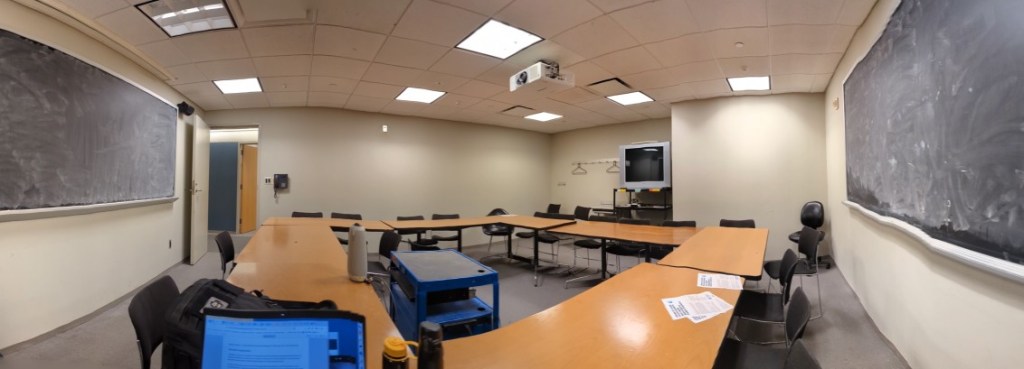
Last night, I stuck around after my first co-taught Interactive Technology and Pedagogy I class at the CUNY Graduate Center. The class went very well. Students demonstrated that they had done the reading and some brought deep perspectives from their disciplines to bear on our first discussion on technology and media.
Thankfully, there were no classes afterwards, because after everyone cleared out, I used the classroom to meet with a City Tech student over Zoom for her Individualized Study of ENG3790 Information Architecture.
I visited the CUNY Graduate Center on 5th Avenue in Manhattan to get an adjunct faculty ID made, because I’ll be co-teaching Interactive Technology and Pedagogy I: History and Theory (ITCP 70010) this fall. This course is part of the Interactive Technology and Pedagogy (ITP) Certificate Program, which when offered the opportunity to contribute to this program, I jumped at! It is aligned with some of the work that I do in the Professional and Technical Writing Program at City Tech, which involves using technology for communicating and learning about the history of digital technologies, and it is a kindred program with the learning to teach with technology aspects of the Brittain Fellowship at Georgia Tech. I’m excited to work with the program’s graduate students beginning in a couple of weeks.
Last night, I recorded this final exam review for my Introduction to Language and Technology ENG1710 students. These are the slides that I’m using in the background. The following are the readings that my students and I discussed over the past 14 weeks that comprise the exam review:
Lewis Carroll, “Jabberwocky”
Ted Chiang, “The Truth of Fact, the Truth of Feeling”
Victoria Fromkin, “What is Language?” from An Introduction to Language
Stephen Jay Klein, “What is Technology?”
Salikoko S. Mufwene, “Language as Technology: Some Questions That Evolutionary Linguistics Should Address”
Walter J. Ong, “Writing is a Technology That Restructures Thought,” in The Written Word: Literacy in Transition,
Bruce Mazlish, “The Fourth Discontinuity”
Jacques Derrida, “Linguistics and Grammatology,” translated by Gayatri Chakravorty Spivak
Donna Haraway, “A Cyborg Manifesto”
N. Katherine Hayles, How We Became Posthuman, Chapter 1: “Toward Embodied Virtuality”
Marshall McLuhan, Understanding Media: The Extensions of Man, Chapter 1: “The Medium is the Message”
Friedrich Kittler, “Gramophone Film Typewriter”
J. David Bolter and Richard A. Grusin, “Remediation”
Lisa Gitelman, Always Already New, “Introduction”
Fred Turner, “Where the Counterculture Met the New Economy: The WELL and the Origins of Virtual Community”
Lev Manovich, Language of New Media, Chapter 1: What is New Media?”
Alexander Galloway, “What is New Media? Ten Years After The Language of New Media”
Laurie McNeill and John David Zuern, “Online Lives 2.0: Introduction”
Anil Dash, “The Lost Infrastructure of Social Media”
David Nofre, Mark Priestley, and Gerald Alberts, “When Technology Became Language: The Origins of the Linguistic Conception of Computer Programming, 1950-1960”
Marie Hicks, Introduction to Programmed Inequality: How Britain Discarded Women Technologists and Lost Its Edge in Computing
Jacques Derrida, “Signature Event Context”
William Hart-Davidson, “On Writing, Technical Communication and Information Technology: The Core Competencies of Technical Communication”
Dan Milmo, Seán Clarke, and Garry Blight, “How AI Chatbots Like ChatGPT or Bard Work—Visual Explainer”
Alan F. Blackwell, “Are You Paying Attention?” from Moral Codes
Lorena O’Neil, “These Women Warned of AI’s Dangers and Risks Long Before ChatGPT”
Maria Christoforaki and Oya Beyan, “AI Ethics—A Bird’s Eye View”
A faceless cybernaut prepares to explore cyberspace. Image created with Stable Diffusion.
For today’s class, my ENG2700 Introduction to Professional and Technical Writing students read two articles about social media and professionalism in the Technical Communication field:
Ferro, T. & Zachry, M. (2014). Technical communication unbound: knowledge work, social media, and emergent communicative practices. Technical Communication Quarterly, 23(1), 6-21.
Verzosa Hurley, E. & Hea, A. (2014). The rhetoric of reach. preparing students for technical communication in the age of social media. Technical Communication Quarterly, 23(1), 55-68.
I plan to discuss the difference between active and passive approaches to building an online professional identity (and why the former is the way to go–giving an example about LinkedIn from Dr. Rebecca Burnett).
Toward the end of lecture, when I was talking about lessons learned from Hart-Davidson’s essay, which includes being a life-long learner and keeping up-to-date on changing technologies of writing and communication, Prof. Sarah Schmerler, a City Tech English department colleague with a shared interest in Generative AI technologies, stopped by and participated in the class discussion with my students. It was informal and impromptu, but I think my students enjoyed their perspective and lived experience. I enjoyed our conversation during and after class.
I wanted to jot down some of the conversation and additional thoughts spun off from the conversation here:
How can you expect to be a good writer without learning, at least in part, from reading many examples of writing by others?
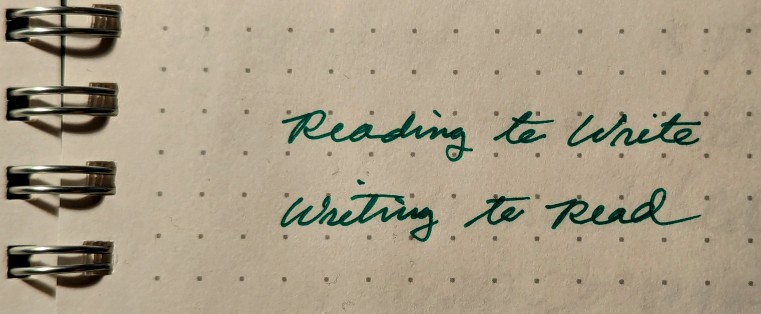
Writing is reading in reverse. Instead of the words coming into you from the world, you are sending the words out into the world.
Reading and writing go hand-in-hand. Developing skill in one, enriches the other.
Reading heuristics, such as lateral reading and vertical reading, can support getting as much as possible out of one’s reading time, energy, and needs (e.g., is this for a research thesis vs. learning enough about something for a journalistic article).
Our needs–enjoyment, learning, work, etc.–play a key role in what strategies (large scale) and tactics (smaller scale) we employ to accomplish reading goals.
Reading can be a passive exercise, but active reading that engages the text and combines cognition, reasoning, and imagination yields the greatest returns in terms of understanding, analysis, and memory.
Isolation, quiet contemplation, and dedicated time can aid the development of reading and writing.
Teaching writing requires a rethink on how we approach reading and how important reading is to developing writing skill.
Students do lots of different kinds of reading, which we as educators can tap into and help the student connect their reading interests to writing development. Furthermore, it can open doors to other kinds of reading that they were not previously aware of. Knowing where they are and interested can lead to possibilities and knowledge that were around them but unseen. Browsing and finding the neighborhood, in Prof. Schmerler’s terms, connects students to new reading opportunities.