Tag: reading

  • Some Notes on Reading and Writing

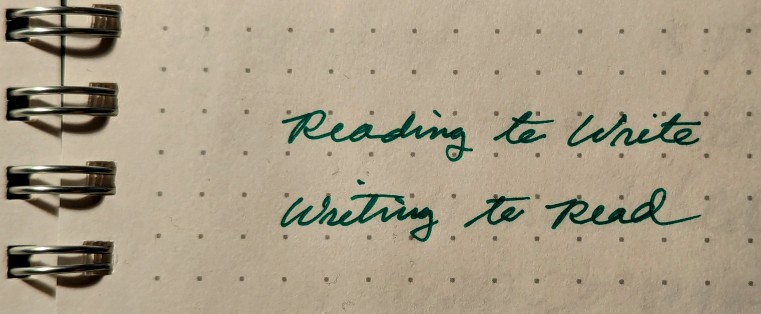
    the words "Reading to Write" and "Writing to Read" written in cursive in a notebook with a dot-grid background and spiral bound

    During last night’s Introduction to Language and Technology (ENG1710) class, I was discussing William Hart-Davidson’s “On Writing, Technical Communication, and Information Technology: The Core Competencies of Technical Communication.” It followed our reading last week of Jacques Derrida’s “Signature Event Context,” which Hart-Davidson engages in part.

    Toward the end of lecture, when I was talking about lessons learned from Hart-Davidson’s essay, which includes being a life-long learner and keeping up-to-date on changing technologies of writing and communication, Prof. Sarah Schmerler, a City Tech English department colleague with a shared interest in Generative AI technologies, stopped by and participated in the class discussion with my students. It was informal and impromptu, but I think my students enjoyed their perspective and lived experience. I enjoyed our conversation during and after class.

    I wanted to jot down some of the conversation and additional thoughts spun off from the conversation here:

    How can you expect to be a good writer without learning, at least in part, from reading many examples of writing by others?

    Writing is reading in reverse. Instead of the words coming into you from the world, you are sending the words out into the world.

    Reading and writing go hand-in-hand. Developing skill in one, enriches the other.

    Reading heuristics, such as lateral reading and vertical reading, can support getting as much as possible out of one’s reading time, energy, and needs (e.g., is this for a research thesis vs. learning enough about something for a journalistic article).

    Our needs–enjoyment, learning, work, etc.–play a key role in what strategies (large scale) and tactics (smaller scale) we employ to accomplish reading goals.

    Reading can be a passive exercise, but active reading that engages the text and combines cognition, reasoning, and imagination yields the greatest returns in terms of understanding, analysis, and memory.

    Isolation, quiet contemplation, and dedicated time can aid the development of reading and writing.

    Teaching writing requires a rethink on how we approach reading and how important reading is to developing writing skill.

    Ray Bradbury was a largely self-educated writer who proudly said that he graduated from the library at the age of twenty eight (though, he adjusted this to twenty seven in a later interview in the Paris Review). In the latter interview, he also remarked about retyping the writing of his favorite authors as a part of his writing apprenticeship and early development as a writer–“[to] Learn their rhythm.”

    Students do lots of different kinds of reading, which we as educators can tap into and help the student connect their reading interests to writing development. Furthermore, it can open doors to other kinds of reading that they were not previously aware of. Knowing where they are and interested can lead to possibilities and knowledge that were around them but unseen. Browsing and finding the neighborhood, in Prof. Schmerler’s terms, connects students to new reading opportunities.
  • Spring Recess 2015: Reading, Exploring, and Making

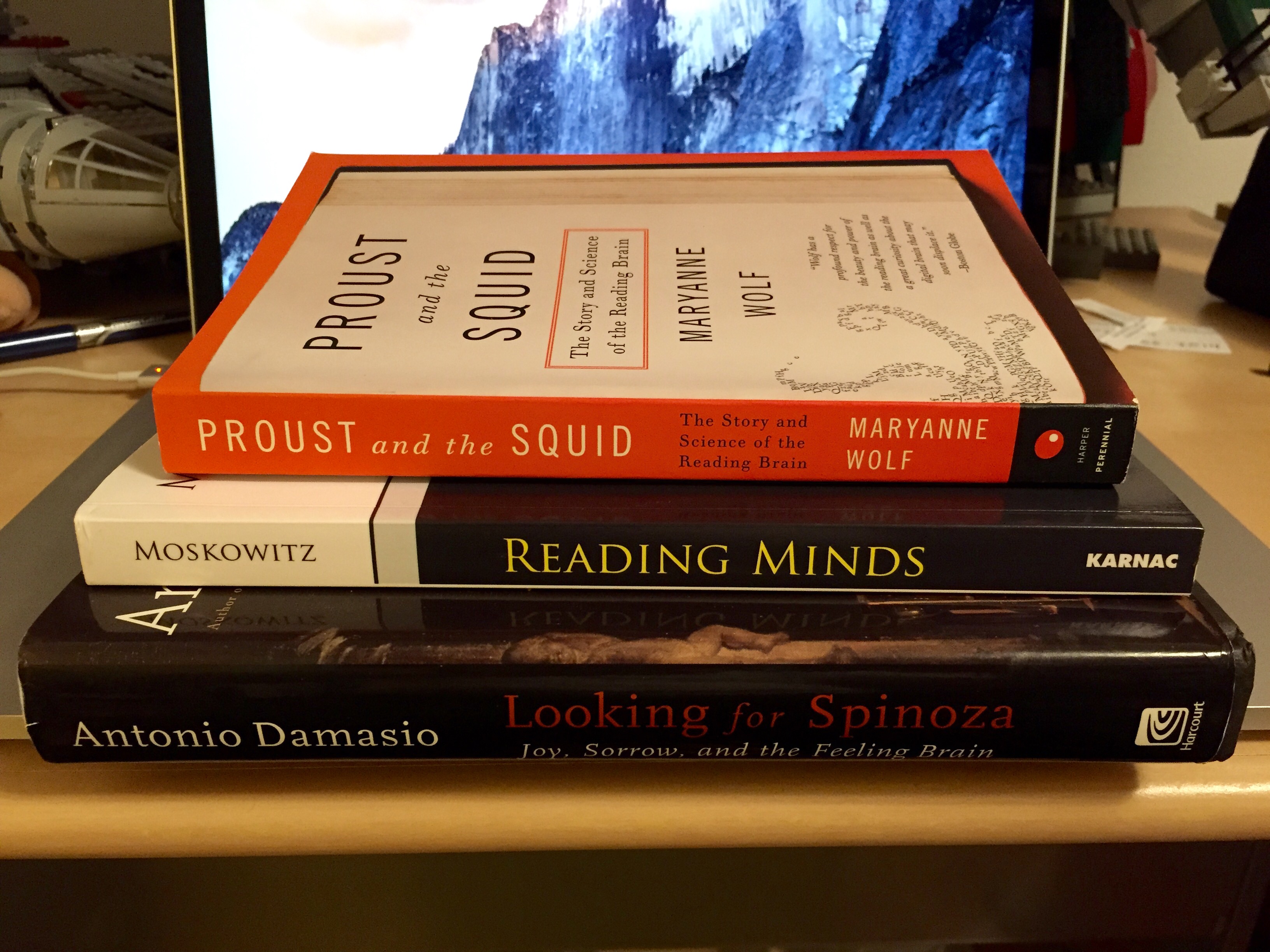
    Spring Break reading list.
    Spring Break reading list.

    I had a fun and productive time during this year’s Spring Recess in our new home of Brooklyn. I read three brain-related books: Maryanne Wolf’s Proust and the Squid, Michael Moskowitz’s Reading Minds, and Antonio Damasio’s Looking for Spinoza. I took the subway to Manhattan twice with Y and Little My to visit Kinokuniya Bookstore, Sun Rise Market, Uncle Sam’s Army Surplus, the New York Public Library, and Washington Square. I picked up an M65 field jacket and put together an EDC kit. I walked to Microcenter twice–each time scoring a free 16GB flash drive thanks to a new coupon promotion. To cap the week off, I completed a draft of my PARSE documentation for advancement at City Tech and posted assignments for tomorrow’s classes on OpenLab. Now, I feel ready to see this semester through to the end.

    A question for my students: how did was your week away from the college? Are you ready to see things through?

  • A Few Reading Strategies for the Science Fiction Novice

    Underlying many definitions of science fiction is the fact that reading science fiction requires some level of apprenticing and learning of the key concepts, tropes, and concepts that appear in much of the genre’s works. Damien Broderick formalized this in his book Reading by Starlight, in which he argues that there is a ‘science fiction megatext’ that authors borrow from and give to that science fiction readers learn over time. Thus, reading science fiction can be a daunting task for someone not yet accustomed to the genre and its many elements.

    However, this is true of any literature that you may read whether it be mainstream fiction from one particular historical period versus another, or another genre such as detective fiction or the western. Any reading requires a certain amount of heavy lifting on the part of the reader to engage the story and its characters. Perhaps with science fiction there is an additional attendant requirement to figure out the science, technology, and estranging qualities of the story, but the reader’s success at figuring these things out is part of the joy of any kind of revelation.

    Below, I have written out some strategies for reading science fiction that can equally apply to other literatures. If you have other suggestions, please leave them in the comments.

    • Read slowly and carefully. Reading is not a race to the finish. You may have to read something more than once to completely understand the story, and you may have to read it a further time in order to uncover any greater meanings lying beneath the surface.
    • Keep a notebook handy as you read. Jot down ideas with the page numbers that attend those ideas.
    • Diagram the characters and actions in a flow chart or story outline to better make sense of a complex narrative. Who are the characters? Where do characters go? Who do they encounter? What happens to them? What do they do?
    • Keep a web browser open with two tabs: one for your favorite search engine and the other for dictionary.oed.com. Search terms that you have not encountered before.
    • Be smart with your reading. If you don’t have the time to read and re-read something, you should search the Lexis Nexis database for reviews of the novel. Wikipedia also has a number of plot summaries. However, I cannot warn you enough that these serve as a guide or introduction only; you should read the work at hand in order to fully understand it and experience the novel itself through the act of reading.
    • Don’t always think literally, and vice versa. When you come across something like, “She turned on her right side,” it could have more than one interpretation. She could turn over onto the right side of her body, or it could mean that she powered up the right side of her body (cybernetic implants, computers, etc.).
    • Pause during your reading to imagine what it is you are reading. This can be hard work, but it does get easier as you encounter it more often.
    • You only build new and powerful connections in your brain through challenging and unique experiences. The readings in my classes are intended to be just that. If you don’t do the heavy lifting though, you won’t get any of the long term benefits of engaging and surmounting these challenges.