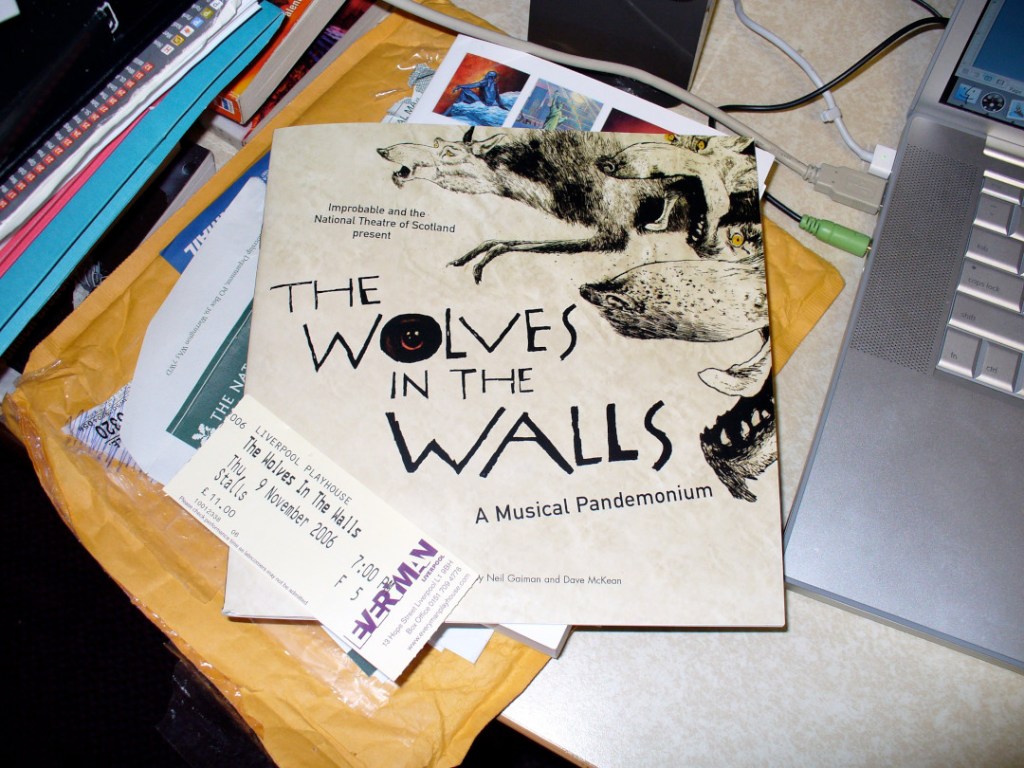
Recently, I ran across the image above of the program book and ticket of the stage adaptation of “The Wolves in the Walls,” based on the book of the same title by Neil Gaiman and Dave McKean on my desk in Liverpool. It gave me pause.
I wrote the short summary below , after seeing it in the fall of 2006:
It’s about a girl named Lucy, who likes to draw. She lives with her mum who makes jam, her dad who plays the tuba, and her brother who plays video games. One day, Lucy begins to hear wolves in the walls. At first, her family doesn’t believe her, but then the wolves come out and it’s all over! Pandemonium breaks loose and Lucy must brave the wolves to regain her pig puppet from the clutches of the crazy wolves.The recent allegations against Gaiman made me think of the theatrical adaptation and source material in a completely skewed and disorienting way. Its difficult now to square my before and after interpretations.
It’s challenging to ignore what shouldn’t, according to Roland Barthes in “The Death of the Author” (1967), matter as far as how we interpret the text. We, the readers, shouldn’t give an author tyranny over our interpretation of a text. Yet, Gaiman is an author who has cultivated a public persona that dovetails with the positive interpretations of his creative work and associated social causes. Joss Whedon also comes to mind in terms of the close connection between auteur, themes, and social causes, and what happens when the auteur’s behavior conflicts with the constructed persona. Of course, these public personae are created, cultivated, supported, and accepted, but the person beneath the persona is far more complicated and potentially far different than the persona circulating in culture. The author’s behavior might be reprehensible and seem radically different from what the audience has come to expect from the author’s persona. A problem for the reader and critic is to disentangle the linkages between the work, persona, and person in order to provide richer interpretations as opposed to those dominated by the author, persona, or both. Of course, what Gaiman has been alleged to have done must be addressed and remedied in other ways.
