Brian Porter and Edouard Machery’s “AI-generated poetry is indistinguishable from human-written poetry and is rated more favorably,” which appears in the open-access journal Scientific Reports, is a fascinating study about how human-made and Generative AI-made poetry is rated by non-expert humans. Interestingly, the study participants rated more of the Generative Ai-made poetry as more “human” than the poems actually written by humans, which included works by Geoffrey Chaucer, William Shakespeare, Samuel Butler, Lord Byron, Walt Whitman, Emily Dickinson, T.S. Eliot, Allen Ginsberg, Sylvia Plath, and Dorothea Lasky. While this quantitative approach provides some interesting talking points about the products of Generative AI, it seems like it might be saying more about the participants than the computer-generated poems. What might the results look like from experts, literature graduate students, and undergraduate students who had taken a class on poetry? What might be revealed by analyzing the AI-penned poems in relation to the work by the respective poets, considering that the prompt was very generic?
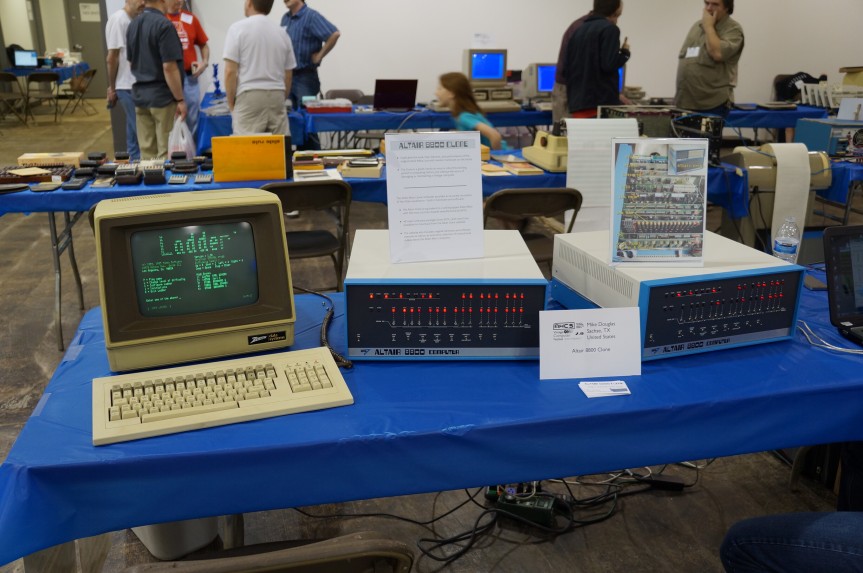
Altair 8800 kit computer running at the SEVCF 2014. This computer is mentioned in Buchanan’s article.
In the November 1977 issue of Analog Science Fiction/Science Fact magazine, Martin Buchanan published a feature article on personal computers titled, “Home Computers Now!” In it, he opens with a scenario about how PCs can automate family life and then goes into the nuts and bolts of how computers work, what to look for in a kit, and what the future of computing looks like. It was at the end of the article that this passage stood out to me:
"With cheap processors, cheap memory, and cheap communications, what can't we do? The effects on individuals and society will be major and unpredictable. Today's personal computer is just a beginning" (Buchanan 74).
Buchanan, Martin. “Home Computers Now!” Analog, Nov. 1977, pp. 61-74.
Illustration of skateboarders skating a halfpipe, surrounded by night sky. Created with Stable Diffusion.
While working on the Generative AI and Pedagogy Bibliography the other day, I realized that I had neglected the Skateboarding Studies Bibliography for the past few years. To bring it up to speed, I updated it with some new rigorous books and articles along with some lighter, reference works for the would-be skateboarder (or researcher who needs the name and steps for a particular trick). The book section more than doubled in size to 33 sources, and the articles and book chapter section grew by a handful to number 87 now. Going forward, I plan to break the bibliography into focused sections as I did on the Generative AI and Pedagogy Bibliography. I’ll post an update when that gets done. In the meantime, I hope that you find something useful to read on the list!
Recently, I had an opportunity to speak with colleagues about what Publishing Studies means to me. I edited my thoughts into the following note.
Publishing Studies: Theory and Praxis
Publishing Studies is an interdisciplinary field of study that encompasses rhetoric and composition, media studies, history of the book/newspaper/magazine/websites/etc., and practical skills including writing, editing, design, layout, production, marketing, business administration, etc. Publishing Studies programs prepare students for publishing industry careers.
Publishing Studies should be grounded in theory and praxis. Theory provides a foundation for understanding the field and its development. It gives ways of seeing and thinking about the process and purpose behind publishing. Theory helps one be a confident problem solver, an open-minded thinker, and a dynamic life-long learner who can adapt to changing work conditions and challenges. Balancing theory is practical skills. These skills are what help students build a portfolio, gain experience through internships and entry level positions, and obtain a job on their desired career path. Through their understanding of theory, students will understand that the skills they have when leaving a program will only go so far as the publishing industry changes. They can leverage their current skills to grow their skill set over time and be engaged members in their profession so that they know what new trends they should pay attention to and what new skills will keep them competitive in the job market.
Rhetoric
Publishing Studies is founded on rhetoric and composition. Publishing is all about communicating particular ideas to a particular audience using a particular (production scale/mass communication) medium. Knowing audience, rhetorical techniques, modes of communication (WOVEN=written, oral, visual, electronic, and nonverbal), and the writing process are essential skills for anyone interested in the publishing industry. Furthermore, being a reflective practitioner–using journal writing and reflection–supports the acquisition, integration, and improvement of the use of rhetoric and composition principles in the work place. There is a lot of overlap in this regard (as well as in the tools employed in the publishing field mentioned below) with Technical Communication.
Media Studies
Media and materiality are really big components of Publishing Studies, because publishing is all about using mass communication media technologies to reach an audience. Important issues for Publishing Studies from a Media Studies perspective might include: the effect/affect of media on audiences, how does media change over time, how does media influence other media, what biases are built into particular media or how those media are used, and are there issues with particular media at scale (e.g., Facebook and Twitter’s role in Brexit and the 2016 US election). Aesthetics, design, layout, and UX are important, too, and they overlap (as do many aspects of theory) with practical skills.
History of the Book/Newspaper/Magazine/Website/Etc
Perhaps under the umbrella of Media Studies, the History of the Book and other produced media such as newspapers, magazines, websites, social media, and others, are key to a fundamental understanding of Publishing Studies. The field encompasses many different forms of mass communication technologies, and the intertwined histories of these media provide a useful context for how we are at this particular moment in publishing history while also revealing how the history of publishing is not a Whig historical progression, but in fact, contains many interesting dead ends and forgotten technologies whose time might not have been right but contained some aspects that were useful and might deserve revisiting in the present. Layered in these histories are issues of labor, capital, production technologies, world historical events, and societal movements, all of which have influenced the development of the publishing history.
Practical Skills
Praxis is tempered by theory. Theory is made meaningful by praxis. The two support one another and enrich one’s experience of the publishing field in a way that helps propel students toward dynamic careers instead of cookie-cutter jobs. Publishing careers include writing, editing, design, layout, printing, IT, programming, procurement, representation, marketing, fact checking, research, and business administration. All of these rely on a basic set of writing, communication, and interpersonal skills, and each branches off into a discrete set of current (but always changing) skills involving knowledge-based work (e.g., planning, research, summarizing, extrapolating, etc.) and tool-based work (e.g., Adobe Creative Suite, Microsoft Office, CMS, etc.). Each career path’s set of widely accepted skills (i.e., those skills that employers are looking for in employees) are those that should be researched and taught by faculty. Besides their course work, students can learn more about these through trade publications and books, mentors, and internships.