Tag: Textbook

  • Lynn Conway, the VLSI Revolution, and Hacking Pedagogy

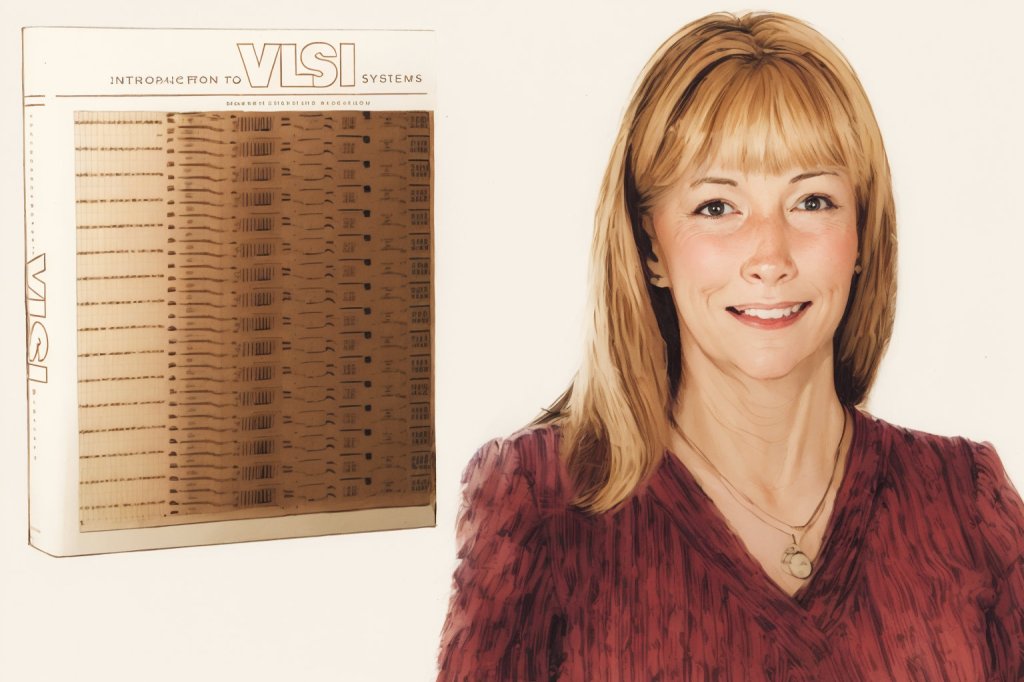
    Illustration of Lynn Conway and a copy of her textbook with Carver Mead: Introduction to VLSI Systems. Image created with Stable Diffusion.
    Illustration of Lynn Conway with a copy of Mead and Conway’s Introduction to VLSI Systems. Conway’s likeness is based on Charles Roger’s photo on Wikipedia, which he released under a CC BY-SA 2.5 License. Image created with Stable Diffusion.

    This past weekend, The New York Times ran an obituary for Lynn Conway, half of the namesake for the Mead-Conway VLSI Revolution and co-author of the groundbreaking textbook Introduction to VLSI Systems (1980). She died at the age of 86.

    What is so cool about the Mead-Conway VLSI chip design revolution was not only that it was the paradigm shift that made possible the next step in microprocessor design and fabrication by enabling electrical engineering and computer science students to do the work that was previously the domain of physicists and the high tech industry, but also that it was a under-the-radar pedagogical hack. Conway writes in the October 2018 issue of Computer:

    "With all the pieces in place, an announcement was made on ARPANET to electrical engineering and computer science departments at major research universities about what became known as "MPC79." On the surface, while appearing to be official and institutionally based, it was done in the spirit of a classic "MIT hack"--a covert but visible technical stunt that stuns the pubic, who can't figure out how it was done or what did it. (I'd been an undergrad at MIT in the 1950s).
    
    The bait was the promise of chip fabrication for all student projects. Faculty members at 12 research universities signed on to offer Mead-Conway VLSI design courses. This was bootleg, unofficial, and off the books, underscoring the principle that "it's easier to beg forgiveness than to get permission" (p. 69).

    While this was a huge contribution to the development of the computer industry leading into the 1980s and beyond, it was only one of her many accomplishments–innovating an out-of-order queuing processing system for IBM only to be fired in 1968 when she began transitioning to become a woman, starting her career over and eventually making her way to Xerox PARC, later joining the University of Michigan as a professor of electrical engineering and computer science and serving as associate dean of engineering, and becoming a transgender advocate later in life. She was recognized with many awards and honorary doctorates for her contributions to the field as an engineer and educator.


  • Joan Slonczewski Added to Yet Another Science Fiction Textbook (YASFT)

    An image of a woman walking through a tunnel toward an ocean's beach and a sky filled with stars inspired by Joan Slonczewski's novel A Door Into Ocean. Created with Stable Diffusion.

    I added a whole new section on the Hard SF writer Joan Slonczewski (they/them/theirs) to the Feminist SF chapter of the OER Yet Another Science Fiction Textbook (YASFT). It gives students an overview of their background as a scientist, writer, and Quaker, and it discusses three representative novels from their oeuvre: A Door Into Ocean (1986), Brain Plague (2000), and The Highest Frontier (2011). Like the Afrofuturism chapter, I brought in more cited, critical analysis of Slonczewski’s writing, which is parenthetically cited with a full citation instead of using a works cited list or footnotes.

    Slonczewski’s A Door Into Ocean was the inspiration for the image above that I created using Stable Diffusion. It took the better part of a day to create the basic structure of the image, then there was inpainting of specific details such as the woman’s footprints in the sand, and finally, feeding the inpainted image back into SD’s controlnet to produce the final image.

  • New OER Launched: Yet Another Science Fiction Textbook (YASFT)

    Woman astronaut wearing an exosuit is reading a book in a futuristic library. A tall alien male is standing in the background selecting a book off the shelf. Image created with Stable Diffusion.

    I’m very happy to announce the launch of a new open educational resource (OER) that I’ve been working on for awhile!

    It’s called Yet Another Science Fiction Textbook (YASFT). It’s over 60,000 words and includes additional resources that can be helpful for readers, students, and instructors.

    YASFT is released under an Attribution-NonCommercial-ShareAlike 4.0 International Creative Commons License. It’s freely available to be read as it is. However, if anyone would like to use it in another way, there are licensing terms that must be followed: “This license requires that reusers give credit to the creator. It allows reusers to distribute, remix, adapt, and build upon the material in any medium or format, for noncommercial purposes only. If others modify or adapt the material, they must license the modified material under identical terms.”

    You can find YASFT under the Teaching menu above or directly here.

    Its abstract and table of contents are included below.

    Abstract

    Yet Another Science Fiction Textbook (YASFT) is an open educational resource or OER, meaning it is freely available for anyone to use and learn with. It provides a chronological history of Science Fiction (SF) with an emphasis on literature and film, and it includes other useful resources, such as a glossary of terms, an extensive list of SF definitions, additional resources, a syllabus with hyperlinked readings available online, and video lectures. It tells a story, but not the only story, about SF history. It’s also an experiment in using generative artificial intelligence (AI) to assist with editing a large body of text, in this case over 60,000 words.

    Table of Contents

        Front Matter
    What is YASFT?
    Who made YASFT?
    Why was YASFT made?
    Why is it called YASFT?
    How can YASFT be used?
    How was YASFT made?
    Acknowledgements
    Preface
    Origins of Science Fiction
    Early Fantastic Stories
    Scientific Revolution
    Age of Enlightenment
    Romanticism
    The Gothic
    Mary Shelley’s Frankenstein
    Science-Saturated Novel
    Victor Frankenstein’s Hubris
    Critique of the Age of Enlightenment
    Tabula Rasa
    Proto-SF
    Historical Context
    Edgar Allan Poe
    Nathaniel Hawthorne
    Jules Verne
    H. G. Wells
    E. M. Forster
    Pulp SF
    Historical Context
    Overview of Pulp SF
    Hugo Gernsback
    E. E. “Doc” Smith
    C. L. Moore
    Edgar Rice Burroughs
    H. P. Lovecraft
    SF Film Serials of the 1930s and 1940s
    Buck Rogers
    Flash Gordon
    Golden Age SF
    Historical Context
    Overview of Golden Age SF
    John W. Campbell, Jr.
    Isaac Asimov
    Ray Bradbury
    Robert A. Heinlein
    Frank Herbert
    Tom Godwin
    SF Film Through the 1950s
    Film vs. Literature
    Early SF Film
    1950s SF Film Boom
    Forbidden Planet
    New Wave SF
    Historical Context
    Overview of New Wave SF
    J.G. Ballard
    Harlan Ellison
    Philip K. Dick
    Samuel R. Delany
    Star Trek
    “The City on the Edge of Forever”
    Feminist SF
    Historical Context
    Beginnings of Feminist SF
    Definitions of Feminist SF
    Joanna Russ
    Marge Piercy
    Pamela Zoline
    James Tiptree, Jr.
    Ursula K. Le Guin
    Octavia E. Butler
    Afrofuturism
    Steven Barnes
    Tananarive Due
    Nalo Hopkinson
    Nnedi Okorafor
    Cyberpunk
    Historical Context
    Coining the Cyberpunk Term
    Cyberpunk Characteristics
    William Gibson
    Sprawl Trilogy and Stories
    Hermes 2000 and Floppy Disk eBooks
    The X-Files, “Kill Switch”
    Bruce Sterling
    Pat Cadigan
    Contemporary Science Fiction
    Historical Context
    Ted Chiang
    N. K. Jemisin
    Cory Doctorow
    Charlie Jane Anders
    Martha Wells
    Mary Robinette Kowal
    Ken Liu
    R. F. Kuang
    SF Film from 1960 Onward
    1960s
    1970s
    1980s
    1990s
    2000s
    2010s
    Global Perspective: Taiwanese SF
    Brief Taiwanese History
    Taiwanese SF Overview
    Taiwanese Fandom
    Cultural Comparisons
    Issues with Translation
    How to Keep Up With Science Fiction
    Appendices
    Appendix 1: Glossary of Science Fiction Terms
    Appendix 2: Chronological List of SF Definitions of Science Fiction with MLA Citations
    Appendix 3: Further Reading
    Textbooks
    Readers
    Teaching
    Online Research
    Appendix 4: Sample Syllabus with Hyperlinked Readings
    Appendix 5: Lecture Videos
    Appendix 6: Version History