Tag: Update

  • Generative AI and Pedagogy Bibliography Updates

    an anthropomorphic cat professor is reading books in a library
    Image created with Stable Diffusion.

    Over the weekend, I added a pile of books to the Generative Artificial Intelligence (AI) and Pedagogy Bibliography and Resource List.

    Also, I added some must-read open-access articles and online guides:

  • Joan Slonczewski Added to Yet Another Science Fiction Textbook (YASFT)

    An image of a woman walking through a tunnel toward an ocean's beach and a sky filled with stars inspired by Joan Slonczewski's novel A Door Into Ocean. Created with Stable Diffusion.

    I added a whole new section on the Hard SF writer Joan Slonczewski (they/them/theirs) to the Feminist SF chapter of the OER Yet Another Science Fiction Textbook (YASFT). It gives students an overview of their background as a scientist, writer, and Quaker, and it discusses three representative novels from their oeuvre: A Door Into Ocean (1986), Brain Plague (2000), and The Highest Frontier (2011). Like the Afrofuturism chapter, I brought in more cited, critical analysis of Slonczewski’s writing, which is parenthetically cited with a full citation instead of using a works cited list or footnotes.

    Slonczewski’s A Door Into Ocean was the inspiration for the image above that I created using Stable Diffusion. It took the better part of a day to create the basic structure of the image, then there was inpainting of specific details such as the woman’s footprints in the sand, and finally, feeding the inpainted image back into SD’s controlnet to produce the final image.

  • First Anniversary of My Generative Artificial Intelligence (AI) and Pedagogy Bibliography and Resource List

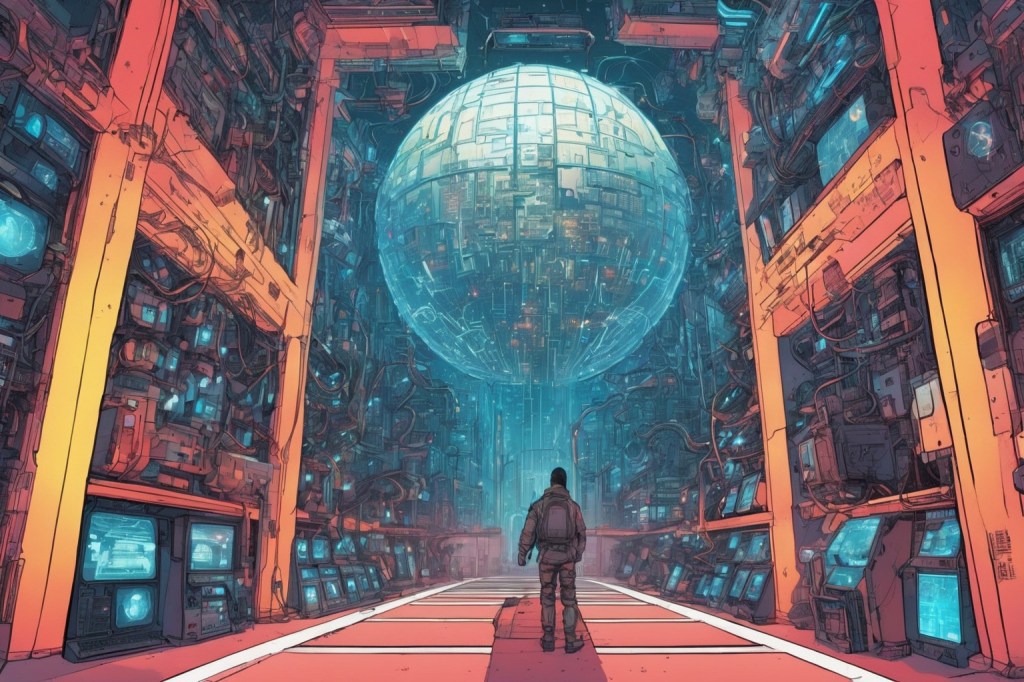
    Artificial intelligence in a giant room of computers. Image generated with Stable Diffusion.

    Tomorrow is the first anniversary of the Generative Artificial Intelligence (AI) and Pedagogy Bibliography and Resource List.

    I first launched it on 13 April 2023 when I was directing the Professional and Technical Writing (PTW) Program at City Tech before going on my current research sabbatical.

    The motivation for the resource was two fold: I wanted to learn all that I could about generative AI for my professional work as a teacher and scholar, and I needed to understand the changes taking place due to these new technologies for the benefit of my students who had already expressed concern and wonder about it.

    I launched it with more than 150 MLA-formatted citations of books, collections, and articles related to AI and generative AI with an emphasis on teaching but also including useful background and area specific sources.

    Now, it has over 550 citations! It also includes a growing list of online resources with direct links!

    I’ll keep adding to it periodically, and if you have some sources that I haven’t included but should, drop me a line (my email address is in the sidebar to the right).

  • November 2023 Update on the Generative AI and Pedagogy Bibliography Page

    A holographic projection of an AI emerges from the portal. Image generated with Stable Diffusion XL.

    Since my last update in September, I’ve continued adding MLA-formatted book and article entries to the Generative AI and Pedagogy Bibliography page each week as I come across them.

    There are now 434 bibliographic entries–an addition of 52 new entries. The online resource list at the bottom of the page is now up to 56 links–an increase of only one.

    Most of the new bibliographic entries are in the pedagogy, generative text, background, and textbook sections, but there are some interesting titles that I added to the other AI application sections.

    Following the explosion of new titles on artificial intelligence earlier this year, the rate of new publications have slowed. I suspect that some titles were rushed out to take advantage of the hype and now new titles are being released at normal publication rates. But, I also suspect that the pipeline is in the process of rebuilding, perhaps with even more titles than were in the first wave.

    As I’ve written before, the list isn’t exhaustive. I include titles that I find interesting through my research and study of generative AI. Nevertheless, I hope that it might be useful to folks who find it one way or another.

  • Site Clean-Up Update and Organization to Surface Information Better

    Anthropomorphic cat computer technician standing in front of a vintage mainframe computer. Image created with Stable Diffusion.

    As I wrote about two weeks ago, I realized that the blog side of dynamicsubspace.net needed a serious cleaning to improve its information architecture. There were numerous posts with dead links as well as removed video and images that erased the context and purpose of the page. There were posts lacking relevance to what I wanted to use the site for. There were posts that had not received any views in over 10 years. And there was the issue of my poorly thought out categories and the related issue of tag proliferation.

    Since that post, I’ve whittled the categories down to 28 from 30, slashed the tags to 187 from 1,300, and removed 234 posts from just over 1,600 (making yesterday’s post the new post number 1,400). Also, I searched for posts by keywords and re-applied Categories and Tags to help relevant information surface easier through the Categories and Tag clouds in the right sidebar and the relevant posts shared at the bottom of each post (when you click through the title or land on a page through a search engine).

    These principles that I’ve learned should apply to any personal website:

    • When initially developing your site, take the time to write up a plan that includes its purpose and goals, a list of categories that encompass the kinds of writing that support your your site’s purpose and goals, and a list of possible tags that give granular detail to your categories (knowing these will increase over time).
    • Review your posts manually and using tools like Google Search Console to search for deadwood, such as posts with dead links, out of date or irrelevant information, removed embedded content hosted elsewhere, etc. If those posts are cross-linked on other posts or pages, you will need to track those down and remove the links.
    • Review your posts’ Categories and Tags. If your Categories change, they might need to be reapplied to some posts. And with your tags, new tags that have relevance to older content should be applied to help build connections and surface that content for your visitors.
    • Don’t be afraid to delete. It’s your site, so you get to make the executive decisions about what the site should offer your audience. Old, outdated, broken, and no longer useful information might be choking your audience’s access to the information that your site is providing.
    • If you keep your site’s posts relevant and labelled appropriately, you can help your visitors discover the information they are looking for that you provide.