Blog

  • Learning from our Grandmothers: Memories of my Granny Ellis (1918-2012)

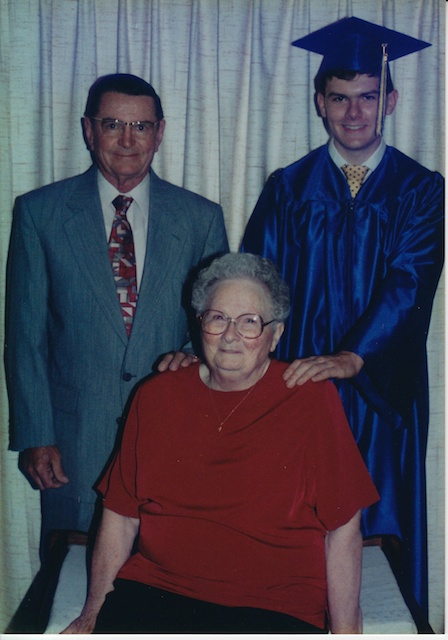
    Papa and Granny Ellis with me after high school graduation in 1995.

    Early Monday morning, I received an unexpected phone call from my Dad. Obviously upset, he told me that my Granny Ellis had passed away during the night. It was hard to wrap my head around this fact. She was 94 years old, and she marshaled on despite numerous health problems–especially later in life. She was from “old stock,” a heartier stock that could weather setbacks and troubles without much complaint or fuss.

    She was my last grandparent to pass away. I am very fortunate to have had so much time to spend and learn from my grandparents. Wilma, Papa Gerald, Papa Ellis, and Granny Ellis contributed in so many ways to my emergence as the person that I am today. I feel somewhat disconnected now from the past anchored by my grandparents–grandparents who I spent time with every day, every week, every summer when I was younger and who I called once a week no matter where I might be in: in Atlanta, Liverpool, or Ohio.

    There are  a couple of things that immediately come to mind in remembering Granny Ellis. The first has to do with food and the second has to do with the surprising power of memory.

    When I was younger, I would usually spend Wednesday afternoons and some weekends with my Granny and Papa Ellis. More often than not, I wanted to “play” with my Legos or other toys, but what no one knew–even myself–was that I was learning. I was modeling. I was thinking through narrative. I was thinking about the possibilities in social interaction, engineering, and creativity.

    Granny Ellis let me explore through my play without interruption–except when it was necessary, as she would remind me, to eat. She believed in making sure that I was well fed. With energy stores fulfilled, she would release me from an empty bowl of chili or a now barren plate where once sat made-from-scratch biscuits to return to my building, my thinking, my “play.” In her own way, I believe that she recognized that I needed to do those things to make sense of a world far different from the one she was born into so many years before. She recognized that even play is an important part of learning.

    Then, many years after those afternoons on the carpeted floor hunting for the right brick, Granny Ellis developed neurological problems. Papa Ellis would need to guide Granny around. It was like she was there, trapped behind her eyes, unable to express herself as she had when I was younger. However, her doctors began experimenting with different medicines to combat what were ultimately long undiagnosed micro-seizures and dementia, she regained to some extent her old self. You could speak with her once again and she could recall the past remarkably well. Unfortunately, her short term memory was impaired–she could not remember from day-to-day or even minute-by-minute on most occasions.

    Due to Granny Ellis’ trouble with short term memory, I expected her to not remember my wife Y after I introduced her. To my overwhelming joy, Granny Ellis not only remembered that I was married to a beautiful girl named Y, but she also remembered to ask how Y and I were doing. Granny’s face would light up when she saw Y on the too few occasions that we could both travel to Brunswick to visit. Despite these few encounters, Granny Ellis overcame her brain’s degenerative hurdles to hold on to that memory. Did her love for Y and me play some role in her brain’s ability to build a lasting long term memory from her short term memory? This question deserves further investigation. In the meantime, I believe that she expressed her love through her memory of Y, and I am glad that I now have that memory to hold onto in my life.

    Our friends and family (and especially our grandmothers) have a lot to teach us. We can learn from them and our experiences. We can reflect on what they did–how they demonstrated solid pedagogical practices for learning and enabling learning–in our own thinking about the theory and practice of teaching.

  • Godspeed, Gary Stephen Thompson (1945-2012)

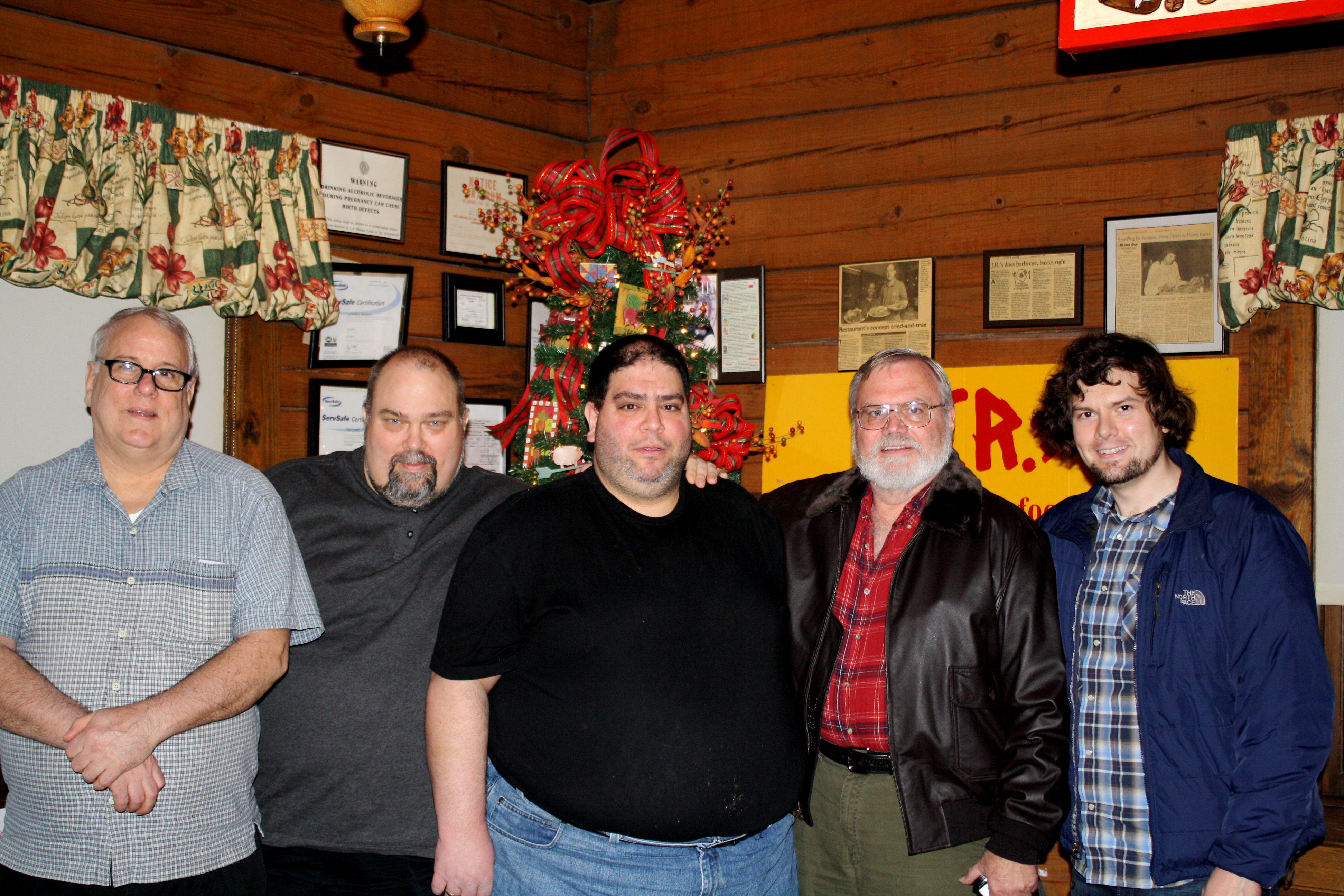
    Scanning from left to right in the adjacent picture from Christmastime 2008, you will see Bob Rainey, Mark Warbington, Paul Talamas, Gary Thompson, and me. This was the last time that I saw my friend Gary jovial and excited with life.

    On my way home to visit my family that year, I stopped through Atlanta to see the good friends that I made during my Mindspring and Georgia Tech undergraduate days. The five of us in the picture often met up at Mark’s house to tinker with computers (and technology in general), watch Red Green episodes (among many other things), and play Battlefield 1942 (with the Desert Combat patch).

    Since I had left Atlanta for graduate school at the University of Liverpool and Kent State University, I had not stayed in touch as much as I would have liked to. However, news has a strange way of finding its way to you through unexpected paths or random encounters. In Gary’s case, I knew that he continued with his annual participation in the Stone Mountain Highland Games, worked with another group of friends building an experimental kit airplane, and recently retired from General Electric where he was an highly experienced machinist.

    When I received a postdoc offer from Georgia Tech, I was excited about the prospect of catching up with my friends and hanging out again like we used to do at Mark’s. I realized that time and life had continued during the six years I was absent from Atlanta, but I did not expect the terrible event that coincided with my moving back to the area.

    (more…)

  • Back from Two Week Trip to UC-Riverside and the Eaton Science Fiction Collection

    From February 5 to 18, I researched in the Eaton Science Fiction Fiction and Fantasy Collection the University of California, Riverside‘s Tomas Rivera Library. As I mentioned last year, I was very appreciative to have won an R. D. Mullen Fellowship to fund my travel and accommodations for the research-oriented trip.

    Professor Rob Latham administers the fellowship and the science fiction work at UC-Riverside, which includes an annual SF symposium and the biannual Eaton Conference co-hosted with the library’s special collections. He is a gracious host, and I enjoyed our conversations while I was in Riverside.

    UC-Riverside is building a strong constellation in science fiction studies. Besides Latham at the helm, the university recently hired the science fiction writer Nalo Hopkinson into the creative writing program. Now, the university is conducting a new hire for a science fiction media studies person (I applied, but alas, I didn’t make the short list). I suspect more the university will continue to grow in this direction–at least, I hope that it does, because it can grow the SF program around the significant holdings of the library.

    The Eaton Collection is located on the fourth floor of the Thomas Rivera Library and its hours of operation are from 9:00am to 5:00pm Monday through Friday. I planned my trip so that I would have two full weeks to work in the special collections to conduct research for my dissertation chapter on Philip K. Dick, his 2-3-74 visions, and his health problems. In the event that I found as much material related to Dick’s work as possible, I also planned a contengency set of materials on the following chapter on William Gibson’s work.

    I am very happy to report that I achieved both goals and went a bit beyond my original set of documents thanks to cross referenced connections as well as new leads produced by my readings. Additionally, Reference Library Gwido Zlatkes turned me onto the two boxes of Philip K. Dick archival materials, which included some very cool autographed materials along with a full run of the Philip K. Dick Society Newsletter and other rare magazines and fanzines (including the November 6, 1975 Rolling Stone article).

    I began my research by reading the full thirty issue run of The Philip K. Dick Society Newsletter, which includes a double issue (#9/10) on cassette tape—one side being an interview conducted by Paul Williams with Dick and the other side Dick recording writing notes. The experience of fast-forwarding Dick’s posthumous canonization yielded more primary sources than I could have hoped for in letters and interviews. Interviews with Dick’s friends and former spouses also provide important corroboration and clarification of Dick’s sometimes-unreliable personal narratives.

    References in the Newsletter, combined with other research done before my visit to Riverside, led me to other interviews, notes, and reviews in fanzines including: The Alien Critic (later Science Fiction Review), Algol (later Starship), and The Patchin Review, and magazines including: Locus, Vertex, Science Fiction Eye, The Magazine of Fantasy & Science Fiction, and Analog.

    After exhausting my leads in the collection related to Dick’s later fictions and personal life, I spent the last three days collecting research for the William Gibson chapter of my dissertation. I focused on the Locus reporting of Gibson’s success following the publication of Neuromancer in 1984 and later interviews with the writer in 1991 and 2003. I was pleased to find a fanzine co-edited by Gibson titled Genre Plat, but Gibson’s essay, “Blues for Horselover Fat” in the fanzine Wing Window provides the strongest evidence that I can use to bridge my chapters on Dick and Gibson.

    To fill out the time that I was in the library, I also found photographs and reports of past Science Fiction Research Association meetings, including the one hosted at Kent State University in the mid-1980s where Samuel R. Delany was honored with the Pilgrim Award.

    My UC-Riverside visit was punctuated with a weekend visit to see Patrick and Sharon Sharp in Los Angeles. They played hosts and guides to my first visit to the strange world of LA–a place that actually felt like another country to me. We visited the Little Tokyo area for lunch and snacks and then strolled through the Museum of Contemporary Art’s (MOCA) Naked Hollywood: Weegee in Los Angeles photography exhibition (Weegee was doing amazing stuff with photography!). We also enjoyed the sunset from the top of the Westin Bonaventure Hotel (a fascinating hotel with interesting designs and spaces, but is it really postmodern? I think that a better case could be made for Riverside’s Mission Inn in that respect). I also got to meet their very friendly cat, Tonks.

    I believe that the research trip (and my first trip to California for that matter) was a smashing success! I have many materials that I have notes on and many other materials that I need to review again. I also got to reconnect with friends and colleagues there: Pawel Frelik, Mark Biswas, and William Sun.

  • Stephen Wolfram Remembering Steve Jobs in the Guardian, Me Thinking About Mathematica

    Mathematica is one of my favorite tools. I first learned about it (version 2–it is now version 8) as an undergraduate at Georgia Tech. I learned how to use it in the computer labs, but I wanted to use it in my dorm room. Unfortunately, I was reminded about the necessity of a floating-point unit to using complex calculating software at a speed faster than a sliderule; my Apple Powerbook 145B was woefully underpowered, lacking the necessary FPU that would have made Mathematica fly. As it was, I plotted one curve and it took 45 minutes to complete the operation. It was shortly after that that I upgraded to a Power Macintosh 8500, which significantly sped things along.

    Mathematica was originally built by an exquisitely smart fellow named Steven Wolfram. I had the pleasure of meeting him at Georgia Tech when he come for a visit and lecture–I believe talking about his work thus far on what become his book A New Kind of Science and the upcoming release of Mathematica 3. Even though I probably didn’t say anything of substance or intelligence when I met him, he was still very polite and cordial to me.

    Apparently, Mathematica’s development paralleled Steve Job’s work on the NeXT computer and then his return to Apple. Wolfram has some nice things to say about Jobs and his influence on Mathematica in the Guardian here.

  • If You Like Lego, Read Paul Di Filippo’s Review of The Cult of LEGO

    Paul Di Filippo, the science fiction author, shares how he built really awesome multi-storied marble mazes with his Legos as a child in his review of The Cult of LEGO on the Barnes and Noble’s website. It is worth the read.

    Updated 7/23/2024: Revised language and changed link to one cached on the Internet Wayback Machine.