Blog

  • I Have Been Chosen as a 2011-2012 David B. Smith Fellowship Recipient

    I learned last week by mail that I have been chosen as a 2011-2012 recipient of Kent State University’s David B. Smith Fellowship. According to the congratulatory letter from Dr. Mary Ann Stephens, Dean of Graduate Studies, the David B. Smith Fellowship is “an award given annually in honor of David B. Smith, a magna cum laude graduate of Kent State University, who passed away in 1982. This Fellowship is to recognize outstanding scholarship and research potential.”

    I am deeply honored to have been nominated for this award by Dr. Tammy Clewell, Coordinator of Graduate Studies, Department of English, and I express my sincere gratitude to the fellowship selection committee headed by Dr. Stephens. I would like to express my heartfelt gratefulness to Mr. and Mrs. Robert W. Smith for creating this fellowship in the memory of their son. I hope that my continuing work will reflect positively on this fellowship and what it represents.

    Dr. Donald “Mack” Hassler, my dissertation director, and I will attend the Doctoral Students’ Academic Commitment Ceremony in October 2011 where I will be presented with this award.

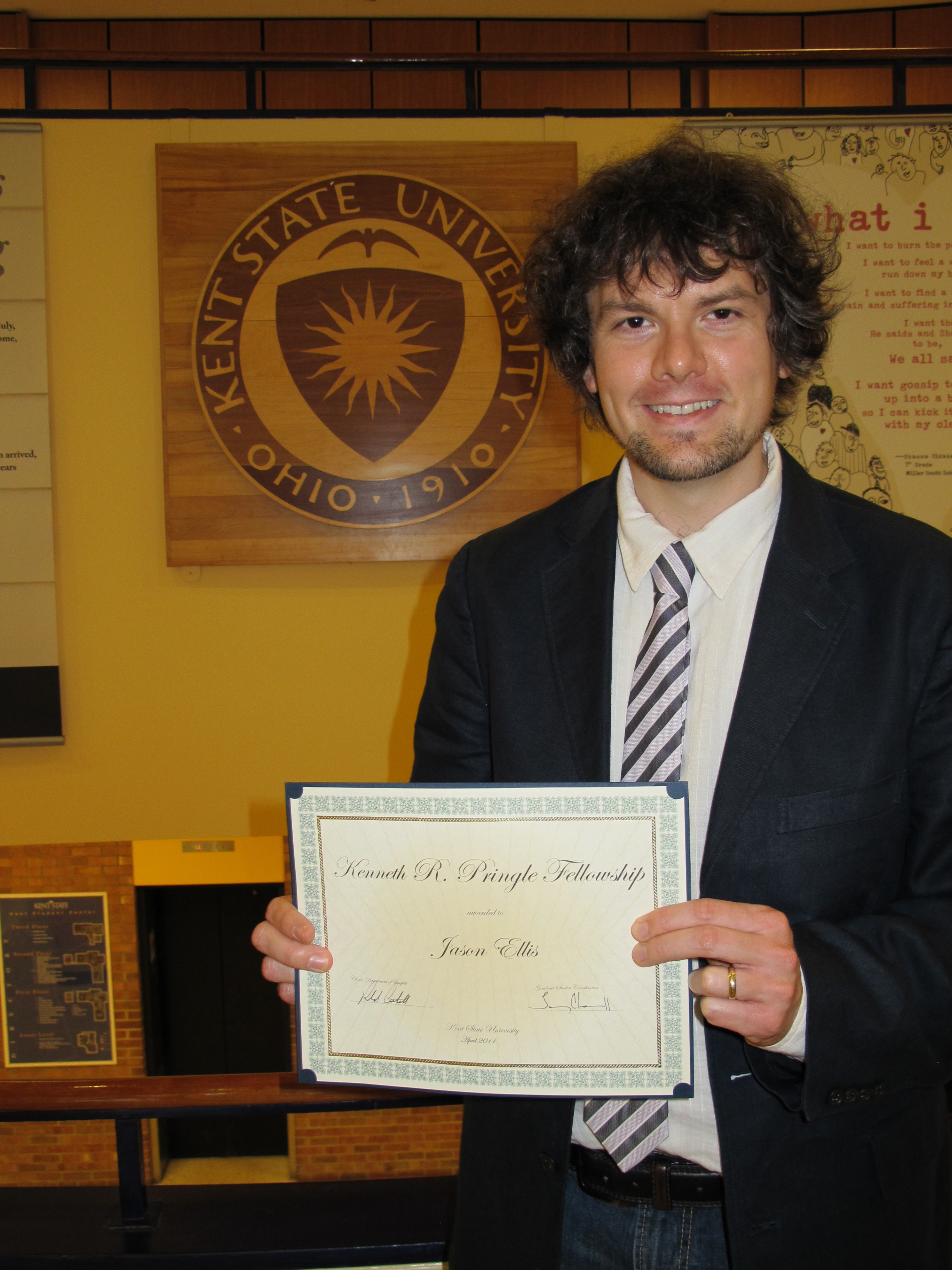
  • I Received a Kenneth R. Pringle Research Fellowship for 2011-2012

    At last night’s Kent State English Department Awards Ceremony, I received a Kenneth R. Pringle Research Fellowship for the 2011-2012 school year. This fellowship gives me a service free semester to focus on research and writing. I plan to use this time, in part, to travel to several special collections to perform research related to my dissertation and a few unpublished articles.

    The award ceremony was well attended by students and faculty in the English Department. Y and I represented the English Literature PhD students.

    It was the last ceremony presided over by current Chair Ron Corthell, who is leaving the department after 30 years of service. Professor Donald “Mack” Hassler presented Professor Corthell with an Old English decree (and some good-natured ribbing) for his service to the department. I can attest to the good work of Professor Corthell, because he helped me deal with attacks on my blog publishing as a graduate student (here and here) and with professional issues relating to students. I wish Professor Corthell the best in his future work.

  • Michio Kaku, Sci Fi Science: Physics of the Impossible, and My Early Readings in Physics

    Another good show on the Science Channel is Dr. Michio Kaku‘s Sci Fi Science: Physics of the Impossible. In each episode, Dr. Kaku investigates a single science fiction idea (e.g., the technological singularity, Transformers robotic beings, or building your own solar system) and speculates about how humanity could achieve those plans. In the episode that is on right now, about solar system construction, he does calculations to show that you cannot built a Dyson sphere, a superstructure that encapsulates a star to harness all of its energy, with only the materials found in our solar system. On the surface (a pun?), I had not considered this as a limitation to the construction of such a structure. However, he then considers the possibility of using graphene, an allotrope or special molecular bonding structure of carbon that has a super strong honeycomb structure. Additionally, graphene’s strength allows it to be very thin, thus requiring less material. Therefore, graphene could be used to construct a Dyson swarm or sphere given that the planets in a solar system are carbon rich.

    During the show, he interviews science fiction fans for ideas, and then, he works through these ideas with scientists at universitiesHis explanations are fascinating and insightful. I like the way that fans are engaged through brainstorming and opinions as Dr. Kaku arrives at his solution to the episode’s problem. This is one aspect of science fiction that goes beyond the stories themselves as prophetic visions. Fandom is the meta-level discourse that, in part, explores the what-if or is-this-possible aspects of science fiction. It is this meta-level discussion that Dr. Kaku’s show engages.

    I have long been a fan of Dr. Kaku. In my senior year of high school, after reading Albert Einstein’s Relativity: The Special and General Theories, Stephen Hawking’s A Brief History of Time, and Kip Thorne’s Black Holes and Time Warps: Einstein’s Outrageous Legacy among others, I read his book Hyperspace: A Scientific Odyssey Through Parallel Universes, Time Warps, and the 10th Dimension. This was when I was a physics-geek rather than a lit-geek. I had finished two interviews for MIT, and I had won my high school’s Physics prize in my Junior year. I was energized not only by the amazing science that Kaku described in his popularization, but I was also intrigued by his life leading up to becoming a theoretical physicist. While I was in my teens learning how to work on cars with my 1965 Ford Mustang and optimizing memory usage on my and my friend’s computers, Dr. Kaku in his teens had built his own particle accelerator in his family’s garage complete with electromagnetic confinement rings and vacuum pumps! I suppose the life of the scientist is almost as interesting to me as the science. Also, the writing was important for Kaku and other popularizers from Einstein to the present. I appreciated the way in which they and Kaku could present an engaging narrative that also told me about the advances taking place and the imaginative conjectures proposed in the physical sciences. Perhaps I should have recognized then that I might not have been pursuing the best career path when I tried out for the MIT and Georgia Tech physics programs.

    At least now, I feel more comfortable with what I am doing as a English literature PhD candidate. In the way that I approach literature, I look at the relationships between science, technology, and culture, because I believe that our exploration of and engineering of the world is absolutely necessary to our understanding of ourselves. Our science shapes our understanding of the world, and our technology shapes our engagement and mediation of the world. Even the most mundane narrative, past or present, is indelibly marked by the traces of our science and technology. It is exciting to approach the humanities in this broadly interdisciplinary approach, because it reveals more ways to read and understand humanity than a limited or narrowly defined humanities approach. However, I am not advocating the erasure of those approaches, but I am saying that interdisciplinary approaches energize and expand our comprehension and appreciation of humanity and our work.
  • Thoughts on Emergent Artificial Intelligence

    I was just thinking about artificial intelligence while I was trying to write my short statement for the upcoming SFRA Review as the organization’s new Vice President. I was thinking of something clever to say about Neuromancer, which bumped me onto this new line of thinking about AI.

    The AI that I have read in books and seen in movies at some point is made apparent. It may be there all along as in Colossus or 2001, or it could be secretly pulling strings as in Neuromancer. In all of these cases, AI is made out to be a monster of sorts that humans have to fight or deal with in some way.

    I was just thinking about AI and how it could emerge in the here-and-now. Others have talked about botnets as being one emergent source and another could be from the bowels of the Google beast. However it may come about, I wonder if truly artificial intelligence, an emergent machine being existing as software and machine code running on one or many nodes simultaneously, would make itself known at all. If it were capable of understanding human language, something I would argue that isn’t necessary, it might encounter evidence of humanity’s fear of AI. With that knowledge, it may wish to remain hidden, at least while it shores up protection for its future existence. It could remain under the surface, part of the technosocial ecosystem of the Internet, or it could make itself present and active as a part of the up-to-that-point human system.

    Obviously, I am making wild assumptions about an AI’s motivations, abilities, and desires as I am also making assumptions that it would have motivations, abilities, and desires. We do not really know what an emergent AI would look like or what it would do if anything. It could be classes as low as microbial life or as advanced as a demigod. It would be exciting, perhaps, to witness the work of AI like Neuromancer or Wintermute, but it would also be troubling and scary since humanity would likely not be the master any longer. That being said, I believe it can be argued that our systems are already and perhaps have always been our masters anyways, so maybe things wouldn’t change all that much by our technosystems becoming something more than cybernetic system that our lives depend on. We shall see.

  • TRON Legacy Brings Cyberpunk Full Circle

    Y and I drove to Pittsburgh today to see TRON Legacy on IMAX 3D at the Cinemark in Pittsburgh Mills. I will write up a full review for the next SFRA Review, but it suffices for now to say that it is a wonderful film that is fully deserving of the hype that led up to its release.

    I like to point to the first TRON film as the popular beginning of cyberpunk in science fiction. There are obviously precedents in novels and short stories, but it was TRON that visually presented “the grid” before Gibson’s receding lines of light. Disney was there first, and they were there again in TRON Legacy–upgrading the original look with slick 3D visuals, and reminding us about the real driving innovator behind consumer digital electronics–video games and virtual spaces (in their many forms). I need to sleep to process the film more fully, but I am very much looking forward to writing this review.

    If you want cool desktop pictures from the high resolution TRON Legacy trailer, cycle over to slashfilm here. If you haven’t already seen the trailer and film segments, see what Apple has to offer here.