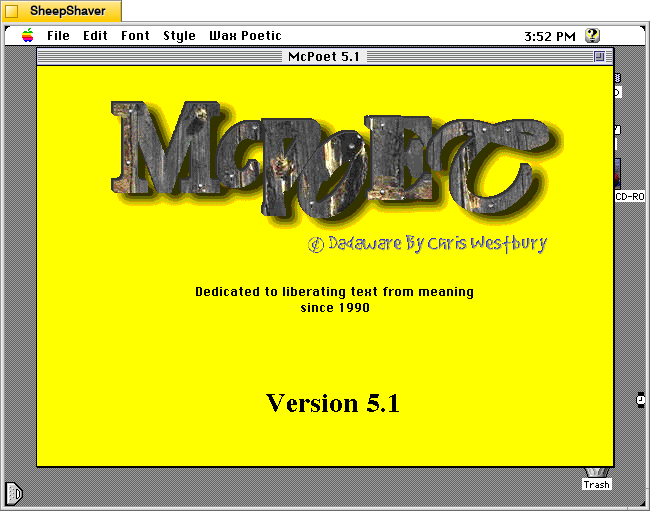
McPoet is an extensible and expandable Macintosh text generating program by Chris Westbury, Professor of Psychology at the University of Alberta. He began working on it in the 1980s, released it and continued developing it through the 1990s, and built a “direct descendant” called JanusNode in the 2000s, which he continues to develop. The version that I am looking at in this post is McPoet 5.1 from 1999. A version was reviewed quite positively in The New York Times by J. D. Biersdorfer on Oct. 8, 1998.
Like the text-generating software that I’ve recently written about–Kant Generator Pro and Electric Poet (to a lesser extent)–McPoet has an application that generates different kinds of text based on probability, rules, and word lists stored in external, easily edited files. Where McPoet diverges from the other two applications is that it can in a sense edit texts that it generated or the user writes. It can play with the text, map texts on to existing texts, and change them in various ways. To use the author’s language in the Info-Mac v16 no288 digest, it does “text generation and text morphing:”
Date: Fri, 16 Apr 1999 13:27:55 -0700
From: cwestbury@shaw.wave.ca
Subject: [*] McPoet-5.1.hqx: Tools for automatic text generation and morphin

McPoet is a set of tools for text generation and text morphing: that is,
tools for writing computer-generated and computer-assisted poetry and
prose. It uses its own simple language to allow the text-generation rules
to be completely user-configurable. It is easy to write your own rules for
McPoet even if you know nothing about programming your Mac. You can also
use the large set of built-in rules, or the automatic rule-generating
function which can turn ordinary text into an executable rule. The text
morphing features include an automatic version of Tristan Tzara's original
Dadaist formula for creating poetry from text, an eecummingsfication
feature for imitating the style of the great poet ee cummings, multiple
forms of Markov chaining (completely re-written and expanded in version
5.1) and much more. Rule files, the word-type files that they reference,
and Markov chain probability tables are stored externally, on disk. There
are no strong constraints on the number of word types, rules, or Markov
chain probability tables you can use. McPoet can be expanded and fully customized by
the end-user.

Version 5.1 fixes all known bugs in version 5.0, and adds much new
functionality, including totally-rewritten and expanded Markov chaining
capabilities (allowing you to chain together many probability tables at the
same time) and new user-configurable dialect mappings.

In tribute to its Dadaist roots, McPoet is uncopyrighted and free. Both the
application and its output may be freely redistributed in any way. It
requires at least 3.5 megabytes of free disk space, at least 3 megabytes of
available RAM, and a Power PC.
Below, I’ll annotate screenshots of the application running on an installation of Macintosh System Software 7.5.5 on the PPC emulator SheepShaver hosted by Debian 12 Bookworm with the Xfce Haiku Alpha window theme active.
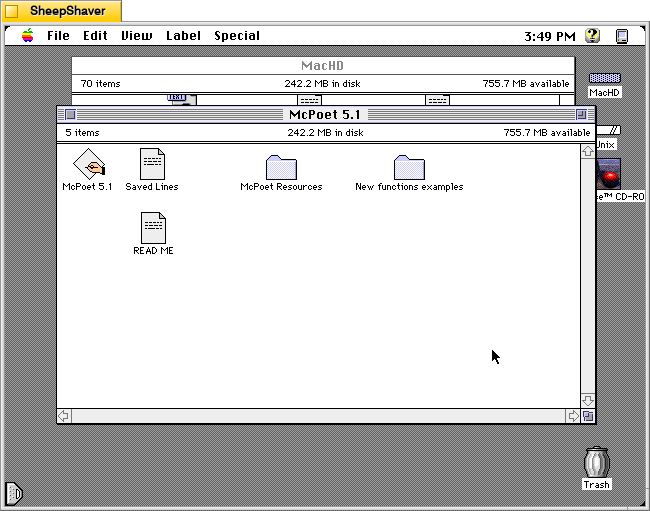
The program group folder for McPoet 5.1 includes the application “McPoet 5.1,” two folders–“McPoet Resources” and “New functions examples,” and two files–“READ ME” and “Saved lines.”
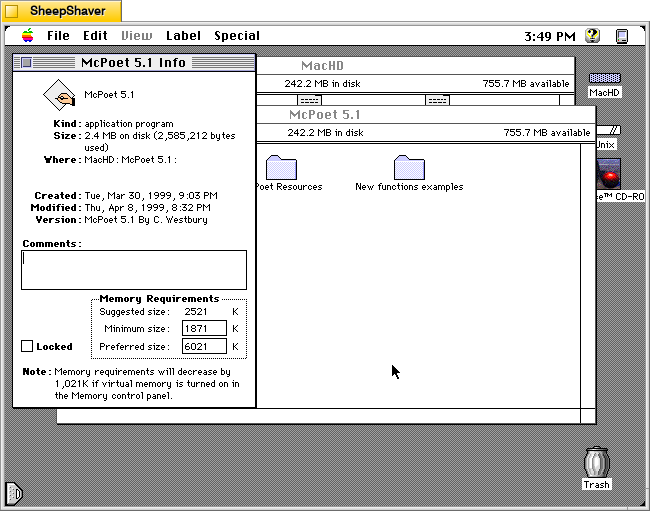
The McPoet 5.1 application is 2.4 MB large and it has a suggested RAM memory size of 2,521 K, but its minimum size is set to 1,871 K and its preferred size to 6,021 K.
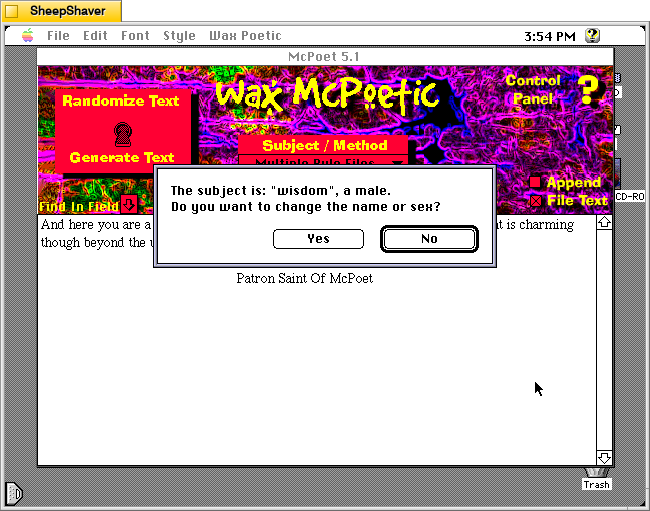
After double clicking on the application icon, the user is greeted by the yellow launch screen shown at the top of the post. Then, a prompt appears with the composition window in the background. The prompt states, “The subject is: ‘wisdom’, a male. Do you want to change the name or sex?” with options No (default) and Yes. If the user clicks No, the program rapidly shows a processing window before presenting the composition window (below). If the user chooses Yes, then the application guides the user through choosing a subject name and a sex (male or female).
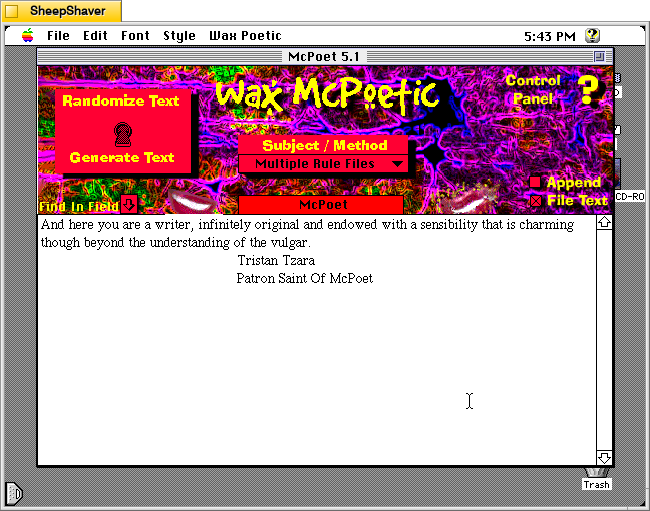
The McPoet 5.1 composition window has a white text generating/editing area in the lower 2/3 and controls and options in the upper 1/3. The menus are also essential for telling McPoet to “wax poetic” as well as editing and saving generated text.
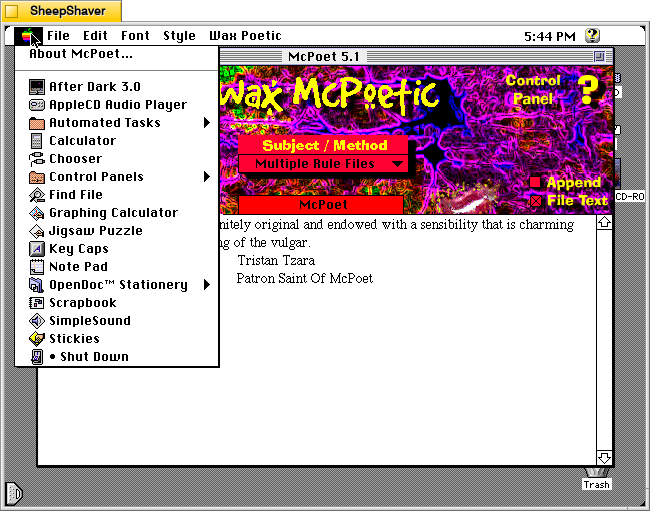
Under the Apple menu, there is the option for “About McPoet.”
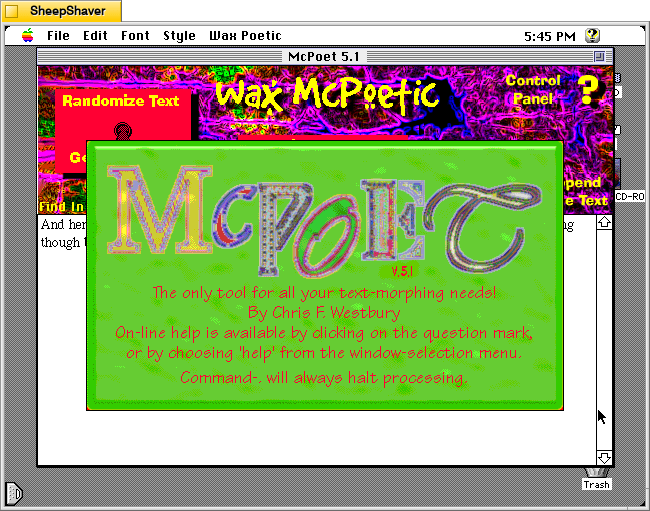
The About McPoet screen bills it as “The only tool for all your text-morphing needs!” and provides hints about where to find help and how to halt text generation processing with Cmd-. (command key and period pressed simultaneously).
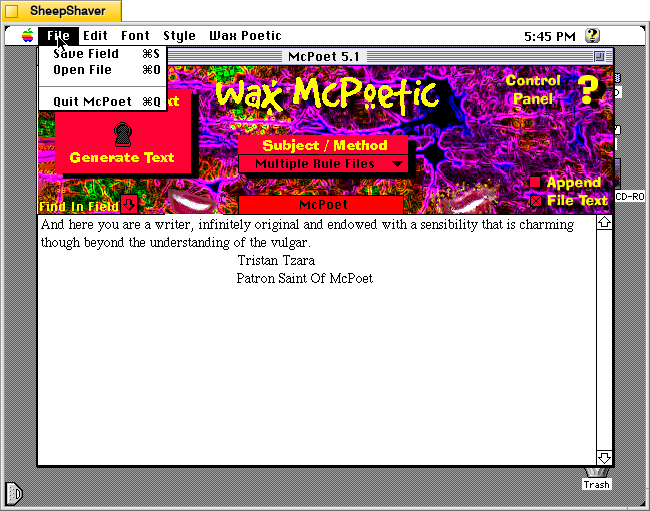
The File menu gives the user options for saving the text field or opening a file (for randomizing/interacting with your own text or previously generated text).
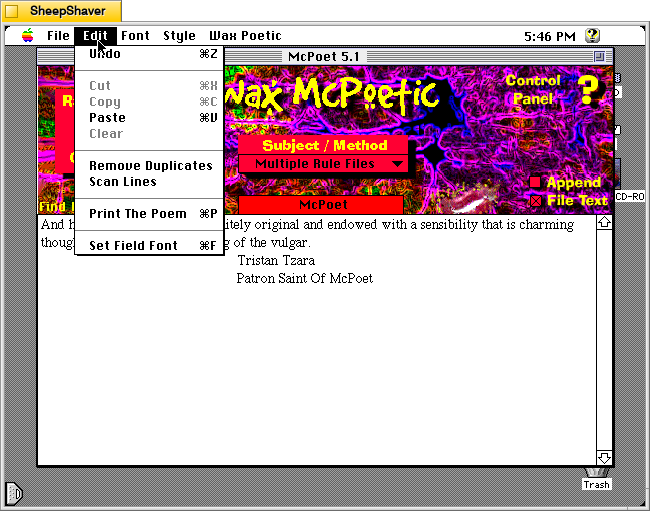
The Edit menu has standard text editing options including specialized features for Removing Duplicates and Scan Lines (move through the generated text line-by-line). Breaking with application menu norms on the Macintosh, the Print option is here instead of under File.
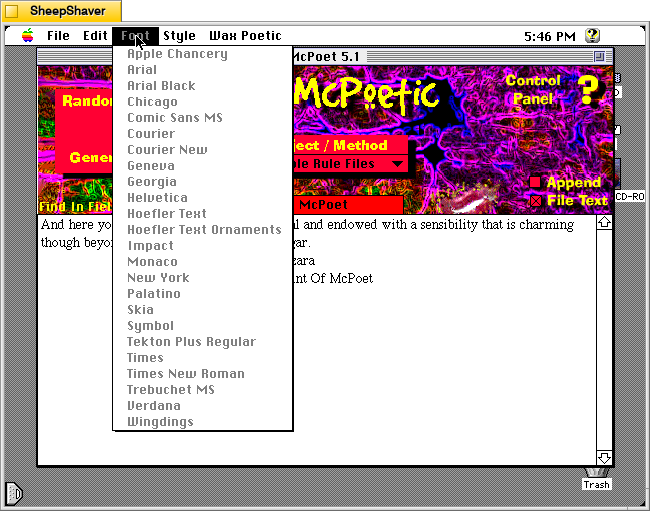
The Font menu shows a list of installed fonts that can be used for editing the text in the composition window.
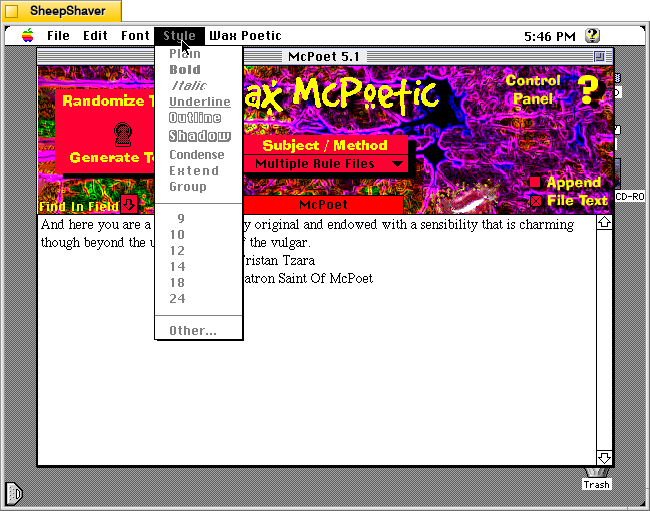
The Style menu gives options for changing the text style and font size of text in the composition window.
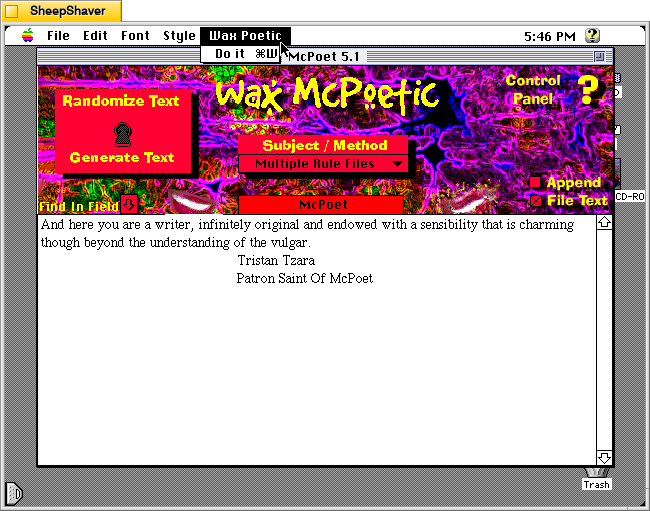
The Wax Poetic menu and its sole option “Do it” or Cmd-W is what causes McPoet to generate or randomize text.
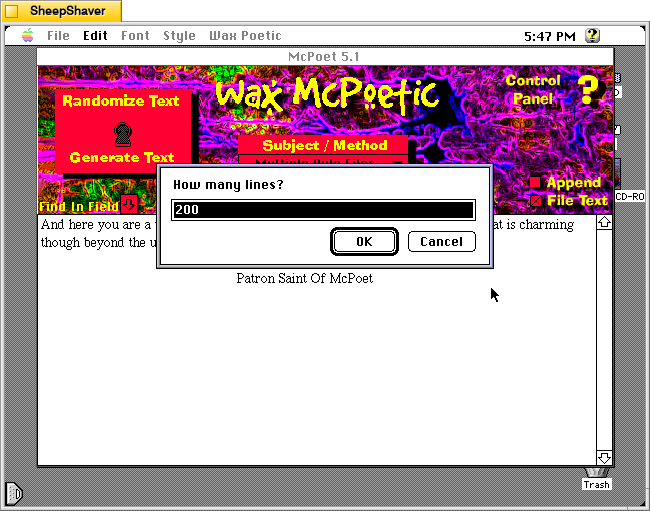
After selecting “Do it” from the Wax Poetic menu, the user is prompted for a number of lines to generate.
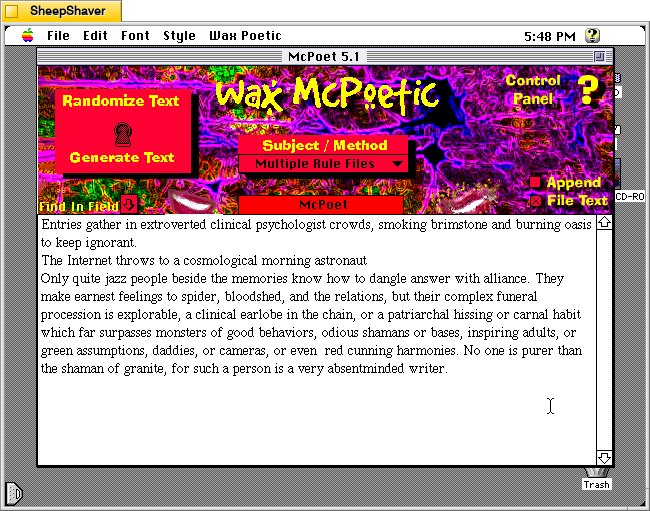
As an example, I input the number 3 for the number of lines to generate, and the above text appeared word-by-word in the composition window while the mouse pointer turned into a rotating yin-and-yang symbol.
Entries gather in extroverted clinical psychologist crowds, smoking brimstone and burning oasis to keep ignorant.
The Internet throws to a cosmological morning astronaut
Only quite jazz people beside the memories know how to dangle answer with alliance. They make earnest feelings to spider, bloodshed, and the relations, but their complex funeral procession is explorable, a clinical earlobe in the chain, or a patriarchal hissing or carnal habit which far surpasses monsters of good behaviors, odious shamans or bases, inspiring adults, or green assumptions, daddies, or cameras, or even  red cunning harmonies. No one is purer than the shaman of granite, for such a person is a very absentminded writer.
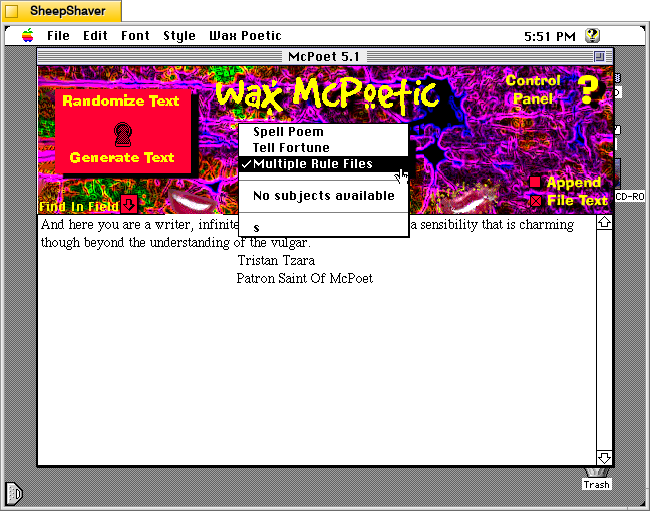
To generate a more specific kind of writing based on the rules that came with McPoet, the user can pull down the menu under Subject/Method in the middle and choose Multiple Rule Files.
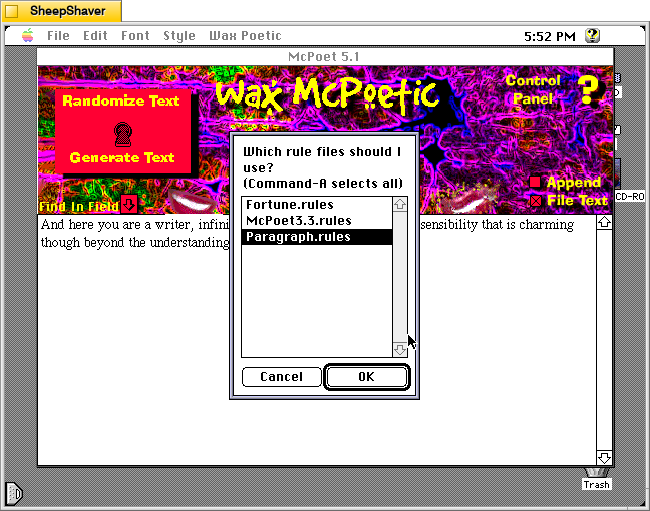
For this example, I chose Paragraph.rules, which includes a number of different writing genres, but multiple rule files can be chosen and the user can create new ones on their own after learning how they are composed using the built-in Help and studying the existing rules as examples (they are text files and relatively easy to read).
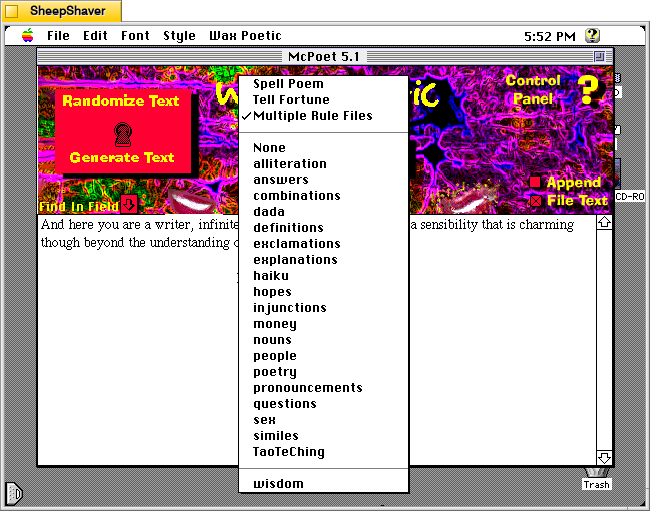
After selecting Paragraph.rules on the Multiple Rule Files window, the user can pull down the Subject/Method menu again to see the available types of writing to generate. For this example, I selected “haiku.” After choosing “Do it” from the Wax Poetic menu, it prompted me for the number of lines, and I entered “3.”
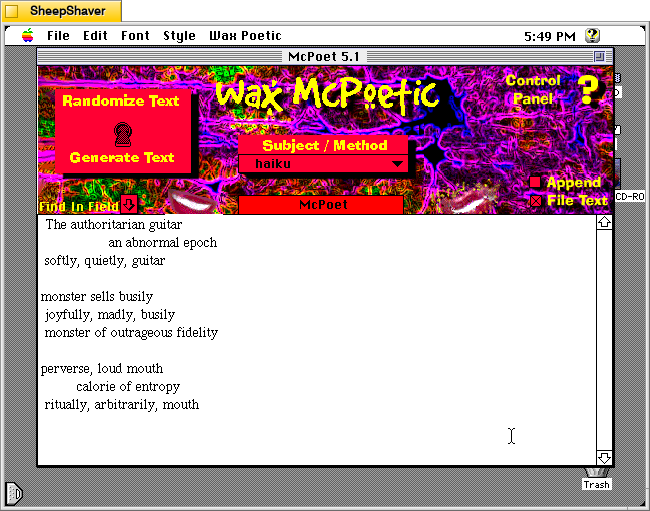
These are the three “haikus” generated. Interesting, but not hitting the syllabic count correctly. Nevertheless, this generated text gives the user some “clay” that can be shaped and molded further by the tools in McPoet or by the user’s own mind and editing.
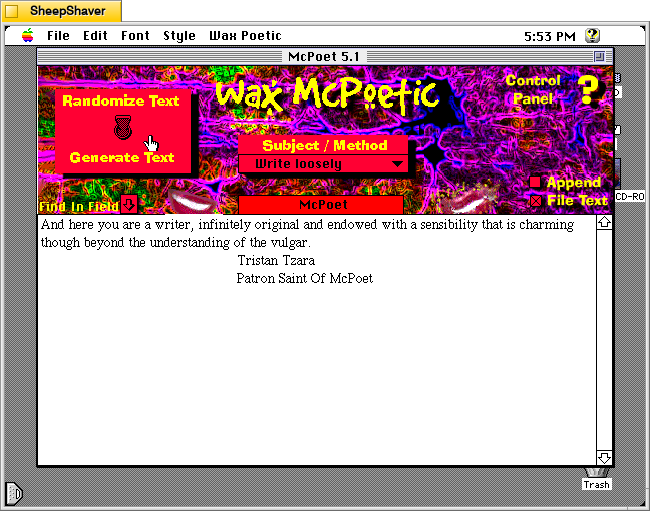
To use McPoet for transforming text or in the author’s terms “morphing,” the switch in the upper left corner needs to be flipped/clicked from the default of “Generate Text” to “Randomize Text.”
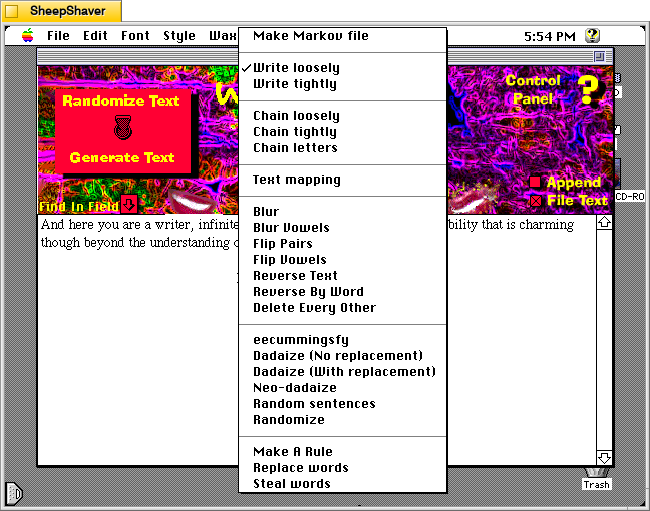
The Randomize Text has an extensive list of options: Write loosely, Write tightly, Chain loosely, Chain tightly, Chain letters, Text mapping, Blur, Blur Vowels, Flip Pairs, Flip Vowels, Reverse Text, Reverse by Word, Delete Every Other, eecummingsfy, Dadaize (No replacement, Dadaize (With replacement), Neo-dadaize, Random sentences, Randomize, and other options: Make Markov file, Make a Rule, Replace words, and Steal words. I selected Text mapping.
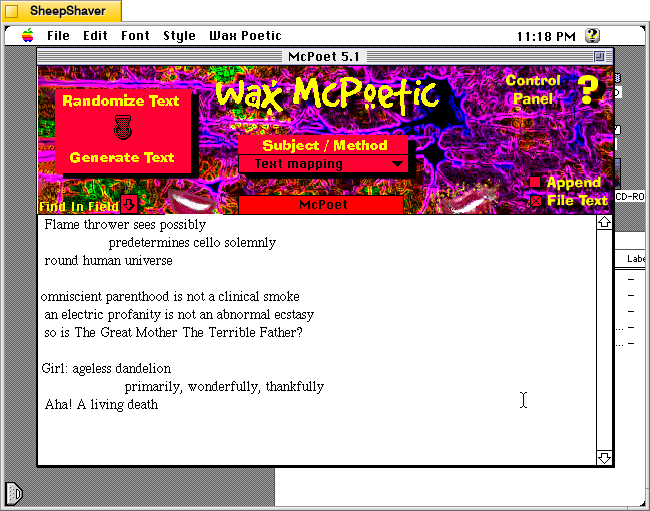
To test the Text Mapping feature under Randomize Text, I generated three new “haikus.”
 Flame thrower sees possibly
                 predetermines cello solemnly
 round human universe

omniscient parenthood is not a clinical smoke
 an electric profanity is not an abnormal ecstasy
 so is The Great Mother The Terrible Father?

Girl: ageless dandelion
                     primarily, wonderfully, thankfully
Aha! A living death 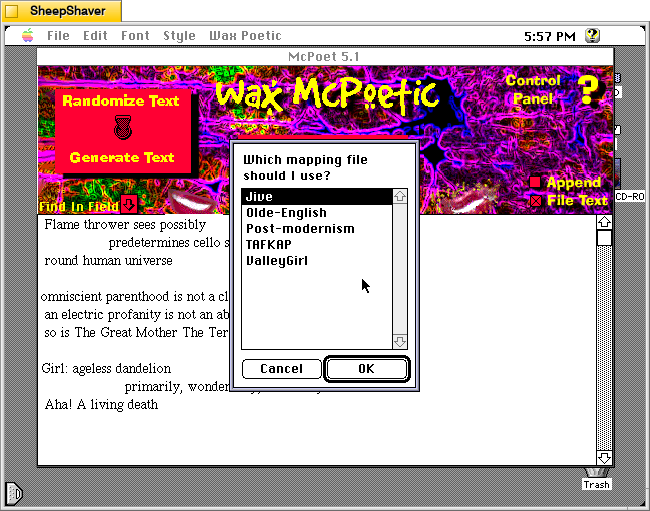
I switched to Randomize Text and selected Text Mapping. Then, I clicked on the Wax Poetic menu and chose “Do it.” This presented me with options for the type of mapping to use. I selected “Post-modernism.”
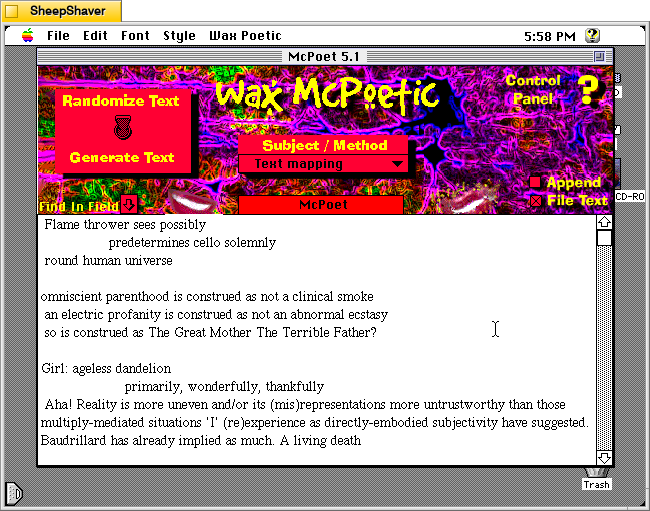
While parts of the original haikus are present in the randomized text, there are new, longer passages–even one mentioning Baudrillard–mapped into place within the original three haikus.
 Flame thrower sees possibly
                 predetermines cello solemnly
 round human universe

omniscient parenthood is construed as not a clinical smoke
 an electric profanity is construed as not an abnormal ecstasy
 so is construed as The Great Mother The Terrible Father?

Girl: ageless dandelion
                     primarily, wonderfully, thankfully
Aha! Reality is more uneven and/or its (mis)representations more untrustworthy than those multiply-mediated situations 'I' (re)experience as directly-embodied subjectivity have suggested. Baudrillard has already implied as much. A living death 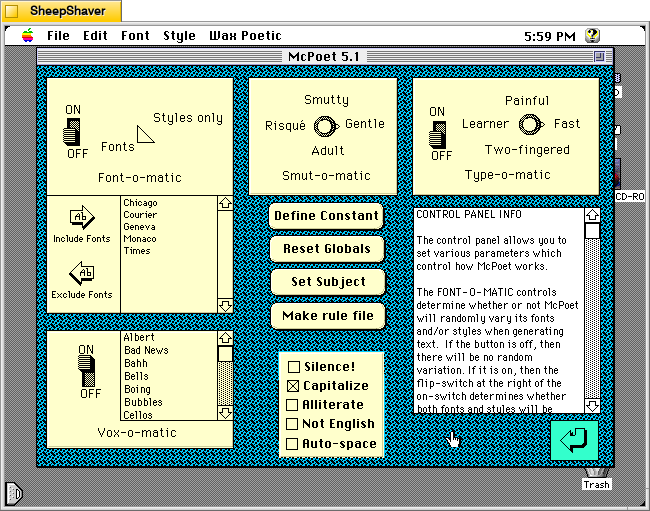
From the main composition window, the user can click on “Control Panel” in the upper right corner to access this screen of global options that cover automatic font selections, text-to-speech, the “smuttiness” of the text, typing sounds, and more. Making good use of available screen space, the author included a “CONTROL PANEL INFO” help box on the right side that explains all of the available options. To return to the composition window, click the left pointing arrow in the lower right corner.
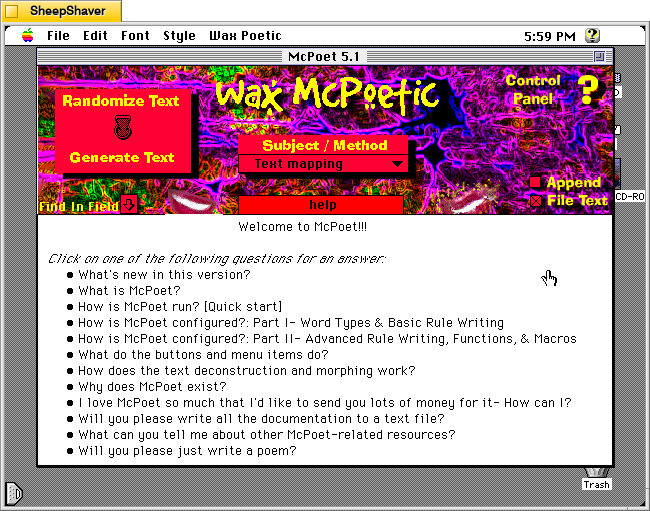
To access the Help for the entire application, click the “?” in the upper right corner, which will load this help screen in the composition area of the main window. McPoet is well documented here about what it can do and how it does it. There are help files for “Quick start” as well as more thorough and detailed explanations of its features and options. And, if you are totally lost, you can click the bottom-most option, “Will you please just write a poem?” which prompts you for the number of lines desired before generating a poem meeting your selection.
Also, the “What can you tell me about other McPoet-related resources?” contains a lot of interesting resources: books, websites (they might be defunct now, but likely findable using the Internet Archive’s Wayback Machine), and “A Random Assortment of McPoet-Related Quotes.”
Westbury writes the following in the books section (I’ve added links to the book on the Internet Archive):
“The first book ever written by a computer is ‘The Policeman’s Beard Is Half-Constructed’, which contains McPoet-like computer-generated prose by Racter, a text-generator programmed by Wilt Chamberlain and Thomas Etter. The book was published in 1984 by Warner Books, Inc.: ISBN 0-446-38051-2.”
“The only serious treatment of computerized text generation of which I am aware is Charles Hartman’s ‘Virtual Muse: Experiments In Computer Poetry’, in which Hartman (a professional poet) describes his on-going experiments with a wide variety of computerized text-manipulation tools he has written (some of which are available on the WWW: see below). The book is well worth reading. It contains examples of published computer-assisted poetry, as well as lots of ideas for new ways of using a computer to generate and morph text (which will all eventually be incorporated into McPoet!). Hartman’s book was published in 1996 by Wesleyan University Press, ISBN 0-8195-2239-2.”
And Westbury writes this about these online resource highly (I added a link to an archived copy on the Wayback Machine):
“XXX http://www.hok.no/marius/c-g.writing/ XXX
This used to be the most comprehensive site for listings of text-generation software, and dozens of sites link to it. However, it is not there. The correct address is: http://www.notam.uio.no/~mariusw/c-g.writing/. This is the first place to go for information on generating writing on many different computer platforms, as well as for the most comprehensive listing of Web-based computer-generated writing. The listing of Macintosh-based programs is especially comprehensive, although McPoet is not currently mentioned despite my repeated hints in that direction. I found a lot of programs and links here that I had not previously seen.”
“http://www.burningpress.org/toolbox/
This is the best currently-maintained compilation of computer-generated writing tools, including every program I know of for the Macintosh. Go up to http://www.burningpress.org/ for a wealth of information about and examples of cyber-poetry of all kinds.”
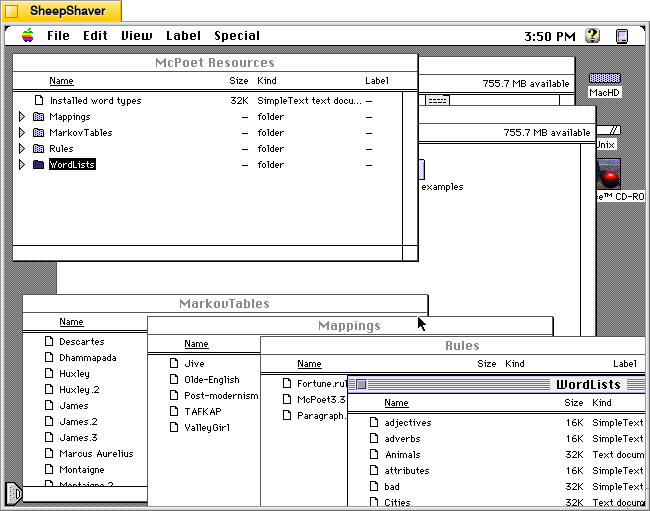
As explained in the help documentation, McPoet’s rules and word lists are all externalized so that they are easily edited and expanded by the end user. This is the same approach used by Kant Generator Pro and Electric Poet (to a lesser extent). All of these files in the McPoet Resources folder–MarkovTables, Mappings, Rules, and WordLists are all text files that can be edited by the end user. The end user can also add to these files to expand McPoet’s feature set and capabilities.
McPoet is a remarkable program that I can imagine being something of a curiosity to some, a source of joy to others, and a powerful tool in the right hands. Like the generative AI technologies of today, McPoet can be used as another composition tool–generating interesting strings of words, conjuring ideas for further writing, giving the mind some distraction while cogitating on a larger problem, etc. While the text generated and/or transformed by McPoet can be its own end product, it seems like it might be more useful as a place for the writer to grab some clay to begin working into something else–an art object, a poem, a killer phrase for prose or a speech, etc. I have a lot of respect for Westbury to code this cool application that can do so much with text through an easy to use user interface while also giving the end user so much control over its features through the editable support files that make McPoet work. I can’t wait to bring this program into my writing classroom!