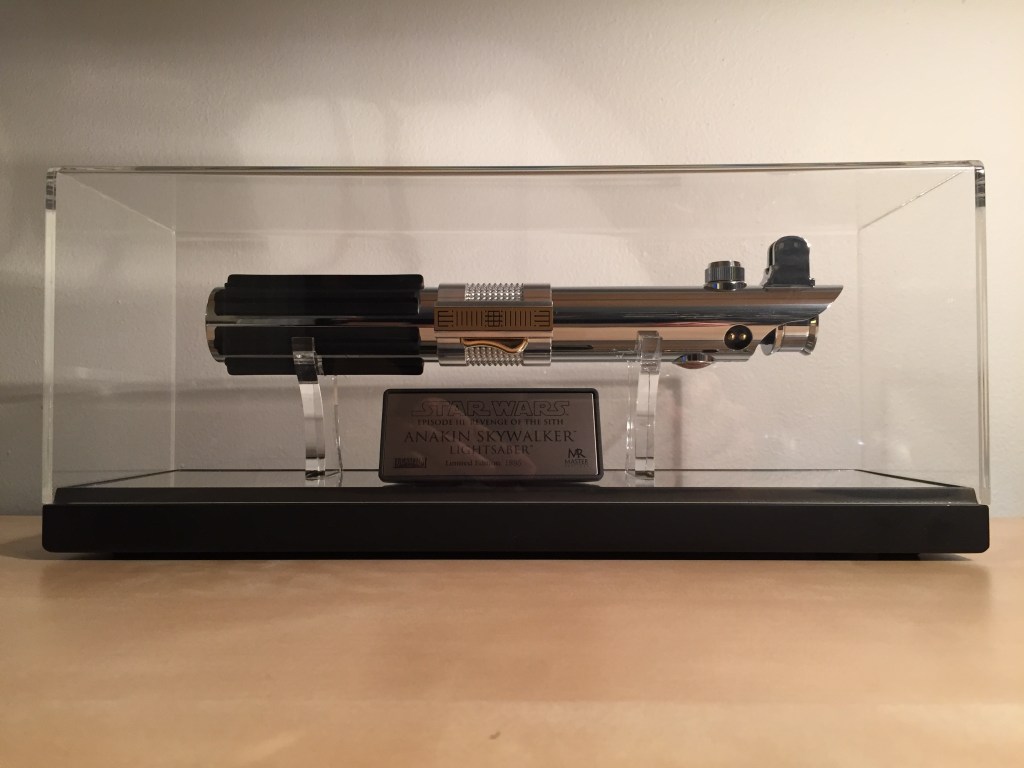
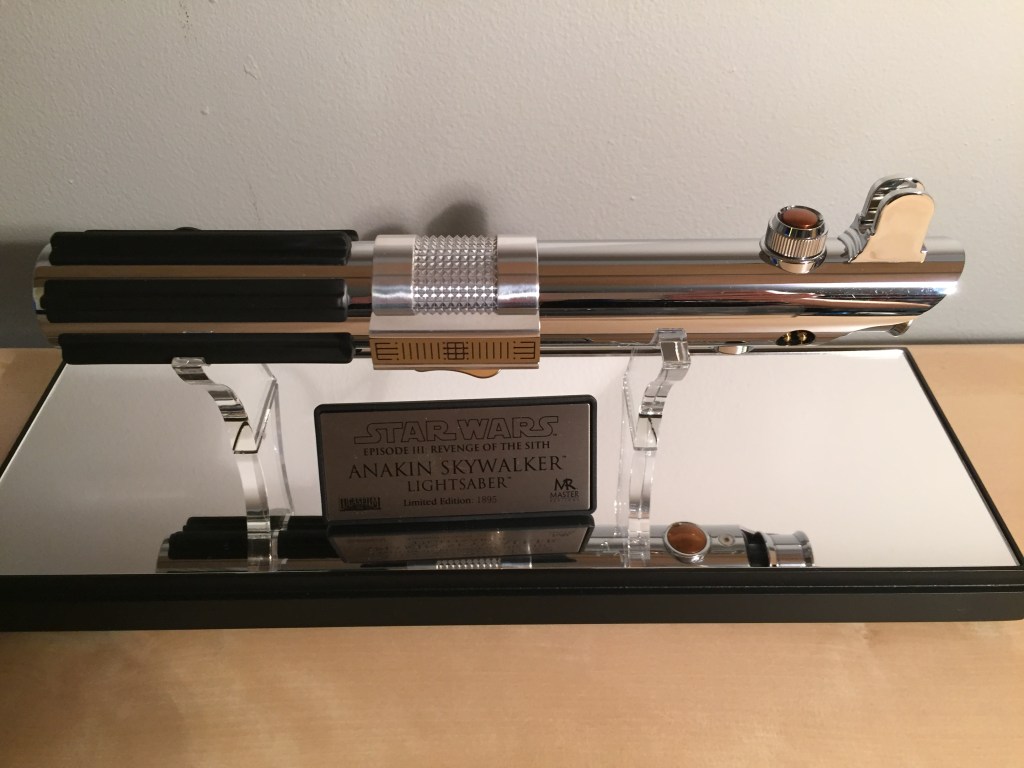
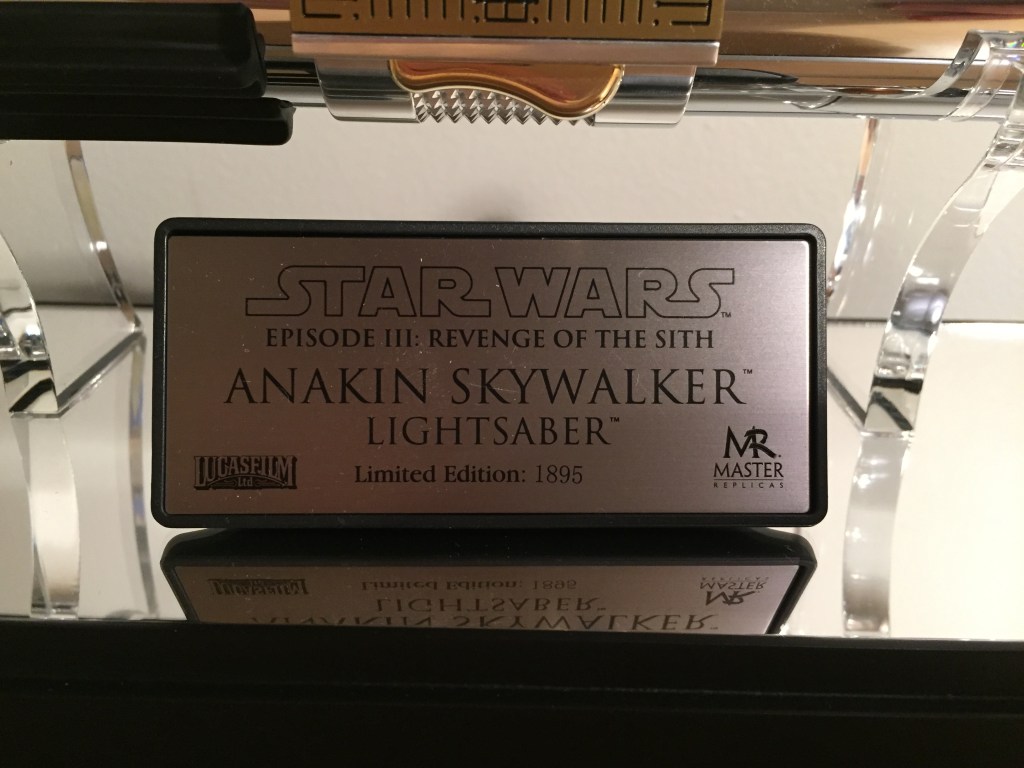
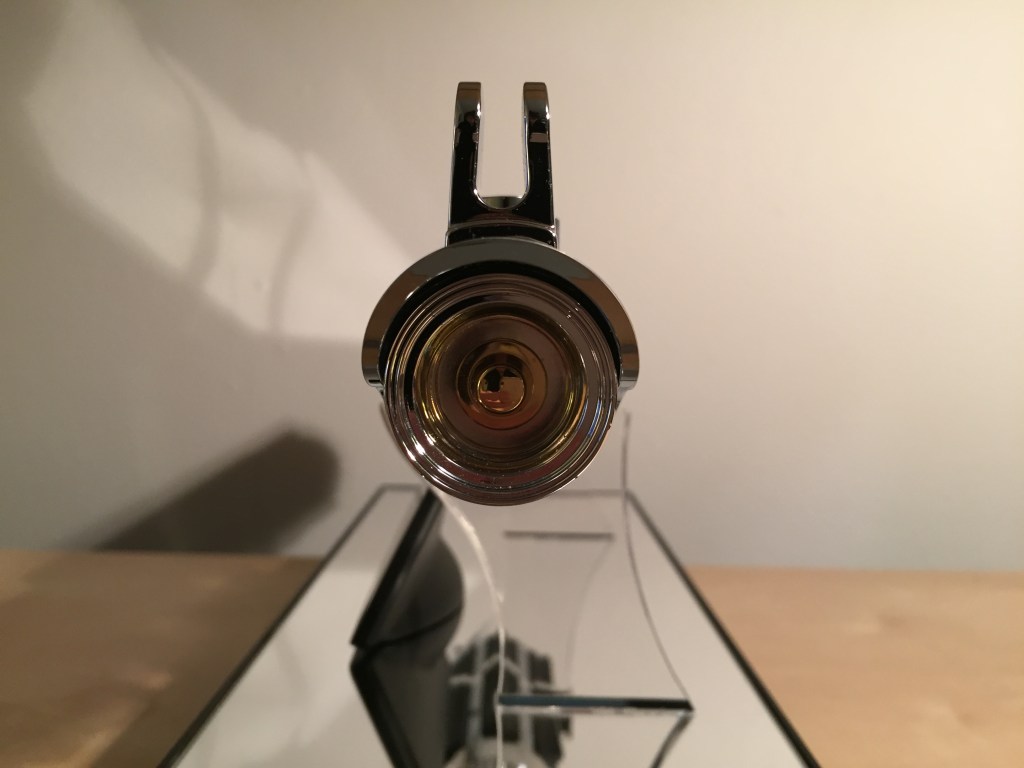
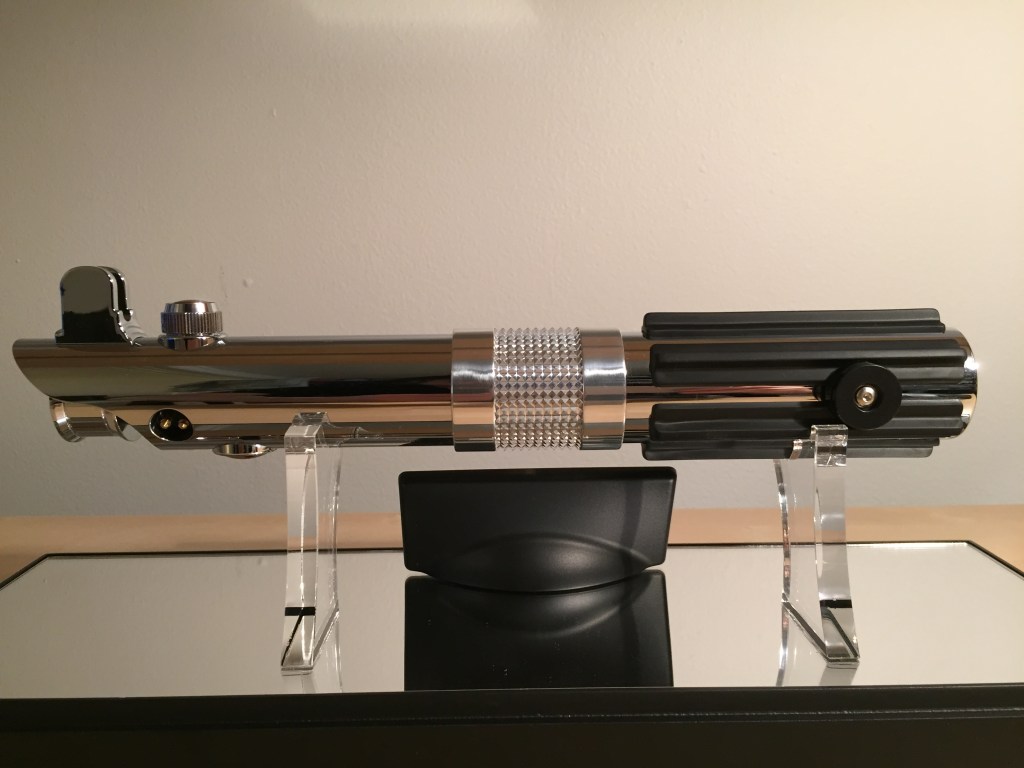
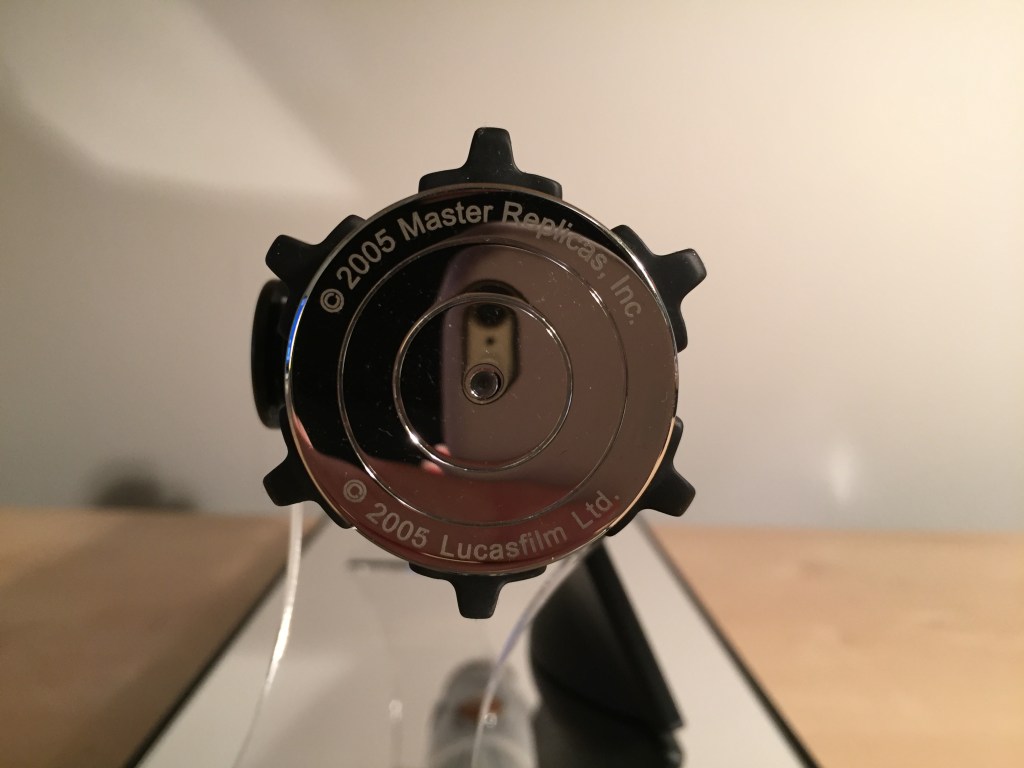
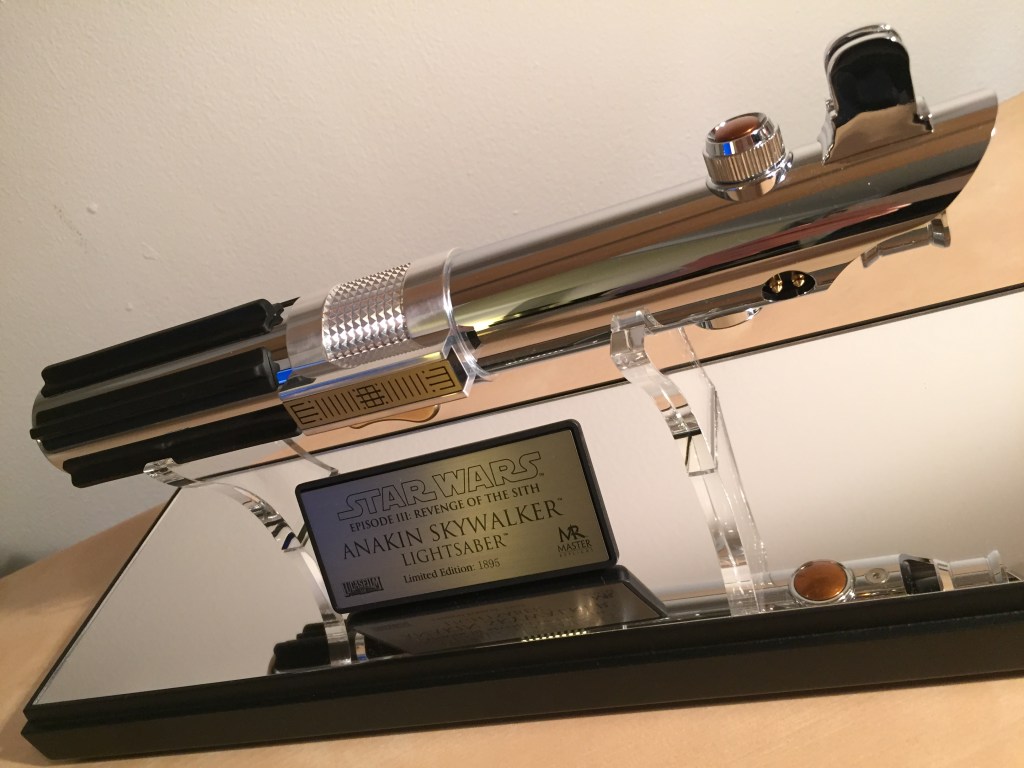
Then, in 2006, my folks gave me the Master Replicas (MR) Anakin Skywalker lightsaber shown above as my Georgia Tech graduation present. It feels like a solid piece of steel or an alloy–heavier than aluminum. It is certainly heavier than the mostly hollow Graflex flash handle (sans batteries). Also, it doesn’t have a belt clip, but given its weight, it would not be practical to have this dangerously heavy lightsaber reproduction hang for your belt during anything more than standing still.
The MR lightsaber is designed for display, and it performs well in that function. The mirrored base illuminates the lightsaber with reflected ambient light. The plastic cover keeps out the dust. The shiny surface of the MR lightsaber attracts grease, fingerprints, and dust, so it’s best to keep a lint-free cloth or gloves nearby for picking it up.
Even sitting there on the shelf, the MR lightsaber inspires imaginative adventures as a Jedi defending the Republic, righting wrongs, and fighting for justice.
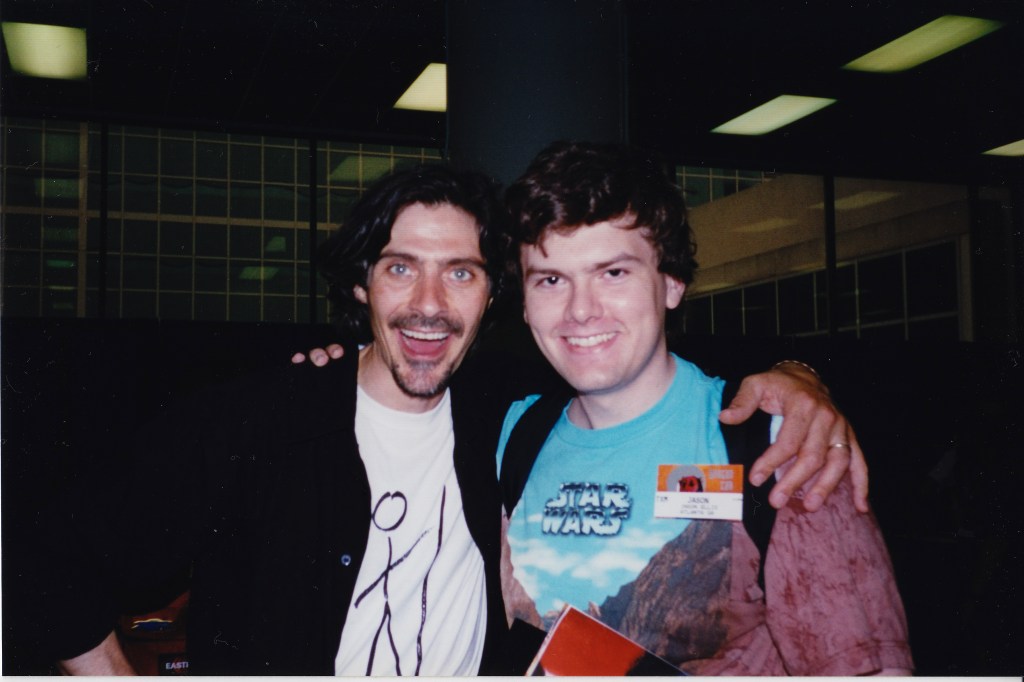
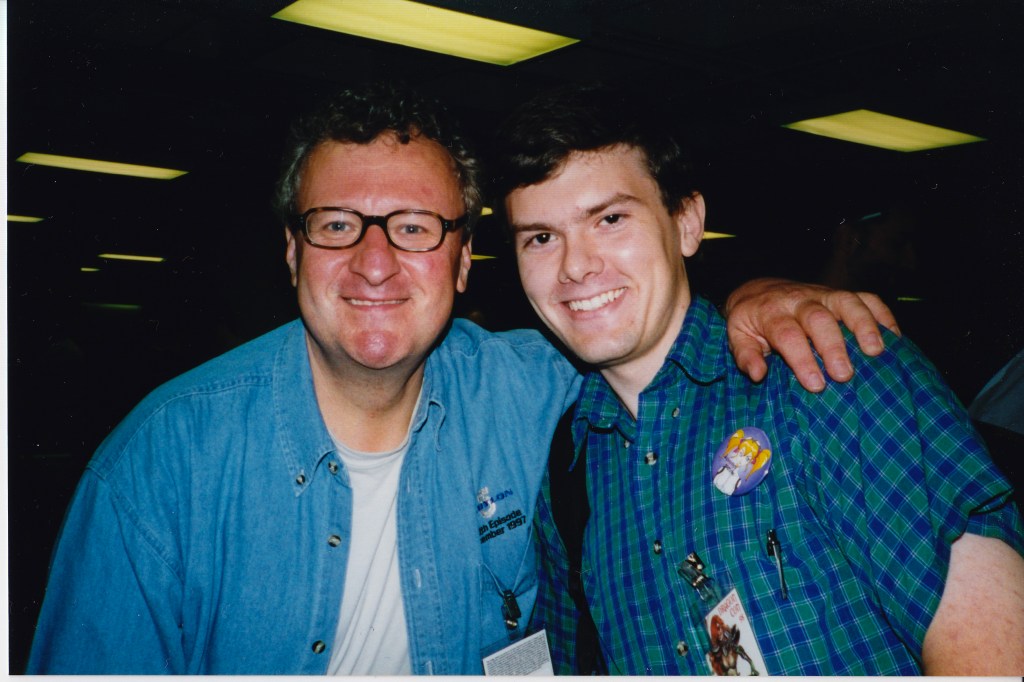
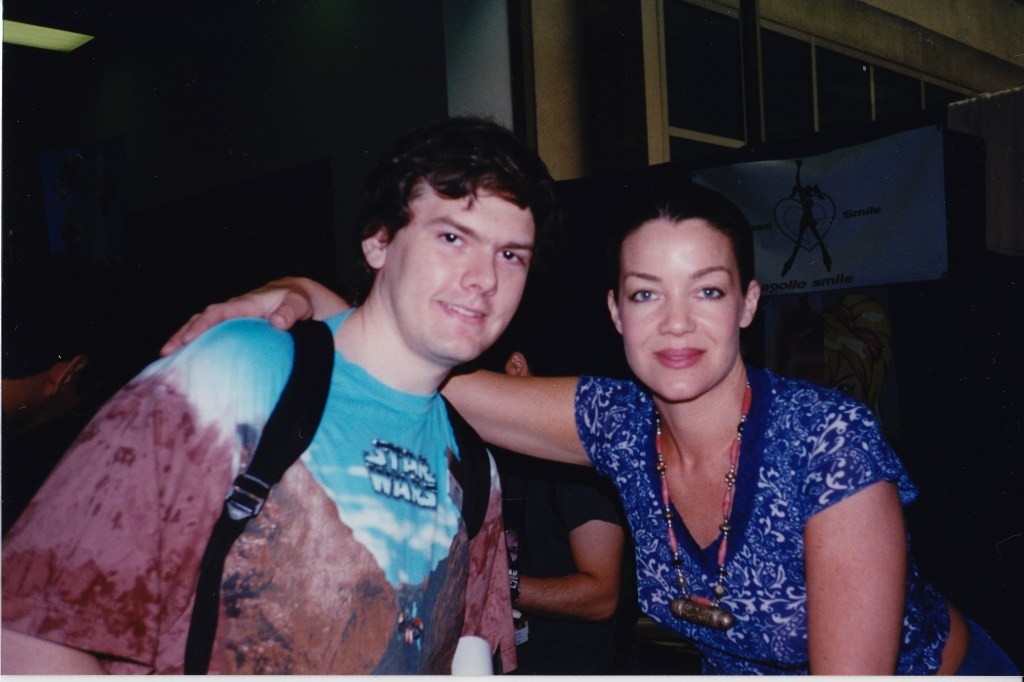
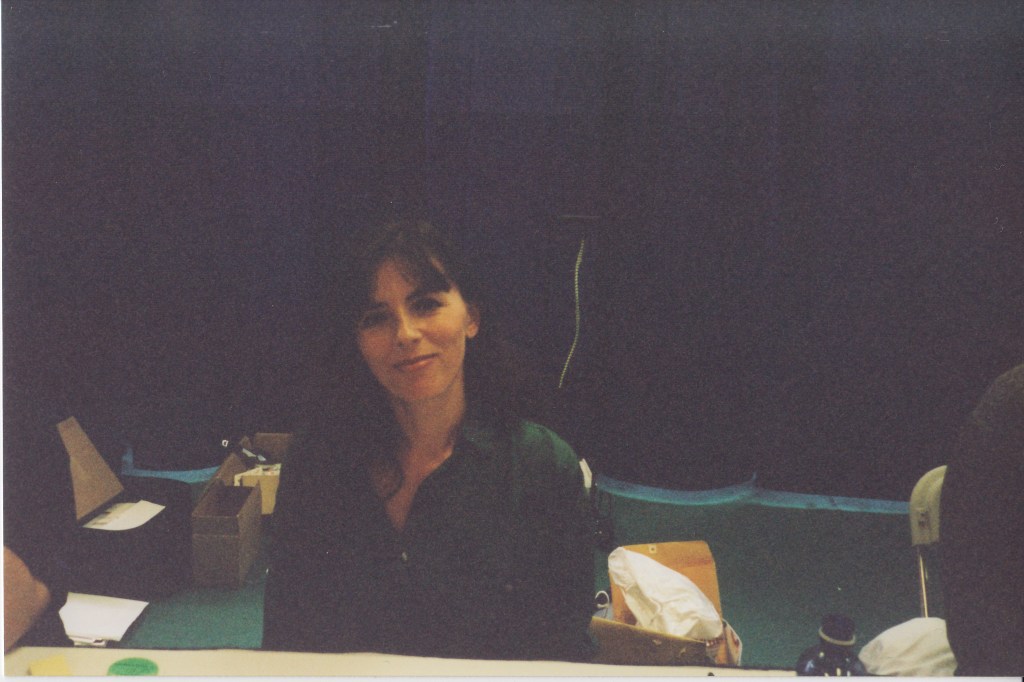
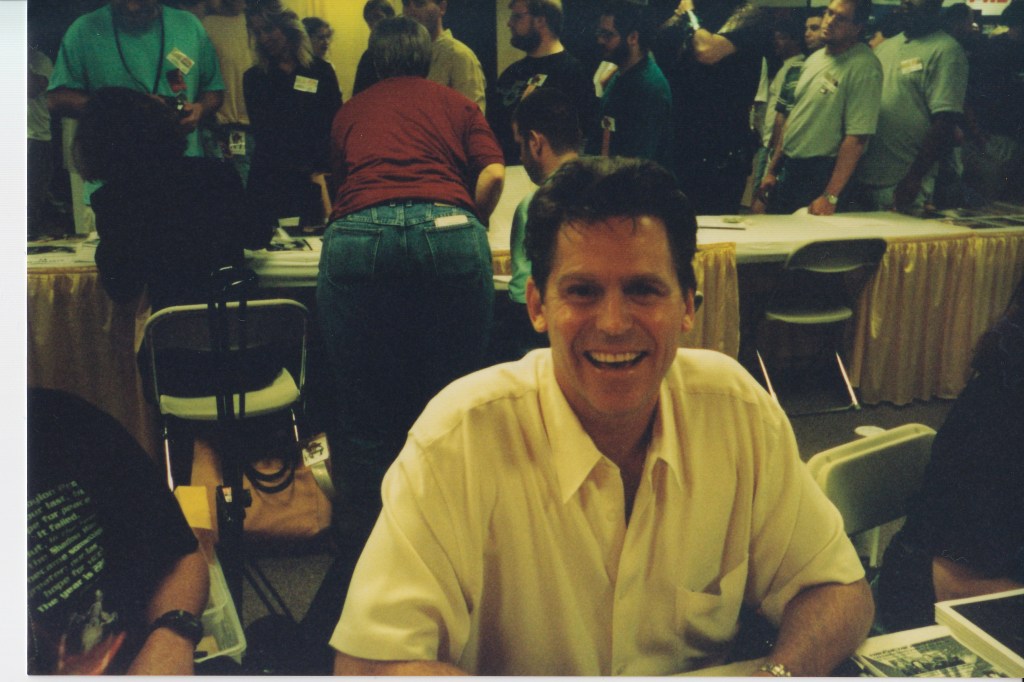
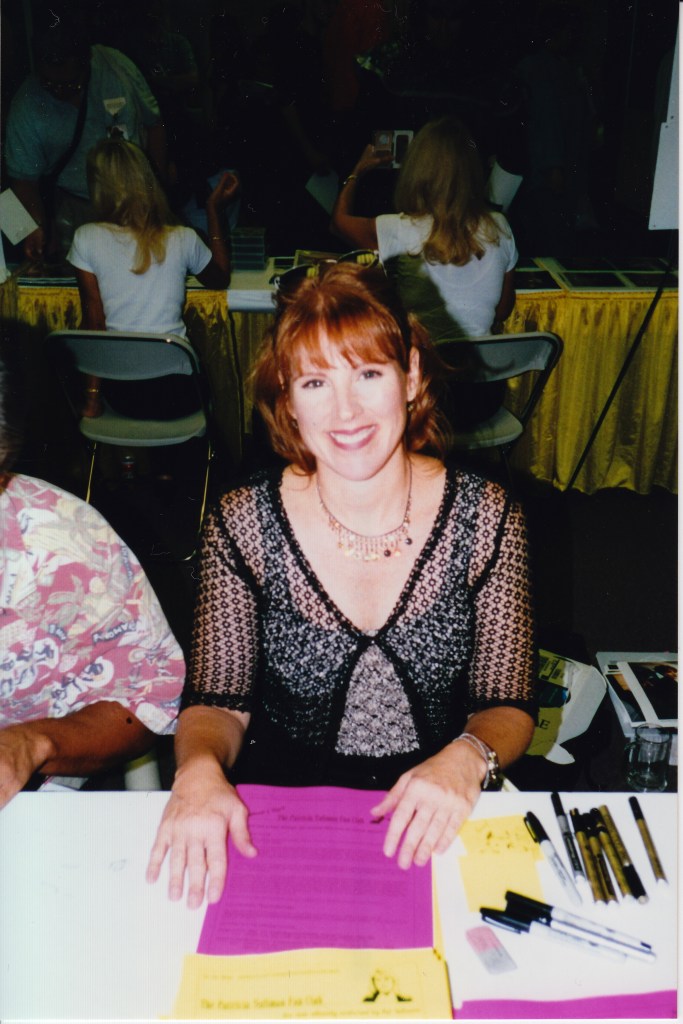
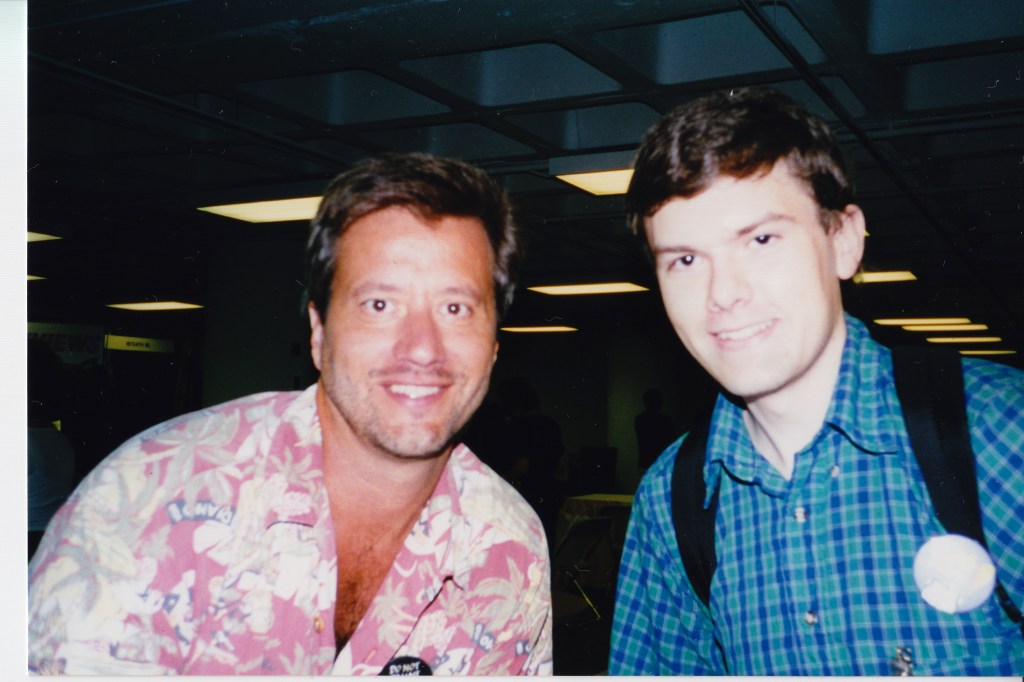
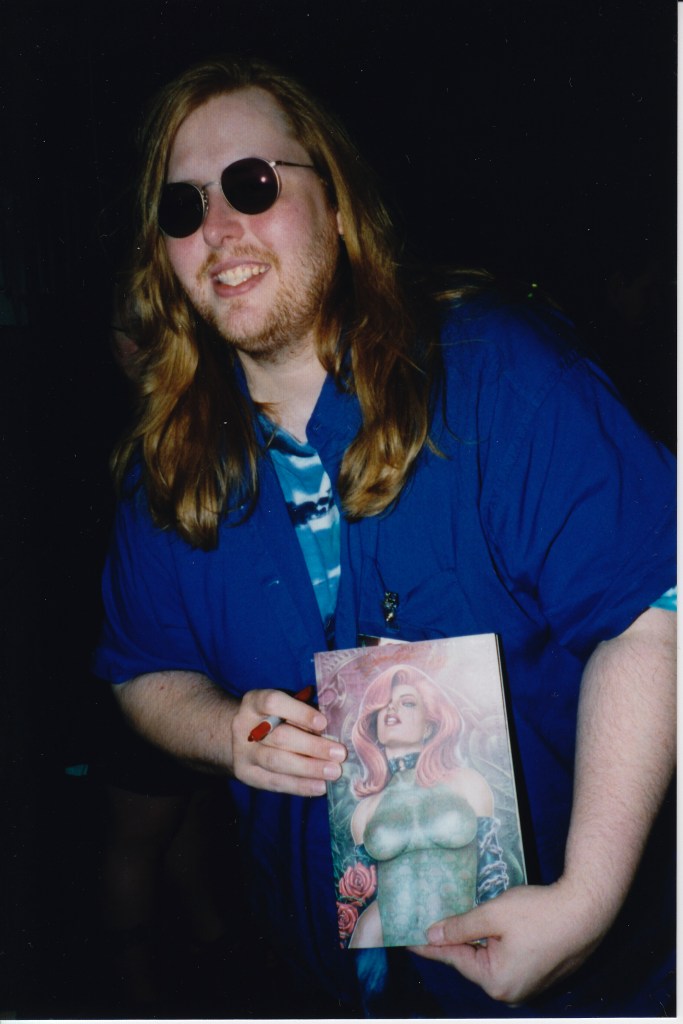
Before the 1998 Dragon*Con in Atlanta, Georgia, I had never been to a fan convention (con) before. I had been to small town comic book/baseball card shows, but there were no celebrities or cosplay at those.
My first girlfriend, who was a student at Wesleyan College, wanted to go, because she wanted autographs from Wendy and Richard Pini (Elfquest) or Marion Zimmer Bradley (The Mists of Avalon). I can’t find a guest list for 1998 and 1999–the two cons we attended together–and I recall from memory who was when.
Nevertheless, I do remember my interests at the con. I am a Star Wars fan, and I was watching Babylon 5 on TNT at that time, so I thought it would be cool to meet some of the actors in my favorite series. As an added bonus, Ray Bradbury and Harlan Ellison were attending, so I looked forward to meeting them, too (I plan to write more about this practice and my disavowal of it now, but I’ll save that for another post).
Looking at these photos now, it’s difficult to wrap my mind around the fact that 25 years separates then from now. While a lot of things have transpired during those 25 years leading up to my winding up in Brooklyn, New York, they seemingly passed in a blink of the eye.
Science Fiction Writers
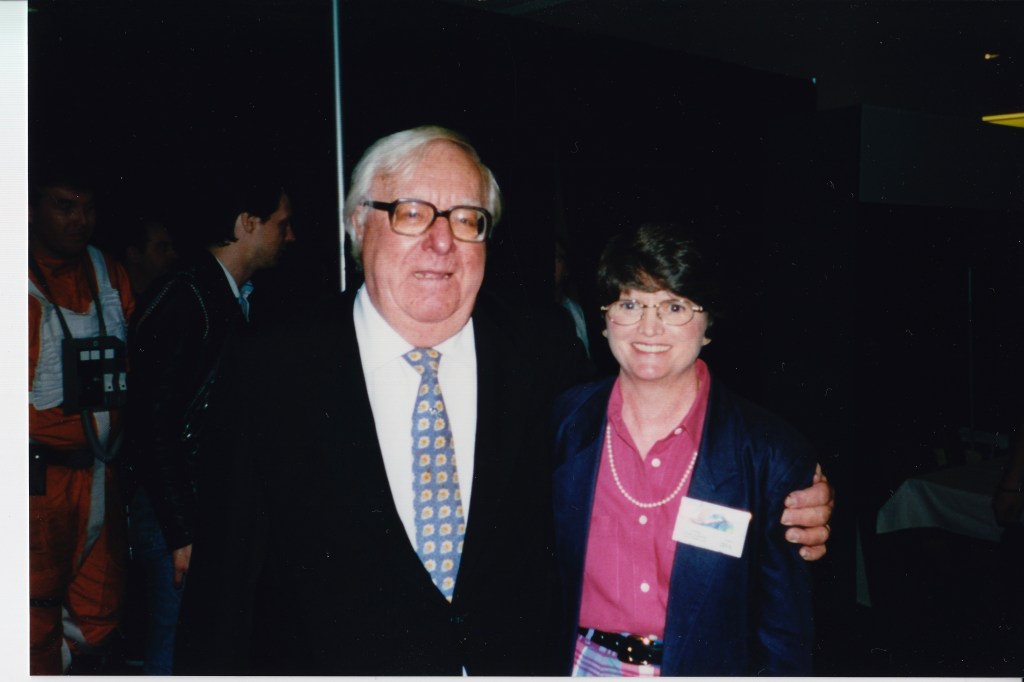
Ray Bradbury
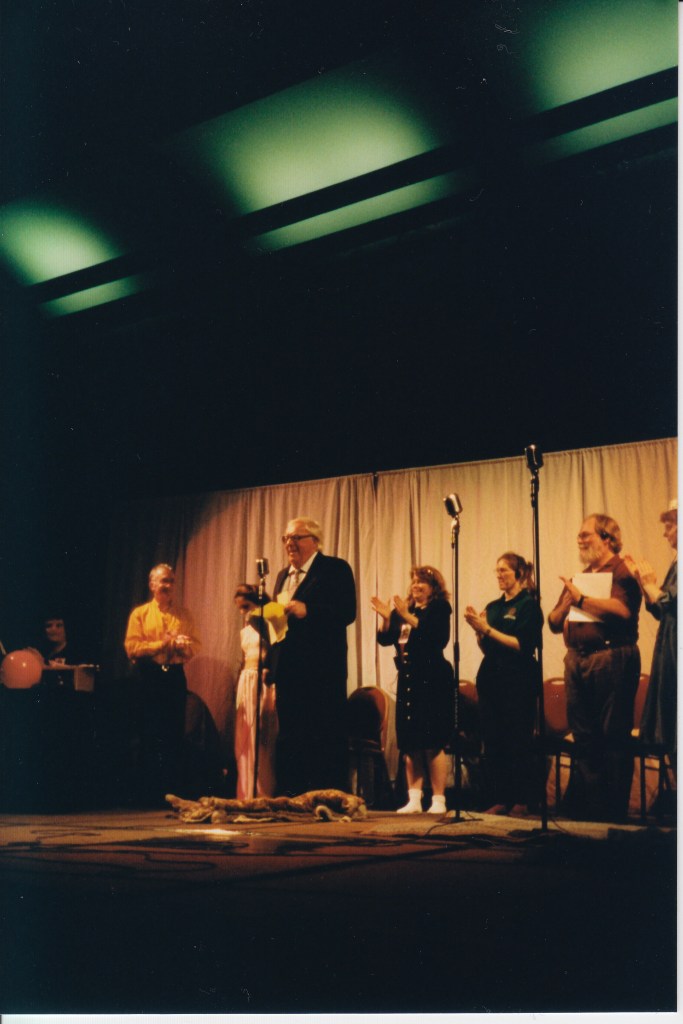
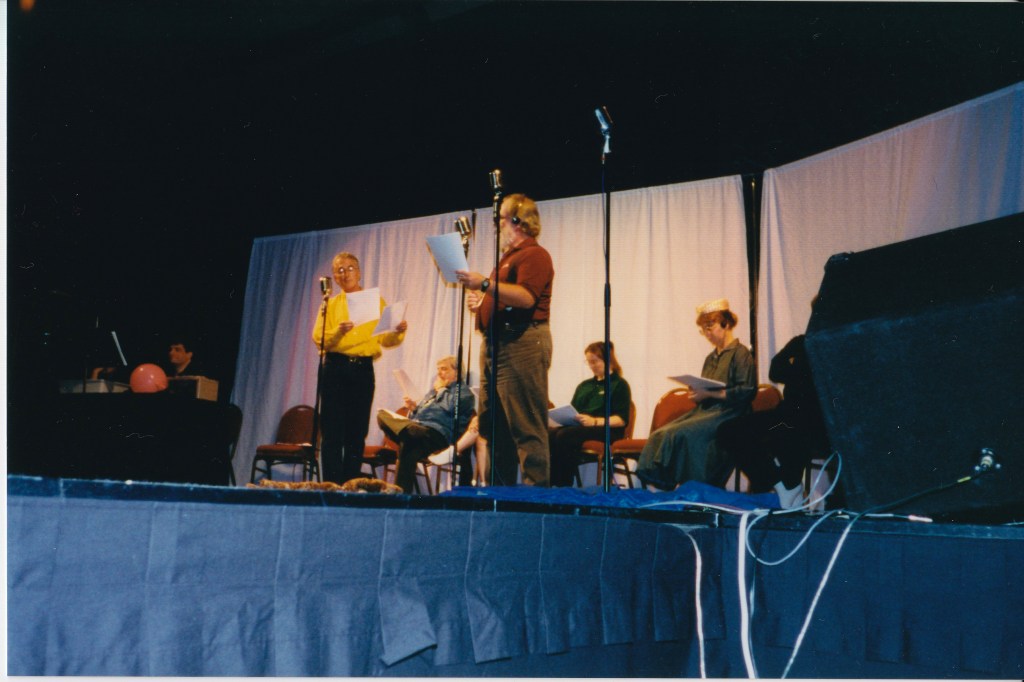
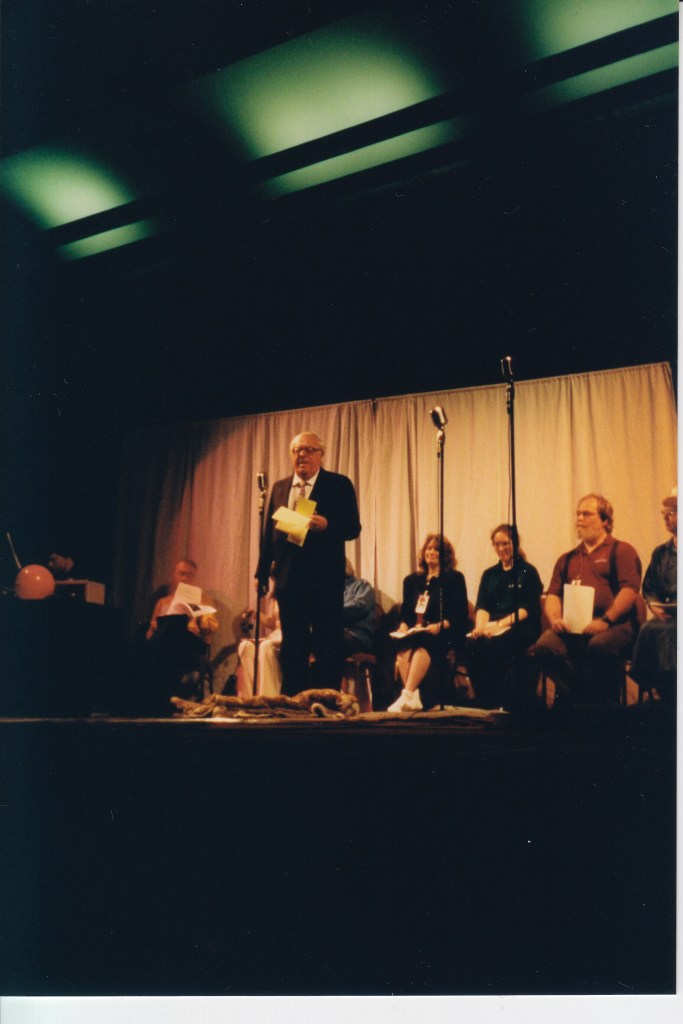
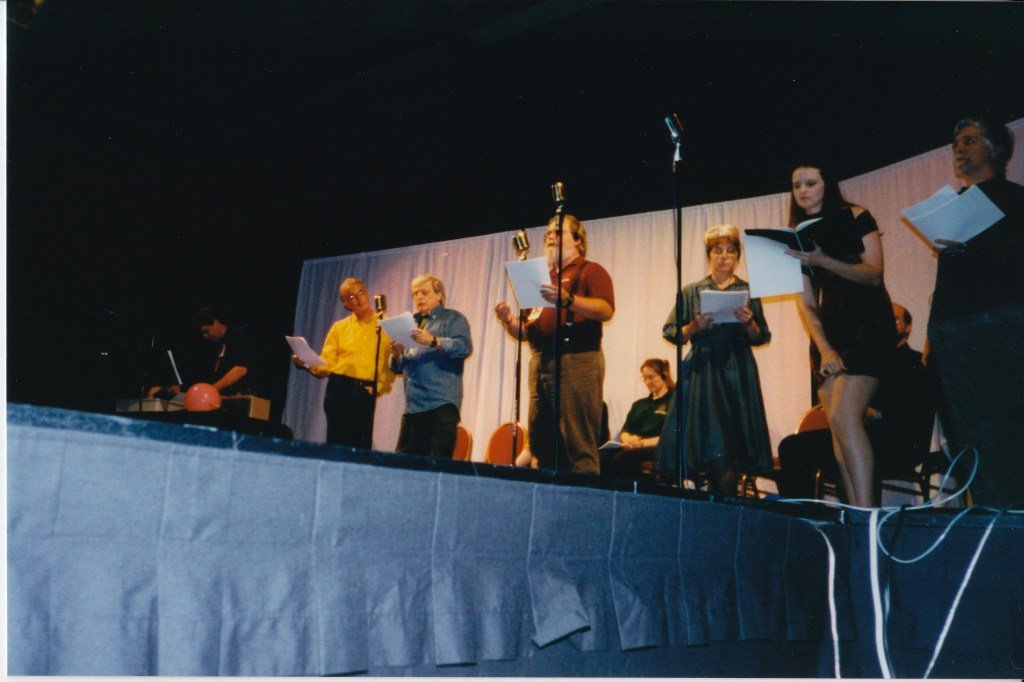
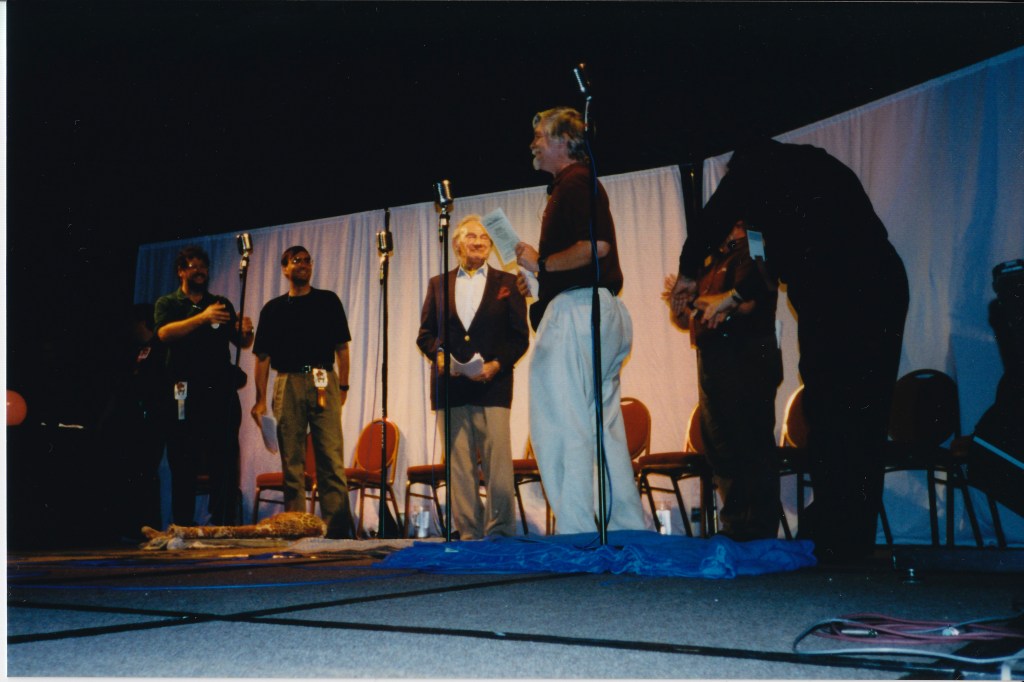
I took this picture after Bradbury had made the introduction to the Atlanta Radio Theater Company’s “The Man Who Walked Through Elephants,” an adaptation of a Robert A. Heinlein story that is Bradburyesque.
After introducing myself, Bradbury besieged me, “Jason, it’s good to meet you, but where are your Argonauts!?”
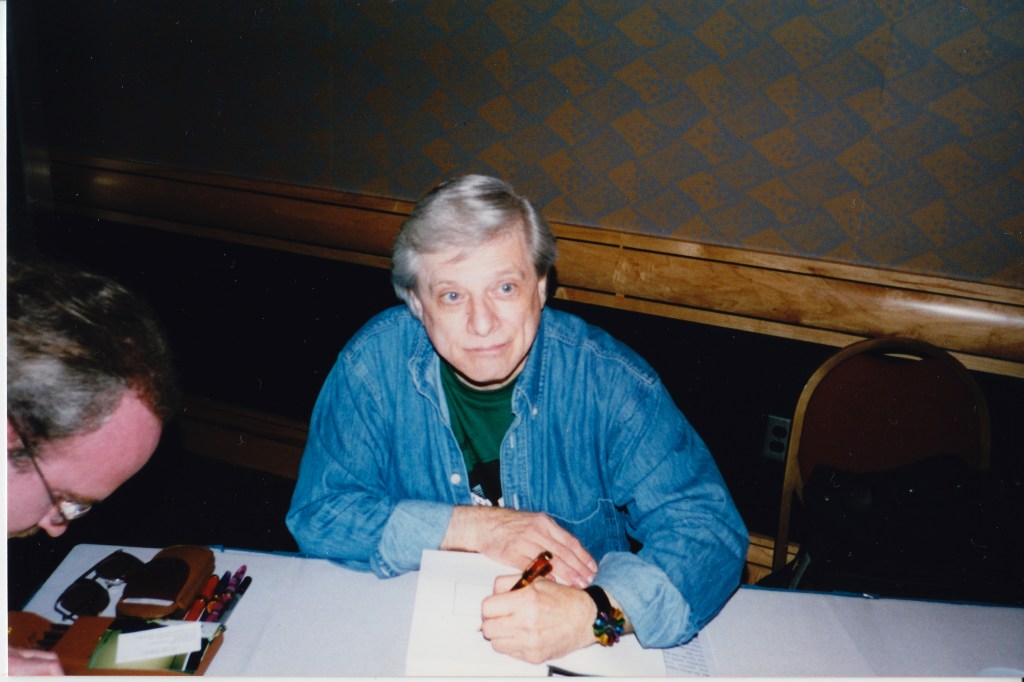
Harlan Ellison
The line for Harlan Ellison’s autograph was astonishingly long. Despite the cantankerousness attributed to him, he stood in his chair and shouted to us, “I’m not leaving until everyone who wants an autograph gets one!” Those of us in the crowd cheered! He was true to his word.
Star Wars
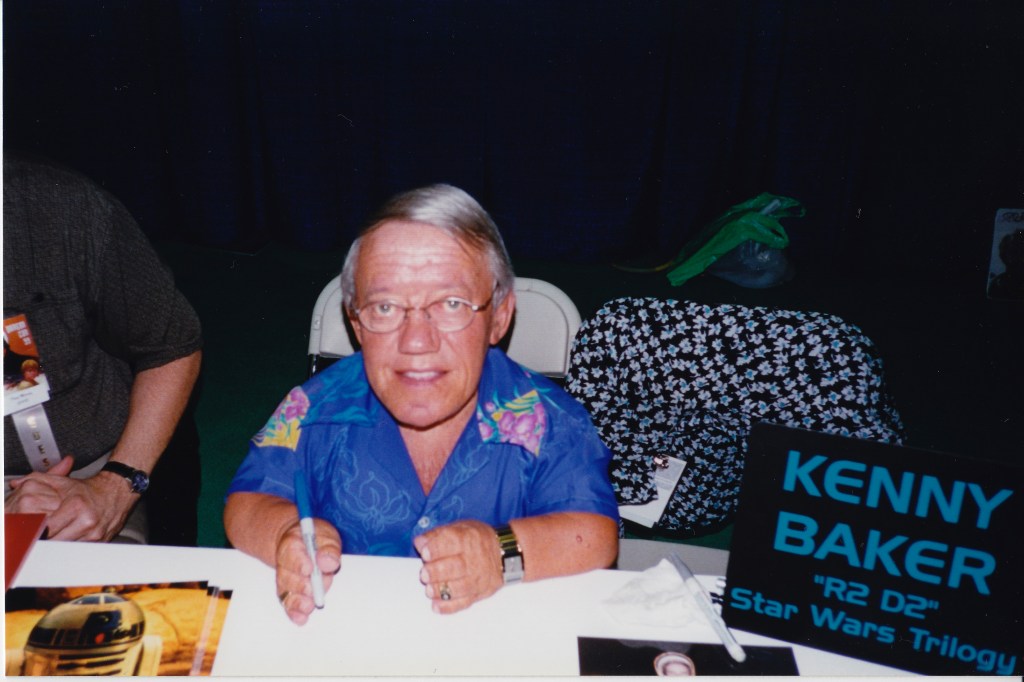
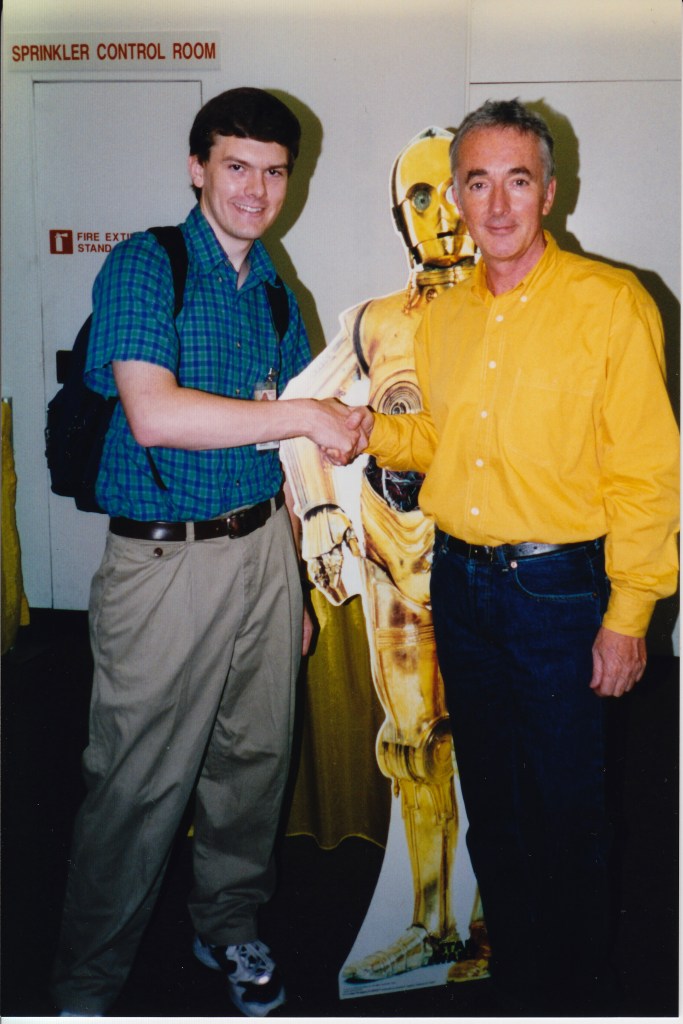
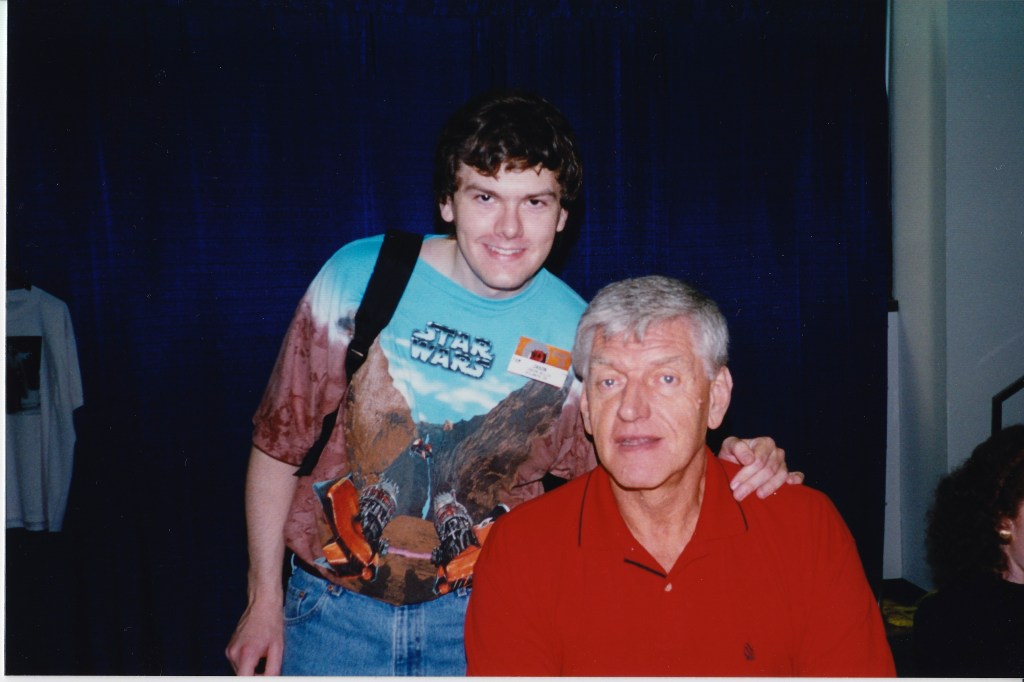
Meeting Kenny Baker, Anthony Daniels, and David Prowse was a highlight of my con experience. It was a strange experience meeting each actor. Having seen them play their roles behind masks and suits throughout my life was difficult for me to square with them in the flesh. Ecce homo.
Kenny Baker/R2-D2Anthony Daniels/C-3PODavid Prowse/Darth Vader
Babylon 5
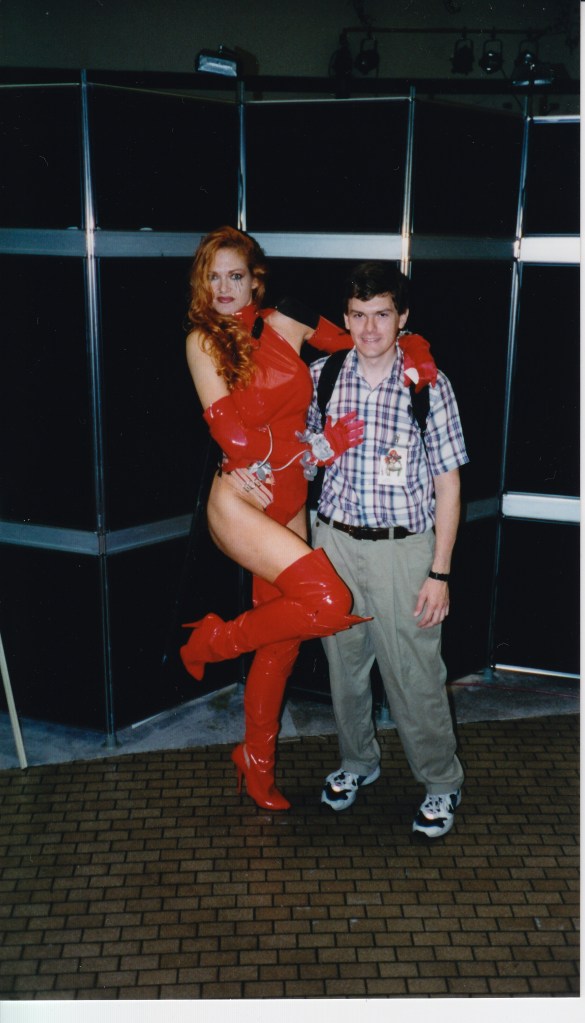
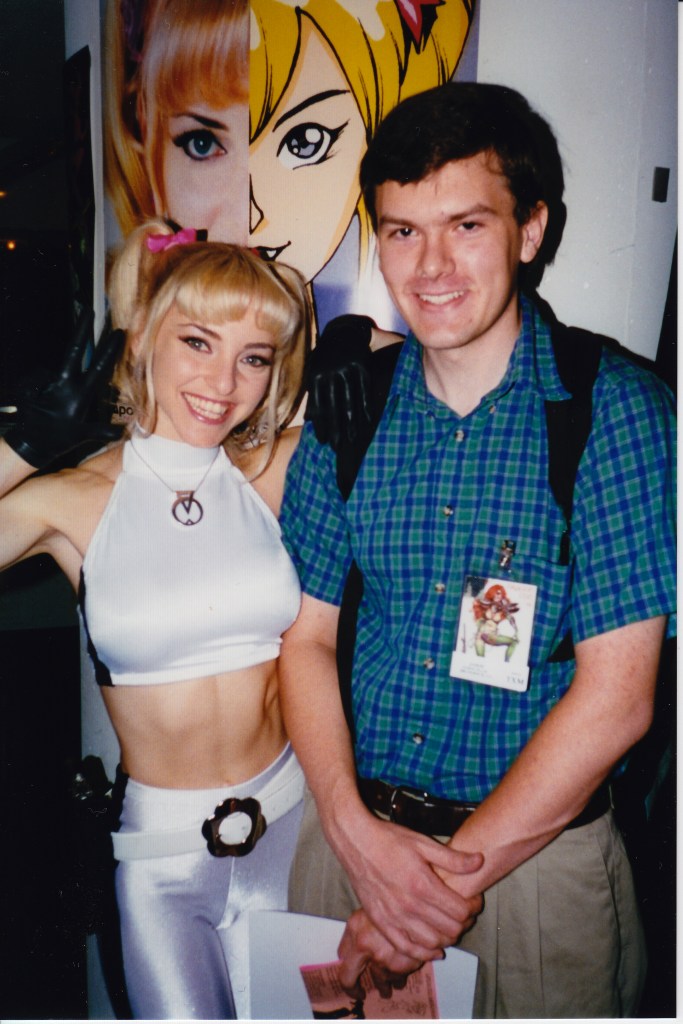
Babylon 5 was nearing the end of its first five season run, so it was great to meet much of the cast in person. I’ll begin with Jason Carter, because I wanted to be a Ranger prepared for action with a Denn’bok.
Jason Carter/Ranger Marcus ColePeter Jurasik/Londo MollariClaudia Christian/Commander Susan IvanovaMira Furlan/DelennJeff Conaway/Zack Allan
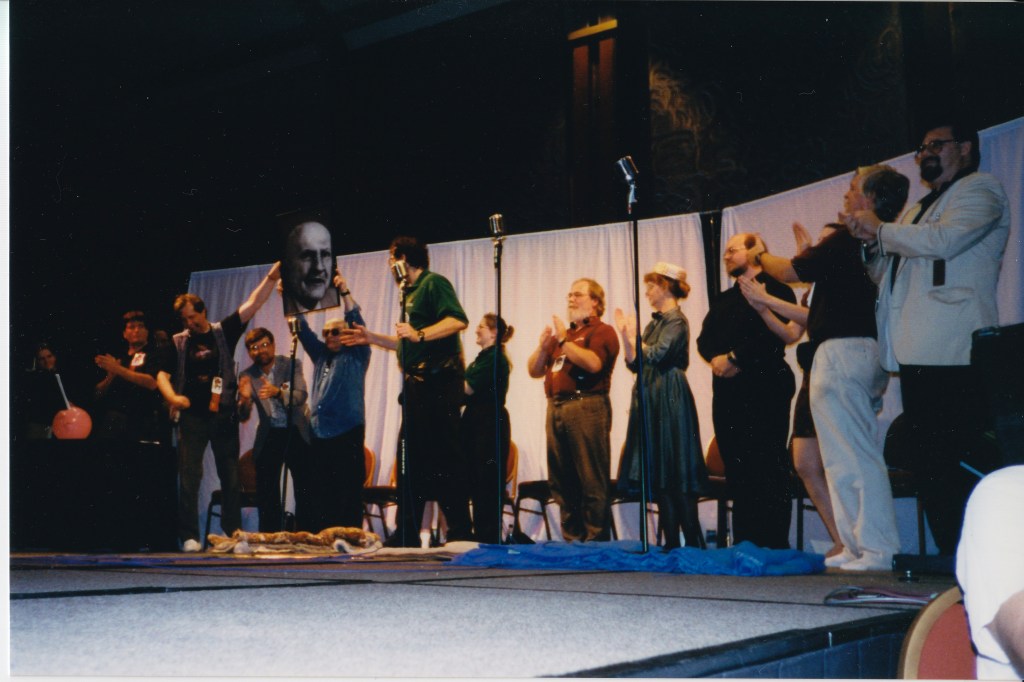
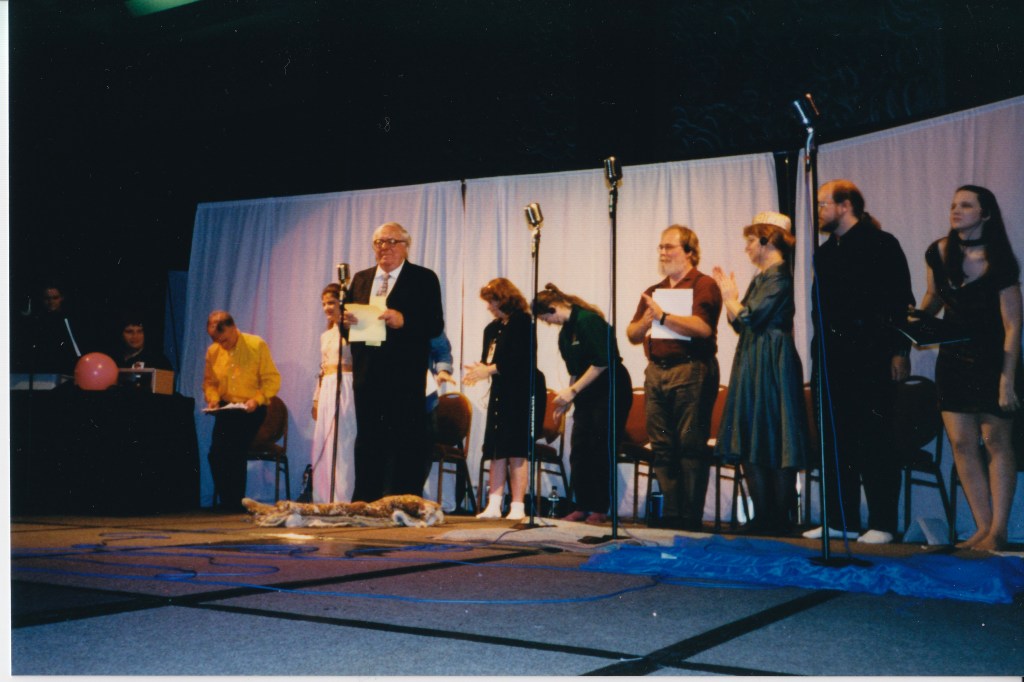
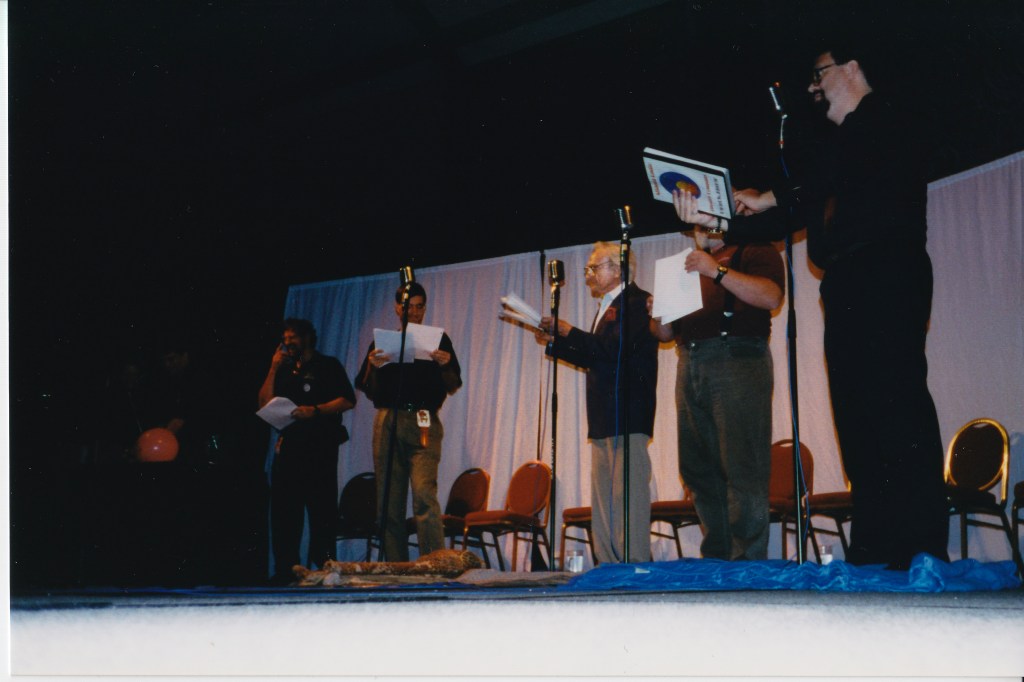
The Atlanta Radio Theatre Company produced two back-to-back shows one evening of the con. The first was “The Man Who Traveled Through Elephants,” an adaptation of a Robert A. Heinlein short story that is Bradburyesque. Ray Bradbury introduced it. Anthony Daniels and Harlan Ellison played roles in the production.
Rory Rammer, Space Marshall: The Space Cycloplex
The second ATRC production was a Rory Rammer, Space Marshall story featuring Jonathan Harris (Dr. Smith on the original Lost in Space TV series).
The last time that I went to Dragon*Con was 2011 to participate on a panel organized by the Science Fiction Research Association (SFRA). I had to wait in a long line to get my badge and then there were crowds of other attendees. I am uncomfortable in crowds. According to numbers on Wikipedia, the weekend event’s attendance was more than 46,000. That’s 2.5x as many attendees as when I first attended in 1998, which was 18,000. In 1999, there were 19,000. And the last time that I attended as a fan with my cousin Ryan and friend Bert in 2000 there were 20,000 attendees, which felt slightly claustrophobic to me. So, you might imagine how overwhelming the 2011 event felt to me while navigating through the crowds in various places of the con.
Of course, this is a personal thing. I’m not necessarily suggesting that cons should be smaller by design (though, that would be cool for folks like me), but there are gobs of people who aren’t concerned by crowds in the least and in fact thrive off all of the humans in one place. I’ll stay at home and let those folks enjoy future big cons!
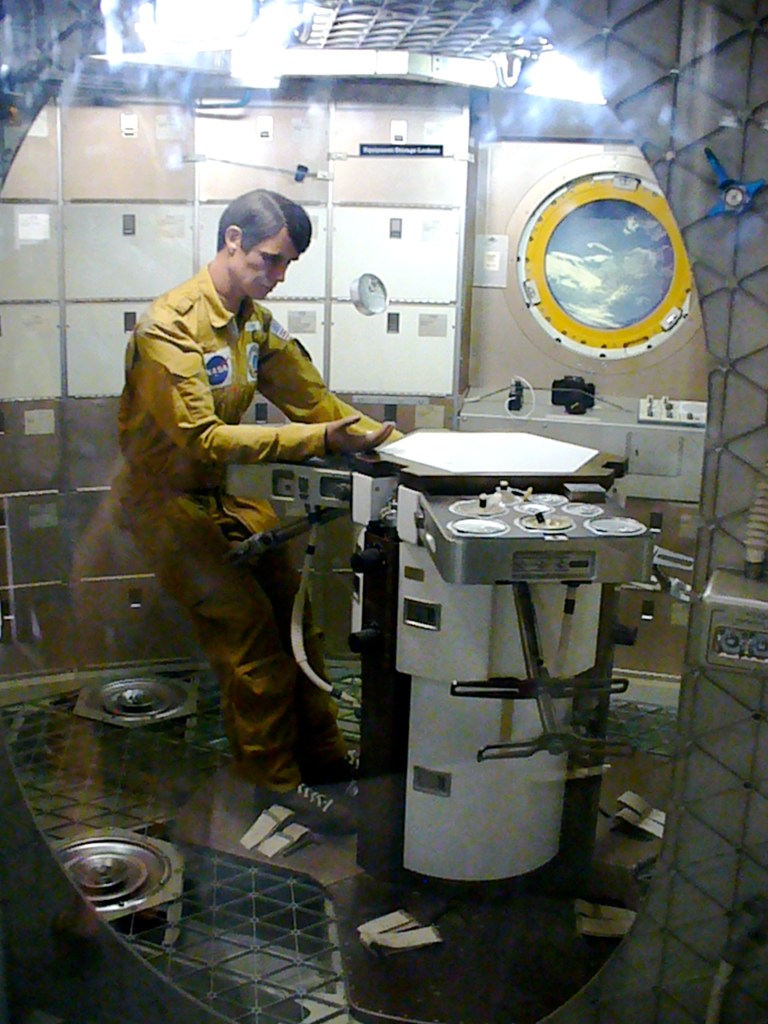
Skylab Orbital Workshop Interior, Smithsonian Air and Space Museum, Washington, DC. Photo taken in 2008.
As I wrote last week here, I reached out to Steve Lenzen via postal mail about Space Station L-4, the Earth Sciences Educational Program from 1977, after I found his contact information on an archived version of GPN’s website. He worked at GPN from 1976 to 2006, and he co-founded Destination Education. He kindly replied to me via email with important details about the history of GPN and why it might be impossible to find a copy of the series. He explains:
"The series was produced by Children's Television International, which was owned by Ray Gladfelter. When Ray was "winding down" his career, GPN took over distribution because Ray was an old friend of our director at the time. When Ray died, many, many years ago his old friend had also retired and GPN ceased distribution. Actually, GPN had ceased distribution years before that because there was no demand."

"Back when Ray produced the series many or most of the PBS Stations broadcast programs specifically designed for use in the classroom. This mode of getting educational programming into the classroom was started before the age of VHS and Betamax. The introduction of Betamax and then VHS is what led to the "death" of 16mm film and subsequently PBS stations airing a block of programs designed specifically for in classroom use. Starting in the late 80's, teachers were demanding that PBS Stations air only new, up-to-date programs depicting current hair styles, clothes, etc. If a series did not meet this criteria, teachers did not want it."

"Due to the lack of storage space, once a series was pulled from distribution GPN destroyed the submaster it had. The copyright holder/producer usually had a master. Space Station L-4 was pulled out of distribution long before advent of DVD which meant it cost of lot of money to keep old master, usually 2" Quad, 1" Helical, or Betamax in storage. As a result, the copyright owner also destroyed their copy."

"After Ray's death, his son . . . took control of Children's Television International. . . . The company, CTI, was, out of business by then so all he could do was find a place to give the tapes or destroy them."
My next move is to reach out to Ray Gladfelter’s son. I will report back with any developments.
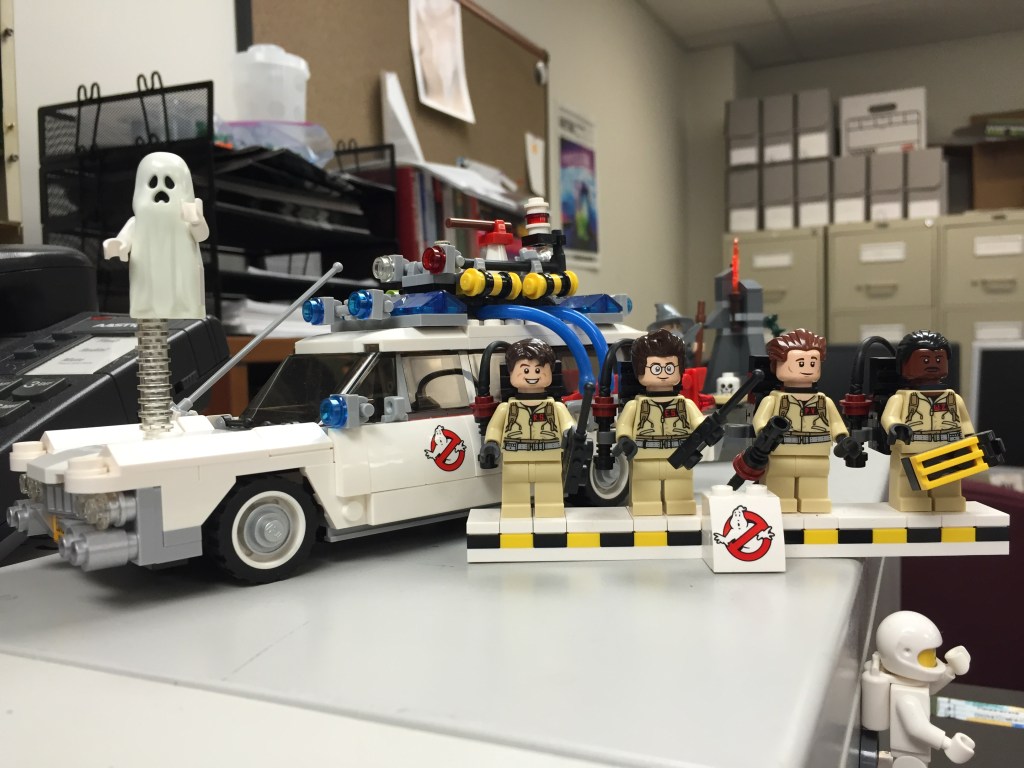
I started with these photos that I had taken in 2015:
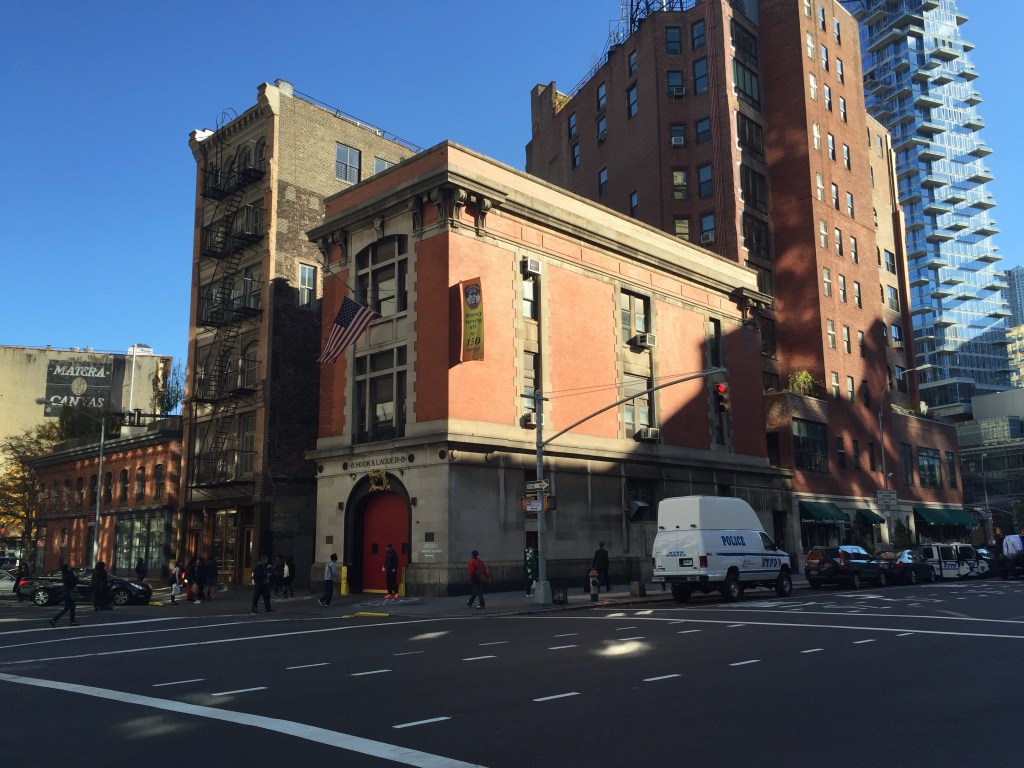
On the left is a photo that I took of the Ghostbusters LEGO 21108 set on my desk at City Tech. All of the elements that I needed are here, but I realized that I would have to break it down into parts to create the composite image–ghost, Ecto-1, Ray, Ego, Peter, and Winston. On the right above is a photo that I took of the Hook and Ladder Company 8 building in Manhattan. Due to the time of day that the photo was taken, the front of the building is in shadow and there are sightseers in front of the firetruck door that need to be removed.
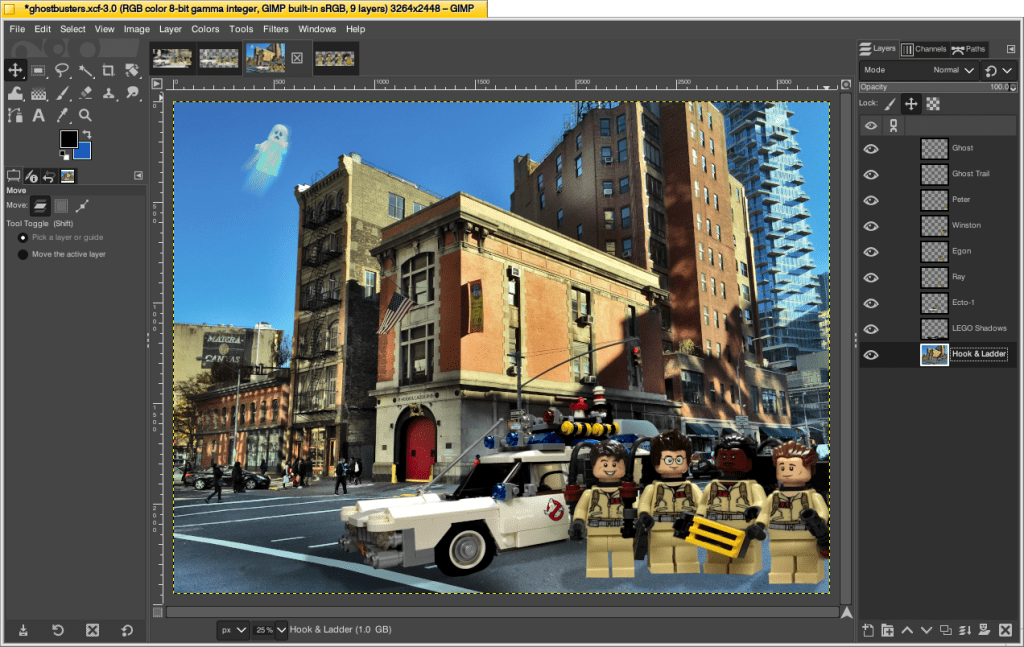
I setup my work document in GIMP in the following way.
First, I pasted the hook and ladder photo as the bottom-most layer. I adjusted the colors and reduced the shadows to help the firehouse pop in the center of the photo. I used the lasso tool (creating irregular shapes instead of squares or circles helps with blending later) and clone tool to copy material over the sightseers in the front of the firehouse and to remove a light reflection on the road surface in front of the pedestrian walking line in the lower left. I smoothed out these fixes with the smudge tool.
Then, I cut out the ghost, Ecto-1, and four Ghostbusters and pasted each into its own independent layer and adjusted colors appropriately. Because the Ghostbusters are obscuring part of Ecto-1 in the original photo, I needed to arrange the composition so that they hid the back of the vehicle. But, I had to use the clone tool to repair some aspects of the car (e.g., the clear 1×1 round studs that had supported the ghost needed to be removed and the white surface of the hood restored), and some of the exterior windows and side panels peeked through gaps between the Ghostbusters (I used the clone tool and lasso tool to create the rear windows and side panels). Also, I wanted to arrange them so that it appeared more like a group shot instead of a line as in the display for the original set. To achieve this, I flipped horizontally Winston and Peter’s images to that they are turned toward Ray and Egon to their right. Unfortunately, this flips their name tags, but maybe no one will notice! Also, I increased their size by 120% to make them appear further away from Ecto-1 and closer to the viewer. I’ll return to the ghost below.
Next, I added a layer between the firehouse image and Ecto-1 (being the lowest layer of the LEGO images). I used the paintbrush with a large brush to paint black “shadow” under Ecto-1 and falling from right to left on each Ghostbuster member. I reduced the opacity of the layer to lighten its appearance so that the shadow wasn’t too harsh.
Finally, I transformed the ghost layer and rotated it to about 60 degrees. I adjusted its colors to give it a neon green hue. I then duplicated the layer. On the lower ghost layer, I applied a linear blur to give it a flowing, streak effect, which I positioned under the ghost to give it implied ethereal movement.
The final product isn’t perfect, but it was fun to make and it helped me learn/reinforce workflow practices in GIMP.
Don’t let perfection hold you back from using tools to make things that bring you joy. Each time you make something, you learn new things and get better at doing the things you’ve learned before. If you have the time, energy, and material, you can always take another stab at the thing you did before to make a better iteration. Though, I recommend starting fresh each time instead of making adjustments to something you’ve already made. The process of building and making from start to finish can yield wildly divergent and better outcomes that can be surprising and unexpected. Tweaking what you’ve already done might yield something interesting, but the constraints of the original project might limit what is ultimately possible.
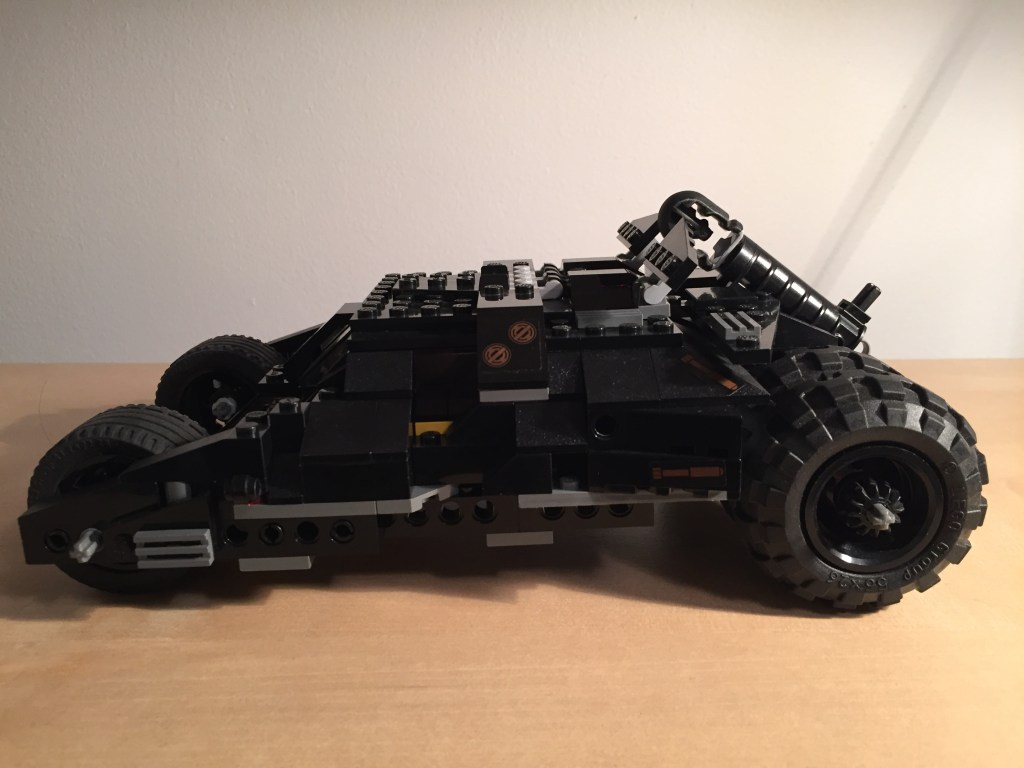
There are, in my mind, only two actors who are worthy of donning the cowl and cape: Michael Keaton and Christian Bale. Keaton’s Batman performances in Tim Burton’s Batman (1989) and Batman Returns (1992), and most recently in The Flash (2023), holds a special place in heart as how I imagined a hard boiled Batman. Bale’s Batman in Christopher Nolan’s Batman Begins (2005), The Dark Knight (2008), and The Dark Knight Rises (2012) reclaimed for the character what had been lost in Joel Schumacher’s Batman Forever (1995) and Batman and Robin (1998), and Nolan’s trilogy elevated Batman’s narrative providing character development and science fictional plausibility. Keaton and Bale are my favorites for sharing certain elements while also approaching the character in subtly different ways.
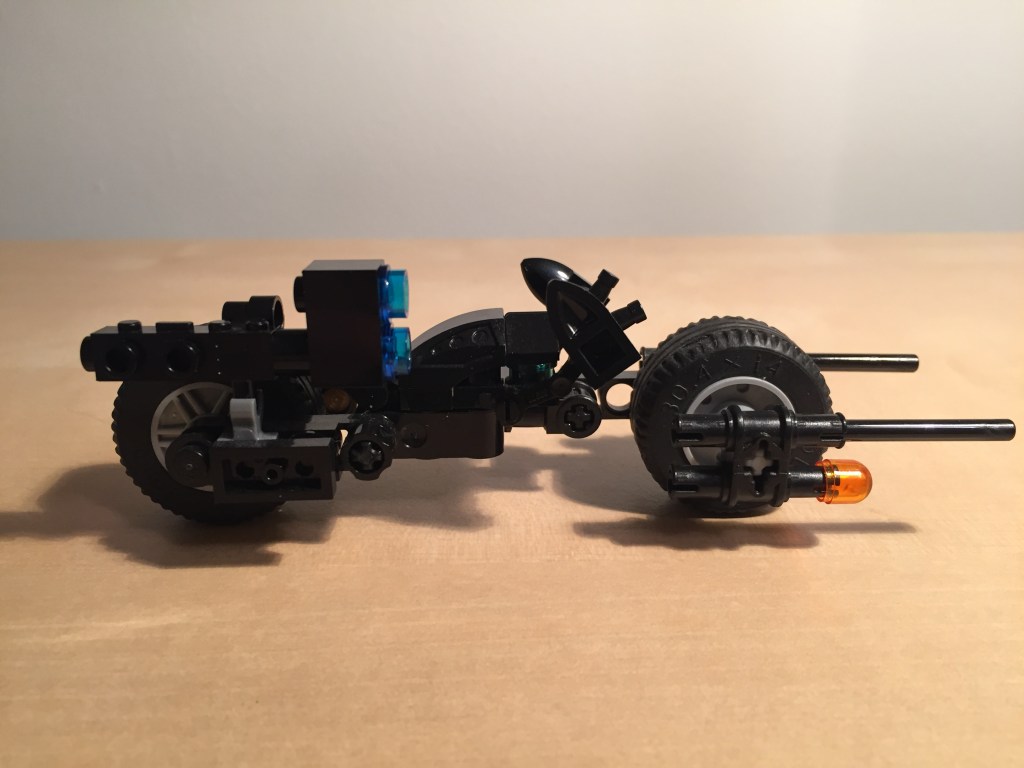
Unfortunately, LEGO didn’t make a widely available minifigure-scale Batpod, Batman’s motorcycle escape system from The Tumbler. Instead, they had a competition for VIP members for an extremely limited set, which resulted in what I see as further erosion of what LEGO could be (play) and instantiation of what it is (making money for LEGO and aftermarket resellers).
Thankfully, a LEGO enthusiast designed the MOC below and offered reasonably priced kits with the parts on eBay. I picked one up to go along with my Tumbler. It includes an electromagnetic pulse gun mounted on the rear quarter.
While LEGO had done alright I thought with The Tumbler, they really dropped the ball with their The Dark Knight Rises set, 76001: The Bat vs. Bane: Tumbler Chase. The Bat, Batman’s VTOL aircraft, was cartoonish with the blue accents and lack of detail, and the military Tumbler was anemic. I would like to build a MOC of The Bat that does it justice–perhaps one day . . .