I wanted to make the most of this year’s Spring Recess. Below are a few things that I accomplished during this late semester respite: a computer storage upgrade, installing Mac OS X Leopard on QEMU, finding Star Wars action figures on eBay, beginning a generative AI and pedagogy bibliography, and spending time with Y.
Upgraded My Desktop Computer’s Boot Drive
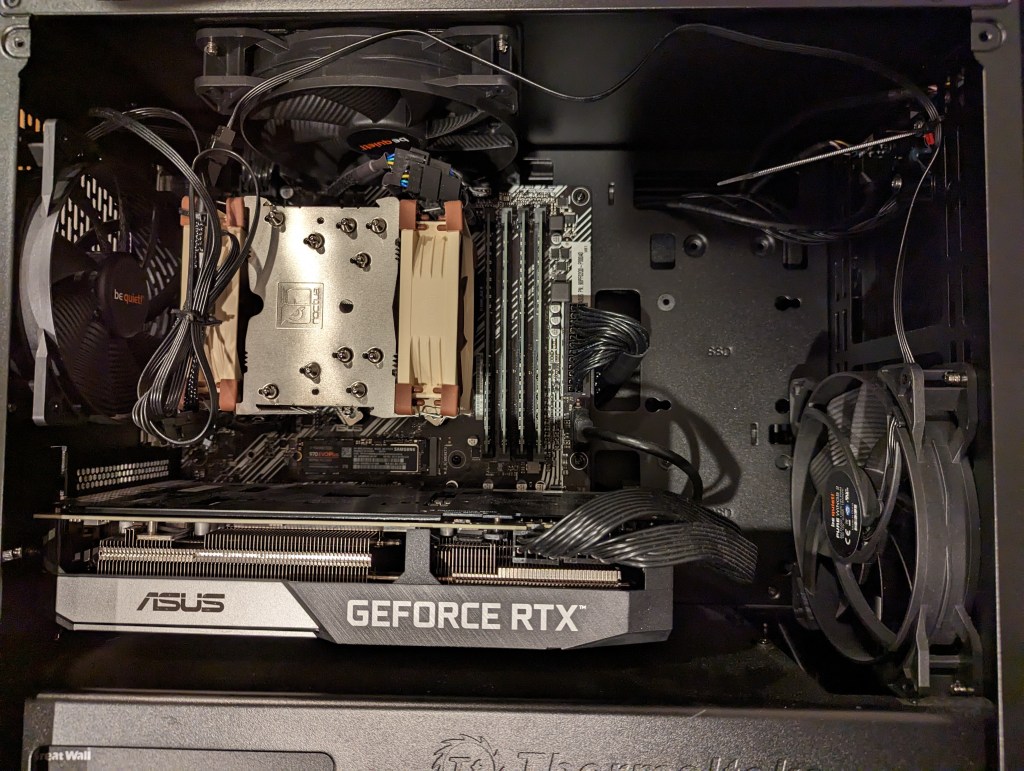
Inside my desktop computer after installing 2TB NVMe SSD.
I took advantage of a BestBuy deal on 2TB Samsung 970 EVO Plus NVMe SSDs to upgrade my desktop computer’s boot drive. Originally, I had a 512GB NVMe drive installed. I had pulled out the wifi card that was in the secondary M.2 slot awhile back. So, I moved the 512GB to that slot (under the video card as pictured above) and installed the 2TB Samsung drive into the primary M.2 slot (just above the video card as pictured above). With the hardware installation done, I reinstalled Linux Mint 21.1, which I run on my desktop and laptop computers.
Installing Mac OS X 10.5 Leopard on QEMU
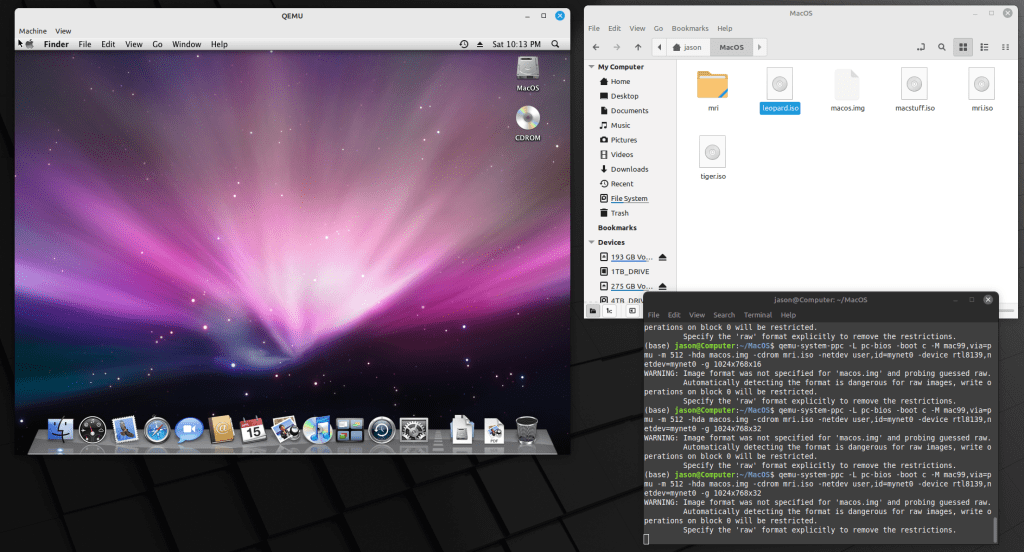
Mac OS X 10.5 Leopard running in QEMU.
Since I reinstalled Linux Mint, I thought that it was a good opportunity to play around with QEMU. For most of my Macintosh emulation needs (mostly System 7.5.5 for Apple’s HotSauce and Voyager’s Expanded Books but occasionally earlier versions that best support some Hypercard stacks and other older software), I rely on SheepShaver and Basilisk II. QEMU-System-PPC supports Mac OS 9.x through Mac OS X 10.5. After Mac OS X 10.9 Mavericks, Mac OS X 10.5 Leopard was my favorite version of Mac OS X, so I picked it for QEMU. After grabbing an ISO from archive.org, it was a short order to install and use Leopard. I had hoped to use an older version of OsiriX to look at the MRI that I had at the University of Liverpool (contemporary DICOM viewers have trouble opening the files), but I should have read the documentation first and seen that OpenGL was a non-starter on the regular version of QEMU.
Star Wars Action Figures from eBay
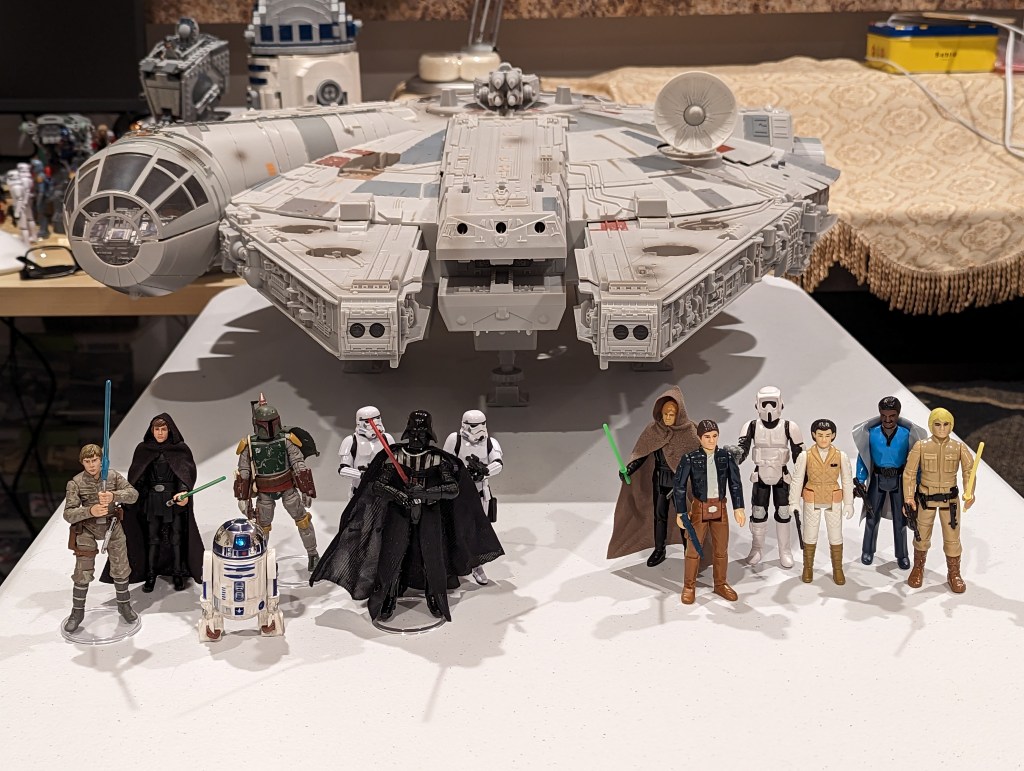
Star Wars Vintage Collection and Kenner/Retro Collection action figures.
At the beginning of Spring Recess, I hit eBay and racked up some good deals with bidding and best offers on 3.75″ Hasbro Vintage Collection action figures, Hasbro Retro Collection action figures, and Kenner action figures. I don’t like to collect action figures in their packages. I like to create scenes with them for display. With these new acquisitions, I plan to create some Empire and Return of the Jedi scenes with my 1979 Kenner Millennium Falcon (not pictured) and 2008 Hasbro Legacy Collection Millennium Falcon (pictured above, aka the Big Falcon).
Compiling a Bibliography of Generative AI Technologies and Pedagogy Resources
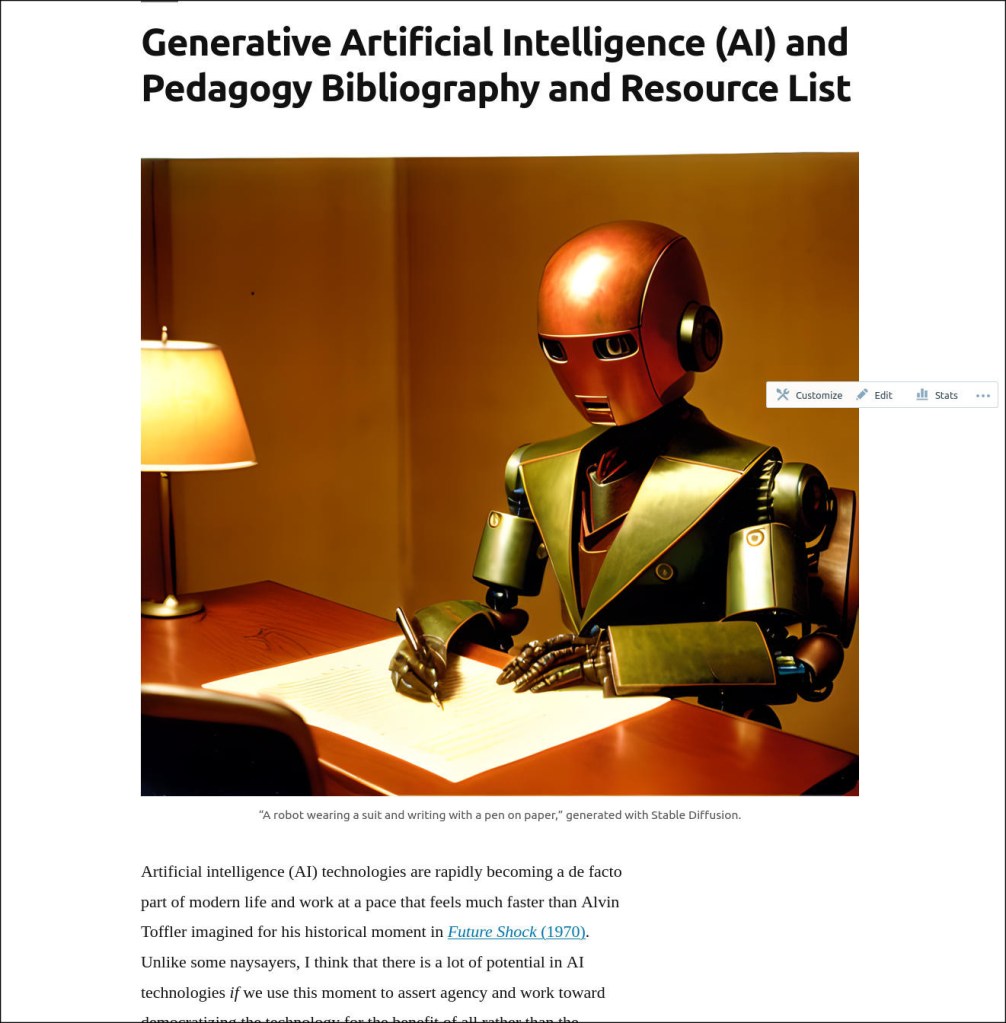
I compiled all of my current research on Generative AI technologies and how they might be used in teaching on this page. It’s not an exhaustive list, but it has a lot of recent publications. It can help someone get up to speed on what’s going on now with ChatGPT, Stable Diffusion, and other AI tools to create text, images, and music from prompts.
Y and I also got to spend time catching up via video chat with my cousin Angie in Maryland and our graduate school friend Masaya in Japan. We enjoyed a walk in Green-Wood Cemetery just before we were awash in tree pollen. And, we watched a lot of Family Guy, too.
I’m holding my Distinguished Alumni Award while standing next to Georgia Tech’s mascot, Buzz.
On Mar. 29, 2023, Georgia Tech’s Ivan Allen College held its 2023 Distinguished Alumni Awards Ceremony. The Ivan Allen College’s six academic schools and its three ROTC branches give these awards to “celebrate excellence in the College community.” I was honored to receive a Distinguished Alumni Award from the School of Literature, Media, and Communication for my contributions as a teacher, scholar, and organizer. The award reads, “For outstanding achievements that inspire continued excellence and bring credit to the School of Literature, Media, and Communication, the Ivan Allen College of Liberal Arts, and the Georgia Institute of Technology.”
To honor all of the Ivan Allen College professors who made my success possible, I delivered these remarks after receiving the Distinguished Alumni Award:
I am honored and humbled to receive this Distinguished Alumni Award. I want to thank the Ivan Allen College, Dean Husbands Fealing, and all of the faculty, administrators, and staff who make the Ivan Allen College not only a indispensable and integral part of Georgia Tech but also a home for someone like me who is better at writing about science than doing science. It also feels like home, because I’ve spent so many years here—first, it took me 10 years to “get out” with my bachelor’s degree, and then, I returned as a postdoctoral Brittain Fellow for 2 years to give back to Tech as an instructor where I had received so much from my former professors. Throughout my career, all of the work that I have done as a scholar, an instructor, an organizer, and an administrator can be traced back to my education and professionalization in the Ivan Allen College. To name a few examples, when I was asked to help establish the City Tech Science Fiction Collection where I now work, I looked at the problem with the engineering mindset that Tech instills in its students. I drew on my experience working under Lisa Yaszek on research projects, public outreach, and donation runs for what was originally called the Bud Foote Science Fiction Collection and now the Georgia Tech Science Fiction Collection. After starting the collection, I inaugurated an annual Science Fiction Symposium to celebrate the collection and create a platform for scholars and students (including Lisa’s SciFi Lab undergraduate researchers) to interact and share their findings. That work over the past seven years was made possible by the experiences that I had with Lisa when she mentored me to create the schedules for the Monstrous Bodies Symposium in 2005 and the international Science Fiction Research Association Conference held in Atlanta in 2009. Lisa has had a profound influence on my career. She’s my hero and I strive to be like her.

Other faculty have also played outsized roles in my development. Carol Senf and Narin Hassan gave me kind and essential advice at key points in my undergraduate career, and they also gave me some of my first editing work by asking me to proofread their respective manuscripts, which helped tremendously in the editing and collaborative writing that I have done over the years since then. In my teaching, I observed and learned from some of the best practioners. I want to excite my students in the way that Hugh Crawford can when talking about William Carlos Williams and bombsights, as detailed as Steven Usselman is about steam engine locomotives, or as illustrative as Robert Wood is when he talks about 15th century Florence. And I show my students compassion when things go wrong as Rebecca Merrens did for me when my maternal grandmother died, foster my students passions as Lisa Holloway-Attaway did for me in the two required freshman college writing classes, give my students a chance like Patrick Sharp did for me by readmitting me in 2002, give my students opportunities to contribute to the life work of our campus communities as Ken Knoespel did for me, and give students an opportunity to be successful and demonstrate learning when the student stumbles on a project they are ill fitted to such as the late Thomas Lux did for me by asking me to produce a Poetry Out Loud DVD for Georgia public schools in place of my atrocious writing as a poet. And while I never had the opportunity to take a class with Jay Telotte or Jay Bolter, their work had a significant influence on my early research, and I teach their scholarship to my students now. Most recently, Rebecca Burnett, the former Writing and Communication Program Director, led the Technical Communication theory and pedagogy seminar that I volunteered to participate in so that I could earn the opportunity to teach Tech Comm as a Brittain Fellow. That experience directly led to my job at the New York City College of Technology and my current position as Director of City Tech’s Professional and Technical Writing Program. Rebecca has continued to selflessly mentor me throughout my directorship.

And lastly, I want to offer a special thank you to Professor Hanchao Lu, because his Asia in the Modern World class had a profound effect on my personal life. He encouraged me to research Taiwan for my final paper. Years later, when I met a Taiwanese girl in graduate school in 2007, I drew on what I had learned in Professor Lu’s class to talk about the KMT and DPP political parties hoping that she might notice me. And guess what? She did, and we got married two years later! Thank you, again!
I arrived in Atlanta a day early, because I wanted to walk around and see all of the changes around Georgia Tech’s campus during the 8 1/2 years since I was last there. Some things remained comfortably familiar, like the entrance to the School of Literature, Media, and Communication on the 3rd floor of the Skiles Building.
School of Literature, Media, and Communication, 3rd Floor of Skiles Building.
However, there were subtle changes like the addition of outdoor tables and seats on breezeway, which I utilized to finish writing my thank you remarks.
Outdoor seating on the 3rd floor breezeway in Skiles.
Besides the changes to buildings and the construction of new facilities, there are new pieces of art that convey important historical events as well as excite the senses.
“The Three Pioneers” by Martin Dawe.
Approaching Tech Tower, I was greeted by this striking bronze sculpture titled “The Three Pioneers” by Martin Dawe. It depicts the first three African American students to matriculate at Georgia Tech in 1961: Ford C. Greene, Ralph A. Long, Jr., and Lawrence M. Williams.
“Continuing the Conversation” by Martin Dawe.
Walking toward the foot of Tech Tower, I sat in this engaging bronze and granite piece titled “Continuing the Conversation.” The viewer sits between two versions of Rosa Parks–42 on the right and 92 on the left. While Parks had never visited Tech’s campus before, this art reflects her influence on change and how we should be a part of that change moving forward.
Me and Robert Berks’ Einstein.
Walking through the center of campus–the Library, Skiles Building, and the Student Center–I found Robert Berks’ Einstein installation. While some folks think the statue is out of place at Tech, it meant something personal to me. When I was in high school, I read Einstein’s Relativity: The Special and the General Theories, which among other works by Carl Sagan, Michio Kaku, Roger Penrose, and Stephen Hawking, directly led to my enrolling as a Physics major at Georgia Tech in 1995. That didn’t work out so well for me academically, but I love Physics and Mathematics despite my own deficiencies.
John C. Portman, Jr.’s KR+C Sculpture.
Walking from the Einstein statute toward the green space between the back of the Library and the School of Architecture I encountered John C. Portman, Jr’s imposing KR+C (for Knowledge and Research plus Creativity) sculpture. Walking around its circumference reveals how it reshapes and changes depending on your perspective. I found that you can walk up the back stairs of the Library and Clough Undergraduate Learning Commons to get a bird’s eye view of this magnificent sculpture.
“Jetson” in the Clough Undergraduate Learning Commons.
Walking into the Clough Undergraduate Learning Commons, I found art suspended between its the clean perspectival lines. The sculpture above titled “Jetson” is a collaborative team project initiated by former College of Architecture Professor Volkan Alkanoglu. Primarily constructed from water jet cut aluminum, this large, futuristic sculpture only weights about 110 pounds!
Walking through the Clough Commons into the Library, I met with my former colleague Wendy Hagenmaier, Digital Curation Archivist and RetroTech Manager, in the 3rd floor Data Vizualization Lab and RetroTech shared space. RetroTech is a working collection of born digital (and analog) art (and science) artifacts that students can use, support, and learn from. Before moving to Brooklyn, I donated four of my vintage computers (a Dell Dimension 4100, Apple Macintosh Perform 550, iMac DV, and Apple Power Macintosh 8500) to the Georgia Tech Library to help kickstart RetroTech, a lab for students to use and interact with older technologies–computers, video game consoles, cameras, slide rules, typewriters, etc. I was amazed at how much space RetroTech has in conjunction with the Data Vizualization Lab. Besides having equipment and space, Wendy is developing RetroTech into a sustainable initiative involving students and cross campus connections. I’m really happy to see how much RetroTech has developed under Wendy’s leadership.
Leaving the Library, I walked through Deanna Sirlin’s “Watermark” installation. The sunlight passing through the colored glass panes creates a changing projected artwork on the floor and surroundings inside this entrance to the Crosland Tower of the Library.
Kessler Campanile.
Walking back toward the Student Center, I stopped in front of the Kessler Campanile designed by Richard Hill for the 1996 Olympics. It was installed during my freshman year at Tech.
Spending almost a whole week in the ATL gave me a much needed boost. 99x is back on the air. I enjoyed not one but two meals at Del Taco. I talked computers with Grantley and Melanie. I met Carol Senf for brunch to talk teaching. I hung out with Lisa Yaszek and Doug Davis at the West End. Rebecca Burnett and Jeff Jeffries invited me over to their home for a wonderful dinner. I talked Doctor Who and Dirk Gently with Mark Warbington. I discussed books with Keith Magnes. And, I got to visit Mike Flanagan in his new house and see his wife Diana compete in a local tennis tournament. Unfortunately, I didn’t have enough time to see everyone I know there, but I hope to get back to Atlanta before another 8 1/2 years pass!
My Distinguished Alumni Award lit by candlelight. Photo by Rebecca Burnett.
I’m very happy to announce that Dr. Sharon Packer’s edited collection Lenses on Blindness: Essays on Vision Loss in Media, Culture, Religion and Experience is now out from McFarland! It includes a chapter that I wrote back in Summer 2020 titled, “Blindness in Science Fiction: From Mary Shelley’s Frankenstein to Star Trek’s La Forge–And Much More.” It covers examples of blindness depicted in literary, television, and film SF. Many thanks to Sharon, a fantastic editor who saw the project through despite the pandemic’s slings and arrows!
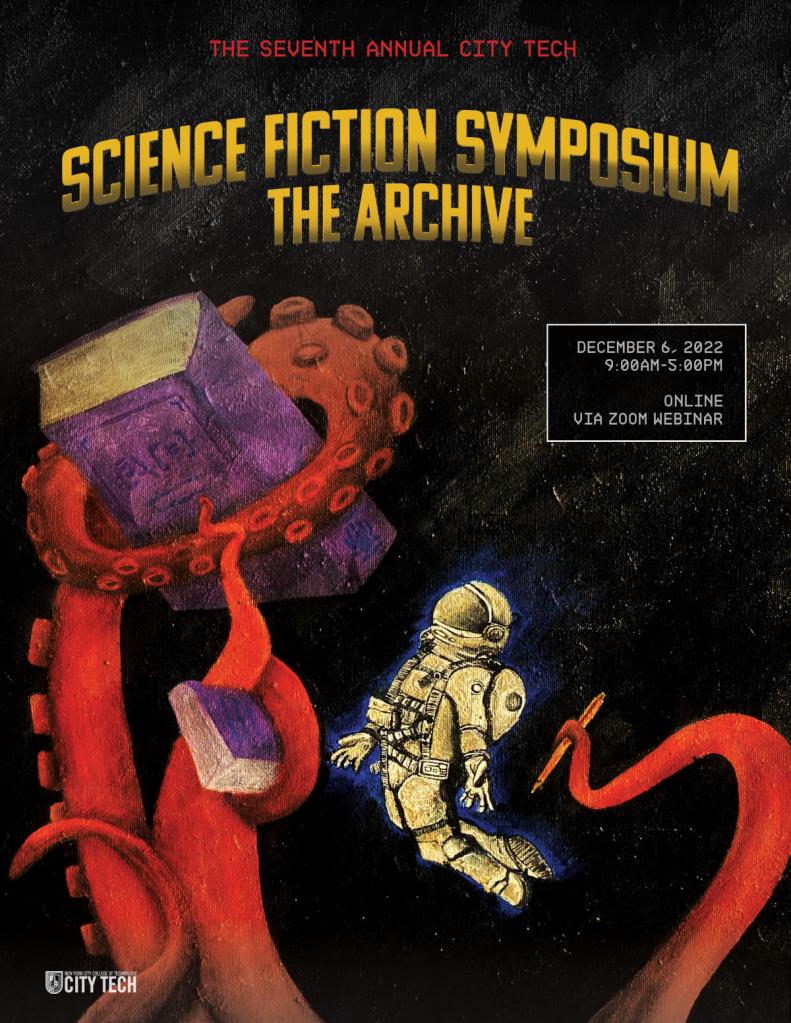
The Seventh Annual City Tech Science Fiction Symposium on the Archive and SF was held on Tuesday, Dec. 6, 2022 as a Zoom Webinar. You can read the full program here.
I started organizing these symposia with my colleagues at City Tech after we received the original 160 box donation that became the City Tech Science Fiction Collection. We’ve covered a lot of important topics at each symposium over the past seven years, but there’s still much to examine and discuss.
I’ve been so busy this semester that I didn’t announce the event here on dynamicsubspace.net. In case you missed the event, you can watch all of the sessions in the videos below.
Many thanks again to everyone who participated and contributed to this year’s event!
Opening Jason W. Ellis Justin Vazquez-Poritz
Paper Session 1: Archival Research Jill Belli – Moderator Jessica Aaron – “Preventing Planetary Patriarchy: Subversions of the White Man’s Ideal World in Early SF Pulps” Chris Leslie – “The Republic of (Interstellar) Letters: From the Archives of Asimov and Merril” Gillian Polack – “Story as Archive: How Speculative Fiction Novels Both Preserve and Interpret Cultural Material”
Panel Discussion: A Tale of Two Archives Jason Ellis (City Tech) Matthew Frizzell (Georgia Tech) Kel Karpinski (City Tech) Alison Reynolds (Georgia Tech) Lisa Yaszek (Georgia Tech)
Panel Discussion: Georgia Tech’s Sci Fi Lab: Archival Research, Octavia’s Ancestor’s Project, and Radio Play Lisa Yaszek – Moderator Panelists: Val Barnhart Laurence Copeland Killian Vetter Edeliz Zuleta
Analog Writers Panel and the Analog Emerging Black Voices Award Emily Hockaday – Moderator Kedrick Brown Meghan Hyland Kelsey Hutton Douglas Dluzen Trevor Quachri and Emily Hockaday – Award Presentation
Paper Session 2: Archives in SF Lucas Kwong – Moderator Jacob Adler – “Summit of Knowledge: Archiving the Fantastical” Rhonda Knight – “A Data Thief in the Archive: Reading Sofia Samatar’s ‘An Account of the Land of Witches’” Adam McLain – “‘Only an Echo’: The Memory of the Archive and the Archive of Memory in Lois Lowry’s The Giver“ Kenrick H. Kamiya Yoshida and Ida Yoshinaga – “An Okinawan Speculative Arts Archive”
Paper Session 3: Latinx SF in the Archive Leigh Gold – Moderator Matthew David Goodwin – “The Latinx Multiverse and the Fictional Recovery of Latinx Science Fiction” Dolores González Ortega and Valeria Seminario – “Inside the Latin American Science Fiction Archive: Challenges and Contributions to a Growing Academic Field”
Keynote Jeremy Brett – “Making Space: Science Fiction Archives and the Archival Citizen” Jason Ellis – Introduction and Moderator
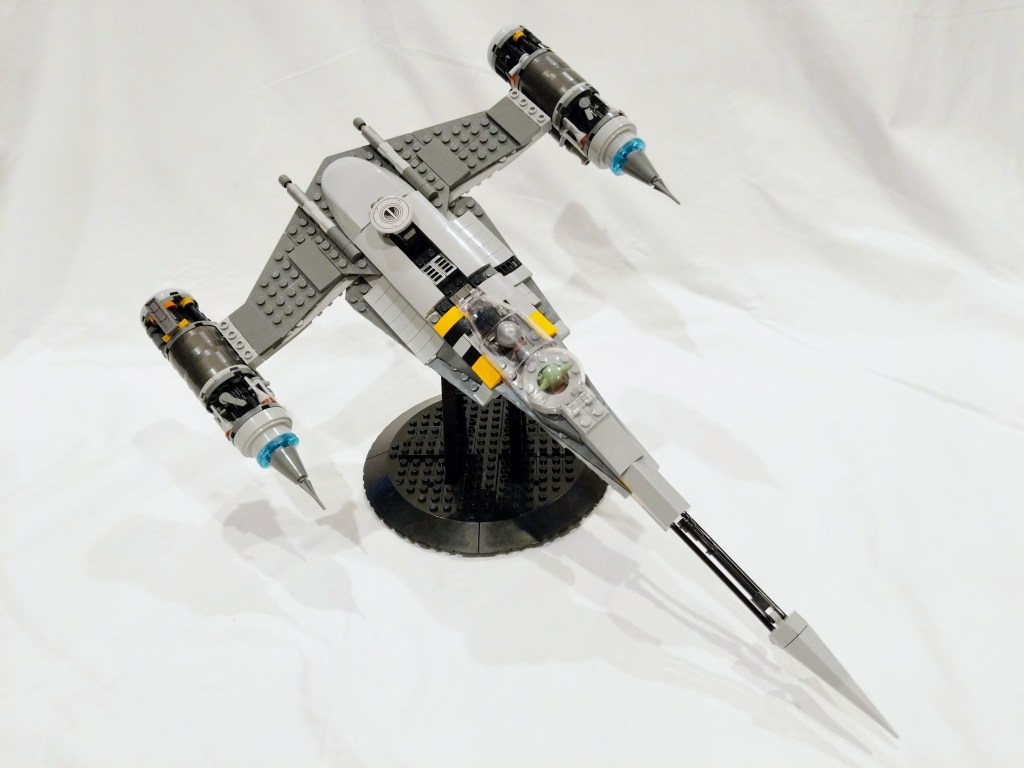
Following the destruction of the Mandoralorian’s Razorcrest, one of the happy surprises in The Book of Boba Fett was Mando’s new ship–a heavily modified Naboo N-1 Starfighter featured in The Phantom Menace and Attack of the Clones. So, when the LEGO version of Mando’s new ride debuted as set 75325, I picked it up at the local Costco for about 20% off MSRP.
The Naboo Starfighter is one of the redeeming elements for me from the Star Wars prequels.
Years ago, I had the original LEGO 7141 Naboo Fighter from 1999, and I built set 10026 Special Edition Naboo Starfighter in 2002 as seen in the photo of my bookcase from that era above. The chromed parts made this an excellent build. If only it had been designed for minifigures!
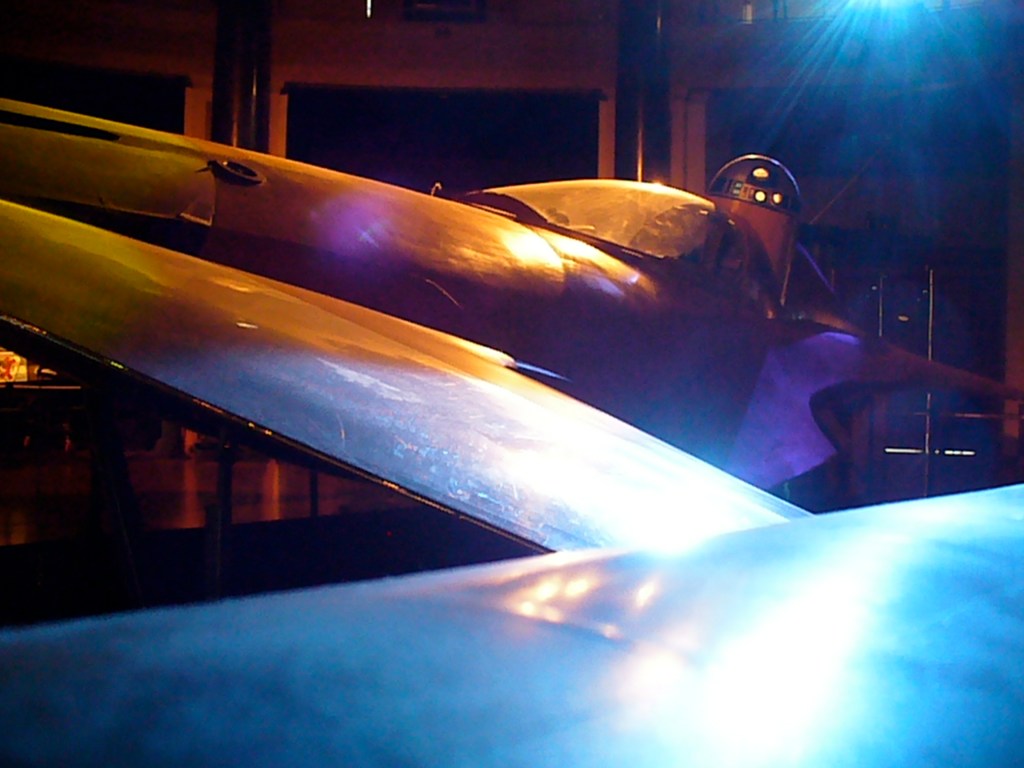
Later, I got to see a life-size Naboo fighter at the Star Wars Exhibition in London in 2007. It was the exhibit’s centerpiece in the display space adjacent to the London Aquarium and the London Eye. Being in the same space made the starfighter seem real. It’s design detail evoked the craftsmanship of a Howard Hughes hand-built race plane. It was extraordinary to behold!
When I first assembled Mando’s modified N-1 LEGO set, I was impressed with its greebling details to the engine nacells and overall design. While there are limitations to the overall smoothness at the scale used for this set, it captures important details that mark it as an inspired model based on what we see on the screen.
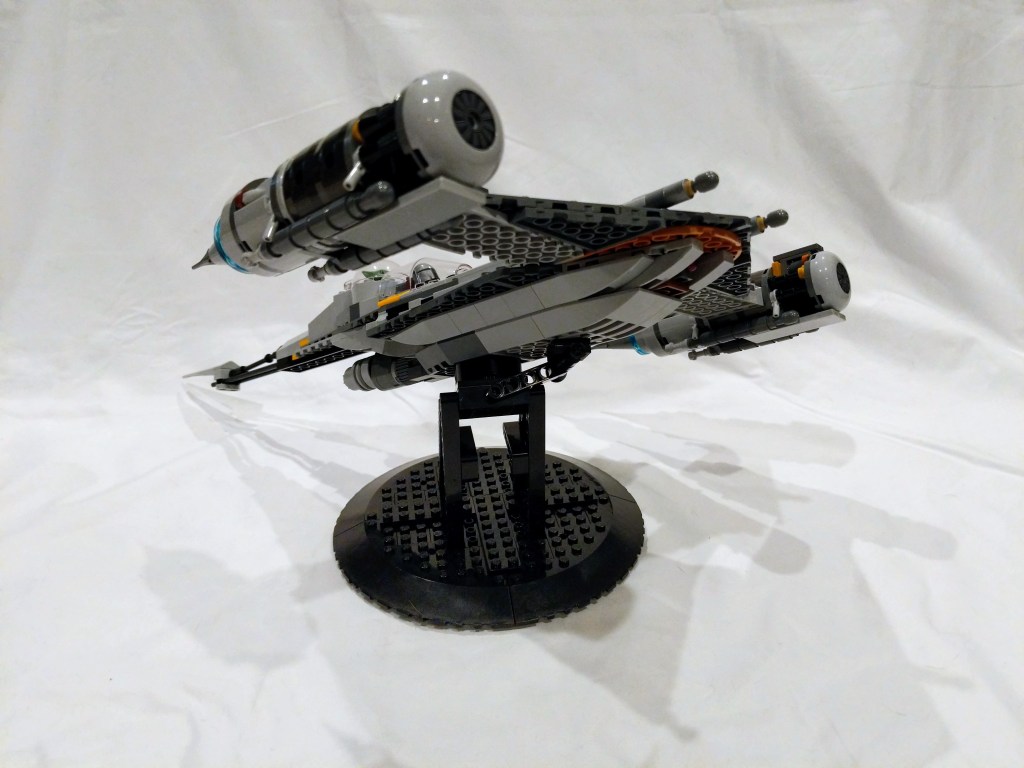
The thing about the Naboo Fighter is that it deserves to be swooshed. It’s design implies motion and speed. It was that feeling about what the design inspires that pushed me to design and build a stand for it.
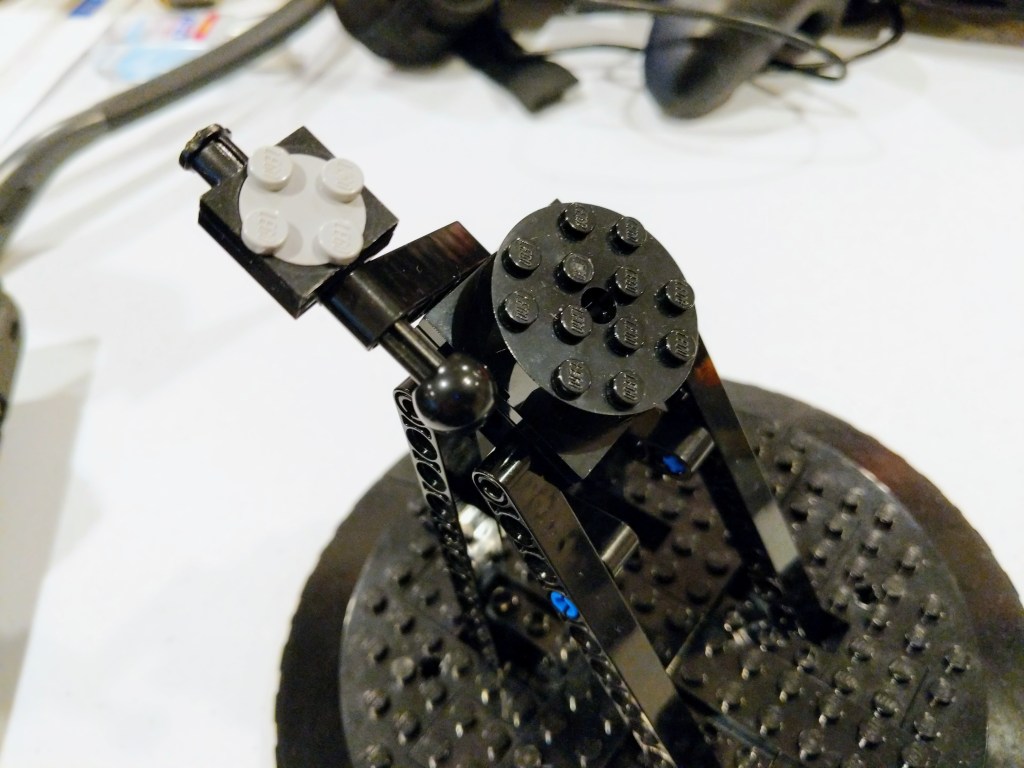
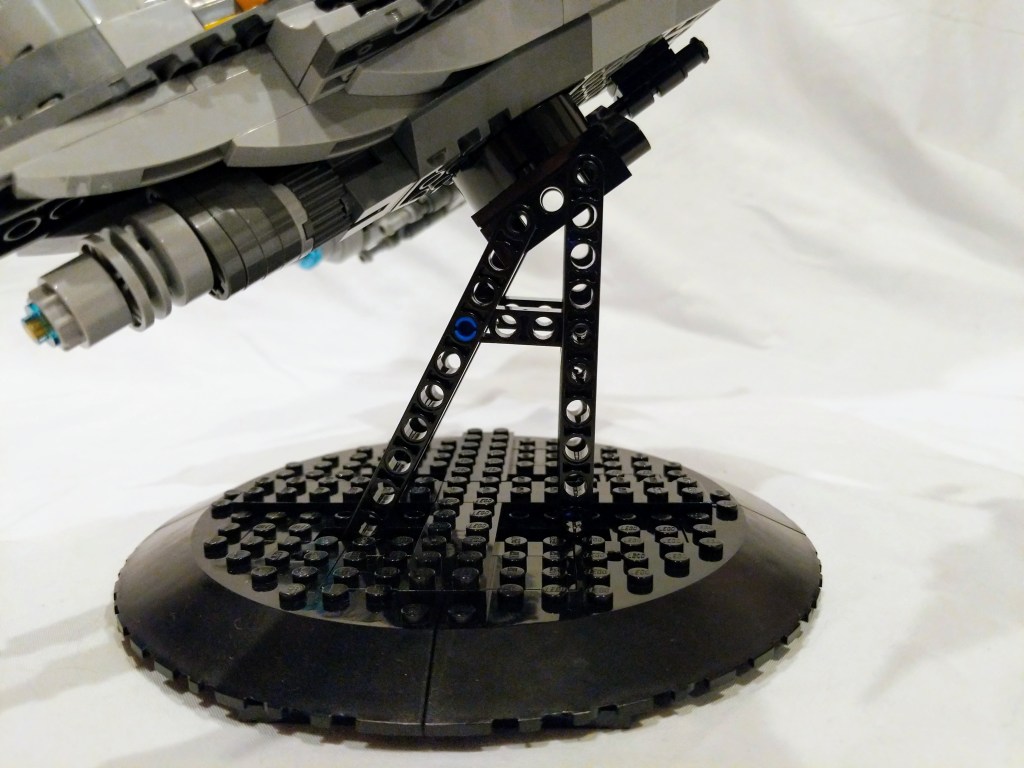
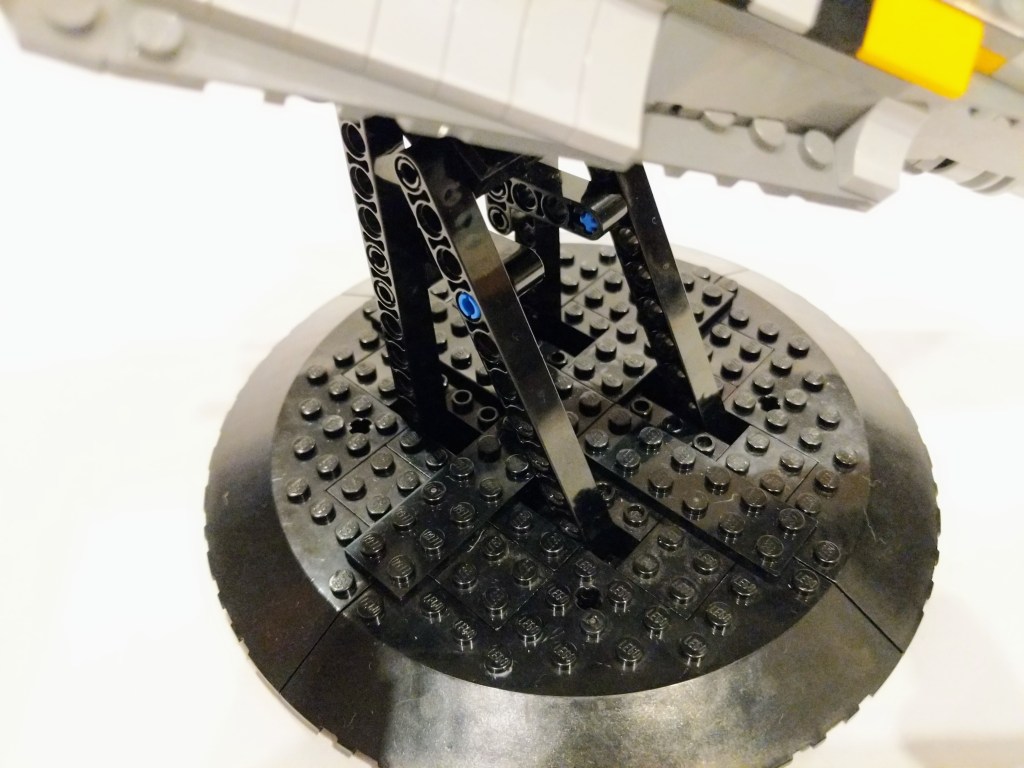
This presented some challenges, because Mando’s N-1 is larger than the 10026 set, which came with a display stand. The 75325 set is bigger than that set, which also implies that it is heavier. Using a rotational click ring supported by Technic beams does not provide enough friction to maintain the model in the orientation desired. I devised a secondary support arm with a 2×2 turntable plate to prevent the weight of the model from changing the desired orientation of the model.
In the photos above, you can get a sense of how to build a similar model display using Technic and other LEGO bricks.
I think the displayed version of the set brings the excitement and joy that Mando and Grogru feel when they open up the sublight thrusters!