This is the sixty-second post in a series that I call, “Recovered Writing.” I am going through my personal archive of undergraduate and graduate school writing, recovering those essays I consider interesting but that I am unlikely to revise for traditional publication, and posting those essays as-is on my blog in the hope of engaging others with these ideas that played a formative role in my development as a scholar and teacher. Because this and the other essays in the Recovered Writing series are posted as-is and edited only for web-readability, I hope that readers will accept them for what they are–undergraduate and graduate school essays conveying varying degrees of argumentation, rigor, idea development, and research. Furthermore, I dislike the idea of these essays languishing in a digital tomb, so I offer them here to excite your curiosity and encourage your conversation.
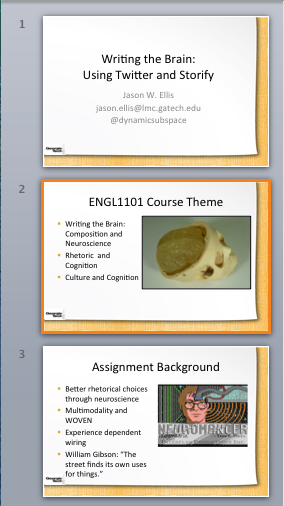
In this Recovered Writing post, I am including two PDF files that I used in my presentation on “Writing the Brain: Using Twitter and Storify” for the 2 October 2013 CETL Brown Bag Workshop. The first is my PowerPoint presentation file and the second is my handwritten presentation notes. Normally, I type up a carefully written script for my presentations, but in this case, I wrote my speaking notes out by hand. While I was driven my a tight deadline imposed by several other responsibilities converging at the same time, I saw this as an opportunity to experiment with a way of presenting that I normally don’t do and I wasn’t completely comfortable doing. As I tell my students, we grow by challenging ourselves, doing new things, and experimenting with new approaches. This was one such attempt on my part.
During today’s class, I will present a final lecture titled, “The Concluding Lecture: Advice from a Georgia Tech Alum to Future Alumni.” There’s a lot of things that I wish I had known when I was an undergraduate at Tech. On reflection and through experience, I gained insights that I wanted to make available to my current Georgia Tech students. I am making the PowerPoint file and my notes available below.
Notes to accompany “The Concluding Lecture: Advice from a Georgia Tech Alum to Future Alumni” follow below:
During today’s lecture, I wanted to talk about one big idea that’s been implicit in the readings and discussions that we’ve shared regarding the brain. That idea is: “Who you are today is not who you will be tomorrow.” What I mean by that is our biology, experiences, thoughts, and choices shape who we are and who we become each moment of our lives. Sometimes these changes can be small and sometimes these changes can be large.
Another way to think about this is that we are like patterns. Our lives, thoughts, and memories are patterns that form, reform, and change based on a number of variables. Some of those variables, like cats, are outside of our control. These things include our genes, disabilities, economic situation, and past. While there’s a lot about our lives and pattern that we cannot control, there’s also a lot of things about our pattern that we can control. These are the conscious choices and decisions that we make in life.
In this lecture, I would like to talk about those choices that I think are particularly important to Georgia Tech undergraduates but that are often pushed aside, ignored, or forgotten in the forward rush to a degree. Choosing to focus on these important things will lead, I believe, to a more robust, meaningful, and enriched undergraduate experience that will prepare you for success in the next stage of your life.
Learn: Feed your curiosity. Gain as much knowledge in your field and others as possible. Form connections between the many things that you learn. Be interdisciplinary in your thinking and learning. Pass on what you have learned to others–in doing so, you will gain a deeper mastery of what you have learned.
Connect: Form connections with faculty at Tech. Seek out mentors to guide you in your progress. Your advisors and mentors will become your colleagues one day when you enter the field as a graduate of Tech and professional. Learn from your mentors and advisors.
Explore: Explore the spaces you inhabit and work. Explore your major and connected disciplines. Explore how you can connect your major to other disciplines. Open doors and find out what’s going on (as long as you won’t be breaking laws or entering a dangerous space). Exploration is another kind of learning.
Travel: Visiting other places is a special kind of exploration and learning. However, it is also a kind of education that you cannot receive in the normal classroom setting. You will learn new perspectives from those you live around. You will gain new insights from the history, economy, and politics of the places you live. My strongest regret was not taking advantage of the study abroad programs at Georgia Tech. There are many, many study abroad programs here–find out about them and take advantage of them.
Meet: Go out and meet people! Meet famous people. Meet smart people. Meet people in your community. Meet other students at Tech. Meet people in the Atlanta area. Superficial connections are not what you want. The important thing is to expand your network of friends and colleagues and form meaningful relationships with those people. Talk with people. Learn from others.
Help: Make the effort to help others. Help your classmates. Help people in your communities. Help your family and friends. If you contribute to building stronger communities through outreach and doing good deeds, you will build a stronger community that will in turn help you in the long term.
Make: Create things. They can be digital, physical, or abstract. The important thing is to never rest. You should always be engaged making things–professionally or for personal enjoyment. The things that you make will in turn make you through the experience of creating.
Do Good Work: Make things that you are proud of. Put the time and effort into making things that you can stand behind. This is hard to do sometimes in classes, but you should think about how to turn assignments to meet your needs as well as the needs of the class’ outcomes. This means think about how you can create things that will earn the grade you want while also serving your uses outside of the class–such as adding a new document to your professional portfolio or using an assignment as an excuse to learn a new skill or software.
Reflect: Above all else, reflect on your life, on the things you do, and on your successes and failures. Learn from the choices that you’ve made before so that you can make better and stronger and more effective decisions in the future. Reflect on all aspects of your life–not just on your writing or major-specific work. Reflect in writing–public or private–for the maximum effect on your thinking and brain wiring. Make your reflections a part of your daily practices. It takes time and energy, but the results over time to improving your likelihood for success is tremendous!
Graduate: Certainly, keep your eye on the prize. It might take you four years, five years, or even longer. No matter how long it might take you or how winding your path might be to graduation, be tenacious in your progress to completion. In the words of Commander Taggart from Galaxy Quest (1999), “never give up–never surrender.” If you find that you need to take time away from school, there’s no reason not to return later. I did that and I believe that I am the better for it. The experience that I gained during those years away from Tech were tremendously useful to me. Anyways, if I can do it, I know that you can, too.
This morning, Mirja Lobnik and I will be co-hosting a workshop on “Multimodality and Perception: A Multi-Sensory Approach to Teaching Rhetorical Skills” at the Assessing Multimodality: Navigating the Digital Turn Symposium co-hosted by Georgia Tech’s Writing and Communication Program and Bedford St. Martin’s. Our workshop is about multisensory perception, multimodal composition, and cognition:
Associated with the use of various media to create cohesive rhetorical artifacts and the neurology of the ways humans process information through different sensory channels, multimodality has gained considerable ground in the composition classroom. Insofar as multimodal pedagogies emphasize the role of students as active, resourceful, and creative meaning-makers, it tends to enhance student engagement and, by extension, the teaching of composition and rhetorical skills. Focusing on sensory details of embodied, lived experience, this workshop centers on teaching that engages students both in mind and body. This approach not only promotes the students’ creation of multimodal artifacts but also encourages students to explore and critically reflect on personal experiences. Specifically, Lobnik focuses on aural composing modalities, including speech, music, and sound, and assignments that highlight sound as a rhetorical and creative resource: a transcription, audio essay, and a video. Ellis discusses cognition, metacognition, and curation and an assignment that integrates Twitter, Storify, ComicLife, and the written essay.
If you get to attend our workshop or the symposium’s other great sessions, please tweet using the hashtag: #AMsymposium.
Dr. Laura Otis presenting in GT Library’s Ferst Room.
Today, Georgia Tech’s School of Literature, Media, and Communication invited Emory University’s Dr. Laura Otis to give a presentation in the Library’s Ferst Room. Dr. Otis’ presentation was titled, “The Surprising Antics of Other People’s Minds” [read the abstract here].
In Dr. Otis’ work, she aims to show with data that she has collected from interviews with an admittedly small number of English-speaking people from the United States that:
1) visual thinking and verbal thinking are not opposites and they cannot be separated,” 2) there is no such thing as a visual thinking type or a verbal thinking type–every mind is unique, and 3) visual and verbal inclinations are not destinies. Anyone can develop visual or verbal skills with practice.
She also offered two suggestions for literary studies:
1) refer to visual imagery in readings, because this might help include more students who may feel excluded by verbal readings, and 2) take reader’s visual imagery seriously, because this might help reconnect the reader to creative writing as co-creator of its imagery.
You can download my handwritten notes on Dr. Otis’ talk and the Q&A session from the event as a PDF from here.
I enjoyed Dr. Otis’ presentation, and it provided me with a new insight into something that I had already read and thought about but in a more biological sense: we each think differently, because our brains are wired differently. Our experience of the world and life, which includes our biology, environment, and culture, leaves its indelible trace on our brain’s physical wiring. As we live, our brains wire themselves to accommodate new memories, abilities, and ways of thinking. It makes sense that all of these experiences would shape our thinking, but more importantly, we can exert our own conscious control over our thinking by adopting reflective practices and training/practice to improve abilities that we already have to greater or lesser degrees.
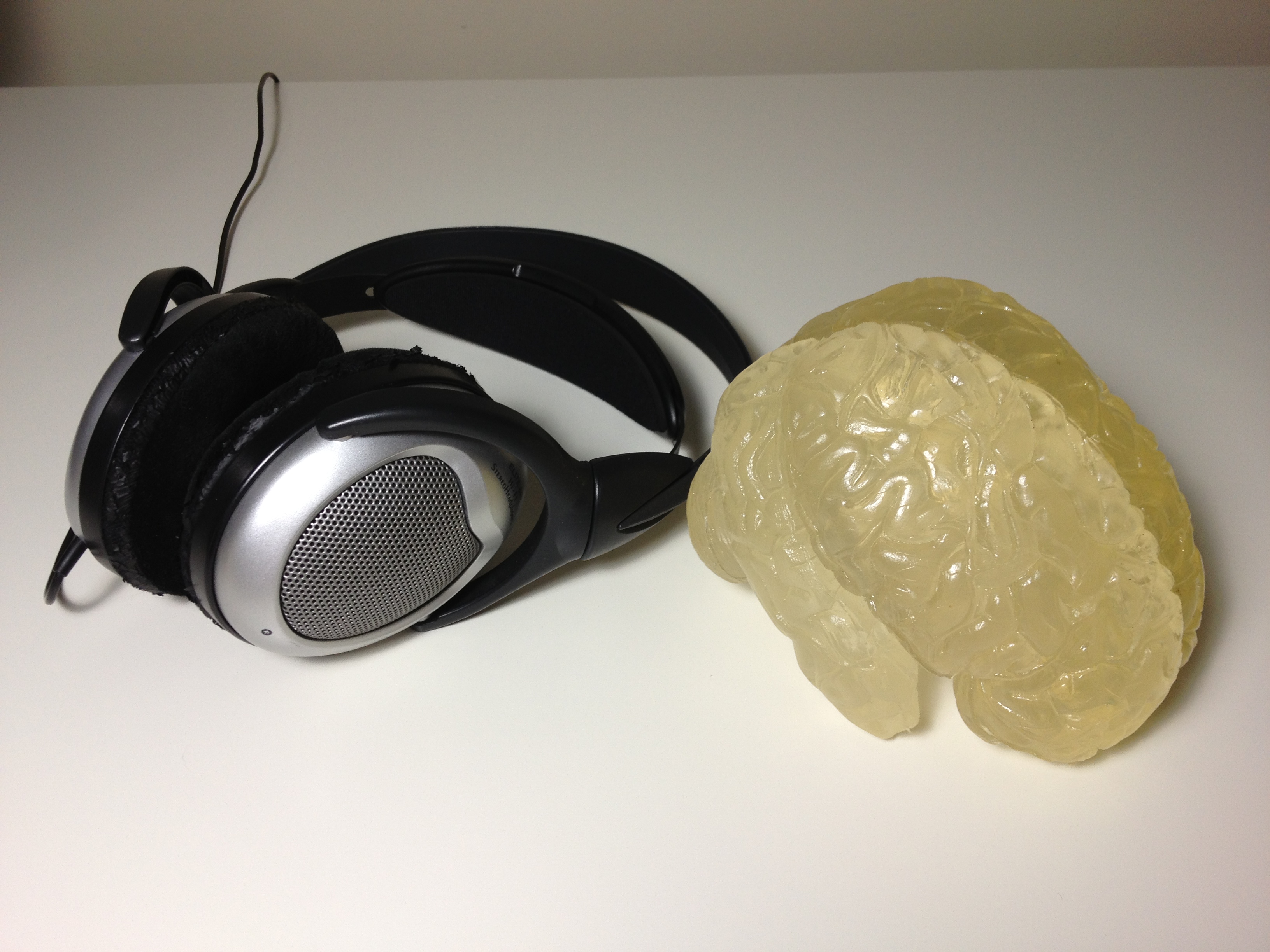
I am currently teaching three sections of ENGL1101 at Georgia Tech. The class’ theme, “Writing the Brain: Composition and Neuroscience,” remains the same as my earlier syllabus that I taught in Fall 2012 [available here]. However, I have made some fundamental changes to the reading list (two books instead of only one: John Medina’s Brain Rules and Jonathan Gottschall’s The Storytelling Animal), reading schedule (began with WOVENtext, then three fundamental essays/excerpts from O’Shea’s The Brain, Gary Marcus’ Kludge, and Geoffrey Miller’s The Mating Mind), and major projects (still three major projects, but now the first project incorporates Storify and ComicLife and the third project is an individual Pecha Kucha presentation instead of a group presentation–students will continue group work on the second project’s video). In the readings, I am encouraging more discussion about WOVEN and rhetoric in addition to discussion about the content and its application to composition. I have also integrated Twitter into the class’ daily rhythm and added daily reading presentations as a core component of the class. I have given the new syllabus a version 1.1 designation. Find out more by reading the new syllabus here.
I should also note that I had planned on teaching ENGL1102 in Spring 2013, but the school asked for a volunteer to teaching ENGL1101 again. This seemed like a terrific opportunity to put some of my ideas from reflection into practice right away. I do plan to teach ENGL1102 in the future, and I will be ready with this syllabus (unless, of course, I find the time to develop another syllabus, which is something that I would like to do by continuing the “Writing the Brain” theme into the second tier class with neuronovels and neuronarratives).


 I am currently teaching three sections of ENGL1101 at Georgia Tech. The class’ theme, “Writing the Brain: Composition and Neuroscience,” remains the same as my earlier syllabus that I taught in Fall 2012 [available