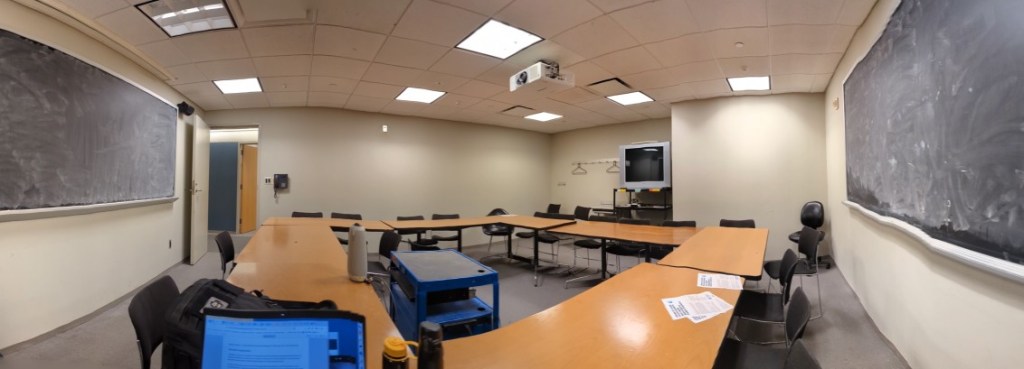
Last night, I stuck around after my first co-taught Interactive Technology and Pedagogy I class at the CUNY Graduate Center. The class went very well. Students demonstrated that they had done the reading and some brought deep perspectives from their disciplines to bear on our first discussion on technology and media.
Thankfully, there were no classes afterwards, because after everyone cleared out, I used the classroom to meet with a City Tech student over Zoom for her Individualized Study of ENG3790 Information Architecture.
Call for Papers: Image in Science Fiction: The Tenth Annual City Tech Science Fiction Symposium
Deadline for CFP: Friday, Oct. 31, 2025
Date and Time of Event: Tuesday, December 2, 2025, 9:00AM-5:00PM EST
Location: Academic Building A-105, New York City College of Technology (City Tech), CUNY
Organizers: Jill Belli, Wanett Clyde, Jason W. Ellis, Leigh Gold, Kel Karpinski, Lucas Kwong, and Vivian Zuluaga Papp
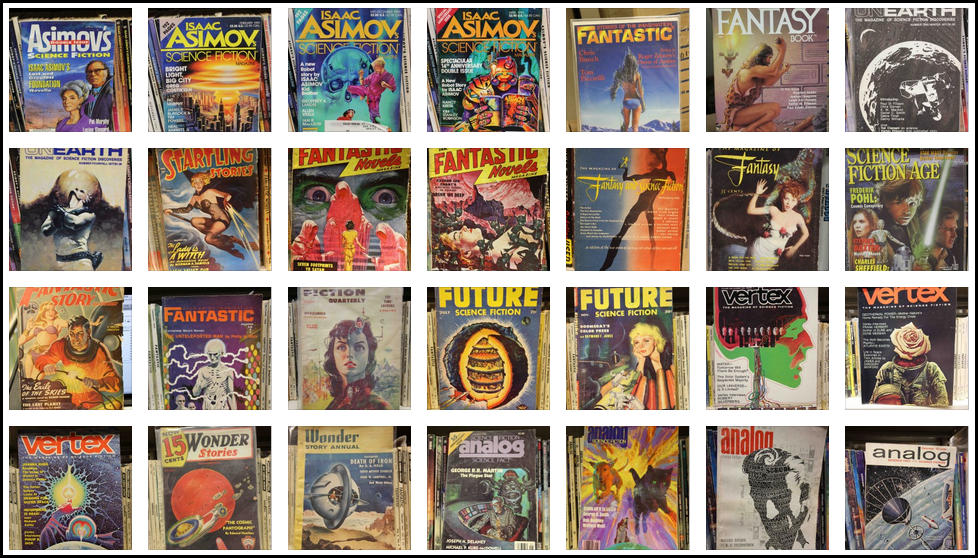
Science Fiction (SF) is an image driven genre. Whether described in text, see the “dull yellow eye” in Mary Shelley’s Frankenstein (1818)); rendered in the two-dimensional art of magazines like Analog; or brought to life in film, TV, and video games, SF imagery continually confirms Gérard Klein’s observation that “science fiction does not proceed directly from science, nor from philosophy, but from the “images (eikons) and representations (eidons)” that these disciplines “unknowingly” produce (“From the Images of Science to Science Fiction,” 2000). SF images abound; how those images are understood and interpreted iterates to infinity.
The Tenth Annual City Tech Science Fiction Symposium explores the many aspects, configurations, and meanings of the image in SF. We invite proposals for 10-20 minute scholarly paper presentations or 40-60 minute panel discussions related to the topic of image in SF broadly construed. Please send a 250-word abstract with title, brief 100-150-word professional bio, and contact information to Jason Ellis (jellis@citytech.cuny.edu) by Friday, October 31, 2025.
Topics with a connection to image in SF might include but certainly are not limited to:
image across modalities: textual, visual, interactive, etc.
images of race, ethnicity, sex, gender, sexuality, and other aspects of identity
images meant to shape understanding of stories and/or sell them (e.g., magazine covers, in-text illustrations, movie posters, trailers)
advertising images in and around SF (e.g., advertising to sell SF as well as non-SF advertising around SF ranging from Big Tobacco to the Johnson Smith Co.
fandom’s use, adaptation, and transformation of images
image and politics
image and meaning
image and representation
SF and photography
SF, simulacra, and simulation
Generative AI and SF
The event will be held in person at the New York City College of Technology (City Tech), CUNY in downtown Brooklyn, New York.
This event is free and open to the public as space permits: an RSVP will be included with the program when announced on the Science Fiction at City Tech website (https://openlab.citytech.cuny.edu/sciencefictionatcitytech/). Free registration will be required for participation.
The event is sponsored by the School of Arts and Sciences at the New York City College of Technology, CUNY.
The Annual City Tech Symposium on Science Fiction is held in celebration of the City Tech Science Fiction Collection, an archival holding of over 600-linear feet of magazines, anthologies, novels, and scholarship. It is in the Archives and Special Collections of the Ursula C. Schwerin Library (Library Building, L543C, New York City College of Technology, 300 Jay Street, Brooklyn, NY 11201). More information about the collection and how to access it is available here: https://openlab.citytech.cuny.edu/sciencefictionatcitytech/librarycollection/.
While I’m keeping Debian 13 Trixie on my media center computer, I’ve decided to fallback to Debian 12 Bookworm on my laptop and workstation. The more that I used Trixie on those machines, the more I realized some things that I relied on just weren’t working right. Once that software gets updated, I’ll try Trixie again, but for now, especially while I’m frantically getting things ready for classes to begin next Tuesday, I’ll rely on tried-and-true Bookworm.
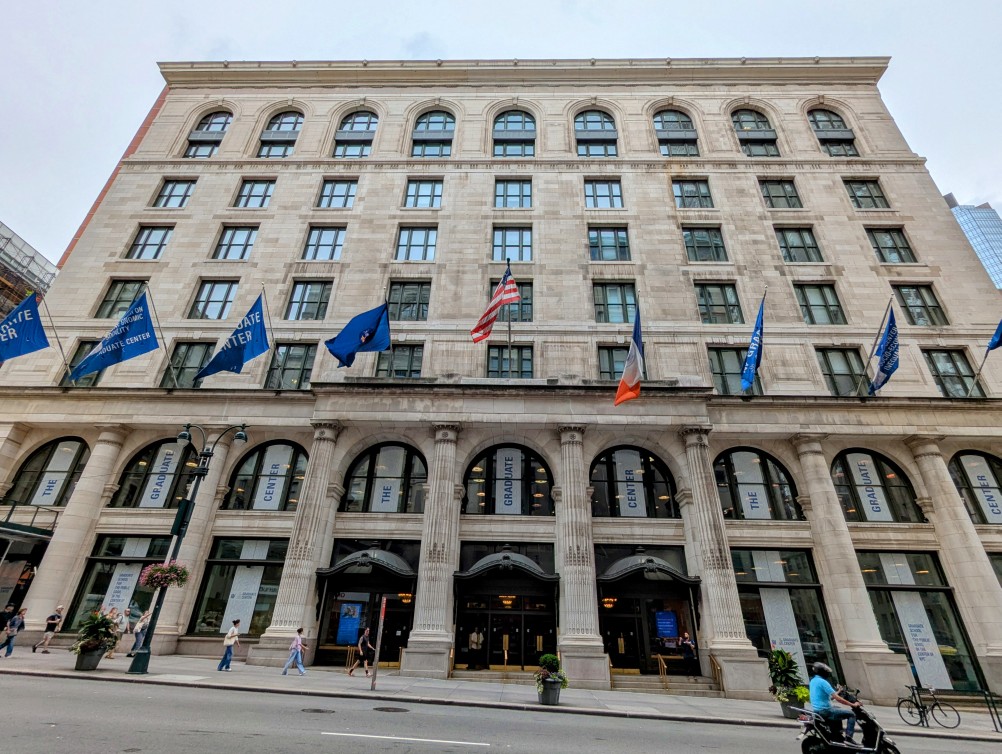
I visited the CUNY Graduate Center on 5th Avenue in Manhattan to get an adjunct faculty ID made, because I’ll be co-teaching Interactive Technology and Pedagogy I: History and Theory (ITCP 70010) this fall. This course is part of the Interactive Technology and Pedagogy (ITP) Certificate Program, which when offered the opportunity to contribute to this program, I jumped at! It is aligned with some of the work that I do in the Professional and Technical Writing Program at City Tech, which involves using technology for communicating and learning about the history of digital technologies, and it is a kindred program with the learning to teach with technology aspects of the Brittain Fellowship at Georgia Tech. I’m excited to work with the program’s graduate students beginning in a couple of weeks.
Click through here to see the other interviewees and topics covered in this special issue.
Editor Sean Scanlan sent out this press release for the issue:
A new issue of NANO: New American Notes Online has been published
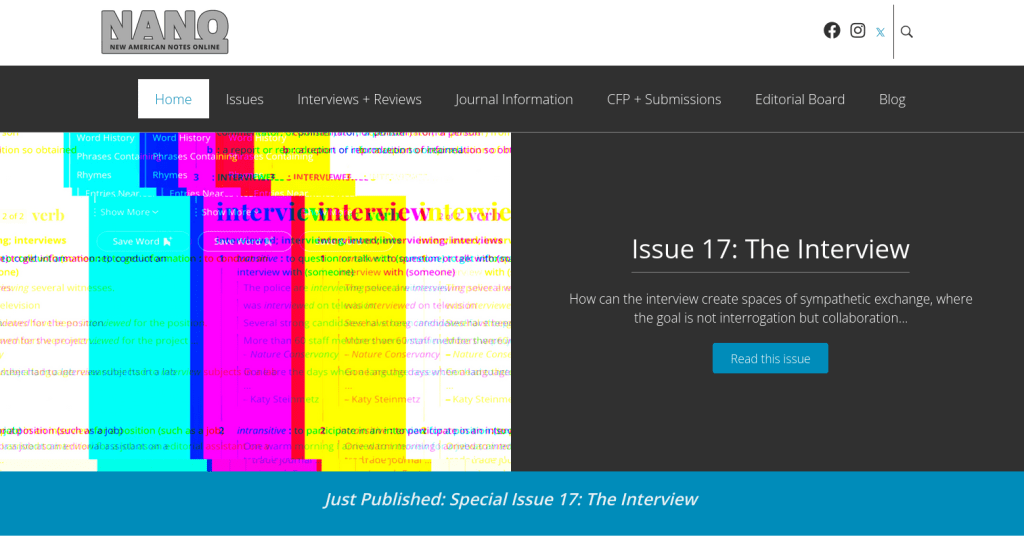
Special Issue 17: The Interview
Publication date: June 2025
ISSN: 2160-0104 (Online)
NANO is an indexed, Open Access, and Open Source humanities journal. NANO never charges to submit or to read content. NANO is published by City Tech, part of the City University of New York.
NANO announces its new issue, an exploration of the ways that interviews connect people.
The interview is woven into our hyper-connected world through podcasts, Zooms, magazines, newspapers, social media, and they still occur in private settings. Interviews are ubiquitous. They can be formal and informal, closed or open-ended; they can yield quantitative and qualitative results; they can invoke power and symbolic capital. But, the interview can also be less about gate-keeping and more about the tension inherent in knowledge production and sharing. The eight interviews in this special issue of NANO create spaces of exchange, where the goal is not interrogation but collaboration, curiosity, and mutual understanding.
Two interviews focus on teaching. A multimedia project by Shauna Chung, Naila Butt, Sandy Fougeres, and Khemraj Persaud describe ways that interviews fuse writing and workplace readiness while the scholar Laura Westengard reveals the communal spaces where gothic and queer reinforce each other.
Two interviews focus on visual art. Jennifer Lockard Connerley discusses ways that academia and spirituality enhance portraiture while Bill Saylor reveals how his environmental and natural abstractions arise.
Two interviews focus on translation. Dana Crăciun acknowledges the difficulty of translation while Johannes Göransson eyes translation’s inherent creativity.
Two interviews focus on creativity and theory. The writer and editor Emily Hockaday discusses the challenges of running a science fiction magazine in the age of AI while Marcus Boon reflects on his interdisciplinary practices.
Editor’s Introduction for NANO Special Issue 17: The Interview