Category: City Tech

  • Reflections for the Open Pedagogy Event on Access Beyond the ADA, Thursday, 9/19/19

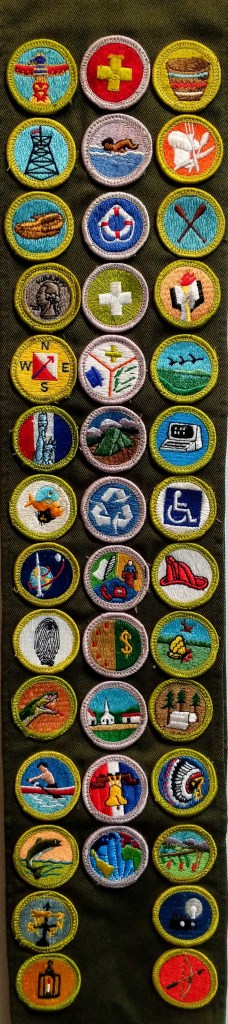
    Jason Ellis' Boy Scouts Merit Badge sash with 40 badges, including Handicap Awareness.
    Jason Ellis’ Boy Scouts Merit Badge sash with 40 badges, including Handicap Awareness.

    On Thursday, 9/19/19, the OpenLab, which I joined as a Co-Director this academic year, is hosting an Open Pedagogy event on “Beyond the ADA” at City Tech in the Faculty Commons at 4:30pm. We will lead a discussion about issues of access, including those related to disabilities, while looking beyond compliance to dynamic, inclusive, and supportive pedagogies that enrich learning for all students. OpenLab’s theme for this academic year is “Access.”

    While reading through the suggested texts informing the background of our discussion, I reflected on my personal, workplace, and classroom experiences relating to access.

    My first memory of disabilities relates to my Uncle Pat. After returning from Vietnam, he started a family in Walnut Grove, Alabama and worked for the railroad. While at work cutting an in-service rail, another truck accidentally bumped his truck, which ran over him and left him a quadriplegic. On visits, I saw first hand how he overcame him disability through mobility with a puffer-controlled electric wheelchair, but the constraints of 24-hour nursing care and accessible buildings were also obviously apparent. Nevertheless, he always trounced me at chess–I just had to setup the board and move the pieces.

    In my hometown, Emory Dawson was another quadriplegic that I knew through Boy Scouts. His injury originated from the Vietnam War and he had some shoulder mobility, which enabled him to drive his own van with the aid of a suicide knob and special controls for brake, throttle, and shifting. In addition to Scouts, Mr. Dawson was involved in many social groups and charities, and he led an active life to support them. I don’t know if it was *the* factor in its construction, but a fellow Scout took on the building of a concrete wheel chair ramp for a rank-level project at Troop 224’s hut in the back of Lakeside United Methodist Church on 341 Highway and Mr. Dawson visited our meetings on occasion.

    It was during that time that I earned my Handicap Awareness merit badge on Feb. 5, 1990, which you can see on the seventh row of the image above of my Boy Scout merit badge sash with the International Symbol of Access surrounded by a green circle. The requirements of the merit badge focused on learning about disabilities and gaining an empathetic awareness of disabilities through simulated impairments of hearing, sight, manual, and mobility. Less visible disabilities were outside the scope of that component of the merit badge’s requirements, but they could be reintroduced through the learning and outreach components (but this was not, as I remember, something that I was cognizant of at that time).

    I wondered how the merit badge might have changed since I earned it, and I’m glad to report that it had changed for the better, I think. In 1993, the merit badge was renamed as Disabilities Awareness, and its requirements shifted from personal simulation of physical impairments to learning first hand from others’ lived experience, identifying accessibility issues in the community, and performing advocacy for better accessibility. There was an advocacy element to Handicap Awareness (publicly sharing what you’ve learned with others), but Disabilities Awareness foregrounds this in a more integrated fashion. It would be interesting to read the merit badge series handbooks for the former and latter versions of this merit badge, but I only have access to the requirements while writing this blog post.

    When I worked in Technical Support at Mindspring Internet in Atlanta, Georgia, I was tasked with working with the Deaf and Hard of Hearing via a telecommunications device for the deaf (TDD). With a single line of LCD text and a running paper tape, I communicated with deaf customers to solve their technical support issues. Unfortunately, many customers had their TDD in a different room, different floor, different part of the house, than their computer. This introduced a tremendous lag between what I wrote questioning or instructing and their response following a result. Also, I was given this extra task to supplement my lower-than-expected phone support numbers (It’s my understanding that Mike McQuary pushed raw number of support calls over the quality of calls and successful resolution of customer issues–valuing quantitative measures over the qualitative effects of those measures on customers and employees). So, I was on the phone with one customer and on the TDD with another customer. Over time, I got better at switching my attention between customers, but more often than not, the customers on the TDD got the short end of the stick as my phone call numbers were given priority by management (QA Brian: “You’ve got to take more calls or you’ll get fired.”). It was an unfair situation for the deaf and hard of hearing customers.

    When I began teaching, I worked with a student on the autistic spectrum. This was a challenging situation for the student as the reported accommodations couldn’t support their success in the classroom, and I took it on myself to provide additional support to help the student progress in the course. I was advised that there was only so much that I could do to support the student, and I should have, in retrospect, dialed back my professional involvement. Nevertheless, this student did help me recognize another side of student needs and the impediments to access that students on the spectrum encounter. I have adjusted my syllabi to be more accommodating to students–self-reporting or not–through multiple activities and assignment adjustments on a one-by-one basis (as long as course learning outcomes are always met).

    Another student had a severe vision impairment and had reported accommodations, including a phone with magnifying app for reading text and a student volunteer note-taker. While the classroom and supporting material could be adjusted to support the student when present, outside life prevented the student from attending some classes. This led to testy encounters between myself and the note taker, who felt their time being wasted, and follow-up conversations between myself and the student to facilitate peace between the student and note taker so that support would be maintained. Of course, life outside of school was creating a different kind of access problem for this student–getting to campus was a hurdle in part due to the student’s vision problem and the issues that can come up in one’s personal life that lead to problems, such as not having someone to help you navigate from home to campus.

    I’ve come to realize that there are things that I can do to help as an instructor–those things that I have control over, such as pedagogy, syllabi, assignments, activities, and one-on-one support, and there are many other things outside the classroom that I don’t have control over. Also, the Open Pedagogy event conversation and the work that we can do together to increase access and lower barriers–in the classroom, online, on campus, and in our lived world–for students and faculty with disabilities is something that we must endeavor to accomplish.

    In addition to the informative readings OpenLab Digital Pedagogy Fellow Jesse Rice-Evans assembled for the Open Pedagogy event, I found these additional readings useful for my thinking:

    Adams, Rachel, Benjamin Reiss, and David Serlin. “Disability.” Keywords for Disability Studies, edited by Rachel Adams, Benjamin Reiss, and David Serlin, NYU Press, 2015, 5-12.

    Campbell, Kumari. “Ability.” Keywords for Disability Studies, edited by Rachel Adams, Benjamin Reiss, and David Serlin, NYU Press, 2015, 12-14.

    Mullaney, Clare. “Disability Studies: Foundations & Key Concepts.” JSTOR Daily, 13 April 2019, https://daily.jstor.org/reading-list-disability-studies/. Accessed 18 Sept. 2019.

    Williamson, Bess. “Access.” Keywords for Disability Studies, edited by Rachel Adams, Benjamin Reiss, and David Serlin, NYU Press, 2015, 14-16.
  • Talking Science Fiction with Neil deGrasse Tyson on StarTalk Radio

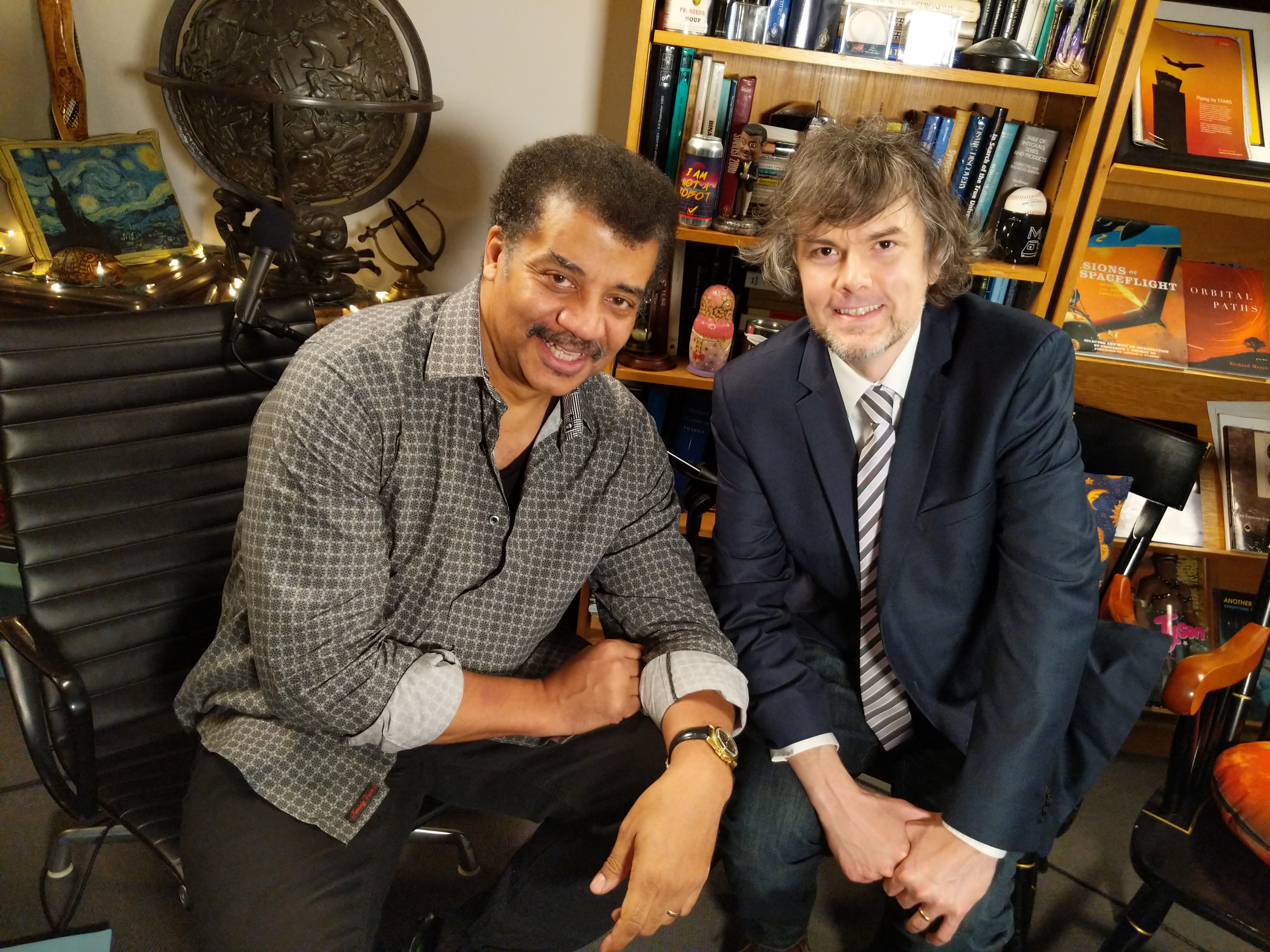
    Neil deGrasse Tyson and Jason Ellis in Dr. Tyson’s Office at the AMNH Planetarium.

    I had the distinct honor to join the conversation about science fiction and society on Dr. Neil deGrasse Tyson’s StarTalk Radio Show on May 30, 2019 (season 10, episode 22). The episode is about Creating Science Fiction, with Gale Anne Hurd, the producer of The Terminator and The Walking Dead. I shared some thoughts on Hugo Gernsback’s formula for “scientifiction,” H.G. Wells and Sir Ernest Swinton’s legal fight over the modern battle tank, the power of SF to engage social issues and debate, and my personal, lifelong relationship to SF. You can listen to the episode here or embedded below:

    About the episode from the StarTalk website:

    The Terminator, The Walking Dead, Aliens, and a lot more. Those are just some of the producing credits for this week’s main guest on StarTalk Radio. Neil deGrasse Tyson sits down with producer-extraordinaire Gale Anne Hurd to explore what it takes to bring great science fiction to life. Neil is joined by comic co-host Chuck Nice, science fiction expert Jason Ellis, PhD, and volcanologist Janine Krippner, PhD.

    Because science fiction comes in many different forms and through many different avenues, there are many ways to get into it. You’ll learn how Gale’s childhood love of Marvel comic books and science fiction novels translated into a career “making what she likes to see.” She tells us how she served as a science fiction consultant to her local library to make sure their stock was up to date. Jason shares why not being able to see Star Wars in the theater sparked a rebellious love for science fiction.

    You’ll hear about the history of science fiction and how it combines the STEM fields and the humanities. We debate if science fiction informs the future of every technological invention. You’ll find out about a lawsuit H.G Wells brought upon military figureheads because he claimed they stole his idea from one of his science fiction stories. Explore using science fiction as social commentary. Discover more about the famous kiss between Captain Kirk and Lt. Uhura, and how William Shatner and Nichelle Nichols purposely flubbed takes to make sure it stayed in the episode.

    We take a deep dive into Dante’s Peak as volcanologist Janine Krippner stops by to share her take on the film. She explains why she thinks it’s still the best volcano movie even with its flaws. Gale gives us a behind-the-scenes look on how she fought for even more scientific realism to be in the film but encountered pushback from the studio. Neil also confronts Gale on the famous scientific inaccuracies of Armageddon. Chuck shares his love for The Expanse, we discuss Interstellar, and Neil tells us about his involvement in The Europa Report.

    Lastly, you’ll also find out the differences between creating science fiction for television and film. According to Hugo Gernsback, the father of science fiction, sci-fi should be 75% romance and 25% science – is that still the goal? All that, plus, Jason caps it off with a story on how he was criticizing the film Sunshine right in front of director Danny Boyle’s family.

    “Creating Science Fiction, with Gale Anne Hurd.” StarTalk Radio, 30 May 2019, https://www.startalkradio.net/show/creating-science-fiction-with-gale-anne-hurd/.
  • ENG3402, The Graphic Novel: Frank Miller’s The Dark Knight Returns (Continued…)

    Continuing from my previous post on The Dark Knight Returns, I’ve assembled a selection of videos below featuring Frank Miller and others talking about Miller’s work in The Dark Knight Returns.

    In this interview introduced by science fiction writer and editor Harlan Ellison for “The Masters of Comic Book Art (1987), Frank Miller discusses The Dark Knight Returns, Ronin, and other works.

    DC Comics interviews people about their work on and memories of The Dark Knight Returns.

    The Frank Miller episode of G4’s Icons discusses The Dark Knight Returns at the 16:00 mark.

    Frank Miller was interviewed for Comic Book Confidential (1988). His part of documentary is embedded below.

    In this final video, Frank Miller talks about his work and influences.

  • ENG3402, The Graphic Novel: Class on Superheroes, Antiheroes, and Frank Miller’s The Dark Knight Returns (filling in for Prof. Rebecca Mazumdar)

    On Thursday, Feb. 14, I’m filling in for Prof. Rebecca Mazumdar in her ENG3402 Special Topics Class on The Graphic Novel.

    Students were asked to read the first two books of Frank Miller’s Batman: The Dark Knight Returns (1986) and Chapter 3, “Blood in the Gutter” of Scott McCloud’s Understanding Comics (1993) for today’s class.

    During today’s class, we’ll discuss The Dark Knight Returns, Superheroes, and the Antihero. These topics will return for discussion in future classes when Prof. Mazumdar joins you next.

    These are some resources that will inform our discussion (in the order of reference):

    Nicholls, Peter, and David Langford. “Superheroes.” The Encyclopedia of Science Fiction. Eds. John Clute, David Langford, Peter Nicholls and Graham Sleight. Gollancz, 31 Aug. 2018, http://www.sf-encyclopedia.com/entry/superheroes.

    Langford, David. “Superpowers.” The Encyclopedia of Science Fiction. Eds. John Clute, David Langford, Peter Nicholls and Graham Sleight. Gollancz, 8 May 2015, http://www.sf-encyclopedia.com/entry/superpowers.

    Langford, David. “Clarke’s Laws.” The Encyclopedia of Science Fiction. Eds. John Clute, David Langford, Peter Nicholls and Graham Sleight. Gollancz, 2 Aug. 2016, http://www.sf-encyclopedia.com/entry/clarkes_laws.

    Tiner, Ron, David Roache DRo and John Platt. “Batman.” The Encyclopedia of Science Fiction. Eds. John Clute, David Langford, Peter Nicholls and Graham Sleight. Gollancz, 15 Oct. 2018, http://www.sf-encyclopedia.com/entry/batman.

    Langford, David. “Antiheroes.” The Encyclopedia of Science Fiction. Eds. John Clute, David Langford, Peter Nicholls and Graham Sleight. Gollancz, 6 Oct. 2017, http://www.sf-encyclopedia.com/entry/antiheroes.

    Kiste Nyberg, Amy. “Comics Code History: The Seal of Approval.” Comic Book Legal Defense Fund, http://cbldf.org/comics-code-history-the-seal-of-approval/. Accessed 13 Feb. 2019.

  • Presentation Videos from the Third Annual City Tech Science Fiction Symposium, Nov. 27, 2018


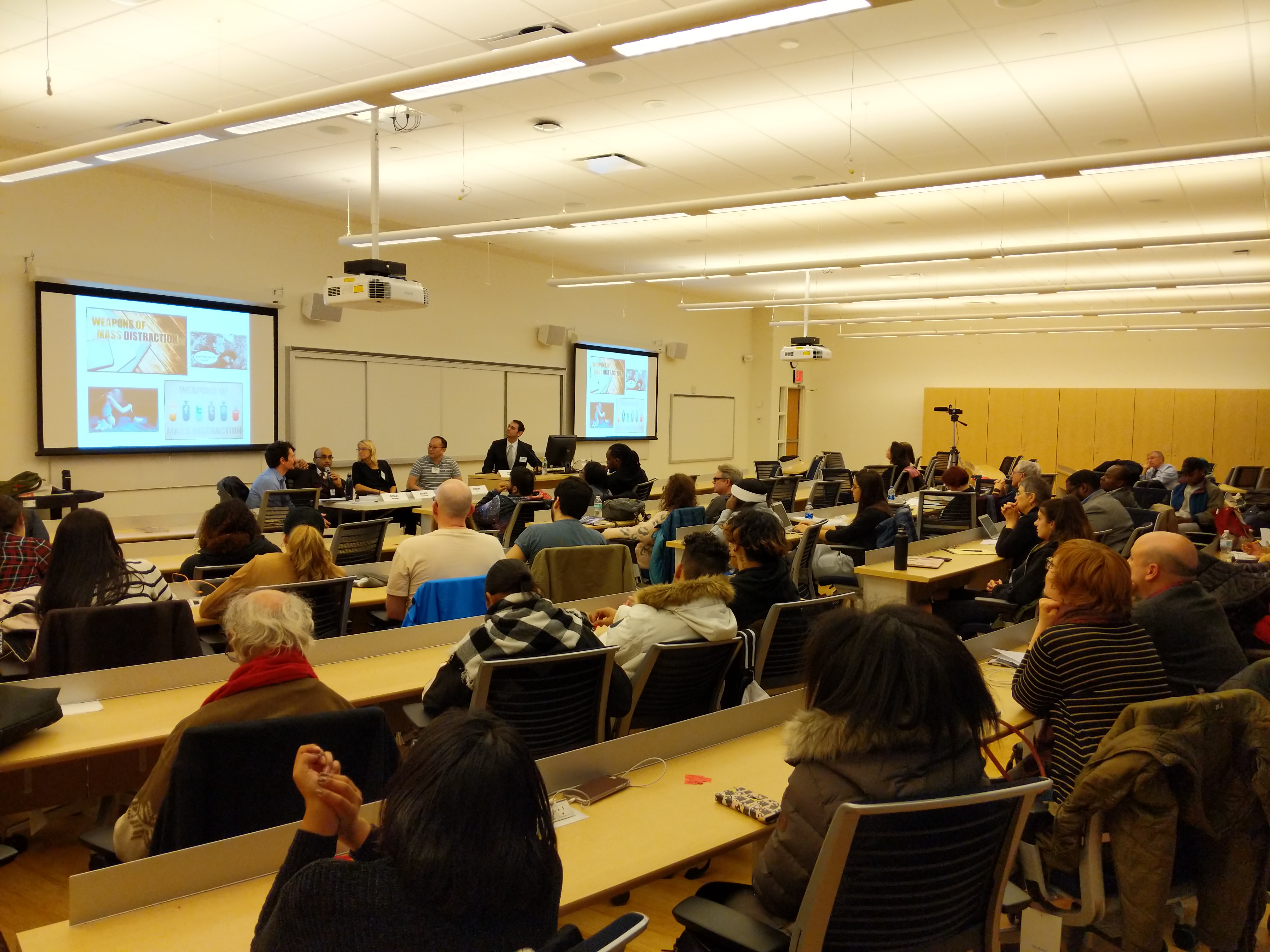
    IMG_20181127_161342

    The Third Annual City Tech Science Fiction Symposium was an amazing success! Here are videos from the symposium’s presentations and discussions from Nov. 27, 2018. Watch them all on YouTube via this playlist, or watch them as embedded videos below.


    9:00am-9:20am
    Continental Breakfast and Opening Remarks
    Location: Academic Complex A105
    Justin Vazquez-Poritz, Dean of the School of Arts and Sciences, New York City College of Technology
    Jason W. Ellis, New York City College of Technology


    9:20am-10:35am
    Session 1: Affect and Experimentation
    Location: Academic Complex A105
    Moderator: Jason W. Ellis
    Leigh Gold, “The Legacy of Frankenstein: Science, Mourning, and the Ethics of Experimentation”
    Lucas Kwong, “The Island Of Dr. Moreau, Fantastic Ambivalence, and the Victorian “Science Of Religion”
    Robert Lestón, “Between Intervals: A Soundscape for all Us Monsters”


    10:45am-12:00am
    Session 2: Identity and Genre
    Location: Academic Complex A105
    Moderator: Jill Belli
    Anastasia Klimchynskaya, “Frankenstein, Or, the Modern Fantastic: Rationalizing Wonder and the Birth of Science Fiction”
    Paul Levinson, “Golem, Frankenstein, and Westworld”
    Joy Sanchez-Taylor, “Genetic Engineering and non-Western Modernity in Paolo Bacigalupi’s The Windup Girl and Larissa Lai’s Salt Fish Girl”


    1:15pm-2:30pm
    Session 3: American Culture and Media
    Location: Academic Complex A105
    Moderator: A. Lavelle Porter
    Aaron Barlow, “‘Fraunkensteen’: What’s No Longer Scary Becomes Funny or, How American Popular Culture Appropriates Art and Expands the Commons”
    Marleen S. Barr, “Trumppunk Or Science Fiction Resists the Monster Inhabiting the White House”
    Sharon Packer, “Jessica Jones (Superhero), Women & Alcohol Use Disorders”


    2:40pm-3:40pm
    Student Round Table: “Shaping the Future: A Student Roundtable on Octavia Butler’s Parable of the Sower”
    Location: Academic Complex A105
    Moderator: A. Lavelle Porter
    Panelists: Zawad Ahmed
    Marvin Blain
    Kartikye Ghai
    Devinnesha Ryan


    4:00pm-4:50pm
    Frankenstein Panel: Mary Shelley’s Novel’s Influence on Scientists and Technologists
    Location: Academic Complex A105
    Moderator: Justin Vazquez-Poritz
    Panelists:
    Heidi Boisvert, Entertainment Technology Department
    Robert MacDougall, Social Sciences Department
    Ashwin Satyanarayana, Computer Systems Technology Department
    Jeremy Seto, Biological Sciences Department


    5:00pm-6:00pm
    Closing and Tour of the City Tech Science Fiction Collection
    Location: City Tech Library L543
    Remarks by Jason W. Ellis