The motivation for the resource was two fold: I wanted to learn all that I could about generative AI for my professional work as a teacher and scholar, and I needed to understand the changes taking place due to these new technologies for the benefit of my students who had already expressed concern and wonder about it.
I launched it with more than 150 MLA-formatted citations of books, collections, and articles related to AI and generative AI with an emphasis on teaching but also including useful background and area specific sources.
Now, it has over 550 citations! It also includes a growing list of online resources with direct links!
I’ll keep adding to it periodically, and if you have some sources that I haven’t included but should, drop me a line (my email address is in the sidebar to the right).
Earlier this week, a high school student, possibly the most articulate and well-spoken high schooler it’s been my pleasure to correspond with, emailed me about her goal of becoming an English professor. She asked what had been my path to where I am now. After replying, I thought that I could edit my response and post it here to help others who might also be curious about joining the ranks of the profession.
General Path
Typically, a student interested in becoming an English (literature—the path for someone focusing on Rhetoric and Composition or Technical Communication would be slightly different than what I write about here) professor will go to a liberal arts college to earn a BA in English, which teaches them the canonical works of English literature with some supporting classes in related subfields, such as African-American Literature, Postcolonial Theory and Literature, Queer Theory and Literature, Romanticism, Science Fiction, etc. The BA and all its associated reading becomes the foundation for the first step in graduate school, the MA in English, which teaches the student more depth in some aspects of English literature but more importantly teaches students the rigors of writing, presenting, and research. The MA then prepares the student for the PhD, in which the student reads more, does more research, writes more, presents in seminar, does some teaching, prepares for the qualifying exams (typically three written and/or oral examinations on three topics that relate to their eventual dissertation), and ultimately, write and orally defend the book-length dissertation on an exceedingly focused topic that introduces new knowledge into the world and supported by rigorous argumentation. Depending on the graduate schools, the student might also have a second and/or third language requirement demonstrated by exams or coursework.
My Path (tl;dr version)
My path to becoming an English professor was not as straightforward. I started as a BS in Physics student at the Georgia Institute of Technology (Georgia Tech) in 1995. It took me a long time to figure out that I was better at writing about science than doing science. Part of that process of discovery involved working in the IT industry at small and large businesses. So, when I “got out” 11 years later, I left with a BS in Science, Technology, and Culture—an interdisciplinary degree that combined literary study, cultural theory, a foreign language (French), and plenty of science and mathematics. Its capstone requirement was a thesis, which I wrote on fictional robots and the Cold War. Then, I went to the University of Liverpool in England where I earned an MA in Science Fiction Studies. Typically, MA in English programs are two years long, but a full-time commitment in this program resulted in a degree. I wrote my thesis on Cold War identities in Battlestar Galactica. Next, I returned to the United States to join the PhD in English program at Kent State University in Ohio. To earn my degree, I did two years of course work, one year to prepare for my three subject area written exams and one foreign language exam (French), and two years to write and orally defend my dissertation, Brains, Minds, and Computers in Literary and Science Fiction Neuronarratives. I taught composition for two years, served as the coordinator for the Office of Digital Composition. During my next to last year in the PhD program, I applied for tenure track jobs and got one interview. During my final year in the program, I applied to about 100 job listings, which gained me an interview and ultimately an offer to become a postgraduate Brittain Fellow at Georgia Tech. While at Georgia Tech, I taught composition classes during the school year and science fiction during the summer. Also, I took advantage of a professionalization program to begin teaching Technical Communication. This was advantageous, because it was that experience that contributed to my getting an interview at the New York City College of Technology, CUNY (City Tech), where I have worked since 2014.
My Path (long version)
It took me a long time, as they say, “to get out of Tech.” I started as a BS in Physics major at Georgia Tech in 1995 with delusions of grandeur to one day rise to the rank of Lucasian Professor of Mathematics at the University of Cambridge. This plan did not work out the way that I wanted, which was driven home to me when I was kicked out of Tech for essentially joining the square root club (i.e., the square root of my GPA was greater than my GPA).
During my time away from Tech, I worked retail jobs and did a little substitute teaching on the side until I was able to find a job with computers and IT. I took classes at a community college to learn more in IT, but I kept thinking that maybe there’s a way for me to finish what I had started at Tech.
Just before I had to leave, I had been doing remarkably well in literature classes offered by the School of Literature, Communication, and Culture (LCC), which is now called the School of Literature, Media, and Communication (LMC). It dawned on me that maybe I was better at writing about science than doing science. And, with my professional interest in computers, web design, and networking, I thought that their BS in Science, Technology, and Culture (STaC) might bridge what I was good at (reading and writing about literature) with my professional interests in technology that would result in having a degree to help me pursue the next step of my professionalization.
Thankfully, Prof. Patrick Sharp, in one of his last official duties before going out west, was to readmit me to Georgia Tech as a STaC major. In a new major with a clearer goal in mind helped me flourish. But, what led me down the path that I am now on was taking Prof. Lisa Yaszek’s Science Fiction class in 2002. I have been a lifelong science fiction fan, but until that moment, I didn’t realize that you could study it in a serious way, much less get paid to teach it and write about it in academia. Prof. Yaszek’s approach to teaching and mentoring students (I went on to take other classes, compete for research awards to work with her, and organize symposia under her direction) inspired me to do that for others. Those experiences made me think about some of the best teachers I had had before college, such as Magistra Ingrid Metz (Latin), Mrs. Emwynn Smith (Pre-Calculus), and Mrs. Laura Ragland (Drafting). And, I had enjoyed being a high school substitute teacher during my time away from Tech. Like the realization about my aptitude for writing was stronger than advanced mathematics, I began to think that teaching could be the vocation that I would be good at and enjoy.
So, late in my undergraduate education at Georgia Tech, I made the decision to go to graduate school. I took the GRE exam and the GRE subject test in English literature (which no longer exists). My score on the former was fair, but my score on the latter was abysmal. Which is probably why I didn’t get accepted to most of the graduate programs that I had applied to. I think my GRE scores played a big role in this, but the other challenge was explaining how I was prepared for and what I offered to a MA in English program with a very interdisciplinary BS degree instead of the traditional BA in English degree that most MA in English students had. I was, however, accepted to the MA in Science Fiction Studies program at the University of Liverpool in England. This was an intensive 1-year program, and it would give me access to one of the best SF special collections in the world. It would help me catch up on my lost time, but it would mean that I would have to begin applying to PhD programs almost as soon as I landed in England.
For the coursework in the MA program at the University of Liverpool, the few of us in the program met once a week in our professors’ offices to discuss that week’s theory and literary readings. There’s no hiding in such a situation. It pushed me to become a faster reader and to be a smarter reader (e.g., using reviews and summaries to guide my reading—it might seem like doing more, but it’s priming the mind for more efficient engagement with those texts). Then, under the direction of one faculty member, in my case Prof. David Seed, I wrote a thesis after consulting with him several times (i.e., read these things and then discuss them, repeat) completed during the summer months titled, “Post-Cold War American Identities in Battlestar Galactica.” It was also during the first month that I started a blog to document my Liverpool experience and give myself an excuse to develop my writing through regular practice.
My PhD applications were a little more successful than my MA applications—two acceptances instead of only one. The University of Liverpool offered me a place in the English PhD program, and I was offered a spot in the English PhD program at Kent State University where I had been recommended to work with Prof. Mack Hassler. While I certainly would have enjoyed continuing my studies in Liverpool, my decision to accept the position at Kent State had to do with its lower cost and greater potential for teaching opportunities (I think teaching might have been an option in Liverpool, but being on a postgraduate student visa would have had some restrictions, if I remember correctly).
In Kent State’s PhD program, I spent the first two years in course work (literature, cultural theory, semiotics), then the third year preparing for my comprehensive exams (20th Century American Literature administered by Kevin Floyd, Postmodern Theory administered by Tammy Clewell, and the Fiction of Philip K. Dick administered by Mack Hassler), and the fourth and fifth years writing my dissertation titled “Brains, Minds, and Computers in Literary and Science Fiction Neuronarratives,” which I defended orally in order to graduate. During my second year, I was given an opportunity to teach composition classes. I also did other kinds of work by serving as coordinator of the Office of Digital Composition and providing workshops to grad students and faculty. And, I joined the Rhetoric and Composition reading group and the Neurohumanities reading group—to learn more and engage in exciting discussions.
I learned very early on from the faculty there just how difficult it was to get a tenure track job after graduation. This is due to a combination of reasons: the over production of PhDs, professors waiting longer to retire, schools not creating new tenure-track lines and/or not replacing lines when someone quits or retires, and schools hire more adjuncts (less money and fewer if any benefits) to teach classes. To put this into perspective, only 35% of the folks I knew in the PhD program landed tenure track jobs. For myself, I have applied to about 150 positions over the years, which have yielded six video interviews, two campus visits, and three job offers. Some of the most onerous job listings, meaning those that would require the applicant to provide potentially hundreds of pages of material, which is more than is typically asked of first round applicants: CV, two-page cover letter, writing sample, teaching philosophy, and three unseen letters of recommendation, never resulted in a call back.
Also, there’s the realization that getting a PhD from Kent State isn’t as revered as one from, say, Yale, UC-Berkeley, Duke, or the University of Wisconsin, Madison, which all have highly recognized English literature programs. That meant that we needed to push ourselves to stand out through our professionalization—conference presentations, journal publications, professional organization service, and awards. They emphasized leveraging the work that we did in our classes for possible conference presentations and journal publications, which would grow our CVs in meaningful ways. While an MA student at Liverpool, I had begun writing reviews for the SFRA Review. As a PhD student, I got more involved in the Science Fiction Research Association and gave presentations at the big conferences related to my work: SFRA, International Conference for the Fantastic in the Arts (ICFA), and the Society for Literature, Science, and the Arts (SLSA). In the SFRA, I worked my way up into leadership positions after doing other service, including publicity and conference programming.
Before graduating with my PhD, I applied for positions during my penultimate and ultimate years in the program. I was very happy to receive an offer during my last year to become a Brittain Fellow at Georgia Tech. The Brittain Fellowship was an amazing postgraduate opportunity while I continued applying for a full-time, tenure track job. As a Brittain Fellow, there is a 3-3 teaching load (3 classes per semester), and a service requirement to contribute to committees, program development, and other initiatives, which support the program while giving Britts, as they are called, opportunities for professionalization. I started out teaching composition, but I volunteered to join the Technical Communication seminar, which is required for those who were hired to teach those classes, so that I could learn and earn the possibility of teaching those classes, too (and it worked out that I got to collaborate with Rebecca Burnett, the Writing and Communication Program Director). This experience helped me land the job that I now have the New York City College of Technology, CUNY (City Tech). Before leaving Georgia Tech during my second year for my current job, I co-presented with Wendy Hagenmaier on “Digital Archives and Vintage Computing at Georgia Tech” at the second Southeast Vintage Computer Festival, and I donated some of my best, working 1990s-era PCs to the Georgia Tech Library to support their RetroTech Lab.
During my second year in the Brittain Fellowship, I sent out a lot of applications, because I knew that I only had three years maximum as a Brittain Fellow. It was vital that I find a tenure track position. Of those applications, I obtained two campus visits. One was to Southern Polytechnic, which is now a part of Kennesaw State University. The other was to the New York City College of Technology, CUNY (City Tech). I drove to the campus visit at Southern Poly. I feel that I did very poorly on my interview with the department chair, but I felt confident about my teaching demonstration. Then, I flew to NYC for the campus interview at City Tech, which I felt went a lot better even though it was a full day of interviews with President Russell K. Hotzler, Provost Bonne August, Dean Karl Botchway, and English Department Chair Nina Bannett followed by a teaching demonstration for the English Department. I received offers from Southern Poly and City Tech. I went with City Tech, because it felt like the right fit for me.
The thing is that this is where my path has led to so far. Where it might lead in the future isn’t clear. The only way to discover where it leads is to keep moving forward—sometimes following paths already established and sometimes blazing new trails for others to follow.
I’m very happy to announce the launch of a new open educational resource (OER) that I’ve been working on for awhile!
It’s called Yet Another Science Fiction Textbook (YASFT). It’s over 60,000 words and includes additional resources that can be helpful for readers, students, and instructors.
YASFT is released under an Attribution-NonCommercial-ShareAlike 4.0 International Creative Commons License. It’s freely available to be read as it is. However, if anyone would like to use it in another way, there are licensing terms that must be followed: “This license requires that reusers give credit to the creator. It allows reusers to distribute, remix, adapt, and build upon the material in any medium or format, for noncommercial purposes only. If others modify or adapt the material, they must license the modified material under identical terms.”
You can find YASFT under the Teaching menu above or directly here.
Its abstract and table of contents are included below.
Abstract
Yet Another Science Fiction Textbook (YASFT) is an open educational resource or OER, meaning it is freely available for anyone to use and learn with. It provides a chronological history of Science Fiction (SF) with an emphasis on literature and film, and it includes other useful resources, such as a glossary of terms, an extensive list of SF definitions, additional resources, a syllabus with hyperlinked readings available online, and video lectures. It tells a story, but not the only story, about SF history. It’s also an experiment in using generative artificial intelligence (AI) to assist with editing a large body of text, in this case over 60,000 words.
Table of Contents
    Front Matter
        What is YASFT?
        Who made YASFT?
        Why was YASFT made?
        Why is it called YASFT?
        How can YASFT be used?
        How was YASFT made?
        Acknowledgements
    Preface
    Origins of Science Fiction
        Early Fantastic Stories
        Scientific Revolution
        Age of Enlightenment
        Romanticism
        The Gothic
    Mary Shelley’s Frankenstein
        Science-Saturated Novel
        Victor Frankenstein’s Hubris
        Critique of the Age of Enlightenment
        Tabula Rasa
    Proto-SF
        Historical Context
        Edgar Allan Poe
        Nathaniel Hawthorne
        Jules Verne
        H. G. Wells
        E. M. Forster
    Pulp SF
        Historical Context
        Overview of Pulp SF
        Hugo Gernsback
        E. E. “Doc” Smith
        C. L. Moore
        Edgar Rice Burroughs
        H. P. Lovecraft
    SF Film Serials of the 1930s and 1940s
        Buck Rogers
        Flash Gordon
    Golden Age SF
        Historical Context
        Overview of Golden Age SF
        John W. Campbell, Jr.
        Isaac Asimov
        Ray Bradbury
        Robert A. Heinlein
        Frank Herbert
        Tom Godwin
    SF Film Through the 1950s
        Film vs. Literature
        Early SF Film
        1950s SF Film Boom
        Forbidden Planet
    New Wave SF
        Historical Context
        Overview of New Wave SF
        J.G. Ballard
        Harlan Ellison
        Philip K. Dick
        Samuel R. Delany
    Star Trek
        “The City on the Edge of Forever”
    Feminist SF
        Historical Context
        Beginnings of Feminist SF
        Definitions of Feminist SF
        Joanna Russ
        Marge Piercy
        Pamela Zoline
        James Tiptree, Jr.
        Ursula K. Le Guin
        Octavia E. Butler
    Afrofuturism
        Steven Barnes
        Tananarive Due
        Nalo Hopkinson
        Nnedi Okorafor
    Cyberpunk
        Historical Context
        Coining the Cyberpunk Term
        Cyberpunk Characteristics
        William Gibson
            Sprawl Trilogy and Stories
            Hermes 2000 and Floppy Disk eBooks
            The X-Files, “Kill Switch”
        Bruce Sterling
        Pat Cadigan
    Contemporary Science Fiction
        Historical Context
        Ted Chiang
        N. K. Jemisin
        Cory Doctorow
        Charlie Jane Anders
        Martha Wells
        Mary Robinette Kowal
        Ken Liu
        R. F. Kuang
    SF Film from 1960 Onward
        1960s
        1970s
        1980s
        1990s
        2000s
        2010s
    Global Perspective: Taiwanese SF
        Brief Taiwanese History
        Taiwanese SF Overview
        Taiwanese Fandom
        Cultural Comparisons
        Issues with Translation
    How to Keep Up With Science Fiction
    Appendices
        Appendix 1: Glossary of Science Fiction Terms
        Appendix 2: Chronological List of SF Definitions of Science Fiction with MLA Citations
        Appendix 3: Further Reading
            Textbooks
            Readers
            Teaching
            Online Research
        Appendix 4: Sample Syllabus with Hyperlinked Readings
        Appendix 5: Lecture Videos
        Appendix 6: Version History
These past two weeks, I’ve been working on a sabbatical side project. I put my primary research project on hold so that I could think about it some more before proceeding. In the meantime, I’m using generative AI to help accelerate my work on an open educational resource (OER) focused on Science Fiction (SF) that I plan to launch soon. The writing is done on the project. What I am doing now is using an large language model (LLM) that I’m running on my desktop workstation to help me with editing. I think the end product will be pretty cool, and it will be something anyone is free to use after it’s launched. Stay tuned!
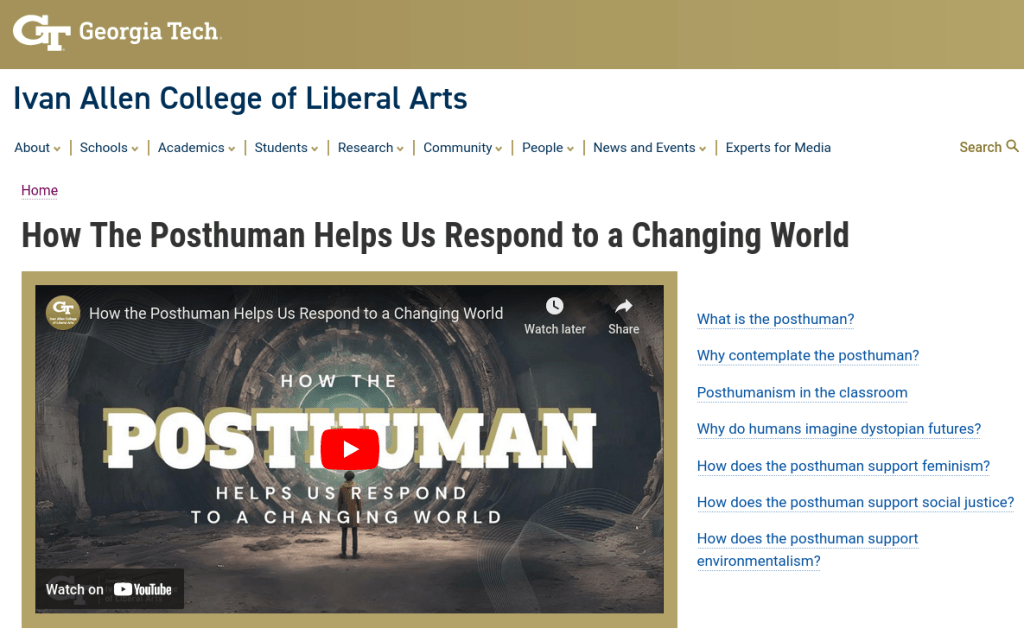
How can we leverage posthumanist ideas to respond to the world’s social and ecological crises? My colleagues at Georgia Tech (Lisa Yaszek, Regents Professor of Science Fiction Studies; Zita Hüsing, Assistant Director of the Writing and Communications Program and Marion L. Brittain Postdoctoral Fellow; and Paul B. Foster, Associate Professor of Chinese) and I give our perspectives in this brief multimodal article that might be great to share with students if you need a resource that succinctly breaks down what posthumanism is and addresses its connections to feminism, social justice, and environmentalism.
Previously, Lisa Yaszek and I wrote an book chapter on Posthumanism and Science Fiction for The Cambridge Companion to Literature the Posthuman (2016). You can read our chapter here.
If you’d like to talk about posthumanism or collaborate on a related project, drop me a line at my email address in the about box to the right.