This morning, Georgia Tech’s Center for the Enhancement of Learning (CETL) hosted the annual Celebrating Teaching Day.
We began with a poster session that showcased pedagogies and assignments from across campus.
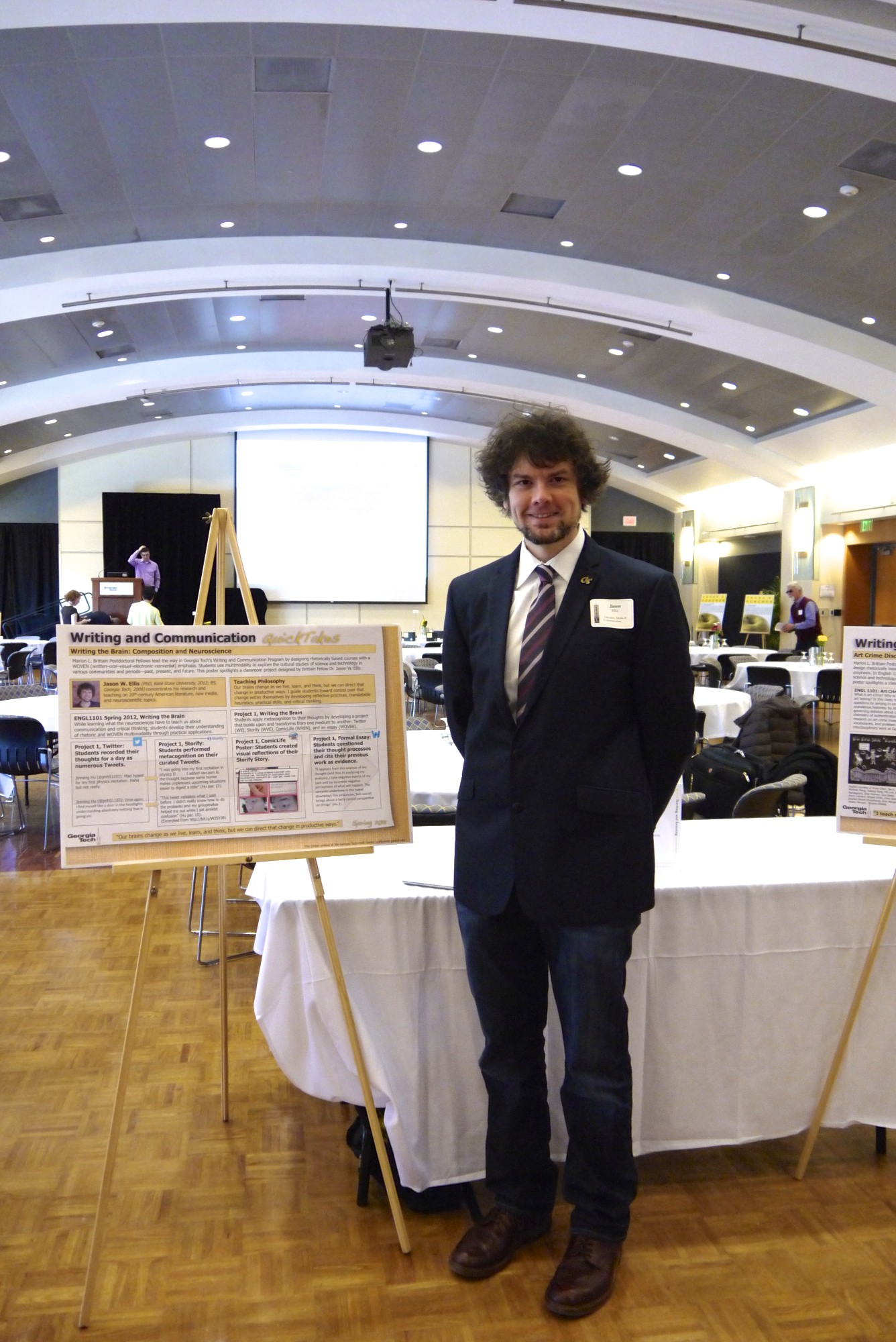
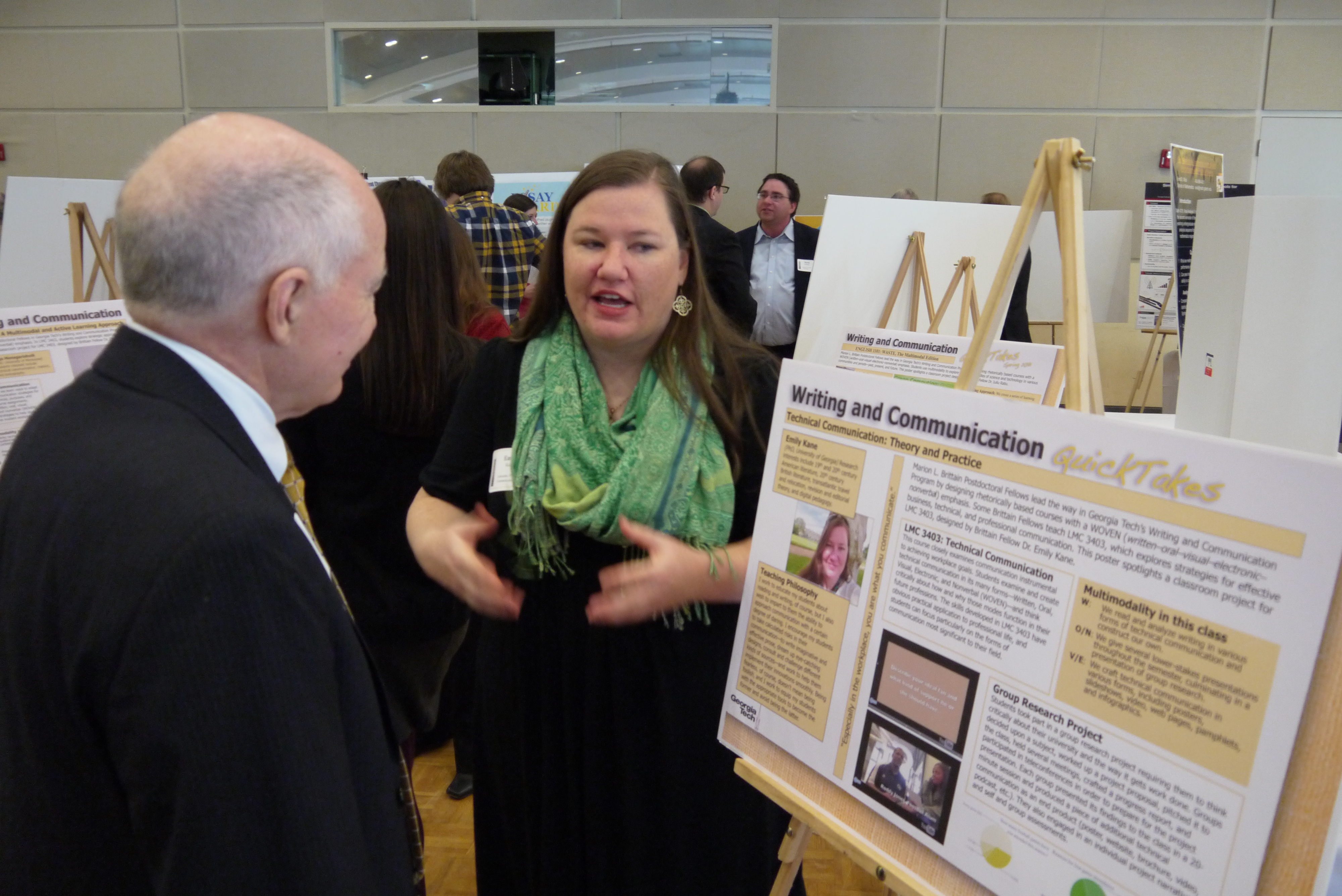
A number of Brittain Fellows had their posters on display and we were there in force to talk about our teaching of communication as rhetorical and multimodal (WOVEN = written, oral, visual, electronic, and nonverbal). I presented my poster on, “Writing the Brain: Composition and Neuroscience” [you may view it here–with thanks to my student Jinming Hu for giving me permission to share his work from class].
Fellow Britts: Olga Menagarishvili, Mollie Barnes, Emily Kane, and Iuliu Ratiu
We were able to share teaching ideas and techniques with others from the Georgia Tech community.
Emily Kane explaining her assignments.
The poster session was very well attended by people from across campus. The posters demonstrated the innovative teaching taking place at Georgia Tech.
Lots of visitors and lots of posters at Celebrating Teaching Day, 2013.
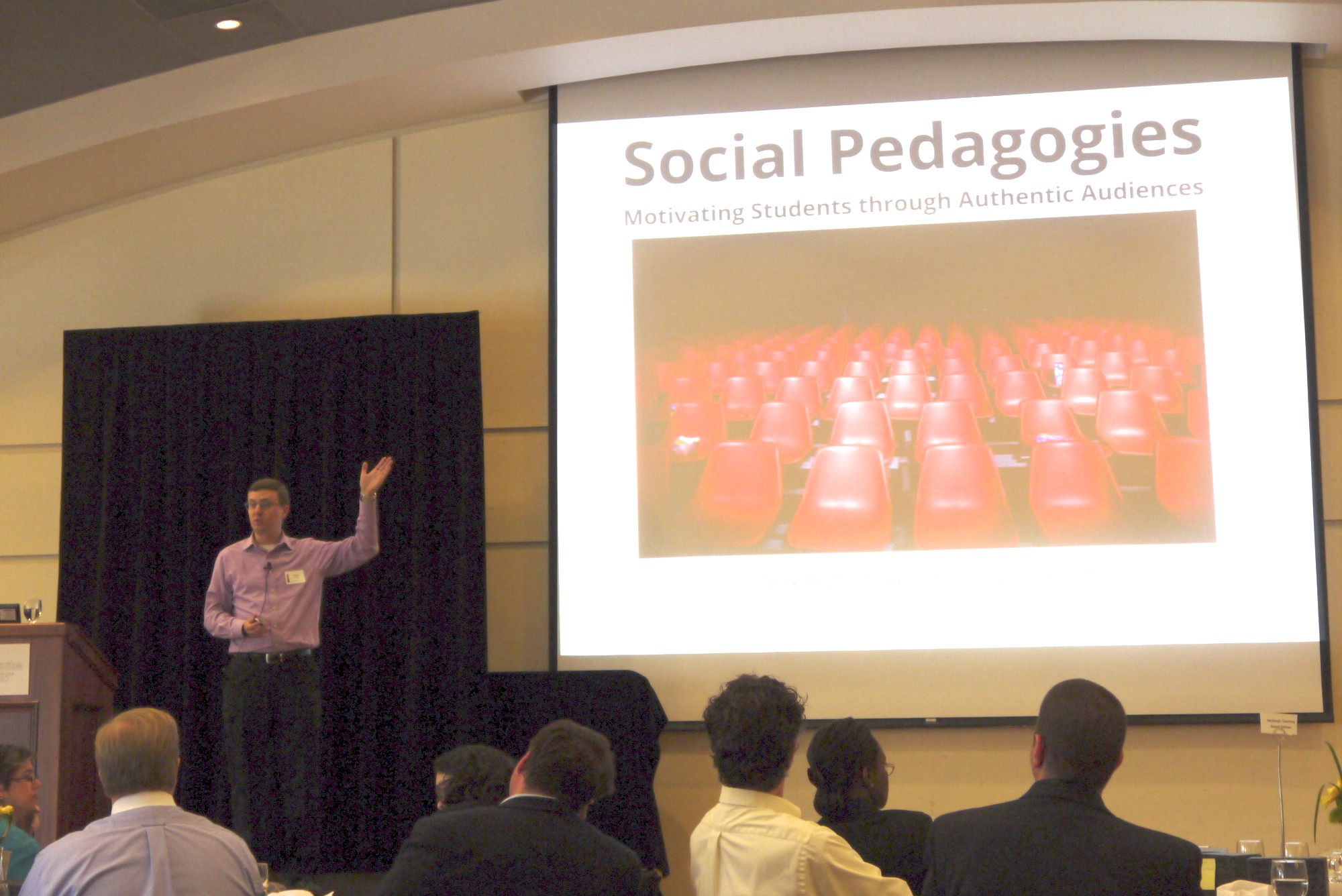
After the poster session, we were treated to lunch, an awards ceremony, remarks by President Bud Petersen, and finally, a presentation by Dr. Derek Bruff of Vanderbilt University on “Social Pedagogies.”
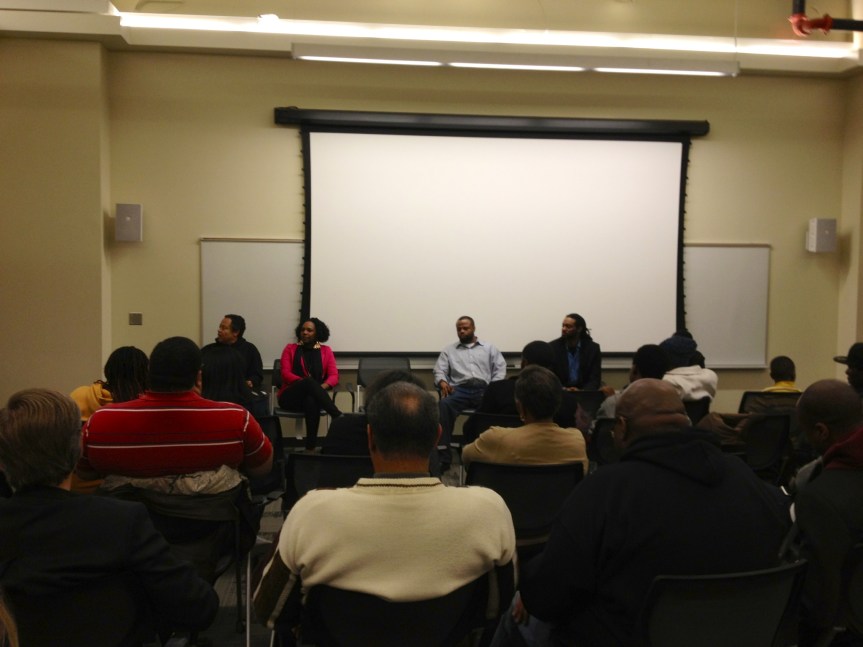
Audience and panelists at the State of Black SF Film Festival.
Tonight, it was standing room only in Georgia Tech’s Hall Building Room 102 for the 2013 State of Black Science Fiction Film Festival. Co-presented by the School of Literature, Media, and Communication and the State of Black Science Fiction Collective, it presented a number of cutting edge and independent films and opened conversation between filmmakers, writers, and critics. Professor Lisa Yaszek introduced the festival and Georgia Tech’s long history with science fiction via her predecessor Bud Foote, and Milton Davis and Balogun Ojetade organized the festival, introduced the films, and lead the post-screening panel discussion.
All of the films were exceptionally great! I have listed the films shown below with links to the video or more information where available.
Clayton Ziga’s “I am Designer” imagines a world where adoptive children can be surgically and technologically redesigned to meet the wants of their adoptive parents.
Matthew Savage’s dieselpunk, noirish short film “Reign of Death,” pits a gumshoe against an allegedly murderous robot. I really liked the integration of the CGI robot with the Sin City-esque visual feel of the moving picture.
Tommy Bottoms showed off his webseries, “Eternal.” It was billed as “True Blood meets The Wire,” and it combines the gritty reality of life with action and humor. In the episodes that we saw, I have to say that my favorite line of the whole night came when the main character Josh Davis, not understanding how the vampires around him seemingly vanish in thin air, exclaims, “Fucking magic tricks!”
We caught a glimpse of Teresa Dowell-Vest’s “Genesis: New American Superheroes,” which is about a couple who survived the Tuskeegee Experiment, went on to become scientists, and bestow science-derived gifts to their their five children: Tage/Power of Earth, Xavier/Power of Water, Xander/Power of Fire, Jordan/Power of Wind, and Quincey/Power of Technology and Knowledge.
Bree Newsome treated the audience to her Southern tale of horror titled, “Wake.” A woman gets more than she bargains for when she conjures a man to marry after ridding herself of her controlling father. Besides being creepy, disturbing, and occasionally funny, I enjoyed its playful use of language.
Balogun Ojetade showed the audience an excerpt from the larger steamfunk project titled, “Rite of Passage: Initiation.” In the scene, Harriet Tubman challenges her student Dorthy to a martial arts contest.
Finally, Donnie Leapheart presented two episodes of his action-packed webseries Osiris. This SF thriller is about a seemingly immortal man fighting back against corporate interests who want to commoditize and sell his ability to live forever. The two episodes that we saw were slick and clever. I was also impressed by the high production value of this series made for the web.
After the screening, Davis and Ojetade lead a panel discussion with Teresa Dowell-Vest, Donnie Leapheart, Tommy Bottoms, Bree Newsome, and Steve Barnes (writer, critic, and martial artist). What follows are my notes and paraphrasing from the conversation.
Question: What makes something black SF?
Bottoms: It can be the production side, actors, or story. However, anyone should be able to enjoy these films, not necessarily an exclusive black audience.
Dowell-Vest: She aims to create a body of work that transcends race and is enjoyable to a broad audience.
Leapheart: He embraces the idea of black SF, because he knows that there are black nerds, but they don’t get represented. Since SF is the biggest grossing genre for a broad audience, why are not more black filmmakers putting their voice out there in SF to reach that audience?
Barnes: He breaks down the definitions of SF, fantasy, and horror to help develop the terminology of the discussion. Broadly speaking, all fiction is fantasy, because fiction is not real. However, what we think of as fantasy involves a world that is unlike our own and operates by a set of rules significantly different than our own. SF is a subset of fantasy that must follow the rules of science, but it can be allowed to break one rule–such as time travel–to produce stories around: what if, if only, and if this goes on. Horror is another subset of fantasy in which the dominant mode is fear and it generates dread in the audience. There are many different kinds of horror: SF horror, fantasy horror, psychological horror, etc.
Question: How and why are black people portrayed negatively in the media?
Newsome: Where do we start!?
Bottoms: Right now, our culture embraces this as entertainment. At least in the past with Blaxploitation, social consciousness and positive endings were an integral part of the early wave of these films.
Newsome: We are fighting and combating stereotypes. Media is not separate from the social world.
Barnes: Negative portrayals are likely not something done with conscious intent, but are the way people actually thought. Put another way, they are not trying to make a group look negative. Instead, they are simply presenting their internalized beliefs. Furthermore, it has a lot to do with one group in a superior position defining itself against others.
Leapheart: We can blame the media, whites, etc., but if you look online there are many negative videos produced by blacks with loads of views and other positive videos with very few views. Is art imitating life or life imitating art? Should we give people what they want (or think that they want), or do we keep doing our own thing?
Dowell-Vest: She is concerned about the declining representation on television. At one point, we had a menu of options (e.g., Cosby, A Different World, In Living Color, etc.), but now it seems to be all on the shoulders of the character Olivia Pope in the show Scandal. If she were played by a white woman, would we be having this conversation? She sees a cycle of fight-struggle-complacency, and she worries that we are now in a period of complacency. True art and storytelling come from bucking the status quo.
Barnes: In the history of network television, there have only been four successful black-starring hour-long dramas. This is why so much rides on Olivia Pope and Scandal. He also mentioned the TV series Deception.
Newsome: Waits for a time when we don’t have to rely on only one show to represent all black people.
Question: What is the future of black film (while considering Quintin Tarantino’s Django Unchained)?
Bottoms: Don’t tell someone that they can’t make a film. If you think that you can do it better, then you go out and make it. He enjoyed Django Unchained despite the problems that some people had with its language–how else could you do it, he asked?
Barnes: Loved Django Unchained. He went to see it with one of Louis Farrakhan’s body guards, who laughed his ass off. Only five directors could have pulled off this film, and four didn’t want to do it. Taratino grew up around black people, and he represented what he knew from his perspective. Anyone can write about others’ experiences, and we have a right to disagree with their perspective. A good thing about Django Unchained is that it proved that a movie with central black characters can sell to an international audience. He asked the audience a pointed question: When was the last time that you saw a film with slaves? Amistad? No, it debated their freedom. Beloved? They were ex-slaves. This is the third rail of cinema, and Taratino is crazy enough to go there and he made people laugh doing it. The film is not a perfect thing, but it is a good thing.
Dowell-Vest: She is from Virginia, and for her, Nat Turner is very real history. There is something significant about that moment when the oppressed have their time or their revenge. It can be soul serving or spiritually serving. She felt that Taratino had given her what she needed.
Newsome: You can’t say he can’t make something because of his race, because then, you say that I can’t make a kind of film due to my race.
Leapheart: Concerned that despite the high a film like this might give us now, it is likely not the beginning of a new wave. Instead, its momentum will dissipate.
Barnes: Yet, a film like this sets the ground for the future: experience, learning, jobs. It is up to you guys (the filmmakers on the panel) to make the future.
Bottoms: There is this thing that I’ve heard about called the Internet, and it gives us new options, choices, and a chance for change. However, change takes time.
Unfortunately, at that point, we had to close it down for the evening. This was an exciting event that reminded me it was very good to be back in Atlanta at Georgia Tech.
The conversation continues at the State of Black Science Fiction group on Facebook here. See you there!
I am currently teaching three sections of ENGL1101 at Georgia Tech. The class’ theme, “Writing the Brain: Composition and Neuroscience,” remains the same as my earlier syllabus that I taught in Fall 2012 [available here]. However, I have made some fundamental changes to the reading list (two books instead of only one: John Medina’s Brain Rules and Jonathan Gottschall’s The Storytelling Animal), reading schedule (began with WOVENtext, then three fundamental essays/excerpts from O’Shea’s The Brain, Gary Marcus’ Kludge, and Geoffrey Miller’s The Mating Mind), and major projects (still three major projects, but now the first project incorporates Storify and ComicLife and the third project is an individual Pecha Kucha presentation instead of a group presentation–students will continue group work on the second project’s video). In the readings, I am encouraging more discussion about WOVEN and rhetoric in addition to discussion about the content and its application to composition. I have also integrated Twitter into the class’ daily rhythm and added daily reading presentations as a core component of the class. I have given the new syllabus a version 1.1 designation. Find out more by reading the new syllabus here.
I should also note that I had planned on teaching ENGL1102 in Spring 2013, but the school asked for a volunteer to teaching ENGL1101 again. This seemed like a terrific opportunity to put some of my ideas from reflection into practice right away. I do plan to teach ENGL1102 in the future, and I will be ready with this syllabus (unless, of course, I find the time to develop another syllabus, which is something that I would like to do by continuing the “Writing the Brain” theme into the second tier class with neuronovels and neuronarratives).
As part of the final Digital Pedagogy seminar of fall 2012, Margaret Konkol, Patrick McHenry, Olga Menagarishvili, and I will lead the discussion on “trends in the digital humanities.” You can find out more about our readings and other DH resources by reading our TECHStyle post here.
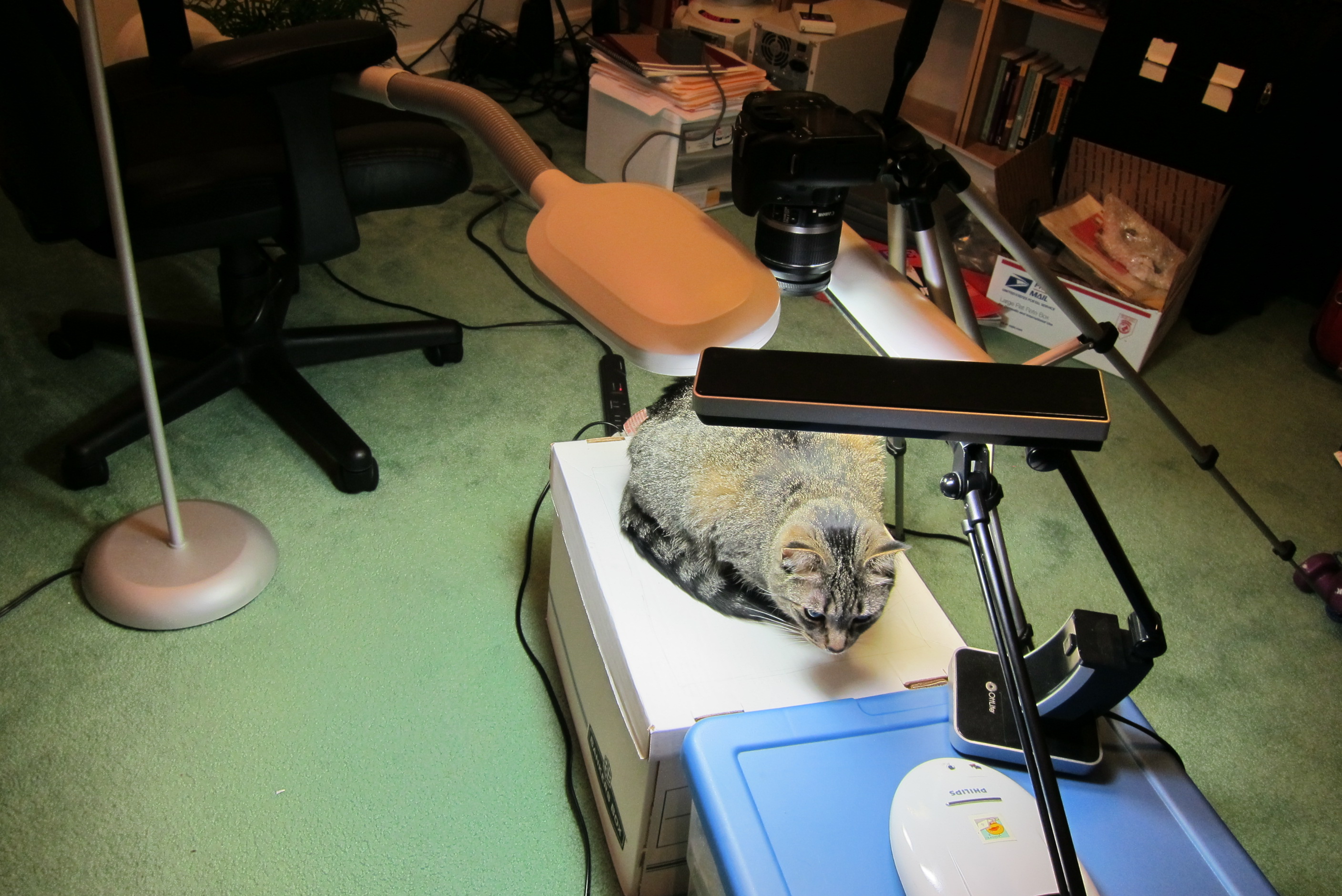
As part of my contribution to the seminar, I will give a demo titled, “Down and Dirty Guide to Literary Research with Digital Humanities Tools: Text Mining Basics.” In my presentation, I will show how traditional literary scholars can employ computers, cameras, and software to enhance their research.
To supplement my presentation, I created the following outline with links to useful resources.
Down and Dirty Guide to Literary Research with Digital Humanities Tools: Text Mining Basics
Text Analysis and Text Mining
My working definition of text mining: “Studying texts with computers and software to uncover new patterns, overlooked connections, and deeper meaning.”
MacOS X and Linux: cat, find, grep, and print (use “man cat” and “man grep” to learn more from the Terminal. More info here, here, here, here, and here.)
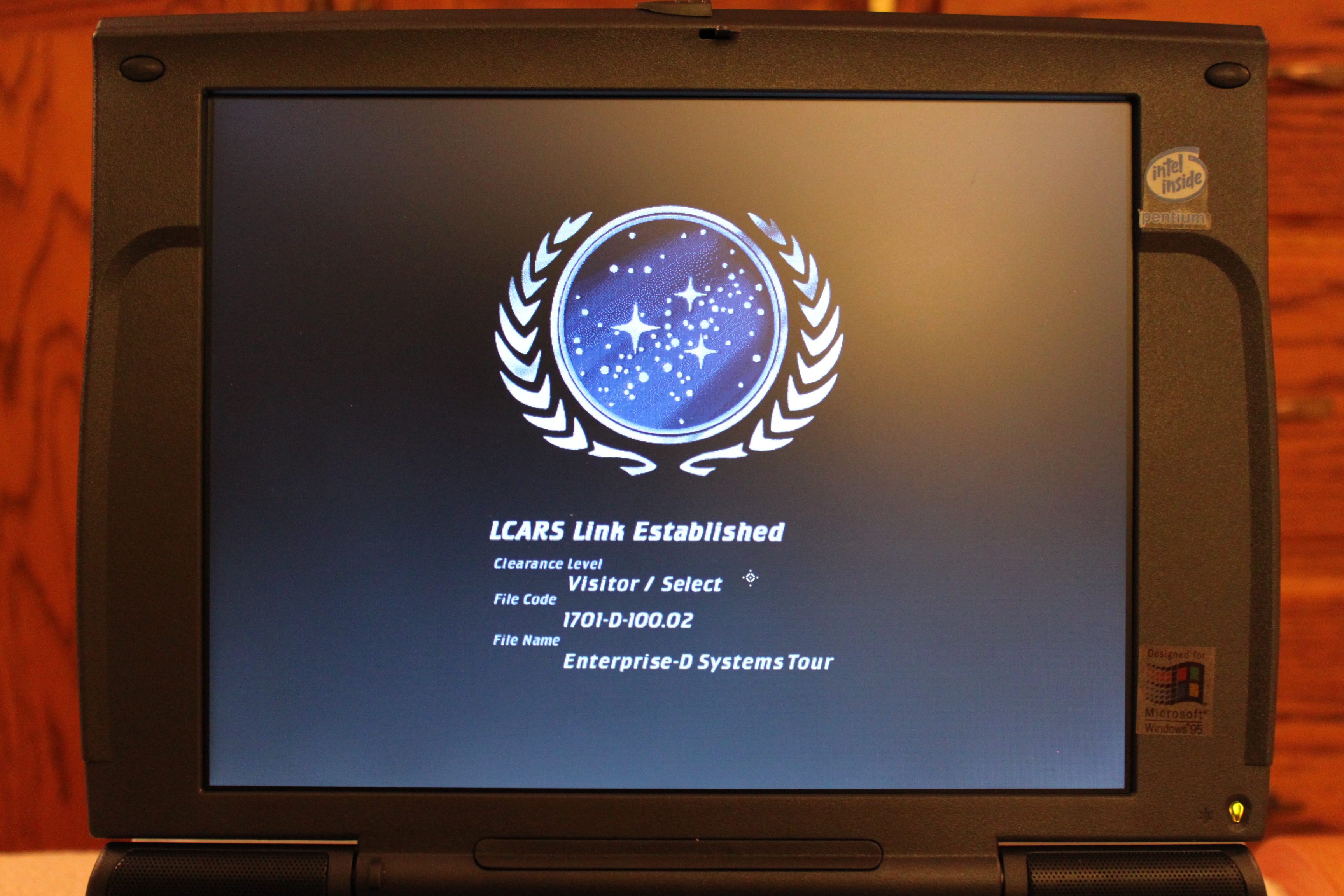
LCARS Initialization Screen from Star Trek: TNG Technical Manual for Windows 3.1
As a member of Georgia Tech’s Brittain Fellowship in the Writing and Communication Program, I have the tremendous opportunity to participate in seminars with my peers after the day’s teaching is done.
All Brittain Fellows are required to participate in the weekly Digital Pedagogy seminar on Wednesday evenings and those Fellows who are specifically teaching technical communication or business writing are also required to join the weekly Technical Communication seminar on Monday nights. Since I am not teaching tech comm but eager to teach it in the near future, I volunteered to join the tech comm folks on Mondays.
At the beginning of the semester in both seminars, we brainstormed and chose topics to present on. From the list of topics, two people elected to work together to choose readings and guide the discussion. For tech comm, we picked these topics to discuss during the fall semester: Rhetorical vs. Instrumental; Career planning; the Ethos or Soul of Technical Communication; Syntactics, grammar, conventions in tech discourse; Gender and Technical Discourse; Visual literacy; Accessibility issues; Single-sourcing and user experience (UX); Digital Literacy and Social media; Workplace Ethics, Technical Discourse, and Business Culture; Service learning; Orality and Nonverbal Communication in the workplace; and Disciplinary distinctions and conventions.
As you might guess from my research interests in digital discourses, I volunteered to present one week on Single-sourcing and user experience (UX) and another week on Digital Literacy and Social media.
Rachel Mahan and I presented on single-sourcing and user experience on Oct. 29, 2012. After I introduced different approaches and theoretical issues surrounding single-sourcing, Rachel shared her personal workplace experience with single-sourcing. I also shared firsthand experience from fellow Georgia Tech alums Smitha Prasadh and Andrew Pilsch (many thanks!). You can find our discussion readings and questions on TechStyle here.
Olga Menagarishvili and I presented on Digital Literacy and Social Media on Nov. 5, 2012. I lead the group through a number of tools for analyzing social media privacy, and Olga prepared a fun active learning “jigsaw” assignment to lead the group toward a deeper discussion of “layered literacies.” You can find our readings, discussion questions, and online resources on TechStyle here.
I am now developing my first technical communication syllabus and assignments. I have some ideas about how to approach technical communication from simultaneously practical (workplace-oriented) and imaginative (science fictional) directions. I want to guide students to be exemplary technical communicators who capably demonstrate and understand the rhetorical, critical, and ethical dimensions of what that entails. We will see when the opportunity for me to do this will present itself.


 I am currently teaching three sections of ENGL1101 at Georgia Tech. The class’ theme, “Writing the Brain: Composition and Neuroscience,” remains the same as my earlier syllabus that I taught in Fall 2012 [available