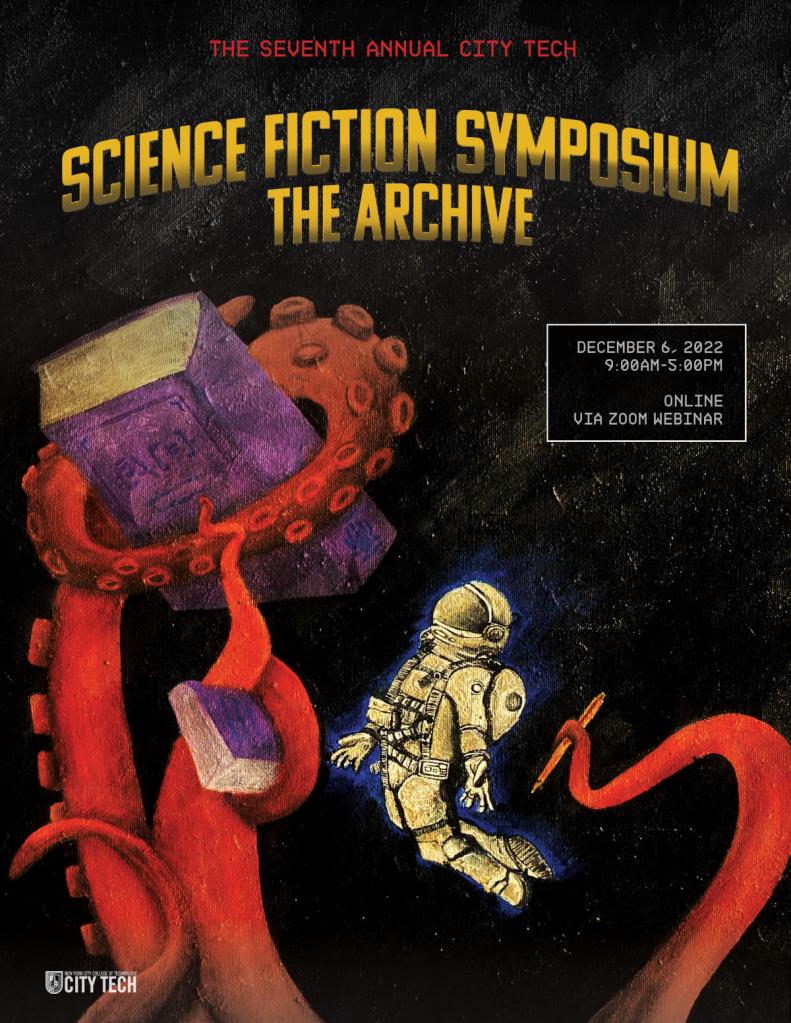
The Seventh Annual City Tech Science Fiction Symposium on the Archive and SF was held on Tuesday, Dec. 6, 2022 as a Zoom Webinar. You can read the full program here.
I started organizing these symposia with my colleagues at City Tech after we received the original 160 box donation that became the City Tech Science Fiction Collection. We’ve covered a lot of important topics at each symposium over the past seven years, but there’s still much to examine and discuss.
I’ve been so busy this semester that I didn’t announce the event here on dynamicsubspace.net. In case you missed the event, you can watch all of the sessions in the videos below.
Many thanks again to everyone who participated and contributed to this year’s event!
Opening Jason W. Ellis Justin Vazquez-Poritz
Paper Session 1: Archival Research Jill Belli – Moderator Jessica Aaron – “Preventing Planetary Patriarchy: Subversions of the White Man’s Ideal World in Early SF Pulps” Chris Leslie – “The Republic of (Interstellar) Letters: From the Archives of Asimov and Merril” Gillian Polack – “Story as Archive: How Speculative Fiction Novels Both Preserve and Interpret Cultural Material”
Panel Discussion: A Tale of Two Archives Jason Ellis (City Tech) Matthew Frizzell (Georgia Tech) Kel Karpinski (City Tech) Alison Reynolds (Georgia Tech) Lisa Yaszek (Georgia Tech)
Panel Discussion: Georgia Tech’s Sci Fi Lab: Archival Research, Octavia’s Ancestor’s Project, and Radio Play Lisa Yaszek – Moderator Panelists: Val Barnhart Laurence Copeland Killian Vetter Edeliz Zuleta
Analog Writers Panel and the Analog Emerging Black Voices Award Emily Hockaday – Moderator Kedrick Brown Meghan Hyland Kelsey Hutton Douglas Dluzen Trevor Quachri and Emily Hockaday – Award Presentation
Paper Session 2: Archives in SF Lucas Kwong – Moderator Jacob Adler – “Summit of Knowledge: Archiving the Fantastical” Rhonda Knight – “A Data Thief in the Archive: Reading Sofia Samatar’s ‘An Account of the Land of Witches’” Adam McLain – “‘Only an Echo’: The Memory of the Archive and the Archive of Memory in Lois Lowry’s The Giver“ Kenrick H. Kamiya Yoshida and Ida Yoshinaga – “An Okinawan Speculative Arts Archive”
Paper Session 3: Latinx SF in the Archive Leigh Gold – Moderator Matthew David Goodwin – “The Latinx Multiverse and the Fictional Recovery of Latinx Science Fiction” Dolores González Ortega and Valeria Seminario – “Inside the Latin American Science Fiction Archive: Challenges and Contributions to a Growing Academic Field”
Keynote Jeremy Brett – “Making Space: Science Fiction Archives and the Archival Citizen” Jason Ellis – Introduction and Moderator
I originally posted this on the Science Fiction at City Tech website here. I used Shotcut to edit the Zoom Webinar recording into these session-length videos with video fade-in and -out, and audio gain adjustments as needed. I used GIMP to create the title cards for each video.
The Sixth Annual City Tech Science Fiction Symposium on the topic of Access and SF was held on Thursday, Dec. 9, 2021 as a Zoom Webinar. You can read the full program here.
Included below are videos of each session as well as links to expanded presentations .
Many thanks again to everyone who participated and contributed to this year’s event!
Opening
Jason W. Ellis Justin Vazquez-Poritz
Paper Session 1: Access to International SF
Jill Belli – Moderator Emrah Atasoy – “Access to SF in Turkey and Turkish SF Abroad” Shanky Chandra – “Chinese Science Fiction: A Literary Genre, A Tool of Teaching Science or A Secret Weapon of China’s Soft Power?” Gillian Polack – “The Problem of Susan Australia, or, The Tyranny of Distance” | Watch Expanded Presentation
Paper Session 2: Access to Science/Fiction/World
A. Lavelle Porter – Moderator Chris Leslie – “Reevaluating the Inclusiveness of the Interstellar Republic of Letters” Katherine Buse and Anastasia Klimchynskaya – “Science Fiction and Citizen Science” Aaron Zwintscher – “Star Wars Biomes: Simulacra, Nature, and Passivity in No Dialogue Nature Shows”
Discussion Panel: “Accessing the Feminist Science Fiction Archive, Or, Young Women Read Old Feminist SF”
Lisa Yaszek – Moderator Panelists: Josie Benner Olivia Kiklica Jessica Taetle Edeliz Zuleta
Paper Session 3: Access, Inclusion, and Representation in SF
Joy Sanchez-Taylor – Moderator Leigh Gold – “Confronting Language in the Science Fiction Text: Language, Access, and Trauma in Octavia Butler and Ursula K Le Guin” Katherine Pradt – “Shipping Supergirl: Discovering and Defending Lesbian Identity Through a DC Fandom” Sean Scanlan – “Cool Access and Access to Cool: Gibson’s Gun Moll, Dorotea Benedetti” Ida Yoshinaga – “Corporate Employment Practices Towards Greater Diversity of Story Development for SFF Screen Stories”
Paper Session 4: Access, Accessibility, Bodies, and Minds in SF
Lucas Kwong – Moderator Jacob Adler – “‘Everything Herein is Fantastic’: Accessibility and Inclusivity in Dungeons & Dragons” Ryan Collis – “Autistic Speculative Imaginings: Accessing and Creating Minor Literatures” Annette Koh – “Urban Planning for Cyborg Cities: Thinking about disabilities and mobilities in sci-fi as an urban planner”
Analog Writers Panel and the Analog Emerging Black Voices Award
Emily Hockaday – Moderator Panelists Alec Nevala-Lee Marie Vibbert Chelsea Obodoechina Trevor Quachri and Emily Hockaday – Award Presentation
Keynote: “Writing Ourselves In: Teaching Writing and Science Fiction with Wikipedia”
Ximena Gallardo C. and Ann Matsuuchi Wanett Clyde – Introduction and Moderator
Ximena and Ann’s book chapter, “My Books Will Be Read By Millions of People!”: The LaGuardia Community College Octavia E. Butler Wikipedia Project,” that appears in Approaches to Teaching the Works of Octavia Butler, edited by Tarshia Stanley (Modern Language Association, 2019), has been made accessible via the CUNY institutional repository, Academic Works: https://academicworks.cuny.edu/lg_pubs/141/. This book was awarded Idaho State University’s 2021 Teaching Literature Award.
The Sixth Annual City Tech Science Fiction Symposium on Access and Science Fiction will be held on Thursday, December 9, 2021 from 9:00am-5:00pm EST (GMT/UTC -5 hours) online via Zoom Webinar.
To participate in this free event, attendees will need to (1) Signup for a free Zoom account here (if you don’t already have one), and (2) Register here to receive access instructions to the Zoom Webinar. Participants may register any time before or during the event!
For those who would like to watch the event without registering, you can join the YouTube Livestream here.
In addition to the Zoom Webinar Chat and YouTube Live Chat, join the event conversation with the event hashtag #CityTechSF and follow us on Twitter @CityTechSF.
As indicated below in the program, some symposium content is pre-recorded to offer more time for discussion on the day of the event. Pre-recorded content includes author readings and full paper presentations. Some of this content is in production and will be posted soon.
9:00am-9:15am Opening Jason W. Ellis Justin Vazquez-Poritz
9:15am-10:05am Paper Session 1: Access to International SF Jill Belli – Moderator Emrah Atasoy – “Access to SF in Turkey and Turkish SF Abroad” Shanky Chandra – “Chinese Science Fiction: A Literary Genre, A Tool of Teaching Science or A Secret Weapon of China’s Soft Power?” Gillian Polack – “The Problem of Susan Australia, or, The Tyranny of Distance” | Watch Expanded Presentation
10:05am-10:10am Break
10:10am-11:00am Paper Session 2: Access to Science/Fiction/World A. Lavelle Porter – Moderator Chris Leslie – “Reevaluating the Inclusiveness of the Interstellar Republic of Letters” Katherine Buse and Anastasia Klimchynskaya – “Science Fiction and Citizen Science” Aaron Zwintscher – “Star Wars Biomes: Simulacra, Nature, and Passivity in No Dialogue Nature Shows”
11:00am-11:05am Break
11:05am-11:45am Discussion Panel: “Accessing the Feminist Science Fiction Archive, Or, Young Women Read Old Feminist SF” Lisa Yaszek – Moderator Panelists: Josie Benner Olivia Kiklica Jessica Taetle Edeliz Zuleta
11:45am-11:50am Break
11:50am-1:10pm Paper Session 3: Access, Inclusion, and Representation in SF Joy Sanchez-Taylor – Moderator Leigh Gold – “Confronting Language in the Science Fiction Text: Language, Access, and Trauma in Octavia Butler and Ursula K Le Guin” Katherine Pradt – “Shipping Supergirl: Discovering and Defending Lesbian Identity Through a DC Fandom” Sean Scanlan – “Cool Access and Access to Cool: Gibson’s Gun Moll, Dorotea Benedetti” Ida Yoshinaga – “Corporate Employment Practices Towards Greater Diversity of Story Development for SFF Screen Stories”
1:10pm-1:15pm Break
1:15pm-2:25pm Access, Accessibility, Bodies, and Minds in SF Lucas Kwong – Moderator Jacob Adler – “‘Everything Herein is Fantastic’: Accessibility and Inclusivity in Dungeons & Dragons” Ryan Collis – “Autistic Speculative Imaginings: Accessing and Creating Minor Literatures” Annette Koh – “Urban Planning for Cyborg Cities: Thinking about disabilities and mobilities in sci-fi as an urban planner”
2:25pm-2:30pm Break
2:30pm-3:55pm Analog Writers Panel and the Analog Emerging Black Voices Award Emily Hockaday – Moderator Panelists Alec Nevala-Lee Marie Vibbert Chelsea Obodoechina Trevor Quachri and Emily Hockaday – Award Presentation
3:55pm-4:00pm Break
4:00pm-5:00pm Keynote “Writing Ourselves In: Teaching Writing and Science Fiction with Wikipedia” Ximena Gallardo C. and Ann Matsuuchi Wanett Clyde – Introduction and Moderator
Ximena and Ann’s book chapter, “My Books Will Be Read By Millions of People!”: The LaGuardia Community College Octavia E. Butler Wikipedia Project,” that appears in Approaches to Teaching the Works of Octavia Butler, edited by Tarshia Stanley (Modern Language Association, 2019), has been made accessible via the CUNY institutional repository, Academic Works: https://academicworks.cuny.edu/lg_pubs/141/. This book was awarded Idaho State University’s 2021 Teaching Literature Award.
Participants
Jacob Adler has worked as the Metadata and Cataloging Librarian at the Bronx Community College Library since 2017. Before that he performed various other cataloging work, most notably at The Paley Center for Media from 2010 to 2016. In addition to his professional work he wrote a fantasy novel for the 2018 National Novel Writing Month contest; he continues to work on the novel and seek to get it published. He is especially interested in early television history, particularly the original 1959-1964 Twilight Zone television series. He is also currently pursuing a master’s degree in Museum Studies, which he is on track to receive in January 2022.
Emrah Atasoy, PhD, serves as a visiting postdoctoral scholar at University of Oxford’s Faculty of English between September 2021 and September 2022 as a recipient of the TUBITAK (The Scientific and Technological Research Council of Turkey) 2219 International Postdoctoral Research Fellowship Grant. His research interests include speculative fiction, futuristic narratives, critical future studies, utopian and dystopian studies, critical dystopia, science fiction, apocalyptic fiction, ecocriticism, posthumanism, Turkish speculative fiction, twentieth-century literature, and comparative literature. He was a visiting scholar at Penn State University under the supervision of Prof. Dr. Jennifer Wagner-Lawlor in the academic year 2015-16. His work has appeared in journals such as Studies in the Novel (2022, collaborative article with Prof. Dr. Thomas Horan), Utopian Studies, Librosdelacorte.es, Literary Voice, and Methis. Studia Humaniora Estonica. His monograph Epistemological Warfare and Hope in Critical Dystopia has been published by Nobel in 2021. His most recent publications include “Speculative Fiction Studies in Turkey: A Preliminary Survey” (2021), in Utopian Studies, “Dys/utopian Narratives on the Screen: Beyond the Binaries in Children of Men and Lobster” (2021), in The Postworld In-Between Utopia and Dystopia: Intersectional, Feminist, and Non-Binary Approaches in 21st Century Speculative Literature and Culture (2021, Routledge), edited by Tomasz Fisiak and Katarzyna Ostalska, and “Epistemological Warfare(s) in Dystopian Narrative: Zülfü Livaneli’s Son Ada and Anthony Burgess’s The Wanting Seed” in Speculations of War: Essays on Conflict in Science Fiction, Fantasy and Utopian Literature (2021, McFarland), edited by Annette M. Magid. He is a member of both Utopian Studies Society-Europe and the Society for Utopian Studies (SUS). His research at the University of Oxford is supported by TUBITAK BIDEB (The Scientific and Technological Research Council of Turkey) under Grant 2219-International Postdoctoral Research Fellowship Program.
Jill Belli is Associate Professor of English at New York City College of Technology, CUNY, where she happily teaches science fiction and utopian studies often. She’s working on long-standing projects on well-being & happiness in education and writing & revising in dystopian texts. Newer interests include looping as composing practice, tarot and astrology as storytelling and knowing, William Reynolds, and grief. Learn more about Jill and her interdisciplinary research and teaching: jillbelli.org.
Josie Benner is a Biomechanical Engineering Major and Science Fiction Minor at Georgia Tech. She works in Professor Lisa Yaszek’s Sci Fi Lab, with funding from Georgia Tech’s Center for Women, Science, and Technology and the Ivan Allen College for the Liberal Arts.
Shanky Chandra is a Ph.D. scholar from the Centre for Chinese and Southeast Asian Studies, Jawaharlal Nehru University, India, in New Delhi. His research interests include modern and contemporary Chinese Science Fiction. The title of his Ph.D. thesis is “Socio-Political and Cultural Factors in the Making of Chinese Science Fiction Writer Liu Cixin: Understanding The Three-Body Problem.” Chandra took his B.A. (2011) and M.A. (2013) in Chinese language and literature, and M.Phil. (2016) from Jawaharlal Nehru University at New Delhi, India. In 2013, the Ministry of Human Resource Development (MHRD) awarded the Chinese Government Scholarship to Shanky Chandra for Post Graduate Diploma at Beijing Language & Culture University (Higher level 1 & 2) 2013-2014. Chandra taught Chinese language and literature at St. Stephen’s College (2014-2019), Delhi University. He completed the Advance Mandarin Teacher Training Program from the National Taipei University of Education Chinese Language Education Center, Taipei, Taiwan, in July 2018. Recently, he spent one year at the Department of Modern and Contemporary Chinese Language and Literature at the School of Chinese Language and Literature of Beijing Normal University (BNU) as a senior visiting scholar under the supervision of Prof. Wu Yan (HYI fellowship). He is also a member of the International Forum of Chinese Language Teachers (国际汉语教师微信群) and its official Account e-journal (国际汉语教师500强公众号). Currently, he is a visiting fellow at Harvard Yenching Institute, Harvard University.
Ryan Collis is a second year PhD student in Education at York University in Ontario, Canada who researches the creation of learning spaces for autistic students. He holds degrees in English (BA, Queen’s ‘99), Computer Science (BScH, Queen’s ‘00), Education (BEd, OISE ‘05), and Science and Technology Studies (BScH, York ’19; MA, York ‘20). Ryan has been a high school teacher in the York Region District School Board since 2006 and is a founding member of the editorial board of the Canadian Journal of Autism Equity. Ryan lives with his wife and son in Ajax, Ontario.
Jason W. Ellis is an Associate Professor of English at the New York City College of Technology, CUNY, where he coordinates the City Tech Science Fiction Collection. He coedited The Postnational Fantasy: Postcolonialism, Cosmopolitics and Science Fiction (McFarland, 2011) and a special issue on Star Wars: The Force Awakens of New American Notes Online, and talked with Dr. Neil deGrasse Tyson about the relationship between SF and society on StarTalk Radio. He holds a Ph.D. in English from Kent State University, M.A. in Science Fiction Studies from the University of Liverpool, and B.S. in Science, Technology, and Culture from Georgia Tech.
Ximena Gallardo C. is a professor of English at LaGuardia Community College-CUNY. She has been a Wikipedia editor since 2012 and a WikiEducation instructor since 2014. Among her current Wikimedia projects are The LaGuardia WikiProject Octavia E. Butler and the LaGuardia and Wagner Archives GLAM initiative, as well as the Wikibooks projects Perspectives in Digital Literacy and Themes in Literature.
Leigh Dara Gold received her doctorate in German Literature in 2011 from New York University. She teaches Introduction to Poetry and English 1121 at New York City College of Technology, and Ancient Literature and Composition at Borough of Manhattan Community College. Her current research interests include science fiction’s role in the classroom, research on Ursula K. Le Guin, and connections between dance, literature, and philosophy.
Emily Hockaday is the managing editor and poetry editor for Asimov’s Science Fiction and Analog Science Fiction and Fact. Her first full-length poetry collection, Naming the Ghost, will be out in November 2022 with Cornerstone Press. You can find her online at www.emilyhockaday.com or @E_Hockaday.
Olivia Kiklica is a Computational Media Major and Science Fiction Fellow at Georgia Tech. She works in Professor Lisa Yaszek’s Sci Fi Lab, with funding from Georgia Tech’s Center for Women, Science, and Technology and the Ivan Allen College for the Liberal Arts.
Anastasia Klimchynskaya’s research brings together literary theory, sociology, and neuroscience to study how storytelling and narrative shape what (we believe) we know about the world. She received her PhD in Comparative Literature from the University of Pennsylvania, focusing on the way science fiction emerged as a literary form in the nineteenth century to express a new social and technoscientific paradigm. Her book project extends this work into the twenty-first century, using the two periods as foils for each other to examine how our fictions shape the innovation, use, and understanding of technoscientific advancements – and, in turn, how these advancements shape the very form of the stories we tell.
Lucas Kwong is an assistant professor of English at New York City College of Technology. His scholarship on fantastic fiction, religion, and colonialism has been published in Victorian Literature and Culture, Religion and Literature, and Journal of Narrative Theory. He also serves as the assistant editor for New American Notes Online, an online interdisciplinary scholarly journal, and as editor for City Tech Writer, a journal of student writing. He lives in Brooklyn with his wife.
Chris Leslie (he/him) is a visiting professor at the South China University of Technology whose research investigates the interactions among science, technology, and society. This paper is based on the research for his book From Hyperspace to Hypertext: Masculinity, Globalization, and Their Discontents, which will be published by Palgrave in 2022. Dr. Leslie is chair of the IFIP working group on the history of computing and a creative consultant for Zhejiang Hexin Toy Group in Yunhe, China.
Ann Matsuuchi is an instructional technology librarian and professor at LaGuardia Community College-CUNY. Past writing projects include those that focus on Samuel R. Delany and Wonder Woman, sf tv shows such as Doctor Who, and Asian American comic books. Ann teaches digital literacy, online cultures, and the fundamentals of internet studies. Current projects include one that focuses on Melvin Van Peebles, and a reference guide to Delany’s works.
Alec Nevala-Lee was a 2019 Hugo and Locus Award finalist for Astounding: John W. Campbell, Isaac Asimov, Robert A. Heinlein, L. Ron Hubbard, and the Golden Age of Science Fiction (Dey Street Books / HarperCollins), which was named one of the best nonfiction books of the year by The Economist. He is the author of three suspense novels from Penguin, including The Icon Thief, and his work has appeared in such publications as the New York Times, the Los Angeles Times, Salon, The Daily Beast, Analog Science Fiction and Fact, and two editions of The Year’s Best Science Fiction. His next book, Inventor of the Future: The Visionary Life of Buckminster Fuller, will be published by HarperCollins on August 2, 2022.
Evelyn Ng is a City Tech Communication Design student with a focus on illustration. She’s designed and illustrated the poster for “The Sixth Annual City Tech Science Fiction Symposium on Access and Science Fiction”. When she isn’t working, she spends her time looking through art publications to elevate her design techniques. See more of her work on Instagram and on her online portfolio.
Chelsea Obodoechina is a graduate student and teaching assistant. In her spare time, she writes short speculative fiction inspired by her academic background in sociology. Her works have been featured in Cast of Wonders, the Unfettered Hexes anthology, and Anathema: Spec from the Margins. She lives in Montreal, Canada with her family.
Gillian Polack, Ph.D. is an Australian speculative fiction writer based in Canberra, Australia. She was the 2020 recipient of the Ditmar (best novel, for her 2019 novel The Year of the Fruit Cake) and the Bertram A. Chandler (lifetime achievement in science fiction) awards. She is an ethnohistorian with a special interest in how story transmits culture, both Medieval and modern. Her current research examines how contemporary speculative fiction novels serve as vectors for cultural transmission. A study of this will be released in 2022 (Story Matrices: Cultural Encoding and Cultural Baggage in the Worlds of Science Fiction and Fantasy, Academic Lunare). Her research at Deakin University furthers this work. Dr Polack’s publications include ten novels, short stories, a monograph (History and Fiction, shortlisted for the William Atheling Jr Award for Criticism or Review) and various works of non-fiction. A list of her books can be found at https://gillianpolack.com/my-books/.
A. Lavelle Porter is an Assistant Professor of English at New York City College of Technology. He holds a B.A. in history from Morehouse College and a Ph.D. in English from the CUNY Graduate Center. His writing has appeared in venues such as The GC Advocate, Callaloo, The New Inquiry, Poetry Foundation, and the African American Intellectual History Society. He recently published The Blackademic Life: Academic Fiction, Higher Education, and the Black Intellectual with Northwestern University Press.
Katherine Pradt is a librarian at the Graduate Center of the City University of New York. In addition to supporting academic research and answering citation style questions (and troubleshooting the printers), she works to connect scholars to open-source tools and open access resources. She holds an MFA in addition to her library degree and is writing a novel set in occupied New York during the Revolutionary War.
Trevor Quachri, who took the reins of Analog Science Fiction and Fact as editor in 2012, started off as an editorial assistant in 1999 and worked his way up the ladder at Analog and Asimov’s Science Fiction, under Stanley Schmidt, Sheila Williams, and Gardner Dozois, respectively. On top of that, he’s also been a Broadway stagehand, collected data for museums, and executive produced a science fiction pilot for a basic cable channel. He lives in New Jersey with his fiancée, daughter, and way, way too many comic books.
Joy Sanchez-Taylor is a Professor of English at LaGuardia Community College (CUNY) whose research specialty is intersections between science fiction, fantasy, and critical race theory. Her book Diverse Futures: Science Fiction and Authors of Color (2021) examines the contributions of late twentieth and twenty-first century U.S. and Canadian science fiction authors of color to the genre. Dr. Sanchez-Taylor is currently working on a monograph project on diverse fantasy representations.
Sean Scanlan is Associate Professor of English at New York City College of Technology—CUNY where he specializes in literary technologies and American and global literature. He published “Global Homesickness in William Gibson’s Blue Ant Trilogy,” for the collection The City after 9/11: Literature, Film, Television (2016), and he is the founder and editor of NANO: New American Notes Online.
Jessica Taetle is a Computational Media Major and Science Fiction Fellow at Georgia Tech. She works in Professor Lisa Yaszek’s Sci Fi Lab, with funding from Georgia Tech’s Center for Women, Science, and Technology and the Ivan Allen College for the Liberal Arts.
Justin Vazquez-Poritz is the Dean of the School of Arts and Sciences at New York College of Technology, CUNY.
Marie Vibberthas sold over 70 short stories to professional publications such as Analog Science Fiction & Fact, The Magazine of Fantasy & Science Fiction, Nature, Vice’s Motherboard, Lightspeed, Escape Pod, and more. Her works have been translated into Chinese and Vietnamese. Her debut novel, Galactic Hellcats, came out in 2021. Publisher’s Weekly called it “A rip-roaring space heist.” By day she is a computer programmer at Case Western Reserve University.
Lisa Yaszek is Regents’ Professor in the School of Literature, Media, and Communication, where she explores science fiction as a global language crossing centuries, continents, and cultures. Yaszek’s books include Galactic Suburbia: Recovering Women’s Science Fiction (Ohio State, 2008); Sisters of Tomorrow: The First Women of Science Fiction (Wesleyan 2016); The Future is Female! 25 Classic Science Fiction Stories by Women (Library of America, 2018); and Literary Afrofuturism in the Twenty-FirstCentury (co-edited with Isiah Lavender III, Ohio State, 2020). Her ideas have been featured in The Washington Post, Food and Wine Magazine, and USA Today, and she has been an expert commentator for the BBC4’s Stranger Than Sci Fi, Wired.com’s Geek’s Guide to the Galaxy, and the AMC miniseries James Cameron’s Story of Science Fiction. A past president of the Science Fiction Research Association, Yaszek currently serves as a juror for the John W. Campbell and Eugie Foster Science Fiction Awards.
Ida Yoshinaga is an Assistant Professor of Science Fiction Film at the Georgia Institute of Technology, and her screen-studies research centers on the production relations between creative labor from racial/gender/class minority groups and majority-dominated management, within corporate transmedia. Along with workplace allyship between these two unequal statuses, she studies the global stratification of SFF-genre scriptwriting within the story development process, as well as produces and facilitates the development of cultural screenplays for Indigenous or 4th cinema and TV.the development of cultural screenplays for Indigenous or 4th cinema and TV.
Edeliz Zuleta is a Biomechanical Engineering Major and Science Fiction Minor at Georgia Tech. She works in Professor Lisa Yaszek’s Sci Fi Lab, with funding from Georgia Tech’s Center for Women, Science, and Technology and the Ivan Allen College for the Liberal Arts.
Aaron Zwintscher is an adjunct professor of English at the New York City College of Technology. He is also an ambient musician and noise artist.
This is a 2,312-word essay on Chris Columbus’ Bicentennial Man (1999) for a cancelled companion titled When Worlds Collide: The Critical Companion to Science Fiction Film Adaptations for Liverpool University Press. I wrote my first draft and submitted it on May 30, 2009 (discussed here). A year-and-a-half later, the editors sent me suggestions and feedback on Jan. 31, 2011 (discussed here). I returned my substantially revised final draft (included below) on Mar. 1, 2011. My enjoyment of Isaac Asimov’s original novelette and novel-length-expansion with Robert Silverberg as The Positronic Man led me to write for this project when I first saw the call for contributors (even though I had not yet seen Columbus’ film!). I was thick in my PhD work when I wrote the first draft and nearing the end of that phase of my career when I submitted my revised copy. It is, unfortunately, a reminder that sometimes projects don’t work out for any number of reasons. I didn’t want my writing on these stories and its film adaptation to disappear, so I’m sharing it here. I am presenting it as-is based on the original document, which followed the house style provided by the editors–with only changes from British to American English spellings and punctuation use.
Bicentennial Man (1492 Pictures, 1999)
Adapted from Isaac Asimov, ‘Bicentennial Man’ (1976) and Isaac Asimov and Robert Silverberg, The Positronic Man (1993)
(Dir. Chris Columbus; Sc. Nicholas Kazan; Pr. Wolfgang Petersen, Gail Katz, Laurence Mark, Neal Miller, Chris Columbus, Mark Radcliffe and Michael Barnathan; Cin. Phil Meheux; P.D. Norman Reynolds; SFX. Dream Quest Images; starring Robin Williams (Andrew); Sam Neill (Sir); Embeth Davidtz (Amanda Martin/Portia Charney); Wendy Crewson (Ma’am); Oliver Platt (Rupert Burns))
Asimov’s “The Bicentennial Man” (1976) won the Nebula and Hugo Awards for Best Novelette in 1976 and 1977 respectively, and it has appeared continuously in print in various anthologies over the past three decades. Later, Asimov and Silverberg co-wrote a novel-length expansion of the original novelette which appeared in 1993 as The Positronic Man. These two works share a nearly identical plot, and the only additions in the novel include elaborate descriptive language, ancillary dialogue, and notable chapter expansions relating to the history of robotic development and the robot-protagonist Andrew’s trip to the Moon. These expansions are largely insignificant and did not influence Columbus’ critically derided and commercially unsuccessful adaptation.
Asimov and Columbus use their respective media to tell a similar civil rights allegory about a robot with human-like qualities who aspires to a human identity and the rights that accompany it. In Asimov’s original novelette, the robot named Andrew overcomes real threats to his existence and he re-engineers his body in order to convince his society and government to grant him the legal status and rights of a human being, because he desires full self-determination. In this telling, Andrew seeks the legal authority to marry from his government. Both the film and the novelette carry an important message about equality and human dignity, but Asimov’s original story carries the burden much more confidently than the more recent film interpretation of that message.
“The Bicentennial Man” is a unique Bildungsroman about Andrew, a robot who desires and ultimately achieves his humanity by freeing himself from the bonds of robotic servitude through his creative works and personal biology-machine negotiations. Andrew begins his life as a purchased NDR robot by the Martin family and he is assigned domestic duties in their household. Soon after, he is named Andrew by his youngest charge, Little Miss. However, he quickly displays an unexpectedly preternatural creativity at woodworking, carving, and original thought. Andrew’s abilities allow him to obtain his freedom, write a history of robots from a robot’s perspective, develop a new science of biological prosthetics, and transform his machine body into one that is organic. On his 200th birthday, and after orchestrating his own mortality, he achieves recognition from the World Government that he is indeed human. Humanity however besets Andrew’s development from robot to virtual human being, which positions the story as a veiled social critique. A significant scene early in the story establishes why Andrew desires a human identity despite his robotic physicality and grounds the story in the American civil rights era: Lost in the countryside, Andrew is confronted by two men who agree that, “If it doesn’t belong to anyone, he could be ours as much as someone else’s” (Asimov, 1991: 262). At this point, Andrew’s situation connotes the predicament of former American slaves prior to the Civil War who traveled with manumission papers fearing they might be enslaved once again. The men’s disregard for Andrew’s freedom and personhood constitutes a powerful episode in the novelette, because it demonstrates a threat to Andrew’s personhood and a reason for his continuing work toward becoming human. Its absence from the film adaptation is symptomatic of the mishandling of the source material, which will be elaborated below.
Columbus’ Bicentennial Man follows the narrative arc of the original, but it departs from Asimov’s novelette in a number of significant ways with the most consequential being Andrew falls in love with a human woman. It is Andrew’s desire to marry that provides the film a different allegorical message while maintaining a focus on Civil Rights. However, it is important to first note that in the original and adaptation, Andrew attempts to purchase himself from Sir, his human master. However, in the novelette, Sir initially refuses to grant Andrew’s freedom in exchange for money. It is only after Andrew wins a suit brought against robot freedom in the courts that Sir concedes to give Andrew his liberty in exchange for money. In the film, Sir immediately liberates Andrew with the caveat that Andrew vacate the Martin home immediately, and Sir says, ‘You wanted freedom. You must accept the consequences.’ In this regard, Andrew’s initial taste of freedom reflects how African-Americans were evicted from plantations following the Civil War with nowhere to go, but Andrew easily overcomes even this situation. It is on this point that the film fails where Asimov’s novelette endures. Andrew in the film never encounters a potentially hazardous circumstance on his journey to be human, and his battles are not convincingly hard-won. Then, finding himself alone in a world dominated by human beings, he serendipitously meets the cyberneticist Rupert Burns who helps his transition to a mortal human body so that he can romantically pursue Little Miss’ great-granddaughter Portia Charney. Instead of wanting the protections and rights of a human being due to his ambiguously defined legal status as in the original story, Andrew’s motivation for human identity comes from his desire to marry Portia. The film’s approach to a civil rights allegory is significantly different than Asimov’s story, but it is of significant importance to contemporary civil rights, which is addressed in the conclusion. Unfortunately, the film is marred by questionable issues in its handling of its source material and an unusual casting considering its subject matter. The first issue has to do with Asimov’s Three Laws of Robotics. In the important closing scene moments after Andrew’s death, Portia orders the android Galatea to unplug the machine keeping her alive after Andrew’s death, which is a gross violation of Asimov’s First Law of Robotics: “a robot may not injure a human being or, through inaction, allow a human being to come to harm” (Asimov, 1991: 126) More importantly, the film’s cast is overwhelmingly white except for the only two prominent characters of color: an unidentified jazz singer (Paula West), and President Marjorie Bota (Lynne Thigpen). Each of these African-American actresses plays an influential role at key moments in Andrew’s transformation from robot to human being. The singer presides over the dance where Andrew begins to understand his feelings for Portia and the President grants Andrew’s request to be recognized as a human being. However, it is surprising that more persons of color were not cast as principles in the film, despite Hollywood’s long history of whitewashing ethnic roles or embracing diversity in its films’ casts considering the allegorical subject matter of the original and its adaptation.
The presentation of the narrative in the original and film also greatly differs. Asimov builds momentum in the novelette through flashback and twenty-three short chapters. These chapters are snapshots in the long life of Andrew Martin as he attempts to transform from robot to human being. Additionally, these episodic chapters rise and fall with dramatic impact from event-to-event until the reader learns Andrew’s ultimate choice and his fate. On the other hand, the film is generally divided between Andrew’s life with the Martins, his search for robots like himself, and his transformation into a human being as he falls in love with Portia. The narrative is slow and plodding, and Robin William’s humor is lost behind the film’s script and special effects veneer. Through its narrative, the film presents a brighter and less dangerous narrative that follows Andrew’s human friendships and ultimately his courtship of a human woman. Besides its relaxed narrative that keeps Andrew out of harm’s way, the film has generally well lit and immaculately clean settings within the home and in the world-at-large, which conveys a sense of safety for Andrew as well as humanity. Furthermore, Columbus avoids dramatic tension by evading conflict or quickly diffusing stress between characters, such as between Andrew and Portia. The director also regularly employs wide shots, which lessens the emotional significance of many scenes. Despite its cinematographic deficiencies, the film endeavors to present a Civil Rights allegory that is closely aligned with its source.
The novelette and film respond to issues of equality and Civil Rights found in many of Asimov’s stories in which robots have to deal with demanding human ‘masters’ spouting slurs, which in other contexts would be considered racist (the use of “boy,” for example: Asimov, 1941: 124). For Asimov and Columbus, Andrew is a bonded servant on two levels – as a thing purchased, owned, and controlled, and as a robot bound by the Three Laws of Robotics first enumerated in Asimov’s short story “Runaround” (1942). Andrew transcends these restrictions on his being and his behavior in order to achieve personhood just as some former African-American slaves overcame their status as property in order to register themselves as persons deserving freedom and equality. In Asimov’s original novelette, Andrew overcomes the threat to his right of self-determination by convincing his society and its government to grant him identical status as a human being, a “Bicentennial Man” (Asimov, 1991: 290). On the other hand, Columbus’ film places its emphasis on a threat to Andrew’s and Portia’s family by calling into question the right of a robot to choose to marry a human being and vice versa. Both are momentous civil rights issues, but the film’s execution of its message appears weighted more toward Andrew’s socialization as Portia’s mate rather than the harsh realities of a society against the marriage of a particular group.
“The Bicentennial Man” deals with ontological concerns and identity politics as is true of many of Asimov’s robot stories. However, Andrew’s story more fully explores one robot’s path from robotic slavery to human freedom, and it does so by closely following models of American slave narratives that emphasize emancipation and personal development. These include Olaudah Equiano’s The Interesting Narrative of the Life of Olaudah Equiano, or Gustavus Vassa, the African (1798), Frederick Douglass’ Narrative of the Life of Frederick Douglass, an American Slave (1845), and Booker T. Washington’s Up from Slavery (1901). These authors demonstrate their subjecthood as equals of all human beings through their lives and writings, and furthermore, they prevail over Thomas Jefferson’s comments on American slaves in his Notes on the State of Virginia (1784): “that in imagination they are dull, tasteless, and anomalous,” and he “never [saw] even an elementary trait of painting or sculpture” (Jefferson, 1984, 267). Likewise, Andrew overcomes society’s expectations by demonstrating that he is artistically creative and an independent thinker who desires freedom. Asimov mirrors slave narratives in his futuristic story: Andrew obtains a personal awareness of his oppressive situation as a robotic slave, he attempts to purchase himself from his master with money saved from his creative labour, he experiences a different way of interacting with humans and robots on the Moon, and he spends his life proving himself an equal of other humans. Andrew, like former American slaves, also demands to know why he is not considered an enfranchised human. He challenges his society’s beliefs about robots, and he ultimately convinces his society and government to grant him equal status with human beings. However, Andrew’s successes in the novelette and film are an oversimplification of the past and present difficulties of people of color to achieve the full benefits of civil rights and wider societal acceptance, but it could be Andrew’s desire to marry a human being in the film adaptation that gives the film more contemporary, perhaps even prophetic importance.
Despite Bicentennial Man’s problems, it may signify the future of civil rights issues in its handling of an individual’s right to marry. Asimov’s novelette appeared a few years after the landmark ruling of the United States Supreme Court in ‘Loving v. Virginia’ (1967), which made all anti-miscegenation laws unconstitutional thus legalizing all mixed-race marriages. However, this issue was not explored in the original story. On the other hand, the film relies on the right to marry as the motivation for Andrew’s development in the last half of the film. In order to marry the human woman Portia, Andrew must transcend his robotic body and convince his society and government to allow him the right that human beings take for granted. This civil rights issue raised in the film is prophetic of the growing call for gay men and lesbians to share the legal right to marry. The film appeared three years after the passage of the Defence of Marriage Act (DOMA) in 1996, which broke the Full Faith and Credit Clause of the U.S. Constitution. It dictates that the States must respect the laws of other States. Without DOMA, all States would have had to respect the marriages of gays and lesbians if any one State had made those marriages legal. Civil rights are and will continue to be a struggle for minority groups in the United States, and it is in this light that Bicentennial Man succeeds as a film veiling a message on an on-going civil rights debate.
Notes
Isaac Asimov, ‘Bicentennial Man’ in I. Asimov, Robot Visions (New York: ROC, 1991), pp. 245-290. Originally published in Stellar #2 (1976).
Isaac Asimov, ‘Runaround’ in I. Asimov, Robot Visions (New York: ROC, 1991), pp. 113-134. Originally published in Astounding Science Fiction (April 1941).
Isaac Asimov and Robert Silverberg, The Positronic Man (New York: Doubleday, 1993).
Frederick Douglass, Narrative of the Life of Frederick Douglass (Boston: Anti-Slavery Office, 1845).
Olaudah Equiano, The Interesting Narrative of the Life of Olaudah Equiano, or Gustavus Vassa, the African (London, 1793).
Thomas Jefferson, Notes on the State of Virginia (New York: Library of America, 1984), pp. 266. Originally published in 1784.
Booker T. Washington, Up from Slavery: an autobiography (New York: Doubleday, Page & Co., 1901).
Analog Science Fiction and Fact magazine launched a new award today called The Analog Award for Emerging Black Voices. It is intended to recognize the work by writers who customarily identify as Black and are at the beginning of their careers.
Instead of simply purchasing and publishing the winning story, Analog is going further by providing mentoring, advice, and networking opportunities for the winner. This is a tremendous opportunity that I would encourage eligible hard science fiction writers (including those who are City Tech students with writing aspirations) to send their work for consideration. Submissions are accepted from May 14-July 23, 2021.
The winner and finalists will be announced at the next City Tech Science Fiction Symposium in late Fall 2021! Stay tuned for the next symposium’s call for papers.
Read the poster above or text below for all of the award’s details:
The Analog Award for Emerging Black Voices
Analog Science Fiction and Fact
analogsf@dellmagazines.com

Eligibility
Any writer over 18 years of age who customarily identifies as Black, has not published nor is under contract for a book, and has three or less paid fiction publications is eligible.

Logistics
Submissions will be open from May 14th – July 23rd to works of hard science fiction of greater than 1,000 words but not over 5,000. Finalists and the winning author will be announced at and in partnership with the Annual City Tech Symposium on Science Fiction.

Judging
A diverse committee of science fiction professionals will judge. The panel for 2021 is: Steven Barnes (Lion’s Blood), Nisi Shawl (Writing the Other), Kim-Mei Kirtland (Howard Morhaim Literary Agency, Inc.), Trevor Quachri (Analog Science Fiction and Fact), and Emily Hockaday (Analog Science Fiction and Fact, Asimov’s Science Fiction). Finalists will be chosen and awarded one mentorship session with Analog editors including a critique of their submission and a chance to ask questions about the field.

Award Winner
With editorial guidance, Analog editors commit to purchasing and publishing the winning story in Analog Science Fiction and Fact, with the intent of creating a lasting relationship, including one year of monthly mentorship sessions. These sessions will be opportunities to discuss new writing, story ideas, the industry, and to receive general support from the Analog editors and award judges.

Submit
Submissions will be read blind. Please remove all identifying information from the document before sending it. The file name should be the title of the story. Submissions should be .doc files and follow standard manuscript format. In the body of your email, please include a short cover letter with your contact information, address, the name of your entry, and a statement of interest describing eligibility. Stories can be submitted here: AnalogAward@gmail.com.