Category: Science Fiction

  • Science Fiction, LMC3214: Global Perspective Unit on Taiwanese SF and Review for Exam 3

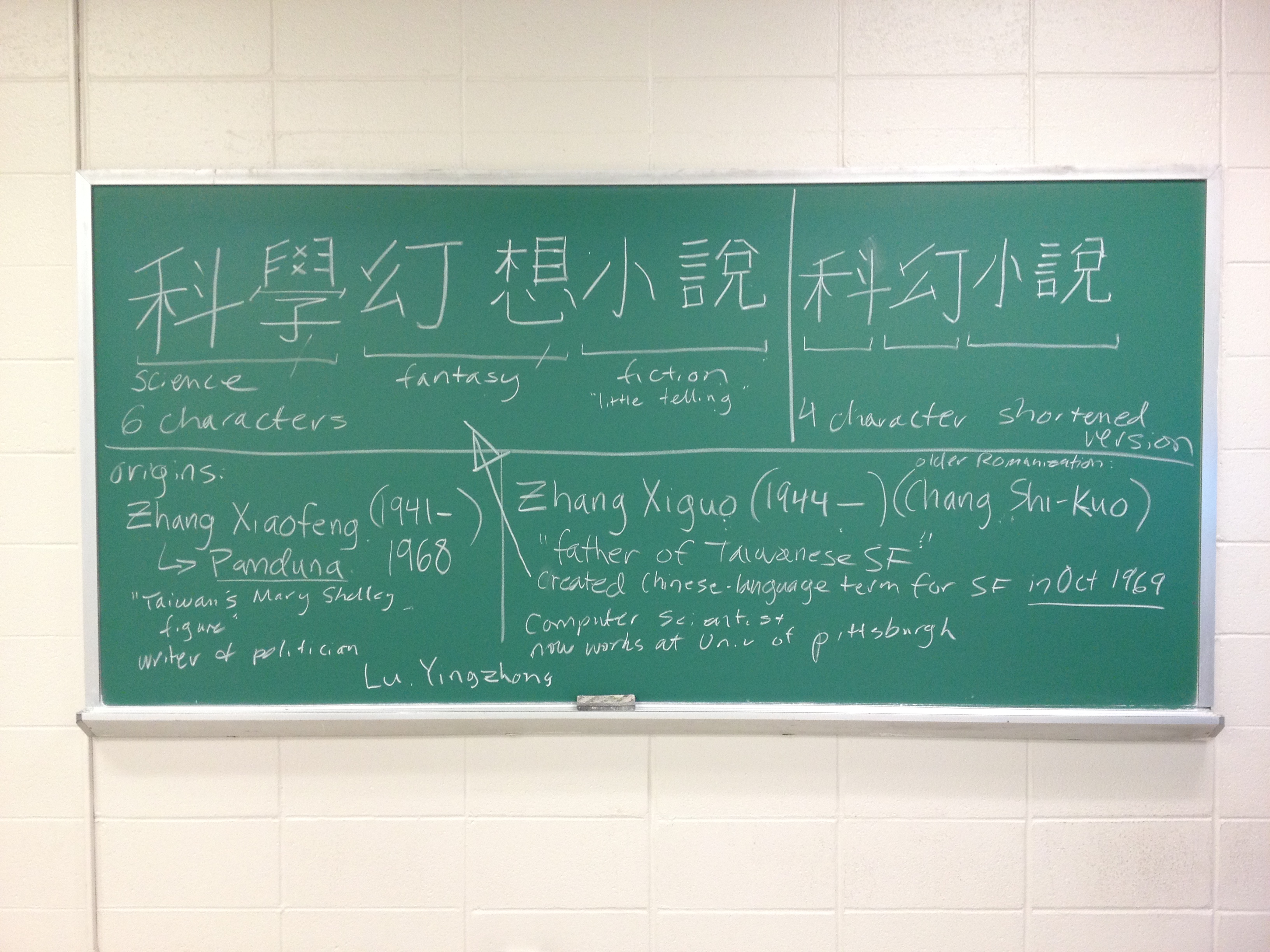
    Taiwanese SF lecture notes on the chalkboard.
    Taiwanese SF lecture notes on the chalkboard.

    In today’s class, I introduced my Science Fiction students to Taiwanese SF. For class, they read David Uher’s “Trends in the Development of Science Fiction Literature in Taiwan” (Anthropologia Integra 1.1 2010, 63-70) and a translation of Chang Shi-Kuo’s (Zhang Xiguo) “City of the Bronze Statue.”

    In today’s lecture, I charted a brief history of China and Taiwan (revolution, Kuomintang/Republic of China, Civil War, and diaspora to Taiwan), the history of Taiwan SF with an emphasis on Zhang Zioafeng’s “Panduna” as the first Taiwanese SF and her role–like Mary Shelley’s–as the “mother of Taiwanese SF” and Zhang Xiguo’s as the “father of Taiwanese SF” who also coined the term for “Science Fantasy Fiction” (科學幻想小說: Science/科學, Fantasy/幻想, Fiction/小說). I also identified five general characteristics of Taiwanese SF: 1) Synthesis of Western and Eastern culture, 2) Wuxia (武俠) or the Chinese martial arts chivalry story, 3) Adopt Chinese mythology and history to make the reader more familiar with the fantastic elements of the story (c.f., Star Trek), 4) Themes of nostalgia and loss, and 5) Conservative affirmation of society and the existing social order.

    During class, I led the students through two exercises. After explaining to them the general characteristics of reading and writing in traditional Chinese, I handed out worksheets for them to practice writing the four characters of the truncated term for “Science Fantasy Fiction” (科幻小說). I gave them about 5 minutes to try out their Chinese penmanship while I walked around watching their progress. This also led to a discussion about how written traditional Chinese is different than Japanese (kanji, hiragana, and katakana).

    In the second exercise, I divided the class into four teams of three students each. I handed each team two pages from the John Balcom translation of the Prologue to Chang Shi-Kuo’s City Trilogy (which corresponds to the “City of the Bronze Statue.”) The students were tasked with identifying differences between the two translations. They discovered small variations in measurements, descriptions, and phrasing. In particular, they noticed that the two translations differed in tone–the translation on his website is more vernacular and the book translation has a more formal tone. However, they reported that the Bronze Statue seemed more life-like and personified in the Balcom translation. I was surprised though that they did not pick up on the understated comedic tone in either translation. Nevertheless, I was glad that they got to experience first hand how much of a role the translator has in the creation of a translation–translation being a creative act itself.
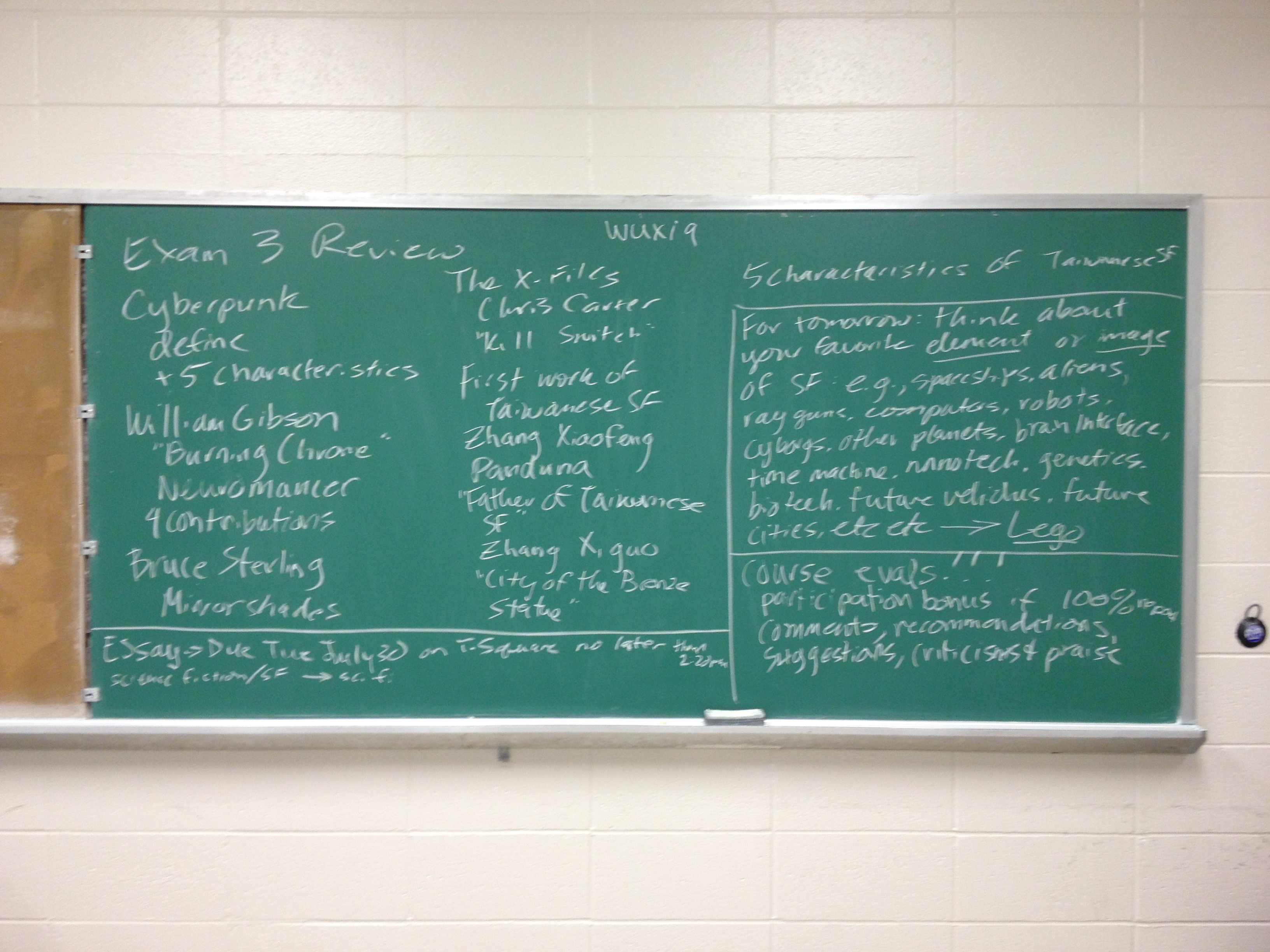
    photo-2
    Exam 3 review notes.

    At the end of class, we reviewed for their short third exam tomorrow and I talked with them about the fun Lego project that I have planned after the exam.

    Their final essays in the class will be due next Tuesday.

    Many thanks to Y for helping me with my research, writing, and pronunciation for this lecture!
  • Science Fiction, LMC3214: Cyberpunk, William Gibson, and Retrocomputing Demo

    After my students took their second exam yesterday, I lectured on cyberpunk to accompany their readings: William Gibson’s “Burning Chrome” and Bruce Sterling’s “Preface” to Mirrorshades. I talked about its historical and cultural moment, proto-cyberpunk examples in the SF genre, and the movement itself. In particular, I contextualized the cyberpunk movement in terms of postmodernism and post-industrial society. We ran out of time while I was talking about Gibson’s contributions to the development of the cyberpunk movement. Besides my enjoyment of talking about cyberpunk, I was happy that my former professor Dr. Carol Senf was in attendance to observe my teaching.

    Today, we watched the William Gibson and Tom Maddox penned episode of The X-Files, “Kill Switch.” Released approximately 16 years after “Burning Chrome” in 1998, it is one of the best examples of cyberpunk in a visual medium–especially in the fact that it takes place in the here-and-now instead of the near future.

    Then, I lectured on The X-Files and cyberpunk film/television before returning to my notes on Gibson, Bruce Sterling, and Pat Cadigan.

    After the lecture, I launched into a retrocomputing demonstration with emulation and my personal collection of resurrected computer gear. I showed my students how to use the http://www.virtualapple.org website to see what cutting edge computing looked like in the early 1980s. Most of my students were born in the early to mid-1990s, so I wanted them to experience first hand how much extrapolation was being done on the part of the cyberpunks and Gibson in particular (of course, telling them about his Hermes 2000 typewriter and its celluloid keys and his recollection of getting inspiration for the cyberspace deck from the Apple IIc–something that his memory likely colored due to the fact that the IIc was released the same year as Neuromancer). Also, I brought in an Apple Powerbook 145 with Gibson’s Voyager Company ebook of the Sprawl trilogy pre-loaded and a Pentium-I PC with old software including Neuromancer (for DOS), Star Wars: Dark Forces (DOS), and the Star Trek Interactive Technical Manual (Windows). I took the U-shaped sheet metal case off my PC so that they could see the insides.

    I had to lug everything across campus in my carry-on sized suitcase with the PC strapped to the handle with nylon straps. I felt like Case in Neuromancer returning from his shopping expedition.

    Tomorrow: Taiwanese SF and review for the third exam.

  • Science Fiction, LMC3214: Revised Schedule for Last Week of Class

    This is the last week of my Science Fiction class. I decided to make some changes to the final week of class to cover the necessary material and to strike out into new territory. Here’s the revised schedule for Monday through Thursday:

    Monday: 9:20-10:20 Exam 2. 10:20-11:20 Lecture on Cyberpunk and short discussion of William Gibson’s “Burning Chrome” and Bruce Sterling’s Preface to Mirrorshades anthology.

    Tuesday: Begin with episode of the X-Files by William Gibson and Tom Maddox, “Kill Switch.” Followed by discussion and retrocomputing demonstration that looks at the computing origins of cyberpunk. Please bring your laptop today for the in-class activity.

    Wednesday: Global Perspectives unit on Taiwanese SF. First part of class: lecture on differences of cultural/historical development and issues of translation. Second part of class: Active learning exercise looking at translations. The two readings for today’s class are on T-Square under Resources.

    Thursday: 9:20-9:50 Exam 3. 9:50-11:20 Exploring your SF imagination with Lego. Think about your favorite trope, image, science, or technology from SF and how you might build it with Lego bricks. We will spend time in class building your creation and then sharing your creations with the class as a whole. If you bring your ideas to class, I will bring the bricks (and a camera to record your work)!

  • Science Fiction, LMC3214: Concluding Aliens and Feminist SF, Review for Exam 2

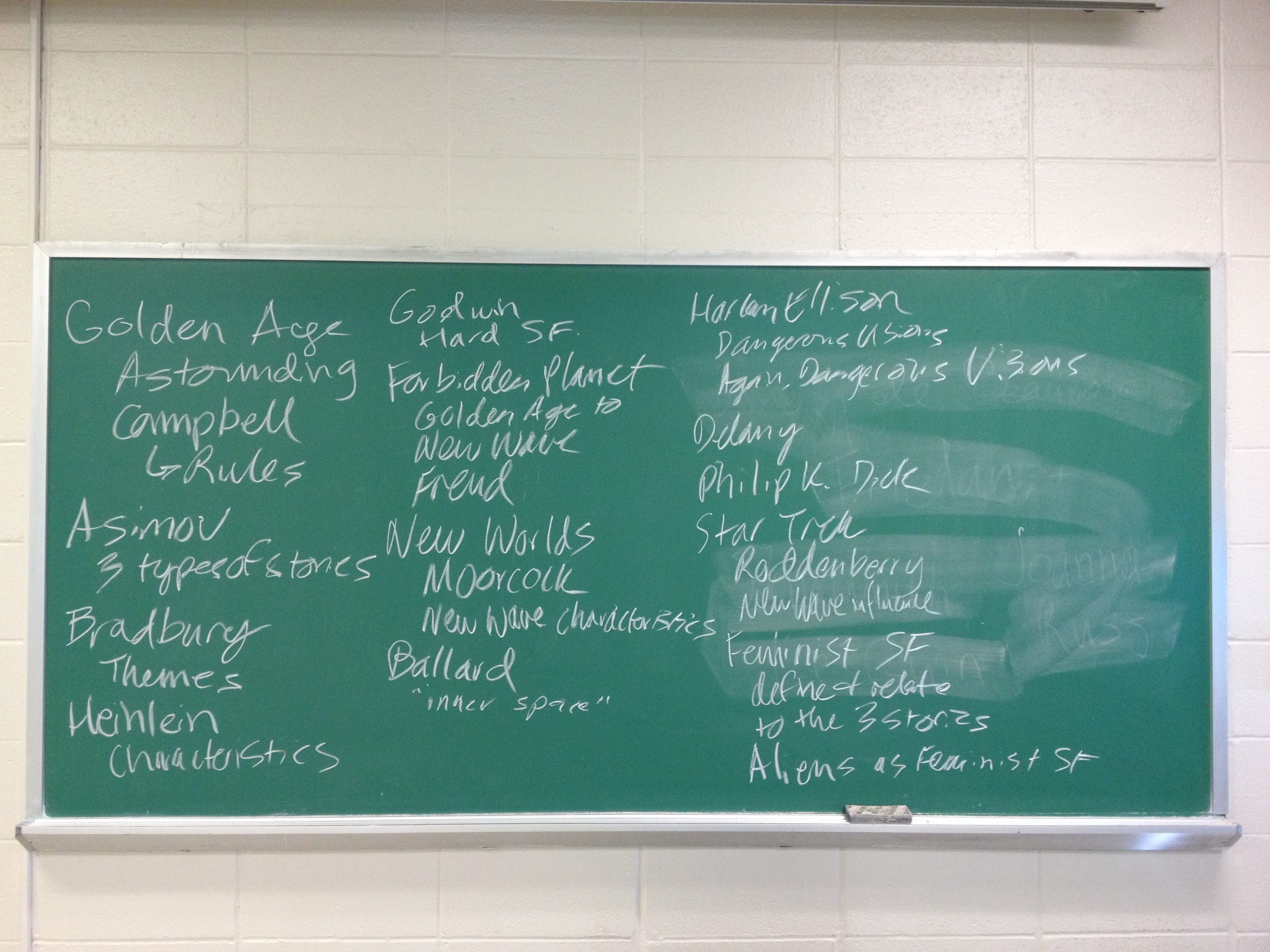
    Exam 2 review notes on the chalkboard.
    Exam 2 review notes on the chalkboard.

    In today’s class, we finished watching James Cameron’s Aliens and discussed how it fits into our earlier discussions on feminist SF (Ripley as strong female hero, challenging stereotypes: Ripley, Vasquez, Ferro, and Dietrich vs. Gorman and Hudson, alternative modes of reproduction, the human role in alien reproduction–“impregnate,” remaking motherhood, what does it mean to be a mother, sexualized bodies of the aliens/HR Giger).

    We also spent some time reviewing for their second major exam, which will take place during the first half of Monday’s class. I recommended students to build a new set of notes that consolidates important information, dates, lists, etc., because it will make their studying over the weekend easier. I also recommended for them to chart connections between the themes and characteristics of SF eras and the stories that we discussed in relation to those eras. The idea is that making the information more meaningful through interconnections will improve their use and recall of course material.

    Next week, we conclude the class. There will be units on cyberpunk, global perspectives/Taiwanese SF, and maybe something creative–this is a fun surprise that I am still working on. I will have a busy weekend planning these things out, but I believe that it will lead to an exciting and fun conclusion of my first SF class!

  • Science Fiction, LMC3214: Alien, Aliens, Giger

    Today, we began watching James Cameron’s 1986 film Aliens, and I lectured on Ridley Scott’s earlier 1979 Alien and how these figure into feminist SF via their characters, themes, and source material: H.R. Giger’s “Necronom IV.” I shared pictures of my visit to Gruyères with the class, too (for the juxtaposition of quaint, medieval Swiss town with the Giger Museum and Bar). I asked the students to take notes about the film and identify how it exemplifies feminist SF as discussed during Tuesday’s class.

    We will conclude Aliens during tomorrow’s class, discuss the students’ findings relating to it being feminist SF, and review for the second major exam.

    For further learning, I found this interesting documentary about Giger’s Necronomicon and his influence on the first Alien film on YouTube: