
Y and I received these tiny paper origami cranes from a fellow Postcrosser a few years back. They neatly fit on top of the lid handle of a small pot.

Y and I received these tiny paper origami cranes from a fellow Postcrosser a few years back. They neatly fit on top of the lid handle of a small pot.

On Mar. 29, 2023, Georgia Tech’s Ivan Allen College held its 2023 Distinguished Alumni Awards Ceremony. The Ivan Allen College’s six academic schools and its three ROTC branches give these awards to “celebrate excellence in the College community.” I was honored to receive a Distinguished Alumni Award from the School of Literature, Media, and Communication for my contributions as a teacher, scholar, and organizer. The award reads, “For outstanding achievements that inspire continued excellence and bring credit to the School of Literature, Media, and Communication, the Ivan Allen College of Liberal Arts, and the Georgia Institute of Technology.”
To honor all of the Ivan Allen College professors who made my success possible, I delivered these remarks after receiving the Distinguished Alumni Award:
I am honored and humbled to receive this Distinguished Alumni Award. I want to thank the Ivan Allen College, Dean Husbands Fealing, and all of the faculty, administrators, and staff who make the Ivan Allen College not only a indispensable and integral part of Georgia Tech but also a home for someone like me who is better at writing about science than doing science. It also feels like home, because I’ve spent so many years here—first, it took me 10 years to “get out” with my bachelor’s degree, and then, I returned as a postdoctoral Brittain Fellow for 2 years to give back to Tech as an instructor where I had received so much from my former professors. Throughout my career, all of the work that I have done as a scholar, an instructor, an organizer, and an administrator can be traced back to my education and professionalization in the Ivan Allen College. To name a few examples, when I was asked to help establish the City Tech Science Fiction Collection where I now work, I looked at the problem with the engineering mindset that Tech instills in its students. I drew on my experience working under Lisa Yaszek on research projects, public outreach, and donation runs for what was originally called the Bud Foote Science Fiction Collection and now the Georgia Tech Science Fiction Collection. After starting the collection, I inaugurated an annual Science Fiction Symposium to celebrate the collection and create a platform for scholars and students (including Lisa’s SciFi Lab undergraduate researchers) to interact and share their findings. That work over the past seven years was made possible by the experiences that I had with Lisa when she mentored me to create the schedules for the Monstrous Bodies Symposium in 2005 and the international Science Fiction Research Association Conference held in Atlanta in 2009. Lisa has had a profound influence on my career. She’s my hero and I strive to be like her.

Other faculty have also played outsized roles in my development. Carol Senf and Narin Hassan gave me kind and essential advice at key points in my undergraduate career, and they also gave me some of my first editing work by asking me to proofread their respective manuscripts, which helped tremendously in the editing and collaborative writing that I have done over the years since then. In my teaching, I observed and learned from some of the best practioners. I want to excite my students in the way that Hugh Crawford can when talking about William Carlos Williams and bombsights, as detailed as Steven Usselman is about steam engine locomotives, or as illustrative as Robert Wood is when he talks about 15th century Florence. And I show my students compassion when things go wrong as Rebecca Merrens did for me when my maternal grandmother died, foster my students passions as Lisa Holloway-Attaway did for me in the two required freshman college writing classes, give my students a chance like Patrick Sharp did for me by readmitting me in 2002, give my students opportunities to contribute to the life work of our campus communities as Ken Knoespel did for me, and give students an opportunity to be successful and demonstrate learning when the student stumbles on a project they are ill fitted to such as the late Thomas Lux did for me by asking me to produce a Poetry Out Loud DVD for Georgia public schools in place of my atrocious writing as a poet. And while I never had the opportunity to take a class with Jay Telotte or Jay Bolter, their work had a significant influence on my early research, and I teach their scholarship to my students now. Most recently, Rebecca Burnett, the former Writing and Communication Program Director, led the Technical Communication theory and pedagogy seminar that I volunteered to participate in so that I could earn the opportunity to teach Tech Comm as a Brittain Fellow. That experience directly led to my job at the New York City College of Technology and my current position as Director of City Tech’s Professional and Technical Writing Program. Rebecca has continued to selflessly mentor me throughout my directorship.

And lastly, I want to offer a special thank you to Professor Hanchao Lu, because his Asia in the Modern World class had a profound effect on my personal life. He encouraged me to research Taiwan for my final paper. Years later, when I met a Taiwanese girl in graduate school in 2007, I drew on what I had learned in Professor Lu’s class to talk about the KMT and DPP political parties hoping that she might notice me. And guess what? She did, and we got married two years later! Thank you, again!
I arrived in Atlanta a day early, because I wanted to walk around and see all of the changes around Georgia Tech’s campus during the 8 1/2 years since I was last there. Some things remained comfortably familiar, like the entrance to the School of Literature, Media, and Communication on the 3rd floor of the Skiles Building.

However, there were subtle changes like the addition of outdoor tables and seats on breezeway, which I utilized to finish writing my thank you remarks.

Besides the changes to buildings and the construction of new facilities, there are new pieces of art that convey important historical events as well as excite the senses.

Approaching Tech Tower, I was greeted by this striking bronze sculpture titled “The Three Pioneers” by Martin Dawe. It depicts the first three African American students to matriculate at Georgia Tech in 1961: Ford C. Greene, Ralph A. Long, Jr., and Lawrence M. Williams.

Walking toward the foot of Tech Tower, I sat in this engaging bronze and granite piece titled “Continuing the Conversation.” The viewer sits between two versions of Rosa Parks–42 on the right and 92 on the left. While Parks had never visited Tech’s campus before, this art reflects her influence on change and how we should be a part of that change moving forward.

Walking through the center of campus–the Library, Skiles Building, and the Student Center–I found Robert Berks’ Einstein installation. While some folks think the statue is out of place at Tech, it meant something personal to me. When I was in high school, I read Einstein’s Relativity: The Special and the General Theories, which among other works by Carl Sagan, Michio Kaku, Roger Penrose, and Stephen Hawking, directly led to my enrolling as a Physics major at Georgia Tech in 1995. That didn’t work out so well for me academically, but I love Physics and Mathematics despite my own deficiencies.

Walking from the Einstein statute toward the green space between the back of the Library and the School of Architecture I encountered John C. Portman, Jr’s imposing KR+C (for Knowledge and Research plus Creativity) sculpture. Walking around its circumference reveals how it reshapes and changes depending on your perspective. I found that you can walk up the back stairs of the Library and Clough Undergraduate Learning Commons to get a bird’s eye view of this magnificent sculpture.

Walking into the Clough Undergraduate Learning Commons, I found art suspended between its the clean perspectival lines. The sculpture above titled “Jetson” is a collaborative team project initiated by former College of Architecture Professor Volkan Alkanoglu. Primarily constructed from water jet cut aluminum, this large, futuristic sculpture only weights about 110 pounds!


Walking through the Clough Commons into the Library, I met with my former colleague Wendy Hagenmaier, Digital Curation Archivist and RetroTech Manager, in the 3rd floor Data Vizualization Lab and RetroTech shared space. RetroTech is a working collection of born digital (and analog) art (and science) artifacts that students can use, support, and learn from. Before moving to Brooklyn, I donated four of my vintage computers (a Dell Dimension 4100, Apple Macintosh Perform 550, iMac DV, and Apple Power Macintosh 8500) to the Georgia Tech Library to help kickstart RetroTech, a lab for students to use and interact with older technologies–computers, video game consoles, cameras, slide rules, typewriters, etc. I was amazed at how much space RetroTech has in conjunction with the Data Vizualization Lab. Besides having equipment and space, Wendy is developing RetroTech into a sustainable initiative involving students and cross campus connections. I’m really happy to see how much RetroTech has developed under Wendy’s leadership.

Leaving the Library, I walked through Deanna Sirlin’s “Watermark” installation. The sunlight passing through the colored glass panes creates a changing projected artwork on the floor and surroundings inside this entrance to the Crosland Tower of the Library.

Walking back toward the Student Center, I stopped in front of the Kessler Campanile designed by Richard Hill for the 1996 Olympics. It was installed during my freshman year at Tech.
Spending almost a whole week in the ATL gave me a much needed boost. 99x is back on the air. I enjoyed not one but two meals at Del Taco. I talked computers with Grantley and Melanie. I met Carol Senf for brunch to talk teaching. I hung out with Lisa Yaszek and Doug Davis at the West End. Rebecca Burnett and Jeff Jeffries invited me over to their home for a wonderful dinner. I talked Doctor Who and Dirk Gently with Mark Warbington. I discussed books with Keith Magnes. And, I got to visit Mike Flanagan in his new house and see his wife Diana compete in a local tennis tournament. Unfortunately, I didn’t have enough time to see everyone I know there, but I hope to get back to Atlanta before another 8 1/2 years pass!


This is a long read that combines autobiography, nostalgia, memory, and instructions. Visitors here might find it interesting and informative. My students might use it as a model for some of their own multimodal writing about memory, processes, instructions, and reflection.
While it has been over 25 years since I last rode a skateboard with my hometown friends, I recently felt drawn to the 7-ply deck once again and decided to assemble a board similar to my second skateboard–a 1990 Powell-Peralta Mike McGill pro board with VCJ’s Skull & Snake graphics, fish shape, nose and tail kicks, natural wood grain with Gullwing Pro III trucks (red), and Powell-Peralta Rat Bones wheels (neon green).
Before I got my original McGill deck, I learned to skateboard on a Teenage Mutant Ninja Turtles complete skateboard that my grandparents–Wilma and Papa Gerald–bought for me from the Wal-Mart on Altama Avenue in Brunswick, Georgia (since replaced by a Supercenter about a mile away, and then the original site re-built as a Neighborhood Market a few years ago).
With the TMNT skateboard, I learned how to balance, turn, and ride on my grandparent’s back car port. At first, I held on to a broom handle to steady myself until I felt confident enough to ride without this support. I don’t think I had a helmet, but I did have pads and wrist guards–the former store bought neon green plastic over black, and the latter used, red, gifted or traded for–I can’t remember.
I rode and shared the TMNT skateboard with my friends who I paled around with when I stayed at my grandparents. However, I wanted to learn how to ollie and do tricks, but I found this to be next to impossible on the heavy, tank-like TMNT board. This is what began my search for a better board, relying heavily on the photo stories and advertising in magazines such as Transworld Skateboarding and Thrasher, and eventually led to me mail ordering the McGill deck and new hardware (was this a Christmas gift from my grandparents or my folks–again, my memory falters).
With the new McGill, I continued skating through the beginning of high school, but I drifted away from the sport when I got more interested in books (physics first, science fiction second), computers (Amiga, IBM-compatible PCs, and eventually, Macintosh), and cars (my first being a 1965 Ford Mustang, but always having a soft spot for the small Toyota pickup trucks that I used to deliver auto parts from my family’s business).
I don’t remember what became of my McGill. I suspect that I gave it to a friend before going to college where I really got into Rollerblading, but my memory fails completely on this point. I hope that I can remember what happened to my old McGill skateboard, not because I want it back, but instead simply to recall that moment in my life’s narrative. Related to this is the fact that I don’t seem to have any photos of me with my skateboard (though I do have a photo of me holding my Rat Bones wheels on Christmas Day). It’s an odd omission in the photographic record of my life of something I considered important to me at that early time in my life.
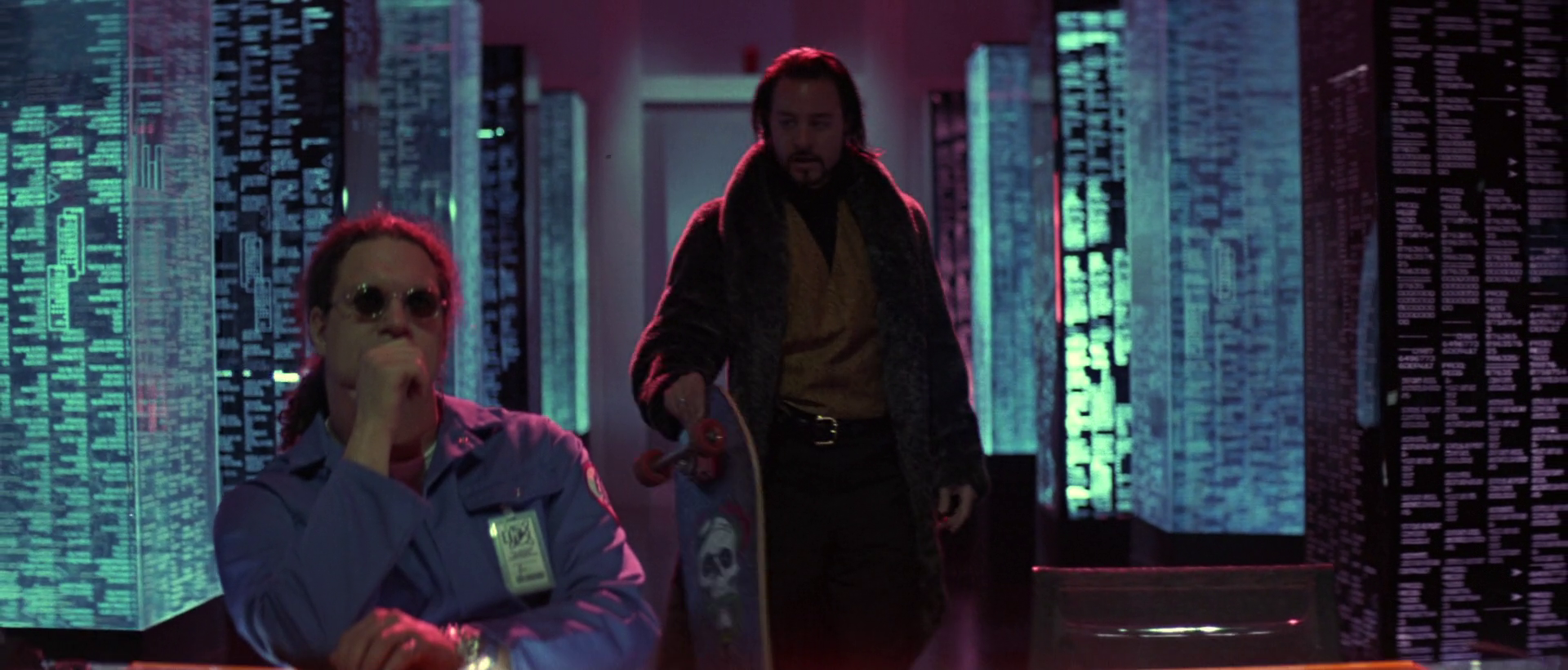
My re-interest in skateboarding began when I was watching the film Hackers (1995) in HD. I don’t think it registered with me when I first saw it when it was originally released that the film’s villain, The Plague (Fisher Stevens), rides into his company’s NOC (network operations center) on a McGill skateboard (see above).
Then, I caught up with my oldest best friend Bert over the phone. He lives in Seattle now, but back in the day, we used to skateboard in his neighborhood. Bert was a much better skater than me. Our conversation drifted back to skateboarding, including the time that he and I were stopped by a cop on our way back from a Hampton Inn construction site. The obese, good ol’ boy police officer asked us questions about what we had been doing and he stopped when he pointed his flashlight on our boards. Bert skated Vision, and I skated Powell-Peralta. The cop took a breath through his teeth and said, “now boys, I’ve done heard things about that POW-ell Per-AL-ta. They’s devil worshipers!” Bert and I smiled and nodded until he let us go on our way back to his house, but it’s a strange encounter that’s stuck with me.
Our phone conversation encouraged me to begin searching the web for information about my old skateboard. This led me to the Bones Brigade video The Search for Animal Chin (1987), which I shared with Bert via text message. By this point, I was thinking and spending more free time learning more about skating history and its evolution after I had left the sport.
While I was already burdened by a big research project on computers in science fiction from 1975-1995, which I’m continuing to work on, and the Third Annual City Tech Science Fiction Symposium, which I was organizing, I wanted to give myself something on the horizon to look forward to as a reward for this work. I decided to get the parts to build a new, complete skateboard similar to one that I had to before without breaking the bank, so I turned to eBay after striking out with the major skateboard online retailers and local shops, such as Uncle Funky’s Boards.

While I couldn’t find my original McGill with a natural finish, I did find this brand new, black dipped, Series #5 re-issue on offer by a seller in Puerto Rico. We negotiated a best offer price, and I received it before anything else.
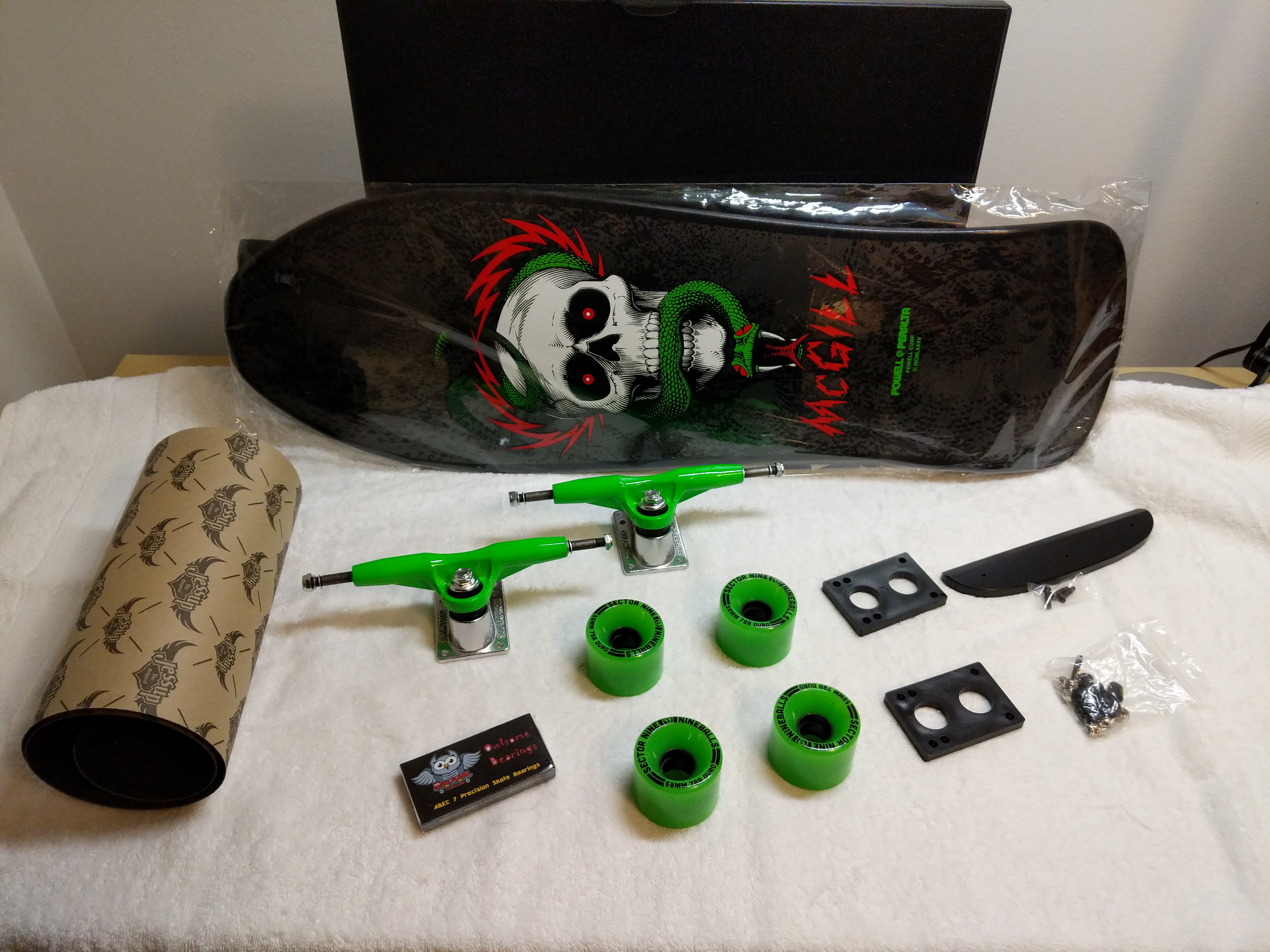
I picked up a Gullwing Pro III trucks, wheels, bearings, risers, hardware combo from Raptorunner in Riverside, CA, and I ordered a Powell Peralta Tailbone and Jessup grip tape (and a helmet and pads) from TGM Skateboards in Mount Clemens, MI.
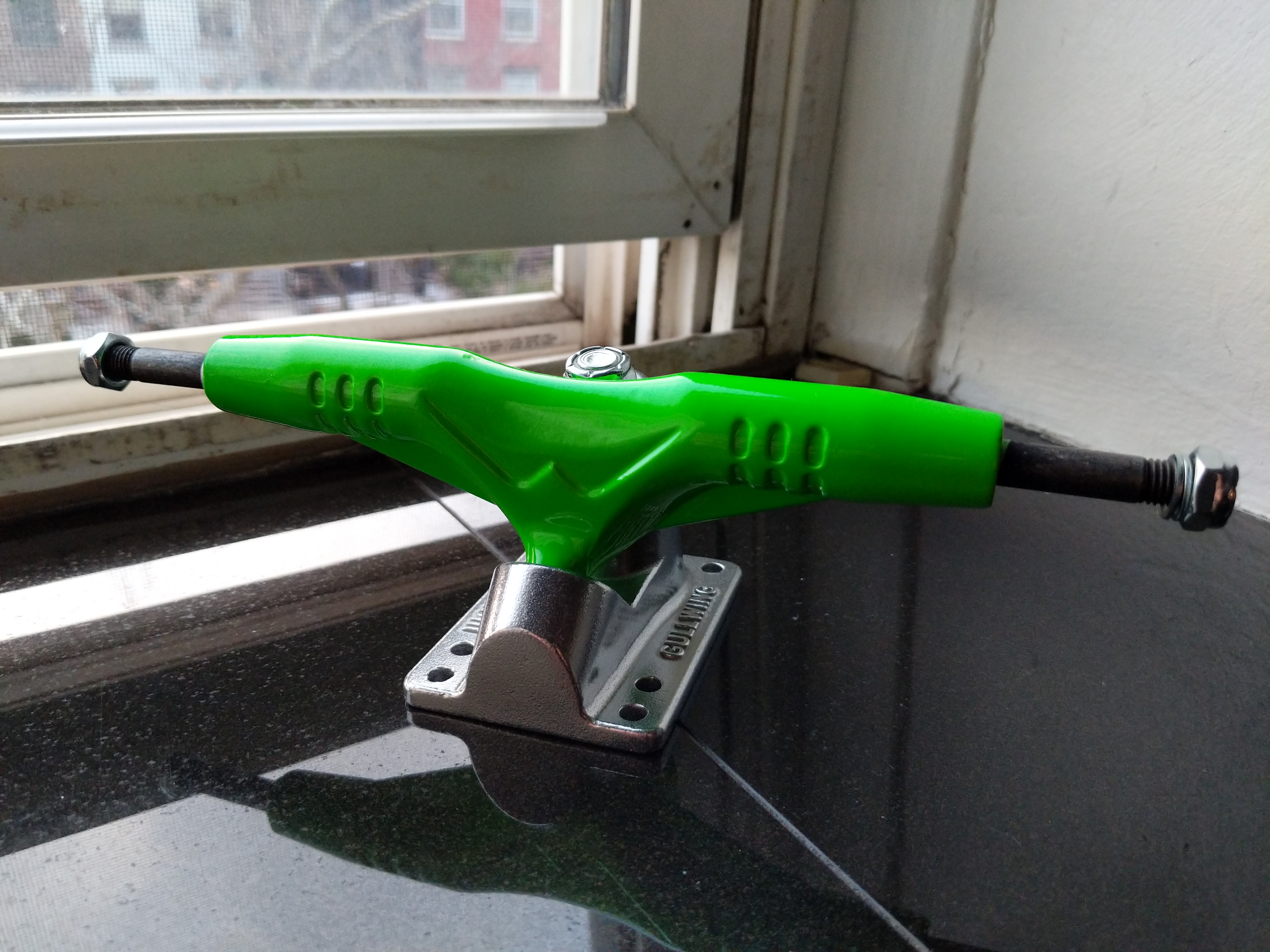
My original Gullwing Pro III trucks were cherry red and stood out well against the natural grain of the board. I liked these new 9″, 155mm neon green ones, because they stand out against the black background on the new, black McGill deck. Also, my re-issued McGill deck uses the old truck bolt pattern, so I chose between these (note that the base plate has six bolt holes instead of four–to accommodate both old and new bolt patterns) and Independent Stage 11 169mm trucks. Ultimately, I opted for the Gullwings since I skated with them before.
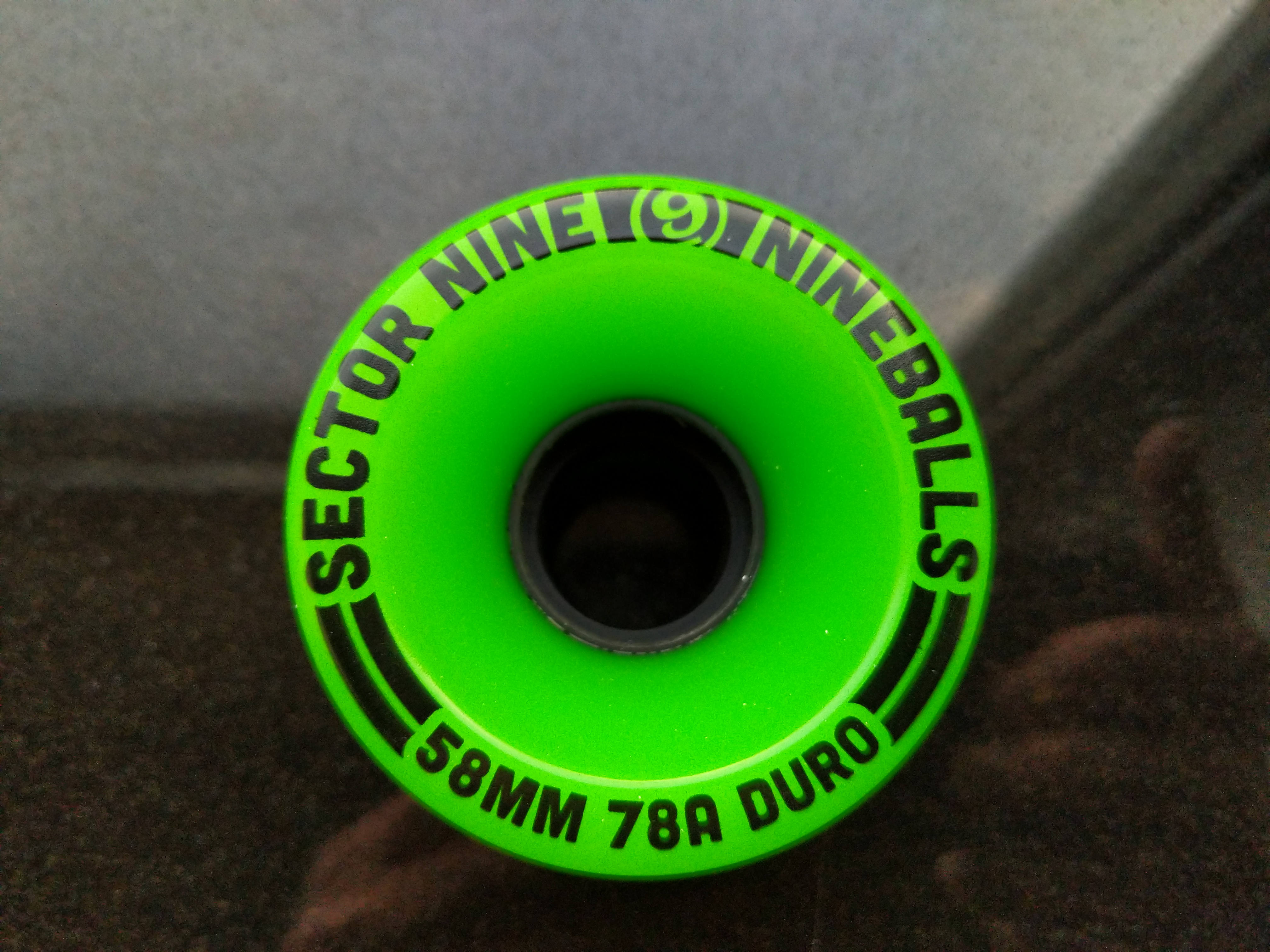
Raptorunner had several different truck, wheel, and hardware bundles. I chose this one, because it had these Sector Nine Nineballs wheels. They aren’t too big (I would have preferred 56mm) and they are real soft (78a), which will be good for the street crusing that I intend to use the skateboard for.
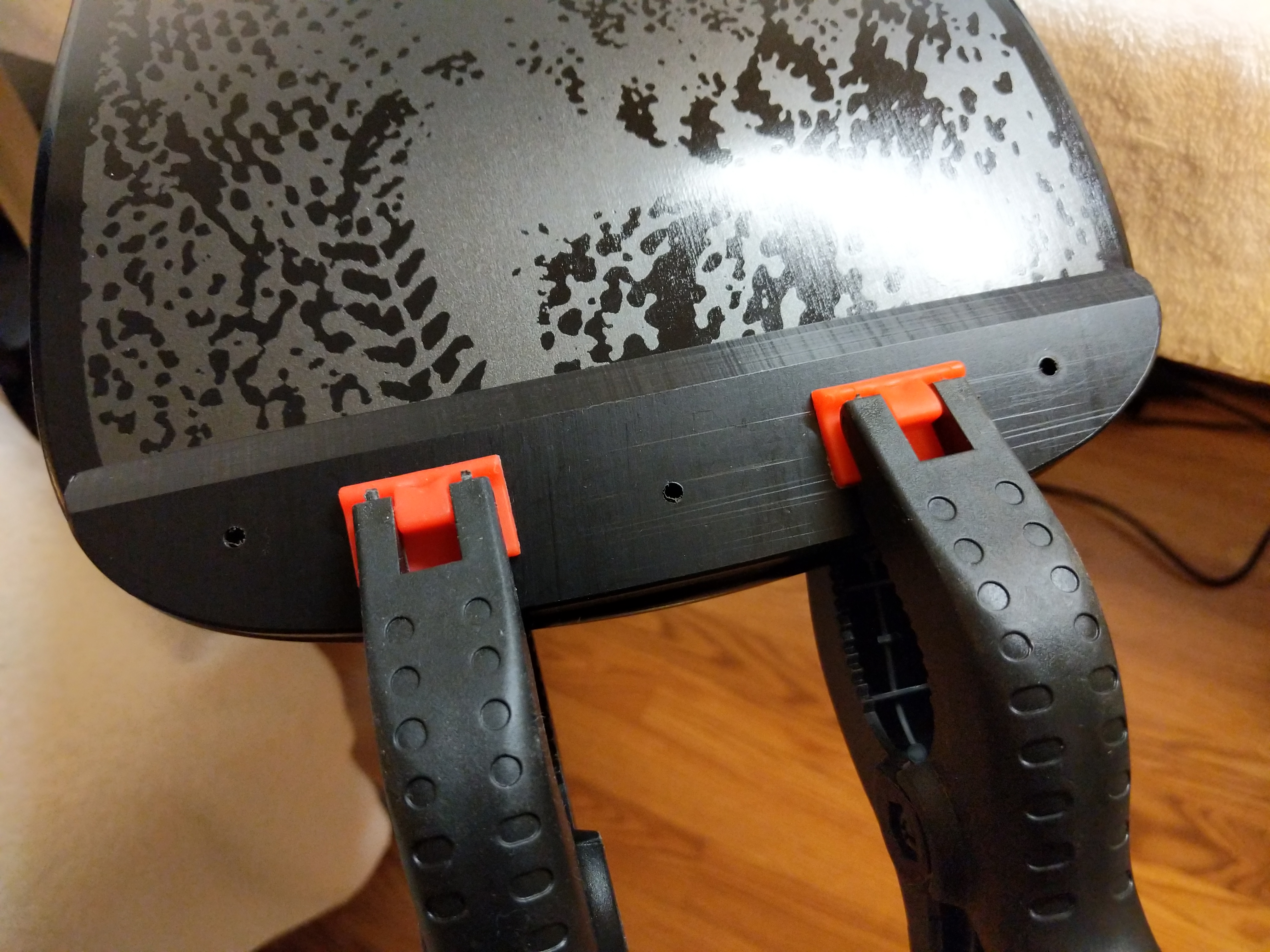
To begin my skateboard’s assembly, I began with the Tailbone before applying the grip tape. I clamped the tail guard to the bottom of the deck’s tail and measured to ensure it was centered.
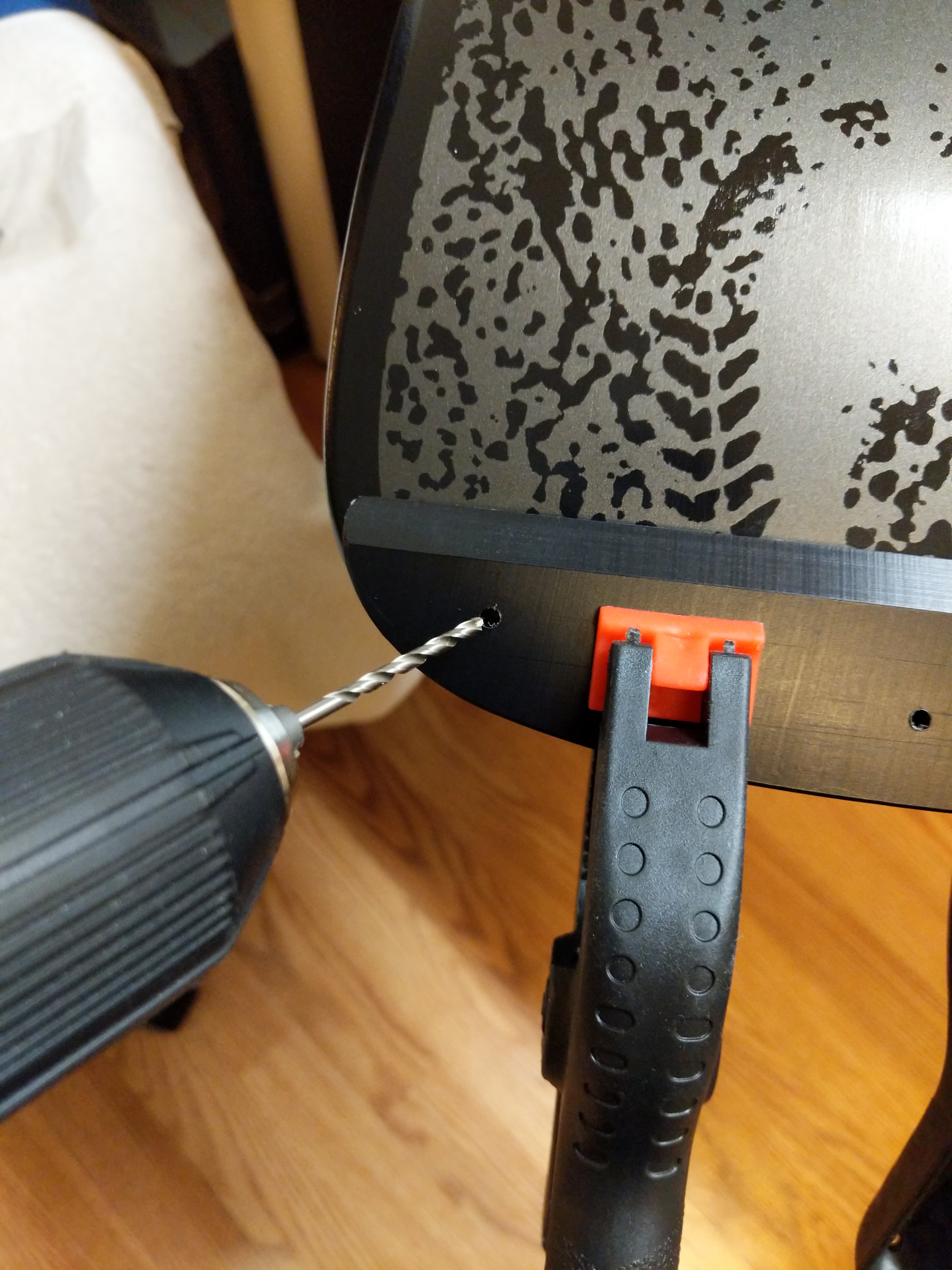
Then, I used a small drill bit to lightly mark where I should drill the larger holes for the wood screws that will go through the top of the board into the Tailbone.
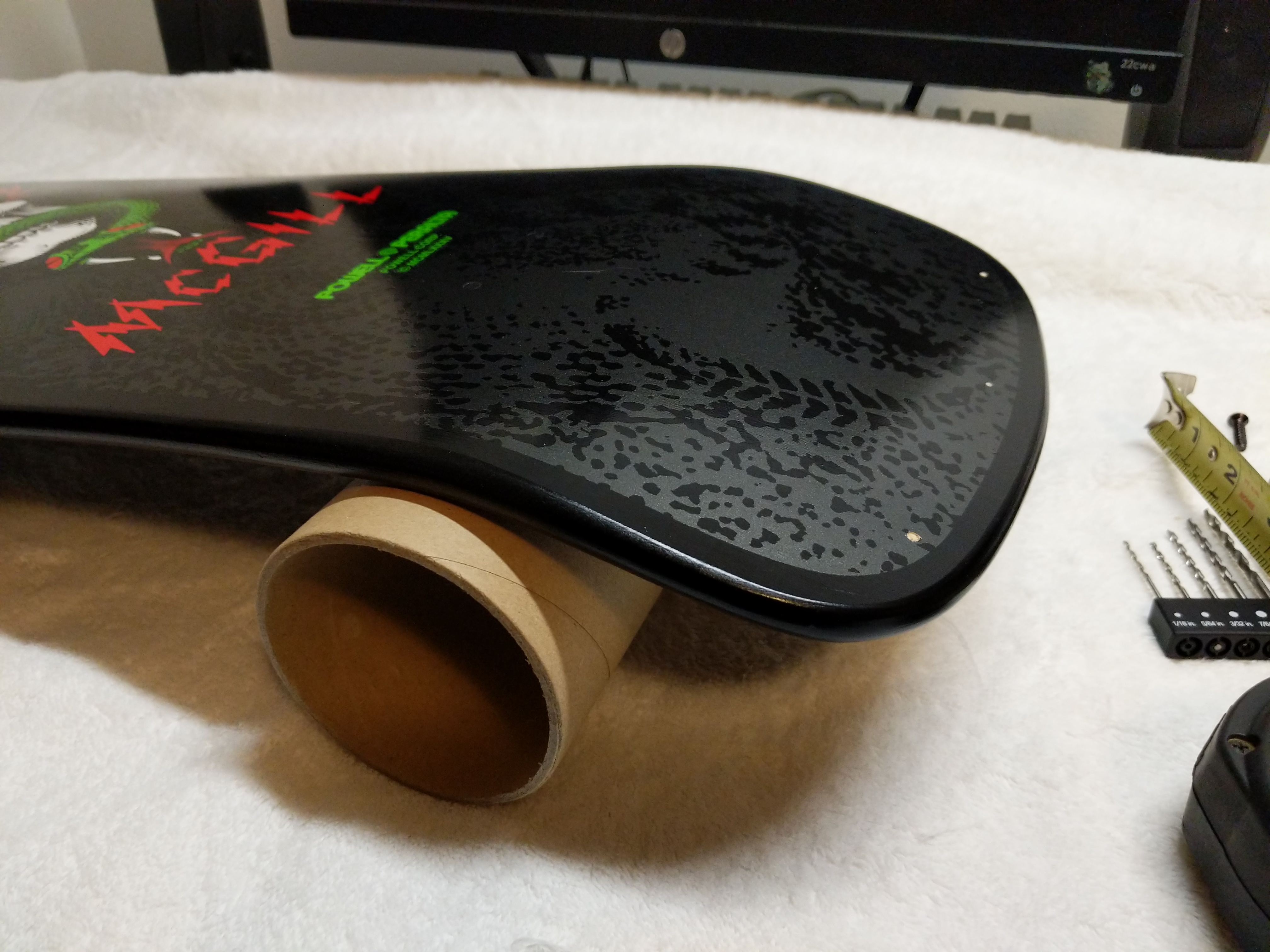
I used the grip tape shipping tube to support the deck while I was drilling.
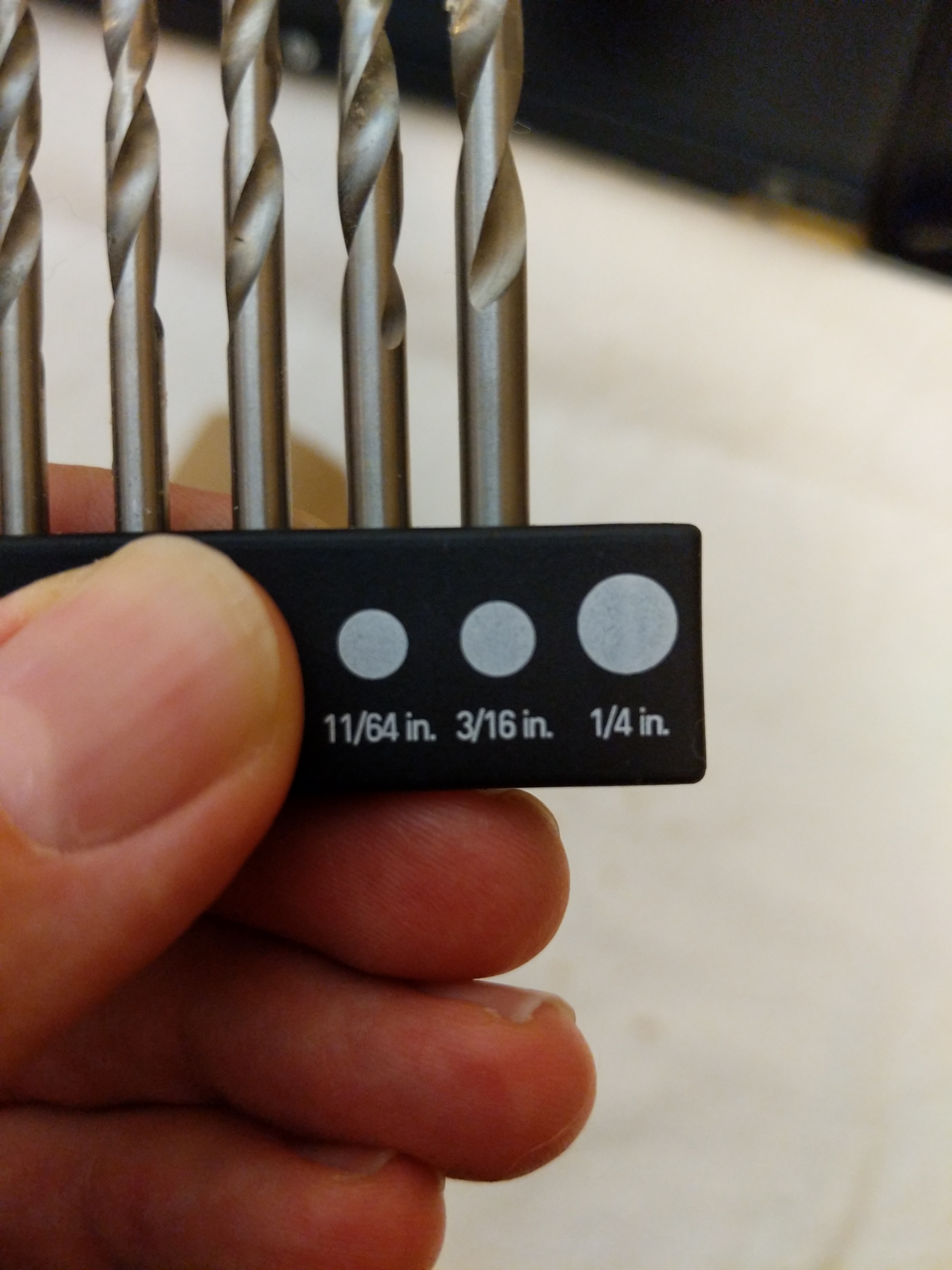
Powell-Peralta’s instructions for the Tailbone call for a 7/32″ drill bit. Unfortunately, I didn’t have one in this size. I didn’t want to go with a larger hole (1/4″), so I tried the 3/16″ bit. Luckily, this was more than enough room for the wood screws to pass through the board without biting and then go into the Tailbone.
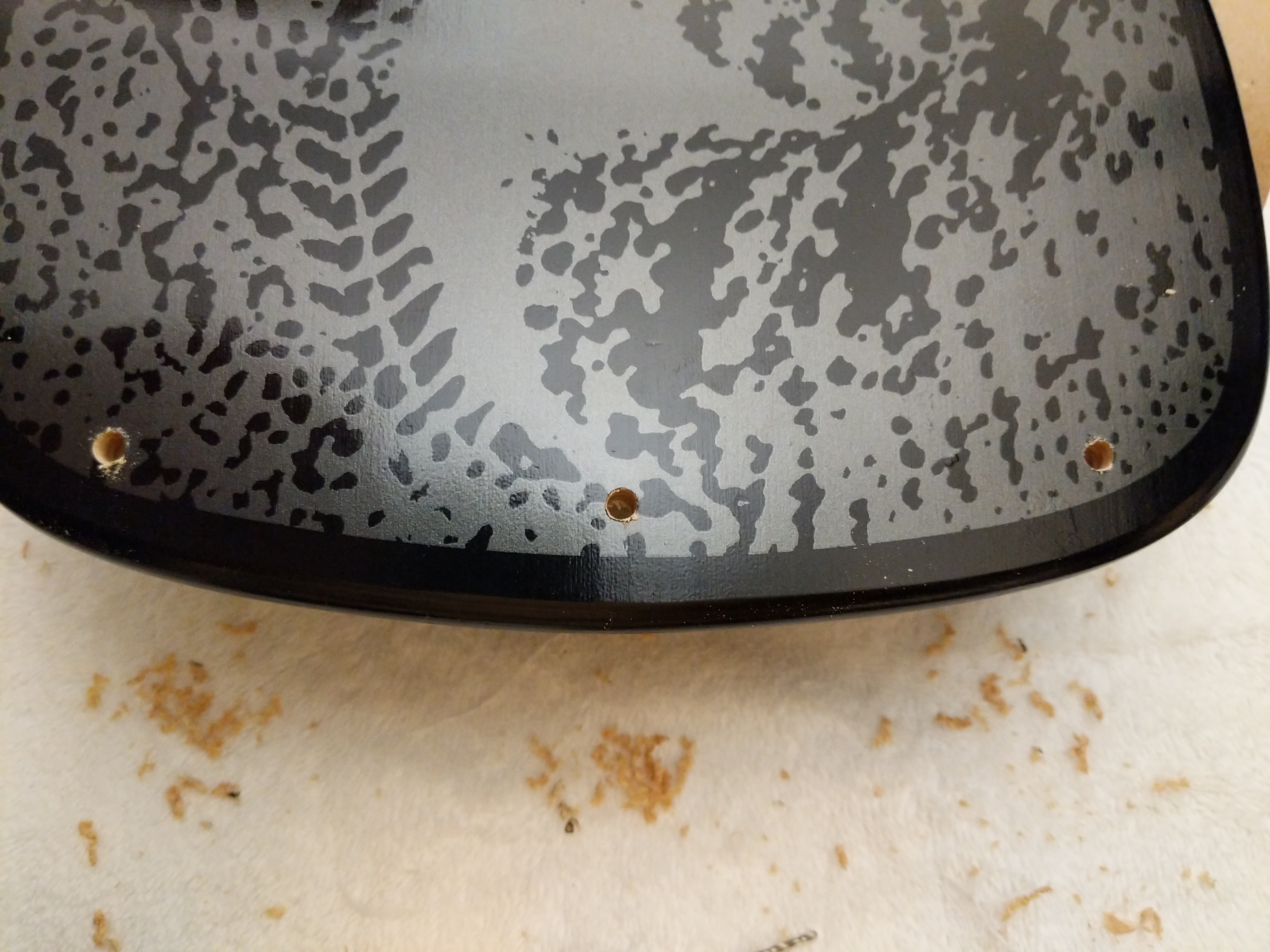
Using my earlier marks, I drilled three holes through the deck’s tail. These will be used later for mounting the Tailbone.
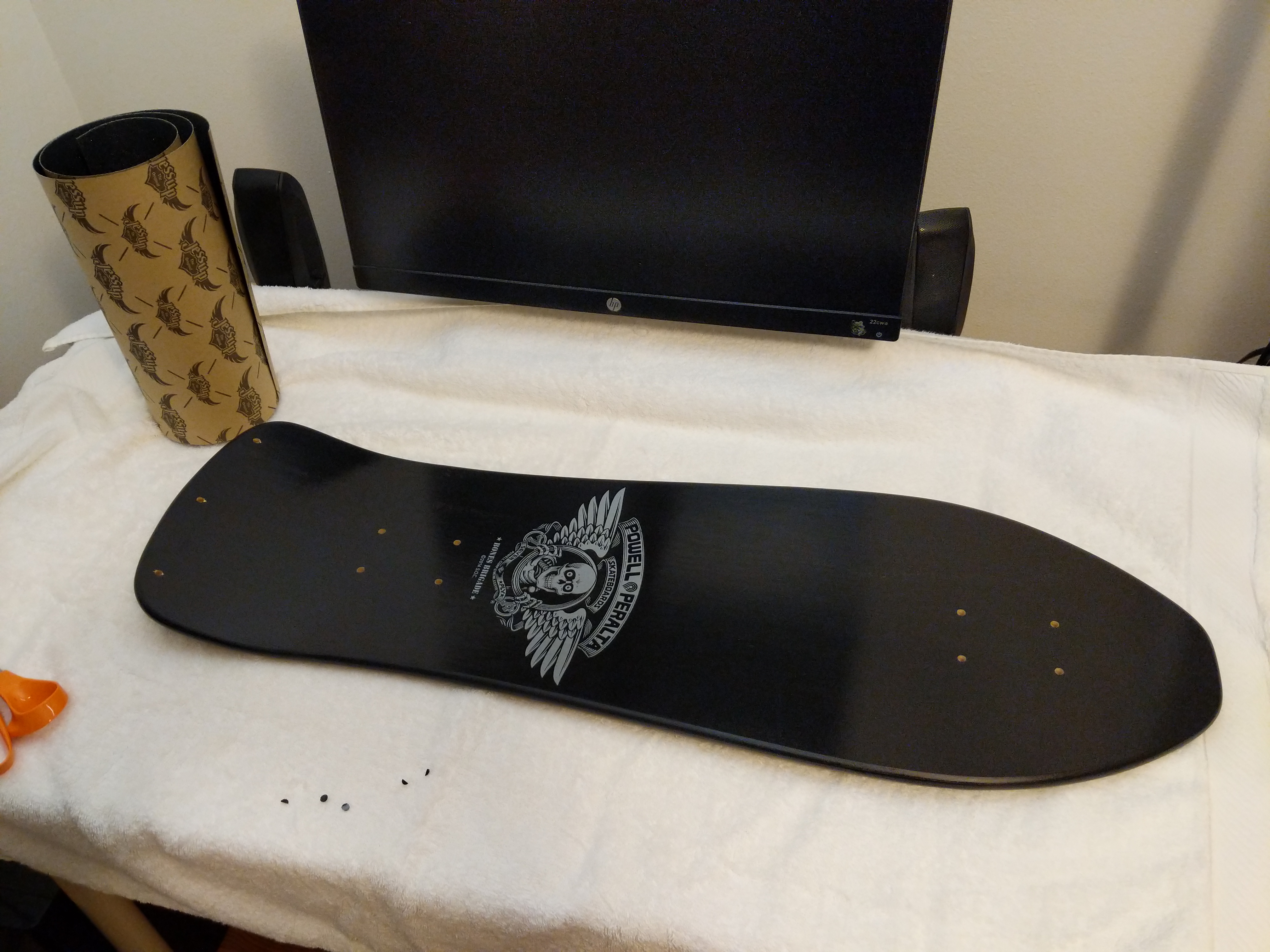
Before mounting the Tailbone, I applied the Jessup grip tape. I bought 10″ wide grip tape, which is just barely wide enough to give some room for error with the front of the deck. If I had to do over again, I would have opted for the 11″ wide grip tape.
I wanted the Bones Brigade logo to appear on the top of the deck, so I needed to apply two sections of grip tape–one above it towards the nose and one below it towards the tail. I measured these lengths twice and cut the length of grip tape into two sections allowing some room for error in terms of length. I used the pre-cut edges as the beginning of application above or below the Bones Brigade logo. I slowly lowered and pressed the grip tape to the deck so as to avoid any air bubbles under the tape.
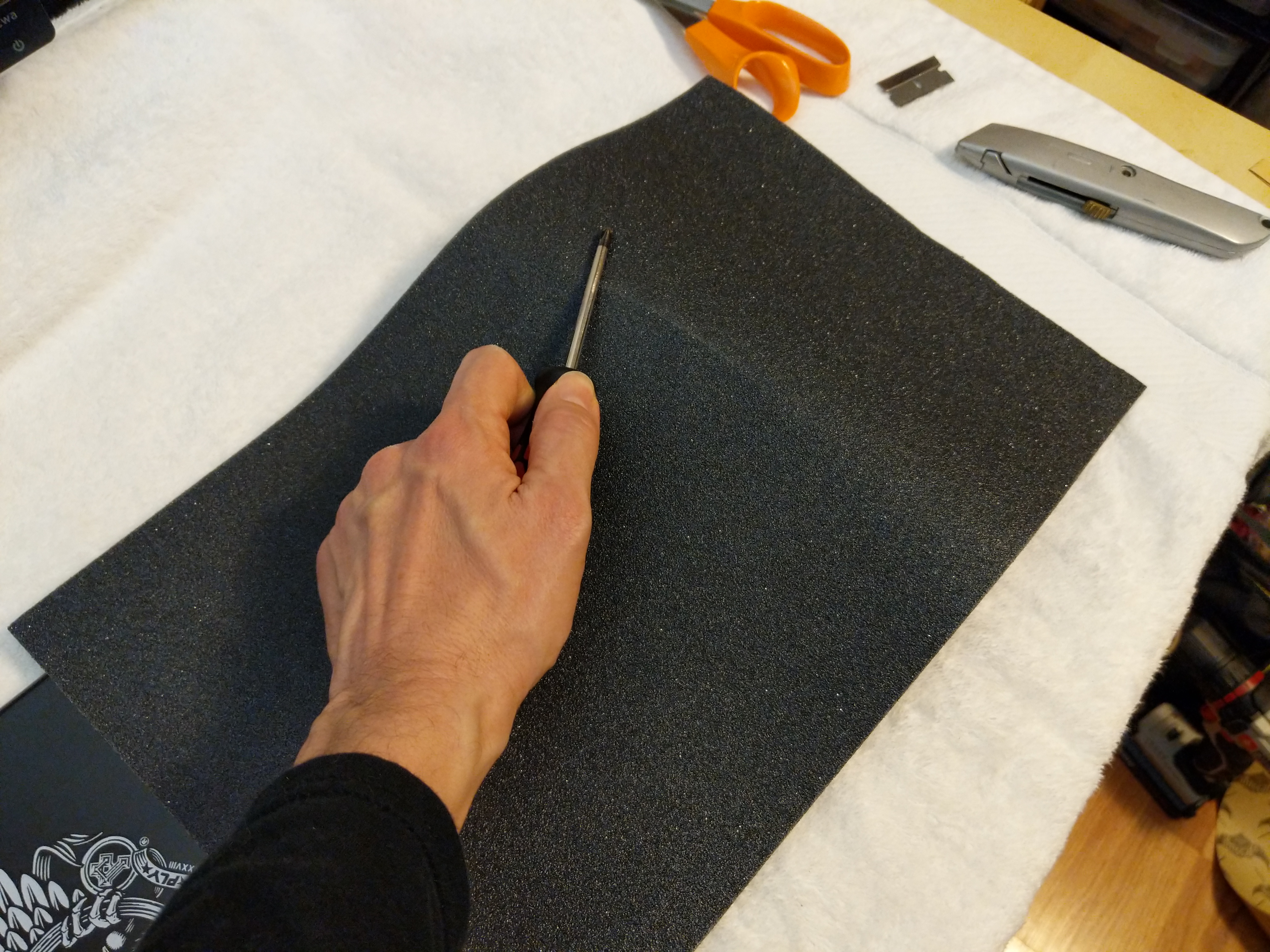
With the tape applied, I used the barrel’s edge of a screw driver to draw a scoring line around the edge of the skateboard deck.
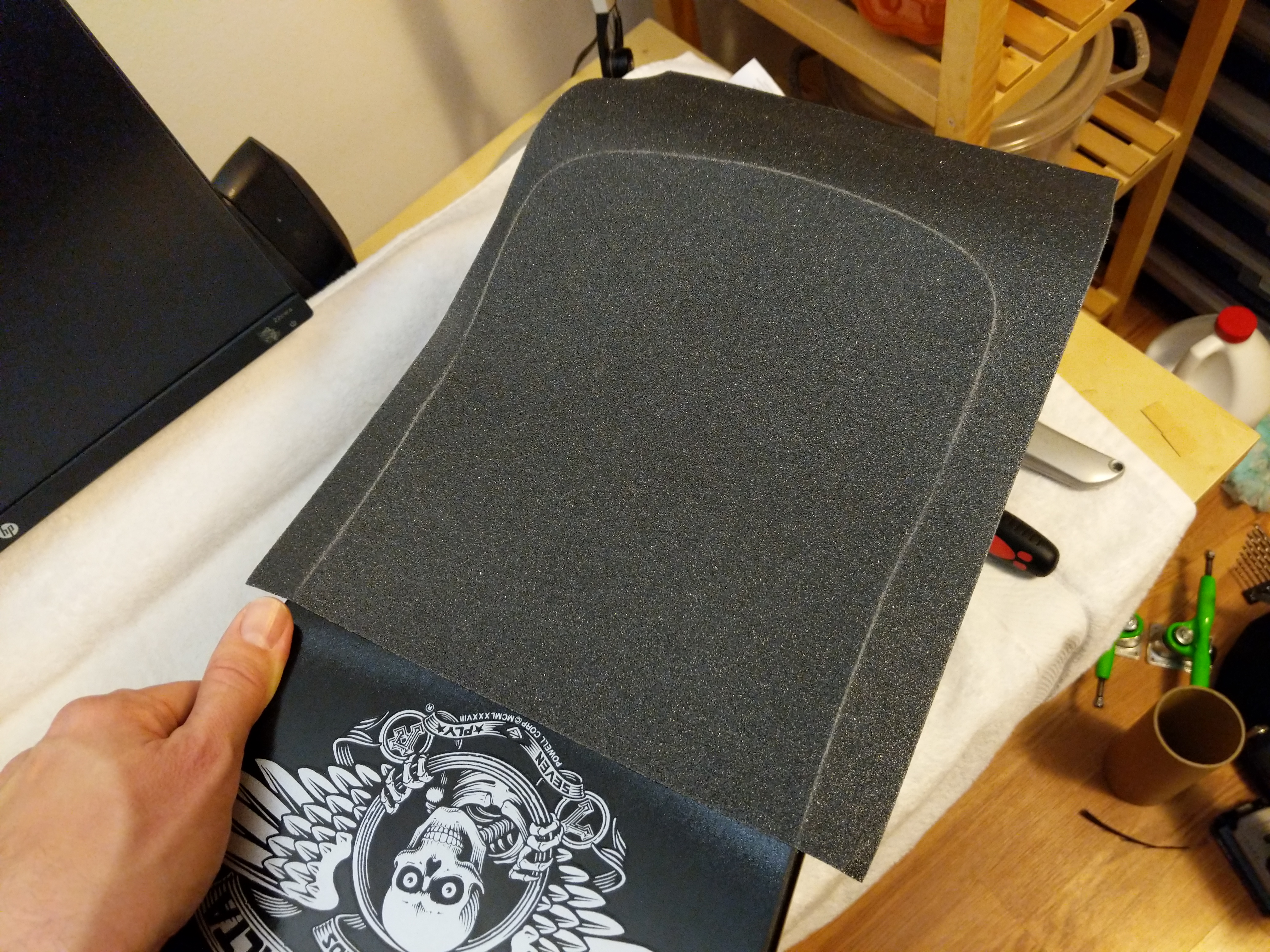
Then, I used a razor blade held from underneath the board to follow the edge of the board and cut the excess grip tape off along the scoring line.
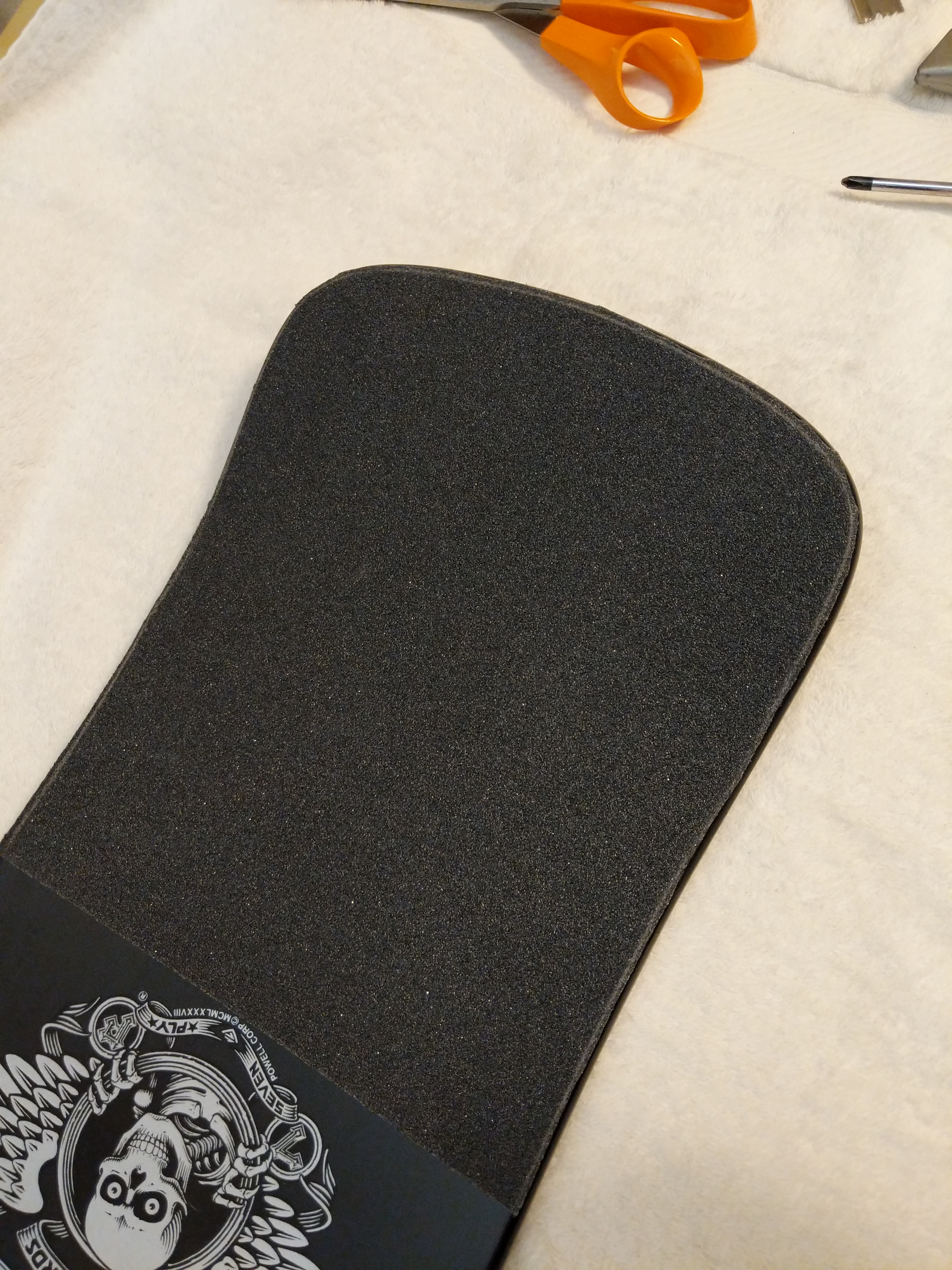
Next, I pressed the grip tape down around the edges of the deck.
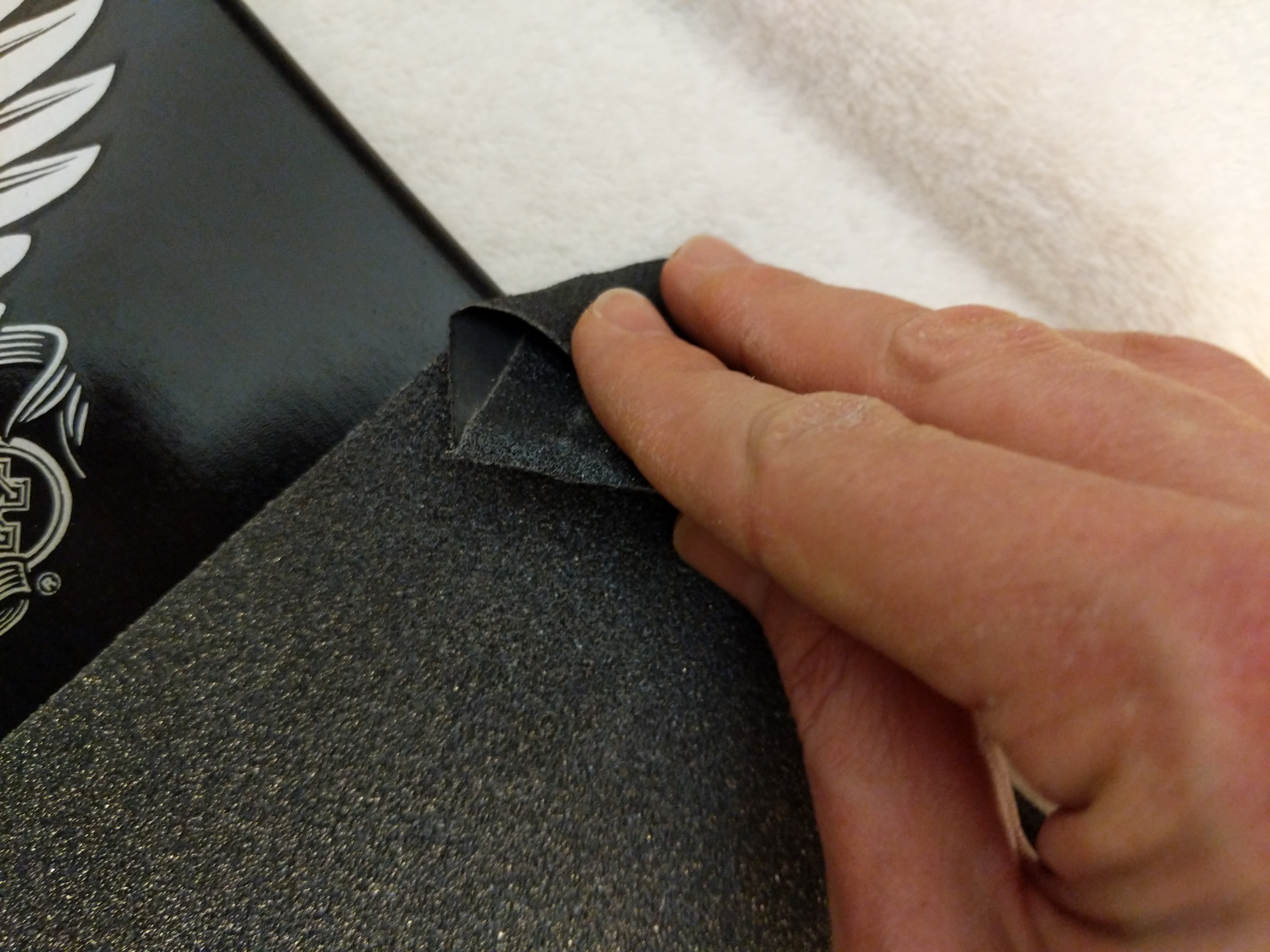
I ran a rolled up piece of excess grip tape around the edge of the deck to give the grip tape a clean edge all away around.
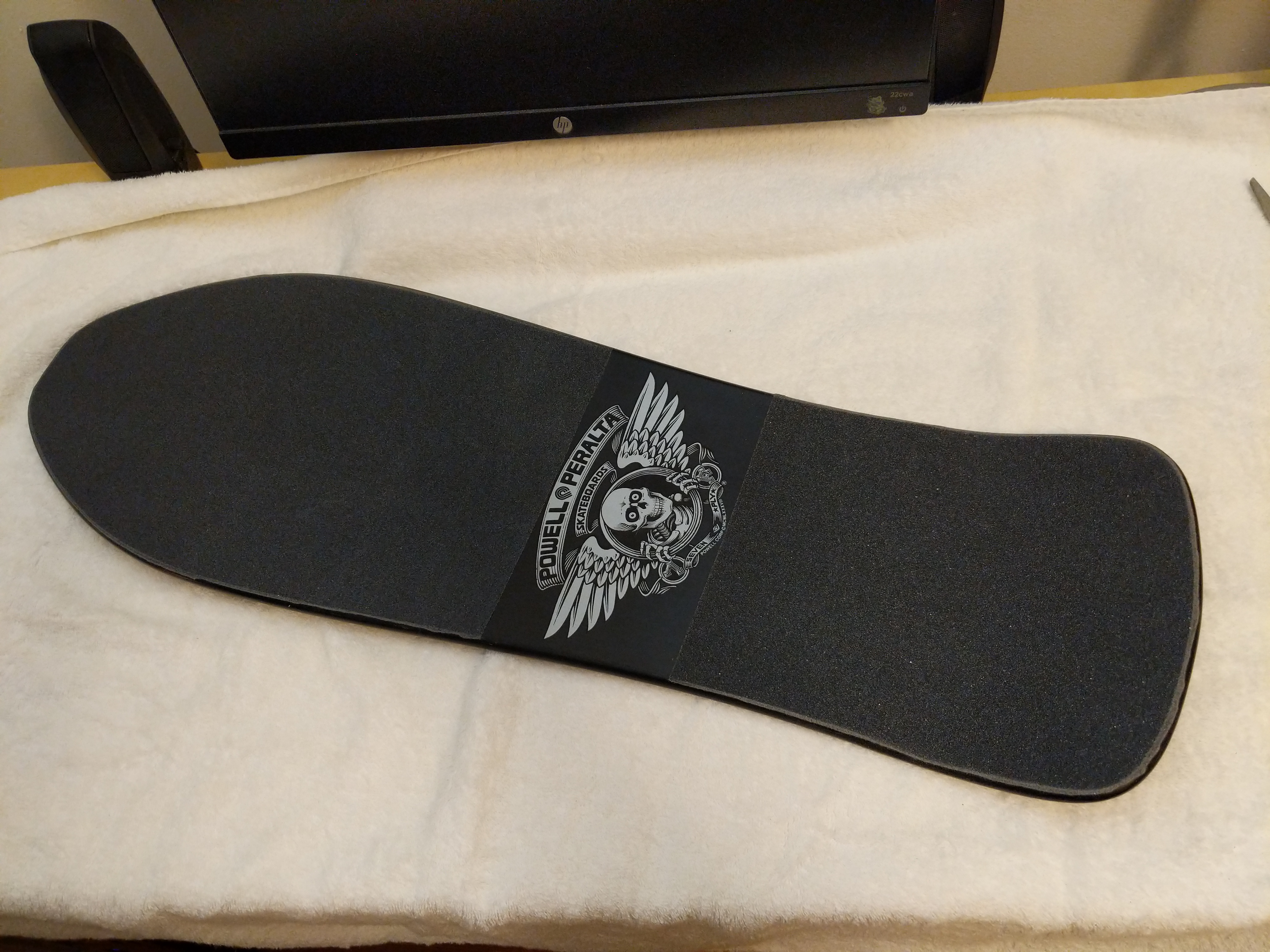
With the grip tape applied, I used a screw driver to punch through all of the holes in the deck for the trucks and Tailbone.
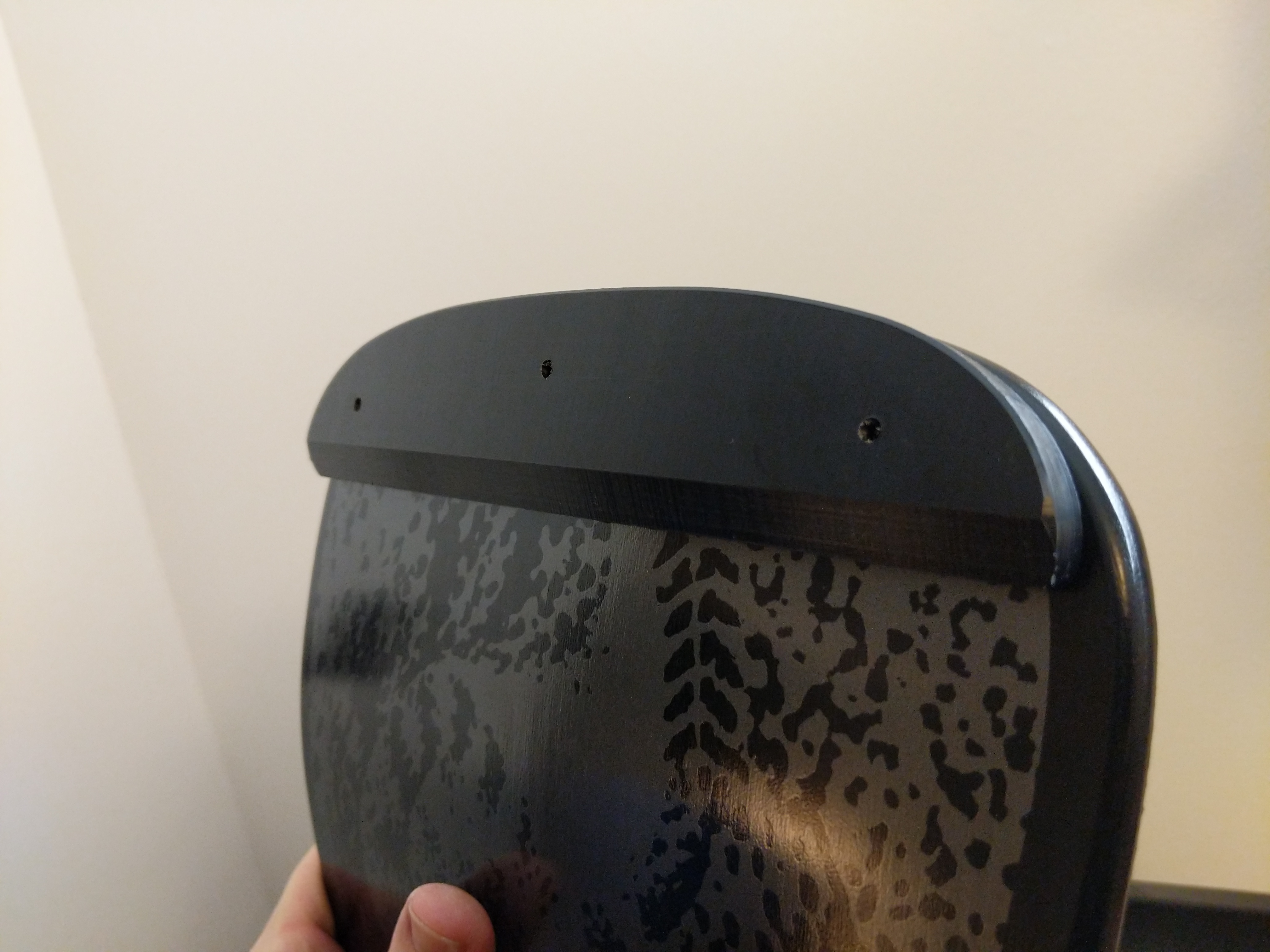
Next, I installed the tailbone by pushing through wood screws and matching them to the holes in the Tailbone.
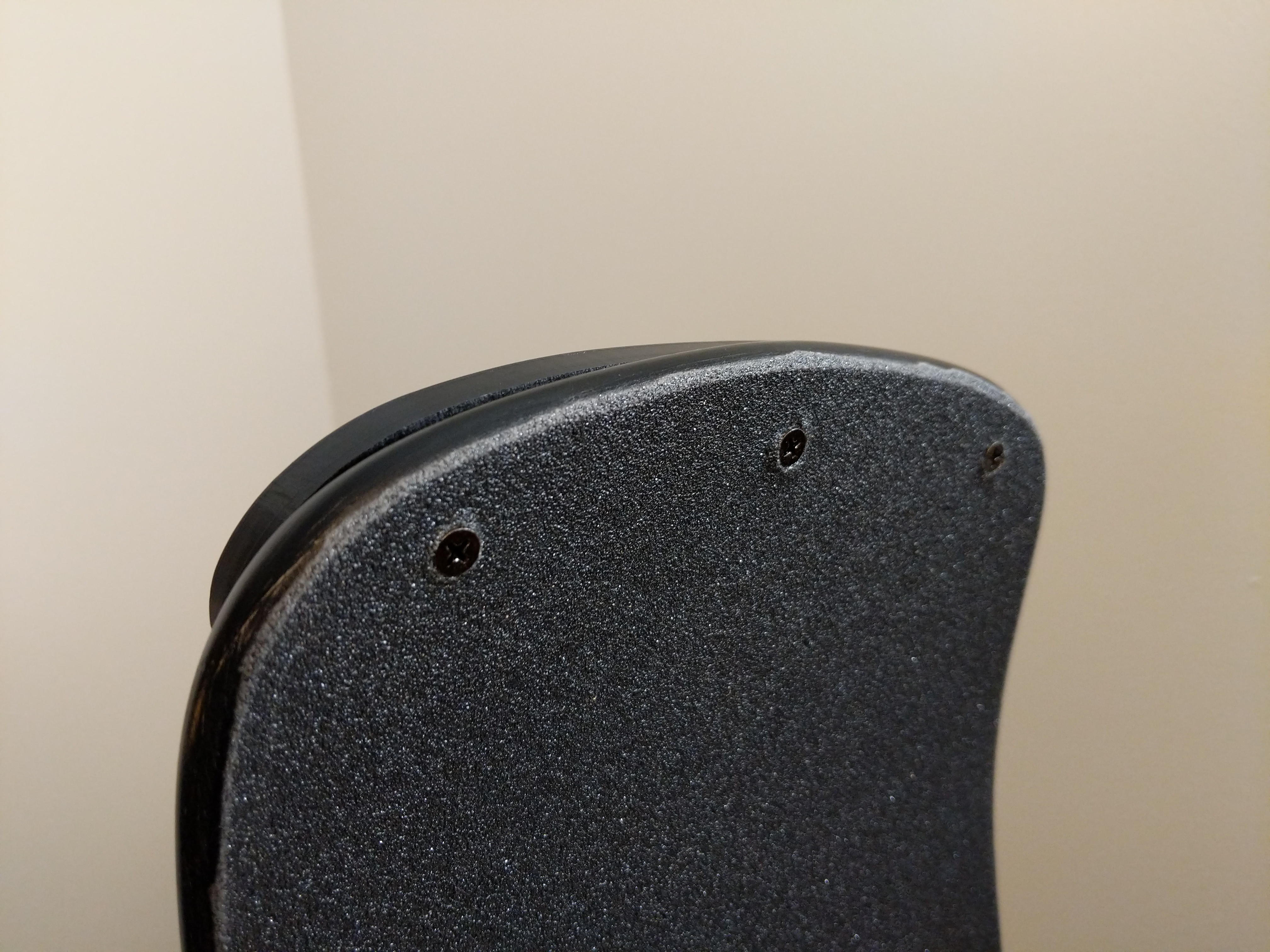
While I had a cordless drill on-hand, I preferred to install these screws by hand. I was afraid of over torquing the screws and losing grip in the Tailbone’s plastic. Installing the screws by hand allows me to feel them dig into the plastic and maintain a secure hold on the Tailbone through the deck without stripping out plastic.
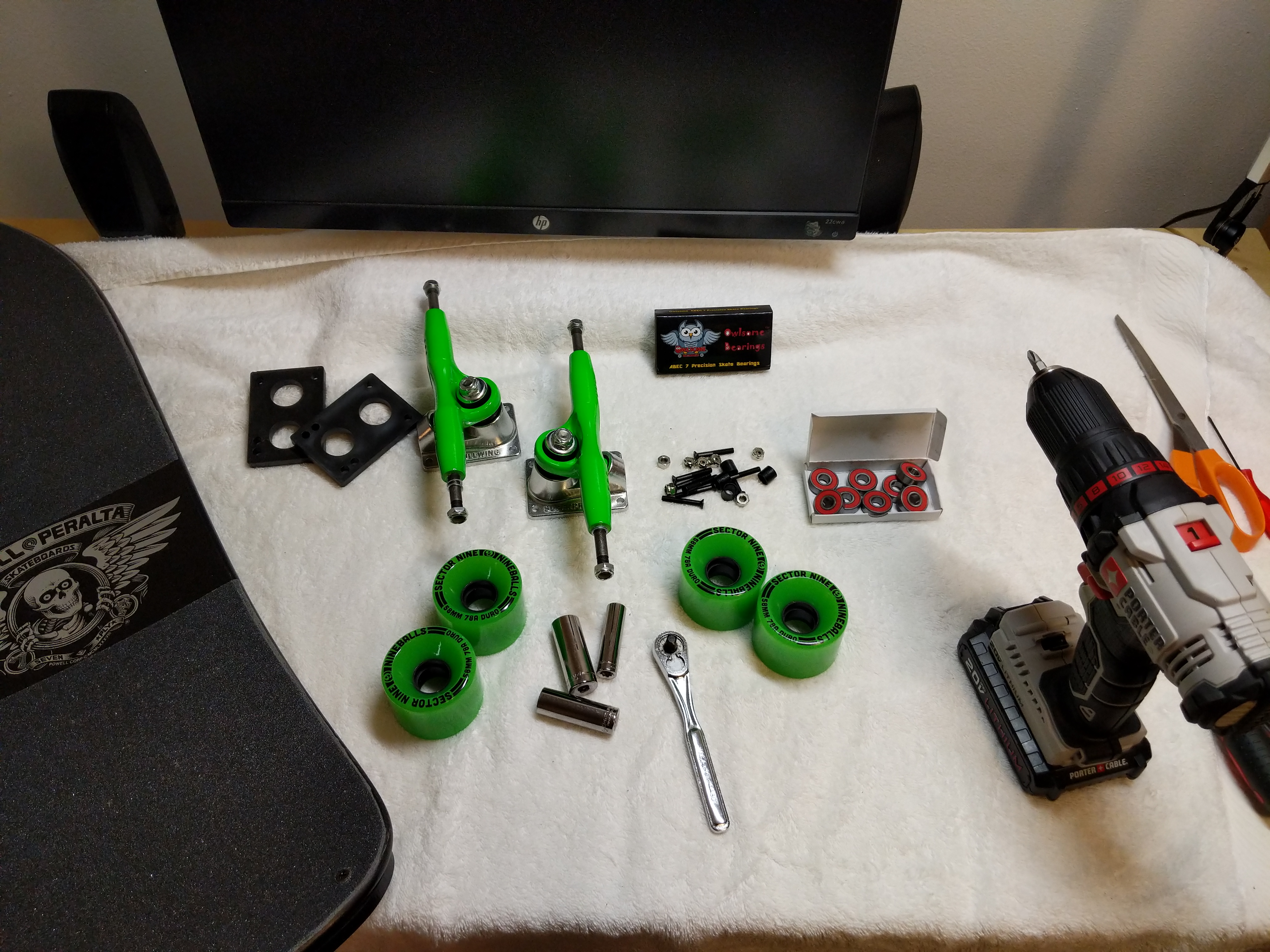
The final stage of the assembly involves the trucks, wheels, bearings, and 1/4″ risers. I laid all of these parts out to make the assembly quicker. For some of the assembly, I used the cordless drill with a Philips head driver, and I had my 1/4″ drive tall sockets in 3/8″ (for the truck mounting bolts) and 1/2″ (for the truck’s axle bolts).
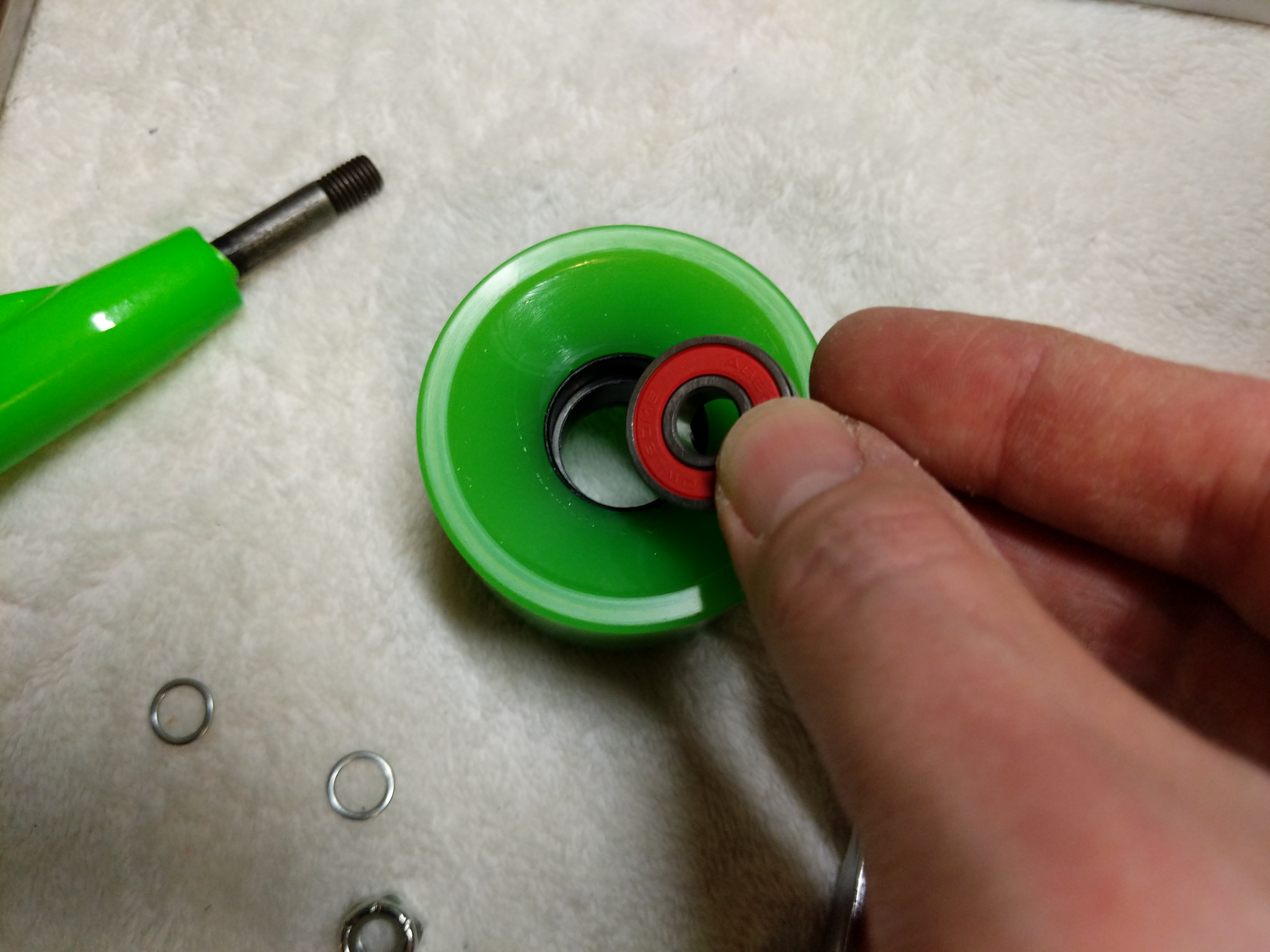
The first task was to install bearings and spacers in each wheel. I placed an Owlsome Precision ABEC 7 bearing assembly into the back of a wheel.
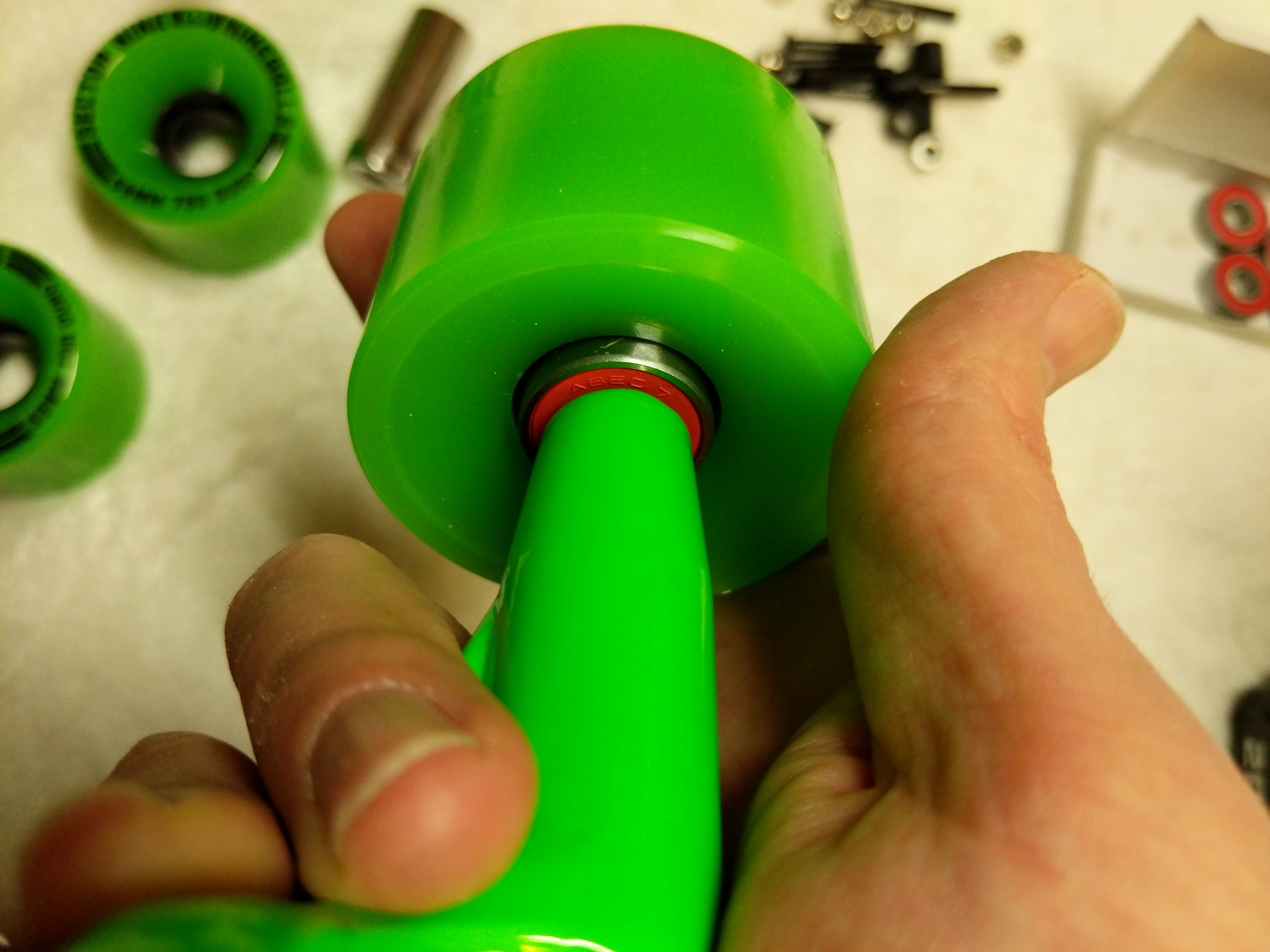
Then, I used one of the trucks to help me press the bearing completely into the wheel so that it is flush with the wheel.
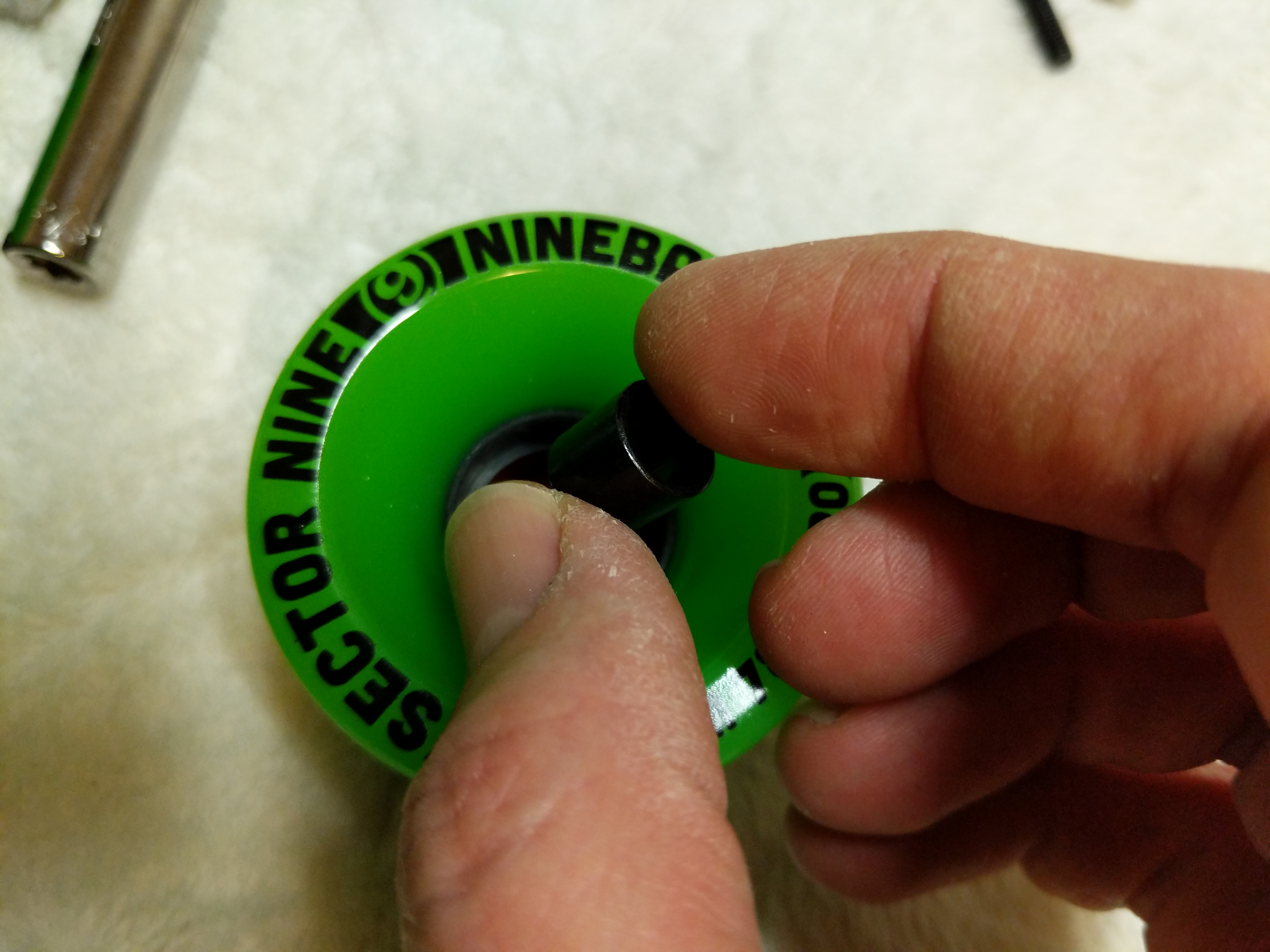
Turning the wheel over, I dropped a spacer on top of the inserted bearing.
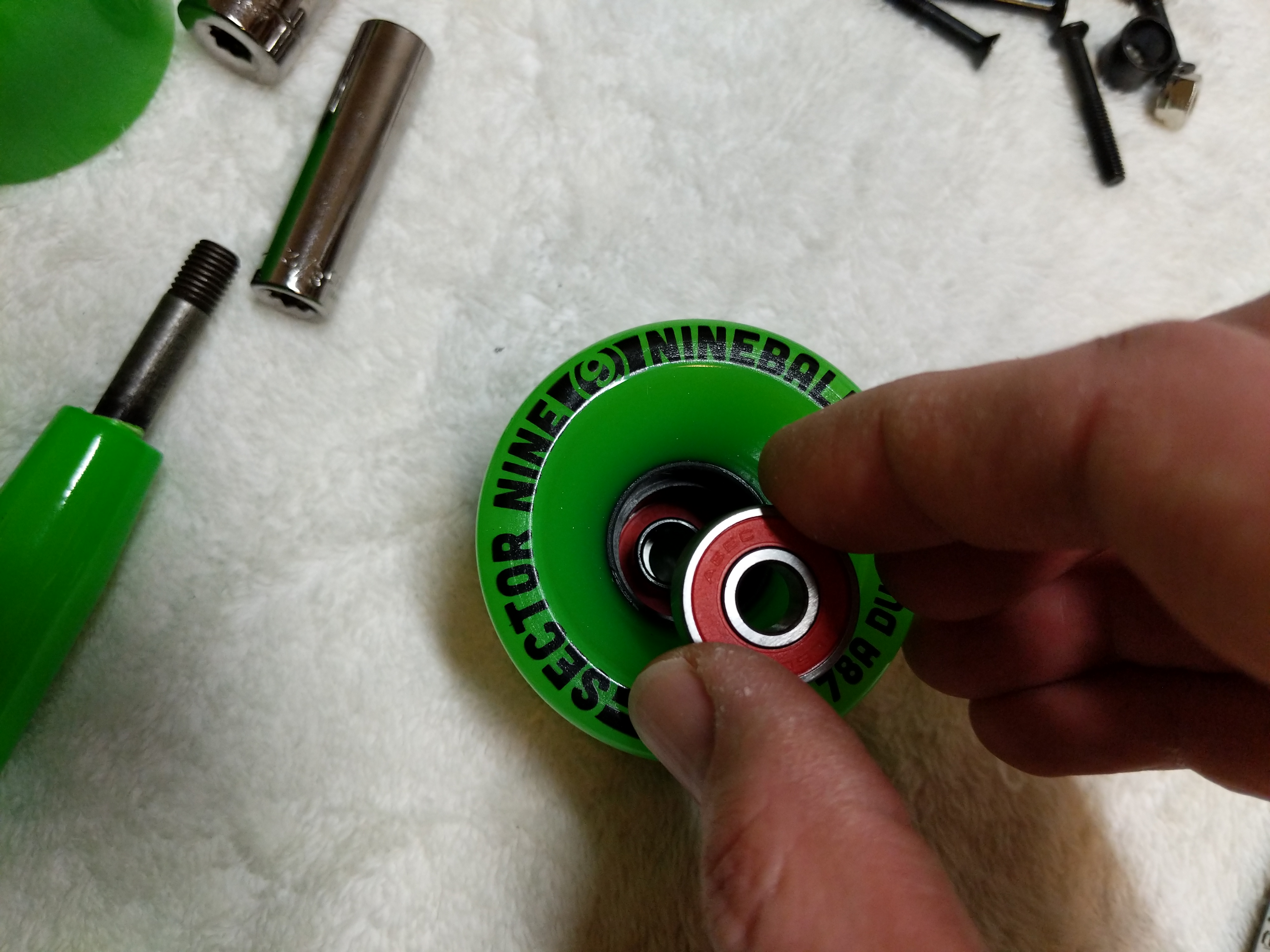
Then, I placed another bearing into the front of the front of the wheel over the spacer, and again, used the trucks to help me press the bearing assembly completely into the wheel.
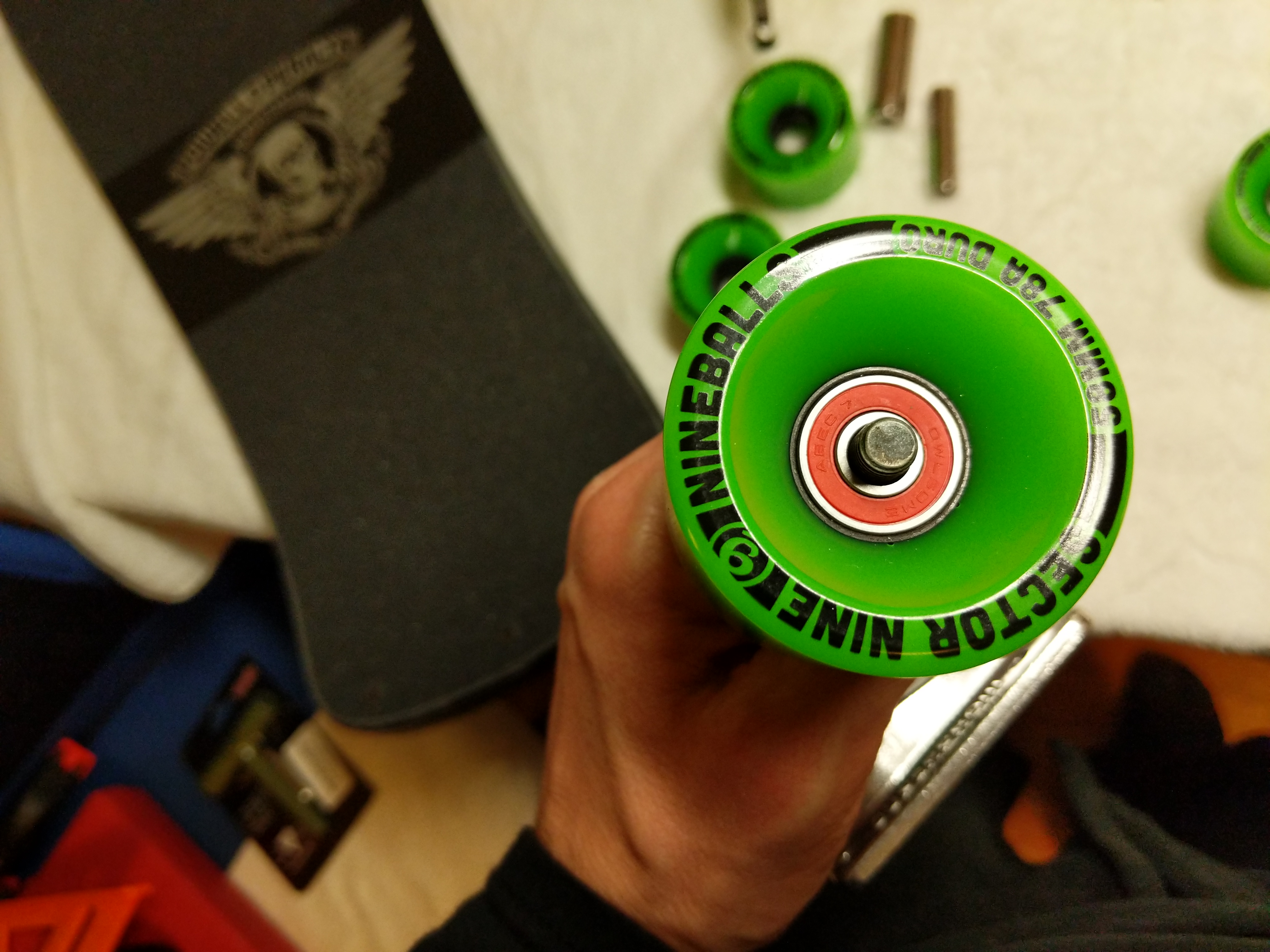
Then, I pulled the wheel off, placed a washer on the axle, followed by the wheel with the front facing outward, another washer, and then the axle nut. I tightened the axle nut by hand with the 1/2″ socket. I left a very slight bit of play for the wheel on the axle.
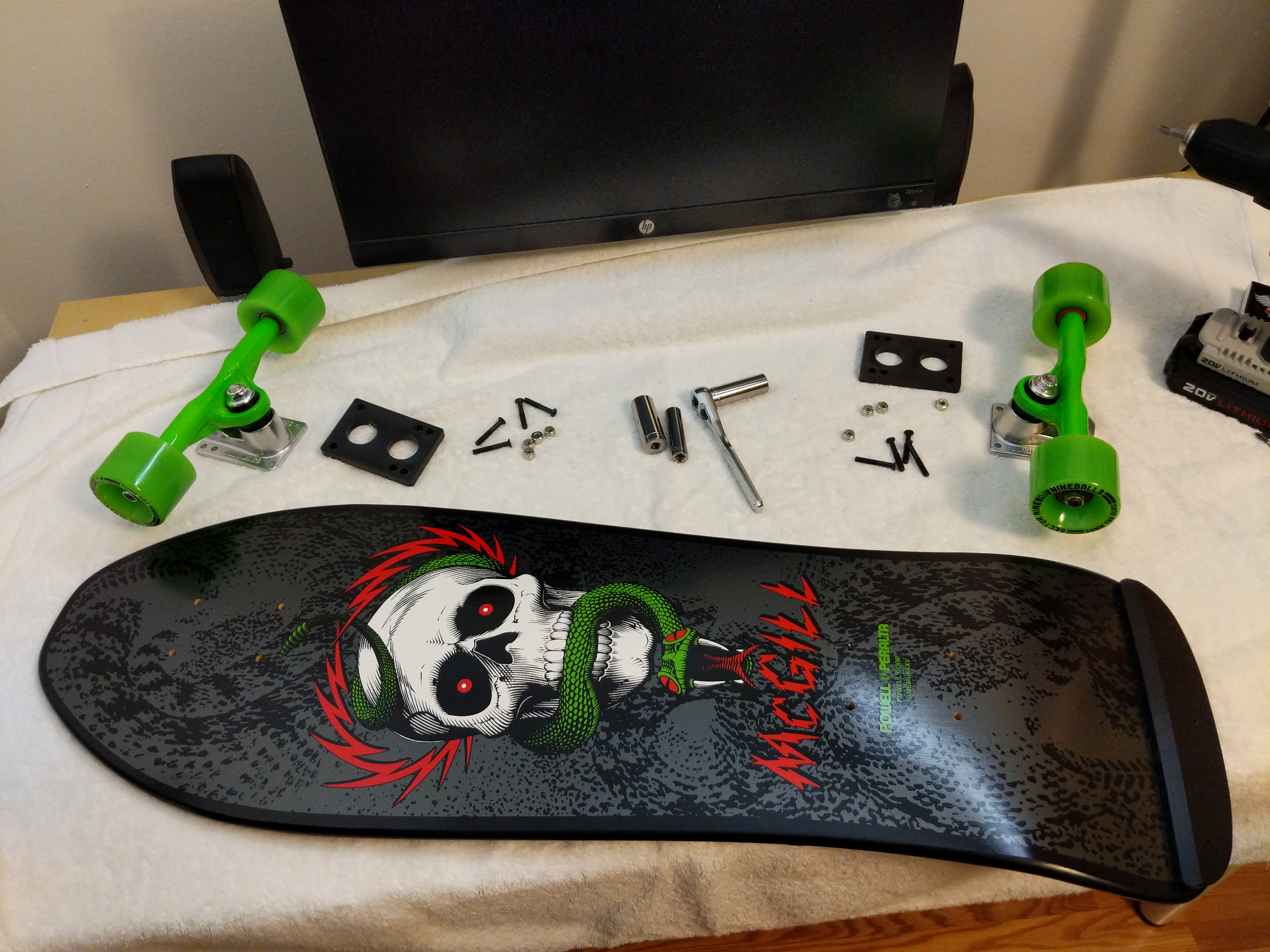
With all of the wheels assembled with bearings and spacers and these installed on the trucks, I was ready to complete assembly of the skateboard by mounting the risers and trucks to the skateboard deck.
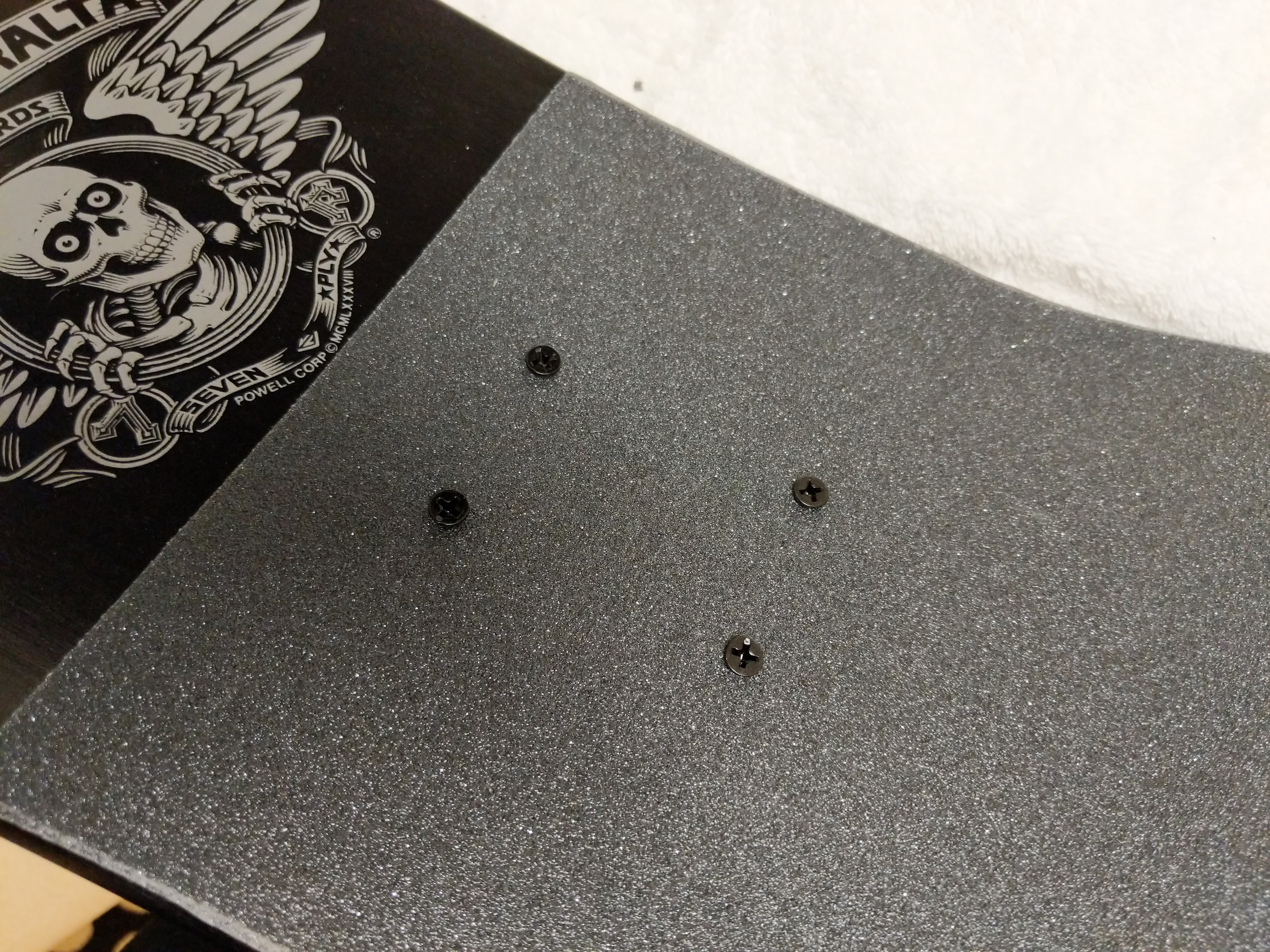
First, I pushed the 1 1/4″ truck mounting bolts through the skateboard deck.
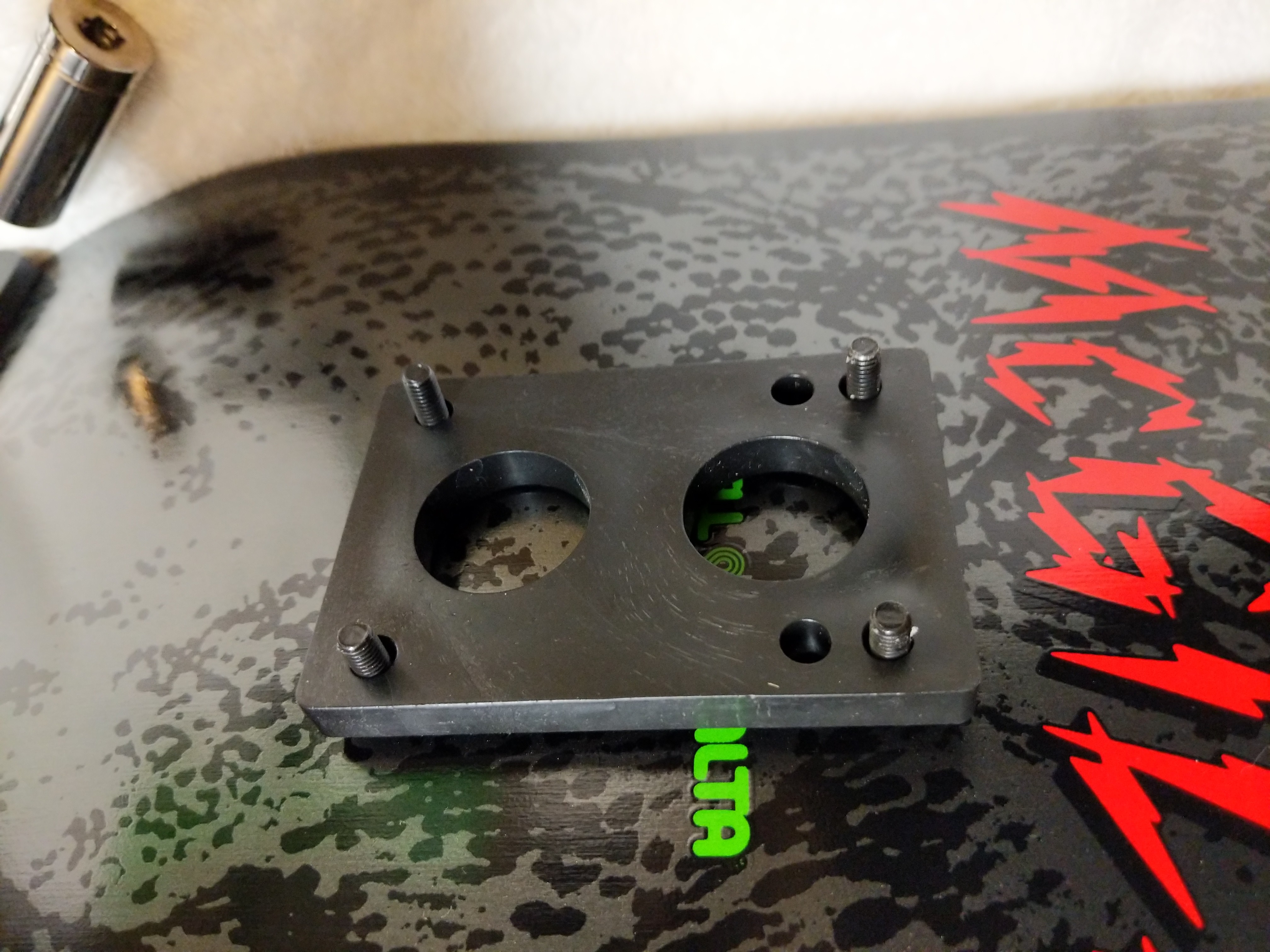
Then, I mounted the 1/4″ riser through the bolts on the underside of the skateboard deck.
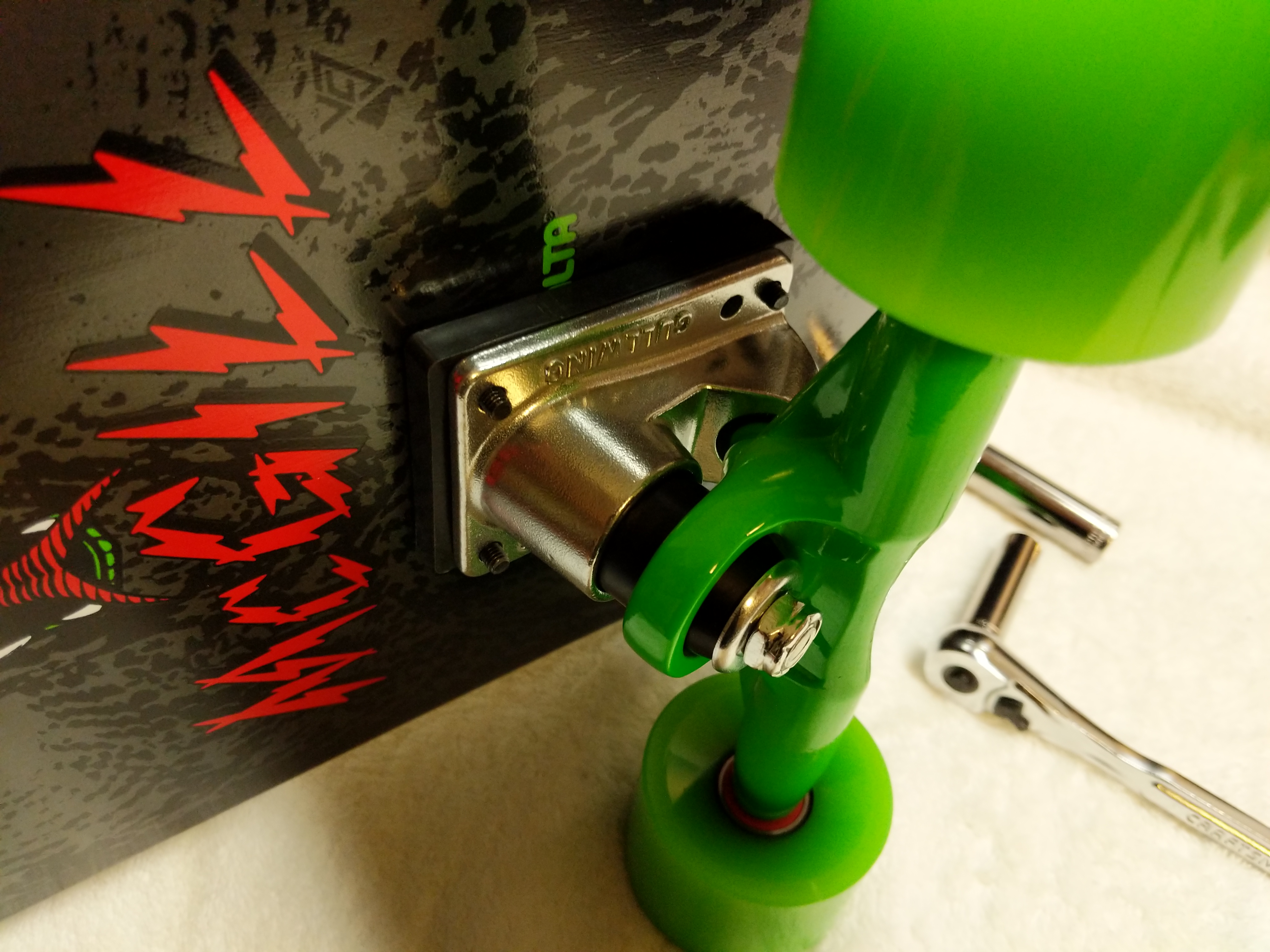
Next, I turned the skateboard on its side and mounted the trucks.
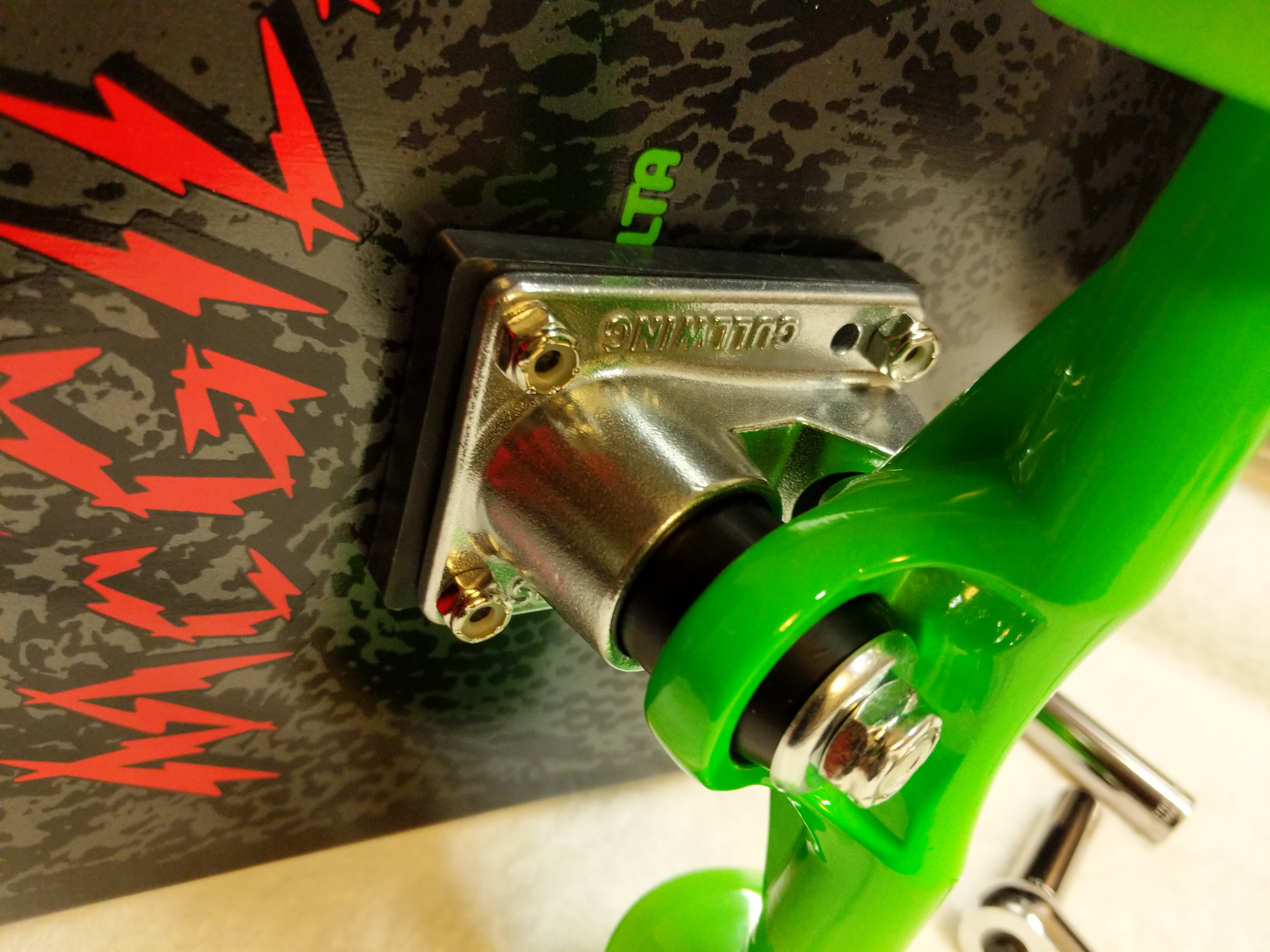
I hand threaded the four hardware nuts on each mounting bolt for each truck.
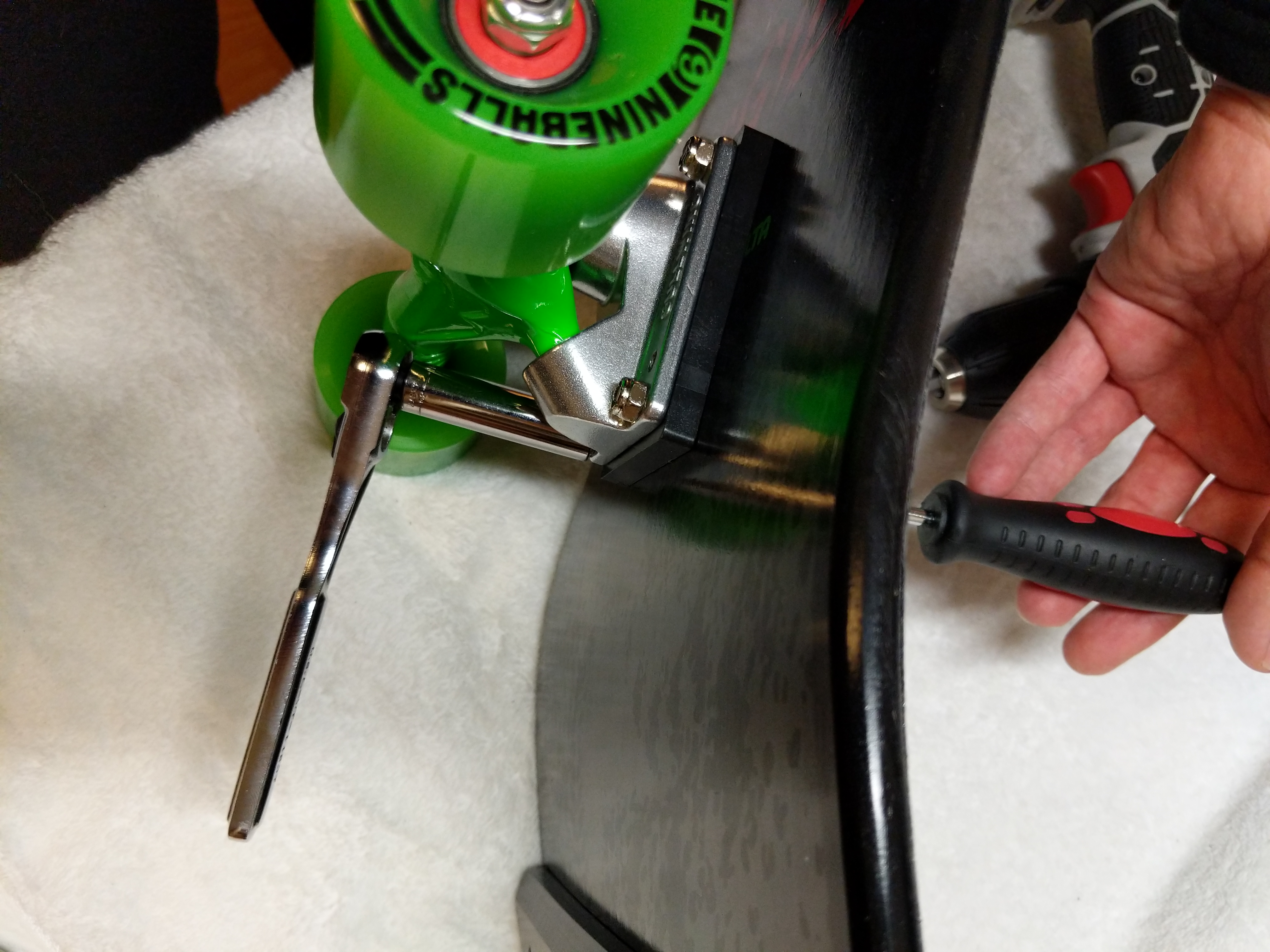
After confirming each nut was threaded correctly, I used the cordless drill to snug each bolt down to the nut and then hand tightened each bolt in an X-pattern until I was confident in each truck’s mounting to the skateboard deck.
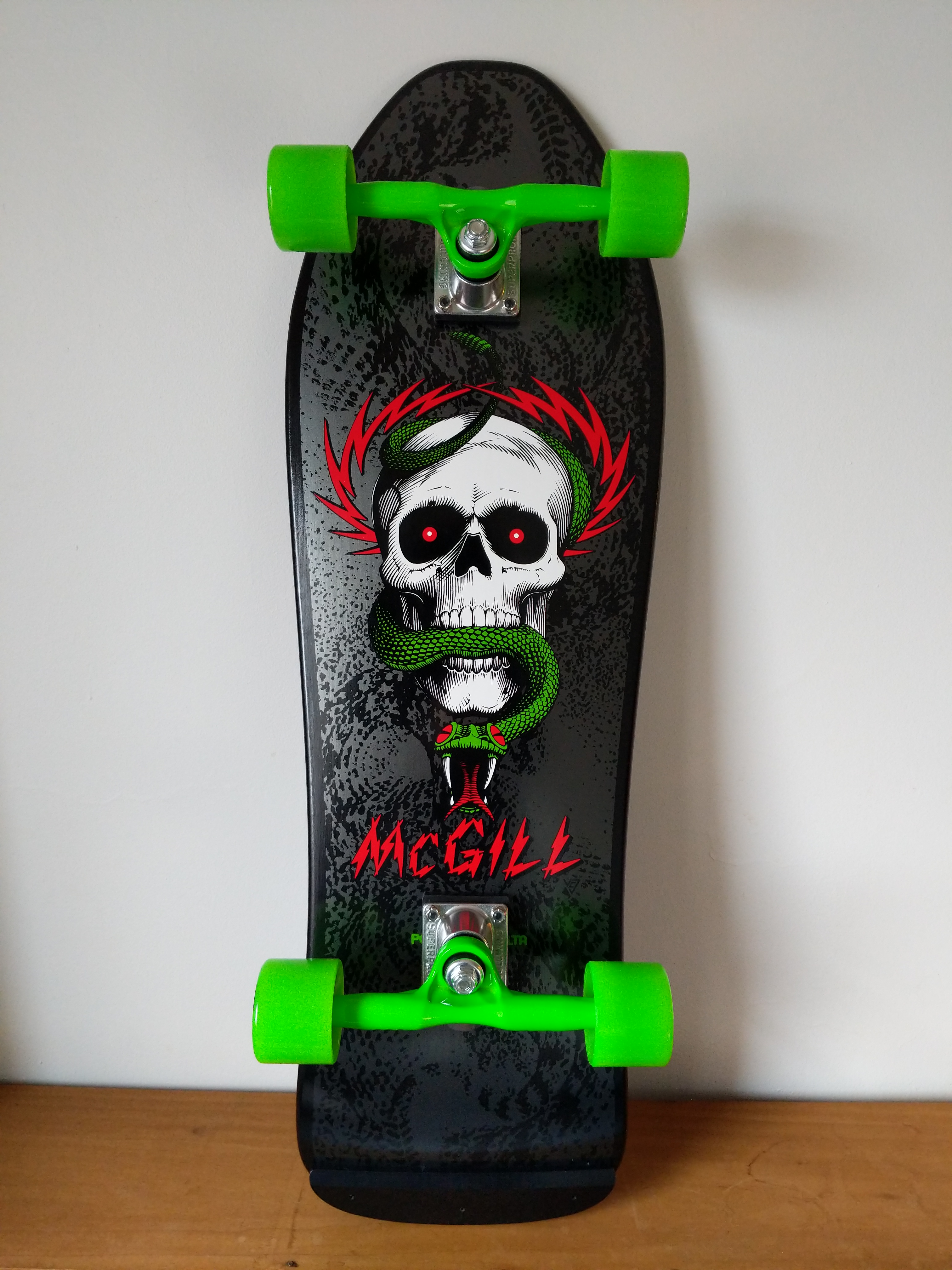
With the trucks mounted, I have a complete skateboard ready to take out and hit the streets with. The soft, larger wheels should be great for riding in my neighborhood. However, I have been looking at Powell-Peralta’s G-Slides, which I might get later.
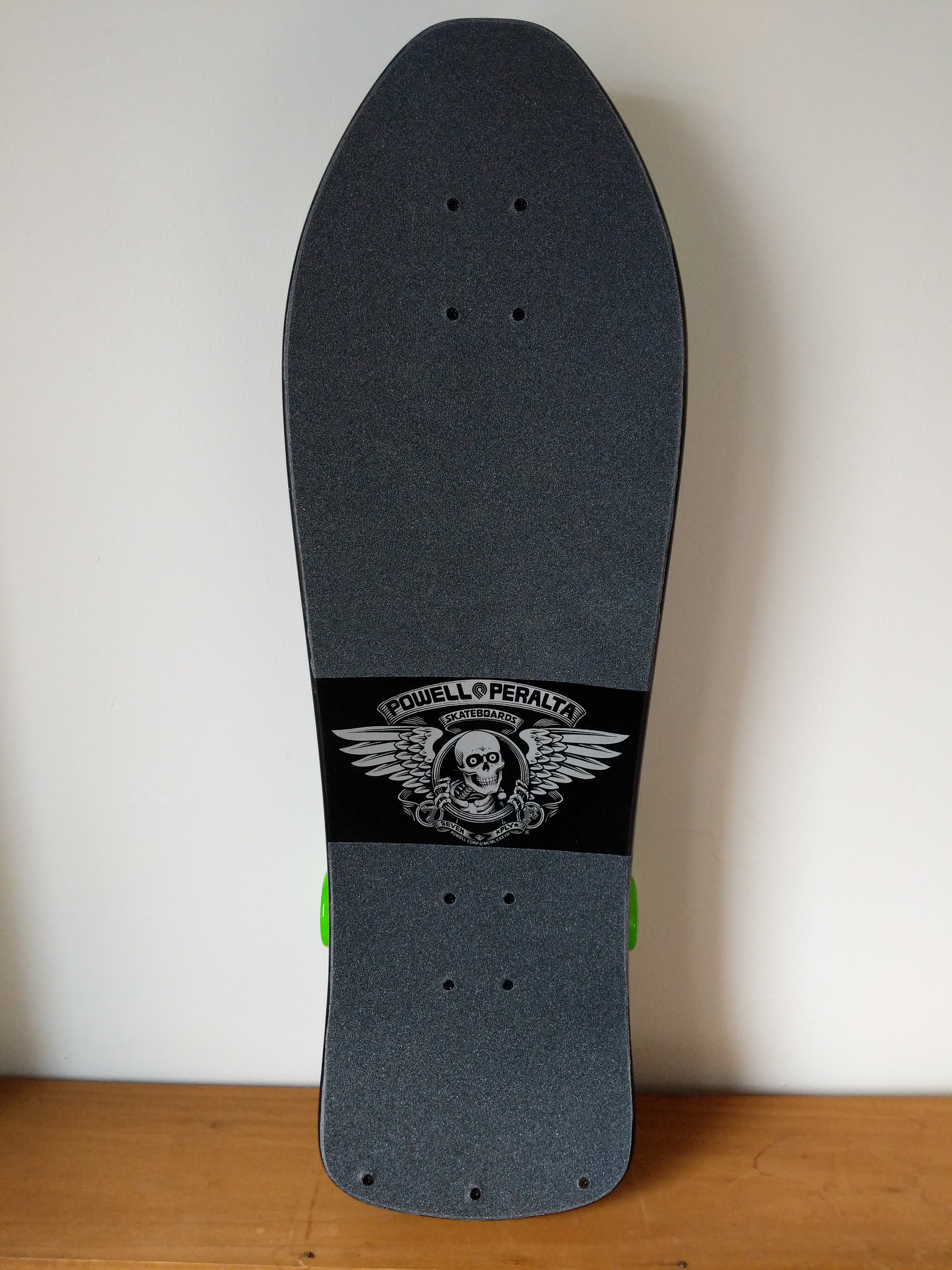
I opted to cover the “Bones Brigade” name beneath the logo, because I wanted a little more grip on the tail section of the deck.
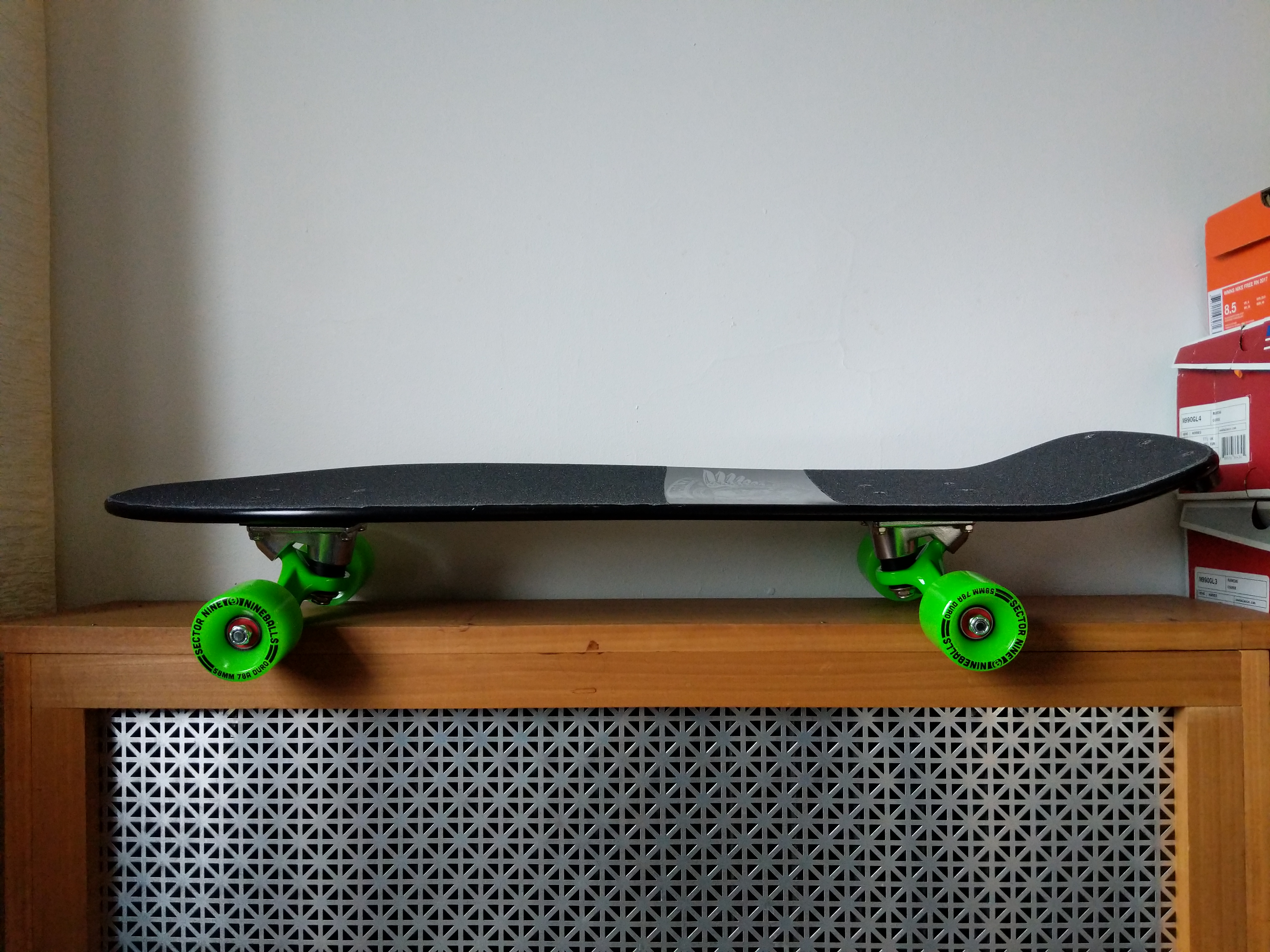
My original McGill had a nose kick while this late-80s re-issue does not. Nevertheless, I think this will be a fun skateboard to ride. Y asked me to wait until she returned from her trip to see her parents before I rode it in case I hurt myself. She’s back, but the weather isn’t superb, so I might content myself with daydreaming about riding my new skateboard until we can take it out together.
In all honesty, I have to remind myself that I can’t necessarily do the things I did when I was younger, or put another way, I can try to do the things that I used to do, but there will likely be more serious consequences. C’est la vie!
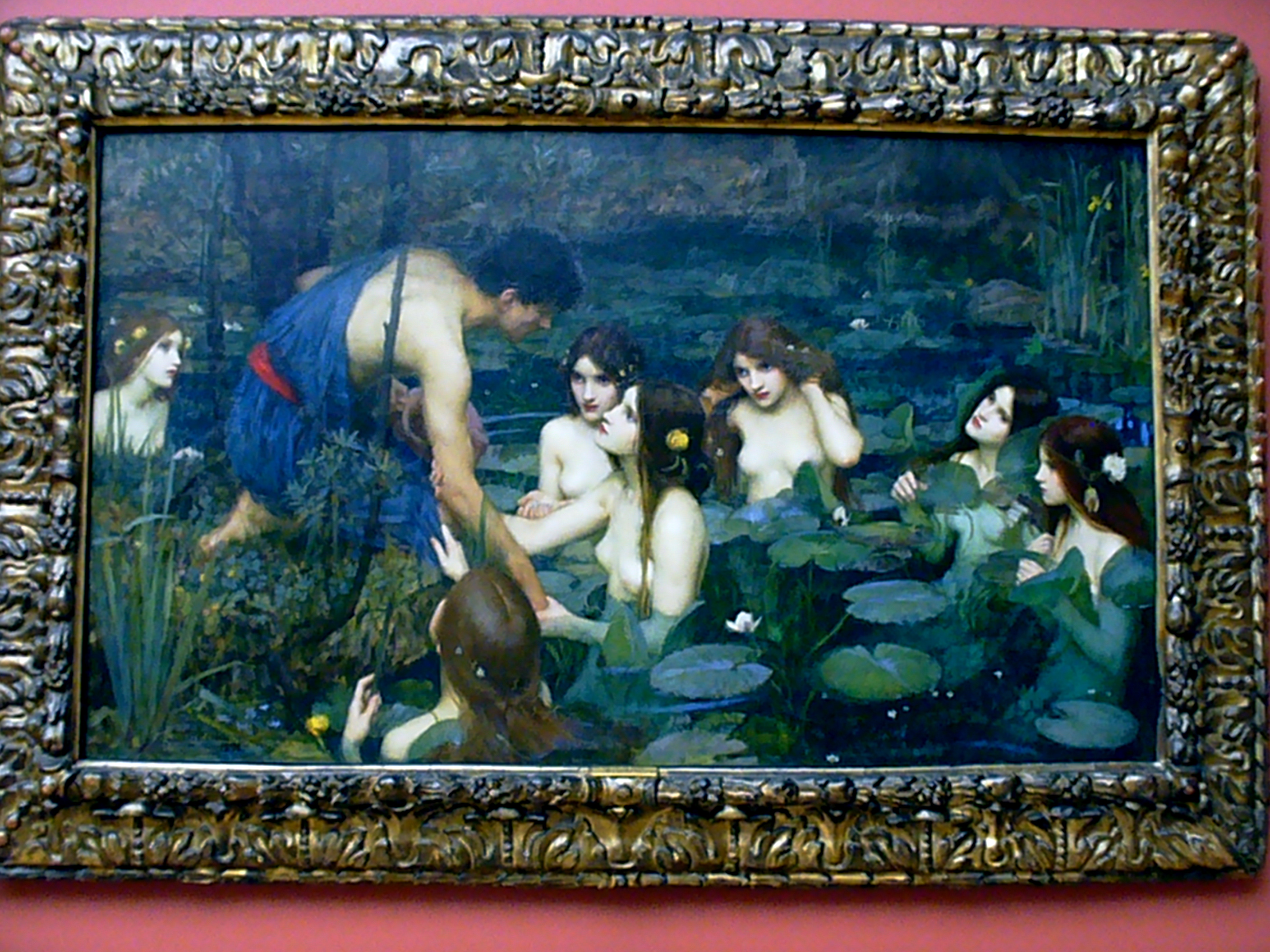
As reported on the Manchester Evening News, BBC, Guardian, and ABC, the Manchester Art Gallery removed John William Waterhouse’s Hylas and the Nymphs with the stated intent that its removal (a supposed artistic act itself) would encourage discussion about how to display such art in the future. Instead, the removal of Waterhouse’s painting seems at best ham-fisted and at worst censorship. While I wholeheartedly agree with artistic criticism and contextualization, the removal of artwork deemed in need of recontextualization is wrongheaded. While Hylas and the Nymphs is well known and available in print and online, the original work itself should remain in place while inviting feedback from its varied audiences and critics. The Manchester Art Gallery’s approach places the work of art in the dark and out of reach for any such debate.
Considering this drastic step by the Manchester Art Gallery, I feel extremely lucky to have seen Waterhouse’s Hylas and the Nymphs on a visit to the gallery in 2006 while I was a graduate student at the University of Liverpool. It was during that visit that I took the photo included above. A higher resolution image of the painting is available on the Wikimedia Commons here.

